
Judge, 1931-08-01 · page 15 of 36
Judge — August 1, 1931 — page 15: what you’re looking at
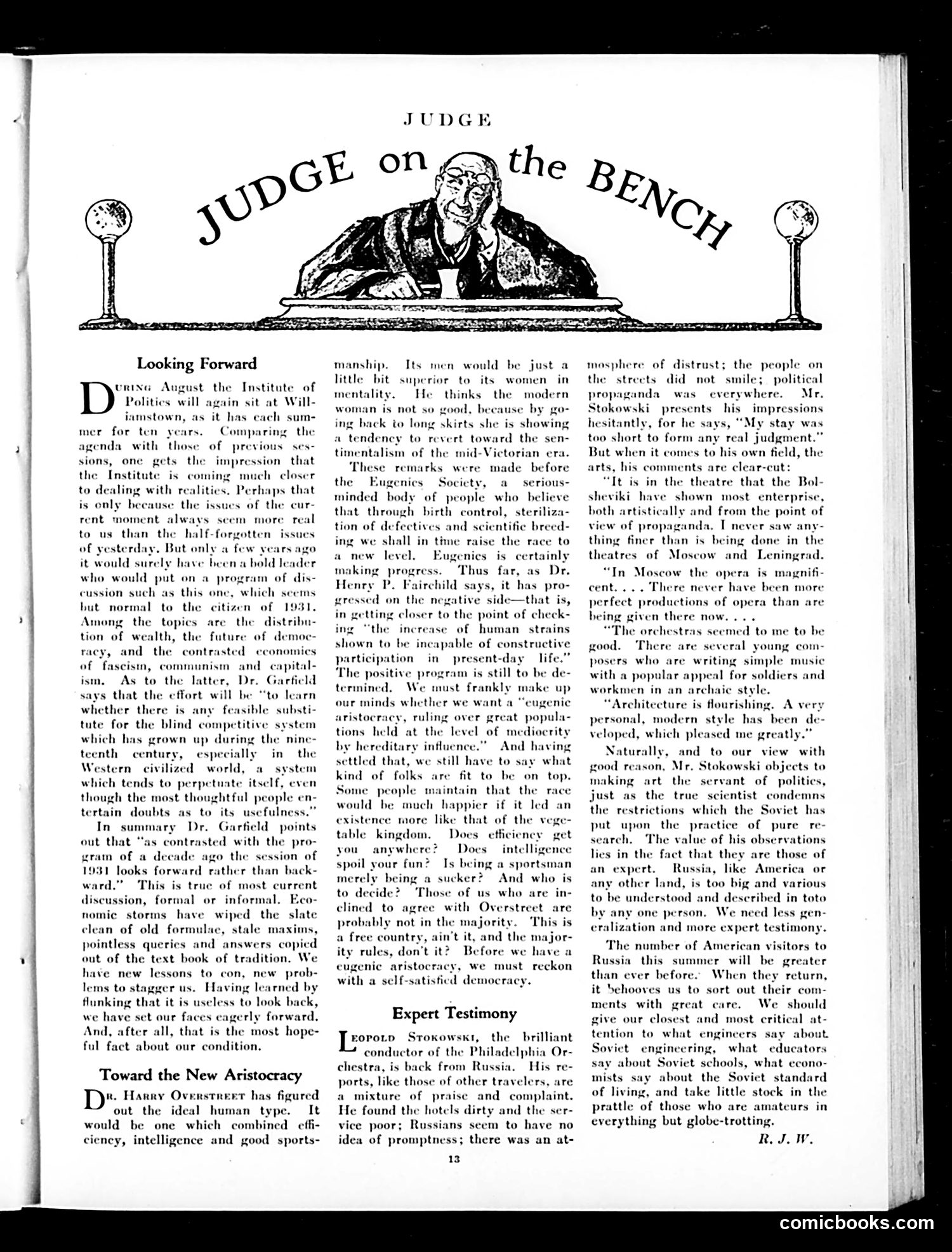
A restored page from Judge, 1931-08-01. Page through the whole issue in the reader above.
📄 Transcribed text from this page (OCR, searchable)
Machine-transcribed from the original scan — historical spelling and the odd misread are preserved.
Looking Forward urine August the Institute of Politics will again sit at Will- iamstown, as it has each sum- mer for ten years. Comparing the agenda with those of previous ses- sions, one gets the impression that the Institute is coming much closer to dealing with realities. Perhaps that is only because the issues of the cur- rent moment to us than t half-forgotten issues of yesterday. But only a few years ago it would sure ly have been a bold leader who would put on a program of dis- ulways seem more real cussion such as this one. but normal to the citizen of If Among the topics are the distribu- tion of wealth, the future of demoe- racy, and the contrasted econ of fascism, communism and ¢: ism. As to the latter, Dr. says that the effort will be whether there is any tute for the blind competitive which has grown up during the nine- teenth century, especially in the Western civilized world, a system which tends to perpetuate itself, even though the most thoughtful people tertain doubts which as to its usefulness.” In summary Dr. Garfield points out that “as contrasted with the pro- gram of a deeade ago the session of 1931 looks forward rather t ward.” This is true of most current discussion, formal or informal. FE nomic storms have wiped the s clean of old formu stale maxims, pointless queries and answers copied out of the text book of tradition. We have new lessons to con, new prob- lems to stagger us. Having learned flunking that it is useless to look we have set our faces eagerly forward. And, after all, that is the most hope- ful fact about our condition. Toward the New Aristocracy n. Harry Overstreet has figured out the ideal human ne. Tt would be one which combined effi- ciency, intelligence and good sports- JUDGE manship. Its men would be just a little bit superior to its women in mentality. He thinks the modern woman is not so good, because by go- back to long skirts she is showing tendency to revert toward the sen- ntalism of the mid-Victorian era. These remarks were before the Eugenics a serious- minded body of people who believe that through birth control, steriliza- tion of defectives and scientific breed- i we shall in time raise the race to ti made Socie a new level. Eugenics is certainly making progress. ‘Thus far, as Dr. Henry P. Fairchild says don the n rtting closer to the point of check- the incre of human. strains shown to be incapable of constructiv tion in’ present-day lif The positive program is still to be de- termined. We must frankly make up our minds whether we want eugenic aristocracy, ruling over great popula- tions held at the level of me diocrity by hereditary intlue And having settled that, we still have to say what kind of folks are fit to be on top. Some people maintain that the race would be much happier if it led a existence more like that of the ve table kingdom. Does. etficienc you anywhere? — Does Migenc spoil your fun? Is being a sportsman merely t And who is to decide Those of us who are in clined to agree with Overstr 6s ing a sucker? are probably not in the majority. This is a free country, ain't it, and the major- ity rules, don’t it? Before we have a eugenic aristocracy, we must reckon with a self-satistied democrac. Py. Expert Testimony oPoLp SroKxowskt, the bril nductor of the Phila chestra, is back from Russi ports, like those of other tr: a mixture of praise and comp! He found the hotels dirty and the ser- vice poor; Russians seem to have no idea of promptness; there was an at- 13 mosphere of distrust; the people on the streets did not smile; political propaganda was everywhere. Mr. < presents his impressi hesitantly, for he says, “My stay w: too short to form any real judgment But when it comes to his own field, the arts, his comments are clear-cut: “It is in the theatre that the Bol- sheviki have shown most enterprise, both artistically and from the point of view of propaganda, T never saw any- thing finer than is being done in the theatres of Moscow and Leningrad. “In Moscow the cent. ... There n perfect productions of ope being given there now... . “The orchestras seemed to me to be good. There posers who with a popula okowski is magnifi- been more a than are re several young com- re writing simple music appeal for soldiers and workmen in an archaic style. rchitecture is flourishing. A ver personal, modern style has be veloped, which pleased me grea Naturally, with good reason, Mr. Stokowski objects to and to our view making art the servant of politics, just as the true. scientist the restrictions which the put upon the prac! search, The value lies in the fact that they an expert. Russia, like any other land, is too big y to be understood and described in toto by any one person. We need less gen- cralization and more expert testimony. condemns Soviet has re- ions The number of American visitors to Russia this summer will be greater than ever before. When they return, t behooves us to sort out their com- ments with great care. We should give our closest and most critical at- tention to what engineers say about. Soviet ‘ing, what educators about Soviet schools, what econo- mists say about the So’ of living, and take little prattle of those who are amateurs in everything but globe-trotting. RILW. engine comicbooks.com