A complete issue · 36 pages · 1931
Judge — March 21, 1931
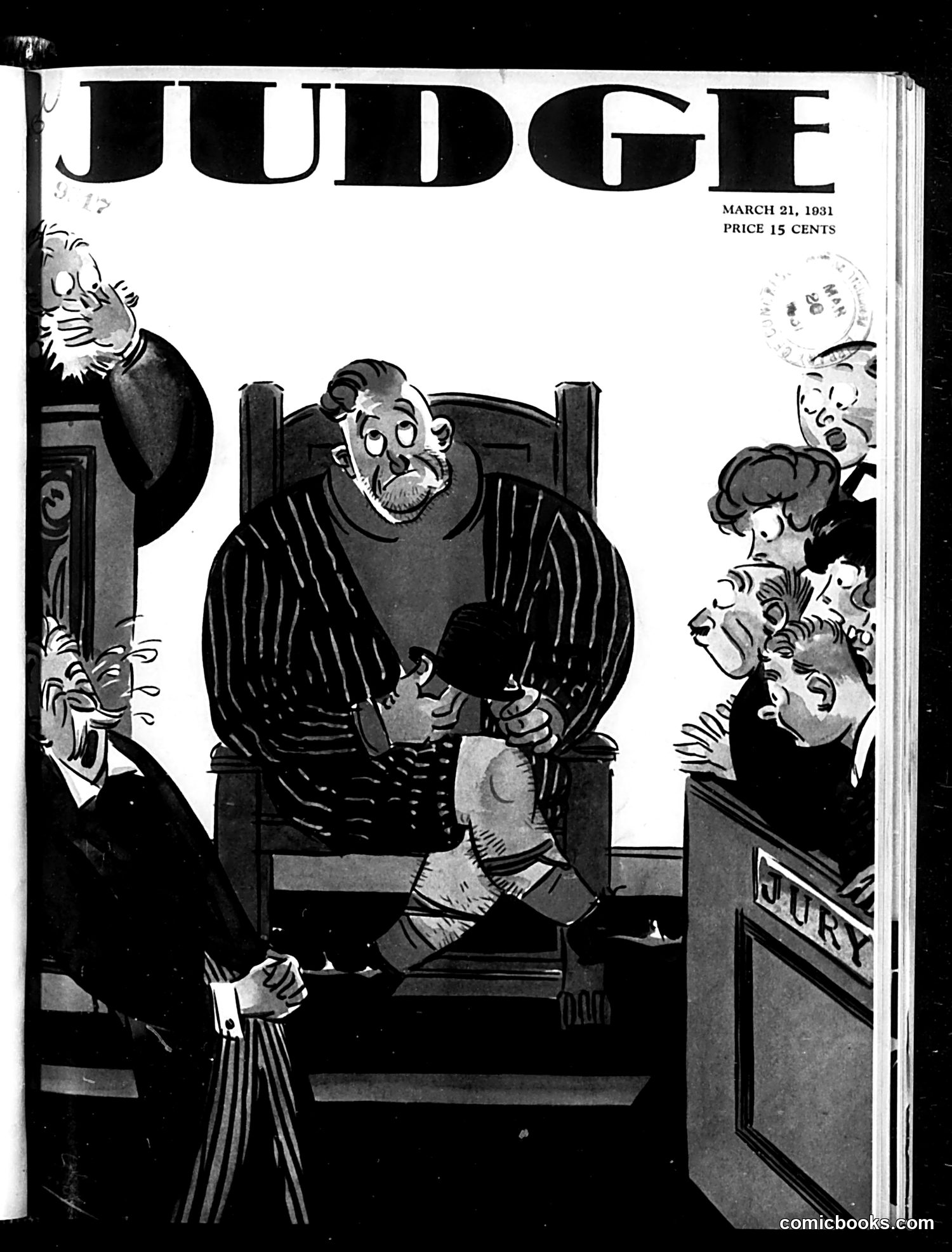
# Judge Magazine Cover - March 21, 1931 This satirical cover depicts a courtroom scene centered on a distressed man seated in what appears to be a judge's chair or witness stand. He's surrounded by angry or accusatory figures—likely lawyers, jurors, or witnesses—pointing fingers at him. The man's exaggerated facial expression and body language suggest he's being interrogated or condemned. Given the 1931 date during the Great Depression, this likely references contemporary legal troubles or financial scandals. The specific identity of the central figure isn't clear from the image alone, but the cartoon's intent appears to be mocking either a particular defendant or the judicial process itself during a period of widespread economic crisis and public distrust of institutions.
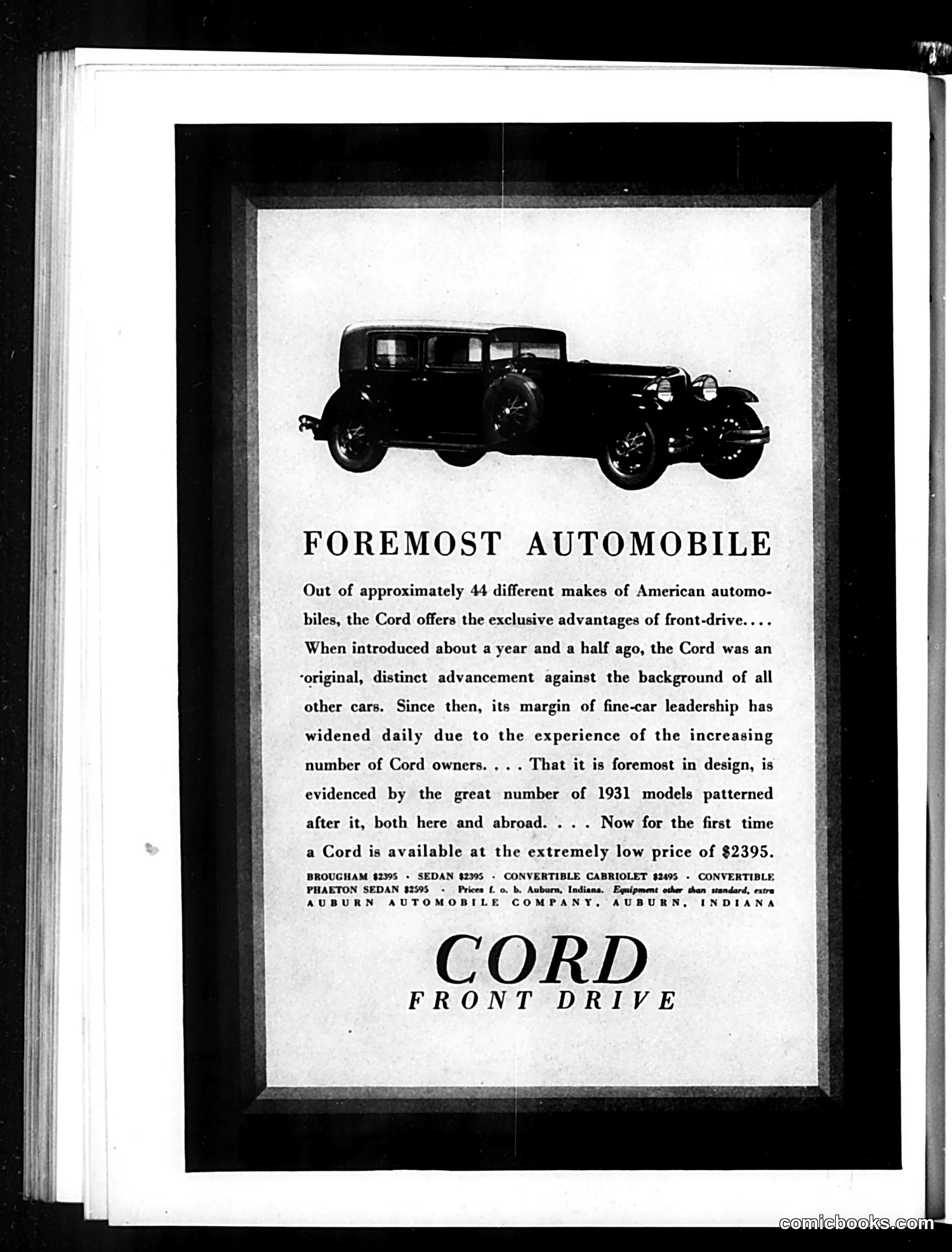
# Analysis This page is primarily **advertising, not satire or editorial content**. It's a Cord automobile advertisement from the Auburn Automobile Company of Auburn, Indiana. The ad claims the Cord is the "foremost automobile" among 44 American car makes, emphasizing its exclusive front-wheel drive as a major innovation introduced about 18 months prior. The copy argues that numerous 1931 models copied this design, proving Cord's leadership in automotive engineering. The advertisement highlights the car's low price of $2395 for the basic model, with variant prices listed (brougham, sedan, convertible options). The silhouetted illustration at top shows a Cord sedan in profile. There is **no political cartoon or satire** present on this page—it's straightforward product advertising typical of Judge magazine's commercial content.
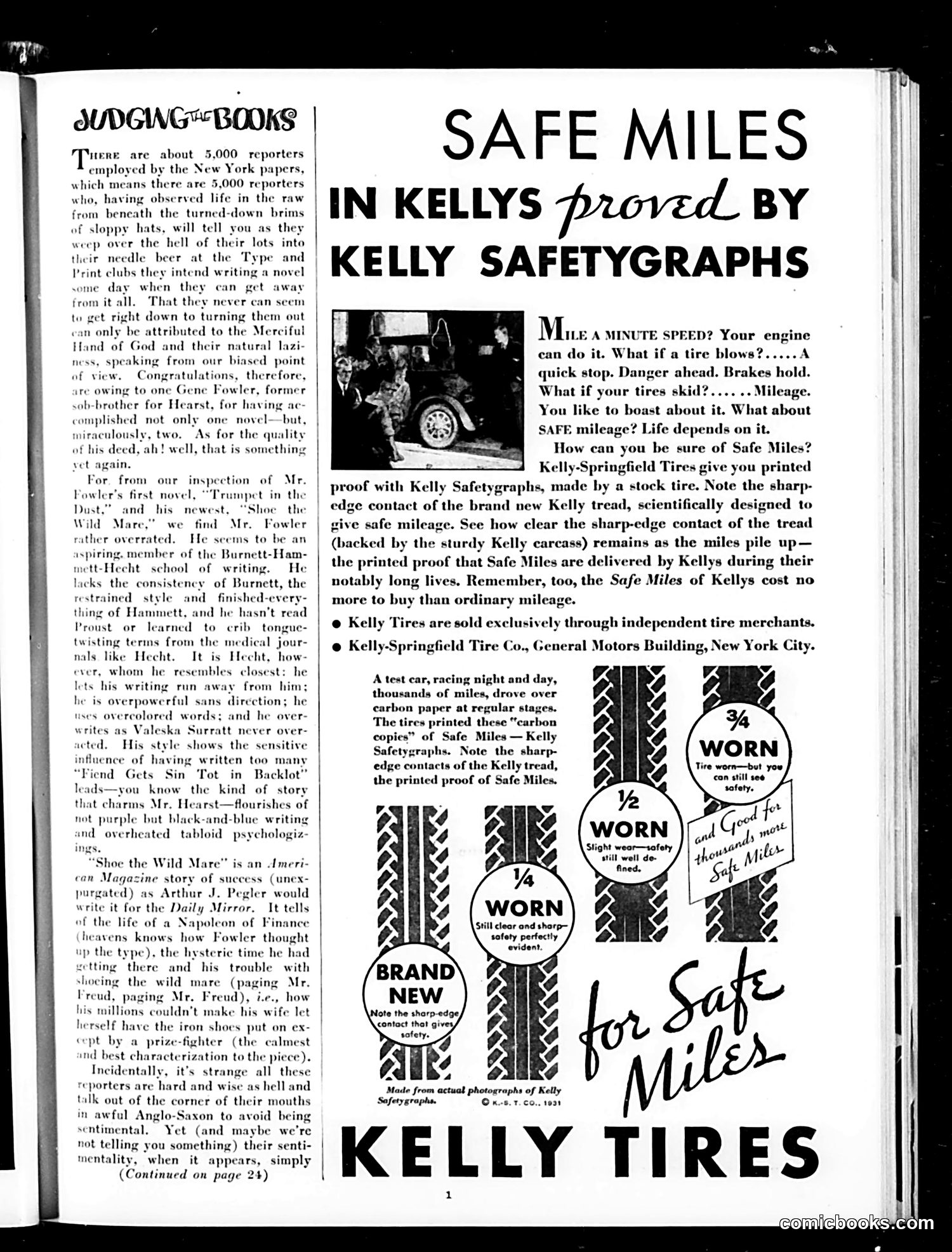
# Analysis This page is **primarily advertising**, not satirical content. The left column contains "Judging the Books," a literary review section discussing newspaper reporters and various writers' styles—standard magazine commentary rather than political satire. The dominant right side is a **Kelly Tires advertisement** promoting "Safe Miles" through Kelly Safetygraphs (tire tread wear documentation). The ad uses comparative tire tread images labeled "BRAND NEW," "1/4 WORN," "1/2 WORN," and "3/4 WORN" to demonstrate tire durability and safety. A test car narrative describes driving over carbon paper to create printed proof of safe mileage performance. This reflects early 20th-century advertising approaches: using technical proof and consumer testimonials rather than humor. There is no political satire visible on this page.
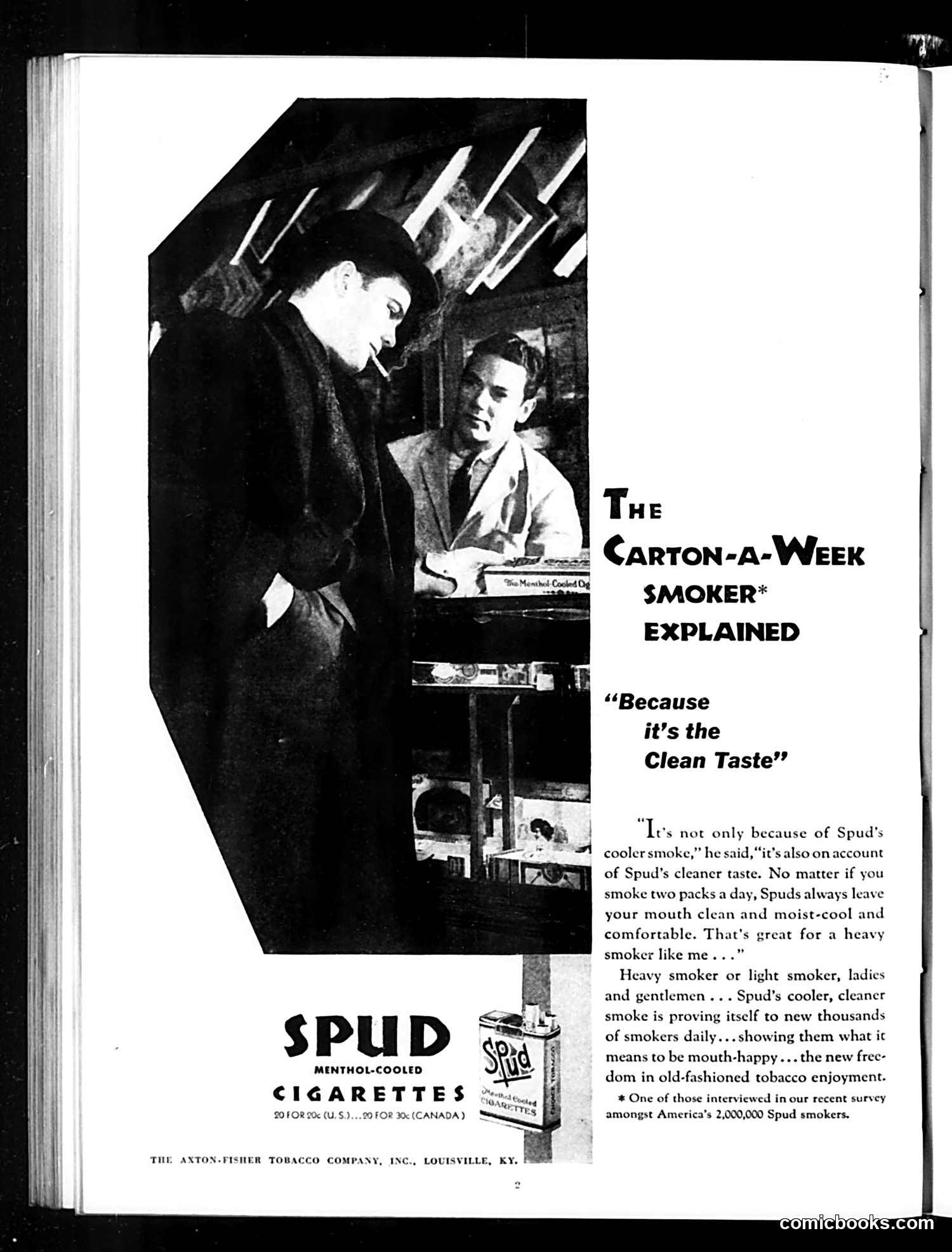
# Spud Cigarettes Advertisement This is **not a cartoon or satire** — it's a straightforward cigarette advertisement from *Judge* magazine for Spud menthol cigarettes. The image shows two men in what appears to be a store or shop, with one examining a Spud cigarette package. The ad's central claim is that Spud cigarettes offer a "clean taste" because of menthol cooling and reduced harshness compared to regular tobacco. The quote attributes this testimonial to one of 2,000,000 Spud smokers surveyed. The marketing emphasizes that even "heavy smokers" can smoke frequently while maintaining "clean and moist-cool and comfortable" mouth conditions — a health-adjacent claim typical of mid-20th-century tobacco advertising before smoking's dangers were widely acknowledged.
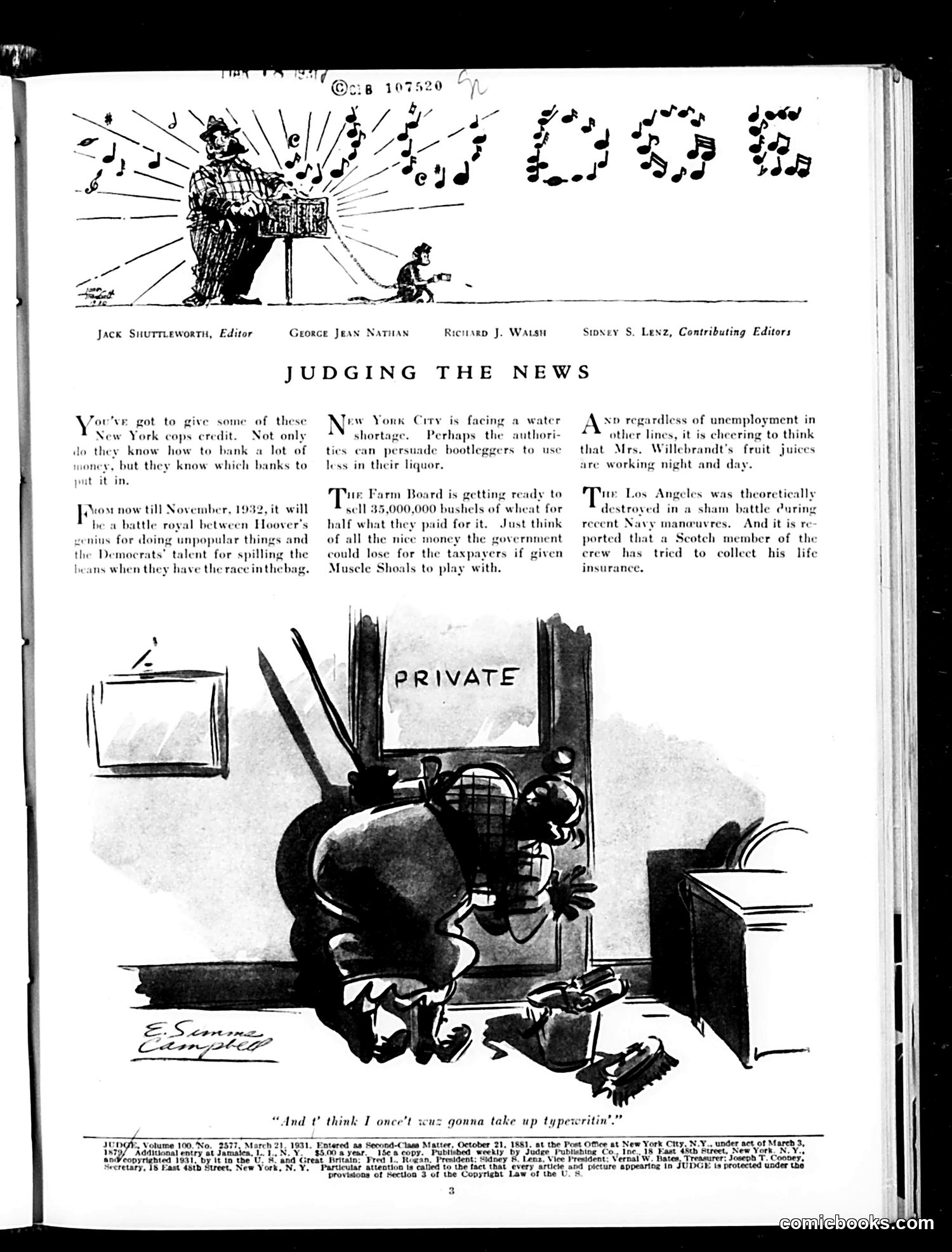
# "Judging the News" - Judge Magazine Satire Page This satirical commentary page addresses 1932 American economic and political issues during the Depression. The main cartoon depicts a figure labeled "PRIVATE" at a desk marked with broadcasting equipment, satirizing media privacy concerns or government secrecy during news reporting. The text columns mock: - New York City's financial crisis and bootleggers exploiting water shortages - The Farm Board's planned wheat sales at loss to taxpayers - A naval incident involving the USS Los Angeles and insurance fraud The top illustration shows a conductor-like figure with musical notes, likely satirizing how news is "orchestrated" or controlled. The cartoons critique government mismanagement, financial corruption, and media manipulation during the Depression era. The overall tone suggests skepticism toward official narratives and institutional competence.
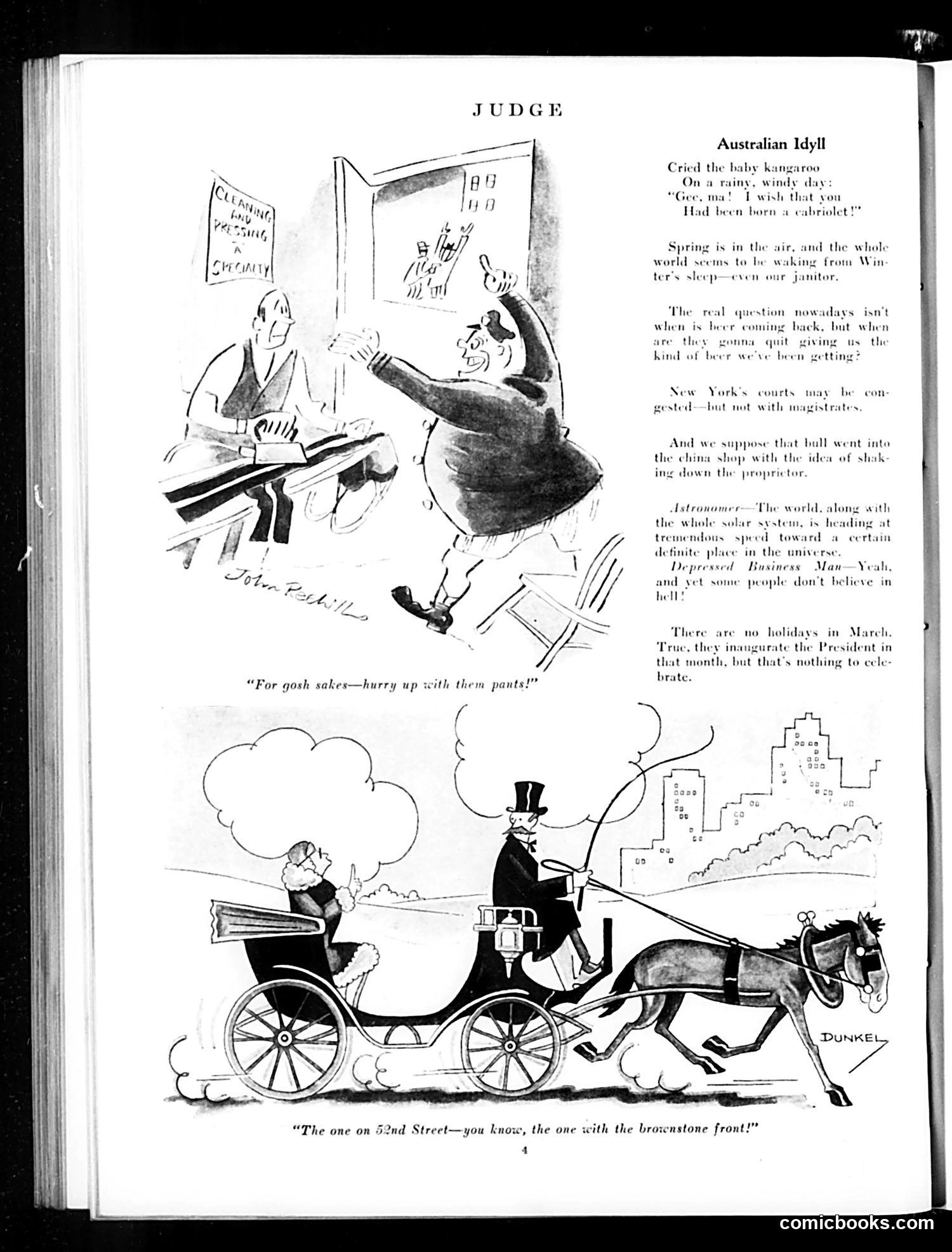
# Analysis of Judge Magazine Page This page contains two cartoons satirizing early 20th-century American life and politics. **Top cartoon**: A judge examines a clerk's filing system labeled "Clearing House Pressing Specialty." The joke suggests judicial incompetence or corruption—the clerk frantically tries to hide disorganized records, implying courts mishandle cases or evidence. **Bottom cartoon** (signed Dunkel): A well-dressed man in a top hat drives a horse-drawn carriage while holding papers, with another figure behind. The caption references "52nd Street" and "brownstone front," likely mocking wealthy New York real estate dealings or social pretension among the affluent. The text snippets on the right ("Australian Idyll," "Astronomer," "Depressed Business Man") appear unrelated to the cartoons—standard magazine filler satirizing various social types and current anxieties about economic conditions.
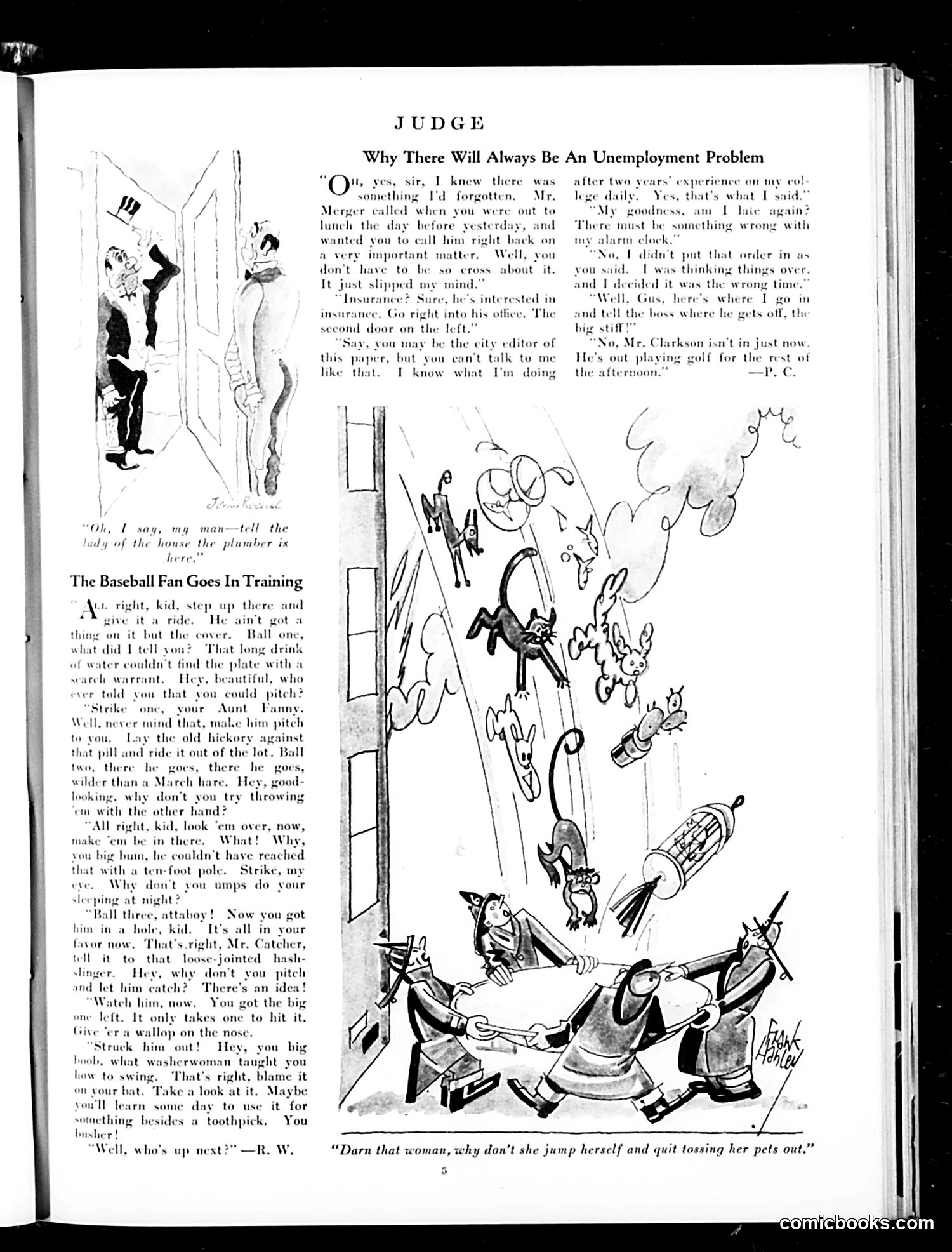
# Judge Magazine Page Analysis This page contains two separate pieces of humor: **"Why There Will Always Be An Unemployment Problem"** (top) is a dialogue joke about a businessman who forgot an important matter, then dismisses his employee's concerns about being called back to work urgently. The humor relies on the businessman's scattered priorities and indifference to others' time. **"The Baseball Fan Goes In Training"** (bottom left) is a humorous monologue offering absurd baseball coaching advice, full of malapropisms and nonsensical suggestions (like using a ten-foot pole to hit). It's gentle sports satire. The large cartoon (right) shows someone throwing household items and pets out a window in frustration, with the caption "Darn that woman, why don't she jump herself and quit tossing her pets out." This appears to be domestic humor, though the subject matter is dark by modern standards.
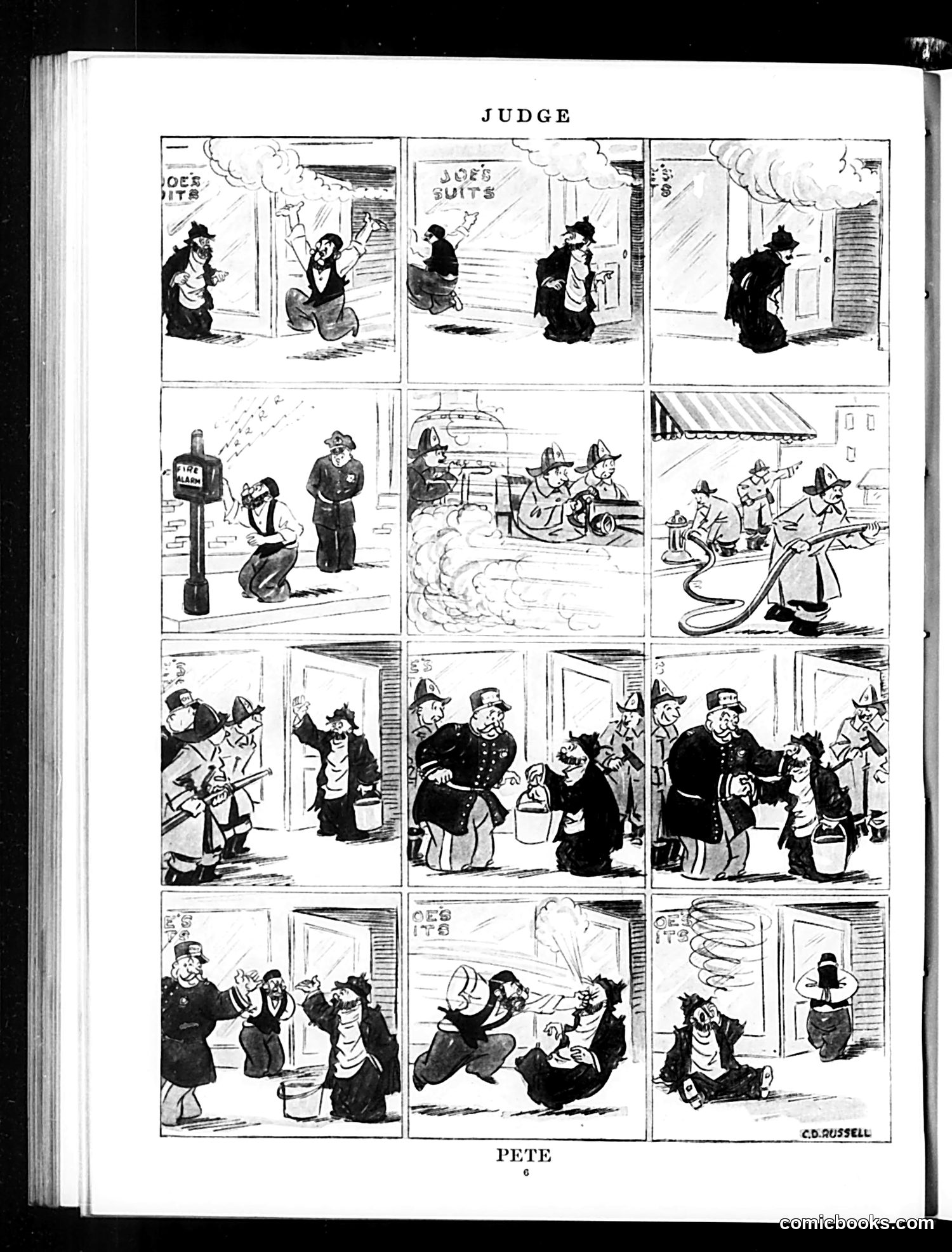
# "Judge Pete" Comic Strip Analysis This appears to be a multi-panel comic strip titled "Judge Pete" by C.D. Russell (credited at bottom). The narrative follows a man in formal attire encountering various urban situations. The strip satirizes bureaucratic red tape and municipal authority. Early panels show the protagonist repeatedly finding "Dog Suits" signs at different locations—suggesting frustration with regulations or legal restrictions. Middle panels depict firefighting and what appears to be emergency response chaos. Later panels show interactions with officials and crowds, possibly critiquing the inefficiency of city government or law enforcement. Without specific date context, the exact political targets remain unclear, but the overall tone mocks municipal incompetence and the absurdity of conflicting or excessive regulations affecting ordinary citizens.
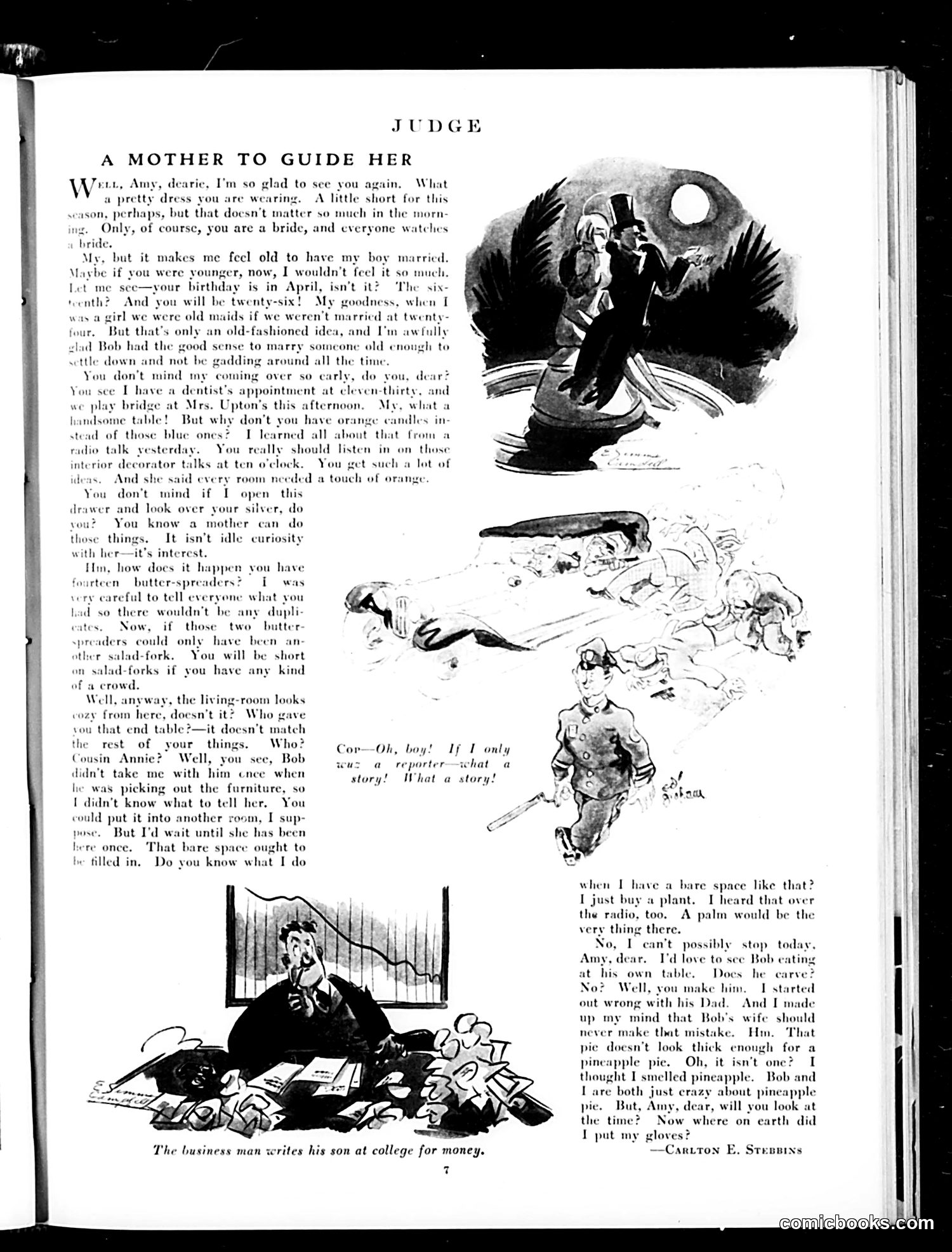
# Judge Magazine Analysis: "A Mother to Guide Her" This is a domestic humor piece satirizing the overbearing mother-in-law. The unnamed elderly mother visits her new daughter-in-law Amy, ostensibly to welcome her but actually to critique every aspect of her home and married life. The satire targets: 1. **Intrusive maternal oversight**: The mother uninvitedly examines Amy's silver, comments on furnishings, and offers unsolicited advice about candle colors and palm plants—claiming it's "interest" rather than "idle curiosity." 2. **Radio culture**: References to radio decorator talks reflect 1920s-30s fascination with mass media as advice source, humorously portrayed as the mother's source of decorating wisdom. 3. **Social anxiety about marriage**: The mother critiques Amy's dress length, her age (twenty-six), and worries about proper entertaining and table settings. 4. **Gender dynamics**: The illustration of a businesslike male figure suggests contrast with domestic female concerns. The cartoon below shows a man drowning in paperwork—likely illustrating the final caption about fathers writing sons for money during college. The byline credits Carlton E. Stebbins (cartoonist).
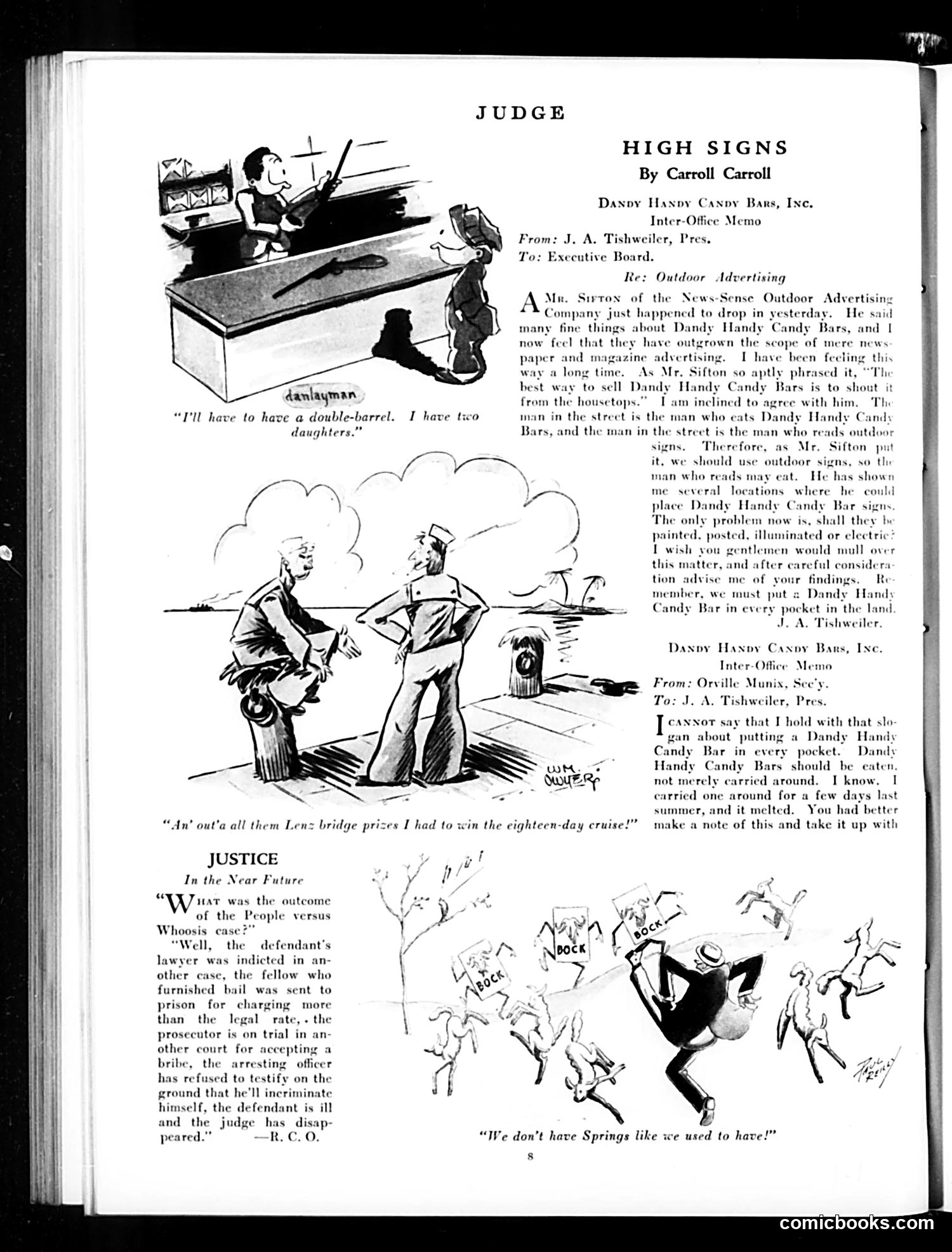
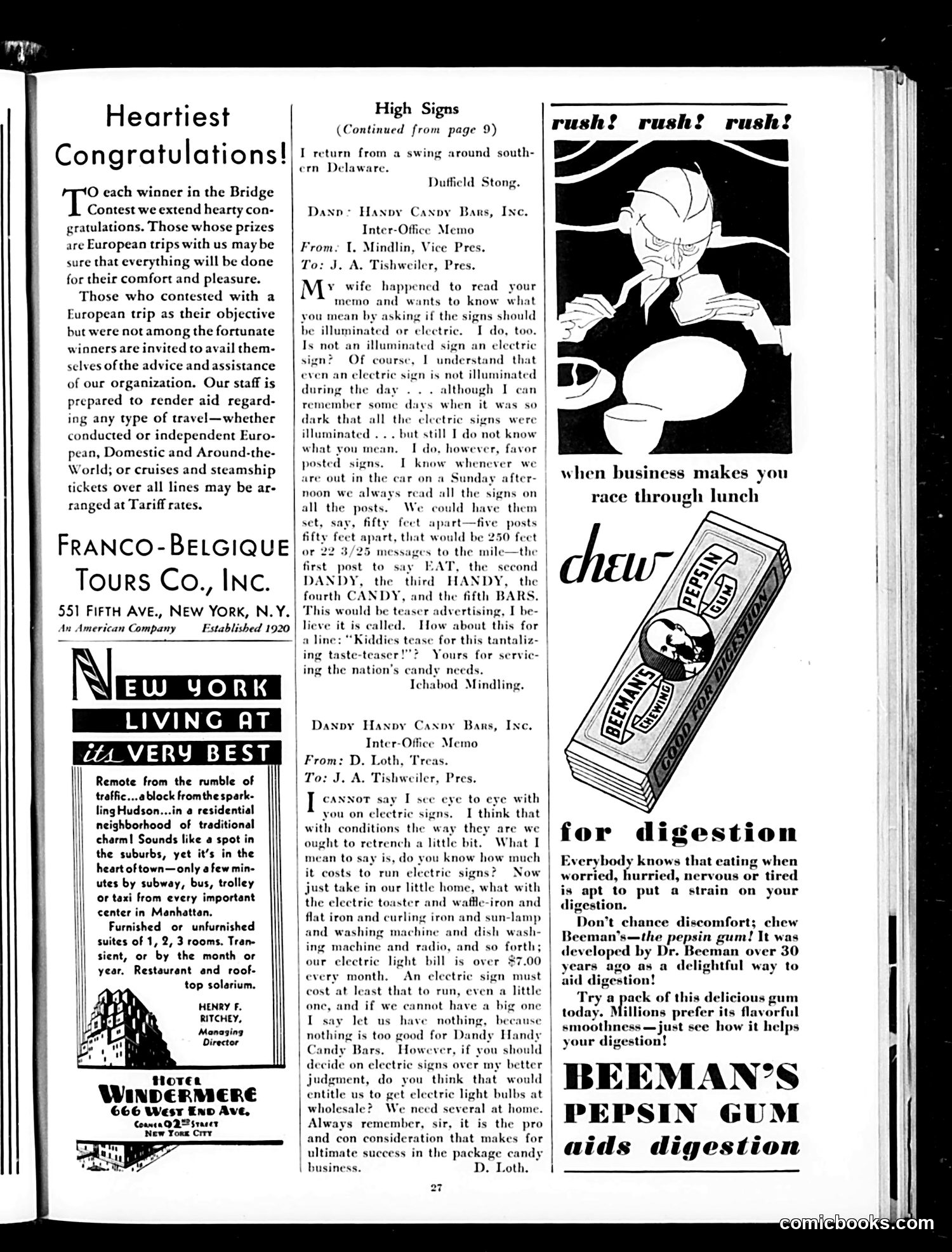
# Analysis: Judge Magazine Page This page contains three separate satirical pieces about American consumer culture and legal corruption circa the 1920s-1930s. **"High Signs"** mocks outdoor advertising excess. A candy company memo proposes plastering "Dandy Handy Candy Bars" everywhere—on buildings, streets, even in pockets. The irony: a follow-up memo notes a bar left in someone's pocket melted, defeating the purpose. The satire targets aggressive marketing's obliviousness to practical reality. **"Justice: In the Near Future"** depicts systemic legal corruption. A court case collapses because everyone involved is compromised: the defendant's lawyer faces charges elsewhere, the prosecutor is on trial for bribery, the arresting officer refuses testimony to avoid self-incrimination, the defendant is ill, and the judge vanishes. The joke critiques a justice system where corruption has become so endemic that cases become impossible to prosecute—a commentary on Prohibition-era institutional decay. Both cartoons satirize American institutions' dysfunction through exaggeration and dark humor.
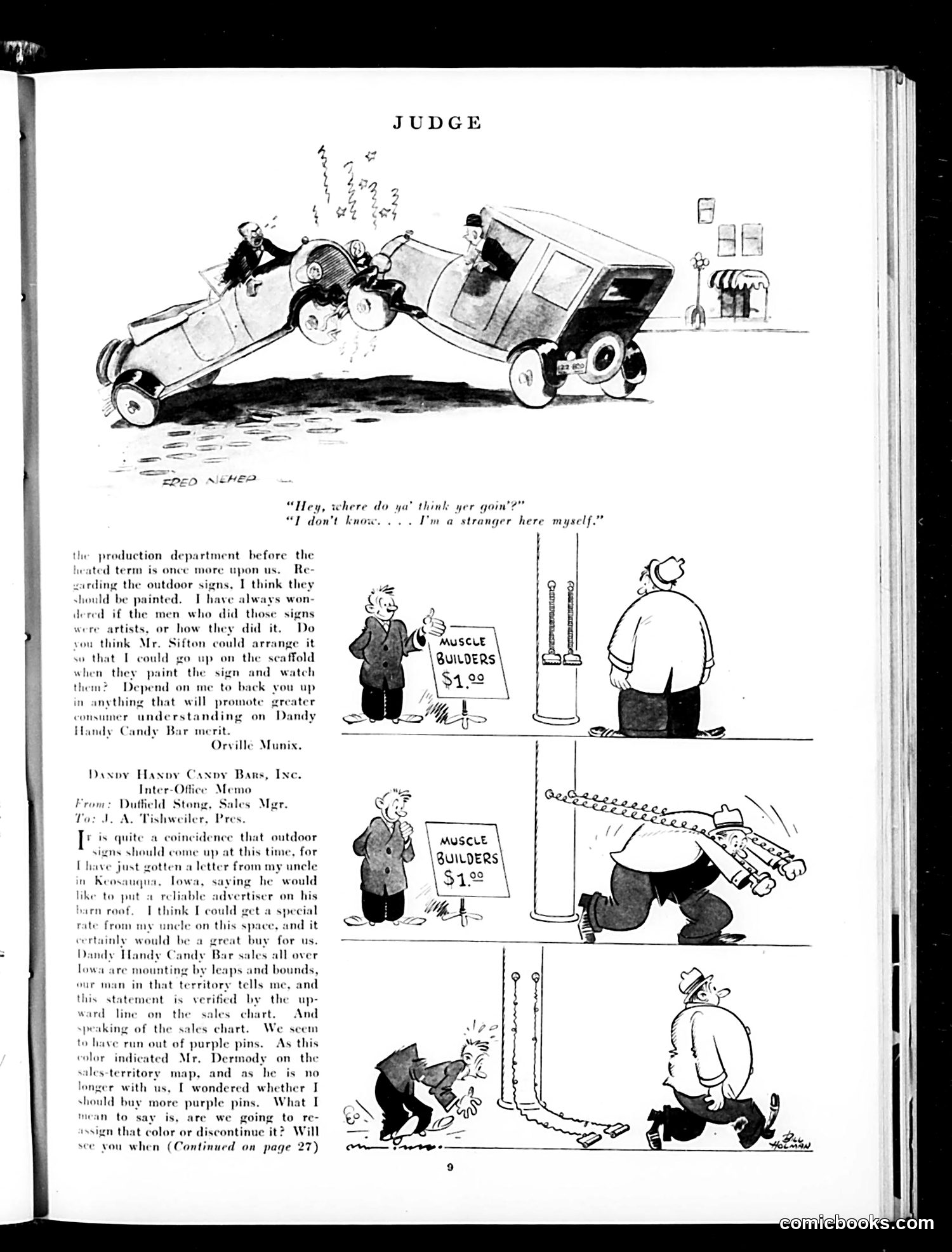
# "Judge" Magazine Page Analysis This page combines corporate satire with advertising humor. The top cartoon depicts two automobiles colliding, with occupants asking each other for directions—a joke about strangers and traffic confusion in an era when automobiles were still relatively novel. Below are inter-office memos from executives at "Dandy Handy Candy Bars, Inc." discussing marketing strategies. The satire targets corporate bureaucracy: one proposes painting outdoor advertising signs while hiring artists to publicize the work; another suggests using his uncle's barn roof in Iowa as billboard space. The memos humorously reveal how small business decisions get bogged down in petty details—notably, they've run out of purple pins on their sales chart. The accompanying cartoons show a "Muscle Builders" product being marketed, with comedic illustrations of salesmen struggling with heavy chains and equipment. The overall satire mocks both corporate inefficiency and the hard-sell advertising culture of the era.
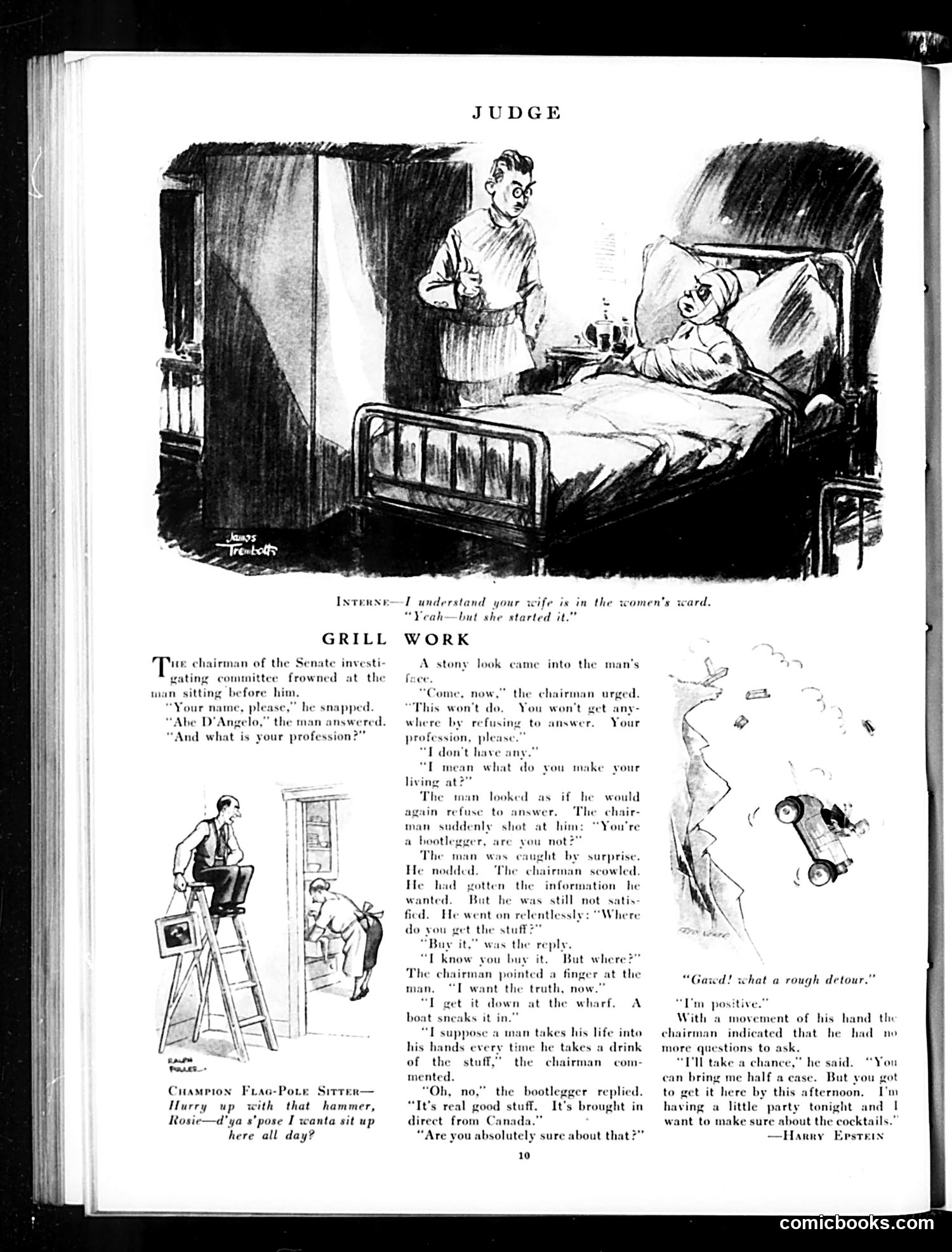
# Explanation of Judge Magazine Page This page contains two separate satirical pieces from the Prohibition era (likely 1920s-1930s). **"Grill Work"** (main story): A Senate investigating committee chairman interrogates a bootlegger about his illegal alcohol operation. The satire targets the futility of Prohibition enforcement—the chairman ultimately reveals he's not trying to stop the bootlegger but rather to secure a reliable supply for his own party that evening. The joke exposes the hypocrisy of lawmakers: they publicly prosecute bootleggers while privately patronizing them. **"Champion Flag-Pole Sitter"** (small cartoon, left): A satirical jab at the 1920s fad of flag-pole sitting—a pointless endurance stunt where people sat atop poles for days. "Rosie" appears to reference female participation in this trend. **"Interne"** (top): A hospital scene joke about a doctor's wife in the women's ward, implying marital discord. All three pieces mock contemporary American behaviors and legal contradictions with sharp, cynical humor typical of Judge's editorial voice.