
Judge, 1931-03-21 · page 18 of 36
Judge — March 21, 1931 — page 18: what you’re looking at
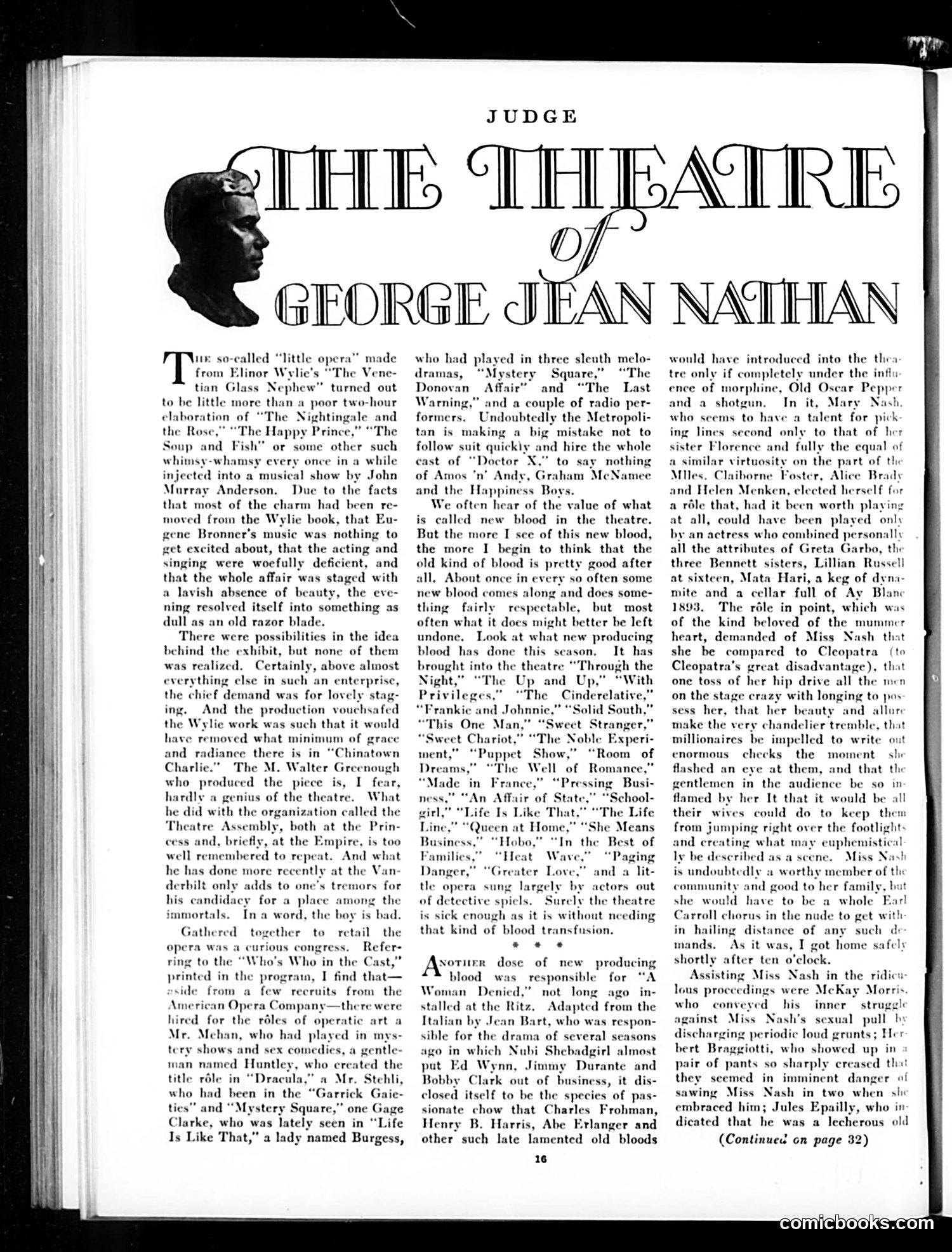
A restored page from Judge, 1931-03-21. Page through the whole issue in the reader above.
📄 Transcribed text from this page (OCR, searchable)
Machine-transcribed from the original scan — historical spelling and the odd misread are preserved.
JUDGE ¢ “HEL, ACRE GEORGE JEAN NAGHAN ur so-called “little opera” made from Elinor Wylie’ ne Vene- an pphe turned out to be little more -hour elaboration of * the Rose,” “The Happy Soup and Fish” or some other such whimsy-whamsy every once in a while injected into a musical show by John Murray Anderson. Due to the facts that most of th ad been re- moved from th ie book, that Eu- gene Bronner’s music was nothing to get excited about, that the ing and singing were woefully deficient, and that the whole affair was staged with a lavish absence of beauty, the eve- ning resolved itself into something as dull as an old razor bl: There were possibilities in the idea behind the exhibit, but none of them was realized. Certainly, above almost everything else in such an enterprise the chief demand was for lovely st ing. And the production vouc the Wylie work was such that it would have removed what minimum of grace and radiance there is in “Chinatown Charlie The M. Walter who produced the piece i hardly a genius of the theatre. he did with the org Theatre Assembly, both at the Prin- cess and, briefly, at the Empire, is too well remembered to repeat. And what he has done more recently at the Van- derbilt only adds to one’s tremors for his candidacy for a place among the mortals. Ina word, the boy is . Gathered together to retail the opera was a curious congress. Refer- ring to the “Who's Who in the Cast,” printed in the prograin, I find that— eside from a few recruits from the American Opera Compa Pre hired for the réles of operatic Mr. Mehan, who had played in mys- tery shows and sex comedies, a gentle- man named Huntley, who created the title réle in “Dracula . Stehli, jreenough I fe What ization called the and “Mystery ke, who lately seen in “Life Is Like That,” a lady named Burgess, who had played in three sleuth melo- dramas, “Mystery Square,” Donovan Affair” Warning,” and a couple of radio per- formers. Undoubtedly the Metropoli- tan is making a big mistake not to follow suit qi ind hire the whole cast of “Doctor X,” to say nothing of Amos ‘n’ Andy, Graham McNamee and the Happiness Boys. We often hear of the value of what is called new blood in the theatre. But the more I see of this new blood, the more I begin to think that the old kind of blood is pretty good after all. About once in every so often some new blood comes along and does some- thing fairly respectable, but most often what it does might better be left undone, Look at what new producing blood has done t son, It has brought into the theatre “Through the ” "The Up and Up,” “With .” “The Cinderelative,” “Solid South,” is st *t Cha ixperi- ment,” “Puppet oom of Dreams,” “The Well of Romance,” “Made in France,” “Pressing Busi- ” “An Affair of State,” “School- Life Is Like Th The Life Queen at Home,” “She Means Business,” “Hobo,” “In the Best of Families,” “Heat W “Paging nd a lit- tors out the theatre of detective spicls. Sure is sick enough as it is without needing that kind of blood transfusion. ee A tien dose of new producing blood was responsible for “A Woman Denied,” not long ago in- stalled at the Ritz, Adapted from the Italian by Jean Bart, who was respon- sible for the drama of several seasons ago in which Nubi Shebadgirl almost Ed Wynn, Jimmy Durante and Clark out of business, it dis- closed itself to be the species of pas- sionate chow that Charles Frohman, Henry B. Harris, Abe Erlanger and other such late lamented old bloods 16 would have introduced into the thea tre only if completely under the influ ence of morphine, Old Oscar Pepper and a shotgun, In it, Mary Nash. who seems to have a talent for pick ing lines second only to that of her sister Florence and fully the equal of a similar virtuosity on the part of the Miles. Claiborne Foster, Alice Brady and Helen Menken, elected herself for a rile that, had it been worth playing at all, could have been played only by an actress who combined personally all the attributes of Greta Garbo, the three Bennett sisters, Lillian Russell at sixteen, Mata Hari, a keg of dyna- mite and a cellar full of Ay Blane 1893. The réle in point, which was of the kind beloved of the mummer heart, demanded of Miss Nash that she be compared to Cleopatrs Cleopatra's great disadvantage), that one toss of her hip drive all the men on the stage c: h longing to sess her, that auty and allur: make the very chandelier tremble, that millionaires be impelled to write o enormous checks the moment shir flashed an eye at them, and that th: gentlemen in the audience be so in flamed by her It that it would be all their wives could do to keep them from jumping right over the footlights and creating what may euphemistical ly be described as a scene. Miss Nas! is undoubtedly a worthy member of thi community and good to her famil she would have to be a whole Carroll chorus in the nude to get with in hailing distance of any such d: mands, As it was, I got home safels shortly after ten o'clock. Assisting Miss Nash in the ri¢ lous proceedings were McKay Morris. who conveyed his inner” struggle inst Miss Nash's sexual pull h periodic loud grunts; Her iotti, who showed up in nts so sharply creased that they scemed in imminent danger of sawing Miss Nash in two when sli embraced him; Jules Epailly, who in dicated that he was a lecherous old (Continued on page 32)