
Judge, 1931-03-21 · page 24 of 36
Judge — March 21, 1931 — page 24: what you’re looking at
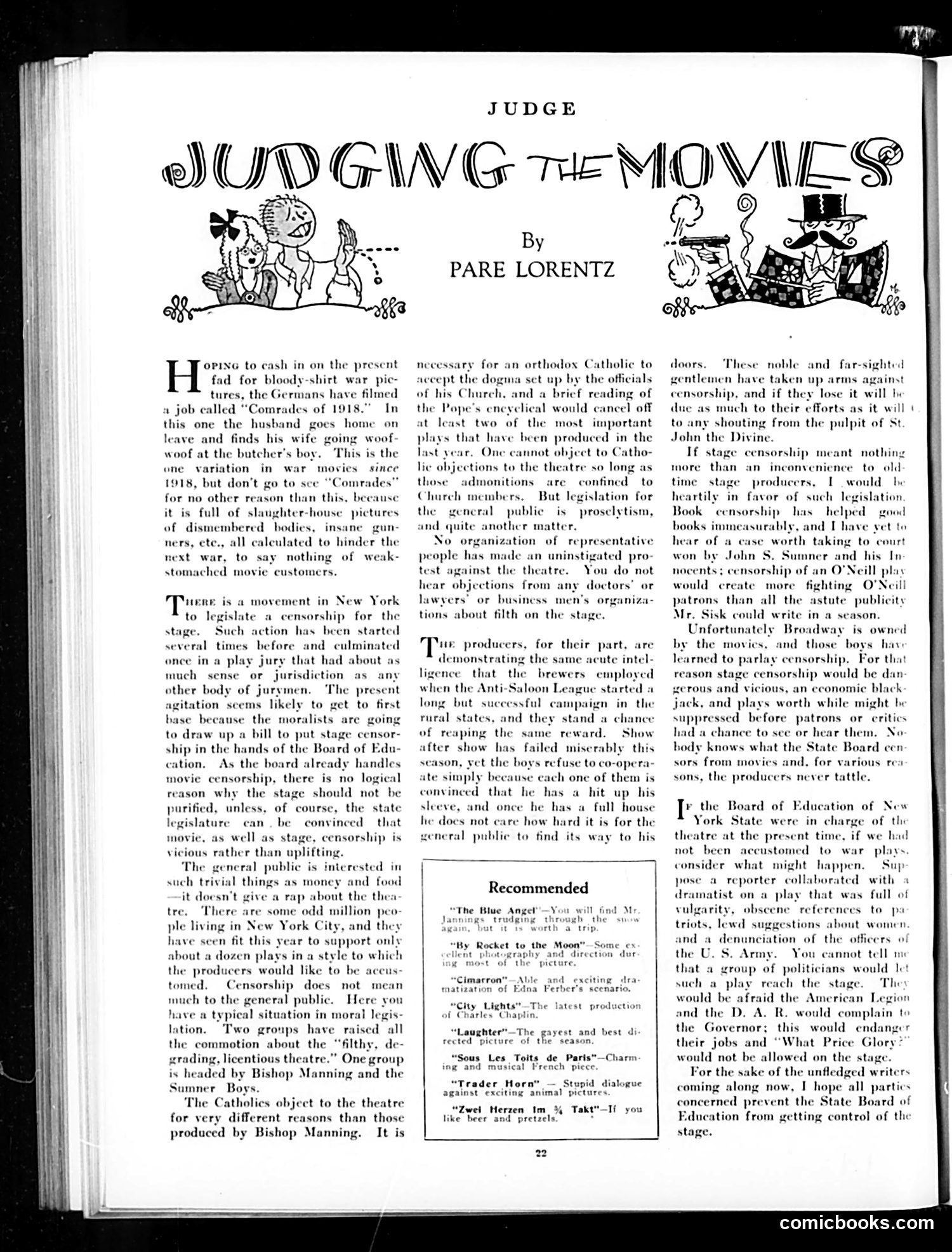
A restored page from Judge, 1931-03-21. Page through the whole issue in the reader above.
📄 Transcribed text from this page (OCR, searchable)
Machine-transcribed from the original scan — historical spelling and the odd misread are preserved.
JUDGE JUVGIVG TEMOVIES fad for bloody-shirt w: tures, the Germans have filmed 1 job called “Comrades of 1918." In this one the husband gocs home on leave and finds his wife woof at the butcher's boy. © variation in) war since 1918, but don't go to sce “Comrades” for no other re woof his is the movies son than this, beeause it is full of slaughter-house pictures of dismembered bodies, insane gun- ners, ete., all calculated to hinder the next war, to nothing of weak- stomached movie customers. ere is a movement in New York to legislate a censorship for the Such action has been started 1 times before and culminated once ina play jury that had about as much sense or jurisdiction as any other body of jurymen. The present ation scems likely to get to first hase because the moralists are going to draw up a bill to put stage censor- ship in the hands of the Board of Edu- cation. As the board alre movie censorship, there is no logical reason why the stage should not be rified, unless, of course, the legislature movie, as well as stage, censorship is vicious rather than uplifting. The general public is interested in such trivial things as money and food it doesn't give a rap about the thea tre. There are some odd million peo ple living in New York City, and they have seen fit this y about a dozen plays can. be con ar to support only a style to which the producers would like to be accus- tomed. Censorship does not much to the general public. have a typical situation in moral legis- lation. “Two groups have raised all the commotion about the “filthy, de- grading, licentious theatre.” One group is headed by Bishop Manning and the Sumner Boys. The Catholics object to the theatre for very different reasons than those produced by Bishop Manning. It is mean Here you By PARE LORENTZ necessary for an orthodox Catholic to accept the dogma set up by the of his Church, and a brief re: the Pope's encyclical would cancel off at least two of the most important plays that have been produced in the last year, One cannot object to € lic objections to the theatre so these admonitions are contin But legislation for public is proselytism, and quite another matter, No organization of representative people has made an uninstigated pro test against the theatre. Y hear objections: froni Church members. the general ry doctors’ or lawyers’ or business men’s organiza tions about filth on the stage. T" producers, for their part, are demonstrating the same ligence that the brewers employed when the Anti-Saloon League started long but successful campaign: in the rural states, and they stand a chance of reaping the same reward. Show after show has failed miserably this son, yet the boys refuse to co-opera- ate simply because cach one of them is convinced that he has a hit up his sleeve, and once he has a full house he does not care how hard it is for the general public to tind its way to his acute intel Recommended “The Blue Anget 1 will find M Janning d ugh the stow aK att worth a trip. “By Rocket to the Moon”-Some ex lent photography and direction dur of the picture “Cimarron” —Able and exciting matization of Edna Ferber’s scenar “City Lights*—The latest prod Af ¢ n arles Cl “Laughter"—The gayest and best di rected picture of the season. “Sous Les Toits de Paris"—Charm ing and ical French pi “Trader Horn” — Stupid dialogue against exciting animal pictures “Zwei Herzen im % Takt"—If you like beer and pretzels. : a) These noble and entlemen have taken up arms censorship, and if they lose it will hv duc as much to their efforts as it will to any shouting from the pulpit of St John the Divine. If stage censorship meant nothing re than an inconvenience to old time stage producers, [would be heartily in faver of such legislation Book “censorship helped books immeasurably, and [have yet hear of to cour won by John S. and his In nocents; censorship of an O'Neill pl would create more fighting O'Neill an all the astute publicity Mr. Sisk could write in a season. Unfortunately Broadway is owned by the movies, and those boys has learned to parlay censorship. For that reason stage censorship would be dan id vicious, an economic black jack, and plays worth while might be suppressed before patrons or critics had a chance to see or hear them, No body knows what the State Board cen sors from movies and, for various rex sons, the producers never tattle. I the Board of Education of New York State were in charge of the theatre at the present time, if we | not been accustomed to war p consider what might happen. Suj pe reporter collaborated with dramatist on a play that was full of vulgarity, obscene references to pa far-sighted has case W serous. triots, lewd suggestions about women and a denunciation of the officers of the U.S. Army. You cannot tell nv that a group of politicians would let such a play reach the stage. Th would be afraid the Ameri " and the D. A. R. would e the Governor; this would endanger their jobs and “What Price Glory? would not be allowed on the stage. For the sake of the unfledged writers coming along now, I hope all parties concerned prevent the State Board of Edueation from getting control of the stage. comicbooks.com