
Judge, 1931-03-21 · page 15 of 36
Judge — March 21, 1931 — page 15: what you’re looking at
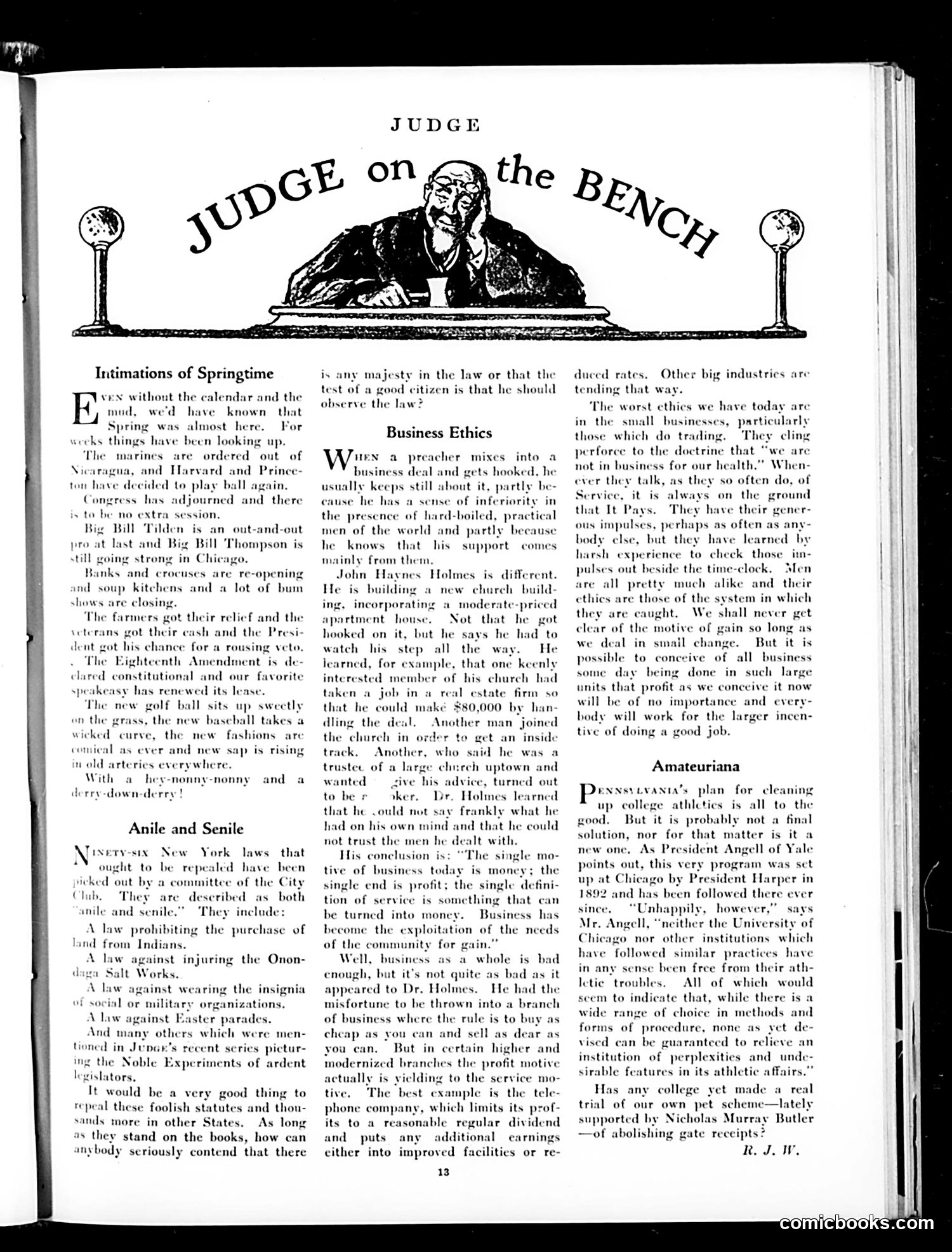
A restored page from Judge, 1931-03-21. Page through the whole issue in the reader above.
📄 Transcribed text from this page (OCR, searchable)
Machine-transcribed from the original scan — historical spelling and the odd misread are preserved.
Intimations of Springtime ven without the calendar and the K mud, we'd have known that Spring was almost here. For s things have been looking up. Phe ordered out of Nicars and Harvard and Prince- ton have decided to play ball a Con ourned and there is to be no extra session. Big Bill Tilden is an proat last and Bi: still going stror marines are ress has out-and-out Bill Thompson is in Cl Oo. Banks and crocuses are re-opening ind soup kitchens and a lot of bum shows are closing. The veterans their relief and the ot their cash and the Presi- it got his chance for a rousing veto. . The Eighteenth Amendment is de- clared constitutional and our favorite speakeasy has renewed its lease. The new golf ball sits up sweetly on the grass, the new baseball takes a wicked curve, the fashions are comical as ever and new sap is rising wold arteries everywhere. With a lerry-down-derry new hey-nonny-nonny and a Anile and Senile New York that ought to be repealed have been ricked out by a committee of the City Club. They described as inile and senile.” ‘They include: Tinery-six laws \ law prohibiting the purchase of land from Indians. A law against injuring the Onon- daga Salt Works. A law against wearing the insignia f social or milits ations, des. y others which were m tioned in JCpae’s recent series: pictur- ing the Noble Experiments of ardent legislators. It would be a very good thing to repeal these foolish statutes and thou- sands more in other S' As long 1s they stand on the books, how can inybody seriously contend that there ates, JUDGE is any majesty in the law or that the test of a good citizen is that he should observe the law? Business Ethics W. eN a preacher mixes into a business deal and gets hooked, he usually keeps still about it, partly be- cause he has a sense of inferiority in the presence of hard-boiled, practical men of the world and partly he knows that his mainly from them, John Haynes Holmes is different. He is building a new church build- ing, incorporating a moderate-priced apartment house. Not that he got hooked on it, but he ys he had to ch his step all the way. He learned, for example, that one keenly interested member of his chureh had taken a job in a real estate firm so that he could make $80,000 by han- dling the deal. Another man joined the church in order to get an inside track, Another, who trustee of a large chnech uptown and wanted sive his advice, turned out to be vker. Dr. Holmes learned that he could not say frankly what he had on his own mind and that he could not trust the men he dealt with. His conclusion is: “The single mo- tive of business today is money; the the single defini- tion of service is something that can be turned into money. become the exploitation of the needs of the community for gain.” Well, business as a whole is bad enough, but it’s not quite as bad as it appeared to Dr. Holmes. He had the misfortune to be thrown into a branch of business where the rule is to buy as cheap as you can and sell as dear as you can. But in certain higher and modernized branches the profit motive actually is yielding to the service mo- tive. ‘The best example is the te phone company, which limits its prof- its to a reasonable regular dividend 1 puts any additional earnings ither into improved facilities or re- 13 because support comes tid he was a single end is profi Business has duced rates. Other big industries are tending that way The worst ethics we have today are in the small businesses, particularly those which do trading. They cling perforce to the doctrine that “we are not in business for our health.” When- ever they talk, as they so often do, of Service, it is always on the ground that It Pays. ous impulses, perhaps as often as any- body else, but they have learned by harsh experience eck those pulses out beside the time-cloc are all pretty much alike and their cthics are those of the system in which they are caught. We shall never get clear of the motive of gain so long as we deal in small change. But it is possible to conceive of all business some day being done in such large units that profit as we conceive it now will be of no importance and every- body will work for the larger incen- tive of doing a good job. They have their gener- to ¢ Amateuriana Denxsvievanta’s plan for cleaning up college athletics is all to. the good. But it is probably not a final solution, nor for that matter is it a new one, As President Angell of Yale points out, this very program was set ago by President Harper in been followed there ever “Unhappily, however,” » Angell, “neither the U iversity of nor other institutions which have followed similar practices have in any sense been free from their ath- letie troubles. AIL of which would seem to indicate that, while there is a wide range of choice in methods and forms of procedure, none as yet de- vised can be guaranteed to relieve an institution of perplexities and unde- sirable features in its athletic « Has any college yet made trial of our own pet scheme—lately supported by Nicholas Murray Butler —of abolishing gate receipts? R.JLW.