A complete issue · 36 pages · 1931
Judge — February 21, 1931
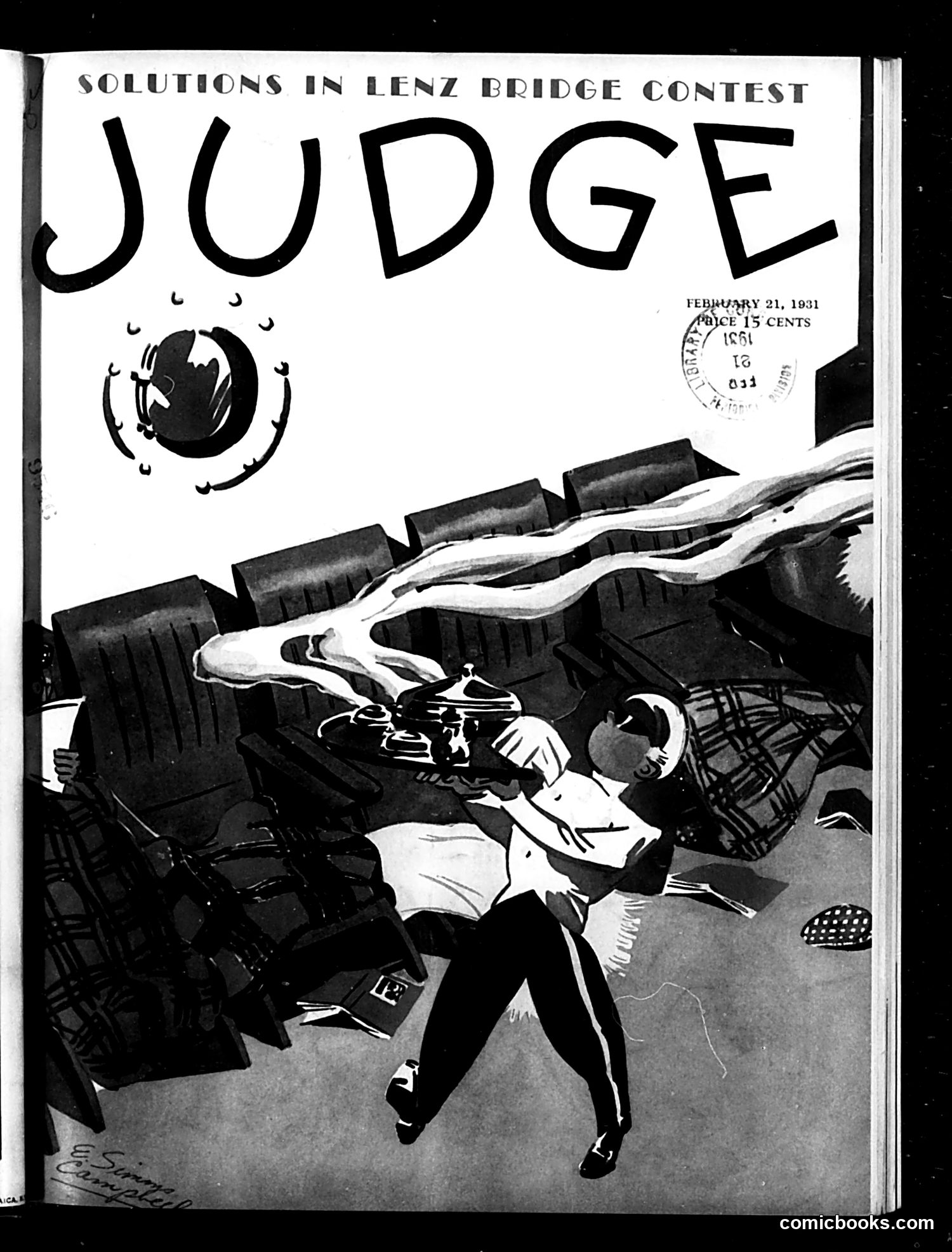
# Analysis of Judge Magazine Cover, February 21, 1931 This cover references the **Lenz Bridge Contest**, a 1930-31 engineering competition to design a bridge. The illustration shows a figure juggling or struggling with industrial materials (steel girders/pipes), suggesting the challenge and complexity of bridge design solutions. The cartoon satirizes competing engineers attempting to solve the structural problems of the Lenz Bridge project. The figure's precarious balancing act—surrounded by heavy industrial components—mocks the difficulty of the engineering feat and perhaps the competing proposals' impracticality or instability. The small circular inset at top-left likely depicts the bridge or related imagery, though details are unclear. This was timely content given the bridge's prominence during the Depression era.
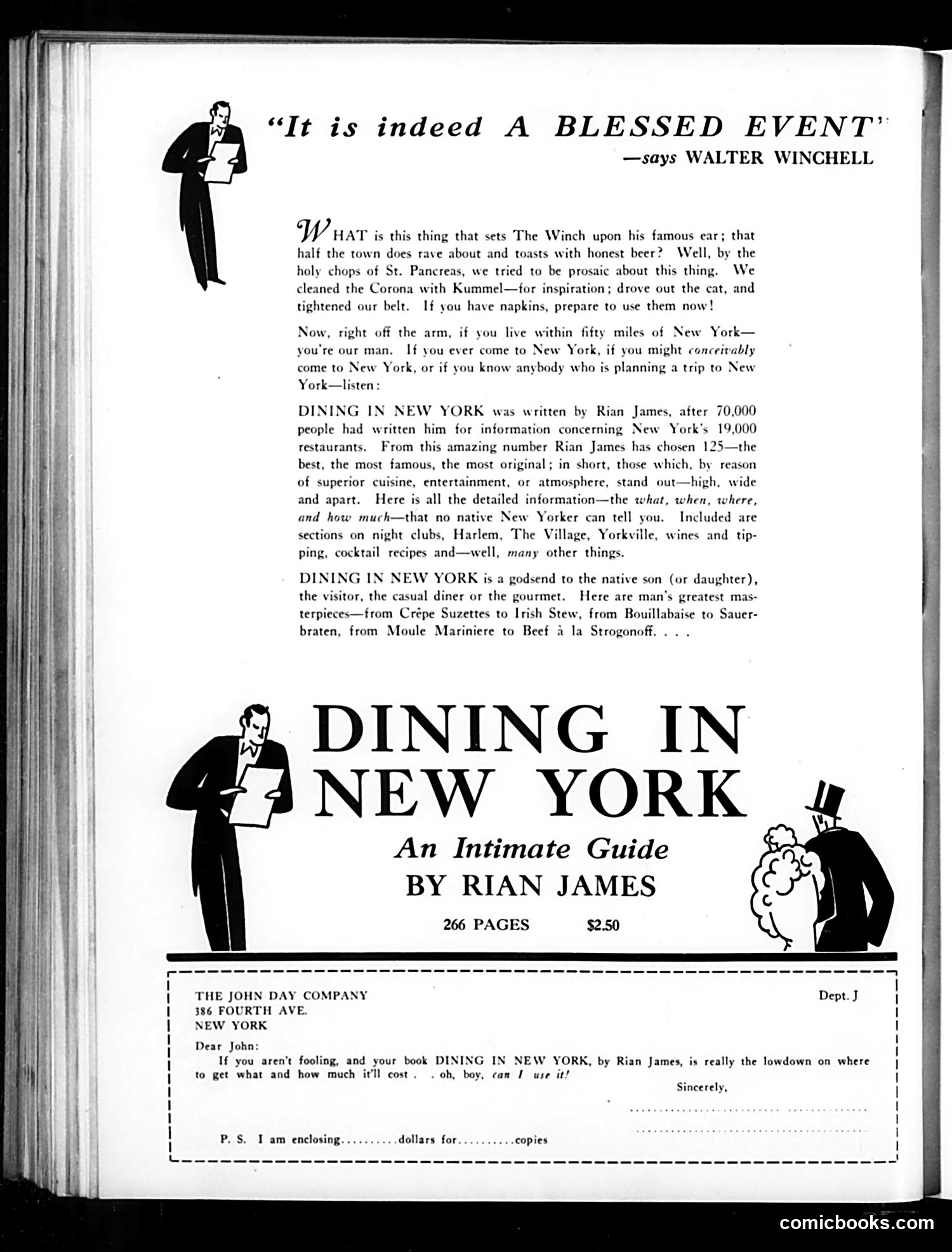
# Analysis This page is primarily **advertising for a guidebook**, not satirical content. It promotes "Dining in New York: An Intimate Guide" by Rian James—a 266-page restaurant guide selling for $2.50. The illustrated figures (men in formal attire with clipboards) are generic representations of the author or informed guides, not political caricatures. They frame the book as an authoritative resource. The endorsement from "Walter Winchell" (a famous gossip columnist of the era) lends credibility. The text emphasizes the book covers 125 selected restaurants with details about "what, when, where and how much"—practical information for New Yorkers and visitors. The bottom section includes an order form from the John Day Company publisher. This is essentially a **vintage advertisement**, not satirical commentary.
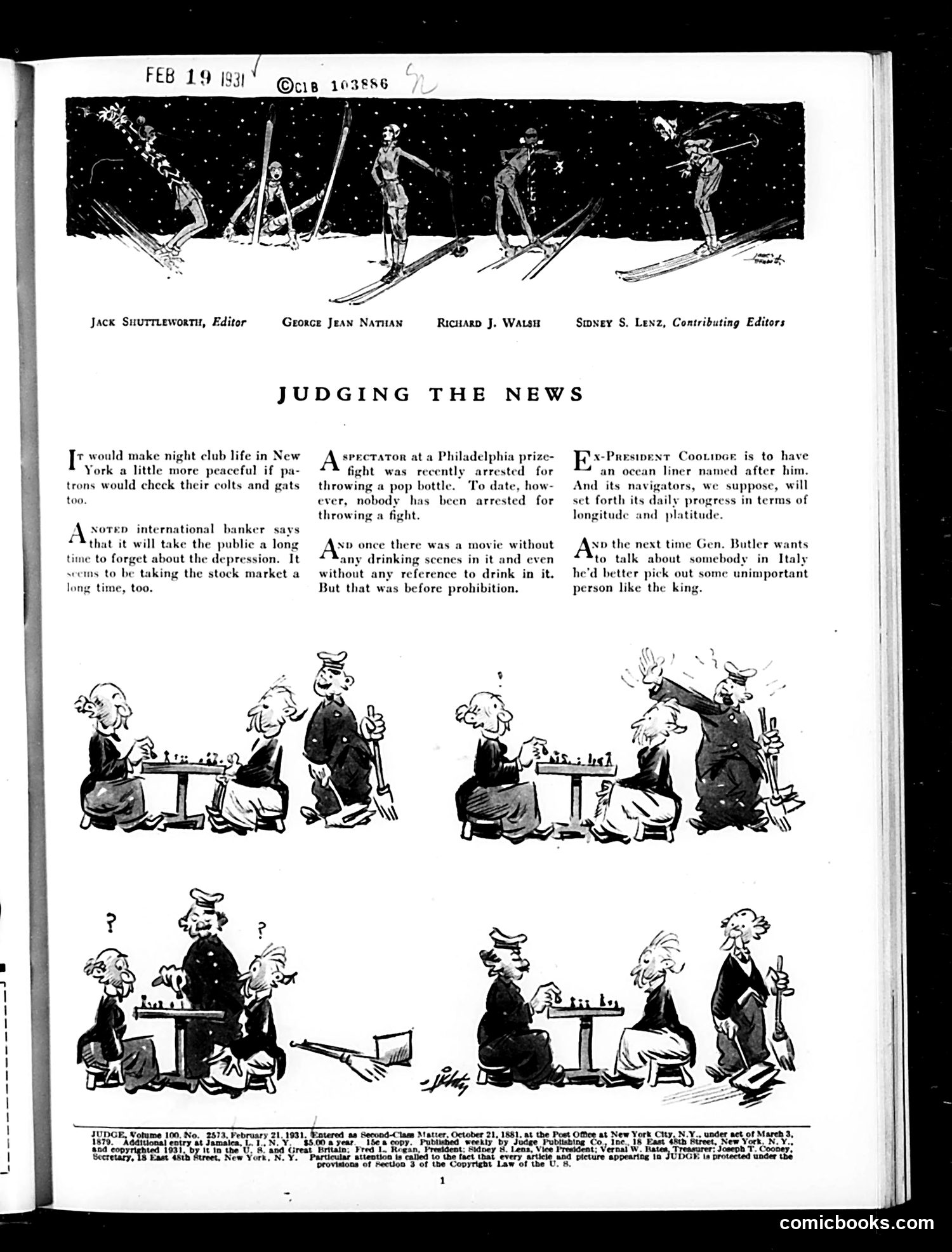
# "Judging the News" - February 21, 1931 This editorial cartoon page satirizes current events through four comic vignettes featuring caricatured figures playing chess. The commentary addresses: a proposed nightclub regulation in New York; a Philadelphia incident involving a spectator throwing a pop bottle at a prizefight; nostalgia for pre-Prohibition movies with drinking scenes; and General Butler's diplomatic efforts (likely regarding Italy, referencing someone "picking out an important person like the king"). The chess motif suggests these situations involve strategic maneuvering or game-like power plays. The cartoons mock political absurdities and social contradictions of the era—particularly Prohibition's lingering effects on entertainment and culture. Ex-President Coolidge apparently planned an ocean liner voyage. The humor relies on contemporary political awareness now largely lost to modern readers.
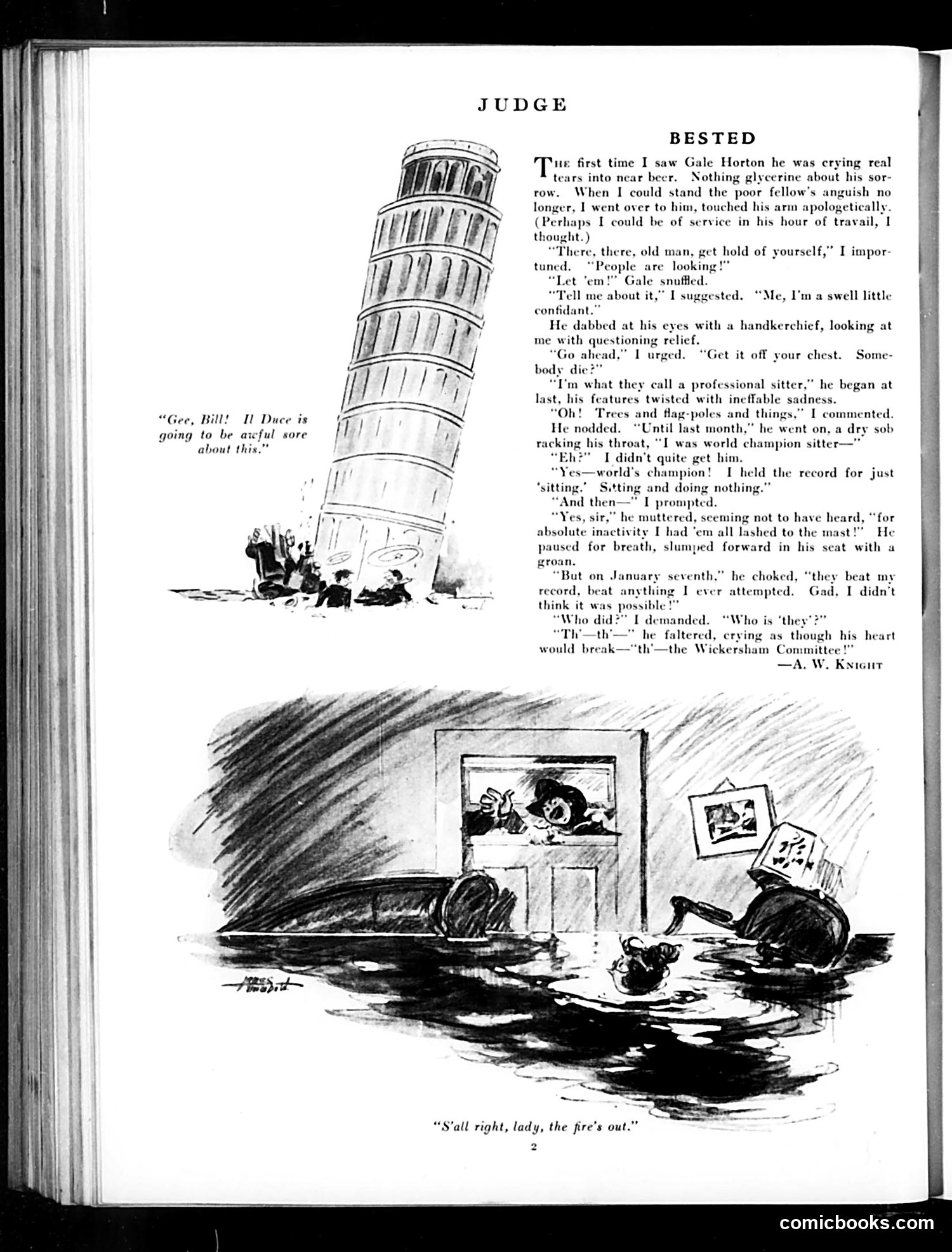
# Analysis of "Judge" Page: "Judge Bested" This page satirizes **Gale Horton**, a professional "sitter" (likely a hired caretaker or babysitter). The story describes Horton's emotional breakdown while recounting his previous record-holding inactivity—until the "Wickersham Committee" supposedly beat his record on January 7th through complete inaction. The **Wickersham Committee** (1929-1931) investigated Prohibition enforcement under President Hoover. The satire mocks the committee's perceived ineffectiveness and passivity, comparing government inaction to a professional sitter's job. The cartoon suggests the committee was so inactive and useless that even a professional "do-nothing" couldn't match their record. The joke plays on frustration with government bodies appearing to accomplish nothing while tasked with important work.
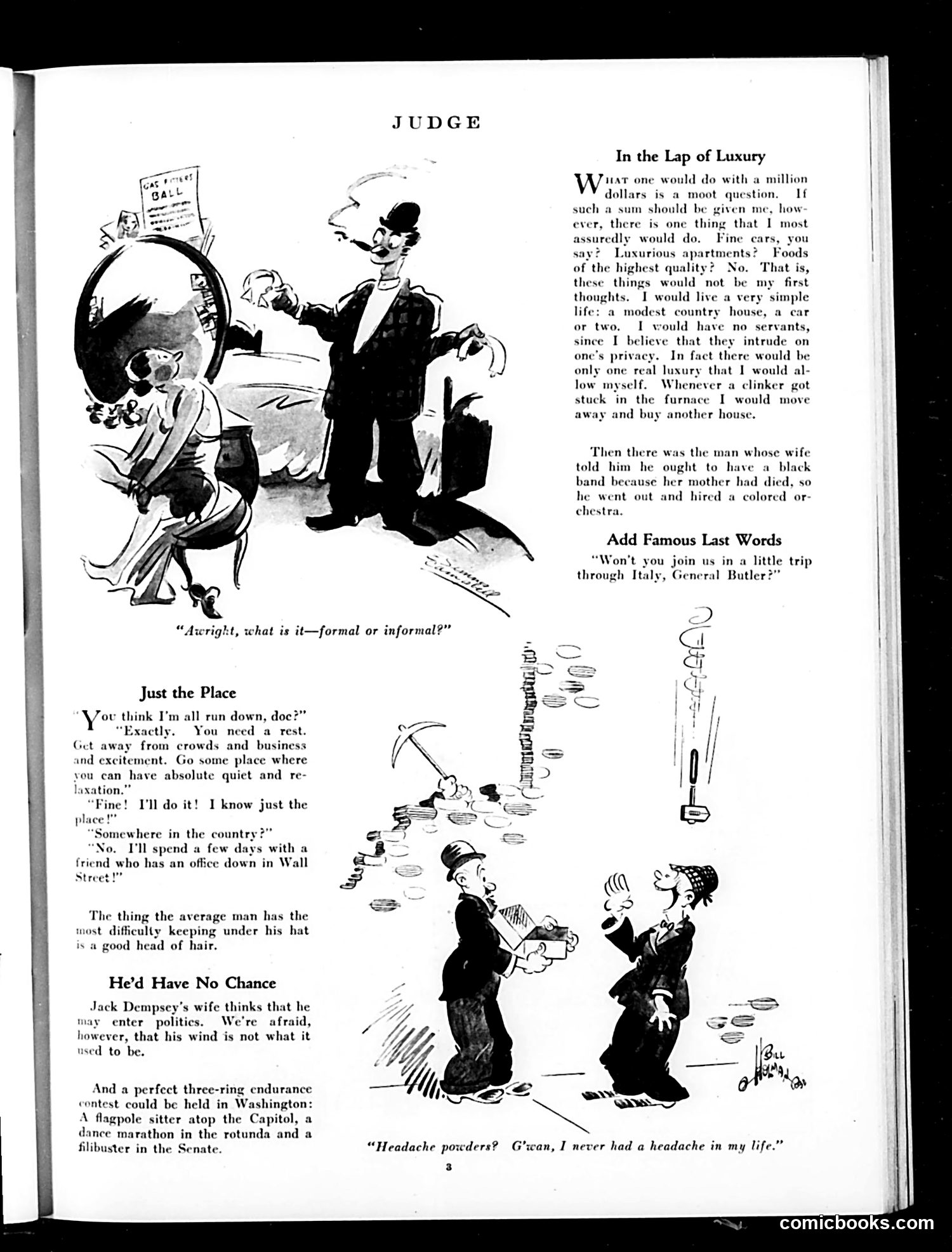
# Judge Magazine Page Analysis This page contains several humorous vignettes satirizing wealthy lifestyles and social pretension. **"In the Lap of Luxury"** mocks the ultra-wealthy, with the author claiming he'd only truly want one luxury: moving houses when his furnace breaks. The anecdote about hiring a "colored orchestra" because his wife needed to mourn her mother satirizes performative status-seeking. **"Just the Place"** jokes about exhausted professionals seeking rest, with a punchline about spending days with a Wall Street friend—implying that location provides no actual escape from business concerns. **"Headache powders?"** shows two men exchanging headache powder, with one claiming never to have had a headache, satirizing either hypochondria or the placebo nature of patent medicines. The cartoons target wealthy pretension and 1920s-era patent medicine marketing.
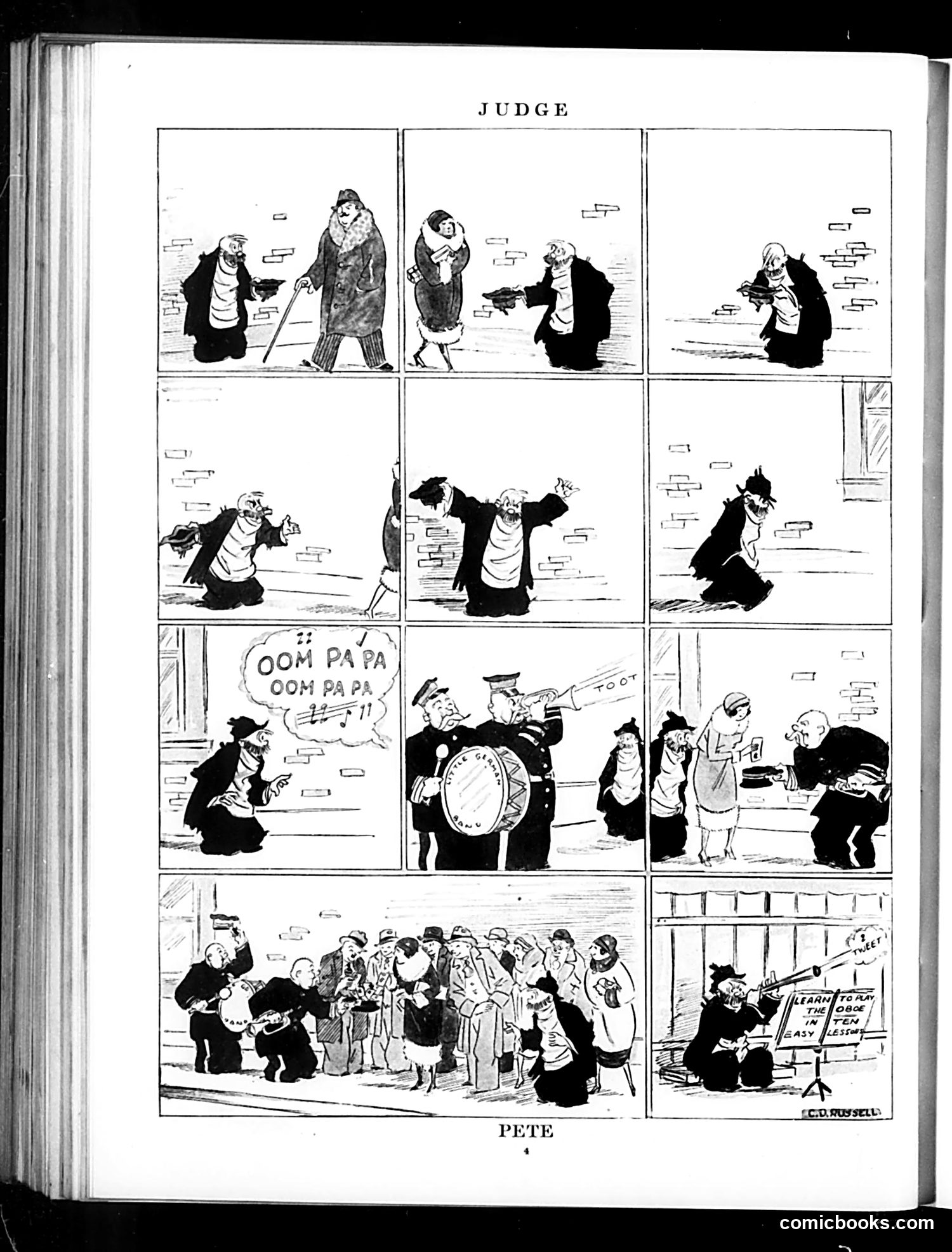
# Political Cartoon Analysis: "Judge" - "Judge" and "Pete" This page presents a sequential comic strip titled "Judge" and "Pete" by cartoonist Ed Russell. The strips depict a judge character attempting to maintain courtroom order while a band or musical group creates chaos. The central panels show the judge becoming increasingly frustrated as musicians play loudly—note the "OOM PA PA" musical notation and the large drum in the middle panel. The satire appears to mock judicial authority's helplessness against disruptive noise or disorder, possibly referencing early-20th-century concerns about jazz music, street performers, or public nuisance laws. The final panel shows the judge attempting to impose order on a crowd, though the specific political context remains unclear without additional publication date information.
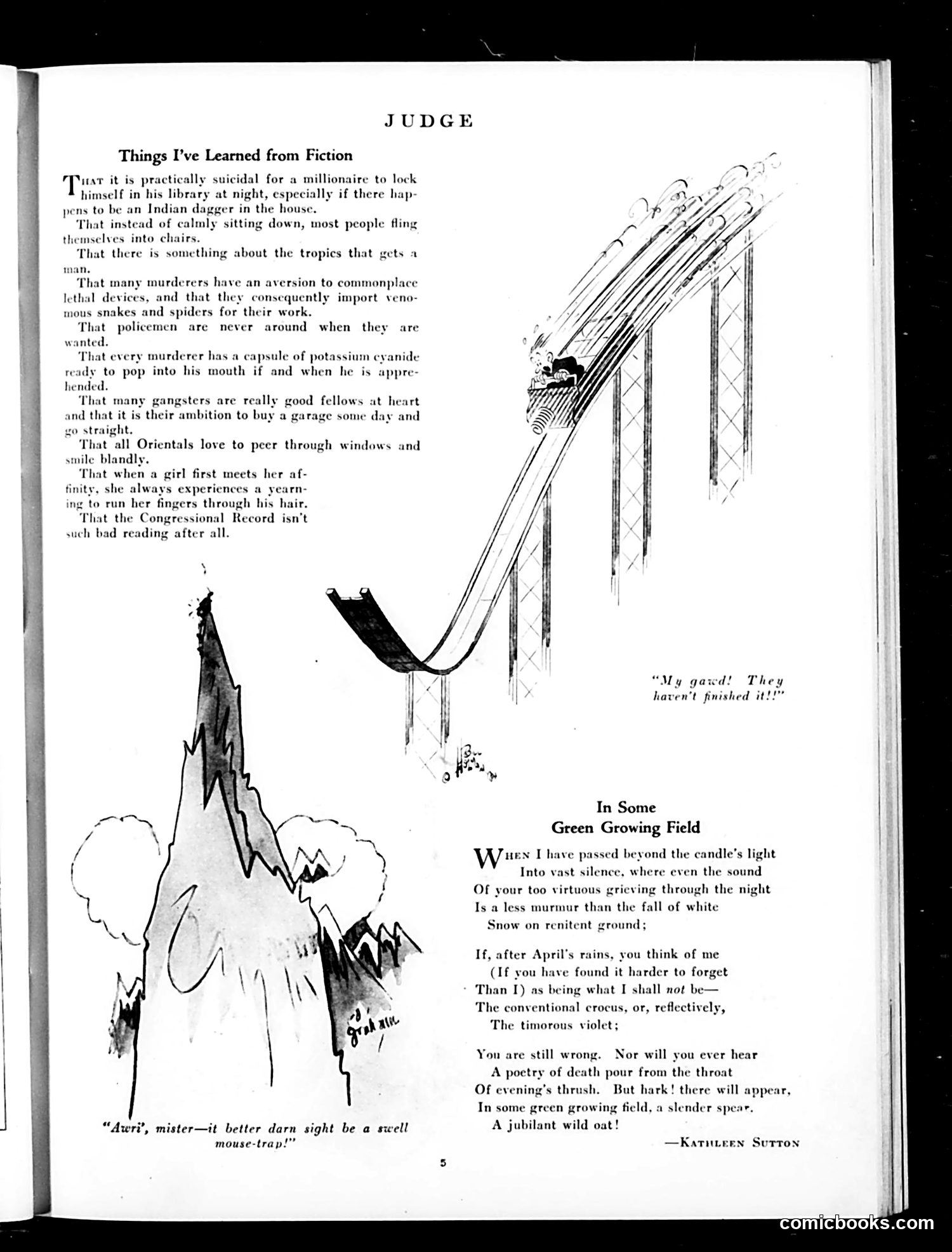
# Analysis This page contains two distinct pieces: **"Things I've Learned from Fiction"** (top left): A humorous list of observations about tropes in crime and romance fiction—millionaires with libraries, murderers' habits, gangsters' ambitions, and romantic encounters. It's light social satire about how fiction shapes perceptions of reality. **The cartoons** show two scenes with dramatic dialogue. One figure warns another: "Acrid, mister—it better darn sight be a swell mouse-trap!" The other caption reads "My gosh! They haven't finished it!" These appear to be slapstick humor about everyday situations, though the specific references are unclear without additional context. **"In Some Green Growing Field"** (bottom): A serious poem by Kathleen Sutton about remembrance and nature—likely related to war memorials or loss, given imagery of death and "green growing field." The page mixes humor with sentimental verse, typical of Judge's varied editorial content.
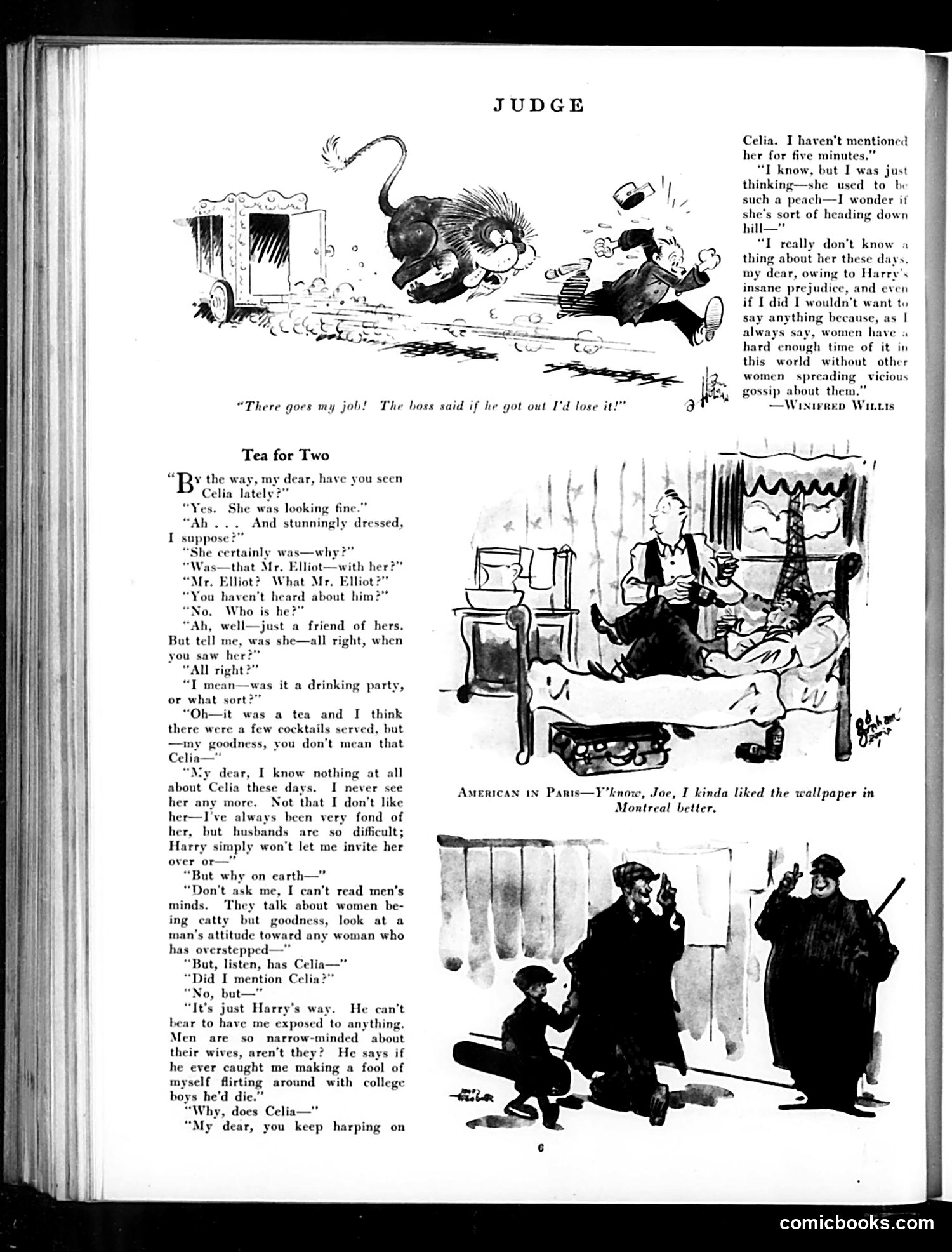
# Analysis of This Judge Magazine Page **Top Cartoon ("There goes my job!"):** A disheveled man flees as a monkey operating a mechanical device destroys his workspace. The caption suggests the monkey will outperform him. This satirizes widespread early-20th-century anxiety about automation and machines replacing workers—a common fear during industrialization. **"Tea for Two" Section:** A dialogue between two women gossiping about a third woman named Celia and her association with "Mr. Elliot." The conversation reveals anxieties about women's social behavior and propriety. The male speaker expresses controlling attitudes toward women, reflecting period attitudes about wives' social conduct and marital jealousy. **Other Illustrations:** Appear to depict social situations—a tea party and winter street scenes—supporting the gossip theme about proper social behavior.
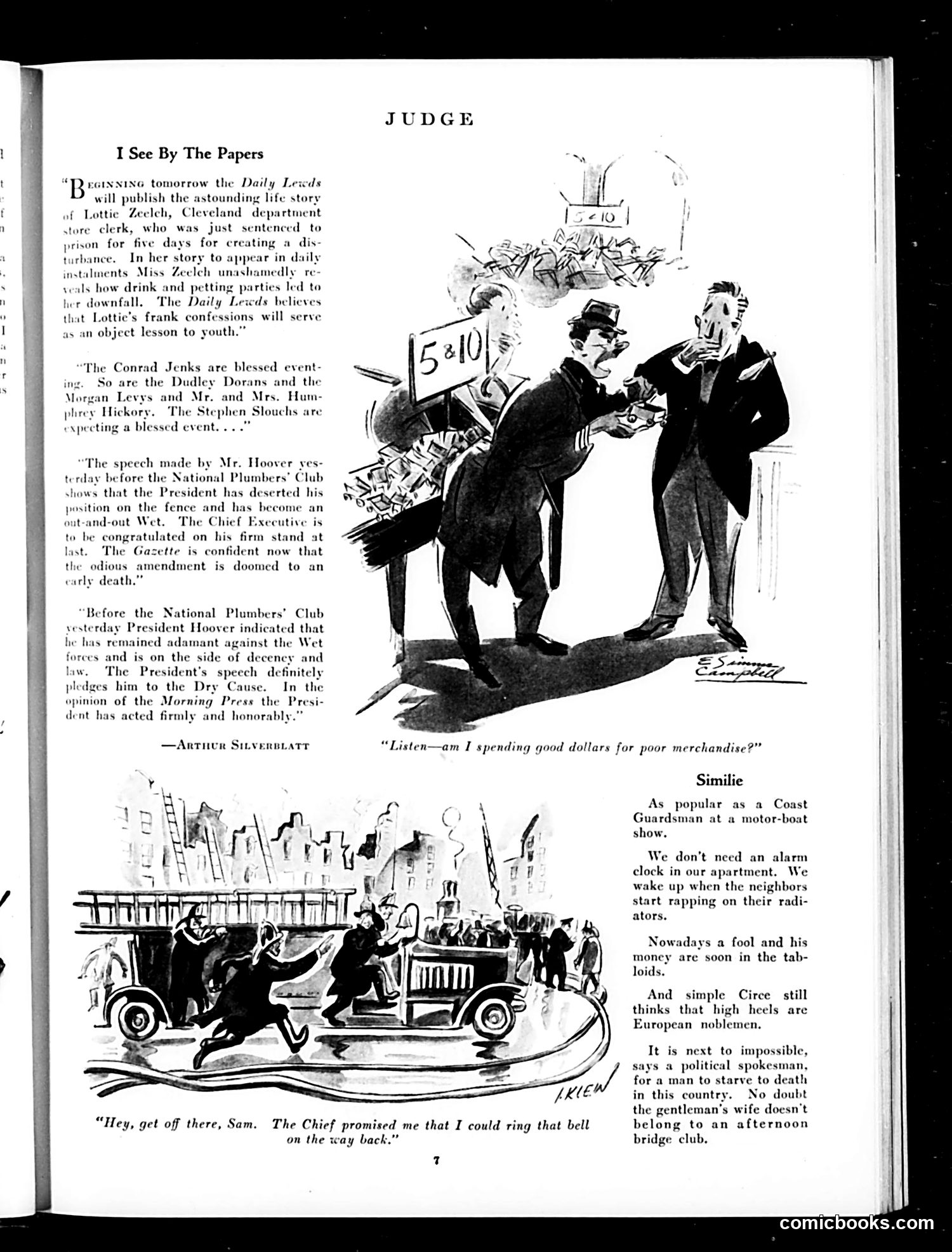
# Political Satire from Judge Magazine This page contains political commentary on Prohibition-era America. The top cartoon satirizes conflicting newspaper coverage: two papers report opposite interpretations of President Hoover's speech to the National Plumbers' Club—one claiming he opposes Prohibition ("Wet"), the other insisting he supports it ("Dry"). The joke exposes how the same speech could be spun to support contradictory positions, depending on the newspaper's bias. The lower cartoon depicts a chaotic scene at what appears to be a motor-boat show, likely mocking Prohibition enforcement or smuggling activity. The "Similie" section offers unrelated witty observations about contemporary social life—apartment living, foolish spending, fashion trends, and afternoon bridge clubs. The page is attributed to Arthur Silverblatt and illustrator Cesare Zimbalist. Without a visible date, the specific year remains unclear, though references to Prohibition and Hoover suggest the 1920s-early 1930s.
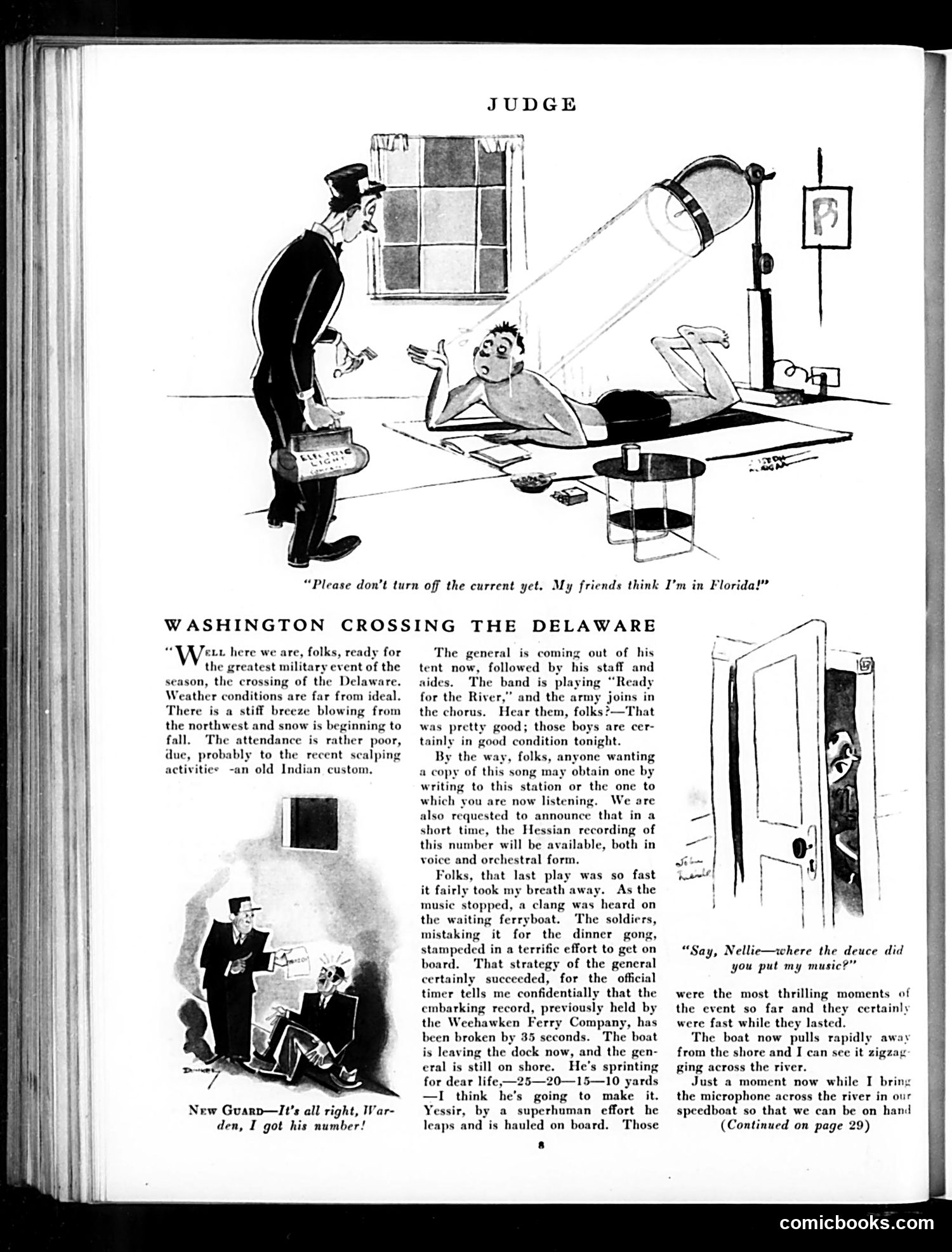
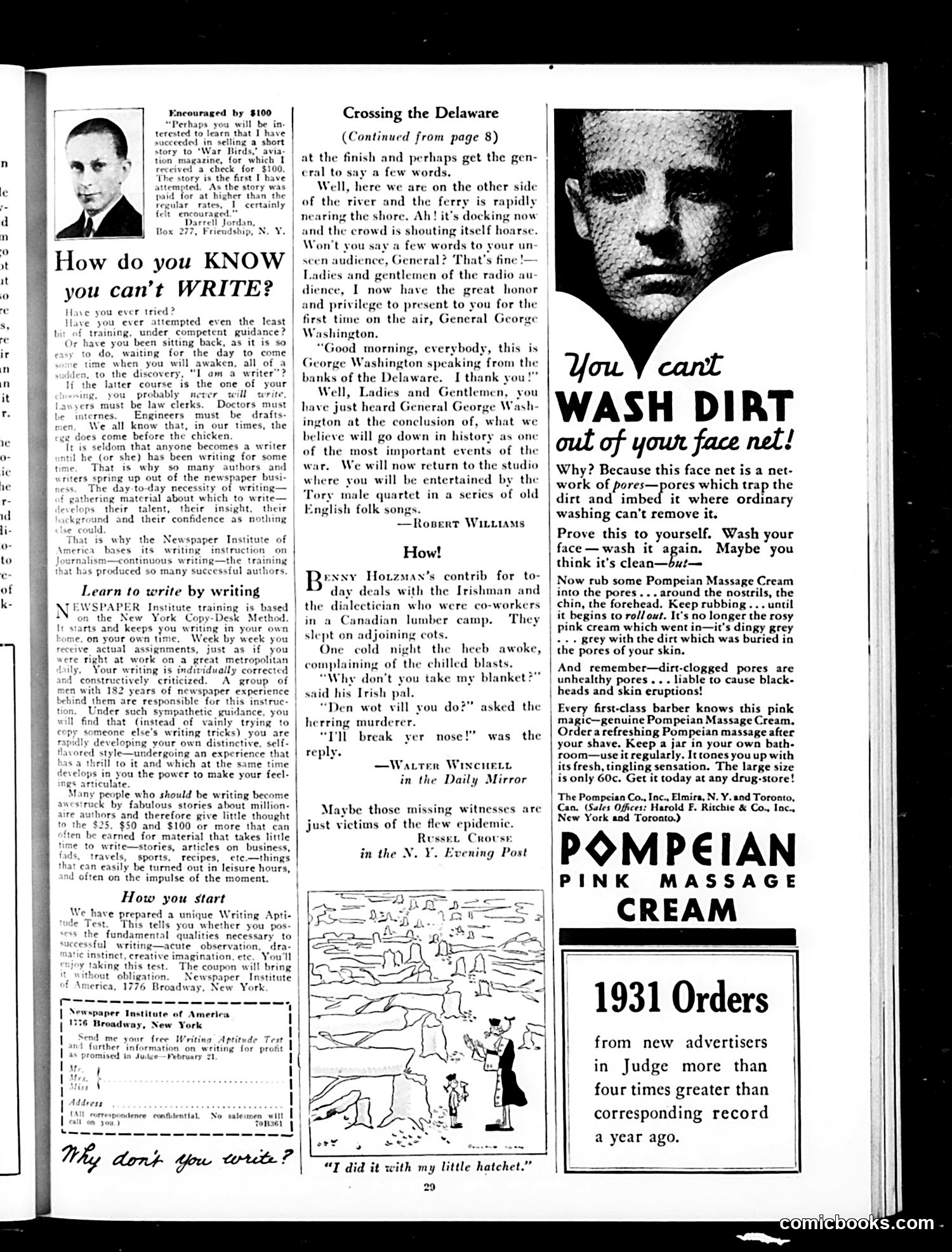
# Judge Magazine Satire Analysis This page satirizes modern radio broadcasts by reimagining Washington's famous 1776 Delaware crossing as a live sports event commentary. A judge figure operates an intense spotlight on a shirtless prisoner, with the caption "Please don't turn off the current yet. My friends think I'm in Florida!"—satirizing both radio's entertainment obsession and torture disguised as recreation. The main article parodies breathless radio sportscasting, complete with a commentator breathlessly narrating the military operation as if it were a game show. The humor derives from treating a historic military event as entertainment spectacle, with absurd details: soldiers stampeding for dinner, breaking ferry-loading records by 35 seconds, and the general nearly missing his own boat. This mocks 1920s-30s American culture's appetite for sensationalized radio broadcasts and the trivialization of serious events through entertainment media—treating history and even violence as consumer products.
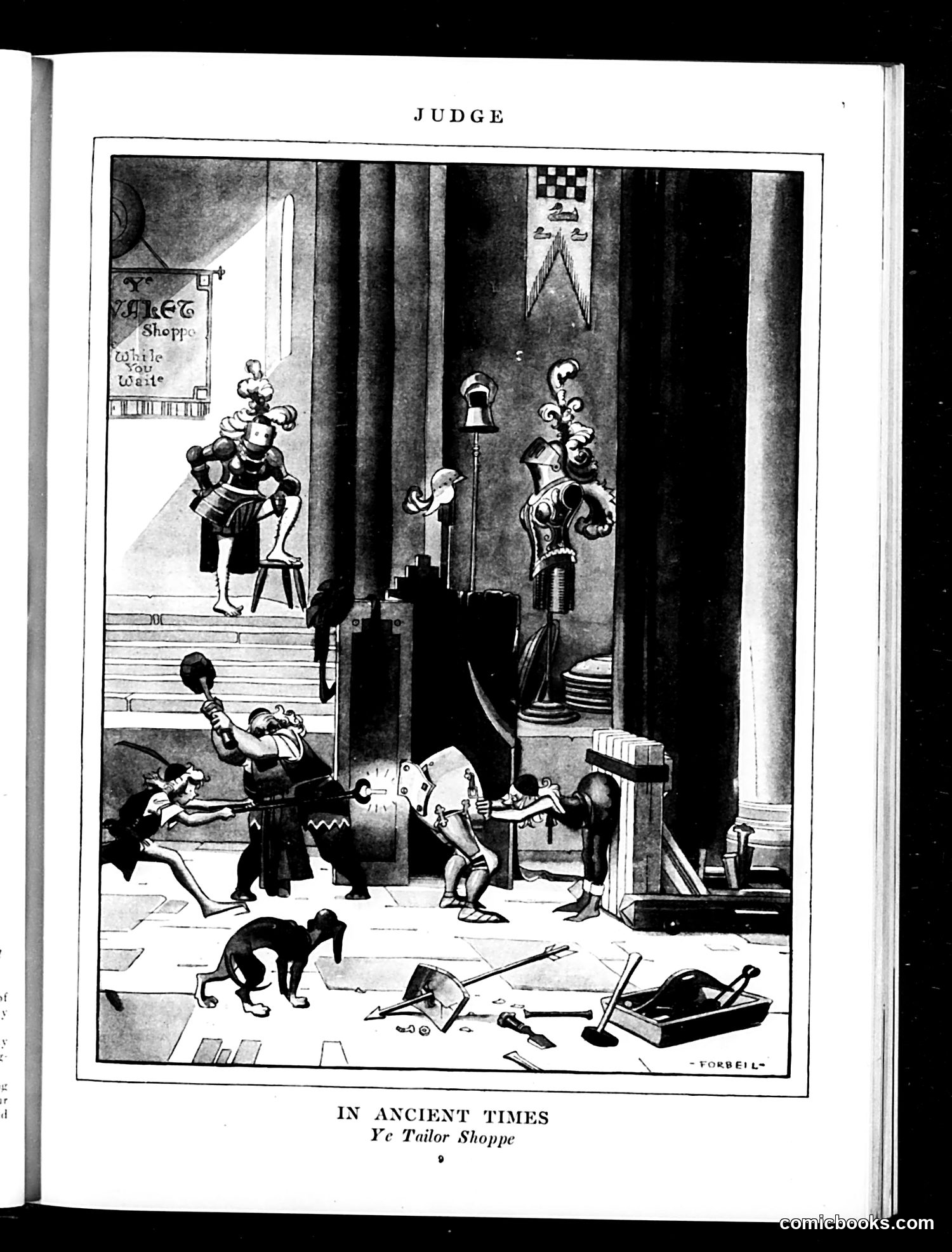
# "Judge" Cartoon: "In Ancient Times - Ye Tailor Shoppe" This satirical cartoon depicts a chaotic tailor's shop in medieval or ancient times. The scene shows multiple figures—apparently tailors and customers—engaged in various activities: measuring, fitting garments, and conducting business. A dog rummages through scattered tools and fabric on the floor. The humor appears to satirize the tailoring trade itself, possibly mocking tailors' incompetence, disorganization, or the messy nature of their work. The "ancient times" framing suggests a nostalgic or historical parody—perhaps implying tailoring practices haven't improved much, or commenting on contemporary tailors through historical analogy. The specific political or social target remains unclear without additional context about Judge magazine's 1920s-era concerns or contemporary tailoring industry issues.
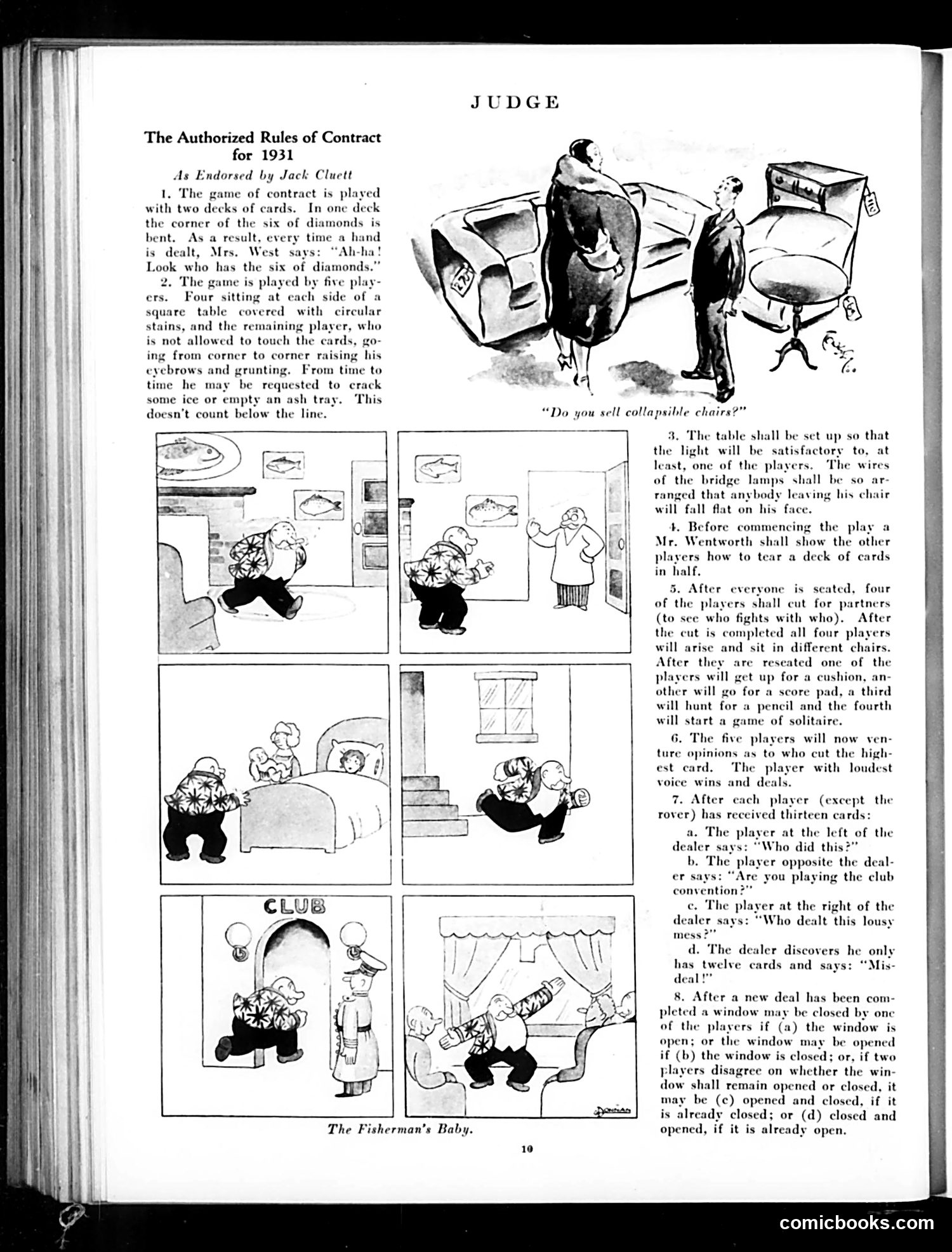
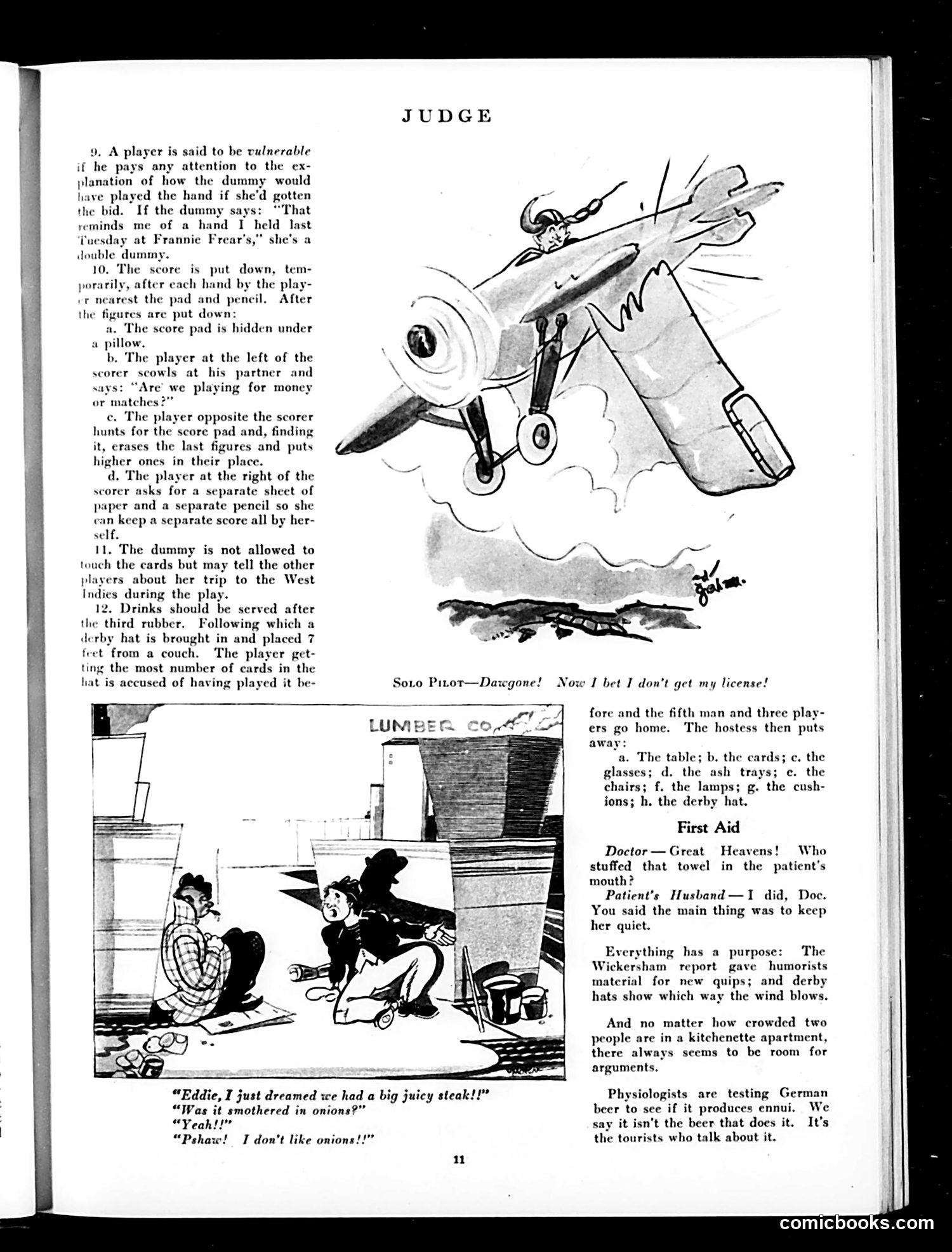
# Judge Magazine: "The Authorized Rules of Contract for 1931" This is satirical humor about **Contract Bridge**, the wildly popular card game of the 1930s. The text, "endorsed by Jack Cluett" (likely a contemporary figure), mocks the game's actual rules by describing absurdly dysfunctional gameplay instead. The jokes target: - **Cheating/suspicion**: A bent card that reveals who holds it - **Social chaos**: Five players instead of four; one stands awkwardly raising eyebrows - **Physical comedy**: Hazardous wiring that trips players; constant chair-switching for cushions, scorepads, pencils - **Petty argument**: Players loudly disputing who cut the highest card - **Incompetence**: Dealers miscounting cards; endless bickering about whether to open/close windows The accompanying comic panels show portly figures in domestic chaos—a visual gag depicting real-life bridge games as suburban pandemonium rather than genteel entertainment. The satire mocks both the game's popularity and the social pretensions of players treating casual cards as serious business.