
Judge, 1931-02-21 · page 15 of 36
Judge — February 21, 1931 — page 15: what you’re looking at
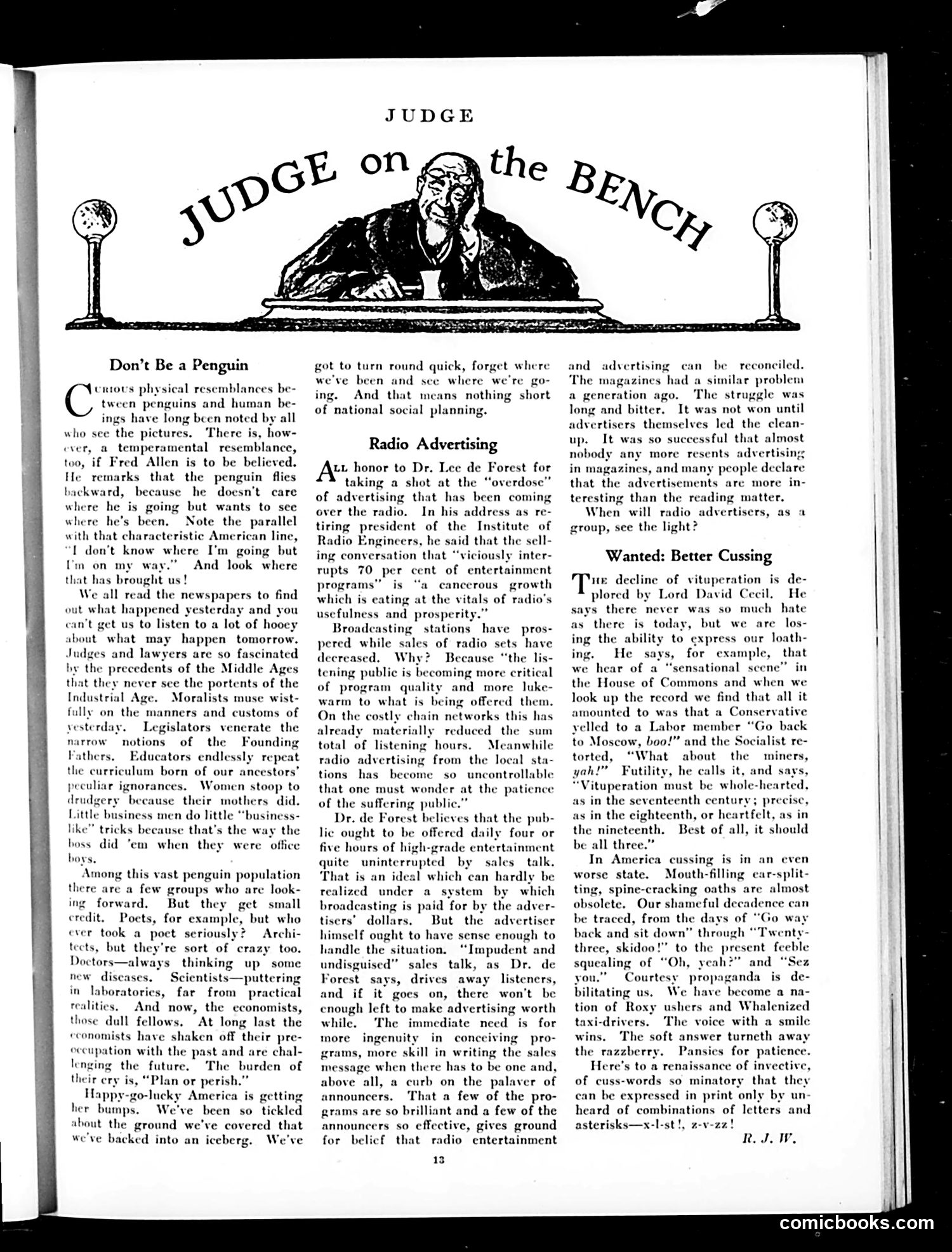
A restored page from Judge, 1931-02-21. Page through the whole issue in the reader above.
📄 Transcribed text from this page (OCR, searchable)
Machine-transcribed from the original scan — historical spelling and the odd misread are preserved.
Don’t Be a Penguin crtovs physical resemblances be- C tween penguins and human be ings have long been noted by all who see the pictures. There is, how- ever, a temperamental resemblance, too, if Fred Allen is to be believed. He remarks that the penguin flies backward, because he doesn’t care where he is going but wants to see where he’s been, Note the parallel with that characteristic American line, I don’t know where I'm going but I'm on my way.” And look where that has brought us! We all read the newspapers to find out what happened yesterday and you can’t get us to listen to a lot of hooey ibout: what may happen tomorrow. Judges and lawyers are so fascinated by the precedents of the Middle Ages that they never see the portents of the Industrial Age. Moralists muse wist- fully on the manners and customs of yesterday, Legislators venerate the narrow notions of the Founding Fathers, Educators endlessly repeat the curriculum born of our ancestors’ peculiar ignorances. Women stoop to drudgery because their mothers did. Little business men do little “business- like” tricks because that’s the way the boss did ‘em when they were office boys. Among this vast penguin population there are a few groups who are look- ing forward. But they get small credit. Poets, for example, but who ever took a poct seriously? Archi- tects, but they're sort of crazy too. Doctors—always thinking up some new diseases. Scientists—puttering in laboratories, far from practical realities. And now, the economists, those dull fellows, At long last the economists have shaken off their pre- occupation with the past and are chal- lenging the future. The burden of their cry is, “Plan or perish.” Happy-go-lucky America is g her bumps. We've been so tickled about the ground we've covered that we've backed into an iceberg. We've ting got to turn round quick, forget where “ve been and see where we're go- ing. And that means nothing short of national social planning. Radio Advertising tt honor to Dr. Lee de Forest for taking a shot at the “overdose” of advertising that has been coming over the radio. In his address as re- tiring president of the Institute of Radio Engineers, he said that the sell- ing conversation that “viciously inter- rupts 70 per cent of entertainment programs” is wh “a cancerous growth ing at the vitals of radio's usefulness and prosperity.” Broadcasting stations have pros- pered while sales of radio sets have decreased. Why? Because “the lis- tening public is becoming more critical of program quality and more lu warm to what is being offered them. On the costly chain networks this h: materially reduced the sum ning hours. Meanwhile radio advertising from the local st tions | become so uncontrollable that one must wonder at the ps of the suffering public.” Dr. de Forest believes that the pub- lic ought to be offered daily four or five hours of high-grade entertainment quite uninterrupted by sales talk. That is an ideal which can hardly be is ea ience realized under a system by which broadcasting is paid for by the adver- tisers’ dollars, But the advertiser himself ought to have sense enough to handle the situation. ‘“Impudent and undisguised” sales talk, as Dr. de Forest says, drives away listeners, and if it goes on, there won't be enough left to make advertising worth while. The immediate need is for more ingenuity in conceiving pro- ms, more skill in writing the sales ge when there has to be one and, above all, a curb on the palaver of announcers. That a few of the pro- grams are so brilliant and a few of the announcers so effective, gives ground for belief that radio entertainment 13 and advertising can be reconciled. ‘The magazines had a similar problem a generation ago. The struggle was long and bitter. It was not won until advertisers themselves led the clean- up. It was so successful that almost nobody any more resents advertising in magazines, and many people declare that the advertisements are more in- teresting than the reading matter. When will radio advertisers, as a group, see the light? Wanted: Better Cussing Tt decline of vituperation is de- plored by Lord David Cecil. He s there never was so much ha y, but we are los- ing the ability to express our loath- ing. He says, for example, that we hear of a “sensational scene” in the House of Commons and when we look up the record we find that all it amounted to was that a Conservative yelled to a Labor member “Go back to Moscow, boo!” and the Socialist re- torted, “What about the miners, yah!” Futility, he calls it, and says, “Vituperation must be whole-hearted, as in the seventeenth century; precise, s in the eighteenth, or heartfelt, as in the nineteenth. Best of all, it should be all three.” In America cussing is in an even worse state. Mouth-filling ear-split- ting, spine-cracking oaths are almost obsolete. Our shameful decadence can io way through “Twenty- skidoo!” to the present feeble squealing of “Oh, y you.” Courtesy propaganda is de- bilitating us. We have become a na- tion of Roxy ushers and Whalenized taxi-drivers. The voice with a smile wins. The soft answer turneth away the razzberry. Pansies for patience. Here's to a renaissance of invective, of cuss-words so minatory that they can be expressed in print only by un heard of combinations of letters and asterisks—x-l-st!, z-v-zz! sa as there is to be traced, from the days of back and sit dow thre R.ILW, comicbooks.com