
Judge, 1931-02-21 · page 22 of 36
Judge — February 21, 1931 — page 22: what you’re looking at
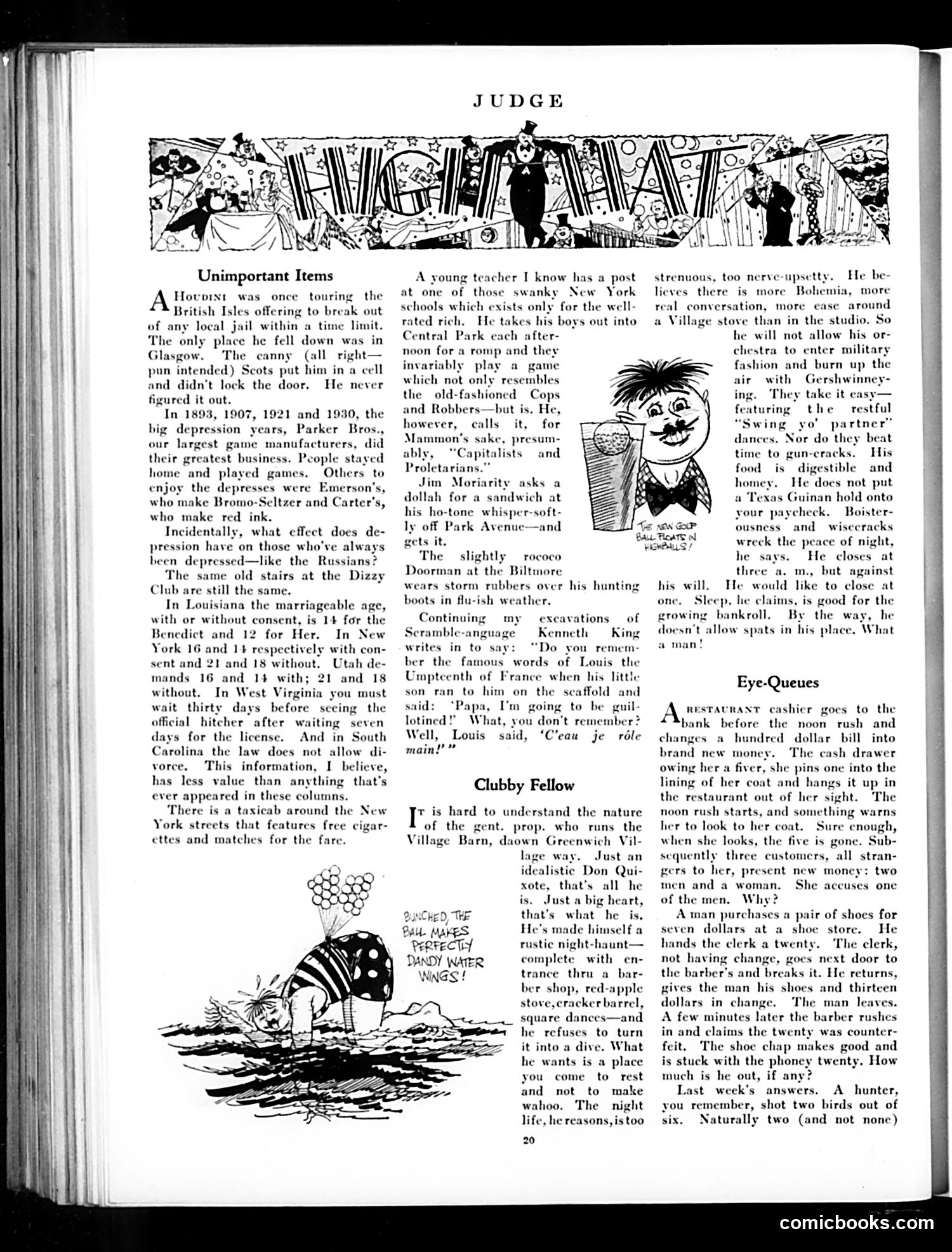
A restored page from Judge, 1931-02-21. Page through the whole issue in the reader above.
📄 Transcribed text from this page (OCR, searchable)
Machine-transcribed from the original scan — historical spelling and the odd misread are preserved.
Unimportant Items Hovpint was once touring the British Isles offering to break out of any local jail within a time limit. The only place he fell down was in Glasgow. The canny (all right— pun intended) Scots put him in a cell and didn't lock the door. He never figured it out. In 1893, 1907, 1921 and 1930, the big depression years, Parker Bros., our largest game manufacturers, did their greatest business. People stayed home and played games. Others to enjoy the depresses were Emerson's, who make Bromo-Seltzer and Carter's, who make red ink, Incidentally, what effect does de- pression have on those who've always heen depressed—like the Russians? The same old stairs at the Dizzy Club are still the same, In Louisiana the marriageable age, with or without consent, is 14 for the Benedict and 12 for Her. In New York 16 and 14 respectively with con- sent and 21 and 18 without. Utah de- mands 16 and 14 with; 21 and 18 without. In West Virginia you must wait thirty days before seeing the official hitcher after waiting seven days for the license. And in South Carolina the law does not allow di- vor This information, I believe, has less value than anything that's ever appeared in these columns. There is a taxicab around the N York streets that features free c ettes and matches for the fare. A young teacher I know has a post at one of those swanky New York schools which exists only for the well- rated rich, He takes his boys out into Central Park each after- noon for a romp and they invariably play a game which not only resembles the old-fashioned Cops and Robbers—but is. He, however, calls it, for Mammon’s sake, presum- a Capitalists and Jim rity asks a dollah for a sandwich at his ho-tone whisper-soft- ly off Park Avenue- it. The slightly rococo Doorman at the Biltmore wears storm rubbers over his hunting boots in flu-ish weather. and Continuing mye Scrambl uage writes in to. s: “Do you remem: ber the famous words of Louis the Umpteenth of France when his little son ran to him on the scaffold and said: ‘Papa, I'm going to be guil- lotined!’) What, you don't rememt Well, Louis said, ‘C’eau je main!’ ”” tions of Kenneth — King role Clubby Fellow ‘tv is hard to understand the nature of the gent. prop. who runs ¢ Village Barn, daown Greenwich V xote, that’s all he is. Just a big heart, that’s what he is. He's made himself a rustic night-haunt— complete with en- trance thru a bar- ber shop, red-apple stove, cracker barrel, square dances—and he refuses to turn it into a dive. What he wants is a place you come to. rest and not to make wahoo. The night life, he reasons, is too 20 strenuous, too nerve-upsett Bohem more al conversation, more ease around a Village stove than in the studio. So he will not allow his or- chestra to enter military fashion and burn up the air with Gershwinney: ing. They take it easy— the — restful ng yo’ partner” dances. Nor do they beat time to gun-cracks. His food is digestible and He does not put Guinan hold onto your paycheck. Boister- ousness and wisecracks wreck the peace of night, he says. He closes at three a. m., but against He would like to close at Sleep, he claims, is good for the growing bankroll. By the way, he doesn’t allow spats in his place. Whe aman! lieves there is more his will. one, Eye-Queues A RESTAURANT cashier goes to the bank before the noon rush and nges a hundred dollar bill into brand new money. The cash drawer owing her a fiver, she pins one into the lining of her coat and hangs it up in the restaurant out of her sight. The noon rush starts, and something warns her to look to her e Sure enough, when she looks, the five is gone. Sub- sequently three customers, all stran- gers to her, present new money: two men and a woman. of the men, Why? Aman purchases a pair of shoes for seven dollars at a shoe store. He nds the clerk a twenty. The clerk, not having change, goes next door to the barber's and breaks it. He returns, gives the man his shoes and thirteen dollars in change. The man leaves. A few minutes later the barber rushes in and claims the twenty was counter- feit. The shoe chap makes good and is stuck with the phoney twenty. How much is he out, if any? Last week's answers. A hunter, you remember, shot two birds out of six. Naturally two (and not none) She accuses one comicbooks.com