
Judge, 1931-02-21 · page 25 of 36
Judge — February 21, 1931 — page 25: what you’re looking at
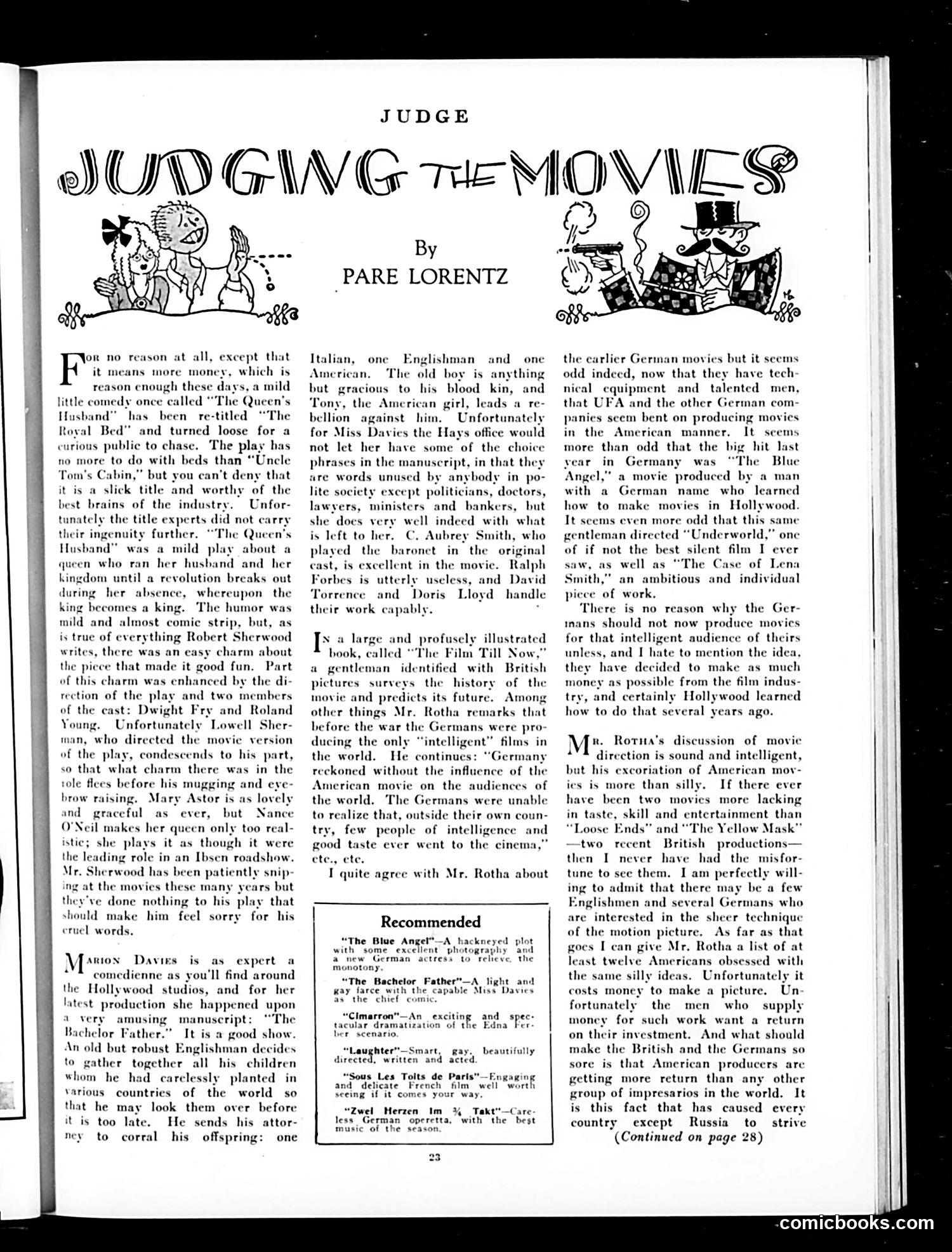
A restored page from Judge, 1931-02-21. Page through the whole issue in the reader above.
📄 Transcribed text from this page (OCR, searchable)
Machine-transcribed from the original scan — historical spelling and the odd misread are preserved.
on no reason at all, except that F it means more money, which is reason cnough these i little comedy once called * Husband” has been re-titled Royal Bed” and turned loose for a curious public to chase. The play has » more to do with beds than “Uncle n’s Cabin,” but you can’t deny that slick title and worthy of the best brains of the industry. Unfor- tunately the title experts did not their ingenuity further. it is queen who ran her husband and her kingdom until a revolution breaks out during her absence, whereupon the king becomes a king. The humor was mild and almost comic strip, but, as is true of everything Robert Sherwood writes, there was an easy charm about the piece that made it good fun. Part of this charm was enhanced by the di- rection of the play and two members of the cast: Dwight Fry and Roland Young. Unfortunately Lowell Sher- man, who directed the movie version of the play, condescends to his part, so that what charm there in the le flees before his mugging and eve- brow raising. Mary Astor is as lovel ind graceful as but Nance O'Neil makes her queen only too real- istic; she plays it as though it were the leading role in an Ibsen roadshow. Mr. Sherwood has been patiently snip ng at the movies these many years but they've done nothing to his play that should make him feel sorry for his eruel words. Maes Davies is as expert a +" comedienne as you'll find around the Hollywood studios, and for her latest production she happened upon \ very amusing manuscript: ‘The Bachelor Father.” It is a good show. An old but robust Englishman decides to gather together all his children whom he had carelessly planted in countries of the world so that he may look them over before it is too late. ney to ever, Various He sends his attor- corral his offspring: one JUDGE Italian, one Englishman and American. The old boy is anything but gracious to his blood kin, and Tony, the American girl, leads a re- bellion against him. Unfortunately for Miss Davies the Hays office would not let her have some of the choi phrases in the manuscript, in that they ure words unused by anybody in po- lite soc pt politicians, doctors, lawyers, ministers and bankers, but she does very well indeed with what is left to her. C, Aubrey Smith, who played the baronet in the original st, is excellent in the movie. Ralph Forbes is utterly useless, and David Torrence and Doris Lloyd handle their work capably. . one wa large and profusely illustrated book, called “The Film Till Now,” a gentleman identified with British pictures surveys the history of the movie and predicts its future, Among other things Mr. Rotha remarks that before the war the Germans were pro- ducing the only “intelligent” films in the world. He continucs: “Germany reckoned without the influence of the American movie on the audiences of the world. The Germans were unable ¢ that, outside their own coun- few people of intelligence and good taste ever went to the cinema,” ete., ete. I quite agree with Mr. Rotha about Recommended he Blue Anget*—A hackneyed plot with some excellent photography and a new German actress to reheve the monotony. “The Bachelor Father"—A light and way farce with the capable Miss Davies as the chief comic “Cimarron”—An tacular dramatiz. her scenario. exciting and spec- n of the Edna Fer “Laughter"—Smart, gay, beautifully directed, written and acted. “Sous Les Toits de Paris"—Engaging and delicate French film well worth seeing if it comes your way, “Zwel Merzen Im % less German oper music of the season. 4 Takt"—Care ta, with the best the earlier Gerinan movies but it s odd indeed, now that they have tech nical equipment and talented men, that UFA and the other German com- panies scem bent on producing movies in the American manner. It seems more than odd that the big hit last year in’ Germany “The Blue ‘Angel,” a movie produced by a man with a German name who learned how to make movies in Hollywood. It scems even more odd that this same gentleman directed “Underworld,” one of if not the best silent film I ever as well as “The of Lena "an ambitious individual piece of work. There is no reason why the Ger- inans should not now produce movies for that intel t audience of theirs unless, and I hate to mention the idea they have decided to make as much money as possible from the film indus- try, and certainly Hollywood learned how to do that several years ago. M rn. Rotia's discussion of movie 4"* direction is sound and intelligent, but his excoriation of American mov- ies is more than silly. If there ever have been two movies more lacking in taste, skill and entertainment than “Loose Ends” and “The Yellow Mask” two recent British productions— then I never have had the misfor- tune to see them. I am perfectly will- ing to admit that there may be a few Englishmen and several Germans who are interested in the sheer technique of the motion picture. As far as that gocs I can give Mr. Rotha a list of at least twelve Americans obsessed with the same silly ide: Unfortunately it costs money to make a picture. Un fortunately the men who supply money for such work want a return on their investment. And what should make the British and the Germans so sore is that American producers are getting more return than any other group of impresarios in the world. It is this fact that has caused every country except Russia to strive (Continued on page 28) was and -comicbooks.com