
Judge, 1931-02-21 · page 18 of 36
Judge — February 21, 1931 — page 18: what you’re looking at
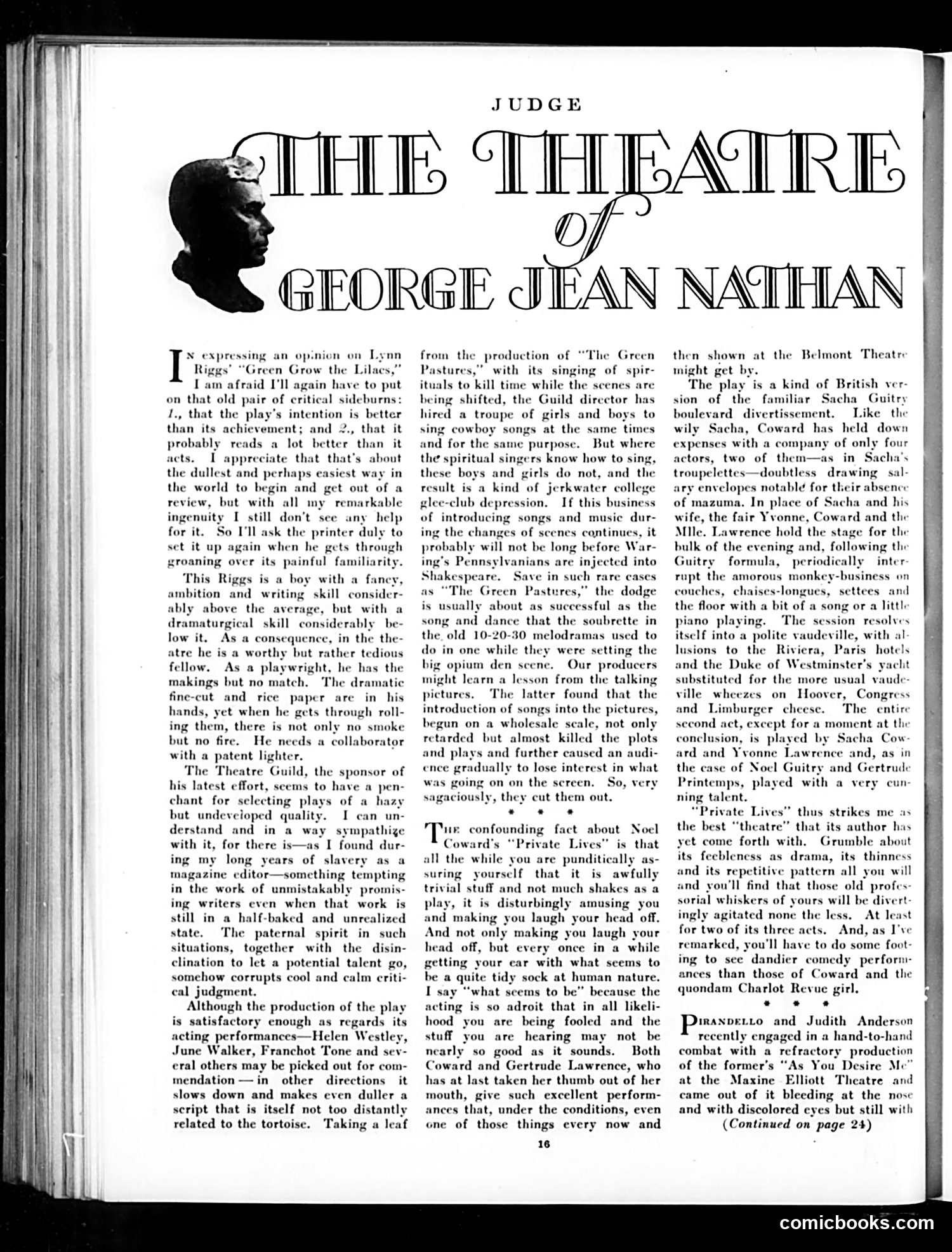
A restored page from Judge, 1931-02-21. Page through the whole issue in the reader above.
📄 Transcribed text from this page (OCR, searchable)
Machine-transcribed from the original scan — historical spelling and the odd misread are preserved.
JUDGE O GEORGE J N expressing an opinion on L. I Riggs’ “Green Grow the Lilacs,” I am afraid I'll a, have to put on that old pair of critical sideburns: 1., that the play's intention is better than its achievement; and 2., that it probably reads a lot better than it acts. I appreciate that that’s about the dullest and perhaps easiest way in the world to begin and get out of a review, but with all my remarkable ingenuity I still don’t see any help for it. So I'll ask the printer duly to set it up again when he gets through groaning over its painful familiarity. This Riggs is a boy with a fancy, ambition and writing skill consider- ably above the av but with a dramaturgical skill considerably be- low it. As a consequence, in the the- atre he is a worthy but rather tedious fellow. As a playwright, he has the makings but no match. ‘The dramatic fine-cut and rice paper are in his hands, yet when he gets through roll- ing them, there is not only no smoke but no fire. He needs a collaborator with a patent lighter. The tre Guild, the sponsor of his latest effort, seems to have a pen- chant for selecting plays of a haz, but undeveioped quality. [can un- derstand and in a way sympathige with it, for there is—as I found dur- ing my long years of slavery as a magazine editor—something tempting in the work of unmistakably promis- ig writers even when that work is still in a half-baked and unrealized state. The paternal spirit in’ such situations, together with the disin- clination to let a potential talent go, somehow corrupts cool and calm criti- cal judgment. Although the production of the play is satisfactory enough as regards its ng performances—Helen Westley, June Walker, Franchot Tone and sev- eral others may be picked out for con mendation—in other directions it slows down and makes even duller a script that is itself not too distantly related to the tortoise. Taking a leaf from the production of “The Green Pastures,” with its singing of spir- ituals to kill time while the scenes are being shifted, the Guild director has hired a troupe of girls and boys to sing cowboy songs at the same times and for the same purpose. But where the spiritual singers know how to sing, these boys and girls do not, and the result is a kind of jerkwater college glee-club depression. If this business of introducing songs and music dur- ing the changes of scenes continues, it probably will not be long before War- ing’s Pennsylvanians are injected into Shakespeare. Save in such rare cases “The Green Pastures,” the dodge is usually about as successful as the song and dance that the soubrette in the old 10. 0 melodramas used to do in one while they were setting the big opium den scene. Our producers might learn a lesson from the talking pictures. The latter found that the introduction of songs into the pictures, begun on a wholesale scale, not only retarded but almost killed the plots and plays and further caused an audi- ence gradually to lose interest in what was going on on the sercen. So, very sagaciously, they cut them out. * 8 T tr confounding fact about Noel Coward's “Private Lives” is that all the while you are punditically as- suring yourself that it is awfully trivial stuff and not much shakes as a play, it is disturbingly amusing you and making you laugh your head off. And not only making you laugh your head off, but every once in a while getting your car with what seems to be a quite tidy sock at human nature. I say “what seems to be” because the acting is so adroit that in all likeli- hood you are being fooled and the stuff you are hearing may not be nearly so good as it sounds. Both Coward and Gertrude vrence, who has at last taken her thumb out of her mouth, give such excellent perform- ances that, under the conditions, even one of those things every now and 16 ACRE: NACTHIAN then shown at the Belmont Theatre might get by The play is a kind of British ver- sion of the familiar Sacha Guitry boulevard di ement. Like the wily Sacha, Coward has held down expenses with a company of only four actors, two of them acha’s troupelettes—doubtless drawing. sal- ary envelopes notabld for their absence of mazuma. In place of Sacha and his wife, the fair Yvonne, Coward and thic Mile. Lawrence hold the st for the bulk of the evening and, following th: Guitry formula, periodically inter rupt the amorous monkey-business on couches, chaises-longues, settees and the floor with a bit of a song or a littl: piano playing. The session re itself into a polite vaudeville, with al lusions to the Riviera, Paris hotels and the Duke of Westminster’s yaclit substituted for the more usual vaude- ville wheezes on Hoover, Congress and Limburger cheese. The entire second act, except for a moment at the conclusion, is played by Sacha Cow ard and Yvonne Lawrence : e case of Noel Guit Printemps, played with a very cun- ning talent. “Pri -ives” the best thus strikes me as at its author has Grumble about drama, its thinness and its repetitive pattern all you will and you'll find that those old profes- sorial whiskers of yours will be di ingly agitated none the less. At le for two of its three acts. And, as I've remarked, you'll have to do some foot- ing to see dandier comedy perform- ances than those of Coward and the quondam Charlot Revue girl. * 8 «© manpeELLO and Judith Anderson recently engaged in a hand-to-hand combat with a refractory production of the former’s “As You Desire Me” at the Maxine Elliott Theatre and came out of it bleeding at the nos and with discolored eyes but still with (Continued on page 24) comicbooks.com