
Judge, 1931-02-21 · page 28 of 36
Judge — February 21, 1931 — page 28: what you’re looking at
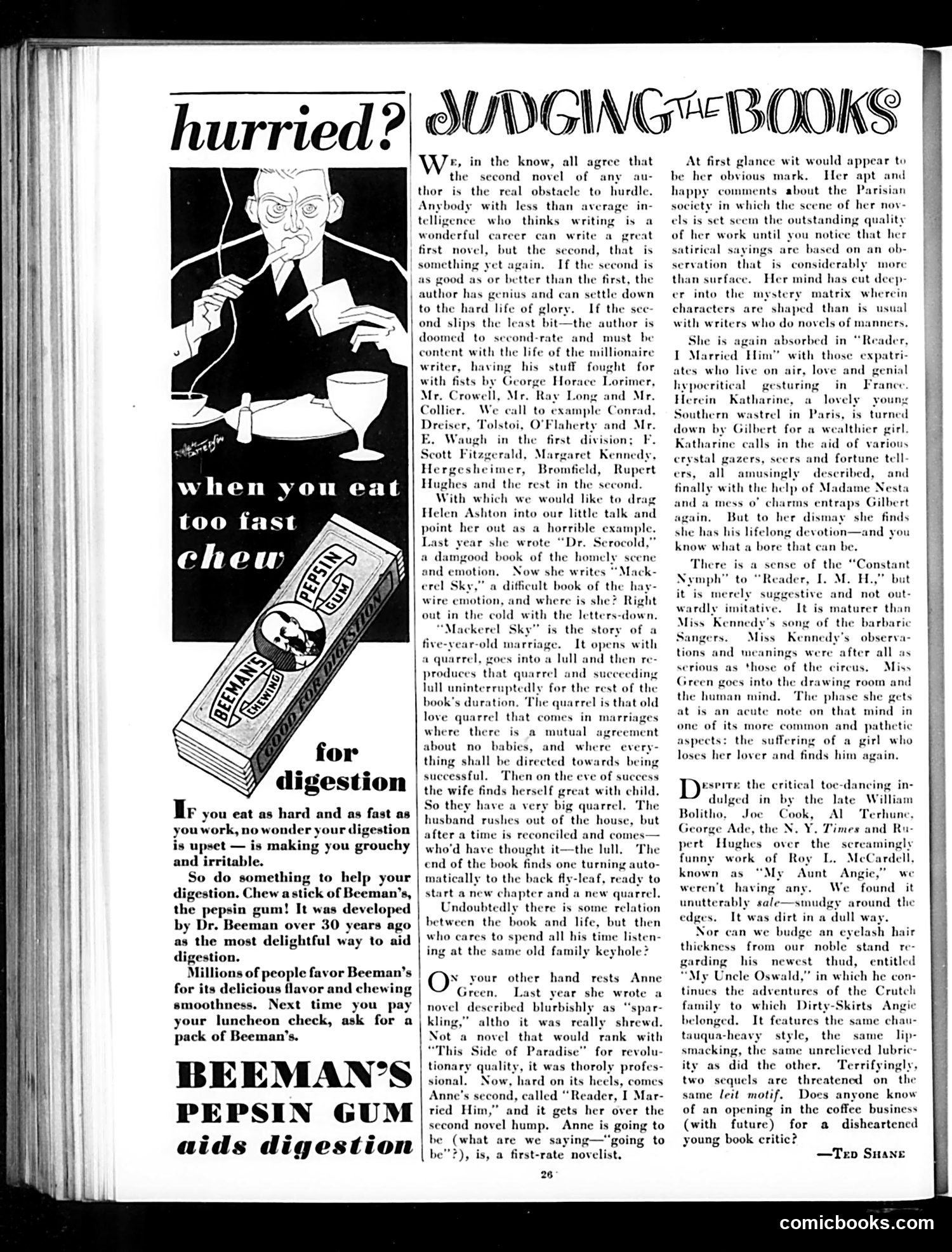
A restored page from Judge, 1931-02-21. Page through the whole issue in the reader above.
📄 Transcribed text from this page (OCR, searchable)
Machine-transcribed from the original scan — historical spelling and the odd misread are preserved.
hurried: ? when too fast Ir you eat as hard and as fast as you work, no wonder your digestion is upset — is making you grouchy and irritable. So do something to help your digestion. Chew a stick of Beeman’s, the pepsin gum! It was developed by Dr. Beeman over 30 years ago as the most delightful way to aid digestion. Millions of people favor Beeman’s for its delicious flavor and chewing smoothness. Next time you pay your luncheon check, ask for a | pack of Beeman’s. BEEMAN’S PEPSIN GUM aids digestion AUDGING BOOKS | W" in the know, all agree that the second novel of any au- thor is the real obstacle to hurdle. Anybody with less t erage in- telligence who thinks writing wonderful career c write a first novel, but the second, something yet again, If the sec as good as “or better than the first, the author has genius and can settle down to the hard life of glory. If the sec- ond slips the least bit—the author is doomed to second-rate and must be content with the life of the millionaire writer, having stuff fought for with fists by G Horace Lorimer, Mr. Crowell, nd Mr. his rorge Mr. I Collier. We call to mple Conrad, Dreiser, Tolstoi, O'Flaherty and Mr. in the first division; PF. E. Waugh Scott Fitz ald, A Hergesheimer, Bromfield, Rupert Hughes and the rest in the second. With which we would lik Helen Ashton into our little point her out as a horrible ex Last year she wrote “Dr. Serocold,” od book of the homely scene Now she writes “Mack- difficult book of the hay- wire emotion, and where is she? Right out in the cold with the letters-down, ckerel Sky” is the story of a ur-old marriage. It opens with rrel, goes into a lull and then re- produces that quarrel and succeeding lull uninterruptedly for the rest of the book's duration, The quarrel is that old love quarrel that comes i where there is a mutual about no babies, and where Margaret Ke every: thing shall be directed towards being successful. Then on the eve of success the wife finds herself great with child. So they have a very big quarrel. The husband rushes out of the house, but after a time is reconciled and comes— who'd e thought it—the lull. The end of the book finds one turning auto- matically to the back fly-leaf, ready to start a new chapter and a new qu 5 Undoubte there is some relation between the book who cares to spenc i 1 life, but then | his time listen- at the same old family keyhole? Ox other hand rests Anne Green, Last year she wrote a novel described blurbishly as ‘ kling,” altho it really shrewd. opt a novel that would rank with This Side of Paradise” for revolu- tionary quality, it was thoroly profes- sion. N ard on its heels, comes Anne's second, called “Reader, I Mar- tied Him,” and it gets her over the second novel hump, Anne is going to be (what are we saying—‘going to your be" ?), is, a first-rate novelist. 26 At first glance wit would appear to be her obvious mark. Her apt and happy comments about the Pari society in which the scene of her nov- ely is set seem the outstanding quality of her work until you notice that her satirical sayir servation that than surface. n ob- considera more Her mind has cut deep- er into the mystery matrix wherein characters shaped than is usual with writers who do novels of manners, She is again absorbed in “Reader, I Married Him” with those expatri- ates who live on air, love and genial hypocritical gesturing in France. Herein Katharine, a lovely young Southern wastrel in Paris, is turned down by Katharine calls in the aid of various crystal gazers, seers and fortune tell ers, all amusingly described, and finally with the help of Madame Nesta and »s Gilbert she finds are ilbert for a wealthier girl, mess 0° charms ¢ n. But to her dismay she has his lifelong devot know what a bore that can be. a sense of the ‘ Nymph” to “Reader, I. M. H it is merely suggestive and not out- wardly imitative. It is maturer than Miss Kennedy's song of the barbaric Miss Kennedy's observa- and meanings were after all as of the circus. Miss goes into the drawing room and human mind. The phase she gets There is rs. tions serious as those at is an acute note on that mind in one of its more common and pathetic aspects: the suffering of a girl who loses her lover and finds him again, | yeseite the critical toe- Bolitho, G erhune, rge Ade, the N.Y. Times and Ru- pert Hughes over the sereamingly funny work of Roy L. MeCardeli, known as “My Aunt Angie,” we weren't having any. We found it unutterably sale—smui around the edges. It was dirt in a dull way. Nor can we budge an eyelash hair thickness from our noble stand re- arding his newest thud, entitled “My Uncle Oswald,” in which he con- tinues the adventures of the Crutch family to which Dirty-Skirts Angie belonged. It features the same chau- tauqua-heavy style, the same lip- smacking, the same unrelieved lubric- ity as did the other. Terrifyingly, two sequels are threatened on the same leit motif. Does anyone know of an opening in the coffee business (with future) for a disheartened young book critic? —Tep Suane comicbooks.com