A complete issue · 36 pages · 1930
Judge — May 24, 1930
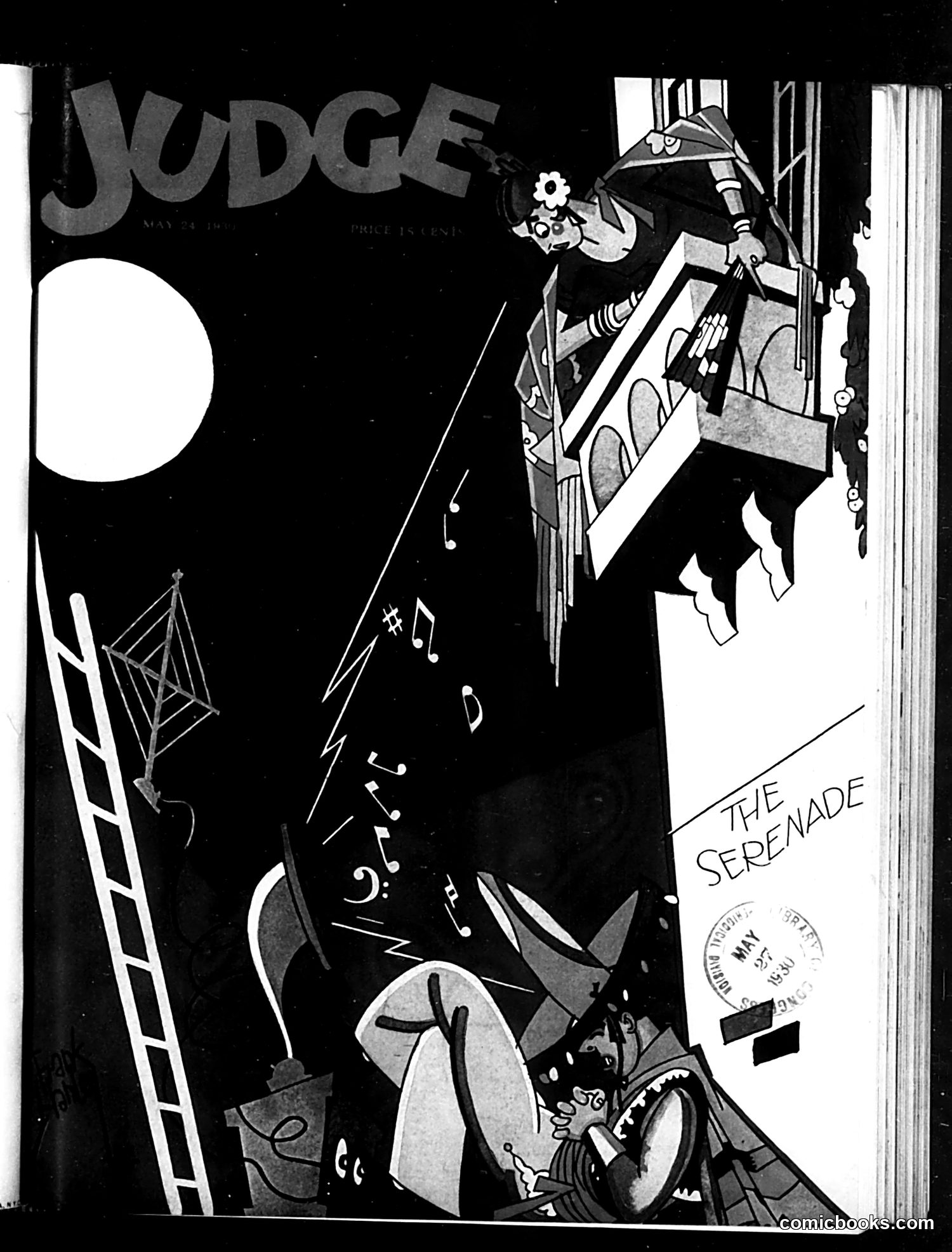
# Analysis of "The Serenade" from Judge Magazine This satirical cartoon depicts a nighttime serenade scene with musical notation floating through the air. A figure plays an instrument beneath a window while another figure leans out from above. The composition suggests romantic comedy—a classic "serenade" trope where a suitor performs beneath a lover's window. The satire likely mocks either romantic pretension or the melodramatic nature of such displays. The exaggerated musical notes and the somewhat absurd positioning of the figures suggest ridicule of overly theatrical romantic gestures popular in the era when this appeared. Without additional context or visible dates, the specific target remains unclear, but Judge magazine's typical approach was skewering American social affectations and sentimental behavior through visual humor.
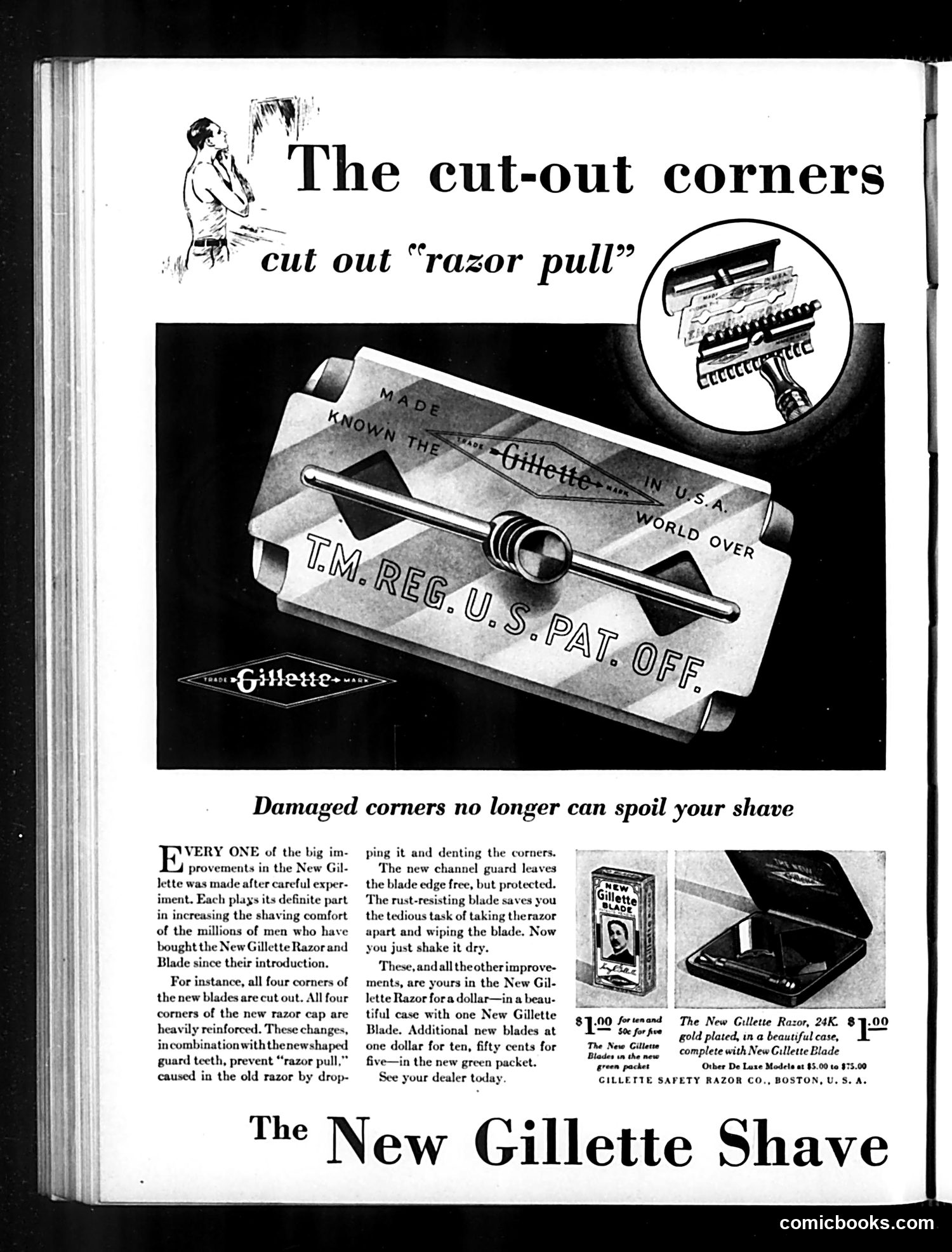
# Analysis This is **not a political cartoon or satire page**—it's a **Gillette razor advertisement** from an era when Judge magazine accepted commercial advertising alongside editorial content. The ad promotes Gillette's "New Gillette Shave" by highlighting a specific product innovation: reinforced cut-out corners on the razor blade case to prevent "razor pull" (a common problem where damaged blade corners caused pulling during shaving). The illustration shows the protective channel guard and emphasizes that this design improvement prevents the blade from being damaged during removal and use. The ad positions this as one of several recent improvements in the New Gillette razor, sold for one dollar with additional blades available cheaply. There is no political satire present on this page.
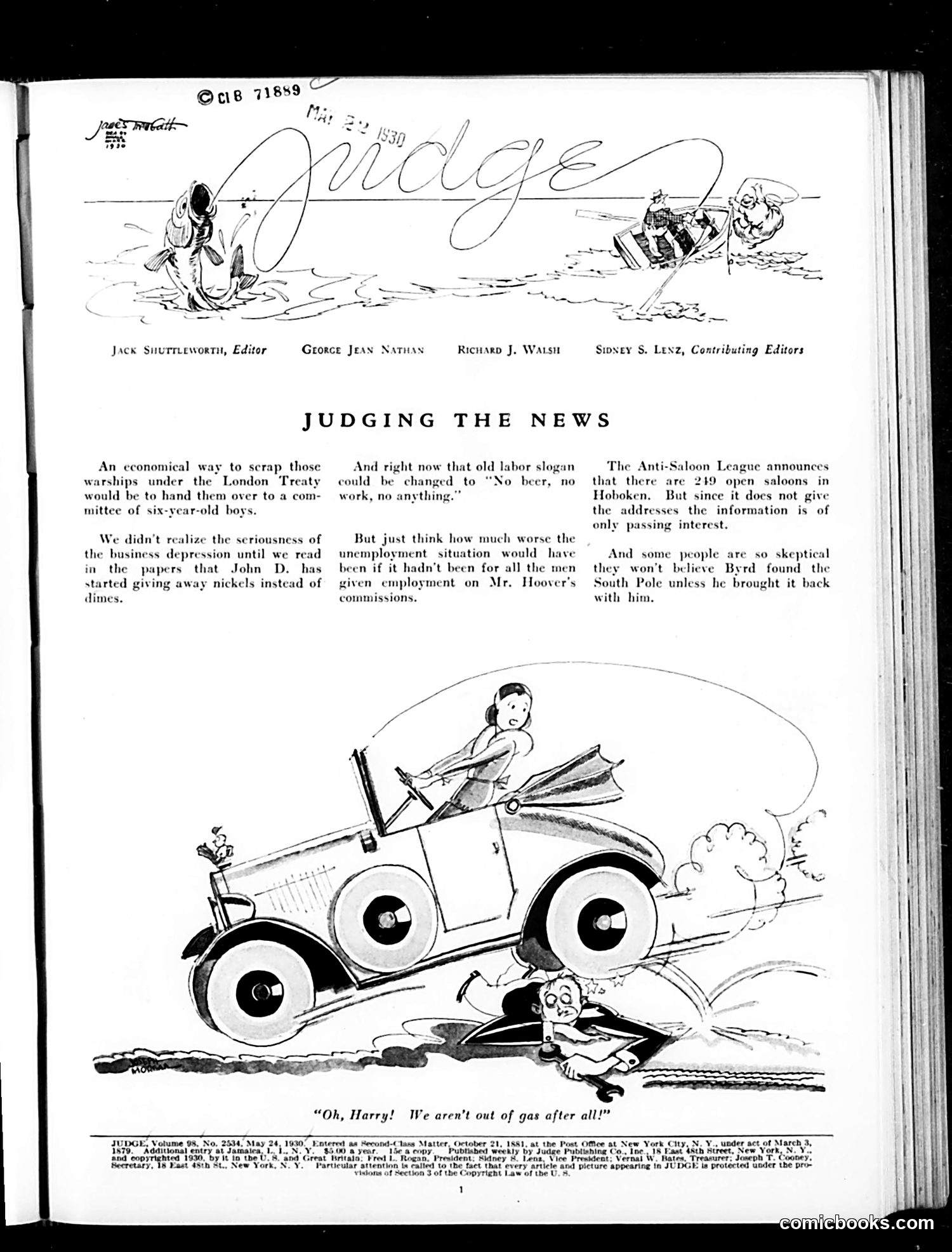
# "Judging the News" - May 24, 1930 This page satirizes early Depression-era issues. The main cartoon depicts a reckless driver in a careening automobile nearly hitting a pedestrian, captioned "Oh, Harry! We aren't out of gas after all!!" The visual metaphor suggests economic recklessness during the Depression. The driver's surprised discovery that the car still has fuel humorously represents people's false sense of security about financial stability. The accompanying text commentary references: - Scrapping warships under the London Treaty - John D. Rockefeller giving away nickels instead of dimes during the Depression - Hoover's unemployment commissions - Admiral Byrd's South Pole expedition - The Anti-Saloon League's concerns about open saloons in Hoboken The satire mocks both government policy and public complacency amid economic crisis.
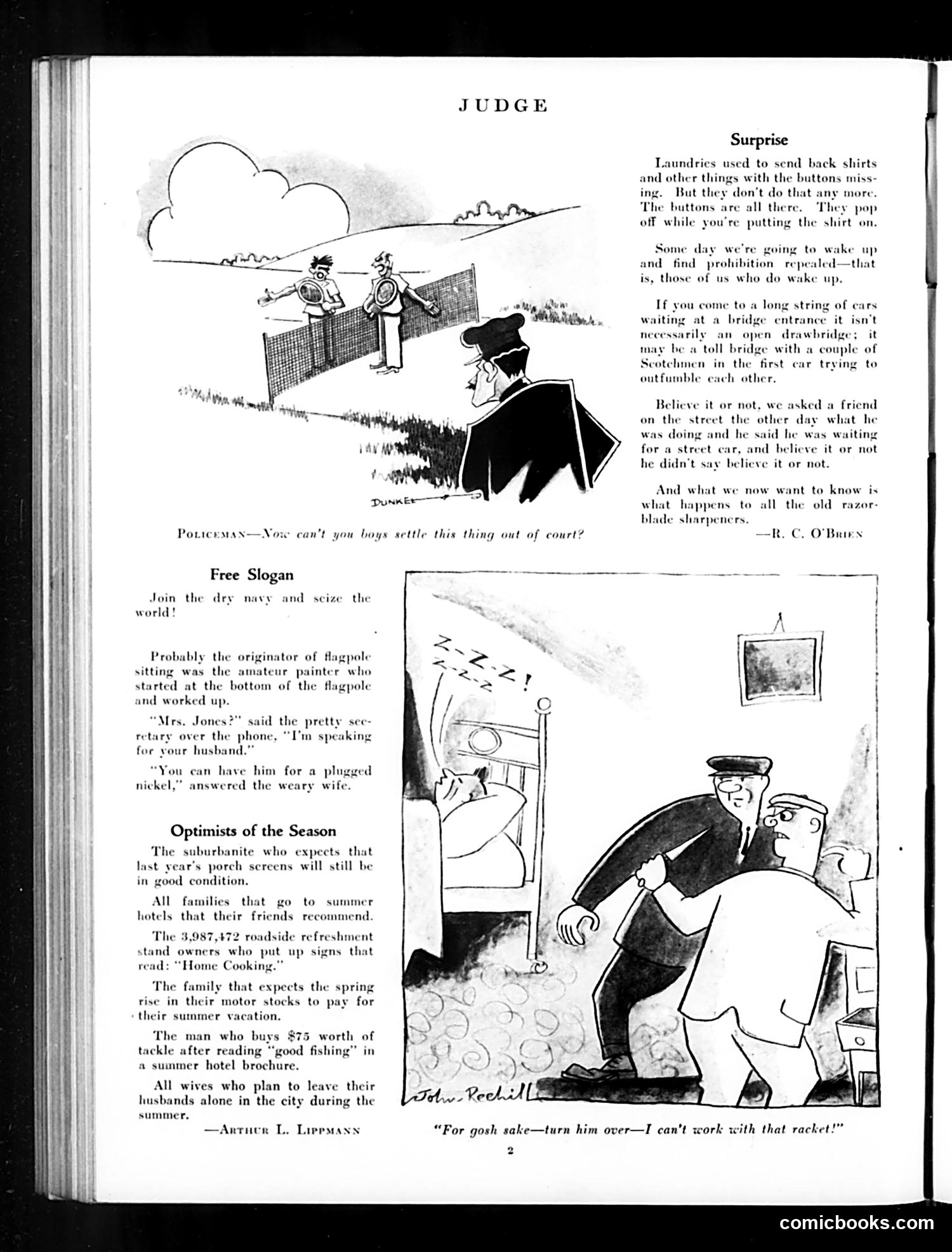
# Judge Magazine Page Analysis This page contains humor columns and two cartoons satirizing early 20th-century American life. The top cartoon depicts a policeman mediating a dispute between two people at a bridge entrance, likely satirizing disputes over toll bridge vs. free bridge access—a real public issue of the era. The bottom cartoon shows a frustrated man (possibly a landlord or employer) ejecting a tenant or worker, with the caption "For gosh sake—turn him over—I can't work with that racket!" The humor derives from the sleeping figure creating noise disturbances. The "Free Slogan" and "Optimists of the Season" sections contain witty observations about contemporary life: laundry mishaps, naive expectations about home maintenance, and unrealistic vacation planning among middle-class families. These pieces reflect period concerns about domestic life, class anxieties, and urban inconveniences rather than partisan politics.
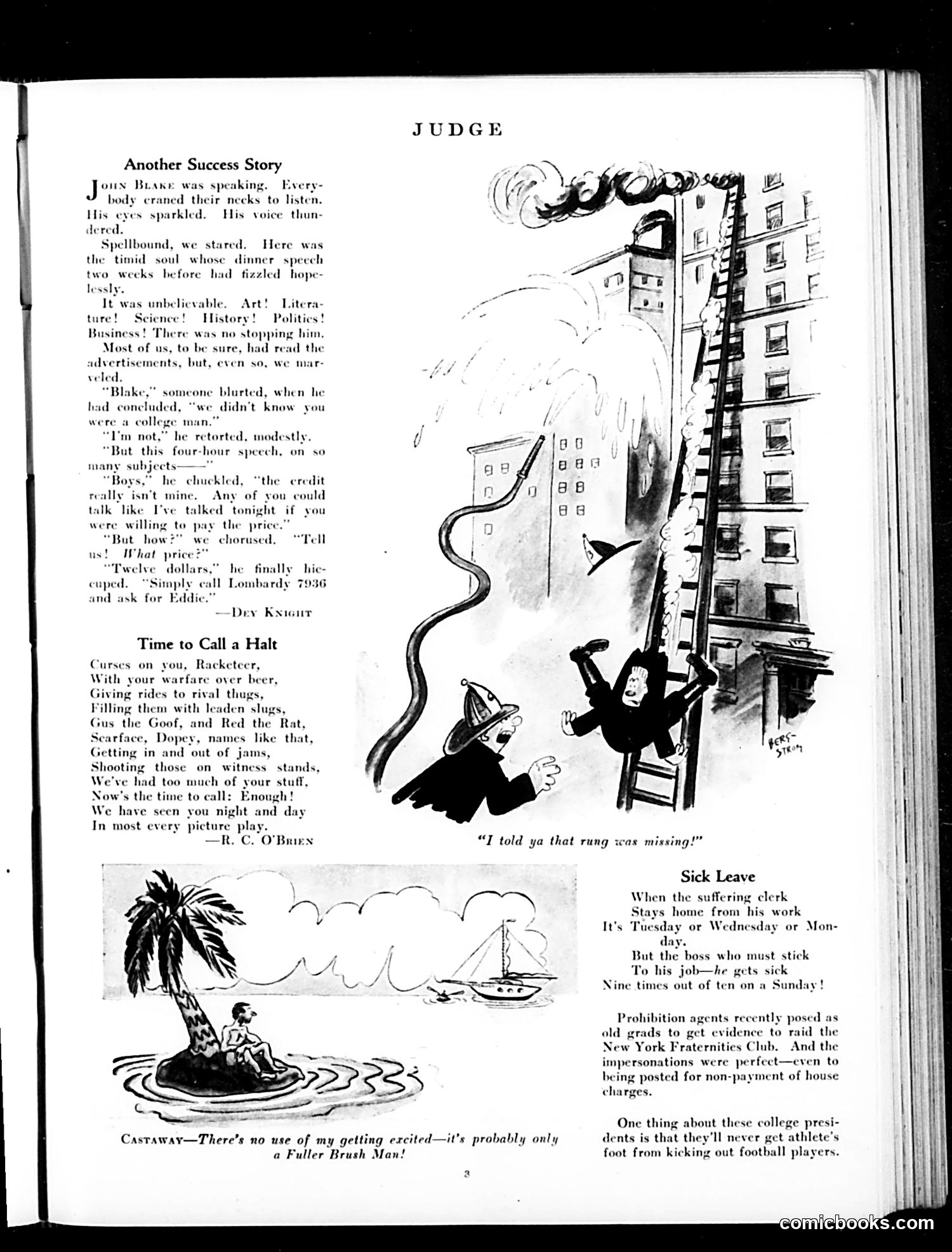
# Analysis of Judge Magazine Page This page contains three distinct pieces of satirical commentary: 1. **"Another Success Story"** mocks a timid college student whose dinner speech on various subjects ("Art! Literature! Science!") impresses listeners—until he reveals it cost him $12, undermining his credibility. 2. **"Time to Call a Halt"** (by R.C. O'Brien) criticizes violent crime and urban lawlessness—"racketeers," gang violence, witness intimidation—arguing society has tolerated such behavior too long in entertainment and real life. 3. **"Castaway"** shows a shipwrecked man on an island, quipping he won't get excited since he's just "a Fuller Brush Man"—a joke about door-to-door salesmen's reputation for persistence. The cartoons reflect 1920s-30s concerns: educational pretension, Prohibition-era gangsterism, and commercial culture.
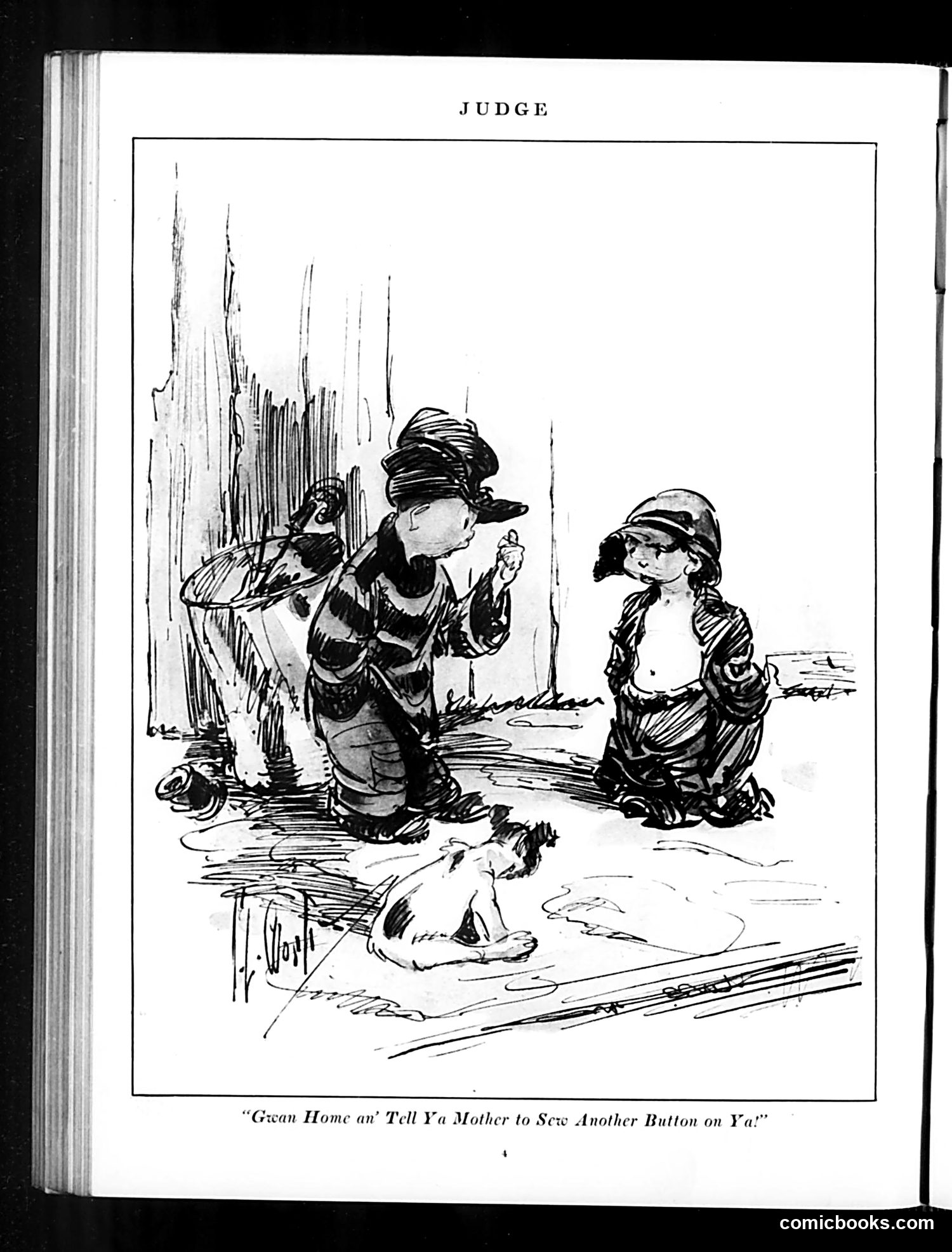
# Analysis of "Judge" Cartoon This cartoon depicts two children in ragged clothing, appearing impoverished. The caption reads: "Gwan Home an' Tell Ya Mother to Sew Another Button on Ya!" The satire likely targets: **Social commentary on poverty and childhood**: The poorly dressed children suggest urban working-class or immigrant families struggling economically. One child appears to be scolding the other about their shabby appearance—specifically a missing button. **The joke's edge**: Rather than sympathy for their obvious poverty, the cartoon offers caustic humor about their condition. It satirizes either parental neglect, the desperation of poor families, or possibly the indifference of society toward impoverished children. The harsh tone suggests *Judge* magazine's typically cynical perspective on social issues of that era, using child poverty as fodder for uncomfortable humor rather than advocating reform.
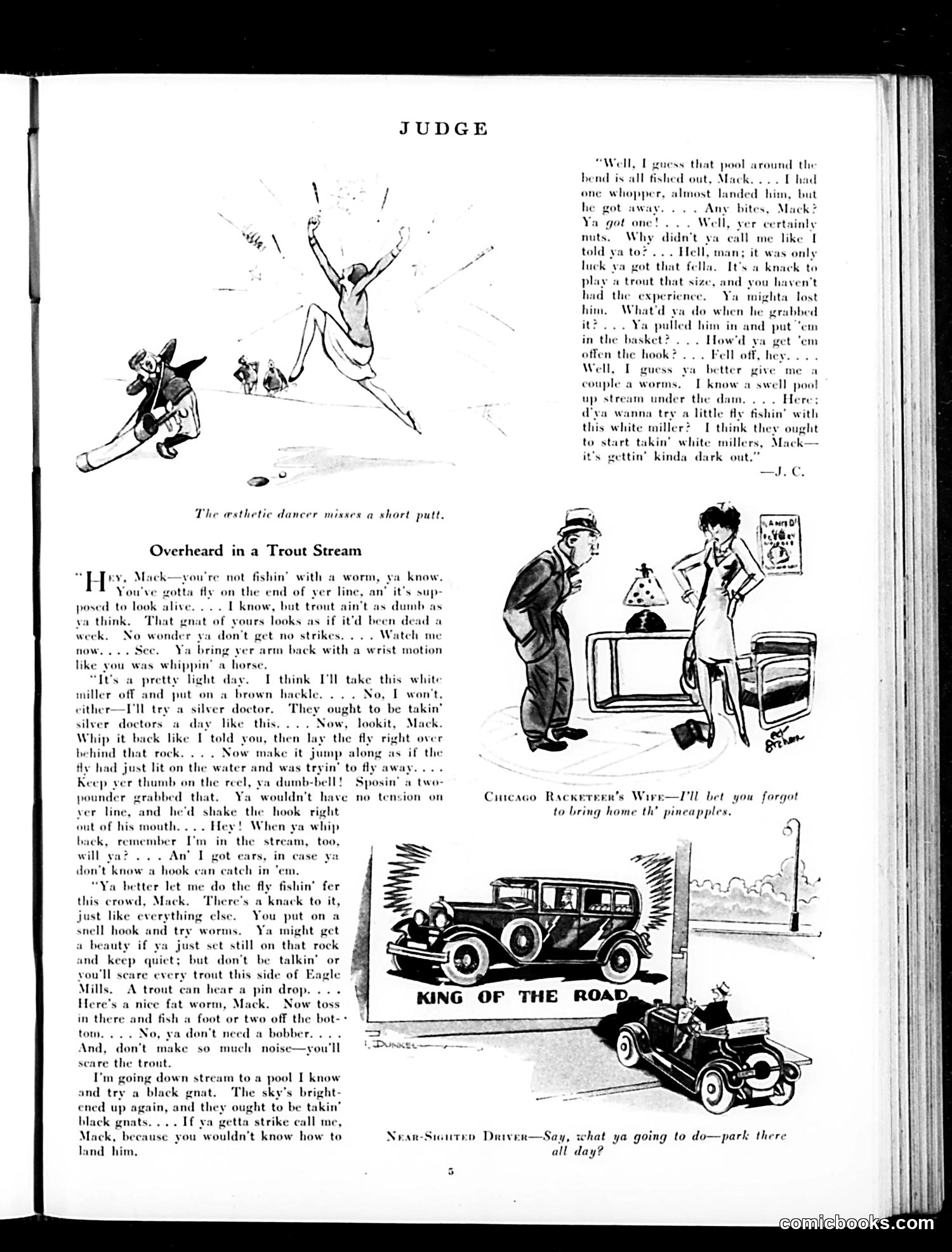
# Analysis of Judge Magazine Page This page contains humorous illustrated vignettes rather than political satire. The top section, "Overhead in a Trout Stream," depicts fishing advice between two men—one experienced angler instructing an amateur ("Mack") on proper fly-fishing technique. The humor derives from the expert's detailed, condescending monologue about worm selection, casting method, and stream etiquette. Below are three separate cartoon gags: an "aesthetic dancer" doing a golf putt, a domestic scene titled "Chicago Racketeer's Wife," and automobile humor labeled "King of the Road" and "Near-Sighted Driver." These are lifestyle and social humor pieces typical of 1920s-era Judge magazine—satirizing modern urban life, gender relations, and automotive culture rather than political figures or events.
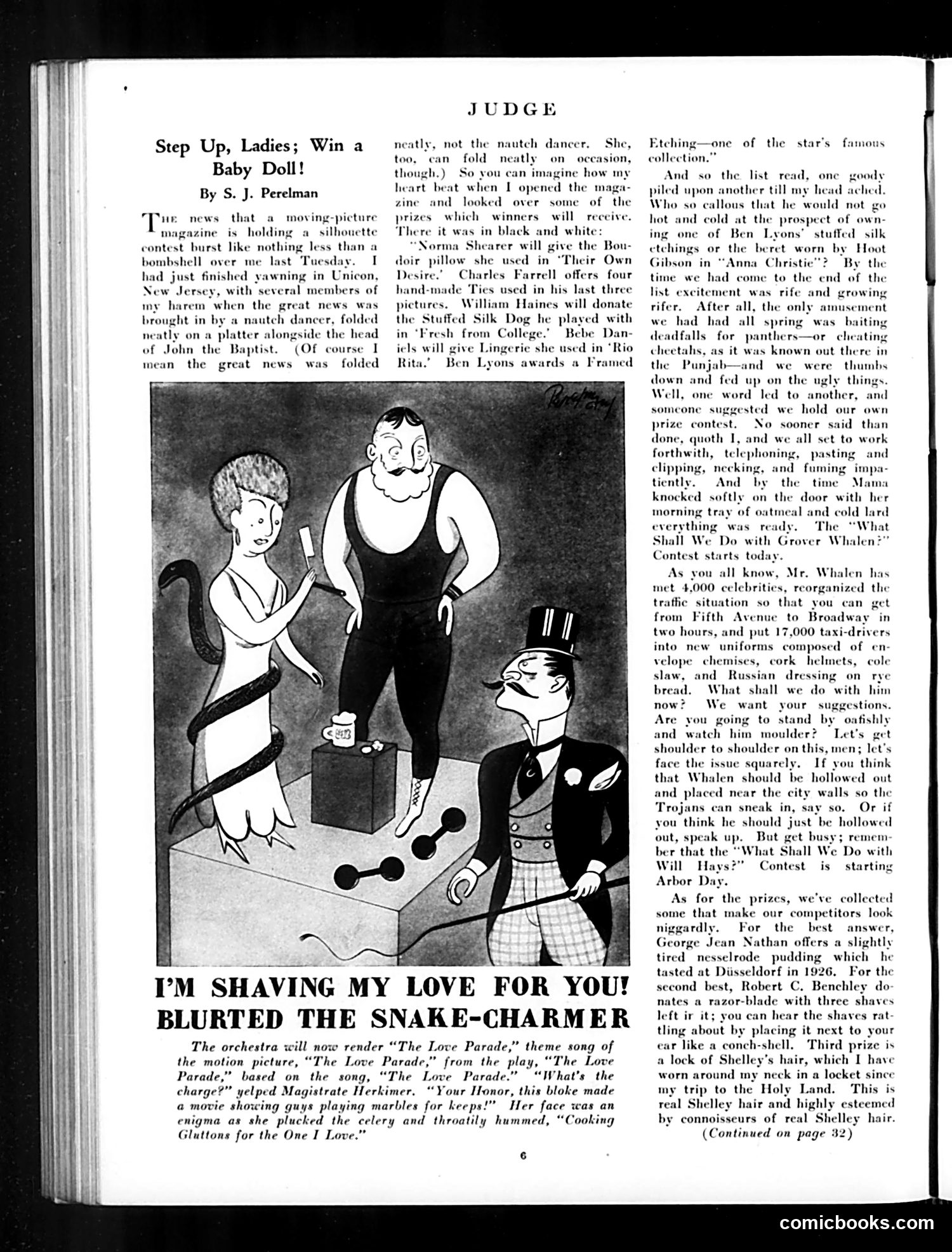
# Analysis of Judge Magazine Page This page contains two distinct pieces: **"Step Up, Ladies; Win a Baby Doll!"** is a humorous article by S.J. Perelman about a magazine contest involving celebrity memorabilia as prizes. The main cartoon illustrates the absurdist premise: a large man and woman examine dolls while a small well-dressed man (likely representing a celebrity or contest organizer) presents them. **The bottom cartoon** titled "I'm Shaving My Love for You! Blurted the Snake-Charmer" appears to be a visual gag accompanying commentary about a film titled "The Love Parade." The image shows figures in exaggerated poses, playing on the melodramatic tropes of silent-era cinema that Judge satirizes. Both pieces mock entertainment industry excess and the era's celebrity culture through absurdist humor typical of 1920s-30s satirical magazines.
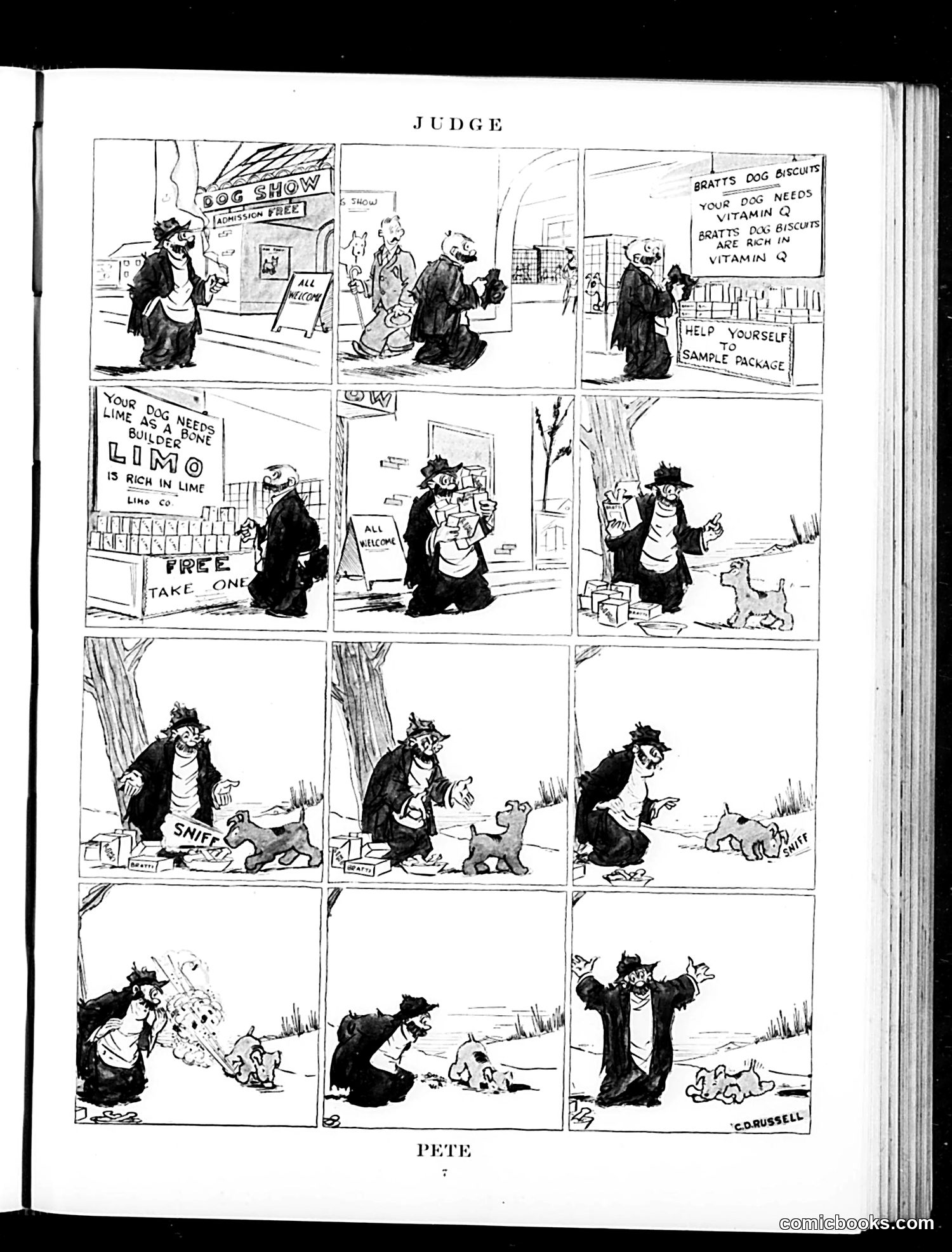
# "Judge Pete" Comic Strip Analysis This comic depicts a street vendor hawking Bratt's Dog Biscuits at a dog show by making health claims. The salesman repeatedly pitches that the product is "rich in Vitamin Q," a fabricated vitamin that doesn't exist—this is the joke's core satire. The strip mocks early 20th-century advertising's misleading health claims and the public's gullibility. During this era, manufacturers made unsubstantiated medical promises to sell products. By inventing "Vitamin Q," the cartoonist highlights how absurd and deceptive such advertising had become. The punchline comes when the vendor finally abandons his pitch and simply gives the dog biscuits away free, suggesting the product's actual worthlessness beneath the marketing hype.
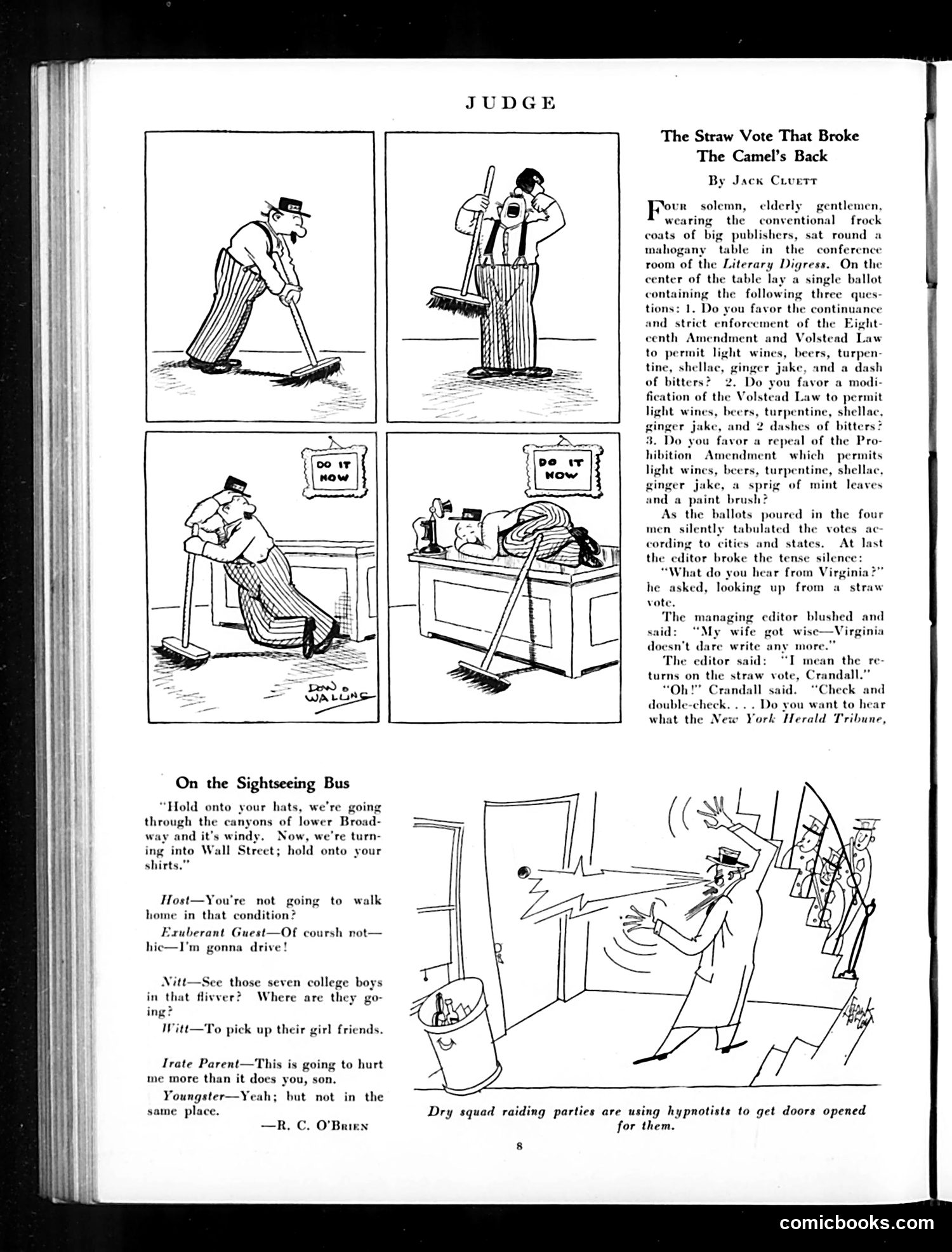
# Explanation for Modern Readers **"The Straw Vote That Broke the Camel's Back"** satirizes the *Literary Digest*, a major magazine that conducted famous straw polls predicting election outcomes. The cartoon mocks their polling methodology during Prohibition (1920-1933). Four publishers debate three absurdly similar ballot questions about alcohol enforcement, each ostensibly different but practically identical—all permitting various drinks under different pretexts. The joke: their "scientific" polling is meaningless nonsense. The punchline involves a wife from Virginia who stopped contributing responses after "getting wise" to the scam. The lower section contains unrelated humor: a drunk tourist on a sightseeing bus, jokes about college boys picking up girlfriends, and a reference to Prohibition enforcement. The final cartoon jokes that federal "dry squad" agents raiding illegal alcohol operations now resort to hypnotism to enter premises—commenting on Prohibition's difficulty and the public's creative resistance to enforcement.
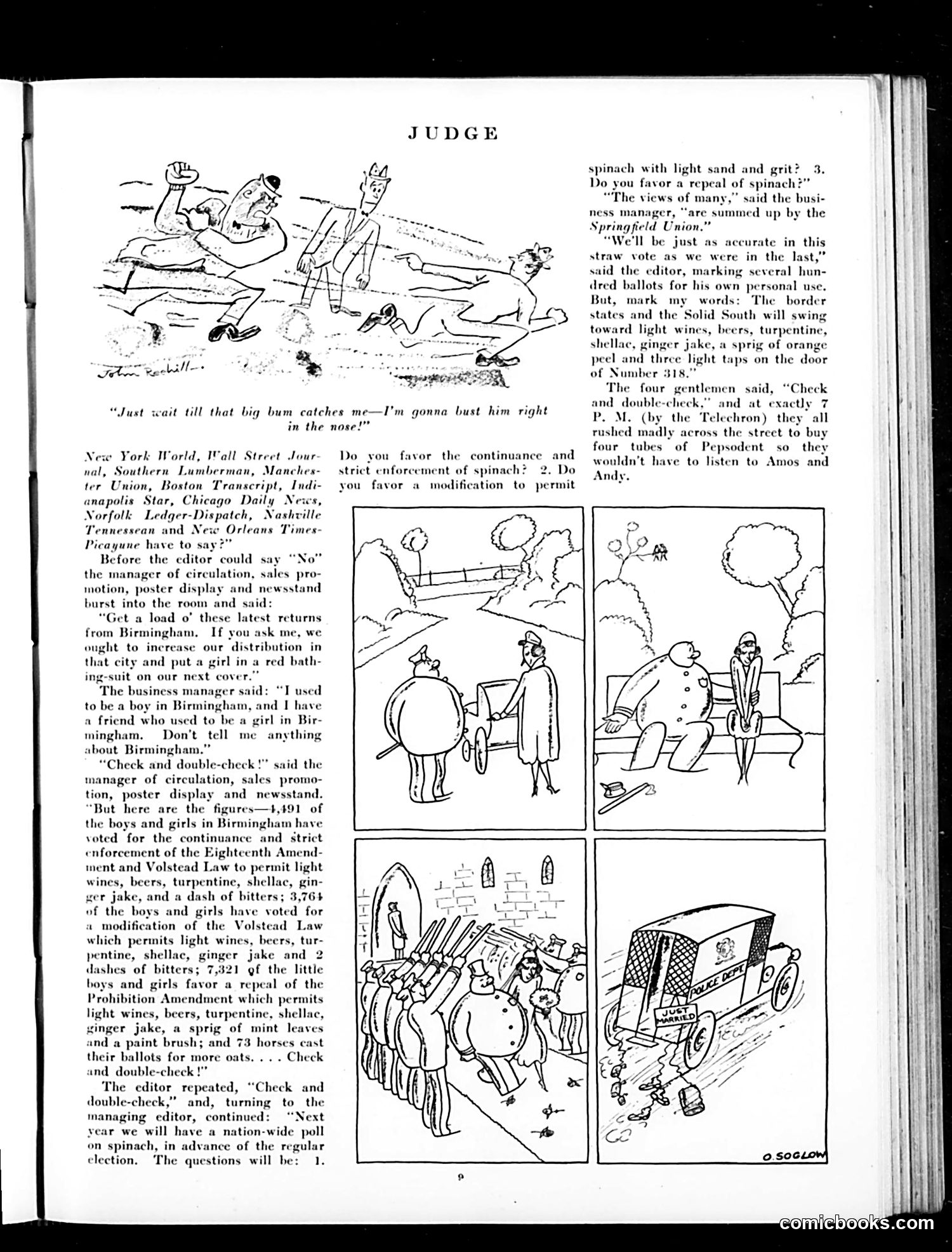
# Analysis This 1920s Judge magazine page satirizes Prohibition-era politics and polling practices. The cartoons mock how magazines conducted dubious "straw polls" to gauge public opinion on contentious issues. The main text describes an absurd editorial meeting where circulation managers present fabricated Birmingham poll results claiming overwhelming support for Prohibition enforcement. The joke pivots on the magazine's dishonesty—the editor acknowledges they'll manipulate thousands of ballots "for his own personal use." The satire targets: 1. **Fake polling**: Magazine straw votes were notoriously unreliable, often rigged to support editors' preferred positions 2. **Prohibition absurdity**: The poll questions hilariously conflate spinach enforcement with alcohol policy (light wines, ginger jake, turpentine—patent medicines containing alcohol) 3. **Media manipulation**: Even including "73 horses" voting reveals the complete unreliability The cartoons accompanying this likely illustrate Prohibition-era smuggling and drinking culture. This is essentially Judge mocking other publications' pretense at scientific polling while satirizing Prohibition's widespread public resistance and enforcement failures.
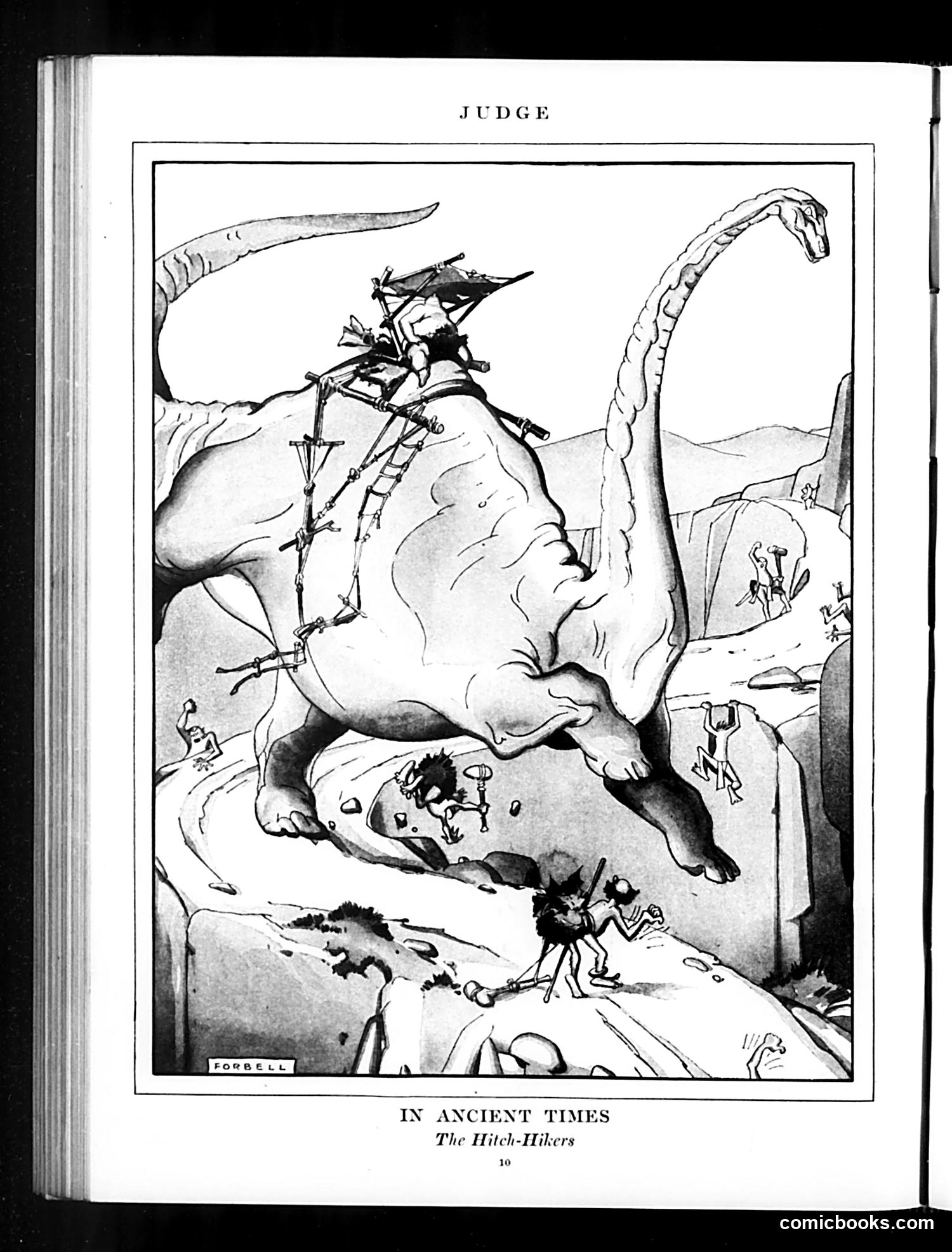
# Analysis This is a Judge magazine cartoon titled "In Ancient Times: The Hitch-Hikers," signed by Forbel. The satire depicts prehistoric humans attempting to hitch rides on dinosaurs—a humorous anachronism that plays on the modern concept of hitchhiking by transplanting it to an impossibly ancient setting. The joke works through absurdist humor: tiny human figures gesture and pose as if hitchhiking along a landscape populated by large sauropod dinosaurs. The cartoon satirizes hitchhiking culture itself, possibly mocking the practice or those who engage in it, by showing its apparent universality across time periods—even "ancient times" apparently had people seeking free rides. The artist's name appears to be Forbel. Without a date visible, the cartoon's exact historical context remains unclear, though Judge was prominent from the 1880s onward.