
Judge, 1930-05-24 · page 25 of 36
Judge — May 24, 1930 — page 25: what you’re looking at
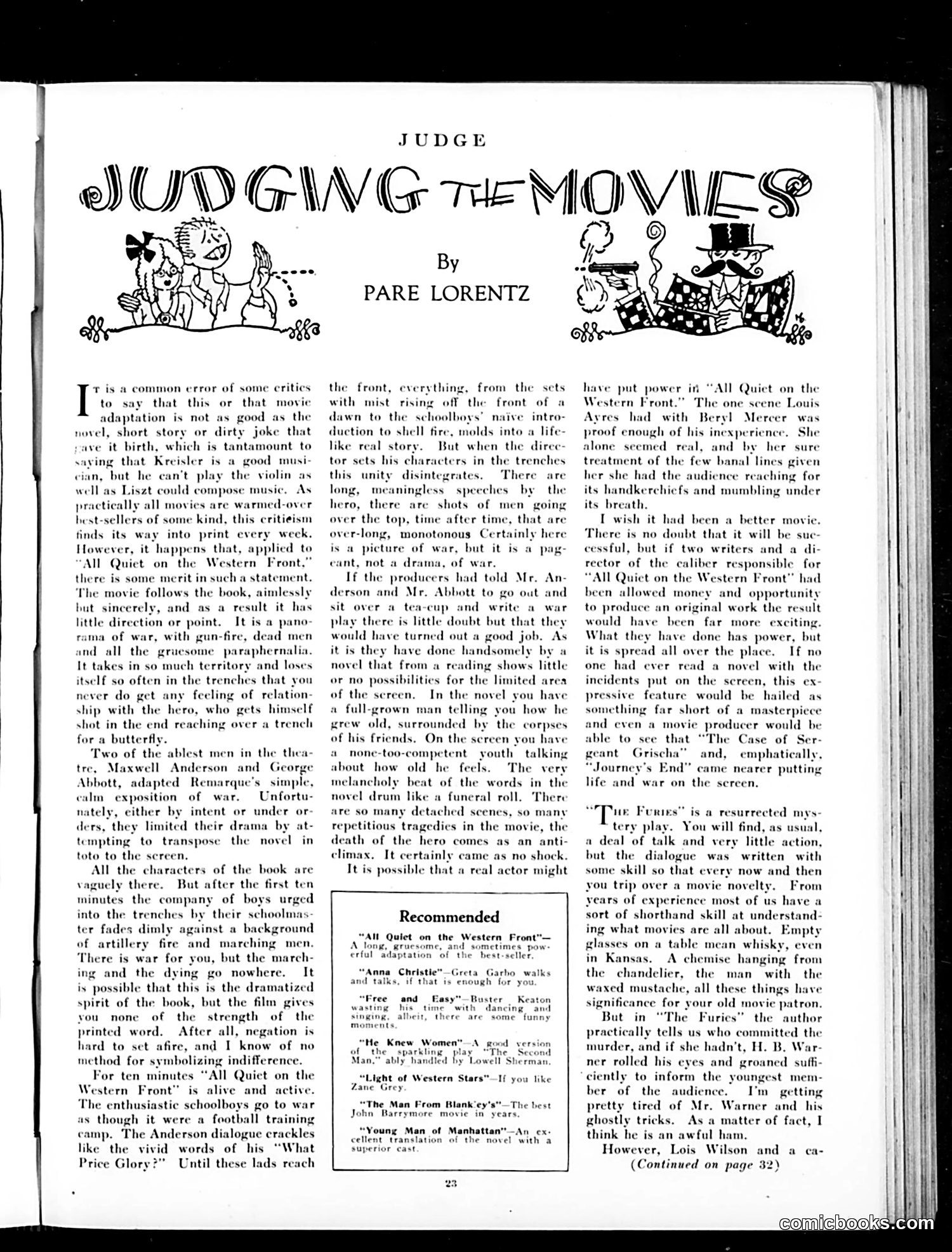
A restored page from Judge, 1930-05-24. Page through the whole issue in the reader above.
📄 Transcribed text from this page (OCR, searchable)
Machine-transcribed from the original scan — historical spelling and the odd misread are preserved.
JUDGE v is a common error of some critics to say that this or that movie adaptation is not as good as the novel, short story or dirty joke that ave it birth, which is tantamount to saying that Kreisler is a good musi- cian, but he can’t play the violin as well as Liszt could compose music. As practically all movies are warmed-over best-sellers of some kind, this eri i@ism finds its way into print every week. However, it happens that, applied to All Quiet on the Western Front,” there is some merit in such a statement. The movie follows the book, aimlessly but sincerely, and as a result it has little direction or point. It is a pano rama of war, with gun-fire, dead men ind all the gruesome par: It takes in so much territor itself so often in the trenches that you never do get any feeling of relati ship with the hero, who gets himself shot in the end reaching over a trench for a butterfly. Two of the ablest men in the thea- tre, Maxwell Anderson and George Abbott, adapted Remarque’s simple, calm exposition of war. Unfortu nately, cither by intent or under or ders, they limited their drama by tempting to transpose the novel in toto to the screen, All the characters of the book are vaguely there. But after the first ten minutes the company of boys urged into the trenches by their schoolmas ter fades diml inst a background of artillery fire and marching men. ‘There is war for you, but the ma ing and the dying go nowher is possible that this is the dran spirit of the book, but the film gives you none of the strength of the printed word. After all, negation is hard to set afire, and I know of no method for symbolizing indifference. For ten minutes “All Quict on the Western Front” is alive and active. The enthusiastic schoolboys go to war as though it were a football training camp. The Anderson dialogue crackles like the 1 words of his “Whe Price Glory?” Until these lads reach the front, everything, from the sets with mist rising off the front of a dawn to the schoolboys’ naive intro- duction to shell fire, molds into a life- like real story. But when the direc- tor sets his ¢ cters in the trenches this unity disintegrates. There long, meaningless. speeches by the hero, there are shots of men going over the top, time after time, that are over-long, monotonous Certainly here is a picture of war, but it is a pag- cant, not a dr. of war, If the producers had told Mr. An- derson and Mr. Abbott to go out and sit over a tea-cup and write a war play there is littl bt but that they would have turned out a good job. it is they have done handsomely by : novel that from a reading shows little or no possibilities for the limited area of the sereen, In the novel you have a full-grown man telling you how he grew old, surrounded by ‘the corpses of his friends. On the screen you have 4 none-too-competent youth talking about how old he feels. The very melancholy beat of the words in the novel drum like a funeral roll. There are so many detached scenes, so many repetitious tragedies in the movie, the death of the hero comes as an anti- climax, It certainly came as no shock. It is possible that a real actor might Recommended “AM Quiet A tong, geuc erful adaptat ront”. $s pow: ler, “Anna Christie’—Greta Garbo walks and talks, if that is en “He Knew Women" —A good version sparkling play “The Se ably handled by Lowell Sher of Mal “Light of Western Stars”—If you like Zane Grey The Man From Blank'ey's"—The best Barrymore movie in years. have put power in “AIL Quiet on the Western Front.” The one Ayres had with Beryl Merc proof enough of his inexperien alone seemed real treatment of the her she had the audience reaching for its handkerchiefs and mumbling under its breath, I wish it had been a better movie. There is no doubt that it will be suc- cessful, but if two writers Louis r was She nd by her sure al lines given and a di- rector of the caliber responsible for “AIL Quiet on the Western Front” had been allowed mone to produc n orig would have What the it is spres and opportunity work the result been far more exciting. y have done has power, but d all over the place. If no one had ever read a novel with the incidents put on the screen, this ex- pressive feature would be hailed as something far short of a masterpiece and even a movie producer would be able to see that “The Case of geant Grischa” and, emphatically. “Journey's End” came nearer putting life and war on the screen. Funirs" is a resurrected mys- You will find, a deal of talk and very little but the dialogue was written with some skill so that every now and then you trip over a movie novelty. From years of experience most of us have a sort of shorthand skill at understand- ing what movies are all about. Empty ses on a table mean whisky, even Kansas. A chemise hanging from the chandelier, the man with the waxed musts II these things have significance for your old movie patron. But in “The Furies” the author practically tells us who committed the murder, and if she hadn't, H. B. War- ner rolled his eyes and groaned suffi- ciently to inform the youngest mem- ber of the audience. I'm getting pretty ed of Mr. Warner and his ghostly tricks. As a matter of fact, I think he is an ful ham. However, Lois Wilson and a (Continued on page 32) [conmiGbooks:com