
Judge, 1930-05-24 · page 18 of 36
Judge — May 24, 1930 — page 18: what you’re looking at
A restored page from Judge, 1930-05-24. Page through the whole issue in the reader above.
📄 Transcribed text from this page (OCR, searchable)
Machine-transcribed from the original scan — historical spelling and the odd misread are preserved.
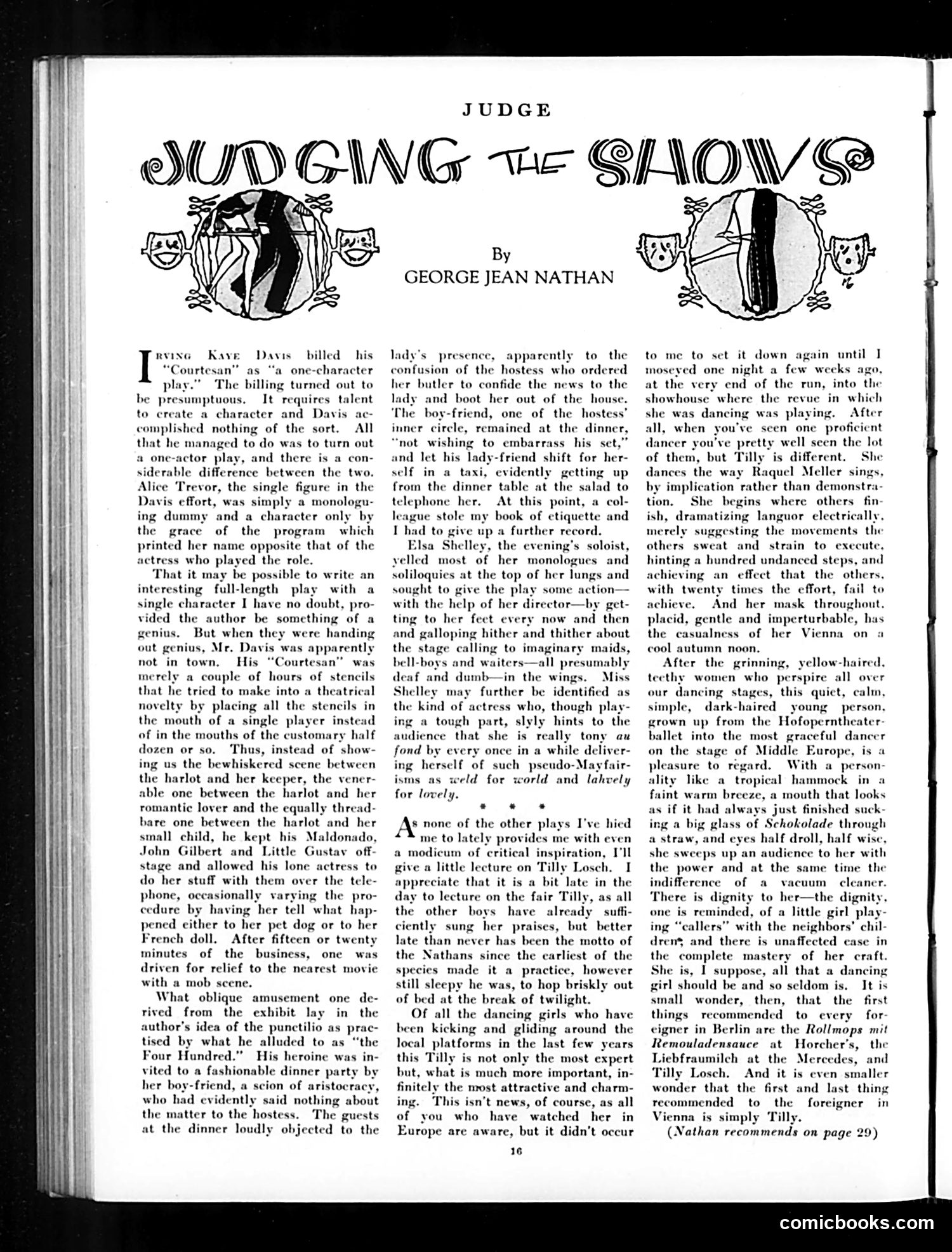
JUDGE MIVCGING v- GAOWS rving Kaye Davis billed his “Courtesan” as “a one-character pla The billing turned out to be presumptuous. It requires ta to create a character and Davis ac complished nothing of the sort. All that he managed to do was to turn out a one-actor play, and there is a con- siderable difference between the two. Alice Trevor, the single figure in the Davis effort, simply a monologu- ing dummy and a characte: ly by the grace of the program which printed her name opposite that of the actress who played the role. That it may be possible to write an interesting full-length play with a single character I have no doubt, pro- vided the author be something of a genius. But when they were handing out genius, Mr. Davis was apparently not in town, His “Courtesan” a couple of hours of ste he tried to make into a the novelty by placing all the stencils in the mouth of a single player instead of in the mouths of the customary h dozen or so. Thus, instead of show ing us the bewhiskered scene between the harlot and her keeper, the vener- able one between the harlot and her romantic lover and the equally thre bare one between the harlot and her small child, he kept his Maldonado, John Gilbert and Little Gustav off- stage and allowed his lone actress to do her stuff with them over the tele- phone, occasionally varying the pro- cedure by having her tell what hap- pened either to her pet dog or to her French doll. After fifteen or twenty minutes of the business, one w: driven for relief to the nearest movie with a mob scene. What oblique amusement one de- rived from the exhibit lay in the author's idea of the punctilio as prac- tised by what he alluded to as “the Four Hundred.” His heroine was vited to a fashionable dinner party by her boy-frie who had evidently the matter to the hostess. The guests at the dinner loudly objected to the By GEORGE JEAN NATHAN lady's presence, apparently to the confusion of the hostess who ordered her butler to confide the news to the lady and boot her out of the ‘The boy-friend, one of the hostess’ inner circle, remained at the dinne “not wishing to embarrass his se and let his lady-friend shift for her- self in a taxi, evidently getting up from the dinner table at the ad to telephone her. At this point, a col- league stole my book of ctiquette and d to give up a further record. Isa Shelley, the evening's soloist, yelled most of her monologues and soliloquies at the top of her lungs and sought to give the play some action— with the help of her director—by get- ting to her fect every now and then and galloping hither and thithe the stage calling to imaginary m ‘I-boys and waiters—all presun f and dumb—in the wings. ielley further be identified as the kind of actress who, though play- ing a tough part, slyly hints to the audience that she is really tony au fond by every once in a while deliver- ing herself of such pseudo-Mayfair- isms as weld for world and lahvely for lovely. house. may * *# « ANS none of the other plays I've hied me to lately provides me with even modicum inspiration, I'll give a little lecture on Tilly Losch. I appreciate that it is a bit late in the day to lecture on the fair Tilly, as all the other boys hs ready suffi- ciently sung her praises, but better late than never has been the motto of the Nathans since the earliest of the species made it a practice, however still sleepy he was, to hop briskly out of bed at the break of twilight. Of all the dancing girls who have been kicking and gliding around the local platforms in the last few years this Tilly is not only the most expert but, what is much more important. finitely the most attractive and charm- ing. This isn't news, of course, as all of you who have watched her in Europe are aware, but it didn’t occur 16 to set it down a) moseyed one night a few w . at the very end of the run, into the showhouse where the revue in which she was dancing was playing. After all, when you've scen one proficient dancer you've pretty well seen the lot of them, but Tilly is different. dances the way Raquel Meller sin by implication rather than demonst tion. She begins where others fin ish, dran ¢ languor electrically. merely suggesting the movements the others sweat and strain to execute. hinting a hundred undanced steps, and achieving an effect that the others, with twenty times th rt, fail to achieve. And her mask throughout. placid, gentle and imperturbable, the casualness of her Vienna on cool autumn noon, After the grinning, yellow-haired, tecthy women who perspire all over our dancing stages, this quiet, calm, simple, dark-haired young person, grown up from the Hofoperntheater ballet into the most g: on the stage of Middle asure pgard. y like a tropical hammock. in fi int warm breeze, a mouth that looks it had always just finished suck ga big glass of Schokolade through a straw, and eyes half droll, half wise, “ps up an audience to her with the power and at the same time the indifference of a vacuum cleaner. There is dignity to her—the dignity, one is reminded, of a little girl p ing “callers” with the neighbors’ chil- dren§, and there is unaffected case in the complete mastery of her craft. She is, I suppose, all that a dancing girl should be and so seldom is. It is small wonder, then, that the first things recommended to every for- eigner in Berlin are the Rollmops mit Remouladensauce at Horcher’s, the Liebfraumilch at the Mercedes, and Tilly Losch. And it is even smaller wonder that the first and last thing recommended to the foreigner in Vienna is simply Tilly. (Nathan recommends on page 29) to me she sw comicbooks.com