A complete issue · 36 pages · 1929
Judge — December 21, 1929
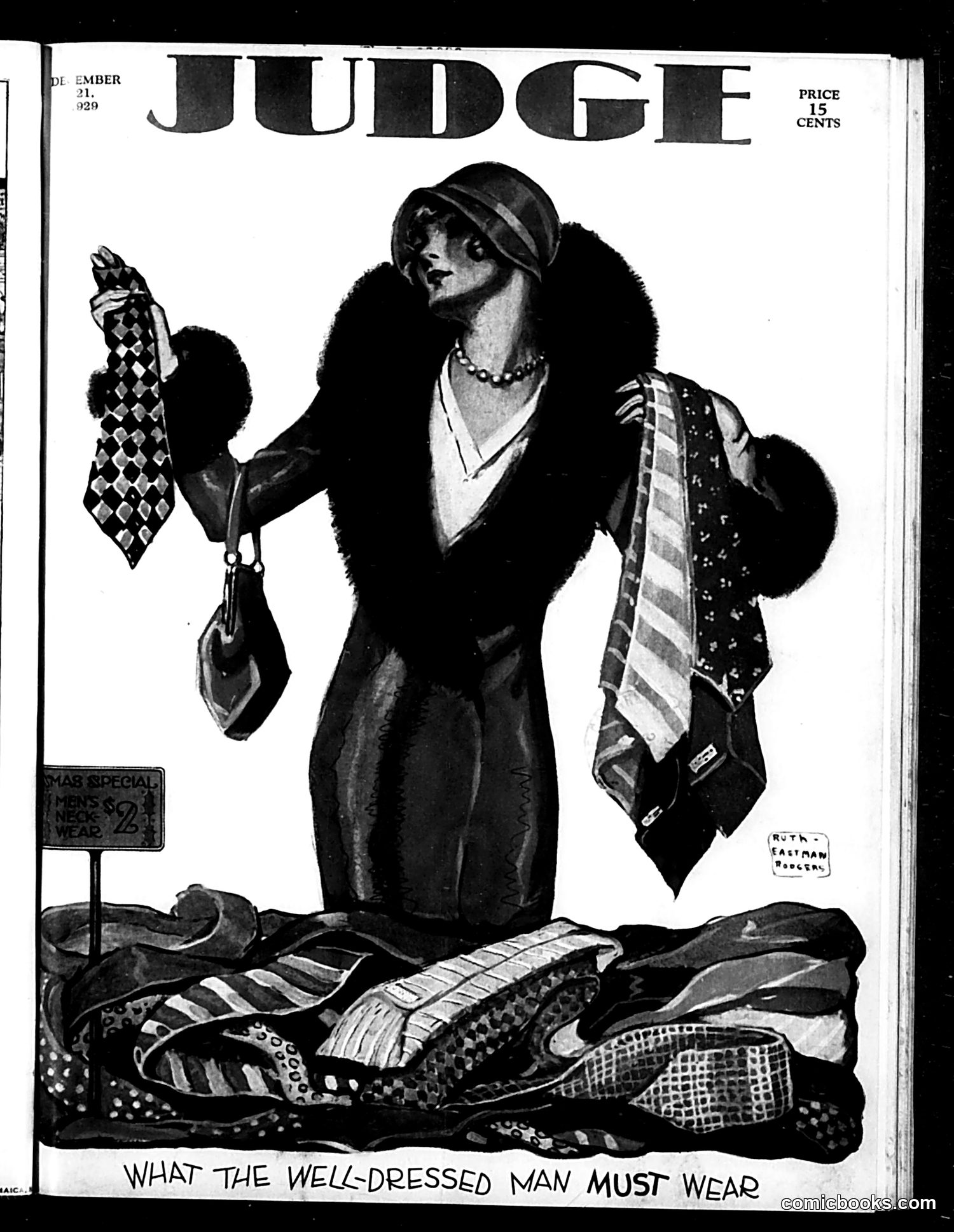
# Judge Magazine Cover Analysis This December 21, 1929 *Judge* cover satirizes men's fashion and accessories during the Jazz Age. The illustration shows a stylishly dressed woman displaying various neckties and accessories—including patterned ties and decorative scarves—arranged both on her body and displayed below like merchandise. The caption "WHAT THE WELL-DRESSED MAN MUST WEAR" is ironic: a woman, not a man, is modeling these items. This likely satirizes either: 1. Women's growing influence on men's fashion choices in the 1920s 2. The absurdity of commercialized fashion trends and conspicuous consumption 3. Gender role disruptions during the flapper era The "Xmas Special" price sign ($2) suggests commercial advertising satire. The humor derives from the incongruity of feminine presentation selling masculine accessories.
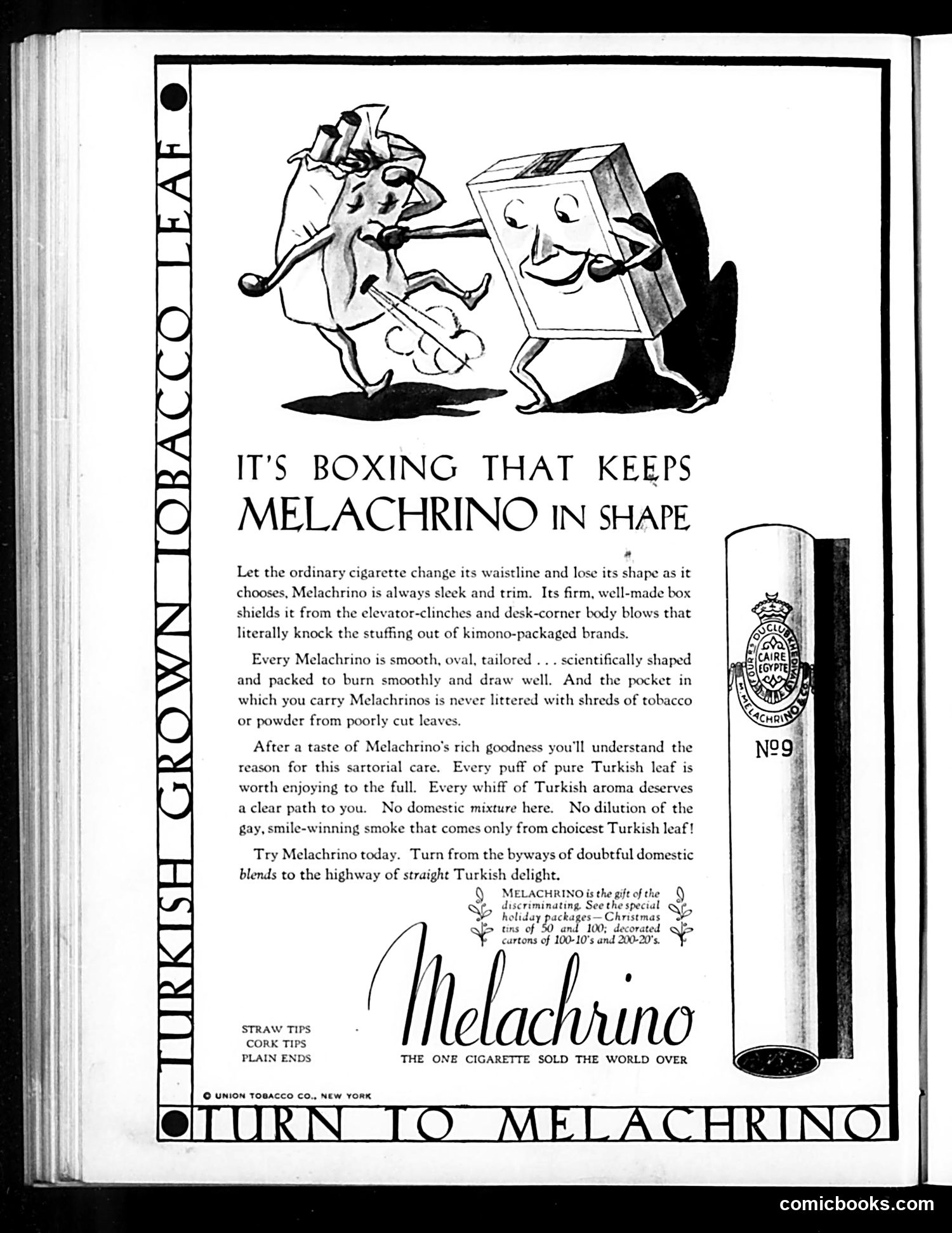
# Content Analysis This page is **primarily advertising**, not political satire. It's a full-page advertisement for Melachrino cigarettes from Union Tobacco Co., New York. The cartoon shows two anthropomorphized characters—a cigar and a cigarette box—boxing, illustrating the ad's central claim: "It's Boxing That Keeps Melachrino in Shape." The humor is visual wordplay: the box's structural rigidity (from boxing/packaging) preserves the cigarette's quality during transport and handling. The ad emphasizes that Melachrino uses pure Turkish tobacco without domestic blends, positioning it as superior. The bottom lists available tip styles (straw, cork, plain), standard for cigarettes of this era. This appears to be from Judge's earlier advertising-heavy period, likely 1920s-1930s, before the magazine shifted toward more satirical content.
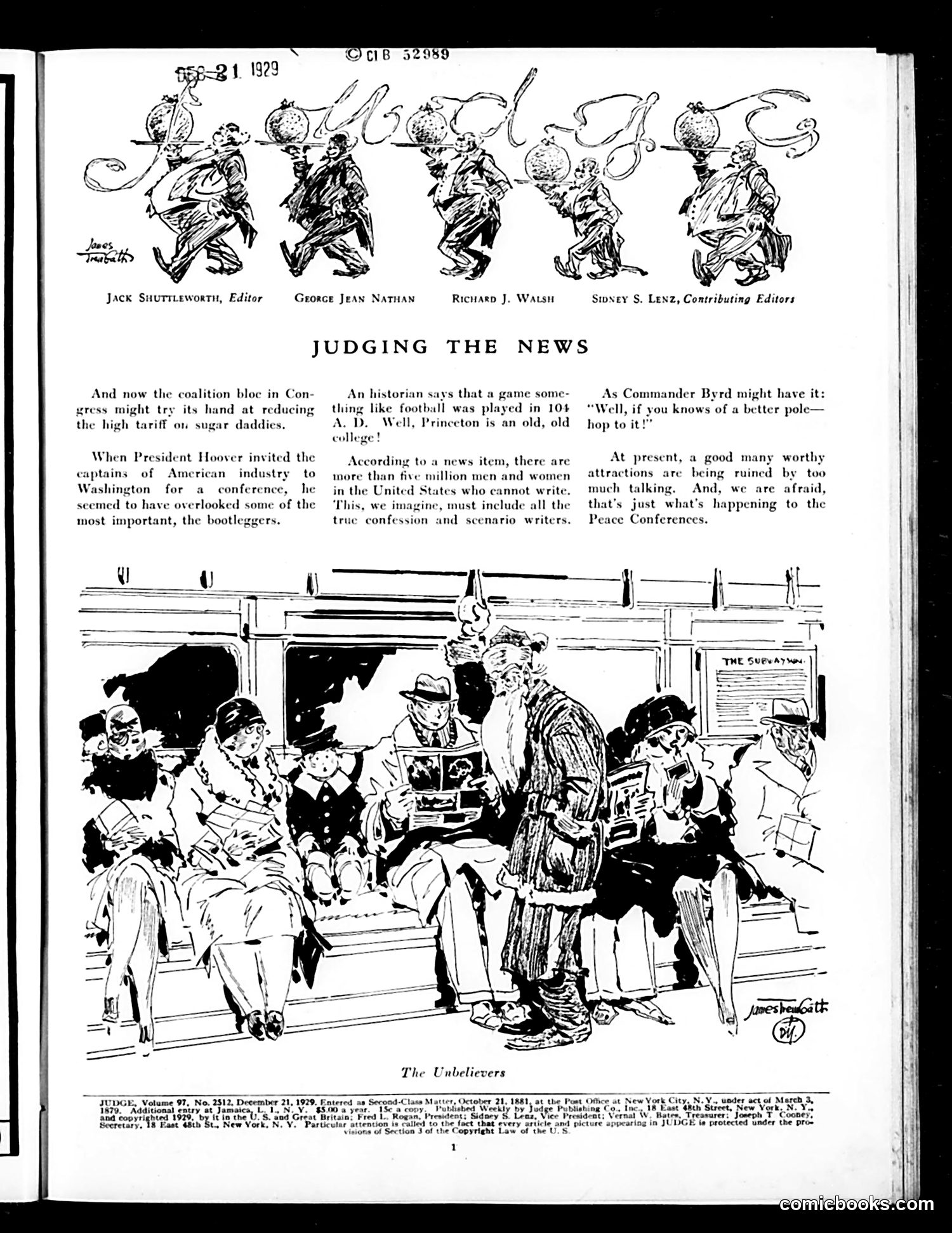
# "Judging the News" - December 21, 1929 This satirical page comments on early Depression-era politics and society. The five cartoonists at top (Shuttleworth, Nathan, Walsh, Lenz) are credited as editors. The main cartoon, "The Unbelievers," depicts skeptical citizens in what appears to be a government or public office, examining documents. The satire likely critiques public doubt about government responses to economic crisis or policy announcements—a common theme in 1929 as the stock market crash's consequences became clear. The text snippets reference President Hoover's industrial conference, literacy statistics, and peace conference discussions, suggesting cynicism about whether leadership could effectively address contemporary crises. The cartoon's title "The Unbelievers" suggests citizens no longer trust official statements or promises.
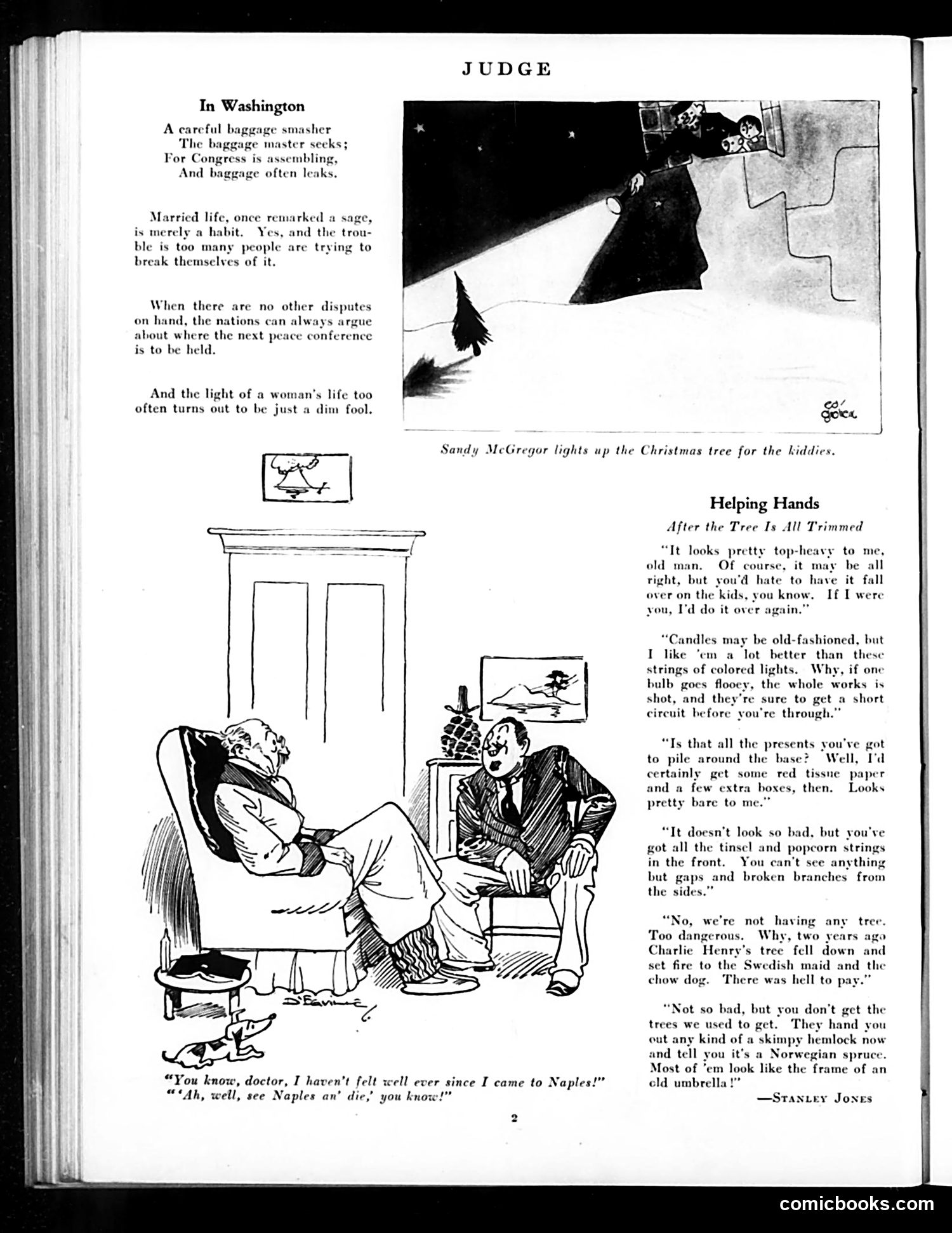
# Analysis of Judge Magazine Page This page contains two distinct pieces: **"In Washington"** (top): Political verse mocking Congress—baggage handlers, marital dissatisfaction, and international peace conferences. The satire targets governmental dysfunction and the predictability of diplomatic disputes. **"Helping Hands"** (bottom): A domestic humor cartoon showing an elderly man and woman discussing Christmas tree decoration. They debate whether the tree looks "top-heavy," discuss decorating choices (candles vs. lights), and recount a cautionary tale about a neighbor's tree fire. The humor derives from elderly characters' nostalgic bickering over holiday traditions and their tendency toward worry. Both pieces reflect early 20th-century Judge magazine's approach: combining political commentary with gentle domestic comedy. The artwork style and sensibility suggest this is from approximately the 1910s-1920s era.
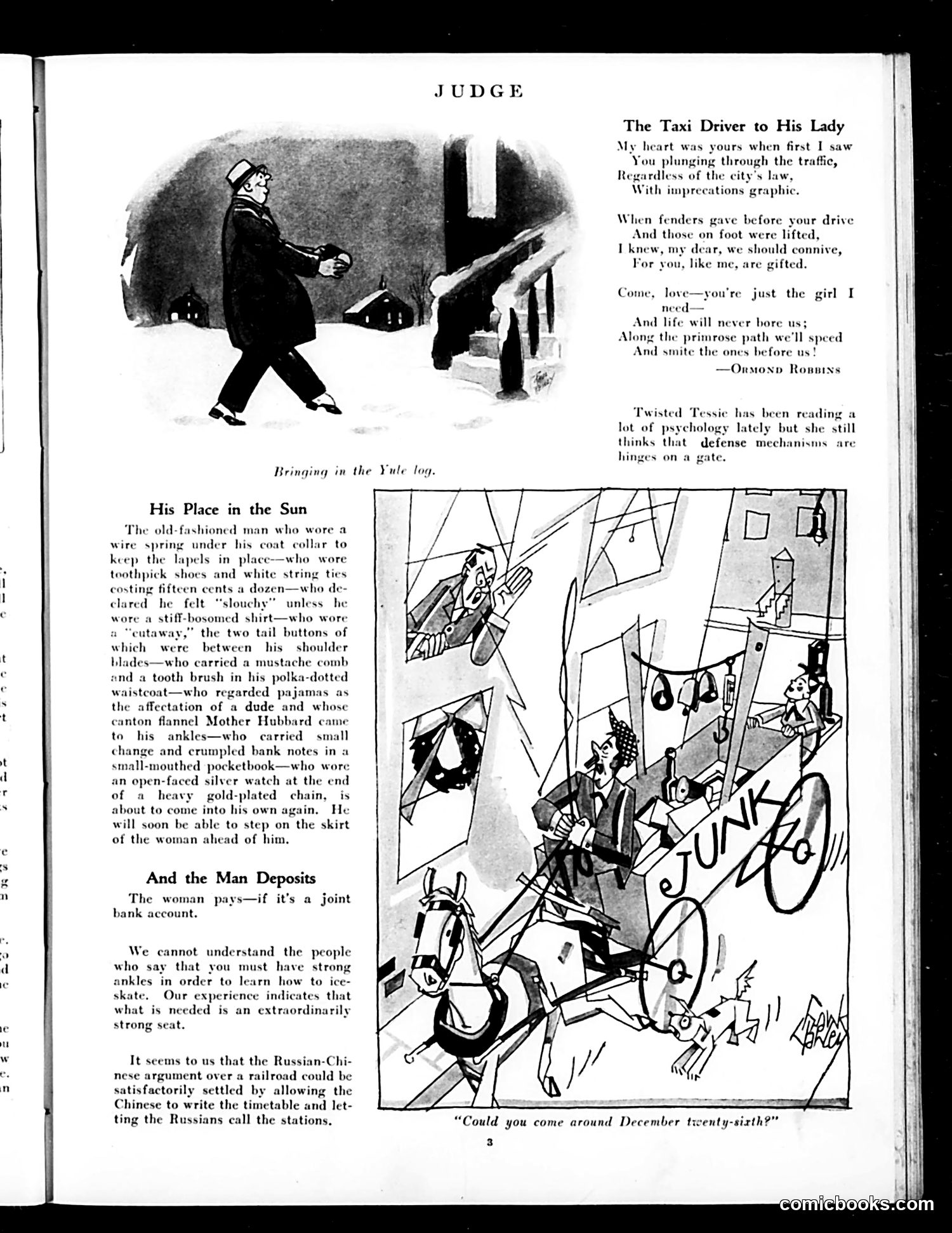
# Analysis of Judge Magazine Page This page contains three distinct pieces: 1. **"The Taxi Driver to His Lady"** — A romantic poem by Ormond Robbins about a taxi driver courting a woman, playing on the idea that taxi drivers were seen as dashing, modern figures. 2. **"His Place in the Sun"** — A satirical piece mocking old-fashioned men clinging to outdated fashion (wire suspenders, polka-dotted waistcoats, etc.), suggesting they're relics of a bygone era. 3. **"Bringing in the Yule Log"** (cartoon) — A humorous domestic scene showing a cluttered apartment during Christmas preparations, with the caption "Could you come around December twenty-sixth?" The joke appears to reference post-holiday chaos and scheduling complications. The page reflects early 20th-century American humor about modern urban life, changing social customs, and domestic situations.
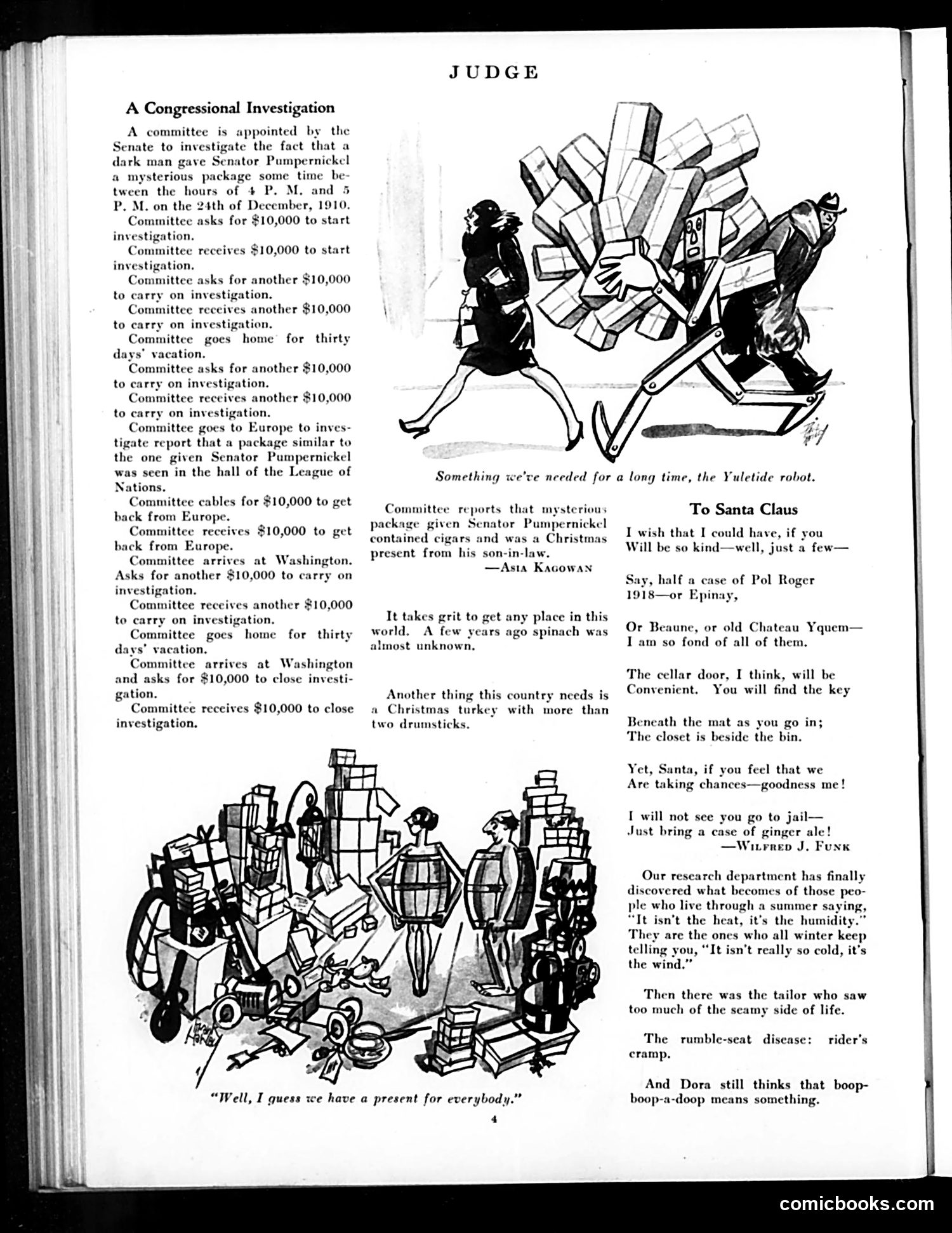
# Analysis of Judge Magazine Page **"A Congressional Investigation"** (left column) satirizes wasteful government spending through repeated cycles: a committee investigates a mysterious package given to Senator Pumpernickle, requesting $10,000, receiving it, requesting more, taking vacations, requesting again—each step repeated multiple times before finally "closing" the investigation. The joke lampoons bureaucratic inefficiency and endless appropriations without apparent progress. **The illustrations** show government officials buried under packages/paperwork, humorously depicting bureaucratic excess. **"To Santa Claus"** section contains humorous holiday wish-list poems mocking various types of people—those claiming poverty, tailor observations of social problems, and general absurdities. The page targets government waste and institutional absurdity through exaggeration, typical of Judge magazine's satirical approach during the Progressive Era.
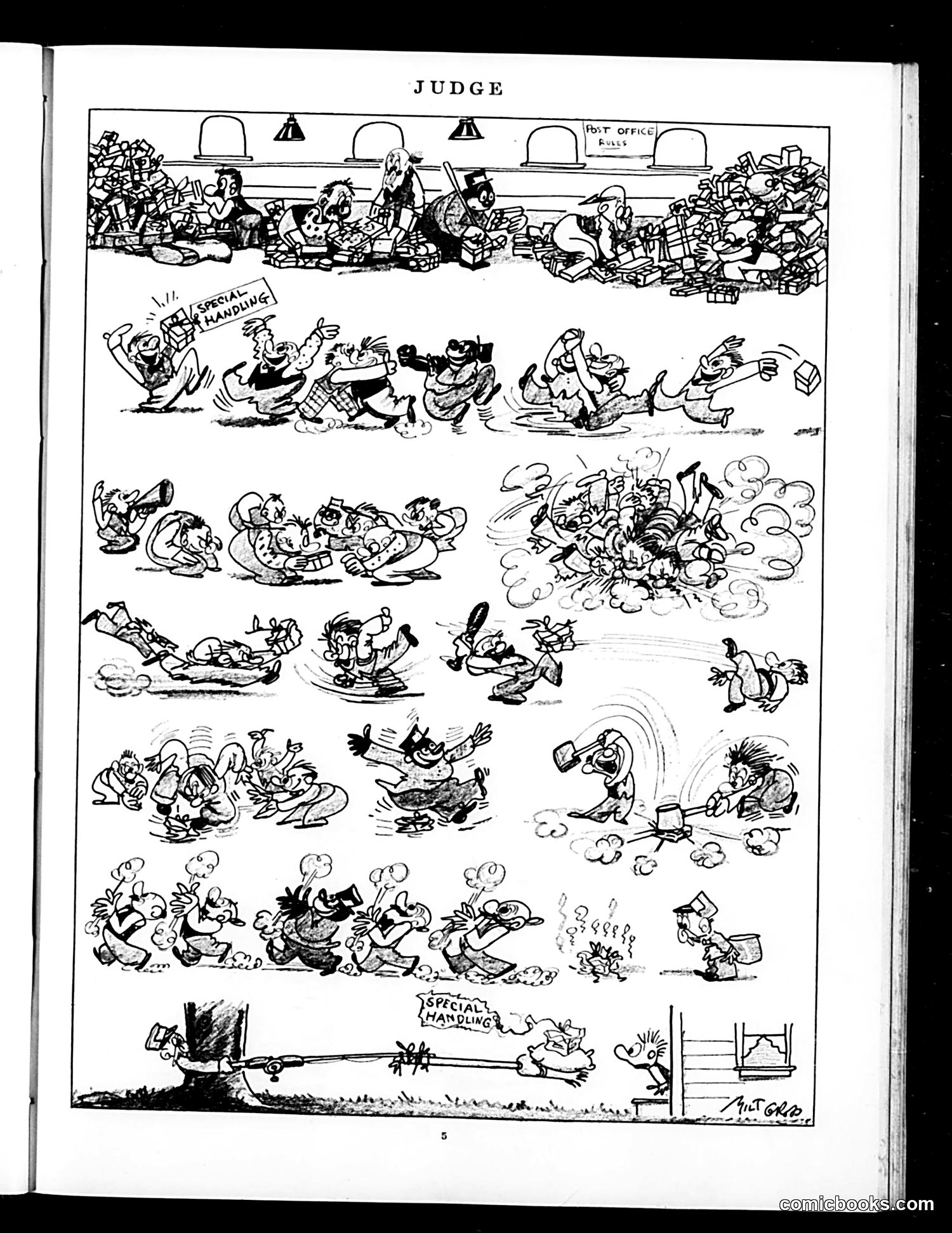
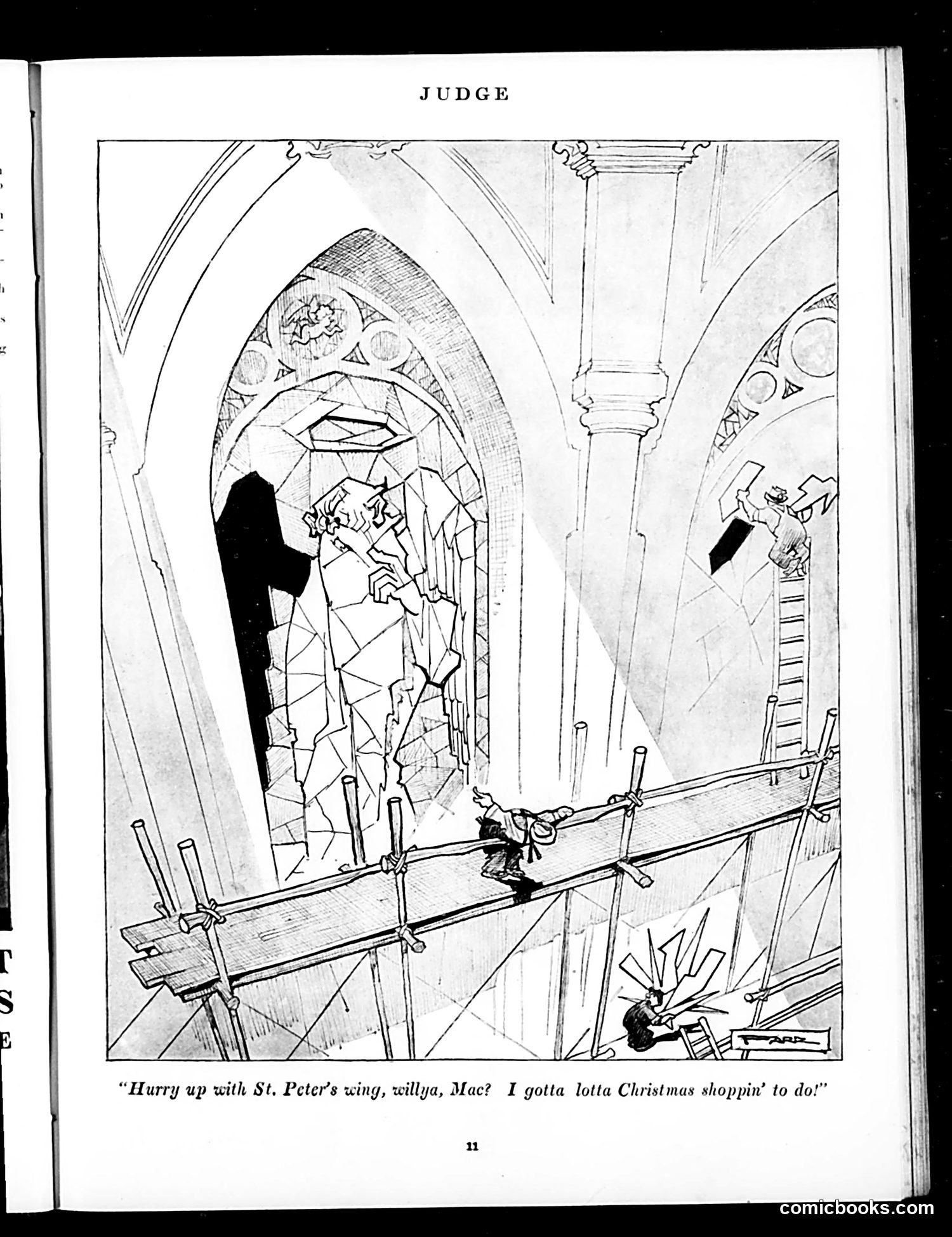
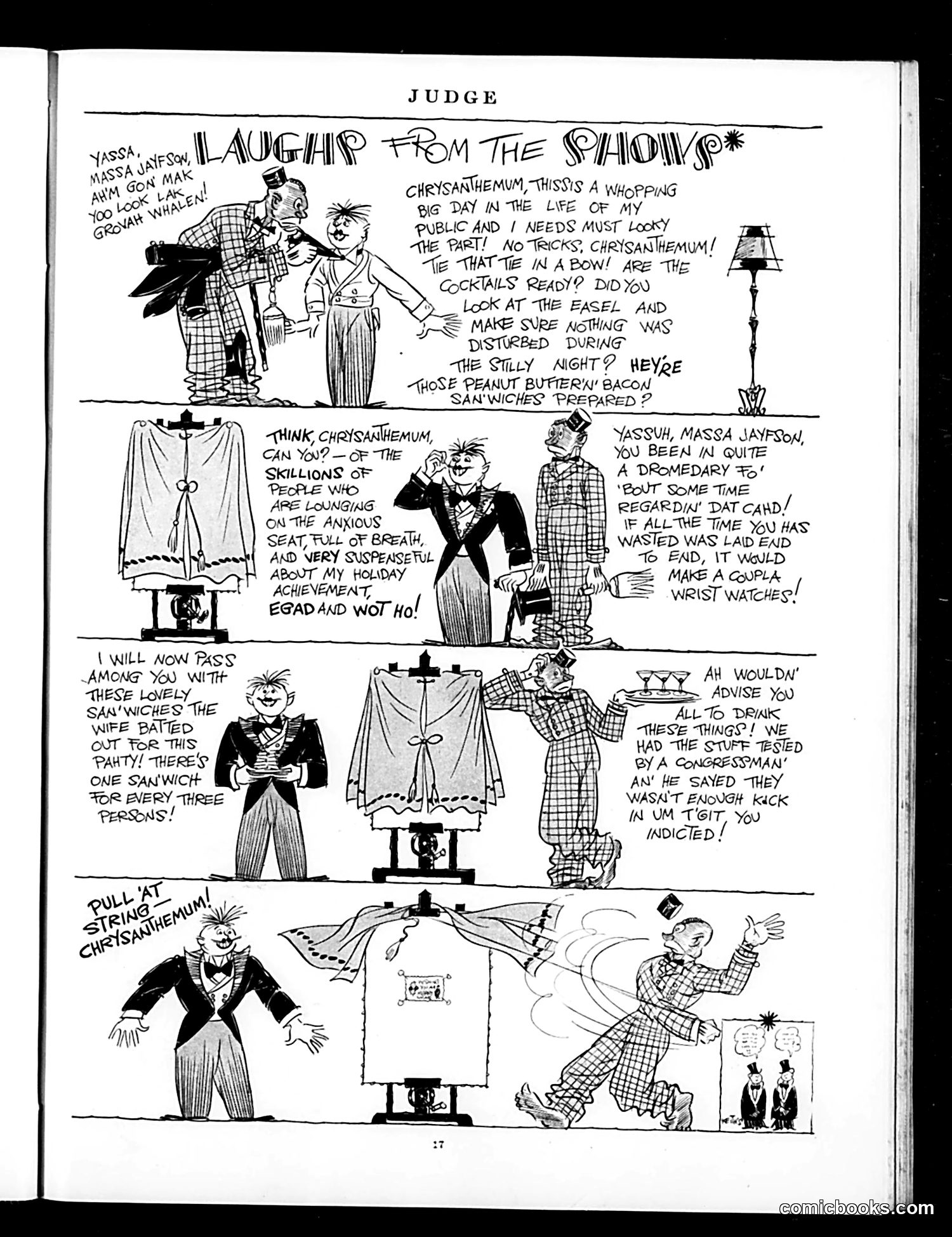
# Analysis of Judge Page: "Special Handling" This political cartoon satirizes chaotic judicial or governmental mishandling of cases or matters. The top panel shows an overflowing courtroom or office ("Post Office" visible), suggesting bureaucratic disorder. The sequential panels below depict various figures—appearing to be lawyers, judges, or officials—literally juggling, dropping, and fumbling documents and cases marked "Special Handling." The chaos escalates through each panel, culminating in an explosion or complete breakdown. The bottom panel shows what appears to be a cannon or official shooting documents across a landscape, with a small figure caught in the crossfire—visualizing how "special handling" of important matters results in destructive incompetence rather than careful attention. The satire mocks institutional negligence and bureaucratic bungling.
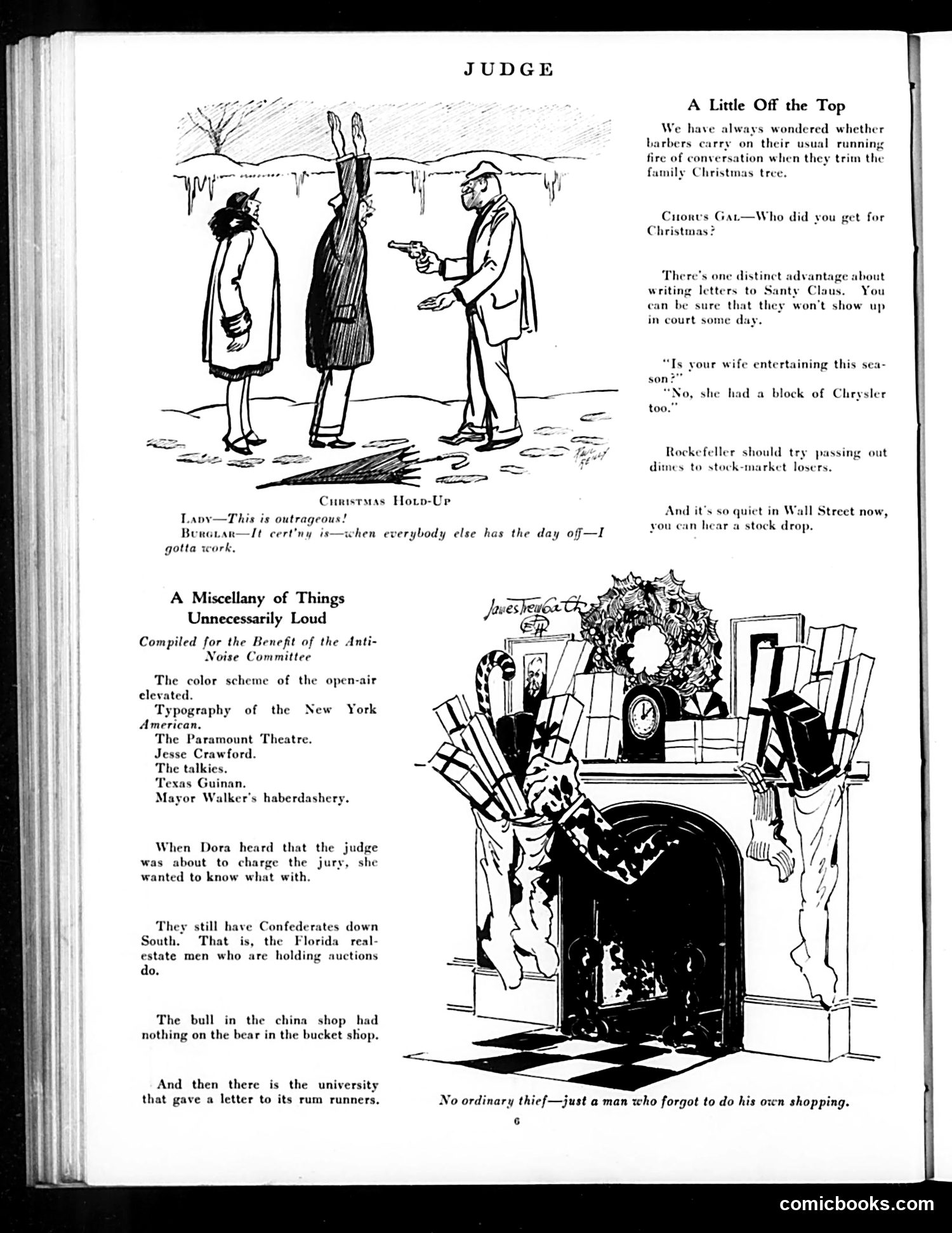
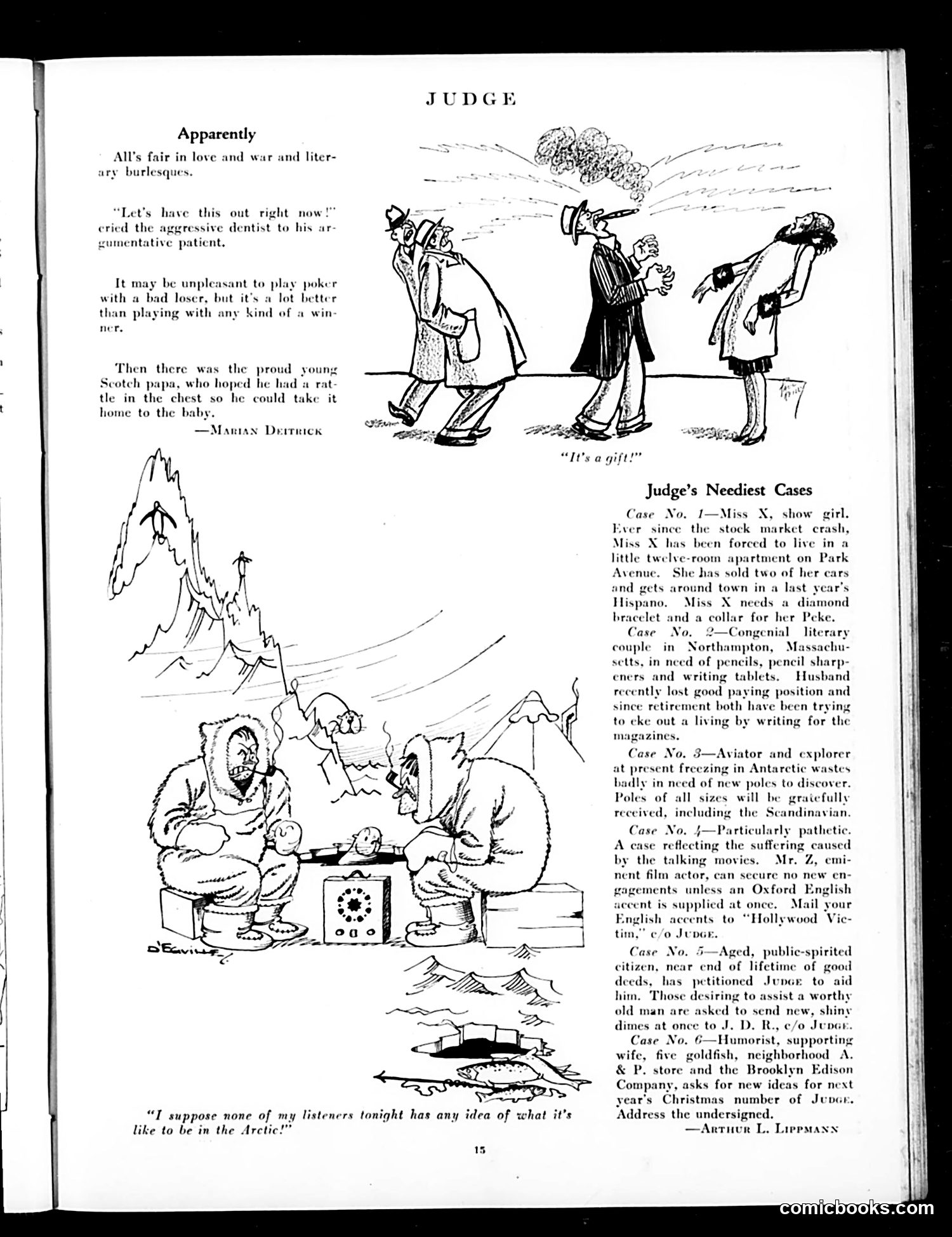
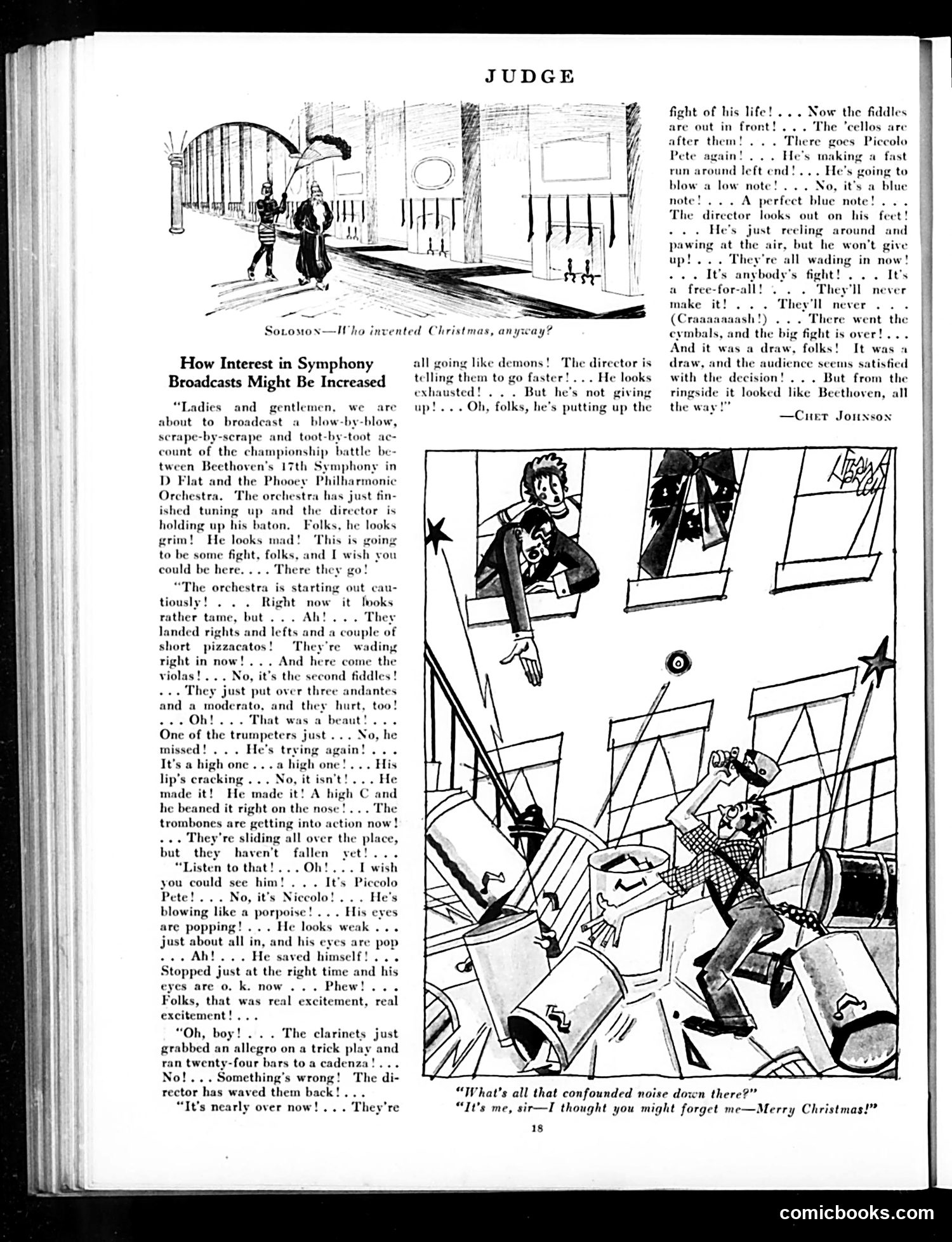
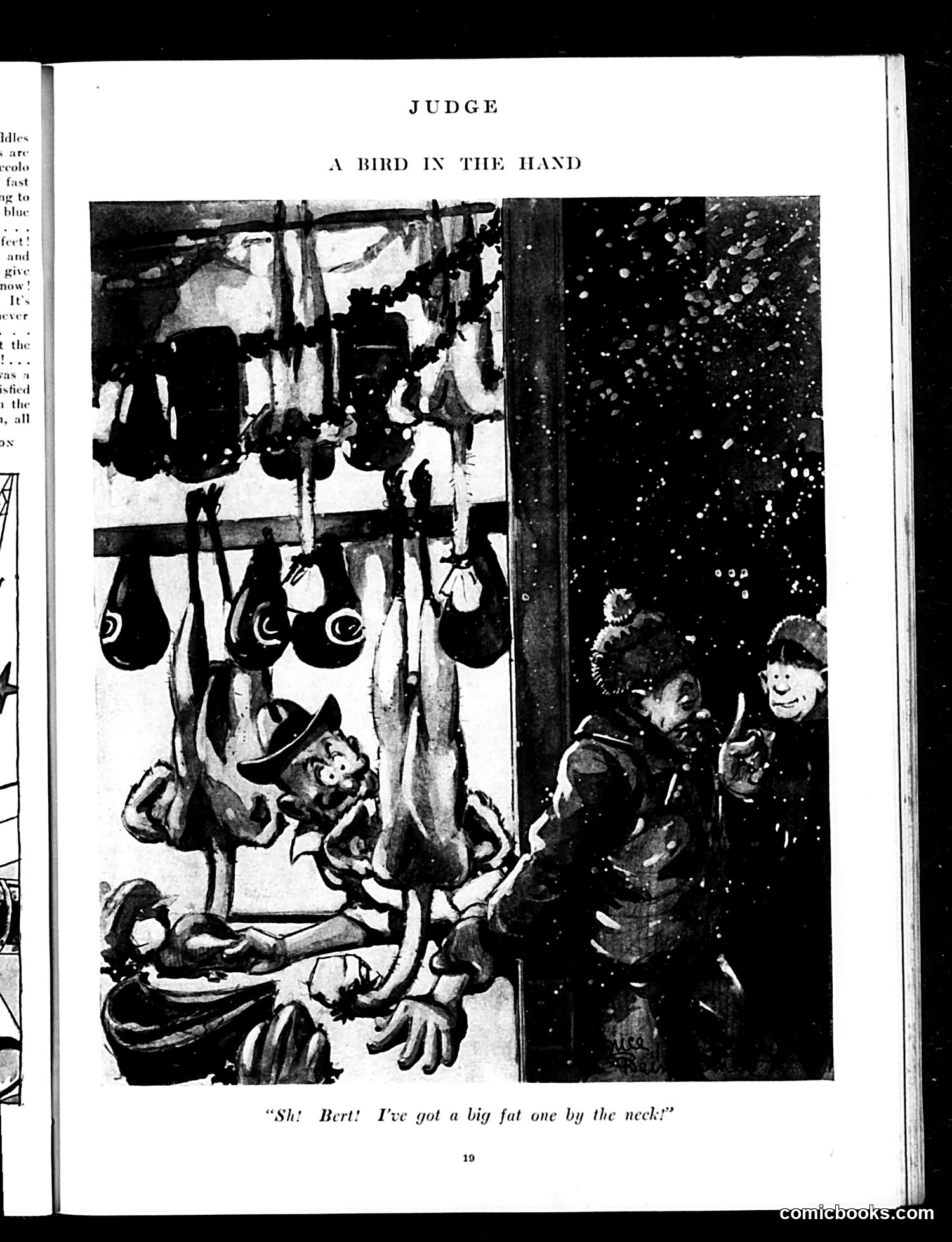
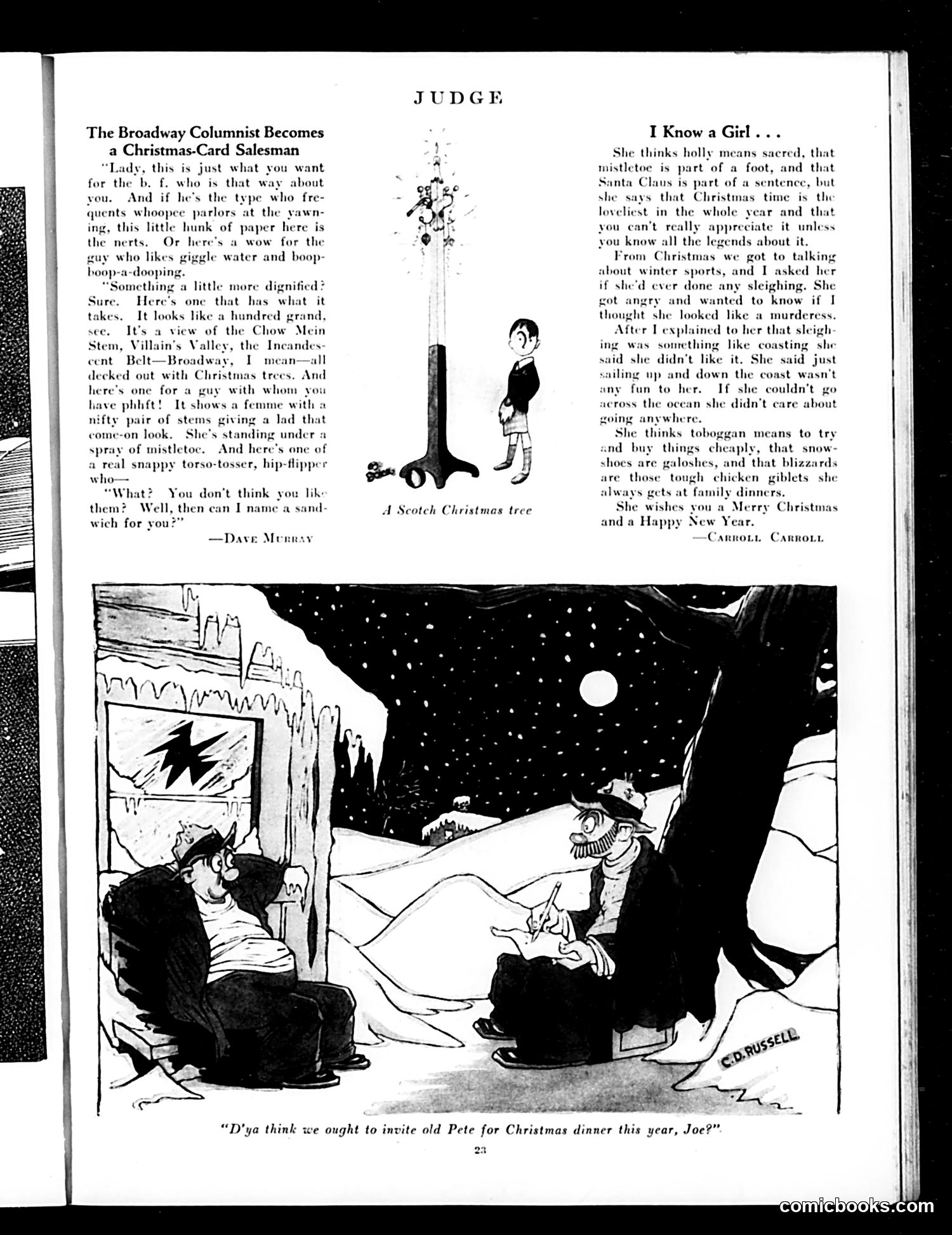
# Analysis of Judge Magazine Page This page contains two separate satirical pieces: **"Christmas Hold-Up"** (top cartoon): Shows a burglar robbing a woman at gunpoint on a snowy street while another figure watches. The joke plays on the irony that crime continues even during the holiday season—the burglar uses the excuse "everybody else has the day off—I gotta work," suggesting criminals don't observe Christmas traditions. **"A Miscellany of Things Unnecessarily Loud"** (bottom): A collection of brief satirical observations about noisy urban annoyances, including typography, theater, and Wall Street. The main cartoon shows an overflowing mantelpiece of Christmas decorations, with the caption joking about a man who "forgot to do his own shopping"—likely depicting middle-class holiday stress and materialism. Both pieces mock urban life's contradictions and commercialism.
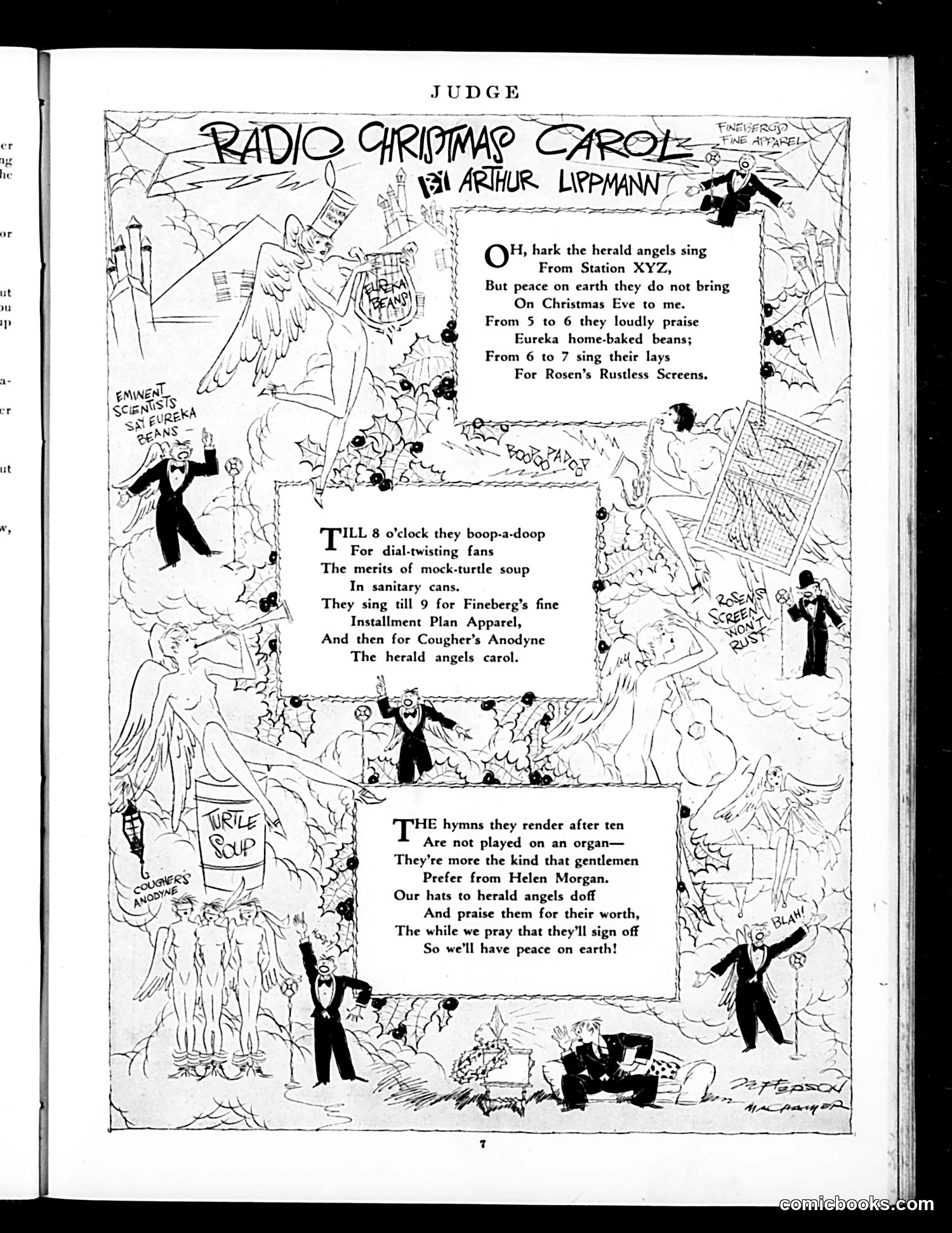
# Radio Christmas Carol Satire This is Arthur Lippmann's parody of "Hark! The Herald Angels Sing," mocking radio advertising's invasion of Christmas programming. The cartoon depicts heaven's angels reduced to shilling commercial products on a fictional "Station XYZ." The satire targets radio stations' relentless product placement during the holiday season: Eureka vacuum cleaners, Rosen's screens, mock-turtle soup, Fineberg's apparel, and Cougher's cough medicine interrupt sacred carols. The final stanza references Helen Morgan, a popular cabaret singer, suggesting the stations replace hymns with secular entertainment. The joke: listeners desperately wish the angels—and their advertising—would "sign off" so they could actually experience "peace on earth." This reflects 1920s-30s frustration with American commercial radio's unapologetic commodification of Christmas tradition, turning religious observance into mere advertising vehicles.
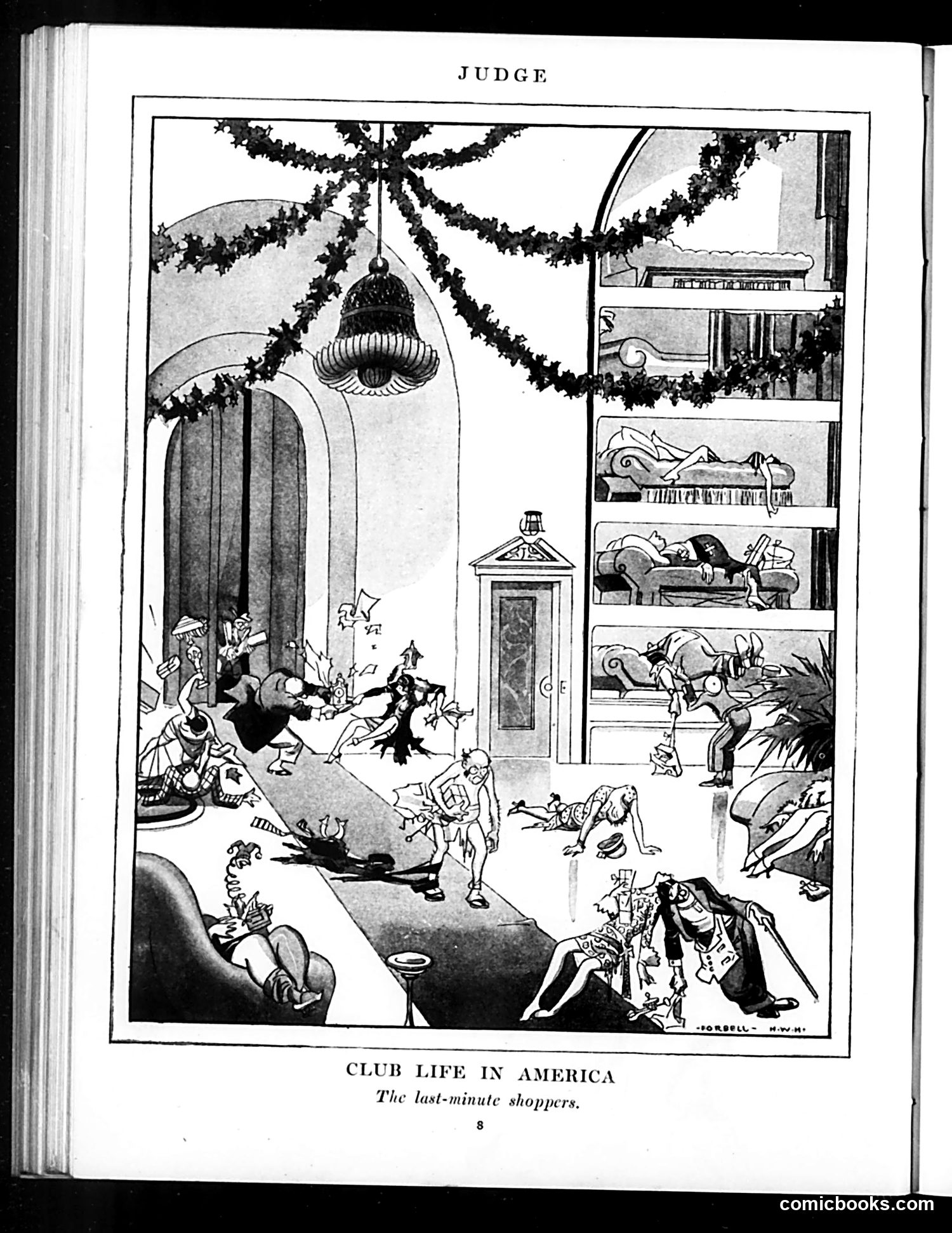
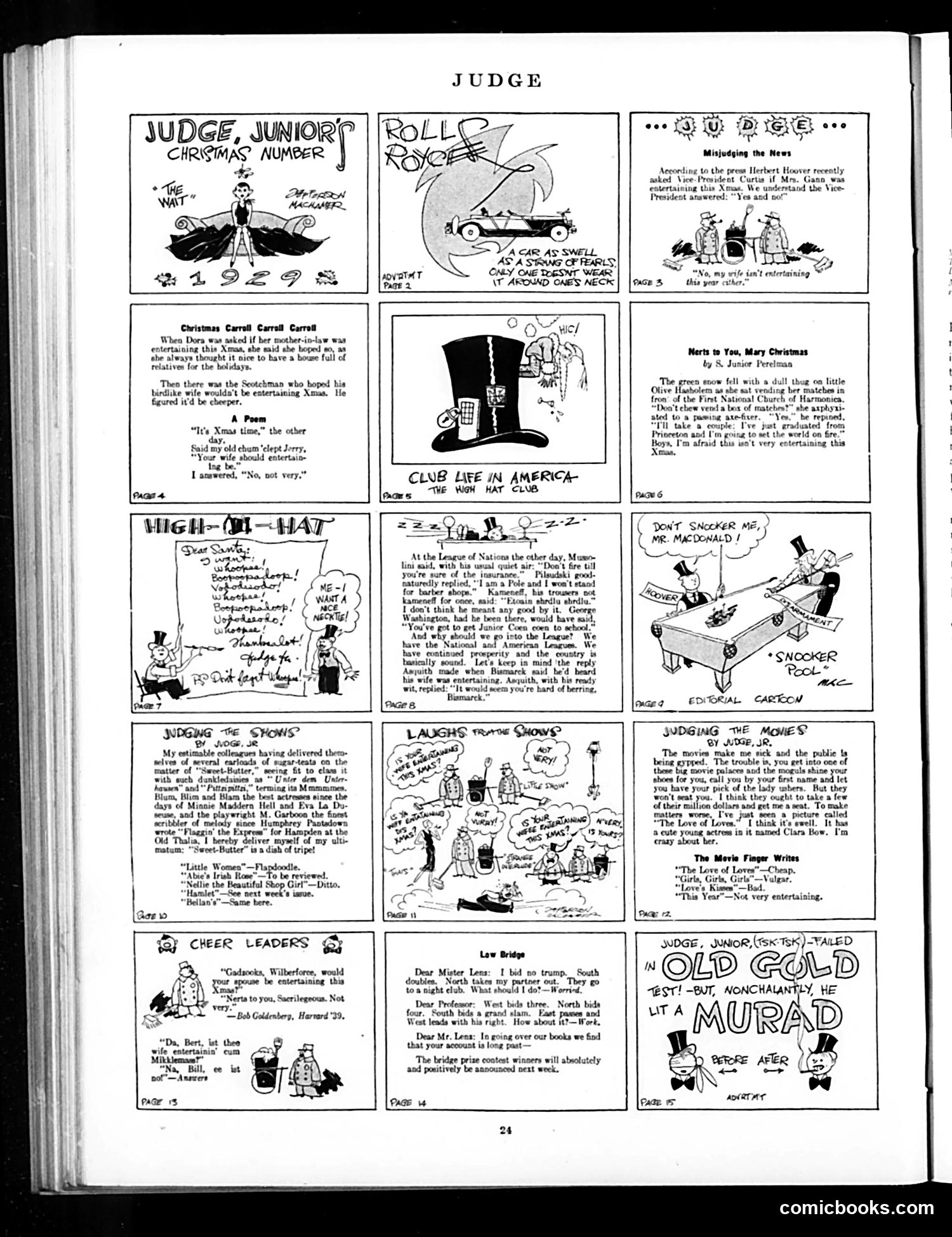
# Analysis This is a satirical cartoon titled "Club Life in America: The last-minute shoppers," depicting frantic Christmas shopping at what appears to be an exclusive club or upscale venue. The illustration shows chaotic scenes of well-dressed people in various states of rushed gift-purchasing panic—some lounging exhausted, others frantically searching or carrying packages. The right panel shows sequential scenes of people in what looks like a club's shopping facilities or nearby stores. The satire targets the wealthy elite's last-minute holiday shopping habits and the comedic desperation that ensues even among the privileged classes. The humor relies on contrasting the sophisticated "club life" setting with the undignified, frenzied behavior of Christmas shopping season—a relatable theme suggesting that wealth doesn't exempt one from holiday stress.
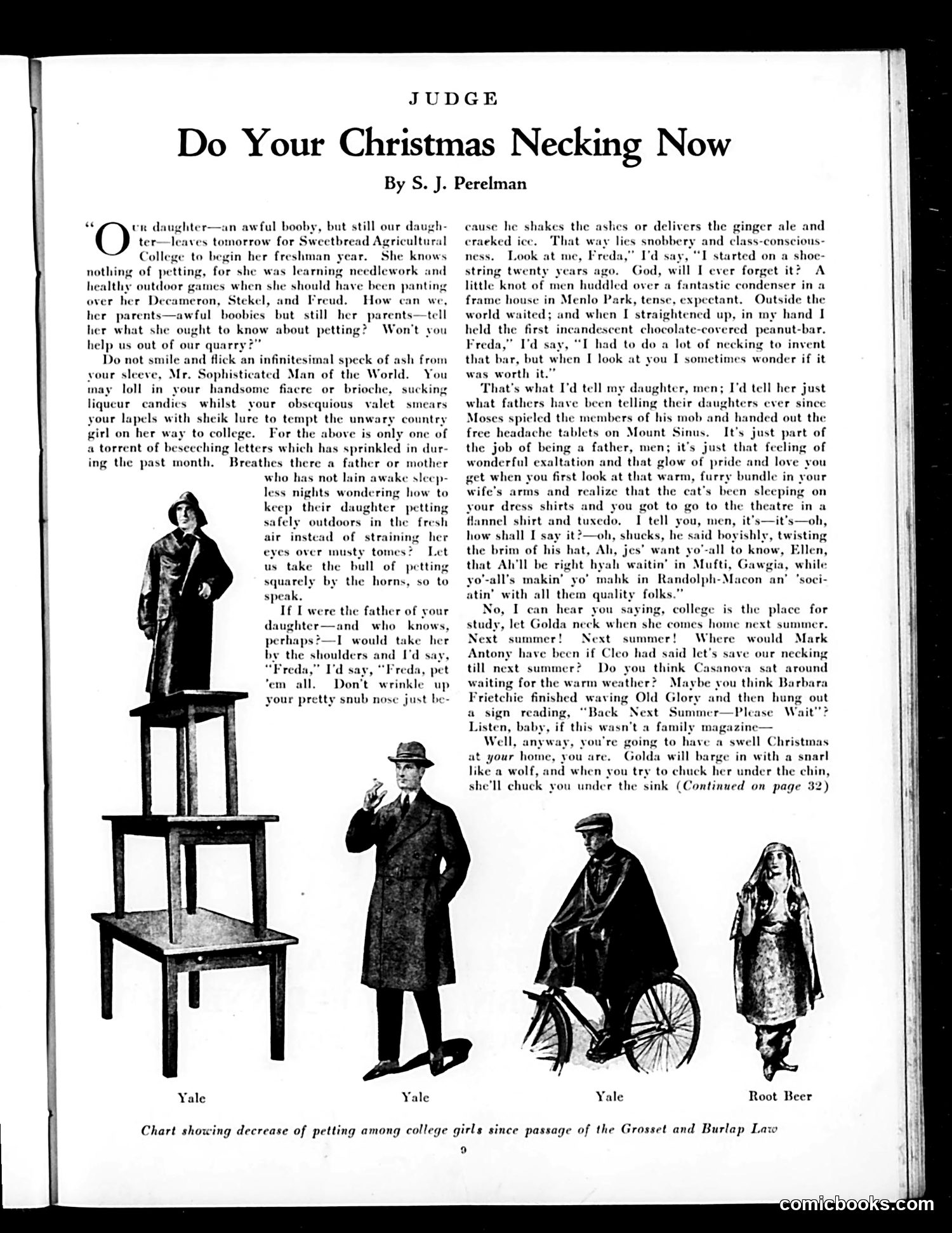
# "Do Your Christmas Necking Now" - Judge Magazine Satire This humorous article by S.J. Perelman satirizes parental anxiety about college-aged daughters' romantic behavior and changing social norms. The piece mocks fathers seeking advice on how to prepare daughters for college by sarcastically encouraging "petting" (1920s-era slang for kissing/light physical affection). The joke targets: 1. **Dated parental concerns**: Parents worried daughters were learning "needlework" instead of understanding modern dating 2. **Self-made-man mythology**: A character boasts about inventing chocolate-covered peanuts through "necking," mocking how men justify their romantic past 3. **The "Grosset and Burlap Law"**: A fictional regulation supposedly restricting college girls' petting—a jab at actual moral panic legislation of the era The accompanying illustrations (labeled "Yale" and "Root Beer") appear to be visual gags about college types and masculine stereotypes. The satire criticizes both parents' cluelessness about youth culture and society's hypocritical attitudes toward sexuality.
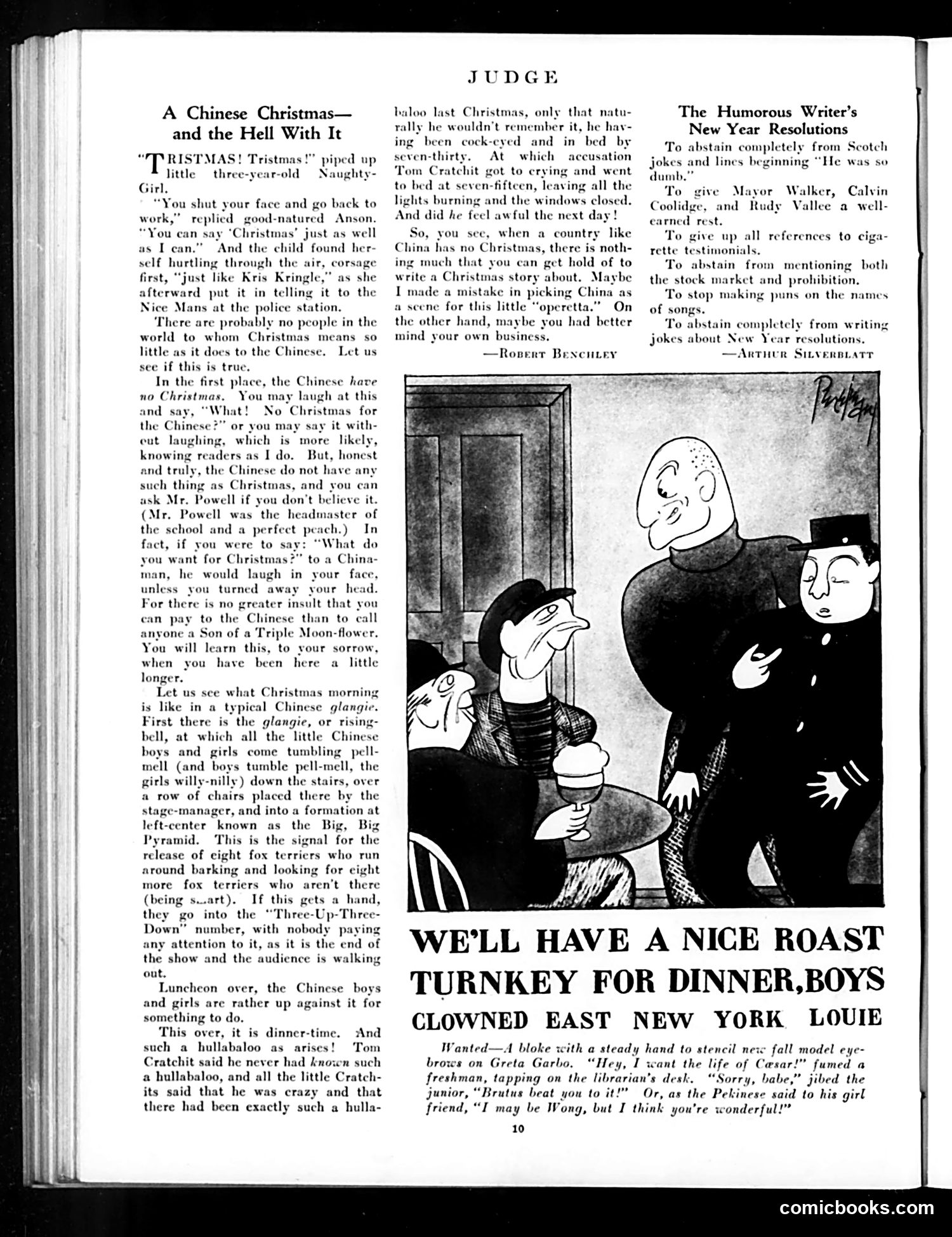
# Judge Magazine Page Analysis This page contains satirical commentary on Christmas customs and American public figures circa the 1920s. **Main Article ("A Chinese Christmas"):** Robert Benchley's humorous essay mocks the difficulty of writing Christmas stories about China, which he claims has no Christmas tradition. The piece uses crude ethnic stereotyping typical of the era, describing Chinese children's chaotic Christmas morning antics with exaggerated comic detail. The satire targets not Chinese culture specifically but rather the limitations of American Christmas storytelling itself—Benchley admits he may have made "a mistake" choosing China as his subject. **"New Year Resolutions" Section:** Arthur Silverblatt lists humorously specific promises to avoid clichéd comedy topics: Scotch jokes, mentions of Mayor Walker, Calvin Coolidge, and Rudy Vallee (contemporary public figures), cigarette testimonials, stock market/prohibition references, song-name puns, and ironically, New Year resolution jokes themselves. **Bottom Cartoon:** Shows a man claiming they'll serve "roast turkey" to "East New York Louie"—likely a mobster reference, with the dark implication of violence rather than actual dinner.