
Judge, 1929-12-21 · page 15 of 36
Judge — December 21, 1929 — page 15: what you’re looking at
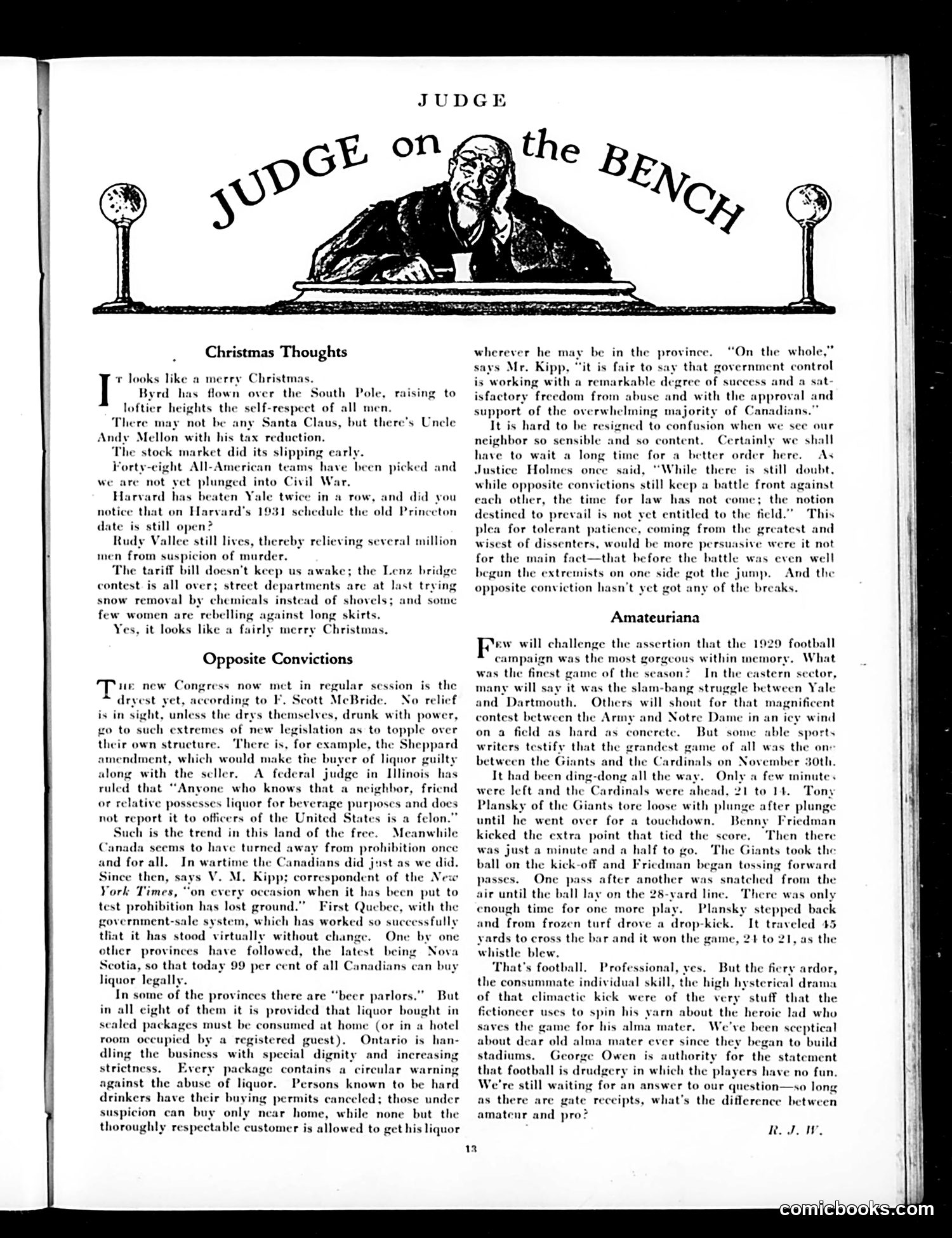
A restored page from Judge, 1929-12-21. Page through the whole issue in the reader above.
📄 Transcribed text from this page (OCR, searchable)
Machine-transcribed from the original scan — historical spelling and the odd misread are preserved.
JUDGE Christmas Thoughts + looks like a merry Christmas. Byrd has flown over the South loftier he: Pole, hts the self-respect of all men. There may not be any Santa Claus, but there's Uncle Andy Mellon with his tax reduction. The stock market did its slipping carly. Forty-eight All-American teams have been pic : not yet plunged into Civil War. Harvard has beaten Yale twice in a row, and did 3 notice that on Harvard's 1931 schedule the old Princeton date is still open? Rudy Vallce still lives, thereby relieving several million men from suspicion of murder. The tariff bill doesn’t keep us awake; the Lenz bridge contest is all over; street departments are at last trying snow removal by chemicals instead of shovel few women are rebelling against long skirts Yes, it looks like a fairly merry Christmas, raising to we and some Opposite Convictions ie new Congress now met in regular session is the dryest yet, according to F. Scott McBride. No relief is in sight, unless the drys themselves, drunk with power, go to such extremes of new legislation as to topple over their own structure. There is, for example, th nendment, which would make the buyer of liq along with the seller. A federal judge in Illinois ruled that “Anyone who knows that a neighbor, friend or relative possesses liquor for beverage purposes and docs not report it to officers of the United States is a felon.” Such is the trend in this land of the free. Meanwhi Canada seems to have turned away from prohibitic d forall. In wartime the Canadians did just as we nce then, says V. M. Kipp; correspondent of the N York Times, “on every occasion when it has been put to test prohibition has lost ground.” First Quebec, with the government-sale system, which has worked so successfully tliat it has stood virtually without change. One other provinces have followed, the latest be Scotia, so that today 99 per cent of all C anadians can buy liquor legally. In some of the provinces there are “beer parlors.” But in all eight of them it is provided that liquor bought in sealed packages must be consumed at home (or in a hotel room occupied by a registered guest). Ontario is han- dling the business with special dignity and increasing strictness. Every © contains a circular warni st the abuse of liquor. Persons known to be hard drinkers have their buying permits canceled; those under suspicion can buy only n home, while none but the thoroughly respectable customer is allowed to get his liquor by one wherever he mi > in the province. “On the whole,” says Mr. Kip ir to say that government control 3 working with a remarkable degree of success and a sat- isfactory freedom from abuse and with the approval and support of the overwhelming majority of Canad It is hard to be resigned to confusion when we see our neighbor so sensible and so content. Certainly we shall have to wait a long time for a better order here. As Justice Holmes once said, “While there is still doubt, while opposite convictions still keep a battle front against each other, the time for law has not come; the notion destined to prevail is not yet entitled to the field.” This plea for tolerant patience, coming from the greatest and wisest of dissenters, would be more persuasive were it not for the main fact—that before the battle was even well begun the extremists on one side got the jump. And the opposite conviction hasn't yet got any of the breaks. Amateuriana w will challenge the assertion that the 1929 football the most gorgeous within memory. What me of the season? was the many will say it was the slam-bang struggle between Yale and Dartmouth, Others will shout for that magnificent contest between the Army and Notre Dame in an icy wind on a ficld as hard as conercte. But some able sports writers testify that th ndest game of all was the on: between the Giants and ‘the Cardinals on November 30th. It had been ding-dong all the way. Only a few minutes were left and the Cardinals were ahead, 21 to 14. Tony Plansky of the Giants tore loose with plunge after plunge until he went over for a touchdown. Benny Friedman kicked the extra point that tied the score. Then there was just a minute and a half to go. The Giants took the ball on the kick-off and Friedman began tossing forward passes. One pass after another was snatched from the air until the ball lay on the 28-yard line. There was only cnough time for one more play, Plansky stepped back and from frozen turf drove a drop- kick. It traveled 45 ds to cross the bar and it won the game, 24 to 21, whistle blew That's footh »fessional, ves. the consummate individual skill, the high hysterical drama of that climactic kick were of the very stuff that the fictioncer uses to spin his yarn about the heroic lad who es the ne for his alma mater. We've been sceptical about dear old alma mater ever since they began to build stadiums. George Owen is authority for the statement that football is drudgery in which the players have no fun. We're still waiting n answer to our question—so long as there are gate receipts, what's the difference between atenr and pro? RJ. IW, COMICDOOK’ In the castern sector,