
Judge, 1929-12-21 · page 18 of 36
Judge — December 21, 1929 — page 18: what you’re looking at
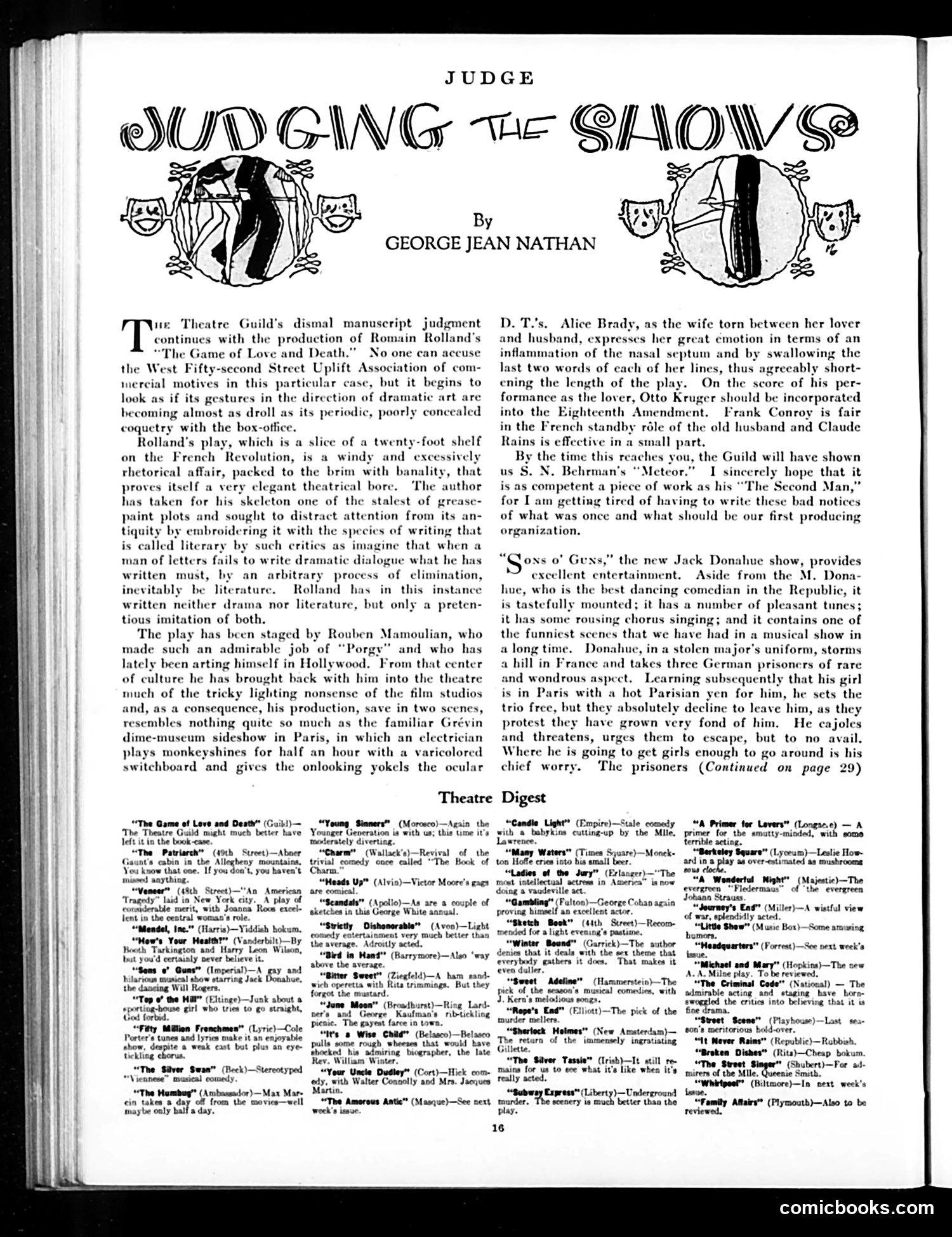
A restored page from Judge, 1929-12-21. Page through the whole issue in the reader above.
📄 Transcribed text from this page (OCR, searchable)
Machine-transcribed from the original scan — historical spelling and the odd misread are preserved.
JUDGE (WW By IG ee GAOW SG GEORGE JEAN NATHAN T : Theatre Guild's dismal manuscript judgment continues with the production of Romain Rolland’s ‘The Game of Love and Death.” No one can accuse the West Fifty-second Street Uplift Association of com- 1 motives in this particular case, but it begins to look as if its gestures in the direction of dramatic art becoming almost as droll as its periodic, poorly conce coquetry with the box-office. Rolland’s play, which is a slice of a twenty-foot shelf on the French Revolution, is a wind. nd excessively rhetorical affair, packed to the brim with banality, t proves itself a very elegant theatrical bore. ‘The has taken for his skeleton one of the stalest of gre paint plots and sought to distract attention from its an- tiquity by embroidering it with the species of writing that is called literary by such critics as imagine that when a man of letters fails to write dramatic dialogue what he has written must, by arbitrary process of climination, inevitably be literature. Rolland has in this instance written neither drama nor literature, but only a preten- tious im ion of both. The play has been staged by Rouben Mamoulian, who made such an admirable job of “Porgy” and who has lately been arting himself in Hollywood. From that center of culture he has brought back with him into the theatre much of the tricky lighting nonsense of the film studios nd, as a consequence, his production, save in two scenes, embles nothing quite so much as the familiar Gré dime-museum sideshow in Paris, in which an electricis plays monkeyshines for half an hour with a varicolored switchboard and gives the onlooking yokels the ocular mere! re led an Alice Brady, as the wife torn between her lover and husband, expresses her great emotion in terms of an nflammation of the nasal septum and by swallowing the t two words of cach of her lines, thus agreeably short- ening the length of the play. On the score of his per- formance as the lover, Otto Kruger should be incorporated into the Eighte endment. Frank Conroy is fair in the French standby réle of the old husband and Claude Rains is effective in a small part. By the time this reaches you, the Guild will have us S. N. Behrman’s “Meteor.” I sine is as competent a piece of work as his for I am getting tired of of what was once and wh organization, 'G shown rely hope that it he Second Man,” ing to write these bad notices at should be our first producing “Goxs o ns,” the new Jack Donahue show, provides excellent entertainment. Aside from the M. Dona- hue, who is the best dancing comedian in the Republic, it is tastefully mounted; it has a number of pleasant tunes; it has some rousing chorus singing; and it contains one of the funniest scenes that we have had in a musical show in along time. Donahue, in a stolen major’s uniform, storms a hill in France and takes three German prisoners of rare and wondrous aspect. Learning subsequently that his girl is in Paris with a hot Parisian yen for him, he sets the trio free, but they absolutely decline to leave him, as they protest they have grown very fond of him. He cajoles and threatens, urges them to escape, but to no ava Where he is going to get girls enough to go around is h chief worry. “The Game of Love and Death” (Gail!) — ‘The Theatre Guild might much better have left it in the book-case. “The Patriarch” (49th Street) —Aboer € at's cabin in the Allegheny mountains, know that one. If you don’t, you haven't missed anything. Veneer” (48th Strect)—"An American Tragedy” laid in New York city. A play of maderable merit, with Joanna Roos excel- n the eeatral woman's role. ‘Mendel, Ine.” (Harris)—Yiddiah hokum. jow's Your Health?” (Vanderbilt) —By Booth Tarkington and Harry Leon Wilson, but you'd certainly never believe it. “Senso? Guas” (Imperial)—A gay and hilarious musical show starring Jack Donahue, the dancing Will Rogers. rep of the Hill” (Eltinge)—Junk about a orting-house girl who tries to go straight, od forbid. Fitty Million Frenchmen” (Lyric)—Cole Porter's tunes and lyrics make it an enjoyable show, despite a weak cast but plus an eye- tickling el “The Silver Swan” (Bec! “Viennese” musical comedy “The Hambug” (Ambassador)—Max Mar- cin takes day off from the movice—well maybe only tall a day. tent Stereotyped Theatre “Young, Sinners” (Morosco)—Again the Younger Generation is with ua; thie time it's morterately diverting. “Charm” (Wallack’s) trivial comedy once called Charm.” “Heads Up" (Alvia)—Victor Moore's gags fare comical. “Scandals” (Apollo)—As are a couple of sketches in this George White annual. “Swrietty Dishomorable” (A von)—Ligh comedy entertainment very much better th: the average. Adroitly acted. rd in Hand” (Barrymore)—Aleo ‘way above the average. “Bitter Sweet” (Ziegfeld)—A ham eand- wich operetta with Rita trimmings. But they forgot the mustard. “dame Moon” (Brosdhurst)—Ring La per's and George Kaufman's ribet picnic. The gayest farce in town. “t's a Wise Child” (Belasco)—Belaseo pulls some rough wheeses that would bave Mhocked, his’ admiring bicgrapber, the late Rev. William Winter. “Your Uncle Dudley” (Cort)—Hiek com edy, with Walter Connolly and Mrs. Jacques Martin. “The Amorous Antic” (Masque)—See next woek's isnue. —Revival of “The Book the of Digest “Candle Light” (Empire)—Stale comedy with babykins cutting-up by the Mlle, Lawrence. “Many Waters” (Times Susre)—Monek- ton Hoffe eries into his small beer. “Gambling” (Fulton)—George Cohan again proving himself an excellent actor “Sketch Book” (44th Screet)—Recom- mended for a light evening’s pastime. “Winter Beand” (Garrick)—The author denies that it deala with the ex theme that, everybody gathers it does, That makes it even duller. “Sweet Adeline’ (Hammerstein)—The Pick of the season's musical comedies, with J. Kern's melodious songs. “Repe’s End” (Filictt)—The pick of the turder mellers “Sherlock Holmes” (New Amstertam)— The return of the immensely ingratiating Gillette. “The Silver Tassie® (Irish)—It still re- mains for us to ese what it's like when it’s really acted. Express™ (Libert: scenery is m }—Underground murder, better than the play. 16 The prisoners (Continued on page 29) “A Primer tor Lovers” (Longac.e) — A primer for the amatty-minded, with some terrible acting. “Berkeley Square” (1.yceum)—Leslie How- ard in in play ‘as over-estimated as mushrooms ous clad “A Wondertul Might”? (Majestic)—The evergreen “Fledermaus” of *t! evergreen Jobana Strauss “Journey's Eng” (Miller)—A wistful view of war, splendidly acted “Little Shaw" (Music Box) —Some amusing humors. issue. ‘Michael and Mary” (Hopkins)—The vew A.A. Milne play. To be reviewed. “The Criminal Code" (National) — The sdmirable acting and staging have hore- ed the eritice into believing that it is fine drama. “Sweet Scene” (Playhouss)—Last sea- son's meritorious bold-over. “4t Mever Rains” (Republic)—Rubbieh. “Broken Dishes (Rits)—Cheap bokum. (Shubert)—For ad- Forrest)—See next week's tomy Aftairs (Plymouth)—Also to be reviewed. comicbooks.com