
Judge, 1929-12-21 · page 27 of 36
Judge — December 21, 1929 — page 27: what you’re looking at
A restored page from Judge, 1929-12-21. Page through the whole issue in the reader above.
📄 Transcribed text from this page (OCR, searchable)
Machine-transcribed from the original scan — historical spelling and the odd misread are preserved.
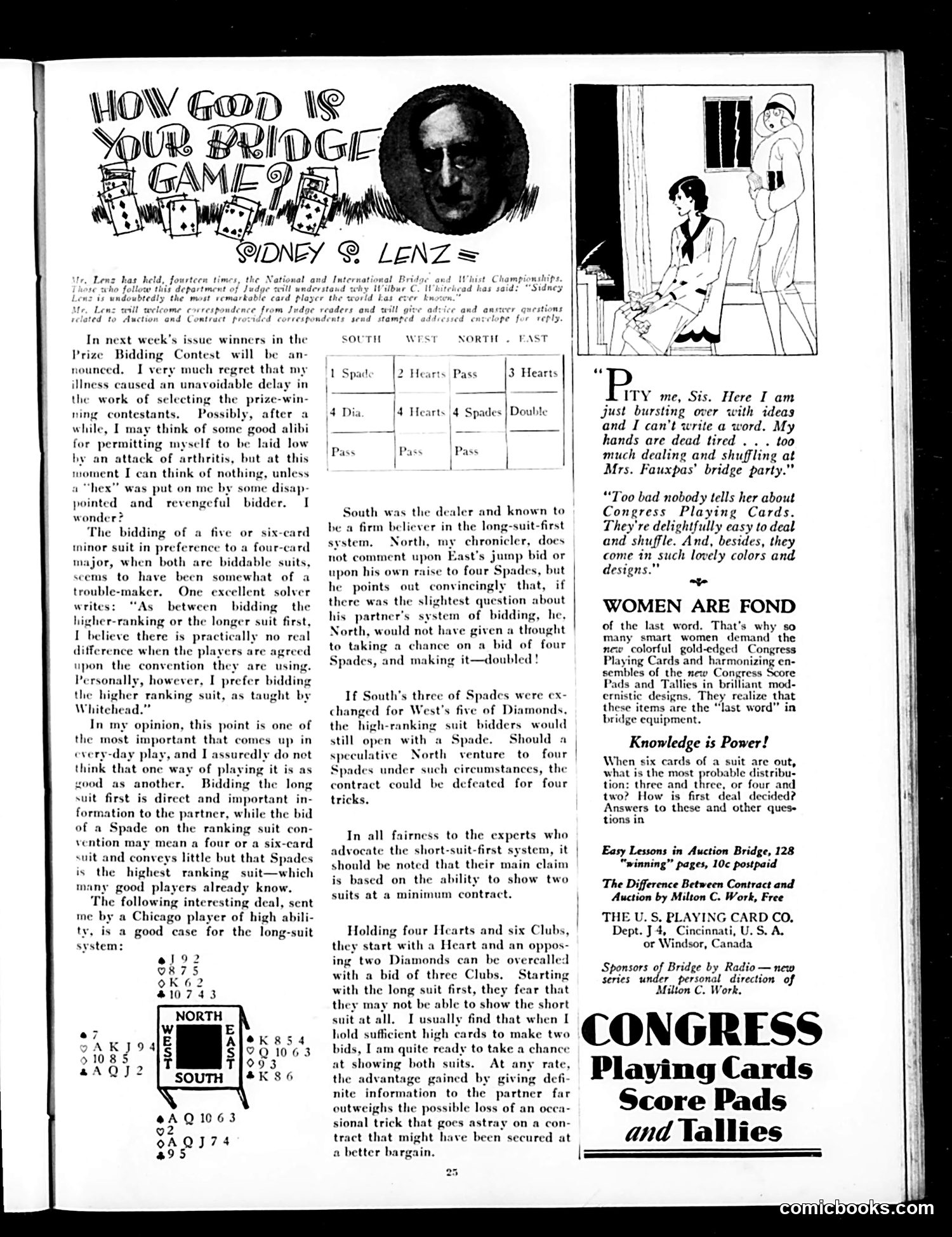
xt week's issue winners in the Prize Bidding Contest will be an- nounced. I very much regret that my illness caused an unavoidable delay in the work of selecting the prize-win- ning contestants. Possibly, after a while, I may think of some good alibi for permitting myself to be laid low by an attack of arthritis, but at this moment I can think of nothing, unless 1 “hex” was put on me by some disap- pointed and revengeful bidder. I wonder? The bidding of a five or si ininor suit in preference to a four major, when both are biddable suits, scems to have been somewhat of a trouble-maker. One excellent solver writes: “As between bidding the higher-ranking or the longer suit first, I believe there is practically no real difference when the players are agreed upon the convention they are using. Personally, however, I prefer bidding the higher ranking suit, as taught by Whitehead.” In my opinion, this point is one of the most important that comes up in every-day play, and I assuredly do not think that one way of playing it is as das another. Bidding the long suit first is direct and important in- formation to the partner, while the bid of a Spade on the ranking suit con- vention may mean a four or a six-card suit and conveys little but that Spades is the highest ranking suit—which good players already know. The following interesting deal, sent me by a Chicago player of high abi sa good case for the long-suit system: “Sidney ders ec and ansx SOUTH Wrst NORTH © FAST 1 Spad 2 Hearts Pass Hearts | 4 Dia 14 Hearts |4 Spades | Double Pass South was the dealer and known to be a firm believer in the lor first system. North, my chronicler, does not comment upon East's jump bid or upon his own raise to four Spades, but he points out convincingly there was the slightest que: his partner's system of bidding, he, North, would not have given a thought to taking a chance on a bid of four Spades, and making it—doubled ! ion about If South’s three of Spades were ex- changed for West's five of Diamonds, the high-ranking suit bidders would still open with a Spade. Should a speculative North venture to four Spades under such circumstances, the contract could be defeated for four tricks. In all fairness to the experts who advocate the short-suit-first system, it should be noted that their main claim is based on the ity to show two suits at a minimum contract. Holding four Hearts and six Clubs, ! they start with a Heart and an oppos- ing two Diamonds can be overcalled with a bid of three Clubs, Starting with the long suit first, they fear that the, -y may not be able to show the short y find that when I hold sufficient high cards to make two bids, I am quite ready to take a chance at showing both suits. At any rate, the advantage gained by giving defi- nite information to the partner ths the possible loss of an oc sional trick that goes astray on a con- tract that might have been secured at a better bargain. that, if | “ Be me, Sis. Here I am just bursting over with ideas and I can't write a word. My hands are dead tired . . . too much dealing and shuffling at Mrs. Fauxpas’ bridge party.” “Too bad nobody tells her about Congress Playing Cards. They're delightfully easy to deal and shuffle. And, besides, they come in such lovely colors and designs.” WOMEN ARE FOND of the last word. That's why so many smart women demand the new colorful gold-edged Congress Playing Cards and harmonizing en- sembles of the new Congress Score brilliant mod- signs. They realize tae ‘ms are the * “last word” bridge equipment. Knowledge is Power! When six cards of a suit are out, what is the most probable distribu- tion: three and three, or four and two? How is first deal decided? Answers to these and other ques- tions in Easy Lessons in Auction Bridge, 128 “winning” pages, 10c postpaid The Difference Between Contract and Auction by Milton C. Work, Free THE U. S. PLAYING CARD CO, Dept. J 4, Cincinnati, U. S. A. or Windsor, Canada Sponsors of Bridge by Radio— new series under personal direction of Milton C. Work, CONGRESS Playing Cards Score Pads and Tallies