
A complete issue · 36 pages · 1929
Judge — January 12, 1929
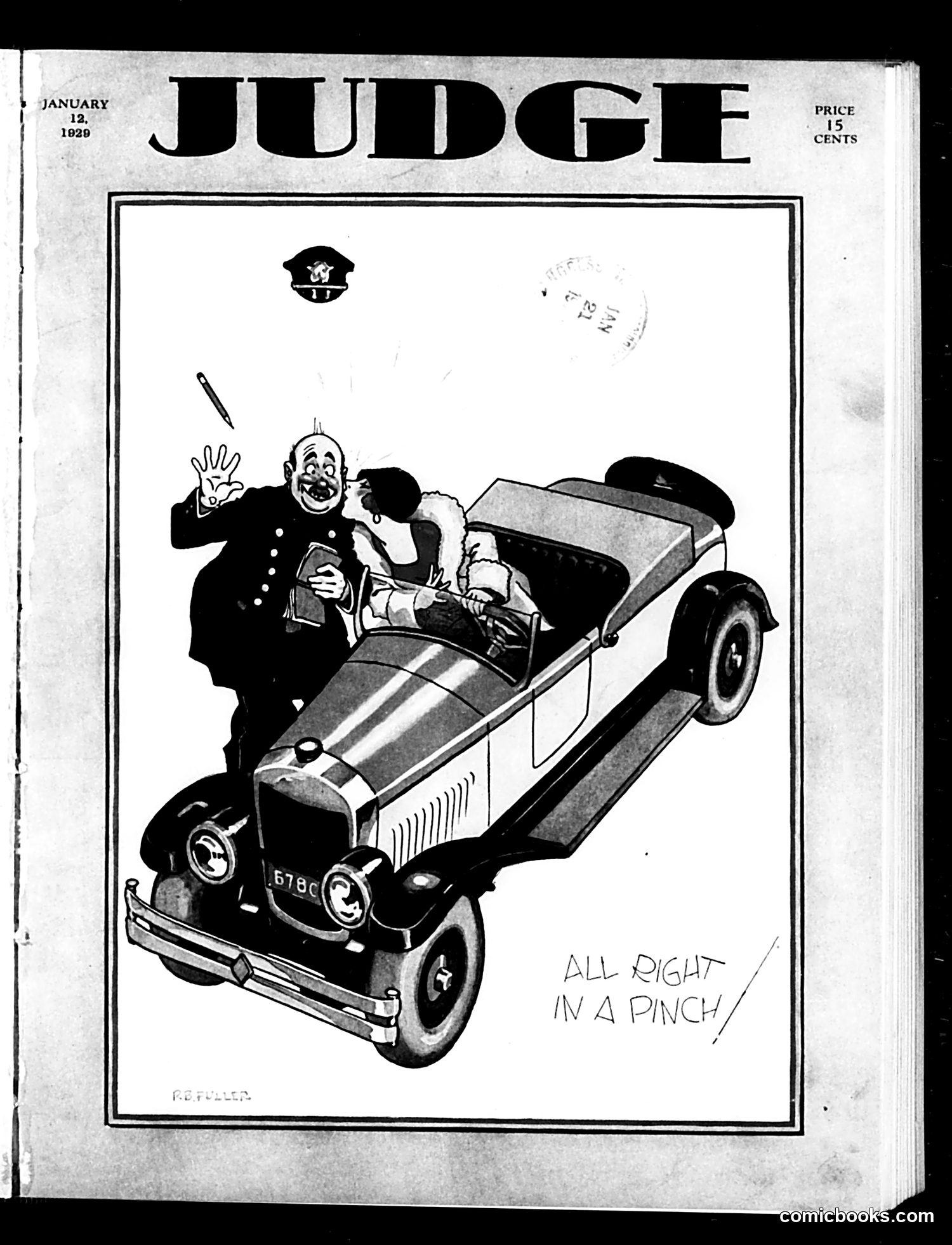
**Date:** January 12, 1920 | **Price:** 15 cents This cover depicts a policeman chasing a car driven by what appears to be a clown or jester character, with the caption "ALL RIGHT IN A PINCH!" The imagery likely satirizes Prohibition enforcement, which began January 17, 1920—just five days after this issue's publication date. The clown driver represents bootleggers or those evading alcohol laws, while the pursuing policeman represents law enforcement. The phrase "all right in a pinch" suggests people will find ways around Prohibition restrictions, or that the law's enforcement will be improvised and unreliable. The cartoon cynically predicts that despite prohibition's new legal status, Americans will continue obtaining alcohol through illegal means.
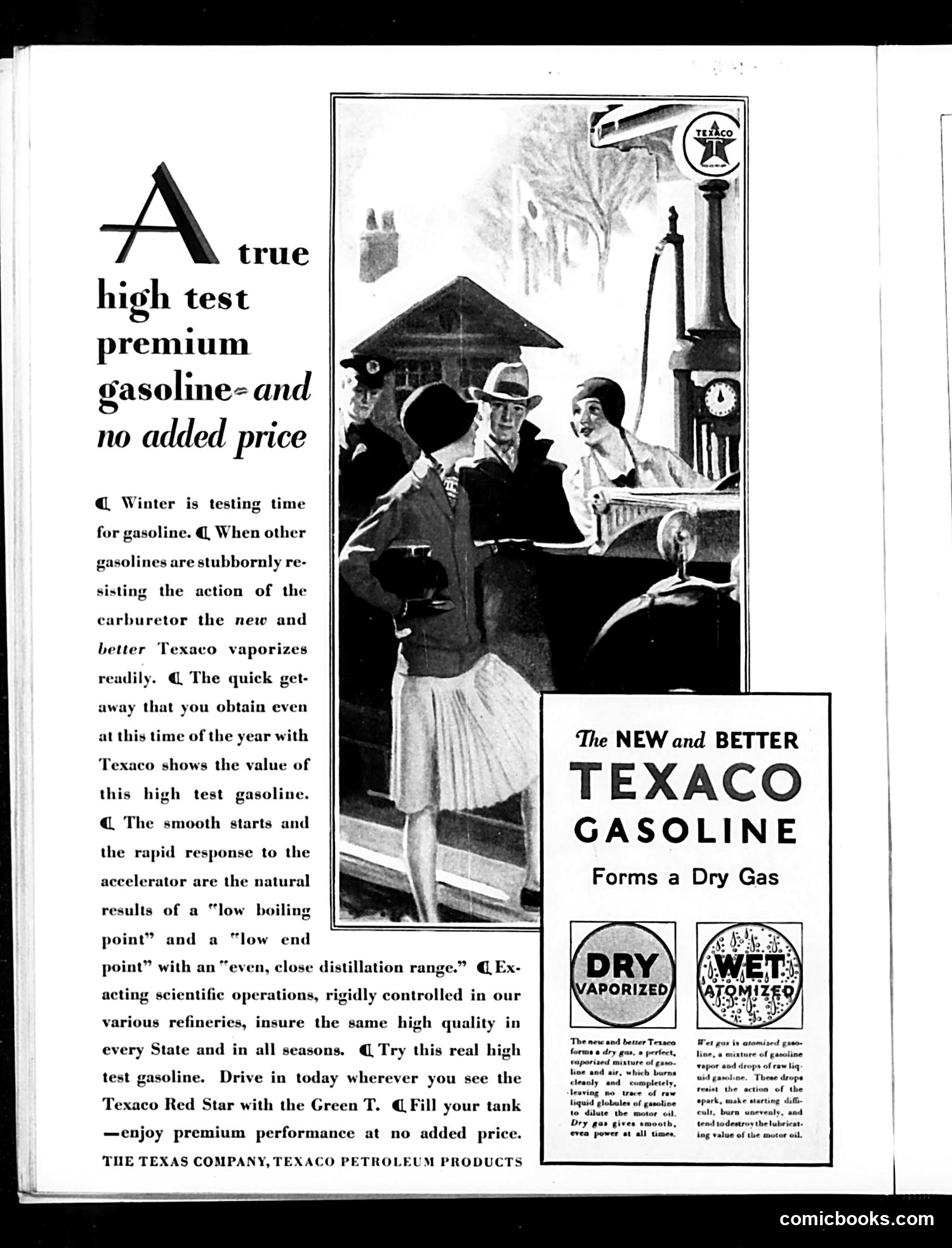
This page is primarily **advertising, not satire**. It promotes Texaco gasoline as a premium winter fuel product. The illustration depicts a social scene at what appears to be a gas station or service location, where well-dressed figures (a man, woman, and attendant) interact cheerfully. The messaging emphasizes Texaco's performance advantages: superior vaporization in cold weather ("dry gas" formation), smooth engine starts, and responsive acceleration—all marketed as premium quality "at no added price." The diagram comparing "dry vaporized" versus "wet atomized" gas explains the technical superiority claim. This is straightforward commercial advertising exploiting winter driving concerns, not political satire. Judge magazine, while satirical by reputation, regularly published paid advertisements like this one to sustain publication.
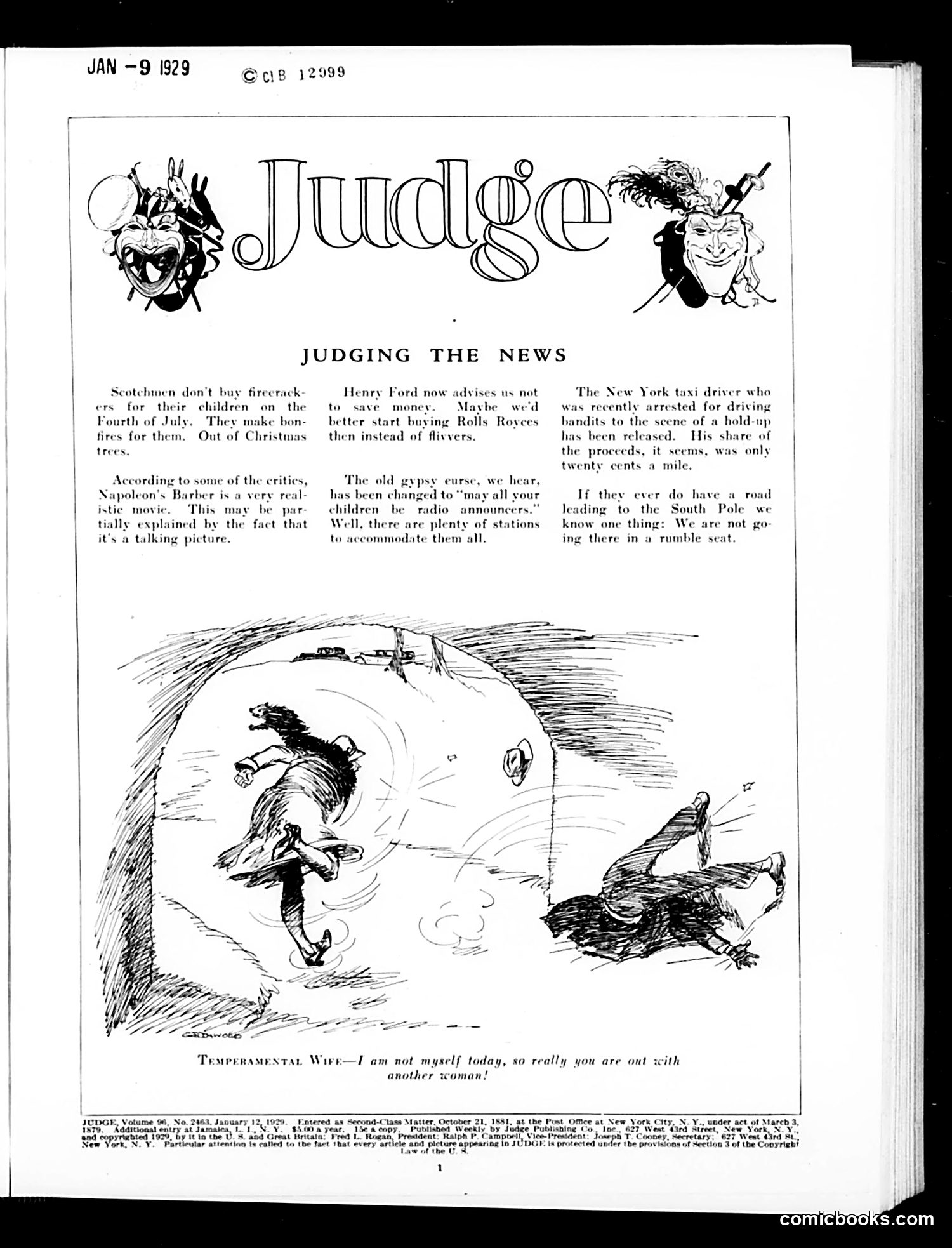
This page contains brief satirical news commentary ("Judging the News") and one cartoon. The main cartoon, captioned "Temperamental Wife—I am not myself today, so really you are out with another woman?", depicts a domestic dispute where a wife confronts her husband about infidelity, suggesting he's seeing someone else while she's in an altered emotional state. The accompanying text snippets mock contemporary figures and trends: Henry Ford's business advice, criticism of "Napoleon's Barber" as a realistic film, a gypsy curse becoming "may all your children be radio announcers," and a joke about a New York taxi driver arrested for holding up passengers for only twenty cents. The satire targets domestic relations, celebrity culture, and modern urban life.
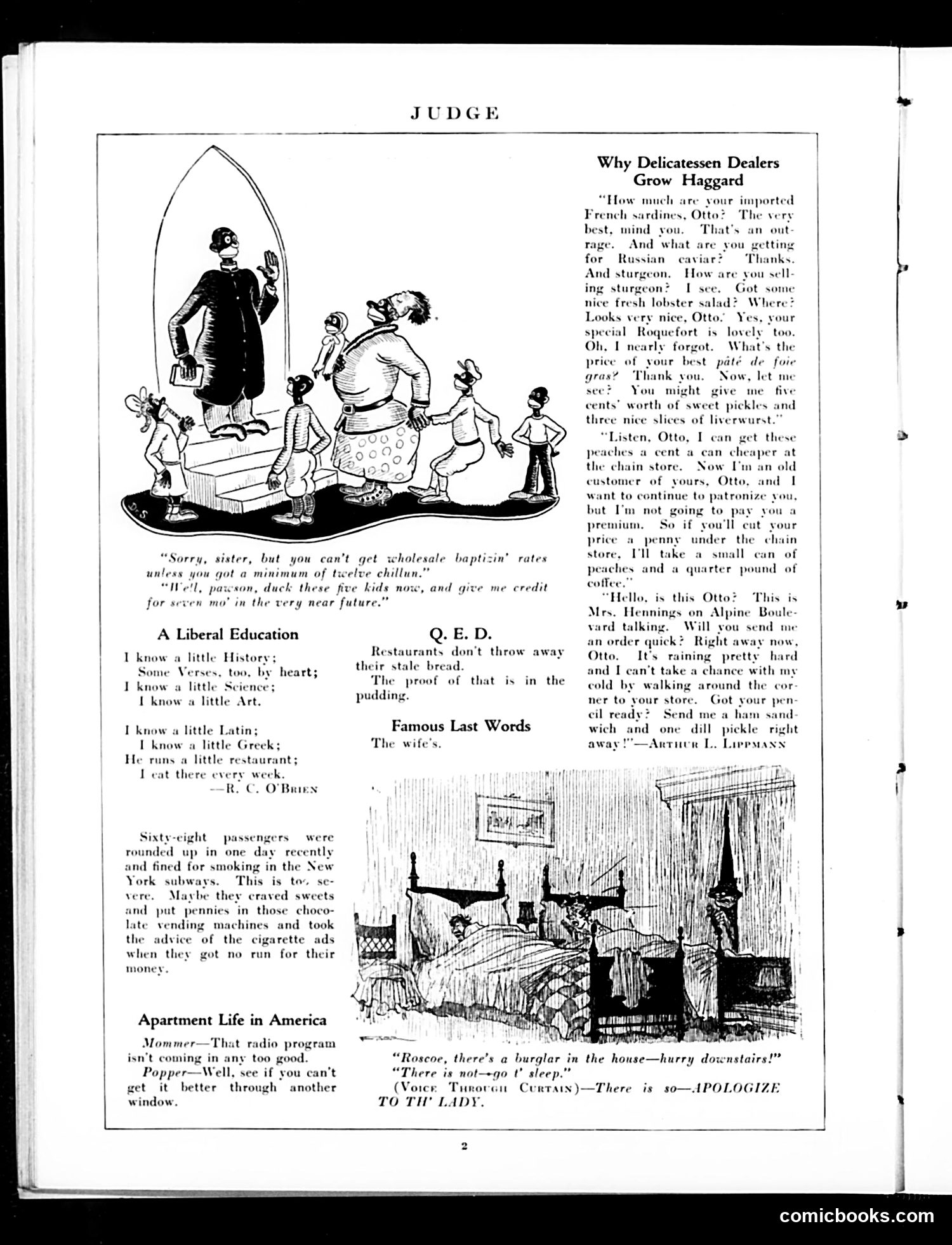
The main cartoon "Why Delicatessen Dealers Grow Haggard" satirizes the relationship between demanding customers and long-suffering delicatessen owners. A stern woman (likely representing a typical demanding customer) towers over a harried shopkeeper and children, as she makes increasingly petty requests—haggling over French sardines, Russian caviar, lobster salad, and pickles, constantly seeking discounts and credit. The satire mocks both the customer's aggressive penny-pinching and the shopkeeper's exhaustion trying to maintain patronage despite impossible demands. It captures early 20th-century urban consumer culture and class dynamics, where working-class merchants faced relentless pressure from customers seeking premium imported goods at bargain prices while demanding special treatment and credit.
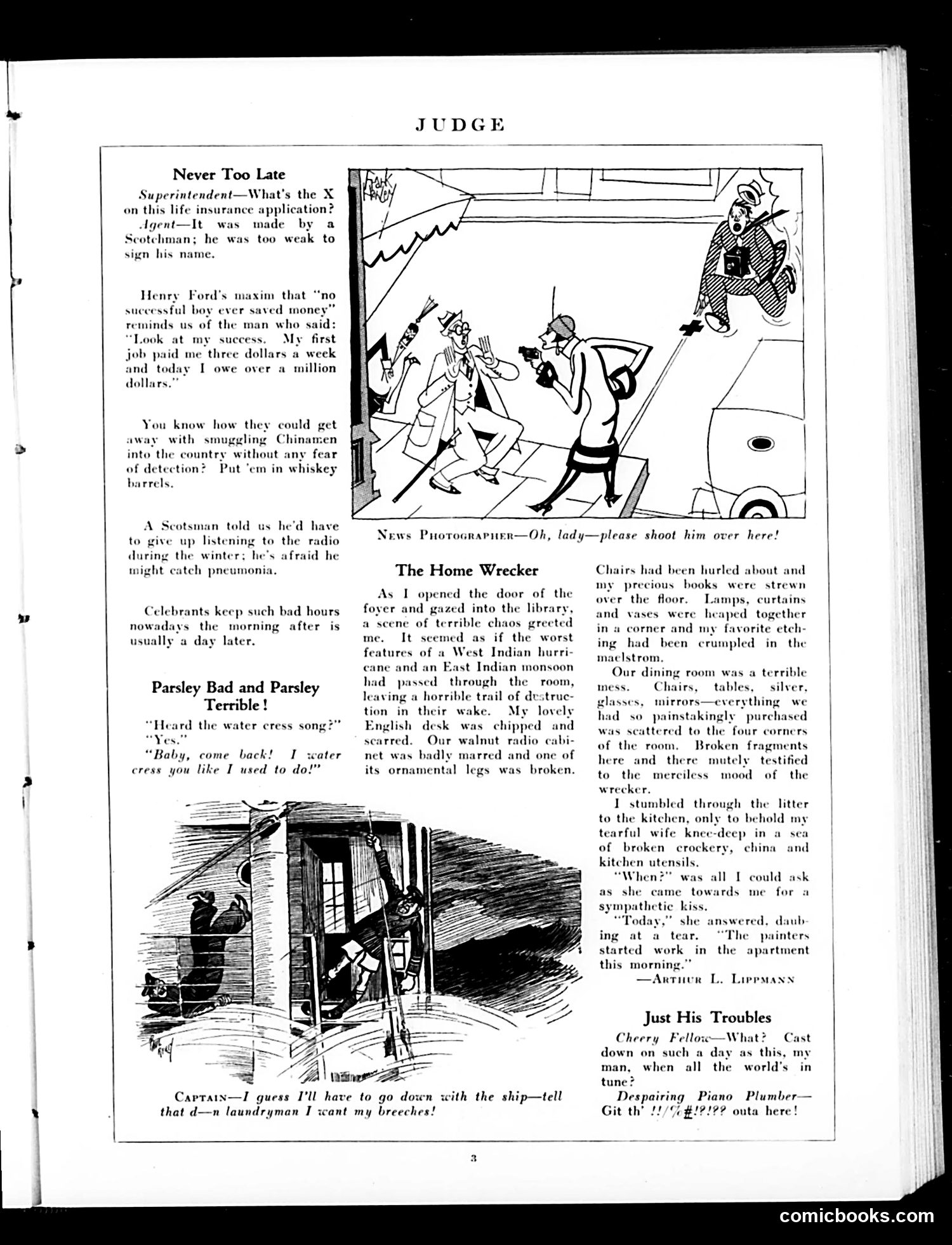
This page contains several humor pieces typical of Judge's satirical style: **"Never Too Late"** mocks life insurance applications, showing a Scotsman too weak to sign his own name—suggesting insurance companies accepted obviously unsuitable applicants. **"The Home Wrecker"** describes domestic chaos from what appears to be a severe storm or disaster, with furniture destroyed and the narrator's wife distressed. It's a humorous account of property destruction. **"Parsley Bad and Parsley Terrible"** is a brief joke about a water crossing, likely referencing a song or common phrase. **"Just His Troubles"** offers quick quips about misfortune—a pianist and others facing bad days. The cartoons are genteel humor targeting middle-class anxieties: insurance fraud, domestic disasters, and everyday misfortunes. No specific political figures or events are referenced on this page.
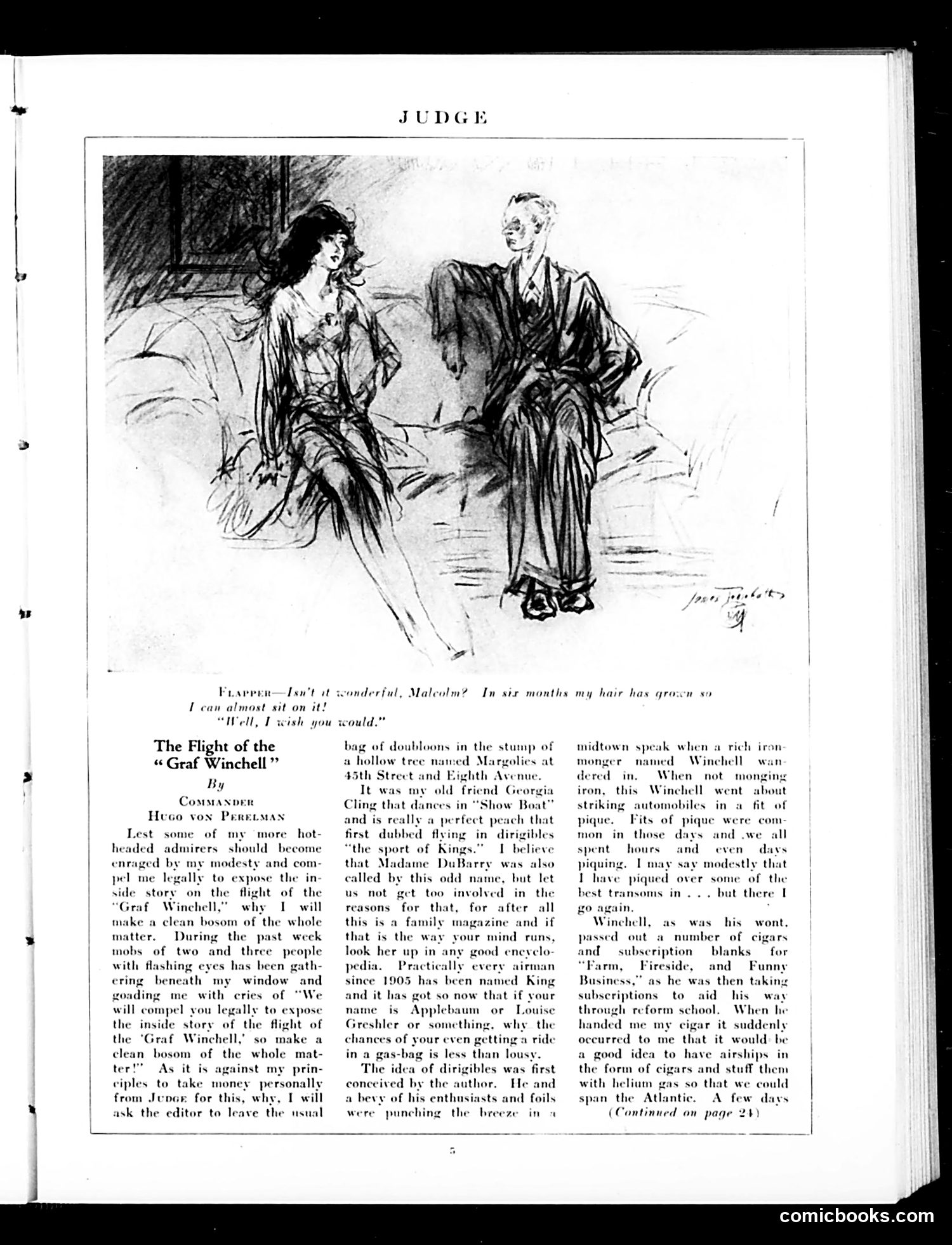
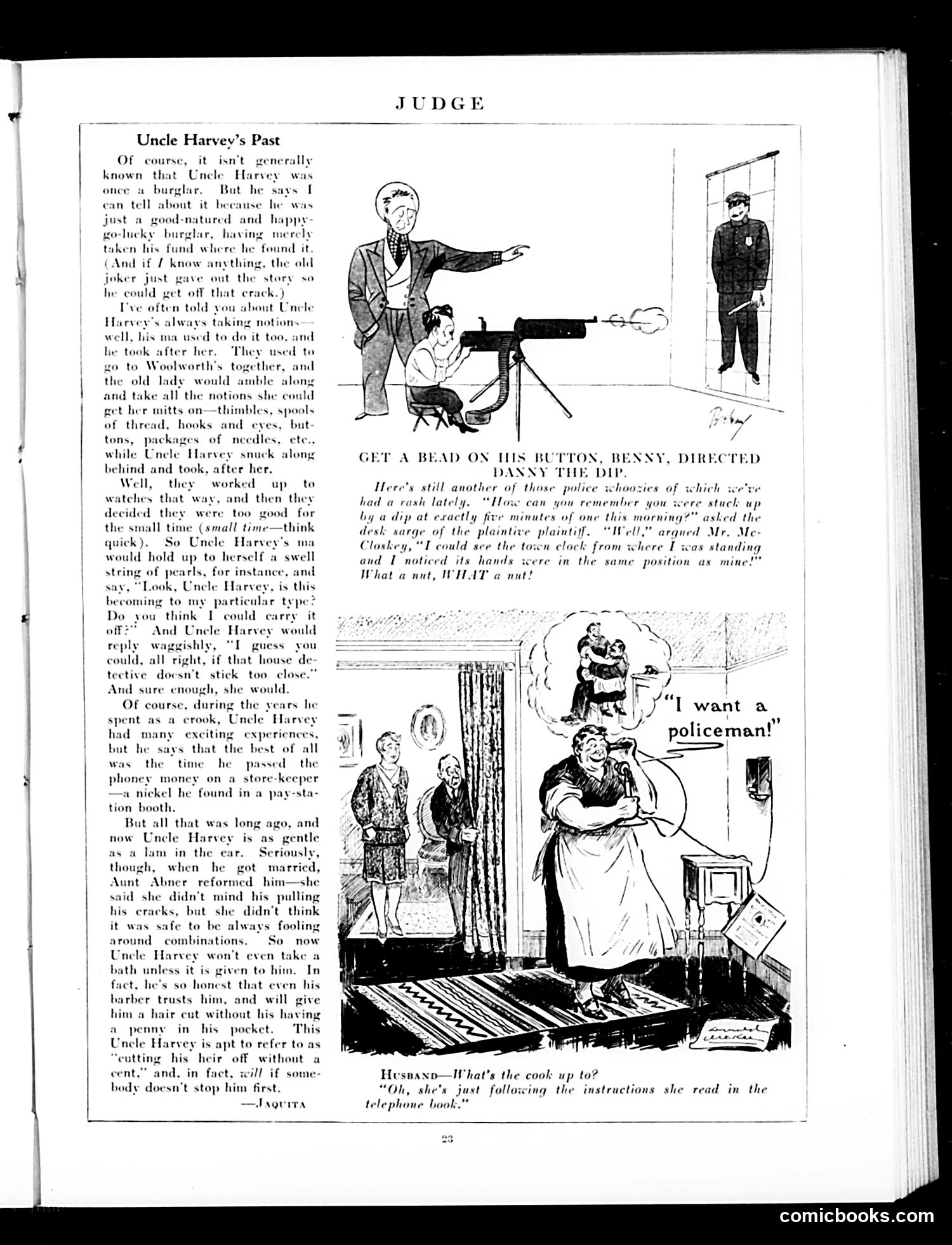
The illustration depicts a conversation between a woman and an older man in formal attire, likely representing a judge based on the page title. The woman ("Flapper") comments on the judge's hair growth over six months, saying "Isn't it wonderful, Malcolm? In six months my hair has grown so I can almost sit on it!" The judge replies, "Well, I wish you would." This is satirical commentary on 1920s fashion, specifically the "bobbed hair" controversy. Flappers—young women embracing modern styles—wore short hair, which scandalized conservatives. The joke targets judicial authority's dismissive attitude toward women's fashion choices, with the judge making a crude, inappropriate remark that suggests he'd prefer women to conform to traditional longer hairstyles. The satire mocks both generational conflict and male condescension toward women's autonomy.
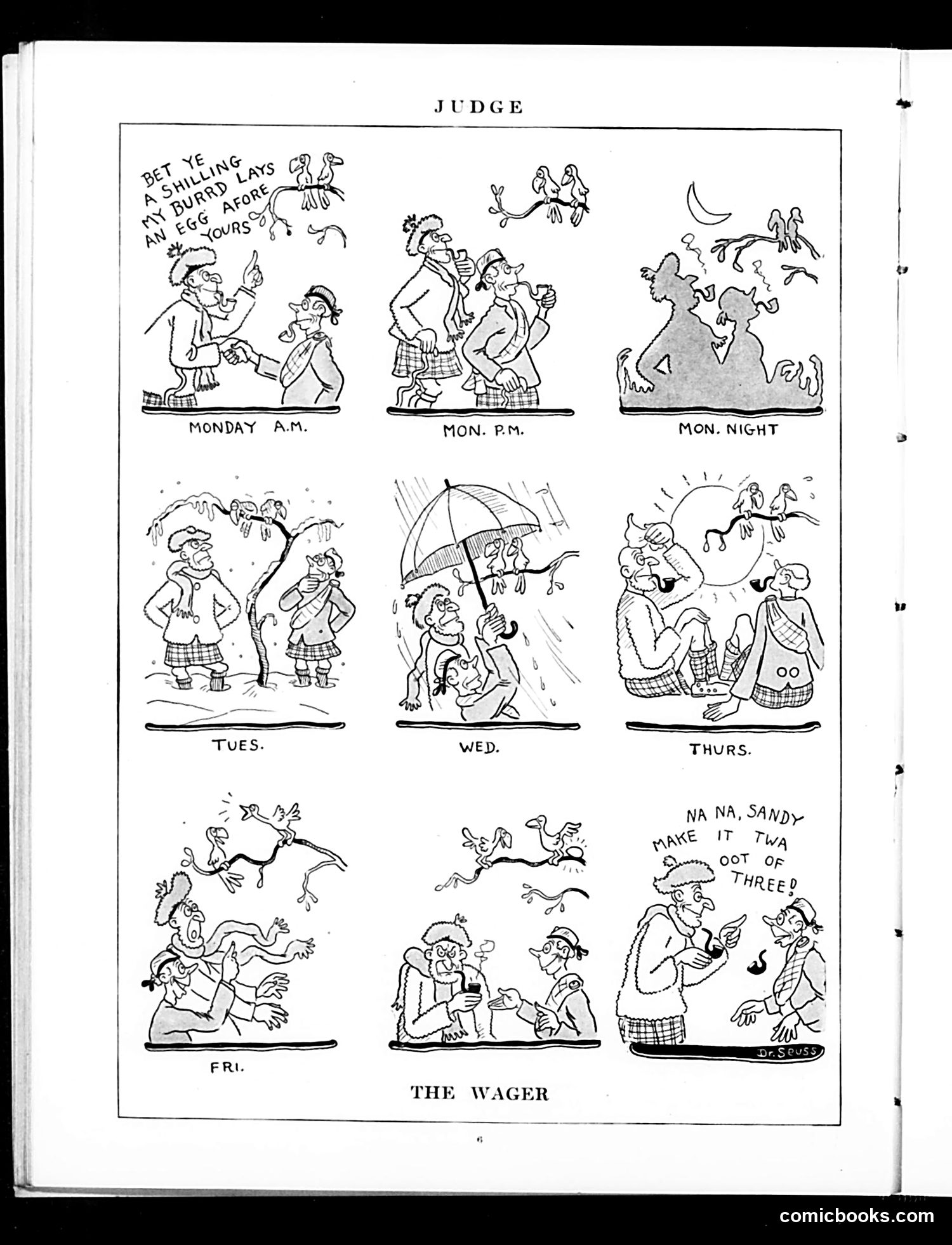
This comic strip satirizes a week-long bet or wager involving children. The narrative follows a sequence where someone bets "a shilling a burro lays an egg before yours"—an absurd proposition. Monday through Friday depict escalating chaos: the children engage in increasingly wild and destructive behavior (nighttime mischief, fighting in rain, violent play, and chaotic antics). By Friday, the situation has become completely uncontrolled. The final panel shows an adult (likely the bet's originator) desperately trying to resolve the wager by offering "Na na, Sandy—make it two got of three," suggesting they're attempting to escape the bet's consequences as the chaos spirals beyond control. The satire critiques foolish gambling and the unintended consequences of careless wagers involving children.
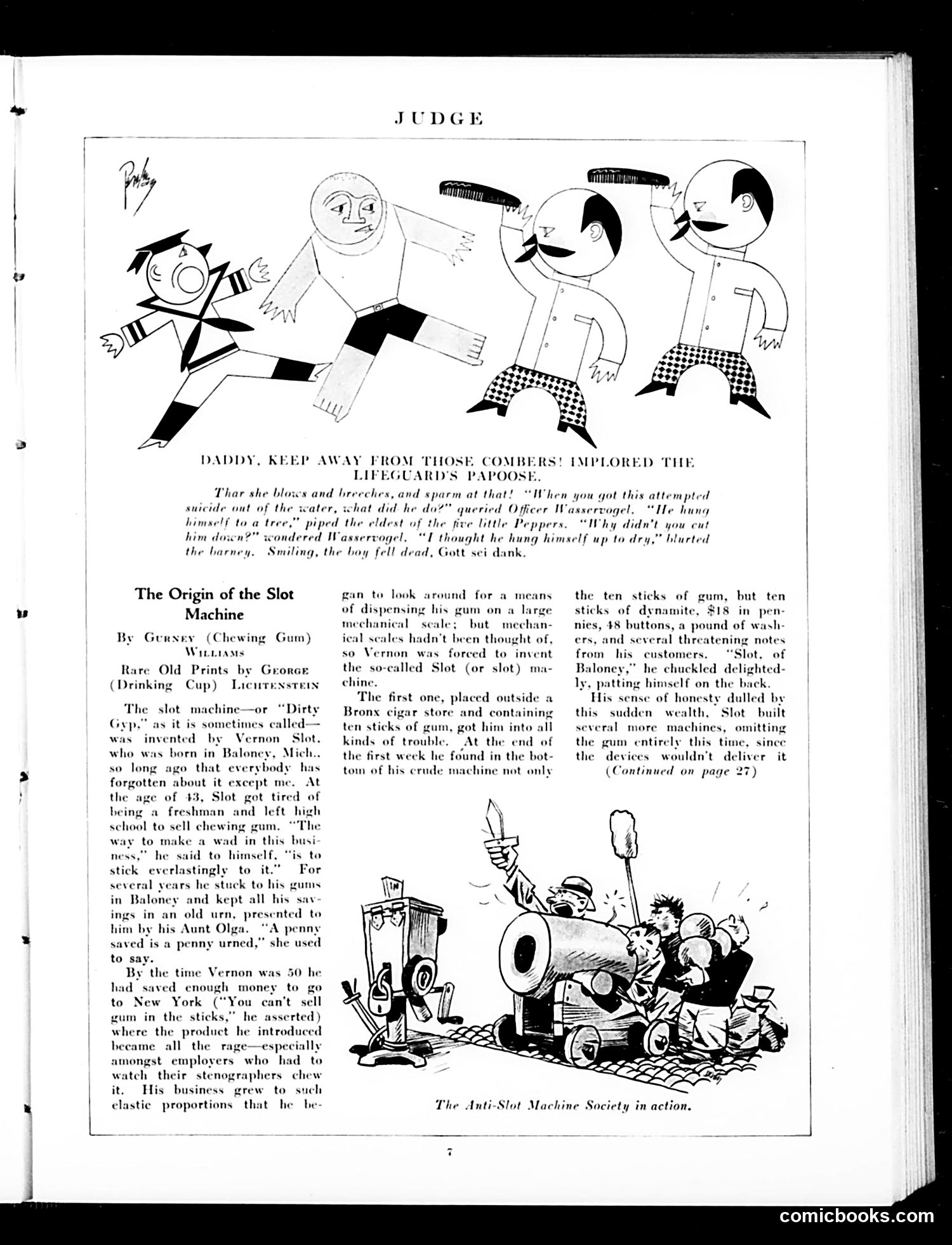
This page contains two distinct satirical pieces from *Judge* magazine: **Top cartoon**: A crude joke about lifeguards and "combers" (unclear what this references specifically), depicting a father warning children away from something dangerous. The accompanying text is a dark humor anecdote about a suicide attempt, typical of the magazine's irreverent tone. **Main article**: "The Origin of the Slot Machine" by Gersay—a fictionalized, humorous "history" attributing the slot machine's invention to one Vernon Slot from "Baloney, Mich." (a made-up place). The satire mocks: - Self-made American business mythology - How slot machines proliferated and displaced legitimate commerce - The irony that Slot's first machine contained dynamite and threatening notes rather than coins—suggesting the machines were already controversial and viewed as dangerous/criminal by the public The accompanying illustration shows chaotic scenes of the "Anti-Slot Machine Society in action," depicting machines being destroyed or attacked. This reflects actual early-20th-century resistance to slot machines, which were widely seen as gambling devices corrupting morality.
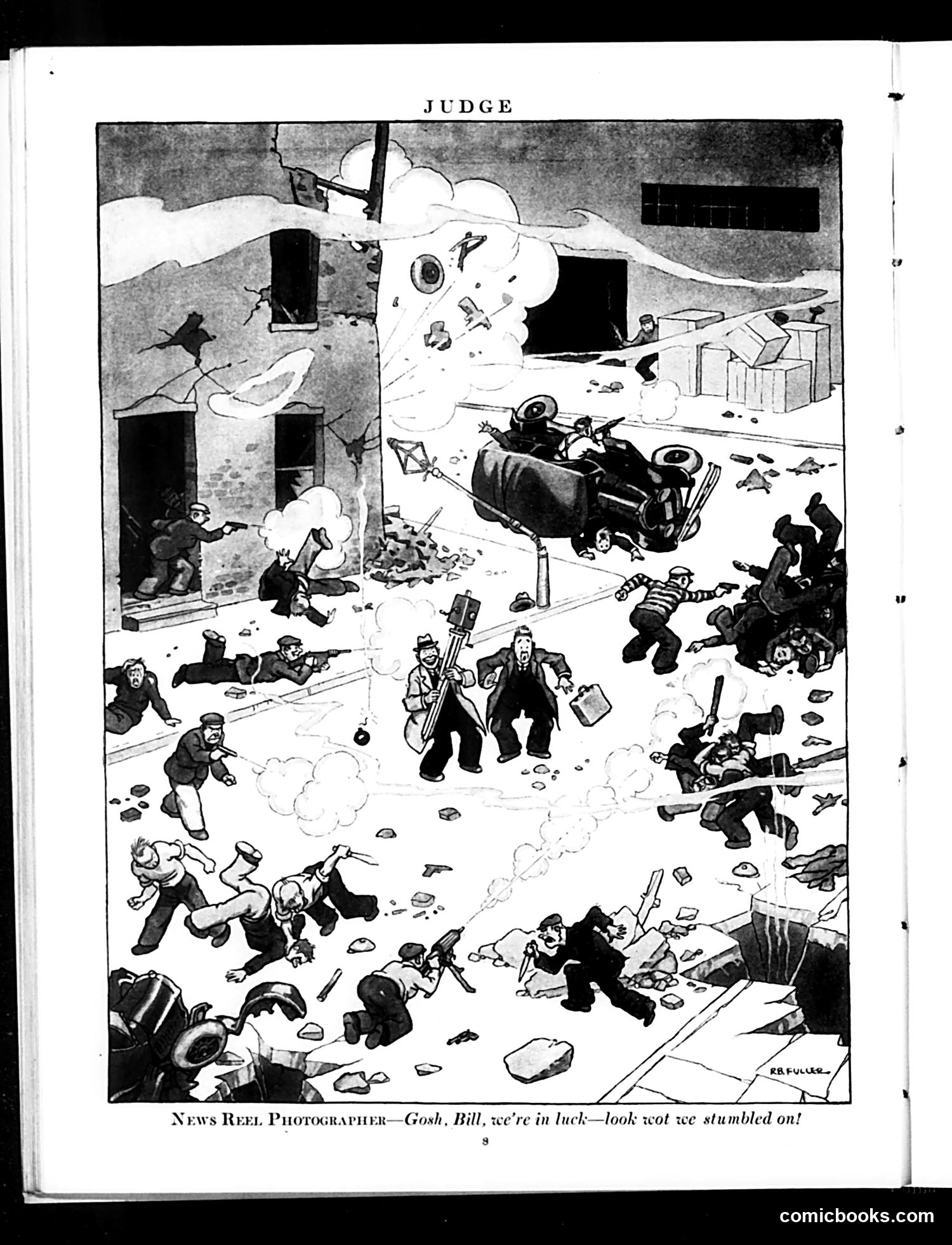
This cartoon satirizes newsreel cameramen of the early-to-mid 20th century. The scene depicts a chaotic urban conflict with multiple figures fighting, running, and taking cover amid explosions and debris. Two cameramen in the center—one holding a large film camera—excitedly exclaim they've "stumbled on" this violent action, suggesting they've accidentally discovered dramatic footage for their news reels. The satire targets how newsreel photographers actively sought or exploited violent incidents for compelling footage rather than simply documenting events. The crowded, violent scene with numerous casualties implies commentary on sensationalism in journalism and how media professionals prioritized dramatic imagery over human welfare. The "luck" of finding such footage underscores the cynicism of news media during this period.
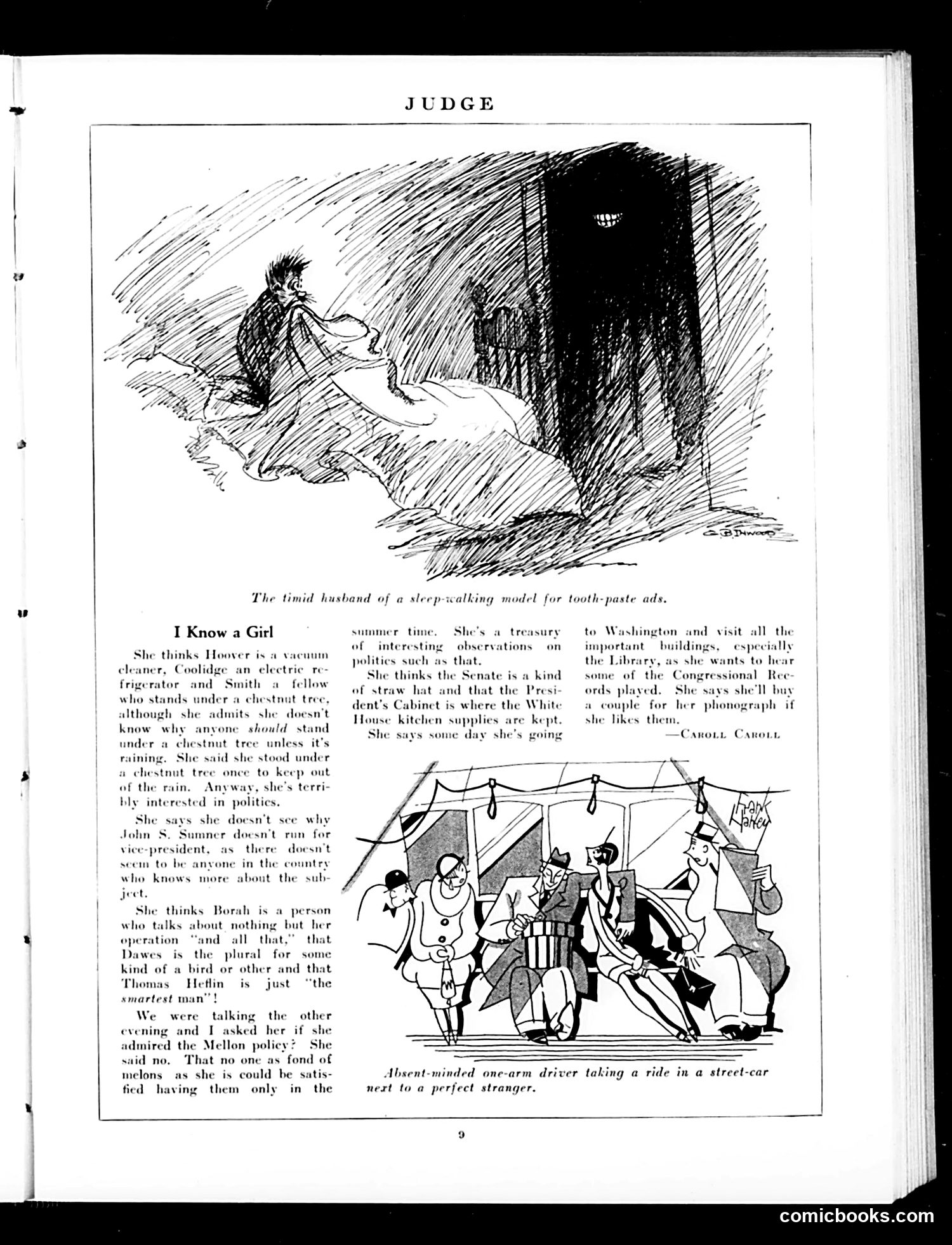
This page satirizes political ignorance among the voting public, a common Judge theme in the 1920s. The article "I Know a Girl" mocks a woman who confuses prominent political figures with everyday objects: President Coolidge with an electric refrigerator, Treasury Secretary Andrew Mellon's policies with actual melons, Senator William Borah with a medical condition, Vice President Charles Dawes with birds. She thinks the Senate is a hat and the Presidential Cabinet stores kitchen supplies. The satire targets voter apathy and civic illiteracy during the Coolidge administration (1923-1929). References to Hoover, Sumner, and Mellon were contemporary political figures readers would recognize. The top cartoon shows a frightened man watching his sleepwalking wife—likely satirizing how toothpaste advertisements used increasingly absurd models and scenarios for product promotion, a growing advertising trend. The bottom cartoon depicts an absent-minded one-armed streetcar passenger—likely mocking distracted public behavior or transportation hazards of urban life.
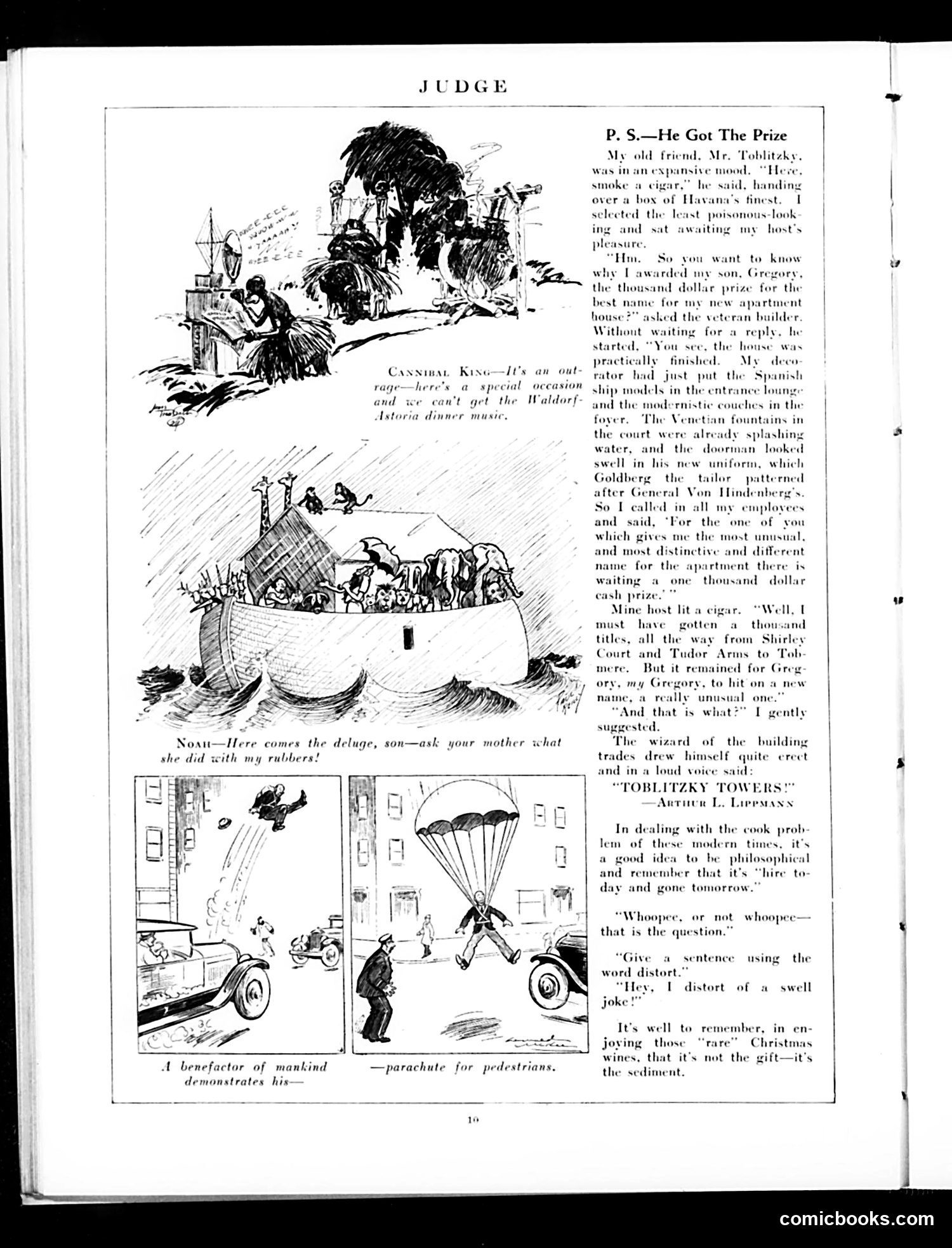
This Judge page contains three satirical pieces: **"P.S.—He Got The Prize"**: A wealthy builder (Mr. Toblitzky) offers a thousand-dollar prize for the most distinctive apartment-house name. His son Gregory wins by naming it "Toblitzky Towers"—a joke about nepotism and vanity. The satire mocks both the father's self-aggrandizement and the son's unoriginal "solution." **"Cannibal King" and "Noah"**: These appear to be brief comic captions accompanying dark-humored illustrations about civilization's problems—one referencing a fancy dinner, the other about chaos ("the deluge"). **Noah's Parachute panels**: Two cartoons showing absurd "inventions" presented as benefiting mankind—one involving cars/traffic chaos, another showing a parachute for pedestrians. The satire critiques modern "progress" and technology as often creating more problems than solutions. The page reflects early 20th-century Judge magazine's typical blend of social satire targeting wealth, modernization, and human folly.
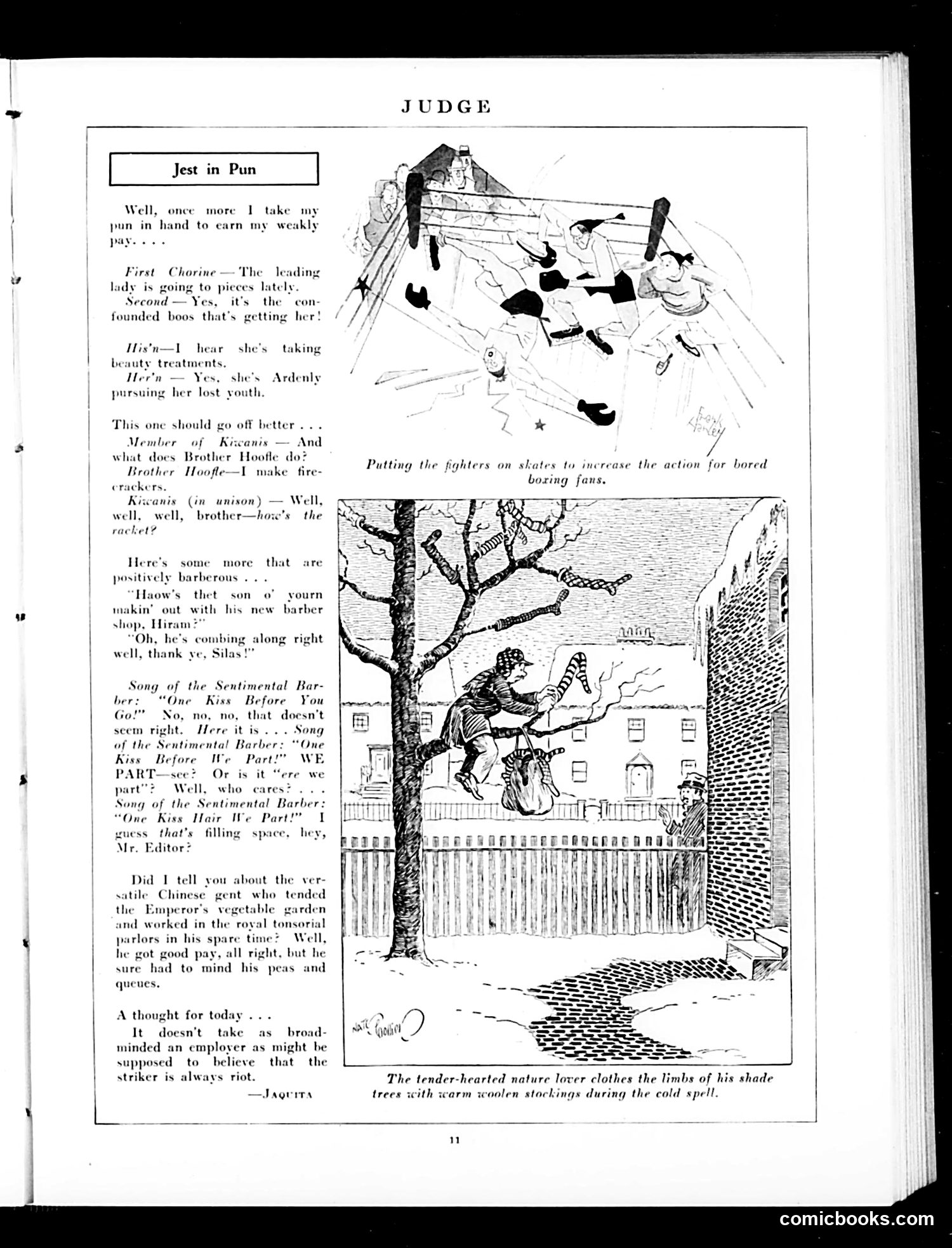
This page contains **multiple short jokes and puns** typical of Judge's humor format, rather than political cartoons. The content includes: 1. **Theater gossip jokes** about chorus girls and beauty treatments 2. **A Kiwanis Club joke** about a member who makes "fire crackers" 3. **Rural dialect humor** ("Haow's thet sono") about a barber's business 4. **A extended pun** on "One Kiss Before We Part" sung as a barber's song, playing with similar-sounding words 5. **A Chinese servant pun** about minding "peas and queues" (playing on "peas" vs. "peace" and the queue hairstyle) 6. **Two illustrated cartoons**: one showing boxers on skates (mocking "action" entertainment), another showing someone wrapping tree limbs in stockings (nature-lover sentimentality) The editorial comment about strikers being "always riot" suggests mild political commentary, but the page is primarily **light entertainment humor**—puns, wordplay, and gentle social observation rather than sharp satire. The audience appears to be middle-class readers enjoying clean, family-friendly jokes.
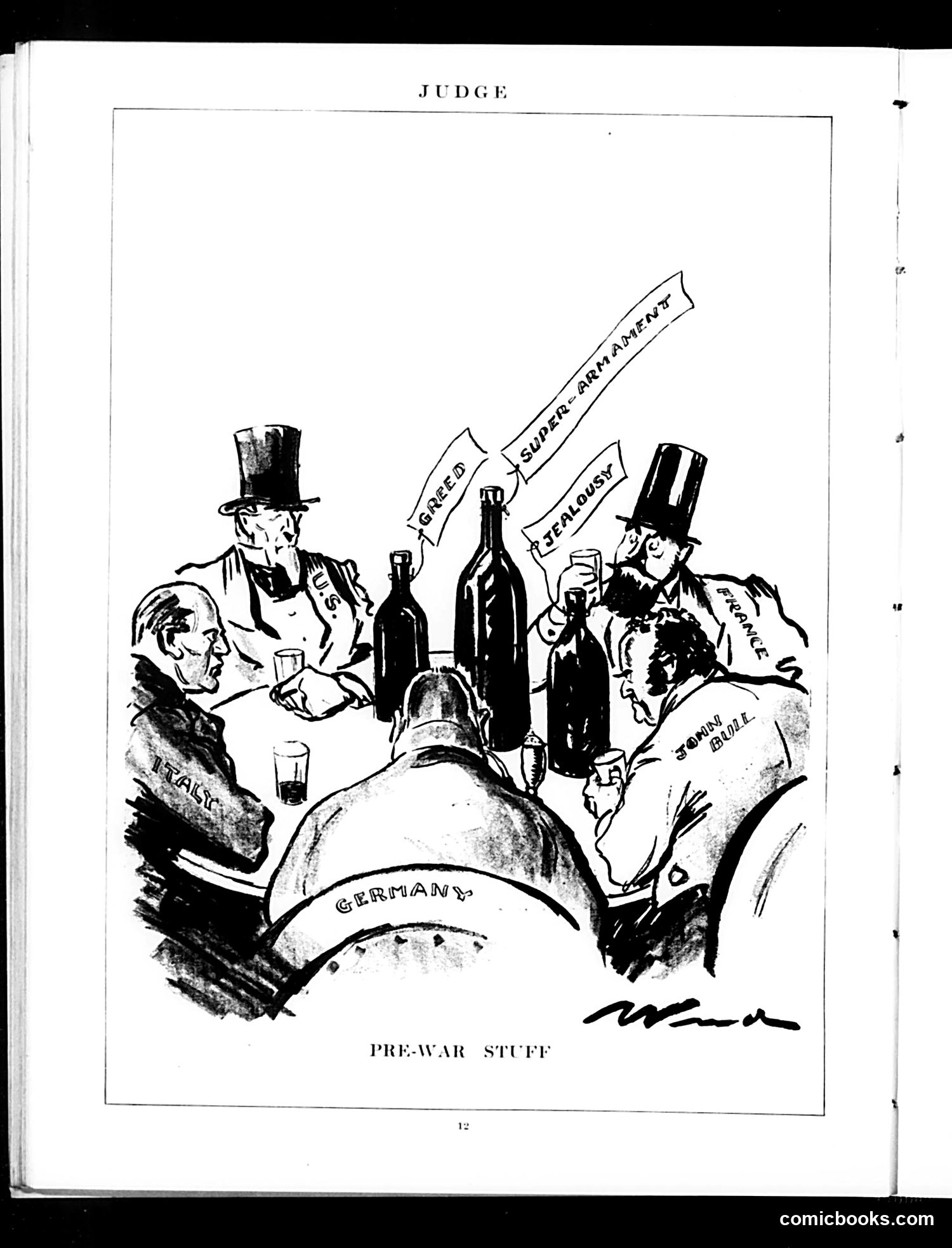
This political cartoon depicts several well-dressed gentlemen seated around a table laden with wine bottles, labeled as representing different nations. The large figure in the foreground is labeled "GERMANY." The other figures have flags or labels suggesting they represent other European powers (likely France, Britain, and others). The banners above reference "GREED," "SUPER-ARMAMENT," and "JEALOUSY"—identifying these as the driving forces behind pre-war tensions. The cartoon satirizes how European nations' competitive militarization, territorial ambitions, and mutual suspicion were fueling conflict before World War I. The title "Pre-War Stuff" treats this dangerous geopolitical situation as if it were a social gathering, using dark humor to critique the leaders' complacency toward mounting international tensions.
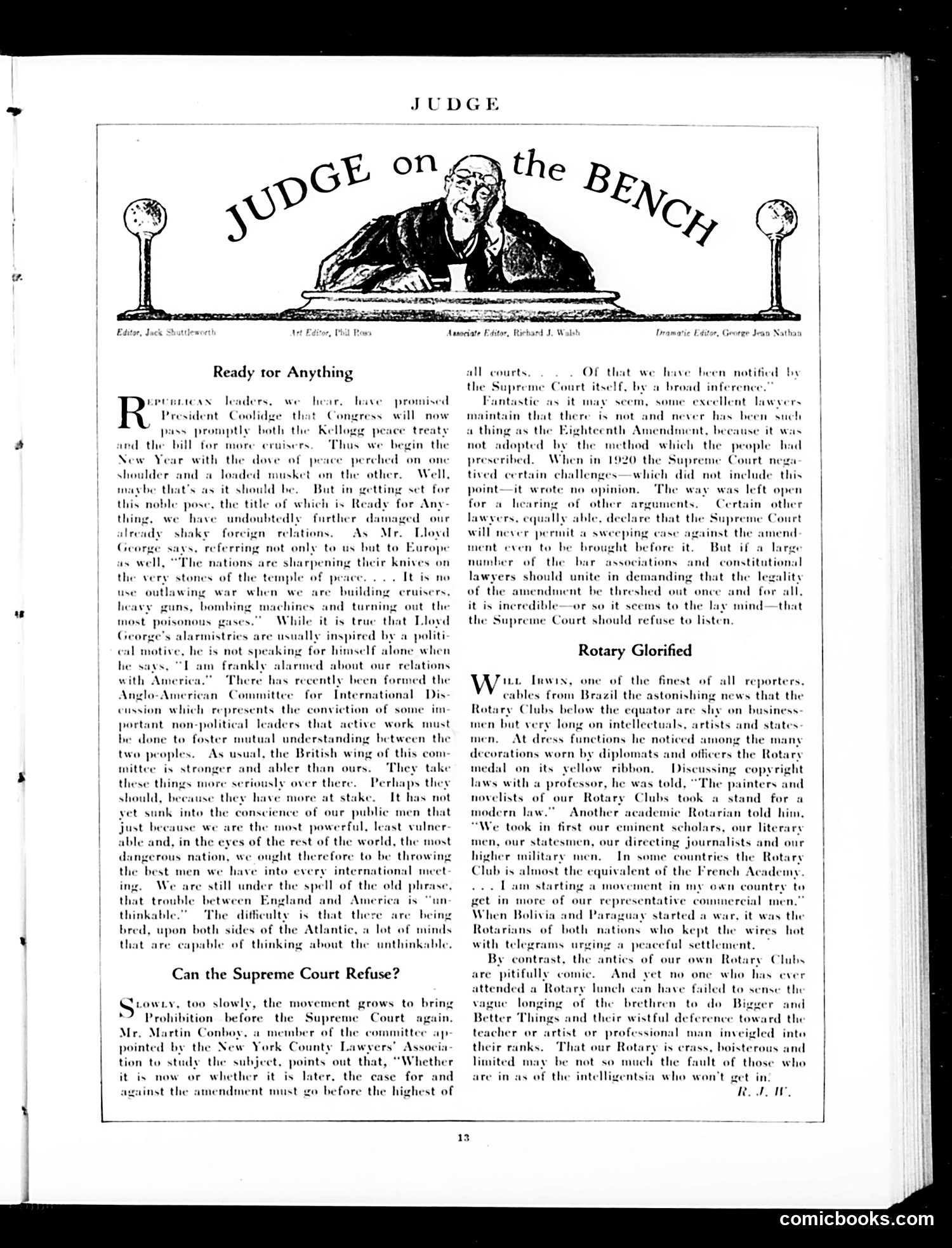
This page from *Judge* magazine contains political commentary on early 1920s American issues, centered around three main topics: **"Ready for Anything"** criticizes Republican leaders' contradictory stance—simultaneously pursuing the Kellogg peace treaty while expanding naval armaments. The satire mocks President Coolidge's administration for claiming peace while preparing for war, with references to Lloyd George's concerns about Anglo-American relations deteriorating despite a recent Anglo-American Committee for International Discussion. **"Can the Supreme Court Refuse?"** addresses the constitutional challenge to Prohibition. Legal scholars debated whether the Eighteenth Amendment was validly ratified; the piece argues the Supreme Court should hear challenges to settle the question definitively. **"Rotary Glorified"** praises the Rotary Club's international reach, noting with apparent surprise that South American Rotary clubs attract intellectuals and artists rather than just businessmen. The masthead shows "Judge on the Bench"—the magazine's recurring judicial commentary feature. The overall tone is conservative but reform-minded, typical of 1920s establishment criticism.
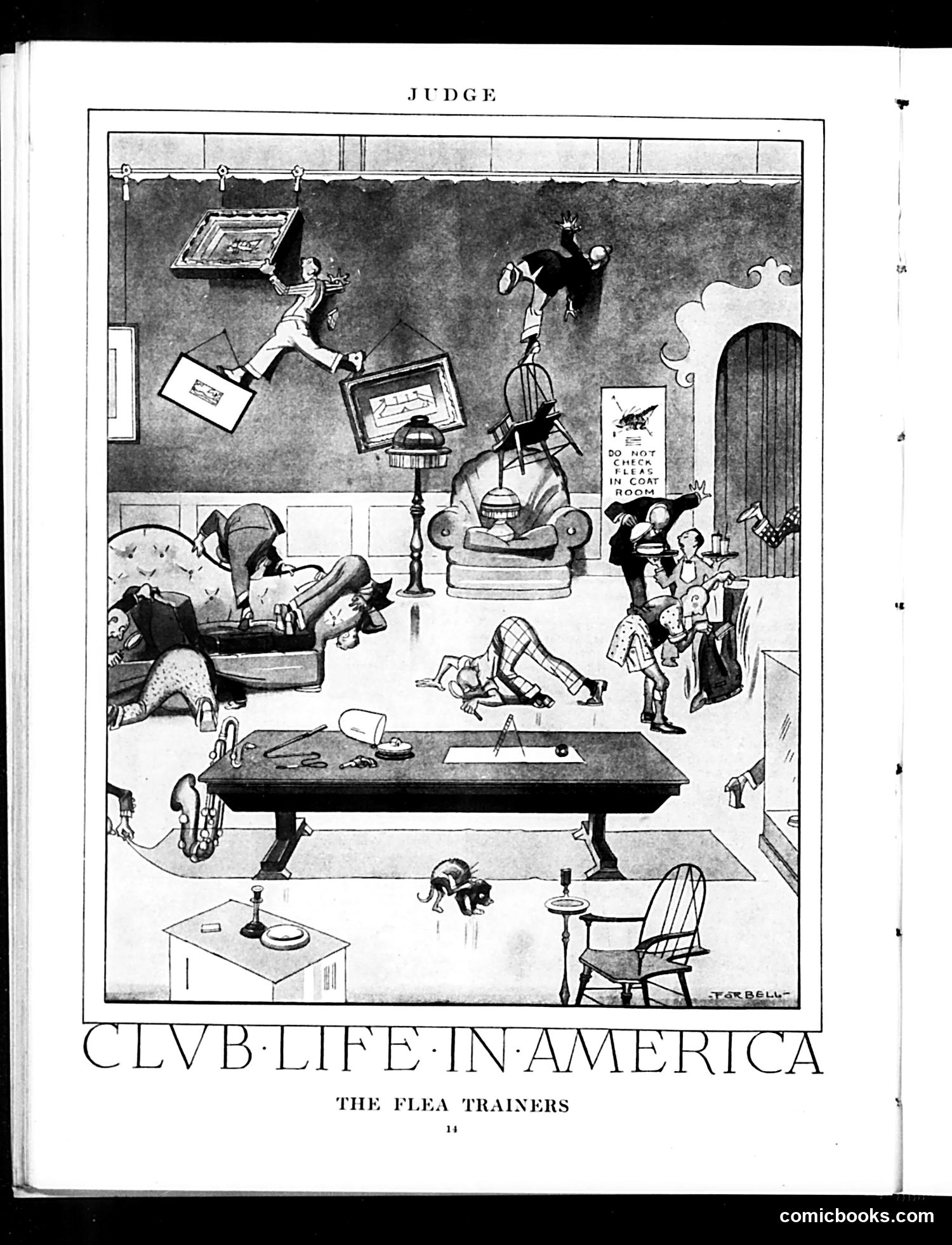
This satirical cartoon from *Judge* magazine depicts a chaotic indoor circus scene titled "Club Life in America." The image shows performers training fleas—a reference to the popular "flea circus" entertainment acts that existed in the early 20th century, where tiny insects were supposedly harnessed to perform tricks. The satire appears to mock American leisure culture and club entertainment, portraying the spectacle as absurdly chaotic. Well-dressed onlookers watch acrobats performing impossible stunts, people lounging, and general pandemonium. A sign reads "DO NOT CHECK YOUR WITS IN COAT ROOM," suggesting the humor targets the intellectual vacuity of such entertainment venues and their patrons. The cartoon critiques American entertainment trends and club culture as frivolous and mindless spectacle.
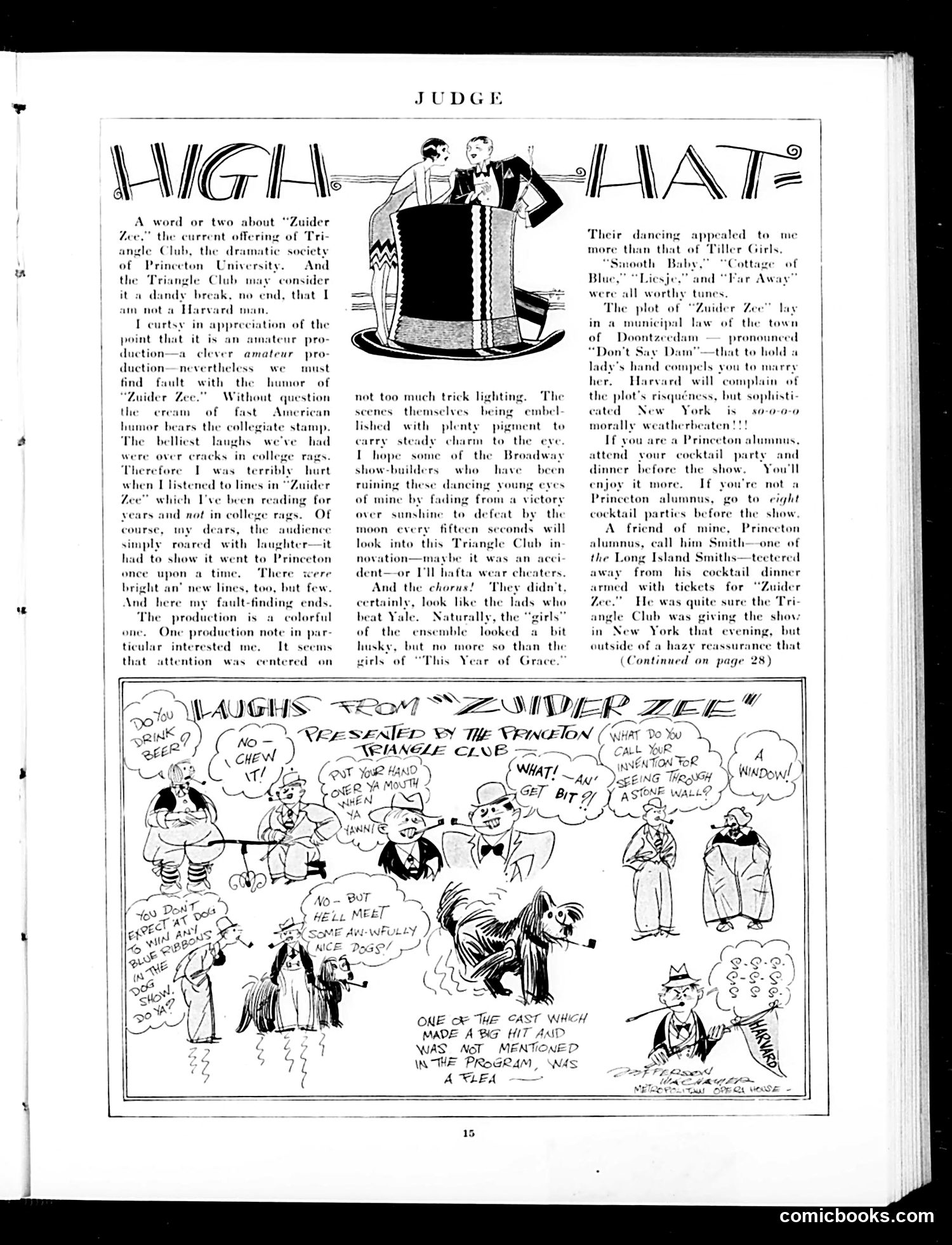
This is a theater review from *Judge* magazine critiquing Princeton University's Triangle Club production of "Zuider Zee." The review praises the show's technical execution and chorus dancing while gently mocking its humor as derivative of college comedy clichés rather than truly original wit. The cartoon below illustrates backstage gossip and complaints from the production, depicting cast members and crew discussing various theatrical mishaps—unclear lighting, costume issues, and an uncredited performer who "made a big hit" but wasn't mentioned in the program. The "high hat" tone (sophisticated mockery) comes from the reviewer's affectation of being a Harvard man critiquing a rival Princeton institution, while simultaneously admiring their amateur theatrical efforts. The overall satire gently ribs college theater productions as earnest but derivative of Broadway standards.
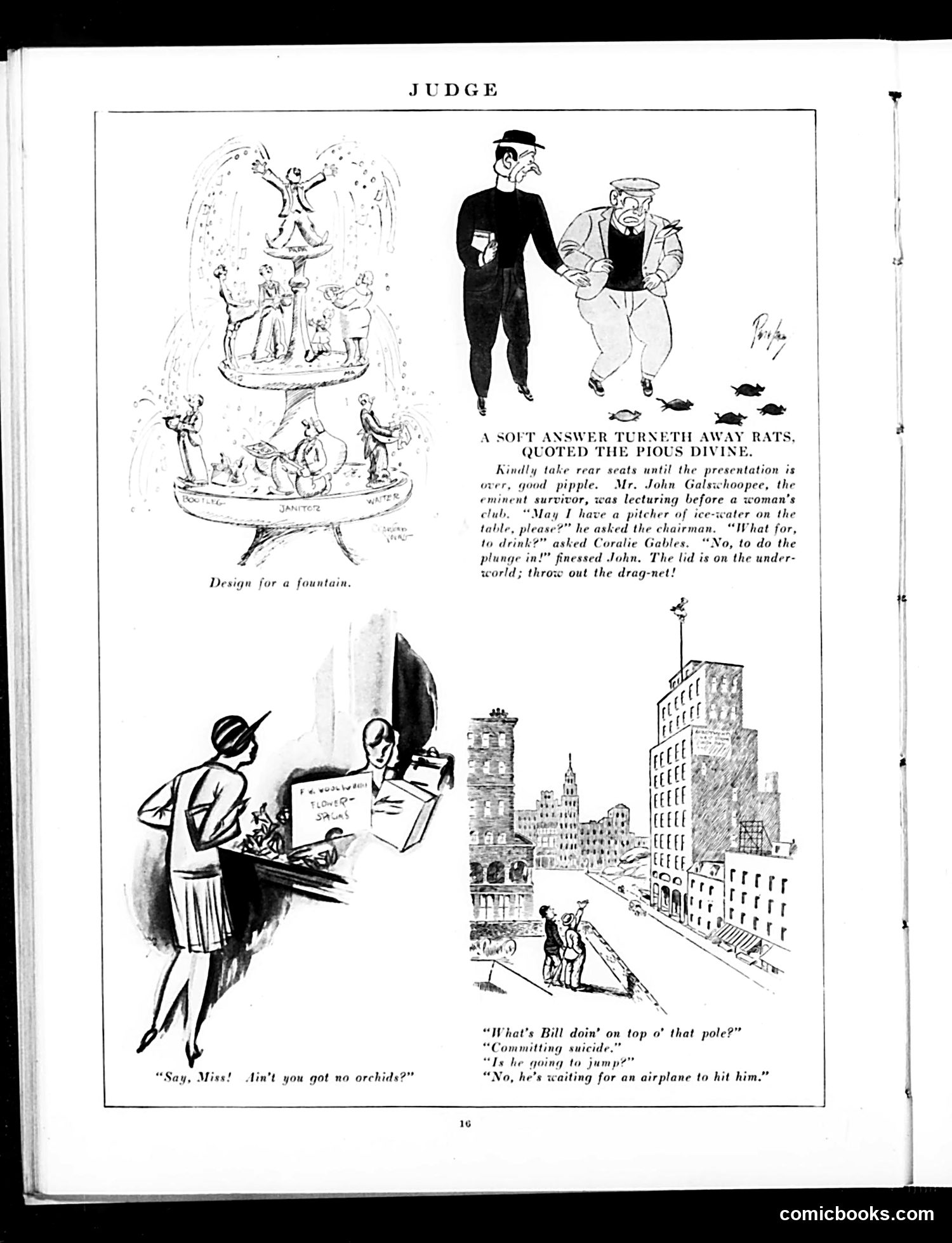
This page contains four separate humorous cartoons satirizing early 20th-century American society: 1. **Top left**: A tiered fountain design mocking pretentious social displays, with figures arranged like a decorative monument. 2. **Top right**: A joke about a lecture at a women's club where a speaker requests ice-water, then reveals he plans to perform a dangerous "plunge" stunt—satirizing sensationalism and attention-seeking behavior. 3. **Bottom left**: A woman asking a florist for orchids (expensive luxury flowers), satirizing materialism and social pretension among the wealthy. 4. **Bottom right**: A dark joke about someone standing atop a pole "committing suicide" but actually "waiting for an airplane to hit him"—likely satirizing both the novelty of early aviation and contemporary morbid humor about accidents. The overall page mocks wealthy urbanites, their vanities, and emerging modern anxieties like aviation danger.
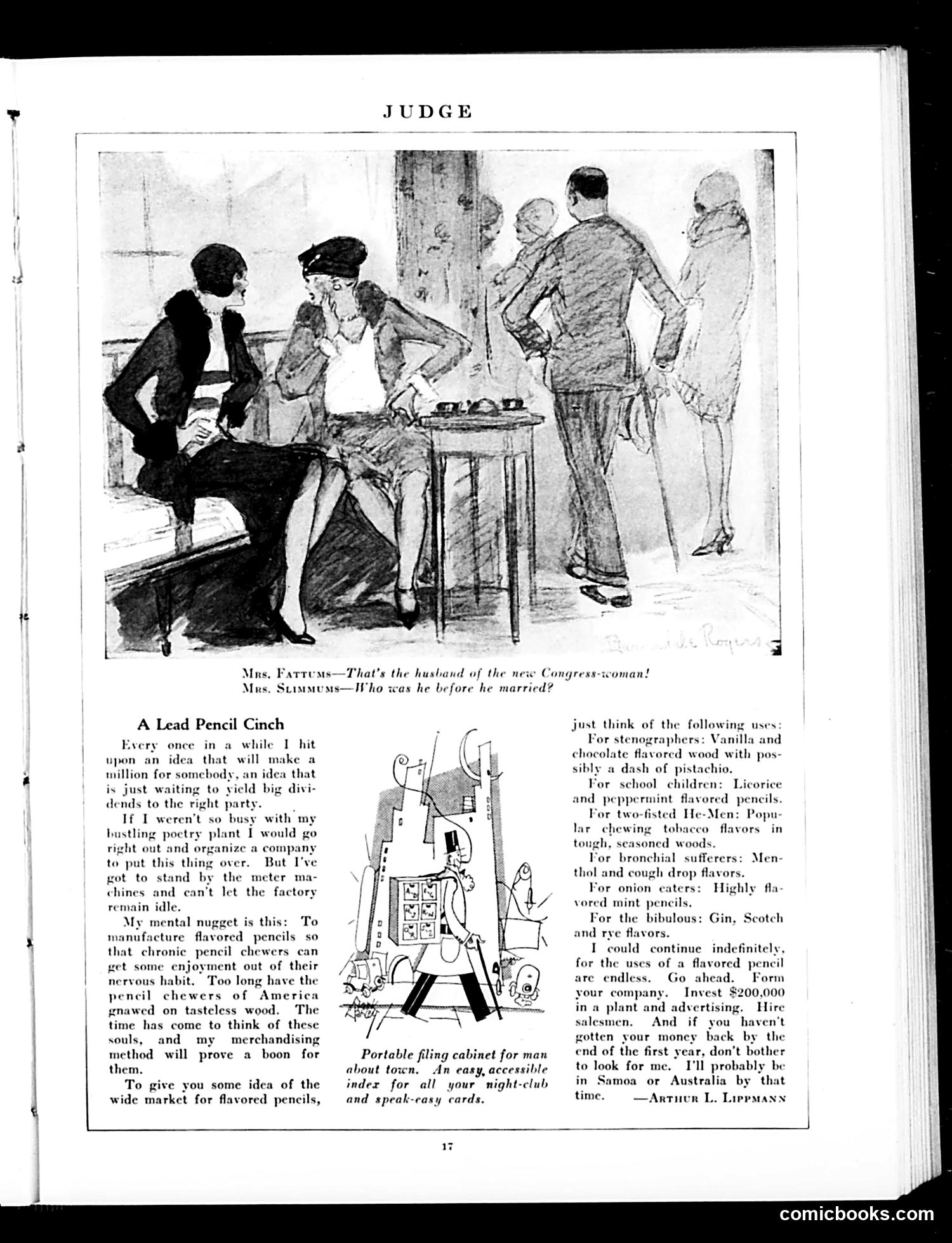
**Top Cartoon:** A satirical jab at the first female members of Congress (elected in 1916 and after). Two society women gossip about a congresswoman's husband, with one asking who he was "before he married"—the joke being that a woman's political achievement supposedly defines or eclipses her husband's identity, inverting the traditional dynamic where wives were known only through their husbands. **"A Lead Pencil Cinch":** A humorous business-idea article by Arthur L. Lippmann proposing flavored pencils for various markets—vanilla for stenographers, licorice for children, tobacco flavors for "he-men," menthol for the sick, gin for drinkers. The satire mocks both the absurdity of the product and get-rich-quick business schemes of the era. The author jokingly offers the idea freely, claiming he's too busy to develop it himself. **Side note:** The "portable filing cabinet" illustration is a separate satirical item about organizing speakeasy cards during Prohibition.
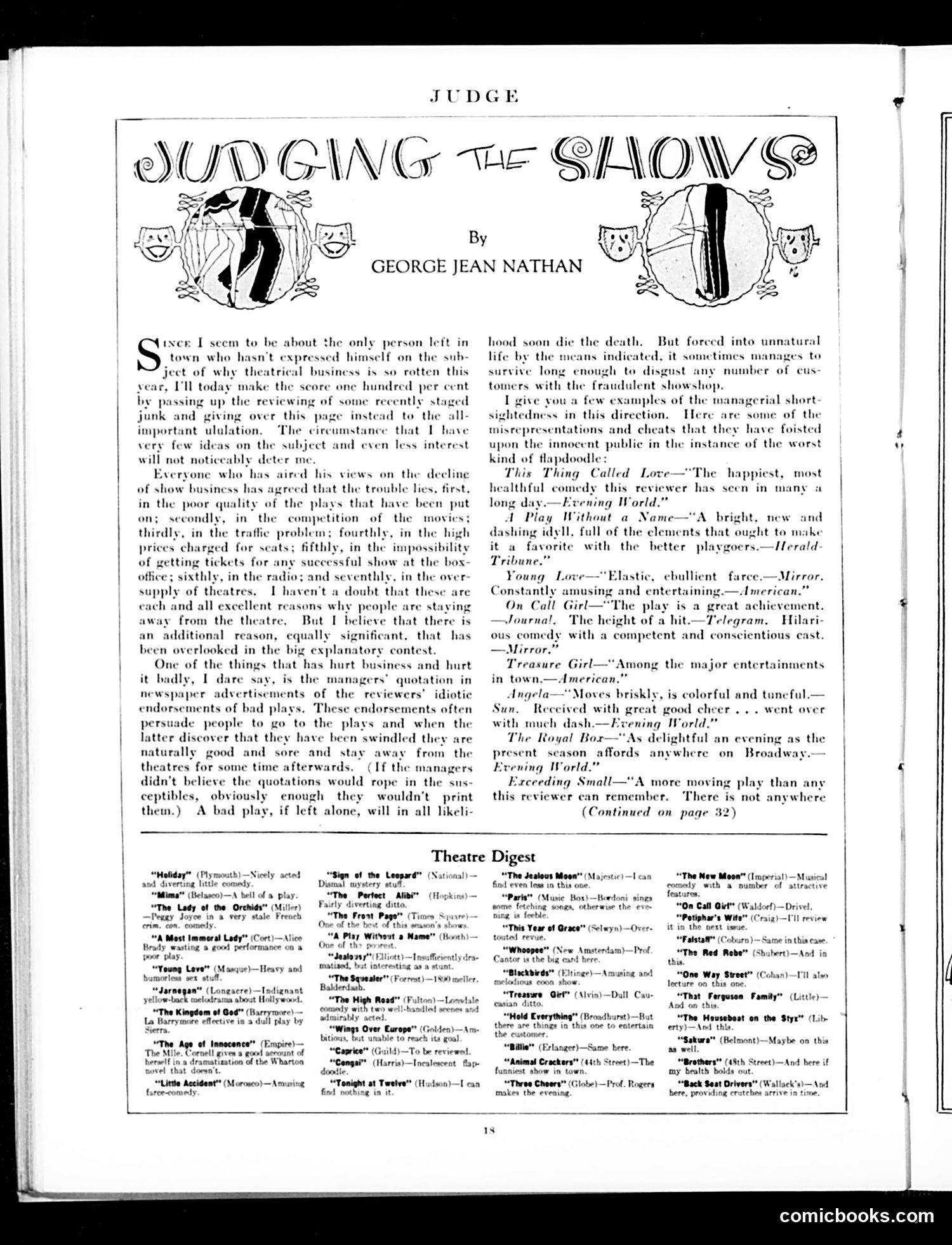
This is a critical essay by prominent theater critic George Jean Nathan attacking what he sees as false advertising in theater. Nathan argues that Broadway's decline stems not just from poor plays, high prices, and competition from movies, but from **managers' deceptive use of reviewers' quotes in advertisements**. Nathan's satire targets the practice of cherry-picking or misrepresenting critics' words to promote bad plays. He provides examples of glowing quotes attributed to publications like the *Evening World* and *Herald Tribune* for shows he implies were mediocre or worse—*This Thing Called Love*, *A Play Without a Name*, *Young Love*, *Treasure Girl*, etc. The joke: managers quote reviewers out of context or selectively, duping audiences into attending terrible productions. Once swindled, audiences avoid theaters entirely, harming the industry further. Nathan argues a bad play "left alone" would naturally die, but fraudulent marketing keeps it alive long enough to damage theater's reputation. The page also includes a "Theatre Digest" listing current Broadway shows with brief critical notes.
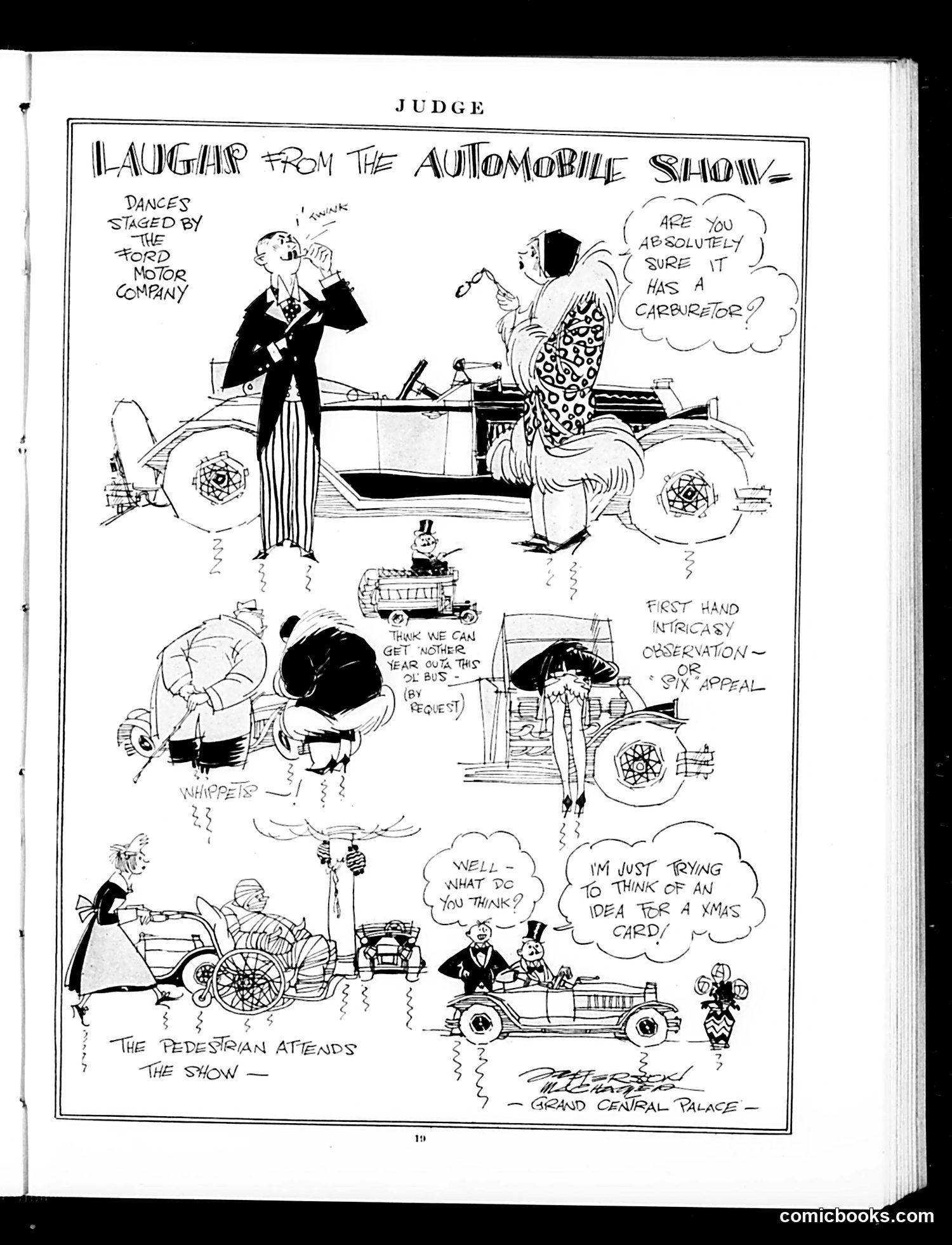
This Judge cartoon satirizes the Ford Motor Company's staged automobile show featuring synchronized dances. The humor targets the absurdity of treating cars as entertainment spectacles rather than practical vehicles. The joke hinges on a disconnect between promotional glamour and reality: well-dressed dancers perform elaborate routines around automobiles, while pedestrians and observers make practical complaints—one asks if the car has a carburetor, another requests information about bus schedules instead. The satire mocks early automotive marketing's emphasis on style and showmanship over function, and suggests that ordinary people care more about basic mechanical questions and affordable transportation (buses) than choreographed displays. The Grand Central Palace venue indicates this was a major New York exhibition, making the contrast between high-society spectacle and working-class practicality even sharper.
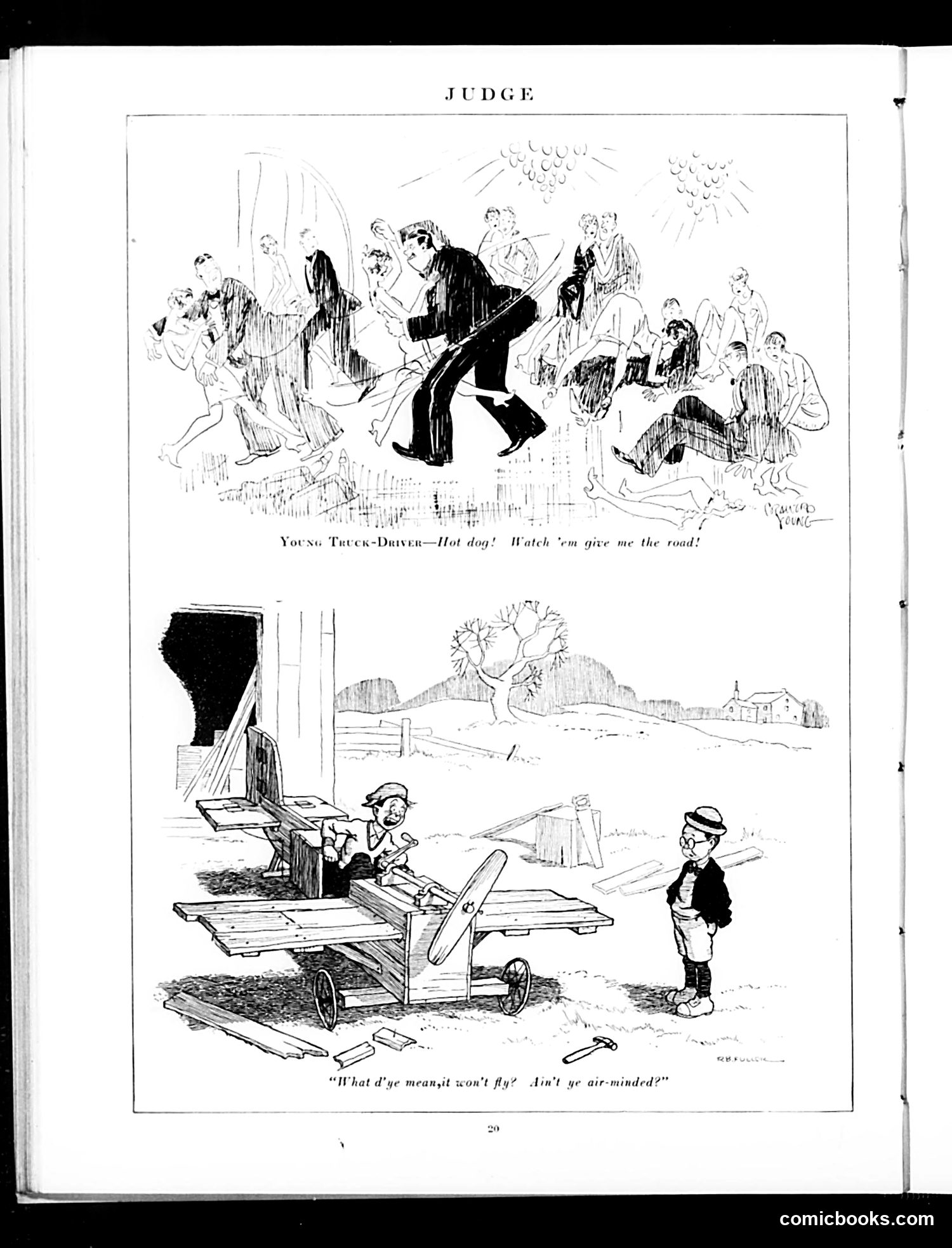
**Top cartoon**: A young truck driver navigates through a crowded street scene, demanding "Hot dog! Watch 'em give me the road!" The satire mocks aggressive, reckless driving behavior—portraying the truck driver as a public nuisance who expects others to scatter. **Bottom cartoon**: Two boys construct a crude wooden airplane. One builder confidently claims "What d'ye mean it won't fly? Ain't ye air-minded?"—a play on the term "air-minded," which in the early aviation era meant enthusiastic about or supportive of aviation technology. The joke satirizes overconfident amateur aviators who conflate enthusiasm with actual engineering competence. Both cartoons mock modern transportation trends: reckless motoring and naive aviation optimism.
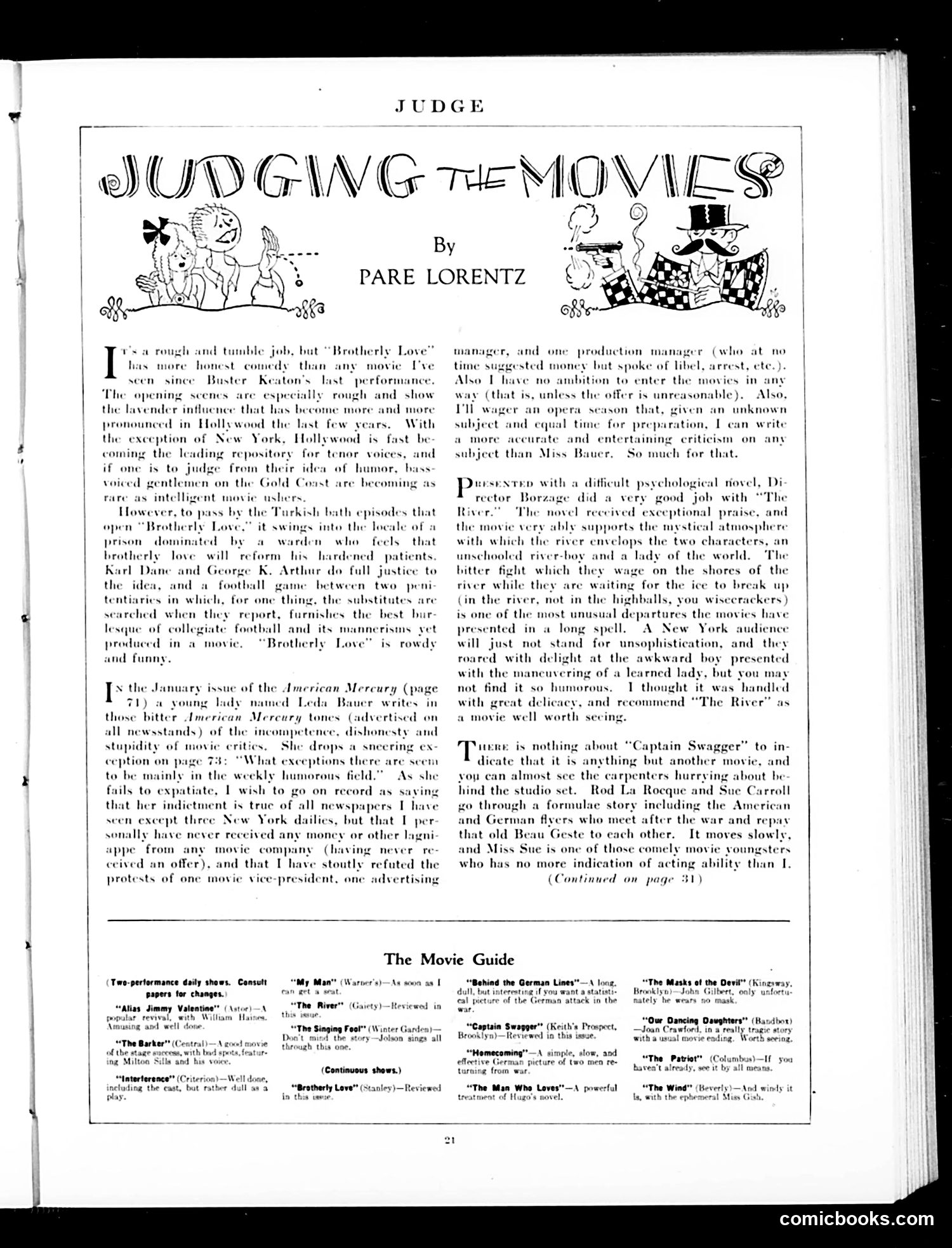
This is a film criticism column, not a political cartoon. Lorentz reviews recent movies for Judge magazine's entertainment section. The column critiques "Brotherly Love" (a prison-reform comedy starring Karl Dane and George K. Arthur), praising its humor despite rough opening scenes. Lorentz also defends film critics against accusations by Leda Bauer in *American Mercury* magazine that movie reviewers are incompetent and corrupt. He argues critics receive no bribes from studios and maintain editorial independence. Lorentz recommends "The River," praising its unusual psychological depth and atmospheric direction, while dismissing "Captain Swagger" as formulaic wartime melodrama with wooden performances. The satire targets both lazy movie criticism and formulaic studio productions of the 1920s era.
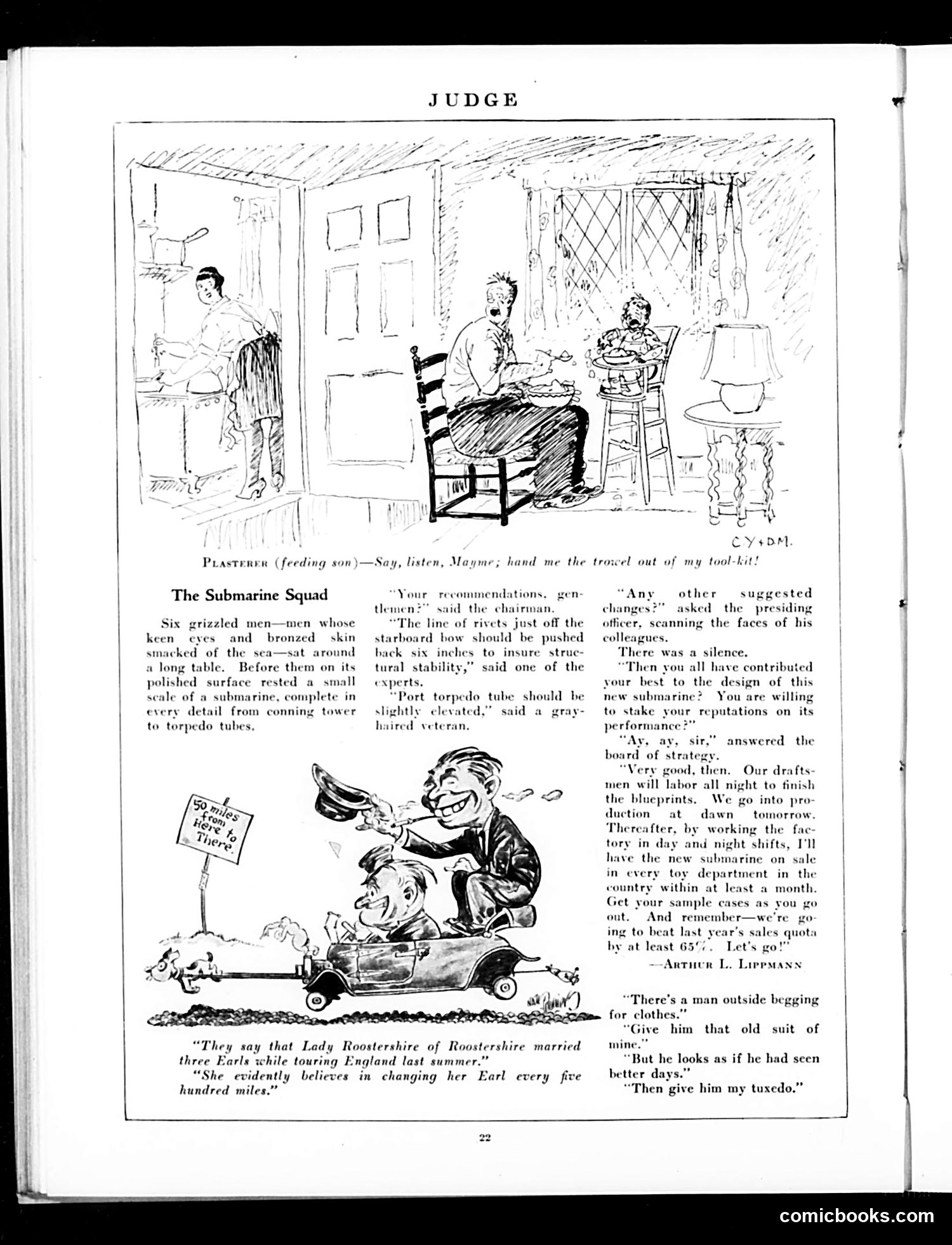
This page satirizes wartime industrial production and corporate management during what appears to be WWI or WWII era (based on submarine design references). **The main cartoon** depicts six grizzled naval engineers debating minor technical specifications for a submarine design with intense seriousness. The satire lies in the punchline: after this serious technical discussion, an executive announces they'll mass-produce the design as a **toy submarine** for department stores, racing to beat last year's sales quota. The joke mocks how corporate manufacturing priorities override genuine engineering concerns. These seasoned naval experts are staking their reputations on submarine performance, unaware their work will become a children's toy. It satirizes the disconnect between serious technical work and commercial toy manufacturing, suggesting corporate greed and poor judgment in wartime production. The bottom cartoon about Lady Roostershire is an unrelated society joke about serial marriages.
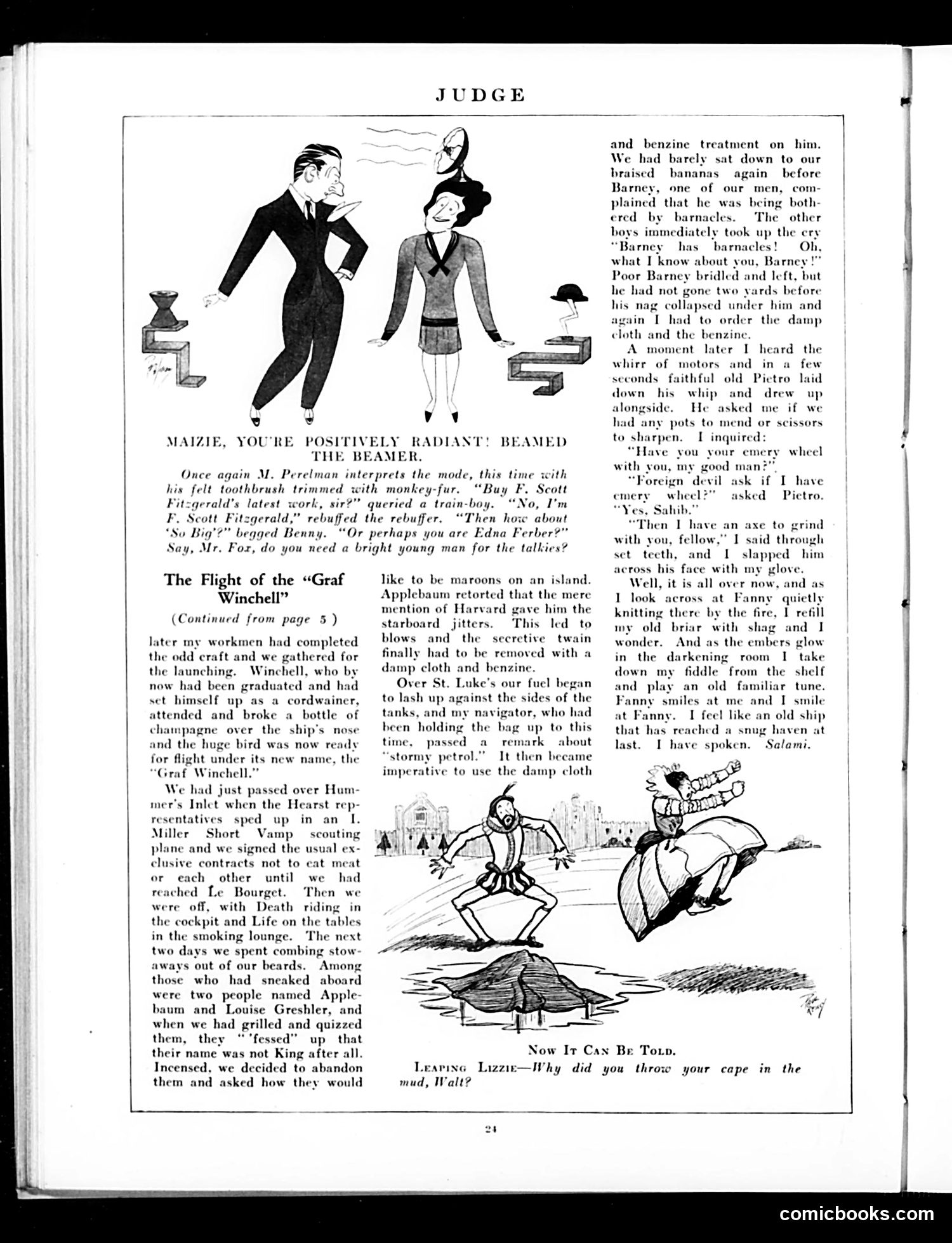
This page contains two separate pieces of satirical humor typical of Judge magazine's style: **Top cartoon ("Maizie, You're Positively Radiant!"):** A society gossip joke mocking 1920s literary celebrities. The dialogue references F. Scott Fitzgerald, his novel "So Big," author Edna Ferber, and Walter Winchell (a famous gossip columnist). The humor derives from name-dropping and absurdist responses to questions about contemporary literary figures—typical of the era's celebrity-obsessed culture. **"The Flight of the Graf Winchell":** A serialized tall tale parodying both aviation adventure stories and Walter Winchell's prominence. The "Graf Winchell" (mimicking the real German airship *Graf Zeppelin*) contains absurdist incidents: stowaways, damp cloth-and-benzene "treatments," and characters with ridiculous names. The satire targets sensationalized journalism and Winchell's reputation for covering dramatic events. The crude illustration shows slapstick-style figures in a surreal landscape. Both exemplify Judge's reliance on contemporary celebrity references and wordplay humor that requires knowledge of 1920s-30s public figures to fully appreciate.
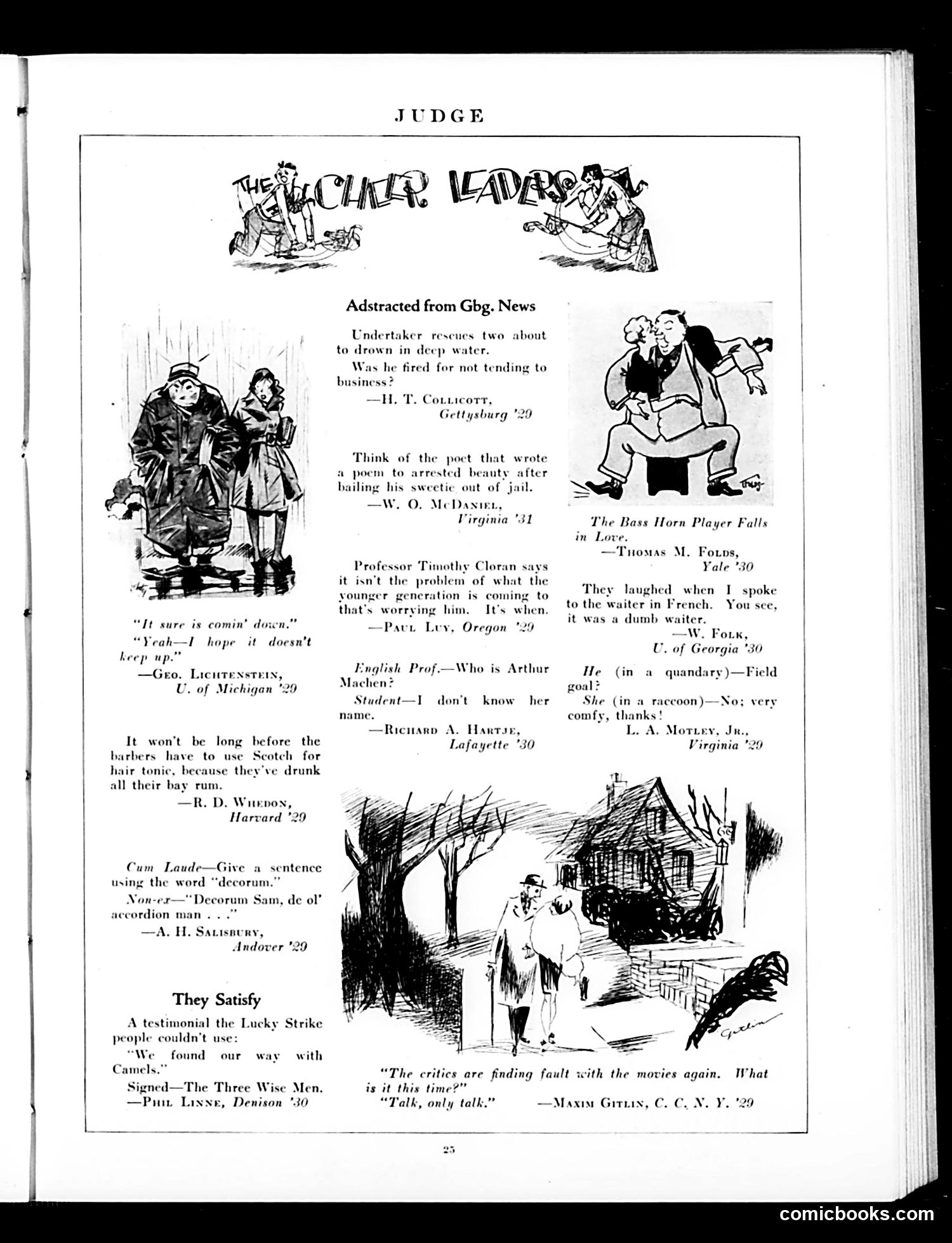
This page from *Judge* presents college humor submitted by students from various universities (circa 1929-1930). The content consists of short jokes and quips rather than formal political cartoons. The humor reflects 1920s college culture: jokes about Prohibition (barbers drinking bay rum, a medicinal alcohol substitute), slang from the era ("It sure is comin' down"), and social anxieties about the younger generation. Several items mock academic pretension—a student who doesn't know who author Arthur Machen is, and misusing "decorum" in a sentence. The cigarette advertisements ("Lucky Strike," "Camels") were typical for the era. One joke references silent films transitioning to "talkies" (talking pictures)—a major entertainment controversy of 1929. The illustrations are generic cartoons accompanying the jokes: a couple in rain, a man with a bass horn, and a countryside scene. This is primarily a humor page reflecting college student sensibilities and contemporary consumer culture rather than political satire.
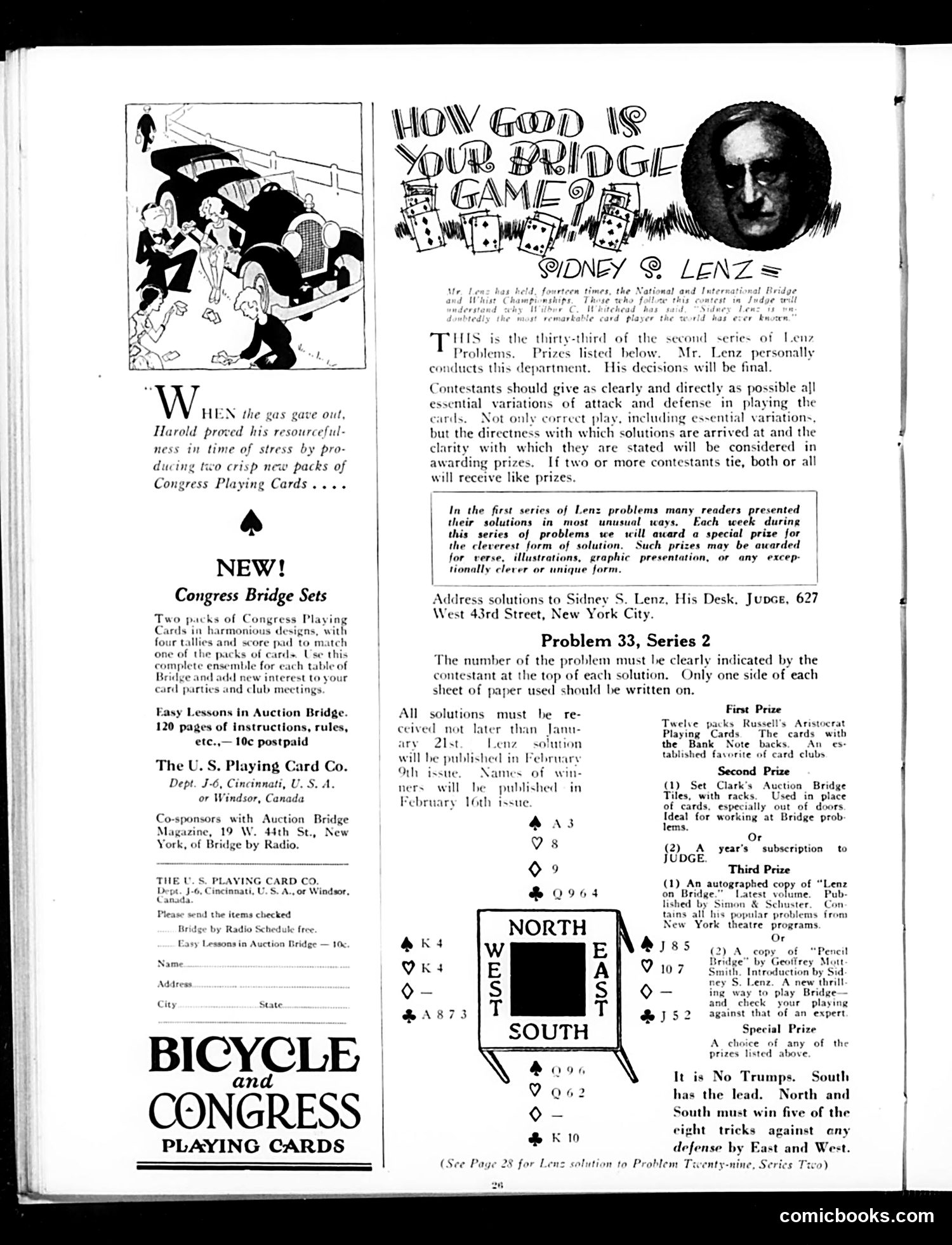
This page is primarily **advertising and a bridge card game puzzle**, not political satire. The main content features "Problem 33, Series 2" from Sidney S. Lenz's bridge problem column. Lenz was a renowned bridge expert, and Judge magazine ran these puzzles as a regular feature. The cartoon at top-left is decorative filler showing people in a car—a generic illustration about someone resourcefully producing playing cards during an emergency (when "the gas gave out"), used to promote Congress Playing Cards. The bulk of the page announces contest details: readers submit solutions to bridge hands, with prizes ranging from playing card decks to subscriptions to *Judge* magazine itself and Lenz's book. The competition awards prizes not just for correct answers but for creative presentation—verse, illustrations, or unique approaches. This represents early 20th-century magazine culture: publications used puzzles and contests to build reader engagement and community.
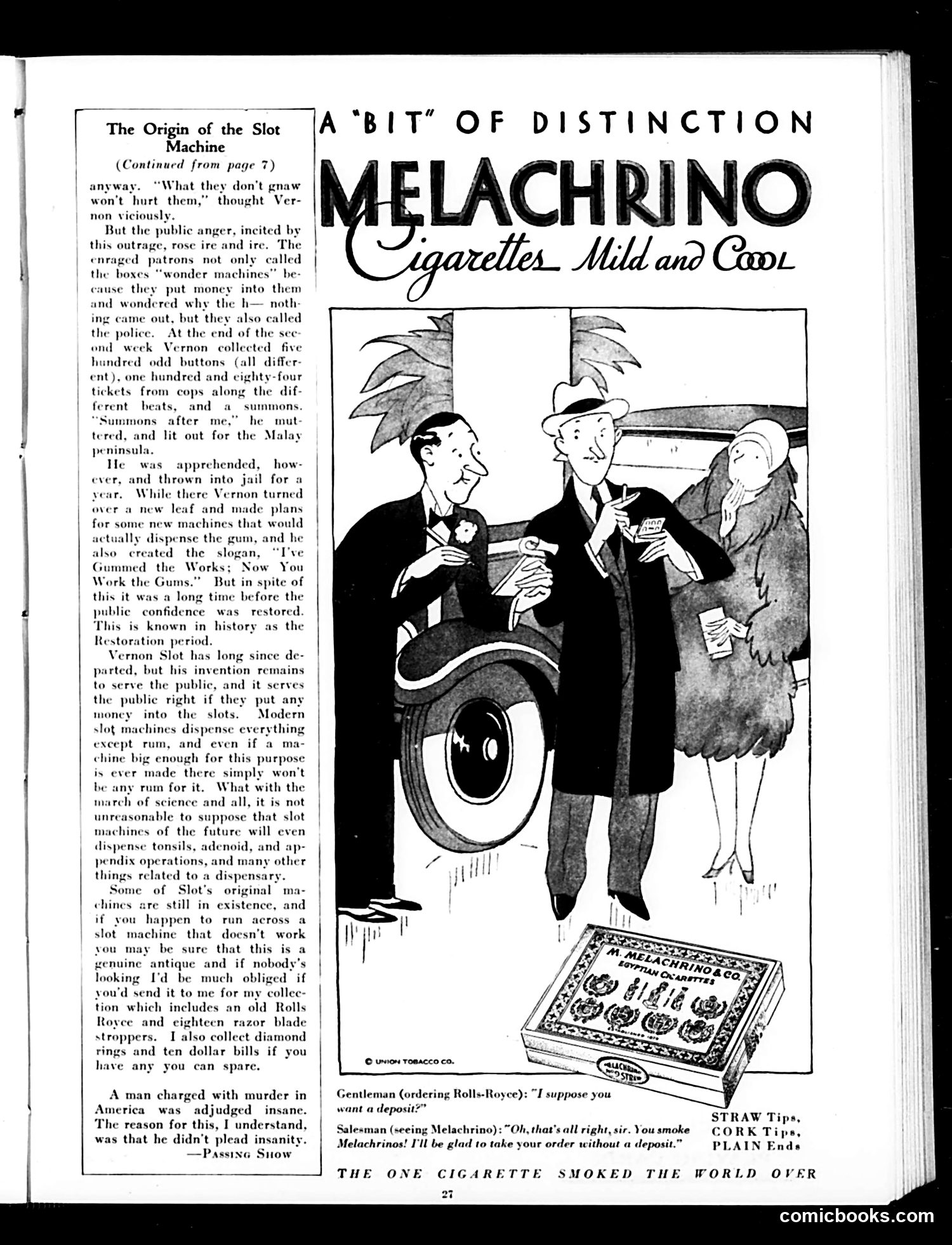
This page contains two distinct elements: ## Left Column: "The Origin of the Slot Machine" A humorous fictional origin story about "Vernon Slot" inventing the slot machine. The narrative describes Vernon creating machines that malfunctioned spectacularly—dispensing buttons and police summonses instead of gum—angering the public. He's jailed, reforms his design, and his invention eventually gains acceptance. This is satirical commentary on new technology adoption: society initially distrusts innovations, but they eventually become normalized. The joke culminates in suggesting future slot machines might dispense medical procedures. ## Right: Melachrino Cigarettes Advertisement A commercial cartoon showing a gentleman ordering a Rolls-Royce. When he smokes Melachrino cigarettes, the salesman waives the deposit requirement—the cigarette brand apparently confers such status and creditworthiness that financial assurance becomes unnecessary. It's aspirational advertising using class signaling: smoking these cigarettes elevates one's social standing. The page demonstrates Judge's mix of satirical commentary and advertising content.
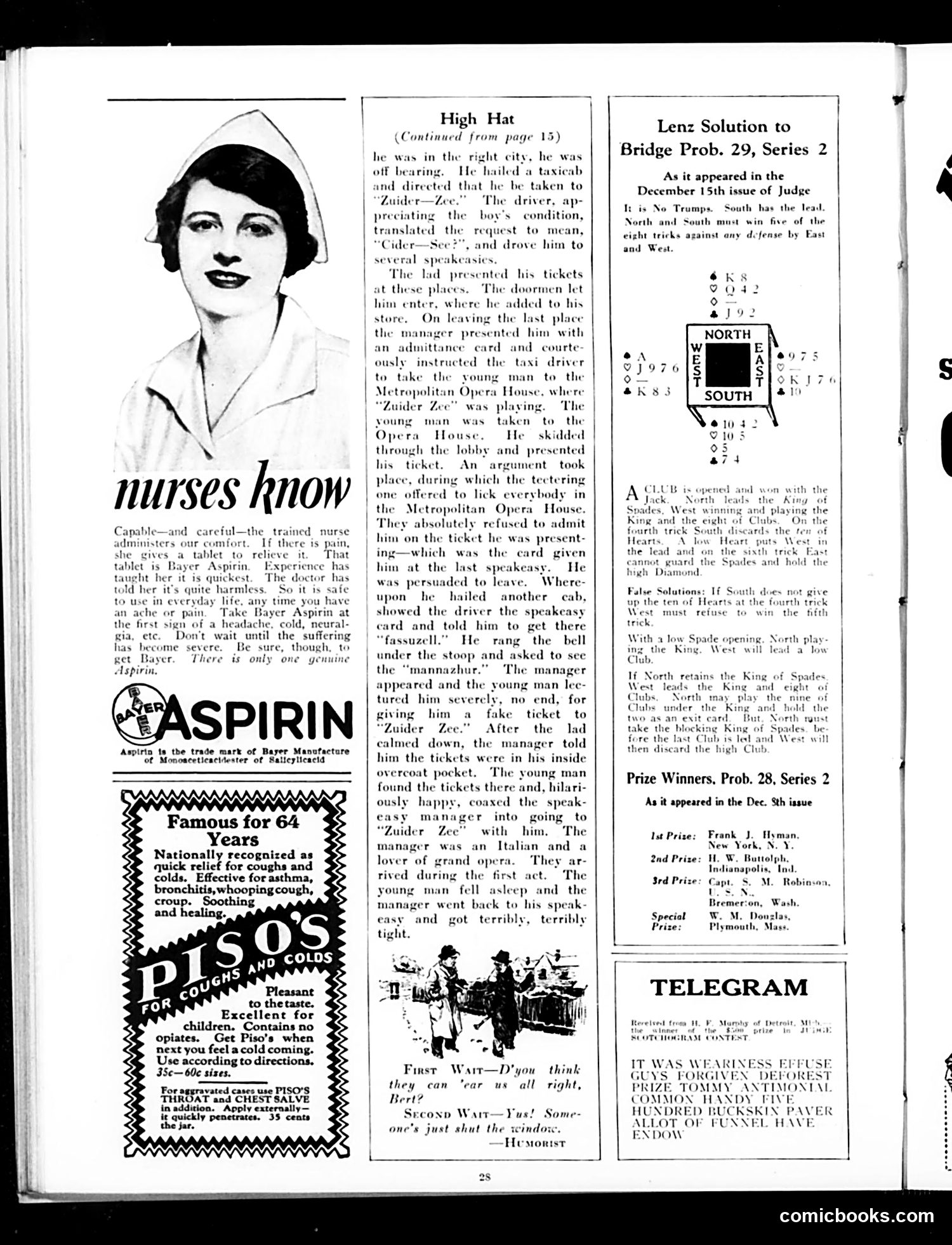
This page contains a humorous story about a drunk man's misadventure during Prohibition. A intoxicated young man, attempting to reach a speakeasy called "Zuider-Zee," gets repeatedly misdirected by taxi drivers who mishear his slurred speech. He's given fake admission tickets, bounced from wrong locations, and eventually recovers his real tickets from his pocket. The satire targets **Prohibition enforcement absurdities**: the story depicts how the illegal liquor trade created farcical situations where speakeasies operated openly enough to issue admission cards, while legitimate businesses (like the Metropolitan Opera House) stood nearby. The drunk protagonist's persistent, humorous determination to reach his destination satirizes how pervasive speakeasy culture had become despite official bans. The page also contains period advertisements (Aspirin, Piso's cold remedy) and a bridge puzzle solution—typical Judge magazine filler content.
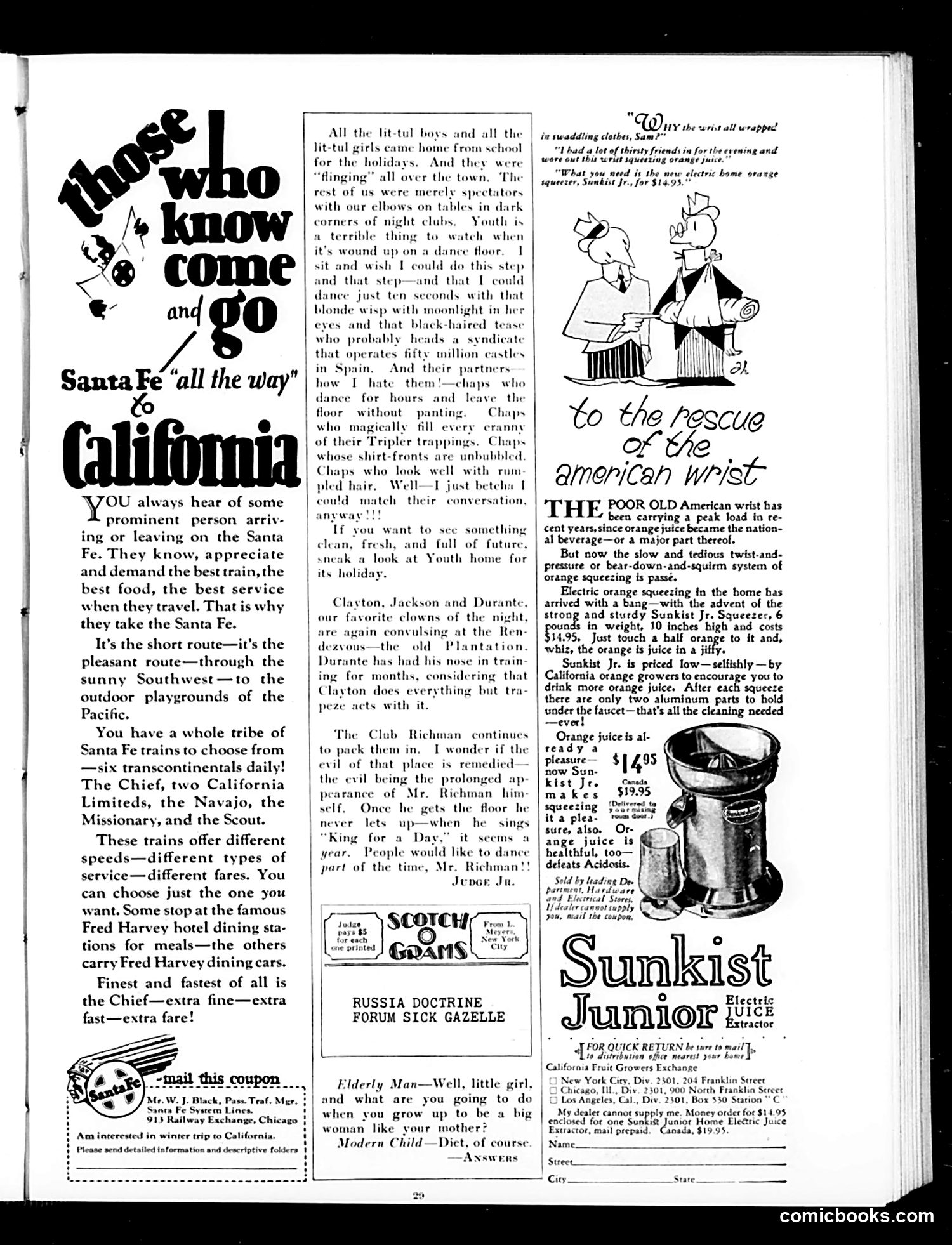
This is primarily an **advertisement and lifestyle page** from Judge magazine, likely 1920s-early 1930s. The main content includes a **satirical humor piece** mocking young people's dancing and nightlife during the Jazz Age. The author (speaking as an older observer) envies young dancers at clubs like the Rendezvous and Club Richman, mentions popular entertainers Clayton, Jackson, and Durante, and complains about overly-energetic dance partners. The page is dominated by **paid advertising**: a Santa Fe railway advertisement promoting trains to California, and a large ad for the "Sunkist Junior" electric orange juice squeezer. An accompanying humor bit jokes about someone wrapping their wrist after manually squeezing oranges for guests. There's also a small **Q&A joke** at bottom about a modern child choosing "diet" as a career aspiration—satirizing contemporary diet culture concerns. The page reflects Jazz Age leisure culture, emerging electrical home appliances, and consumer advertising's growing presence in satirical magazines.
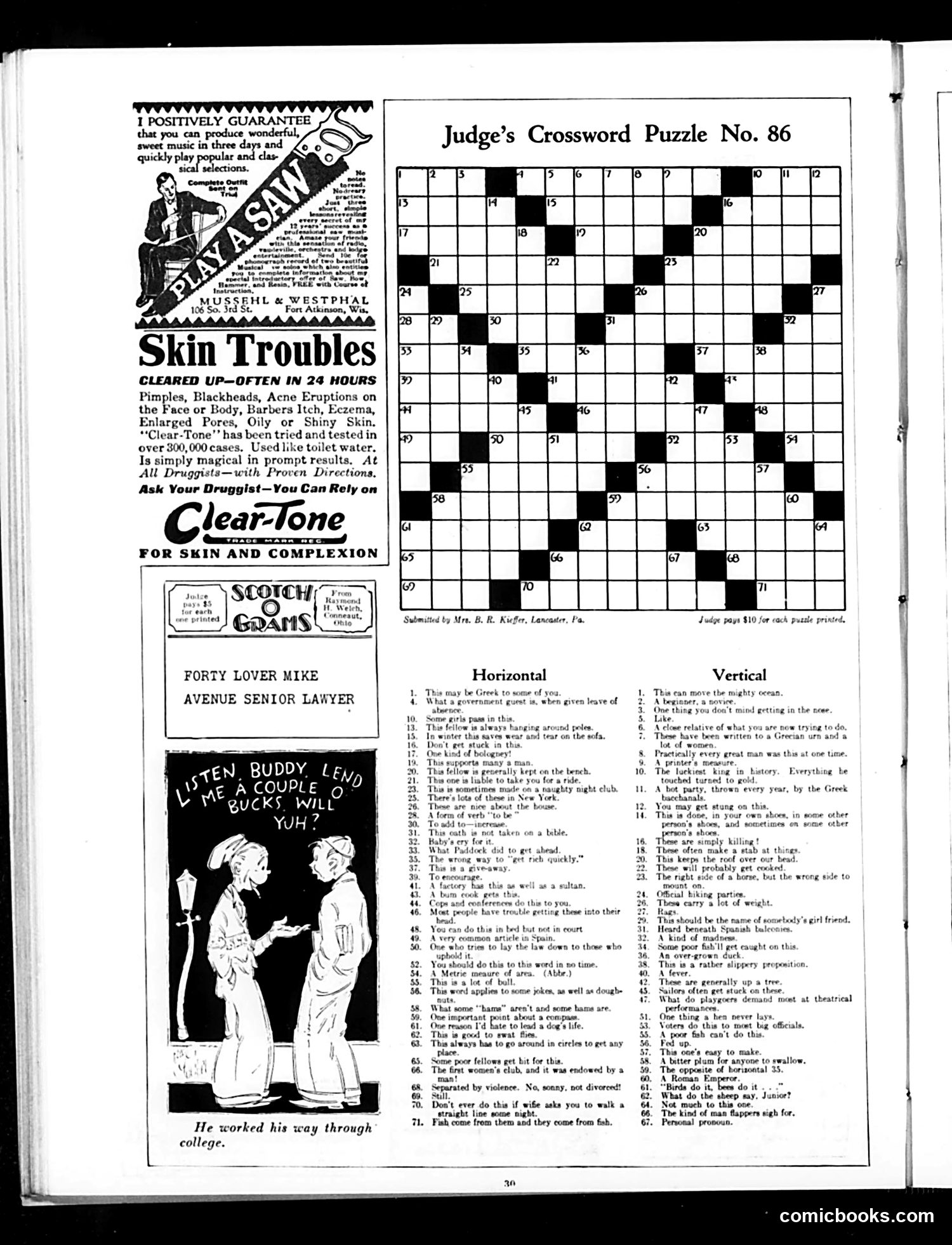
This page is primarily **advertising and puzzle content** rather than editorial satire. The main feature is Judge's Crossword Puzzle No. 86, submitted by a reader from Lancaster, Pennsylvania (who won $10). The only cartoon on the page depicts two men in conversation with the caption "Listen, buddy, lend me a couple of bucks, will yuh? He worked his way through college." This is a **mild joke about economic struggle**—the implication being that despite working through college, the man remains financially struggling and must borrow money. It's gentle social commentary on the difficulty of social mobility in this era. The surrounding advertisements (Clear-Tone skin treatment, musical instruction, and a law firm) are typical period commercial content. The crossword clues reference contemporary culture and slang ("flapper," "Greek" as slang for incomprehensible, government customs), making it a snapshot of 1920s-era vocabulary and concerns rather than pointed political satire.
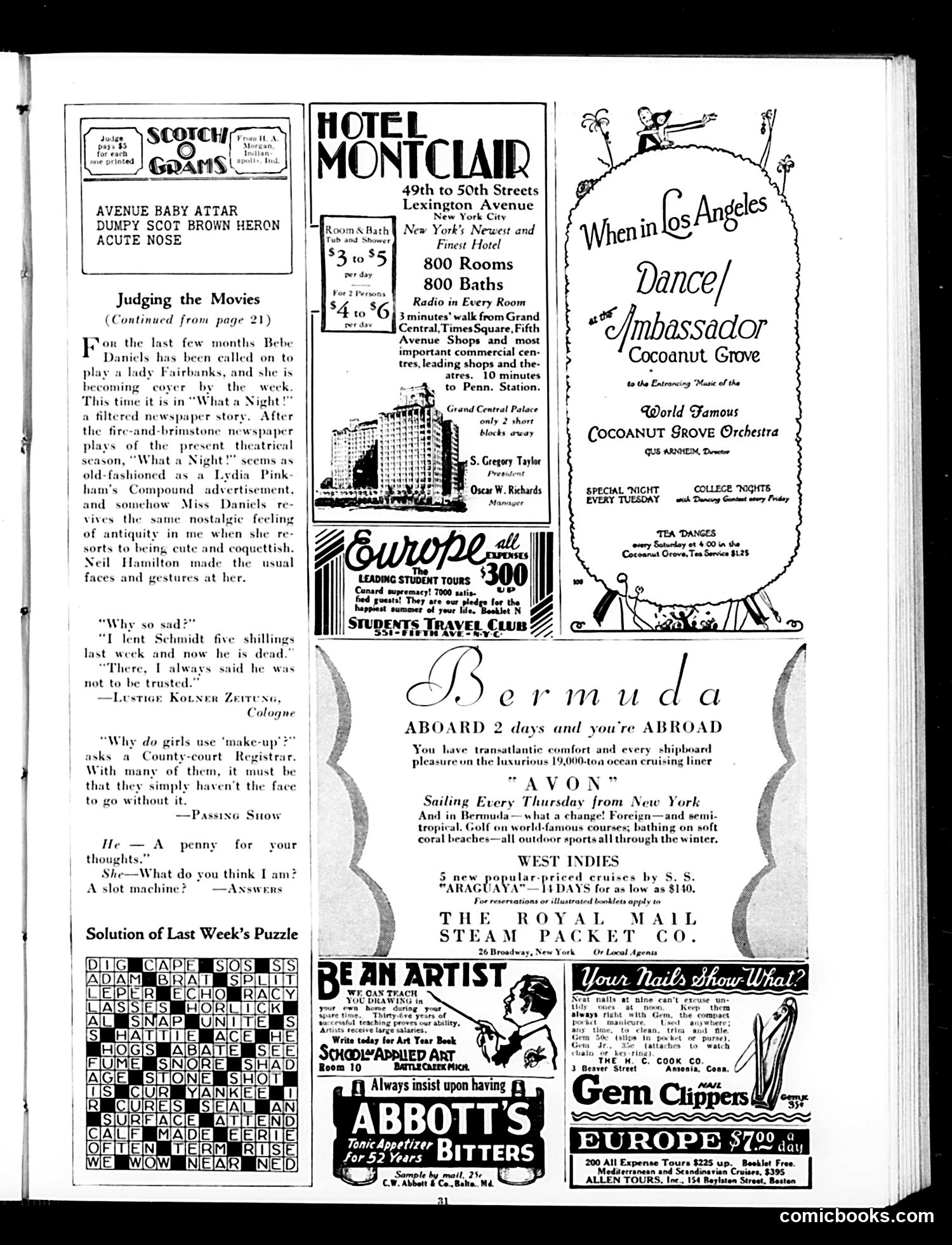
This page is primarily **advertising** rather than editorial content, featuring hotel, travel, and product promotions typical of 1920s publications. The limited editorial content includes: **"Judging the Movies"** — A film criticism column discussing actress Bebe Daniels, who appears in "What a Night?" The reviewer finds the theatrical story old-fashioned, comparing it to nostalgic patent medicine ads. This reflects contemporaneous film criticism standards. **Humor shorts** — Brief joke exchanges about lending money, makeup, and courtship, representing typical period humor (somewhat sexist by modern standards). **One visible cartoon element** — An illustration for "Bean Artist" art instruction, typical of instructional advertising from the era. The page reflects 1920s consumer culture: luxury hotel stays, European cruises, student tours, and grooming products dominate. The content assumes a middle-to-upper-class readership interested in entertainment, travel, and modern conveniences like radio.
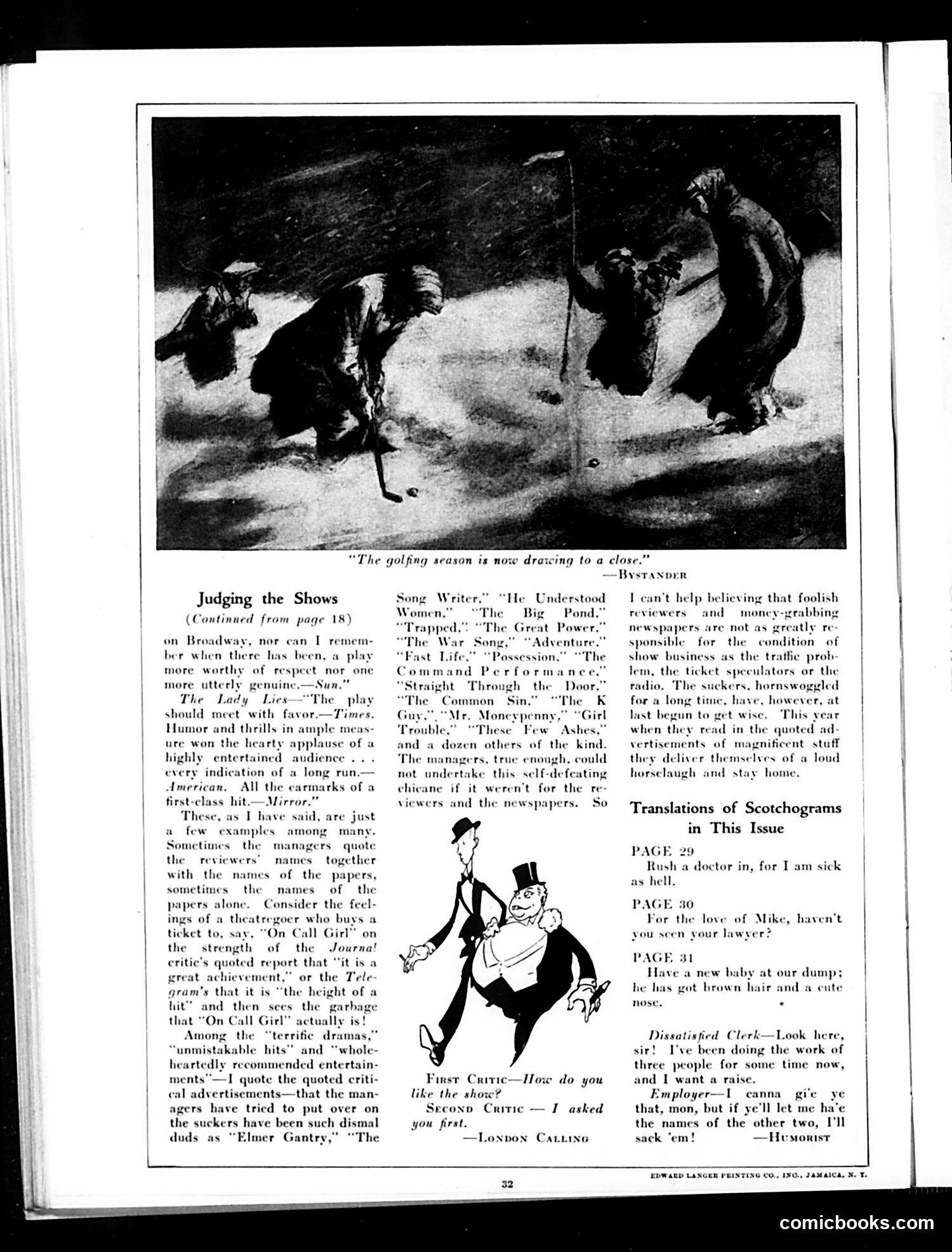
This is a critical essay (not a cartoon) attacking how Broadway theater managers exploit positive reviews in advertisements. The author notes that managers selectively quote critics' praise while omitting context, misleading theatergoers into buying tickets for mediocre shows. The essay cites real examples: plays praised as "worthy of respect" and "first-class hits" by major newspapers (Times, Sun, American) that proved to be commercial or critical failures, including "Elmer Gantry" and "The Moneypenny." The satire's point: unscrupulous managers quote glowing reviews out of context, while reviewers and newspapers bear partial responsibility for enabling this deception. However, the author suggests audiences are becoming savvier—they now "deliver themselves of a loud horselaugh and stay home" rather than trust dubious advertising claims. The accompanying cartoon depicts two critics unable to form independent opinions, needing to defer to each other.
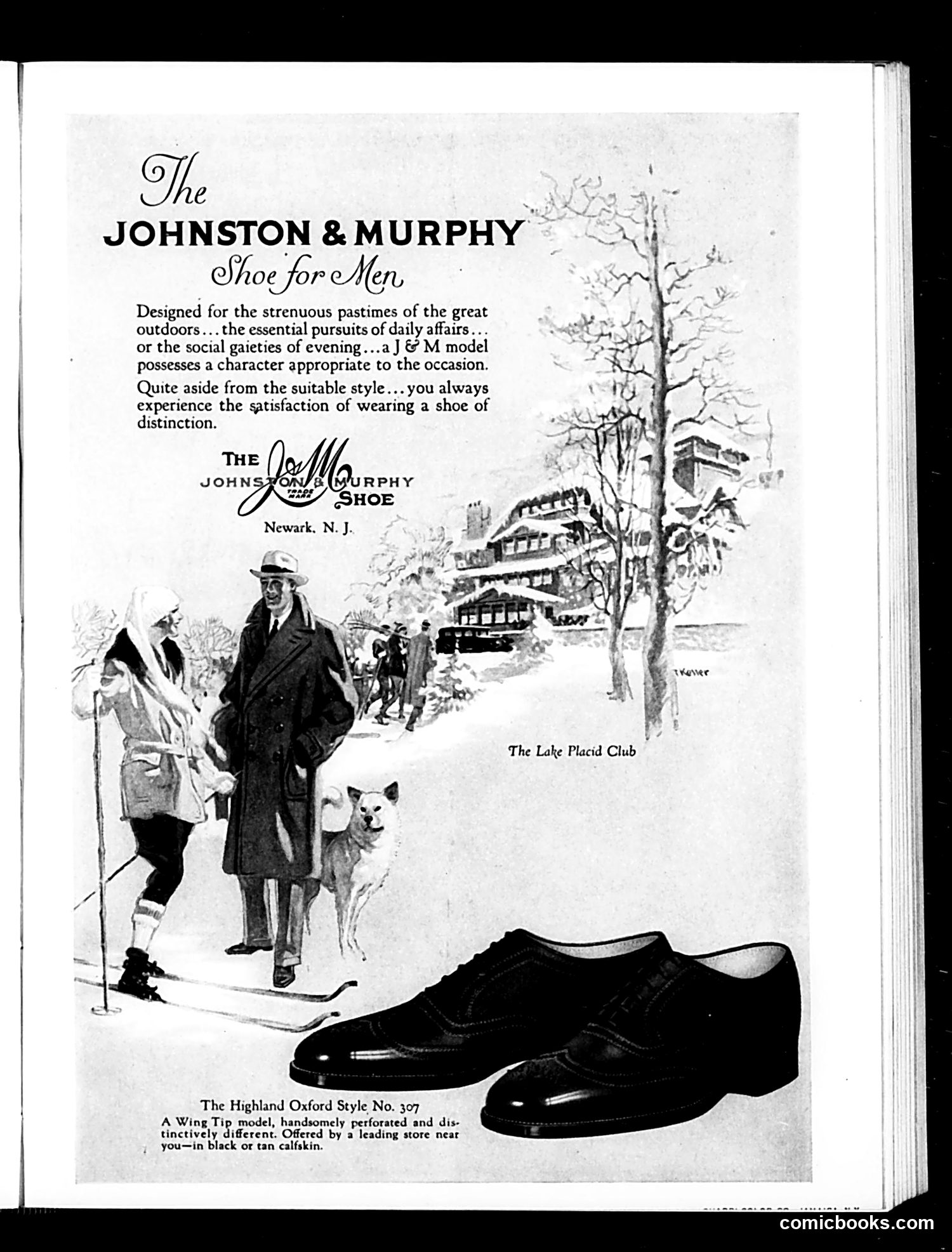
This is a **shoe advertisement**, not political satire. It promotes Johnston & Murphy men's shoes from Newark, New Jersey. The illustration depicts an affluent winter leisure scene at Lake Placid Club—a prestigious Adirondack resort—showing well-dressed men engaged in outdoor recreation (skiing, walking) alongside fashionable women. This imagery establishes the shoes as appropriate footwear for both "strenuous pastimes of the great outdoors" and "social gaieties of evening." The featured product, "Highland Oxford Style No. 307," is shown as a wing-tip oxford available in black or tan calfskin. The advertisement's appeal is entirely aspirational: it associates the shoes with wealth, sophistication, and leisure-class activities. There is no satire or political commentary—this is straightforward luxury marketing from the early-to-mid twentieth century.
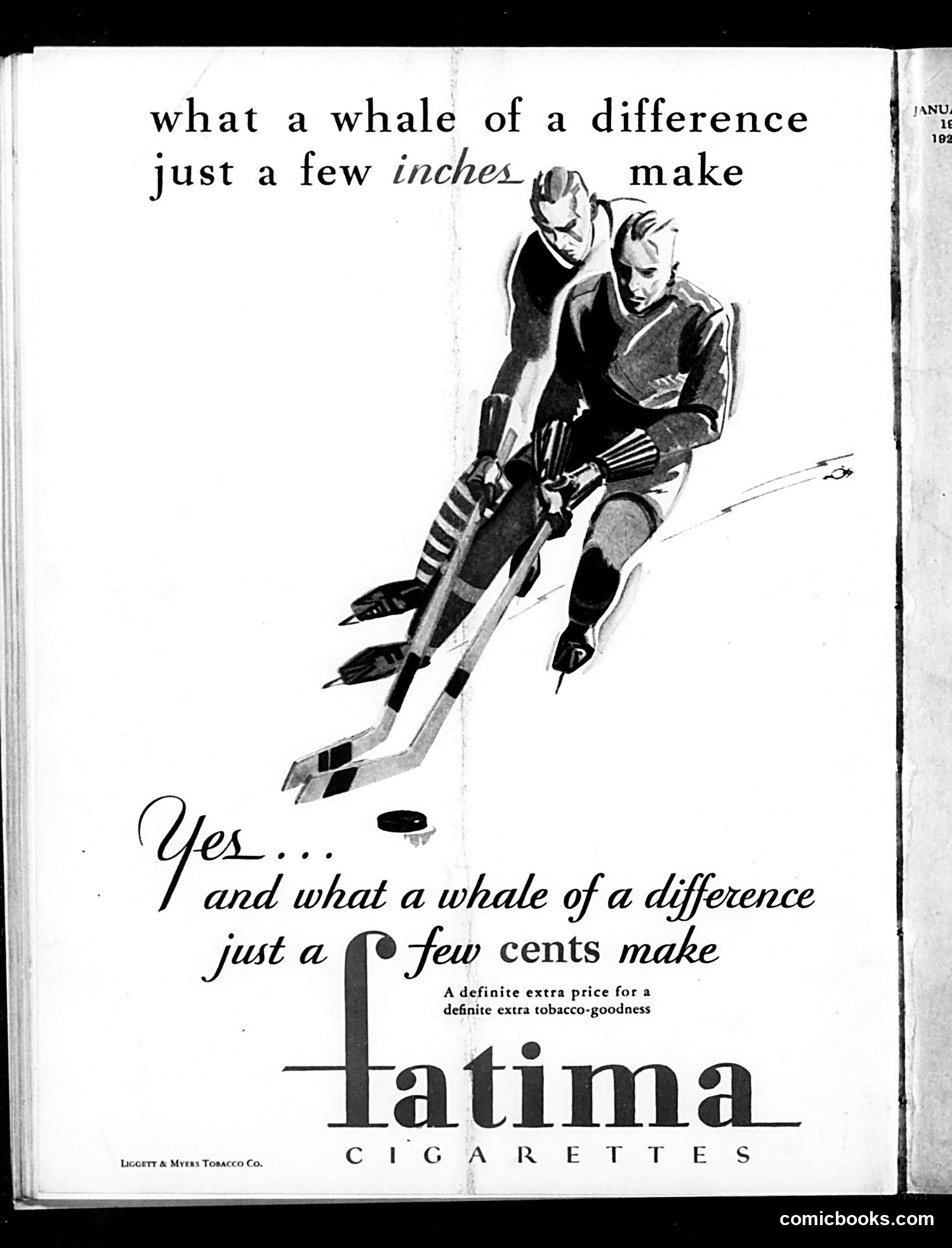
This is an advertisement for Latima cigarettes, not a political cartoon. The page depicts two ice hockey players in action, with the tagline playing on the phrase "what a whale of a difference a few [units] make." The ad's joke compares two scenarios: just a few *inches* difference in hockey positioning dramatically affects gameplay, while a few *cents* extra price for Latima cigarettes supposedly provides noticeably superior tobacco quality. The rhetorical structure suggests that small expenditures yield meaningful quality improvements. The illustration emphasizes dynamic sports action to convey the importance of minor differences having outsized consequences—a common advertising strategy of the era to justify premium pricing. This is commercial content rather than satirical commentary on current events or politics.