
Judge, 1929-01-12 · page 15 of 36
Judge — January 12, 1929 — page 15: what you’re looking at
What you’re looking at
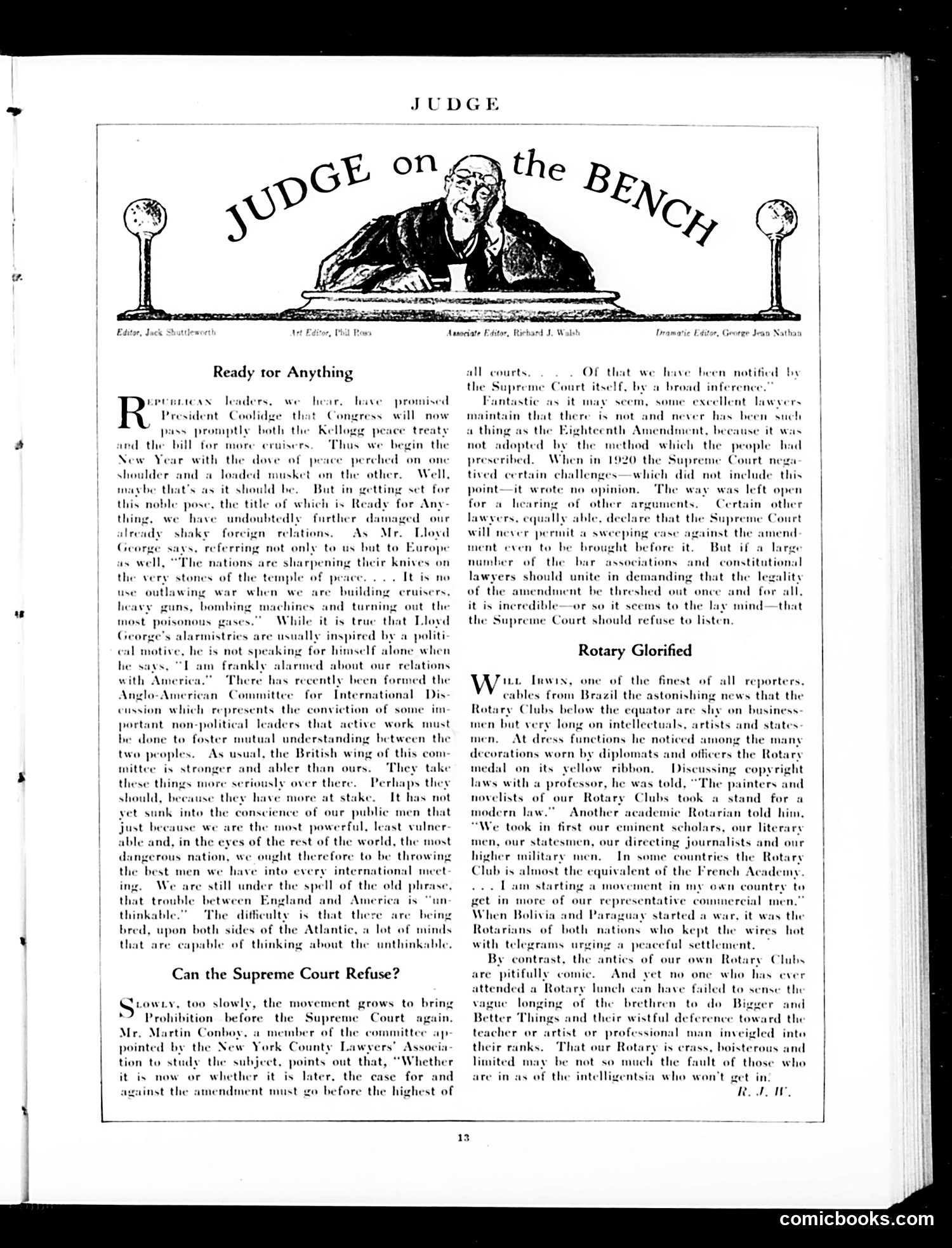
This page from *Judge* magazine contains political commentary on early 1920s American issues, centered around three main topics: **"Ready for Anything"** criticizes Republican leaders' contradictory stance—simultaneously pursuing the Kellogg peace treaty while expanding naval armaments. The satire mocks President Coolidge's administration for claiming peace while preparing for war, with references to Lloyd George's concerns about Anglo-American relations deteriorating despite a recent Anglo-American Committee for International Discussion. **"Can the Supreme Court Refuse?"** addresses the constitutional challenge to Prohibition. Legal scholars debated whether the Eighteenth Amendment was validly ratified; the piece argues the Supreme Court should hear challenges to settle the question definitively. **"Rotary Glorified"** praises the Rotary Club's international reach, noting with apparent surprise that South American Rotary clubs attract intellectuals and artists rather than just businessmen. The masthead shows "Judge on the Bench"—the magazine's recurring judicial commentary feature. The overall tone is conservative but reform-minded, typical of 1920s establishment criticism.
📄 Transcribed text from this page (OCR, searchable)
Machine-transcribed from the original scan — historical spelling and the odd misread are preserved.
itor, J a! ditor, P Nanociate Bitar, Rich Ready tor Anything | epenrtican len d President idge that Congress will now pass promptly both the Kellogg peace treaty red the bill for more cruisers. Thus we begin the New Year with the dove of peace perched on one | shoulder and a loaded musket on the other. Well, Ybe that’s as it should be. But in getting set for Yhle pose, the title of which is Ready for Any- we have undoubtedly further damaged our shaky fore relations, Ay Mr. Lloyd > says, referring not only te us but to Europ: ts well, “The nations are sharpening their knives on the very stones of the temple of peace... . [tis no use out we hear, have. 4 are building cruisers, nd turning out the most poisonous gases.” While it is true that Lloyd George's alarmistries are usually inspired by a. politi cal motive, he is not speaking for himself alone when he says, "Lam frankly alarmed about our re | with America.” Anglo-American Committee for Internatic awing war when w heavy guns, bombing machines ations There has recently been formed the 1 Dis | cussion which represents the convietion of some im | portant non-political leaders that active work must be done to foster mutual understanding between the two peoples. As usual, the British wing of this com mittee is stronger and abler than ours. They take these thi Perhaps they should, be ec. It has not yet sunk into the conscience of our public men that | just because we are the most powerful, least vulner | able and, in the eyes of the rest of the world, the most Prous nation, we ou ws more seriously over the ause th y have more ght therefore to be throwing best men we have into every international meet | We are still under the spell of the old phrase. | that trouble between England and America is “un | thinkable."” The difficulty is that the | bred, upon both sides of the Atlantic, a lot of minds that are capable of thinking about the unthinkable. are being Can the Supreme Court Refuse? LowLy, too slowly, the movement grows to. bring | 2 Prohibition before the Supreme Court again. Mr. Martin Conboy, a member of the committee ap pointed by the New York County Lawyers’ Associa ject, points out that, “Whether it is now or whether it is later, the case for and against the amendment must go before the highest of tion to study the su and J, Walsh Dramatic bait an Nathan all courts, OF that we hy the Supreme Court itself, by a bro: 1 inference.” Fantastic as it may seem, some excellent lawyers maintain that there is not and never has been such a thing as the Eighteenth Amendment, because it was not adopted by the method which the people had prescribed. When in 1920 the Supreme Court nega tived certain challenges—which did not include this point—it wrote ne opinion, The way was left open for a hearing of other arguments, Certain other lawyers. equally able, declare that the Supreme Court will never permit a sweepir cainst the amend ment even to. be ght before it. But if a large number of the associations and constitutional nase lawyers should > in demanding that the legality of tl mend » threshed out once and for all, it is incredible—or so it seems to the lay mind—that the Supreme Court should refuse to listen Rotary Glorified Inwix, one of the finest of all reporters. les from Brazil the astonishing news that the Rotary Clubs below the equator are shy on business men but very long on intellectuals, artists and s\ men. At dress functions he noticed among the many ts and officers the Rotary on its yellow ribbon. Discussing copyright laws with a professor, he was told, “The painters and novelists of our Rotary Clubs took stand for a modern law.” Another academic Rotarian told him. “We took in first our eminent scholars, our literary men, our statesmen, our directing journalists and our higher military men, In some countries the Rotary Club is almost the equivalent of the French Academy. - Lam starting a movement in my own country to get in more of our representative commercial men,” When Bolivia and Paraguay started a war, it was the Rotarians of both nations who kept the wires hot with te ful settlement. By contrast, the our own Rotary Clubs are pitifully comic. And yet no one who has ever attended a Rotary lunch can have failed to sense the vague longing of the brethren to do Bigger and Better Things and their wistful deference toward the teacher or artist or professional man inveigled into their ranks. That our Rotary is crass, boisterous and limited may be not so much the fault of those who are in-as of the intelligentsia who won't ¢ ions worn by diplom: etin ROW, 13 comicbooks.com