
Judge, 1929-01-12 · page 34 of 36
Judge — January 12, 1929 — page 34: what you’re looking at
What you’re looking at
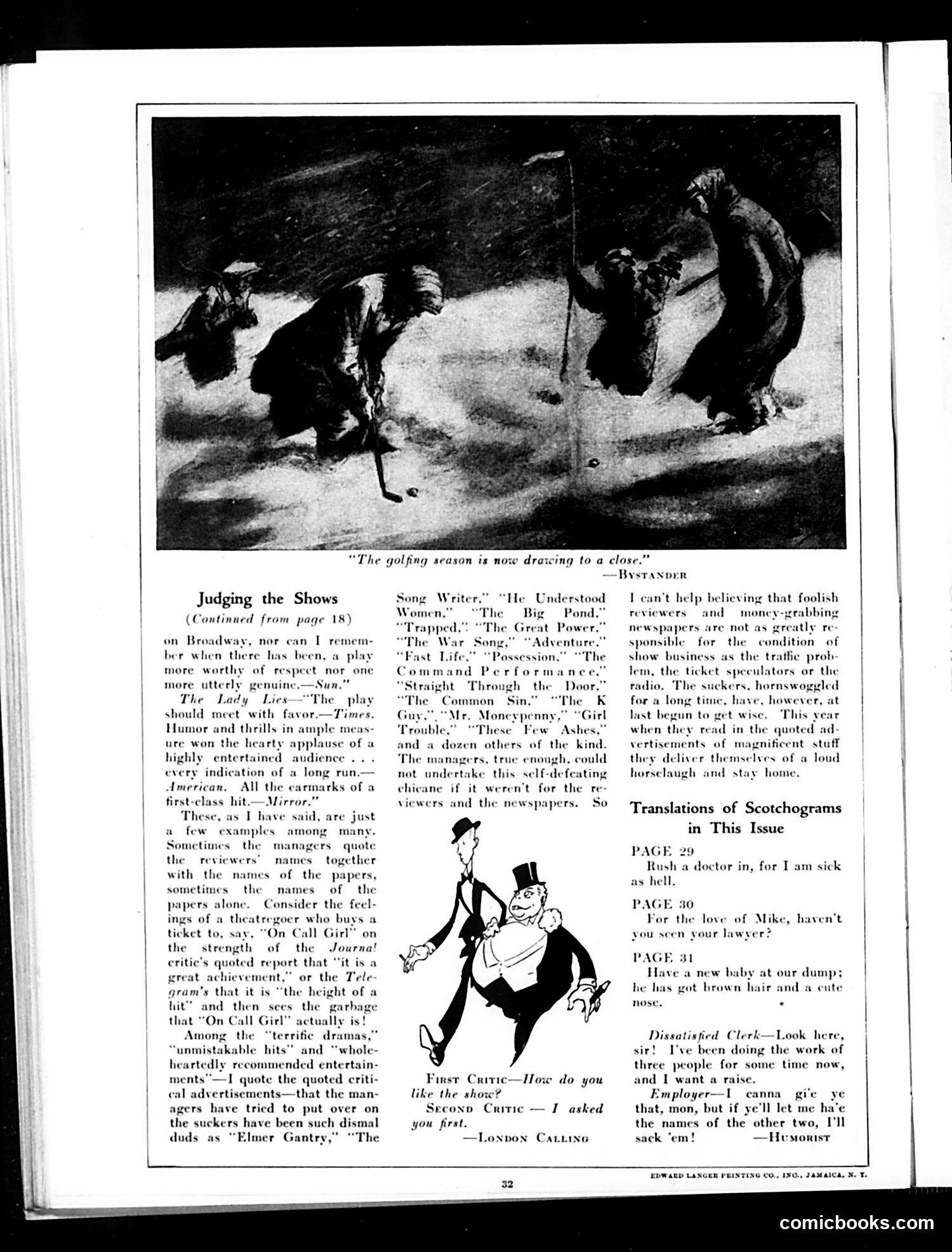
This is a critical essay (not a cartoon) attacking how Broadway theater managers exploit positive reviews in advertisements. The author notes that managers selectively quote critics' praise while omitting context, misleading theatergoers into buying tickets for mediocre shows. The essay cites real examples: plays praised as "worthy of respect" and "first-class hits" by major newspapers (Times, Sun, American) that proved to be commercial or critical failures, including "Elmer Gantry" and "The Moneypenny." The satire's point: unscrupulous managers quote glowing reviews out of context, while reviewers and newspapers bear partial responsibility for enabling this deception. However, the author suggests audiences are becoming savvier—they now "deliver themselves of a loud horselaugh and stay home" rather than trust dubious advertising claims. The accompanying cartoon depicts two critics unable to form independent opinions, needing to defer to each other.
📄 Transcribed text from this page (OCR, searchable)
Machine-transcribed from the original scan — historical spelling and the odd misread are preserved.
Judging the Shows (Continued from page 18) on Broadway, nor can I remem- ber when there has been, a play more worthy of respect nor one more utterly genuine.—Sun.” The Lady Lies—"The play should meet with favor.—Times. Humor and thrills in ample meas- ure won the hearty applause of a highly entertained audience .. . every indication of a long run.— American, All the earmarks of a first-class hit—Mirror.” These, as I have said, are just a few examples among many. Sometimes the managers quote the reviewers’ names together with the names of the papers, sometimes the names of the papers alone. Consider the feel- ings of a theatregoer who buys a ticket t - “On Call Girl” on the strength of the Journa! critic's quoted report that “it is a great achievement,” or the Tele gram’s that it is “the height of a nd then sees the garbage ‘On Call Girl” actually i the “terrif ble hits” - “unmistal heartedly ments” —I quote the quoted criti- advertisements—that the man- gers have tried to put over on the suckers have been such dismal duds as “Elmer Gantry,” “The "he golfing season is now drawing to a close.” Song Writer,” Women,” Understood Big Pond,” Comm: “Straight nd Performance,” Through the Door.” he Common Sin,” “The K Guy.","Mr. Moneypenny,” “Girl uble,” “These Few Ashes,” 1 a dozen others of the kind. ers, true enough, could not undertake this self-defeating chicane if it weren't for the re- viewers and the newspapers. So Finst Crrtic—How do you like the show? Srcoxn Critic — I asked you first. —Loxpvon Carine Bystanper I can't help believing that foolish rev sand mone. apers are not as sponsible for t condition of show business as the traffic prob lem, the ticket speculators or the radio. The suckers, hornswe for a long time, have, last be wise. This ye when they read in the quoted ad vertisements of magnificent stuff they deliver themselves of a loud horselaugh and stay home. we news Translations of Scotchograms in This Issue PAGE 29 Rush a doctor in, for I am sick as hell. PAGE 30 For the love of Mike, haven't you scen your Inwyer? PAGE 31 Have a new baby at our dump; he has got brown hair and a eute nose. . Dissatisfied Clerk—Look here, sir! I've been doing the work of three people for some time now, and I want a raise. Employer—I that, mon, but i the sack " canna gi’e ye ye'll let me ha’e nes of the other two, I'll —Hemorist EDWAED LANGER PRINTING CO., INC, JAMAICA, B. Te comicbooks.com