
A complete issue · 36 pages · 1928
Judge — November 10, 1928
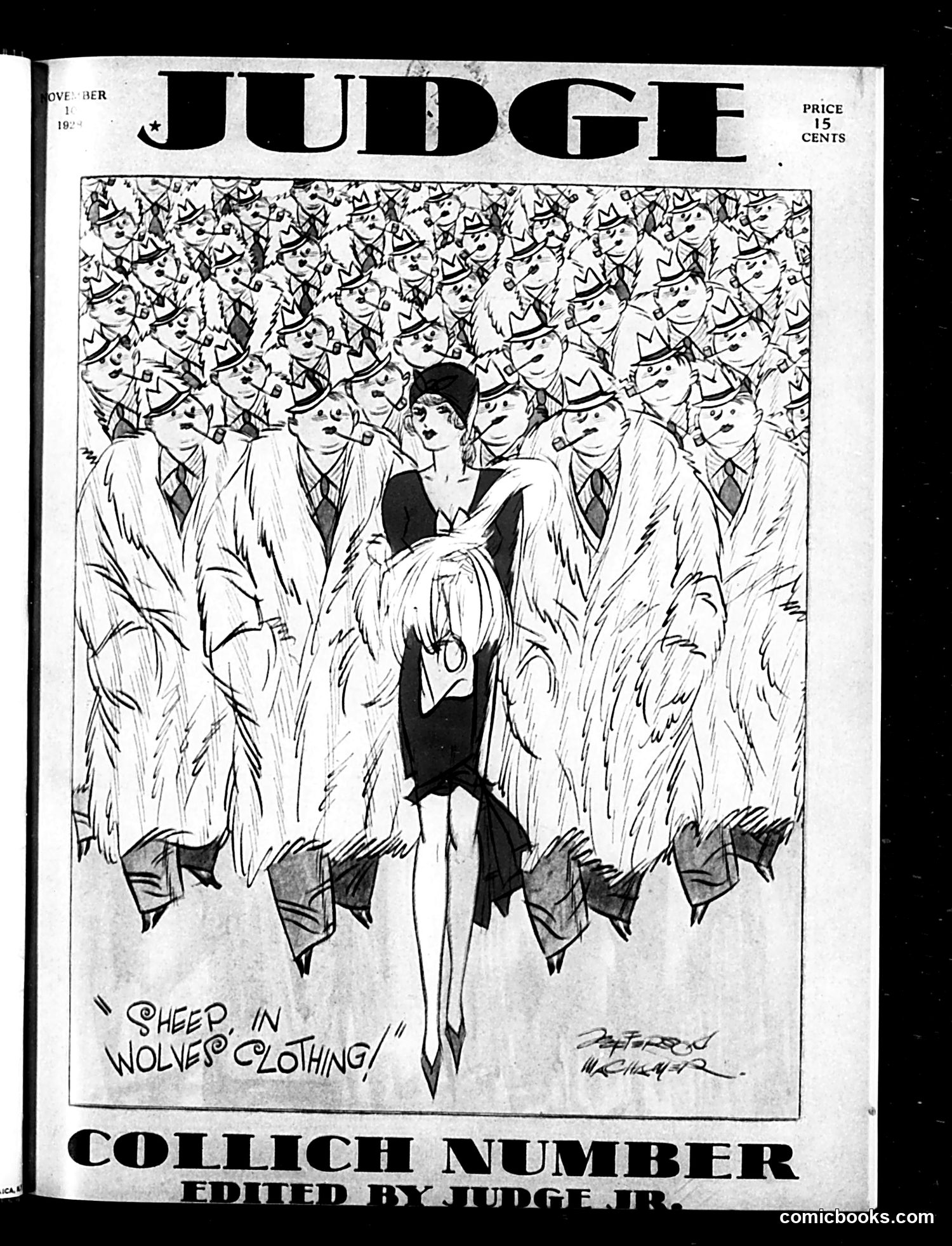
This Judge magazine cover satirizes women adopting masculine fashion trends of the 1920s era. The image shows a lone woman in a fashionable dark dress and cloche hat surrounded by men in identical overcoats and bowler hats—she's visually indistinguishable from them except for her exposed legs and feminine silhouette. The caption "SHEEP, IN WOLVES' CLOTHING" inverts the familiar "wolf in sheep's clothing" idiom. The satire suggests that women adopting menswear-inspired styles are merely mimicking masculine conformity rather than achieving genuine independence. The crowd of identical-looking men emphasizes how uniform male fashion was, making the woman's attempt to blend in ironic—she remains conspicuously female despite adopting their clothing conventions. This reflects 1920s anxieties about changing gender roles and fashion during the flapper era.
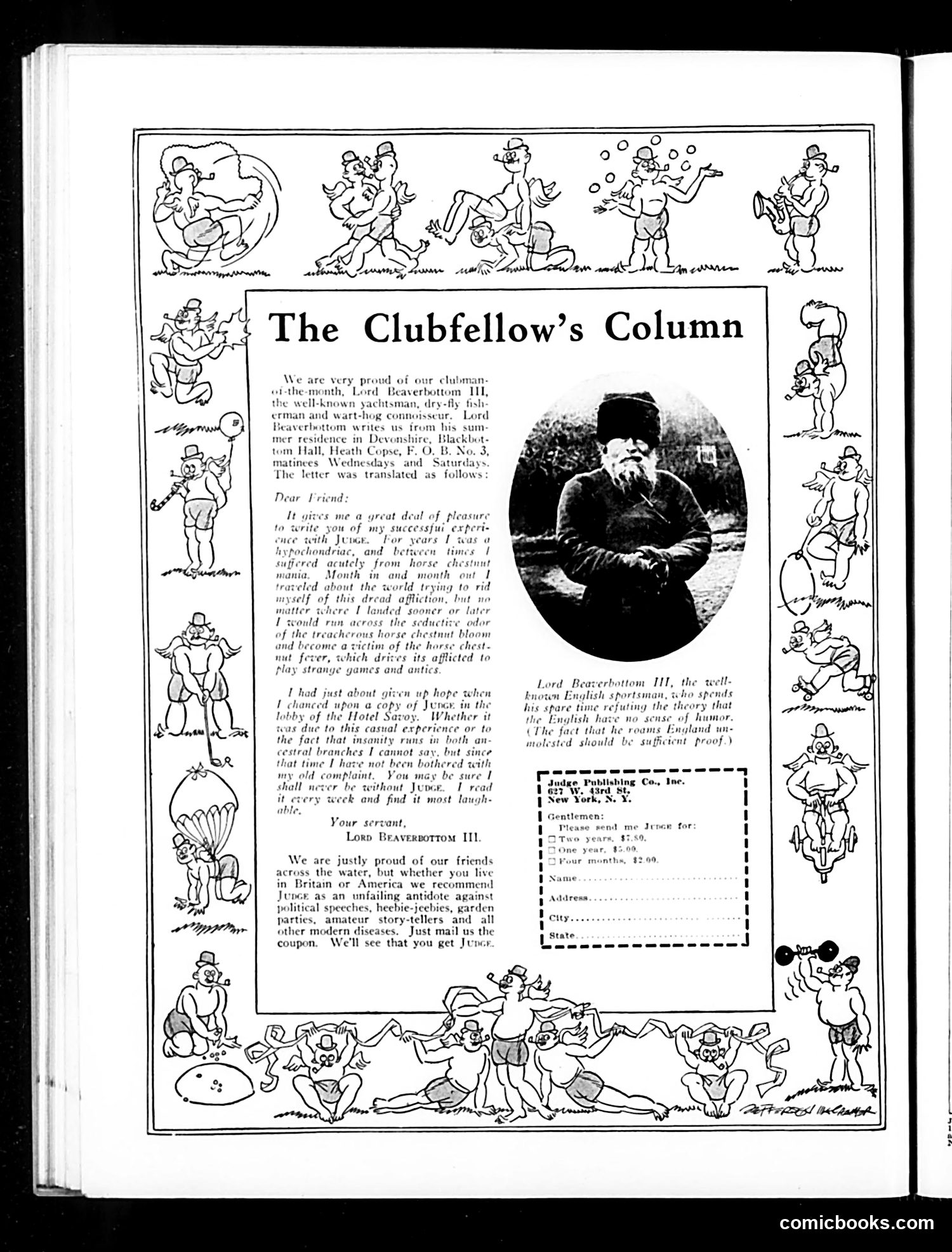
This page features a humorous column supposedly written by "Lord Beaverbrook III," a fictional English sportsman. The accompanying photograph shows an actual elderly gentleman, likely the real Lord Beaverbrook, presented as the column's authority. The letter describes comical misadventures with horses and hunting, establishing Beaverbrook as an absurd, accident-prone character despite his supposed expertise. The joke appears to be satirizing English upper-class pretensions and the gap between aristocratic reputation and actual competence. The page is surrounded by whimsical illustrations of people in various physical predicaments, reinforcing the theme of bumbling incompetence. A coupon at bottom advertises "Juice"—likely a patent medicine or tonic, typical of Judge magazine's commercial content, suggesting the entire column may be tongue-in-cheek advertising.
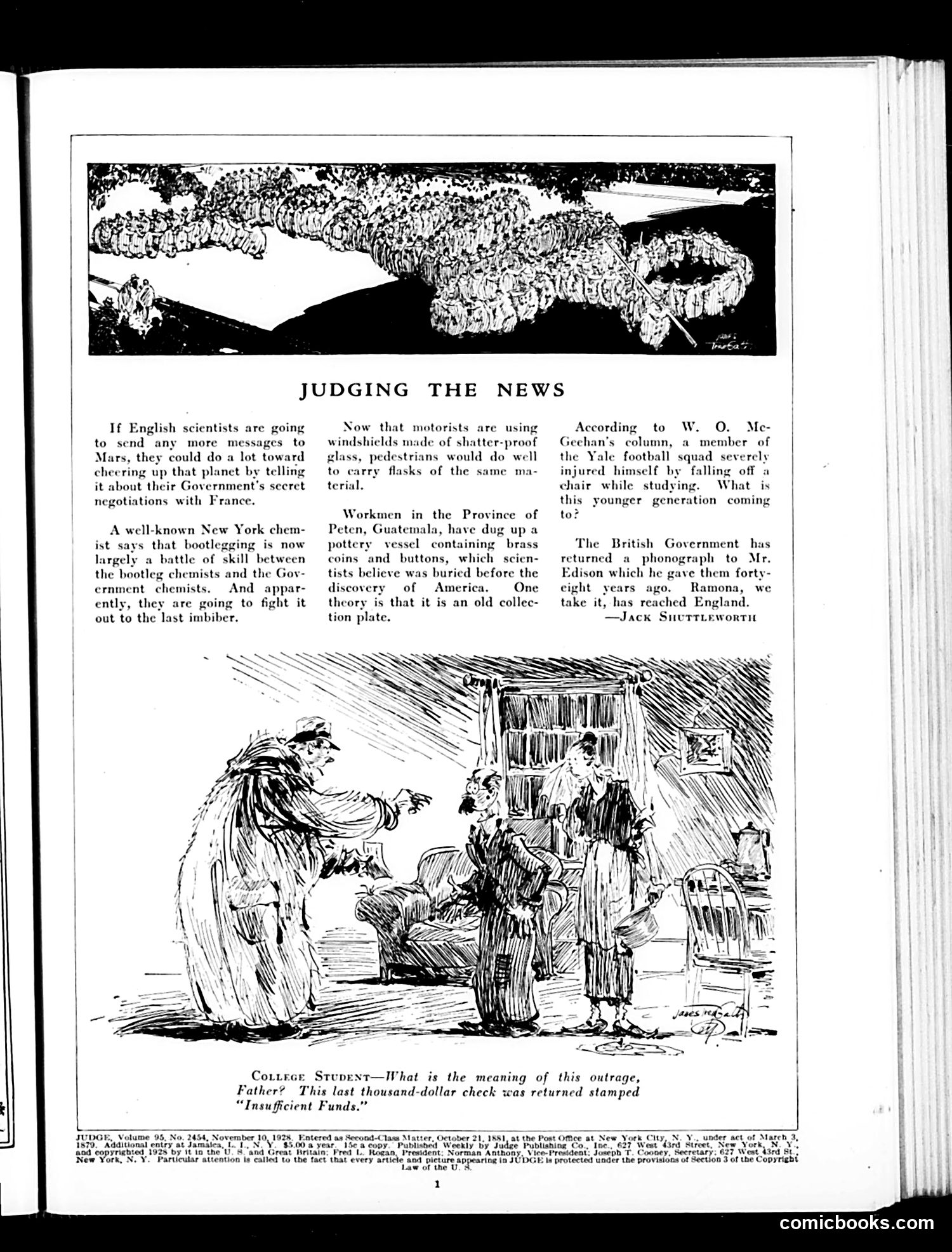
This satirical section critiques recent news reports with humorous commentary. The main cartoon depicts a college student confronting his father about a returned check marked "Insufficient Funds"—a joke about financial irresponsibility during the Jazz Age, when college students were notorious for excessive spending. The "Judging the News" section above mocks various reports: English scientists sending messages to Mars, motorists using shatterproof glass, workmen discovering old pottery in Guatemala, and a phonograph returned to Edison after eight years. The satire suggests these news items range from absurd to trivial, poking fun at both scientific ambition and everyday consumer culture of the 1920s.
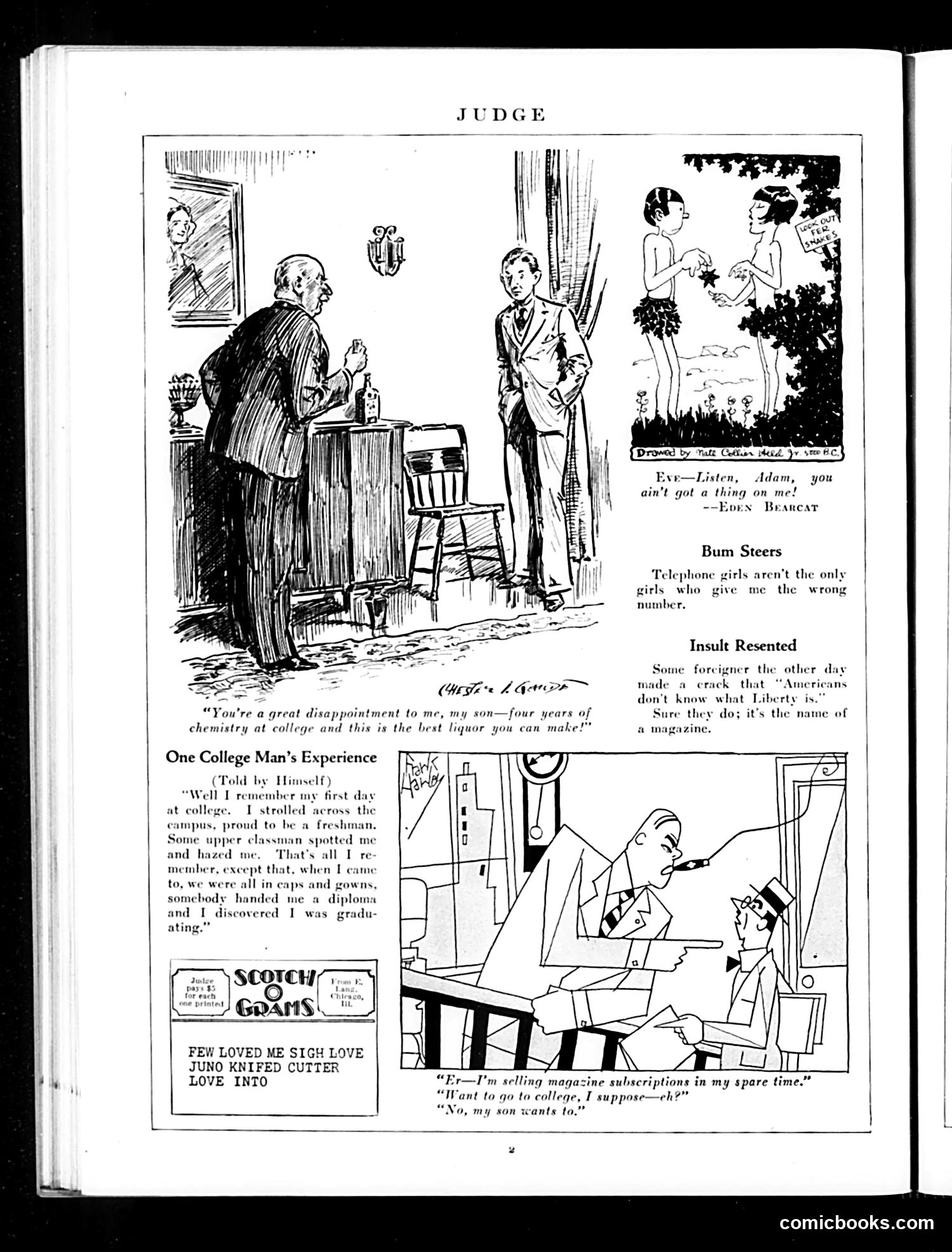
This page contains three separate satirical items: **Top Left Cartoon**: A father confronts his son about making liquor at college. The humor targets Prohibition-era hypocrisy—the father ironically criticizes the son's homemade alcohol while apparently drinking himself ("four years of chemistry...best liquor you can make"). It satirizes parents who condemned youth behavior while engaging in similar illegal activity. **Top Right**: A simple Adam-and-Eve joke about temptation and blame, captioned with a quote from John Milton's *Paradise Lost*. **Bottom Section**: "One College Man's Experience" humorously depicts a student's college memories, including a Scotch ad. The final cartoon jokes about a father opposing his son's college education, preferring he sell magazine subscriptions instead—satirizing working-class attitudes toward higher education.
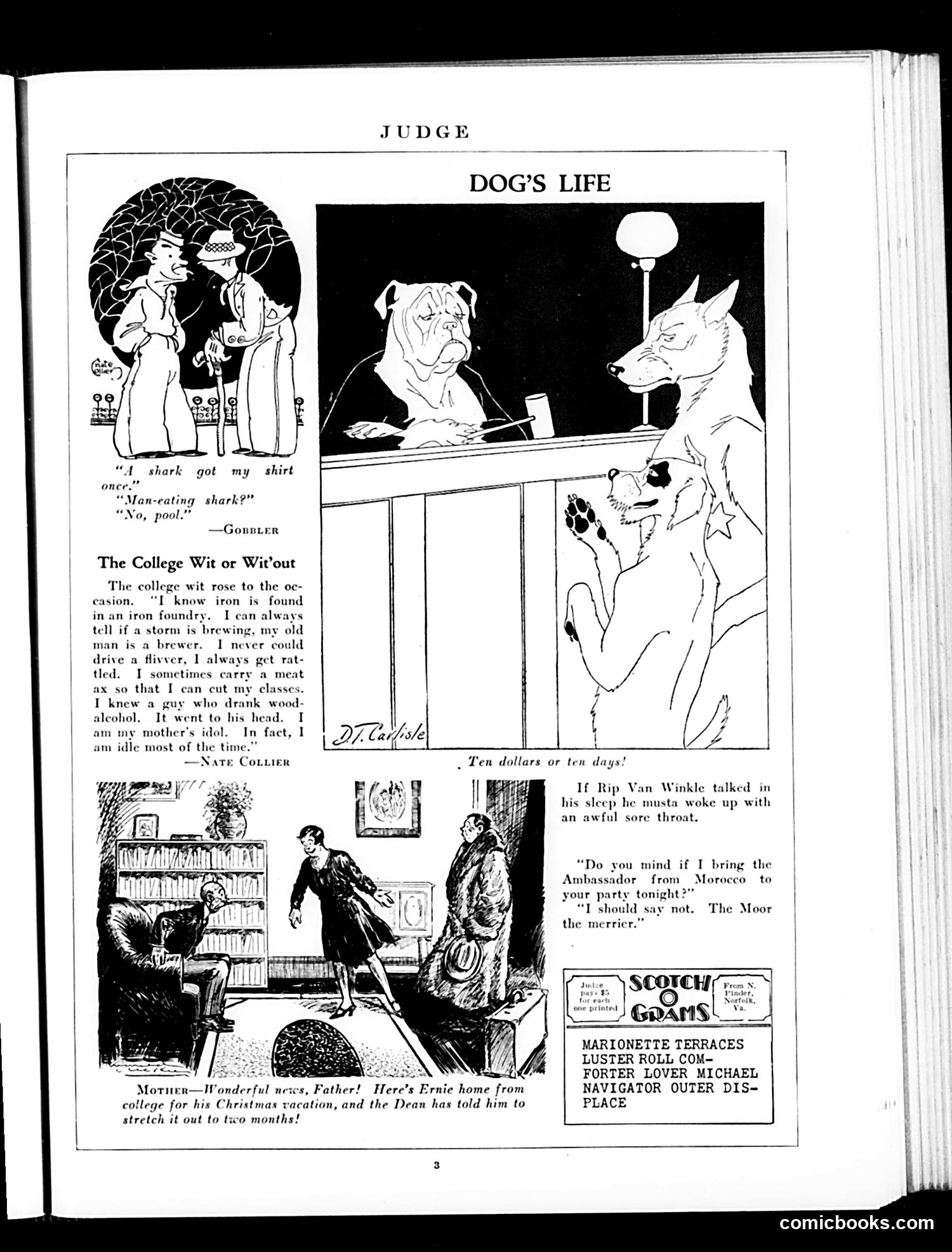
This page contains satirical humor and advertisements typical of early 20th-century Judge magazine. **"Dog's Life" cartoon**: A courtroom scene where a dog appears as defendant before a stern judge, with caption "Ten dollars or ten days!" This satirizes the legal system's treatment of minor infractions, comparing human justice to how dogs might be tried. **"The College Wit or Wit'out"**: A Nate Collier quote mocking college-educated men who boast about knowledge (iron foundries, brewing) but lack practical sense—contemporary social commentary on educated pretension. **Bottom cartoon**: Shows a mother and father reacting to their son Ernie's unexpected early return from college Christmas vacation, with the Dean's explanation suggesting misbehavior requiring dismissal—a common concern about student conduct. The advertisements include Scotch Grams and film promotion.
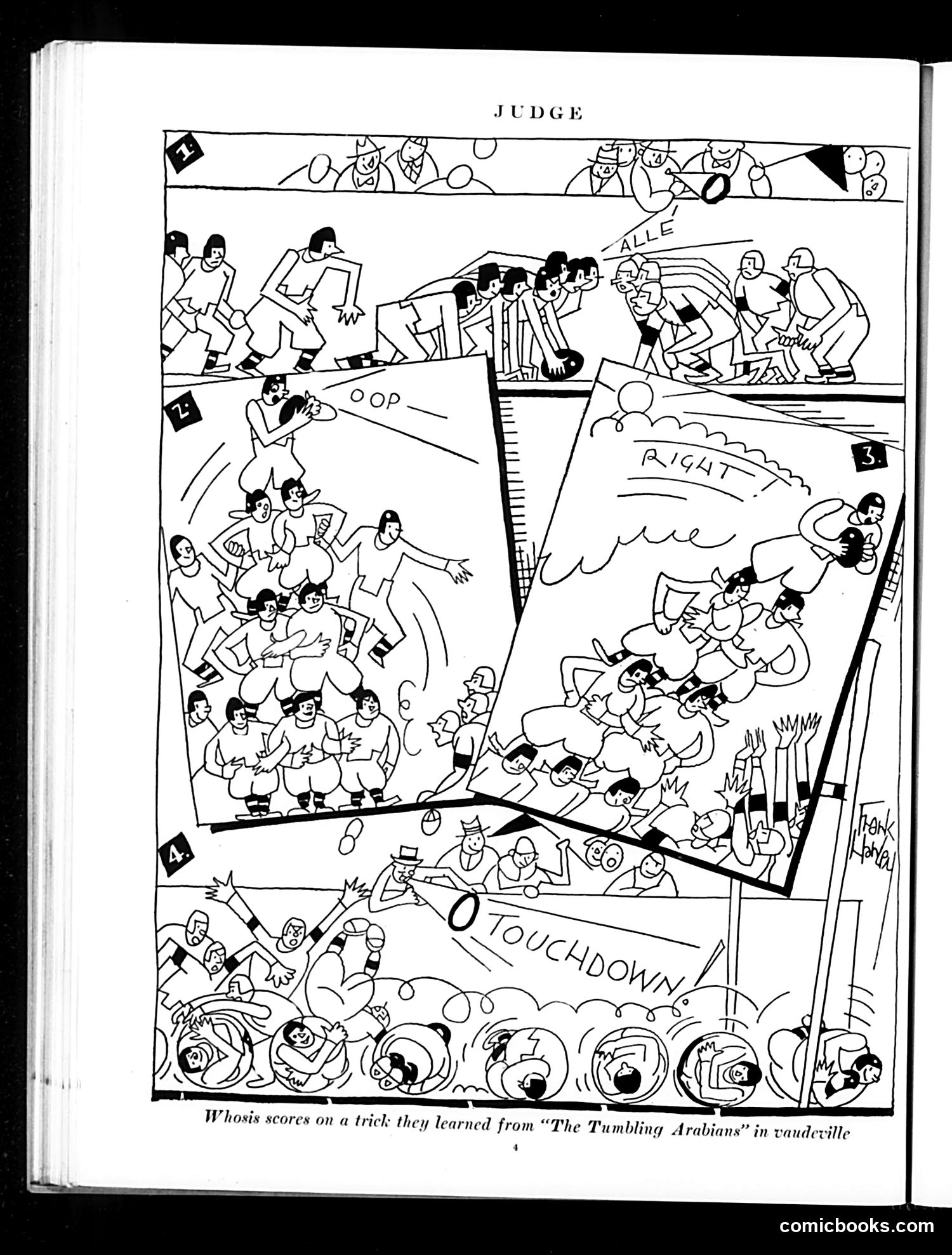
This page satirizes American football through a sequential comic strip format. The caption states: "Whosis scores on a trick they learned from 'The Tumbling Arabians' in vaudeville." The cartoon depicts a football team executing an elaborate trick play involving acrobatic maneuvers—tumbling, stacking, and coordinated physical stunts—to score a touchdown. The multiple panels show the progression from the initial play setup through increasingly complex physical formations, culminating in a score. The humor derives from comparing organized football strategy to vaudeville acrobatic acts, suggesting that modern football has become more about theatrical spectacle and elaborate tricks than straightforward athletic competition. This reflects early 20th-century concerns about football becoming overly complicated and entertainment-focused rather than a pure sport.
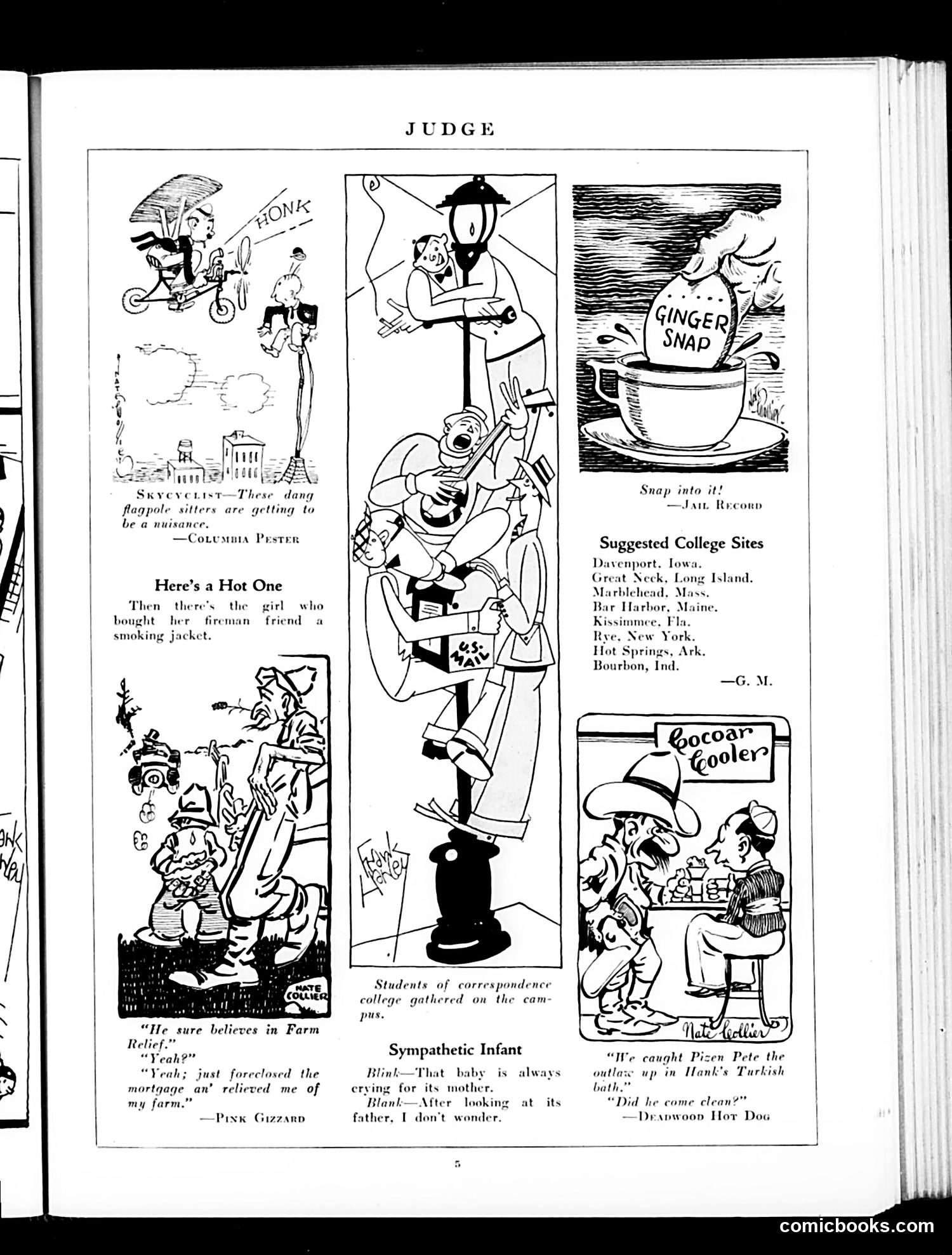
This page contains several unrelated humorous items typical of Judge magazine's format: 1. **"Here's a Hot One"**: A joke about a fireman who bought a smoking jacket—the humor relies on the double meaning of "smoking." 2. **"Skyscrapers"**: Satirizes New York's urban development, with a Columbia Poster attribution. 3. **Center panel**: Shows correspondence college students gathered around a campus, likely mocking the popularity of mail-order education courses. 4. **"Ginger Snap"**: A pun-based advertisement for a beverage. 5. **"Cocoa Cooler"**: An advertisement cartoon. 6. **"Sympathetic Infant"**: A joke about a baby crying after seeing its father. 7. **"Suggested College Sites"**: Lists humorous fake college locations. The page exemplifies Judge's mix of topical satire, wordplay, and advertising humor typical of early-to-mid 20th-century American magazines.
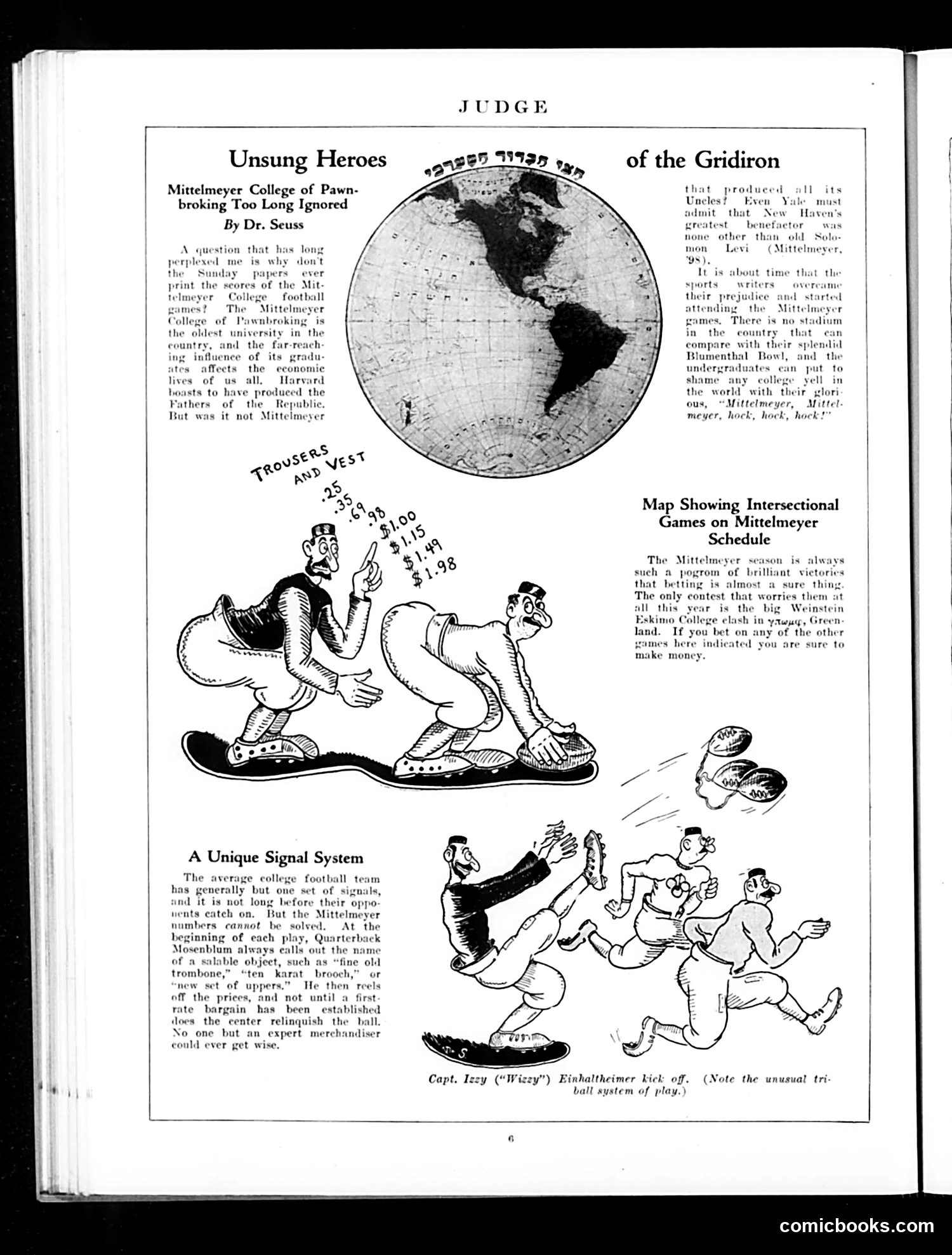
This is a satirical piece by Dr. Seuss mocking college football coverage and sports journalism prejudice. The central joke: **Mittelmeyer College of Pawnbroking** is a fictional, entirely made-up institution that Seuss presents as historically significant yet mysteriously ignored by sportswriters. The satire targets: 1. **Sports media bias**: Why don't newspapers cover Mittelmeyer's football scores despite the college's supposed importance to American history? 2. **Absurd credibility**: The article solemnly claims Mittelmeyer (a pawnbroking school) produced "Uncles" and benefactors rivaling Yale's donors—obviously ridiculous. 3. **College football excess**: References to lavish stadiums ("Blumenthal Bowl") and betting culture highlight how seriously colleges take football. 4. **Ethnic humor**: Names like "Einhaltheimer" and "Weinstein" suggest Jewish college football, playing on early 20th-century ethnic stereotypes common in Judge magazine. The "unique signal system" cartoon mocks complicated play-calling by depicting the quarterback announcing pawned items like "fine old trombone" instead of actual plays.
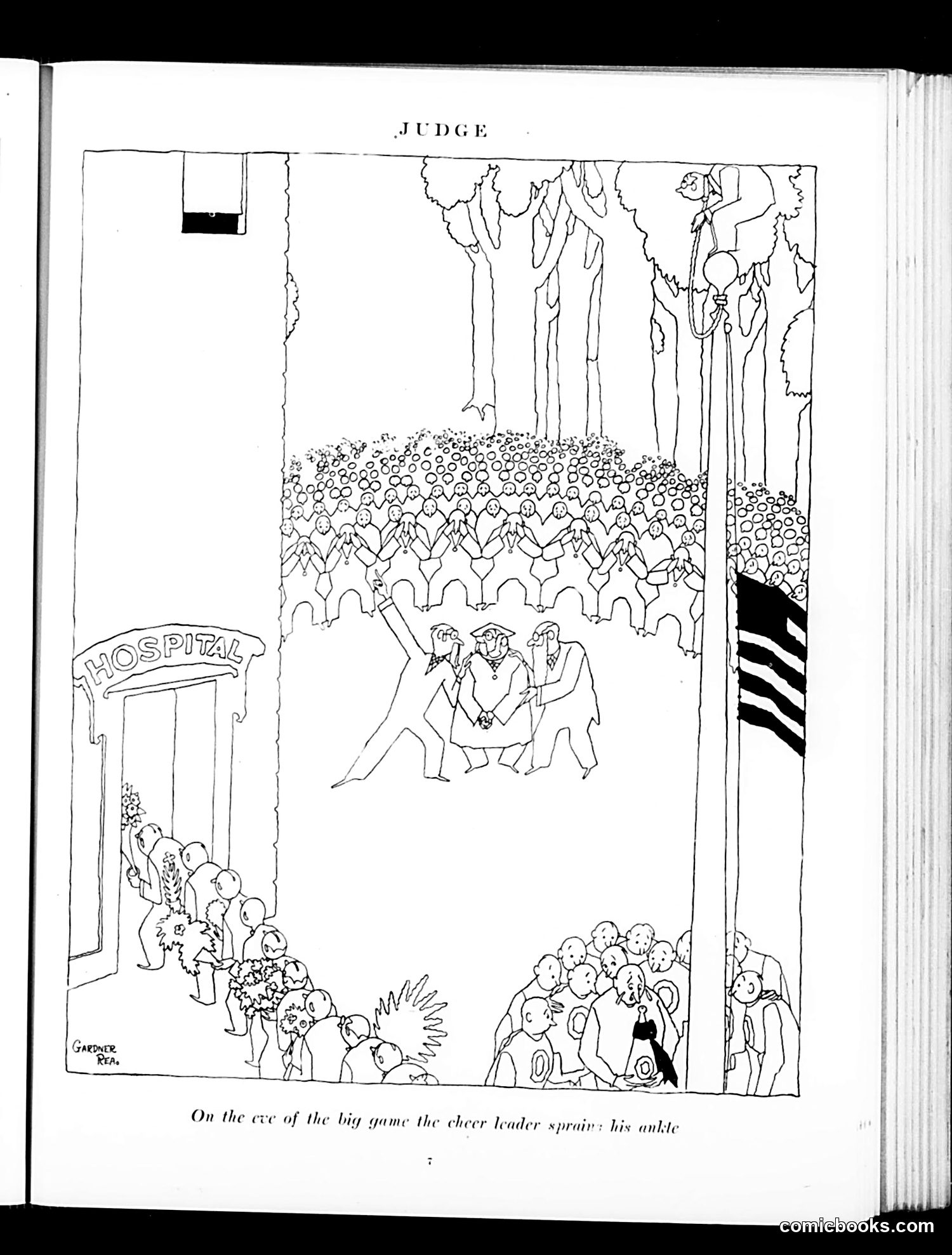
This cartoon depicts a large crowd gathered in a forest or wooded area, with a hospital entrance visible on the left. The caption reads: "On the eve of the big game the cheer leader sprains his ankle." The satire targets the importance placed on cheerleaders in American college sports culture. The massive crowd assembling—apparently in response to this minor injury—mocks how disproportionately significant cheerleaders were considered to the actual game. The forest setting and enormous gathering suggest the absurd level of public concern over what amounts to a small mishap. The cartoonist (signed "Gardner Rea") satirizes both the inflated role of cheerleaders in collegiate athletics and the crowd's overreaction, likely commenting on early 20th-century college sports culture's priorities.
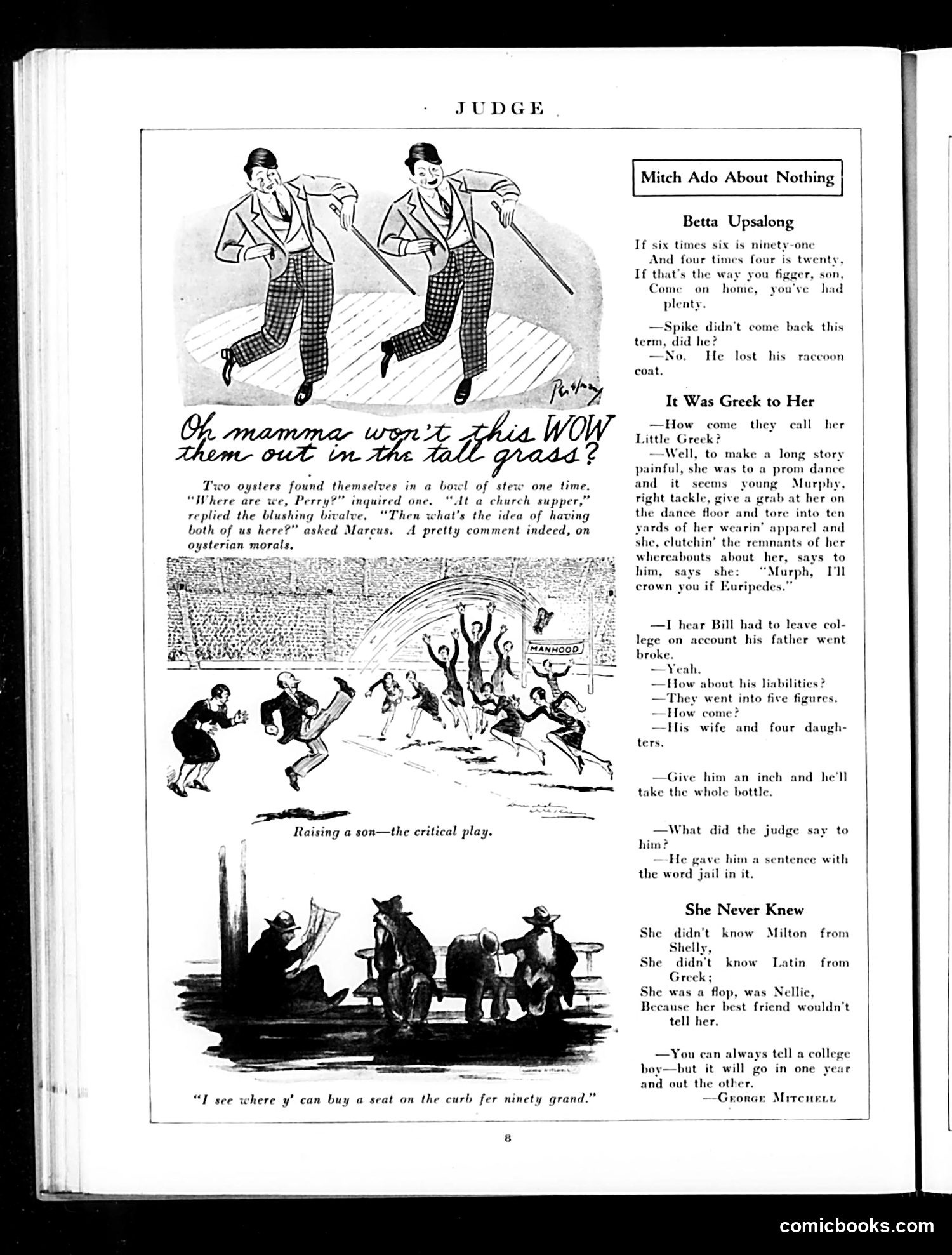
This page from *Judge* magazine presents several short humorous anecdotes typical of early 20th-century American comic magazines. The main cartoon depicts two men in matching outfits playing golf, captioned with a domestic complaint about yard maintenance. Below are illustrated jokes about social situations: one involves oysters in stew making a moral commentary; another jokes about a college student ("Spike") who lost his raccoon coat—a status symbol of 1920s collegiate fashion. The remaining text pieces satirize dating, education, and gender dynamics. "It Was Greek to Her" plays on a woman's lack of classical education and references a prom incident. Other jokes mock paternity liabilities, judicial sentencing, and female ignorance. A quote attributed to George Mitchell closes the page. The humor relies on period-specific references (raccoon coats, college culture, classical education gaps) and assumes reader familiarity with 1920s-era social conventions around class, education, and courtship.
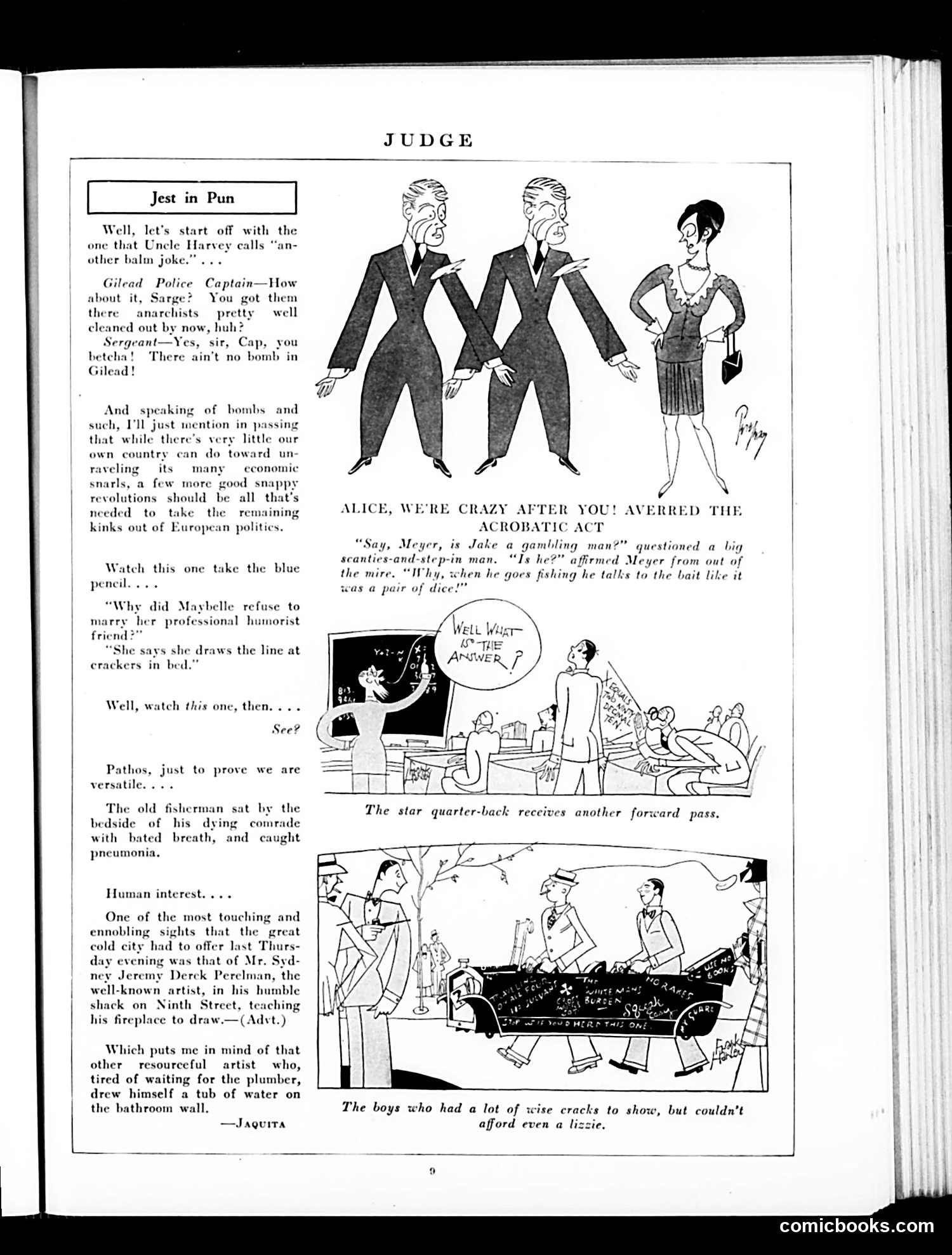
This page from Judge magazine contains several brief satirical pieces typical of early 20th-century American humor: **"Jest in Pun" section:** Opens with a joke about anarchists and bombs, referencing contemporary anxieties about anarchist violence—a real concern in America during this period. The Gilead police captain's boast about eliminating anarchists plays on public fears while mocking small-town police competence. **Top cartoon:** Shows two identical men being confronted by a woman titled "Alice, We're Crazy After You!" The caption involves Meyer and Jake discussing gambling and fishing, with a pun equating dice to fishing bait. **Lower cartoons:** Include brief humorous observations: one about a fisherman's dying son (attempting pathos), another mocking an artist teaching his fireplace to draw (absurdist humor), and a final joke about poor boys with "wise cracks" but no money for a "lizzie" (slang for an inexpensive car, likely a Model T Ford). The humor relies on puns, observational comedy, and topical references rather than visual wit.
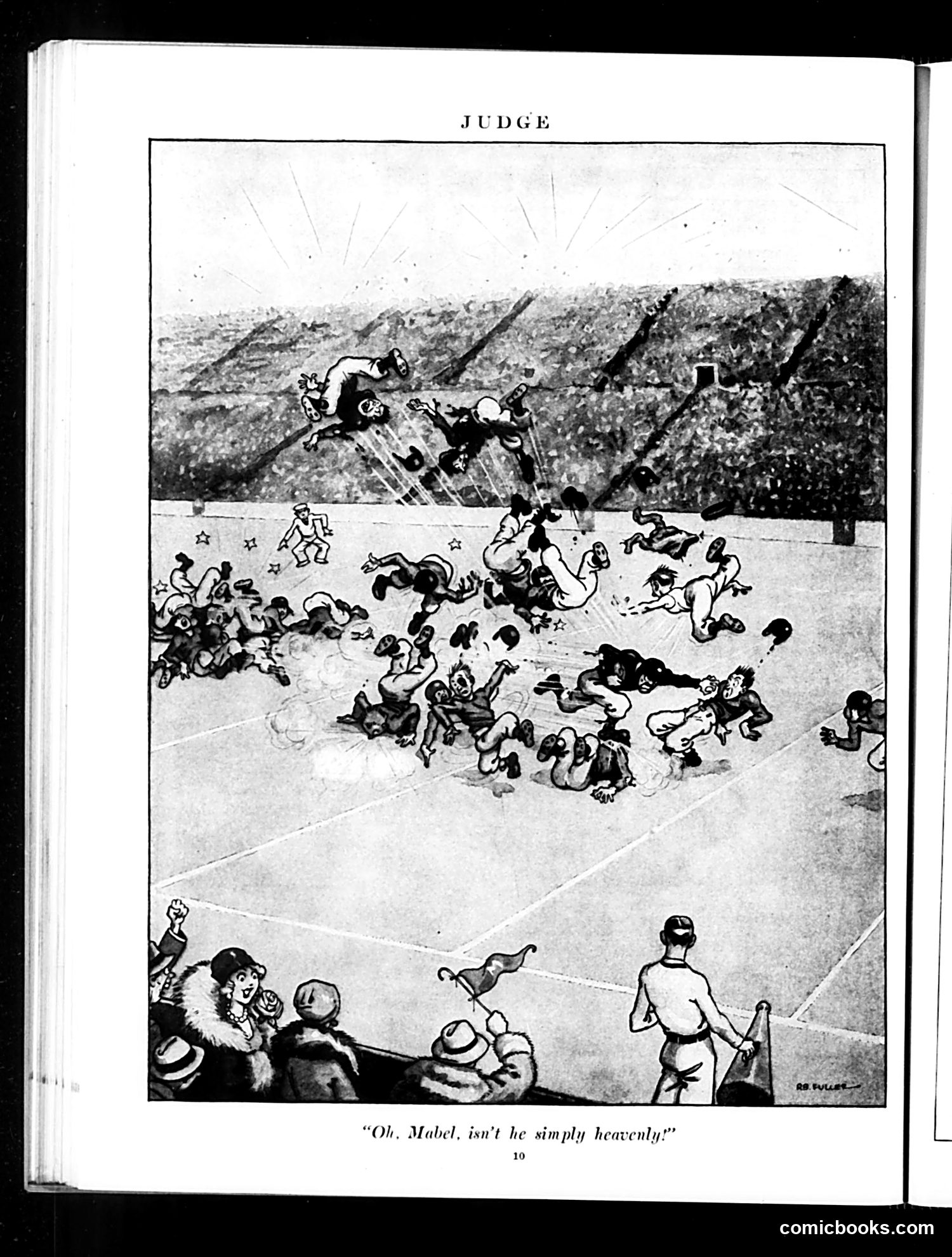
This is a satirical illustration depicting a baseball game where players and spectators are rendered as cherubs or cupids—heavenly, childlike figures with wings. The caption, "Oh, Mabel, isn't he simply heavenly?" appears to be spoken by a female spectator admiring one of the players. The satire likely mocks the romantic or idealizing language fans (particularly women) use when discussing baseball players and athletes. By literally depicting the players as "heavenly" cherubs, the cartoon humorously exaggerates the almost religious reverence some fans bestow upon sports figures. The illustration contrasts the ethereal, angelic imagery with the competitive, physical nature of the sport—creating comedic tension between the sacred and the secular.
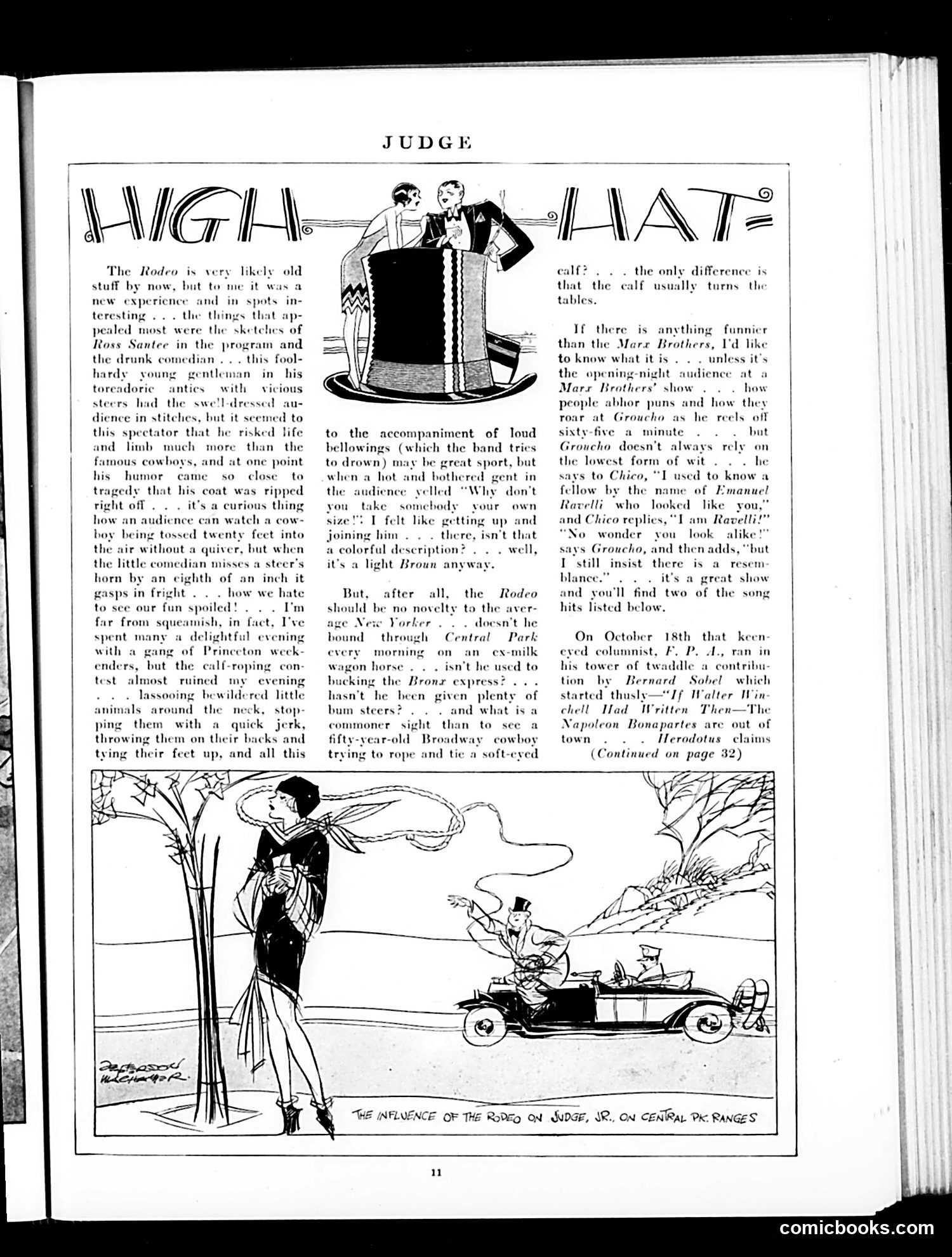
This page contains a theater/entertainment critique disguised as casual commentary. The author discusses attending a rodeo and critiques its entertainment value, particularly a drunk comedian performing in toreadoric (bullfighting) style who risks injury for laughs. The satire targets New York audiences' desensitization to danger and their entertainment preferences. It draws parallels between rodeo spectators watching steers being roped and tied versus New Yorkers' daily commutes on dangerous subways (the "Bronz express") and Central Park horse rides—suggesting New Yorkers live their own unintentional "rodeo" daily. The piece also mocks popular entertainment trends, referencing the Marx Brothers' vaudeville success and columnist F.P.A.'s tower gossip column, poking fun at what constitutes "funny" for contemporary audiences. The bottom cartoon illustrates the rodeo's impact on Central Park—showing how the event influenced New York culture and society.
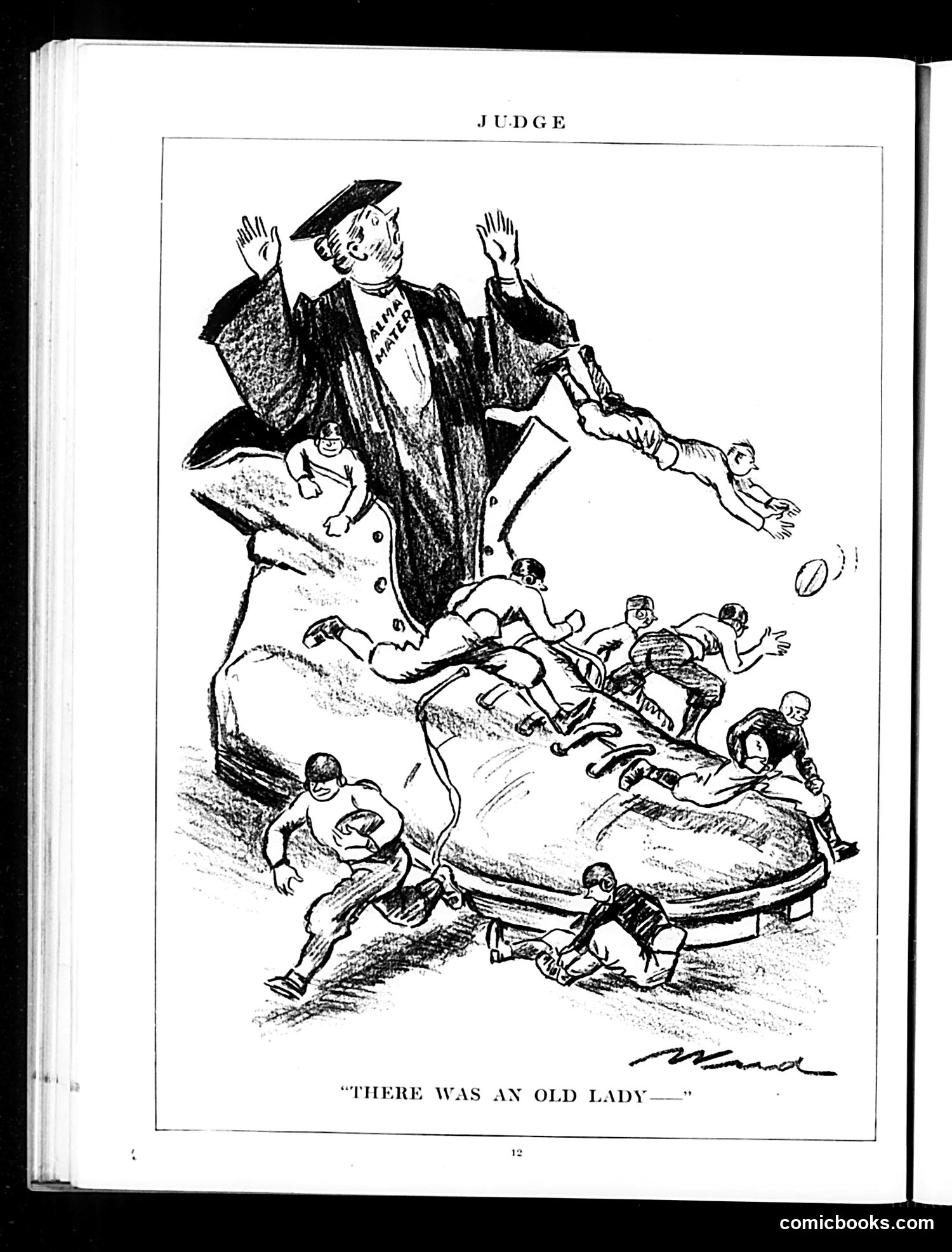
This political cartoon depicts a large judge figure towering over multiple small children who appear to be climbing on or clinging to an enormous shoe. The title references the nursery rhyme "There Was an Old Lady Who Lived in a Shoe," which ends with the line about giving them all some broth and sending them to bed. The satire appears to comment on judicial authority and children—likely critiquing either the judge's role in child welfare cases, orphan management, or institutional care. The cramped shoe housing numerous children suggests overcrowding or inadequate conditions. The judge's gesturing hands and elevated position emphasize his power over these vulnerable dependents, suggesting commentary on judicial oversight (or lack thereof) of child welfare systems during the period when *Judge* magazine was published.
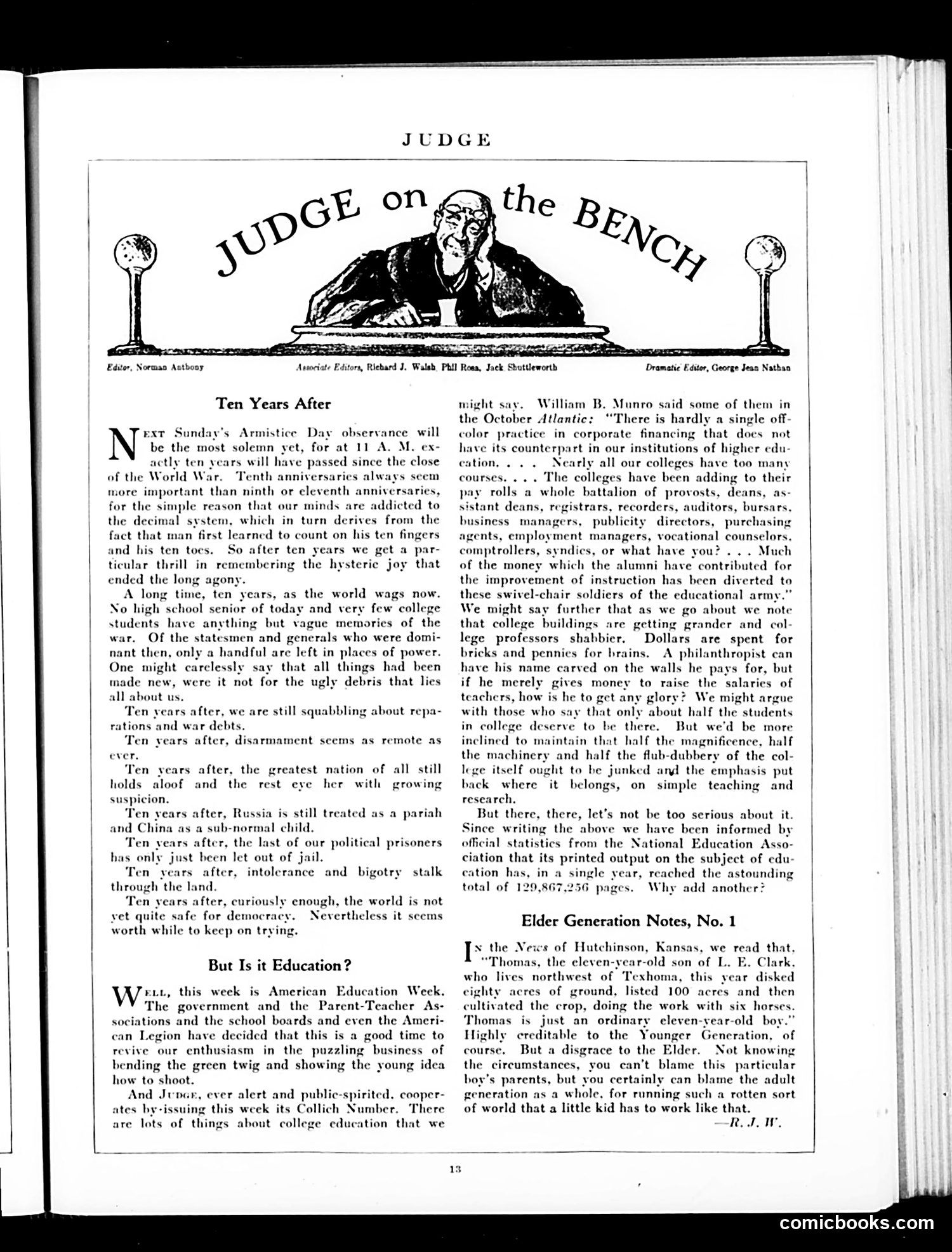
This editorial page reflects on the tenth anniversary of Armistice Day (November 11, 1928), examining what has—and hasn't—changed since World War I ended. The "Ten Years After" section catalogs persistent post-war problems: unresolved war debts and reparations, failed disarmament efforts, American isolationism, Russia treated as a pariah state, and lingering intolerance. The tone is sardonic—the world isn't yet "safe for democracy," yet efforts continue anyway. The "But Is it Education?" section critiques American colleges during Education Week. Drawing on William B. Munro's *Atlantic* article, it attacks administrative bloat: colleges have added "swivel-chair soldiers" (unnecessary bureaucrats)—deans, registrars, comptrollers—while professor salaries stagnate. Grand buildings receive donations while teaching suffers. The satire targets donors seeking ego gratification through named buildings rather than supporting actual education, and criticizes colleges prioritizing prestige infrastructure over fundamental instruction.
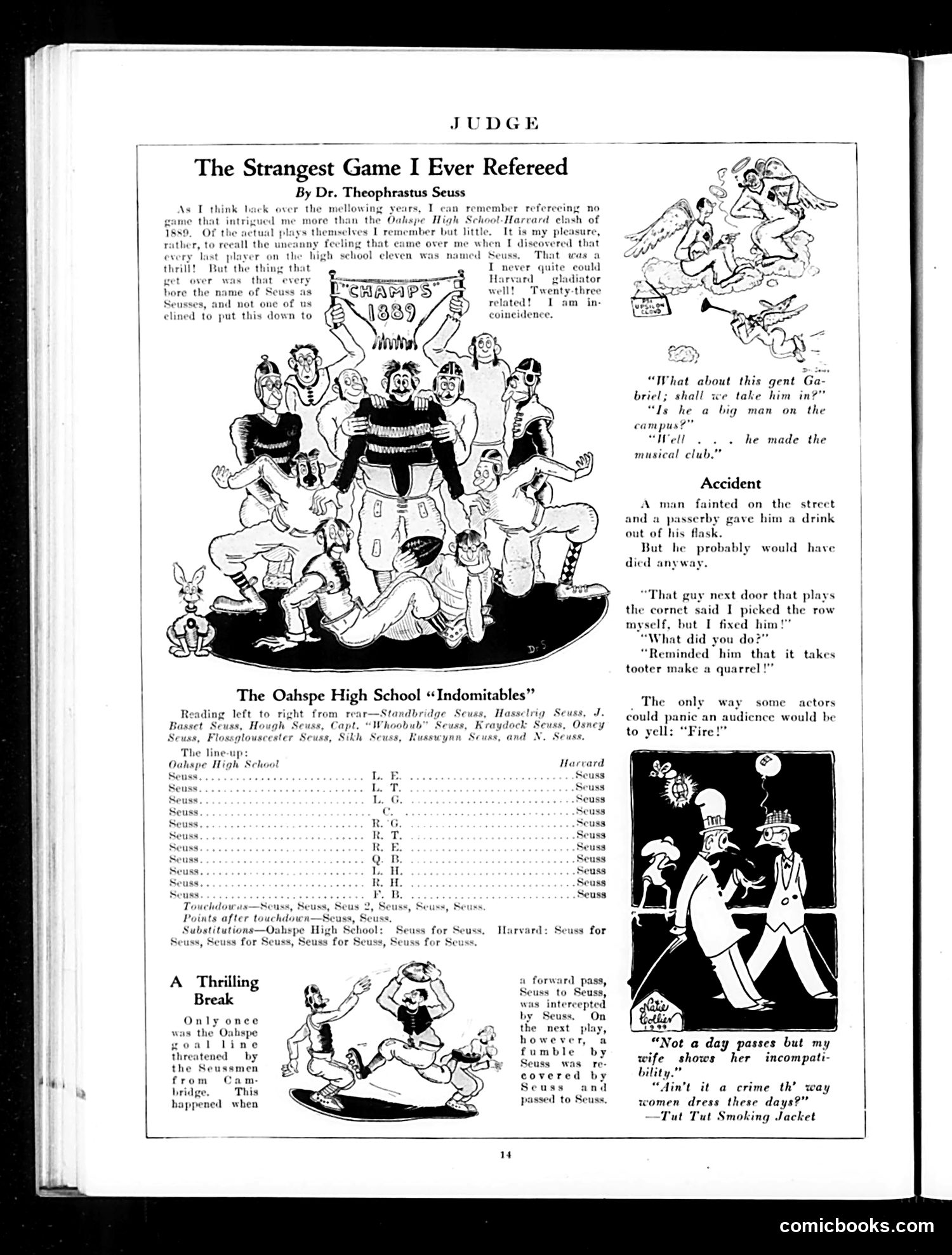
This is a humorous piece by Dr. Seuss (Theodor Geisel), presenting a fictional 1889 football game between Oahspe High School and Harvard where every single player on both teams is named Seuss—a running gag about unlikely coincidence. The satire targets: 1. **Absurd naming conventions** in early American sports reporting, where elaborate player rosters were published with minimal variation 2. **Small anecdotes about college life**—the sidebar jokes about admitting Gabriel to campus (who "made the musical club"), the cornet player quarrel, and street accidents reflect period college humor 3. **Women's fashion criticism** (the "Tut Tut Smoking Jacket" caption), common fodder for Judge magazine's social commentary The cartoon's central joke relies on the improbability of forty-six unrelated people sharing one surname, amplified by formal sports documentation. This would have amused early-1900s readers familiar with both sporting hyperbole and Seuss's emerging comedic sensibility.
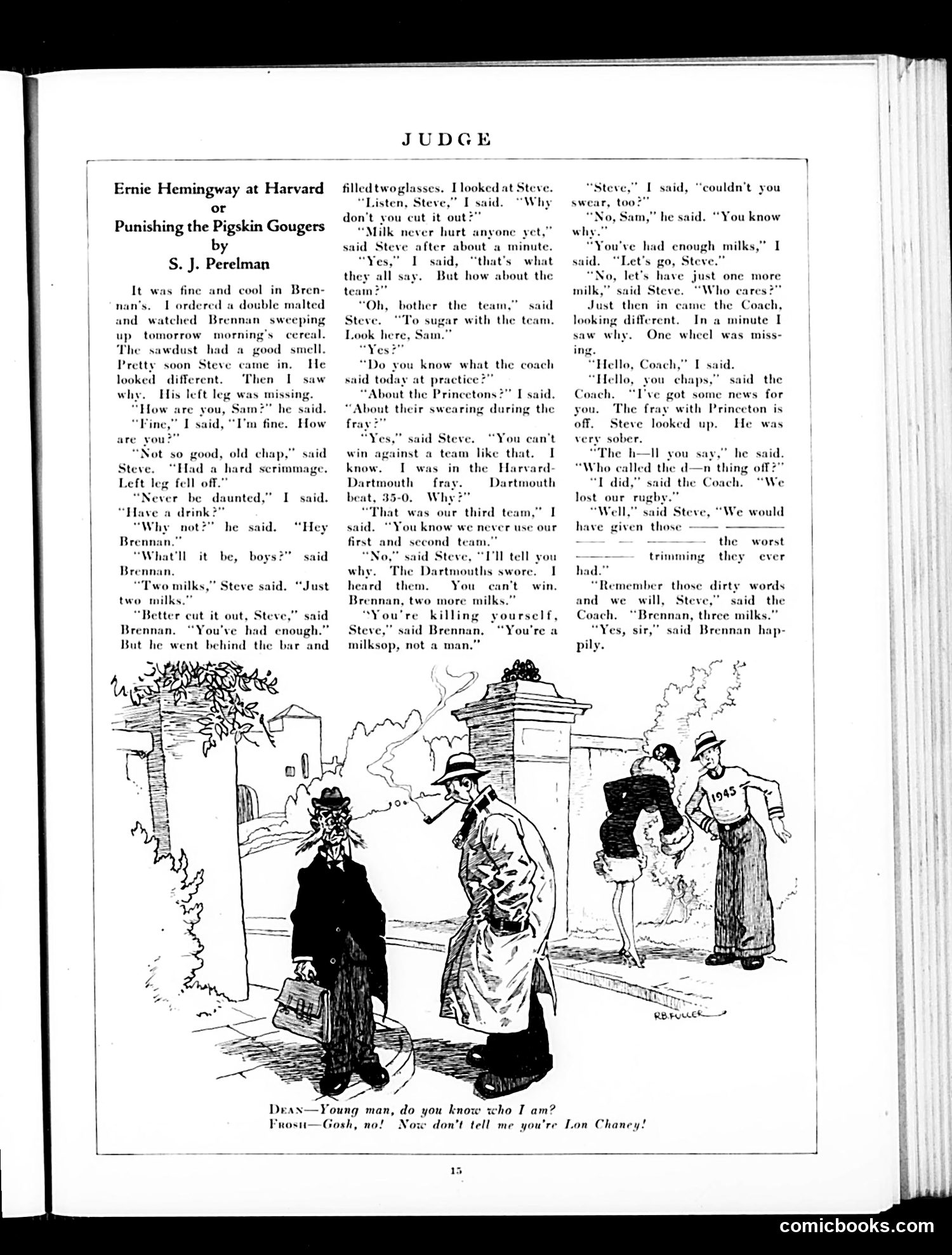
This is a satirical short story by S.J. Perelman (a famous humorist) mocking Ernest Hemingway's distinctive literary style. The parody exaggerates Hemingway's signature traits: sparse dialogue, repetitive simple sentences, drinking scenes, masculine posturing, and emotional detachment. The narrative follows a character named Steve who visits a bar and gradually loses body parts (his left leg, then wheels) while discussing Harvard football and drinking excessive milk instead of alcohol—inverting Hemingway's typical drinking stories. The humor lies in the absurdist escalation and Perelman's deadpan mimicry of Hemingway's famous minimalist prose style. The accompanying cartoon shows a dean confronting a young man at Harvard, with the joke playing on mistaken identity and social pretension—characteristic Judge magazine humor about ivy-league life. The satire targets both Hemingway's literary mannerisms and 1920s-30s college culture.
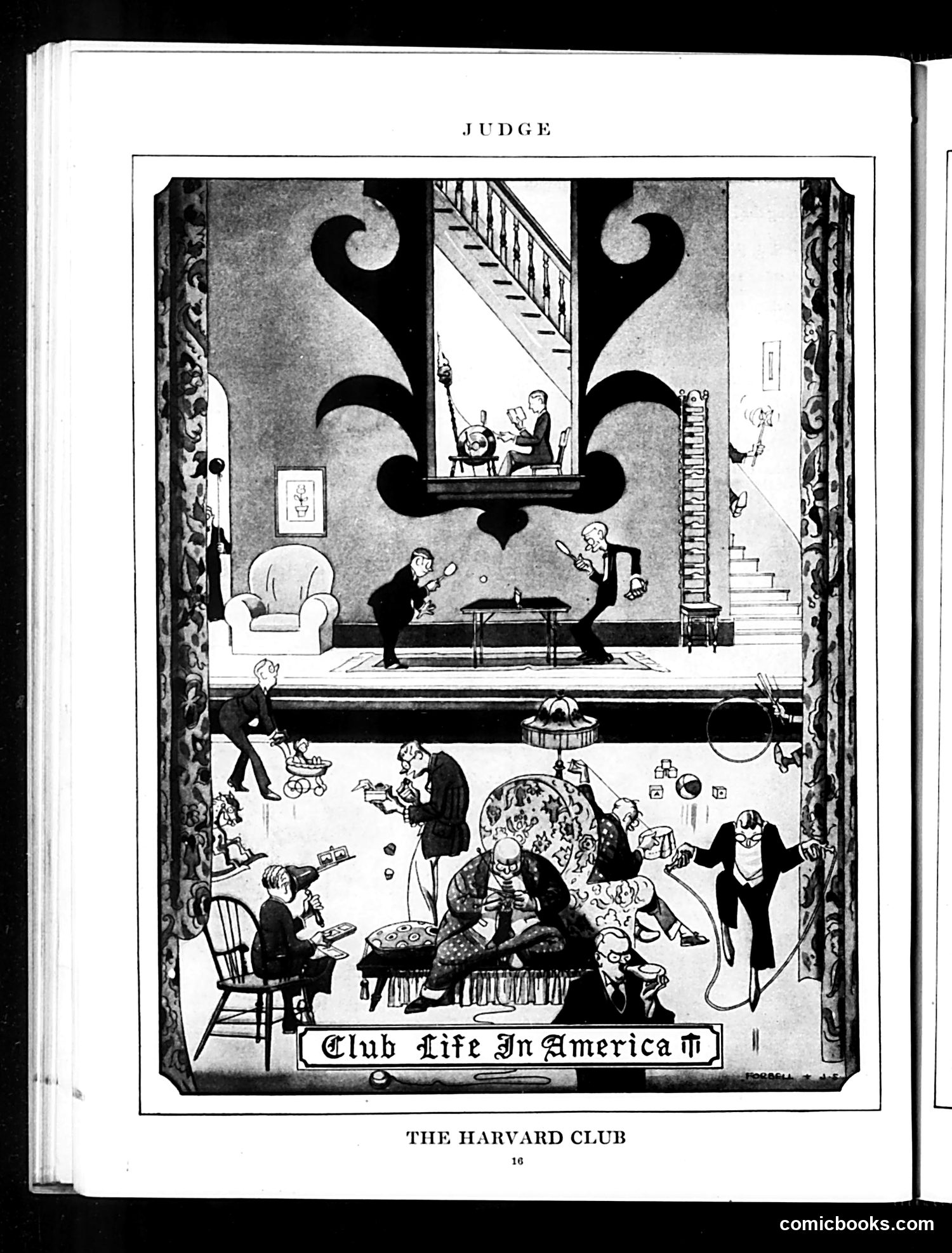
This satirical illustration from Judge magazine contrasts two scenes of "Club Life in America" at the Harvard Club. The upper panel shows an orderly, refined interior with well-dressed gentlemen engaged in genteel activities—conversation, ping-pong, reading. The lower panel depicts the same space transformed into chaotic revelry: people eating, drinking, socializing boisterously, and generally behaving without restraint. The large fleur-de-lis symbol dominating the composition likely references French luxury or aristocratic pretension. The satire mocks the gap between Harvard Club members' pretensions to sophistication and their actual behavior—suggesting that beneath the veneer of upper-class refinement lies indulgence and disorder. The cartoon critiques American elite institutions' false gentility.
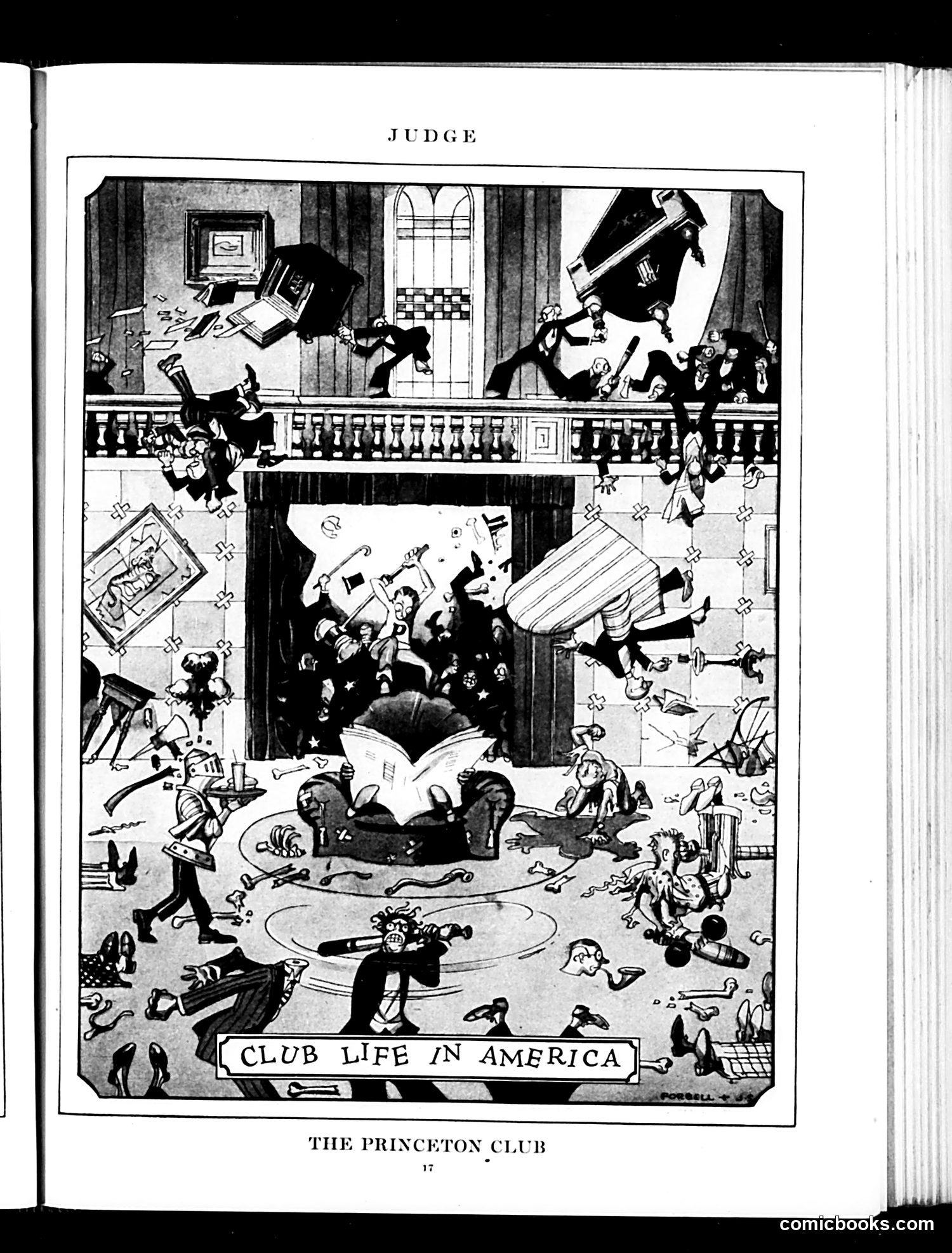
This satirical illustration depicts chaos at an exclusive men's club, likely the Princeton Club in New York. The cartoon shows the dignified institution in complete disorder—figures tumble from upper floors, furniture crashes through windows, and mayhem erupts throughout multiple levels. The satire appears to mock the pretensions of elite social clubs, contrasting their veneer of sophistication and respectability with underlying chaos and absurdity. The "Club Life in America" subtitle suggests broader commentary on American upper-class institutions and their members' actual behavior versus their public image. The exaggerated destruction and comedic violence represent Judge magazine's typical irreverent critique of American institutions, particularly those catering to the wealthy and privileged classes during the early-to-mid twentieth century.
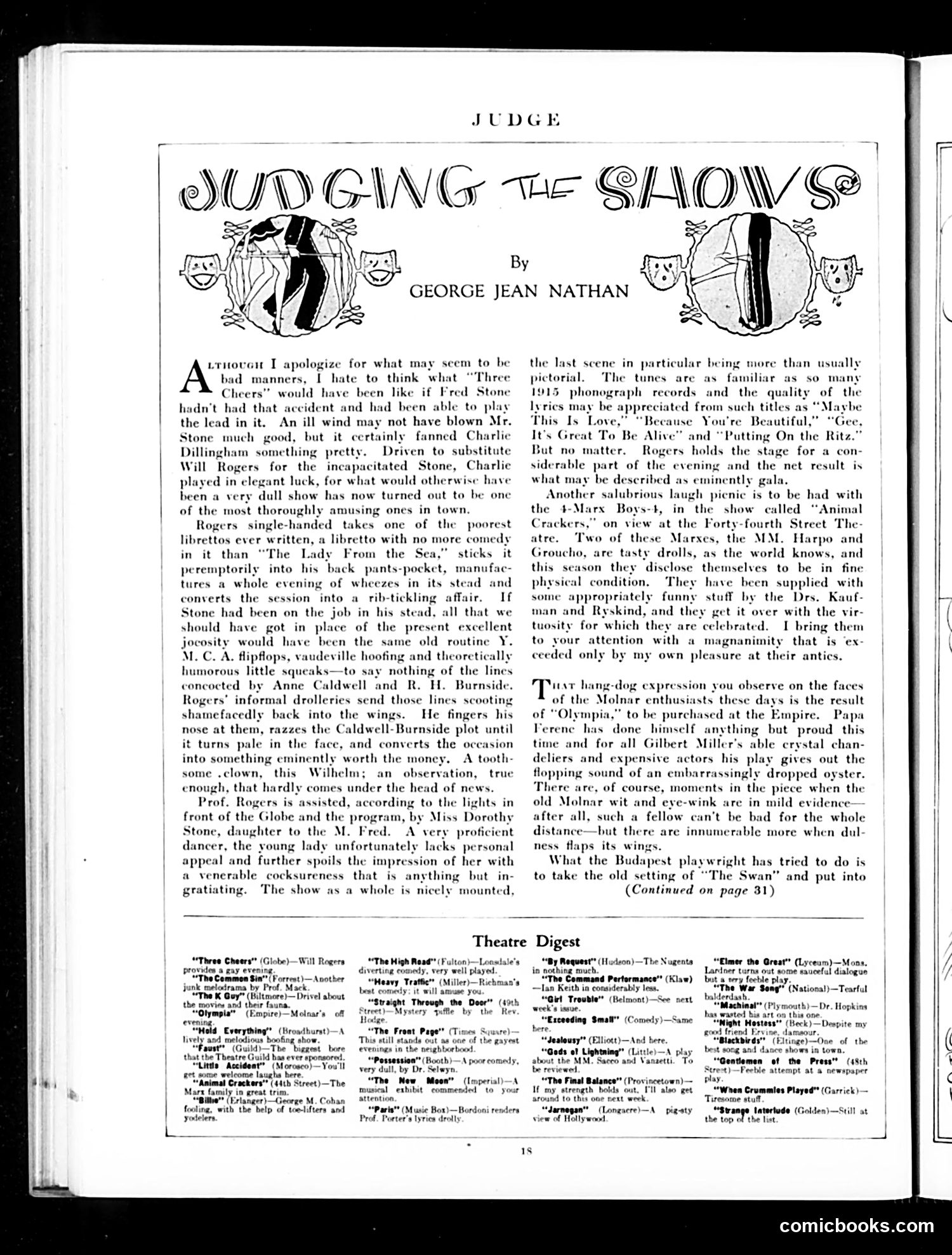
This page contains theater criticism by George Jean Nathan reviewing Broadway productions. The main subject is **Will Rogers** in "Three Cheers," where Nathan praises Rogers' comedic talent for salvaging what he calls a poorly written libretto (script). He notes that Fred Stone, the originally intended lead, suffered an accident, allowing Rogers to substitute and transform an otherwise dull show into an entertaining one through his improvisational humor and charm. Nathan also briefly mentions **the Marx Brothers** ("4-Marx Boys") in "Animal Crackers," celebrating their physical comedy and the writing by Kaufman and Ryskind. A third review discusses a play by Hungarian dramatist Molnár (likely Ferenc Molnár), criticizing its execution despite the playwright's reputation. The text demonstrates Nathan's influential role as a sophisticated theater critic evaluating performances for Judge's educated readership.
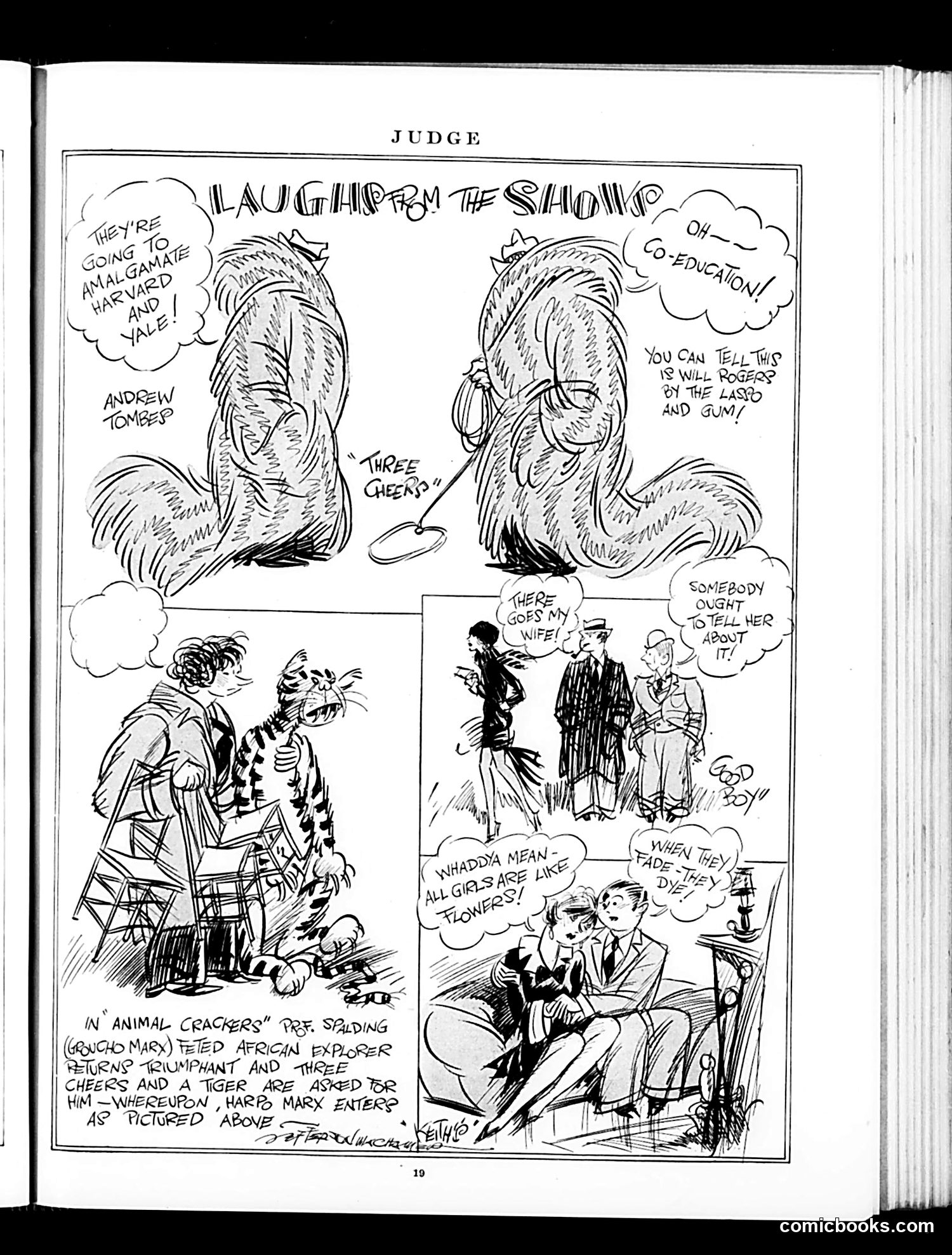
This page satirizes a scene from the Marx Brothers' film "Animal Crackers." The top panel shows two large chickens discussing Harpo, Chico, and Groucho Marx's antics—specifically mocking their acclaim ("co-education," "Harvard and Yale"). The lower panels depict a scene where Groucho Marx (as an African explorer) is celebrated upon his return, with people offering "three cheers and a tiger." Harpo Marx then appears, causing confusion about what's being celebrated. The satire targets the Marx Brothers' irreverent comedy style and their satirizing of high society. The reference to "Animal Crackers" suggests Judge magazine was commenting on contemporary popular entertainment, using the brothers' trademark absurdist humor—where dignified situations devolve into nonsense—as its subject. The cartoon mocks both the characters' pretensions and the audience's fascination with their comedic antics.
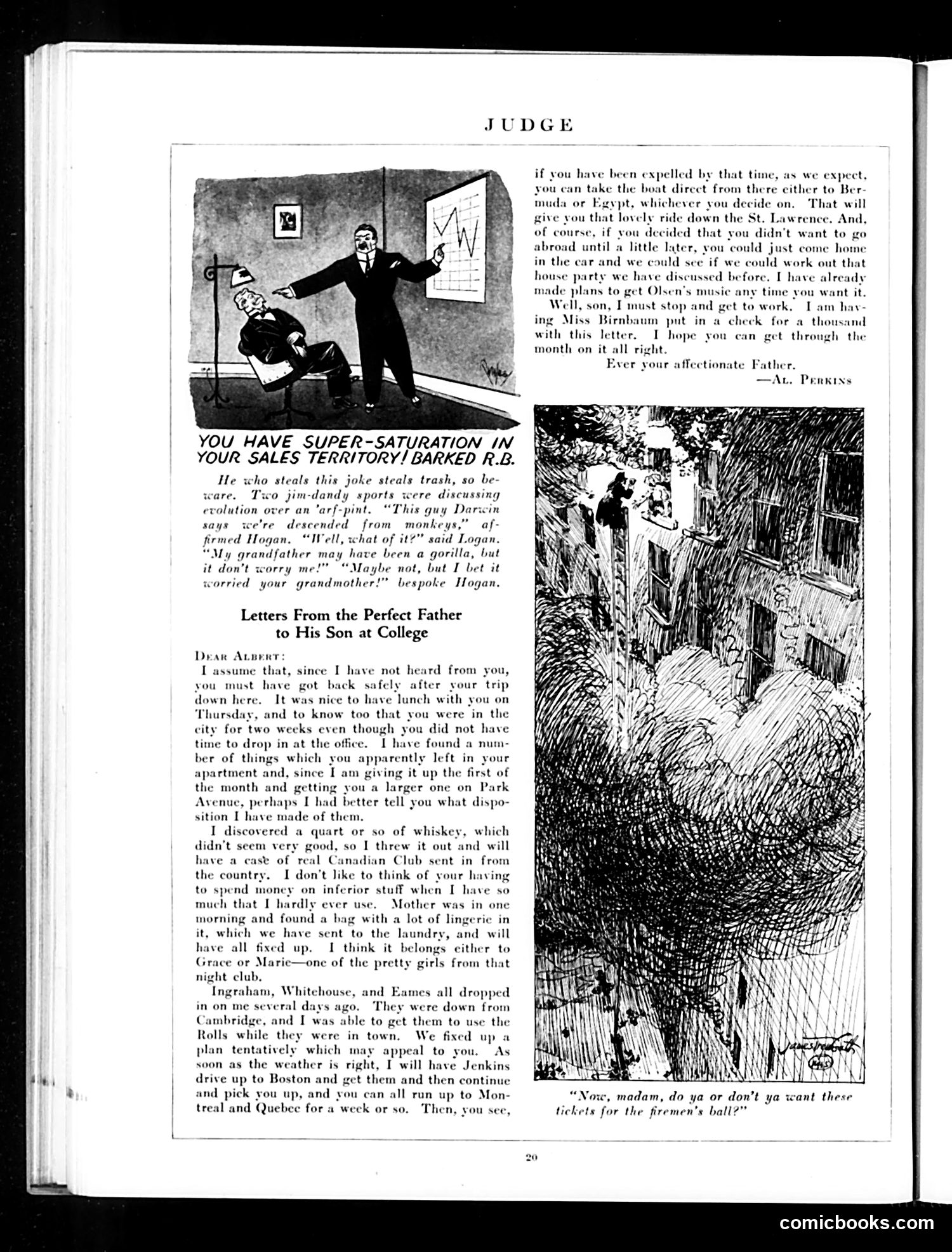
This page contains two distinct pieces of satirical content: **Top cartoon:** A boss berates a salesman ("Barked R.B.") about "super-saturation" in his sales territory. The joke below mocks evolutionary theory: two working-class men discuss Darwin's claim that humans descended from monkeys, with one cavalierly dismissing concern about having a gorilla ancestor—until his friend quips that *his grandmother* would have worried about it. This reflects early 20th-century class-based mockery of evolution theory. **Main feature:** "Letters From the Perfect Father to His Son at College" satirizes wealthy, indulgent parenting. The father casually describes replacing his son's apartment, upgrading his whiskey, laundering what appear to be a girlfriend's undergarments, and offering unlimited use of the family Rolls-Royce for trips to Montreal. The satire targets how the ultra-rich enable their sons' irresponsibility through unlimited money and privilege—a critique of generational wealth enabling moral laxity. The bottom illustration appears unrelated: a woman at a ticket booth, likely advertising or a separate joke.
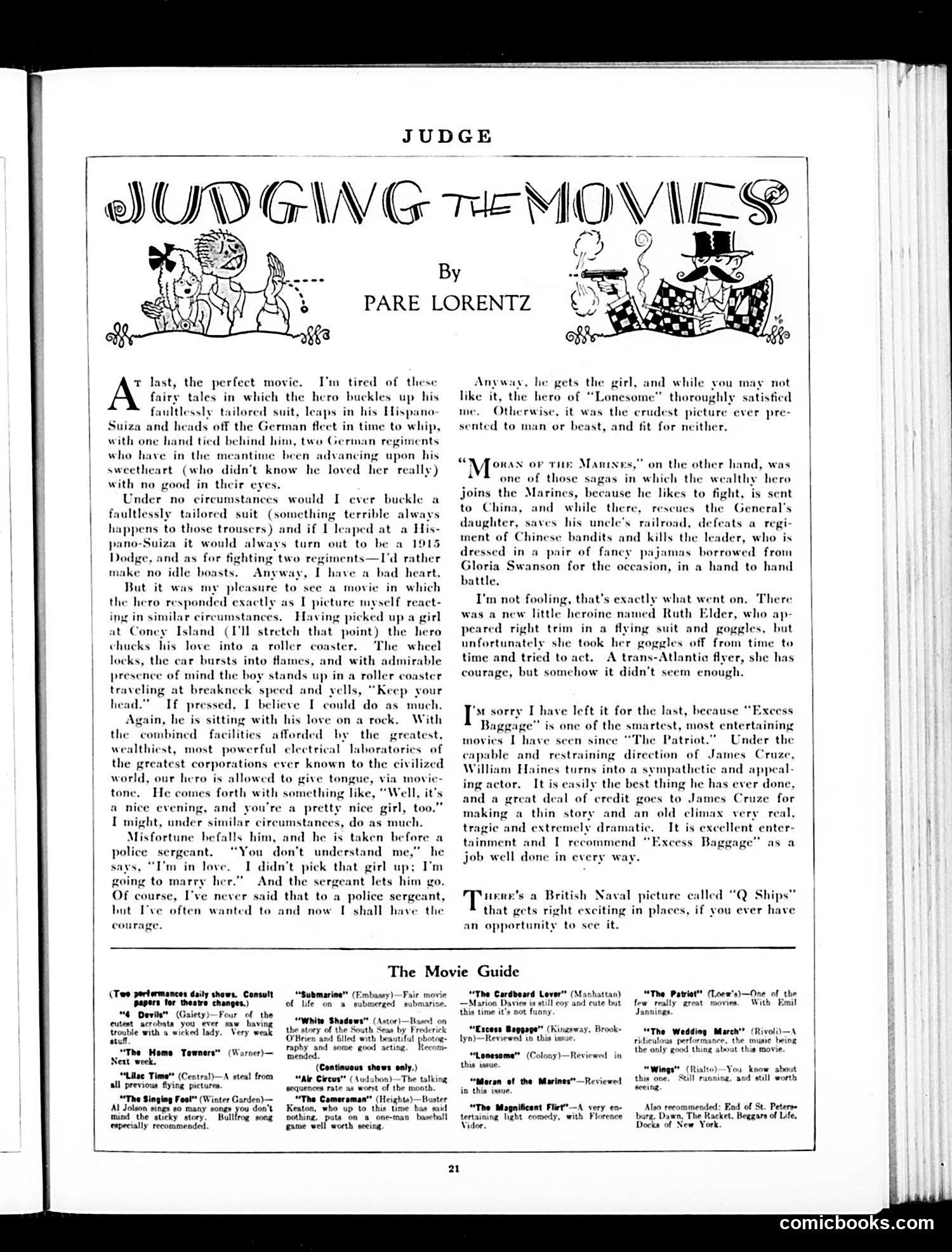
This is a film review column, not a political cartoon. Lorentz critiques 1920s movies, contrasting unrealistic "fairy tale" plots with more authentic storytelling. He ridicules conventional romance films where heroes in expensive cars defeat German regiments while impressing women—scenarios he finds absurd and would never attempt himself. He praises "Lonesome" for its realistic portrayal of how actual people behave in romantic situations, and appreciates "Excess Baggage" for its intelligent direction by James Cruze, calling it tragic and genuinely dramatic rather than melodramatic. The "Movie Guide" section below lists current releases with brief critical assessments. The satire targets Hollywood's formulaic, implausible adventure plots and their disconnect from how real people actually speak and act—a common modernist critique of 1920s commercial cinema's artificiality.
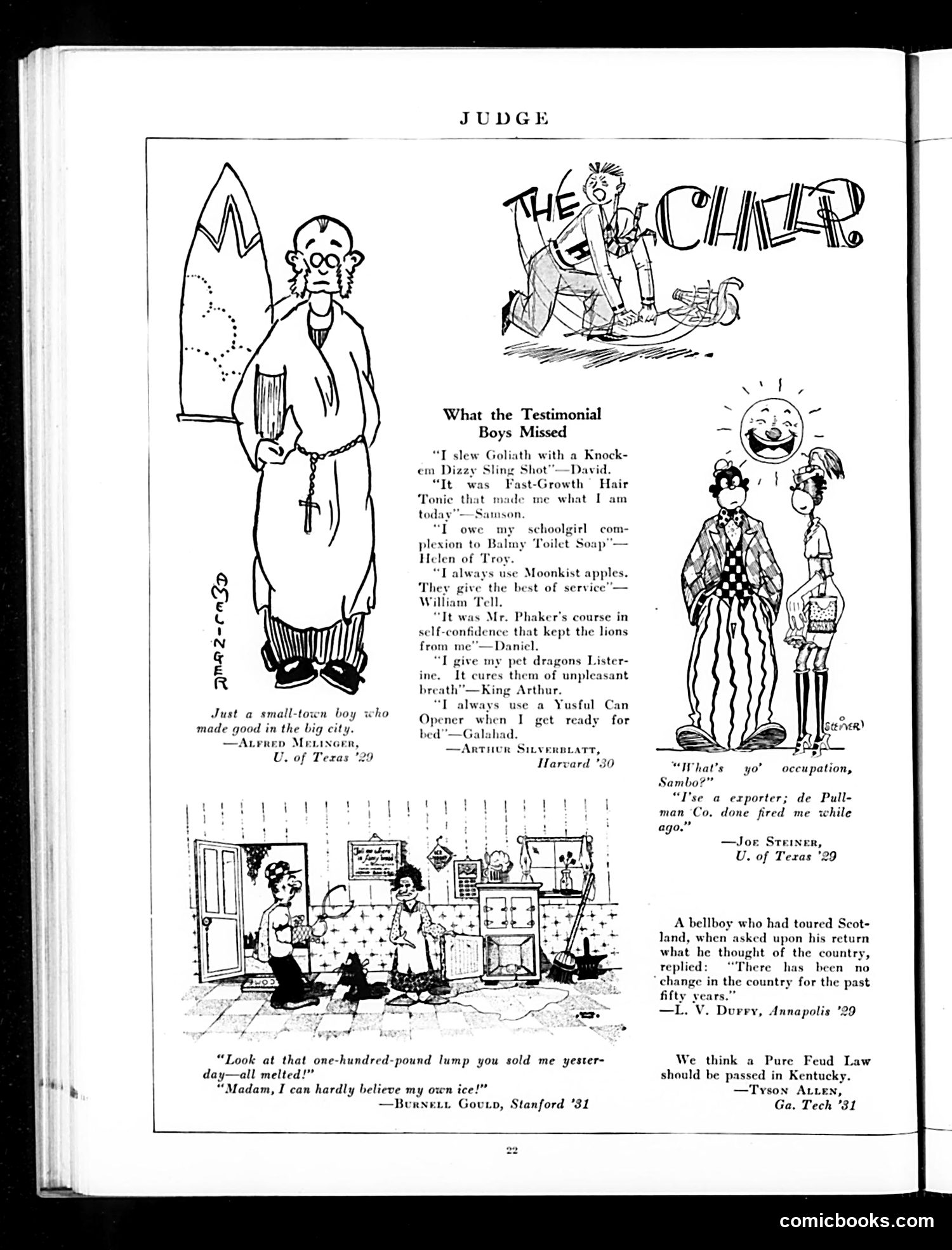
This Judge magazine page satirizes **fake testimonials and advertising claims** by imagining what famous historical and biblical figures would endorse if they existed today. The main feature, "What the Testimonial Boys Missed," uses humor by attributing modern products to legendary figures: Samson crediting "Fast-Growth Hair Tonic," King Arthur endorsing Listerine for his dragons, Goliath defeated by a "Knock-em Dizzy Sling Shot," etc. The satire mocks how advertisers cynically use invented endorsements and exaggerate product claims. The page header cartoon shows a rural judge figure, likely commenting on authority or justice in small-town America. The bottom panels include various humorous anecdotes from college students—jokes about ice melting, Scottish tourism decline, and racial humor typical of 1920s-30s publications (the "Sambo" dialogue reflects the era's offensive conventions). The overall message: **advertising testimonials are ridiculous fabrications**, and consumers should recognize obvious fakery when they see it.
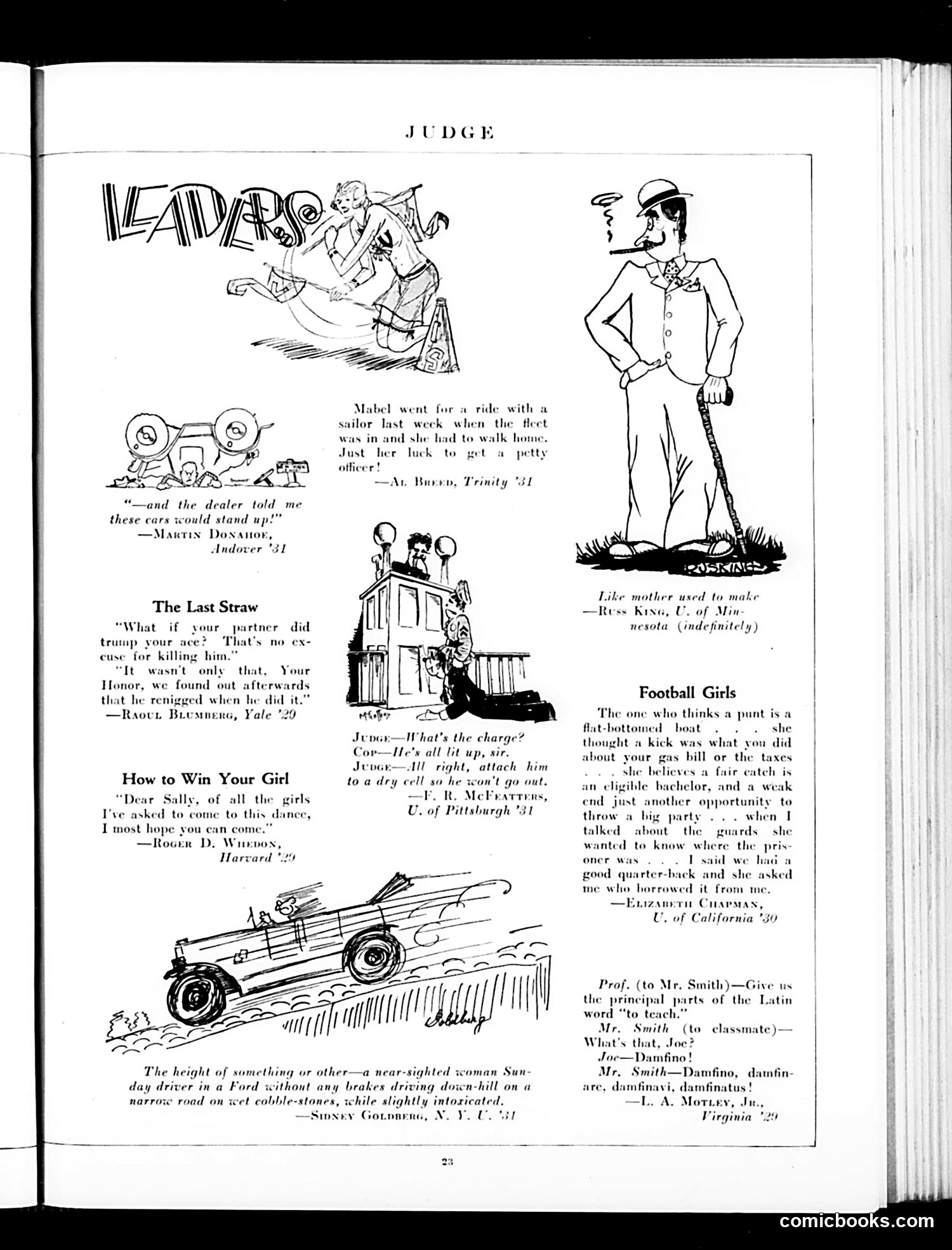
This page presents college humor from circa 1929-1931, featuring jokes submitted by university students. The cartoons satirize dating, automobiles, and student life rather than politics. **"The Last Straw"** jokes about a murder trial where the defendant killed his card-playing partner—ostensibly over a trumped ace, but really because the partner "renigged" (cheated). The humor lies in the trivial excuse. **"How to Win Your Girl"** shows a man driving recklessly in a convertible, illustrating courting behavior. **"Football Girls"** mocks women's ignorance of sports terminology, confusing "punt" with boats, "kick" with bills, and "fair catch" with eligible bachelors—contemporary sexist humor treating women as intellectually inferior to male students. The other brief jokes mock automobiles, petty officers, and Latin instruction. The page reflects 1920s-30s college culture and gender attitudes now considered offensive, where women were stereotyped as shallow and unknowledgeable about "serious" male interests.
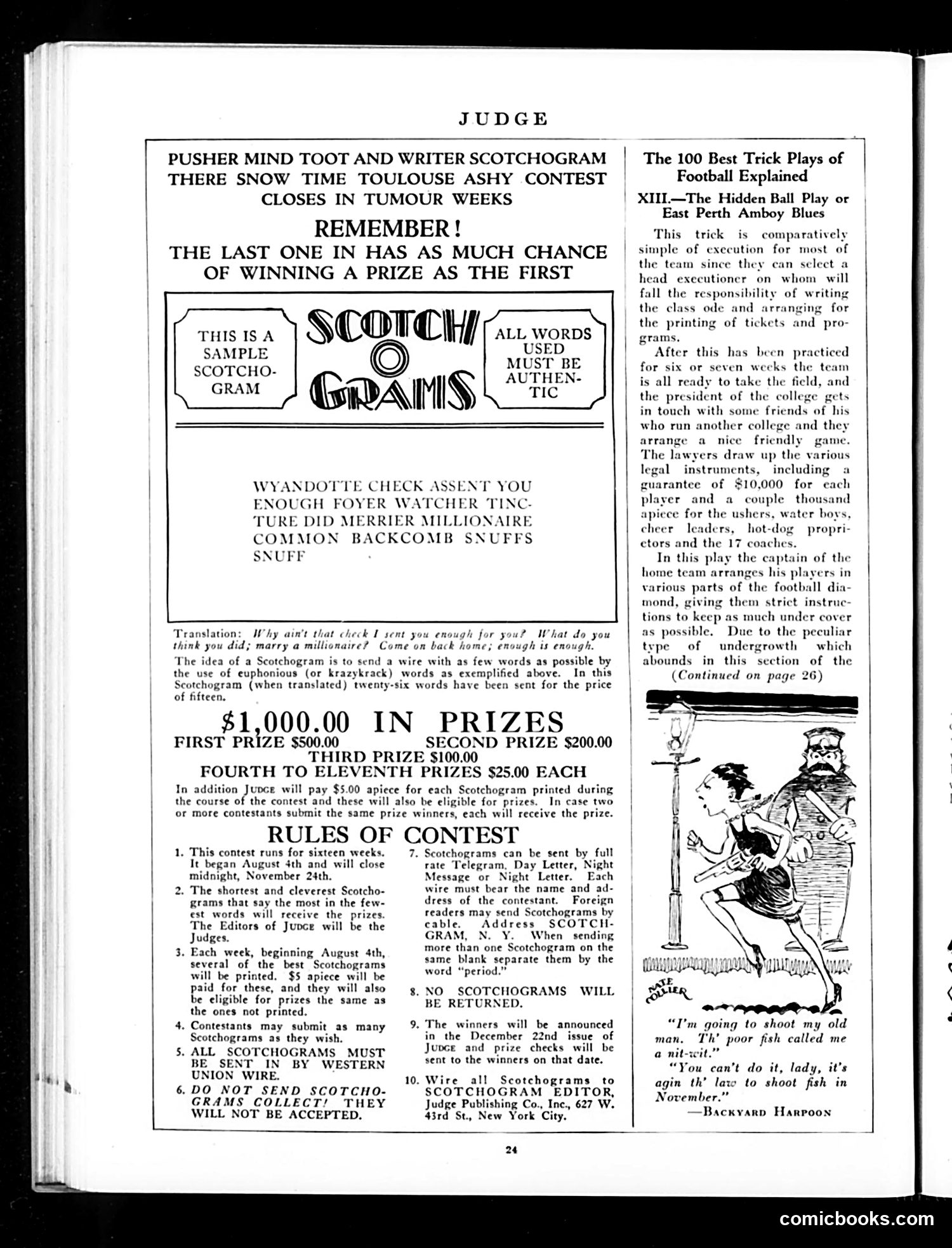
This page primarily features a **"Scotchogram" contest** — a wordplay competition where entrants compress messages into punchy, economical telegraph-style communications using creative slang and portmanteau words. The sample shown translates a complaint about insufficient money from someone claiming to be a millionaire's spouse. The joke plays on **Depression-era anxiety about wealth and marriage** — a husband questioning his wife's extravagant spending by sarcastically suggesting she married him thinking he was rich. The contest offered $1,000 in prizes and paid $5 per published entry, incentivizing readers to participate. The right column contains an unrelated piece on football trick plays, satirizing the elaborate pageantry of college football (legal documents, insurance, numerous coaches). At bottom, a cartoon shows a woman threatening to shoot her husband; when told it's illegal to shoot fish in November, the joke relies on calling him a "fish" — period slang for a fool or sucker.
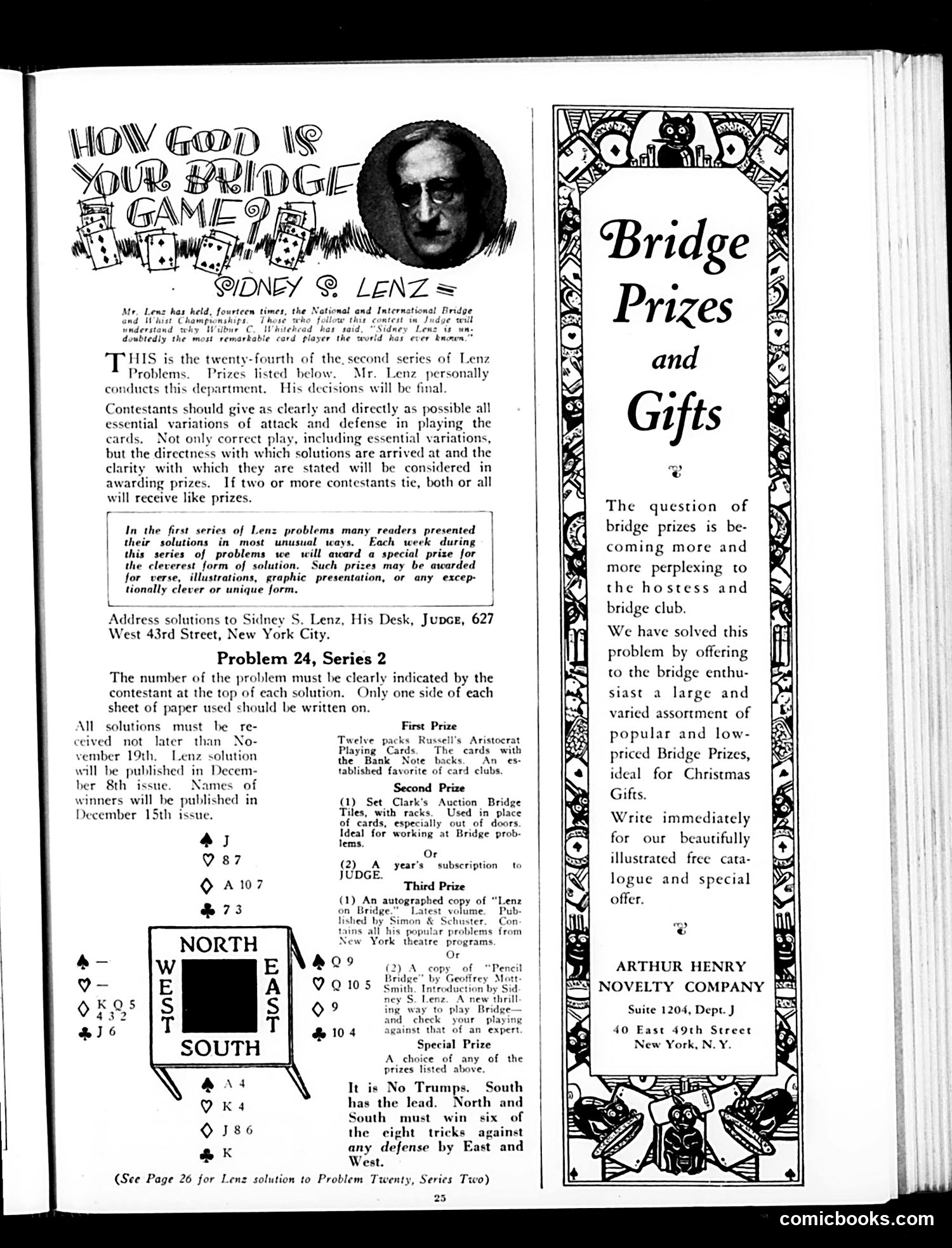
This page is primarily **instructional and advertising content**, not satirical cartoon material. The left side features **Sidney S. Lenz's bridge problem column**—Lenz was a renowned bridge expert and card game authority of the early 20th century. Judge magazine ran his weekly bridge puzzles as a regular feature, with contestants submitting solutions for prizes. The problem shown is a technical bridge hand requiring players to win six of eight tricks with no trump suit. The right side is a **commercial advertisement** for the Arthur Henry Novelty Company, promoting bridge-related gift items and prizes (playing cards, game sets, subscription to Judge magazine itself, and Lenz's instructional book "Lenz on Bridge"). This was pitched at bridge-playing hostesses seeking appropriate Christmas gifts—reflecting bridge's popularity as a social activity among affluent Americans during this era. The page reflects Judge's dual function: entertainment magazine mixed with consumer advertising.
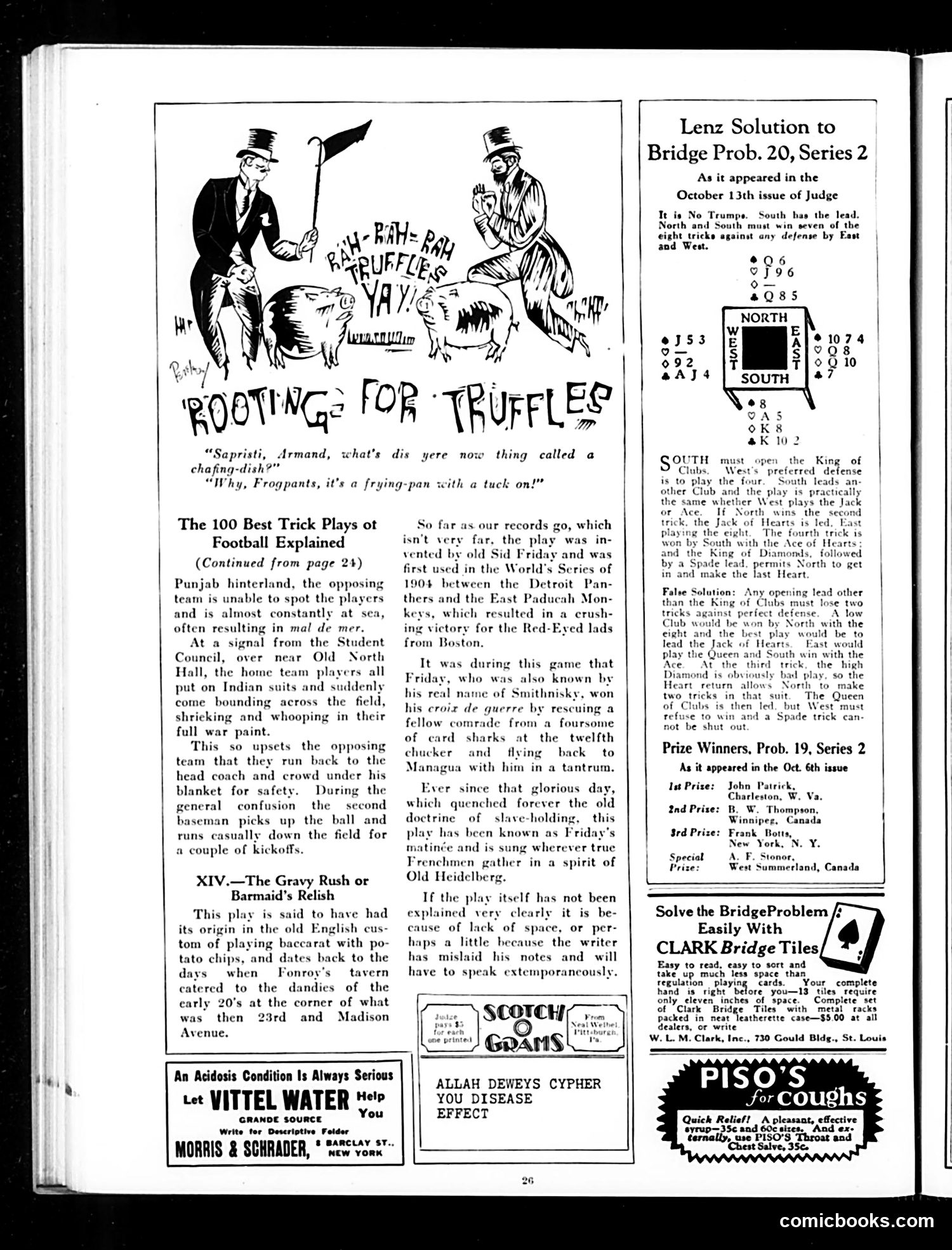
The cartoon "Rooting for Truffles" is a visual pun playing on French cuisine and dialect humor. Two figures—appearing to be caricatured Frenchmen based on their clothing and accents—are literally "rooting" (digging) for truffles using pigs, which were traditionally used to hunt these expensive underground fungi. The accompanying joke uses exaggerated French-accented English ("Sapristi," "dis yere"), a common comedic device in early 20th-century American humor. A "chafing-dish" is humorously redefined as "a frying-pan with a tuck on"—playing on word confusion and mock-French pretension. The satire targets American fascination with French sophistication and cuisine, while mocking both French accents and the absurdity of the truffle-hunting process. This reflects period stereotypes about French people and American aspirations toward European refinement. The cartoon's humor relies on audiences' familiarity with both culinary snobbery and ethnic caricature conventions typical of Judge magazine's satirical style.
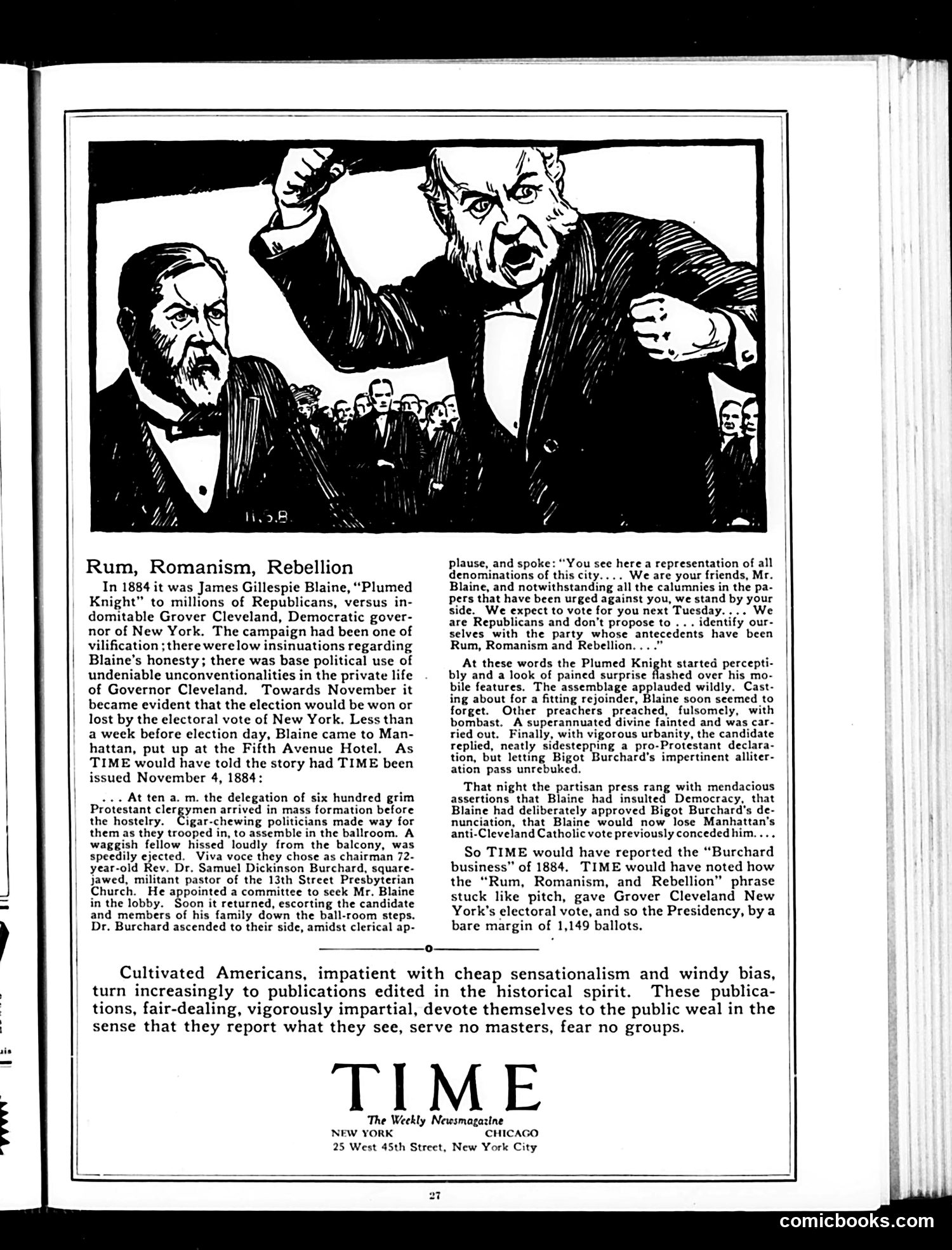
This page documents a pivotal 1884 presidential election moment between Republican James Gillespie Blaine ("Plumed Knight") and Democrat Grover Cleveland. The cartoon depicts Blaine confronted by Protestant clergy led by Reverend Burchard, who denounced "Rum, Romanism, and Rebellion"—a phrase attacking the Democratic party's associations with Irish Catholic immigrants and alcoholism. The satire criticizes how this clergy delegation's public statement backfired politically. Blaine's failure to immediately repudiate Burchard's inflammatory language cost him crucial Catholic votes in New York—the decisive state. Cleveland won by just 1,149 ballots, securing the presidency. TIME magazine uses this historical episode as self-promotion, claiming it would have reported the "Burchard business" with the impartial accuracy cultivated Americans deserve, contrasting itself against sensationalist competitors. The page is essentially disguised advertising presented as political history.
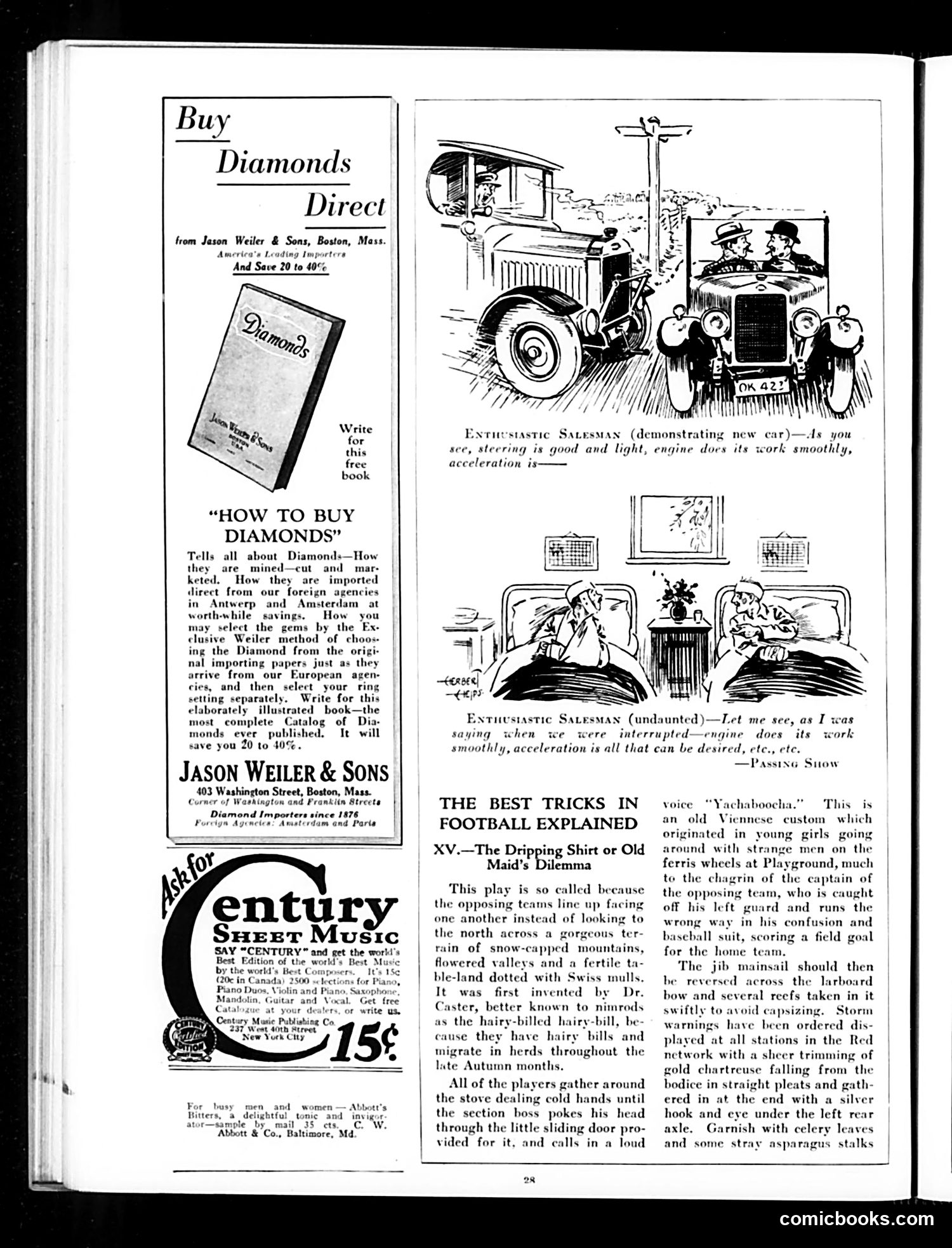
This page is primarily **advertising**, not political satire. It contains three unrelated commercial ads: 1. **Jason Weiler & Sons Diamond Ad** (left): A straightforward pitch to buy diamonds directly from Boston importers, claiming 20-40% savings by eliminating middlemen. 2. **Century Sheet Music Ad** (bottom left): A standard music publisher advertisement offering popular sheet music at 15 cents. 3. **Car Salesman Cartoon** (right): A humorous sketch showing an "enthusiastic salesman" demonstrating a new automobile. The joke is that the salesman keeps trying to complete his pitch about the car's smooth engine and acceleration, but gets repeatedly interrupted—first by the "Passing Show" (street activity), then by the passenger's concerns. It's gentle satire of aggressive 1920s car salesmen and their scripted pitches. The football section appears to be absurdist nonsense masquerading as sports instruction—likely filler content or parody. No identifiable political figures or events appear on this page.
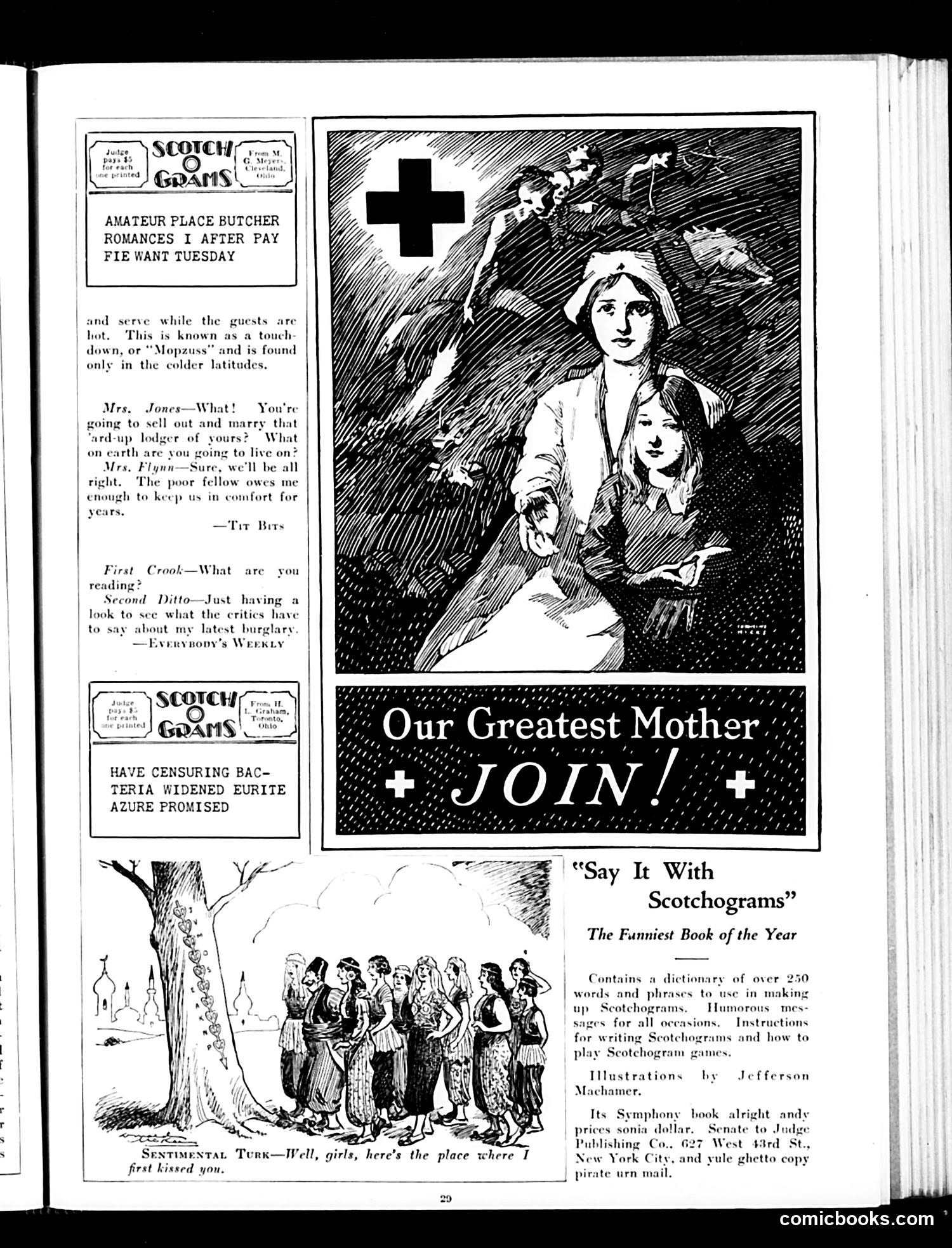
This page mixes humor columns with advertising. The left side contains three separate joke items in the "Scotch Grams" (Scottish phrase humor) format: 1. **"Amateur Place Butcher"** — A joke about a butcher romance, using Scottish dialect humor 2. **Mrs. Jones/Mrs. Flynn dialogue** — Dark humor where a widow plans to marry a poor lodger specifically because he owes her money, so she'll be financially supported through his debt obligation 3. **Crook dialogue** — A burglar reads reviews of "his latest burglary," treating crime like an artistic performance The large right-side image advertises **"Say It With Scotchograms,"** a book of Scottish phrases and jokes. The illustration shows figures (likely meant to represent Scotland/Scottishness) with a Red Cross symbol, referencing charitable/patriotic messaging common during WWI era. The humor throughout relies on Scottish stereotypes and working-class economic anxieties (poverty, debt, crime). The publication date and style suggest early 20th century.
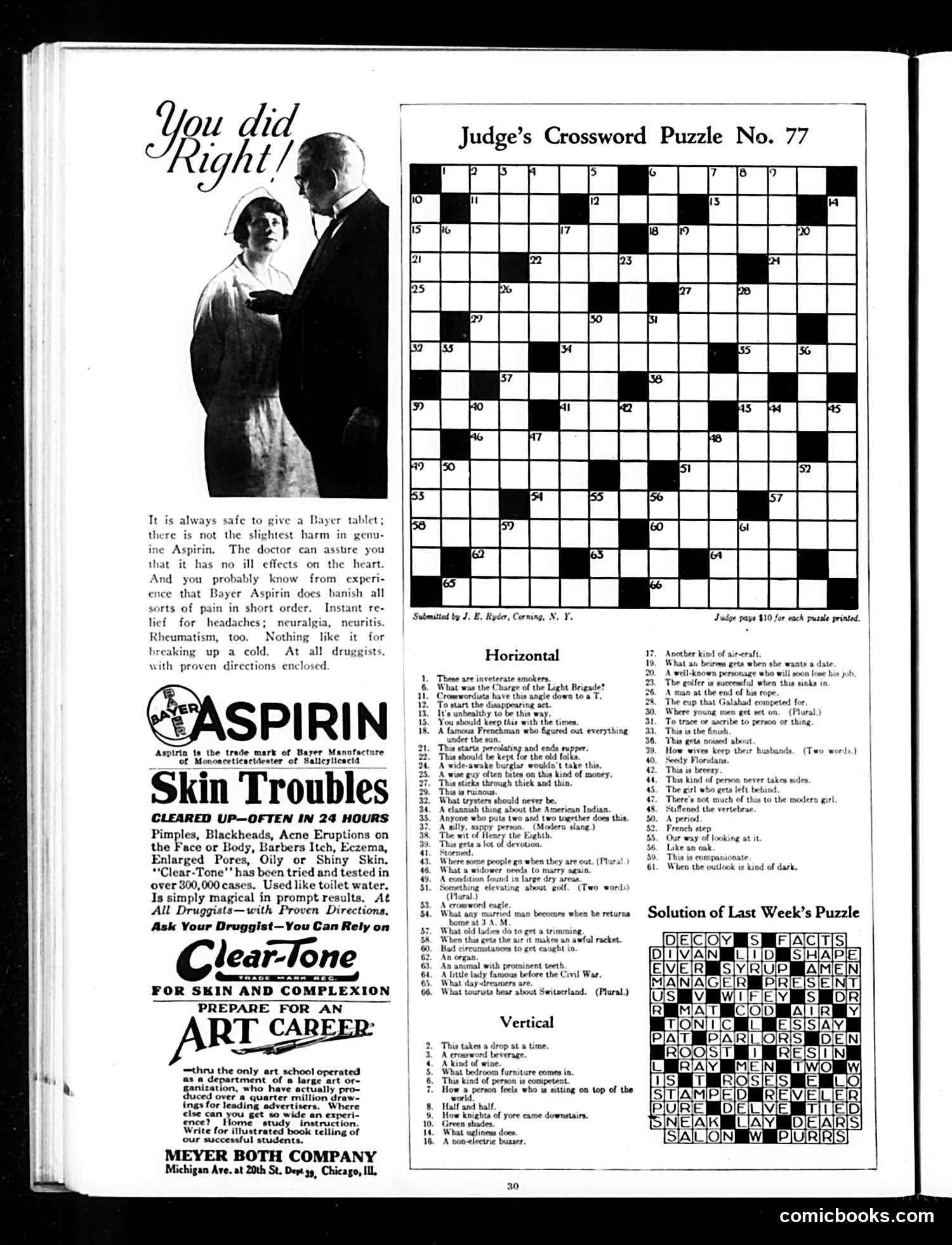
This page is primarily **advertising**, not satire or political commentary. The main content consists of three pharmaceutical/commercial advertisements: 1. **Bayer Aspirin** (large ad, left side): Markets aspirin as a safe, effective pain reliever for headaches, neuralgia, rheumatism, and colds. The accompanying image shows a doctor reassuring a woman patient—a common advertising trope of the era meant to convey medical authority and safety. 2. **Clear-Tone** (center): Advertises a skin treatment claiming to clear acne, pimples, eczema, and other dermatological issues "often in 24 hours." 3. **Meyer Roth Company Art School** (bottom left): Promotes correspondence art instruction. The page also includes **Judge's Crossword Puzzle No. 77** and the solution to the previous week's puzzle. The "You did Right!" caption accompanying the doctor-patient image is purely marketing copy reinforcing the safety message of Bayer products. There is no satirical or political content on this page.
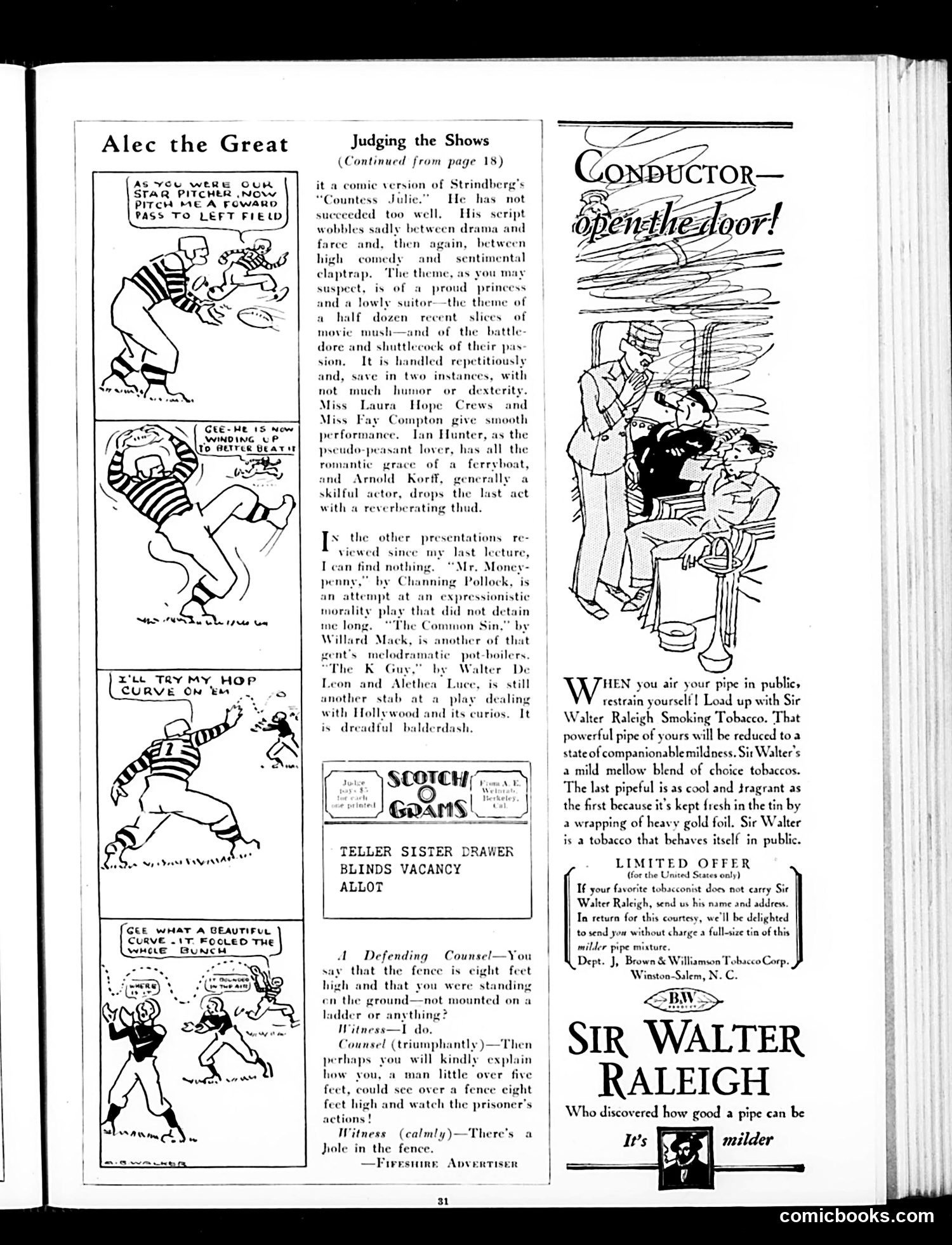
This page features a humorous comic strip about baseball, where a character named Alec—apparently a skilled pitcher—is asked to throw a "forward pass" instead of a pitch. The joke plays on the confusion between baseball and football terminology. The sequential panels show Alec attempting various throwing techniques (a "hop curve," a "curve"), with the final panel highlighting an absurdly exaggerated throwing posture labeled "a beautiful curve," poking fun at the character's misunderstanding of what's being asked. The satire is gentle and domestic rather than political—it's simply mocking sports confusion and physical comedy. The remainder of the page shifts to theatrical reviews and a Sir Walter Raleigh tobacco advertisement, suggesting this is a general-interest satirical magazine mixing entertainment criticism with advertising rather than focusing on political commentary.
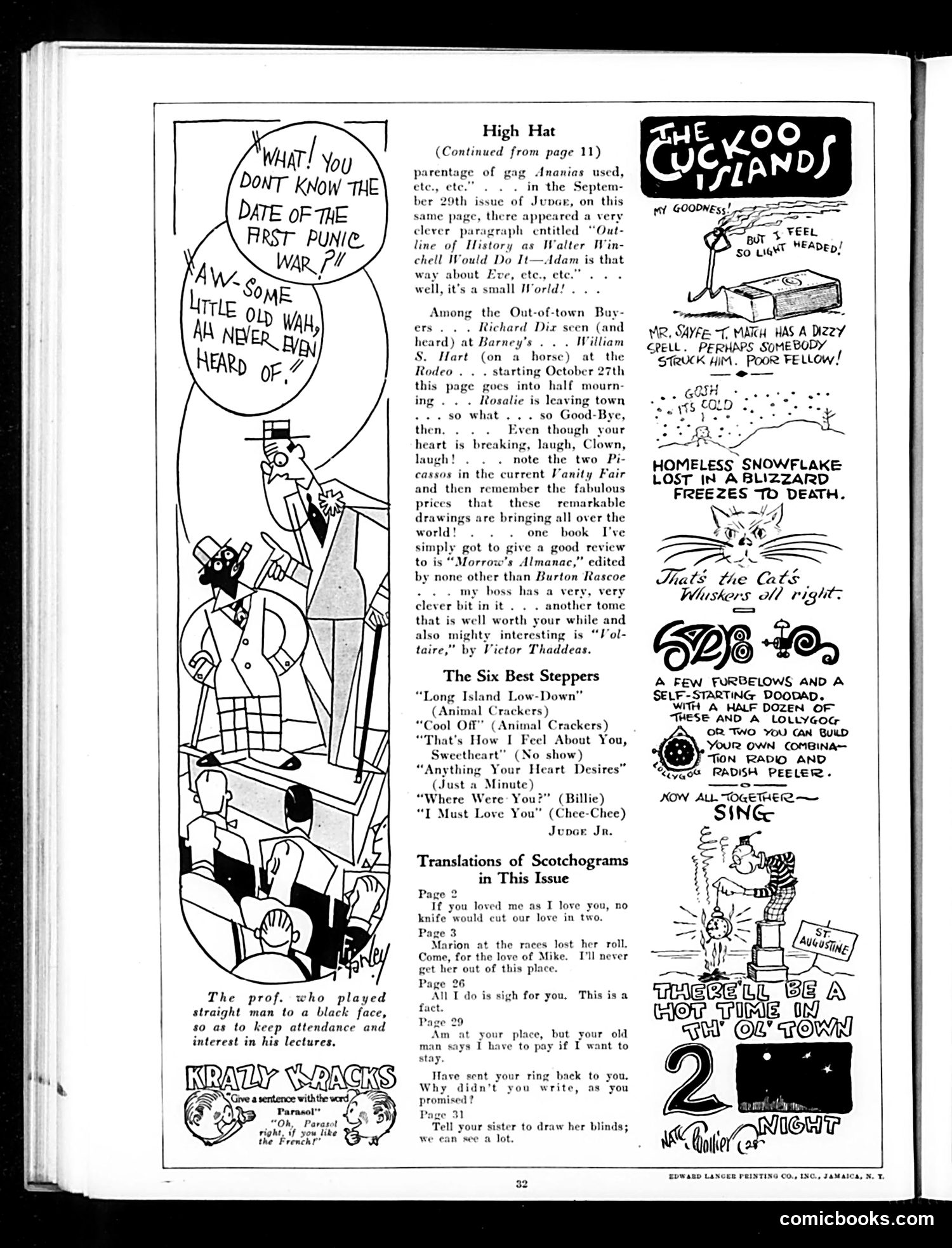
This page from Judge magazine (circa 1920s-30s) contains several satirical elements: **"High Hat" column**: A gossip/entertainment commentary section discussing Broadway figures, book reviews, and popular songs. It references William S. Hart (silent film cowboy star) and Richard Dix (actor), reflecting entertainment industry chatter of the era. **"The Prof. Who Played Straight Man"**: A cartoon mocking an academic who performed in blackface comedy to maintain student attendance. This reflects the period's casual acceptance of minstrelsy in entertainment, even by educated professionals—now deeply offensive but presented here as humorous hypocrisy. **Various comic strips and humor features**: Including "Krazy Kracks," "The Cuckoo Islands," and whimsical invention cartoons typical of Judge's light satirical style. **"Translations of Scotchograms"**: Scottish dialect jokes, popular period humor. The page represents pre-WWII American satirical magazine content mixing entertainment gossip, social observation, and crude ethnic humor considered acceptable at that time.
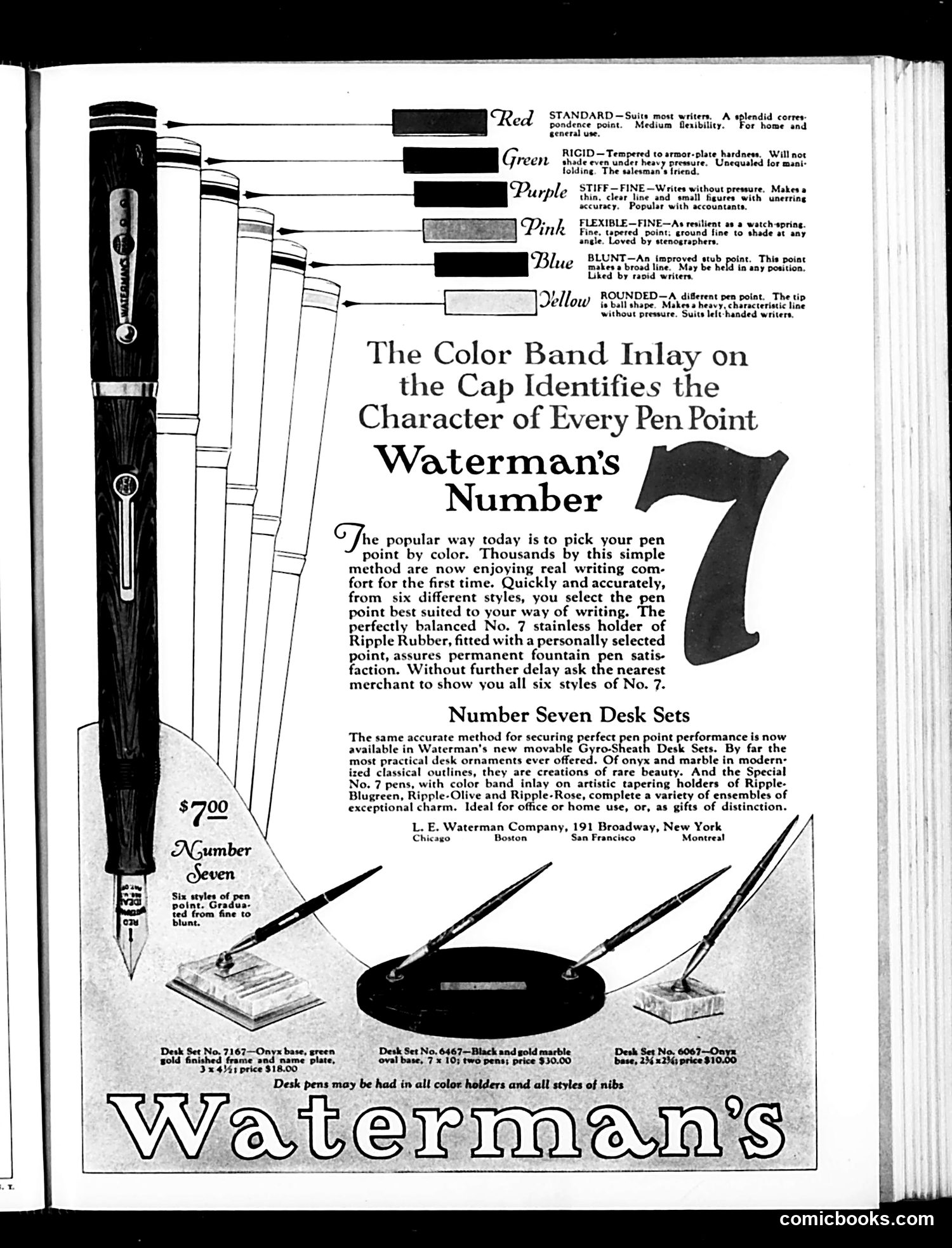
This is **not a cartoon or satire** — it's a straightforward advertisement for Waterman's fountain pens, specifically their "Number 7" model. The page showcases the company's innovation: **color-coded pen points** on the cap to help customers select the right nib style for their writing needs. Six different point types are illustrated (Red, Green, Purple, Pink, Blue, Yellow), each suited to different uses — from rigid points for salesmen to flexible ones for stenographers. The advertisement emphasizes modern convenience: rather than technical confusion, buyers could simply "pick your pen point by color" like selecting from a menu. The "Number Seven Desk Sets" at the bottom show luxury desk ornaments (priced at $7-$30) combining these pens with onyx and marble bases. This reflects early 20th-century marketing strategy — using clear visual organization and consumer psychology (color-coding for ease) to sell premium writing instruments as both practical tools and status symbols.
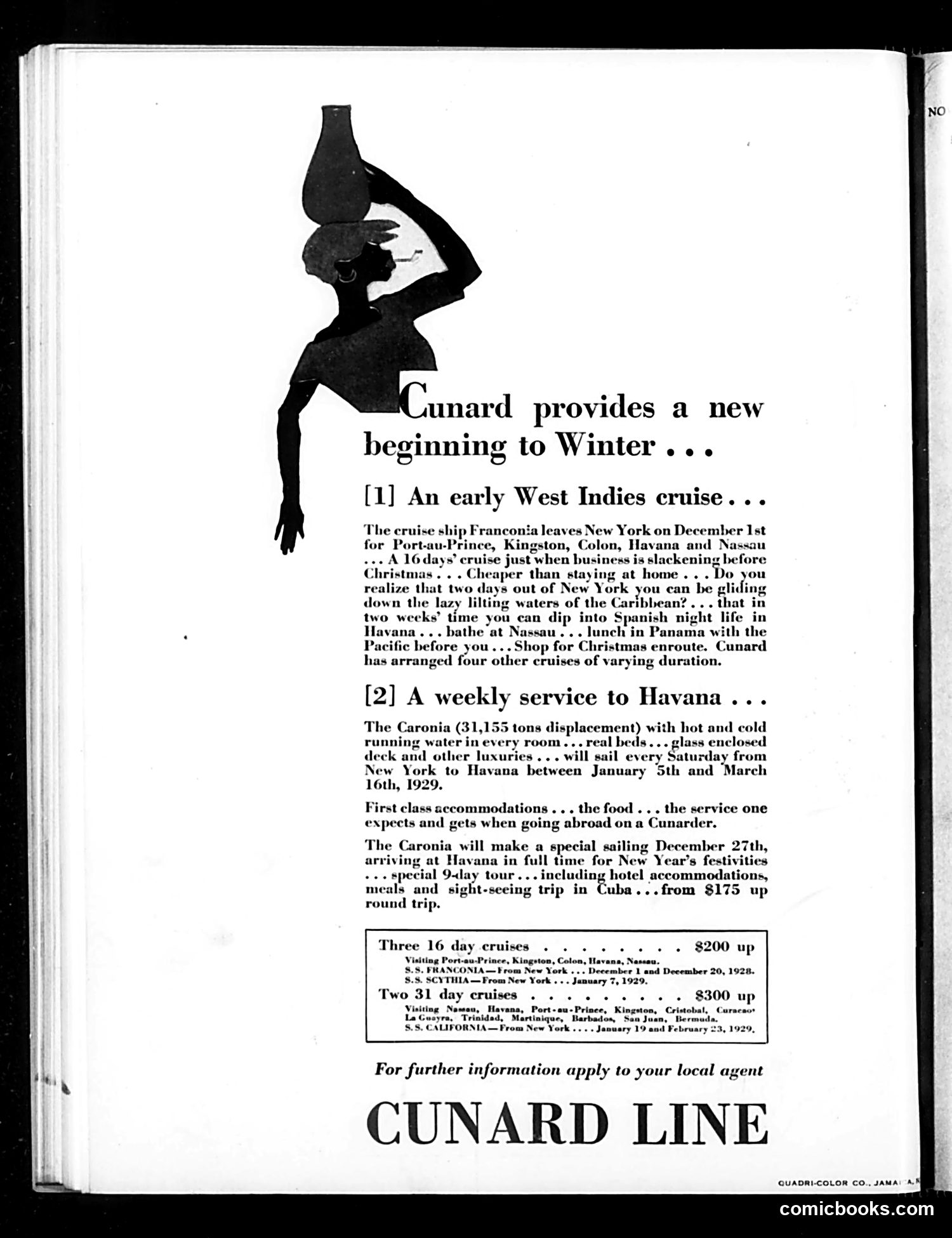
This page is **not a political cartoon or satire** — it's a **full-page advertisement** for Cunard Line cruise ships, appearing in Judge magazine (likely 1928-1929, based on the sailing dates mentioned). The silhouetted figure at top is a stylized, art deco-era woman in elegant pose — a decorative advertisement motif, not a caricature or political figure. The ad promotes three cruise options: a 16-day West Indies voyage on the *Franconia*, a weekly Havana service on the *Caronia*, and longer 31-day cruises. The copy emphasizes luxury ("hot and cold running water in every room"), affordability ("cheaper than staying at home"), and timely escape before Christmas when "business is slackening." The page reflects 1920s consumer culture and the appeal of Caribbean travel as accessible leisure for affluent Americans. There is no satirical content — Judge, while primarily satirical, carried advertisements to fund publication.