
Judge, 1928-11-10 · page 15 of 36
Judge — November 10, 1928 — page 15: what you’re looking at
What you’re looking at
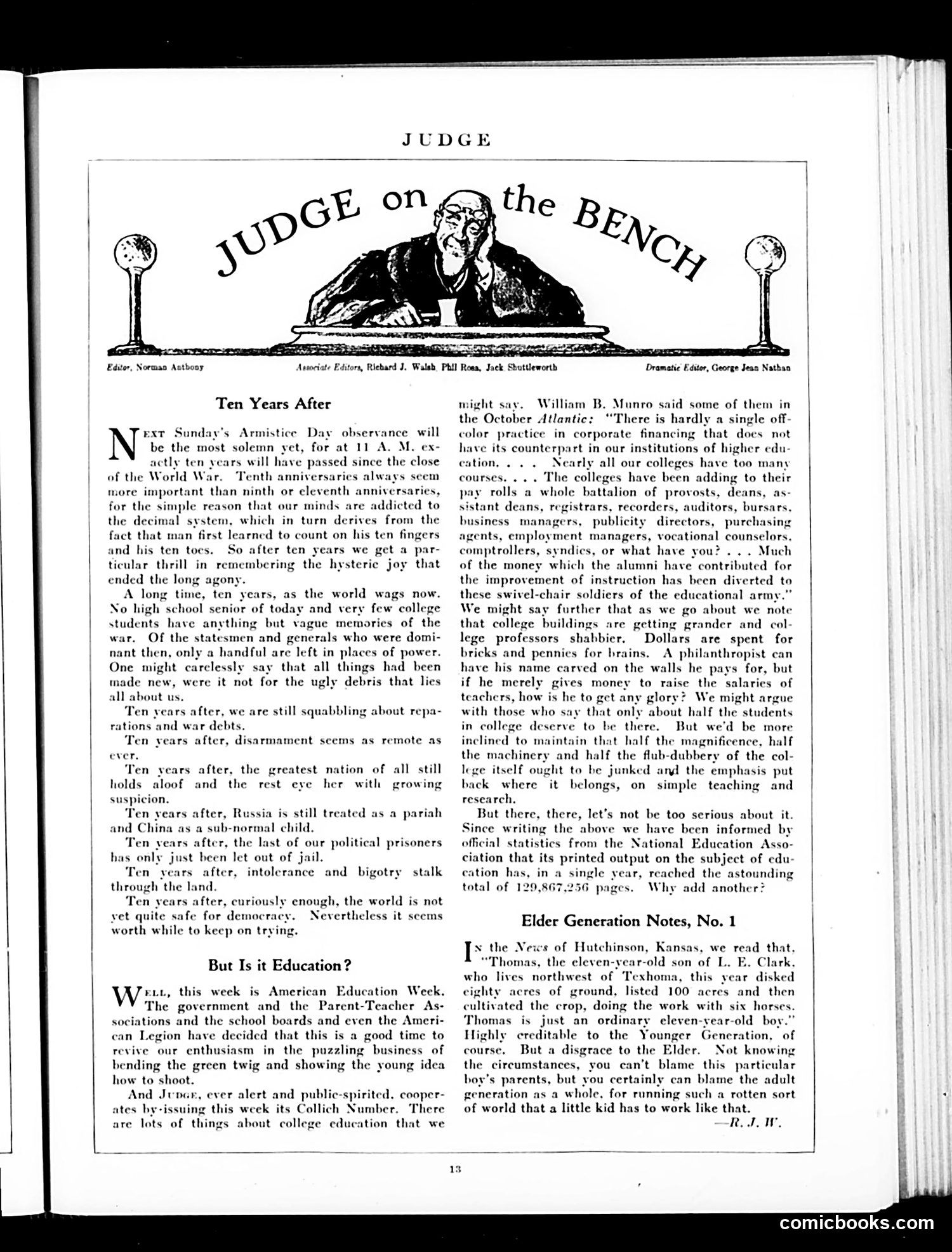
This editorial page reflects on the tenth anniversary of Armistice Day (November 11, 1928), examining what has—and hasn't—changed since World War I ended. The "Ten Years After" section catalogs persistent post-war problems: unresolved war debts and reparations, failed disarmament efforts, American isolationism, Russia treated as a pariah state, and lingering intolerance. The tone is sardonic—the world isn't yet "safe for democracy," yet efforts continue anyway. The "But Is it Education?" section critiques American colleges during Education Week. Drawing on William B. Munro's *Atlantic* article, it attacks administrative bloat: colleges have added "swivel-chair soldiers" (unnecessary bureaucrats)—deans, registrars, comptrollers—while professor salaries stagnate. Grand buildings receive donations while teaching suffers. The satire targets donors seeking ego gratification through named buildings rather than supporting actual education, and criticizes colleges prioritizing prestige infrastructure over fundamental instruction.
📄 Transcribed text from this page (OCR, searchable)
Machine-transcribed from the original scan — historical spelling and the odd misread are preserved.
Editor, Norman Astbosy Ten Years After ext Sunday's Armistice Day observance will N be the most solemn yet, for at 11 A. M. ex- tly ten years will have passed since the close of the World War. Tenth anniversaries alw more important than ninth or el for the simple reason that our minds are addicted to the decimal system, which in turn derives from the fact that man first learned to count on his ten fingers and his ten toes. So after ten years we get a par- ticular thrill in remembering the hysteric joy that ended the long agony. ys seem A long time, ten years, as the world wags now. No high school senior of today and very few college students have anything but vague memories of the war. Of the statesmen and gencrals who were domi- nant then, only a handful are left in places of power. One might carelessly say that all things had been made new, were it not for the ugly debris that lies all about us. Ten years after, we are still squa rations and war debts. Ten years after, disarmament scems as remote as ever. Ten years after, the greatest nation of all still holds aloof and the her with suspicion. Ten years after, Russia and Chi a sub-normal child. Ten years after, the last of our political prisoners has only just been let out of j sbling about repa- rest eye growing is still treated as a pariah Ten years after, intolerance and bigotry stalk through the land. Ten years after, curiously enough, the world is not yet quite safe for democracy. Nevertheless it seems worth while to keep on trying. But Is it Education? this week is American Education Week. The government and the Parent-Teacher As- ations and the school boards and even the Ameri- can Legion have decided that this is a good time to revive our enthusiasm in the puzzling business of bending the green twig and showing the young idea how to shoot. And Jvpor, ever alert and public-spirited. cooper- es by-issuing this week its Collich Number. lots of things about colle sor There that we education Associate Editors, Riebard J. Walsh Phil Rosa, Jack Shuttleworth Dramatic Editer, George Jean Nathan might say. William B. Munro said some of them in the October Atlantic: “There is hardly a sii off- color practice in corporate financing that does not have its counterpart in our institutions of higher edu ion... . Nearly all our colleges have too many ‘ourses. ... The colleges have been adding to their rolls a whole battalion of provosts, deans, as- nt deans, registrars, recorders, auditors, bursars. business managers, publicity directors, purchasing agents, employment managers, vocational counselors. comptrollers, syndics, or what have you? ... Much of the money which the alumni have contributed for the improvement of instruction has been diverted to these swivel-chair soldiers of the educational army.” We might say further that as we go about we note that college buildings are getting grander and col- lege professors shabbier. Dollars are spent for bricks and pennies for brains. A philanthropist can have his name carved on the walls he pays for, but if he merely gives money to raise the salaries of teachers, how is he to get any glory? We might argue with those who say that only about half the students in college deserve to b there. But we'd be more inclined | to maintain that half the magnificence, half the machinery and half the flub-dubbery of the col- lege itself ought to be junked and the emphasis put back where it belongs, on simple teaching and research, But there, there, Since writing the let's not be too serious about it. above we have been informed by fficial statistics from the National Education Asso- ciation that its printed output on the subject of edu- tion has, i car, reached the astounding total of 1 ges. Why add another? single 6 ps Elder Generation Notes, No. 1 I the News of Hutchinson, Kansas, we read that. “Thomas, the eleven-year-old son of L. E. Clark. who lives northwest of Texhoma, this year disked cighty acres of ground, listed 100 acres and then cultivated the crop, doing the work with six horses. Thomas is just an ordinary eleven-year-old boy." creditable to the Younger Generation, of But a disgrace to the Elder. Not knowing the circumstances, you can’t blame this particular boy's parents, but you certainly can blame the adult generation as a whole, for running such a rotten sort of world that a little kid has to work like that. RILW, urse, comicbooks.com