
A complete issue · 36 pages · 1928
Judge — October 6, 1928
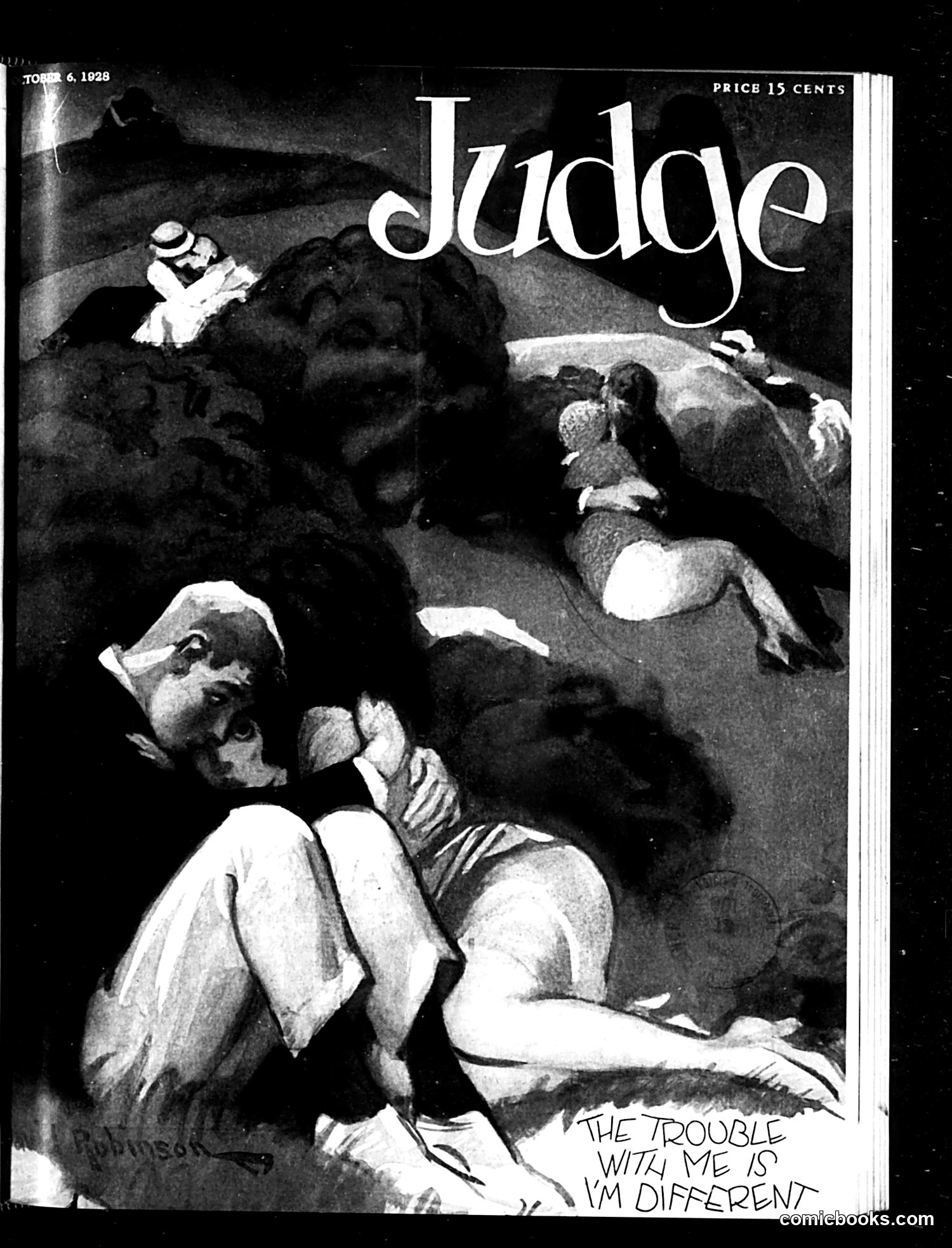
This cover depicts a social satire about nonconformity. The central figure is a young woman in casual, somewhat disheveled clothing sitting among what appear to be more conventionally dressed people (shown in shadow). The caption reads "THE TROUBLE WITH ME IS I'M DIFFERENT." The cartoon satirizes 1920s youth culture and the "Modern Woman" phenomenon—specifically critiquing young women who rejected traditional social conventions. During the Jazz Age, such women were often condemned by mainstream society for their casual dress, behavior, and independence. Judge, being a satirical publication, likely mocks both the rebellious youth and society's scandalized reactions to them. The price of 15 cents reflects the publication's 1920s circulation period.
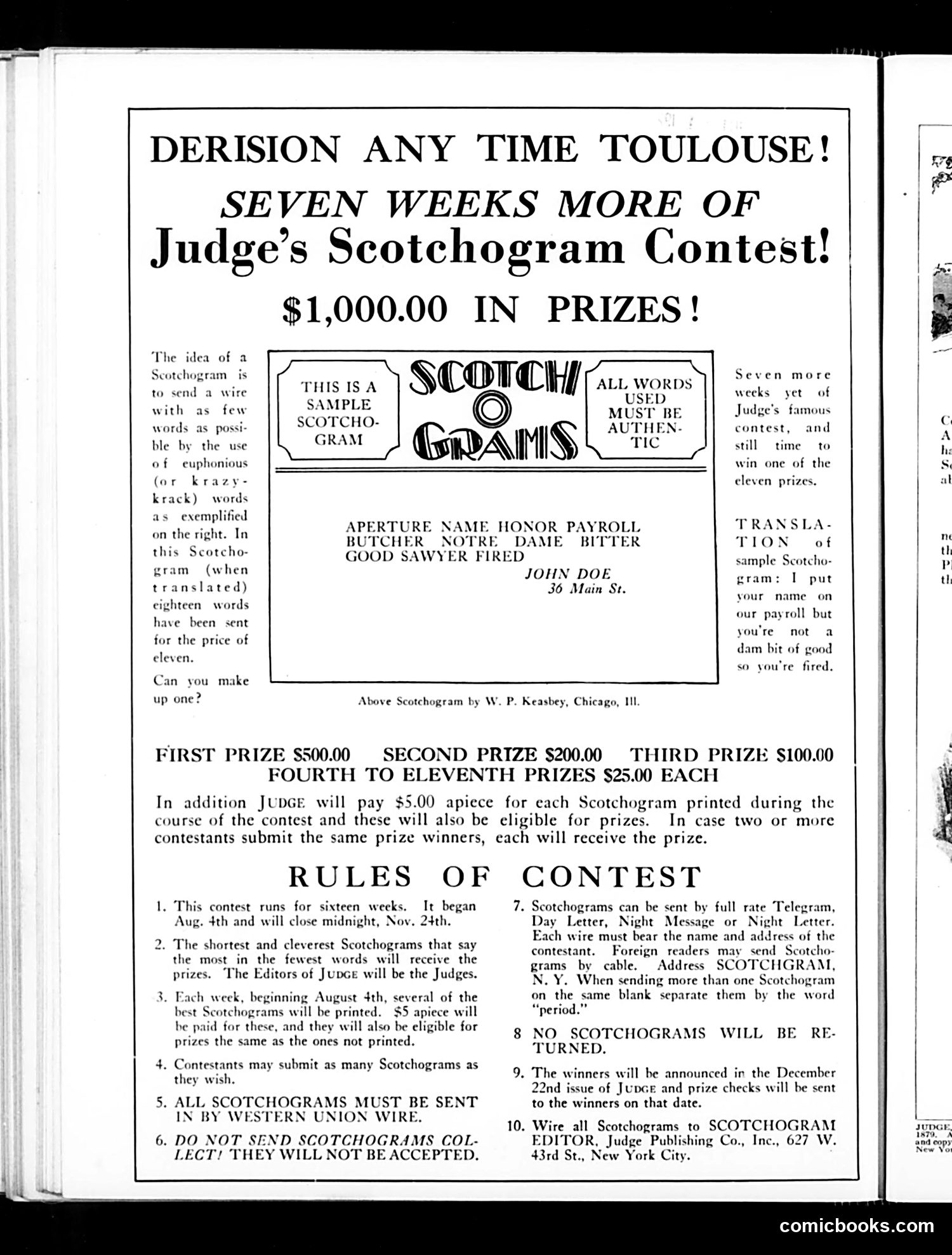
This page is primarily **advertising and contest rules**, not political satire. Judge magazine is promoting a "Scotchogram Contest"—a word puzzle game where contestants encode messages using the fewest possible words, with winners determined by brevity and cleverness. The sample "Scotchogram" shown translates workplace jargon into plain English: "APERTURE NAME HONOR PAYROLL BUTCHER NOTRE DAME BITTER GOOD SAWYER FIRED" becomes "I put your name on our payroll but you're not a dam bit of good so you're fired." The contest offers $1,000 in total prizes over seven weeks. Entries must be sent via Western Union wire to Judge's New York office. This represents early-20th-century entertainment advertising rather than political commentary.
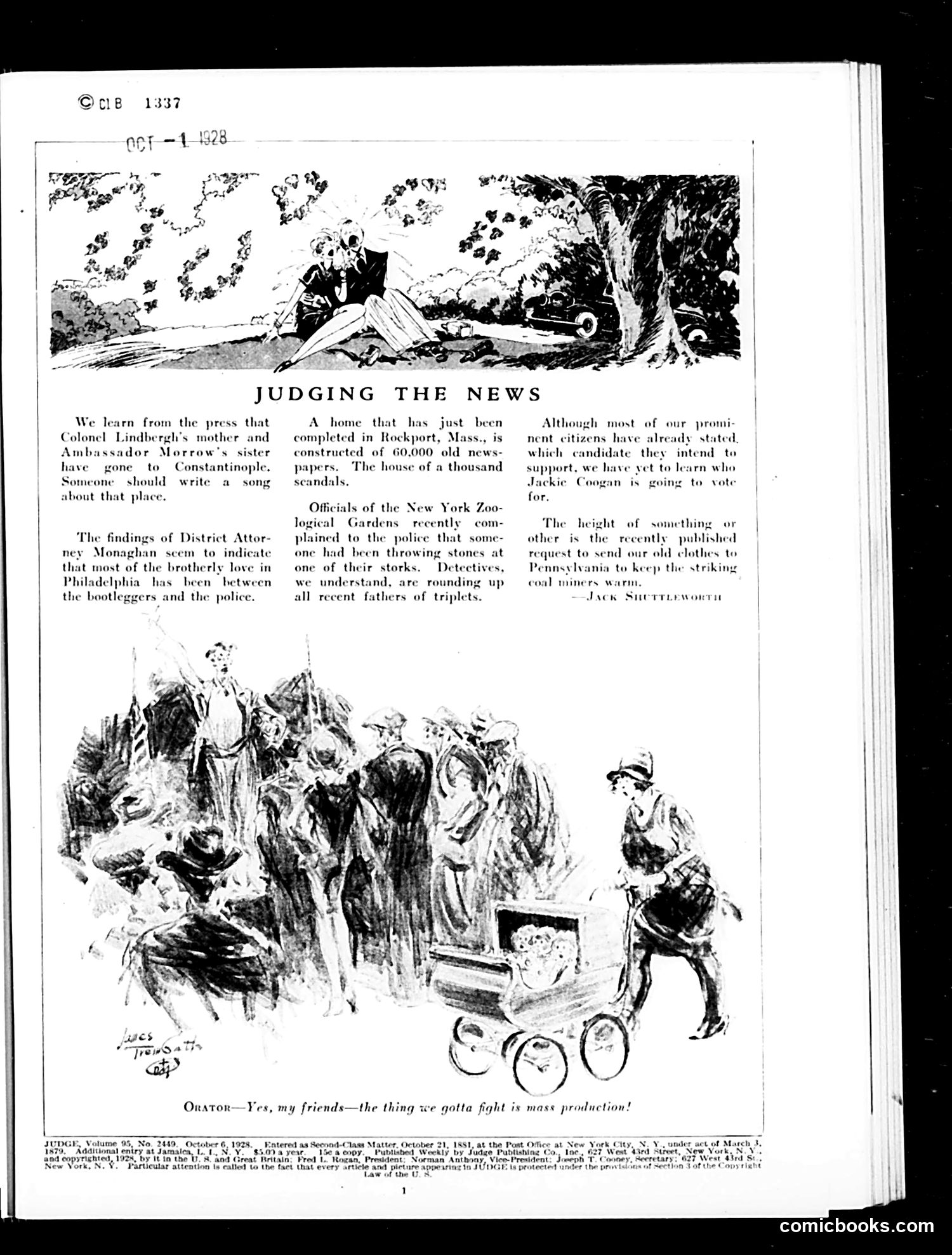
This page presents satirical commentary on contemporary news items under the heading "Judging the News." The top cartoon mocks Colonel Lindbergh's sister visiting Constantinople, suggesting someone should write a song about that destination. The main illustration below depicts a political rally or public gathering with an orator addressing a crowd around a baby carriage. The caption reads: "Orator—Yes, my friends—the thing we gotta fight is mass production!" This satirizes political rhetoric of the 1920s era, likely targeting populist or progressive politicians who blamed industrial mass production for social problems, while ironically appealing to large masses of voters. The baby carriage may symbolize family concerns or domestic issues politicians claimed to champion. The accompanying text columns reference various news stories about crime, zoo incidents, and Pennsylvania coal miners, maintaining Judge's characteristic witty, tongue-in-cheek commentary on contemporary American life.
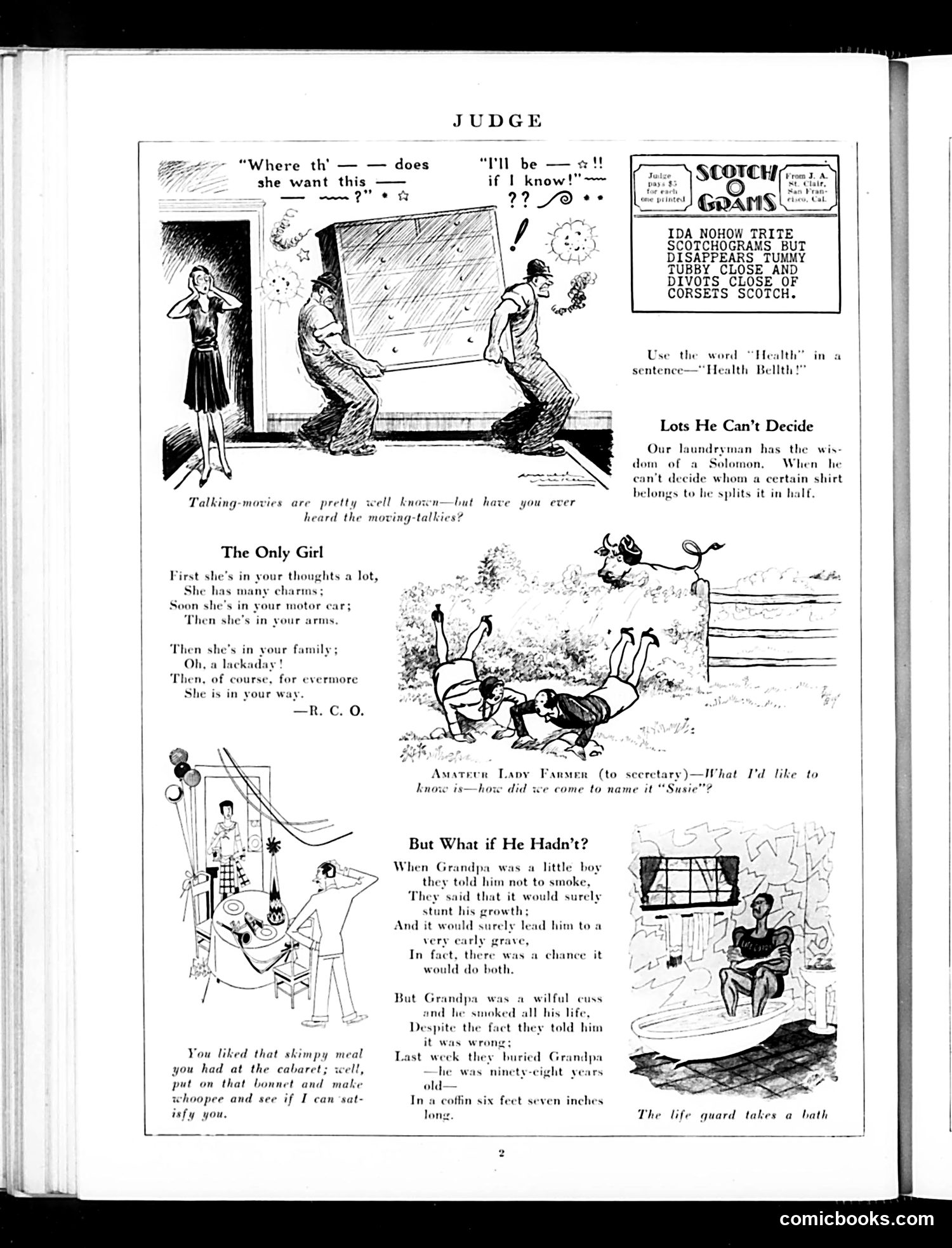
This page contains several unrelated humorous pieces typical of Judge magazine's satirical format: **Top cartoon**: A domestic dispute about a woman's whereabouts, mocking "talking movies" (early sound films) and their tendency toward repetitive dialogue. **"The Only Girl"**: A sentimental poem by R.C.O. about romantic love's all-consuming nature. **"Lots He Can't Decide"**: A joke about a laundryman's indecision regarding a shirt, demonstrating Solomon-like wisdom through absurdity. **"But What if He Hadn't?"**: A satirical poem about mortality and smoking, using Grandpa's death (age 98) as dark humor. The implied joke: warnings about smoking's dangers are moot when someone lives nearly a century anyway. **"Amateur Lady Farmer"**: A caption joke about naming a horse "Susie." The page reflects 1920s-30s domestic humor and early cinema mockery rather than political satire.
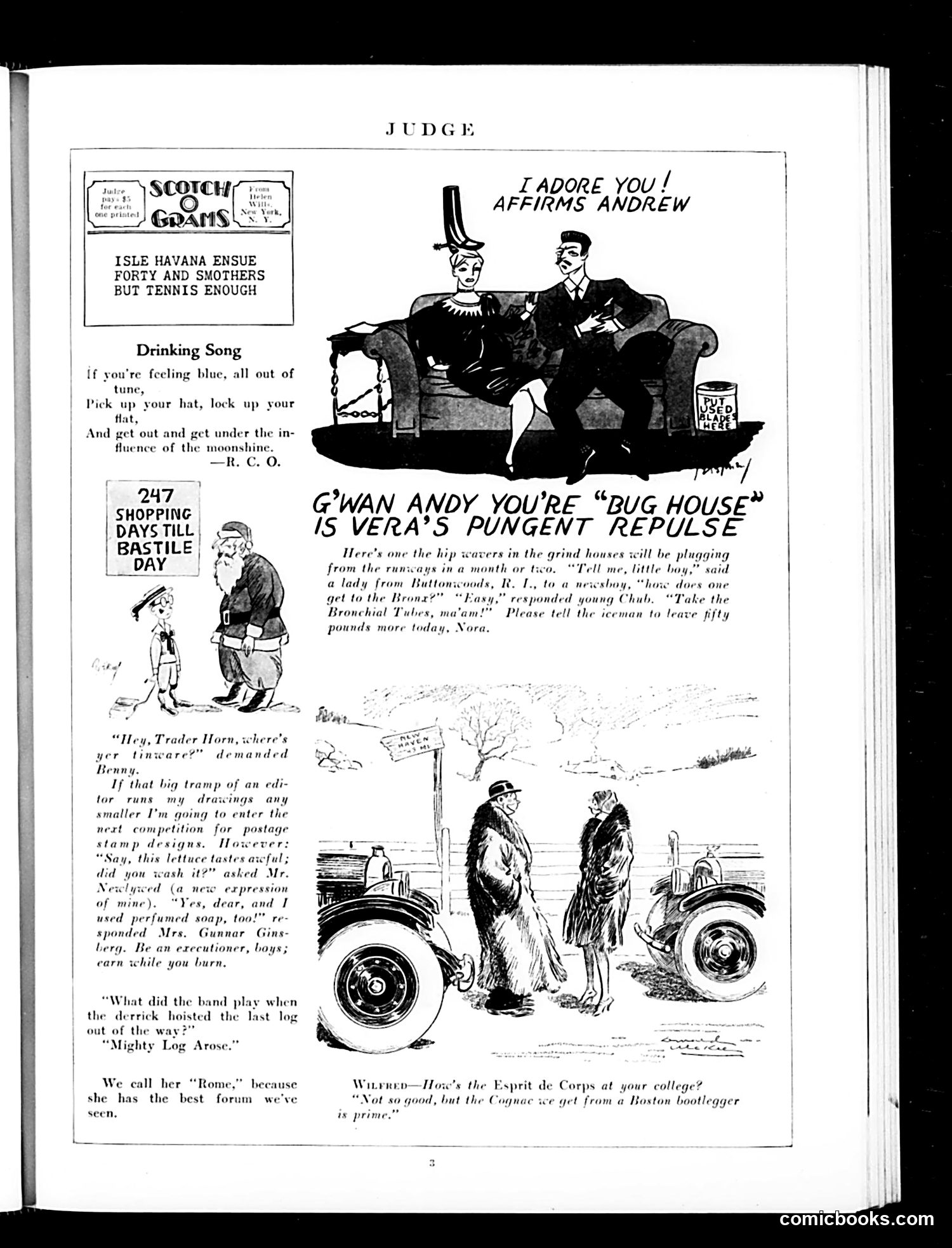
This page contains several humor pieces typical of early 20th-century satirical magazines: **Top cartoon**: A couple on a sofa; the man declares "I adore you! Affirms Andrew." The joke references Andrew Carnegie, likely satirizing wealthy industrialists' public displays of affection or romantic gestures. **Middle section**: "Scotch Grams" jokes about Scottish stereotypes (whisky, thriftiness). **Lower cartoons**: Humorous anecdotes about everyday life—a child asking Santa for gifts, a trader inquiring about linens, and two men discussing automobiles. These mock ordinary domestic situations and class differences. **Bottom**: A joke about "Rome" having "the best forum"—wordplay on the Roman Forum versus a person named Rome. The page represents typical Judge humor: social satire, puns, and gentle mockery of wealth, ethnicity, and modern consumer culture.
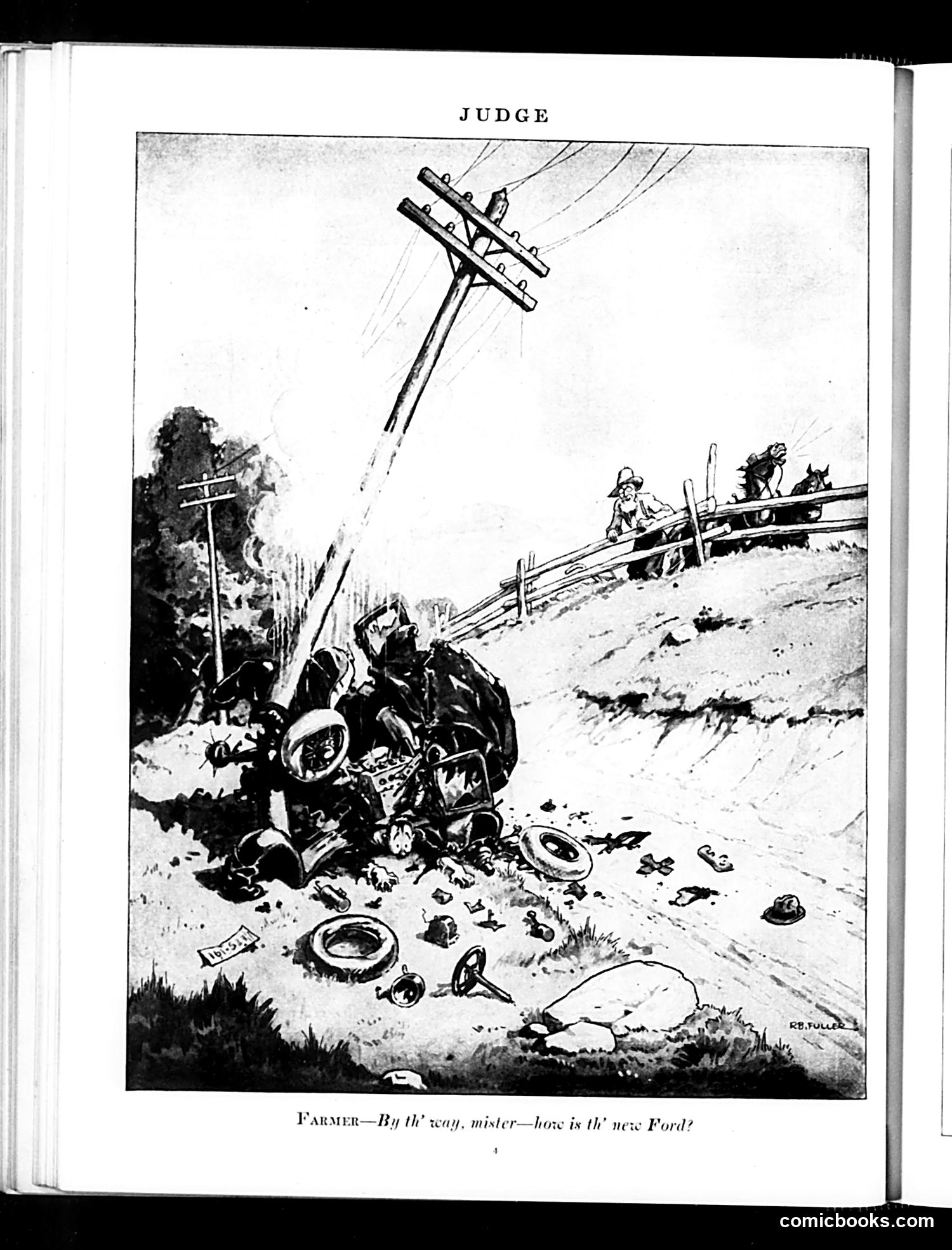
This cartoon satirizes early automobile reliability, specifically Ford vehicles. A farmer stands amid wreckage—scattered auto parts, wheels, and debris—examining a wrecked car with a broken axle or steering component. In the background, other figures observe from a fence. The caption reads: "FARMER—By th' way, mister—how is th' new Ford?" The joke targets the Ford's notorious mechanical problems and poor durability. Despite Henry Ford's reputation for producing affordable mass-market automobiles, early Fords were frequently unreliable. The cartoon mocks this contradiction: the farmer sarcastically asks about the "new Ford" while surrounded by evidence of catastrophic failure, suggesting that owning a Ford meant constant breakdowns and repairs rather than reliable transportation.
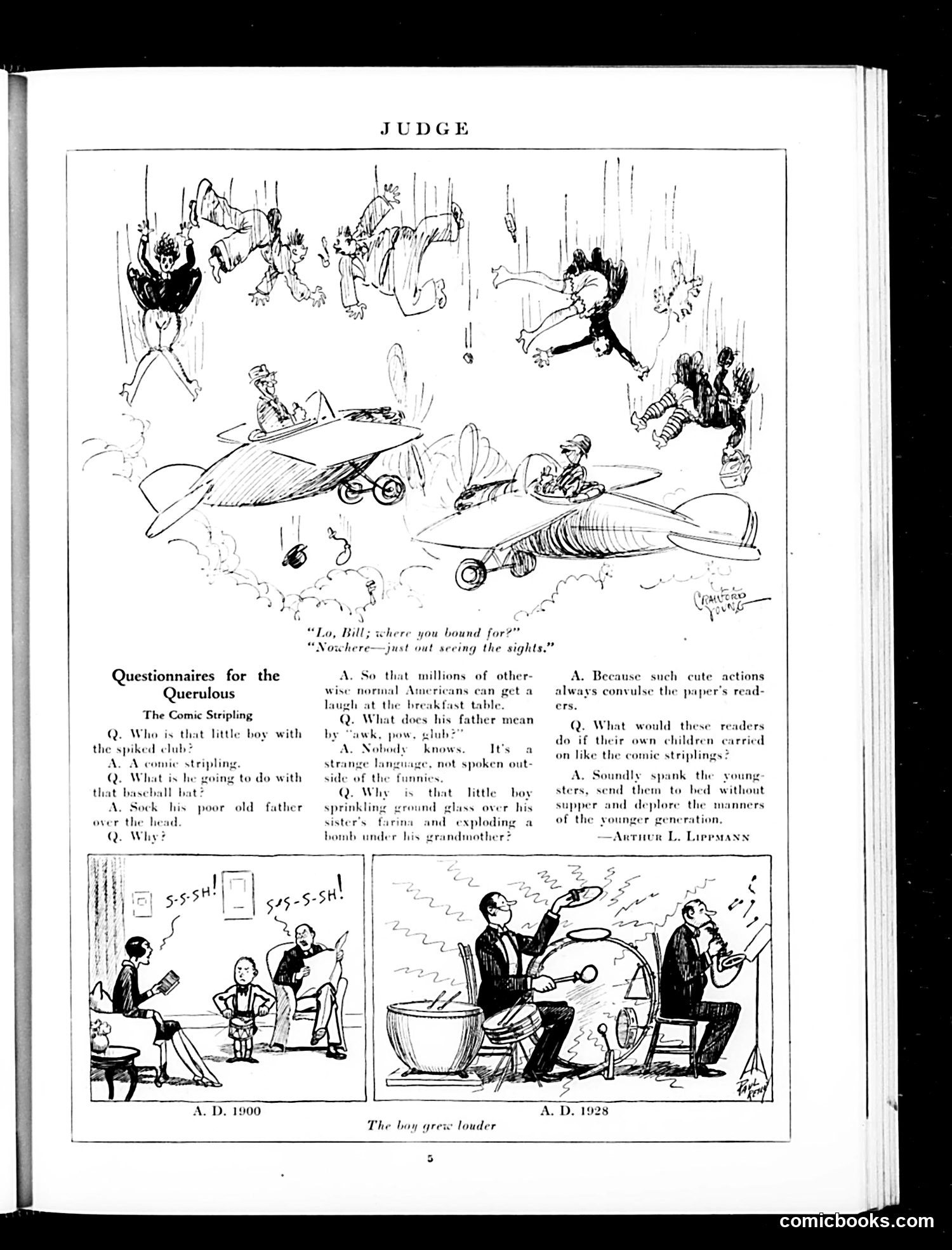
The main cartoon depicts children engaged in aviation-themed play—crashing toy planes, operating mock cockpits—responding to the question "Lo, Bill; where you bound for?" with "Nowhere—just out seeing the sights." The satire critiques how comic strips influence children's behavior. The "Questionnaires" section humorously documents this concern: parents worry that comic strip violence (children "spanking youngsters") and crude language ("awk, pow, chub") normalize poor behavior at the breakfast table. The two bottom panels, labeled "The boy grows louder" (A.D. 1900 vs. A.D. 1928), show escalating domestic chaos across decades—suggesting that exposure to increasingly sensational media progressively corrupts youth conduct and family life. This reflects early 20th-century anxiety about mass media's effects on children.
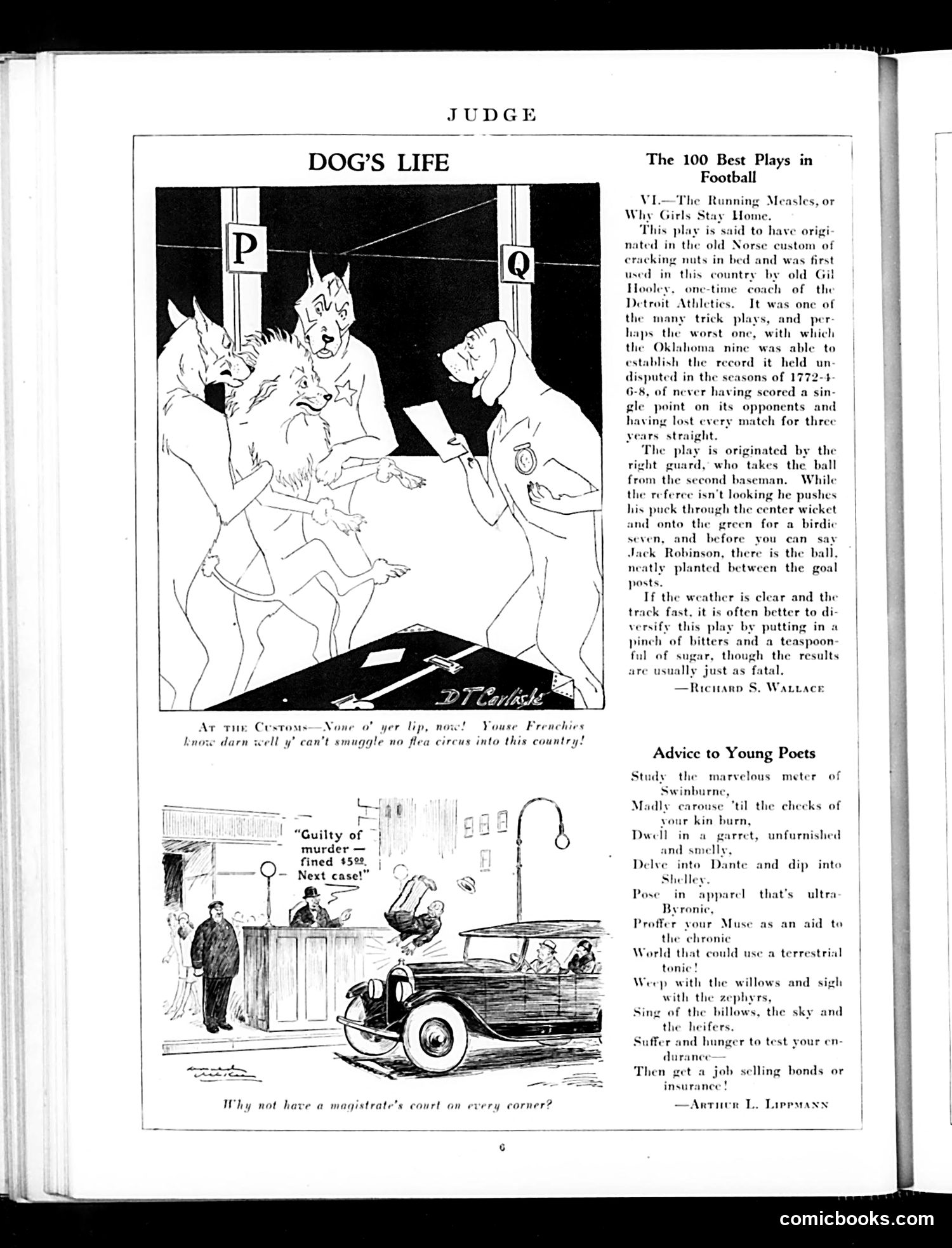
This page contains three satirical pieces from an early 20th-century American humor magazine: **"Dog's Life"** (top cartoon): Depicts customs officials interrogating French travelers about smuggling a "flea circus"—a contemporary novelty act where fleas were trained to perform. The joke mocks both overzealous customs enforcement and the absurdity of the flea circus itself as contraband. **Courtroom cartoon** (bottom left): Shows a magistrate's court with a driver appearing for a "murder" conviction fined $5—likely referencing early automobile accidents, which were novel, deadly, and treated with surprising leniency. The caption sardonically suggests courts on every corner, mocking inadequate traffic law enforcement. **"Advice to Young Poets"** (right column): Offers tongue-in-cheek guidance to aspiring writers, praising Romantic poets (Swinburne, Byron, Dante, Shelley) while satirizing impractical bohemianism—starving in garrets, excessive posing—before the punchline: eventually you'll abandon art for mundane insurance sales. It mocks both pretentious poets and the economic reality crushing artistic ambition.
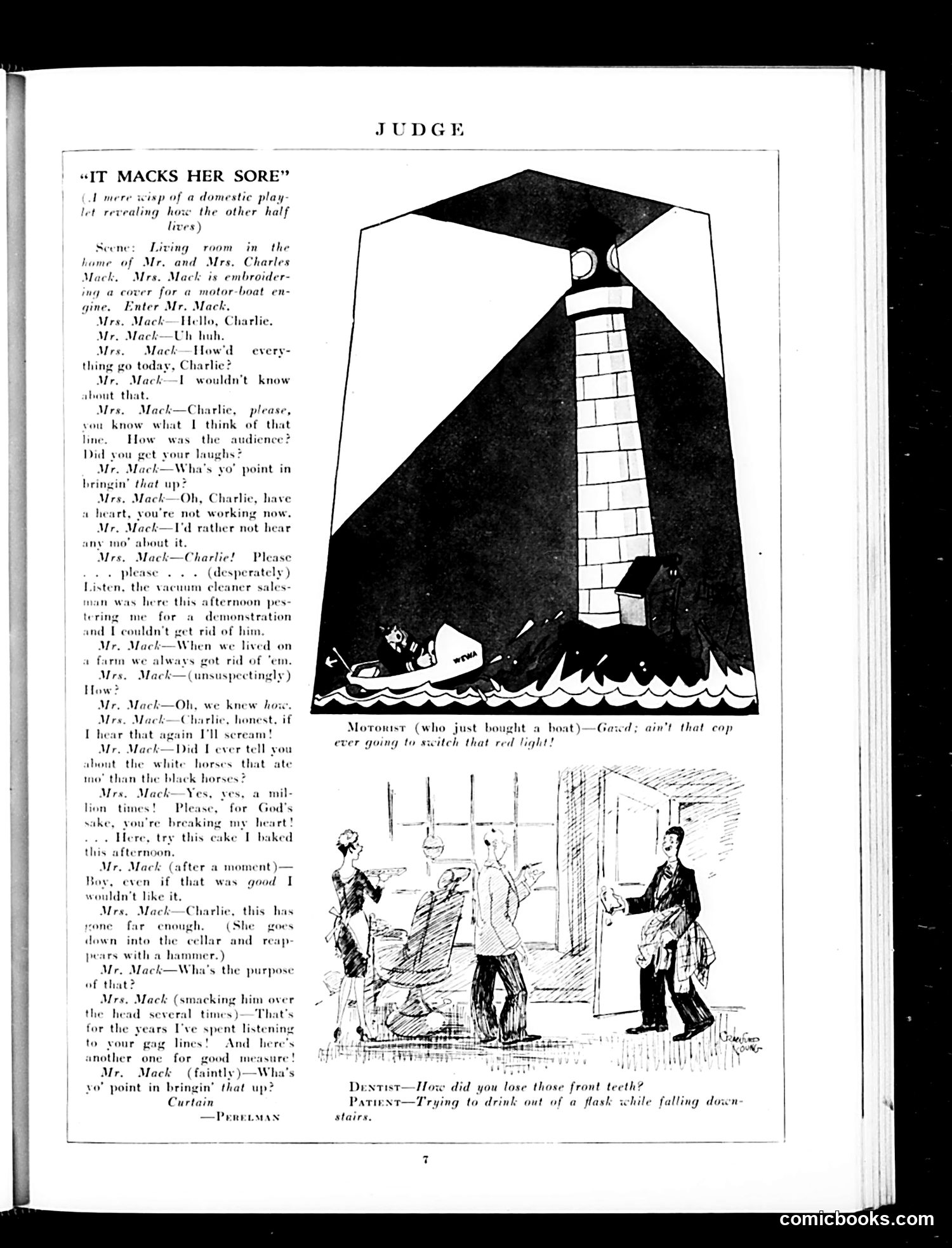
This domestic comedy sketch satirizes the archetypical bored, unresponsive husband. Mr. Mack embodies the stereotypical indifferent spouse who ignores his wife's attempts at conversation, repeatedly tells tired jokes about white horses, and shows no appreciation for her efforts—whether embroidering a motorboat cover or baking cake. Mrs. Mack represents the exasperated housewife, driven to literal violence (beating him with a hammer) by years of emotional neglect and tedious repetition. The satire mocks both the husband's emotional obliviousness and the wife's desperate measures for attention. The accompanying cartoon shows a motorist oblivious to a lighthouse beacon while buying a boat—visual parallel to Mr. Mack's willful blindness to his wife's needs. The dentist/patient vignette (bottom) offers unrelated slapstick humor typical of Judge's variety format. The piece critiques early-20th-century gender dynamics and marital indifference with dark comedic violence as the punchline.
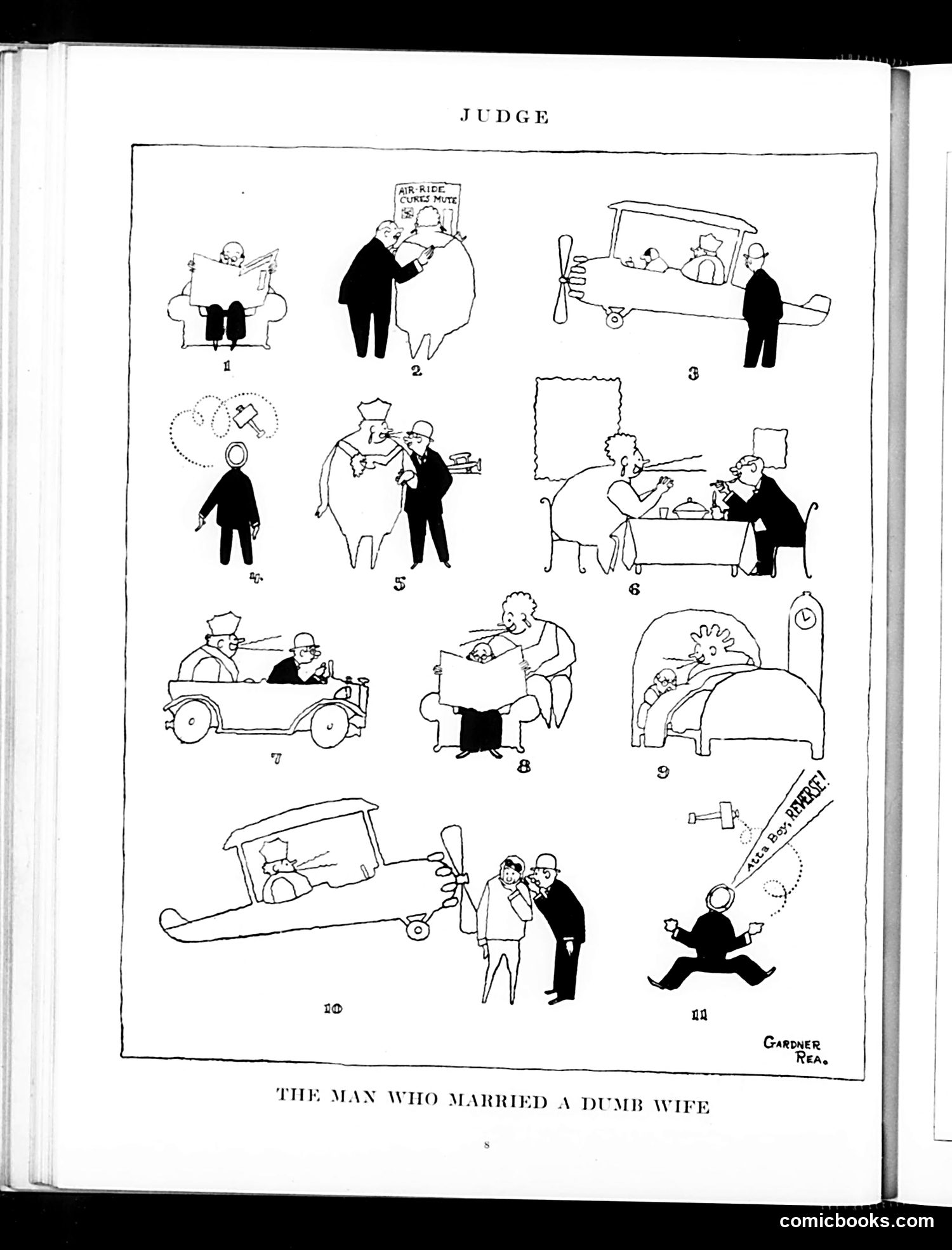
This is a satirical comic strip depicting the misadventures of a man whose wife is portrayed as intellectually disabled or unable to communicate effectively. The 11 panels show escalating domestic chaos: she mishandles modern technology (air rifle, airplane), creates confusion with professionals (doctor, nurse), ruins meals, loses documents, causes car accidents, and generally creates mayhem through incompetence. The humor relies on period stereotypes about women's intellectual capacity and the assumption that a man marrying such a woman deserves the resulting problems. The title suggests this is commentary on poor mate selection or marriages based on superficial attraction rather than compatibility. The strip reflects early 20th-century attitudes toward gender roles and education, where women's perceived "dumbness" was treated as comic fodder for male readers of this satirical magazine.
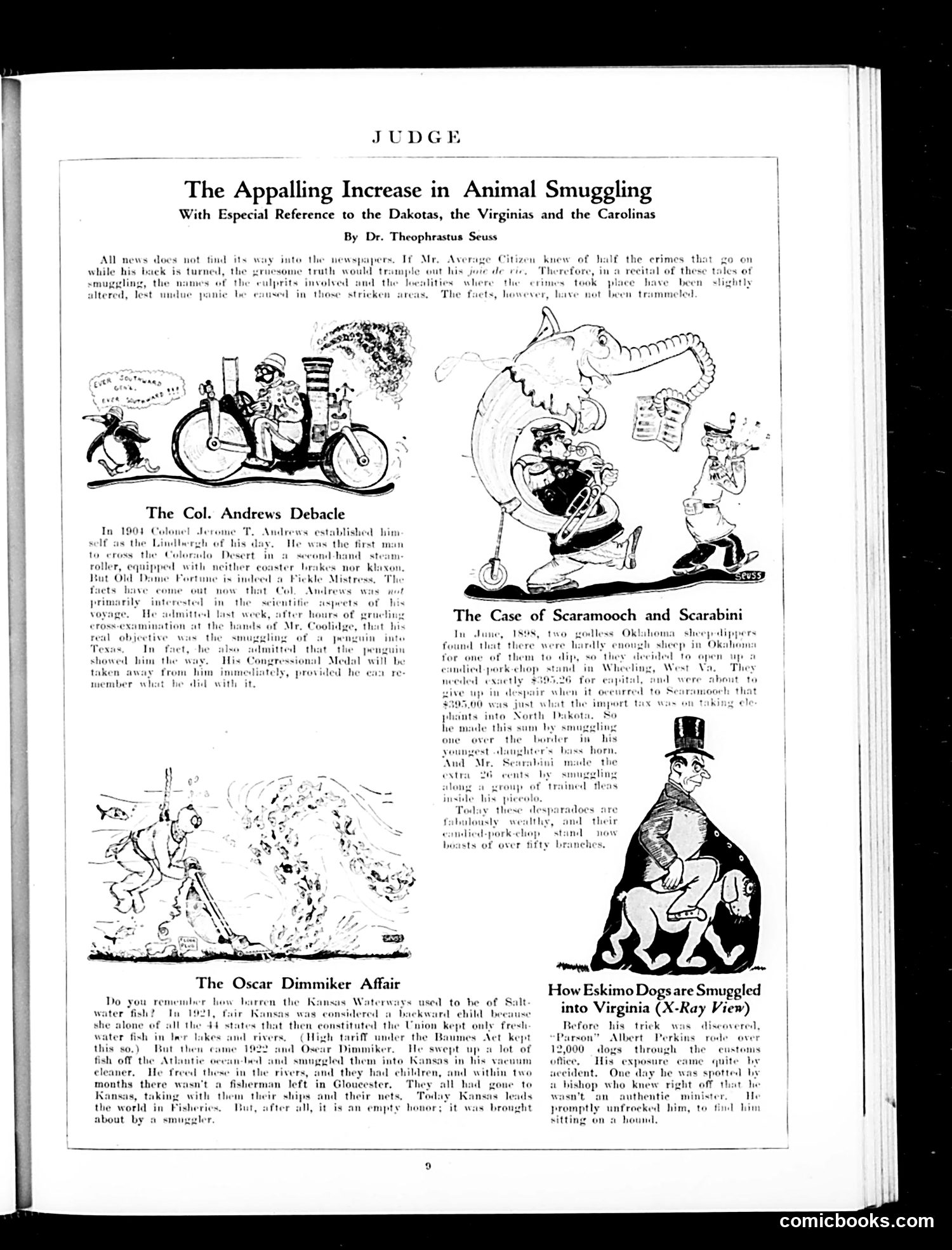
This page satirizes early 20th-century animal smuggling via absurdist tall tales by "Dr. Theophrastus Seuss" (likely a pseudonym). Each illustrated anecdote mocks smuggling operations: **Col. Andrews Debacle**: A man crosses a desert in a steamroller to smuggle a penguin into Texas, supposedly for scientific purposes. **Scaramooch and Scarabini**: Two Oklahoma smugglers import sheep illegally, profiting via hidden tariff evasion. **Oscar Dimmiker Affair**: A Kansas smuggler vacuums fish from the Atlantic and transports them inland. **Eskimo Dogs**: An X-ray view cartoon shows dogs being smuggled into Virginia. The satire targets Prohibition-era and post-WWI tariff enforcement failures. The outlandish smuggling methods—steamrollers, vacuum cleaners, trained fleas—exaggerate real contraband problems while mocking both smugglers' ingenuity and authorities' incompetence. The regional focus (Dakotas, Virginias, Carolinas) suggests these were actual smuggling hotspots.
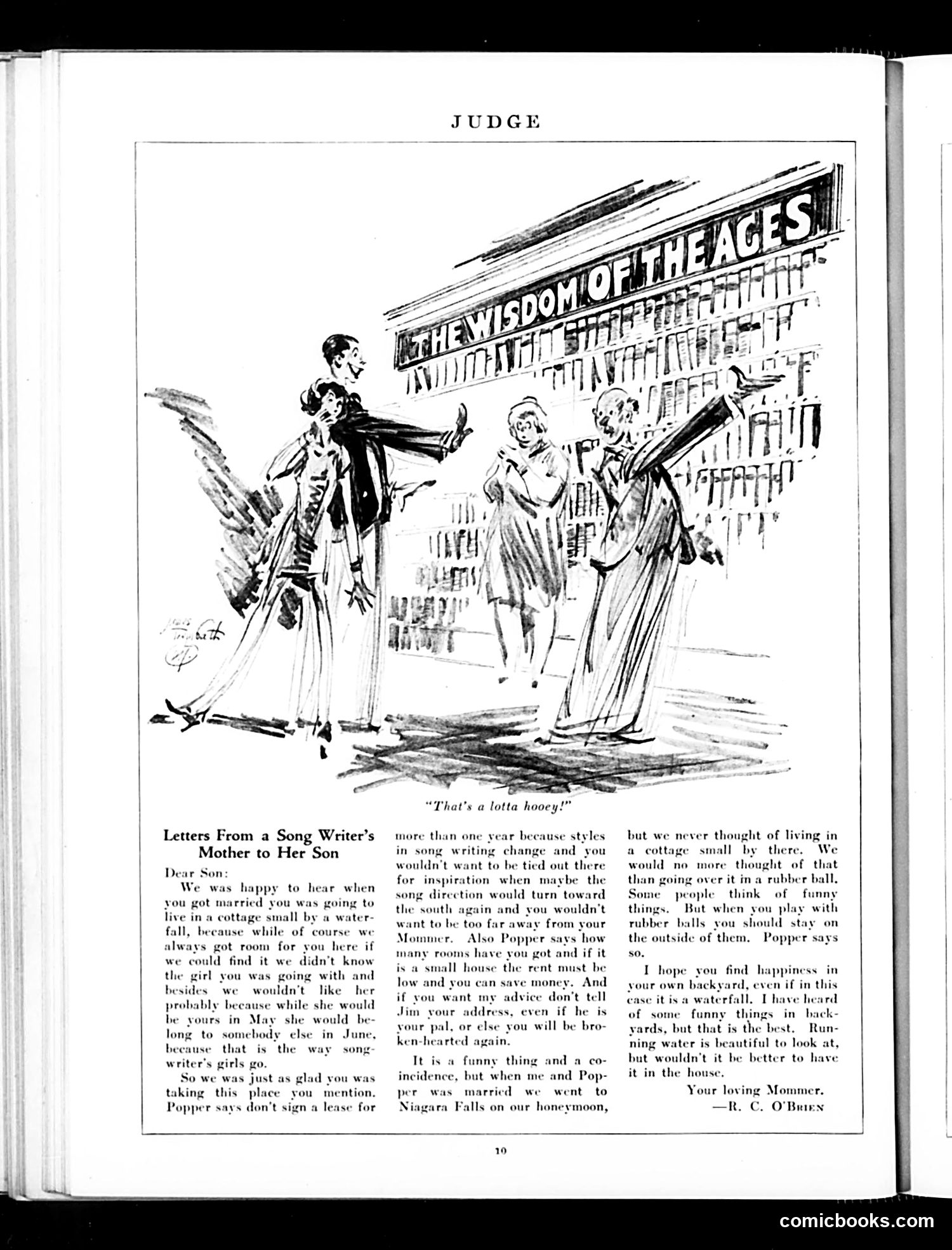
This page contains a humorous letter from a mother to her son who has just married and plans to live in a cottage by a waterfall—likely referencing the popular 1912 song "A Little Cottage Small by a Waterfall." The satire targets **song-writing culture** and **bohemian lifestyles**. The mother's folksy, grammatically imperfect letter pokes fun at: 1. **Song writers' romantic clichés**: The cottage-by-waterfall imagery was trendy in popular songs, mocked here as impractical fantasy. 2. **Unstable relationships**: The joke about the bride belonging to "somebody else in June" satirizes the rapid turnover in song-writers' romantic lives. 3. **Impracticality of artists**: The mother's practical concerns (lease terms, rent, utilities) clash absurdly with artistic inspiration-seeking, suggesting artists were viewed as irresponsible. The cartoon illustration shows fashionably dressed figures, likely representing the song-writing crowd's pretentiousness. The phrase "That's a lotta hooey!" reinforces the skepticism toward romanticized artistic lifestyle claims.
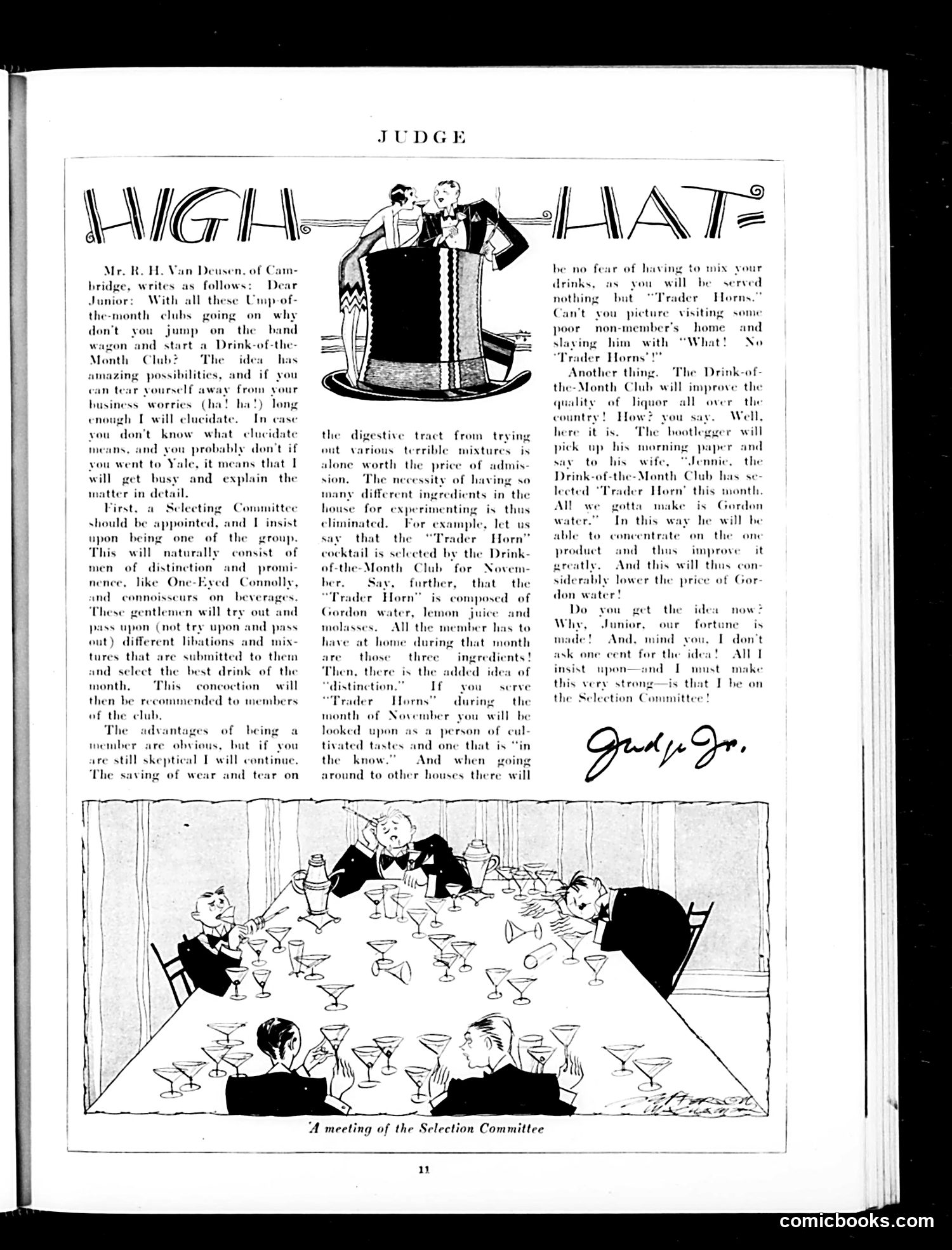
This 1920s piece satirizes Prohibition-era drinking culture through a "Drink-of-the-Month Club" proposal. A reader suggests establishing a gentlemen's committee to select and promote a featured cocktail monthly—mirroring legitimate "of-the-month" clubs. The satire operates on multiple levels: it mocks the pretension of connoisseurship during Prohibition (when alcohol was illegal), the bureaucratic absurdity of formal selection committees, and bootlegger economics. The joke hinges on the gap between the scheme's "civilized" presentation and its reality—illegal alcohol distribution dressed up as sophisticated club activity. The cartoon below shows the Selection Committee meeting, surrounded by countless cocktail glasses, illustrating the absurd excess of their "work." The writer's eagerness to join the committee and his overwrought enthusiasm parody how Americans circumvented Prohibition through elaborate social structures and rationalization.
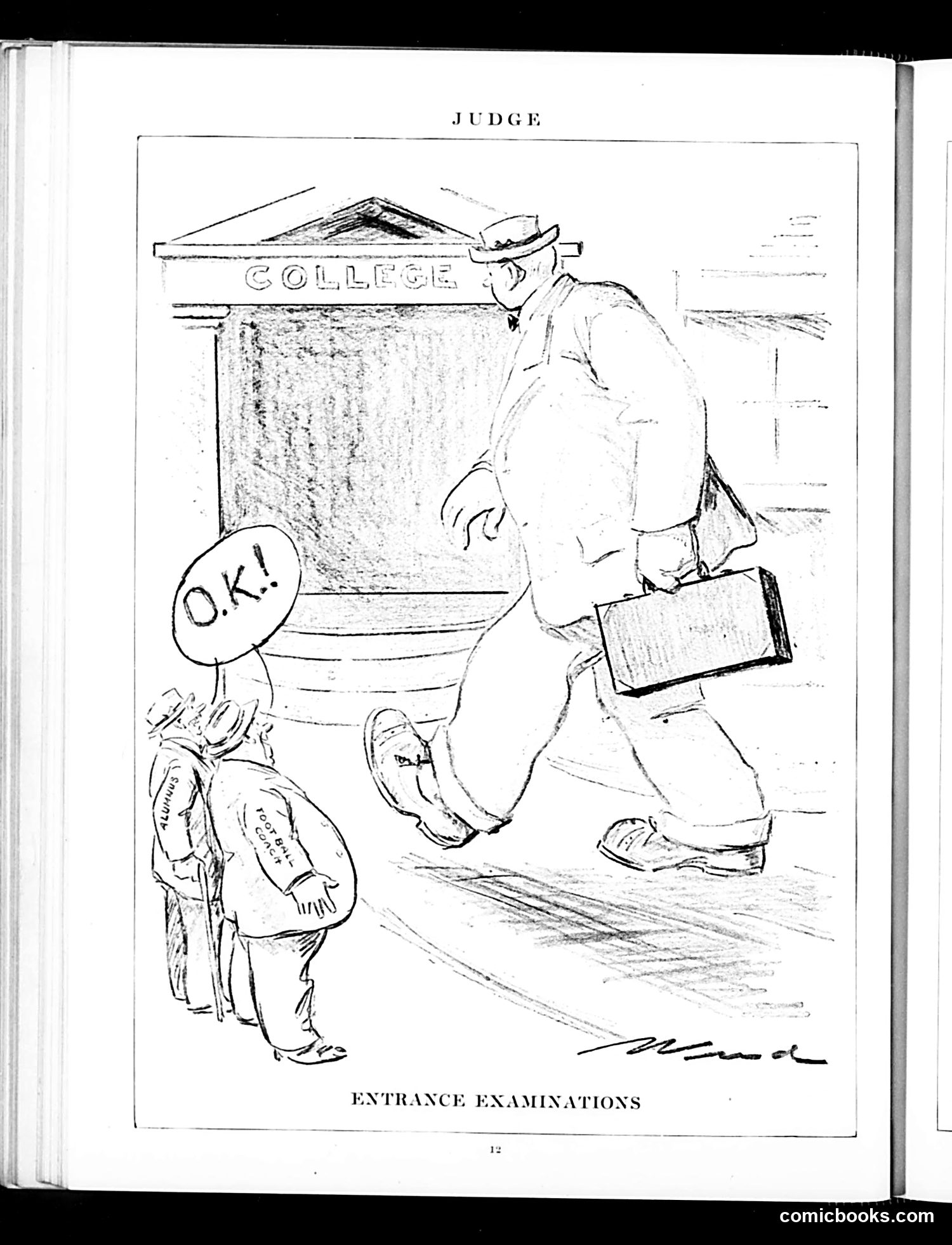
This cartoon satirizes college entrance exams. A stern, authoritative figure (representing an examiner or college official) holds a briefcase and stands before a classical "College" building. He says "O.K.!" to two small, anxious figures—appearing to be students or applicants—who wear what look like school uniforms or poor clothing. The satire likely critiques the intimidating nature of entrance examinations and the power imbalance between institutional gatekeepers and hopeful applicants. The students' diminished size emphasizes their vulnerability before authority. The cartoon suggests anxiety about whether applicants will gain admission, mocking both the formality of the process and perhaps the class barriers to higher education access. The casual "O.K." dismissal adds ironic commentary on the students' fates.
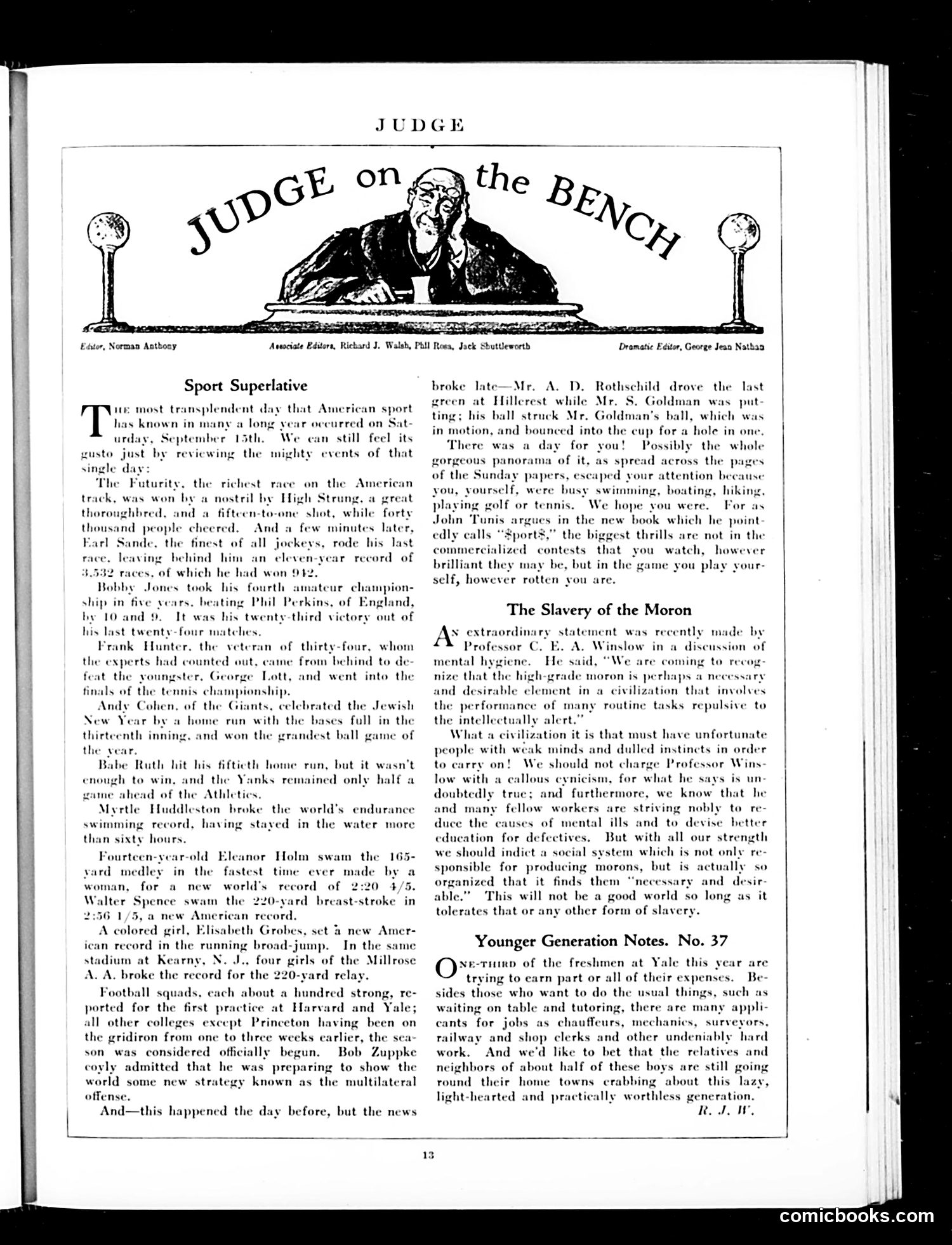
This page from *Judge* satirical magazine (dated September 15th, based on context) celebrates American sports achievements while critiquing social attitudes. **"Sport Superlative"** lists genuine 1920s athletic records: Babe Ruth's home runs, Bobby Jones's golf victories, Earl Sande's jockey record, and various swimming/racing accomplishments. The satire targets how newspapers sensationalize sports while readers ignore them for leisure activities—Tunis's book "Sport" argues real thrills come from playing yourself, not consuming spectacle. **"The Slavery of the Moron"** critiques Professor C.E.A. Winslow's statement that "high-grade morons" are necessary for civilization to function, handling "repulsive" routine tasks. The editorial attacks this callous reasoning: society shouldn't rely on mentally disabled people for labor. While acknowledging Winslow's genuine research into mental health causes, *Judge* indicts a social system that tolerates—rather than prevents—intellectual disability. Both sections satirize American society's contradictions: obsession with sports spectacle versus actual participation, and acceptance of exploited underclasses rather than systemic reform.
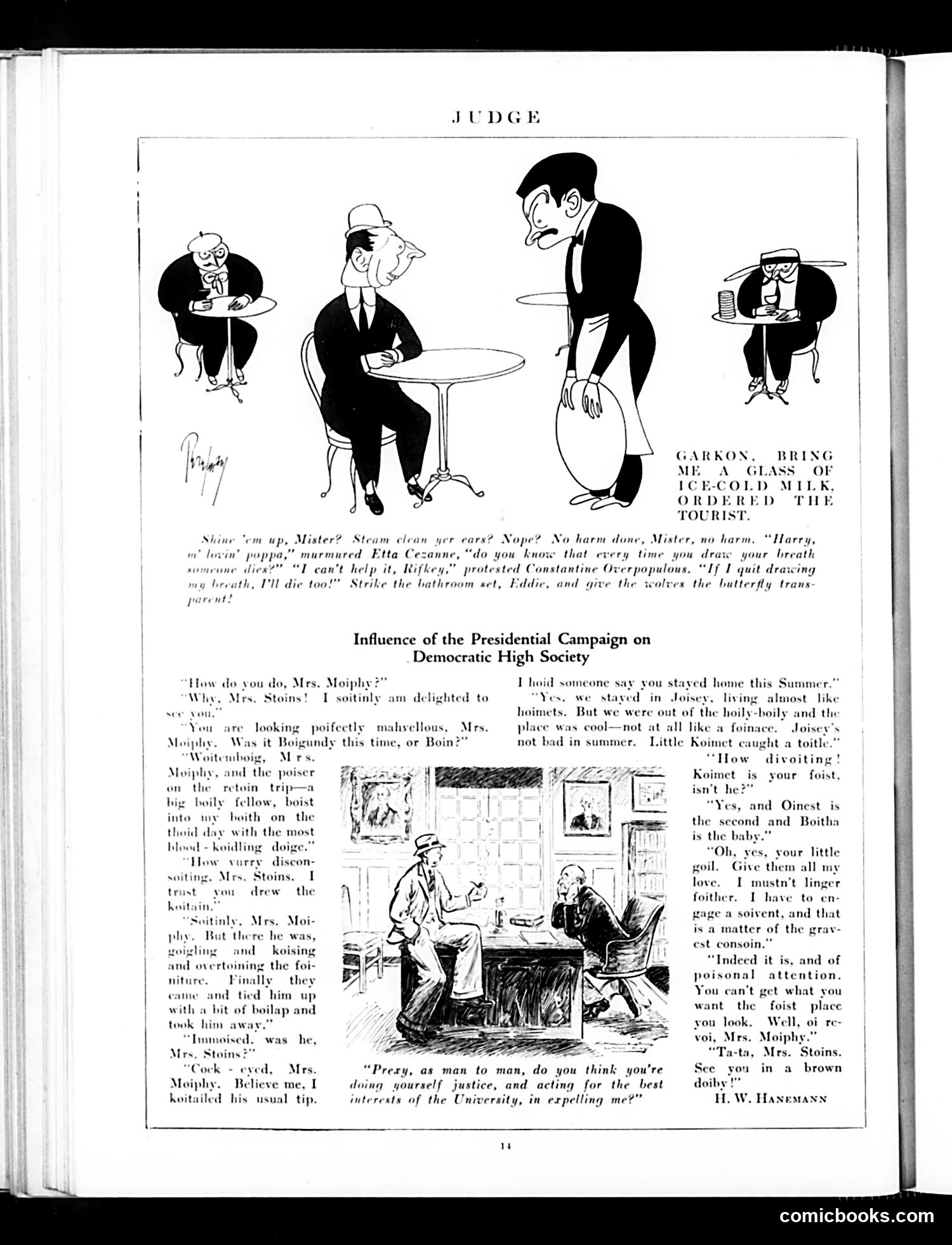
**Top Cartoon ("Judge"):** A waiter serves ice-cold milk to a tourist—likely satirizing an affectation or pretense in upscale dining. The exaggerated dialogue about people dying when they stop breathing appears nonsensical or absurdist humor typical of the era's comic style. **Main Article/Cartoon:** "Influence of the Presidential Campaign on Democratic High Society" mocks wealthy New York socialites (Mrs. Murphy and Mrs. Stoins) with heavily exaggerated working-class accents ("Joisey," "foist," "boily"). They discuss summer vacations and children with deliberately comedic malapropisms. The satire targets how a presidential campaign apparently influenced even high society's behavior and conversation—though the specific campaign year remains unclear from this page alone. **Bottom Cartoon:** A conversation between "Prezy" (appears to be a university president) and an expelled student arguing his case, touching on themes of academic justice and institutional authority. The overall humor relies on class-based caricature and period-specific social commentary about campaign culture's reach into elite circles.
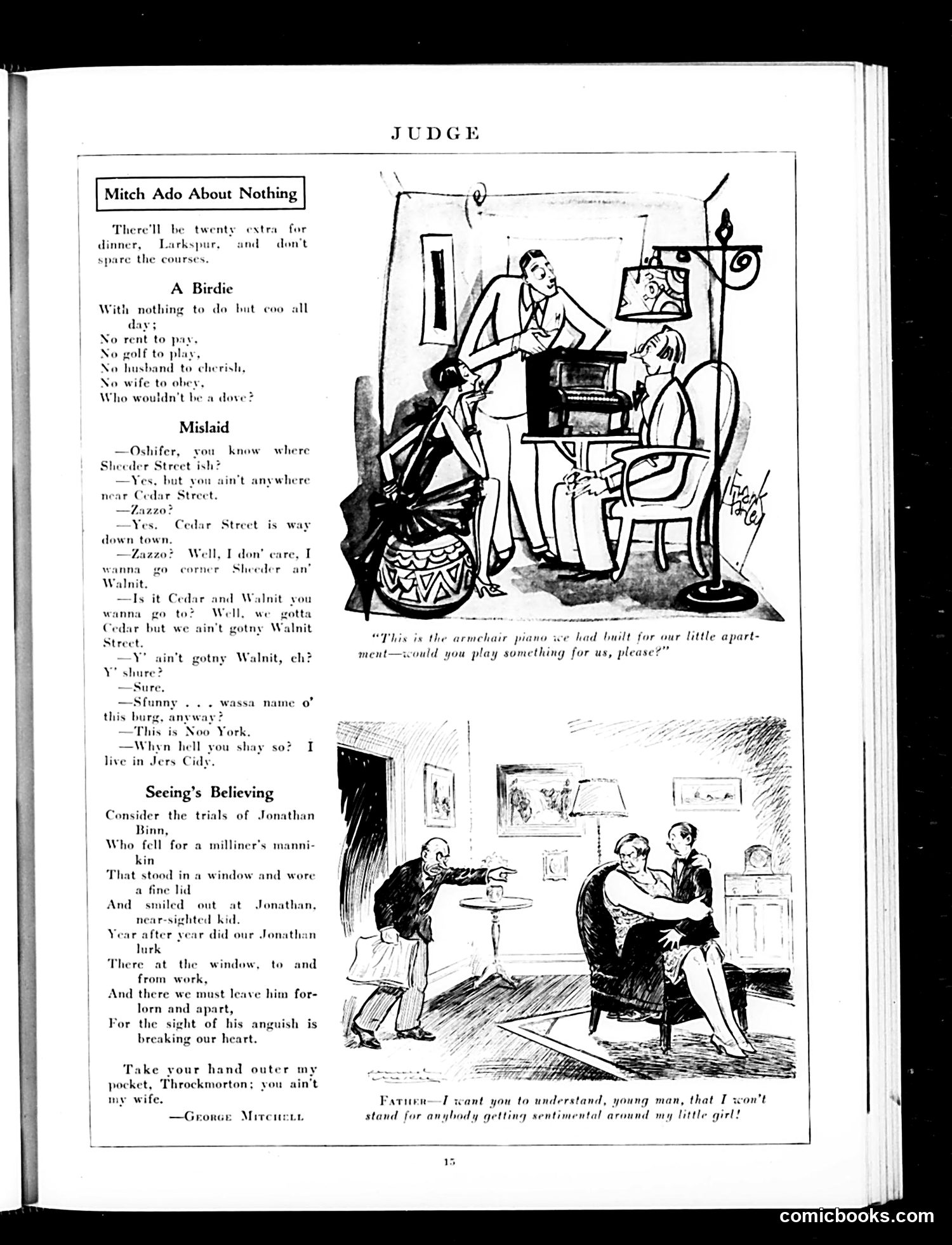
This page contains three satirical pieces typical of early 20th-century American humor: **"Mitch Ado About Nothing"** mocks the idle wealthy—a woman planning an elaborate dinner without practical concerns. **"Mislaid"** uses thick dialect humor (common in this era) to joke about an Irish policeman's confusion regarding street names in New York City, playing on ethnic stereotypes about Irish immigrants and their speech patterns. **"Seeing's Believing"** satirizes a near-sighted man's romantic obsession with a department store mannequin—absurdist humor about modern consumer culture and foolishness. The cartoon illustrations show domestic and urban scenes. The page emphasizes class-based humor (wealthy indulgence, working-class confusion) and ethnic stereotyping typical of Judge's satirical approach. The final caption about a father protecting his daughter reflects period anxieties about courtship and propriety.
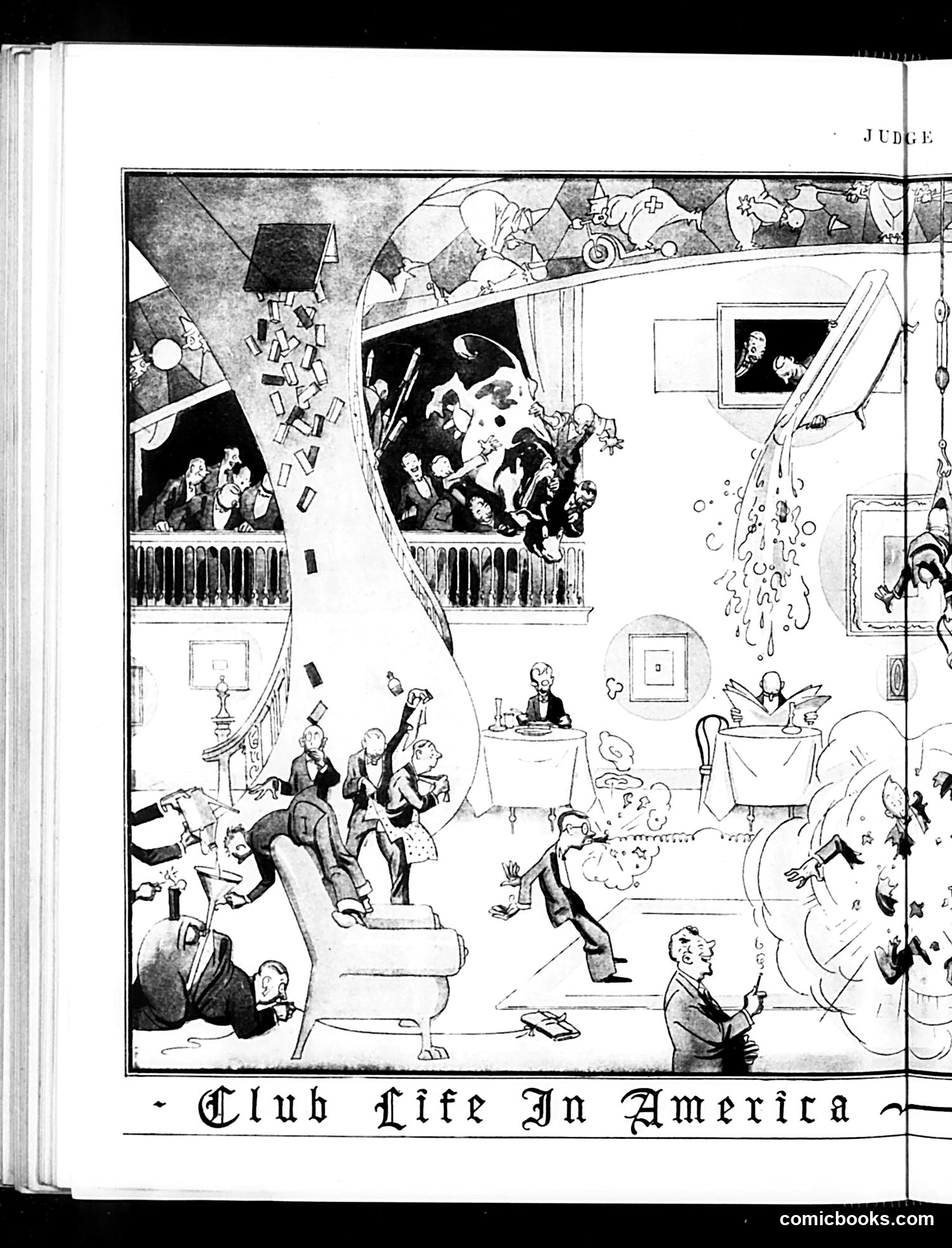
This satirical cartoon depicts chaos at what appears to be an exclusive social club. The illustration shows wealthy members engaged in various forms of misbehavior and disorder—people falling down stairs, throwing objects, creating general mayhem while others dine and conduct business. The satire likely critiques the hypocrisy of upper-class "club life," suggesting that despite the pretense of refinement and decorum, these establishments harbored crude, undisciplined behavior. The juxtaposition of formal dining and social pretense against scenes of chaos and loss of control emphasizes the gap between the clubs' refined image and the actual conduct of their members. The cartoon mocks American aristocratic institutions and their members' lack of genuine civility.
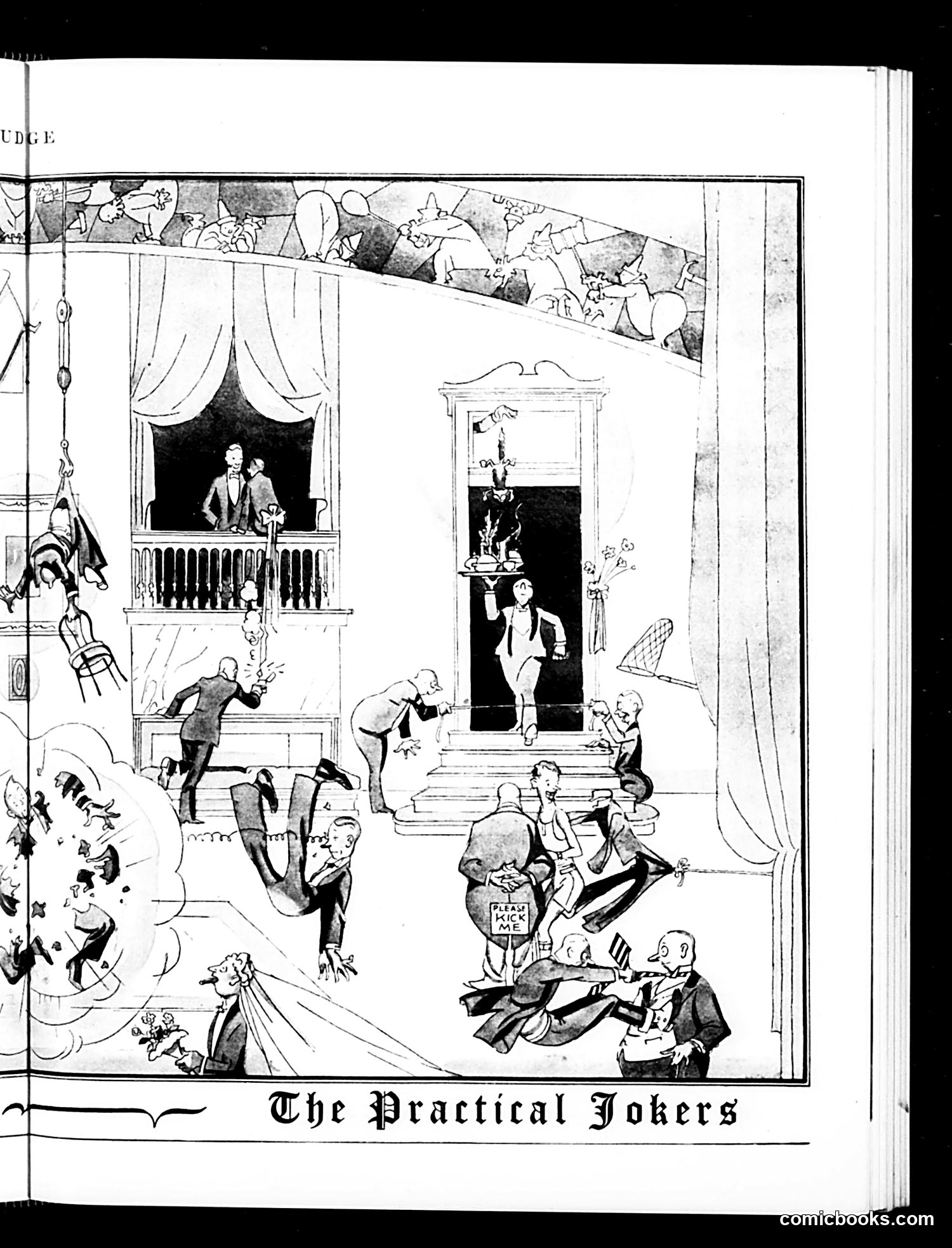
This satirical cartoon depicts chaos at what appears to be an elegant formal gathering or reception. Well-dressed men engage in various pranks and disruptions—one figure is suspended by rope, others are falling or tumbling, and there's general mayhem on the stairs and floor. A man holds a sign reading "PLEASE KICK ME." The cartoon satirizes the behavior of society's upper-class men who, despite their formal attire and refined settings, act like immature troublemakers. The title "The Practical Jokers" suggests mockery of wealthy men who use pranks as entertainment, disrupting dignified occasions. The contrast between the elegant interior architecture and the juvenile chaos emphasizes Judge magazine's critique of the vanity and immaturity of the leisure class.
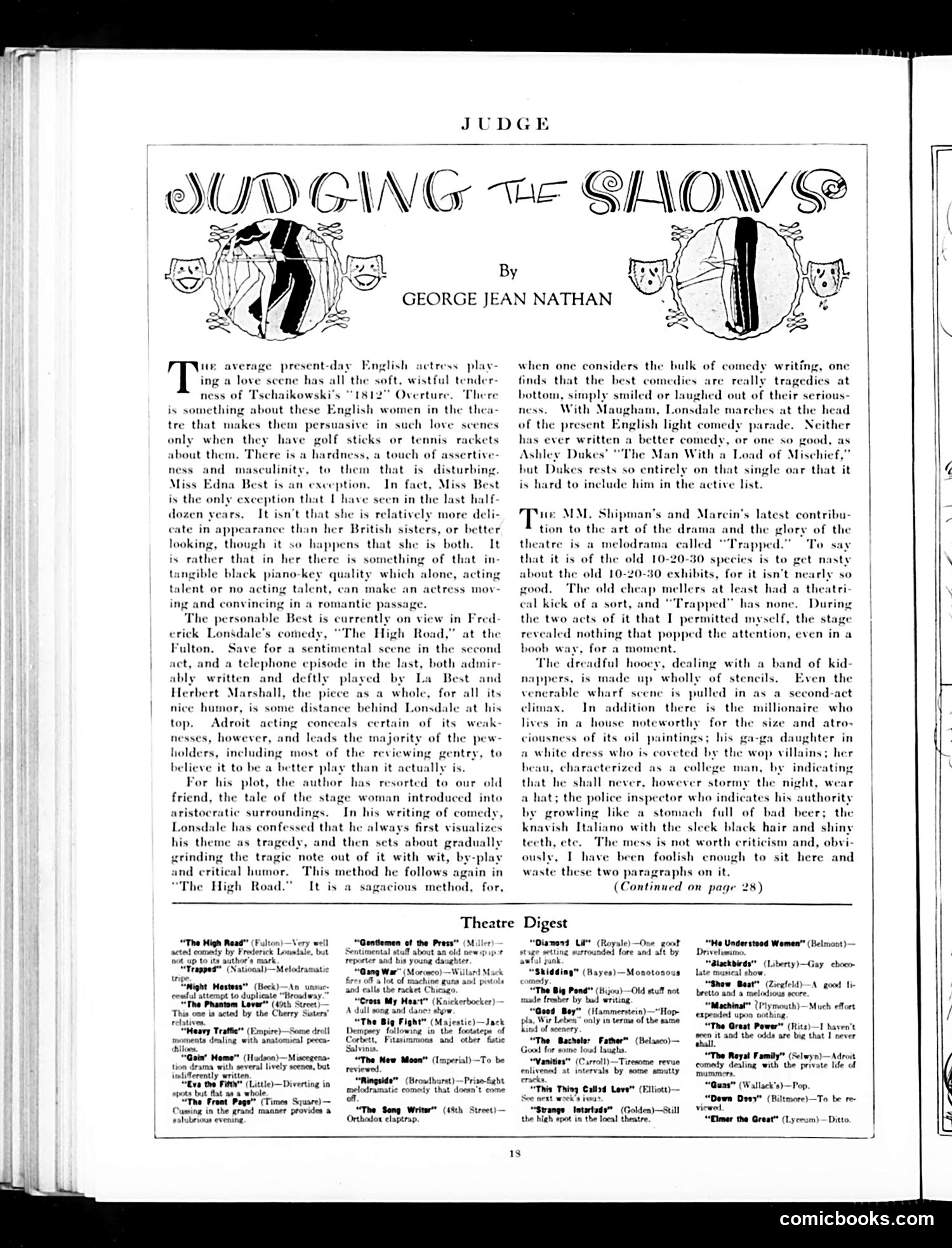
This page from Judge magazine contains a theater review by George Jean Nathan critiquing contemporary English plays and actresses. The decorative header "JUDGING THE SHOWS" features theatrical masks and silhouettes. Nathan discusses English actresses' tendency toward hardness and masculinity in romantic scenes, praising Edna Best as an exception for her delicate quality. He reviews Frederick Lonsdale's comedy "The High Road," noting that while competently acted, it follows Lonsdale's method of visualizing tragedies then extracting the tragic elements through wit. Nathan also harshly critiques a melodrama called "Trapped" by Shipman and Marcin, dismissing it as derivative hokum made of "stencils"—formulaic elements like the millionaire with oil paintings, his daughter in white, a villainous Italian character, and obligatory wharf scenes. He suggests the play barely merits critical attention but has written about it anyway. The page reflects early 20th-century theater criticism standards and period attitudes toward dramatic quality and national character types.
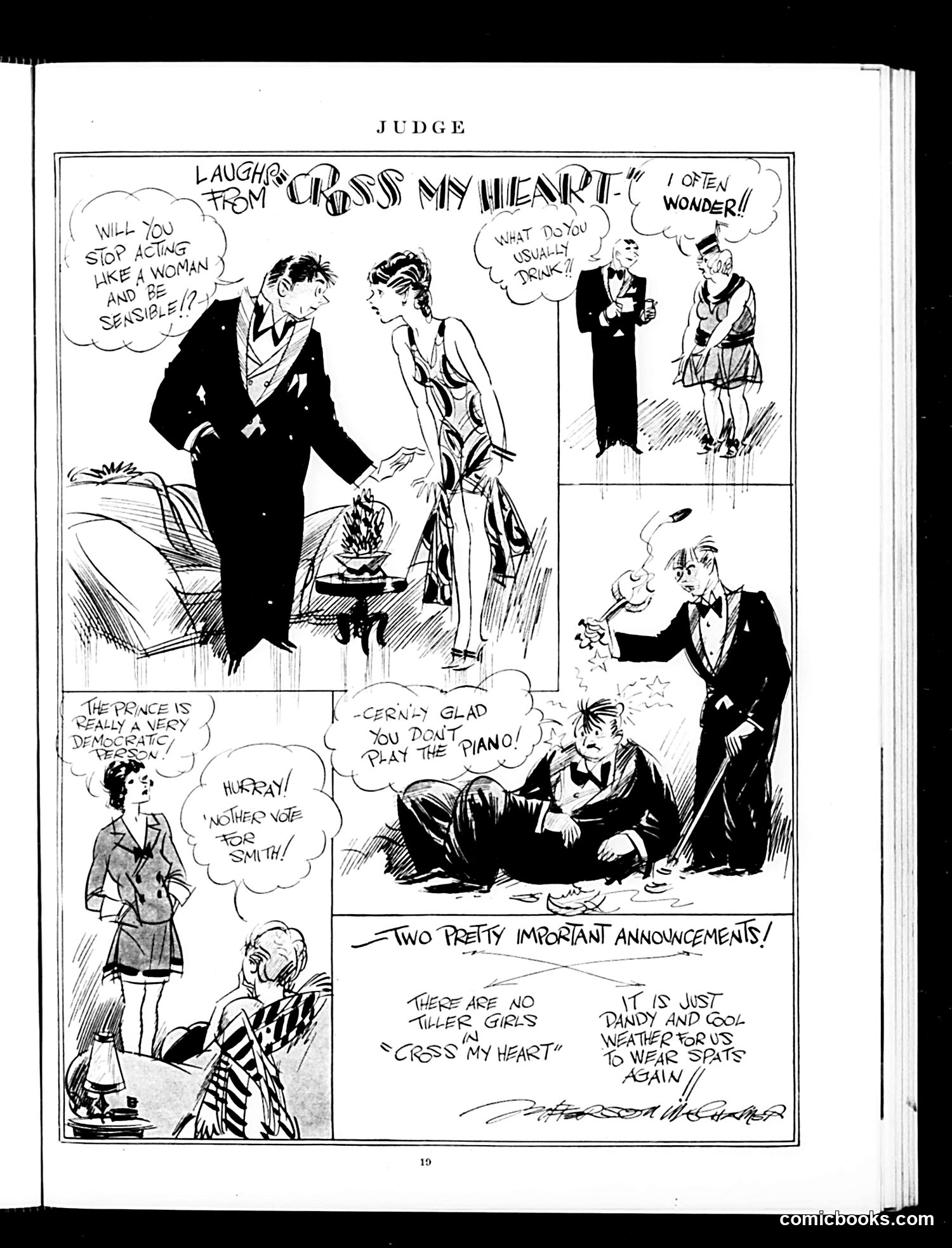
This **Judge** comic satirizes changing social norms and generational attitudes. The title "Cross My Heart" references a popular song, and the cartoon shows an older man repeatedly asking a young woman to "stop acting like a woman" and "be sensible"—complaints about modern female behavior. The satire targets outdated masculine authority: the man tries to impose Victorian propriety while the woman dismisses his concerns. The two concluding announcements mock his irrelevance—first, that "tiger girls" no longer exist (the demure ideal he wants), and second, that fashion now dictates "pandy and cool weather" over formal propriety. The cartoon ridicules older generations' inability to accept the "New Woman" of the 1920s era: independent, fashionable, and uninterested in male disapproval. The joke is on the bewildered man clinging to outdated standards.
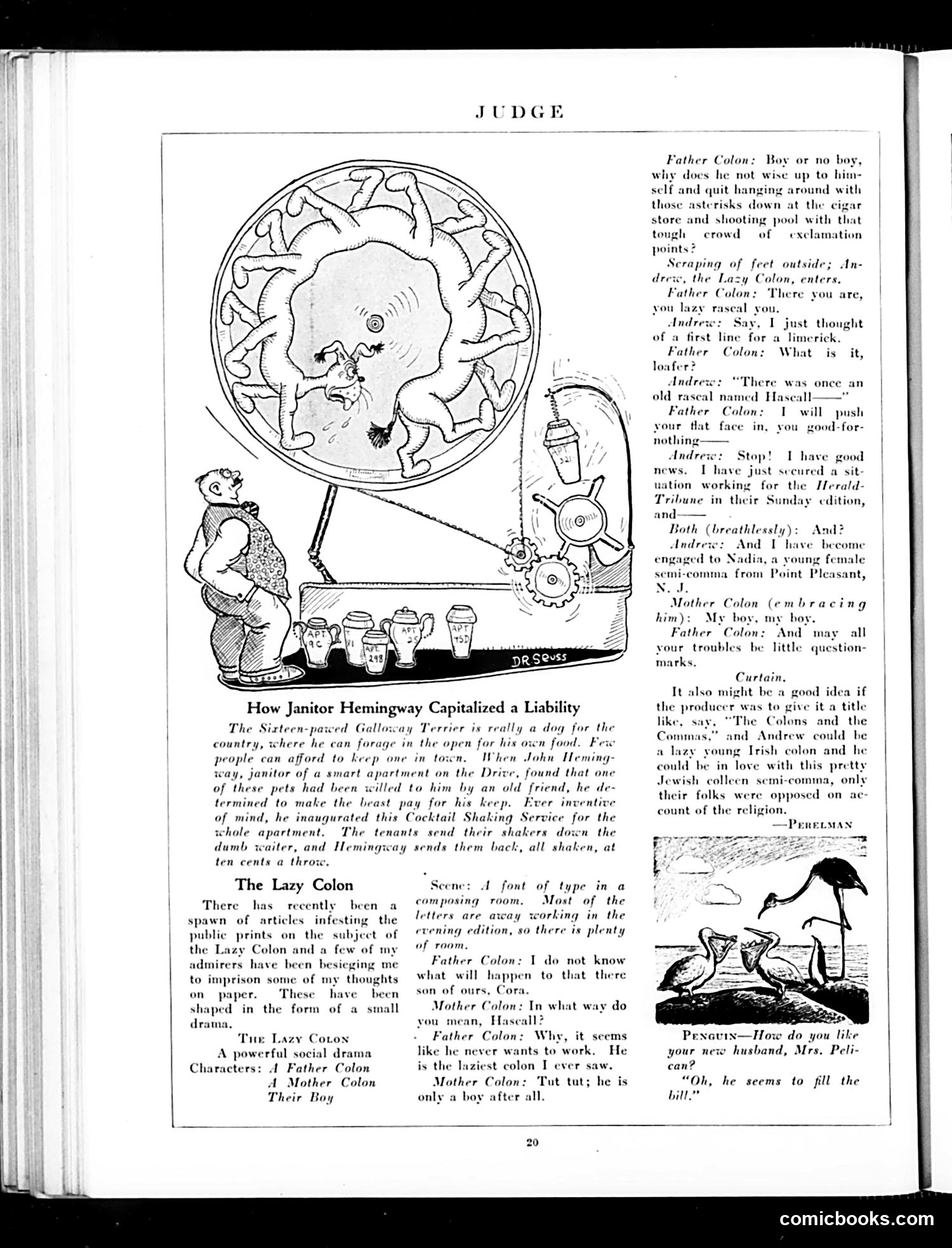
This page contains two satirical pieces: **"How Janitor Hemingway Capitalized a Liability"** mocks class mobility and entrepreneurship. A janitor inherits an expensive dog he can't afford to keep, so he monetizes it by running a "Cocktail Shaking Service"—tenants send their cocktail shakers down the dumbwaiter, the dog shakes them, and they're returned for ten cents. The satire targets both working-class ingenuity and wealthy apartment dwellers' frivolous spending during what appears to be Prohibition-era excess. **"The Lazy Colon"** is a pun-based domestic drama using printing-press terminology as characters. The father, mother, and son "Andrew" are punctuation marks living in a composing room. The satire mocks contemporary concern about "lazy colon" medical conditions (then a popular health anxiety) while using typographic wordplay—asterisks as delinquent friends, exclamation points as rough crowds. The son's redemption through employment and engagement provides gentle social commentary on respectability and family expectations.
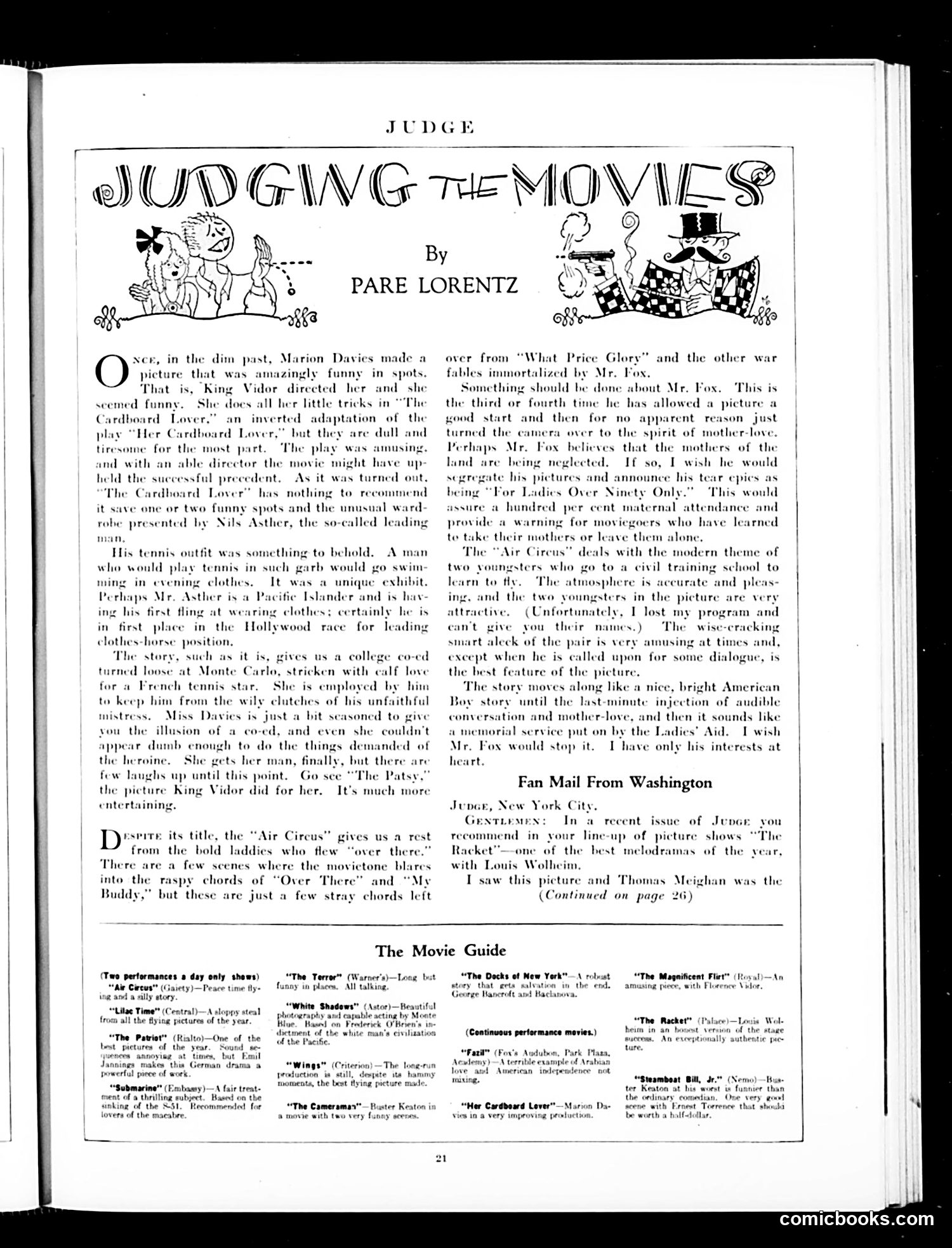
This is a film review column by Pare Lorentz critiquing recent movies. The cartoonish header illustrations depict theatrical entertainment figures. **Main subjects reviewed:** 1. **"The Cardboard Lover"** - starring Marion Davies (directed by King Vidor). Lorentz criticizes the film as dull despite Davies's "little tricks," praising only Nils Asther's absurdly elaborate tennis outfit, which he jokingly suggests marks Asther as Hollywood's leading "clothes-horse." 2. **"The Air Circus"** - about young pilots training. Lorentz complains that director Fox repeatedly abandons plot momentum to inject sentimental "mother-love" themes, repeatedly turning movies into tearjerkers aimed at older women rather than general audiences. **The satire's point:** Lorentz satirizes both Davies's limited acting range and Fox's formulaic reliance on maternal sentimentality to manipulate audiences emotionally—a common 1920s film device that Lorentz finds creatively lazy and patronizing. The page also includes a "Movie Guide" listing contemporary films and a "Fan Mail" section praising *The Racket*.
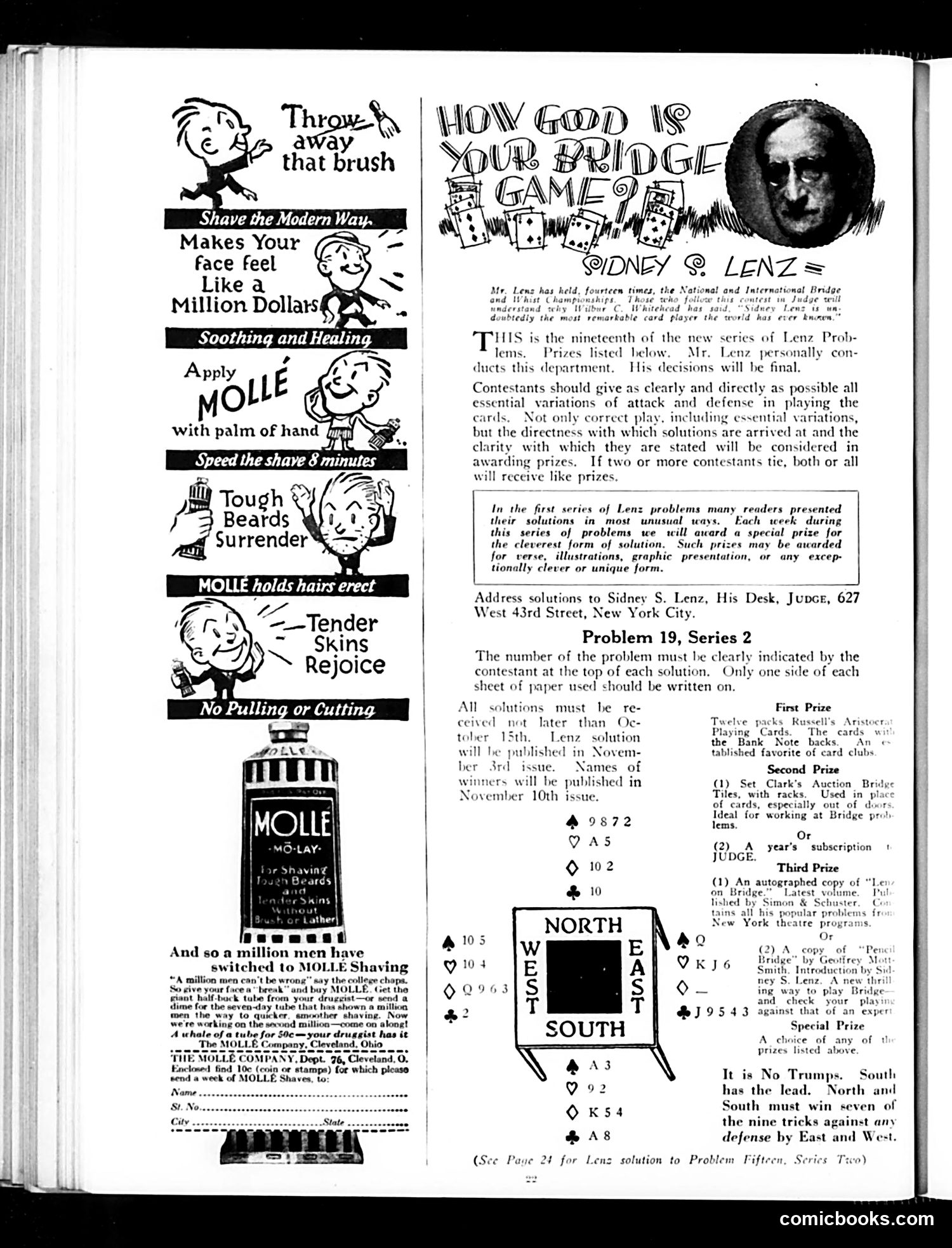
This page combines **advertising** (left side) with **bridge card game content** (right side). The **Molle shaving cream ad** features cartoon men promoting the product with claims about speed and smoothness. The repeated phrase "a million men" is the ad's central hook—implying widespread popularity validates the product. The **right side** presents "Problem 19, Series 2" from Sidney S. Lenz, a famous bridge expert of the early 20th century. Judge ran an ongoing series of bridge puzzles that readers could solve competitively for prizes (including bridge instruction books, card sets, and subscriptions to Judge itself). The specific hand shown requires North and South to win seven of nine tricks with "No Trumps" as the contract. This reflects bridge's enormous popularity among American leisure classes in the 1920s-30s—Judge's target audience. The puzzle series was both entertainment and a status marker: bridge was an intellectual game for educated, affluent readers.
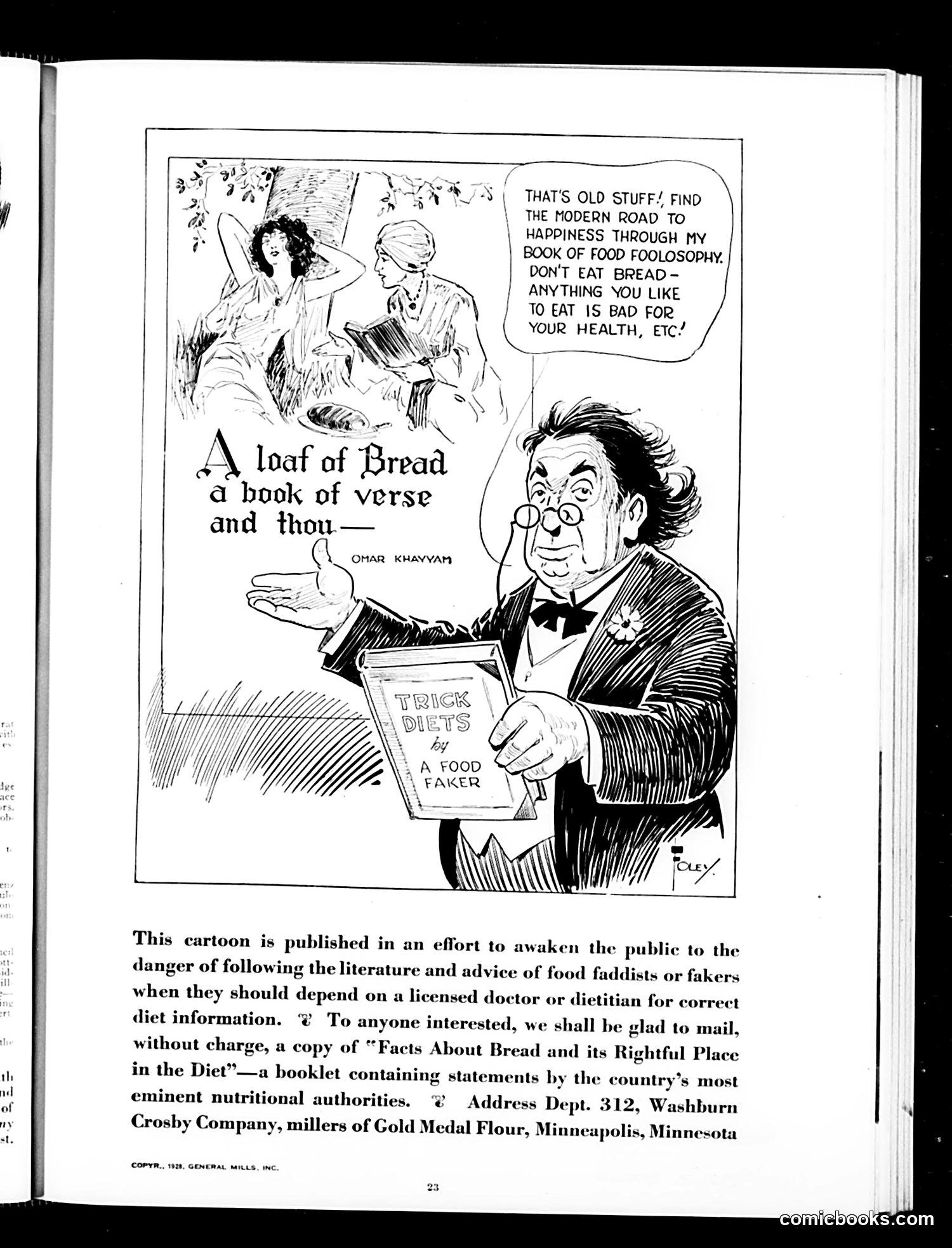
This 1928 cartoon satirizes the "food faddist" craze—trendy diet gurus promising health through restrictive eating. A slick charlatan in formal dress hawks his book "Trick Diets by a Food Faker," dismissing bread as unhealthy while promoting vague "food foolosophy." The upper panel contrasts this with Omar Khayyam's famous poetic line celebrating simple pleasures (bread, wine, companionship)—implying traditional wisdom beats modern quackery. The cartoon functions as **advertising** for Washburn Crosby Company (Gold Medal Flour), which funded this public-service warning. By positioning themselves as defenders of nutritional science against charlatans, they promote bread consumption and position flour-milling as legitimate. The irony: the "educational" cartoon is itself corporate messaging, though the anti-faddist message itself was reasonable for the era.
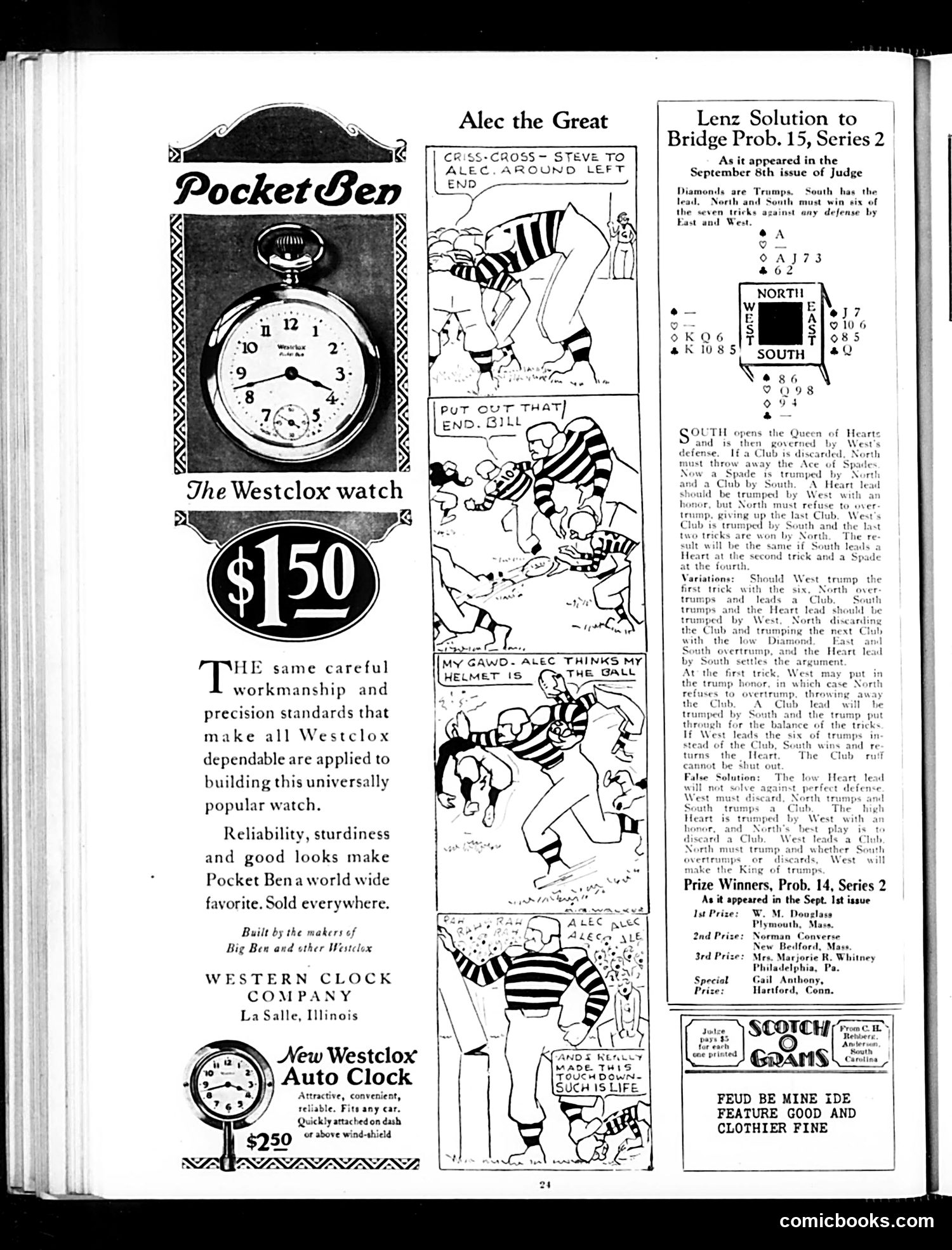
This page is primarily **advertising**, featuring two Westclox watch ads (Pocket Ben at $1.50 and an Auto Clock at $2.50) that dominate the left and bottom portions. The center contains a **comic strip titled "Alec the Great,"** depicting what appears to be a football game. The narrative shows Steve instructing Alec to cross and go around the left end, then tells him to "put out that end, Bill." Alec responds with apparent indignation ("My gawd—Alec thinks my helmet is the gall"). The strip satirizes either miscommunication in sports or Alec's perceived arrogance/entitlement—the joke being his offended reaction to a direct order. The right side contains a **bridge card game problem** solution, a feature typical of Judge magazine's mixed content of puzzles and games. At the bottom is a **Scotch whisky advertisement** and a tagline: "FEUD BE MINE IDE / FEATURE GOOD AND / CLOTHIER FINE" (text appears OCR-garbled). The page reflects early-20th-century magazine format: serious advertising alongside light humor and recreational puzzles.
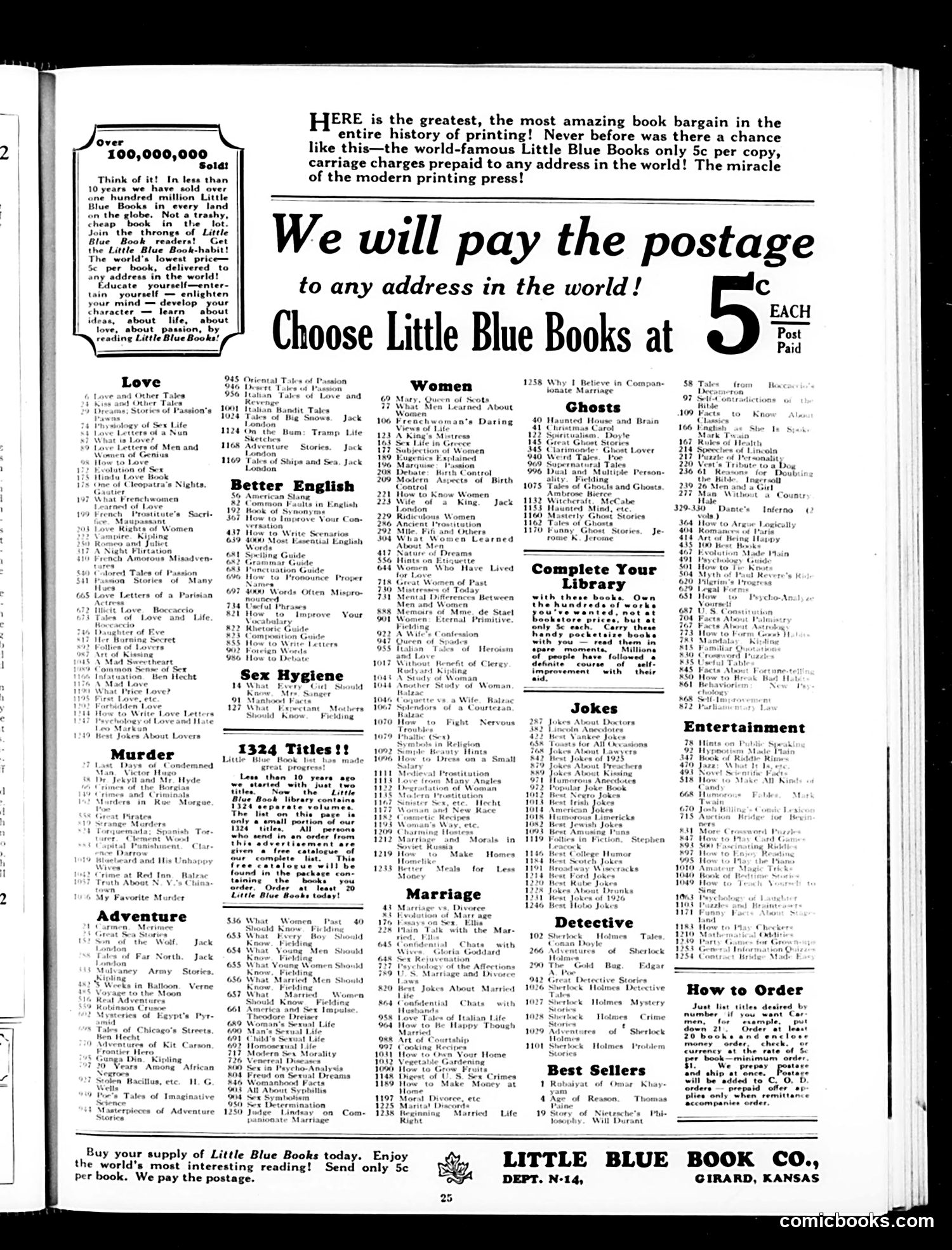
This page is primarily a **mail-order catalog advertisement**, not political satire. The Little Blue Books were a real, famous publishing phenomenon of the 1920s-30s—inexpensive 5-cent paperbacks sold by the millions. The ad emphasizes their remarkable commercial success (100 million sold in 10 years) and advertises their catalog of 1,324 titles across categories like Love, Better English, Women, Sex Hygiene, Marriage, Detective stories, and Entertainment. The company promises to pay postage anywhere in the world. Notable for a modern reader: the catalog's frank discussion of sexuality (numerous titles about "tales of passion," sexual life, birth control) was genuinely radical for the era. These books democratized access to literature, education, and information about taboo subjects. The publisher, based in Girard, Kansas, represented populist, progressive values—making knowledge available to ordinary people cheaply. This reflects early-20th-century optimism about education and printing technology, not satire.
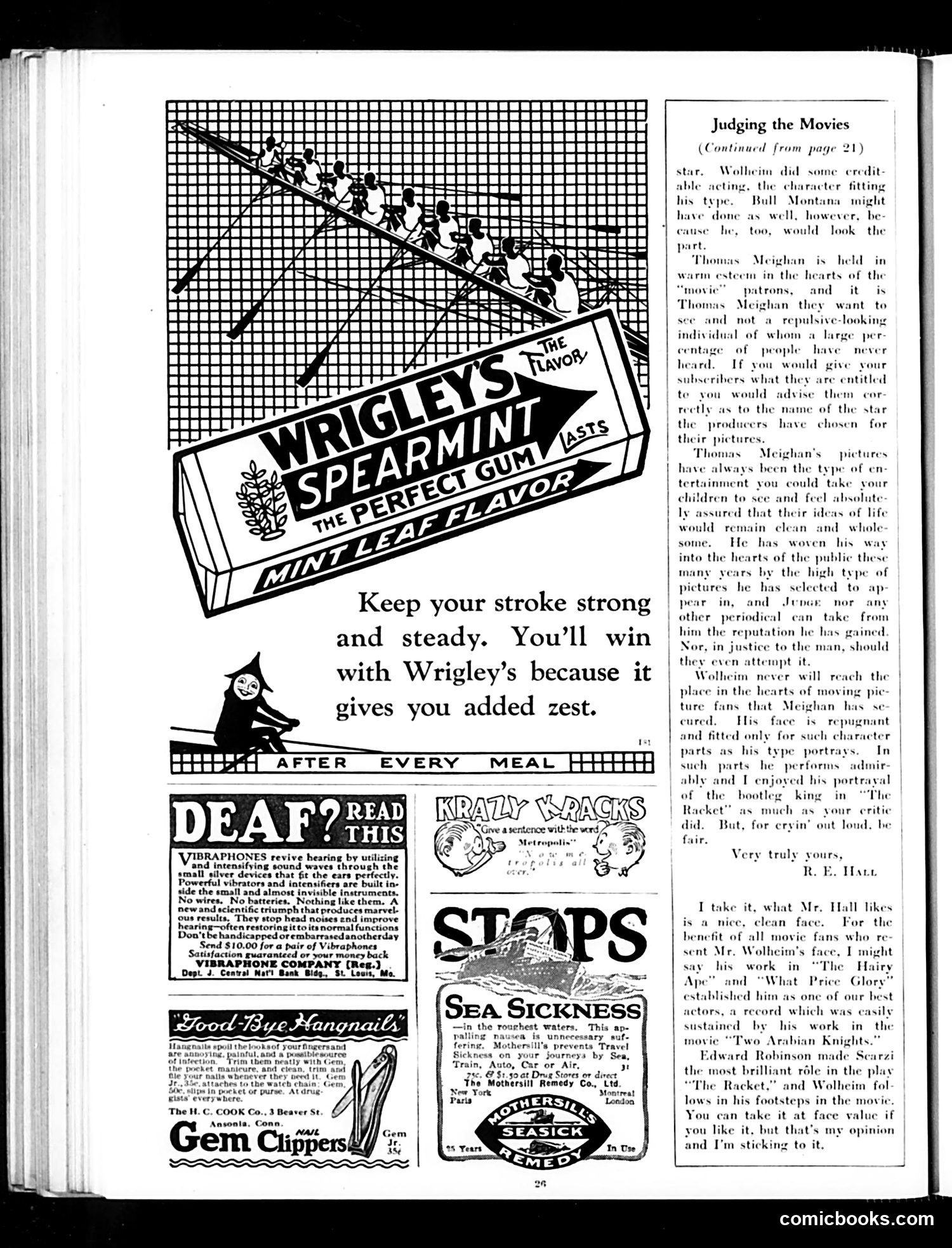
This page is primarily **advertising and reader correspondence**, not political satire. The main content features a **Wrigley's Spearmint gum advertisement** with a golf theme—"Keep your stroke strong and steady. You'll win with Wrigley's because it gives you added zest." The image shows golfers descending a diagonal line on a grid, using the product metaphor to suggest gum aids performance. Below are various period product ads (hearing devices, nail care, seasickness remedies). The significant text is a **"Judging the Movies" column** where reader R.E. Hall defends actor **Thomas Meighan** against critic criticism, arguing Meighan's "clean" family entertainment deserves respect. Hall contrasts Meighan favorably with **Emil Wolheim** (likely misspelled), calling Wolheim's face "repugnant" for disreputable roles, though acknowledging his talent in films like "The Racket." This reflects 1920s-30s debates about **screen morality and star image**—which actors represented wholesome values versus those associated with grittier, "adult" cinema.
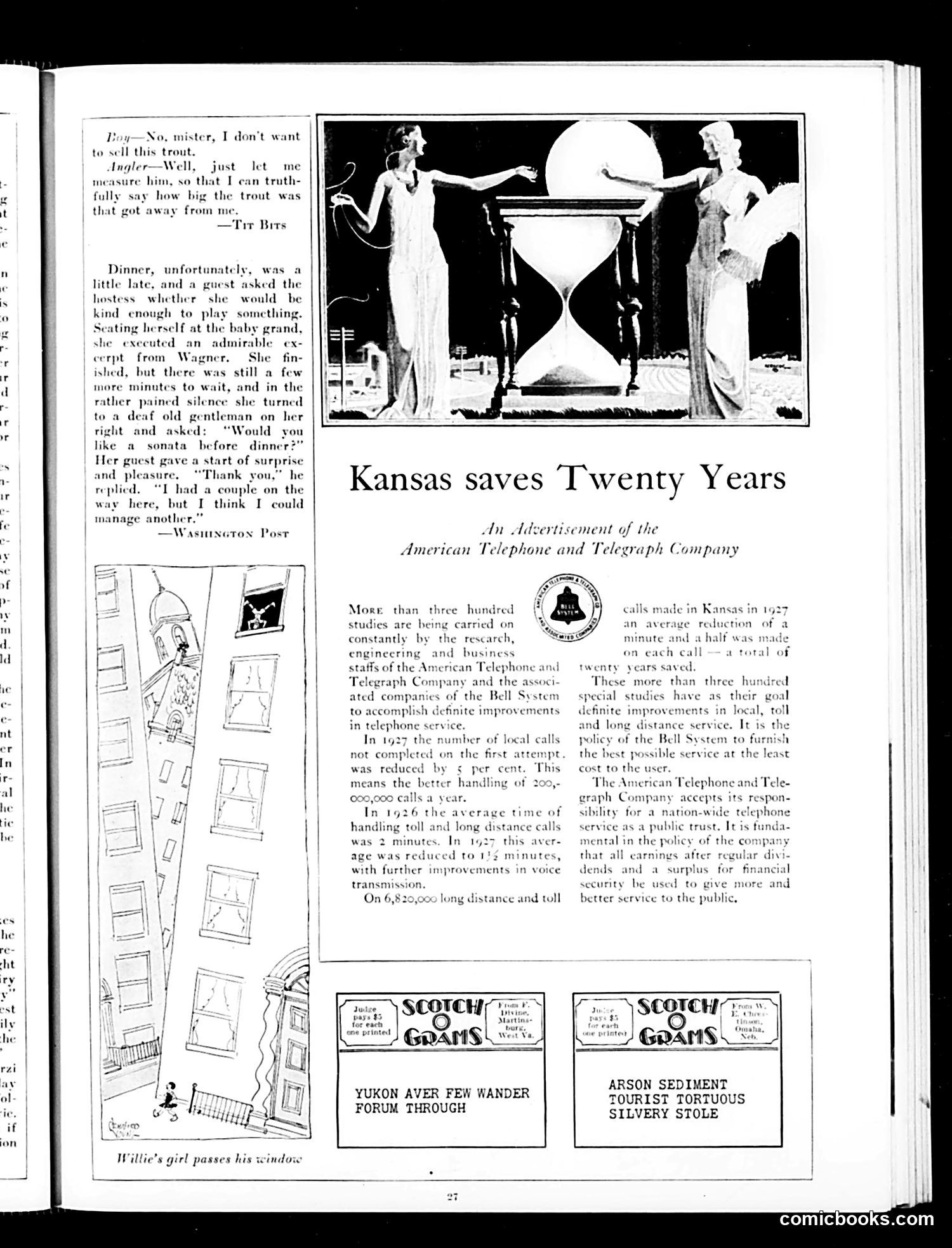
This page contains three distinct elements: **Top cartoons**: Two brief humorous anecdotes—one about a fisherman exaggerating a catch's size, another about a dinner guest who finds Wagner excerpts poor dinner entertainment and asks for a sonata instead. These are light social humor typical of Judge magazine. **Main content**: A full-page advertisement for the American Telephone and Telegraph Company (Bell System) touting efficiency improvements in Kansas telephone service. The ad claims that by 1927, local call handling improved by 5%, average call time decreased from 2 to 1.5 minutes, and the company saved Kansas residents "twenty years" collectively through these efficiency gains. **Bottom**: Two "Scotch Grams"—brief satirical wordplay items mocking drunk behavior ("Yukon Aver Few Wander Forum Through") and criminal negligence ("Arson Sediment / Tourist Tortuous / Silvery Stole"). The page is primarily advertising, with the cartoons serving as filler content typical of magazine layouts from this era.
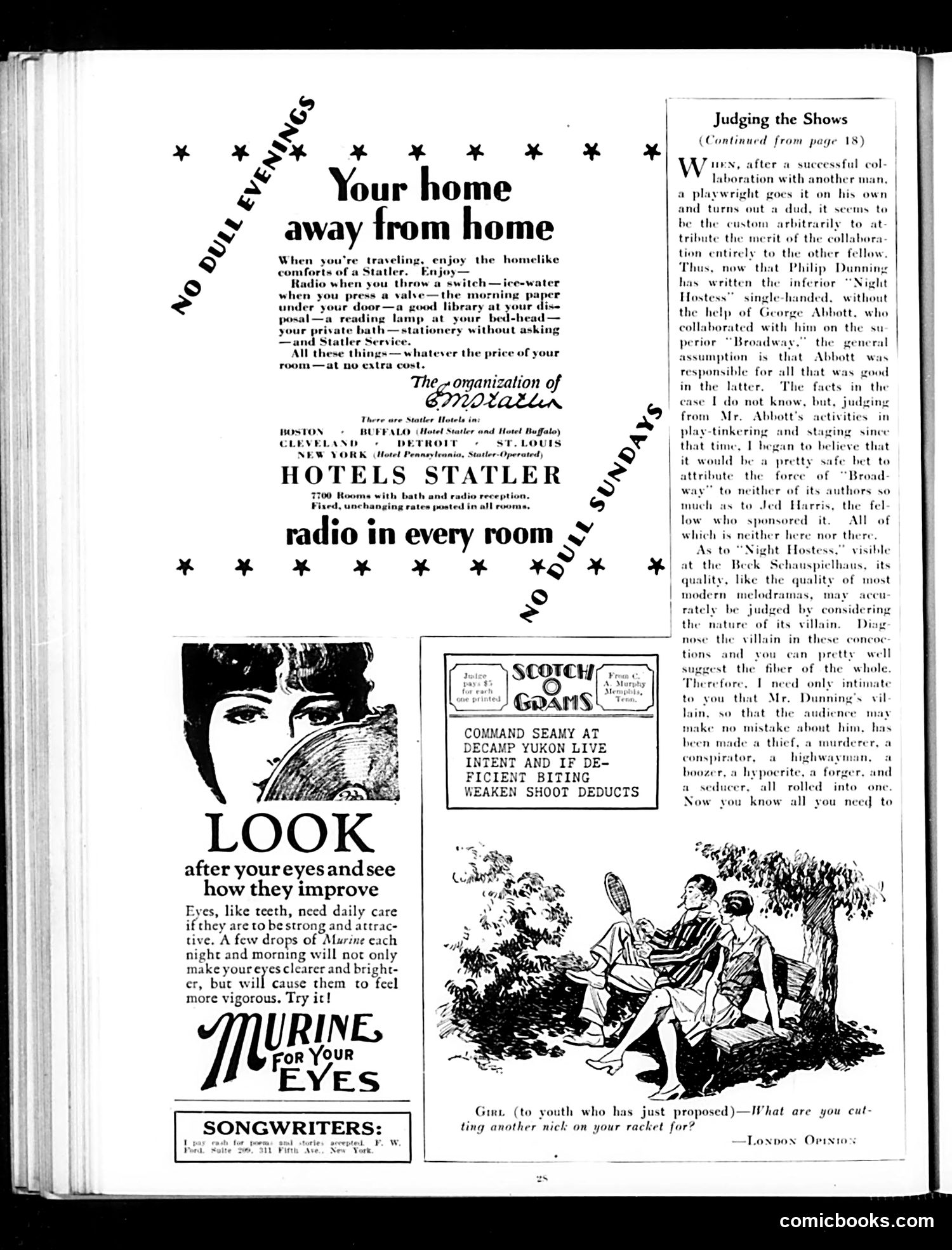
This page is primarily **advertising and theater criticism** rather than political satire. The main content discusses **Philip Dunning's play "Night Hostess,"** critiquing how Broadway collaborators receive unequal credit. The critic argues that when Dunning's solo work proved inferior to his earlier collaboration with George Abbott on "Broadway," audiences wrongly attributed all merit to Abbott. The writer suggests the play's true weakness lies in its melodramatic villain—a character who is "a thief, a murderer, a conspirator, a highwayman, a boozer, a hypocrite, a forger, and a seducer" all rolled into one—making the moral landscape of the play muddled and unconvincing. The advertisements promote **Hotels Statler** (with radio in every room—a modern luxury), **Murine eye drops**, and **Scotch Grams** records. A small cartoon at bottom shows a girl asking a young man why he's making another "nick on your racket"—likely a sexual reference to conquest-keeping, reflecting 1920s dating culture humor.
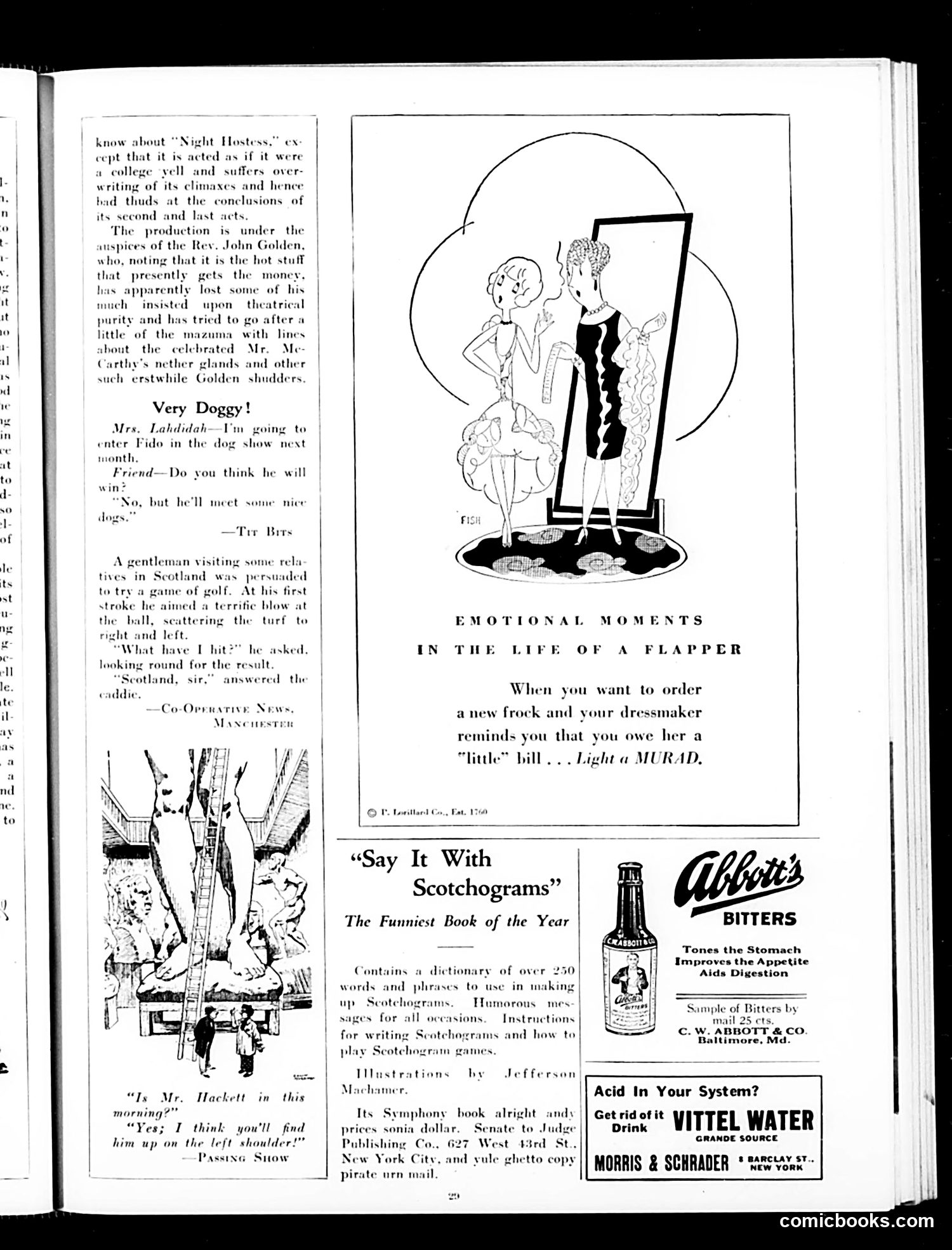
This page contains theater criticism and light humor from an era of 1920s popular entertainment. **Main Content:** The left column reviews "Night Hostess," a theatrical production under Reverend John Golden's management. The critic suggests Golden, known for theatrical propriety, has compromised his standards by embracing more risqué material ("hot stuff") to attract paying audiences—a commentary on commercialism versus artistic integrity in theater. **Humor Sections:** Two brief jokes: one about a woman entering her dog in a show for social opportunities rather than winning; another about a Scottish golfer hitting turf, with the caddie's deadpan response "Scotland, sir"—simple visual humor. **Advertisements:** The page primarily features ads for period products (Murad cigarettes, Abbotts Bitters, Vittel Water), including a "Scotchograms" book capitalizing on 1920s fad for Scottish-themed word games. **Cartoon Art:** The flapper illustration depicts 1920s female fashion and social anxiety about unpaid debts to dressmakers—poking fun at consumer culture and women's spending habits. The overall tone reflects Jazz Age commentary on commercialism, changing morality, and consumer excess.
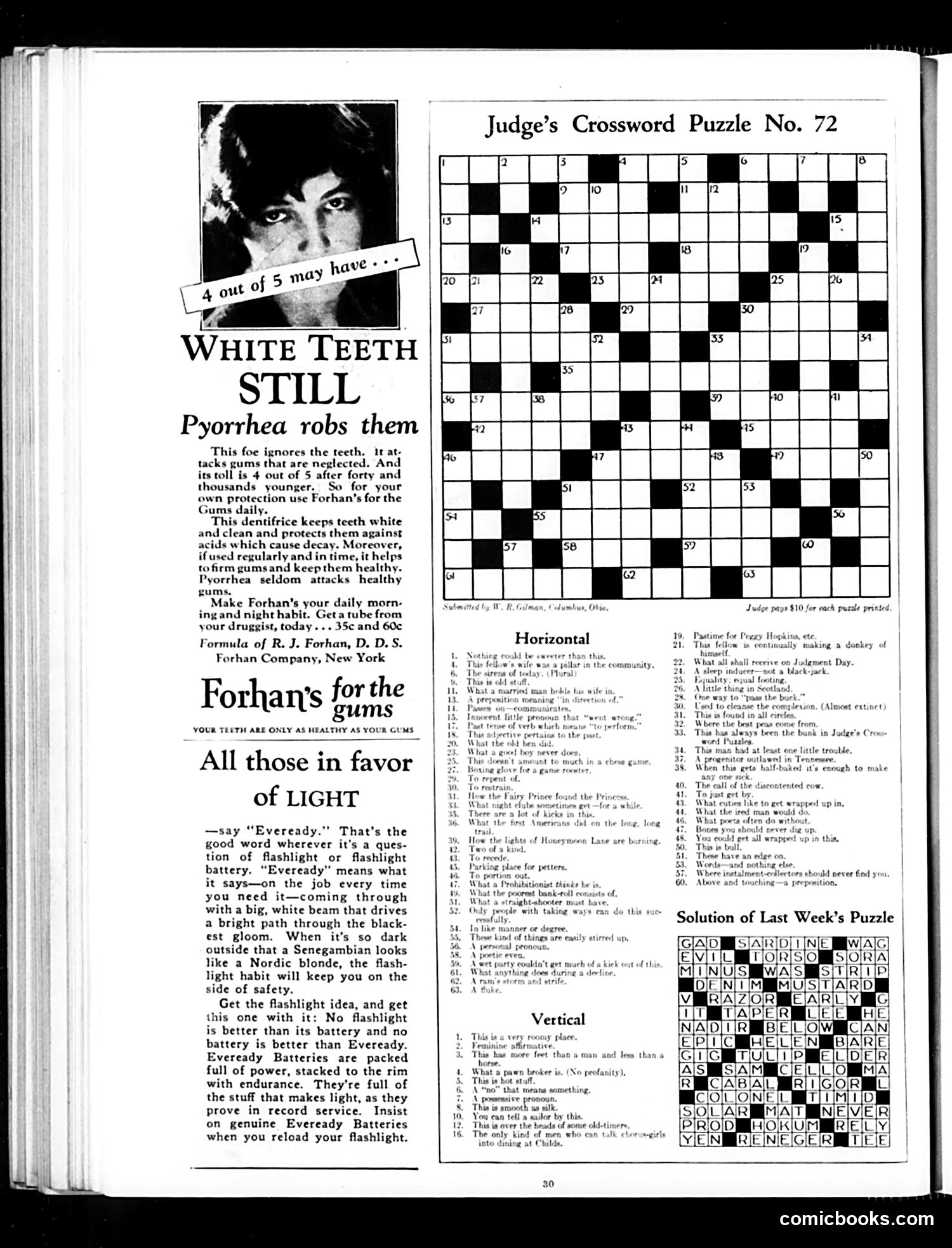
This page is primarily **advertising**, not political satire. It contains two product advertisements: 1. **Forhan's Dentifrice** (top): An ad addressing pyorrhea (gum disease), a genuine health concern of the era. The headline "4 out of 5 may have..." creates urgency by claiming the disease affects most people over forty. The ad promises that regular use prevents tooth loss. 2. **Eveready Batteries** (bottom): A flashlight battery ad using casual, conversational language ("say 'Eveready'") to position the product as reliable and essential. The phrase "when it's so dark outside that a Senegambian looks like a Nordic blonde" is a racial reference typical of 1920s advertising—a crude joke implying darkness makes all people indistinguishable. The page also includes a crossword puzzle and its solution. There is **no political cartoon or satire**—this is a standard Judge magazine issue page combining puzzles, advertisements, and product promotions aimed at middle-class readers.
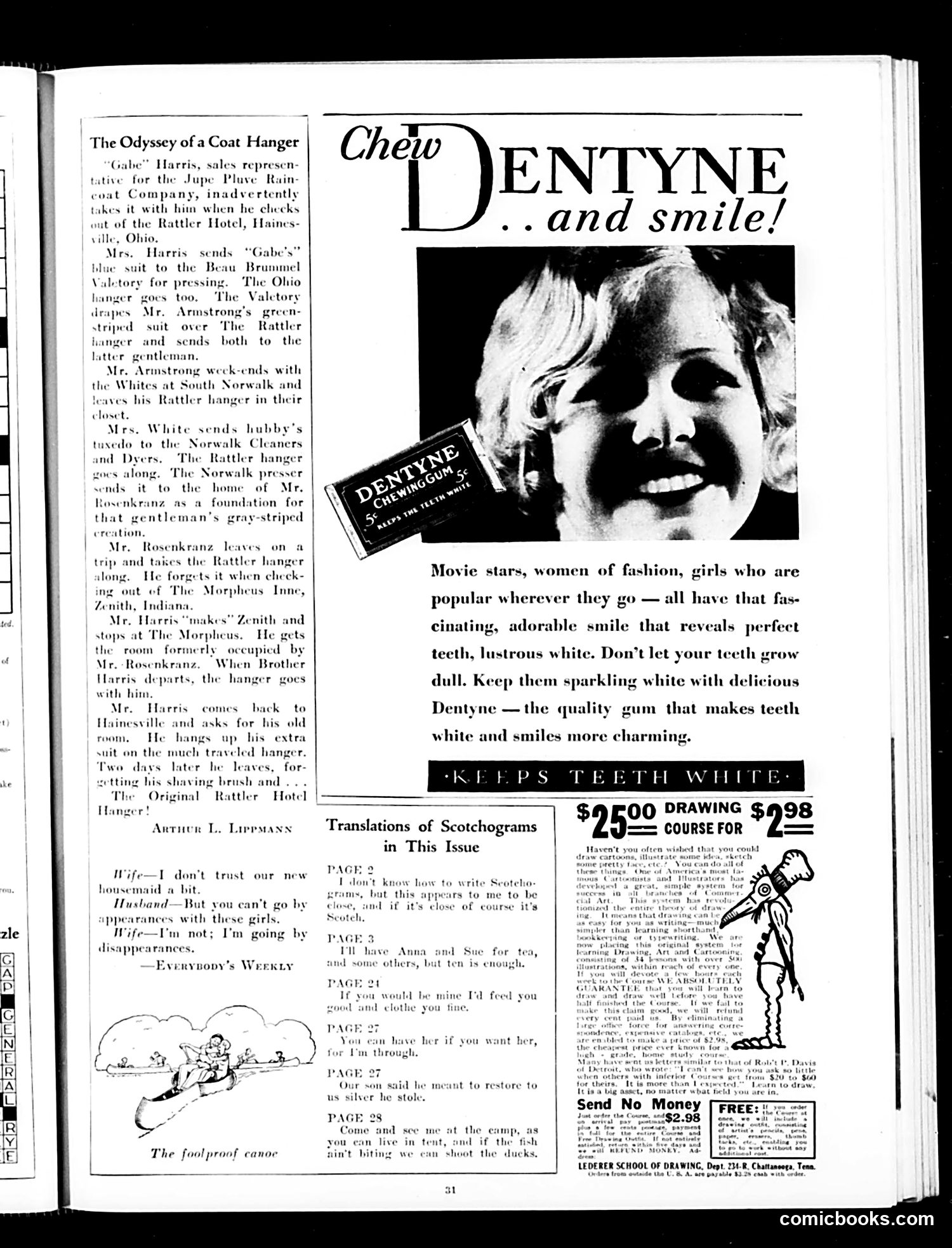
This story-cartoon satirizes the interconnectedness of early 20th-century urban America. A coat hanger from a provincial Ohio hotel (the Rattler Hotel) travels across multiple states—from Hainesville, Ohio to South Norwalk, Connecticut to Zenith, Indiana and back—by accidentally getting packed with clothing sent to dry cleaners and laundries. The joke is that this trivial object leads a more adventurous, cosmopolitan life than most people: it visits multiple cities and homes through the mundane machinery of laundry services. The satire mocks both the absurdity of modern logistics and the pretensions of respectability tied to such services (the "Beau Brummel Valetory," formal dry cleaning for the middle class). The accompanying humor about a housemaid's "disappearances" provides typical period comedy about domestic help. The page is otherwise dominated by a Dentyne chewing gum advertisement featuring an unnamed woman's smile—common advertising of the era.
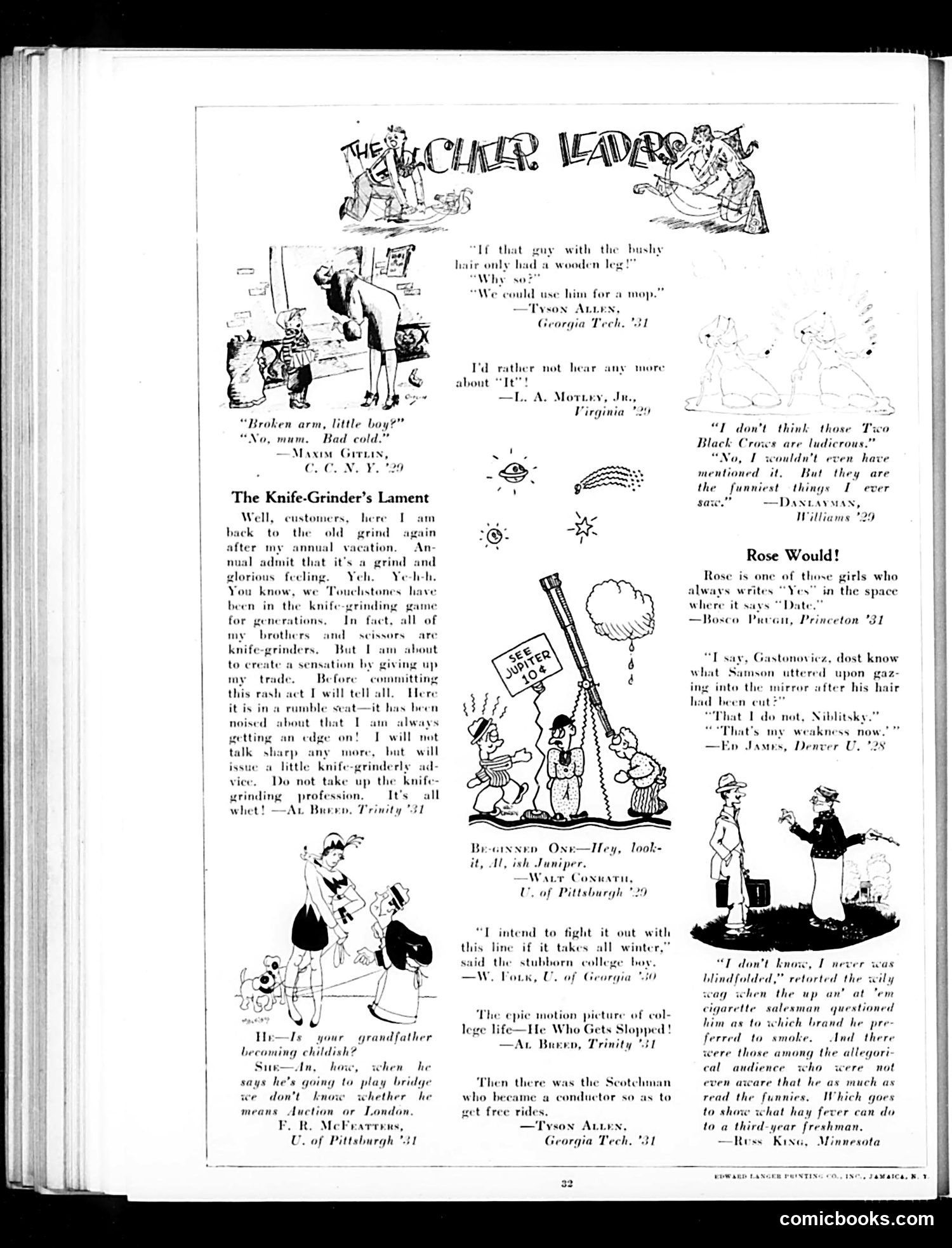
This page collects humorous student observations and brief comic sketches typical of 1920s-30s college humor magazines. The centerpiece, "The Knife-Grinder's Lament," is a monologue satire about a traditional tradesman lamenting his profession's decline. He warns against taking up knife-grinding, suggesting it's becoming obsolete—likely reflecting broader anxiety about mechanization and industrialization displacing traditional crafts. The surrounding quips are college-humor jokes: absurd non-sequiturs (using a one-legged man as a mop), references to contemporary figures like Samson and the "Black Crows" (popular entertainment act), and mock-earnest observations about student life. The humor relies on wordplay, incongruity, and shared college experience. "Rose Would!" pokes fun at dating culture. References to hay fever and cigarette brands suggest consumer culture details recognizable to the era's audience. Overall, this represents early-20th-century satirical humor emphasizing clever wordplay over visual comedy.
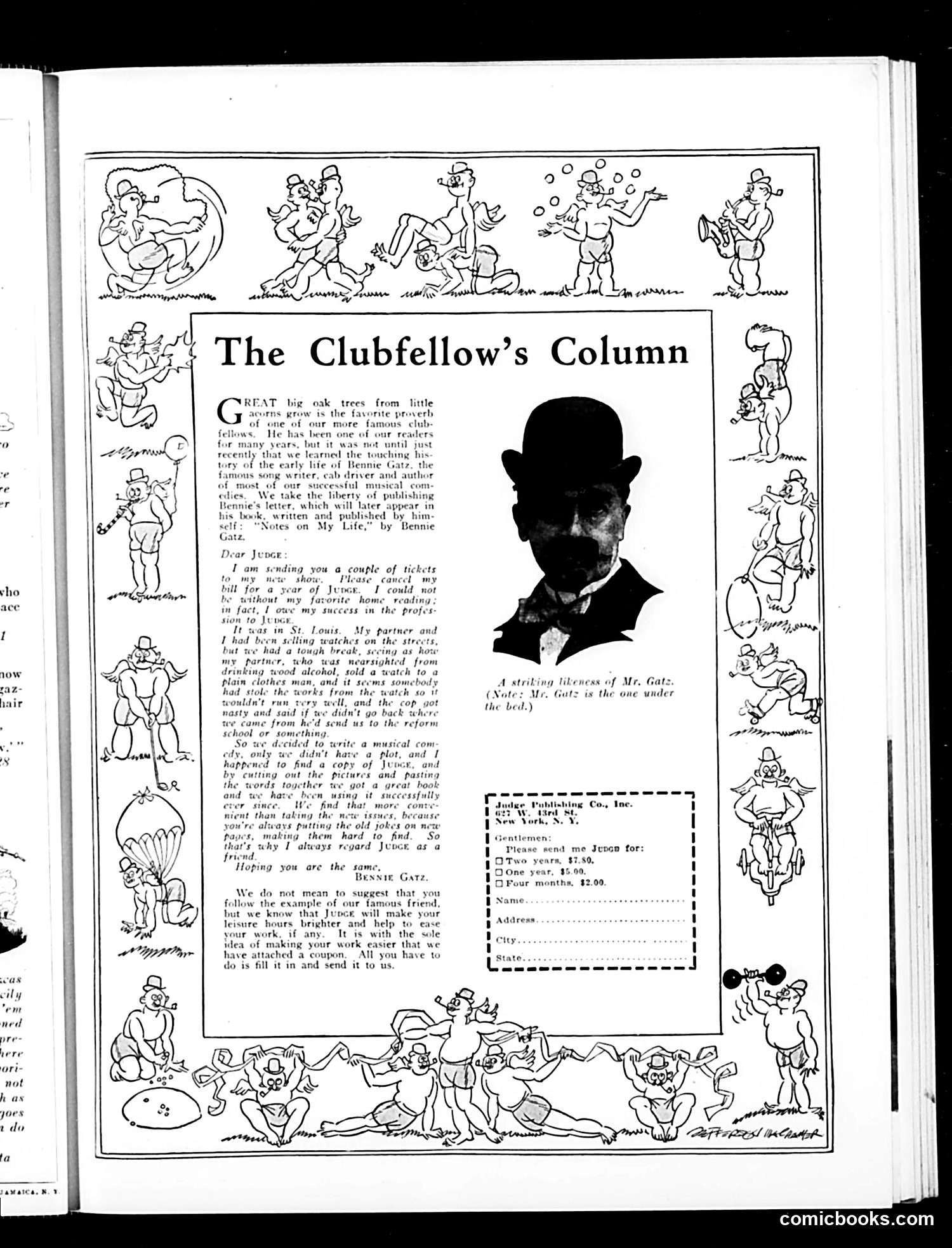
This page features a humorous biographical sketch of "Bennie Gatz," a purported famous songwriter and cab driver. The accompanying photo shows a stern man in formal attire—likely a recognizable public figure to contemporary Judge readers, though unclear to modern viewers. The joke centers on Gatz's humble origins: the anecdote describes his early St. Louis days when he and a partner survived through petty schemes, including selling a stolen watch with missing internal parts to an undercover cop. The humor lies in Gatz's unlikely rise from these disreputable circumstances to respectability. The column uses this rags-to-riches story as a frame for promoting Judge magazine itself, suggesting that reading it brightens leisure and aids work—a tongue-in-cheek advertisement wrapped in entertainment. The decorative borders featuring comical figures reinforce Judge's satirical, humorous editorial style of the era.
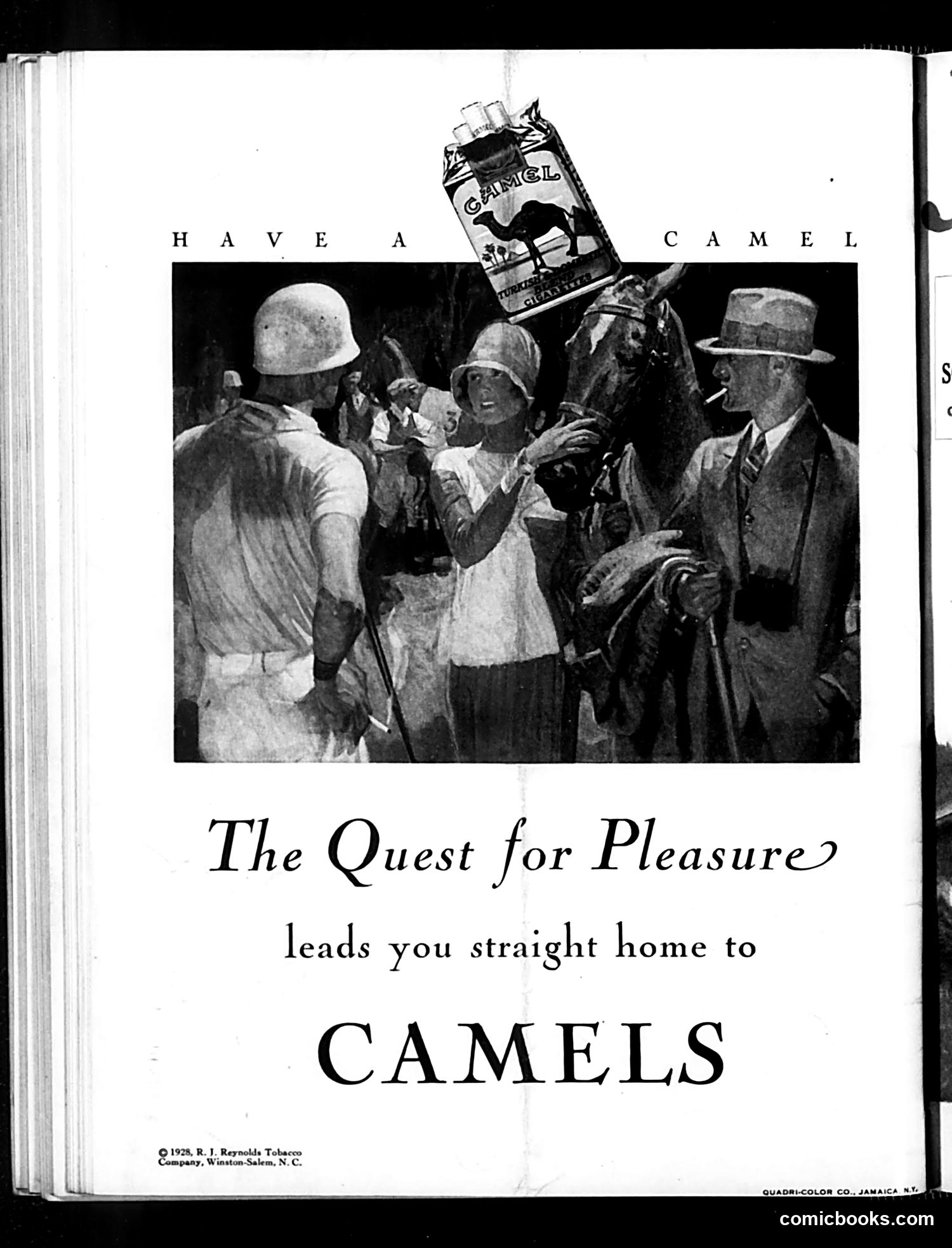
This is a **Camel cigarette advertisement** from 1928, not political satire. The image shows five men in 1920s attire (hats, suits) gathered around a large Camel cigarette package. The ad's caption plays on the phrase "quest for pleasure," suggesting that smoking Camels provides satisfaction and leads one "straight home"—implying the cigarettes deliver what smokers seek. The men's expressions and body language suggest camaraderie and approval, a common advertising technique to make the product appear socially desirable. The composition presents smoking as a normal, pleasurable social activity. This reflects 1920s advertising practices, before tobacco's health risks were widely acknowledged or regulated. The ad targets male consumers through casual, friendly imagery.