
Judge, 1928-10-06 · page 20 of 36
Judge — October 6, 1928 — page 20: what you’re looking at
What you’re looking at
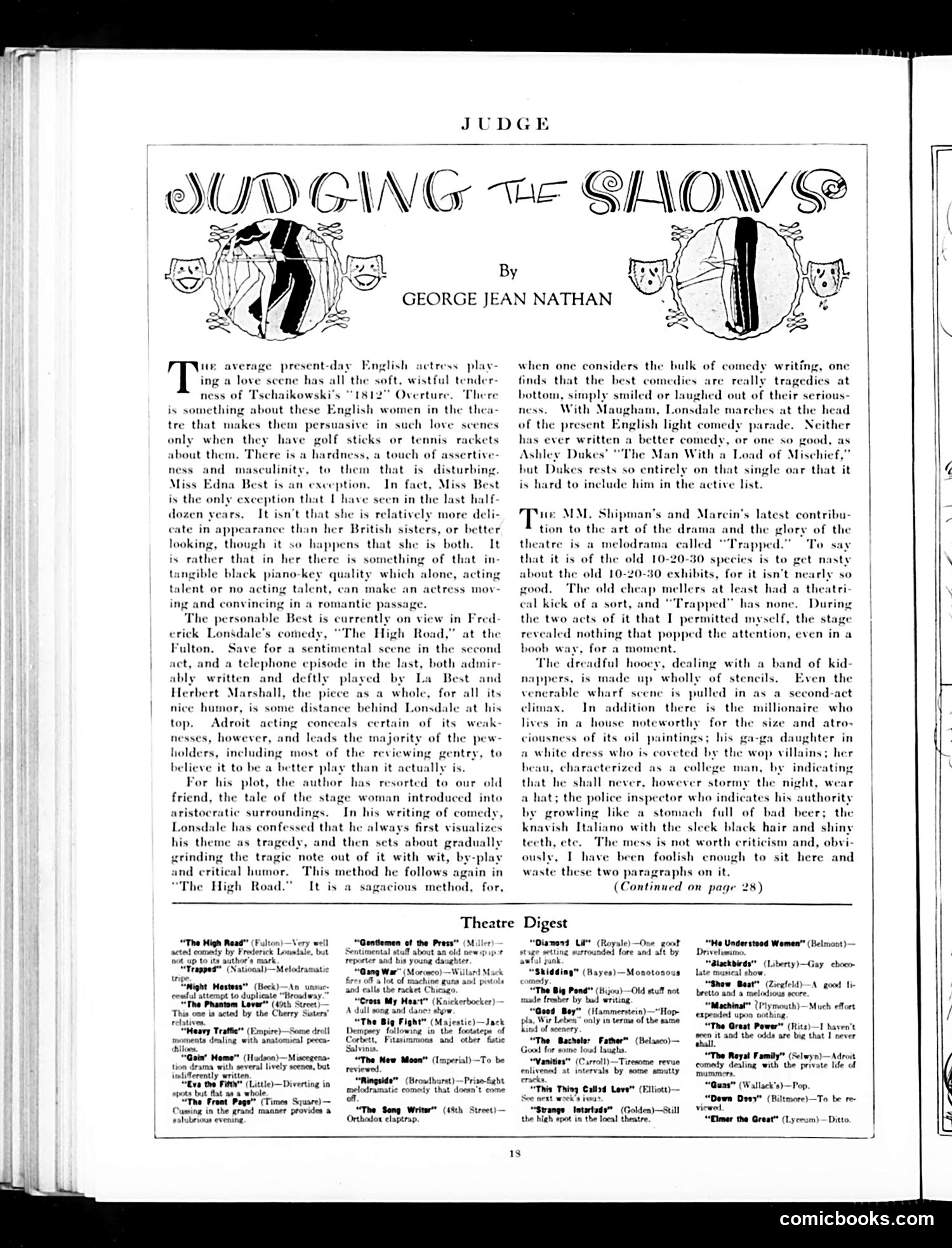
This page from Judge magazine contains a theater review by George Jean Nathan critiquing contemporary English plays and actresses. The decorative header "JUDGING THE SHOWS" features theatrical masks and silhouettes. Nathan discusses English actresses' tendency toward hardness and masculinity in romantic scenes, praising Edna Best as an exception for her delicate quality. He reviews Frederick Lonsdale's comedy "The High Road," noting that while competently acted, it follows Lonsdale's method of visualizing tragedies then extracting the tragic elements through wit. Nathan also harshly critiques a melodrama called "Trapped" by Shipman and Marcin, dismissing it as derivative hokum made of "stencils"—formulaic elements like the millionaire with oil paintings, his daughter in white, a villainous Italian character, and obligatory wharf scenes. He suggests the play barely merits critical attention but has written about it anyway. The page reflects early 20th-century theater criticism standards and period attitudes toward dramatic quality and national character types.
📄 Transcribed text from this page (OCR, searchable)
Machine-transcribed from the original scan — historical spelling and the odd misread are preserved.
JUDGE ent-day English actress play- » has all the soft, wistful tender wski's “18 Overture. There is something about these English women in the thea- tre that makes them persuasive in such love scenes only when they hi If sticks or tennis rackets sbout them. There is a hardness, a touch of assertive- and masculinity, to them that is disturbing. Miss Edna Best is an exception, In fact, Miss Best is the only exception that I have seen in the last half dozen years. It isn’t that she is relatively more deli- cate in appearance than her British sisters, or better looking, though it so happens that she is both. It is rather that in her there is something of t tangible black piano-key quality which alone, talent or no acting talent, can mak, ing and convincing in a romantic pass: The personable Best is currently on view i erick Lonsdale’s comedy, “The High Road, Fulton. e for a sentimental scene in the second ind a telephone episode in the last, both admir ably written and deftly played by La Best and Herbert Marshall, the piece as a whole, for all its nice humor, is some distance behind Lonsdale at his top. Adroit acting conceals certain of its weak- nesses, however, and leads the maj ing a love sce ness of Tsch ness acting n actress mov- rity of the pew- holders, including most of the reviewing gentry, to believe it to be a better play than it actually is. For his plot, the author has resorted to our old friend, the tale of the stage woman introduced into aristocratic surroundings. In his writing of comedy, Lonsdale has confessed that he always first visualizes his theme as tragedy, and then sets about gradually grinding the tragic note out of it with wit, by-play and critical humor. This method he follows again in “The High Road.” It is a sagacious method, for, ‘ By GEORGE JEAN NATHAN when one considers the bulk of comedy writing, one finds that the best comedies are really tra bottom, simply smiled or laughed With Maugham, Lonsdale marches of the present English light comedy pars has ever written a better comedy, or one so good, as Ashley Dukes’ “The Man With a Load of Mischief,” but Dukes rests so entirely on that single oar that it is hard to include him in the active list. edies at ut of their serious- at the head Neither ness. ie MM, Shipman’s and Marcin's latest contribu- tion to the art of the drama and the glory of the theatre is a melodrama “Trapped. , that it is of the old 10-20-30 species is to get nasty about the old 10-20-30 exhibits, for it isn’t nearly so good. The old cheap mellers at least had a theatri cal kick of a sort, and “Trapped” has none. During the two acts of it that I permitted myself, the stage revealed nothing that popped the attention, even in a boob way, for a moment. The dreadful hooey, dealing with a band of kid nappers, is made up wholly of stencils. Even the venerable wharf scene is pulled in as a second-act climax. In addition there is the millionaire who lives in a house noteworthy for the size and atro+ ciousness of its oil paintings; his ga-ga daughter in a white dress who is coveted by the wop villains; her beau, characterized as a coll that he shall nev ge man, by indicating r stormy the night, wear hat; the police inspector who indicates his authority y growling like a stomach full of bad beer; the knavish Italiano with the sleek black ha teeth, ete. The mess is not worth criticism and, obv ously, I have been foolish enough to sit here and waste these two pars phs on it. (Continued on page 28) r, how rand shiny Theatre “Gentlemen of the Press” (M about an old new young daughter “Gang War” (Moromco) fret off lot of raachine and calls the racket Chicag “The High Read” (Fulton) —Very well acted comedy by Frederick Lousdale, but not up to its author's mark “Trapped” (National)—Meladramatic tripe “Might Hestess” (Beck) —An unsucy comful attempt to duplicate “Broadway.” “Tha Phantom Lever” (49th Street) — This one is acted by the Cherry Suters’ . Jeary Trafic” (Emp ts dealing with af “The New Moon” (Imperial) —To be reviewed, “Ringside” (Browlburst) —Prize-fght — Divertin i ttle)—Diverting ims stodramatie comedy that doesn't come ot. epots but flat asa whole. The Froat Page” (Times Square) — Cuming in the grand manner provides a satubevous evening Writer” (48h “The Song Street) — Orthodox elaptrap. Digest “Diamond Lil (Royale stage setting surrounded fo awful junk. kid cunady “The Big Pend’ (Hijou)—Old stuf not made freaber by bad writing, Hammerstein) —"Hop- aly in terms of the eame oot ‘He Under steed Wemen” (Belmont) — and aft by Drivelissino. (Liberty)—Gay eboeo- 0” (Bayes)—Monotonous late musical show, “Show Beat” (Zicefeld beetto and a mel “Machinal”™ (7 expended upoa “ “The Great Power” (Rits)—I haven't seen it and the odds are big that I never shall. “The Royal Family” (Selwyn) —Adroit comadty dealing with the private life of mummers “Quas” (Wallack’s)—Pop. “Dewn Deey" (Biltmore)—To be re viewer “Elmer the Great” (Lyceuin) A good tie Much effort Kind of scenery “The Bachelor Father” (Belasco)— Goal for same loud laughs. “Vanities” (Carroll) —Tiresome revue r fened at intervals by some smutty “This Thing Callod Love” See nent week's iva “svi tatertads” (Golden) —Still the high spot in the local theatre. Eliott) — Ditto. comicbooks.com