
Judge, 1928-10-06 · page 22 of 36
Judge — October 6, 1928 — page 22: what you’re looking at
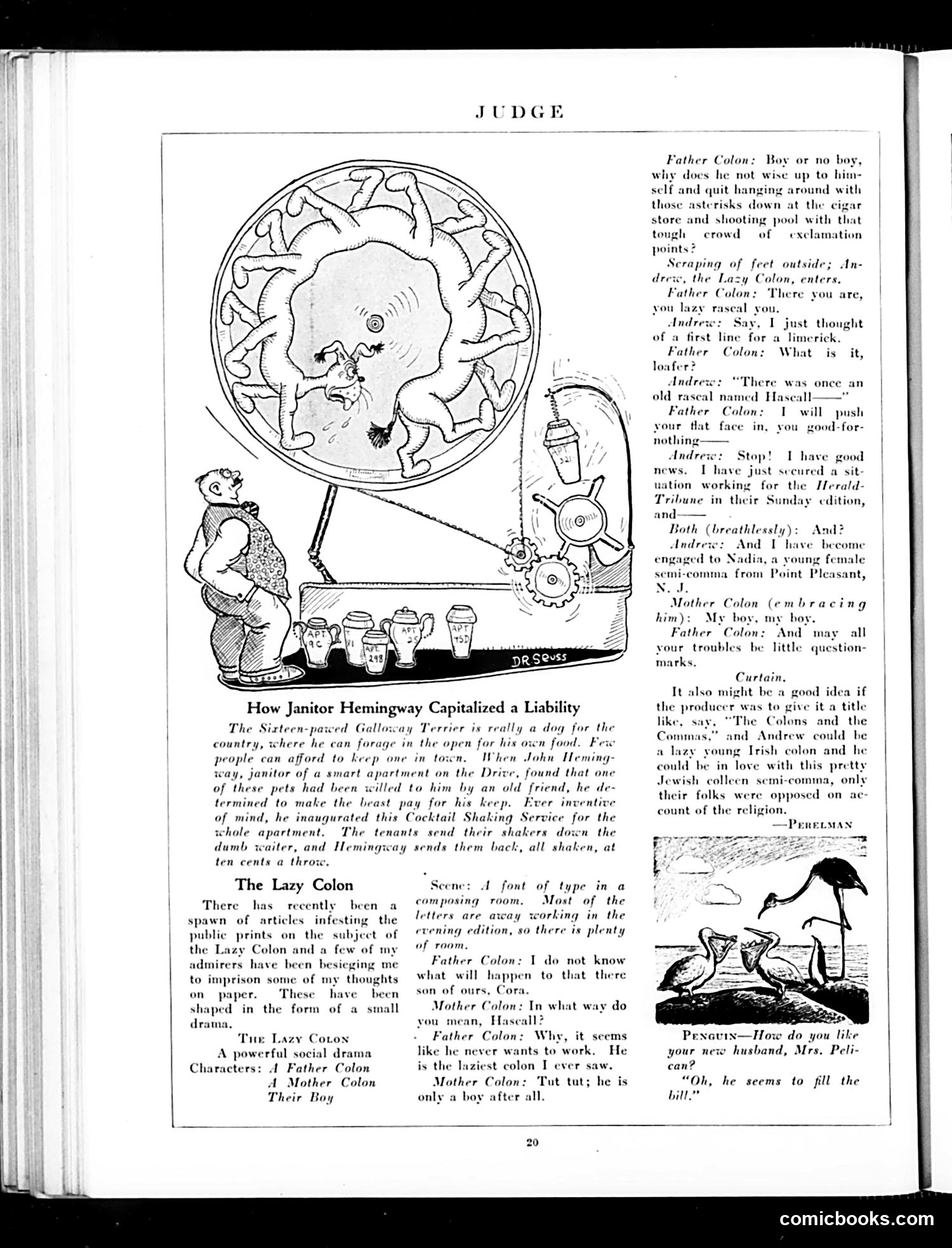
What you’re looking at
This page contains two satirical pieces: **"How Janitor Hemingway Capitalized a Liability"** mocks class mobility and entrepreneurship. A janitor inherits an expensive dog he can't afford to keep, so he monetizes it by running a "Cocktail Shaking Service"—tenants send their cocktail shakers down the dumbwaiter, the dog shakes them, and they're returned for ten cents. The satire targets both working-class ingenuity and wealthy apartment dwellers' frivolous spending during what appears to be Prohibition-era excess. **"The Lazy Colon"** is a pun-based domestic drama using printing-press terminology as characters. The father, mother, and son "Andrew" are punctuation marks living in a composing room. The satire mocks contemporary concern about "lazy colon" medical conditions (then a popular health anxiety) while using typographic wordplay—asterisks as delinquent friends, exclamation points as rough crowds. The son's redemption through employment and engagement provides gentle social commentary on respectability and family expectations.
📄 Transcribed text from this page (OCR, searchable)
Machine-transcribed from the original scan — historical spelling and the odd misread are preserved.
How Janitor Hemingway Capitalized a Liability The Sixteen-pawed Galloway Terrier is really a dog for the country, where he can forage in the open for his own food. Few people can afford to keep one in town, When John Heming- way, janitor of a smart apartment on the Drive, found that one of these pets had been willed to him by an old friend, he de- termined to make the beast pay for his keep. of mind, he inaugurated this Cocktail Shaking S hole apartment. The tenants send their shakers down the r inventive vice for the dumb waiter, and Hemingway sends them back, all shaken, at ten cents a throw. The Lazy Colon There has recently been a spawn of articles infesting the public prints on the subject of the Lazy Colon and a few of my admirers have me to imprison some of my thoughts on paper. T have been shaped in the form of a small drama, Tur Lazy Coton A powerful social drama Characters: A Father Colon A Mother Colon Their Boy n besiegin Scene: A font of type in a composing room. Most of the letters are away working in the evening edition, so there is plenty of room, Father Colon: I do not know what will happen to that there son of ours, Cora, Mother Colon: In what way do you mean, Hascall? Father Colon: Why, it seems like he never wants to work. He is the laziest colon I ever saw. Mother Colon: Tut tut; he is only a boy after all. Father Colon: Boy or no boy, why does he not wise up to him- and quit hanging around with terisks down at the cigar store and shooting pool with that tough crowd of — exclamation points? Scraping of feet outside; An- dre the Lazy Colon, enters. Father Colon: There you are, you lazy raseal you. Andrew: Say, 1 just thought of a first line for a limerick. Father Colon: What is it, loafer? Andrew: “There was once an old rascal named Haseall——” Father C your flat fa nothing Andrew: St news. I have just secured a sit uation working for the Ierald- Tribune in their Sunday edition, and—— : 1 will push : in, you good-for- athlessly): And? : And IT have become aged to Nadia, a young fer ni-comma from Point Pleas: Mother Colon (embracing him): My boy, my boy. Father Colon: ‘And may all your troubles be little question- marks. Curtain. It also might be the producer was t like, ss Commas, give The Colons and the and Andrew could be a lazy young Irish colon and he could be in love with this pretty Jewish colleen semi-comma, only their folks were opposed on ac- count of the religion, —Pernecman Rr eae <—How do you like husband, Mrs, Peli- Peni your 1 can? “Oh, he seems to fill the bill” comicbooks.com