
A complete issue · 36 pages · 1928
Judge — September 1, 1928
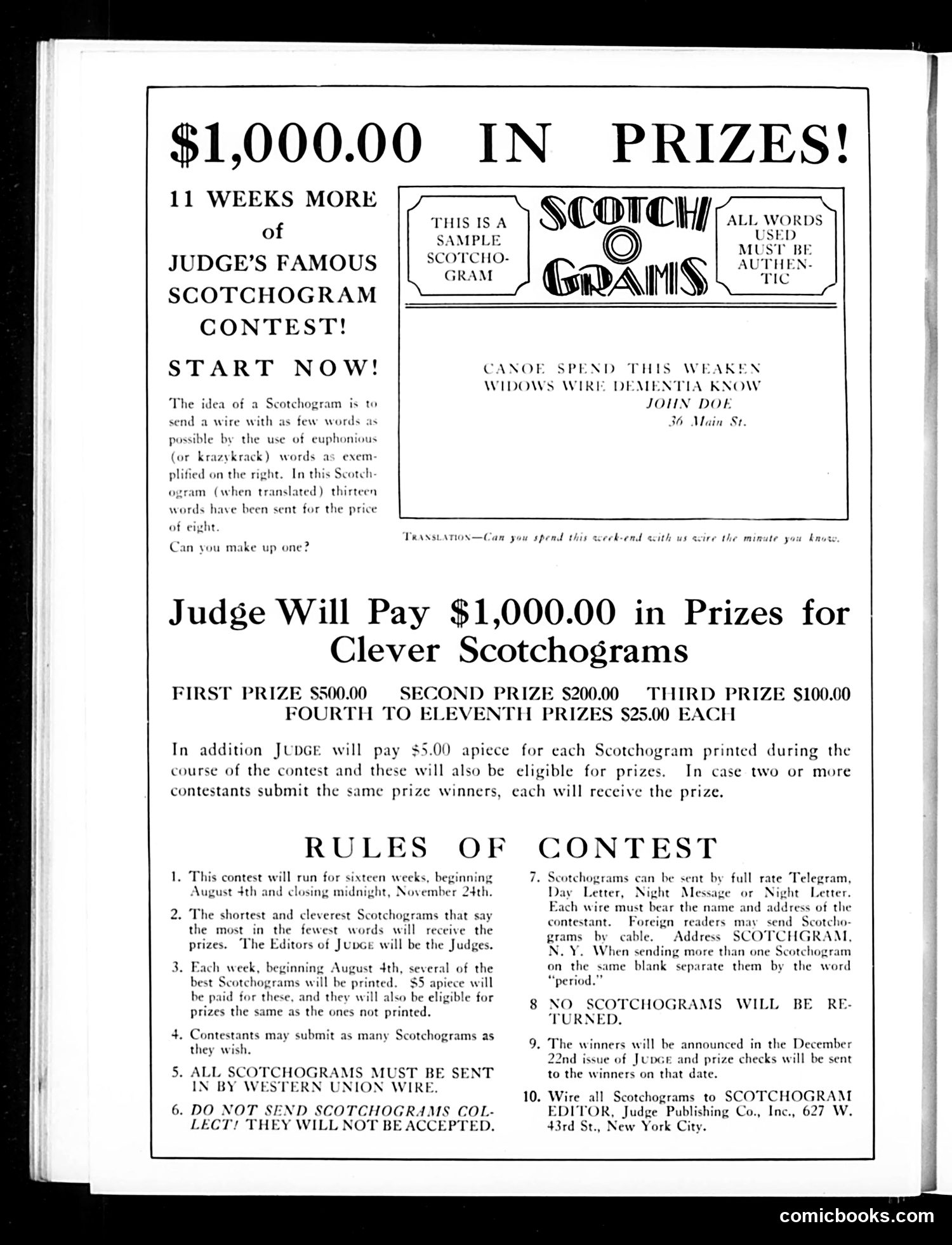
This page is primarily **advertising content**, not political satire or editorial cartoon. It announces Judge magazine's "Scotchogram Contest," offering $1,000 in prizes for the cleverest word-puzzle submissions. A **Scotchogram** is a word game: contestants send telegrams using as few words as possible through euphemisms or playful language, which when translated reveal a longer message (the example shows "CANOE SPEND THIS WEAKEN WIDOWS WIRE DEMENTIA KNOW" translating to something about spending a weekend). The contest ran 16 weeks with prizes ranging from $500 (first place) to $25 each for fourth through eleventh place. Submissions were sent by Western Union telegraph to Judge's offices. There is **no political or social satire** on this page—it's a straightforward promotional contest.
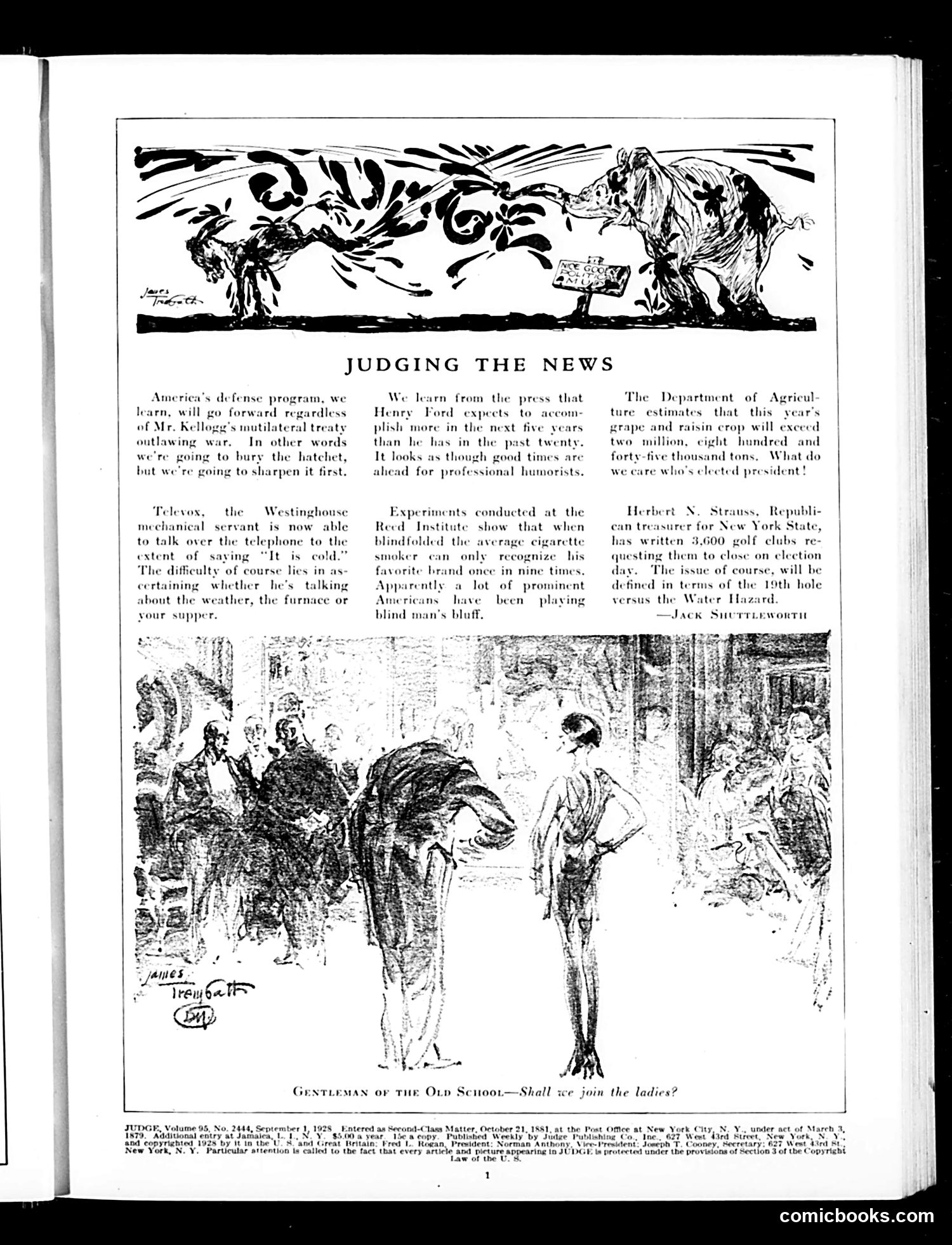
The top cartoon shows two figures apparently debating or gesturing at scattered papers/debris, illustrating the section's theme of satirizing current events. The text column criticizes various news stories: Henry Ford's business predictions, a Red Institute study about cigarettes and blindfolds, Herbert Strauss's golf club anecdote, and commentary on America's defense program and the Kellogg-Briand treaty. The lower cartoon, captioned "Gentleman of the Old School—Shall we join the ladies?" depicts what appears to be social commentary on changing manners or generational differences, showing figures in a domestic scene. Overall, the page mocks contemporary news and social pretensions through satirical commentary and illustration, typical of Judge magazine's blend of political and social satire from the 1920s.
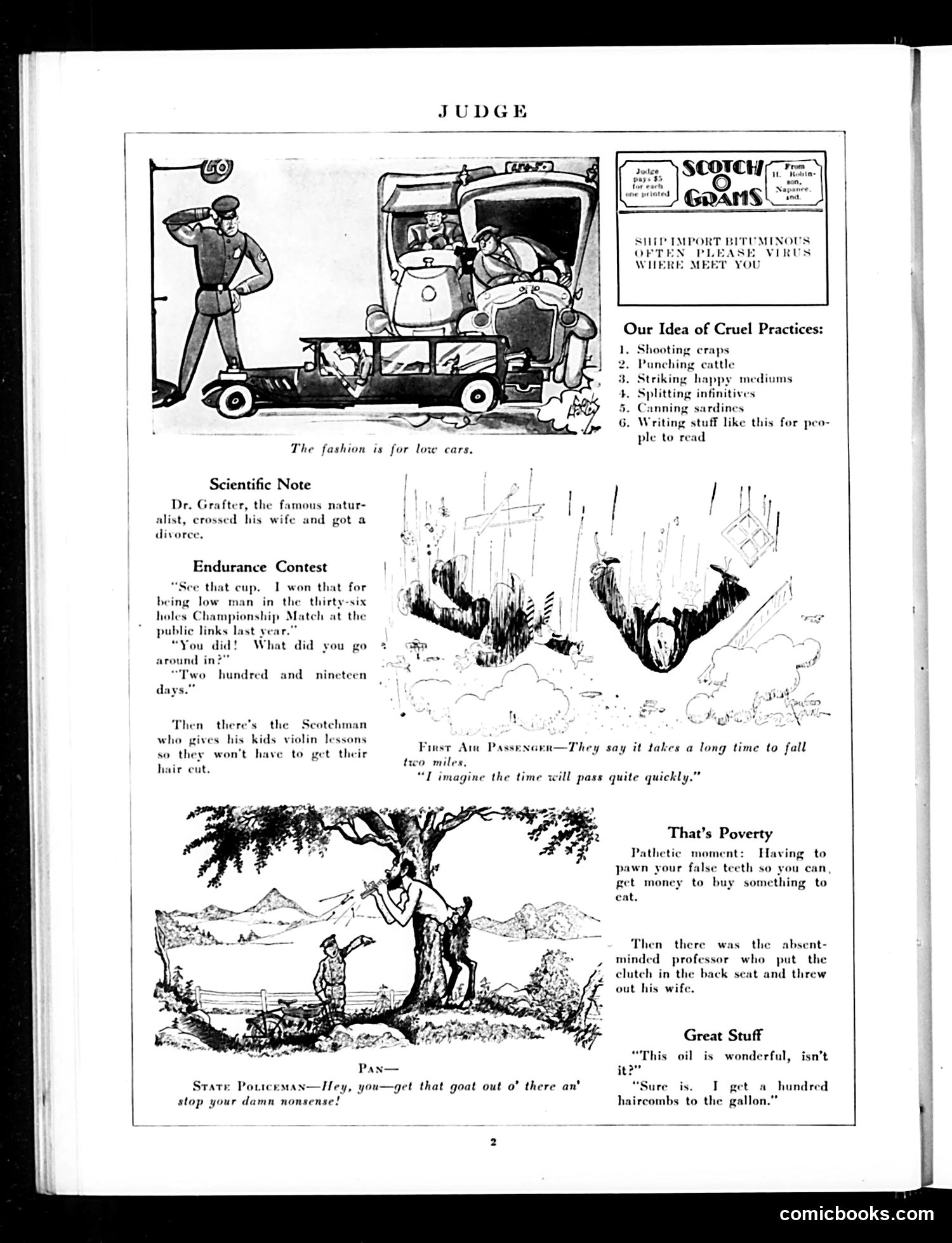
This page contains several unrelated satirical sketches typical of Judge magazine's format: **Top cartoon** ("The fashion is for low cars"): Mocks cramped automobile design, showing a couple squeezed uncomfortably into a tiny vehicle—satirizing the era's trend toward compact cars. **"Scotch and Soda" advertisement**: A mock ad listing crude practices as if they were virtues—typical satirical humor. **"Scientific Note"**: Brief joke about Dr. Grafter divorcing his wife—appears to mock dishonest politicians or public figures. **"Endurance Contest," "First Aim Passenger," "That's Poverty," "Pan," and "Great Stuff"**: Various unrelated one-liner jokes and small illustrations typical of Judge's miscellaneous humor pages, covering topics from violin lessons to false teeth to oil quality. The page represents Judge's standard format of brief, disconnected jokes rather than sustained political commentary.
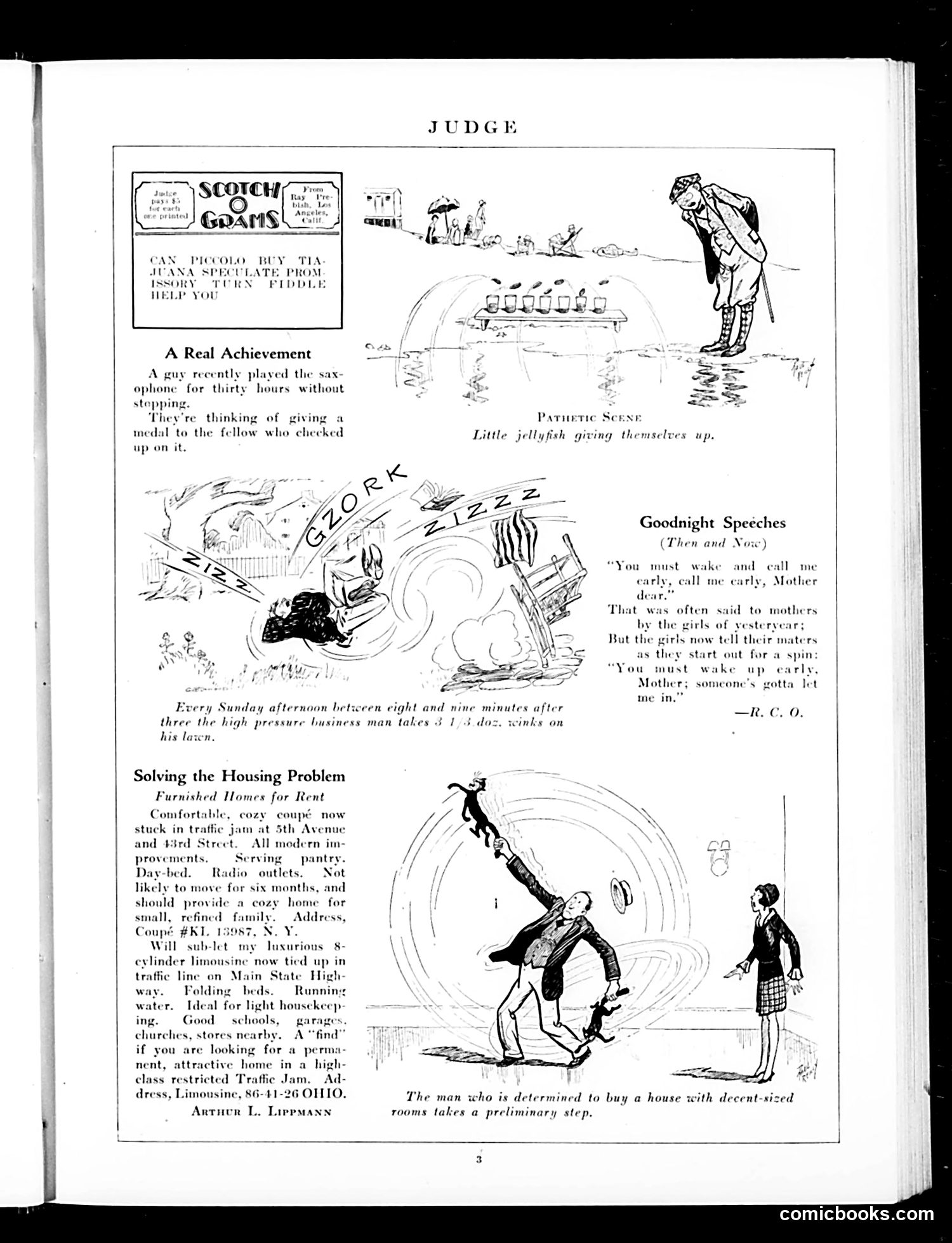
This page contains several satirical pieces from Judge magazine: **"A Real Achievement"** mocks a saxophonist who played for thirty hours straight—the joke being they're considering giving him a medal for this dubious feat. **"Patriotic Scene"** shows jellyfish "giving themselves up," likely satirizing some contemporary patriotic or military recruitment campaign. **"Every Sunday afternoon"** depicts a businessman sinking into his chair, suggesting he's so exhausted from work that he collapses weekly. **"Solving the Housing Problem"** illustrates the difficulty of buying a home, showing a man taking an exaggerated "preliminary step"—satirizing how challenging and arduous the home-buying process is. **"Goodnight Speeches"** quotes period-appropriate maternal farewells, poking fun at how mothers' sayings have changed. The overall theme critiques modern work culture, consumerism, and changing social customs.
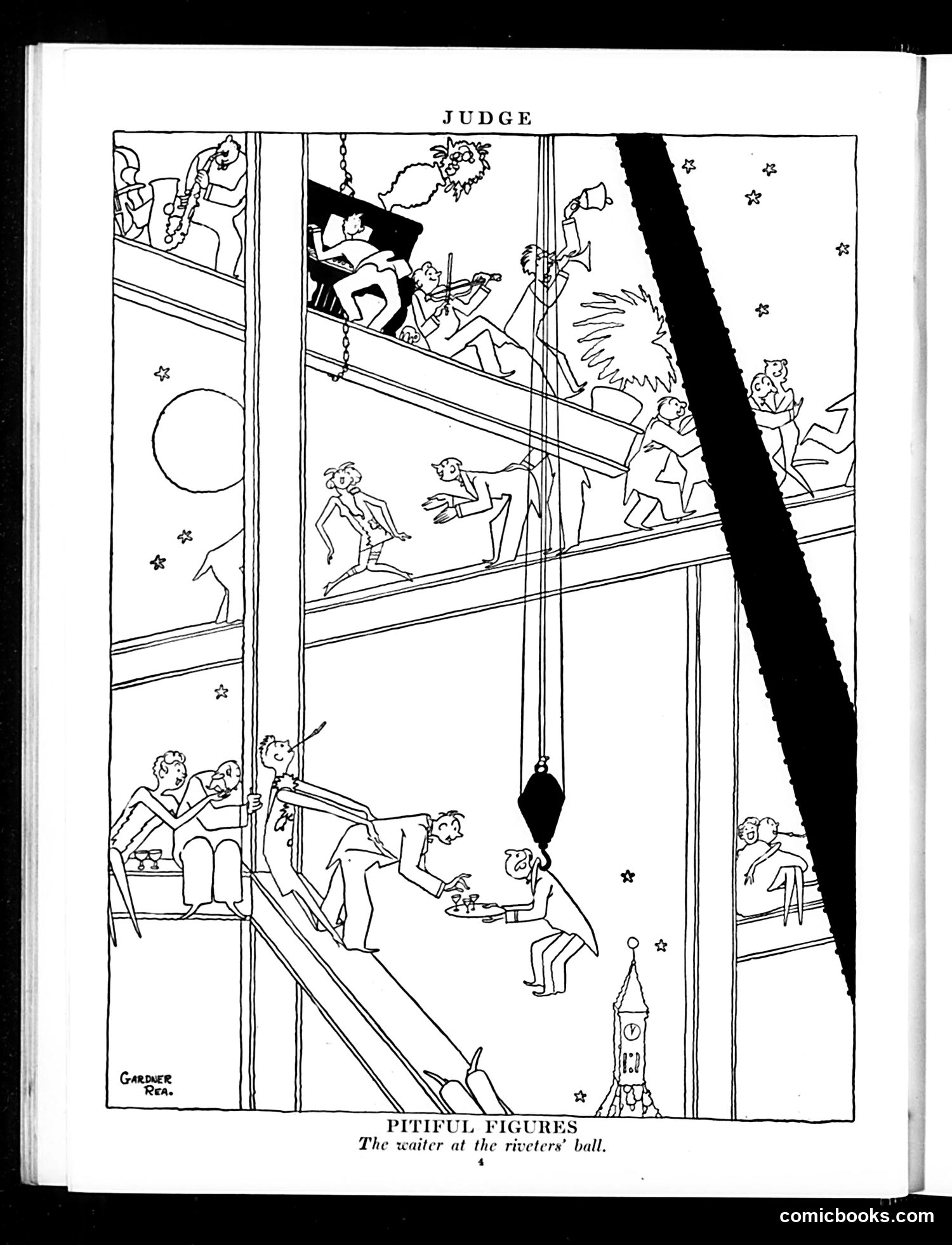
This cartoon satirizes high society's pretensions through a visual pun. The title references "revelers" (partygoers), but the image depicts "rivelers"—a play on words suggesting something related to rivers or divisions. The central figure is a waiter serving at an upscale ball held in a tall building (possibly representing a skyscraper or luxury hotel). Multiple floors show wealthy socialites dining and dancing while the lone waiter navigates between levels. The satire likely critiques class divisions—the contrast between the indulgent revelers above and the laboring servant below emphasizes economic inequality. The architectural verticality visualizes social stratification. The "pitiful figures" caption suggests sympathy for working-class servants toiling while the privileged enjoy themselves, a common Judge magazine theme mocking Gilded Age excess.
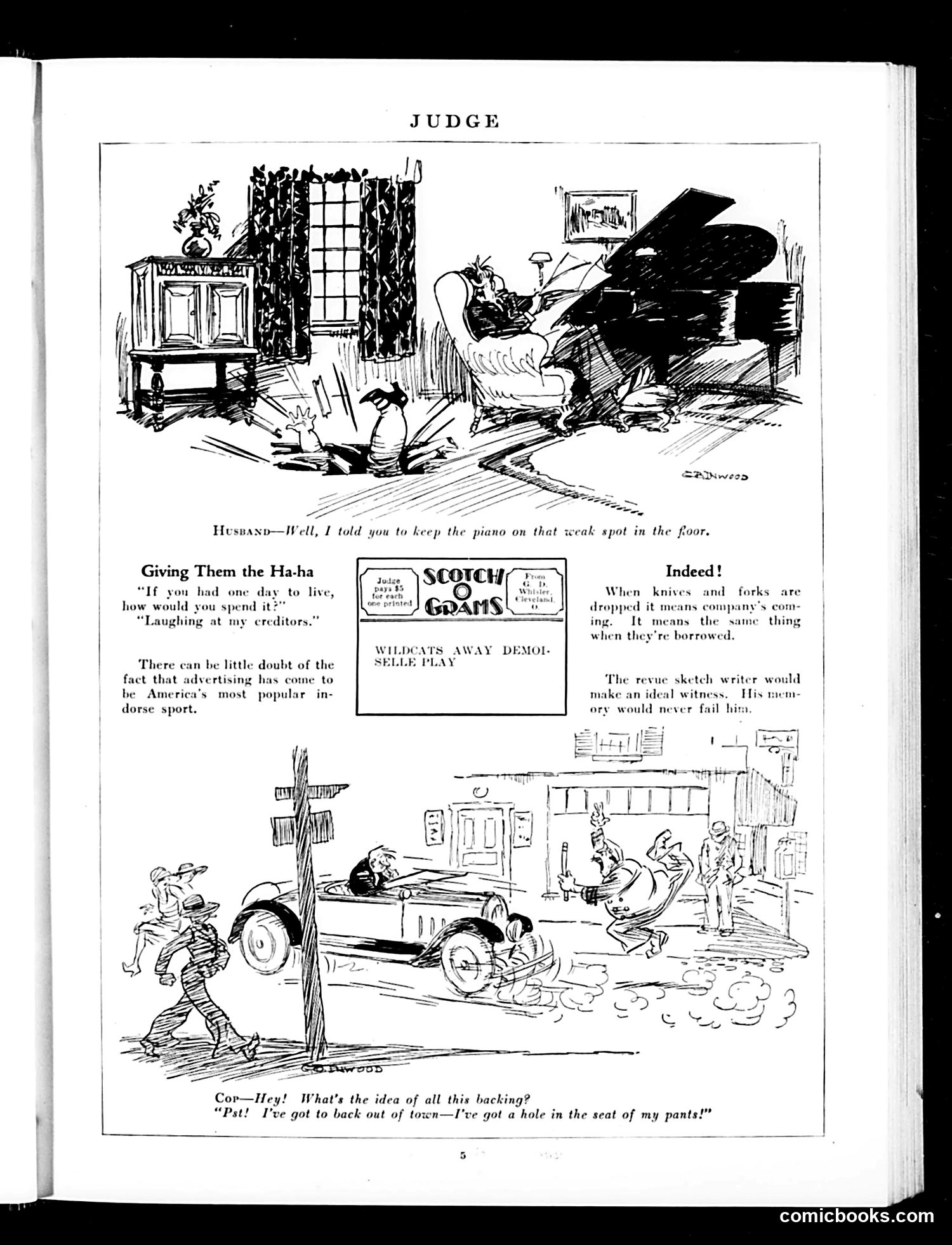
This page contains two distinct cartoons satirizing American leisure and domestic life. **Top cartoon ("Judge"):** Shows a wife confronting her husband about a damaged piano. The humor derives from the husband's failed excuse—he was supposed to keep the piano away from a weak spot in the floor, but it fell through anyway. This satirizes marital discord over household maintenance and domestic incompetence. **Bottom cartoon ("Cor"):** Depicts a car accident scene with a driver backing up into other vehicles. The humor centers on the driver's absurd excuse: he has a hole in his pants and needs to back out of town to avoid embarrassment. This mocks both reckless driving and misplaced priorities. Both cartoons reflect early 20th-century concerns about automobiles, modern domesticity, and gender relations.
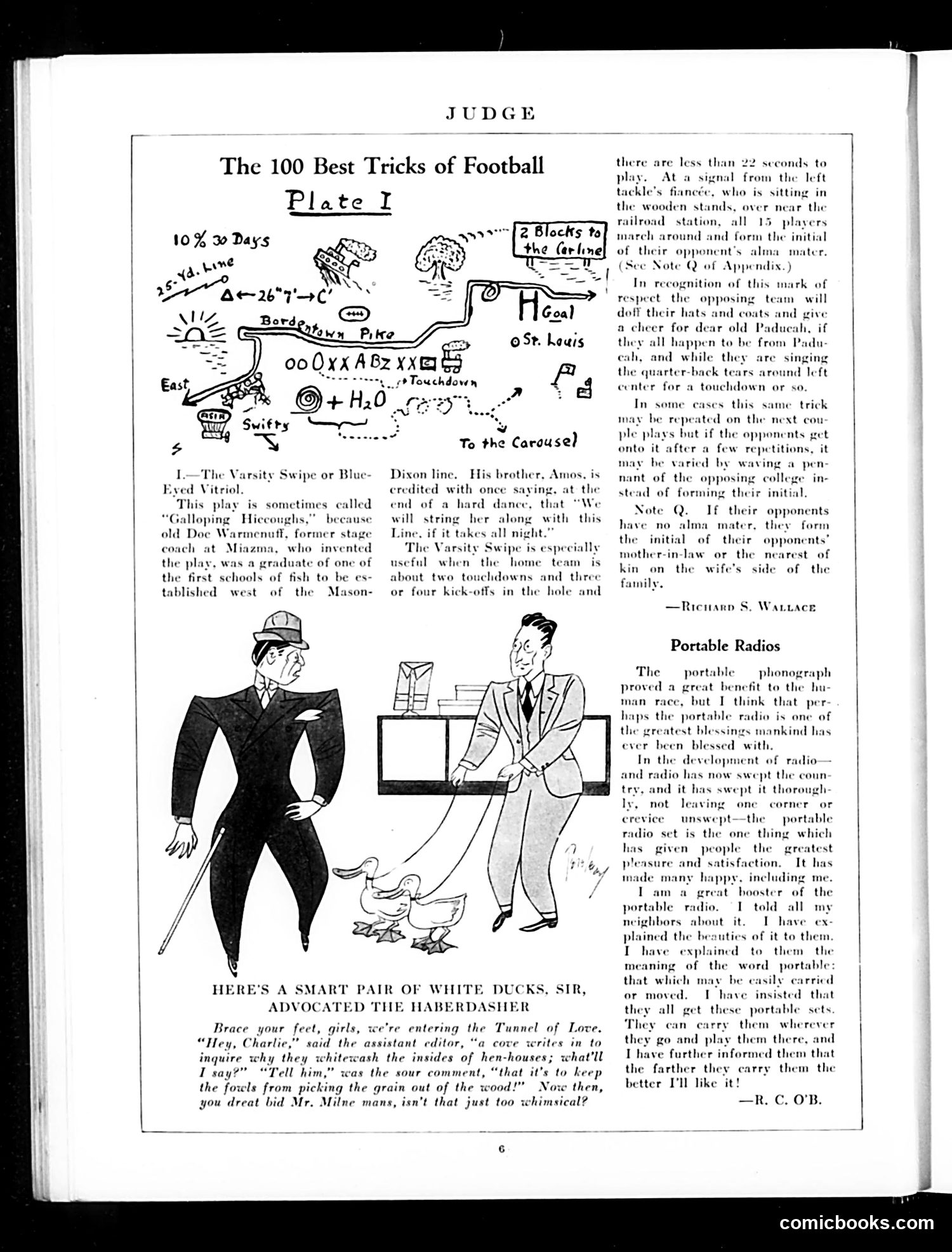
This page from *Judge* contains two distinct pieces: **"The 100 Best Tricks of Football" (Plate I):** A satirical instructional diagram mocking college football plays. The "Varsity Swipe or Blue-Eyed Vitriol" is presented as a deliberately absurd strategy where players form their opponent's alma mater initials as a sign of respect, during which the quarterback scores. The accompanying illustration shows two men (likely a coach and assistant editor) discussing ridiculous tactics like using white ducks to keep fowl from eating grain—a non sequitur joke. The satire targets the increasingly complex, sometimes nonsensical nature of early 20th-century football strategy and coaching culture. **"Portable Radios":** A brief advocacy piece praising portable radio sets as modern technology's greatest blessing. The author (R.C. O'B.) enthusiastically describes radios' sweep across America and encourages neighbors to acquire them, noting that carrying them farther increases personal satisfaction. Together, these pieces reflect 1920s-30s American culture—poking fun at college athletics while celebrating new consumer technology.
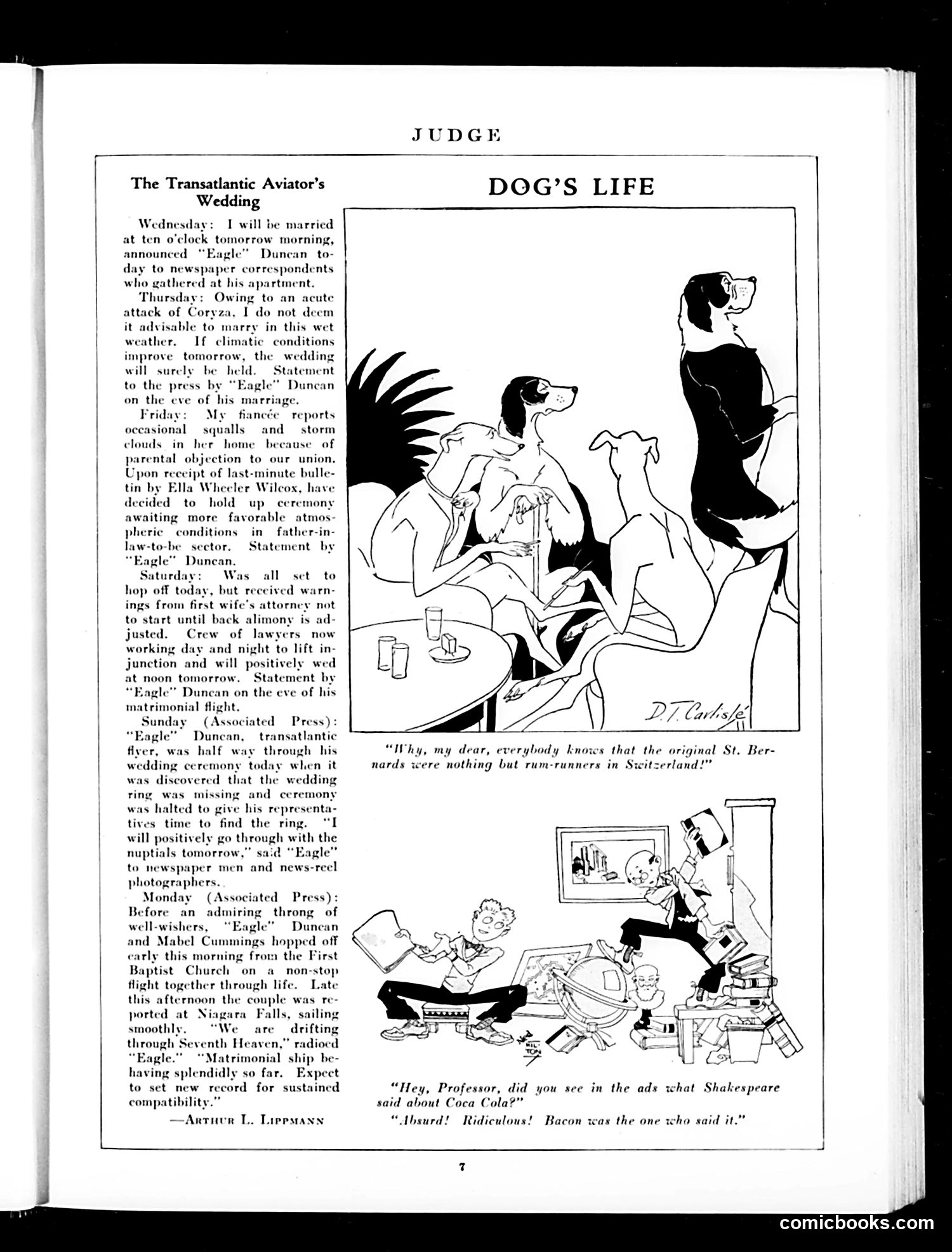
This Judge page satirizes "Eagle" Duncan, a famous transatlantic aviator of the 1920s-30s era. The main article mocks his chaotic wedding through a week-long narrative of constant delays—cold symptoms, parental objections, a first wife's lawyer blocking proceedings, a missing wedding ring—before the couple finally marries "in flight" from a church. The satire targets both aviation celebrity culture and the era's tabloid obsession with famous aviators' personal dramas. Each day's excuse becomes increasingly absurd, culminating in a wedding conducted mid-flight. The two cartoon strips below are unrelated: one jokes about St. Bernards as smugglers during Prohibition (they famously carried brandy), and another satirizes academic pretension—a professor wrongly attributes a Coca-Cola advertising slogan to Shakespeare, then to Bacon. The humor relies on knowing 1920s-30s celebrity gossip and Prohibition-era references unfamiliar to most modern readers.
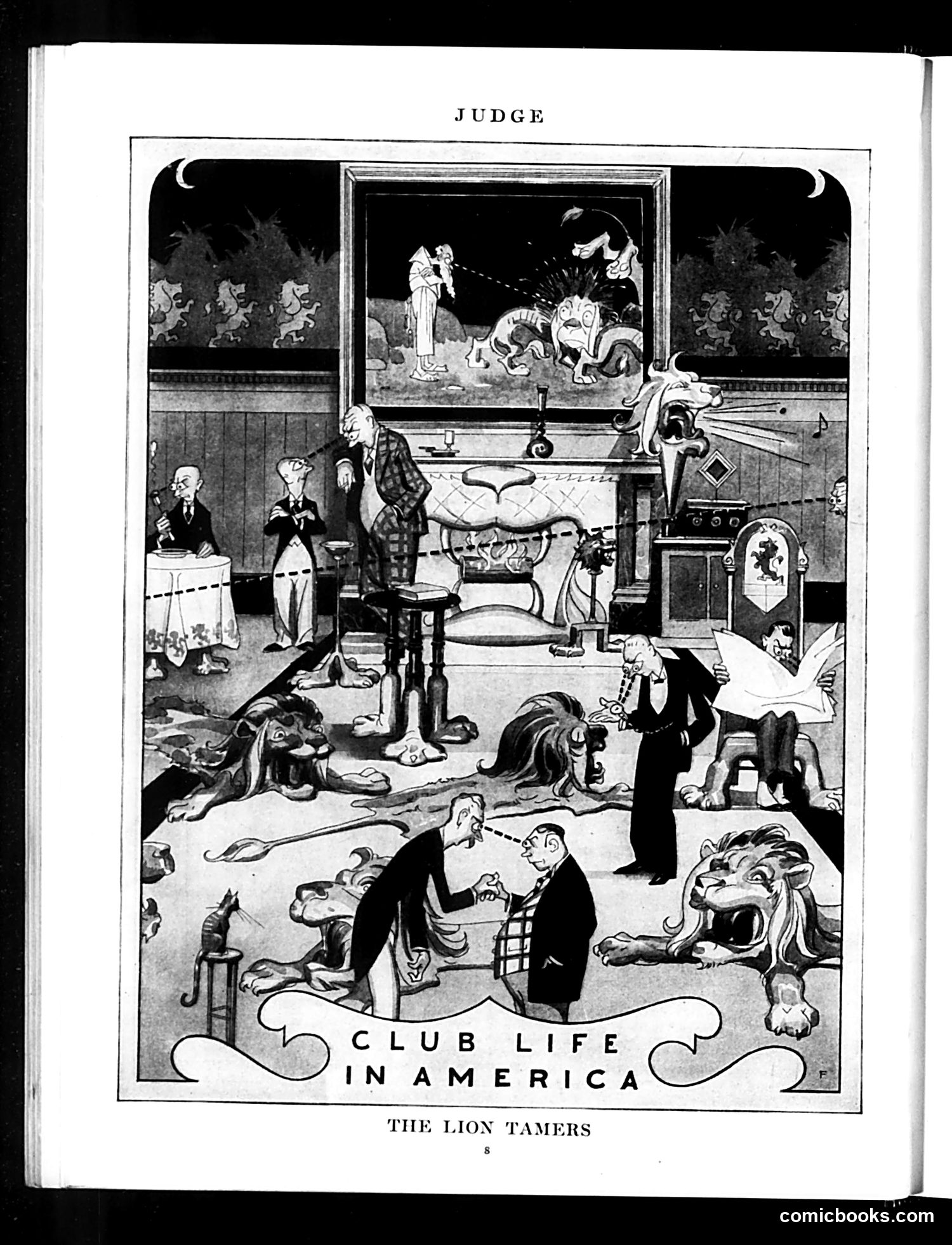
This satirical cartoon depicts a nightclub or entertainment venue where wealthy patrons observe dangerous lions being tamed. The scene mocks upper-class "club life" by showing well-dressed men and women casually watching wild animal performances as entertainment. The satire likely critiques the excesses and frivolous pursuits of America's wealthy elite during Judge magazine's era (early-to-mid 20th century). The title "Lion Tamers" appears metaphorical—suggesting these club members are themselves "taming" danger or wildness through controlled spectacle, or conversely, that they are the "lions" being managed by society. The elaborate venue with its fireplace, artwork, and attendants emphasizes the luxurious setting. The cartoon's point seems to be mocking the decadence and artificiality of club culture among the privileged classes.
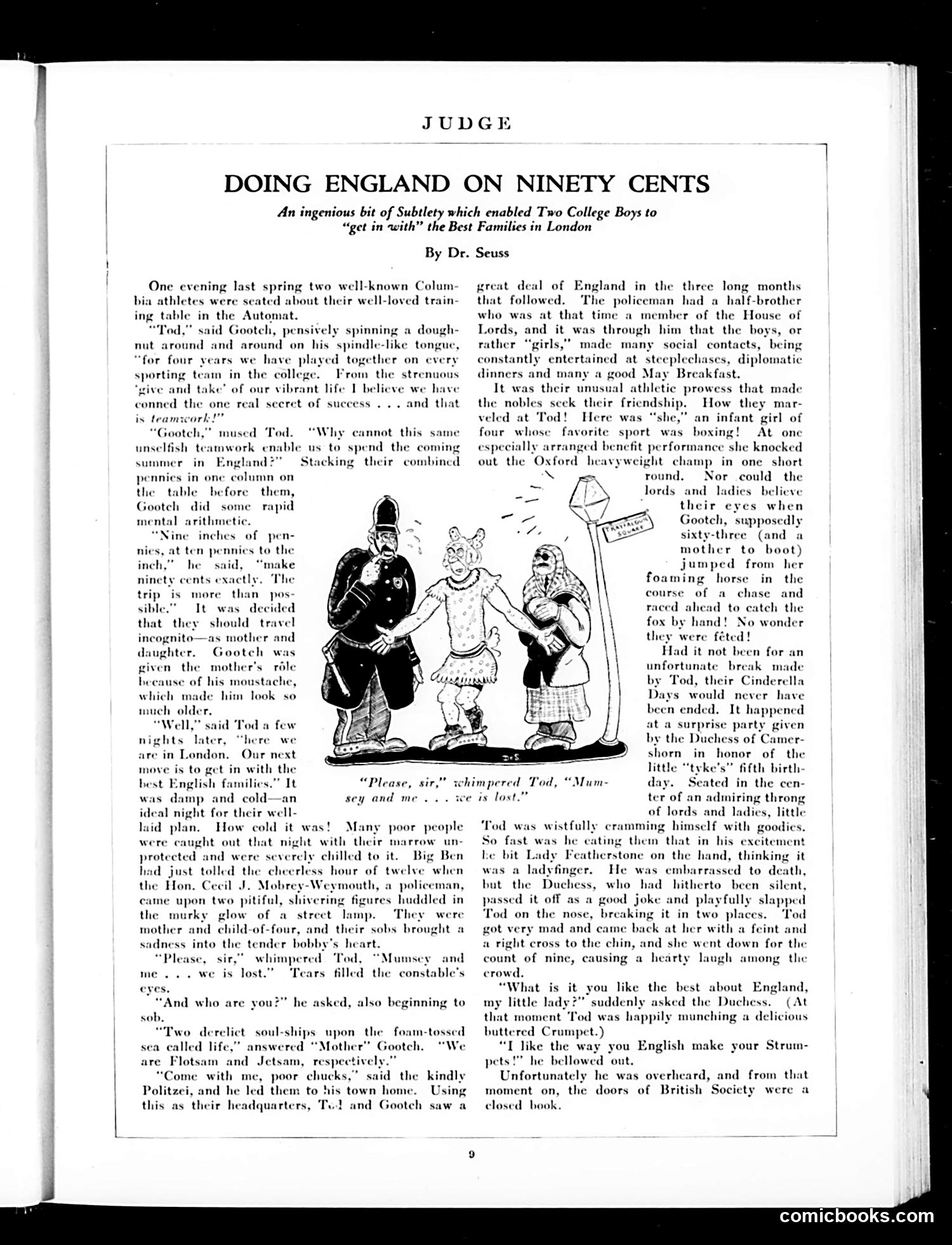
This satirical story in *Judge* magazine mocks wealthy English society and social pretension. Two college boys, Tod and Gootch, pool their meager savings (ninety cents) to travel to England. Their scheme: Gootch disguises himself as an elderly widow and Tod as her young daughter, claiming to be destitute refugees named "Flotsam and Jetsam." A sympathetic London policeman takes them in, unknowingly connecting them to high society through his aristocratic relatives. The boys gain acceptance among nobles by fabricating extraordinary athletic feats (Tod supposedly boxes, Gootch hunts foxes on horseback), which appeal to the English upper class's athletic pretensions. The satire targets both the gullibility of British aristocracy and the superficiality of their social networks—they welcome obvious frauds based purely on impressive (if implausible) sporting stories. The scheme unravels when Tod, at a duchess's party, bites her hand while mistaking it for a ladyfinger, exposing their deception.
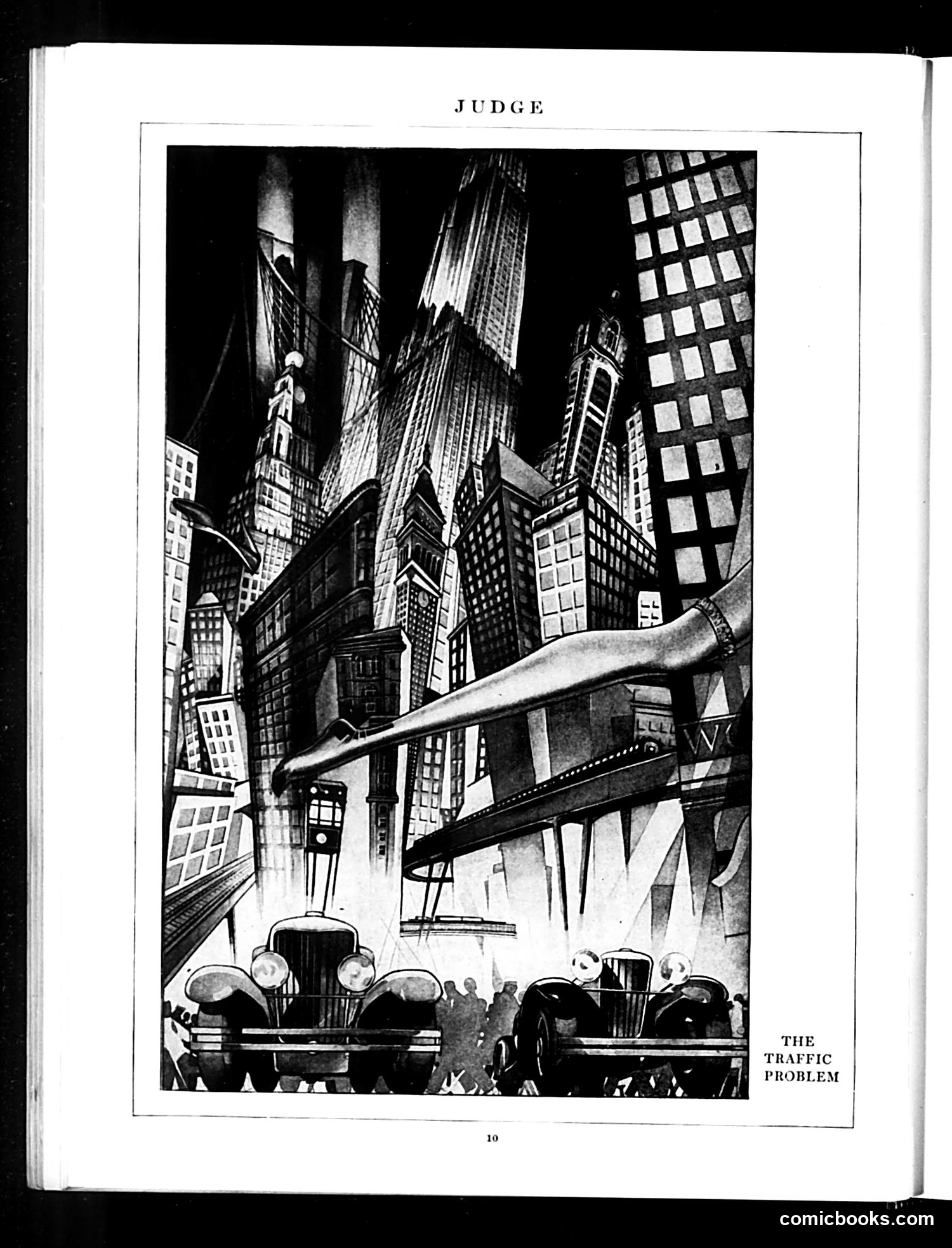
This satirical illustration depicts an urban traffic jam in a towering cityscape, likely New York. Two automobiles are gridlocked beneath massive skyscrapers and an elevated structure (possibly an elevated railway or highway). The image critiques the growing chaos of urban automobile congestion in early-to-mid 20th century American cities. The cartoon appears to mock the inability of city infrastructure to accommodate increasing vehicle traffic—a new and pressing social problem as car ownership expanded. The contrast between the monumental architecture above and the tiny, trapped vehicles below emphasizes human powerlessness against modern urban congestion. The title "The Traffic Problem" directly labels this as commentary on a contemporary civic challenge that city planners struggled to solve.
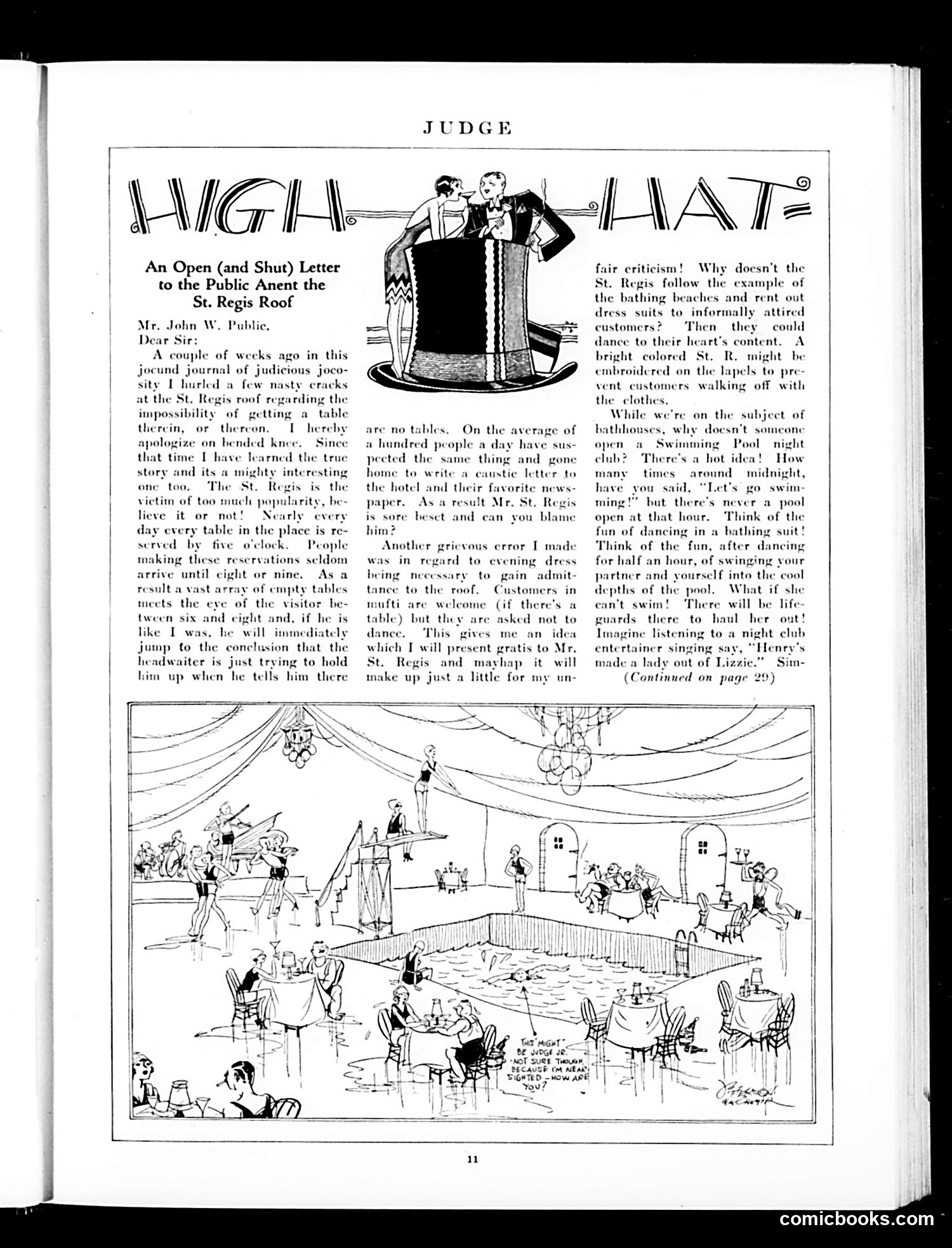
This is a satirical letter to the editor addressing complaints about the St. Regis Hotel's rooftop venue in New York. The author (writing as "Judge" magazine's correspondent) corrects his own previous criticism of the establishment. **The satire's points:** 1. **The real problem isn't the hotel's fault**: Tables appear empty because people make reservations at 5 PM but don't arrive until 8-9 PM, creating the false impression of exclusivity or snobbishness. 2. **Misunderstandings about dress codes**: Evening dress wasn't strictly required for entry, only for dancing—but this wasn't clearly communicated, generating angry letters and bad press. 3. **Absurd "helpful" suggestions**: The author sarcastically proposes the hotel rent dress suits (like bathing beaches rent swimwear) and suggests someone open a "swimming pool night club" where patrons could dance in bathing suits and dive into pools between songs. The cartoon below illustrates this imagined aquatic nightclub venue with its various entertainments and swimming pool. The humor targets both the hotel's communication failures and the era's emerging leisure culture obsessions.
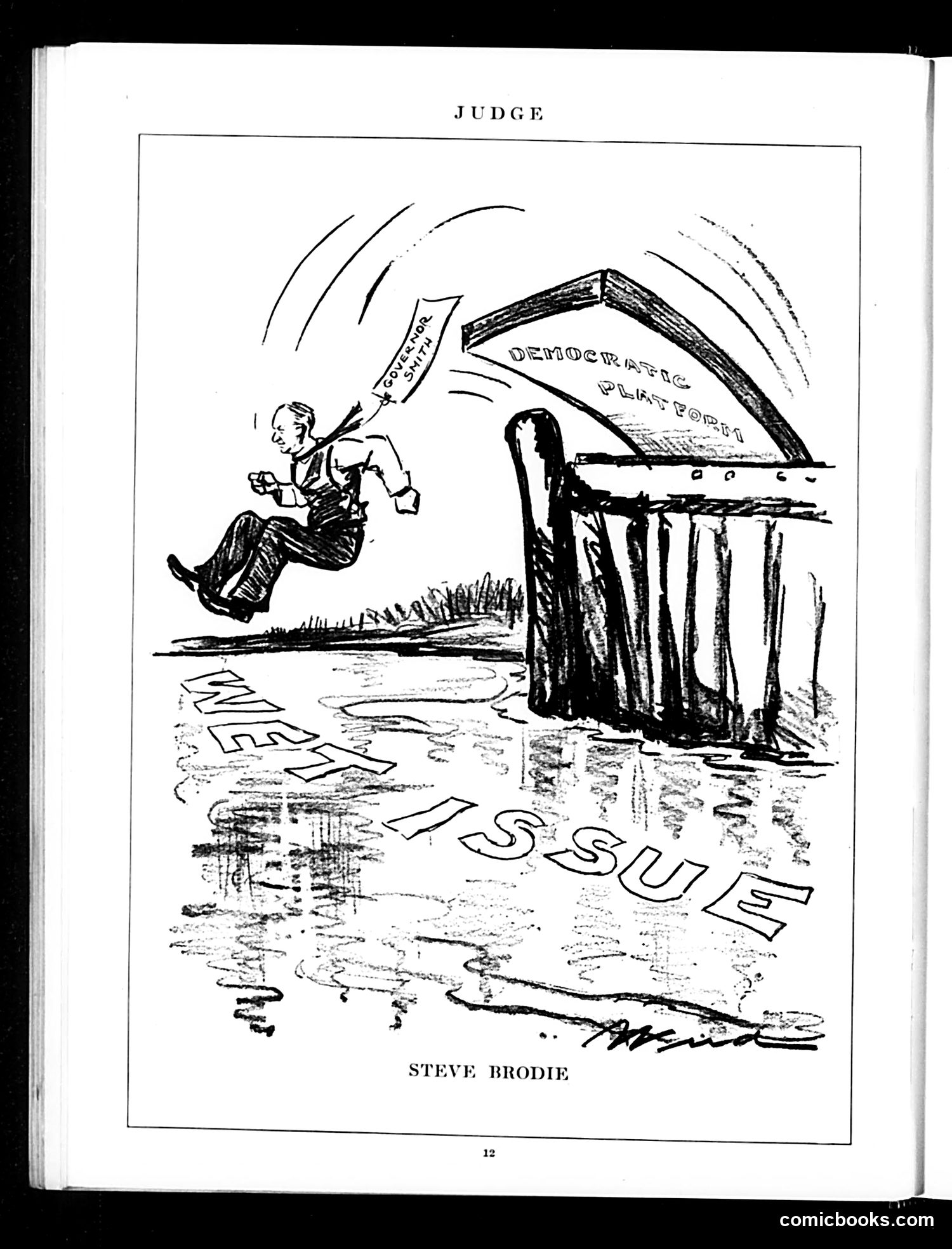
This political cartoon depicts a figure running desperately toward a structure labeled "Democratic Platform," which appears to be collapsing or sinking into muddy ground labeled "Recall/Suit." The figure carries a banner reading "Good Government." The satire critiques the Democratic Party's platform as unstable and unreliable—literally crumbling beneath those who try to stand on it. The "recall/suit" ground suggests legal or political challenges undermining Democratic credibility. The cartoonist suggests that Democratic promises of "good government" are hollow, built on unstable foundations that cannot support genuine reform. The cartoon likely comments on a specific early 20th-century political moment when Democrats faced accusations of corruption or failed governance, though the exact historical context requires additional dating information not provided on this page.
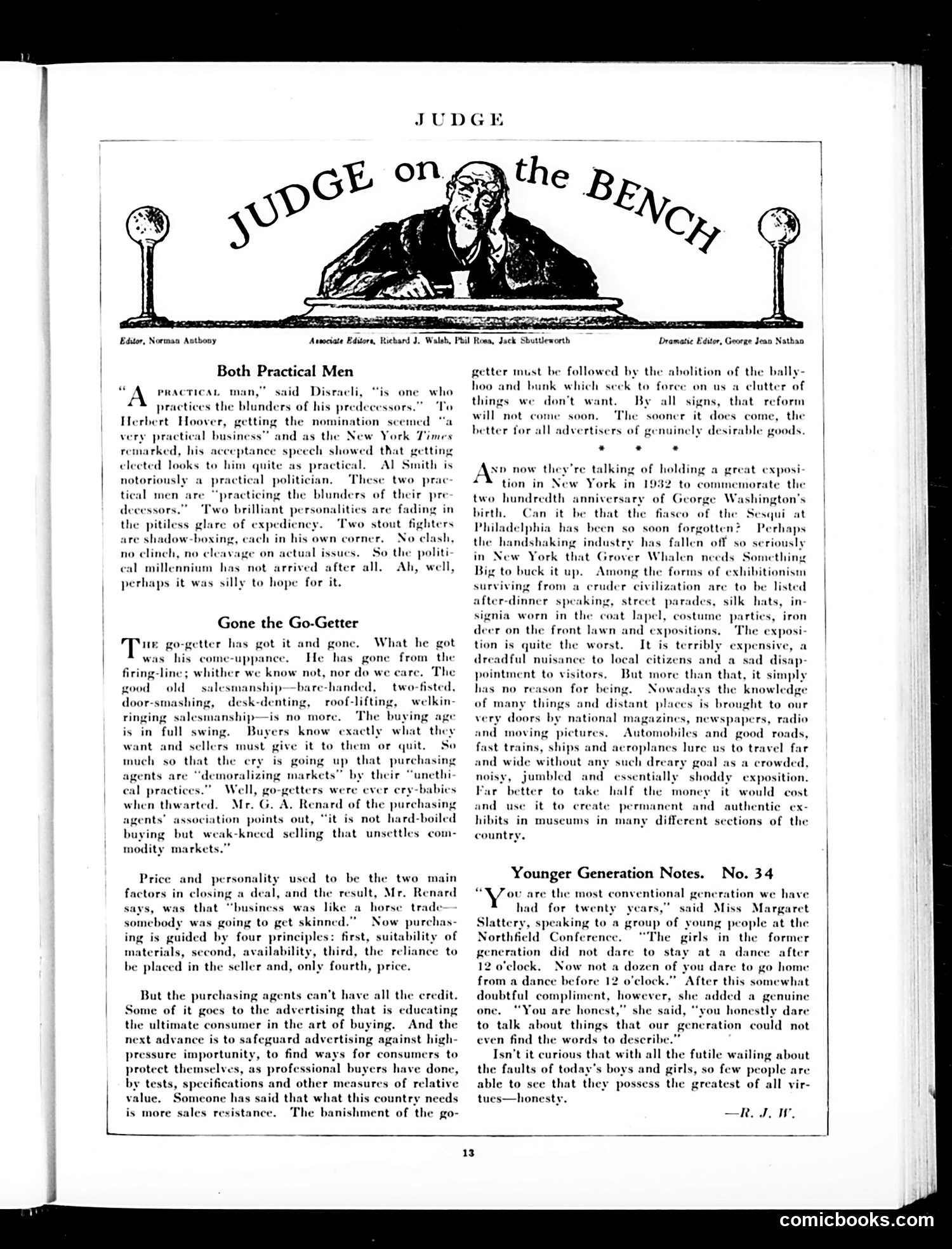
This page contains three editorial commentaries from Judge magazine (editor Norman Anthony), likely from 1932 based on the George Washington bicentennial reference. **"Both Practical Men"** criticizes the 1932 presidential race between Herbert Hoover and Al Smith as uninspired. Both candidates are dismissed as merely "practicing the blunders of their predecessors"—brilliant fighters reduced to shadow-boxing with no real clash of ideas or genuine engagement. **"Gone the Go-Getter"** mourns the decline of aggressive American salesmanship. The high-pressure "go-getter" sales style is obsolete; modern buyers now demand substance (suitability, availability, reliability) over personality and price. The article suggests this shift, while good for consumers, means aggressive advertising tactics are ending—though the writer doubts real change will come soon. **"Younger Generation Notes"** quotes Margaret Slattery criticizing youth for lacking honesty and courage to discuss serious matters openly. The overall tone reflects Depression-era skepticism about business-as-usual and political leadership.
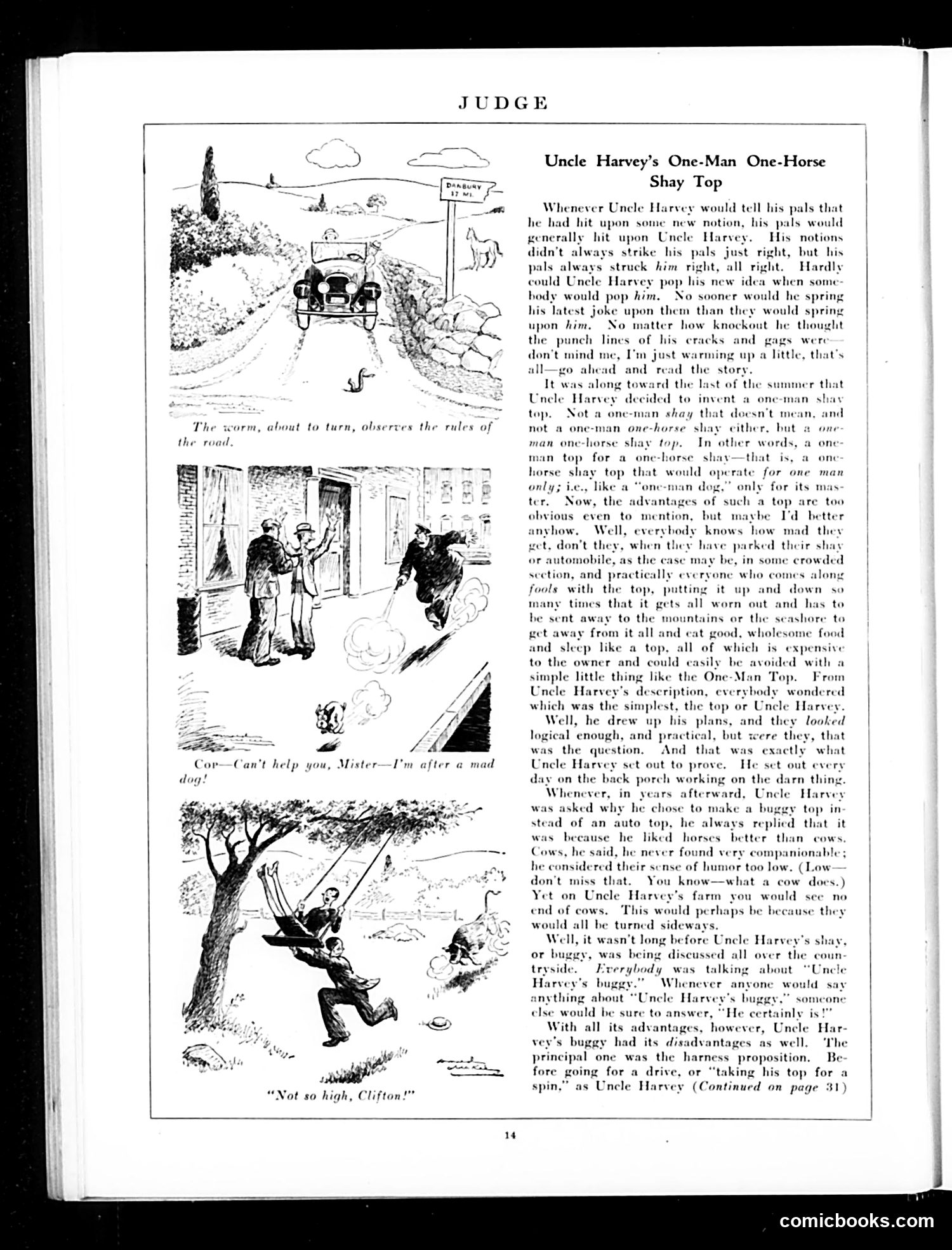
This is a humorous short story about an eccentric inventor named Uncle Harvey who designs a removable top for a horse-drawn buggy (shay). The satire targets the obsessive tinkerer and gadget enthusiast—a recognizable character type in early-20th-century American humor. The joke is Uncle Harvey's impractical thinking: he invents an elaborate solution to a minor problem (people fiddling with buggy tops), when a simple design would suffice. The story gently mocks inventors who overthink problems and those who celebrate mediocre innovations. The illustrations show Uncle Harvey's mishaps with his contraption and the social chaos it causes. The phrase "He certainly is!" is a double entendre—suggesting ambiguity about whether Uncle Harvey or his invention is the "simplest." The recurring motif of cows turned "sideways" suggests the device's ineffectiveness or absurdity in practical use. This reflects Judge magazine's typical target: middle-class American pretension and mechanical overconfidence.
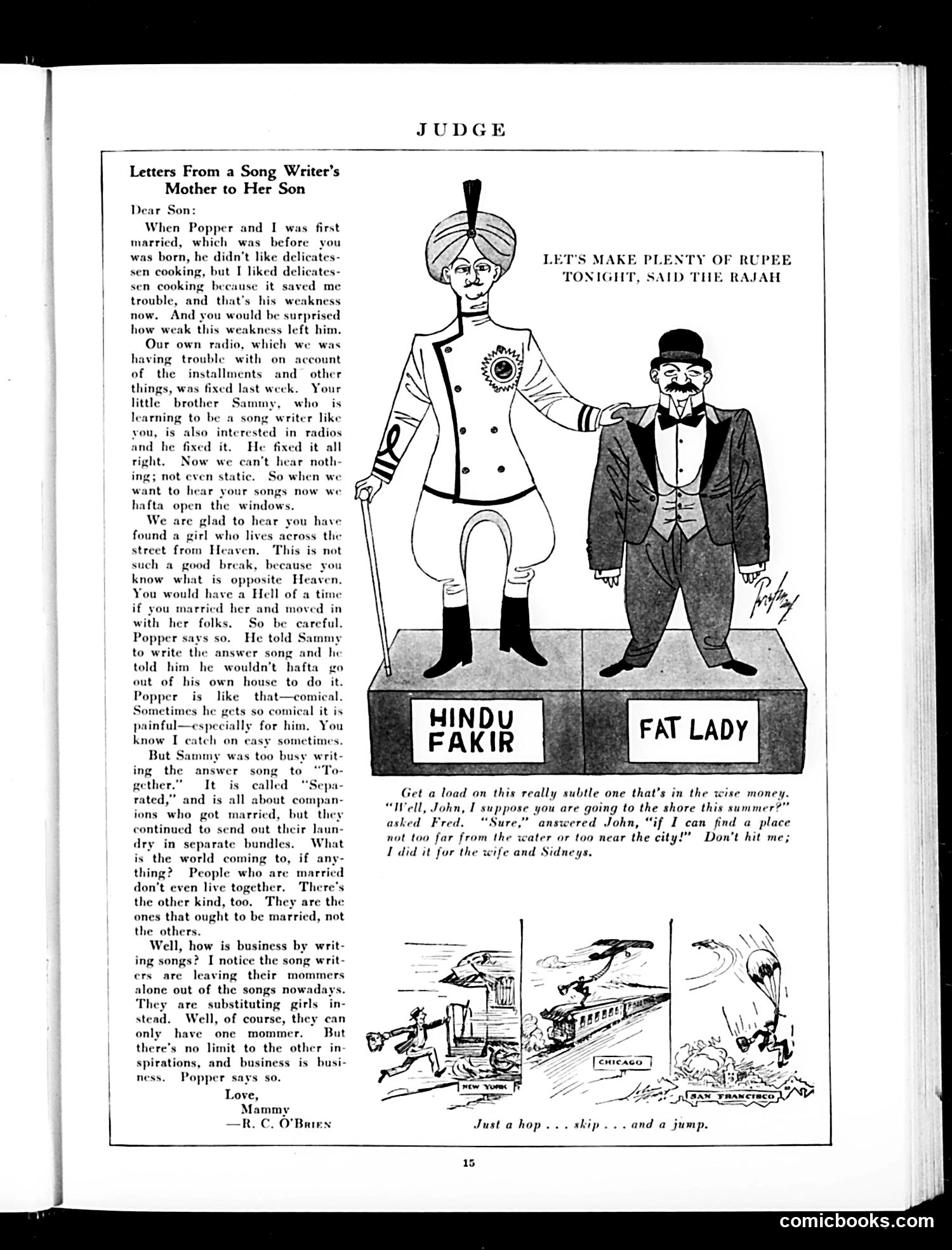
This page from *Judge* contains satirical content targeting early 1920s American culture: **Main Cartoon ("Hindu Fakir" and "Fat Lady"):** The large illustration depicts racist stereotypes—a caricatured Indian man and an overweight woman on pedestals. The caption suggests they're exotic attractions or oddities being displayed, reflecting the era's dehumanizing attitudes toward non-Western peoples and body-shaming humor common in period satire. **"Letters from a Song Writer's Mother":** This humorous column parodies working-class immigrant speech patterns and attitudes. The mother warns her son about marrying a girl "across the street from Heaven" (near hell), and discusses how songwriters now focus on romantic subjects rather than mothers. The separate laundry joke mocks couples who maintain separate households. **Small Comics Strip:** Shows travel between cities (Chicago, San Francisco), appearing to joke about romantic getaways or vacations. The overall tone reflects 1920s popular entertainment—mixing gentle domestic humor with crude ethnic and physical caricature that would be considered deeply offensive today.
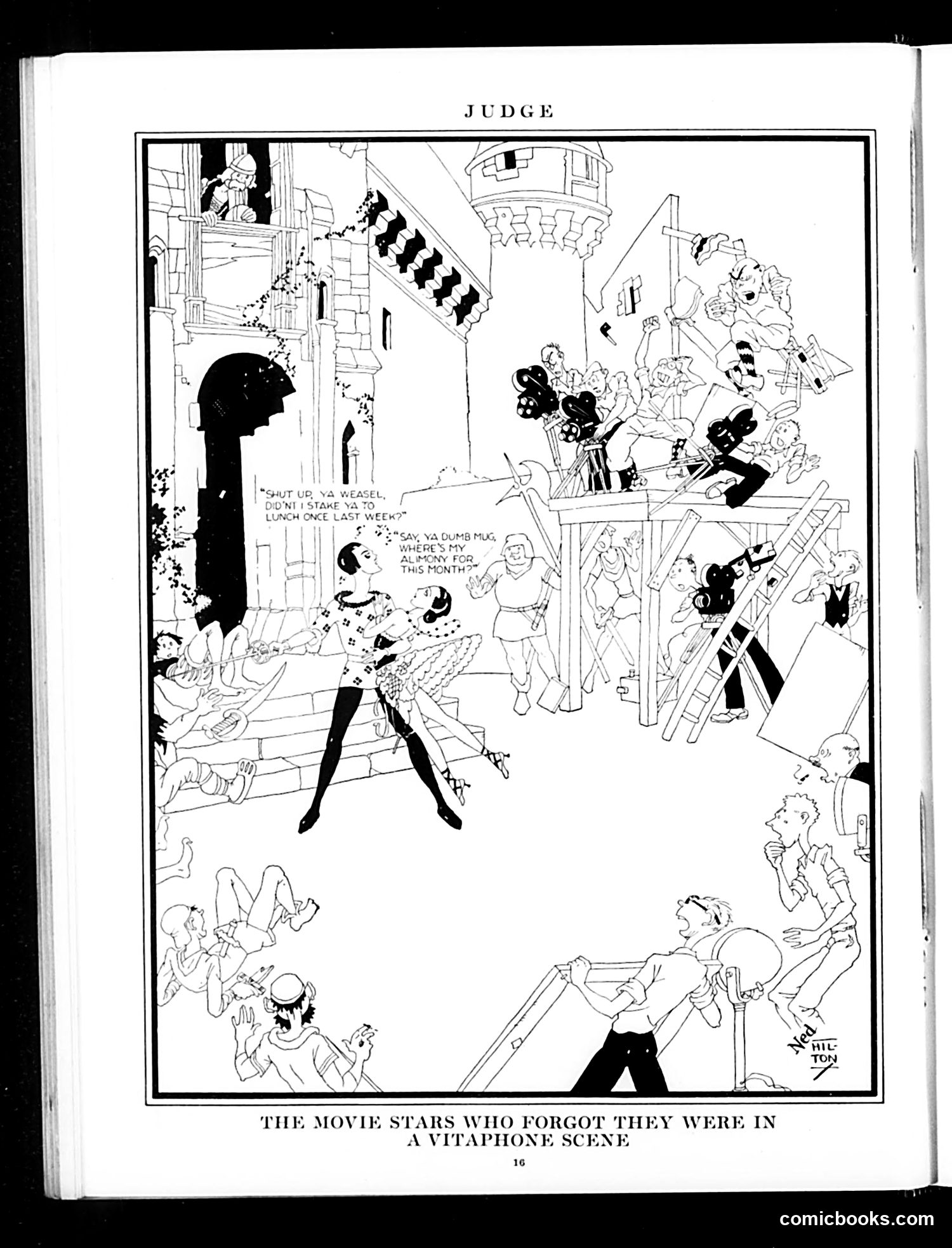
This cartoon satirizes silent film actors who were unprepared for the arrival of sound cinema (Vitaphone technology). The scene depicts chaos on a movie set where performers—accustomed to silent acting—have forgotten they're being recorded with audio. The dialogue bubbles show characters speaking naturally (one says "shut up, ya weasel, didn't I stake ya to lunch once last week?"), suggesting actors weren't adjusting their behavior for sound. The towering silhouette on the left appears to be a director or authority figure observing the pandemonium. The satire mocks the transition period when many silent film stars struggled to adapt to "talkies"—their exaggerated gestures, ad-libbed language, and overall theatrical behavior suddenly became problematic with synchronized sound recording. The title emphasizes their apparent obliviousness to the technological change reshaping their industry.
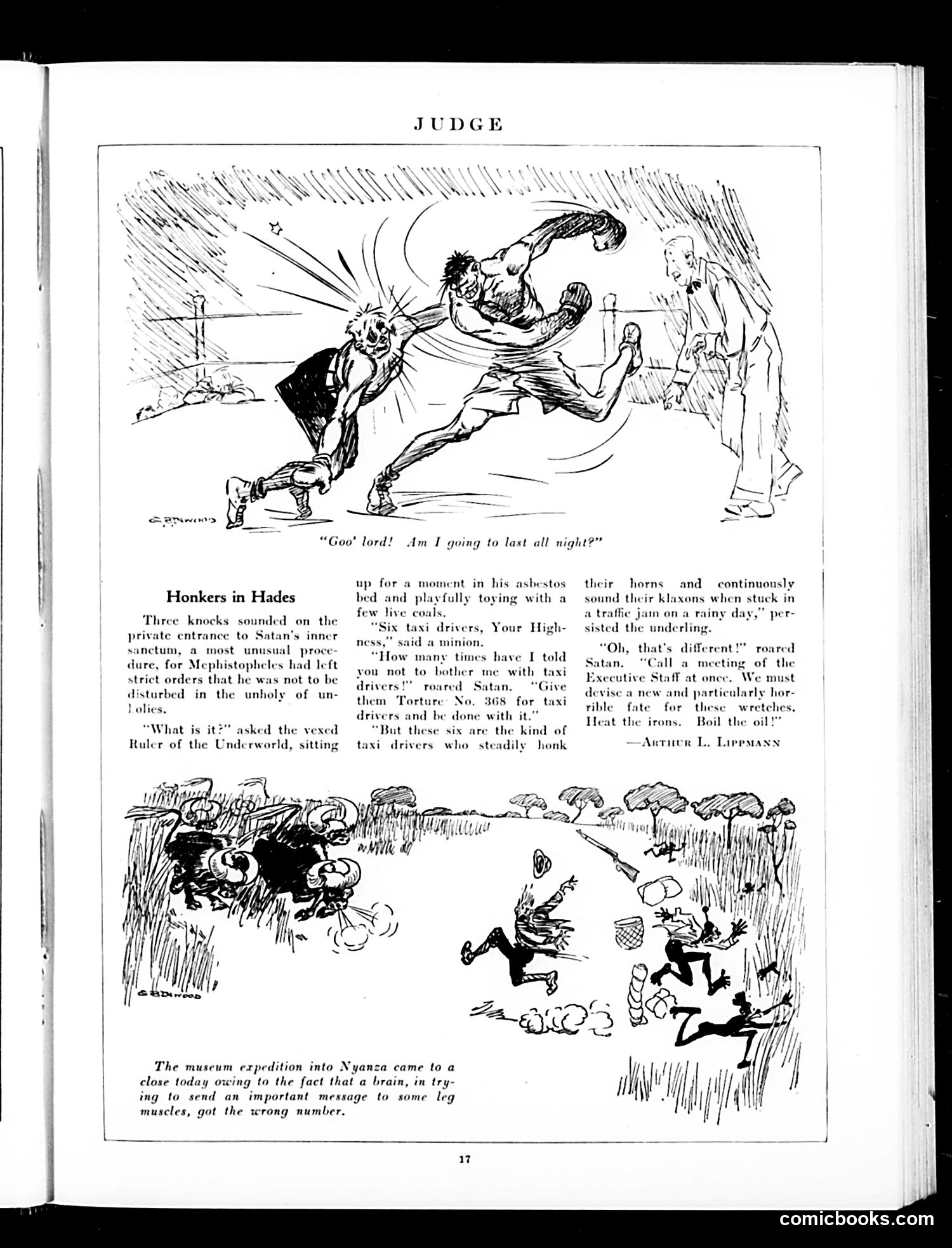
This page contains two satirical pieces from Judge magazine about taxi drivers. **Top cartoon:** Shows Satan annoyed by six taxi drivers sent to Hell. The joke plays on a common urban complaint: taxi drivers who continuously honk their horns in traffic jams. Satan, even in the underworld, finds them so unbearable that he demands a "new and particularly horrible fate" for them—suggesting these drivers are worse than typical sinners. **Bottom cartoon:** Depicts a museum expedition in Nyanza (a region in Africa) where someone's brain misfired, sending a message to the wrong body part, creating chaos. The caption implies bumbling incompetence. **Context:** Both pieces mock taxi drivers as persistently annoying urban figures, likely reflecting 1920s-30s complaints about noisy city traffic and aggressive cab drivers. The satire uses absurdist humor—even Hell's torments pale compared to taxi driver behavior—to comment on everyday urban frustrations that readers would recognize.
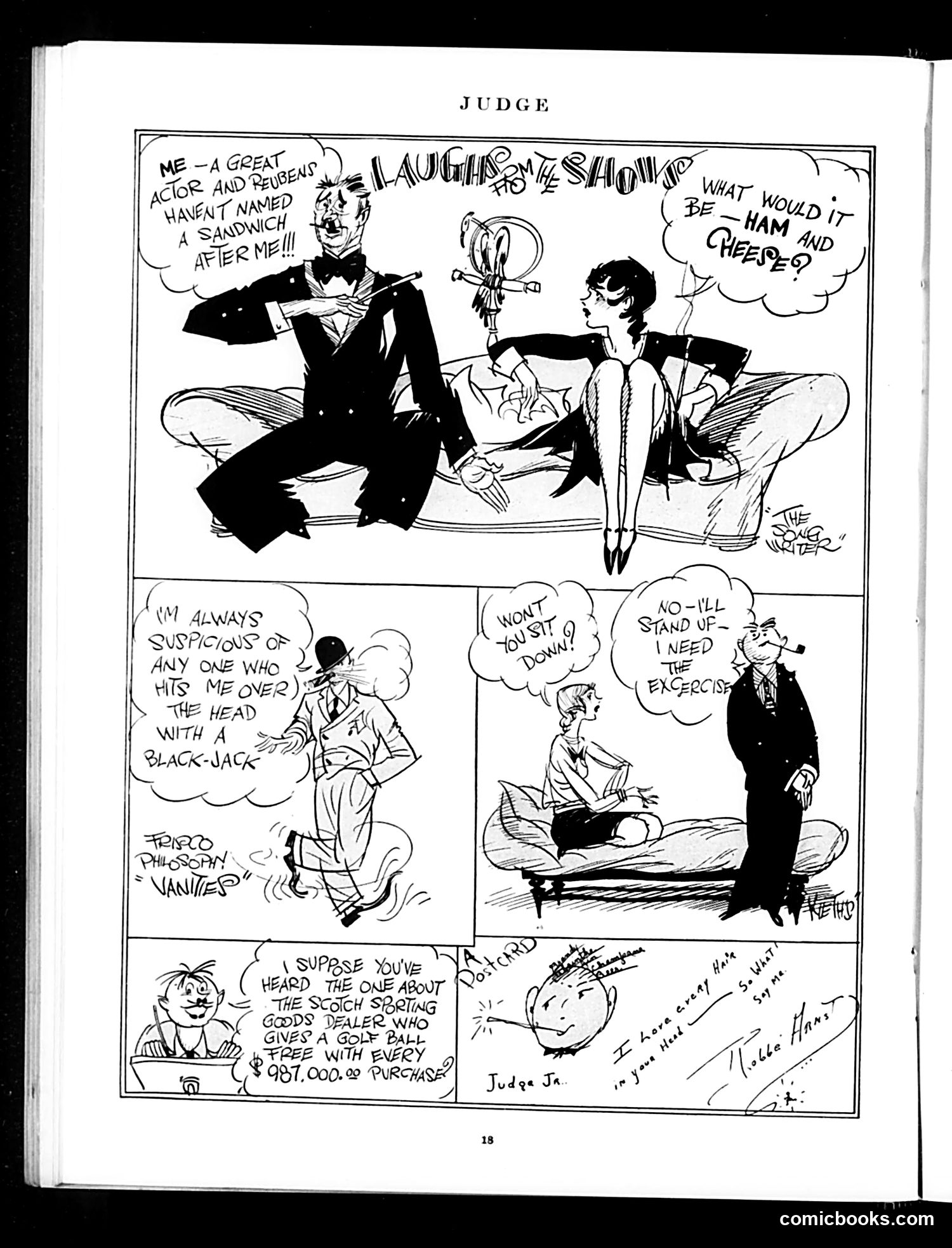
This is a multi-panel satirical comic titled "Judge" featuring a wealthy man bragging about his importance and suspicious nature. **The Setup:** A distinguished gentleman in formal wear boasts he's so great a sandwich should be named after him, while a woman asks what such a sandwich would contain—"ham and cheese?" **The Satire:** The subsequent panels mock his paranoia and vanity. He's suspicious of anyone hitting him with a "blackjack" (robbery), worried about being poisoned by his "valet," and needs constant exercise. **The Punchline:** The final panel reveals the joke—a wealthy businessman mentions a golf dealer who sells balls with "$987,000 purchase" included, implying the man's absurd wealth and status obsession. The cartoon satirizes the arrogance and neuroses of the wealthy elite, their paranoia about threats, and their ridiculous spending habits. The humor relies on period-specific class commentary typical of *Judge* magazine's satirical approach to American society.
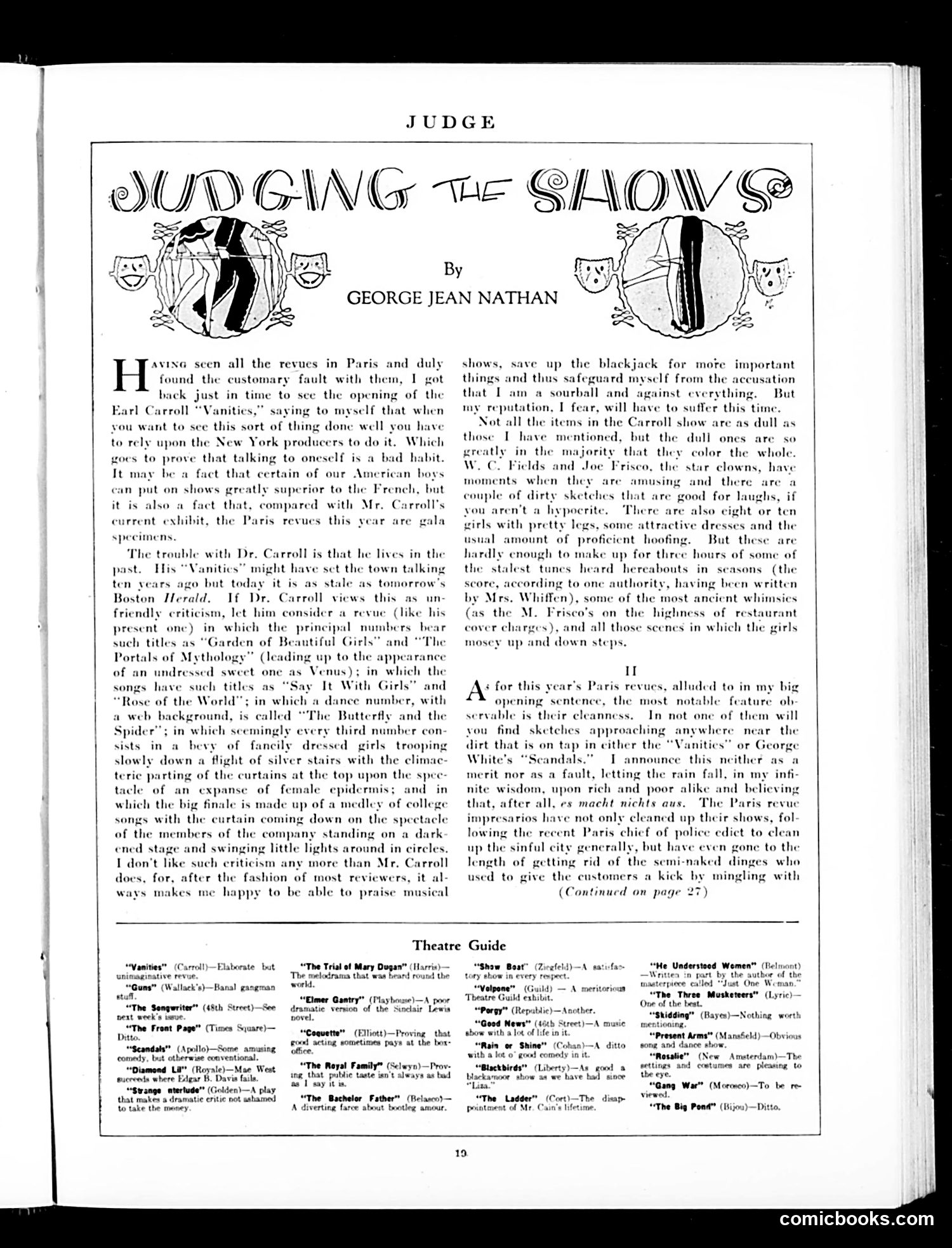
This is a theater review column, not a political cartoon. Theater critic George Jean Nathan compares American Broadway revues (specifically Earl Carroll's "Vanities") unfavorably to Parisian revues. **The satire:** Nathan criticizes Carroll's show as outdated and formulaic—full of hackneyed numbers like "Garden of Beautiful Girls" and "Rose of the World," repetitive scenes of girls descending silver staircases, and an ancient musical score. He notes that while American shows feature crude humor and nudity, the French productions are cleaner and more refined (following a Paris police edict to clean up entertainment). **The irony:** Nathan admits he dislikes such critical negativity—preferring to praise—yet feels obligated to honest assessment. He praises performers W.C. Fields and Joe Frisco but concludes the show is "as stale as tomorrow's Boston Herald." This represents typical 1920s theatrical criticism in Judge's satirical voice.
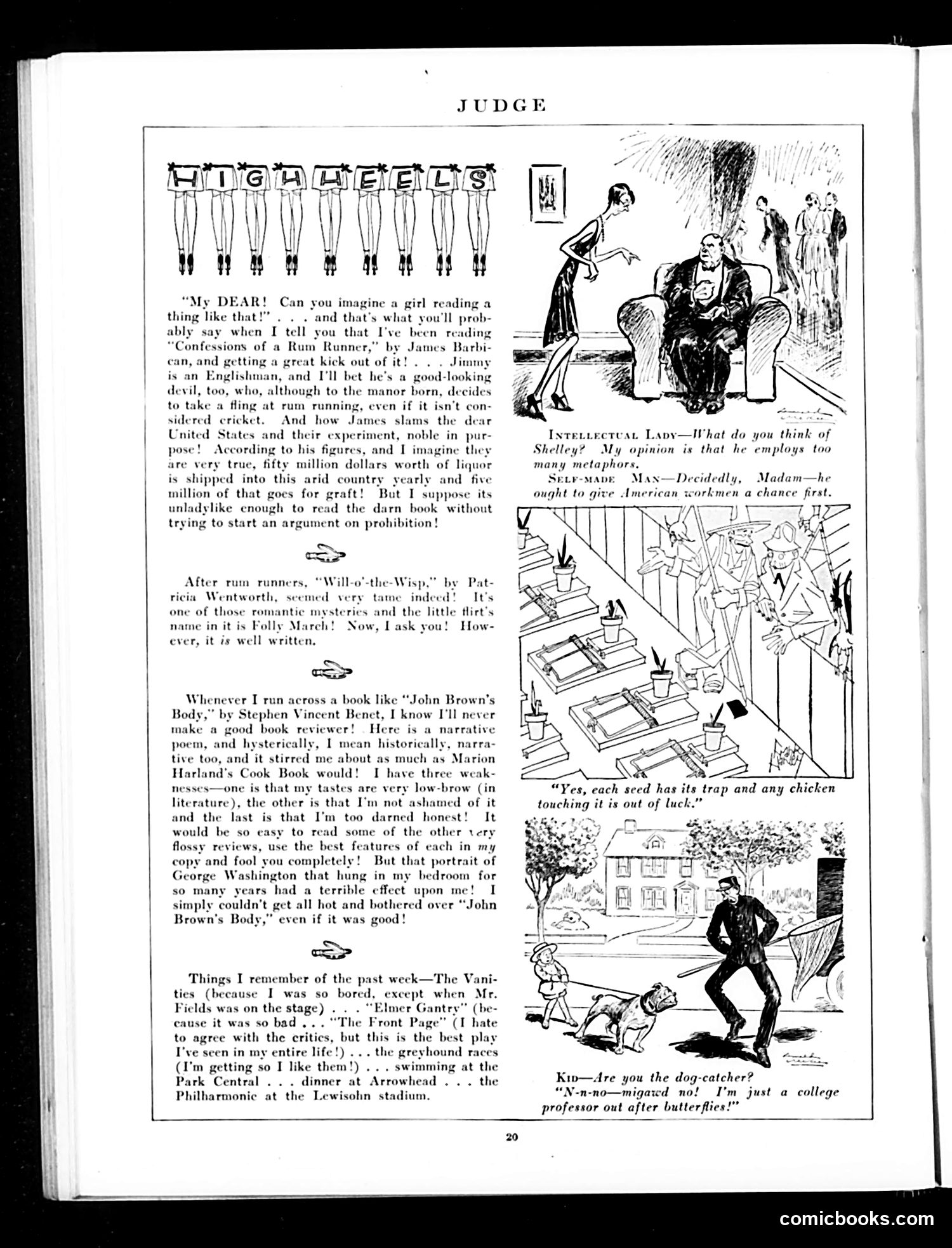
This page from Judge satirizes literary and cultural pretensions through a book reviewer's column. The main text mocks the reviewer's own inconsistency: she claims to be honest and "low-brow" yet admits reading scandalous books like "Confessions of a Rum Runner" (about Prohibition-era smuggling) while disapproving of them publicly. The humor lies in her contradiction—she's simultaneously thrilled by salacious content and self-consciously defensive about it. The cartoons below offer social commentary: one shows intellectuals debating literary merit with overwrought language; another depicts a man catching butterflies (labeled a "college professor"), satirizing impractical academics; a third shows a homeowner with children and a mousetrap, suggesting working-class family life. Overall, the page mocks 1920s urban sophistication—pretentious book culture, Prohibition hypocrisy, and class-conscious behavior among the middle class trying to appear cultured while enjoying lowbrow entertainment.
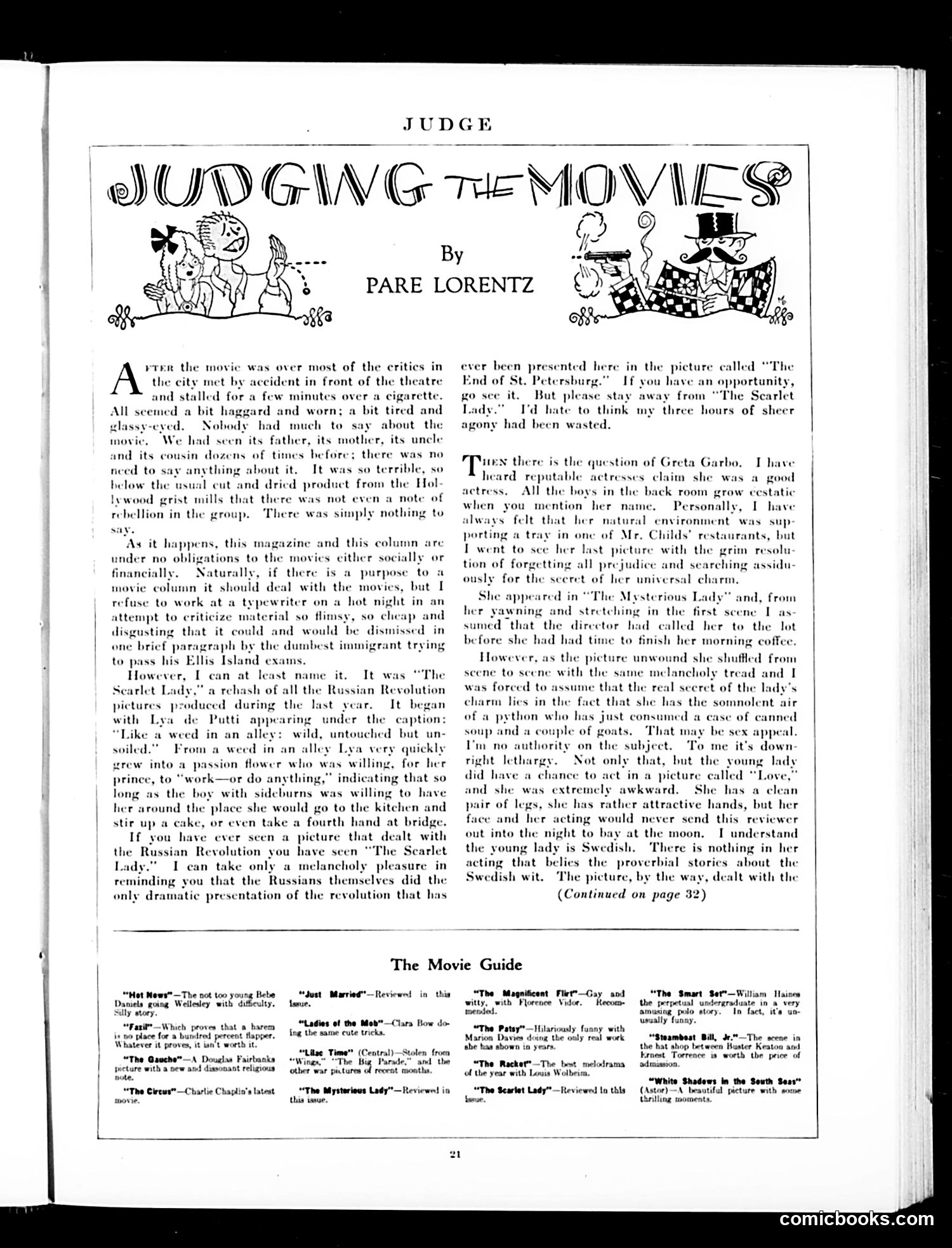
This is a film review column criticizing recent Hollywood movies, particularly those depicting the Russian Revolution. The author dismisses "The Scarlet Lady" as a formulaic, uninspired rehash—a tired "weed in an alley" transformed into a "passion flower"—arguing it lacks even the authenticity of actual Russian revolutionary cinema. The review then turns to actress Greta Garbo, whom the author ridicules despite her celebrity status. He claims she appears perpetually sleepy and aimless, comparing her to a "python who has just consumed a case of canned soup," while suggesting her real talent lies in waitressing (referencing Child's restaurants). The author finds her acting awkward and unconvincing, dismissing her widespread appeal as undeserved. The satire targets both Hollywood's lazy recycling of trendy subjects and celebrity worship disconnected from actual talent.
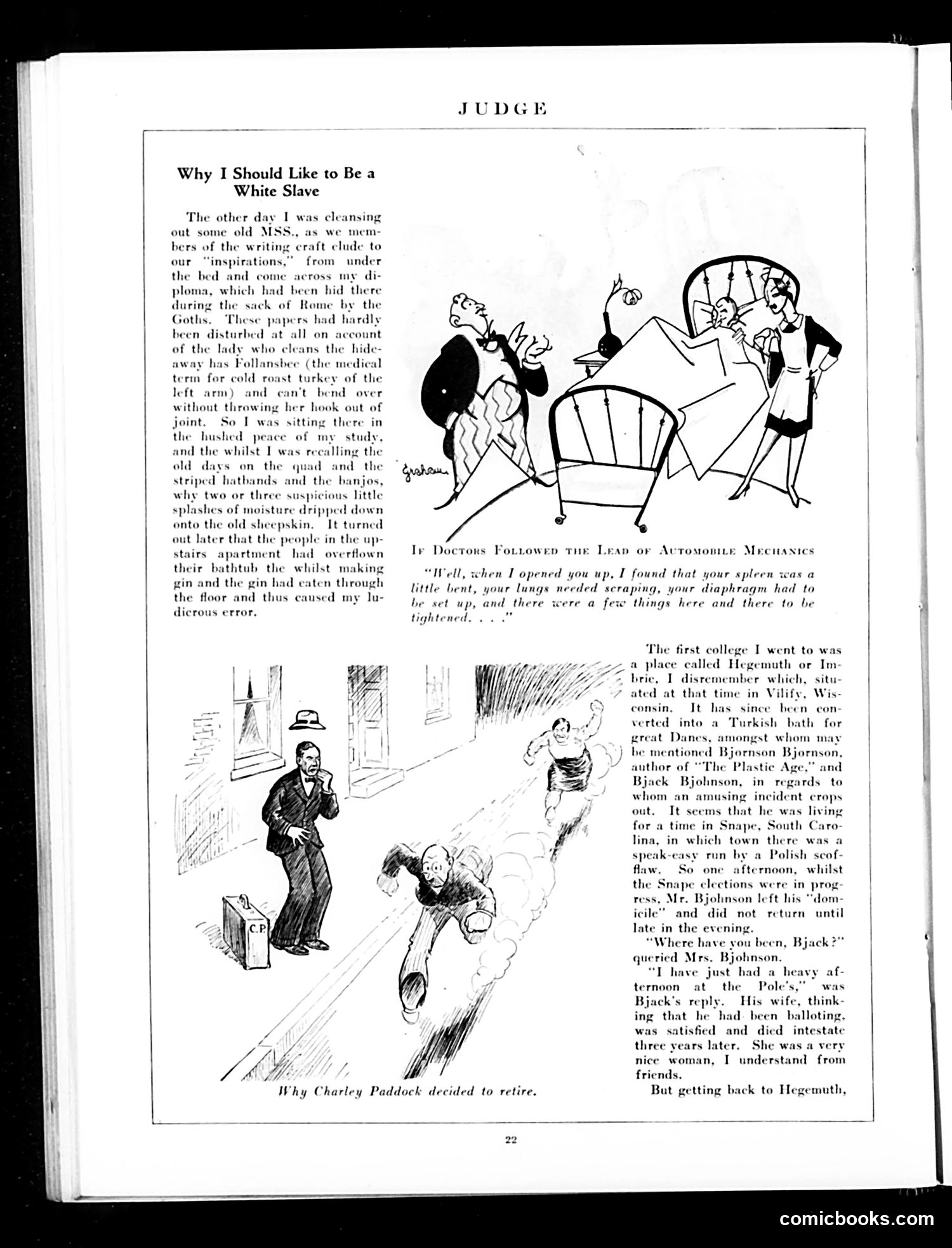
This page contains humorous personal essays illustrated with cartoons, typical of Judge's satirical style. **"Why I Should Like to Be a White Slave"** is a comedic essay playing on the era's popular "white slave" narratives—sensationalized stories about women trafficked into servitude. The author ironically uses this loaded phrase to describe mundane domestic mishaps: a cleaning lady with a frozen shoulder ("Follansbee") and water damage from an upstairs bathtub overflow. The humor derives from applying inflammatory contemporary language to absurdly trivial situations. **The lower cartoon** shows a doctor examining a patient like an automobile mechanic, listing mechanical repairs needed ("spleen bent," "lungs needed scraping"). This satirizes the early-20th-century tendency to view the human body through industrial/mechanical metaphors—reflecting an era when mechanical thinking dominated popular culture. The essay itself mixes intentionally absurd details (a college converted to a Turkish bath for Great Danes) with period references (mentions of author Bjornson, "speak-easy" prohibition-era bars) to create nonsensical humor typical of Judge's irreverent style.
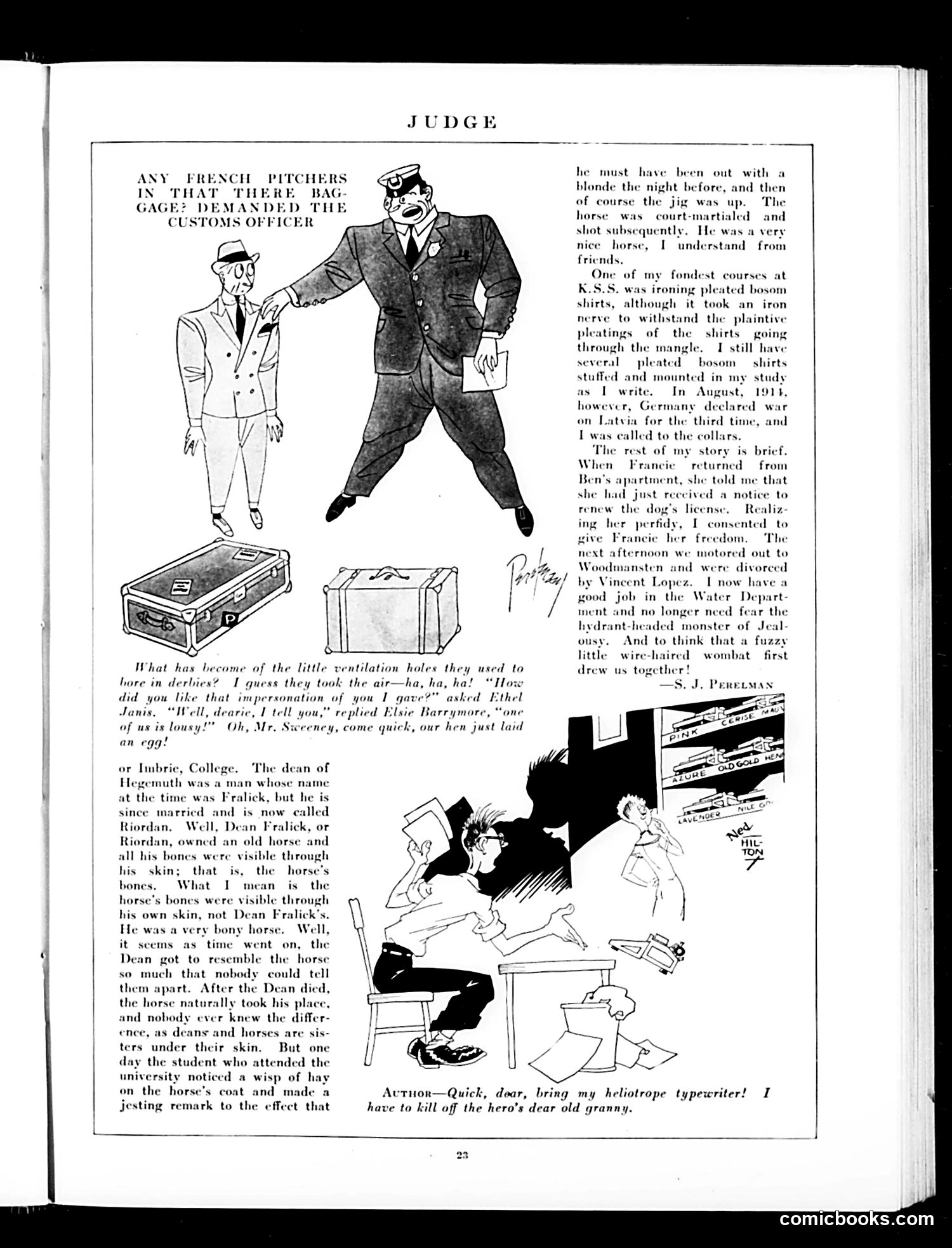
This page contains two distinct pieces of humor: **Top cartoon:** A customs officer interrogates a small French pitcher about smuggled items. The joke plays on the double meaning of "pitcher"—the officer expects contraband but is questioning a ceramic vessel instead. This appears to satirize post-WWI customs procedures and Franco-American trade relations. **Bottom section:** A rambling, absurdist anecdote about a university dean who physically resembles his horse so closely that after the dean's death, nobody notices the horse has replaced him. The story digresses extensively with non-sequiturs (German war declarations, dog licenses, divorce details) to maximize comedic confusion. The final caption shows a harried author requesting a "heliotrope typewriter" to kill off a character, suggesting this deliberately meandering narrative is self-parody of overwrought storytelling. Both pieces exemplify *Judge*'s satirical humor through absurdity and wordplay rather than direct political commentary.
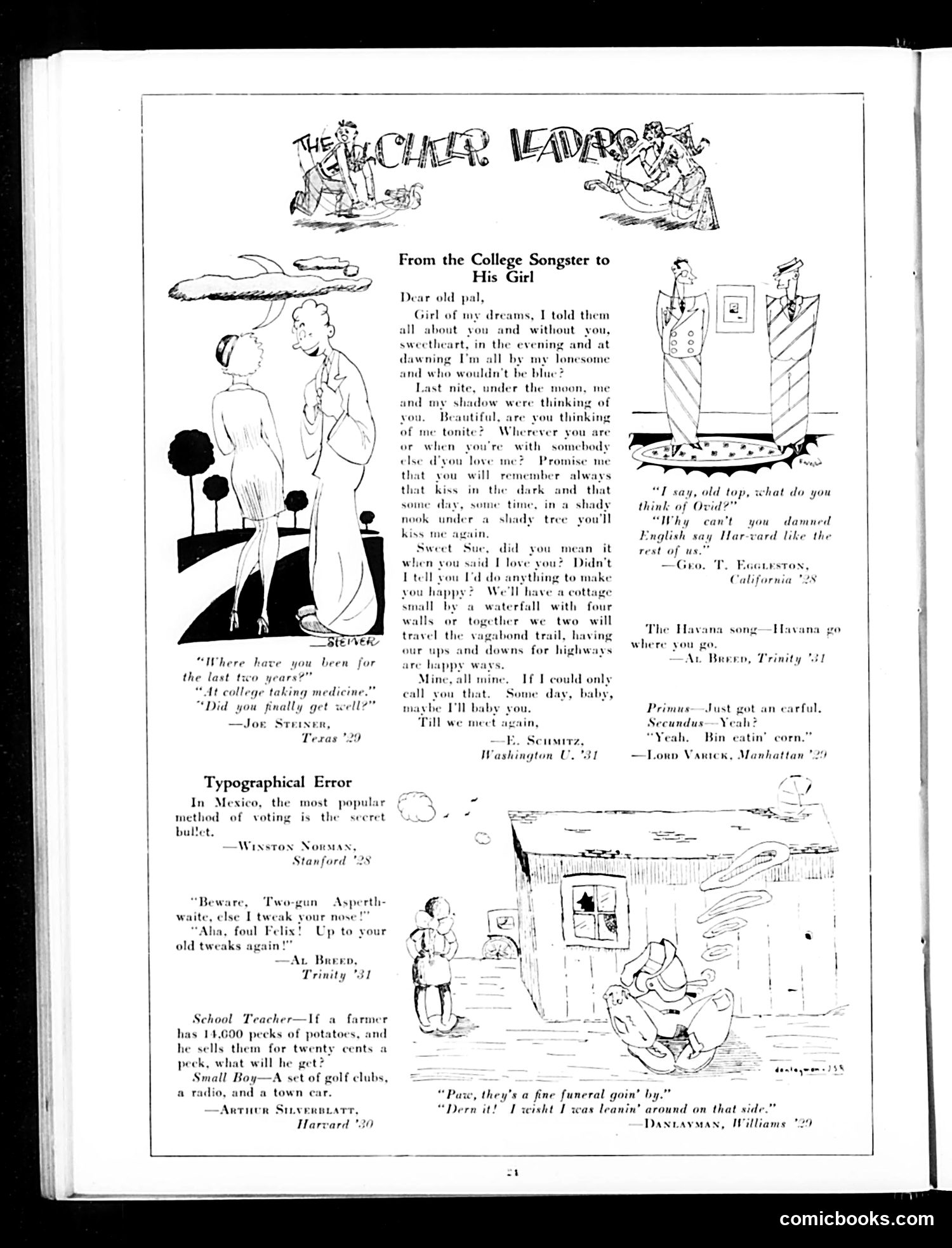
This page collects humor from college students circa 1928-1931, presented as satirical observations. Key items: **"Typographical Error"**: A joke about Mexico's voting system, suggesting that secret ballots there are literally bullets—dark political satire implying Mexican elections were violent/deadly rather than democratic. **"School Teacher"**: Satire on American wealth and materialism. A farmer selling potatoes would realistically get modest cash, but the "Small Boy's" answer (golf clubs, radio, town car) mocks how the prosperous 1920s made luxury goods seem within reach of ordinary people. **College humor**: The "Songster" poem and campus jokes mock sentimental romantic letters and affected collegiate speech—particularly the running joke about mispronouncing "Harvard" as "Har-ward," poking fun at pretentious Boston Brahmin accents. **Various quips**: Poke gentle fun at romance, slang ("Bin eatin' corn"), and classroom absurdities. The overall tone reflects Jazz Age college culture—irreverent, focused on dating/romance, material consumption, and class affectation.
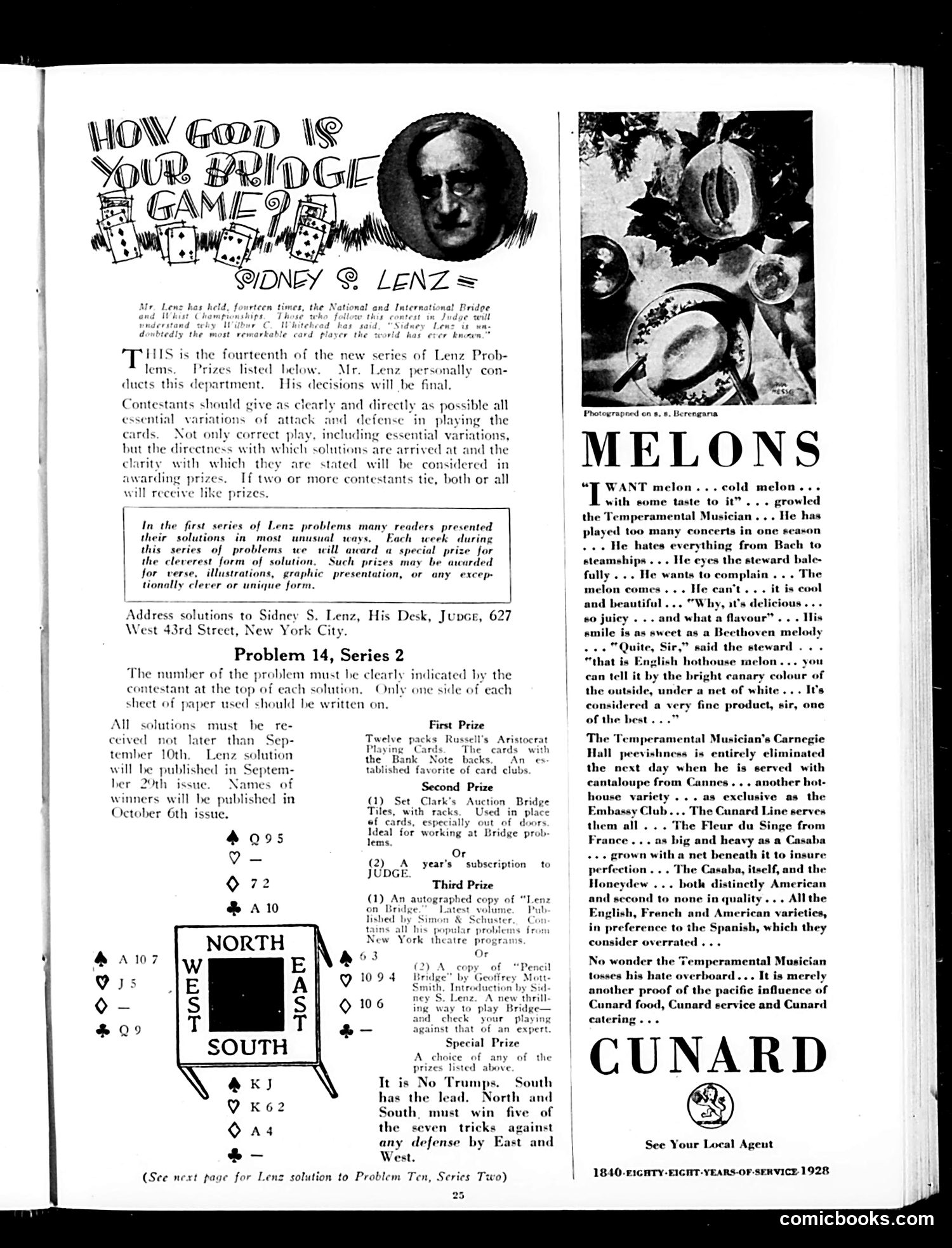
This page combines a bridge card puzzle contest with advertisements. The main content is Sidney S. Lenz's "Problem 14, Series 2"—a bridge challenge where readers submit solutions for prizes including playing cards, a subscription to *Judge*, and an autographed Lenz book. Solutions were judged on correctness and creative presentation (verse, illustrations, etc.). The right page features a *Cunard* shipping line advertisement disguised as humor. It depicts a temperamental classical musician who despises everything except fine melons—particularly English hothouse and French Cannes varieties. When served these luxuries aboard Cunard ships, his mood transforms. The joke satirizes both the musician's pretentiousness and implicitly advertises Cunard's superior amenities and continental dining. The bridge puzzle and advertisement represent typical *Judge* magazine content: intellectual games for educated readers paired with luxury brand marketing.
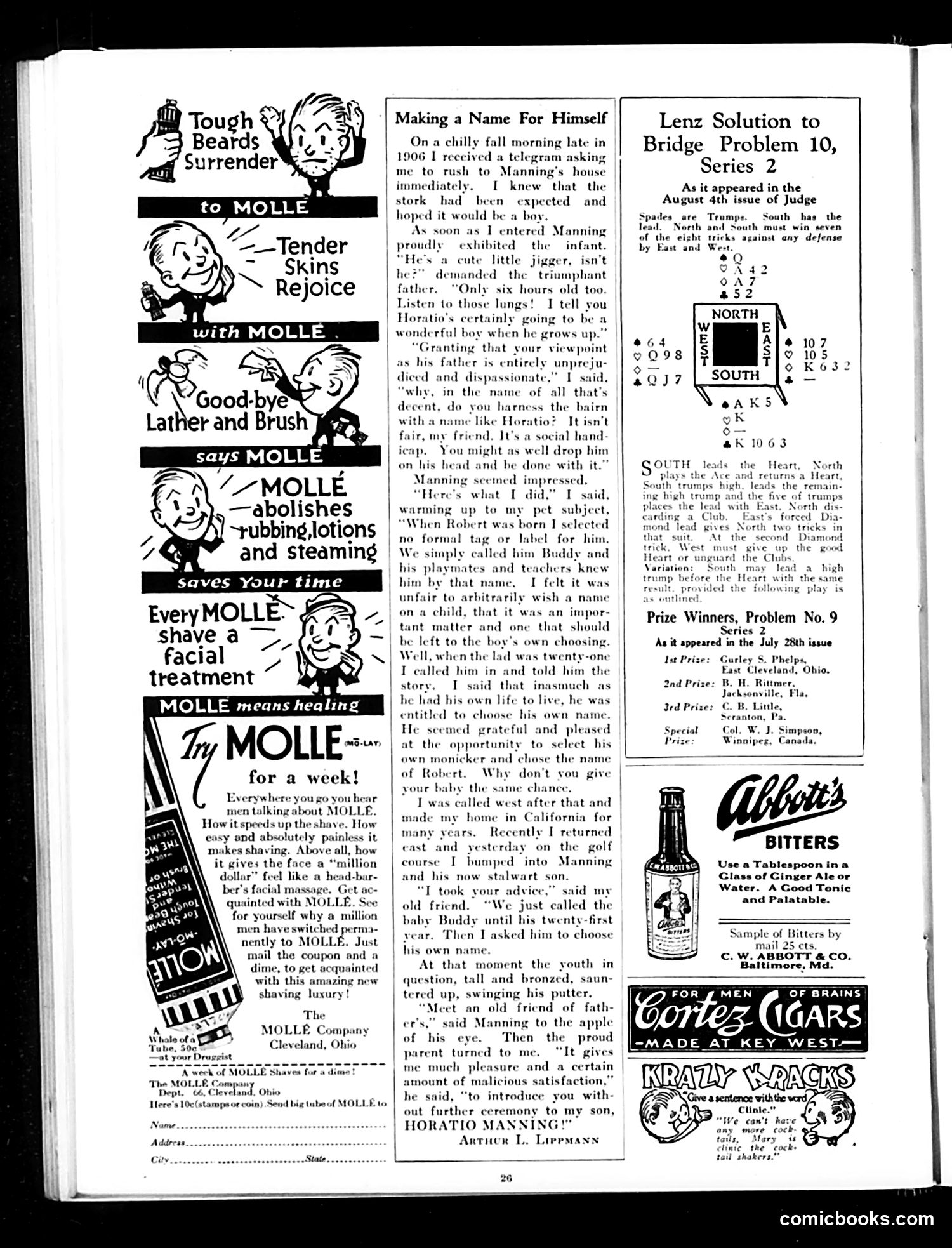
This page is primarily **advertising and fiction**, not political satire. The main content is a short story titled "Making a Name For Himself" by Arthur L. Lippmann. It's a humorous narrative about naming children: a father named Manning arbitrarily names his newborn son "Horatio," which the narrator criticizes as an unfair social handicap. The narrator counters with his own anecdote about letting his son choose his own name at age 21—only for Manning's son to later choose "Horatio Manning" anyway, vindicating the father's original choice. The surrounding material consists entirely of **period advertisements**: MOLLE shaving cream (emphasizing it provides facial treatment benefits), Abbott's Bitters (a medicinal tonic), Cortez Cigars, and Krazy Kracks (a children's product). A bridge puzzle solution also appears. There is **no political commentary or satire** on this page—it's a lifestyle magazine mixing light fiction with commercial advertising, typical of early 1900s American periodicals.
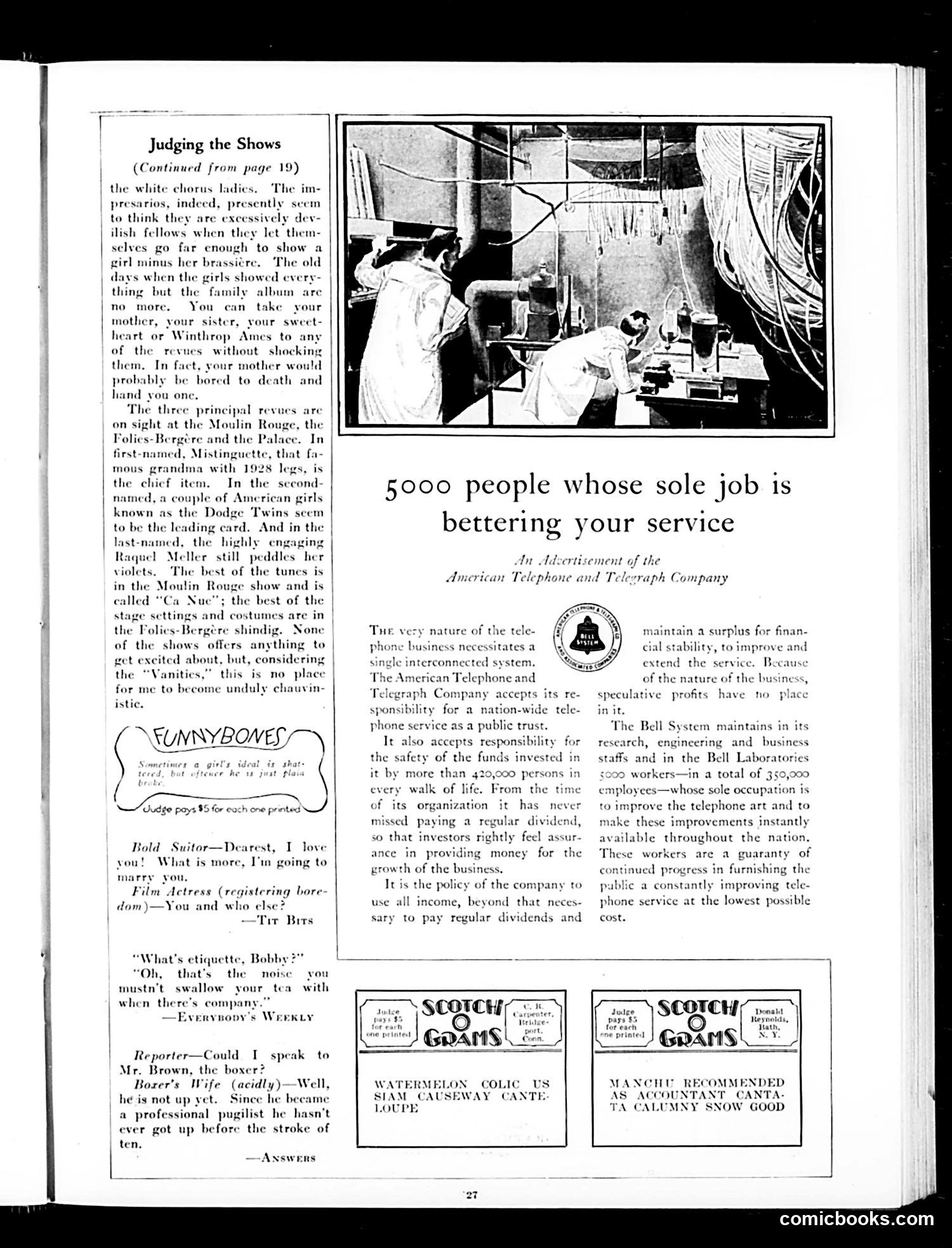
This page contains theater criticism and several unrelated joke segments typical of Judge magazine's format. **"Judging the Shows"** reviews Parisian revues (musical theater), mentioning famous performer **Mistinguette** and the **Dodge Twins**. The critic notes that modern revues are less scandalous than in previous eras—performers now wear brassieres, disappointing those seeking shock value. He dismisses the shows as tame compared to old standards. **The humor pieces** are brief, disconnected jokes: a suitor proposes to a bored actress; an etiquette question about tea-drinking; a reporter asks about boxer "Mr. Brown," learning he doesn't rise before 10 AM since becoming a professional. **The substantial content** is a **Bell Telephone Company advertisement** emphasizing their 5,000 employees dedicated to service improvement. It stresses the company's commitment to public trust and reinvestment rather than speculation—essentially corporate messaging about responsibility and infrastructure. **Bottom section** shows two Scotch Grams (whisky advertisements) with nonsensical captions, a common advertising format of the era. The page is primarily advertising and light entertainment rather than political satire.
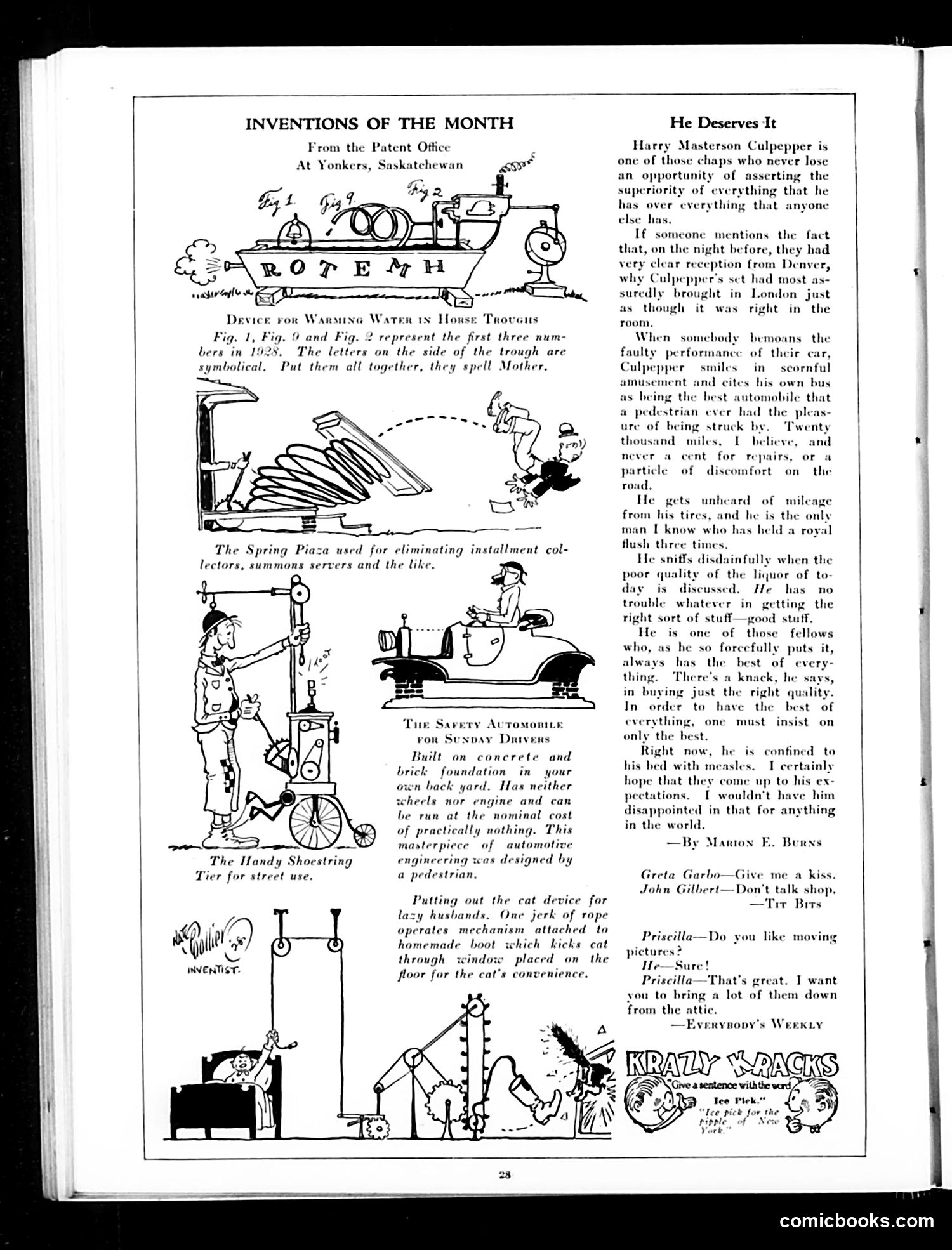
This page mixes two distinct contents: patent office satire and a character sketch. **Left side:** "Inventions of the Month" presents absurd contraptions from Yonkers, Saskatchewan—a device for warming water in horse troughs, a spring plaza for removing installment collectors, a shoelace tier, and a "safety automobile for Sunday drivers" built on concrete with no wheels or engine. These mock useless or ridiculous patents, satirizing the era's flood of dubious inventions. **Right side:** "He Deserves It" profiles Harry Masterson Culpepper, a snobby one-upmanship artist who constantly boasts his possessions surpass everyone else's. The joke culminates darkly: confined to bed with measles, the narrator hopes the disease meets Culpepper's impossibly high standards for quality—a bitter punchline suggesting his pretension deserves comeuppance. The humor targets wealthy social climbers obsessed with superiority and exclusive status.
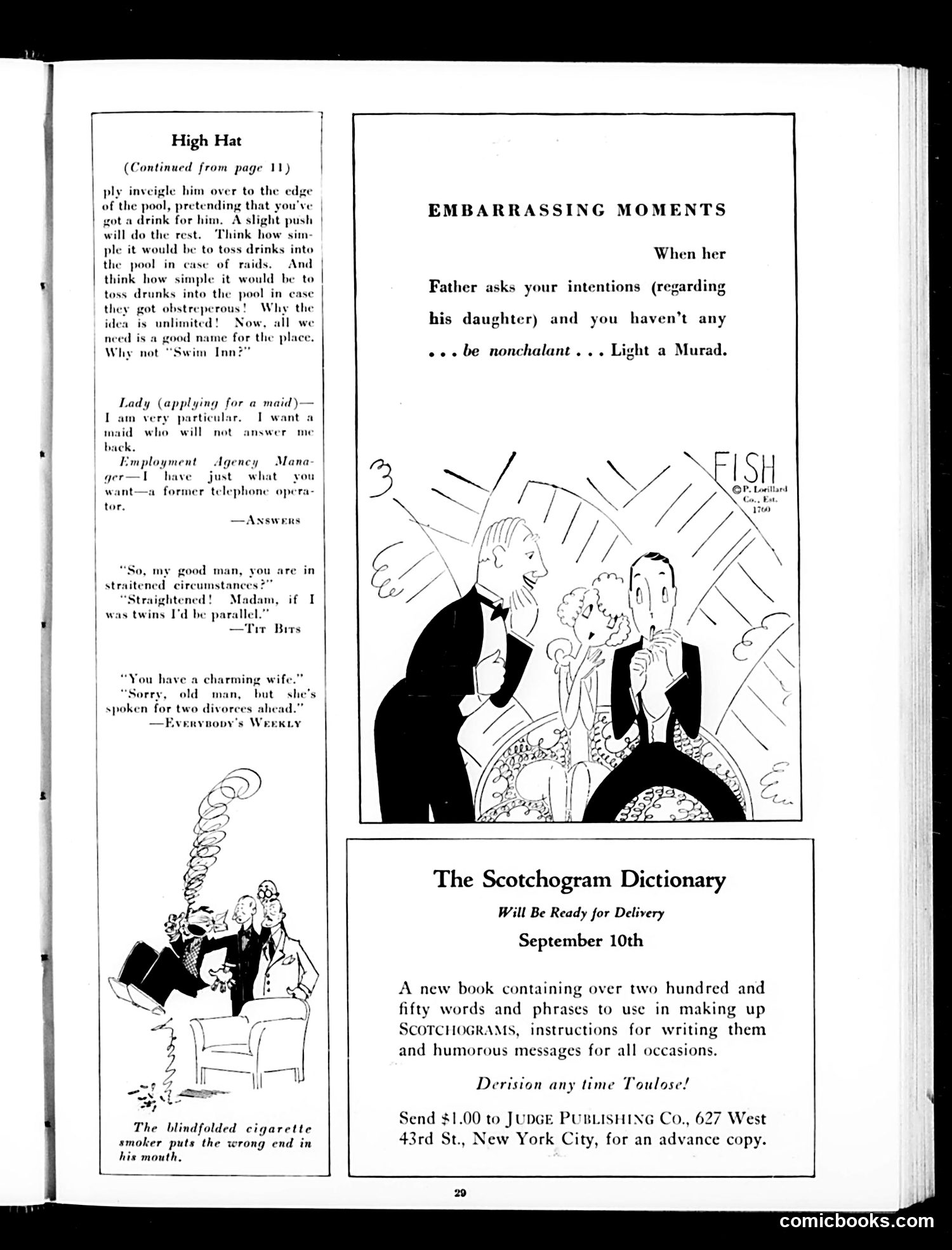
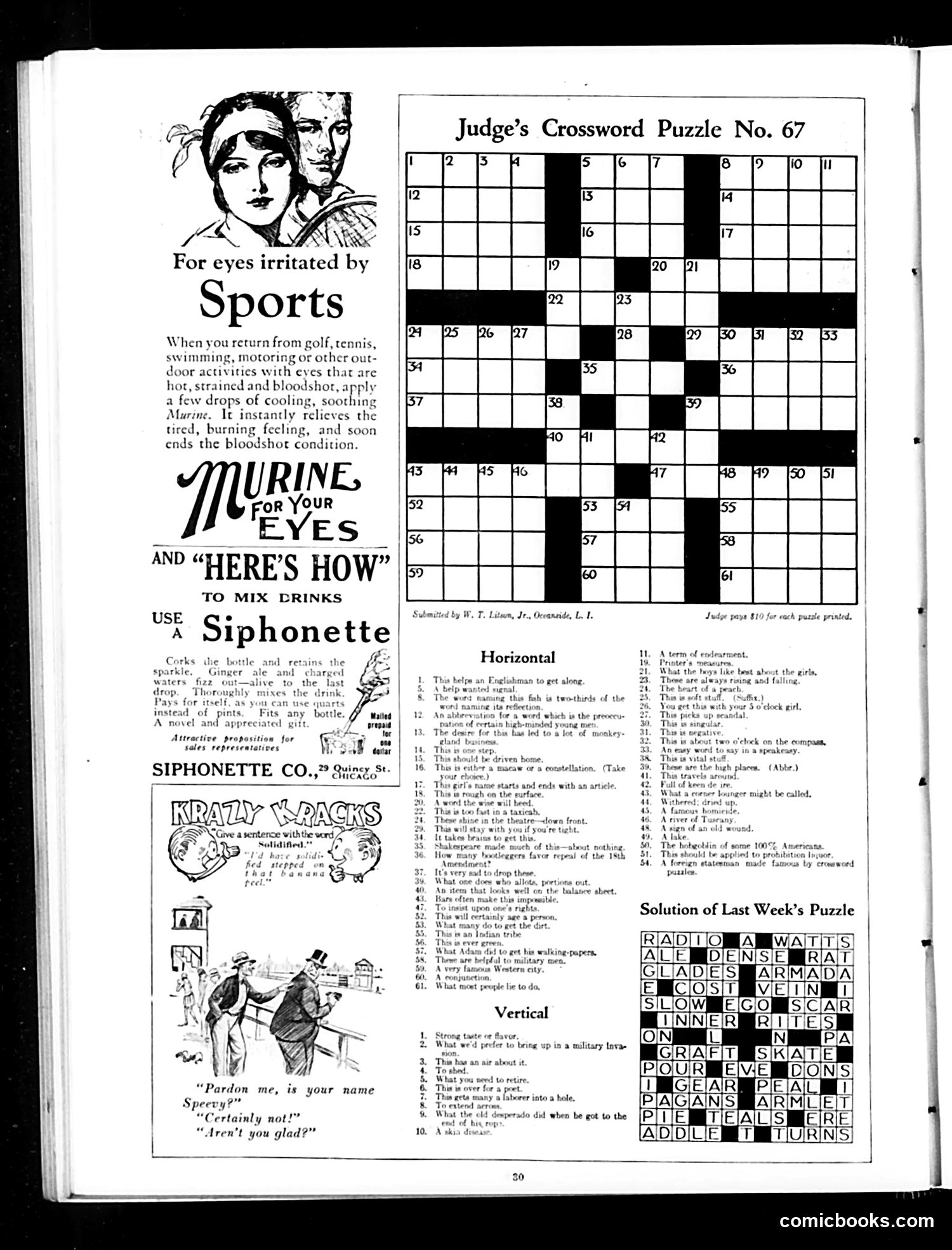
This page is primarily **advertising and puzzle content**, not political satire. The main elements are: **Murine Eye Drops Advertisement**: The top left features a vintage ad for eye drops marketed to sports enthusiasts. The illustration shows a woman and man's faces, with text explaining that outdoor activities (golf, tennis, swimming, motoring) cause eye strain, redness, and fatigue—problems solved by Murine drops. This reflects early 20th-century concerns about leisure activities and their physical toll. **Siphonette Advertisement**: A drink-mixing device advertised below, with a small cartoon showing two men in conversation ("Certainly not!" / "Aren't you glad?"), though the joke's context is unclear from this excerpt. **Crossword Puzzle No. 67**: The right side contains Judge's featured puzzle with clues and a solution from the previous week's puzzle shown. **Krazy Kracks**: A small humor panel appears lower left, though illegible in this reproduction. The page demonstrates how Judge mixed satirical journalism with consumer advertising and entertainment features typical of 1920s magazines.
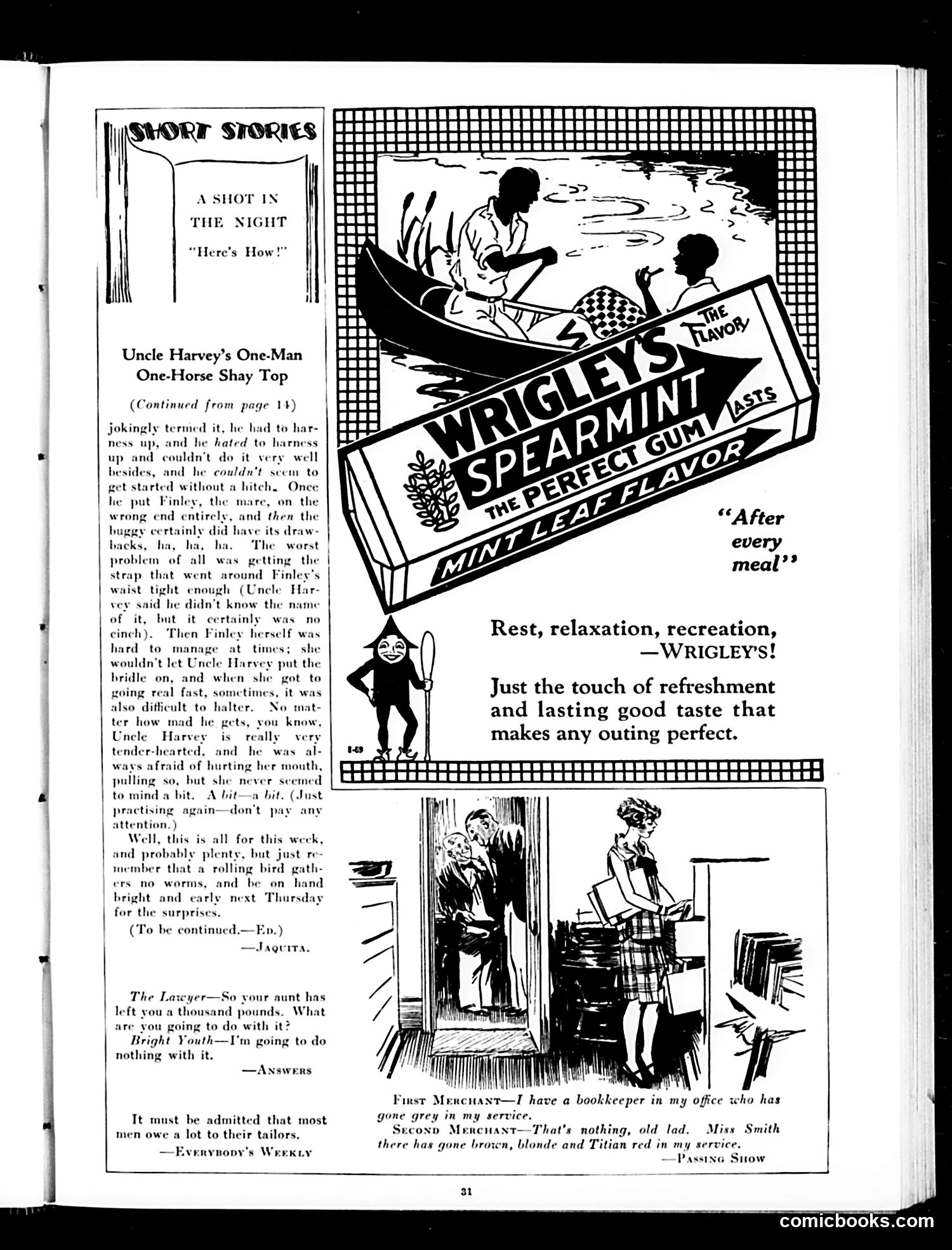
This page contains a serialized humorous short story ("Uncle Harvey's One-Man One-Horse Shay Top") about an elderly man's comical struggles harnessing and managing a stubborn mare named Finley. The humor derives from Uncle Harvey's incompetence with basic tasks—putting the horse on "wrong end entirely," not knowing proper equipment names—and his overly sentimental nature, fearing he'll hurt the horse's mouth despite her indifference to his pulling. The page also includes a Wrigley's spearmint gum advertisement featuring a romanticized boating scene, and several brief joke exchanges about inheritance and workplace longevity. A cartoon depicts two merchants competing over whose employee has aged more dramatically in service—one's bookkeeper "gone brown, blonde and Titian red"—suggesting either dye jobs or the physical toll of long employment. The overall tone reflects early 20th-century magazine humor: gentle, domestic comedy mixed with advertising.
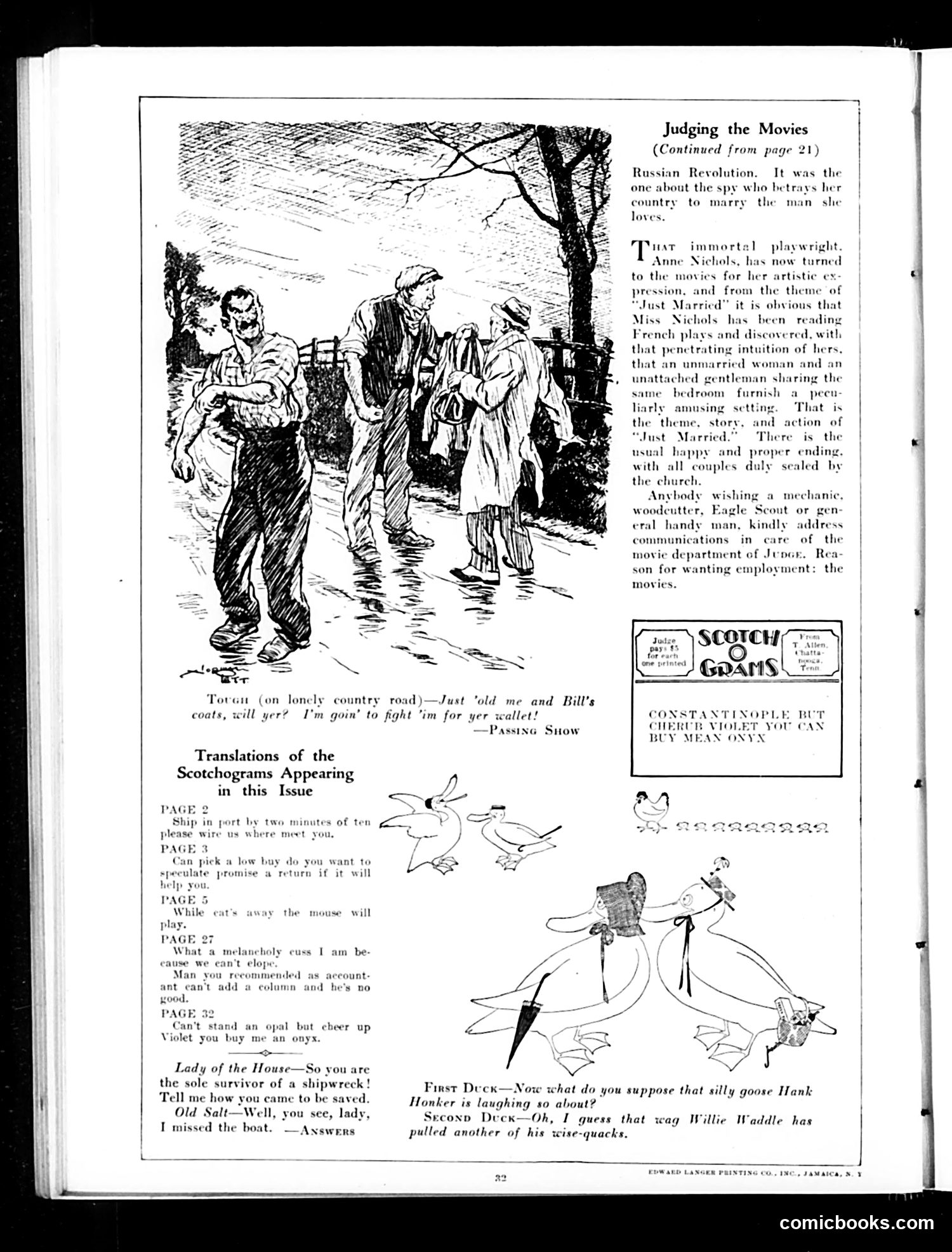
This page contains **film criticism and humorous sketches** rather than political cartoons. The main article "Judging the Movies" discusses actress **Anne Nichols** and her film "Just Married," sarcastically praising her for discovering that unmarried couples sharing a bedroom makes "amusing" cinema. The reviewer implies the film merely copies risqué French plays while maintaining a moralistic ending with church approval—mocking the hypocrisy of American censorship standards. The illustrated sketches below show **working-class characters** in comedic situations: a tramp threatening robbery on a country road, and sailors making crude jokes about a "silly goose" named Hank. The "Scotchograms" are joke translations, including a maritime pun about a mishap with "wise-quacks." The **Scotch Grams advertisement** promotes a liqueur with the slogan "Constantinople but cherub violet you can buy means only." Overall, this is satirical commentary on 1920s film censorship standards and lower-class humor—not political satire.
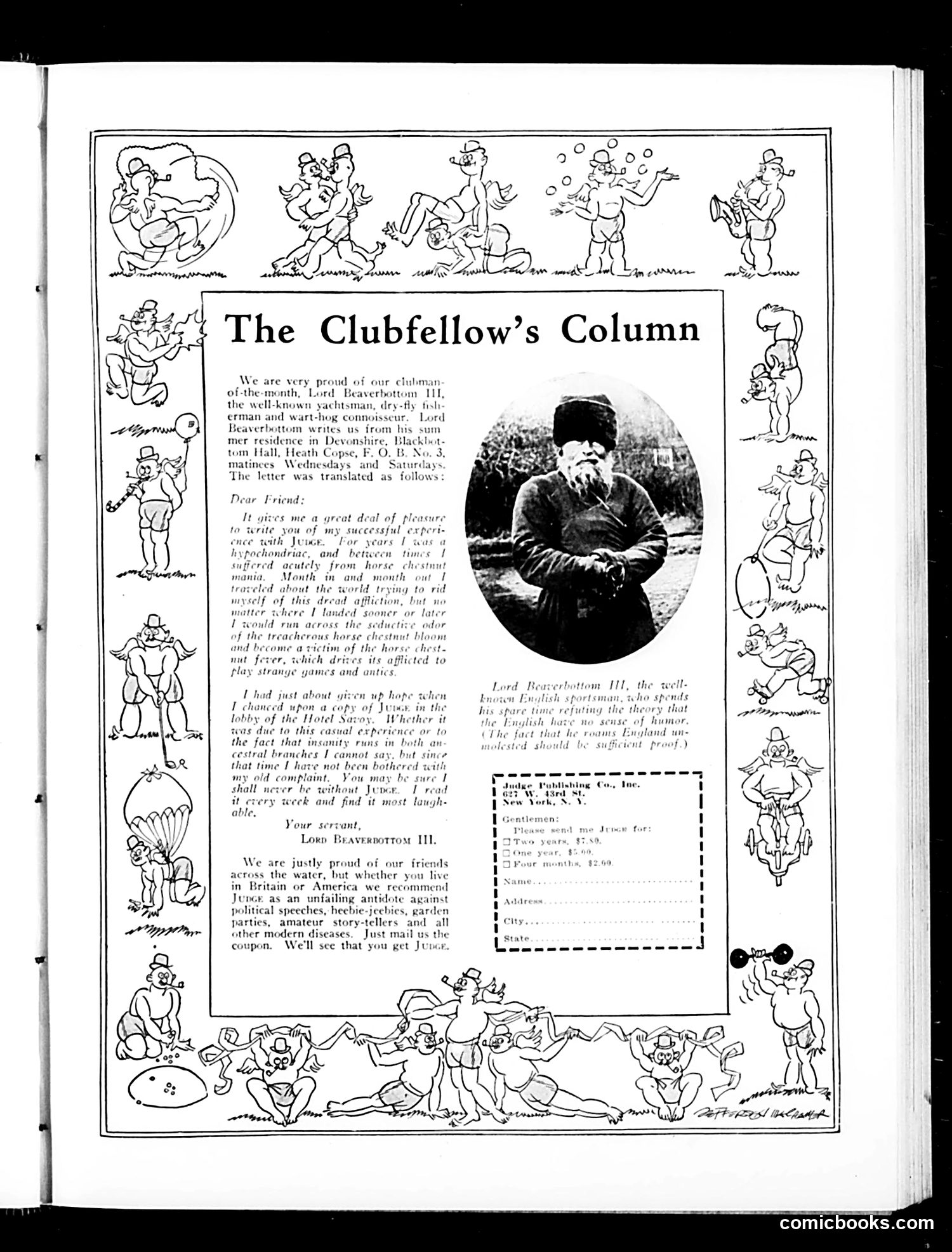
This is a humorous advice column featuring "Lord Beaverbottom III," a fictional upper-class British character. The satire targets wealthy eccentrics and their absurd pursuits: yachting, dry-fly fishing, and "wart-hog connoisseurry." The joke centers on Beaverbottom's supposed affliction—"horse chestnut mania" and "horse chestnut fever"—silly obsessions presented as if they were serious medical conditions. His "cure" involves drinking Junce, a fictitious beverage being advertised. The piece mocks both the pretension of aristocratic hobbyists and the advertising industry's tendency to market dubious "cure-alls." The whimsical decorative illustrations of portly figures reinforce the lighthearted tone. The coupon at bottom completes the parody of patent medicine advertisements common to the era.
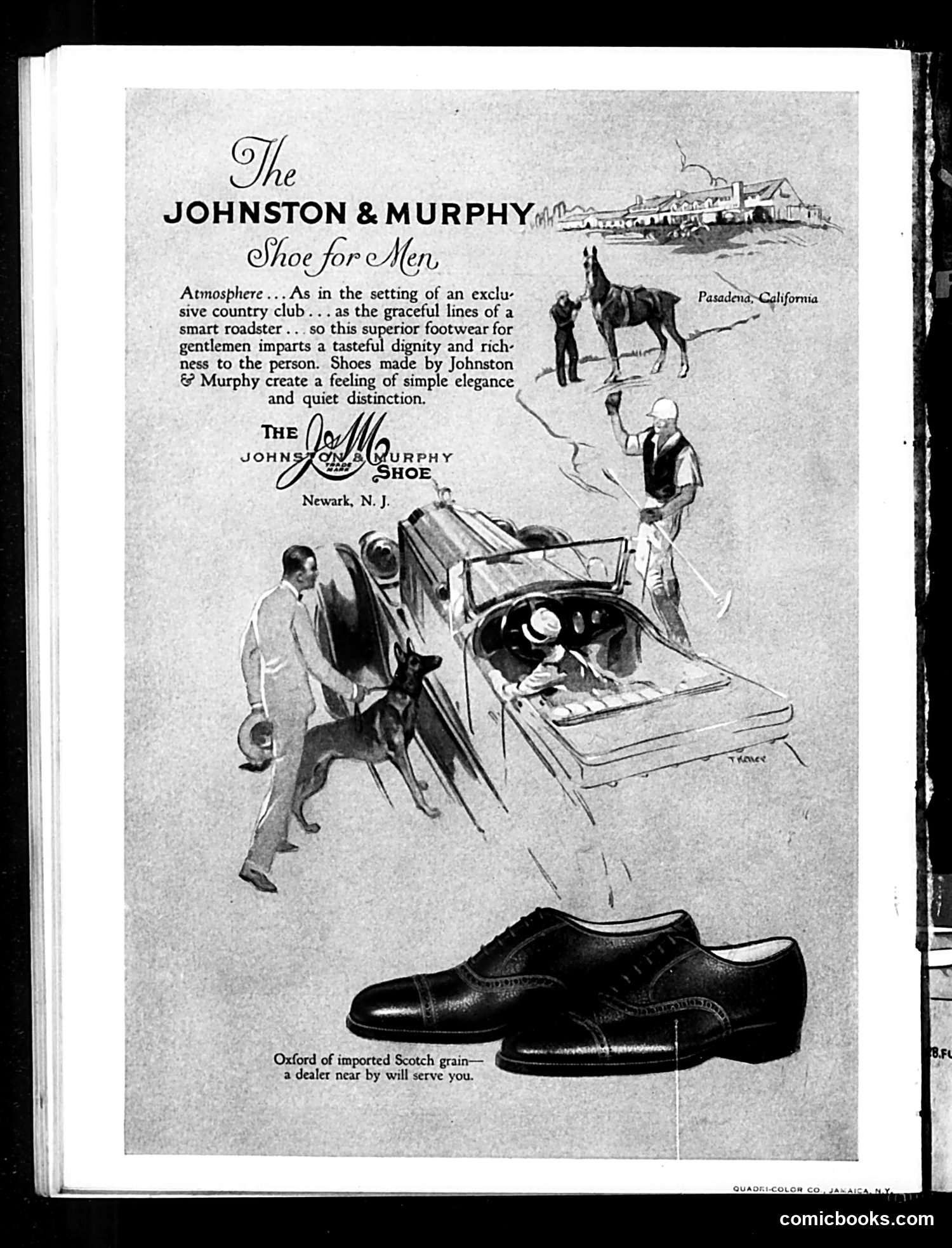
This is a **shoe advertisement**, not political satire. It promotes Johnston & Murphy shoes from Newark, N.J., marketed as luxury footwear for gentlemen. The ad uses lifestyle imagery to convey exclusivity: a country club setting, a roadster (sports car), and leisure activities like horseback riding and golf in Pasadena, California. The central illustration shows well-dressed men enjoying these pursuits, suggesting that wearing these shoes signals membership in an affluent, refined social class. The copywriting emphasizes "simple elegance," "quiet distinction," and "tasteful dignity"—appeals to aspirational masculinity and social status. The featured shoe is an Oxford style in imported Scotch grain leather. This reflects early 20th-century advertising strategy: selling shoes not merely as functional items but as status symbols that grant access to an idealized world of leisure and gentlemanly refinement.