
Judge, 1928-09-01 · page 15 of 36
Judge — September 1, 1928 — page 15: what you’re looking at
What you’re looking at
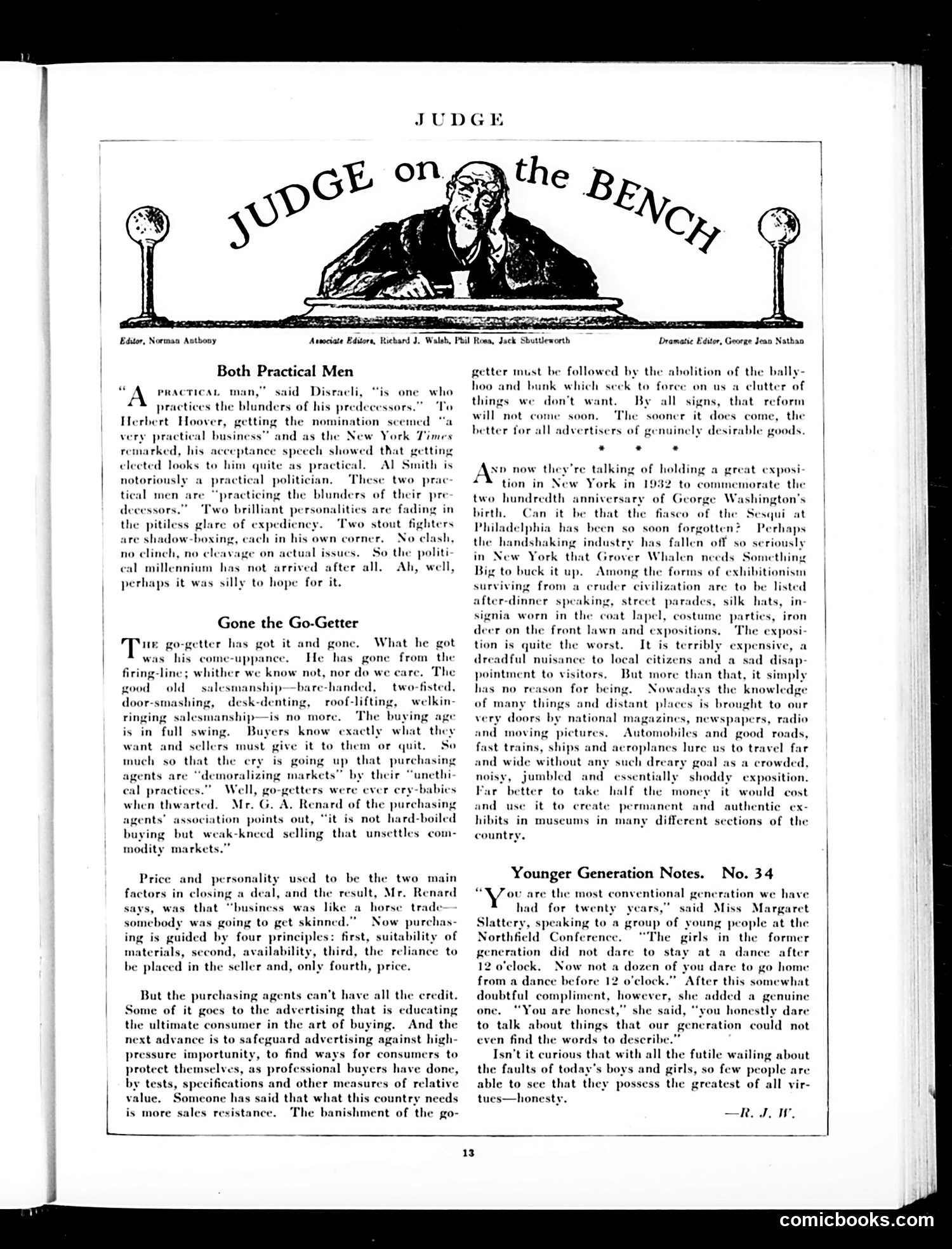
This page contains three editorial commentaries from Judge magazine (editor Norman Anthony), likely from 1932 based on the George Washington bicentennial reference. **"Both Practical Men"** criticizes the 1932 presidential race between Herbert Hoover and Al Smith as uninspired. Both candidates are dismissed as merely "practicing the blunders of their predecessors"—brilliant fighters reduced to shadow-boxing with no real clash of ideas or genuine engagement. **"Gone the Go-Getter"** mourns the decline of aggressive American salesmanship. The high-pressure "go-getter" sales style is obsolete; modern buyers now demand substance (suitability, availability, reliability) over personality and price. The article suggests this shift, while good for consumers, means aggressive advertising tactics are ending—though the writer doubts real change will come soon. **"Younger Generation Notes"** quotes Margaret Slattery criticizing youth for lacking honesty and courage to discuss serious matters openly. The overall tone reflects Depression-era skepticism about business-as-usual and political leadership.
📄 Transcribed text from this page (OCR, searchable)
Machine-transcribed from the original scan — historical spelling and the odd misread are preserved.
JUDGE Editor, Norman Anthony | Both Practical Men “A practican man,” said Disracli, “is one who practices the blunders of his predecessors.” ‘To Herbert Hoover, getting the nomination seemed “a very practical business” and as the New York Times remarked, his acceptance speech showed that getting elected looks to him quite as practical. Al Smith is storiously a practical politician. ‘These two prac re “practicing the blunders of their pre decessors.” Two brilliant personalities are fading in the pitiless glare of expediency. ‘Two stout fighters dow-boxin ch in his own corner. No clash, tical men « 1, no cleavage on actual issues. So the politi cal millennium has not arrived after all, Ab, well, perhaps it was silly to hope for it. Gone the Go-Getter T= go-getter has got it and gone. What he got | was his come-uppance. He has gone from the firing-line; whither we know rn nor do we care. The good old — salest ‘e-hanc two-fisted, door-smashing, desk-denting, _roof-lifting, ringing salesmanship—is no more. The buying age is in full swing. Buyers know exactly what they want and sellers must give it to them or quit, So much so that the ery is going up that purchasing . Jemoralizing markets” by their“ Well, go-getters were ever ery- Mr. G. A. Renard of the pure ation points out, “it is not hard buying but weak-kneed selling that unscttles com- modity markets.” anship—b cal p when thwarte agents’ assoc Price and personality used to be the two main factors in closing a deal, and the result, Mr. Renard , was that “business was like a horse trade body was going to get skinned.” Now purchas- ing is guided by four principles: first, suitability of materials, second, availability, third, the rel | be placed in the seller and, only fourth, pri som nee to But the purchasing | Some of it goes to the advertising that is educating the ultimate consumer in the art of buying. And the next advance is to safeguard advertising against high- pressure importunity, to find ways for consumers to protect themselves, as professional buyers have done, | by tests, specifications and other measures of relati | value. Somcone has said that what this country needs is more sales resistance. The banishment of the go- Ausociate Editors, Richard J, Walsh, Pbil Rosa, Jack Sbutueworth Dramatic Editor, George Jean Nathan getter must be followed by the abolition of the bally- hoo and bunk which seck to force on us a clutter of things we don't want. By all signs, that reform will not come soon. The sooner it does come, the better for all advertisers of A’ p now they're talking of holding a ** tion in New York in If two hundredth anniversary birth. Can it be that th Philadelphia has been so soon forgotten? Perhaps the handshaking industry fallen off so seriously in New York that Grover Whalen needs Something Big to buck it up. Among the forms of exhibitionism surviving from a cruder civilization are to be listed after-dinner speaking, street: parades, silk h a worn in the coat lapel, costume partic on deer on the front lawn and expositions, The exposi- tion is quite the worst. It is terribly expensive, « dreadful nuisance to local citizens and a sad disap- pointment to visitors, But more than that, it simpl has no reason for being. Nowadays the knowledge aces is brought to our nuinely desirable goods. at exposi 2 to commemorate the ieorge Washington's of the Sesqui at fin se s, in very doors by Zines, Newspapers, ri biles and good rc st trains, ships and acroplancs lure us to tra and wide without any such dr ¥, jumbled and moving pictures. ds, far ary goal as a crowded, nd essentially shoddy exposition, Far better to t half the money it would cost and use it to create permanent and authentic ex- hibits in museums in many different sections of the country, Younger Generation Notes. No. 34 “You ¢ the most conventional generation we have ad for twenty years,” said Miss Margaret Slattery, speaking toa group of young people at the Northfield Conference. The girls in the former generation did not dare to s\ a dance after 12 o'clock. Now not a dozen of you dare to go home from a dance before 12 0 kk.” After this somewhat doubtful compliment, however, she added a genuine one. “You are honest,” she said, “you honestly dare to talk about things that our generation could not even find the words to describe.” Isn't it curious that with all the futile wailing about the faults of today’s boys and girls, so few people able to sce that they possess the greatest of all vir- tues—honesty. —Rk.ILW, comicbooks.com