
Judge, 1928-09-01 · page 21 of 36
Judge — September 1, 1928 — page 21: what you’re looking at
What you’re looking at
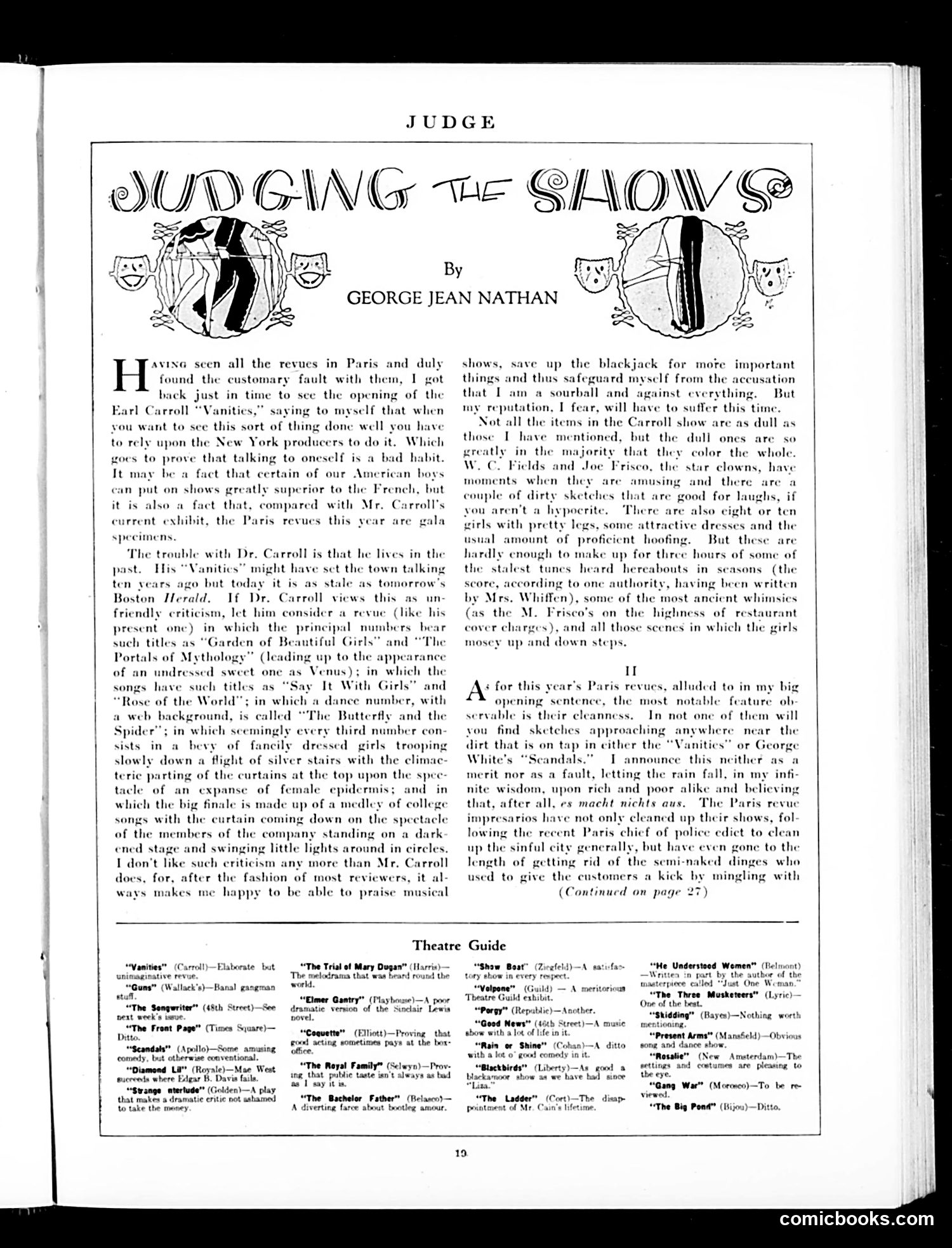
This is a theater review column, not a political cartoon. Theater critic George Jean Nathan compares American Broadway revues (specifically Earl Carroll's "Vanities") unfavorably to Parisian revues. **The satire:** Nathan criticizes Carroll's show as outdated and formulaic—full of hackneyed numbers like "Garden of Beautiful Girls" and "Rose of the World," repetitive scenes of girls descending silver staircases, and an ancient musical score. He notes that while American shows feature crude humor and nudity, the French productions are cleaner and more refined (following a Paris police edict to clean up entertainment). **The irony:** Nathan admits he dislikes such critical negativity—preferring to praise—yet feels obligated to honest assessment. He praises performers W.C. Fields and Joe Frisco but concludes the show is "as stale as tomorrow's Boston Herald." This represents typical 1920s theatrical criticism in Judge's satirical voice.
📄 Transcribed text from this page (OCR, searchable)
Machine-transcribed from the original scan — historical spelling and the odd misread are preserved.
JUDGE avina seen all the revues in Paris and duly H found the customary fault with them, I got back just in time to see the opening of the rroll “Vanities,” sa to myself that when you want to sce this sort of thing done well you have to rely upon the New York producers to do it. Which goes to prove that talking to oneself is a bad habit. It may be a fact that certain of our American boys hy but rroll’s can put on shows greatly superior to the Fre it is also a fact that, compared with Mr. C current exhibit, the Paris revues this year are gala specimens. The trouble with Dr. Carroll is that he lives in the past. His “Vanities” might have set the town talking ten years but today it is as stale as tomorrow's Boston Herald, If Dr. Carroll views this as un- friendly criticism, let him consider a revue (like his present one) in which the principal numbers bear such titles as “Garden of Beautiful Girls” and “The Portals of Mythology” (leading up to the appearance of an undressed sweet one as Venus); in which the \ such titles as “Say It With Girls” and “Rose of the World”; in which a dance number, with ckground, is called “The Butterfly and the : in which scemingly every third number con sists in a bevy of fancily dressed girls trooping slowly down a flight of silver stairs with the climac- terie parting of the curtains at the top upon the spee- tacle of an expanse of female epidermis; and in which the big finale is made up of a medley of college songs with the curtain coming down on the spectacle of the memt company standing on a dark ened stage a little lights around in circles. I don’t like such criticism any more than Mr. Carroll does, for, after the fashion of most reviewers, it al- ways makes me happy to be able to praise mus: By GEORGE JEAN NATHAN iN Gr THe GING OWS ss \ AK oo a shows, save up the blackjack for mote impor! things and thus safeguard myself from the that Iam a sourball and against everything. But my reputation, I fear, will have to suffer this time. Not all the items in the Carroll show are as dull as those I have mentioned, but the dull ones are so greatly in the maj that they color the whole. W. C. Fields and Joe Frisco, the star clowns, have moments when they are amusi nd there are a couple of dirty sketches that ‘ood for laughs, if you aren't a hypocrite. ‘There are also eight or ten nd the But these are ke up for three hours of some of the stalest tunes heard hereabouts in seasons (the score, according to one authority, having been written by Mrs. Whiffen), some of the most ancient wh (as the M. Frisco’s on the highness of restaurant cover charges), and all th II mosey up and down steps, A ar's Paris revues, alluded to in my big opening sentence, the most notable feature ob servable is their cleanness. In not one of them will you find sketches approaching anywhere near. the dirt that is on tap in cither the “Vanities” or G White’s “Scandals.” I announce this neither merit nor as a fault, letting the rain fall, in my infi- nite wisdom, upon rich and poor alik that, after all, es macht nichts aus. impresarios have not only cleaned up their shows, fol nt Paris chief of police edict to ¢ up the sinful city generally, but have even gone to the length of getting rid of the semi-naked dinges who used to give the customers a kick by mingling with ccusation girls with pretty legs, some attractive dresses usual amount of proficient hoofing hardly enough to 1 scenes in which the girls or this y and believing The Paris revue lowing the ree (Continued on page 27) Theatre ‘Vanities’ (Carroll)—Elaborate but “The Trial of Mary Dugan” (Harris) — unimaginative revue ‘The melodrama that was brard roursd the Guns” (Wallack’s)—Banal gangman world. stuf y Eimer Gantry" (Playhosse)—A poor “The Sengwriter’* (48th Street)—Ser tie version of the Sinclair Lewis peat week's tan Daabe Frost Page” (Times Siuare}— sre gquette” (Elliott) —Proving that vend acting sometimes pays at the box “Scandals” (Apollo)—Some amusing Sere Ue my comedy, but otherwise conventional. cree Reta Ciam~ "Ga me “Diamond Lil (Royale)—Mae West family” (Selwyn) —Prov- sucess where Edgar B. Davis fails. bie taste isn't always as bad “Strange atertude” ( )—A play that makes a dramatic eritic not ashamed to take the maney “The Bachelor Father” (Relarcn)— A diverting farce about bootleg amour. Guide “Show Boat” (Zicefe tory show in every 1 t ast One Woman,” “The Three Musketeers” (Lyric) — One of the beat. (Bayes)—Nothing worth <ovelpone” piece called ““S ‘Theatre Guild exhibit. “Porgy” (Repubdiic)—Another. “Good News” (4) treet)—A music abow with a lot of life “Present Arms” (Mansfeld) —Obvious ditto nce show, (New Amsterdam)—The “Blackbirds” (Liberty)—As good a maing to Dackamnoor show aa we have bad since “Lisa. “Gang War” (Moreco)—To be re “The Ladder” (Cort)—The dimp- Yiewst pintenent of Mr. Cain's lifetime, “The Big Pend” (iijou)—I comicbooks.com