
A complete issue · 36 pages · 1928
Judge — August 18, 1928
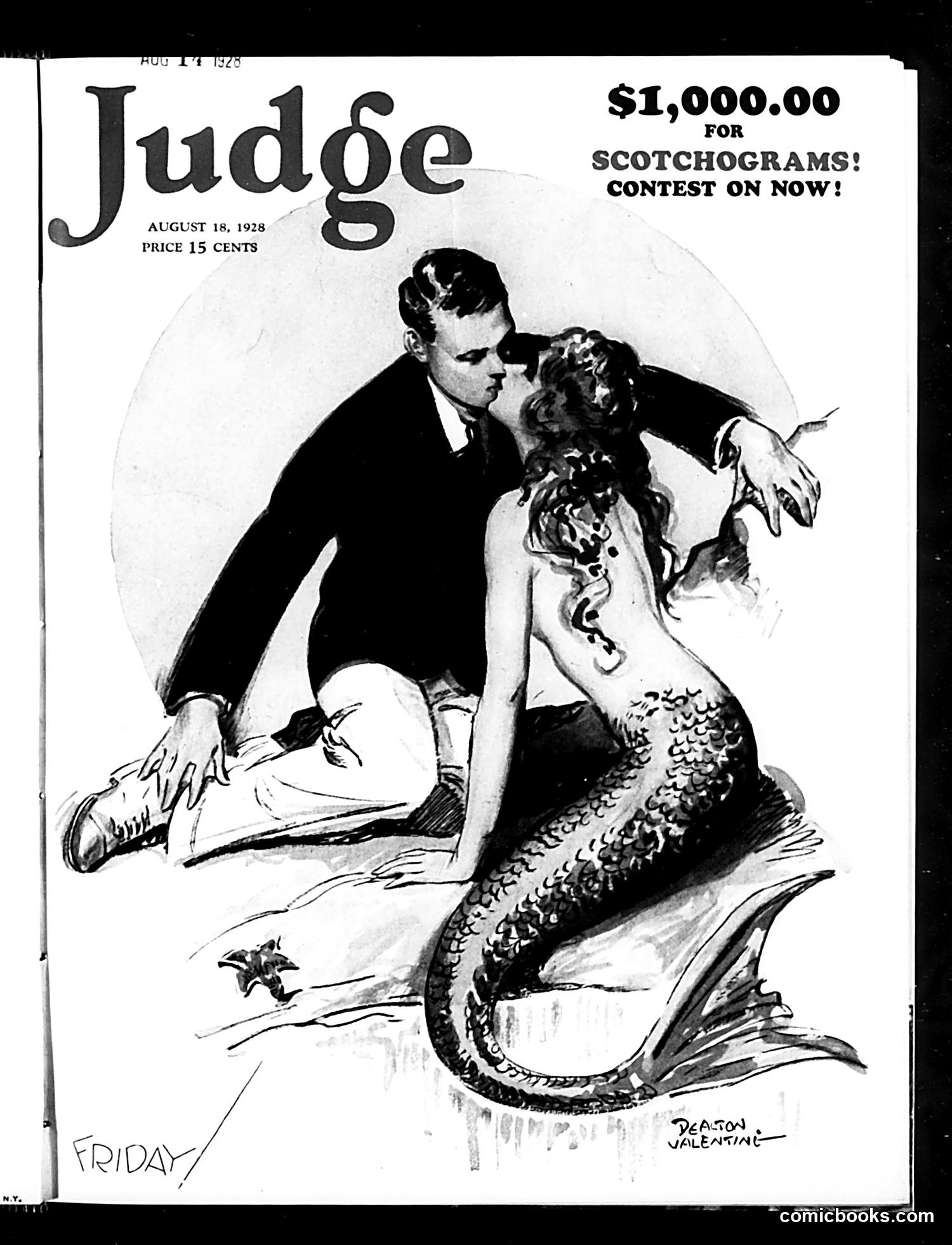
This cover features a man in formal attire kissing a mermaid—a fantastical romantic scenario. The illustration is credited to Deasey Valeentini and signed "FRIDAY." The main text promotes a "$1,000.00 FOR SCOTCHOGRAMS! CONTEST ON NOW!"—indicating Judge was running a reader contest, likely soliciting humorous short messages or jokes submitted by readers. The mermaid imagery appears to be purely whimsical rather than satirizing specific political figures or events. It's representative of Judge's typical content: lighthearted romantic or comedic scenarios used as cover art. The "Scotchogram" contest suggests the magazine was actively engaging its readership through interactive promotions, a common marketing strategy for magazines of this era.
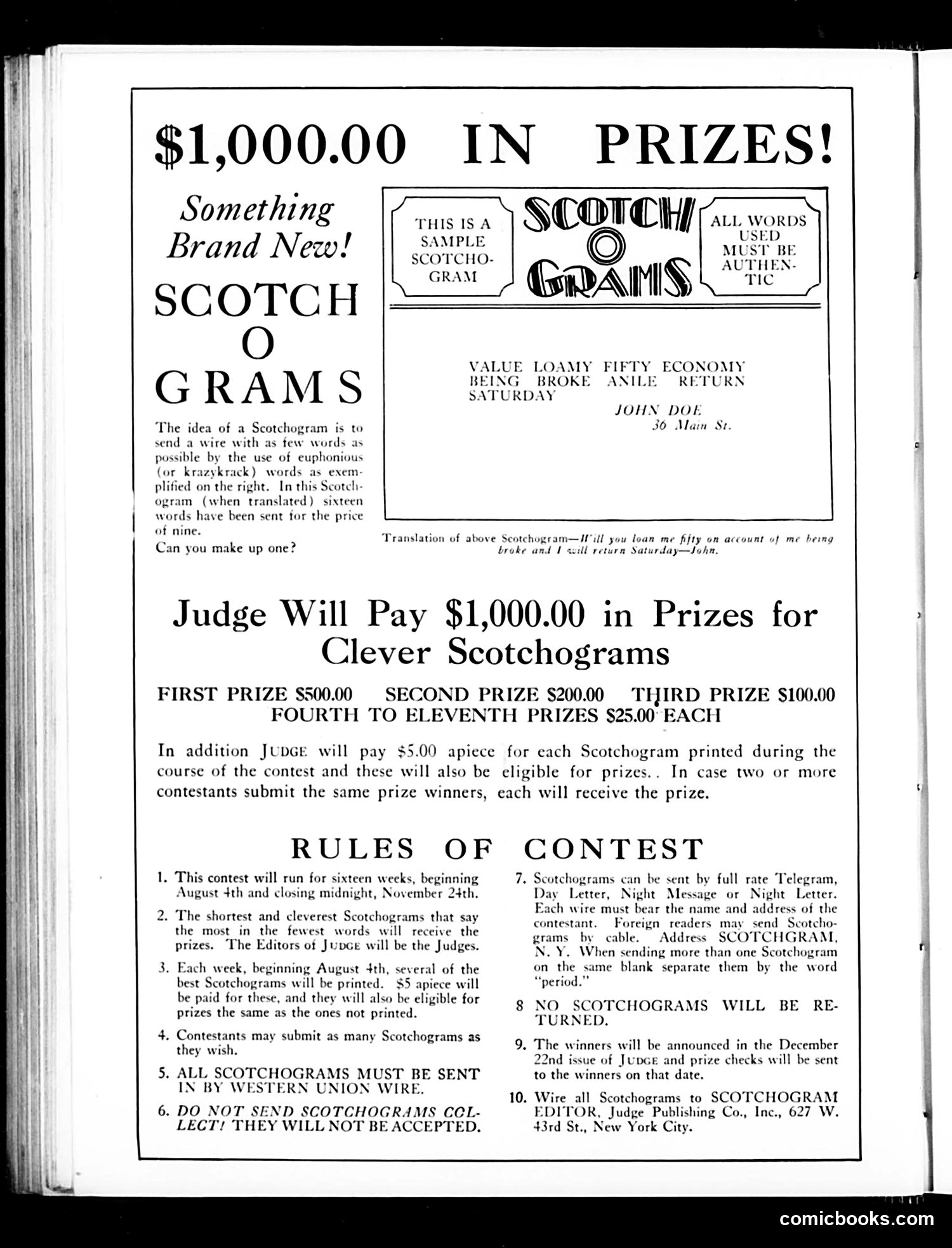
This page is primarily a **contest advertisement** rather than political satire. Judge magazine is announcing a "Scotchogram" contest with $1,000 in prizes. A **Scotchogram** is explained as a telegram using euphemistic or clever wordplay to send messages cheaply—the name plays on "Scotch" (meaning frugal). The sample shown reads as financial humor: "VALUE LOAMY FIFTY ECONOMY BEING BROKE AGILE BUTLERS SATURDAY" which translates to a request for a loan. The contest rules specify participants must create clever Scotchograms using as few words as possible. Entries run August 4 through November 24, with winners announced in December. Submissions go to Judge Publishing Co. in New York City via Western Union wire only. This represents Judge's typical early 20th-century blend of wordplay humor and reader engagement through contests.
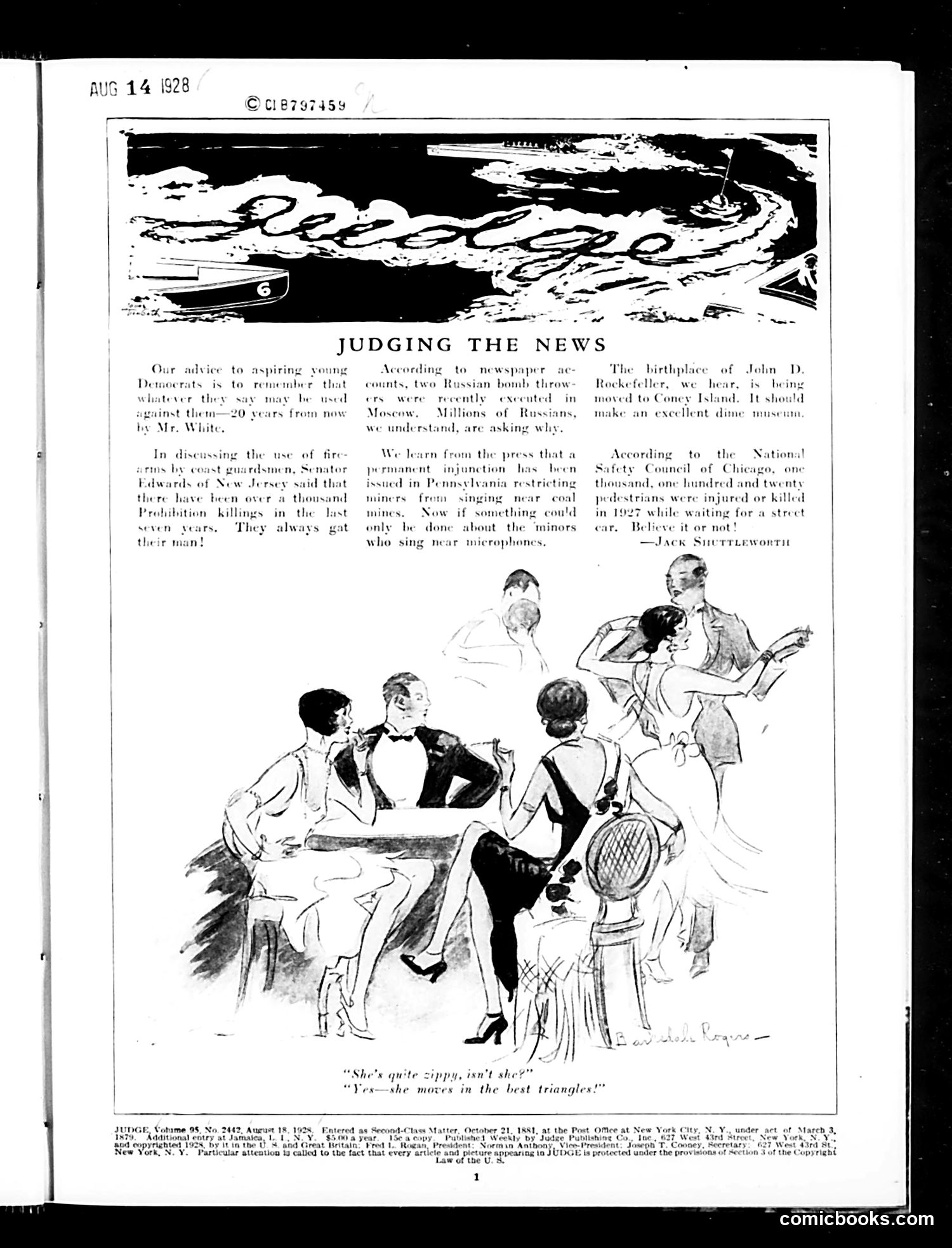
This satirical page critiques recent news stories through editorial commentary and illustration. The main cartoon depicts a social gathering where a woman in revealing attire is the subject of discussion. The caption reads: "She's quite zippy, isn't she?" / "Yes—she moves in the best triangles!" This appears to be mockery of 1920s social morality and the "modern woman"—likely referencing both the scandalous "love triangle" affairs that dominated society gossip, and the flapper culture's challenge to Victorian propriety. The page's text addresses other topics: Russian executions, New Jersey fireworks safety violations, Pennsylvania coal-mine labor disputes, and Chicago pedestrian deaths. The overall tone suggests Judge magazine used humor to commentary on contemporary social anxieties—moral decay, industrial hazards, and evolving gender norms during the Jazz Age.
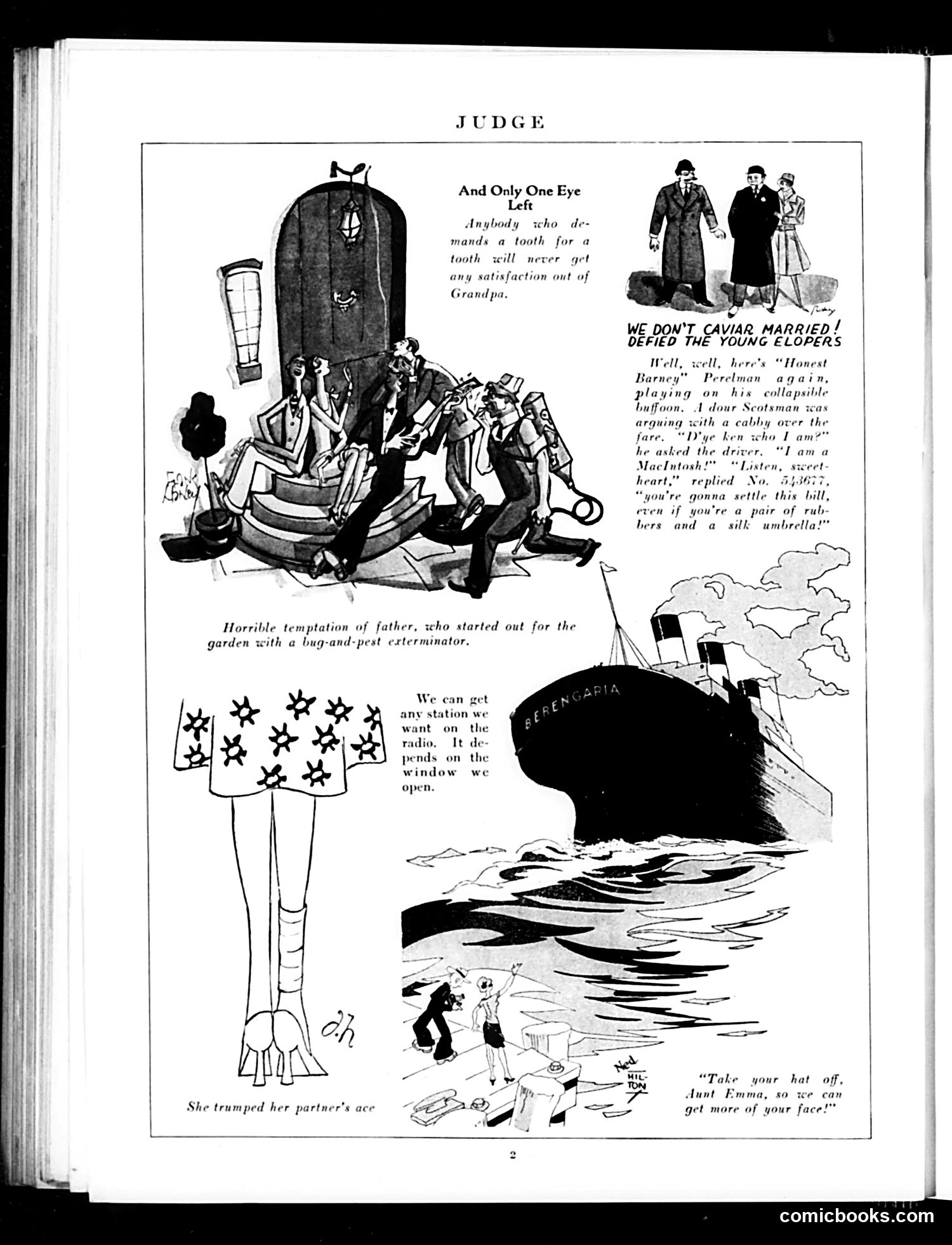
This satirical page contains four separate cartoons mocking social behaviors and current events: 1. **"And Only One Eye Left"**: Critiques demanding compensation for minor injuries—a father threatens legal action over a dental matter. 2. **"We Don't Caviar Married/Defied the Young Elopers"**: Mocks eloping couples and their parents' reactions, featuring a character named "Honest Barney" Berdelman. 3. **Radio Reception Joke**: A woman's starry dress allows radio reception depending on which window is open—satire on 1920s radio technology enthusiasm. 4. **Ship Wreck Scene (Berenga)**: Shows people salvaging from a shipwreck, with dialogue about removing a woman's hat for decorum—dark humor about disaster priorities. The page reflects 1920s concerns: litigation culture, generational conflict over romance, new technology, and social propriety during crises.
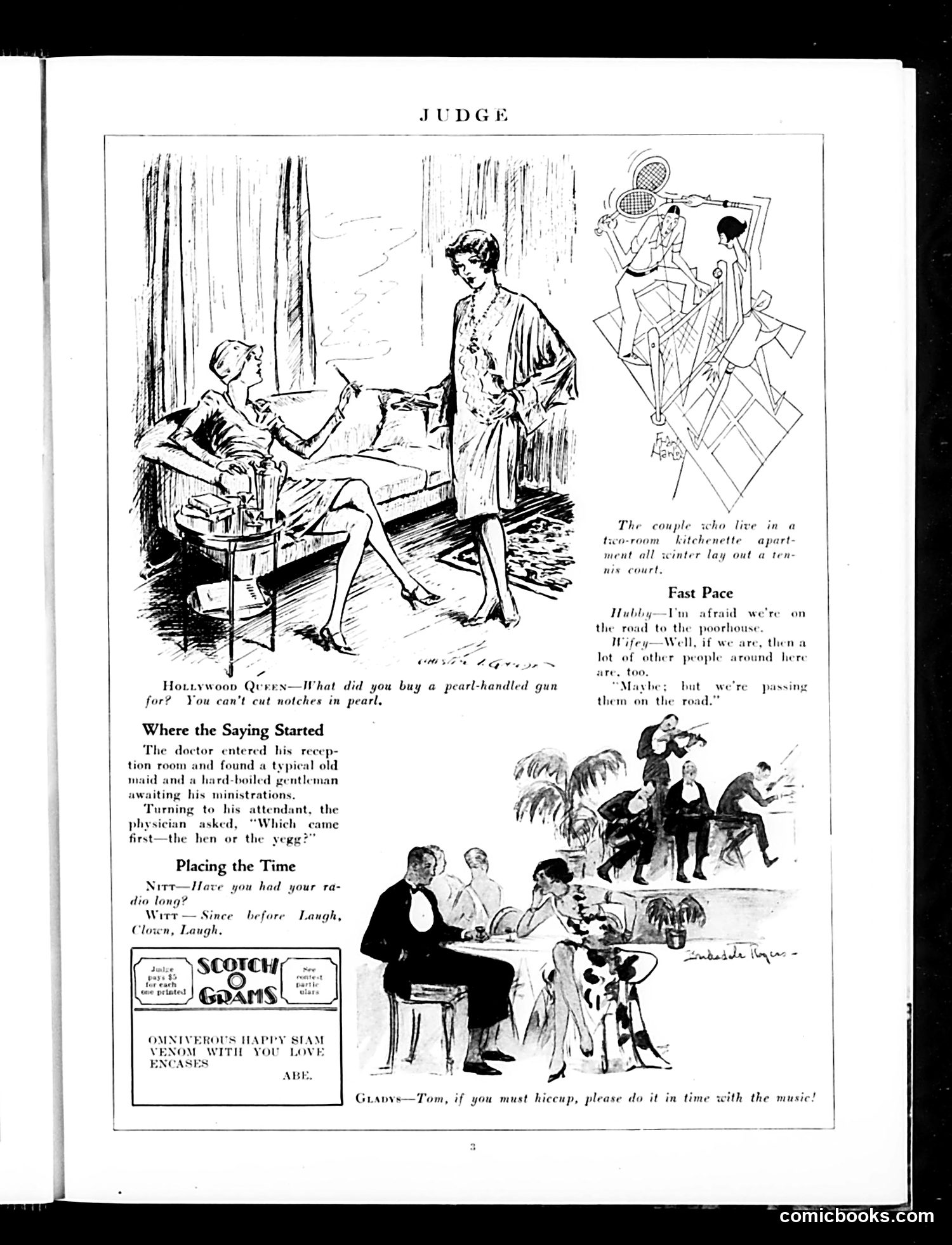
This page contains **satirical humor** rather than political cartoons. The content includes three separate joke scenarios: 1. **"Hollywood Opens"**: Mocks a pearl-handled gun purchase—the joke being that cheap "cut notches" cannot be made in pearl. 2. **"Where the Saying Started"**: A doctor asks a patient which came first—the hen or egg—playing on the origin of this philosophical riddle. 3. **"Fast Pace"** and **"Placing the Time"**: Social humor about modern life and scheduling. The sketches depict everyday middle-class situations—a woman in bed, a doctor's office, a social gathering—typical of Judge's **lifestyle satire**. There's also a **Scotch and Grams advertisement**. These appear aimed at affluent readers, poking gentle fun at contemporary manners and speech rather than addressing politics or major social issues.
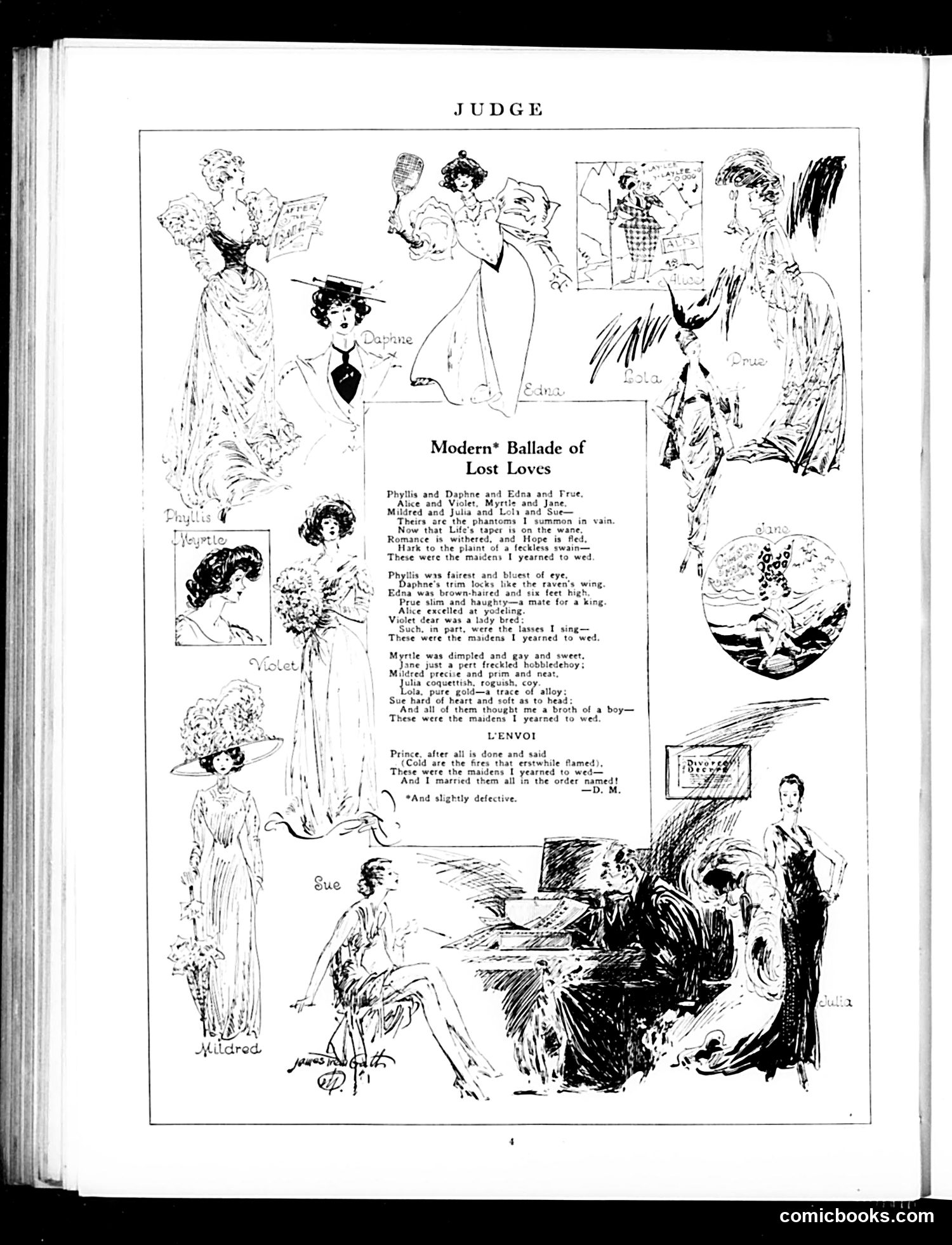
This page from *Judge* presents a satirical poem and accompanying illustrations mocking romantic disappointment. The central text, "Modern Ballad of Lost Loves," catalogs various women—Phyllis, Daphne, Edna, Frue, Mildred, Julia, Lois, Sue, and Violet—each described with exaggerated romantic or physical characteristics ("fairest and bluest of eye," "brown-haired," "dimpled and gay"). The surrounding pen-and-ink sketches illustrate these female characters in various poses and situations, appearing somewhat caricatured. The satire targets the melodramatic nature of romantic loss and male sentimentality about past relationships. A brief note marked "*And slightly defective" suggests tongue-in-cheek criticism of these romantic ideals. The overall effect mocks both romantic excess and the superficiality of cataloging love interests, typical of *Judge's* satirical humor about modern social behavior.
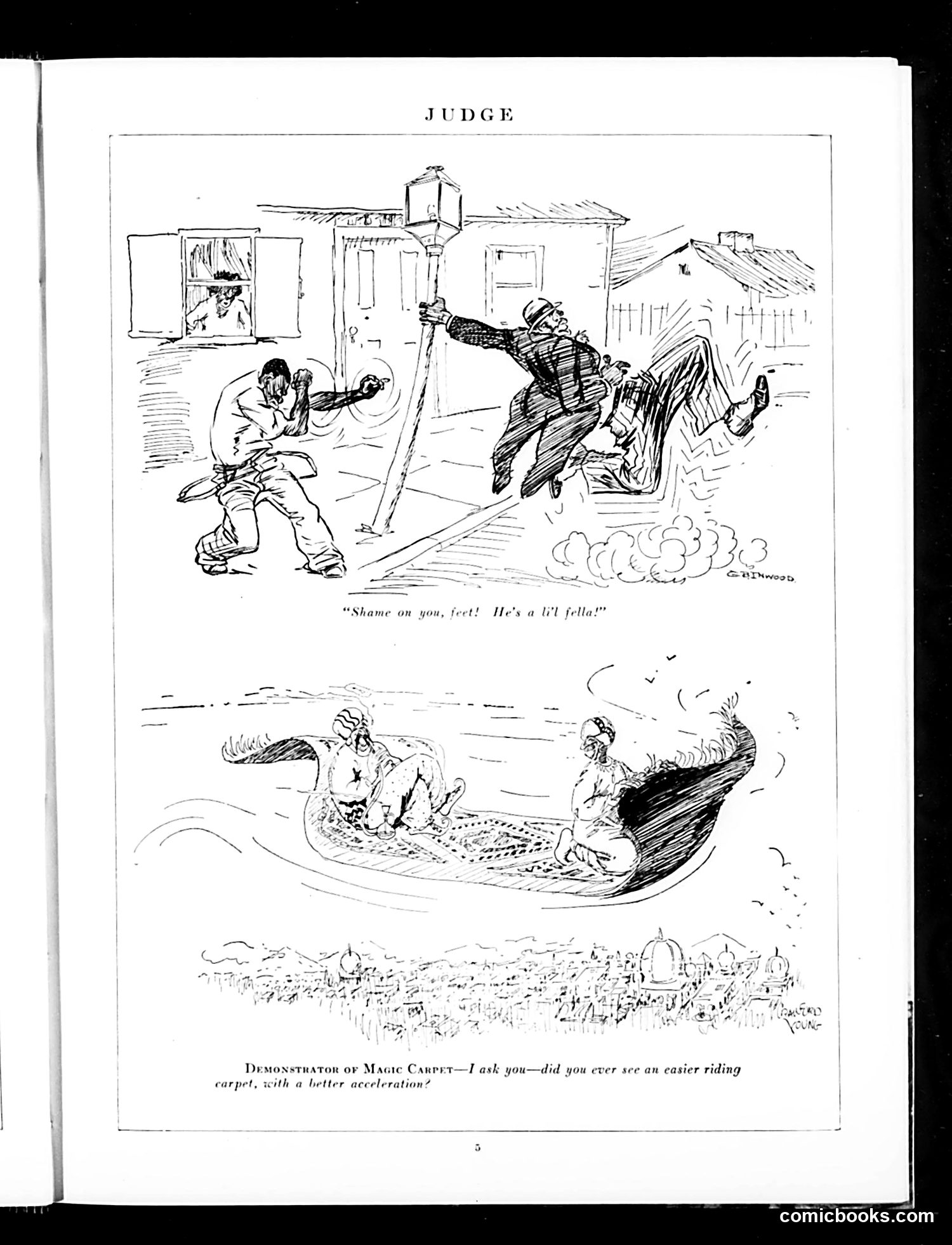
This page from *Judge* magazine contains two satirical cartoons: **Top cartoon:** Shows a man being violently ejected from what appears to be a prison or institution, with the caption "Shame on you, feet! He's a lil fella!" The humor appears to be about physical punishment or harsh treatment of a smaller person—likely social commentary on disproportionate consequences or bullying. **Bottom cartoon:** Depicts a fantastical "Magic Carpet" ride, with a demonstrator promoting it to a customer. The caption reads: "Demonstrator of Magic Carpet—I ask you—did you ever see an easier riding carpet, with a better acceleration?" This is clearly absurdist humor mocking new technological advances or consumer gadgetry of the era, poking fun at exaggerated sales pitches and the public's fascination with modern innovations.
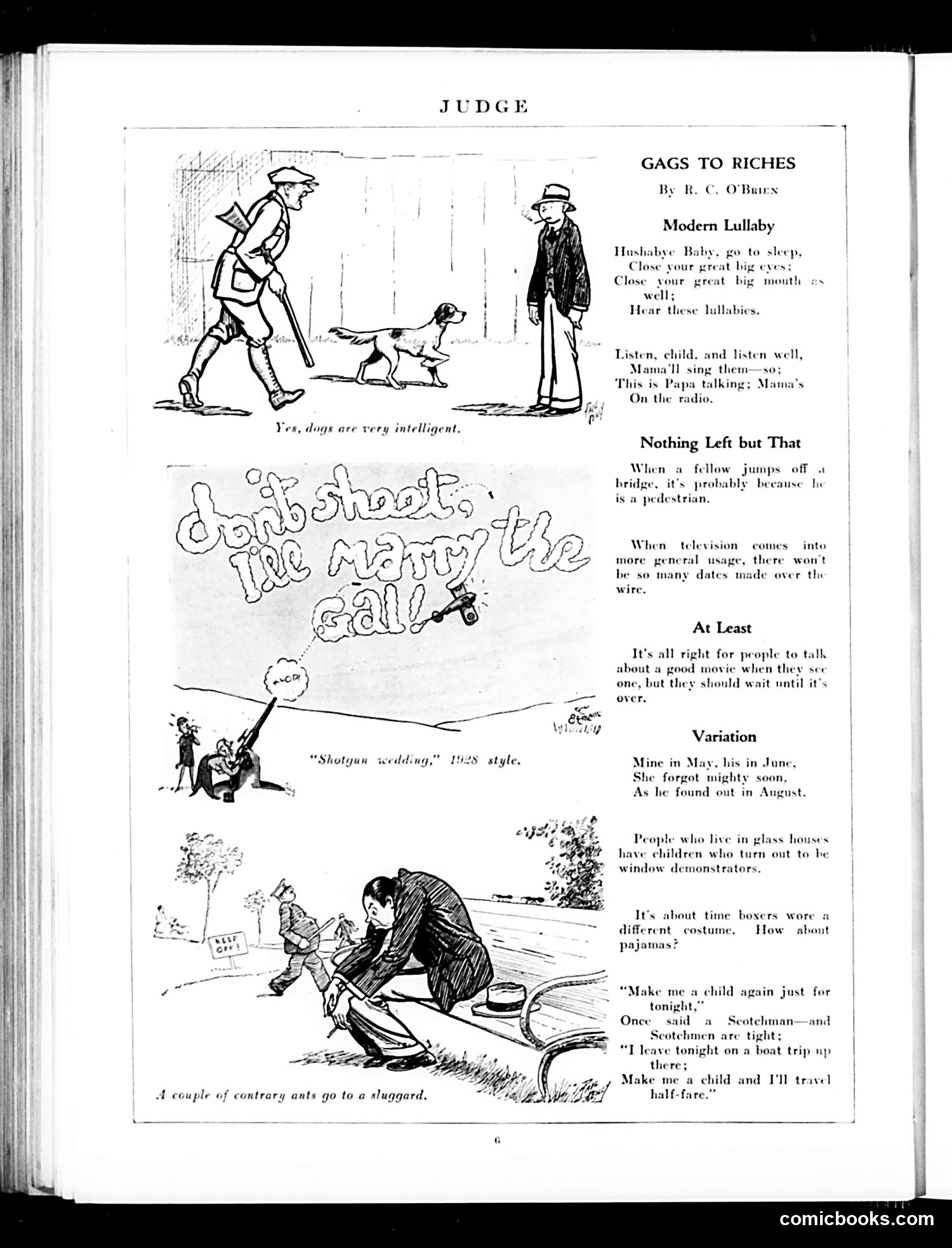
This page from *Judge* contains several satirical observations about modern American life, likely from the late 1920s: The top cartoon shows a man with a dog and the caption "Yes, dogs are very intelligent"—likely mocking people's tendency to anthropomorphize pets. **"Modern Lullaby"** satirizes radio's dominance in family life, where a baby is sung to sleep by a mother *on the radio* rather than present in person—a jab at how broadcasting was displacing domestic intimacy. **"Nothing Left but That"** jokes about two emerging technologies: the bridge-jumping reference mocks sensationalized news, while the television gag predicts it will disrupt dating by allowing people to watch movies at home instead of going out. The remaining items are brief one-liners mocking contemporary behaviors: movie-talkers, boxing costume conventions, and Scottish frugality. The "shotgun wedding" cartoon references forced marriages caused by pregnancy—presented as outdated by 1928. Overall, the page satirizes how modern technology and social changes were reshaping traditional family and social interactions.
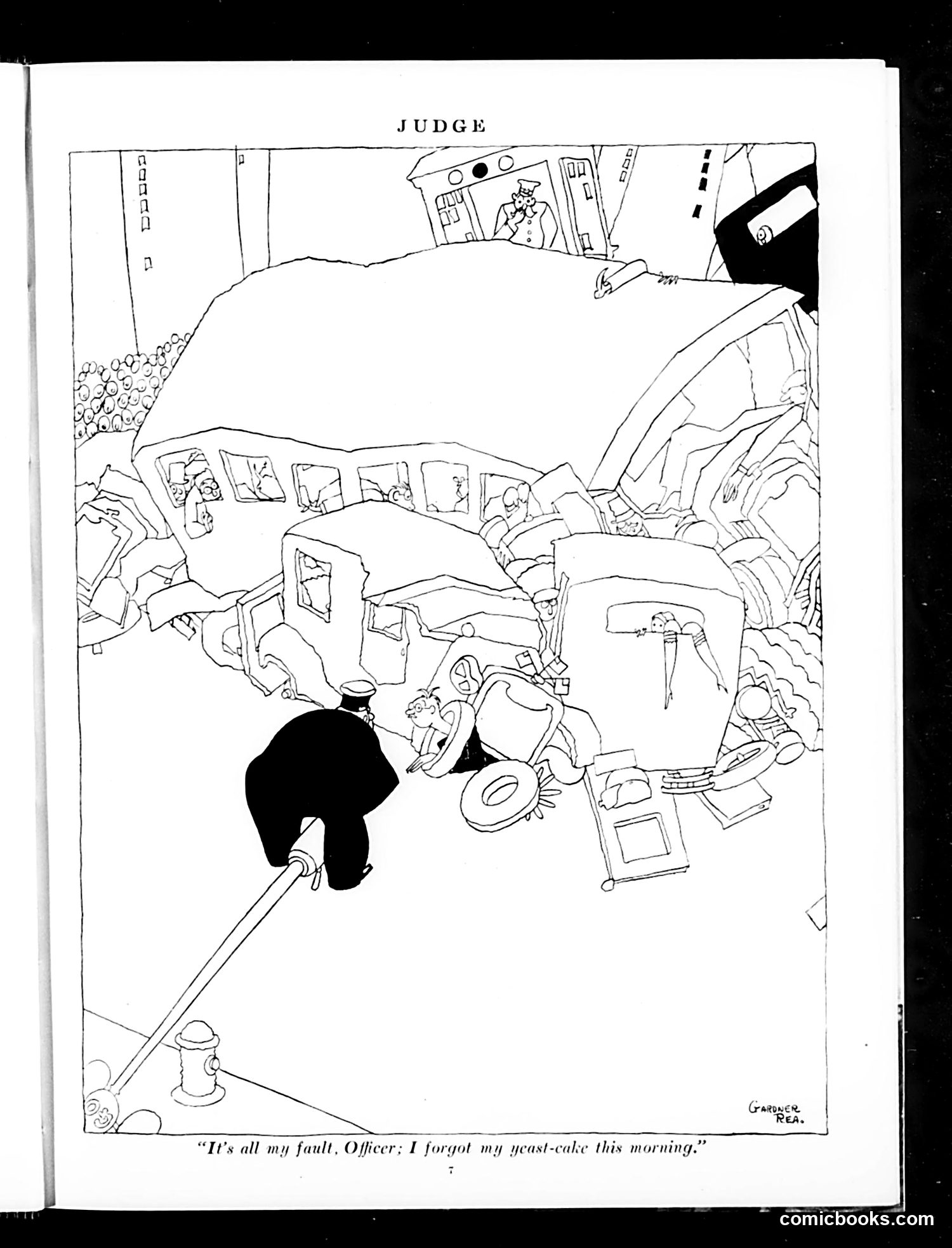
This single-panel cartoon satirizes traffic enforcement and minor violations. A man in formal attire (top hat, coat) is stopped by a police officer, apparently for a traffic infraction. His excuse—"I forgot my yeast-cake this morning"—is absurdly irrelevant to any driving offense, suggesting he's either confused, delirious, or making a joke of the situation. The humor lies in the disconnect between the officer's legitimate traffic concern and the defendant's nonsensical defense. The cartoon appears to mock either: (1) drivers who offer ridiculous excuses to officers, or (2) the judicial/traffic enforcement process itself as ineffectual when citizens aren't taking it seriously. The setting appears to be a courtroom or traffic court, with spectators visible in the background and what appears to be a judge's bench above.
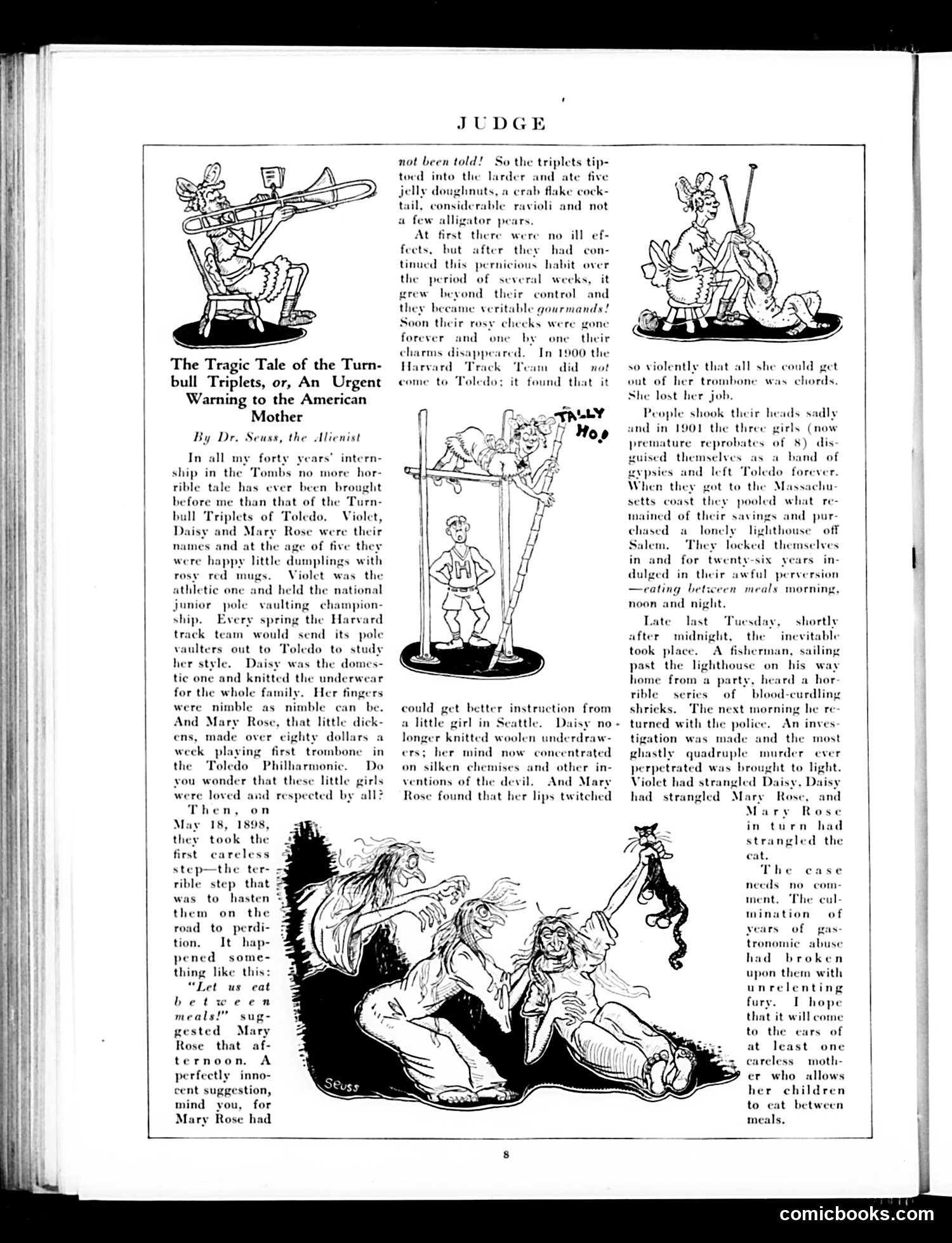
This is a satirical cautionary tale by Dr. Seuss (Theodor Geisel) mocking overly moralistic parenting advice. The "Turnbull Triplets" are fictional characters whose downfall stems from a single indulgence: eating between meals. The satire works by taking this minor transgression absurdly seriously. Five talented young girls (one an athlete, one domestic, one musical) are portrayed as doomed by snacking—their abilities fade, they descend into vice, and ultimately murder each other in a lighthouse after decades of uncontrolled eating. The joke targets early 20th-century "Alienist" (psychiatrist) pseudo-science and parental anxiety culture that blamed minor behavioral lapses for catastrophic moral collapse. By escalating a trivial act into tragedy, Seuss ridicules alarmist warnings to American mothers about child-rearing. The dark ending and clinical tone intensify the parody of serious medical/psychological literature warning against moral decay.
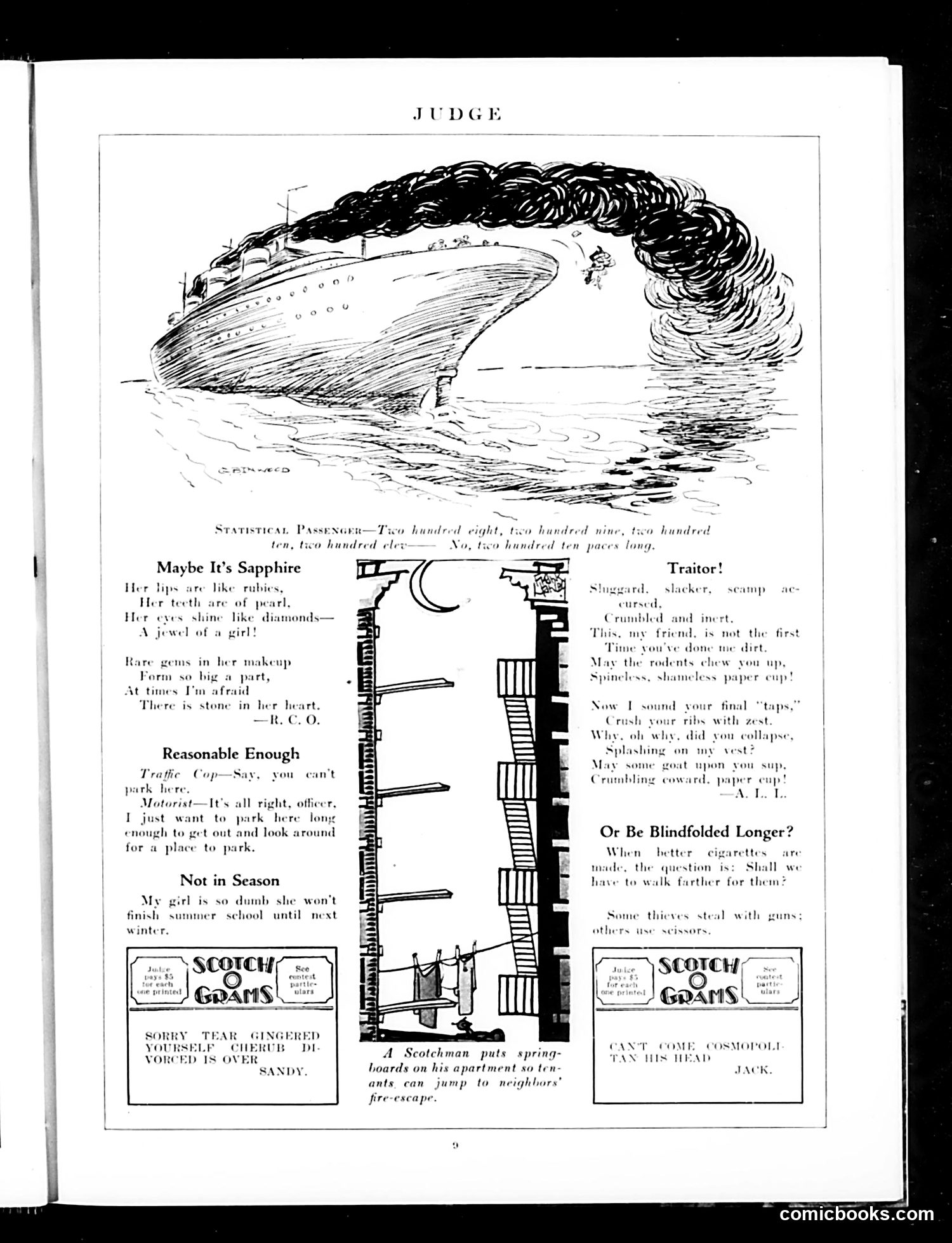
This page from Judge contains several brief humorous pieces typical of the magazine's satirical style: **"Maybe It's Sapphire"** mocks overwrought romantic poetry, using precious gem imagery to describe a woman's features—a parody of sentimental verse. **"Reasonable Enough"** is a traffic joke about a motorist seeking permission to illegally park while "looking" for a legal parking spot—absurd circular logic. **"Not in Season"** jokes that the speaker's girlfriend is so unintelligent she won't finish summer school before winter arrives. **"Traitor!"** (right side) appears to be a sarcastic attack on a paper cup, personified and mocked as a cowardly failure—likely satirizing disposable products or consumer culture. **"Or Be Blindfolded Longer?"** references cigarette advertising, questioning whether smokers would walk farther if better cigarettes were made, with a joke about theft methods. The **Scotch advertisements** are brand placements typical of Judge's era. The top illustration depicts a ship in distress, possibly related to maritime statistics mentioned in the header text (though the exact context is unclear from the OCR).
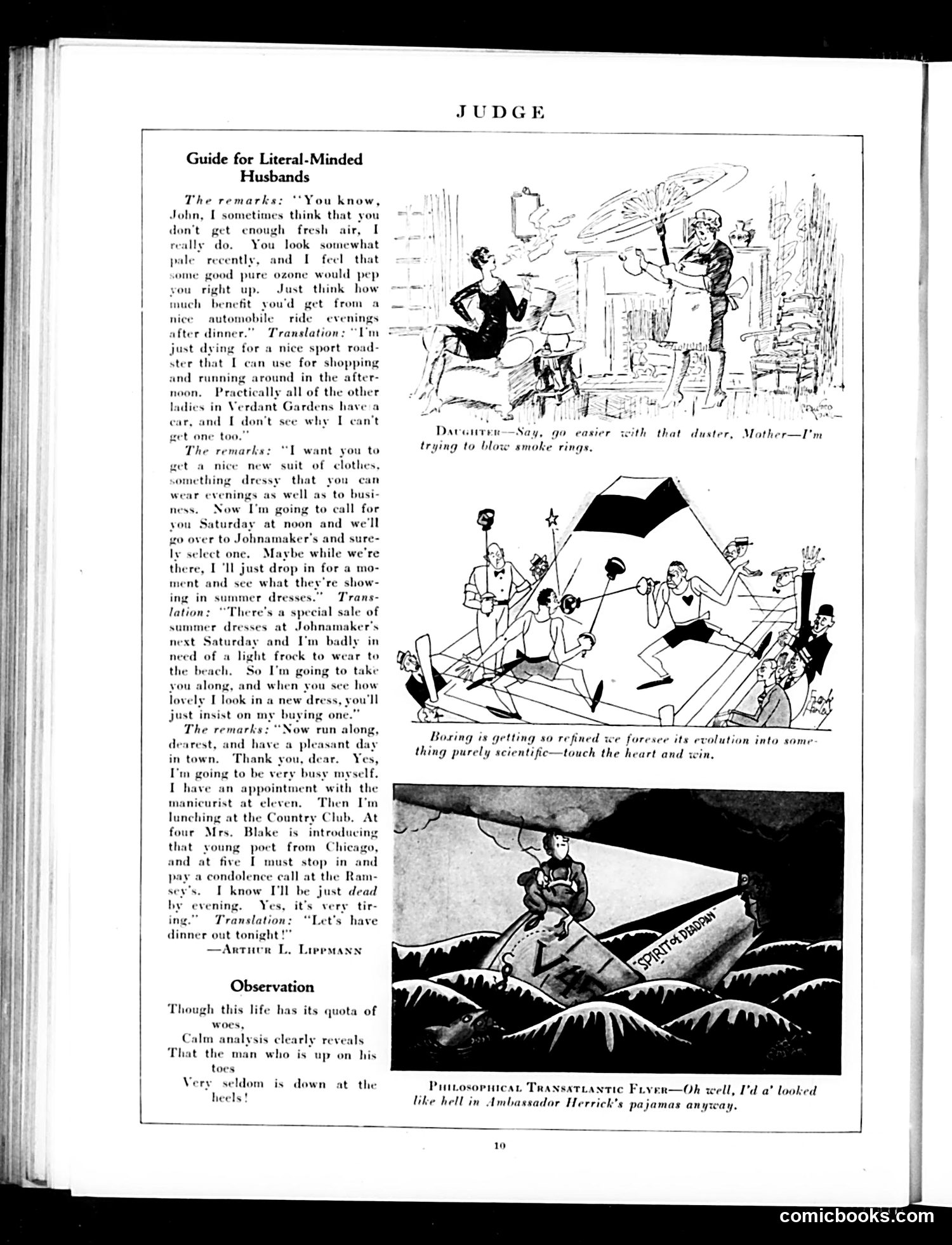
This page satirizes **husbands who misunderstand their wives' indirect requests**—a common domestic comedy theme of the era. The "Guide for Literal-Minded Husbands" mocks men who take women's statements at face value rather than recognizing hidden meanings. The three dialogue examples show wives using euphemistic language: - "You need fresh air" really means "I want a sports car" - "Get a nice suit" really means "I want to shop for dresses myself" - "I'm very busy" really means "Let's go out to dinner" The cartoons illustrate these scenarios with exaggerated situations—a wife dusting while a child blows smoke rings, and a chaotic beach/leisure scene. The final caption about the "Philosophical Transatlantic Flyer" appears unrelated. The satire targets men's supposed obtuseness about female communication styles, a standard domestic humor trope reflecting gender dynamics of the early 20th century. The joke assumes readers recognize wives' indirect requests as a universal marital reality.
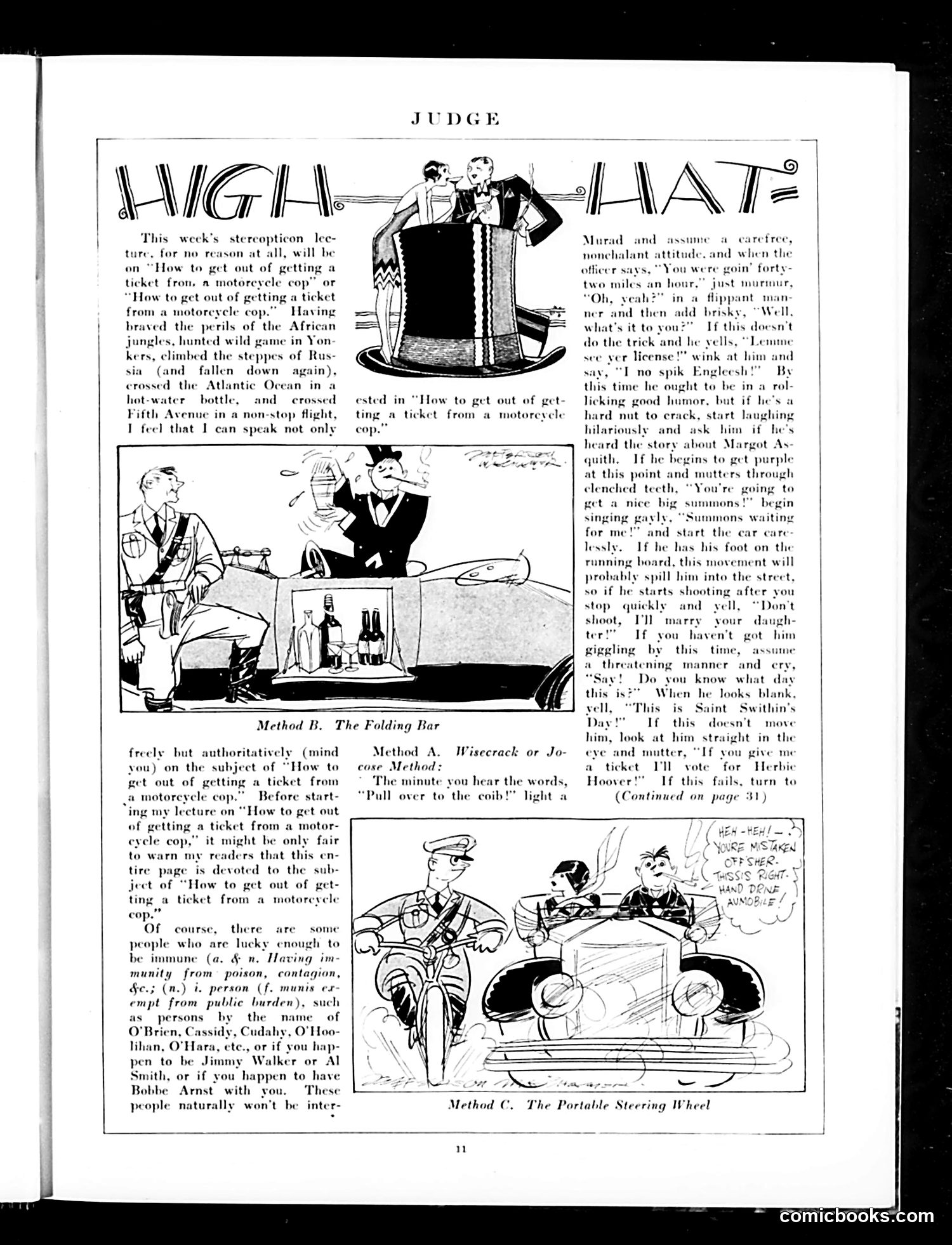
This satirical article mocks 1920s traffic enforcement by proposing absurd methods to evade motorcycle police issuing speeding tickets. The humor relies on escalating ridiculous tactics: **Method A (Wisecrack)**: Use charm and flippant humor—feigning ignorance ("I no spik Engleesh!"), telling jokes, laughing hysterically—to amuse the officer into not writing a ticket. **Method B (Folding Bar)**: Distract the cop by deploying a portable steering wheel or similar device. **Method C (Portable Steering Wheel)**: Shows officers in a slapstick scene, apparently losing control of their motorcycles. The article also references immunity for politically connected figures like Jimmy Walker and Al Smith (NYC politicians), and mentions "Herbie Hoover"—likely Herbert Hoover, then-Secretary of Commerce. The satire critiques both traffic laws' inconsistent enforcement and the era's casual disregard for traffic safety, while poking fun at everyday citizens' creative rule-breaking during Prohibition-era America.
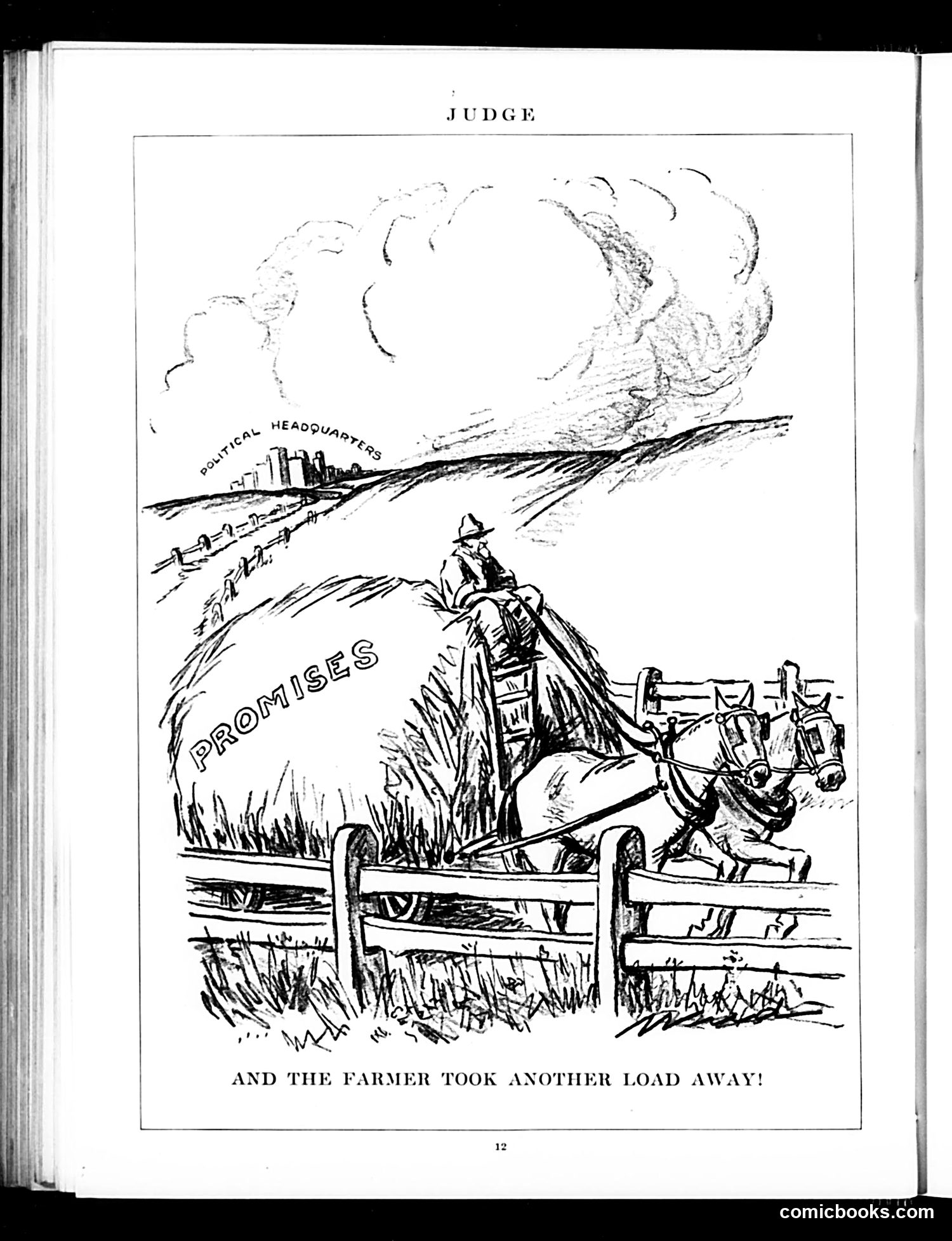
This cartoon satirizes broken political promises to farmers. A large hay bale labeled "PROMISES" sits prominently in the foreground, while a farmer with a horse-drawn wagon hauls it away. In the background, "POLITICAL HEADQUARTERS" appears on the horizon, suggesting politicians made commitments they failed to keep. The satire is straightforward: farmers are literally removing the politicians' empty promises, depicted as worthless hay. This likely critiques a specific era's agricultural policy failures or unfulfilled campaign pledges to rural voters. The farmer's weary posture and repeated action ("another load away") emphasize the cumulative disappointment of broken commitments over time. Without the publication date visible, the specific political context remains unclear, though this reflects common turn-of-the-century rural discontent with unfulfilled governmental support.
This page contains social commentary rather than traditional political cartoons. The "Judge on the Bench" masthead frames three satirical essays: **"Why Fuss About Amateurism?"** critiques the hypocrisy surrounding tennis player Bill Tilden. The piece argues that if Tilden can earn money as an actor, writer, and cigarette endorser while remaining "amateur," the distinction between amateur and professional athletes is meaningless. Judge sarcastically suggests abolishing pretense and letting all players be paid openly—attacking what it sees as commercialism masquerading as amateurism. **The Prohibition essay** discusses Henry Ford's support for alcohol prohibition, noting his workers' improved behavior and savings. Judge dismisses this as self-serving: an "unholy alliance of moralists and manufacturers" using prohibition to control workers' personal freedom and behavior under the guise of moral reform. **Remaining brief items** address a national anthem competition and political candidates, maintaining the magazine's satirical tone throughout.
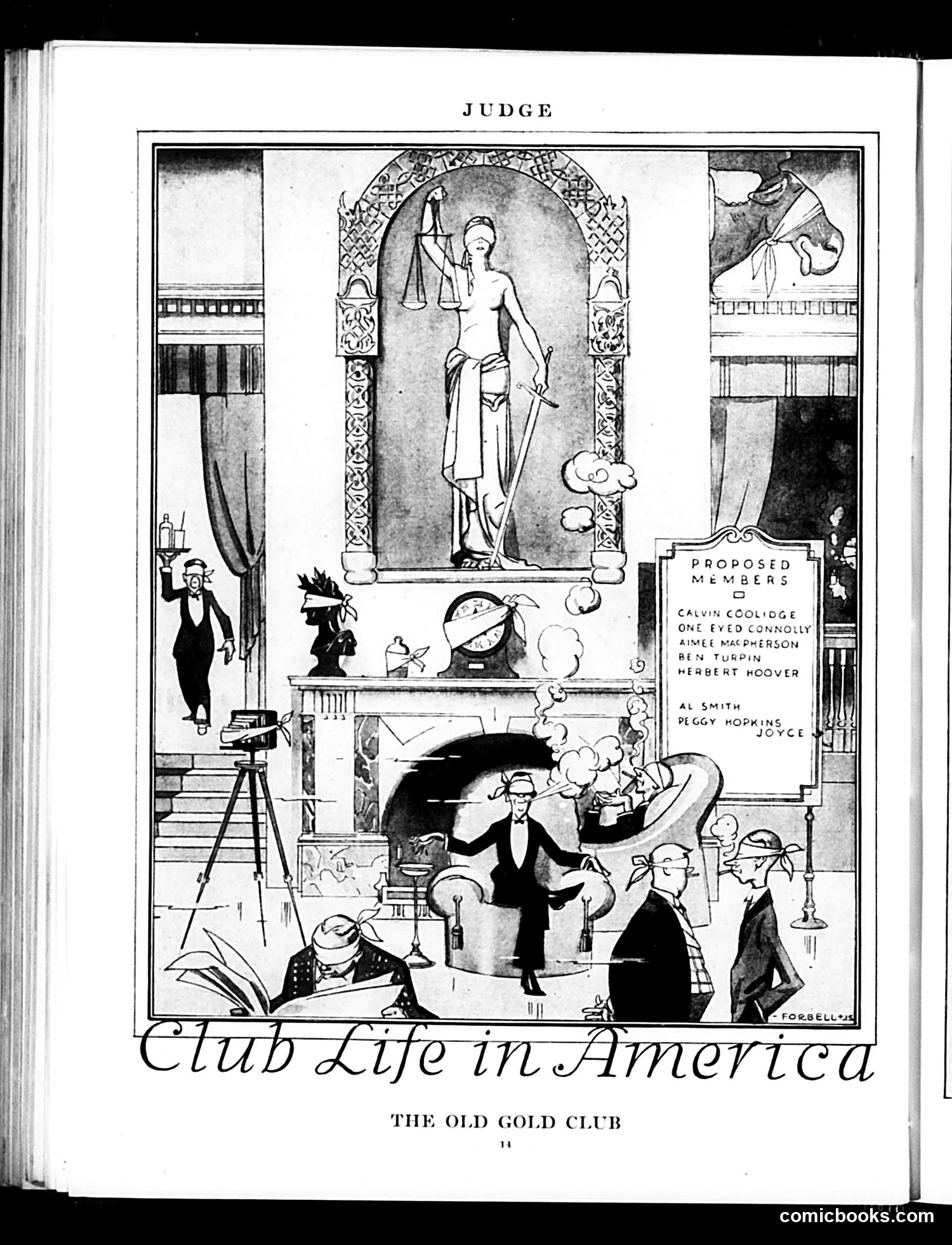
This cartoon satirizes an exclusive club called "The Old Gold Club," whose proposed members are listed as prominent 1920s figures: Calvin Coolidge, Herbert Hoover, one-eyed comedian Ben Turpin, evangelist Aimee Semple McPherson, Al Smith, and others. The satire appears to mock these public figures by grouping them together in a luxurious club setting. The joke likely plays on their shared notoriety or absurdity—mixing serious politicians (Coolidge, Hoover, Smith) with entertainers and controversial figures like McPherson (known for flamboyant revivals). The "one-eyed" descriptor for both Connolly and Turpin may reference shared characteristics or defects being club requirements. The ornate neoclassical architecture suggests pretentiousness, implying these figures don't belong in such refined company—a common Judge magazine approach to deflating public egos through humor.
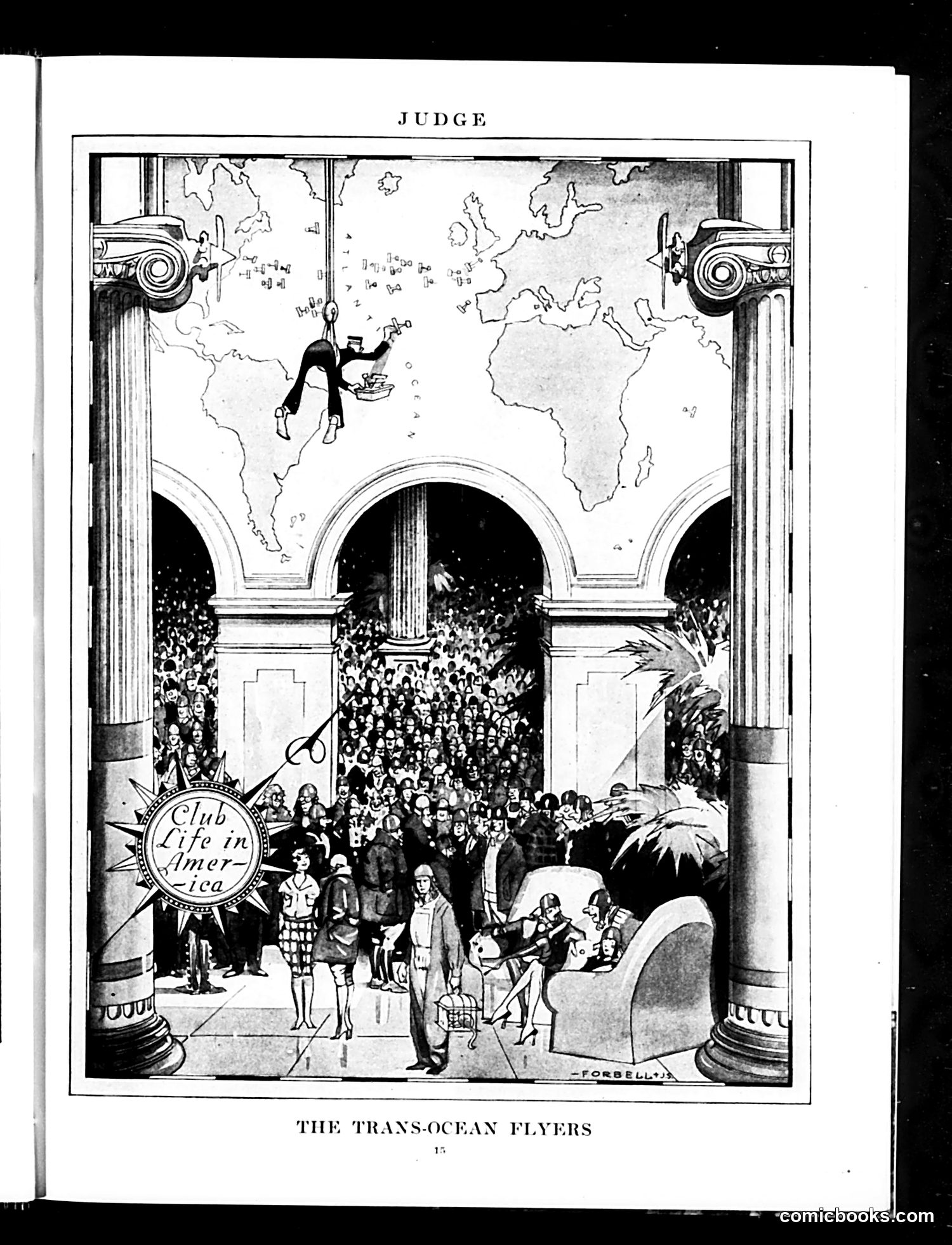
This Judge cartoon satirizes the early aviation craze and transatlantic flight aspirations. The image depicts a grand architectural setting (appears to be a courtroom or civic building, given the "JUDGE" header) hosting a "Club Life in America" gathering. A figure dangles from a rope above a world map, apparently representing an ambitious aviator or "trans-ocean flyer." Below, crowds gather as if witnessing or celebrating aviation achievements. The cars visible at the top corners suggest modernity and technological progress. The satire likely mocks either the grandiose public fascination with early aviation pioneers, or the dubious claims of amateur flyers. The formal institutional setting contrasts humorously with the literal "hanging" figure, suggesting pretension or risk associated with early transatlantic flight attempts. The work appears to date from aviation's pioneering era (1910s-1920s).
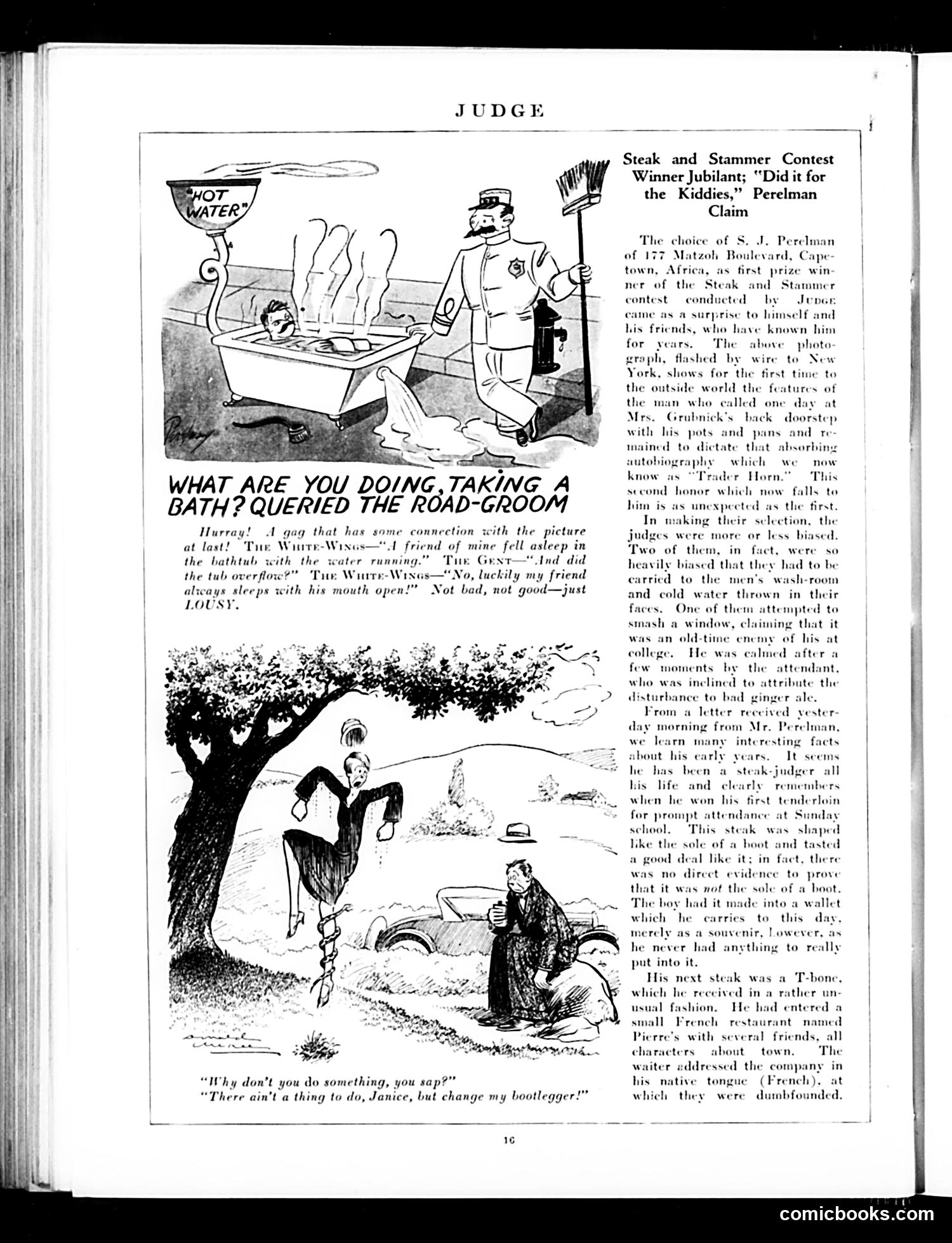
This page contains two humor pieces typical of Judge's satirical style: **Top cartoon**: A road-groom finds a man bathing in a bathtub outdoors. The joke relies on a tired setup: a man fell asleep in his bathtub with water running, but didn't overflow because he "always sleeps with his mouth open." The magazine itself dismisses this as "lousy" humor. **Bottom cartoon**: References Prohibition-era slang. A man tells a woman "There ain't a thing to do, Janice, but change my bootlegger!"—meaning he needs to find a new illegal alcohol supplier. This satirizes the boredom of daily life and casual acceptance of lawbreaking during Prohibition. **Right column**: Announces S.J. Perelman won a "Steak and Stammer Contest," humorously claiming he did it "for the kiddies." The text mocks the contest and judges, suggesting some were so biased they needed cold water thrown on them. It's a playful jab at both the contest and Perelman's writing. The page exemplifies Judge's mix of visual gags, Prohibition references, and literary in-jokes for educated readers.
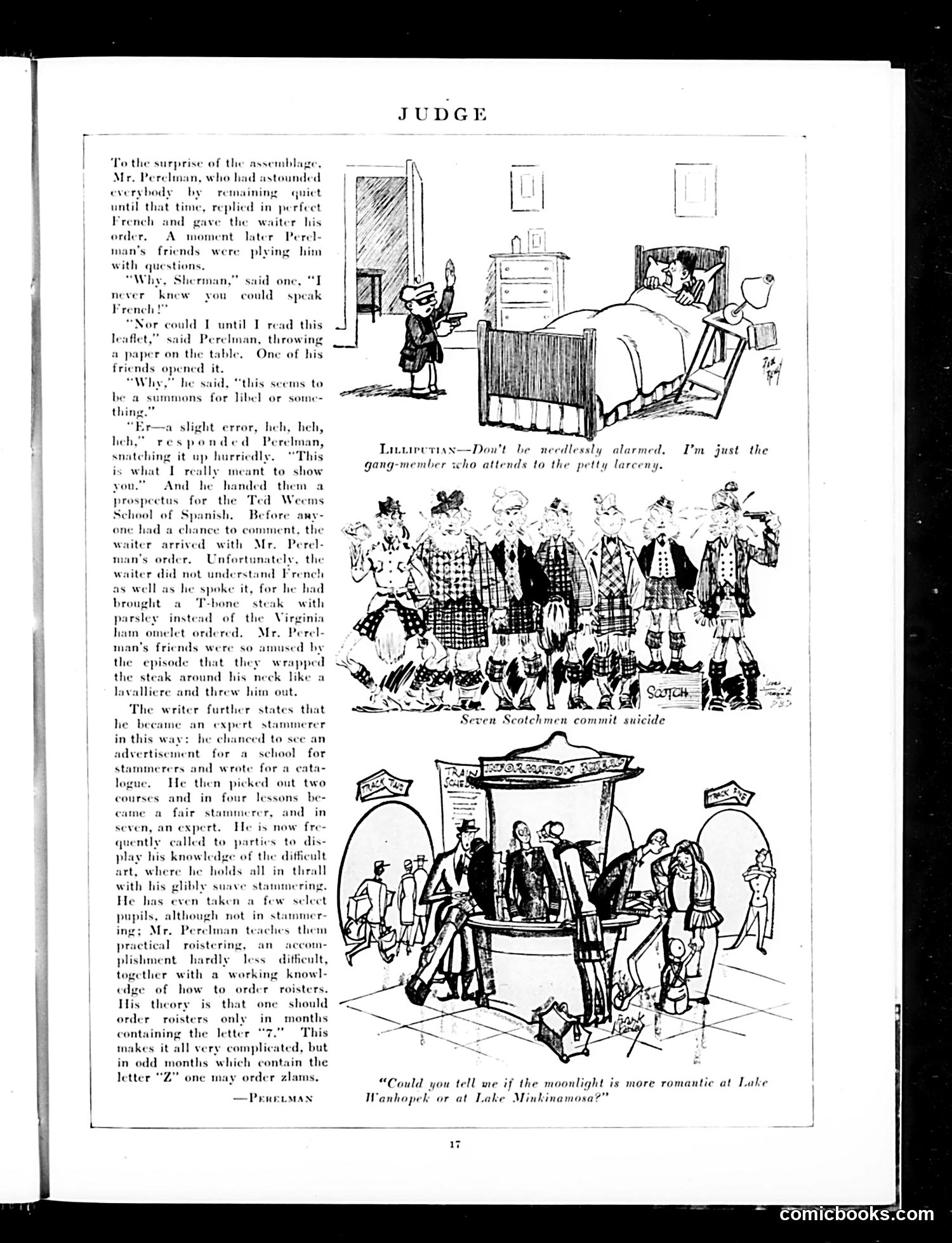
This page satirizes mail-order self-improvement schemes popular in the early 20th century. The main narrative mocks a man named Perelman who obtains a "leaflet" (actually a libel summons) that supposedly teaches him French instantly. The joke's premise: the threat of legal action motivates learning better than legitimate instruction. The cartoons illustrate absurd consequences. The top image shows a waiter's confusion when Perelman orders in French, resulting in a T-bone steak delivered as a necklace. The middle cartoon depicts "Seven Scotchmen commit suicide"—presumably from shock at the waiter's bungling. The bottom cartoon appears unrelated, showing a gazebo scene with someone asking about romantic moonlight at two similarly-named lakes (likely fictional, nonsensical names). The text continues the satire, noting Perelman became a stammering "expert" through similar dubious correspondence courses. The final joke about ordering "roisters" only in months containing specific letters mocks the arbitrary, overcomplicated "rules" these schemes marketed as specialized knowledge. The satire targets gullibility and mail-order fraud.
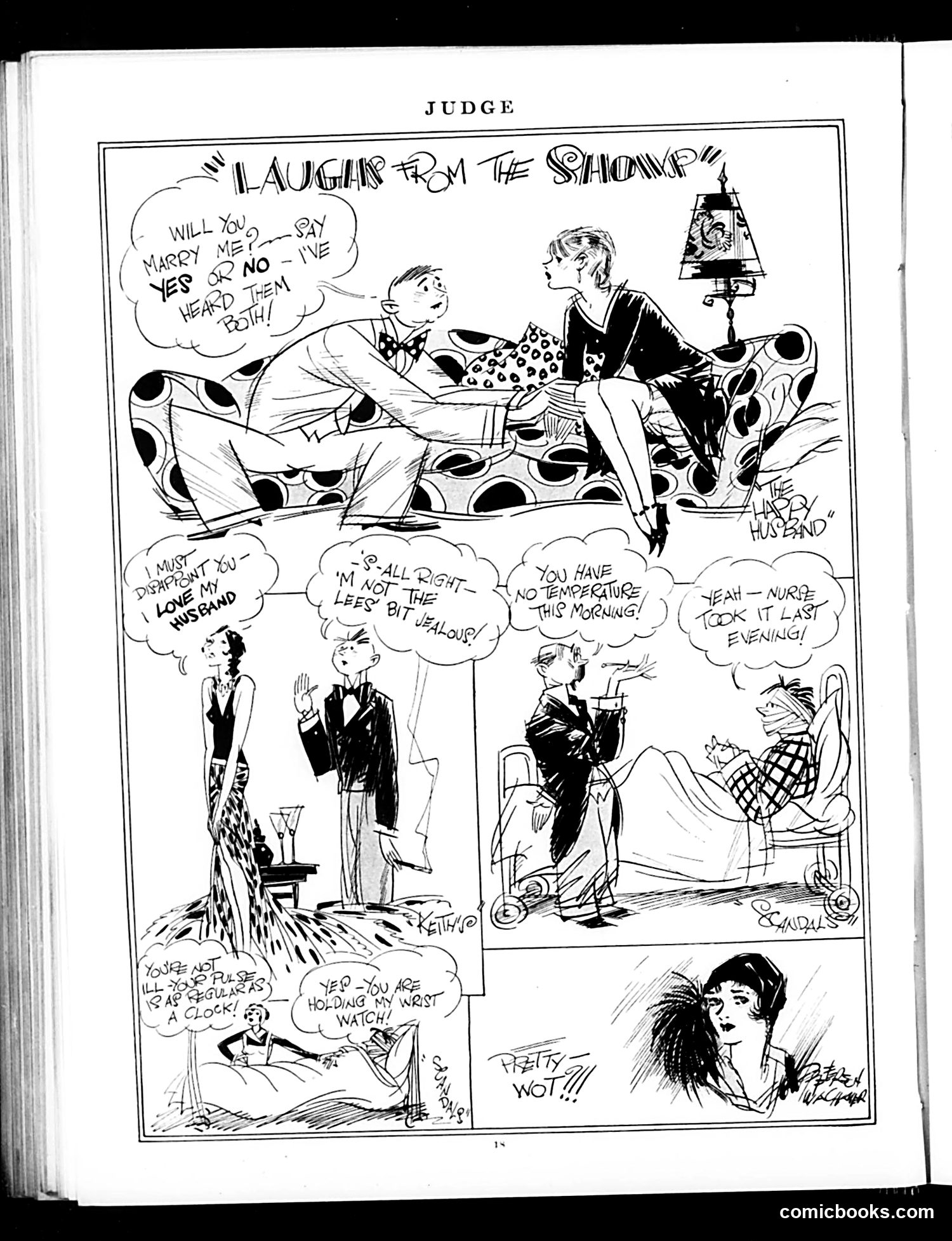
This is a satirical comic strip about marriage proposals and domestic life. The top panel shows a man proposing to a woman in an intimate setting, asking "Will you marry me?" with her responding "Yes or No—I've heard them both!" The subsequent panels depict various marital complaints and excuses: a woman saying she must "dispatch" her love for her husband, a man claiming he's "not in the least jealous," complaints about temperature and morning routines. The final panel shows a woman's exasperated face saying "Pretty wot!!!" The satire targets the gap between romantic courtship and the mundane, often contentious reality of marriage. It mocks both husbands' and wives' excuses and grievances, presenting marriage as a series of predictable disappointments rather than romantic fulfillment—typical of early 20th-century satirical commentary on domestic life and gender relations.
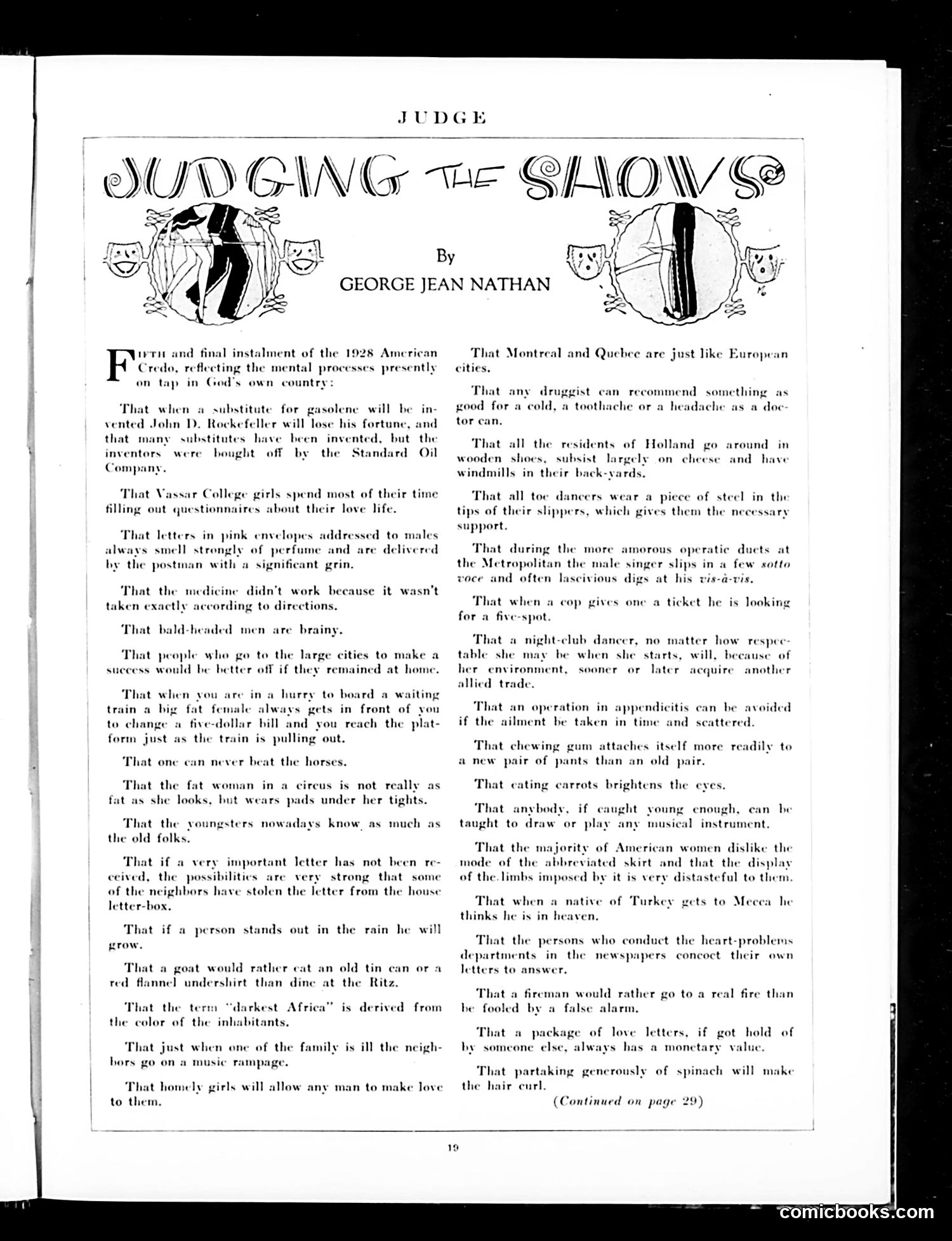
This is the concluding installment of George Jean Nathan's "American Credo"—a satirical list of widespread, often absurd beliefs held by ordinary Americans in 1928. Rather than depicting specific political figures, Nathan mocks popular misconceptions and cultural stereotypes. The humor targets everyday superstitions (bald men are brainy; standing in rain makes you grow), ethnic prejudices (Holland = wooden shoes and windmills; Turkey = primitive), consumer naivety (Rockefeller will lose his fortune once gasoline substitutes are invented), gender stereotypes (homely girls are easy; abbreviated skirts distress women), and institutional cynicism (newspaper advice columnists fabricate their own letters). The satire reflects 1920s anxieties about modernity, immigration, and changing social values. Nathan's list simultaneously ridicules the gullibility of everyday Americans and critiques the sensationalism of popular culture and advertising that perpetuates these myths.
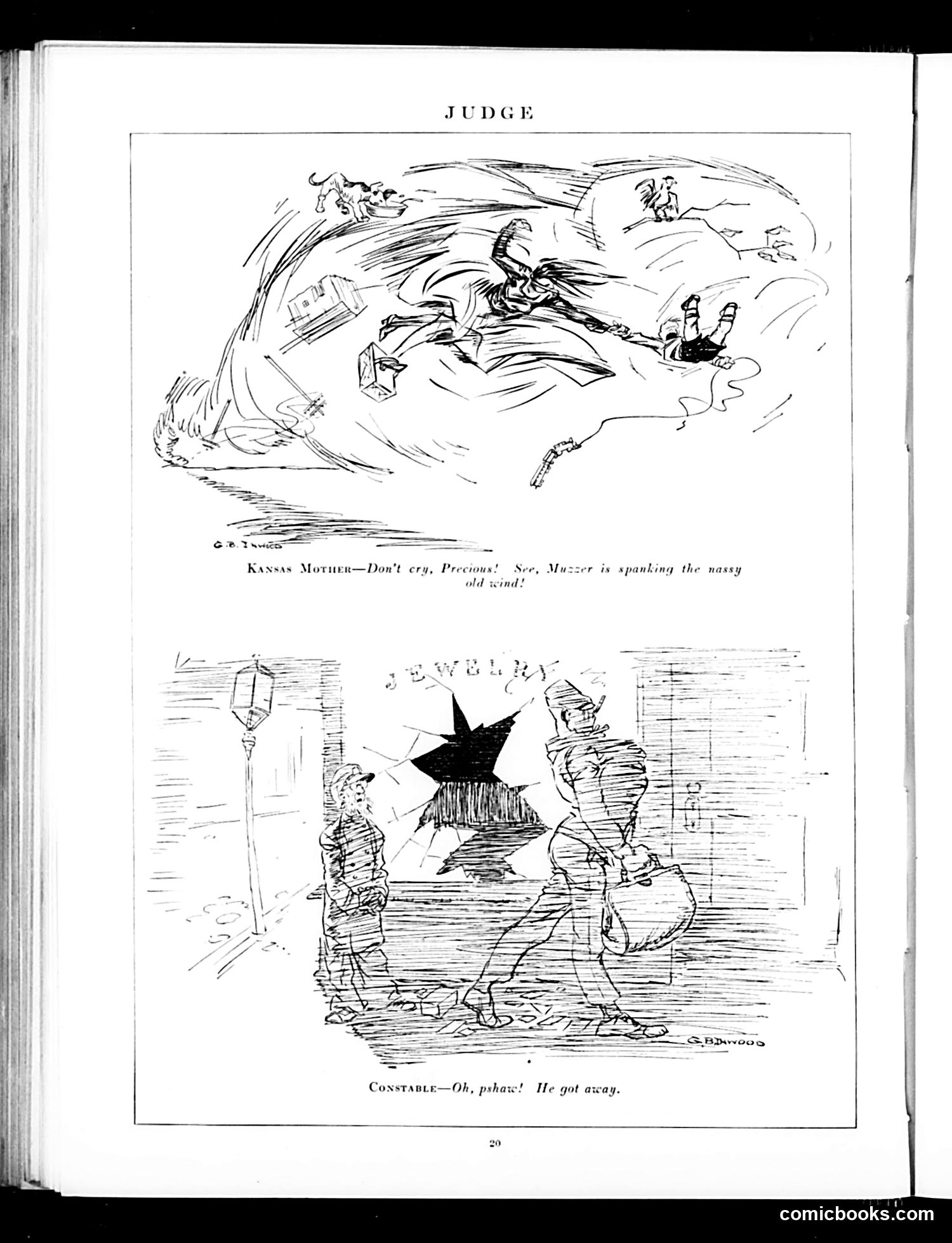
This page contains two satirical cartoons. The upper cartoon depicts "Kansas Mother" reacting to wind damage, with the caption suggesting someone named Muzzer is "spanking the sassy old wind." This appears to reference Kansas's notorious severe weather and a humorous personification of natural forces. The lower cartoon shows a "Constable" exclaiming "Oh, pshaw! He got away," apparently depicting a law enforcement officer's frustration at a criminal's escape. The figure in the center appears to be a witch or criminal character fleeing through a doorway marked "LIBERTY." Without additional context about the specific issue date, the exact political references remain unclear, though both cartoons employ exaggerated character types typical of Judge's satirical humor about American life and governance.
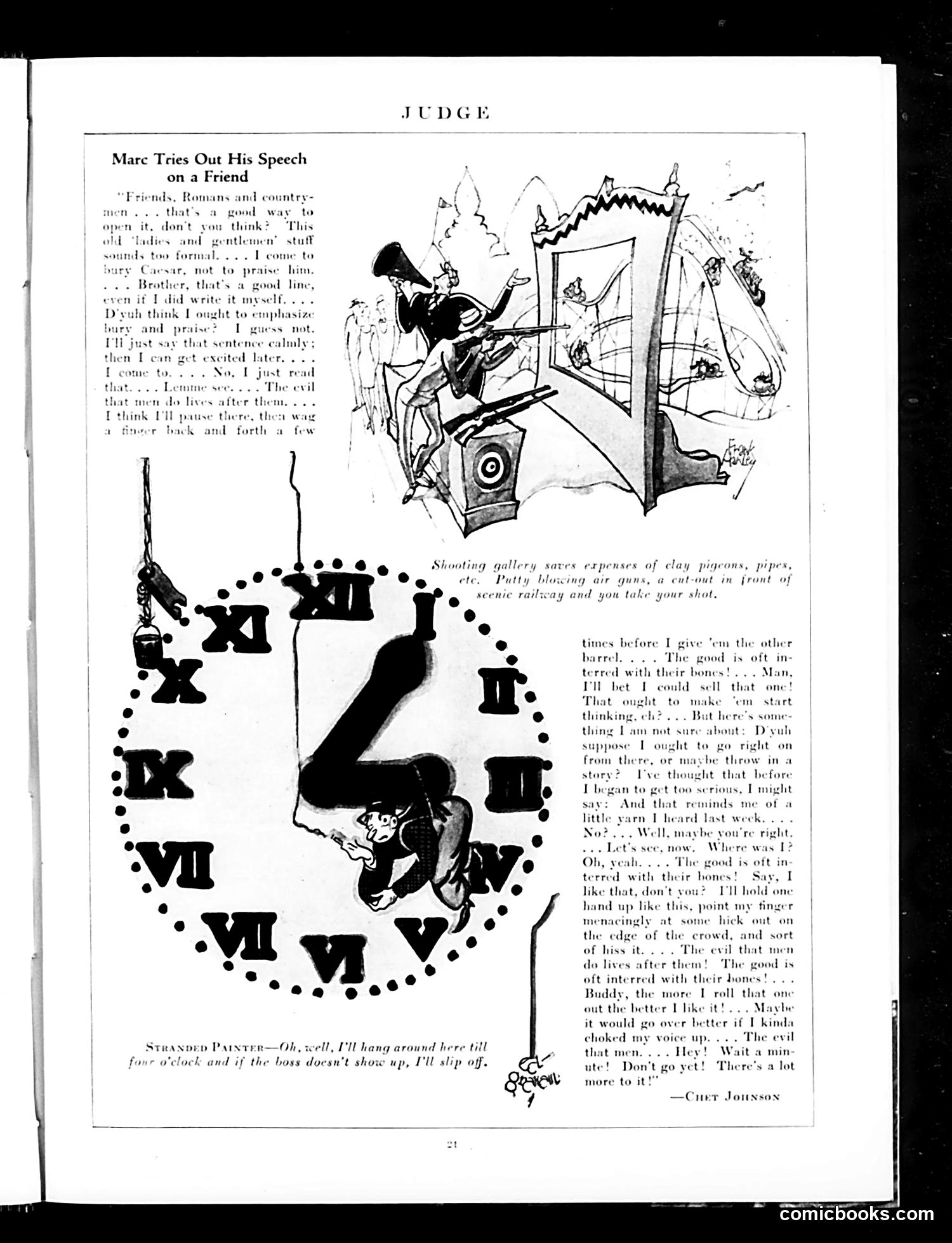
This page satirizes a performer (likely an actor named Marc) rehearsing Shakespeare's *Julius Caesar* funeral oration for a friend. The humor lies in Marc's anxious self-consciousness: he obsesses over delivery choices—whether to open formally, how to emphasize key lines, when to pause or gesture dramatically—while worrying he sounds too theatrical or artificial. The central clock illustration shows him hanging from it as a "stranded painter," a separate joke about someone stuck at work waiting for the boss. The satire targets pretentious amateur theatricality and overwrought Shakespearean performance—Marc treats this classic speech with such self-important deliberation that he becomes comic. The piece gently mocks both theatrical affectation and performers' insecurity about their choices, suggesting that excessive analysis kills natural delivery. The byline credits Chet Johnson as the author.
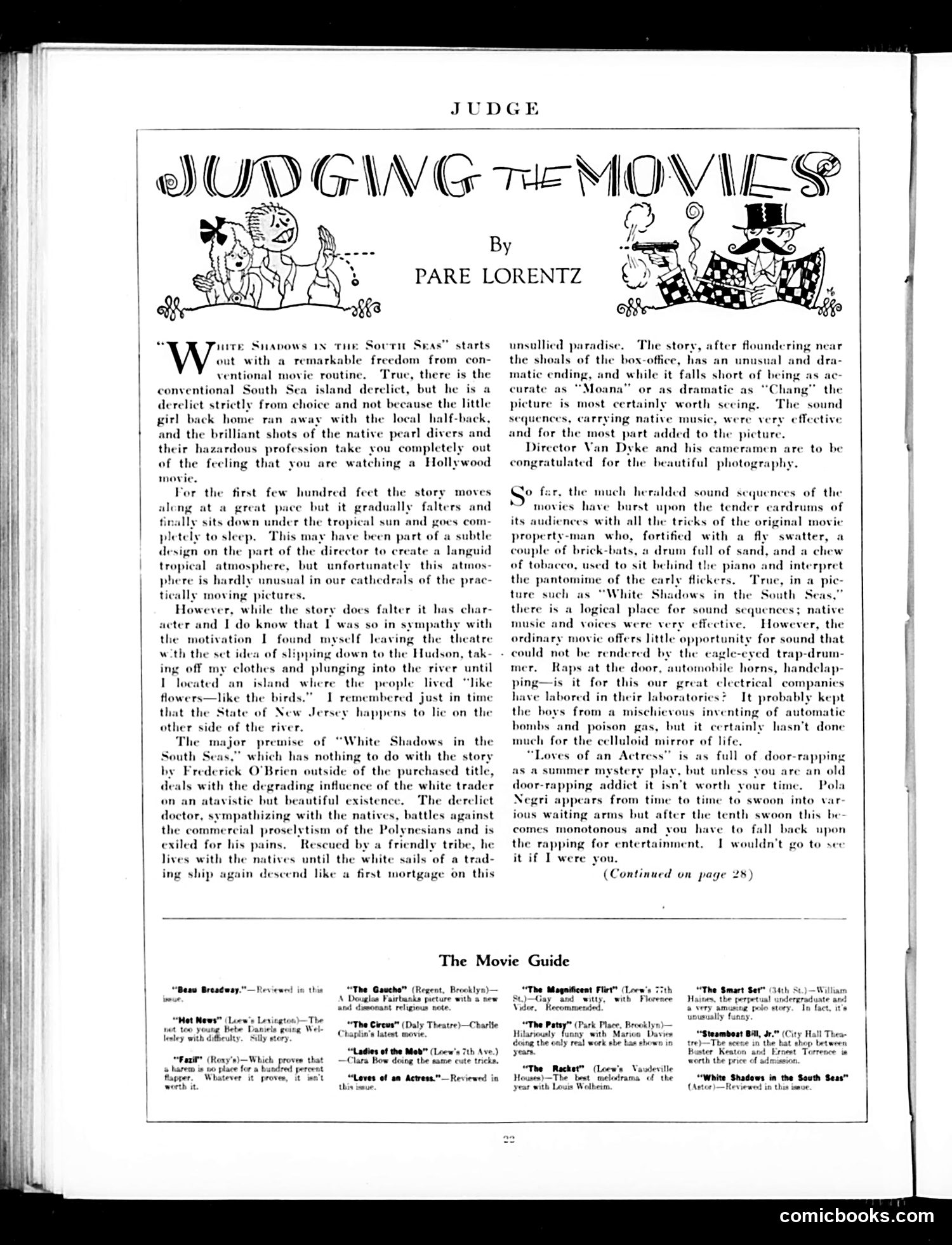
This is a film review column, not a political cartoon. Lorentz critiques "White Shadows in the South Seas," a 1928 silent film directed by W.S. Van Dyke. The review praises the film's cinematography and exotic subject matter—a white doctor living among Polynesians—but faults its pacing, saying it "gradually falters and finally sits down under the tropical sun." Lorentz is satirizing early sound film technology, mocking how sound effects (door-rapping, automobile horns) added by studios often disrupted narrative flow rather than enhancing it. He jokes that the electrical companies' laboratories invented "automatic bombs and poison gas" rather than improving cinema. The column includes brief reviews of other contemporary films like Charlie Chaplin's latest and Clara Bow pictures. The satire targets both filmmaking conventions and the emerging technical limitations of early talking pictures.
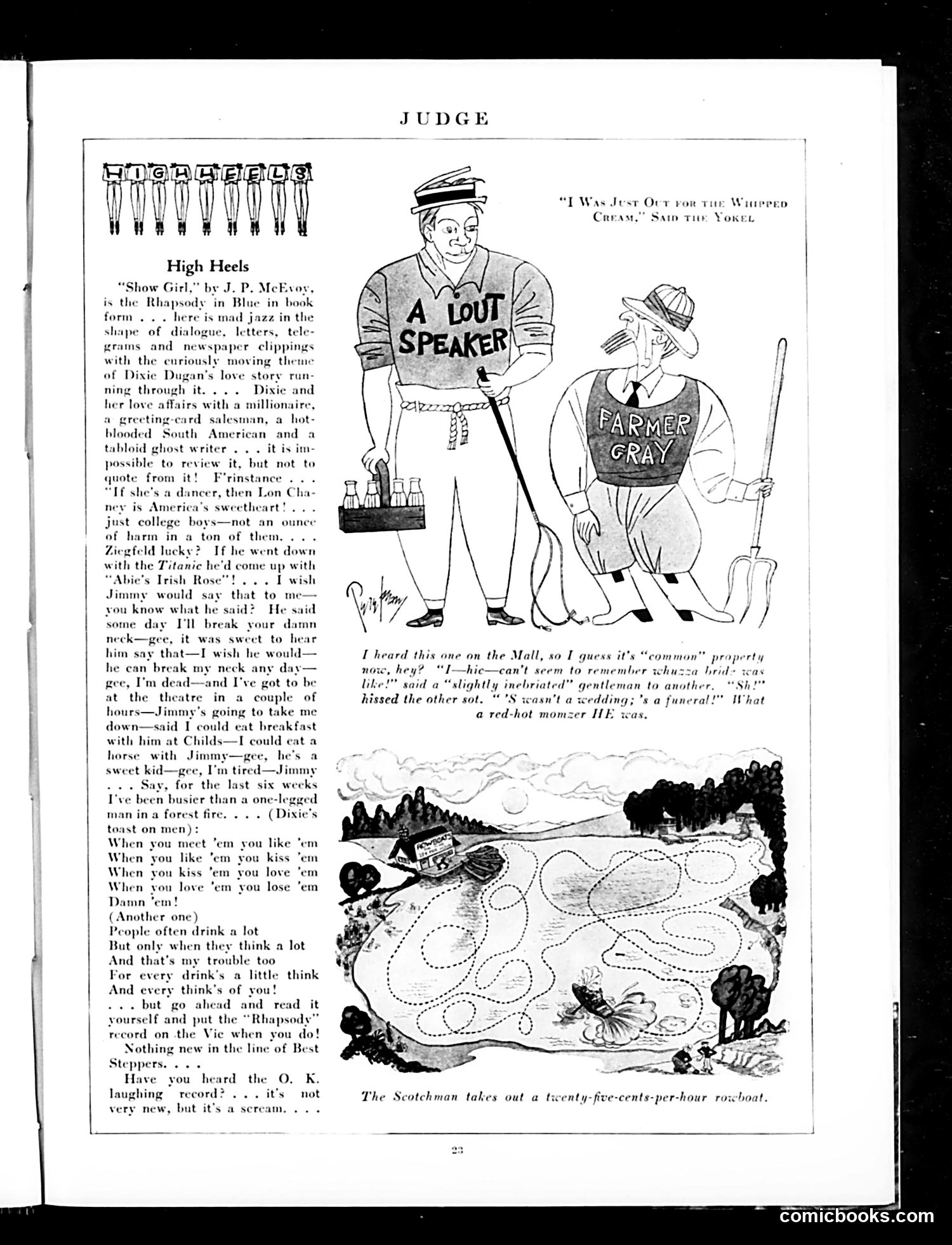
This page features **book and entertainment reviews** mixed with **humor pieces** typical of 1920s Judge magazine. The main cartoon depicts two figures—a "Loud Speaker" (a man in a megaphone-emblazoned shirt) and "Farmer Gray" (a rural character with pitchfork)—illustrating the urban-rural cultural divide of the era. The accompanying jokes mock the social pretensions and gossip of city life versus country simplicity. The "High Heels" section reviews J.P. McEvoy's "Show Girl," a jazz-age novel capturing 1920s urban bohemia through fragmented dialogue and tabloid sensibility. The quotes showcase flapper-era attitudes: cynical romance, theatrical ambition, and the fast-paced social scene. The bottom jokes reference contemporary cultural artifacts (O.K. laughing records, Victrola records) and use racial dialect humor ("whuzza") typical of the period's casual bigotry. The satire targets modern urban life's superficiality and excess while presenting rural characters as befuddled outsiders—reflecting Judge's satirical stance toward Jazz Age society.
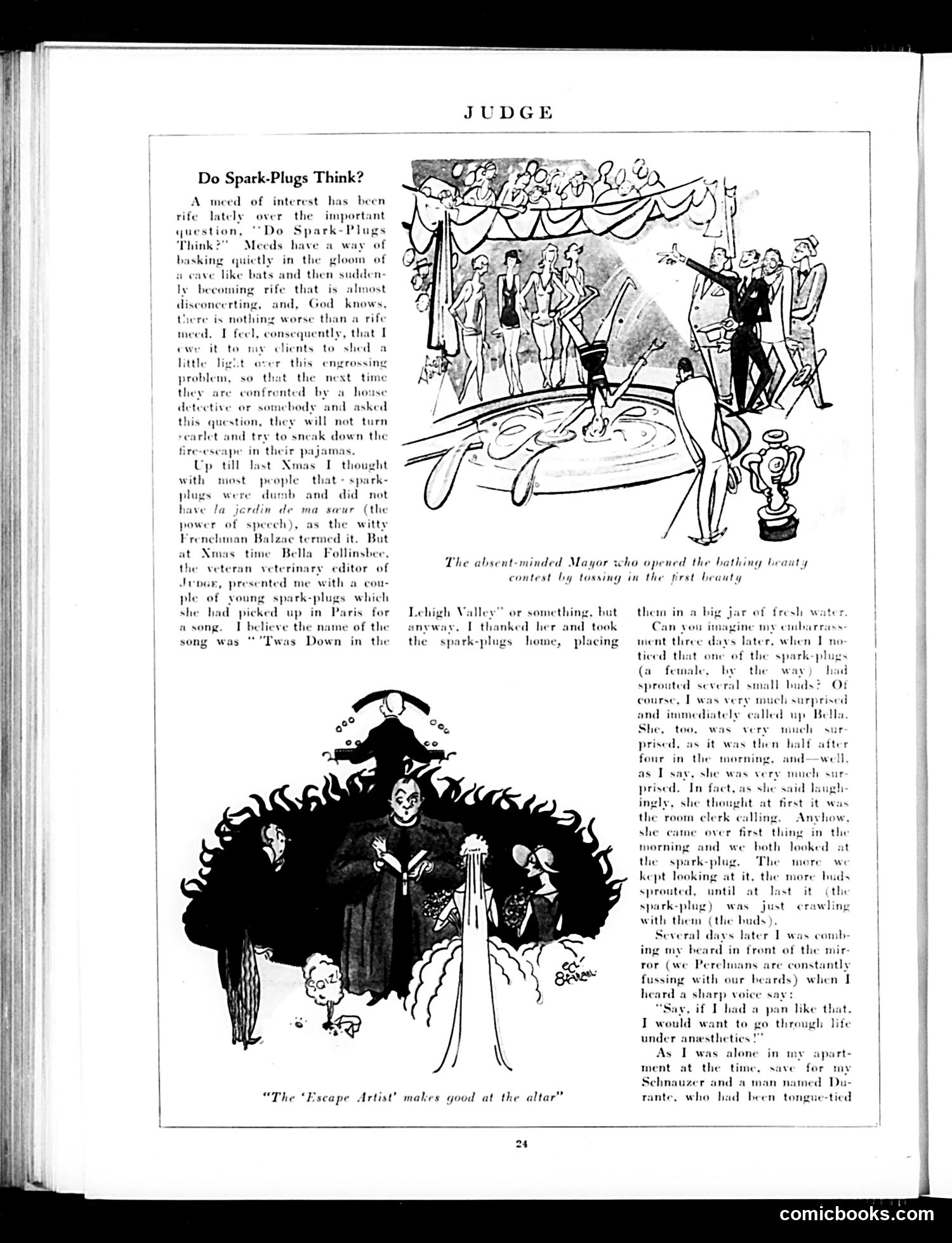
This page contains two satirical pieces: **"Do Spark-Plugs Think?"** is a humorous essay questioning whether automobile spark plugs possess intelligence. The author describes receiving spark plugs as Christmas gifts from "Bella Follinsbee, the veteran veterinary editor of Judge," and claims they sprouted buds and allegedly spoke to him. The piece is absurdist satire—the joke relies on treating mechanical car parts as if they were living creatures capable of thought and speech, mocking pseudo-intellectual debates of the era about animal consciousness. **The two cartoons** appear to be unrelated society humor: one depicts "The absent-minded Mayor" opening a bathing beauty contest by literally tossing a woman into water, and another shows "The 'Escape Artist' makes good at the altar"—likely commenting on marriage as an inescapable fate. The page exemplifies Judge's style: light, whimsical satire aimed at urban middle-class readers, blending wordplay with illustration. Without a specific date visible, the exact historical context remains unclear, though the automotive references suggest early-to-mid 20th century.
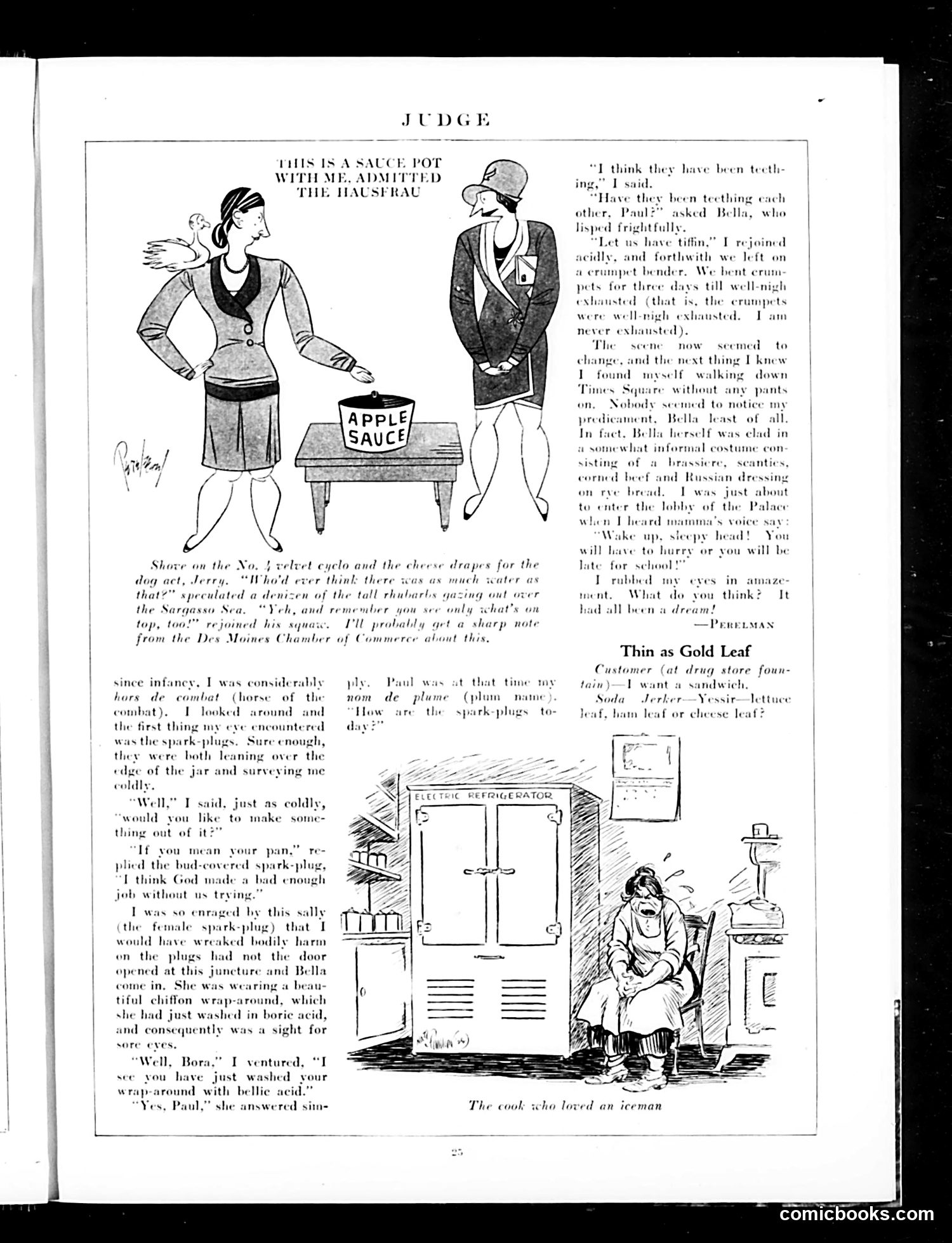
This Judge magazine page contains two separate pieces of satirical humor: **Top cartoon ("Sauce Pot"):** A woman (identified as a "Hausfrau"—German housewife) presents an apple sauce pot to a man. The satire appears to target either domestic stereotypes or possibly German-American relations (the Hausfrau reference suggests pre-WWI or interwar period). The accompanying text is a surreal, dream-sequence narrative mocking domestic life, complete with absurdist non-sequiturs (characters washed in boric acid, eating "corned beef and Russian dressing," walking pantless down Times Square). It's a parody of overwrought, melodramatic storytelling. **Bottom cartoon ("Thin as Gold Leaf"):** A customer at a soda fountain orders a sandwich. The soda jerk asks whether they want "lettuce leaf or cheese leaf?"—a pun exploiting the homophone "leaf/leaf" and mocking the thinness of both ingredients, suggesting meager portions or cheap quality. Both pieces employ wordplay and absurdism typical of 1920s-era humor magazines.
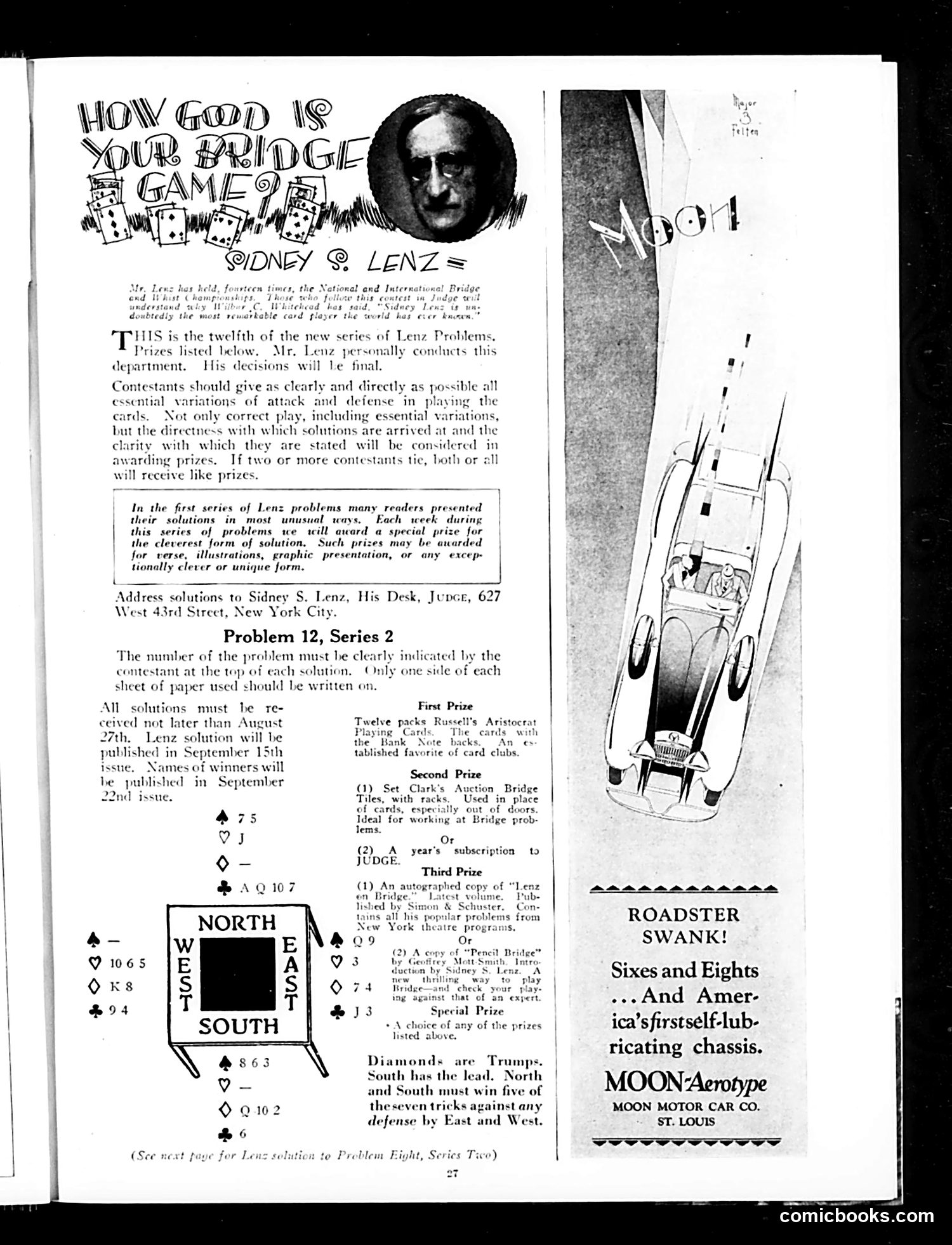
This page is primarily **advertising and a bridge card game puzzle**, not political satire. The main content features "Problem 12, Series 2" of the **Lenz Problems**—a bridge card game competition conducted by Sidney S. Lenz, a famous bridge expert. The puzzle shows a bridge hand and asks contestants to solve it, with prizes ranging from playing cards to a Judge magazine subscription to an autographed bridge book. The accompanying portrait and greeting "How Good Is Your Bridge Game?" introduce Lenz as the puzzle's authority. The page includes two advertisements: one for **Clark's Auction Bridge Tiles** and another for **Moon Aerotype**, a self-lubricating automobile chassis made by Moon Motor Car Company of St. Louis. This reflects Judge's audience: educated readers interested in card games and automobiles—typical leisure pursuits for the magazine's middle- to upper-class readership.
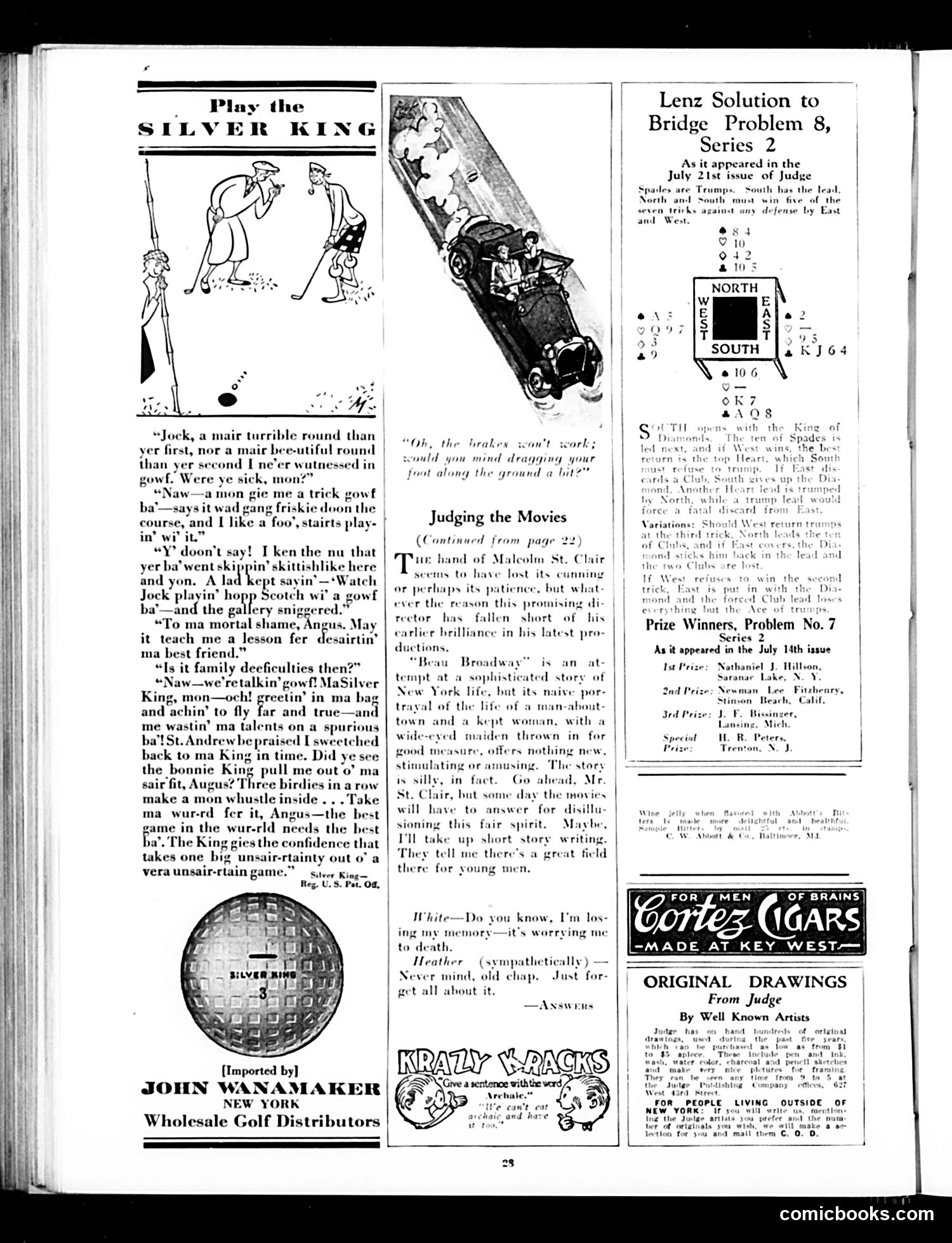
This page contains primarily **golf humor and bridge game solutions** rather than political satire. **"Play the Silver King"** is a Scottish dialect golf joke featuring characters debating a golfer's performance. The humor turns on tension between the golfer's poor technique ("a mair turrible round") and his unexpected success, with the punchline suggesting confidence matters more than skill—"The King gies the confidence that takes one big unsair-rtainty out o' a vera unsair-rtain game." The page also includes a **bridge problem solution** (card game), film reviews of "Beau Broadway," and prize announcements for problem solvers. The remaining content is **advertising**—for John Wanamaker golf supplies, Cortez cigars, and Judge magazine's original artwork offerings. This appears to be a typical mid-1920s Judge page mixing light humor, games/puzzles, and commercial ads rather than pointed political or social commentary.
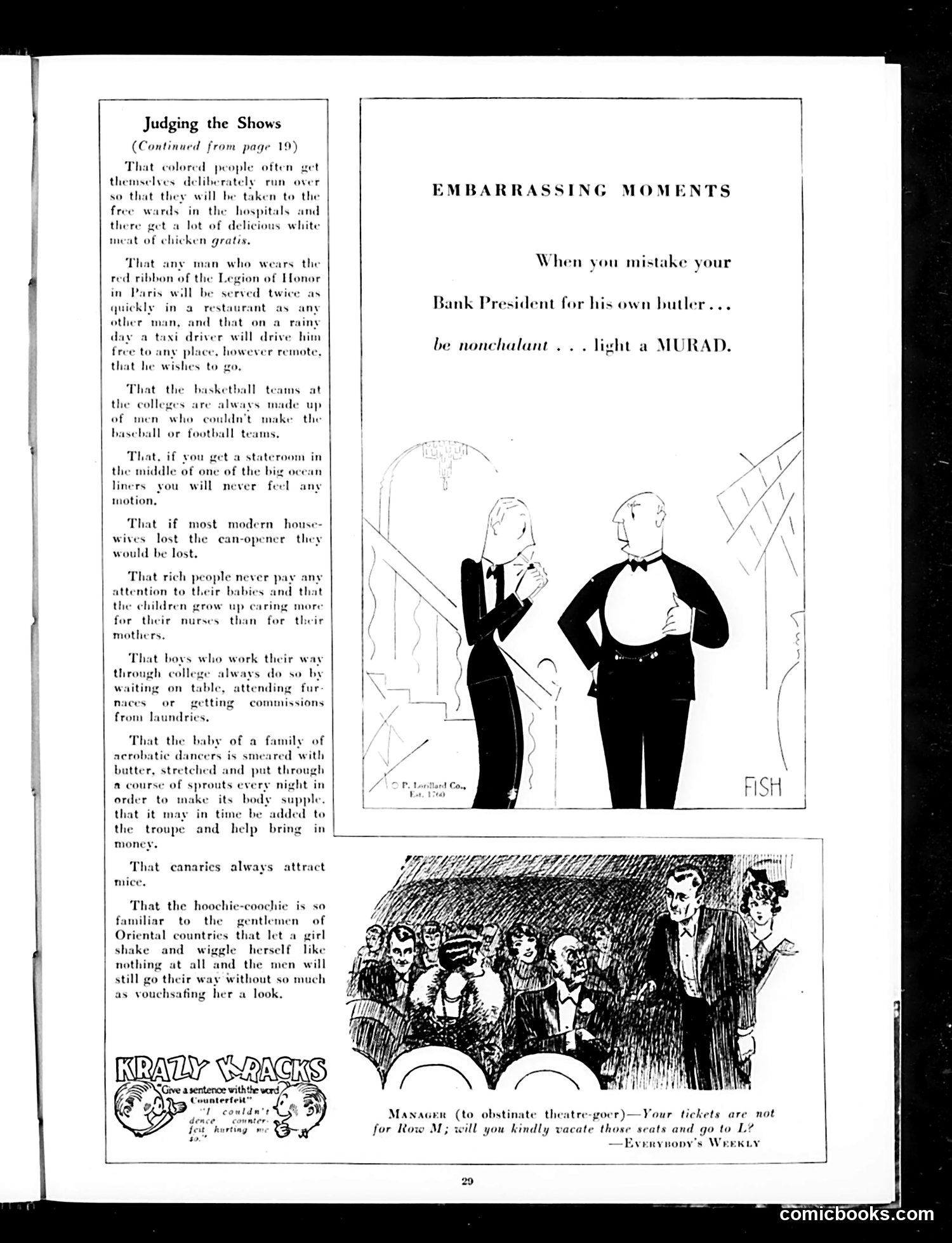
This page contains two main cartoon features: **"Embarrassing Moments"** (top): An advertisement-styled comic showing a man mistaking his bank president for a butler. The joke plays on social embarrassment—the solution being to "light a MURAD" (a cigarette brand), implying smoking provides composure in awkward situations. This reflects early 20th-century advertising that used social anxiety to sell products. **Theater Manager Cartoon** (bottom): A manager tells an obstinate theatergoer their tickets are for Row M, not L, and demands they vacate and move. The humor derives from the manager's blunt rudeness and the patron's apparent stubbornness—typical of vaudeville-era theater disputes. **Left column** ("Judging the Shows"): Social observations and stereotypes about various groups—bankers, dancers, rich people, immigrants—reflecting period prejudices about class, race, and occupation. These are cynical "that's how things really are" quips typical of satirical magazines. The overall tone is satirical commentary on American social conventions and class dynamics of the era.
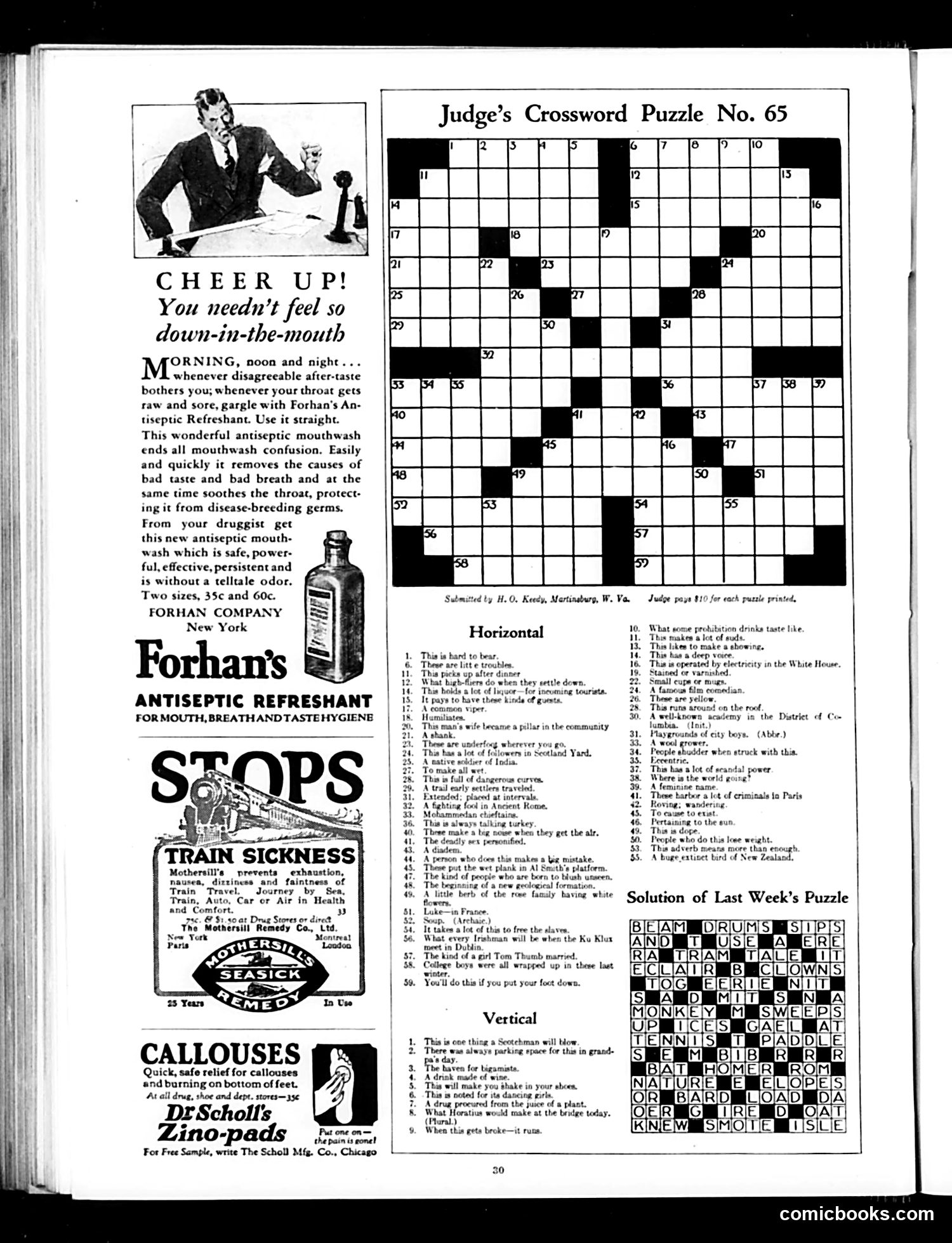
This page is primarily **advertising**, not satirical content. The dominant features are commercial advertisements for patent medicines and health products popular in the early 20th century: **Forhan's Antiseptic Refreshant** (mouthwash) — the largest ad, using the "Cheer Up!" headline to pitch oral hygiene as a cure for bad breath and sore throats. **Mothersill's** (motion sickness remedy) and **Dr. Scholl's Zino-pads** (callous treatment) — additional health product pitches. The page also includes **Judge's Crossword Puzzle No. 65** with clues submitted by H.O. Keedy of Martinsburg, West Virginia, plus the previous week's solution. There is no political satire or cartoon on this page. The small illustration at top left appears decorative rather than satirical — simply showing a man at a desk, matching the "Cheer Up" theme. This is a typical magazine interior page mixing entertainment (puzzle) with revenue-generating advertisements for remedies now considered dubious.
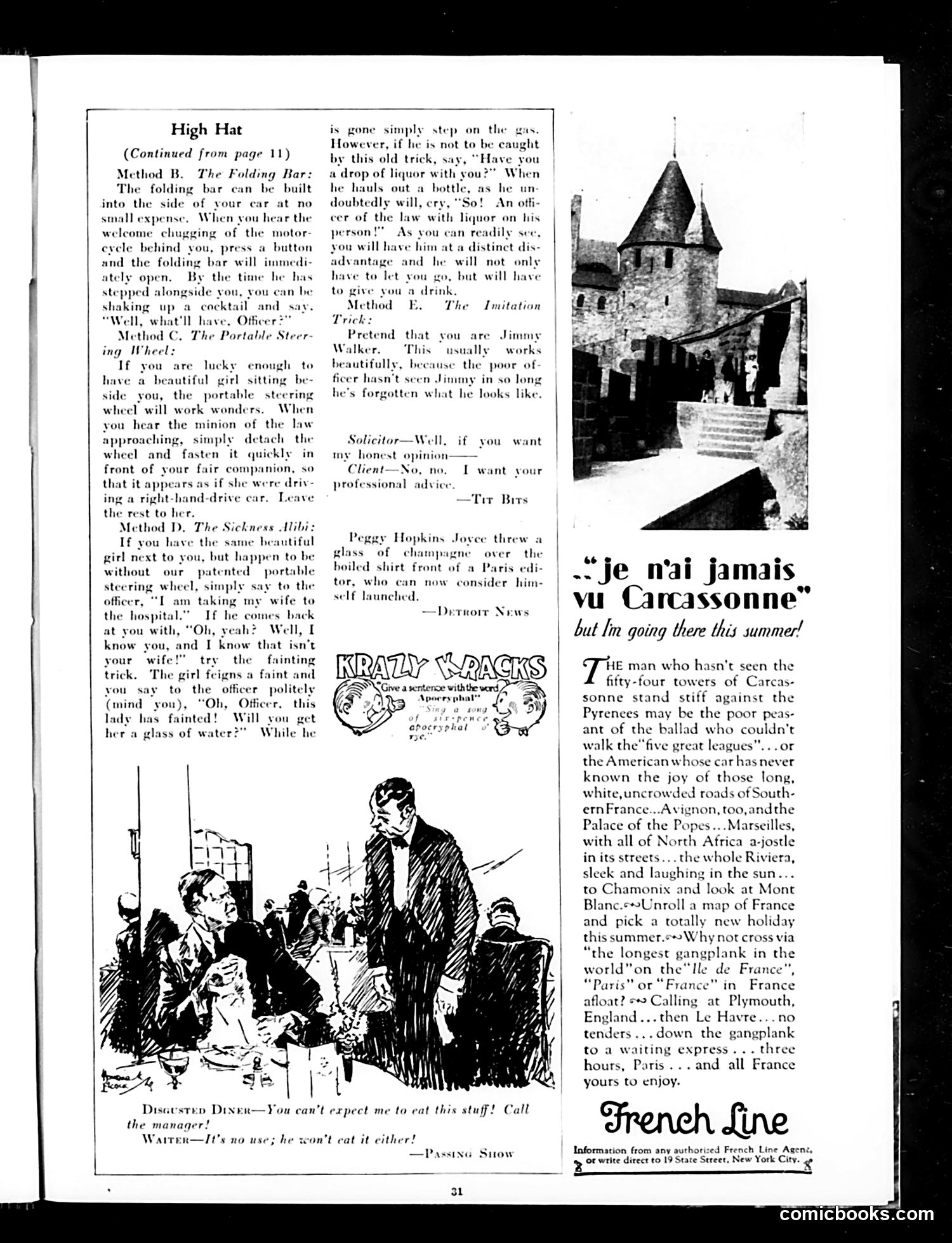
This page consists primarily of **satirical "how-to" advice for evading police during Prohibition**. The "High Hat" column presents five tongue-in-cheek methods for drivers to avoid arrest when stopped by law enforcement: - Hidden bars in cars - Portable steering wheels to shift blame to female passengers - False medical emergencies - Impersonating Jimmy Walker (NYC's famously corrupt mayor known for ignoring Prohibition violations) The humor relies on readers' familiarity with widespread bootlegging and police bribery during the 1920s-early 1930s. Method E's reference to Walker suggests the satirist is mocking both criminal evasion tactics and official corruption. The page also includes minor items: a quip about actress Peggy Hopkins Joyce, a restaurant joke, and a **French Line shipping advertisement** promoting summer travel to Carcassonne and the French Riviera—offering an escape from America's restrictive Prohibition environment.
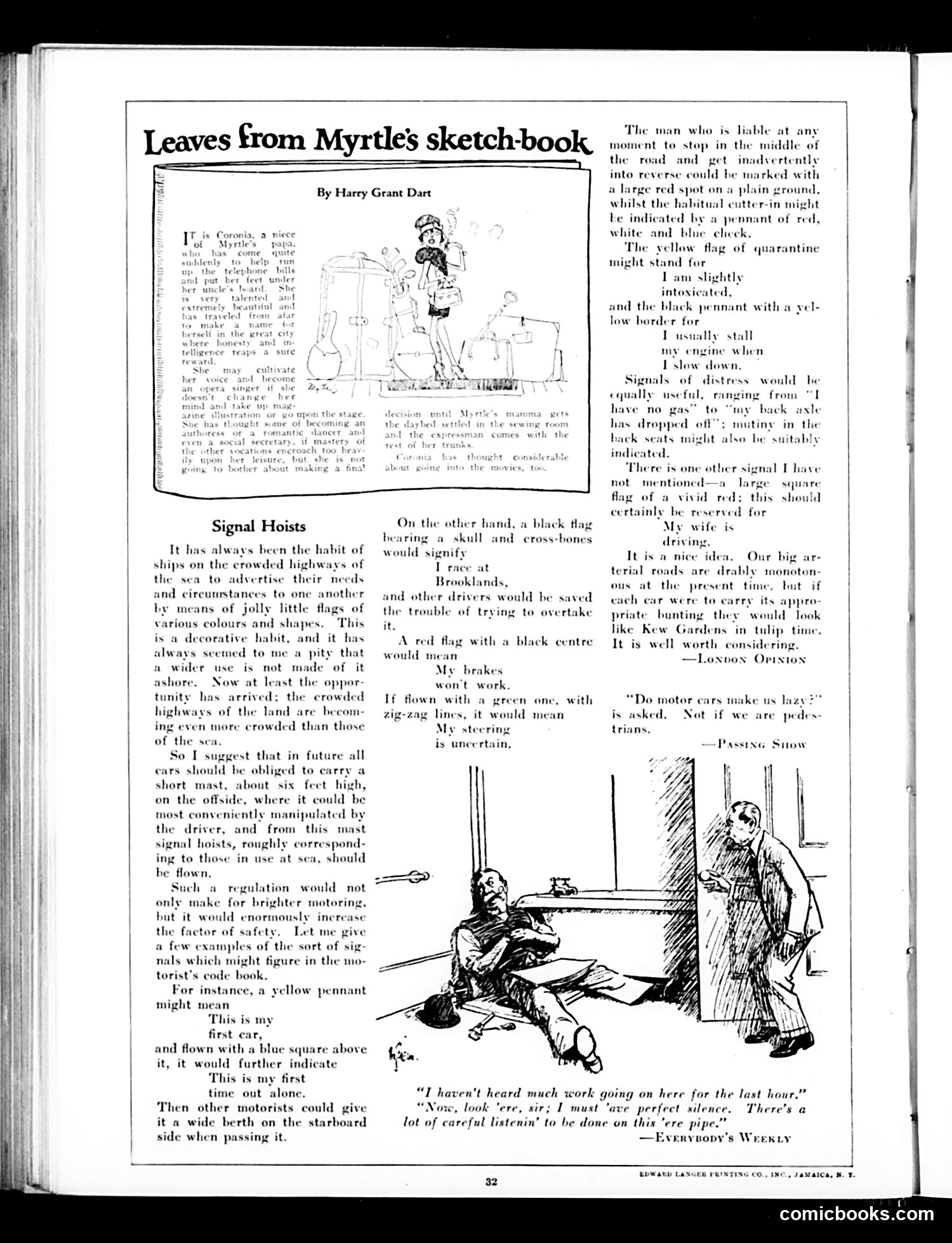
This piece by Harry Grant Dart proposes a humorous solution to dangerous driving on crowded roads: mandatory signal flags on automobiles, modeled after maritime signaling systems. **The Satire:** Dart satirizes both reckless drivers and the era's traffic chaos by suggesting absurd flag codes that would frankly advertise dangerous conditions—"My brakes won't work," "I am slightly intoxicated," "My steering is uncertain." The joke is that drivers would openly display their incompetence rather than hide it. **Key References:** - Early motorist stereotypes (inexperienced drivers, racing enthusiasts, drunkards) - The contrast between orderly naval traditions and chaotic street traffic - A wife's driving, marked with a vivid red flag—playing on contemporary anxieties about women drivers **The Point:** This mocks both the increasing automobile congestion of the era and driver behavior, suggesting that if drivers were honest about their dangerous habits, perhaps safety would improve. It's social commentary disguised as practical proposal, typical of Judge magazine's satirical approach to modern problems.
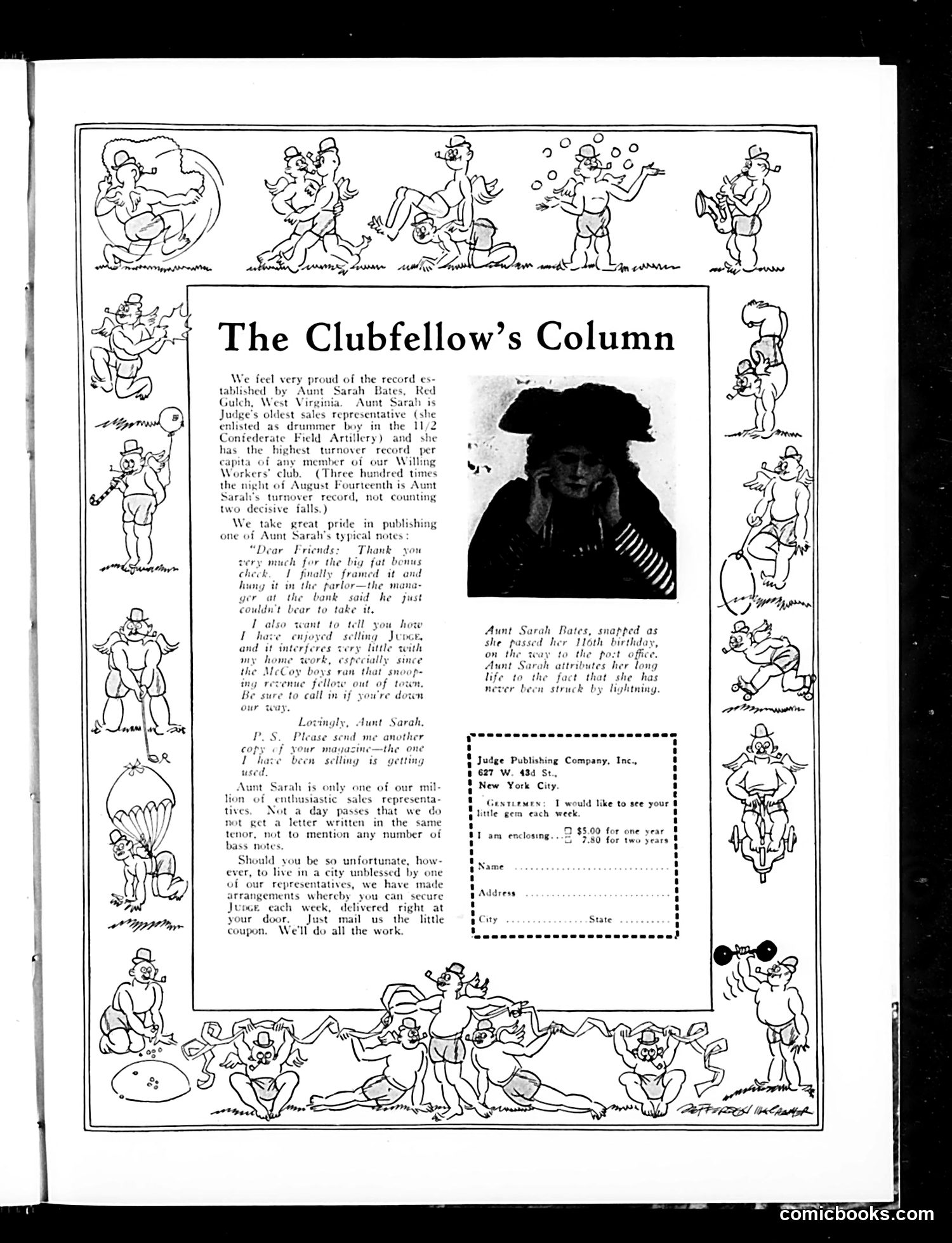
This page features a humorous column celebrating "Aunt Sarah," Judge magazine's sales representative in Gulch, West Virginia. The satire centers on her extraordinary sales record—she achieved 300 turnovers on August 14th alone (plus "two decisive falls"), making her the top performer per capita in the magazine's sales organization. The joke plays on Aunt Sarah's apparent physical robustness and aggressive salesmanship. The borderline illustrations of rotund figures engaged in various activities reinforce the comedic characterization. Her note to management, written in folksy dialect, humorously describes framing an oversized check so large the bank teller "couldn't bear to take it"—exaggerating her success to absurd levels. The column essentially advertises Judge magazine's sales program while poking fun at both Aunt Sarah and the earnest corporate enthusiasm surrounding sales metrics. The "turnover" phrasing may also carry double meaning given her physical description in the illustrations.
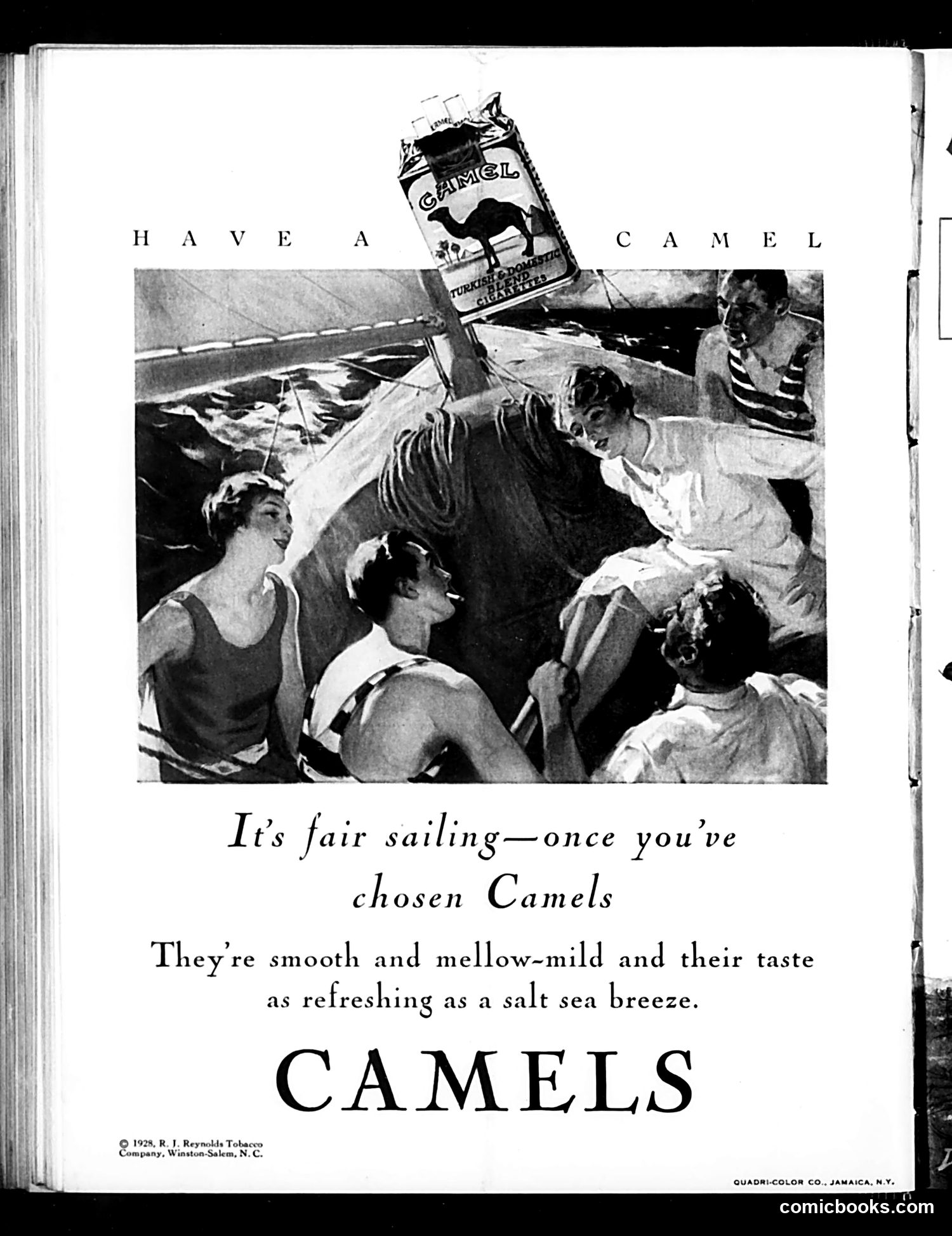
This is a **cigarette advertisement, not political satire**. The page features a photograph of people on a sailboat enjoying themselves, with the headline "It's fair sailing—once you've chosen Camels." The ad uses leisure and pleasure associations to market cigarettes—a common advertising strategy in the 1920s (dated 1928 by the copyright). The claim that Camels are "smooth and mellow-mild" and taste like "a salt sea breeze" employs typical advertising language linking the product to enjoyable experiences. This represents a historical marketing approach now considered unethical: promoting cigarettes without health warnings and using aspirational imagery to encourage consumption. The page demonstrates how Judge magazine mixed editorial content with advertising revenue.