
Judge, 1928-08-18 · page 15 of 36
Judge — August 18, 1928 — page 15: what you’re looking at
What you’re looking at
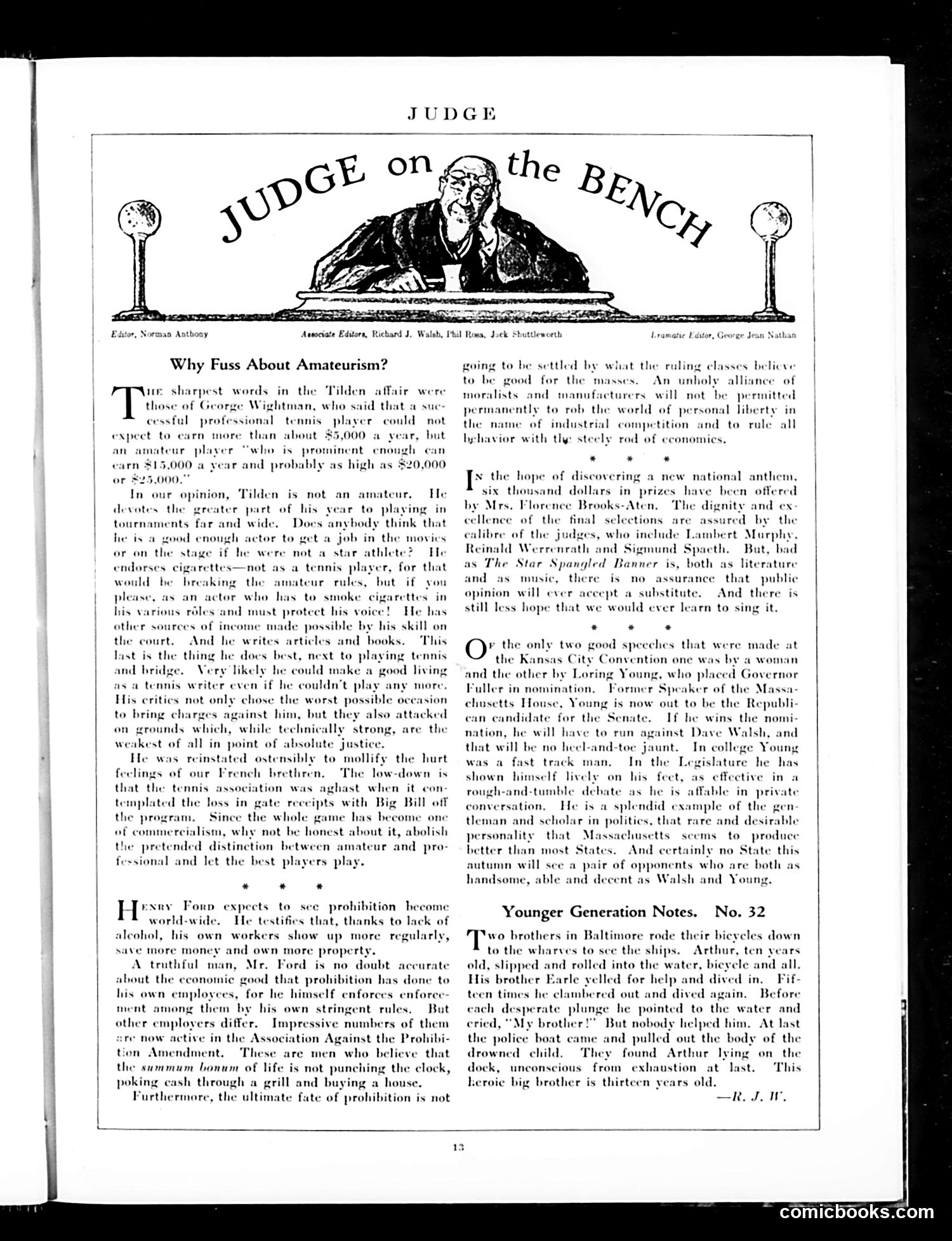
This page contains social commentary rather than traditional political cartoons. The "Judge on the Bench" masthead frames three satirical essays: **"Why Fuss About Amateurism?"** critiques the hypocrisy surrounding tennis player Bill Tilden. The piece argues that if Tilden can earn money as an actor, writer, and cigarette endorser while remaining "amateur," the distinction between amateur and professional athletes is meaningless. Judge sarcastically suggests abolishing pretense and letting all players be paid openly—attacking what it sees as commercialism masquerading as amateurism. **The Prohibition essay** discusses Henry Ford's support for alcohol prohibition, noting his workers' improved behavior and savings. Judge dismisses this as self-serving: an "unholy alliance of moralists and manufacturers" using prohibition to control workers' personal freedom and behavior under the guise of moral reform. **Remaining brief items** address a national anthem competition and political candidates, maintaining the magazine's satirical tone throughout.
📄 Transcribed text from this page (OCR, searchable)
Machine-transcribed from the original scan — historical spelling and the odd misread are preserved.
JUDGE Why Fuss About Amateurism? Th sharpest words in the Tilden affair were those of George Wightman, who said that a suc cessful professional tennis player could not expect to earn more than a $ r, but an amateur player “who is prominent enough can earn $15,000 a year and probably as high as $20,000 or 25,000." ilden is not an ur, He devotes the greater part of his year to playing in tournaments far and wide, Does anybody think that he isa xd enough actor to or on the stage if he were not a star athlete? In our opinion, ta job in the movies He endorses cigarettes—not as a tennis player, for that would be breaking the amateur rules, but if) you n actor who has to sme his various r rrettes in sand must protect his voice! He has other sources of income made possible by his skill on the court. And he writes articles and books. This last is the thing he docs best, next to playing tennis and bric Very likely he could make a good living asa tennis writer even if he couldn't play any more, His critics not onl chose the worst possible gainst him, but they also attacked on grounds which, while technically strong, are the weakest of all in point of absolute justice. He was reinstated ostensibly to mollify the hurt feelings of our French brethren. The low-down. is that the tennis assoc tsion to bring el tion was aghast when it templated the loss in gate receipts with I Bill the program. Since the whole game has become one of commercialism, why not honest about it, abolish the pretended distinction between amateur and pro- fessional and let the best players play. * * * Hs Forp expects to see prohibition become world-wide. He testifies that, thanks to 1 of alcohol, his own workers show up more regularly, save more money and own more property. A truthful man, Mr. Ford is no doubt about the economic good that prohibition has done to his own employees, for he himself enforces enforcer ment among them by his own stringent rules, But other employers differ. Impressive numbers of them are now active in the Association Against the Prohibi- tion Amendment. These are men who believe that the summum bonum of life is not punching the clock, poking cash through a grill and buying a house. Furthermore, the ultimate fate of prohibitic ‘urate going to be settled by what the raling classes believe to be good for the masses. An unholy alliance of moralists and manufacturers will net be permitted permanently to rob the world of personal liberty in the name of industrial competition and to rule all hehavior with tly steely rod of cconomies. * * * Is the hope of discovering a new national anthem, six thousand dollars in prizes have been offered by Mrs. Florence Brooks-Aten. The dignity and ex cellence of the final selections are assured by the calibre of the judges, who include Lambert Murphy. Reinald Werrenrath and Sigmund Spaeth. But, b as The Star Spangled Banner is, both as literature nd as music, there is no assurance that public opinion will ever accept a substitute. And there is still less hope that we would ever learn to sing it. * . * O' the only two good speeches that were made at the Kansas City Convention one w and the other by Loring Young, who placed Governor Fuller in nomination, Former Speaker of the Massa- chusetts House, Young is now out to be the Republi- can candidate for the Sen: If he wins the nomi- he will have to run against Dave Walsh, and that will be no heel-and-toe jaunt. In coll puns was a fast track man, In the gislature he has shown himself lively on his feet, as effective in a s by a woman rough-and-tumble debate as he is affable in private conversation, He is a splendid example of the gen tleman and scholar in polities, that rare and desirable personality that) Massachusetts seems to produce tter than most States. And certainly no State this autumn will sce a pair of opponents who are both as handsome, able « nt as Walsh and Young. Younger Generation Notes. No. 32 Tro brothers in Baltimore rode their bicycles down to the wharves to sce the ships. Arthur, ten years old, slipped and rolled into the water, bicycle and all. His brother Earle yelled for help and di : teen times he clambered out and dived 4 Before +h desperate plunge he pointed to the water and cried, “My brother!” But nobody helped him, At last the police boat came and pulled out the body of the drowned child. They found Arthur lying on the dock, unconscious from exhaustion at last. This heroic big brother is thirteen years old. RIL, comicbooks.com