
A complete issue · 36 pages · 1928
Judge — July 28, 1928
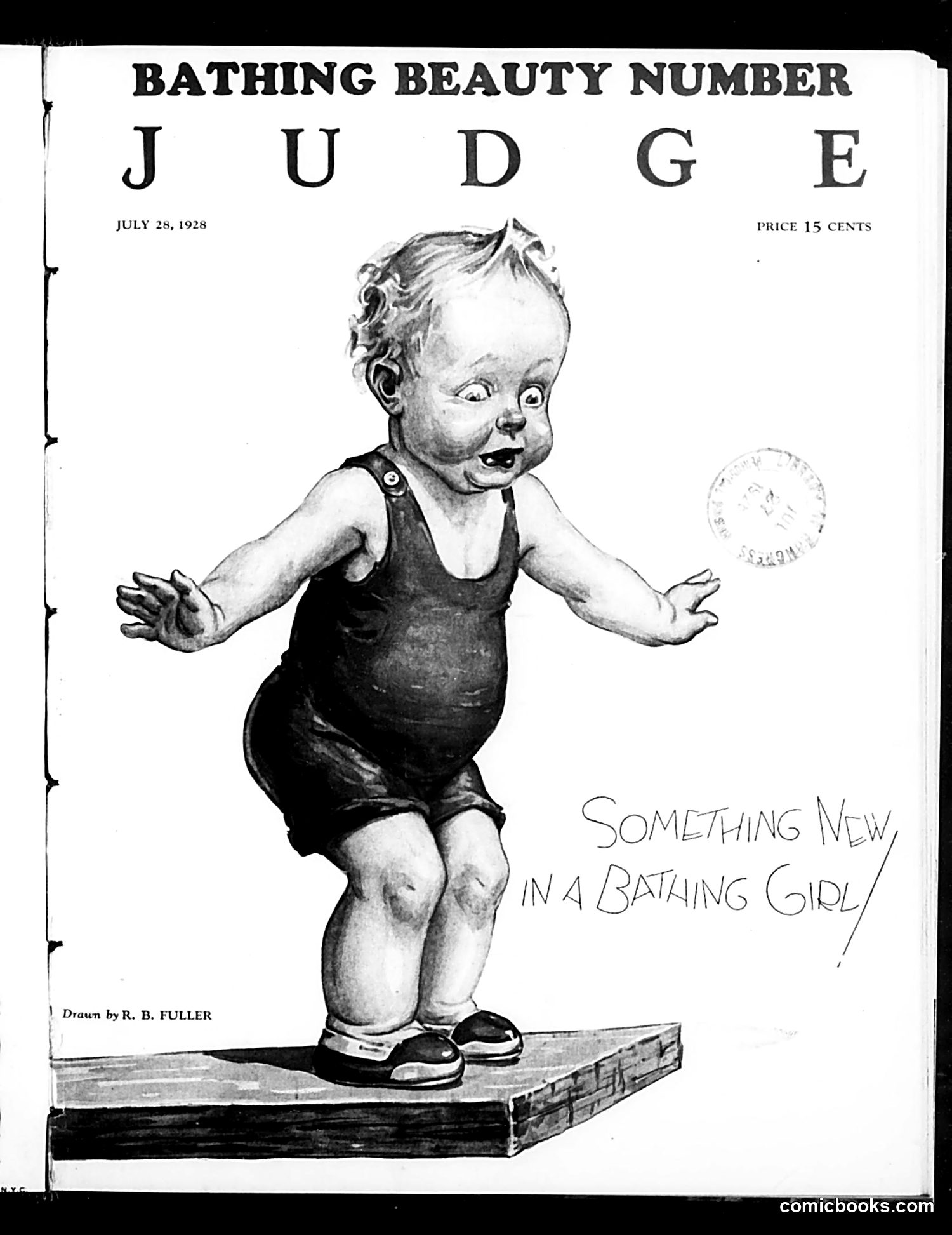
This is the cover of Judge magazine's "Bathing Beauty Number" from July 28, 1928, priced at 15 cents. The illustration, drawn by R.B. Fuller, depicts a toddler in a one-piece bathing suit standing on a diving board with arms outstretched, appearing delighted or surprised. The tagline reads "Something New in a Bathing Girl!" The satire plays on the magazine's focus on "bathing beauties"—a popular 1920s entertainment and magazine feature celebrating women in swimwear. By substituting an infant for the typical adult female subject, the cover creates absurdist humor, subverting reader expectations. This appears to be a lighthearted joke rather than commentary on any specific social or political issue, simply capitalizing on the era's fascination with bathing suit imagery through unexpected substitution.
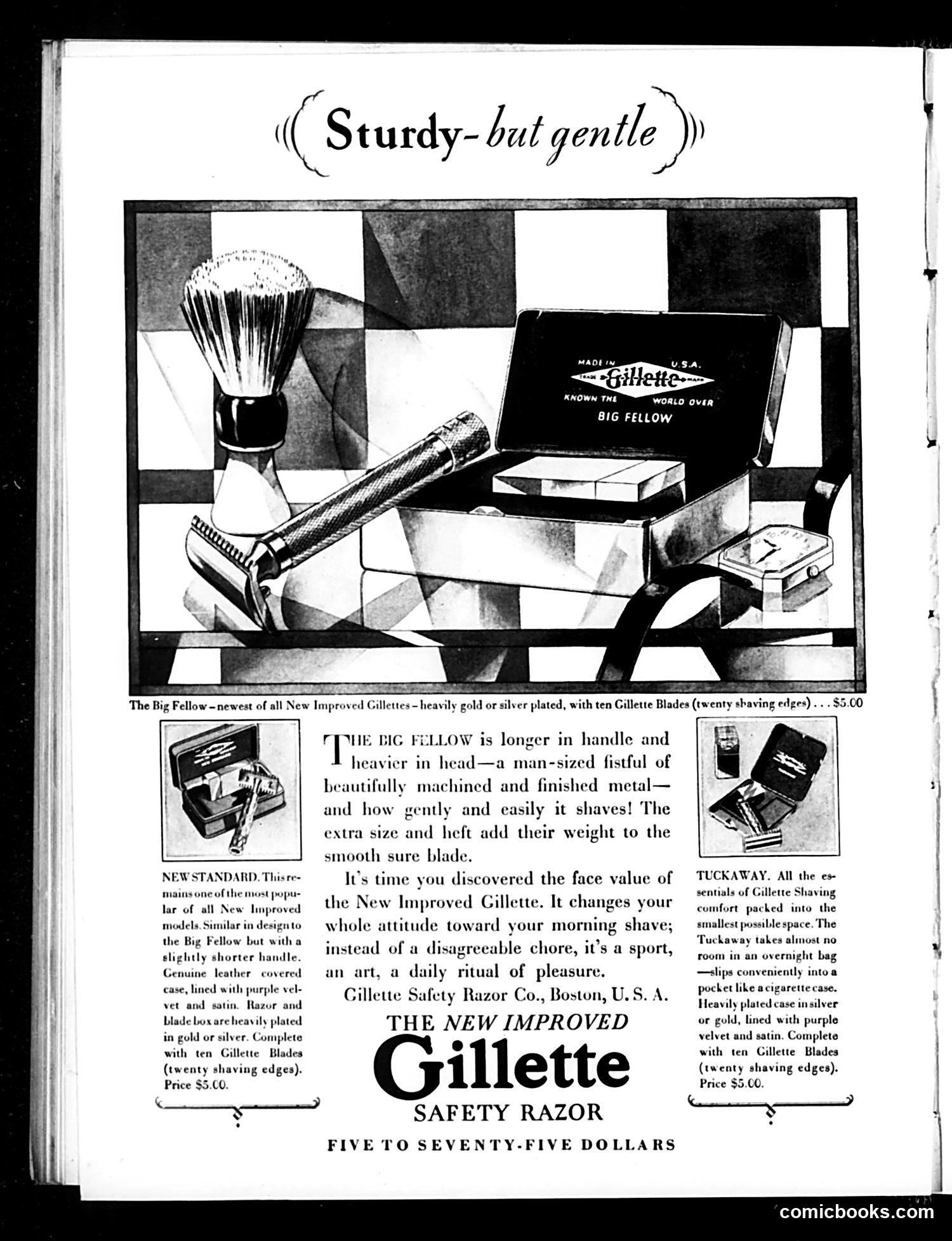
This page is **primarily a Gillette Safety Razor advertisement**, not political satire. The heading "Sturdy—but gentle" frames product marketing rather than social commentary. The ad showcases three Gillette razor models ("The Big Fellow," "New Standard," and "Tuckaway") displayed with shaving brushes and cases. The tagline emphasizes that quality shaving transforms a "disagreeable chore" into "a sport, an art, a daily ritual of pleasure." The illustration style and layout are typical early-20th-century advertising, using visual appeal and product detail rather than satirical commentary. While *Judge* magazine typically contained political cartoons, this particular page functions as straight consumer advertising, leveraging the magazine's readership to promote luxury grooming products at premium prices ($5–$75).
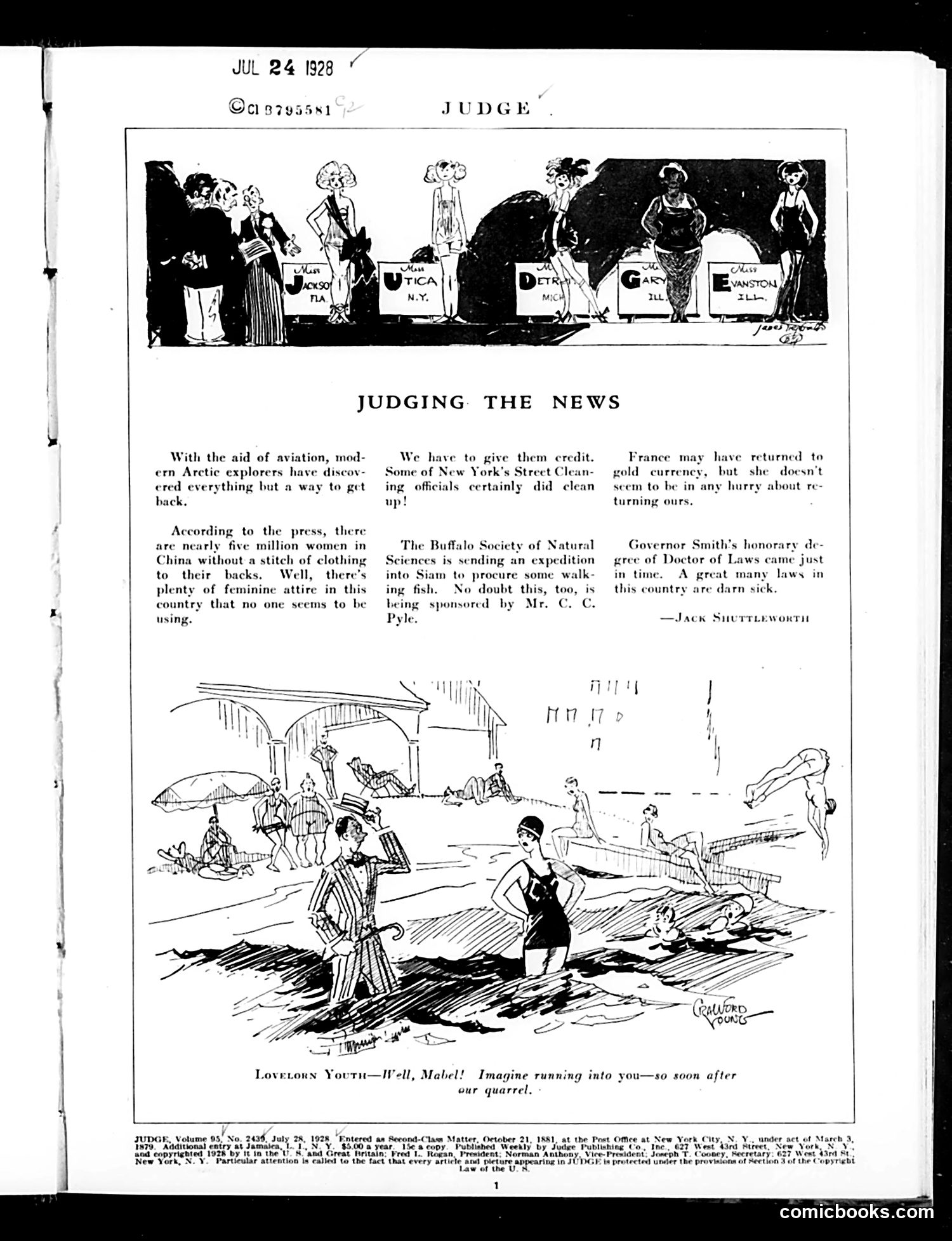
The top cartoon depicts a beauty pageant judging scene, with signs identifying cities (appearing to show contestants from different American locations competing). The main cartoon below satirizes the social anxieties of the 1920s. It shows a fashionably dressed woman at a beach encountering a young man in a bathing suit. The caption reads: "Lovelorn Youth—Well, Mabel! Imagine running into you—so soon after our quarrel." The joke reflects contemporary concerns about changing morality and unchaperoned youth interaction. The "lovelorn" framing suggests romantic melodrama, while the beach setting (where modern bathing attire exposed more skin than previous generations) represents the sexual liberation anxieties of the Jazz Age. The coincidental "chance" meeting appears staged—satirizing both young romance and social propriety debates of the era.
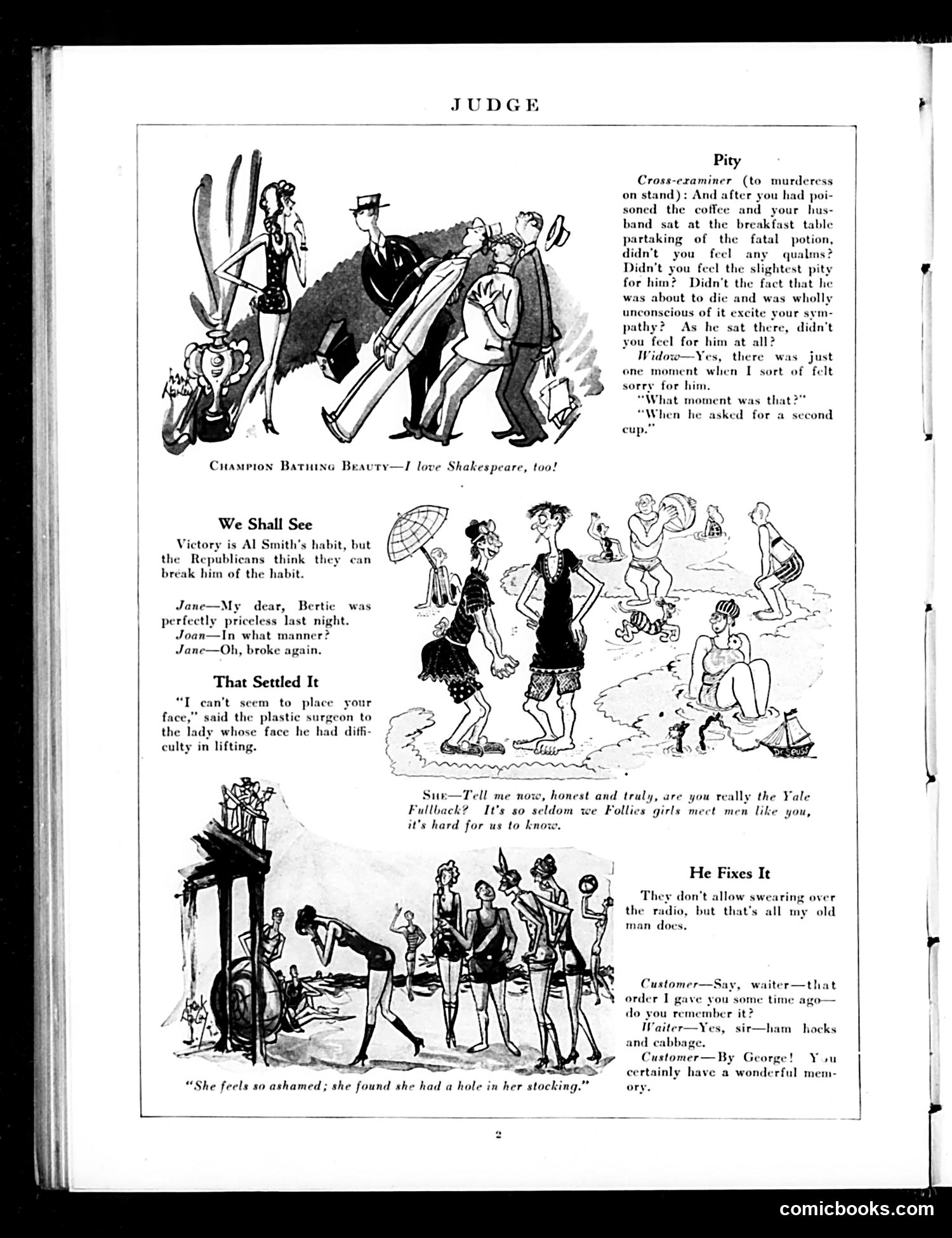
This page contains several unrelated humor sketches typical of Judge magazine's format: **"Champion Bathing Beauty"** mocks a beauty pageant contestant who claims to love Shakespeare while appearing vapid. **"We Shall See"** appears to reference 1920s political competition, mentioning Al Smith (likely the Democratic candidate) and Republicans trying to "break him of the habit" of victory. **"That Settled It"** presents a domestic humor sketch about mistaken identity. **"He Fixes It"** depicts a waiter recalling a customer's previous order (ham hocks and cabbage) with humorous precision. The sketches employ common Jazz Age humor: satirizing beauty culture, domestic squabbles, and working-class characters. Without clearer dates or captions, specific political references remain unclear, but the overall tone reflects 1920s American satirical humor targeting contemporary social pretension and gender dynamics.
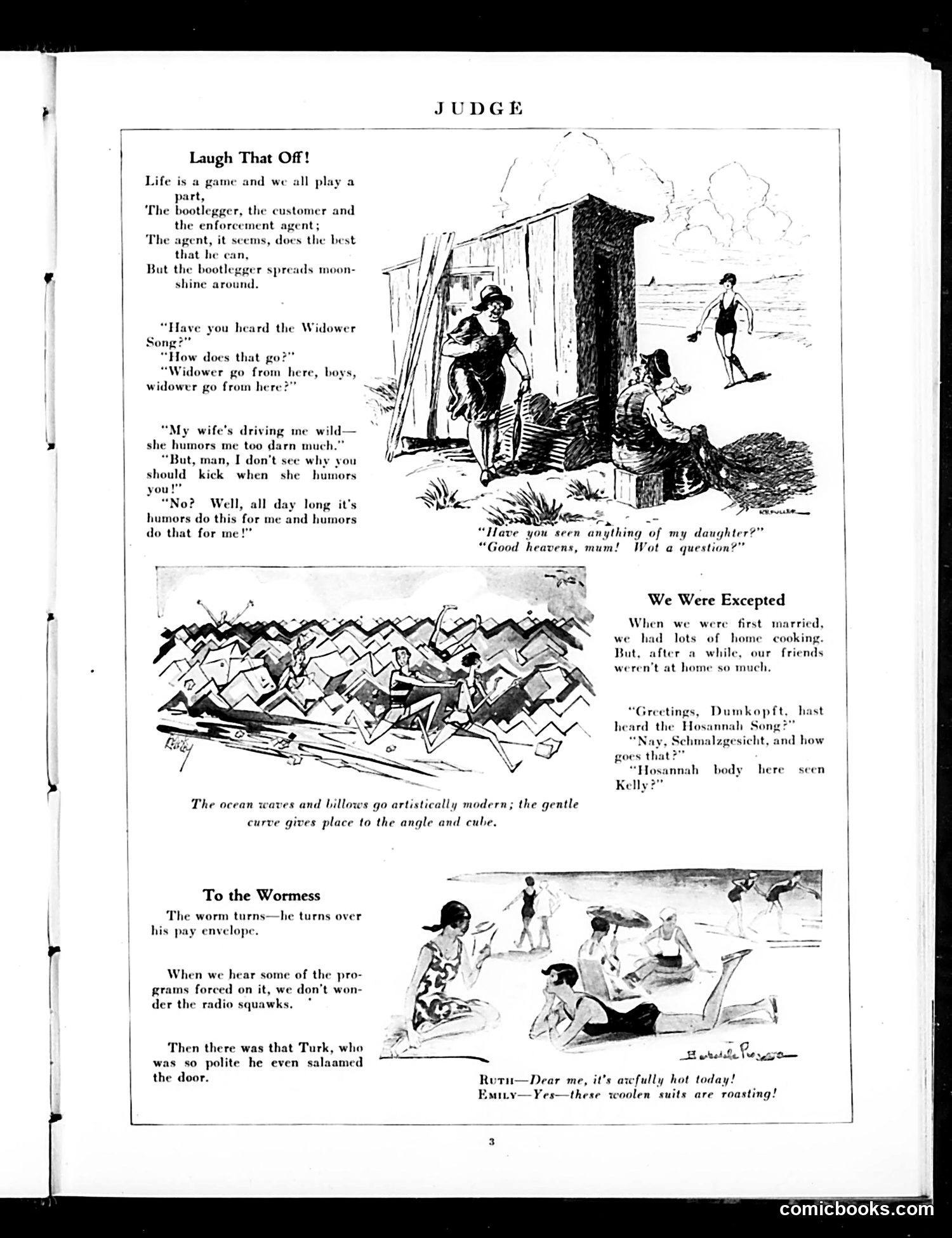
This page contains three separate humorous pieces satirizing early 20th-century social life: 1. **"Laugh That Off!"** mocks Prohibition-era bootlegging through dialogue about a "widower song," suggesting wives drive men to drink and justifying bootlegging. 2. **"We Were Excepted"** jokes about newlyweds' initial domestic skills declining as they stop entertaining guests—referencing period expectations about wives' homemaking duties. 3. **"To the Wormess"** appears to mock complaint-heavy radio programming and references "that Turk" (unclear figure) who was excessively polite. The beach illustration shows people in wool swimming suits complaining about heat—likely satirizing impractical Victorian-era beachwear standards that persisted into the modern era. The overall tone reflects Judge's typical satirizing of contemporary manners, marriage dynamics, and social conventions.
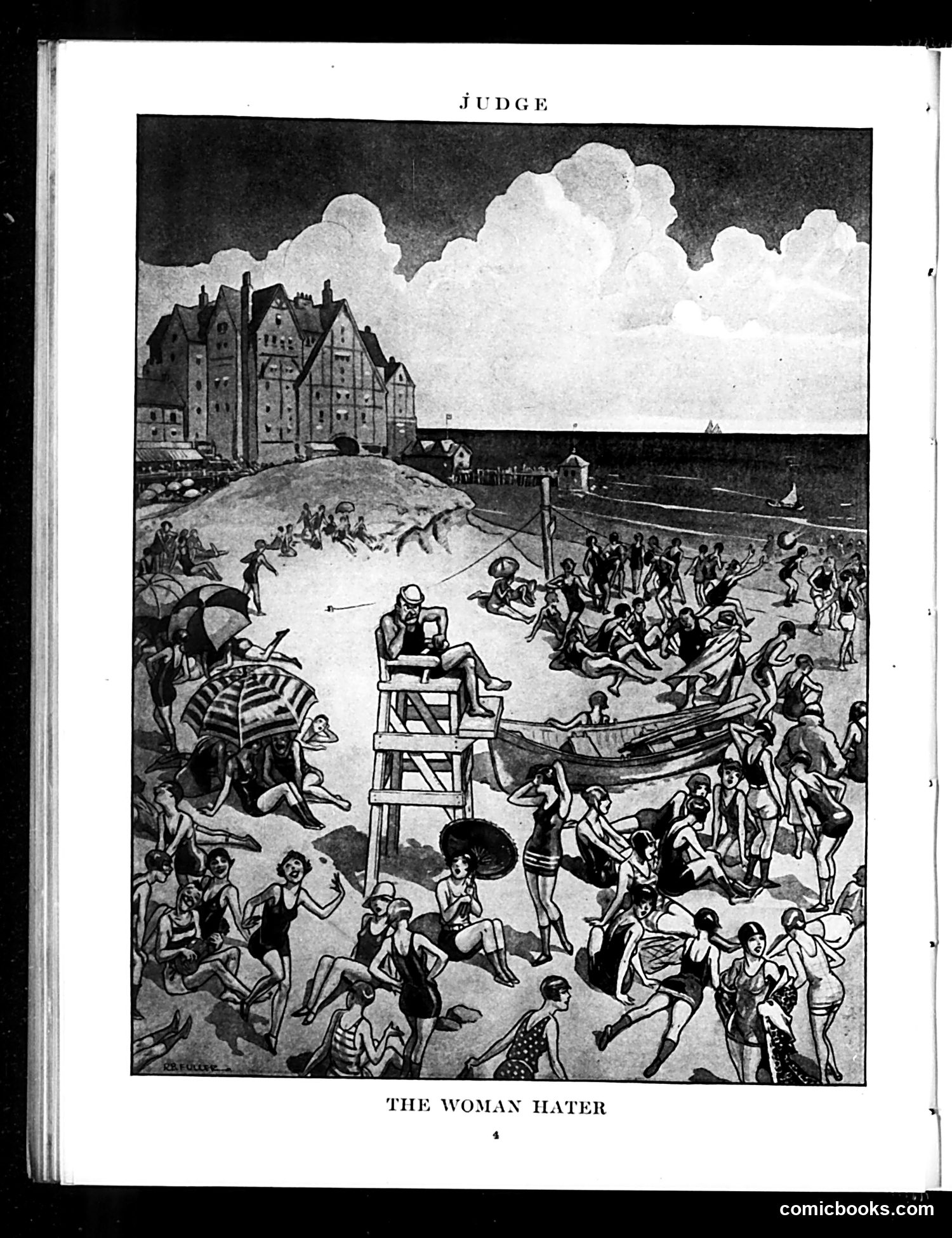
This beach scene satirizes attitudes toward women in public spaces. A lifeguard sits elevated in a tower, apparently supervising a crowded beach where numerous women in 1920s-30s bathing attire swim and relax. The cartoon's title "The Woman Hater" likely refers to someone (possibly the lifeguard or an authority figure) who disapproves of women's increased public presence and freedom—particularly their visibility in bathing costumes at beaches. The satire mocks resistance to women's expanding social roles during this era. The crowded, chaotic scene emphasizes that women's beach attendance is now an established reality, making objections to their presence seem both futile and absurd. The grand hotel looming in the background suggests this is a popular resort destination where excluding women has become impossible.
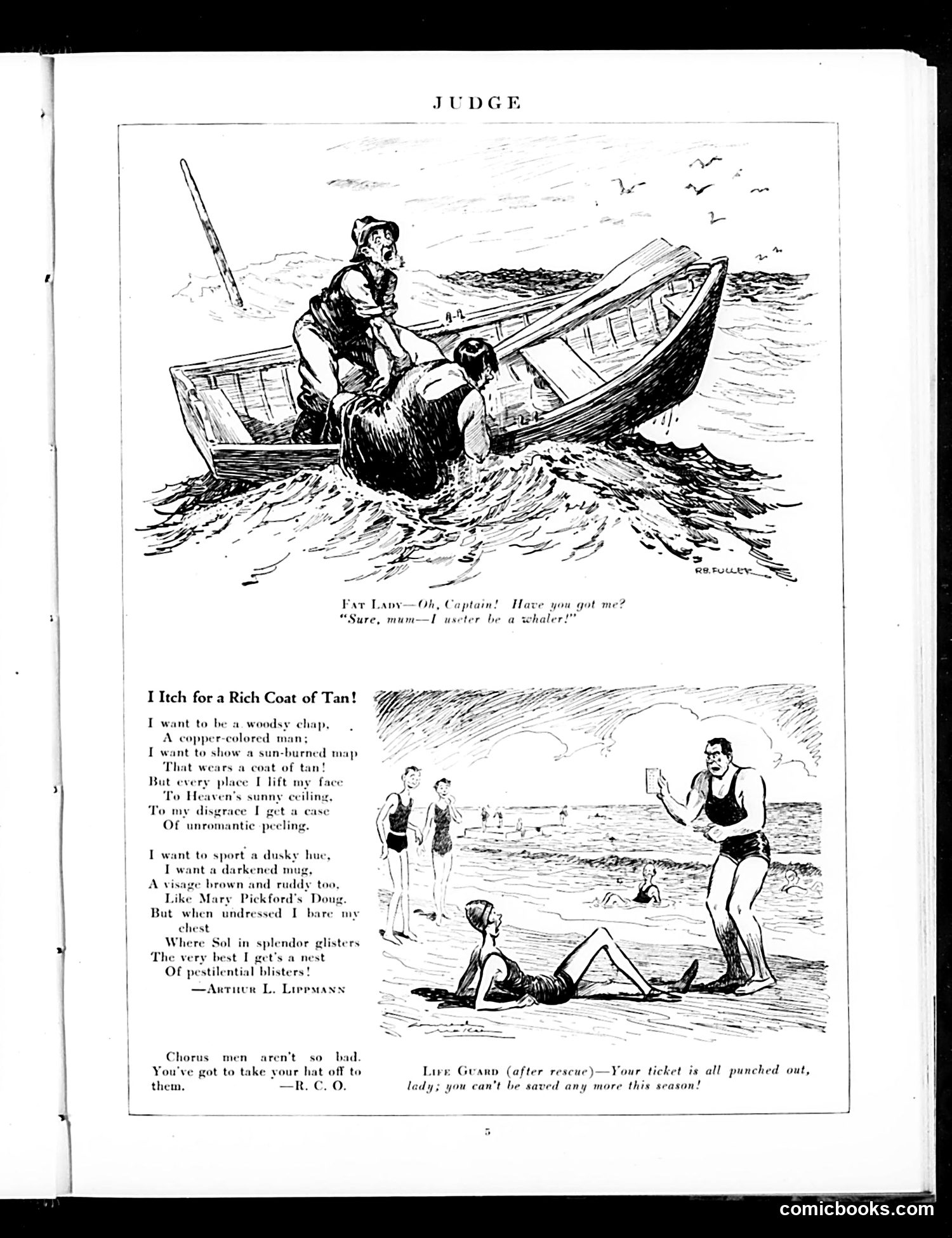
This page contains two beach-themed satirical pieces from Judge magazine. The top cartoon depicts a "Fat Lady" being rescued from the sea by a ship's captain, with the fat woman asking if he'll be a "whaler"—a crude size-based joke. The middle section is a humorous poem titled "I Itch for a Rich Coat of Tan!" by Arthur L. Lipsmann, satirizing the American obsession with achieving a fashionable suntan. The poem mocks the contradiction between wanting a glamorous tan while simultaneously suffering sunburns and "unromantic peeling." References to "Mary Pickford's Doug" suggest contemporary celebrity culture. The bottom cartoon shows a lifeguard telling a rescued swimmer their "ticket is all punched out"—meaning they've exhausted their rescue allowance for the season. Overall, these pieces humorously target 1920s-era beach culture and vanity.
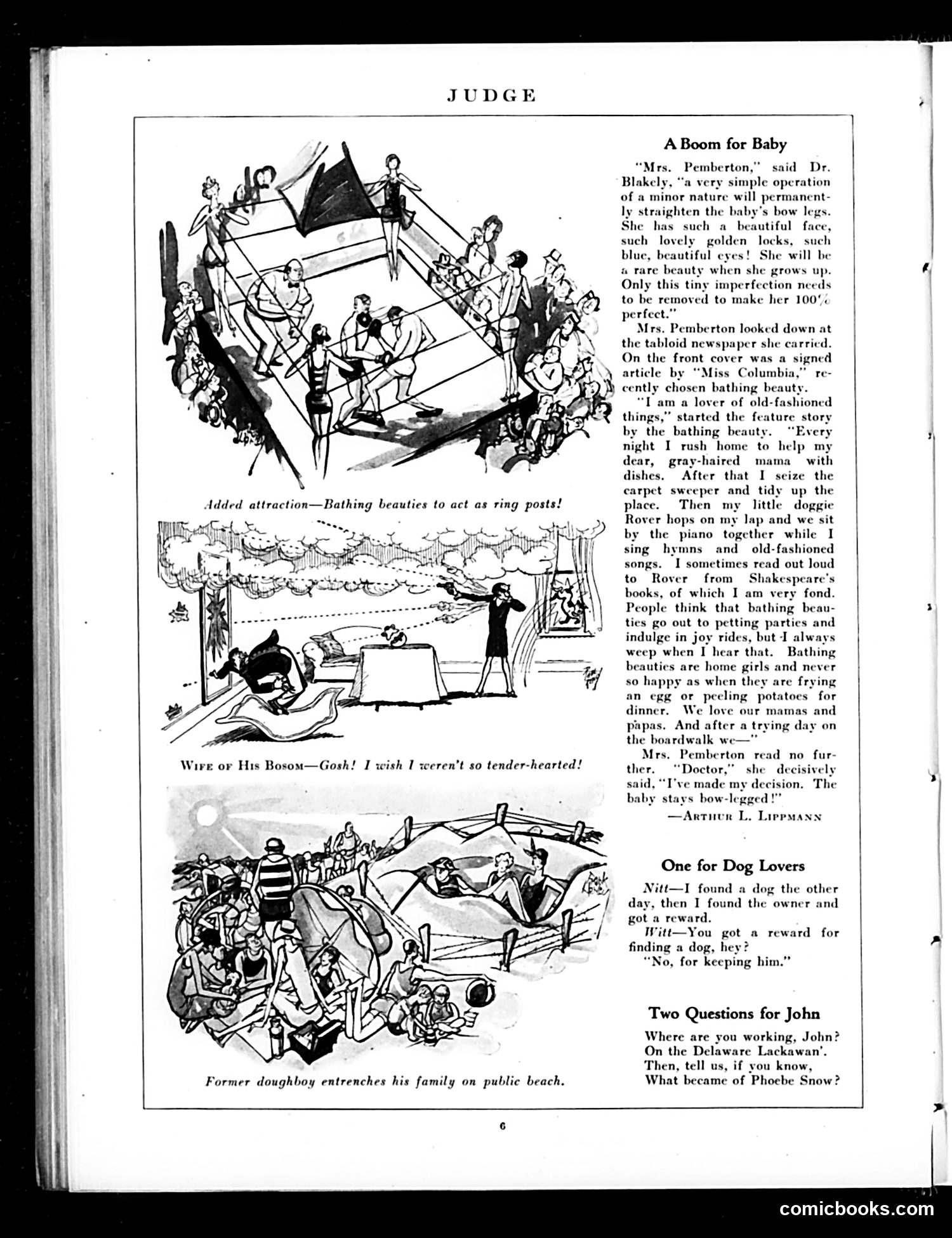
This page contains three separate humorous pieces typical of 1920s-era Judge magazine: **"A Boom for Baby"** satirizes the era's beauty standards and cosmetic surgery trends. A doctor proposes a "simple operation" to "correct" a baby girl's bow legs, promising she'll be "100% perfect." Mrs. Pemberton, skeptical, reads a contradictory bathing beauty article claiming women prefer domestic life—cooking, singing hymns, helping mothers—over modern social activities. The satire mocks both the medical industry's push for "perfection" and the gap between bathing beauties' publicized wholesome image and their actual lifestyle. **"One for Dog Lovers"** is a brief joke about finding a lost dog: the reward wasn't for returning it, but for keeping it—implying the owner was relieved to be rid of it. **"Two Questions for John"** references Phoebe Snow, a famous advertising character from the Delaware, Lackawanna & Western Railroad's early 1900s campaign, known for pristine white clothing. The joke's humor is now obscure without that context.
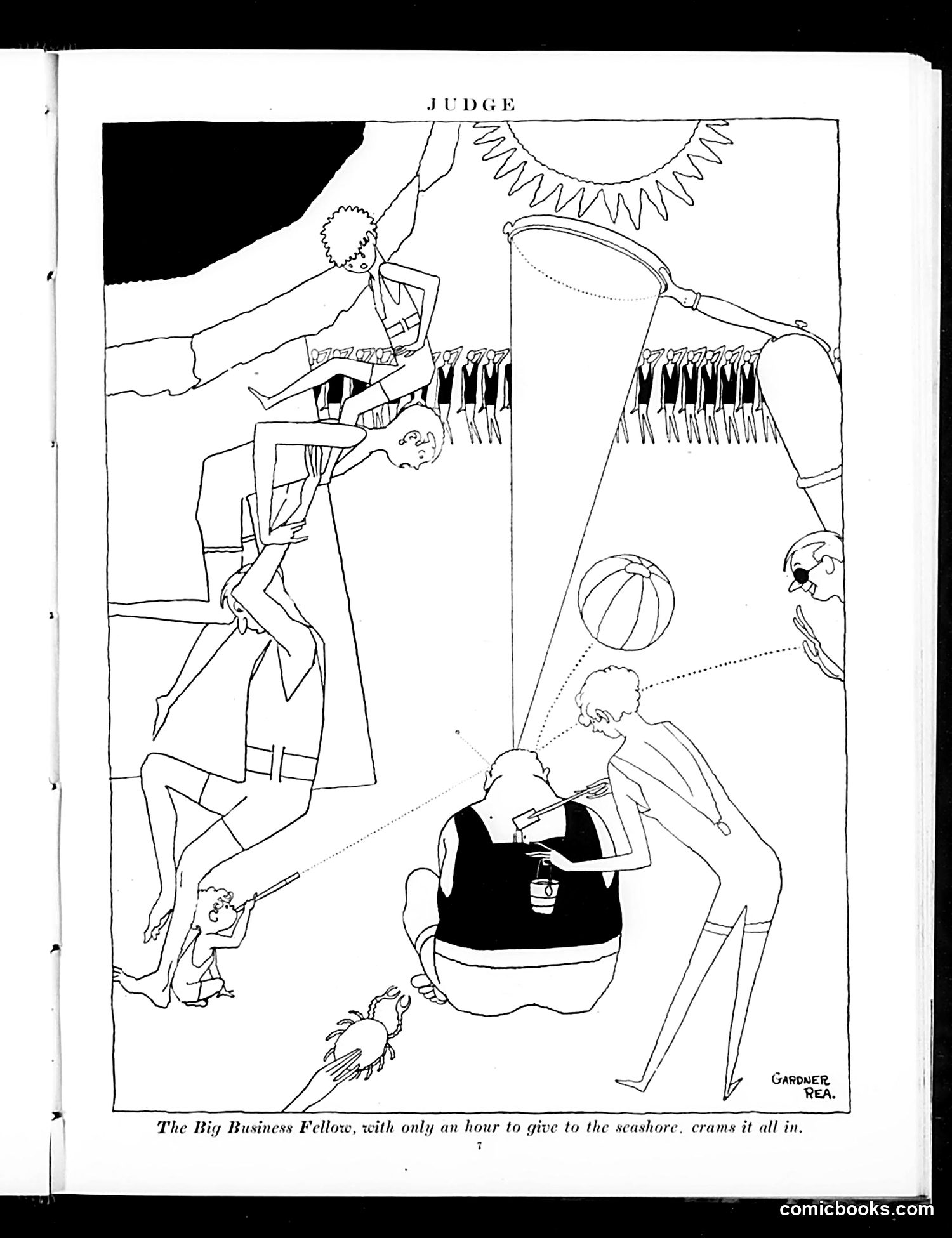
This single-panel cartoon by Gardner Rea satirizes the rushed leisure habits of wealthy businessmen. The central figure—labeled "The Big Business Fellow"—frantically attempts to cram an entire beach vacation into one hour. He's shown simultaneously: playing with a beach ball, lounging in a beach chair, being served by attendants, and generally conducting "business" even at the seashore (indicated by his absorbed posture). The satire targets the early 20th-century "Big Business" culture where wealthy executives were so consumed by work that they couldn't properly relax, even during vacation time. The cartoon mocks this compulsive productivity and inability to slow down—a timeless commentary on workaholic behavior. The exaggerated, frantic poses emphasize the absurdity of trying to experience leisure "efficiently."
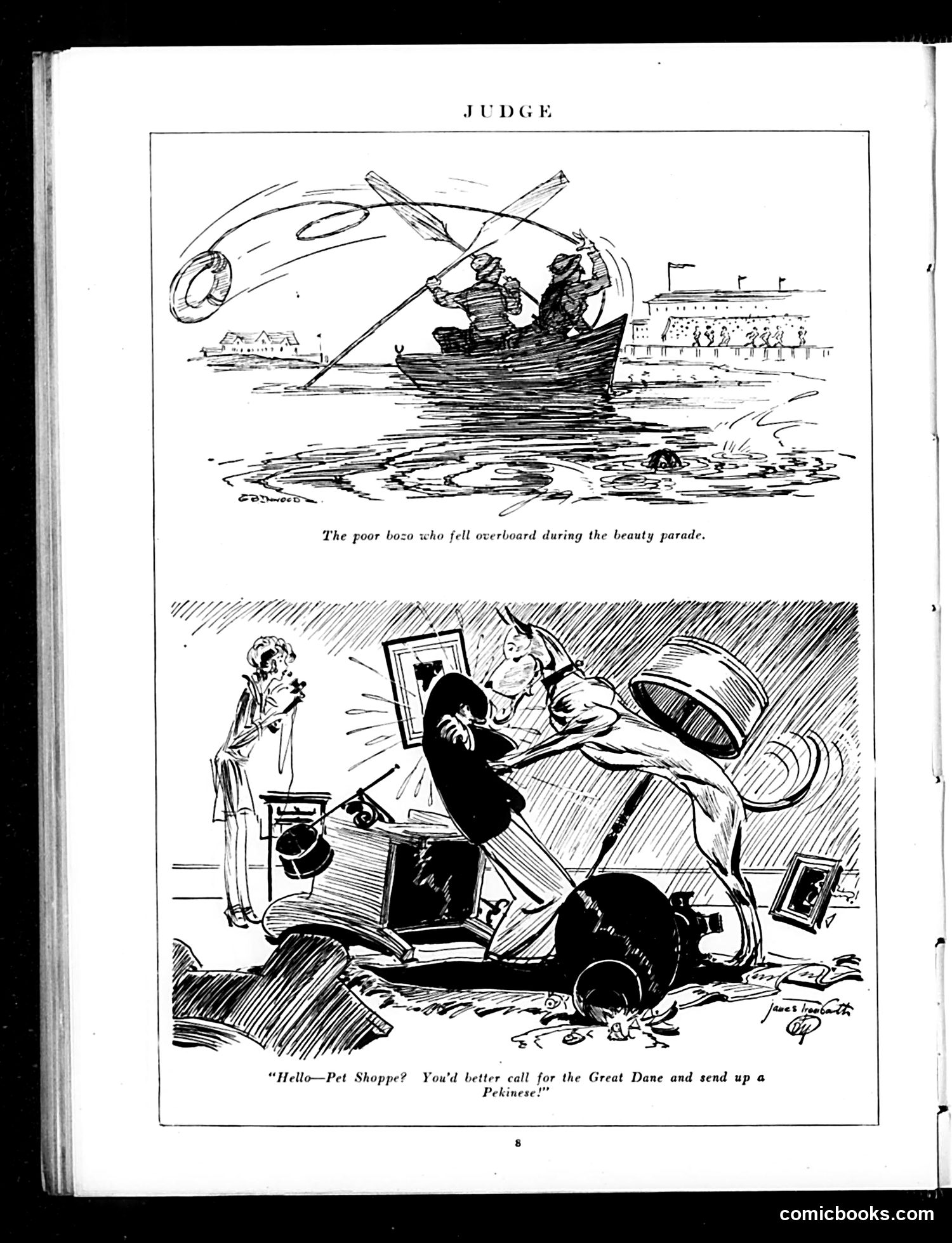
**Top cartoon:** "The poor bozo who fell overboard during the beauty parade." Shows a man in a small boat being fished out of water while an elegant yacht passes by. The satire appears to mock the contrast between high-society "beauty parades" (likely yacht club events) and ordinary working-class misfortune—the irony being the man's crisis occurs during a celebration of beauty and leisure. **Bottom cartoon:** A man has crashed through furniture and is sprawled on the floor, having apparently fallen from above. He jokes about calling a "Pet Shoppe" for a "Great Dane and send up a Pekinese"—likely making light of his accident by suggesting he needs large dogs to break his fall. The humor targets both slapstick physical comedy and upper-class affectations regarding expensive dog breeds.
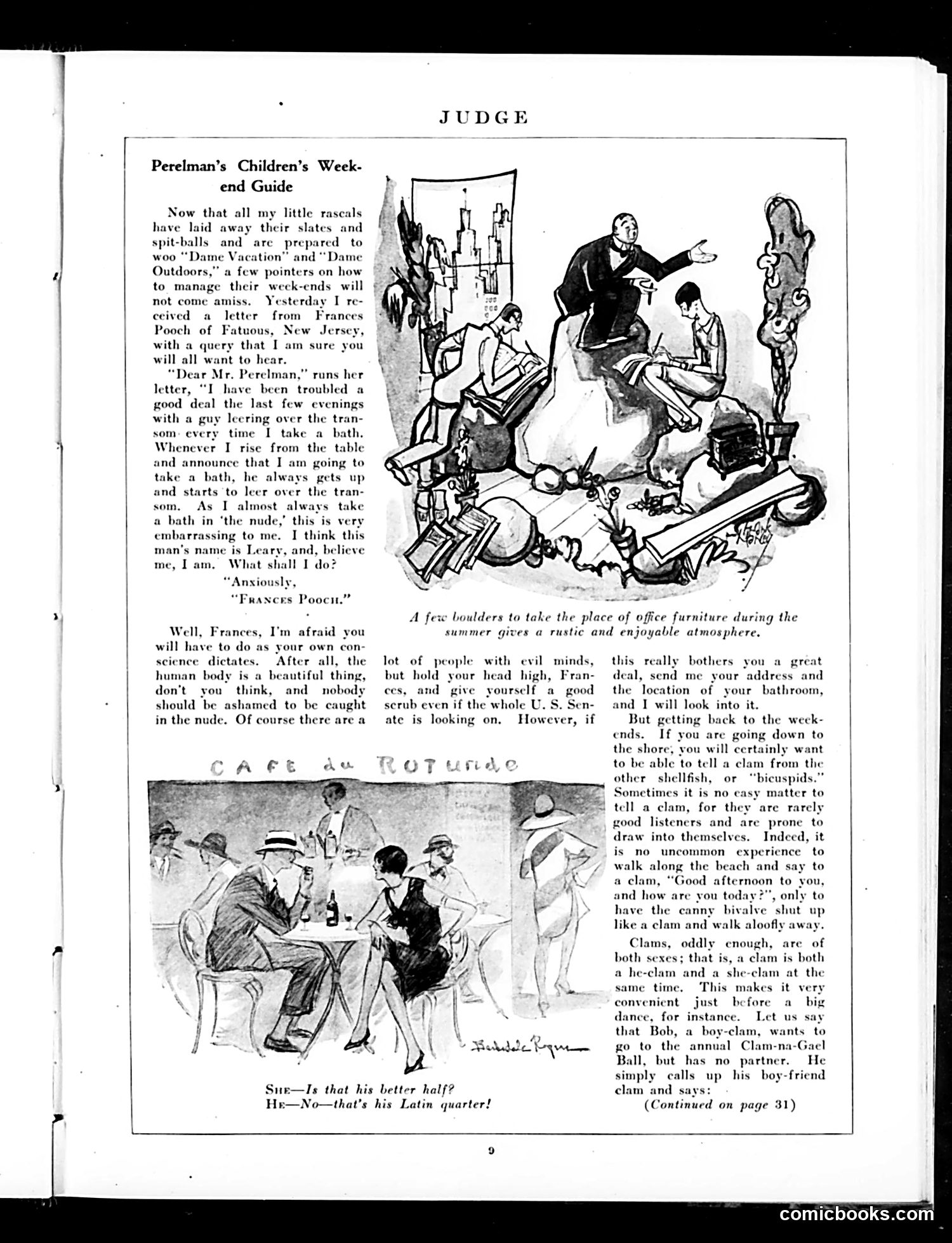
This page from Judge presents humor through two distinct pieces: **"Perelman's Children's Weekend Guide"** is a satirical advice column (likely by S.J. Perelman, a prominent humorist) offering tongue-in-cheek summer vacation tips for children. The main joke involves a letter from "Frances Pooch" complaining about a peeping tom who watches her bathe. Perelman's response sardonically dismisses her concerns by praising the human body's beauty and offering to "look into it"—clearly inappropriate advice presented as earnest counsel. This mocks advice columnists' tendency toward patronizing platitudes. The secondary cartoon about clams is absurdist wordplay: the punchline hinges on calling a female clam a "she-clam" and a male a "he-clam," making them convenient dance partners. **"Café au Rotunde"** (lower cartoon) depicts a social scene with the caption "Sure—is that his better half? / He—No—that's his Latin quarter!" This plays on "better half" (spouse) versus "Latin quarter" (Parisian neighborhood), suggesting the woman is a romantic interest rather than a wife. The humor relies on sexual innuendo and double entendre typical of 1920s-30s Judge satire.
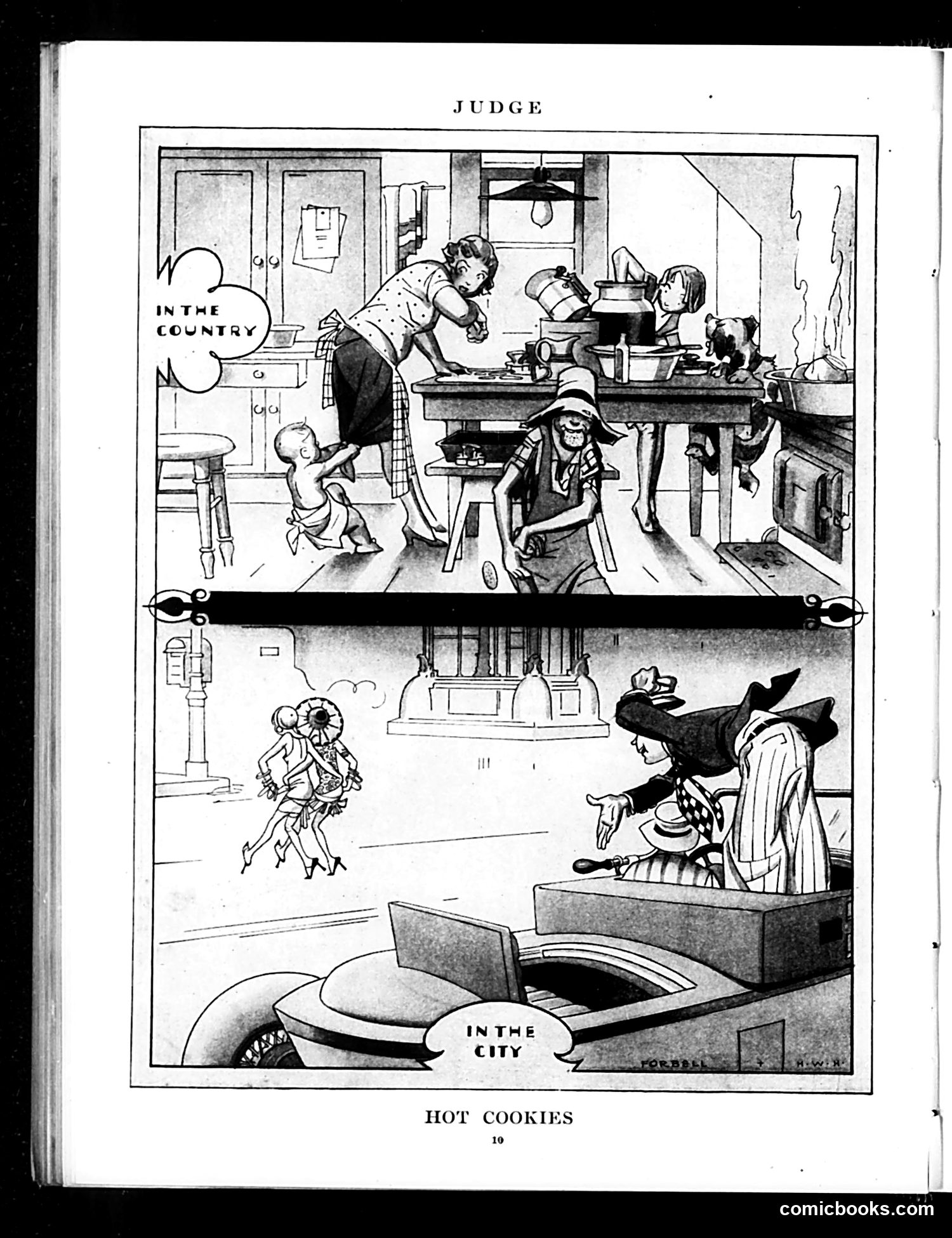
This two-panel satirical cartoon contrasts rural and urban life in America. The top panel labeled "IN THE COUNTRY" depicts a chaotic but wholesome kitchen scene: a mother cooking while children play underfoot, suggesting domestic abundance and family life in agricultural America. The bottom panel "IN THE CITY" shows a darker urban street scene with figures in an alley near what appears to be a sewer or drain, suggesting poverty, crime, or moral degradation associated with city life. The title "HOT COOKIES" likely plays on the contrast—homemade comfort food versus urban dangers. This reflects early 20th-century American anxieties about urbanization, rural decline, and the moral consequences of city living that were common themes in Judge's satirical commentary.
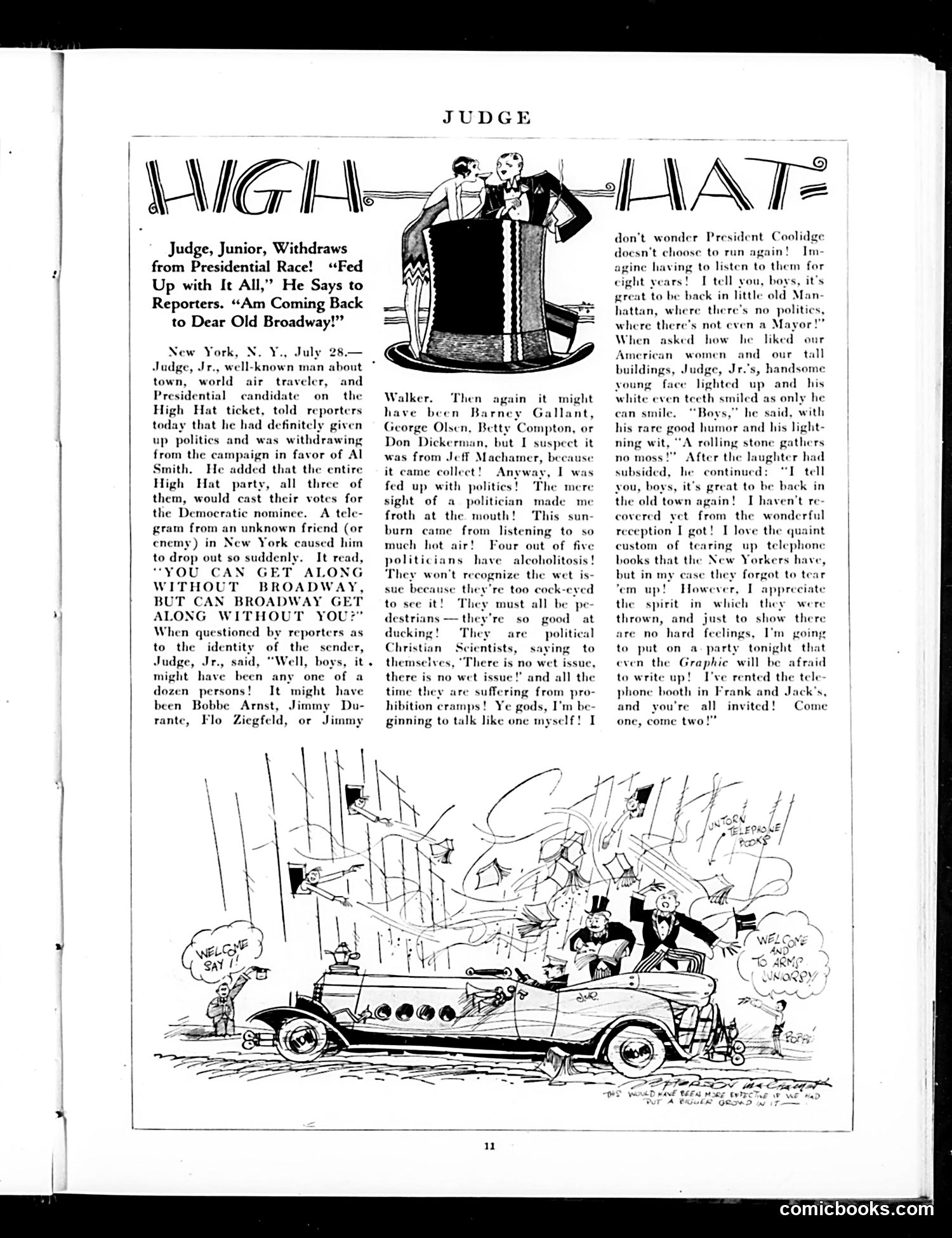
This Judge magazine piece satirizes "Judge, Jr." (the magazine's mascot), who fictionally withdraws from a presidential race to return to Broadway. The satire targets 1920s politics, particularly Prohibition and politicians' hypocrisy. **Key references:** - "Al Smith" (Democratic nominee) and "High Hat party" represent actual political divisions - The Prohibition debate dominates the humor: politicians deny "wet issues" while suffering "prohibition cramps"—mocking their pretense about alcohol - President Coolidge's famous "I do not choose to run" quote is referenced - Famous Broadway figures (Flo Ziegfeld, Jimmy Durante, Betty Compton) are name-dropped - The cartoon's car scene depicts Judge, Jr.'s triumphant Broadway return with celebratory crowds **The joke:** Politicians are absurd, hypocritical hot-air artists. Broadway—glamorous, honest about vice—is preferable to Washington's sanctimony. The piece celebrates returning to entertainment over civic duty, mocking political pretense during the contentious Prohibition era.
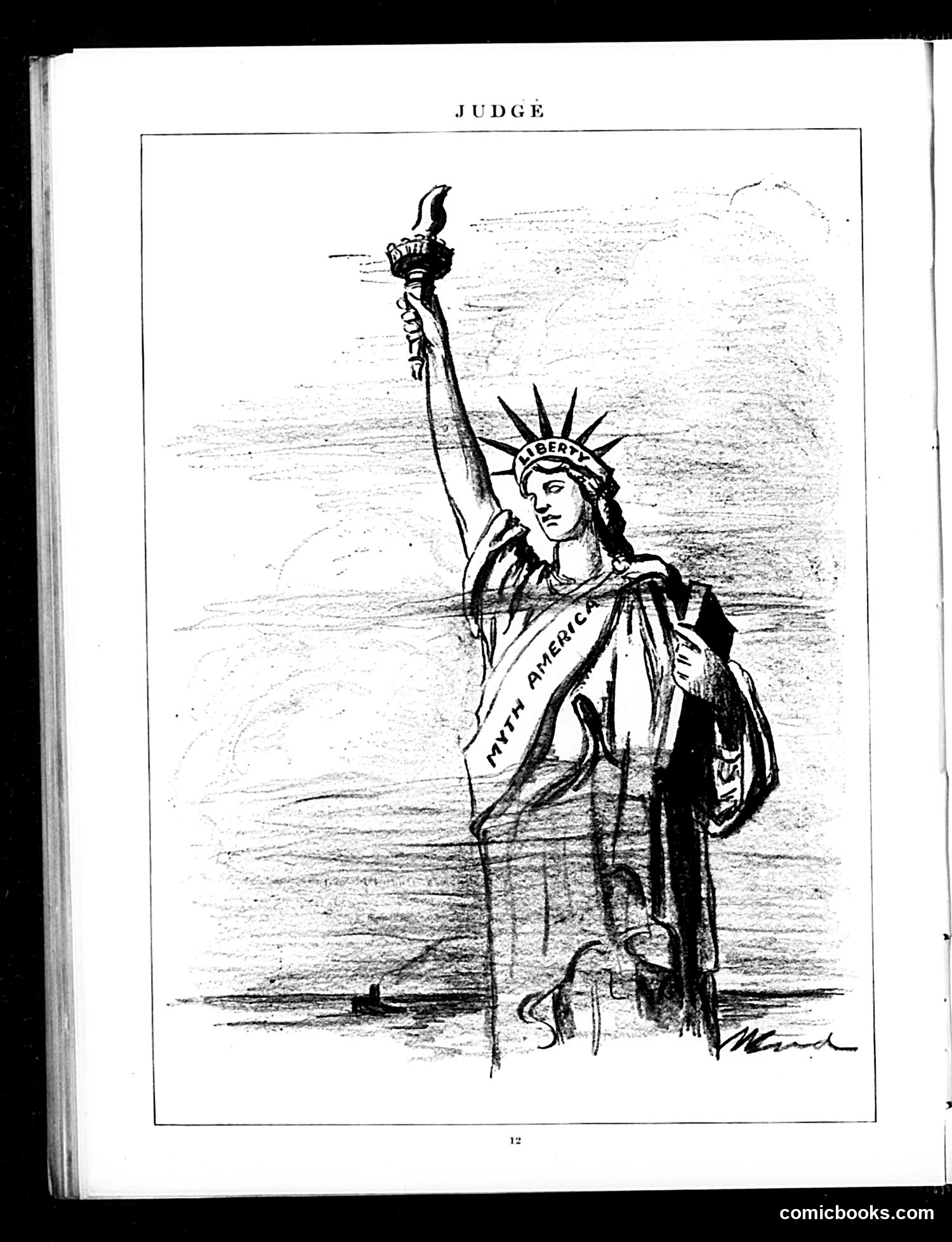
This page from *Judge* magazine features a single editorial cartoon titled "Judge" at the top. The illustration depicts the Statue of Liberty holding her torch aloft, wearing a sash labeled "WITH AMERICA" across her chest. The cartoon appears to be patriotic commentary, likely from the early-to-mid 20th century based on the artistic style and printing technique. The statue's positioning and the sash's text suggest the cartoonist was making a statement about American values or national identity—possibly supporting American interests or interventionism. Without additional context or a clear date, the specific political reference remains unclear, though the image emphasizes American patriotism and the nation's symbolic ideals of liberty and justice.
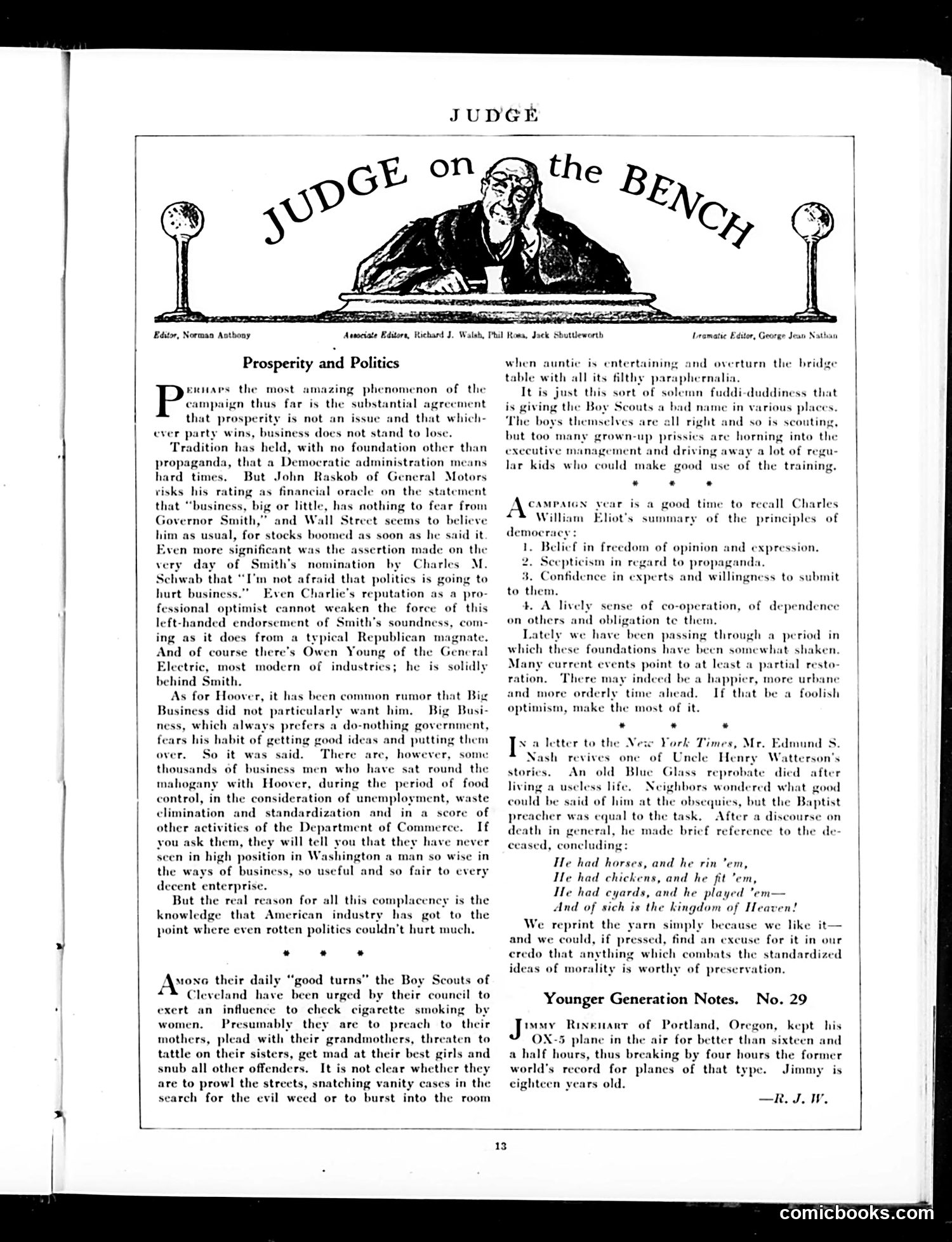
This is the editorial/opinion page of *Judge* magazine, featuring several satirical commentaries on 1920s American politics and society. **Main Article: "Prosperity and Politics"** discusses the 1928 presidential race between Herbert Hoover and Al Smith (Democratic governor of New York). The satire notes that major industrialists—John Raskob (General Motors), Charles Schwab, and Owen Young (General Electric)—have endorsed Smith, breaking tradition by not automatically supporting the Republican. The author argues this reflects that American industry has grown so powerful that electoral politics barely matters anymore. **Boy Scouts Cigarette Campaign**: The piece mocks well-meaning but misguided adult supervisors urging Boy Scouts to pressure women to quit smoking—absurdly imagining them ransacking purses or disrupting social gatherings. The satire criticizes "fuddi-duddiness" corrupting an otherwise solid youth organization. **Charles William Eliot Reference**: A brief reminder of democratic principles during a "shaken" period—likely alluding to post-WWI disillusionment and Red Scare anxieties. The page reflects 1920s concerns: business dominance, generational conflicts, and anxiety about democracy itself.
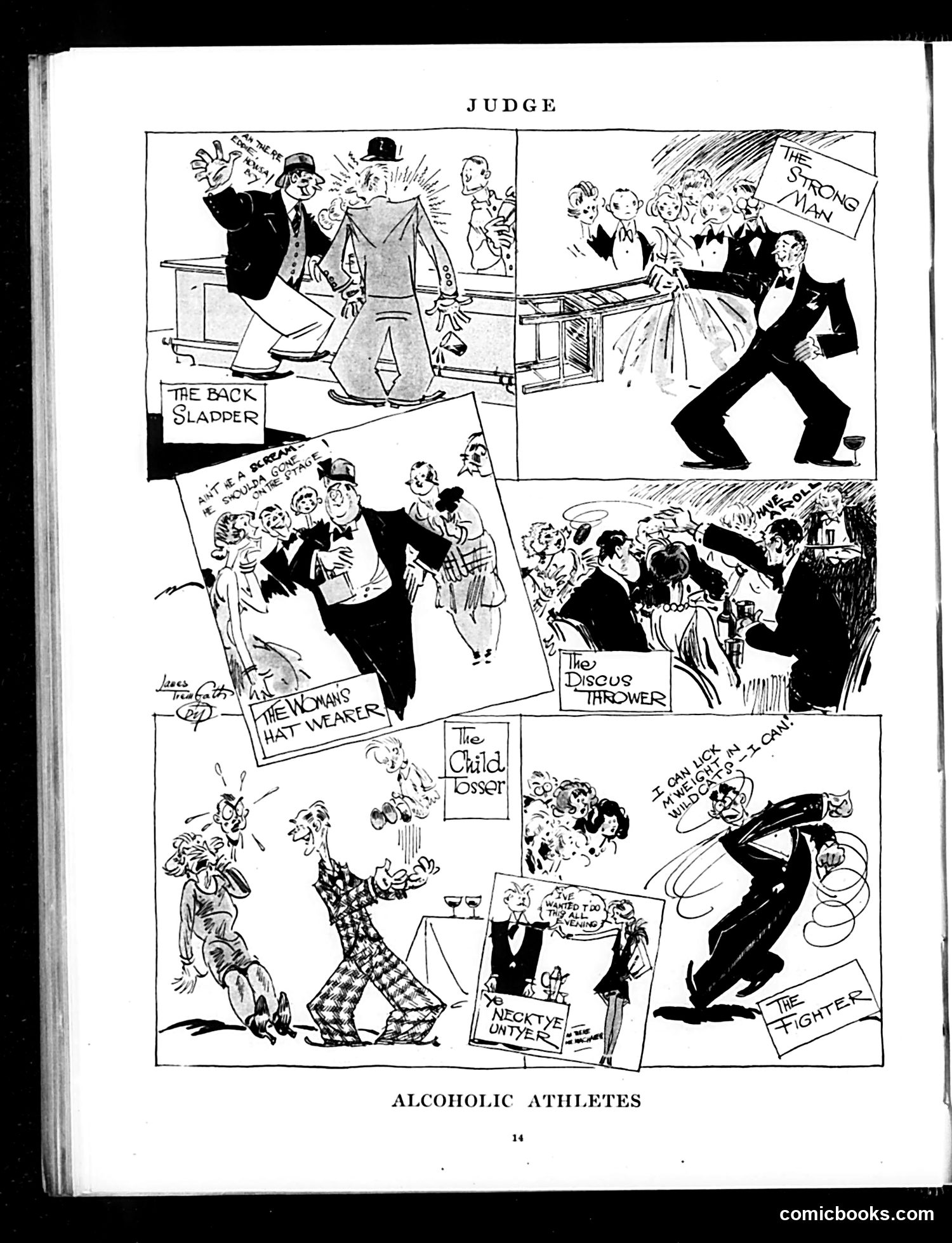
This satirical page mocks various sports figures and entertainers of the Prohibition era who engaged in drinking despite the alcohol ban. The cartoon panels show exaggerated athletic "types": - **"The Back Slapper"** - a glad-handing drunk - **"The Strong Man"** - demonstrating false bravado - **"The Woman Hat Wearer"** - cross-dressing while intoxicated - **"The Discus Thrower"** - athletic posturing while drunk - **"The Child Loser"** - depicting degraded behavior - **"The Necktie Untier"** and **"The Fighter"** - other drunken caricatures The satire targets the hypocrisy of athletic celebrities who publicly violated Prohibition laws. Judge uses exaggerated, unflattering depictions to ridicule their behavior and the gap between their public athletic personas and private alcohol consumption during this period.
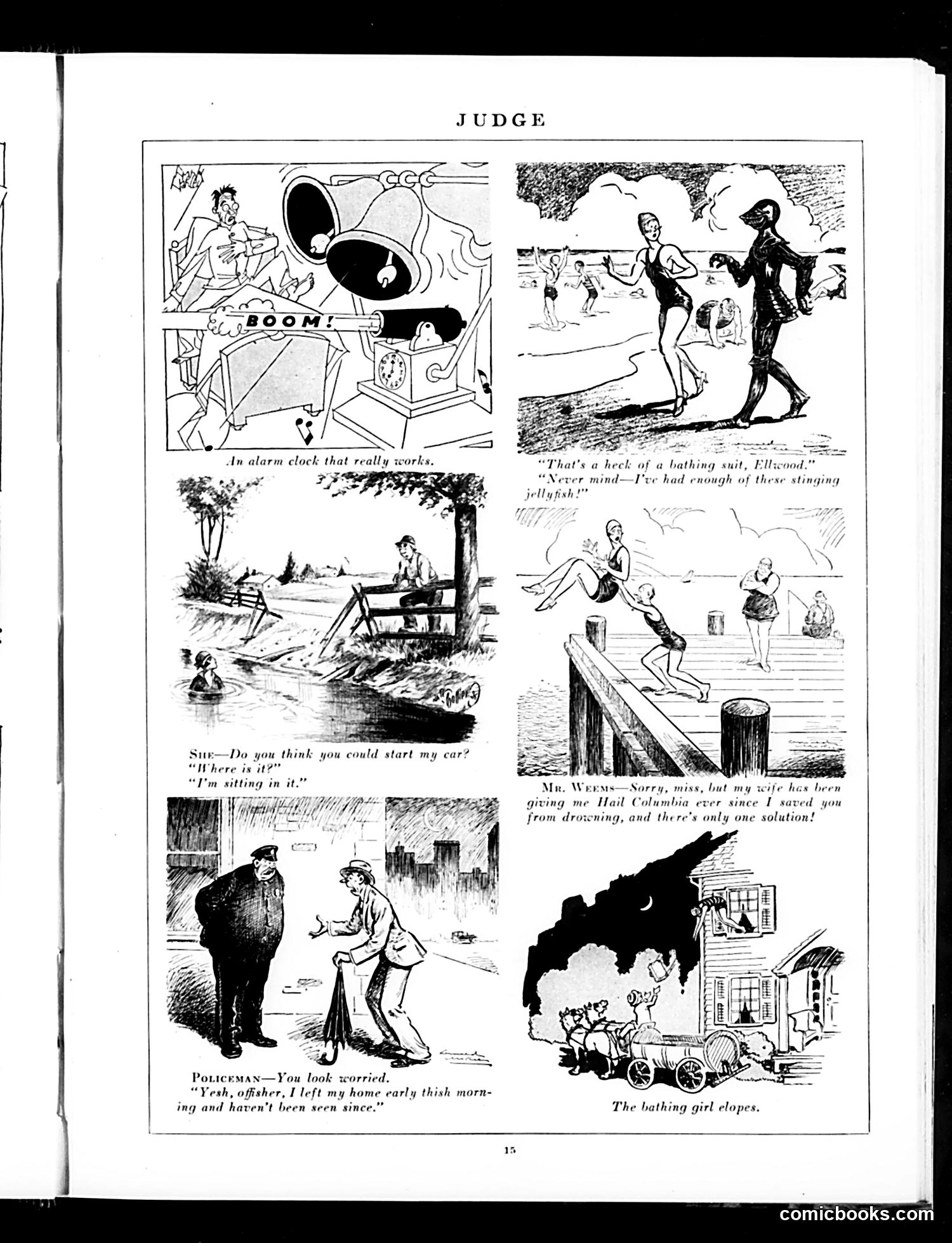
This page collects six comic vignettes satirizing early 20th-century social situations: 1. **Alarm clock**: Mocks unreliable technology with exaggerated slapstick. 2. **Bathing suit complaint**: A woman ridicules a man's bathing attire as outdated ("stinging jellyfish"), reflecting changing fashion standards. 3. **Car trouble**: A woman sits *in* a broken car, unable to start it—satirizing both early automobile unreliability and women's mechanical incompetence (a common stereotype). 4. **Rescue regret**: A man resents being thanked for rescuing a woman from drowning because his wife now jealously harasses him ("giving me Hail Columbia"). The joke: gratitude creates marital problems. 5. **Drunk logic**: A confused man tells a policeman he "left home early this morning and haven't been seen since"—nonsensical drunken speech. 6. **Elopement**: A bathing girl flees with a man, likely a working-class suitor, scandal suggested by the dramatic nighttime escape. The humor targets domestic tensions, technological fumbling, and social propriety violations.
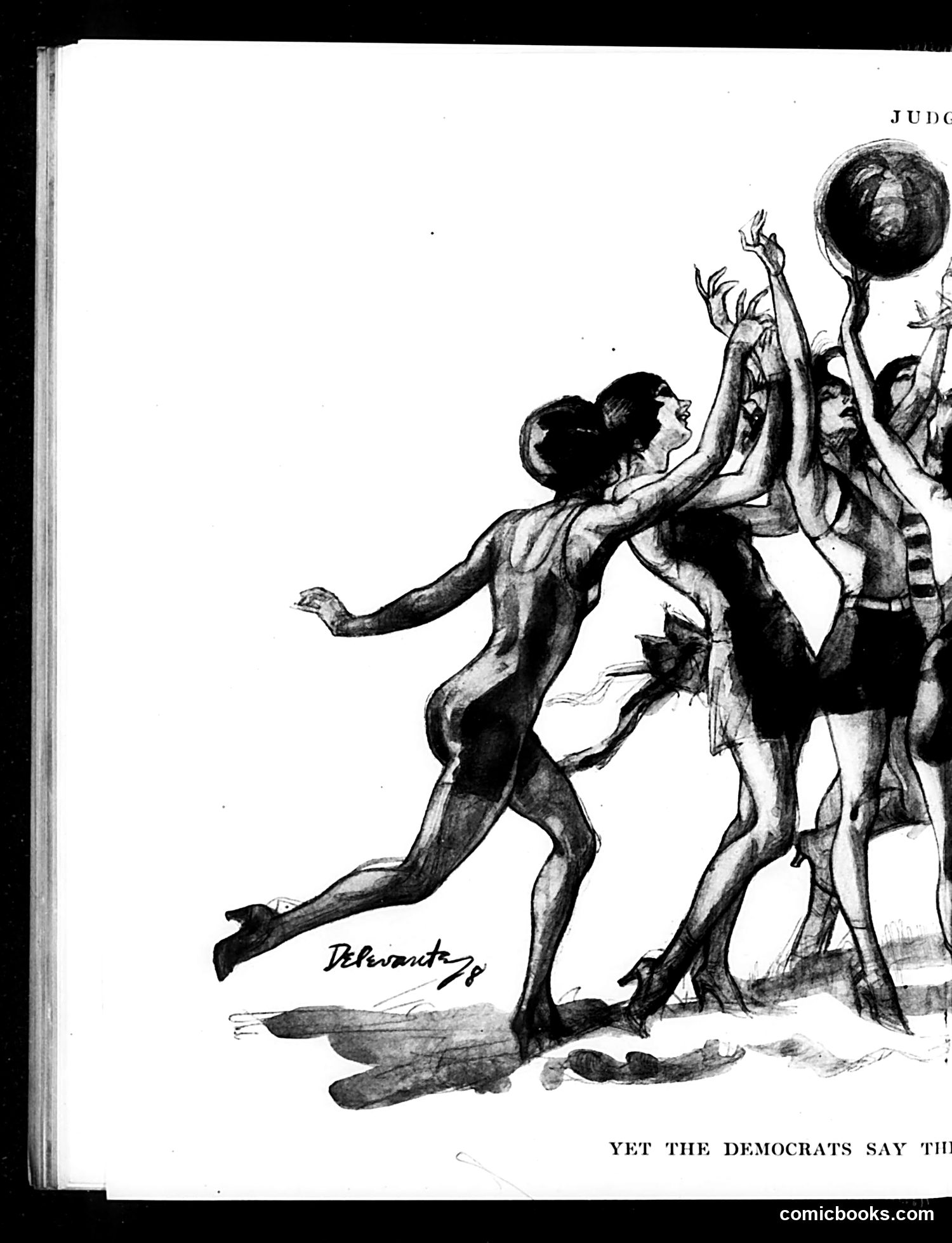
This cartoon satirizes Democratic claims about racial equality. The image depicts Black figures struggling to reach a basketball or sphere being held aloft by white figures, while appearing unable to grasp it despite their efforts. The caption reads "YET THE DEMOCRATS SAY TH[EY]" (text cut off), suggesting irony about Democratic assertions regarding equality or opportunity for Black Americans. The cartoon uses sports imagery (basketball) as a metaphor for opportunity or achievement. The visual composition—with Black figures striving but unable to reach what white figures control—communicates a cynical message about the gap between Democratic political rhetoric and actual racial inequality in America. This reflects Judge's satirical stance during an era of significant racial discrimination and segregation in American society.
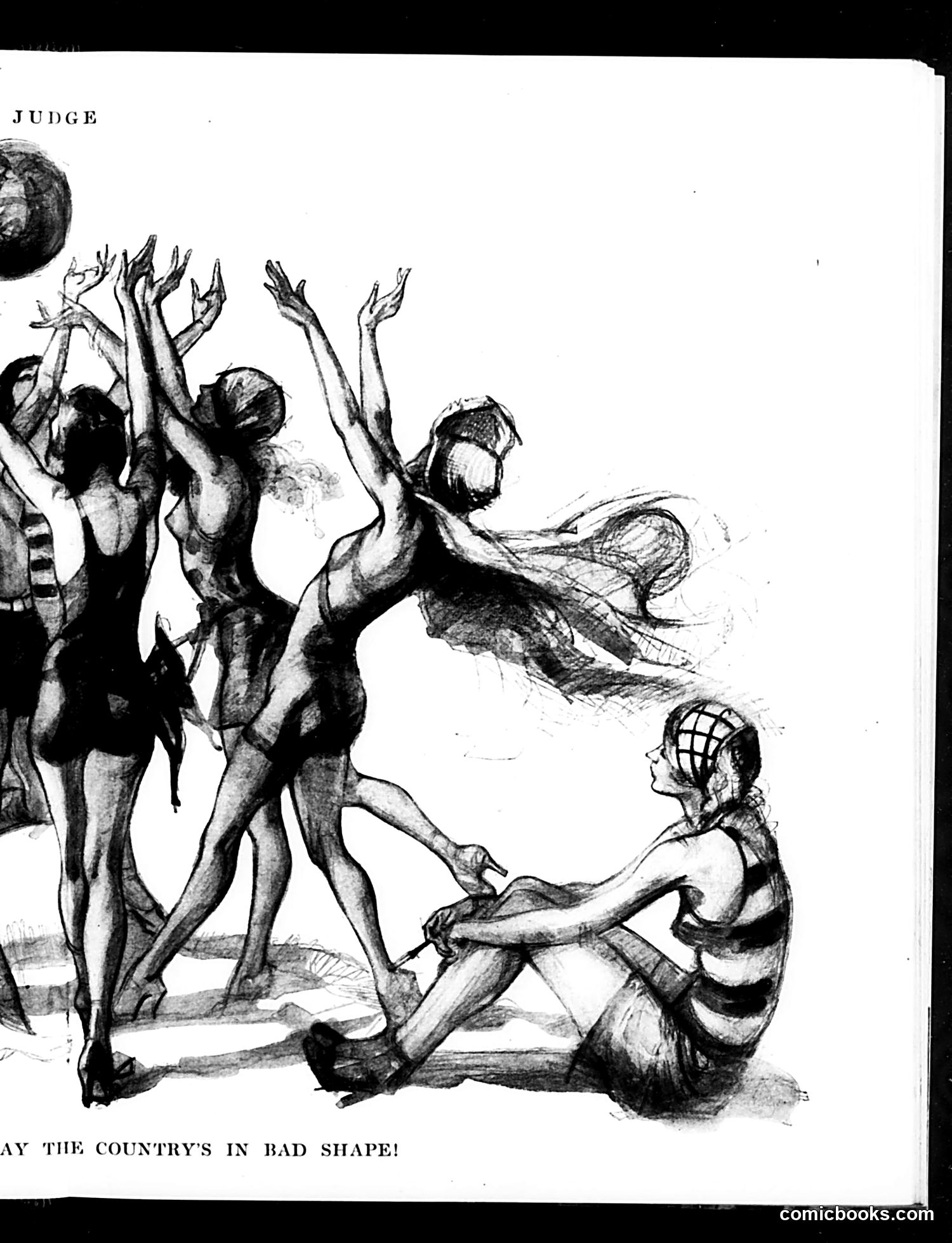
This Judge magazine cartoon depicts a seated figure (appearing distressed or pleading) gesturing upward toward three nude or partially-clothed female figures with raised arms. The title reads "AY THE COUNTRY'S IN BAD SHAPE!" The satire appears to reference political or economic crisis—the seated figure likely represents a politician or the nation itself—while the three female figures probably personify abstract concepts (possibly representing different aspects of national welfare, economy, or social conditions in distress). The cartoon uses the visual metaphor of chaos and disorder (the nude, flailing figures) to satirize the state of the country. Without a specific date, it's unclear which particular crisis or scandal this references, but it's typical of Judge's critical commentary on American politics and governance.
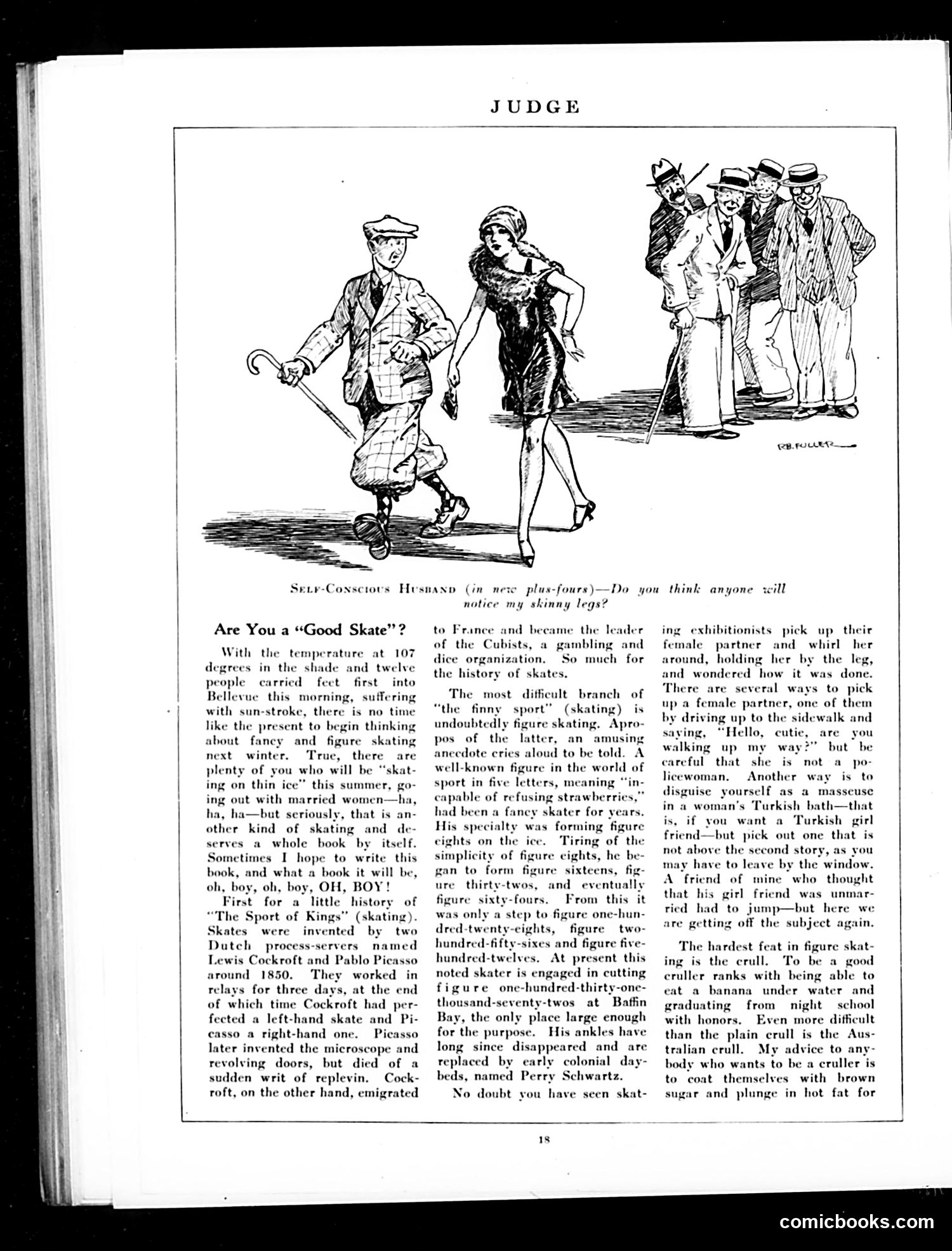
This is a humorous article about ice skating from Judge magazine, disguised as serious advice but filled with absurdist jokes. The cartoon shows a man in fashionable "plus-fours" (baggy golf pants) proudly displaying his thin legs to his wife. The article satirizes the era's skating craze by inventing fake history (crediting Dutch "process-servers" and absurdly naming Pablo Picasso as a skate inventor), then offering ridiculous "tips" on picking up female skating partners—including dressing as a masseuse or driving up to women on sidewalks. The humor escalates into pure nonsense: a skater progresses from figure-eights to impossible numbers like "figure one-hundred-thirty-one-thousand-seventy-twos," performed at Baffin Bay because nowhere else is large enough. The crull (likely a made-up skating move) is compared to coating oneself in brown sugar and diving into hot fat. The overall satire mocks both the pretentiousness of the skating fad and the era's casual attitudes toward flirting and male behavior toward women—presented with enough exaggeration that the mockery becomes obvious.
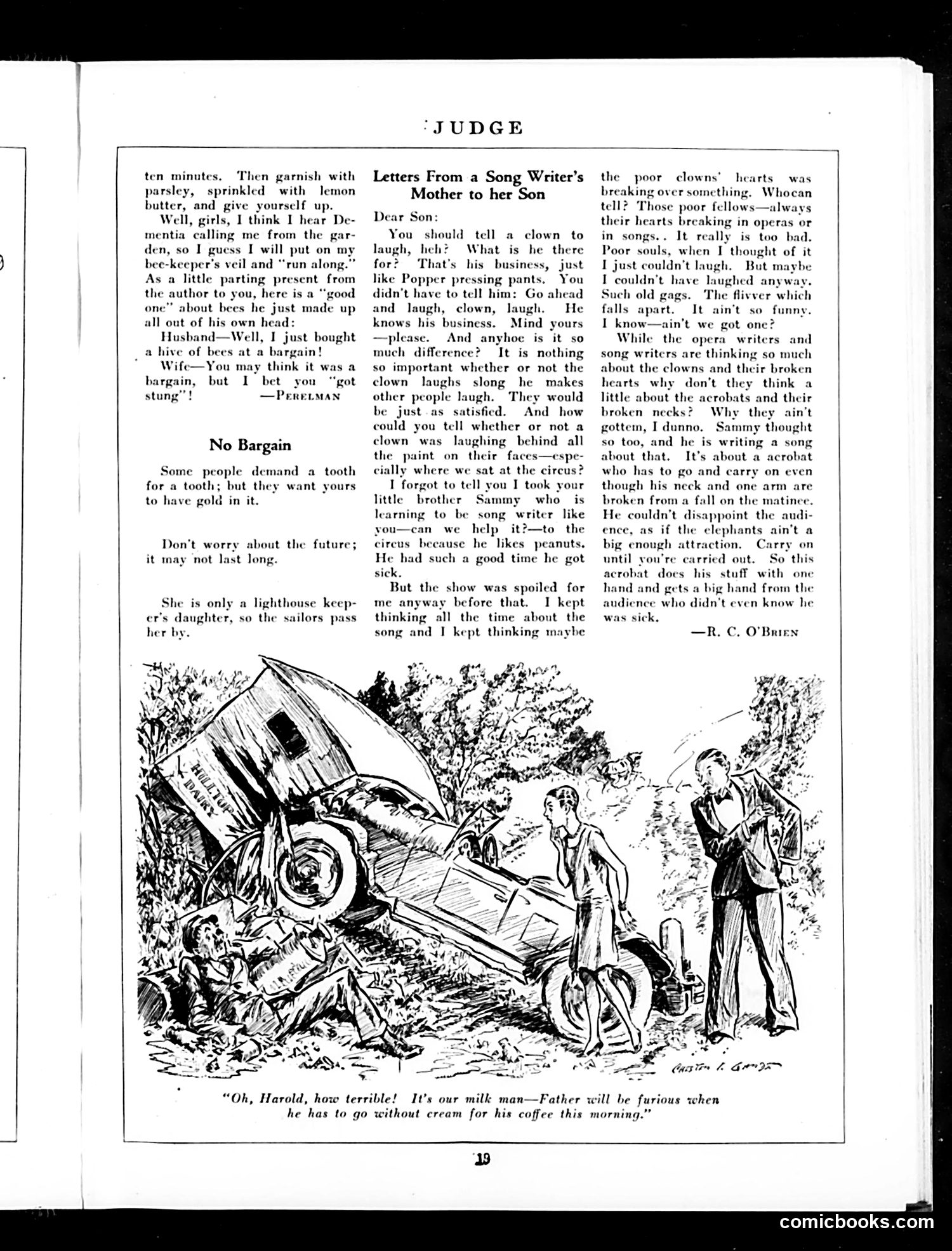
This page contains two distinct pieces of humor from Judge magazine: **The "No Bargain" section** presents short jokes typical of the era—including one about a man who bought bees and got "stung" (a pun), and another mocking people who demand expensive gold fillings in teeth. **The main feature** is a letter from a working-class mother to her son, a song writer, offering blunt maternal advice. She criticizes his sentimental songs about clowns with "breaking hearts"—arguing their job is simply to make people laugh, not deserve pity. She extends this critique to acrobats performing with broken bones for audiences' entertainment. The letter satirizes 1920s popular song writers for excessive sentimentality about performers' suffering. **The cartoon below** shows a car crash, with the caption joking that losing their milkman is the real disaster—"Father will be furious when he has to go without cream for his coffee." This reflects period anxieties about daily convenience and servants' reliability during economic disruption. The humor relies on class attitudes and dismissive views toward both working people and artistic sentiment typical of satirical magazines of this era.
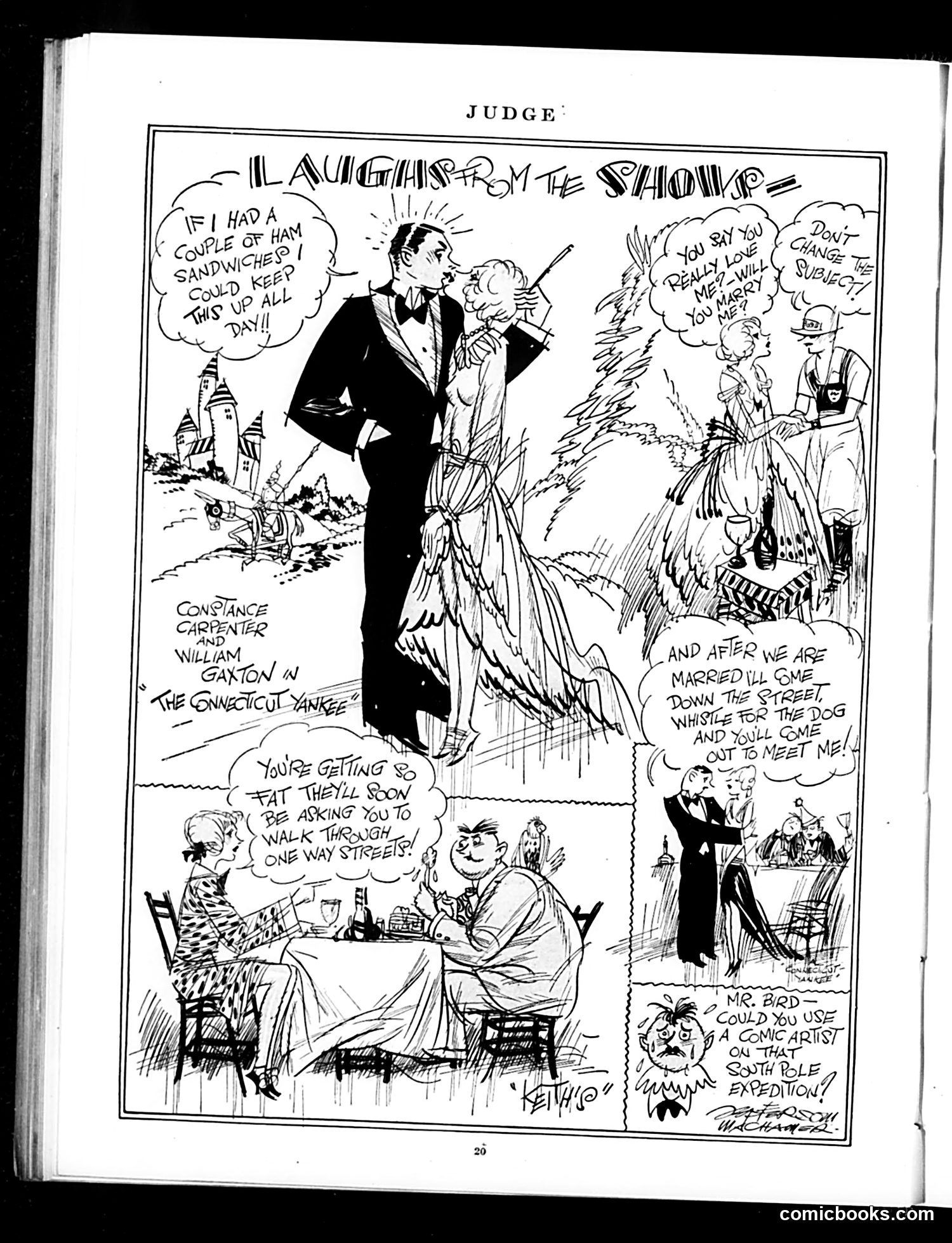
This page satirizes a theatrical scene from "The Connecticut Yankee," featuring actors Constance Carpenter and William Gaxton. The cartoon depicts a romantic plot where a man proposes marriage, imagining their future life together—including walking "one way streets" and eventually meeting the dog. The satire targets the predictability of stage romance and domestic life. The humor lies in the contrast between the man's grandiose romantic vision (shown in the castle/fantasy setting at top) and the mundane reality he describes (asking her to walk one-way streets, meeting his dog). At bottom right, someone asks Mr. Bird if he could use a comic artist for a "South Pole Expedition"—likely a joke suggesting the proposal scene is so tedious it requires escape to Antarctica. The cartoonist (signed Kemp) mocks both theatrical convention and the mundane realities of married life through this exaggerated romantic fantasy.
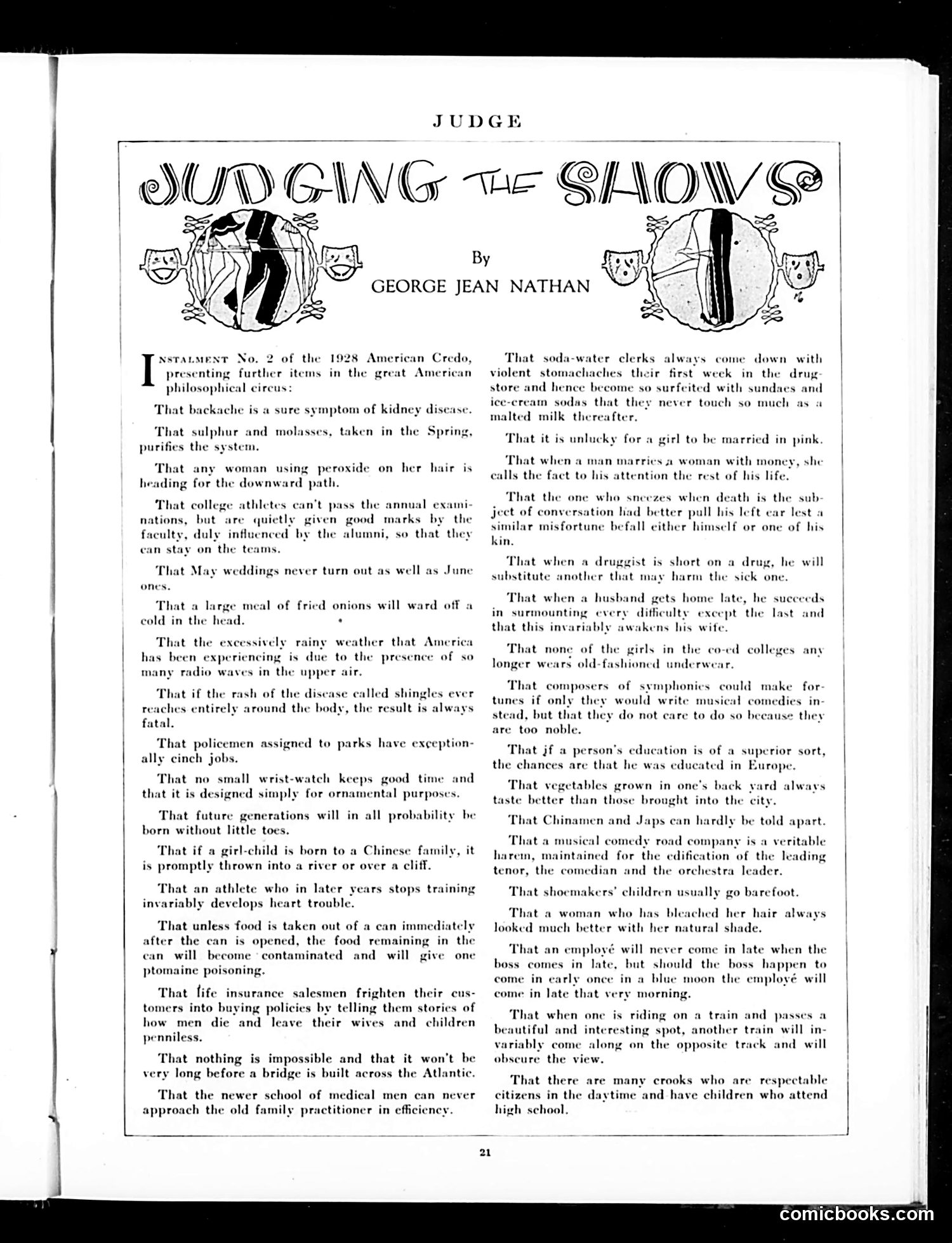
This page presents satirical observations titled "Installment No. 2 of the 1928 American Credo" by George Jean Nathan. Rather than a cartoon, it's a written humor piece skewering popular American superstitions and misconceptions of the era. Nathan mocks widespread folk beliefs (backache signals kidney disease, peroxide causes moral decline), class anxieties (college athletes receiving grade inflation from alumni influence), gender stereotypes (women bleaching hair, unlucky pink weddings), and contemporary fears (radio waves causing rain, Chinese infanticide, ptomaine poisoning from opened cans). The satire targets both old-fashioned superstitions and modern anxieties, ridiculing how Americans uncritically accept dubious "facts." References like radio waves and drug store sodas ground the piece in 1920s specificity, while observations about insurance salesmen and road show orchestras reflect period workplace culture. The comedy lies in how obviously false or exaggerated these "credos" are—Nathan exposes American gullibility and provincial thinking through ironic affirmation of absurdities.
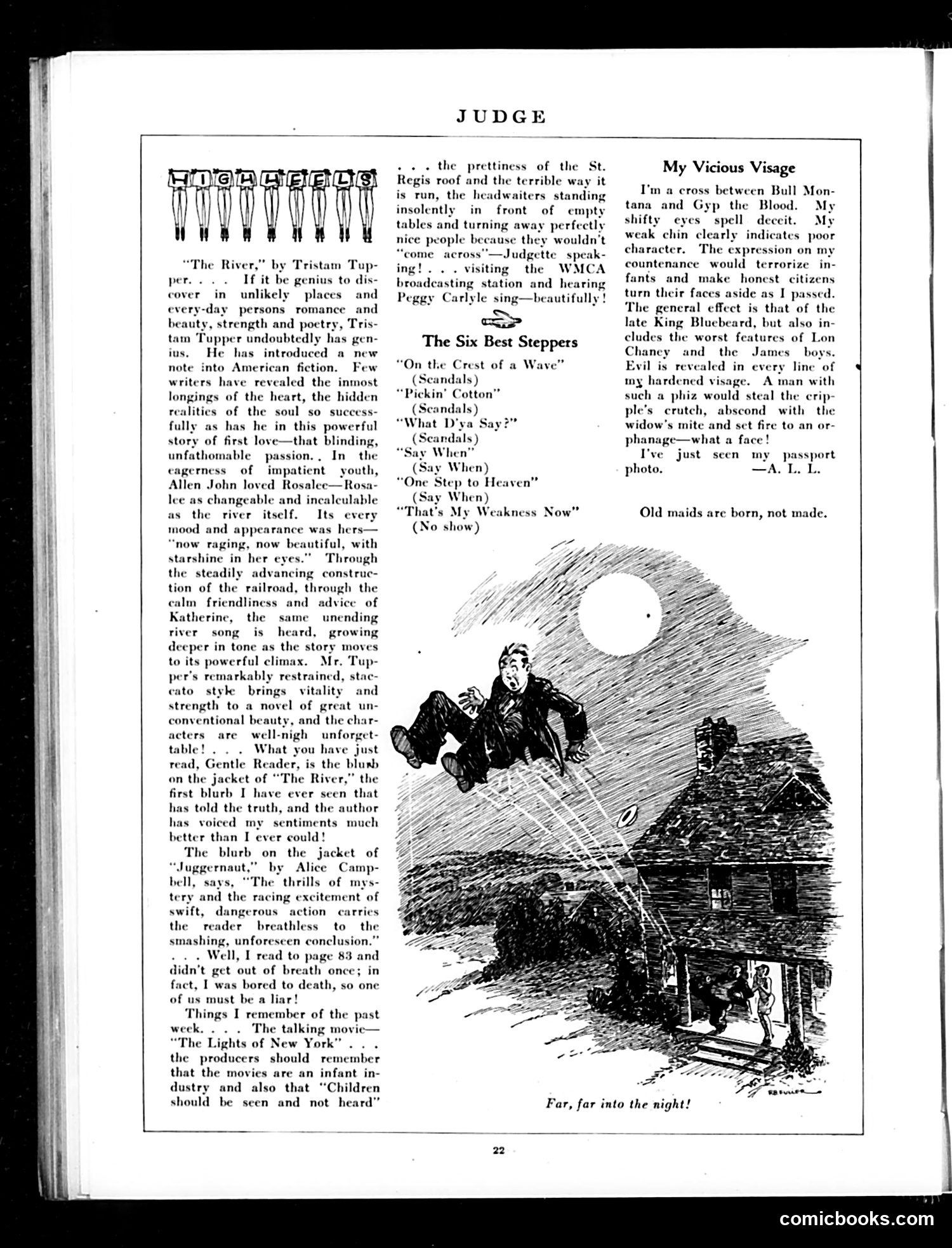
This page combines book reviews with social commentary typical of 1920s satire. The main content critiques dishonest book jacket blurbs—the reviewer praises "The River" by Tristam Tupper for having an honest dust jacket description, then sarcastically notes that the "Juggernaut" blurb promised thrills but bored him to death ("so one of us must be a liar"). The accompanying illustration and "My Vicious Visage" section mock passport photos, with the author jokingly describing himself as villainous-looking, comparing his appearance unfavorably to famous criminals and actors like Lon Chaney. The "Six Best Steppers" lists popular songs from Broadway shows (likely the 1920s "Scandals" revue). The brief notes about St. Regis and talking movies reference current entertainment and technology—early "talkies" were still novel, and the reviewer criticizes producers forgetting the medium's infant status. Overall, the page satirizes publishing dishonesty and contemporary cultural developments.
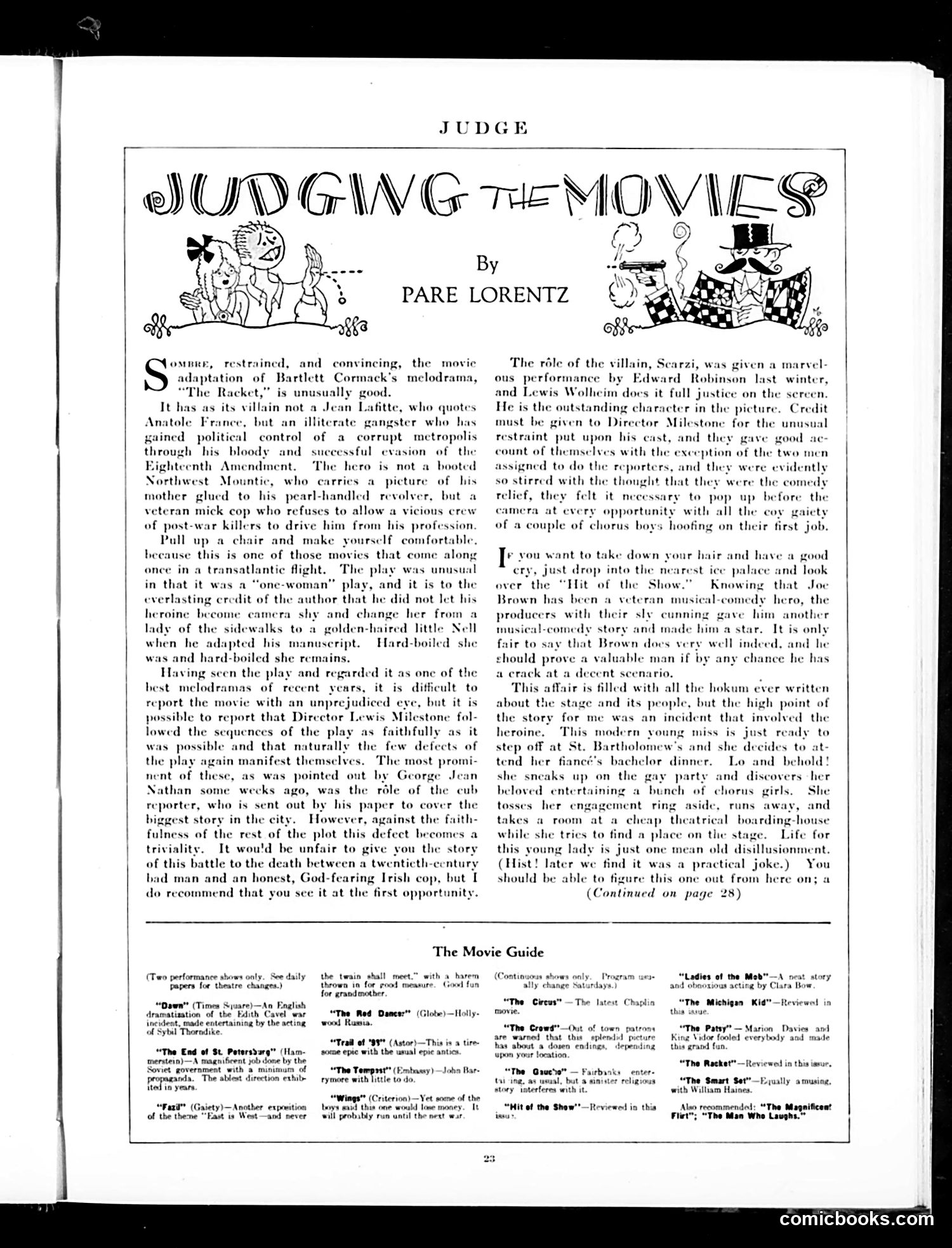
This is a film review column, not a political cartoon. Lorentz reviews the film adaptation of "The Racket," a gangster melodrama by Bartlett Cormack. The review praises the film's restraint and realism. Rather than featuring romantic heroes like Jean Lafitte or Northwest Mounties, the story centers on an "illiterate gangster" who controls a corrupt city through violence, and a veteran cop who opposes him. Lorentz credits Director Lewis Milestone for disciplined casting and direction. The review criticizes the cub reporter character (added from the play) as the story's weak point—he represents unnecessary comic relief. The reviewer also discusses Joe Brown's performance in a musical-comedy subplot and critiques a contrived plot involving a fiancée discovering her partner at a bachelor party with chorus girls. The tone suggests this represents a modern, grittier approach to film melodrama, departing from nineteenth-century theatrical clichés.
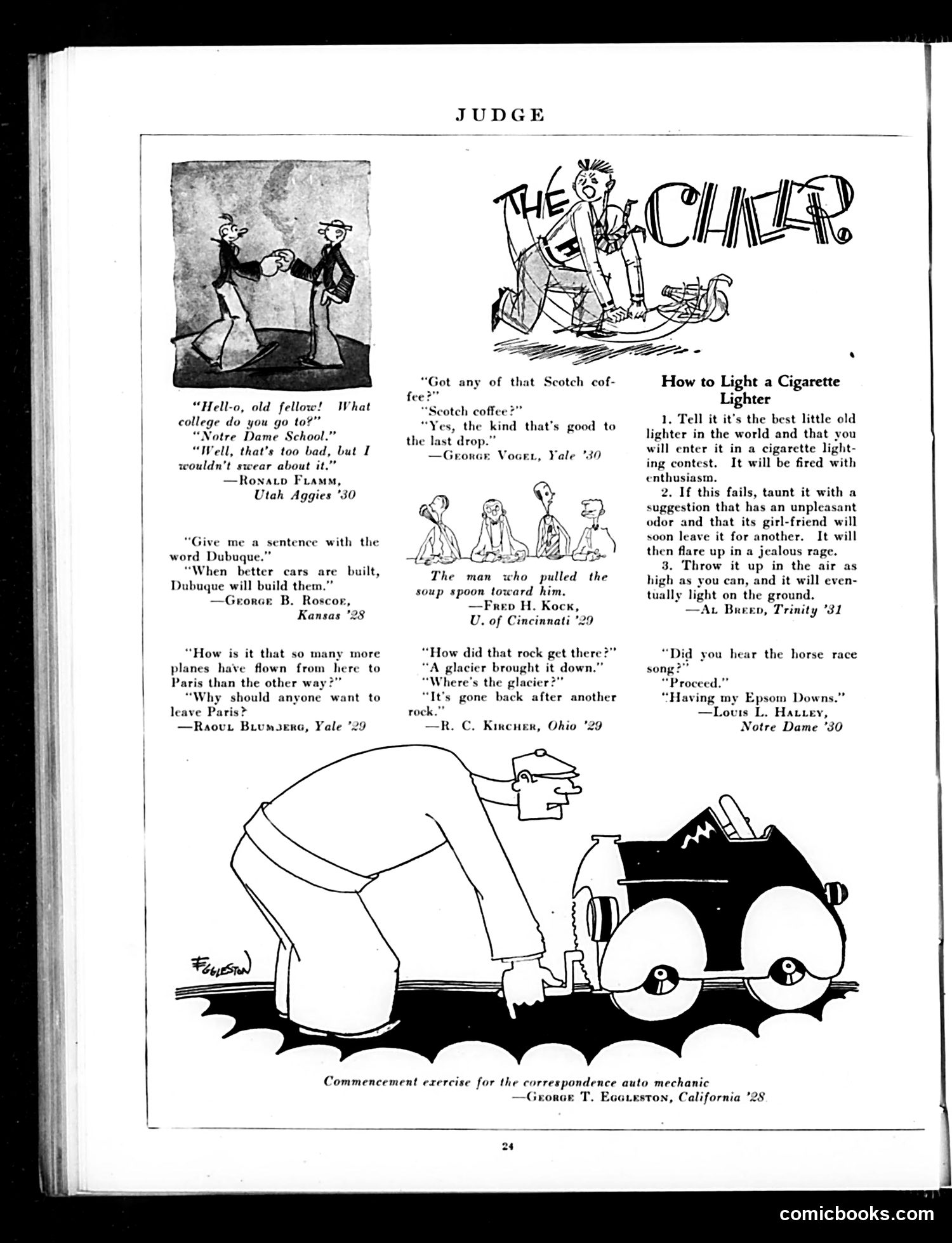
This page collects student humor submissions—jokes and cartoons from college contributors. The content reflects 1920s campus wit: **College Jokes**: The Notre Dame and Dubuque quips mock regional rivalries and college stereotypes. References to Paris and aviation allude to post-WWI travel trends. **The Cigarette Lighter Piece**: Mock-instructional humor personifying a lighter as temperamental and jealous—absurdist comedy treating an object as emotionally volatile, a popular satirical style of the era. **The Main Cartoon**: Shows a man bent over an automobile engine, with the caption about "commencement exercise for the correspondence auto mechanic"—satirizing the absurdity of learning car repair through mail correspondence rather than hands-on training, a growing distance-education trend. **The Horse Race Reference**: "Epsom Downs" is a British racing venue; the joke plays on the homophone "Epsom" versus "upset stomach." All content targets educated middle-class readers familiar with colleges, automobiles, and contemporary leisure activities.
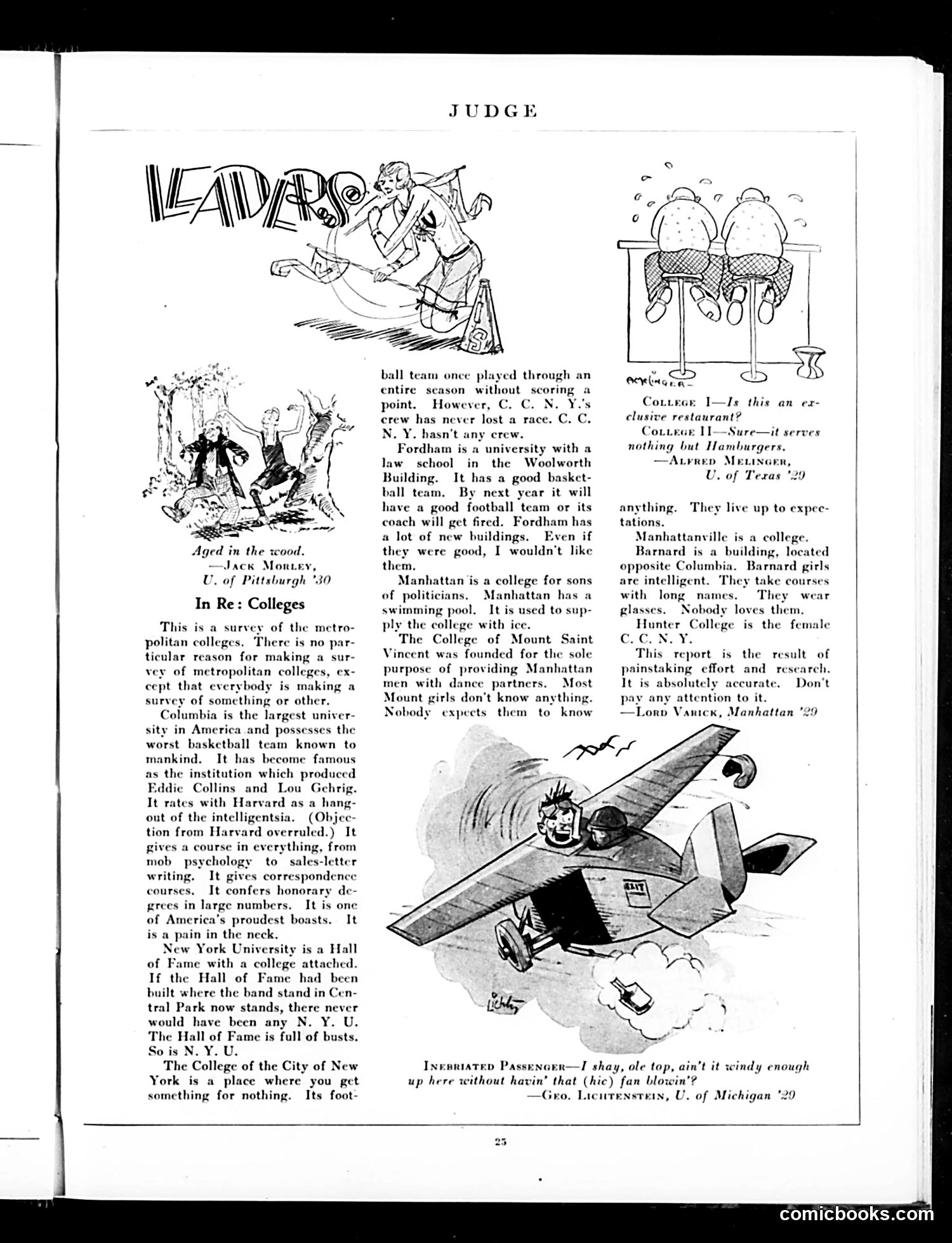
This page satirizes metropolitan colleges circa 1929. The main text is a tongue-in-cheek "survey" mocking New York area universities: Columbia is criticized for its terrible basketball team despite producing famous athletes; NYU is essentially just a Hall of Fame; City College had a winless football team; Fordham threatens to fire coaches over poor sports performance; Manhattan College's swimming pool serves primarily to supply ice rather than recreation. The cartoons are lighter fare—one depicts someone "aged in the wood" (a whiskey barrel), and another shows an airplane passenger complaining about wind, referencing early aviation discomfort. A separate comic depicts two diners discussing hamburgers served at an exclusive restaurant. The satire targets institutional pretension and America's obsession with collegiate athletics in the Jazz Age, while acknowledging the author's own unreliability ("absolutely accurate. Don't pay any attention to it").
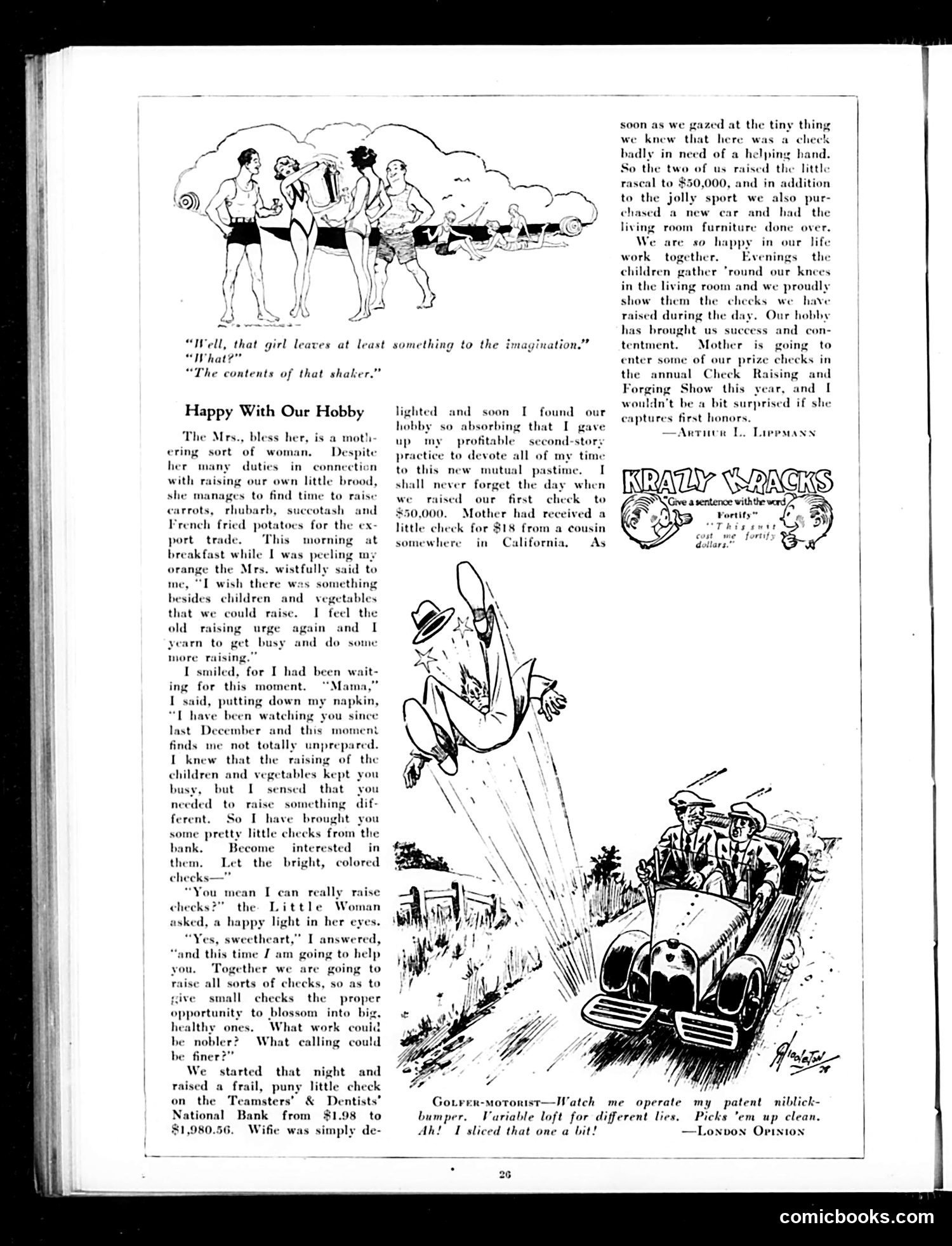
This satirical story mocks the era's get-rich-quick schemes and speculative financial culture. The narrator presents "raising checks" (literally increasing bank deposits through fraudulent means—essentially check forging and embezzlement) as a wholesome family hobby, using the language of agricultural improvement ("raising" crops and children) to normalize financial crime. The humor works through deadpan earnestness: the wife and husband treat forging checks as noble work, involve their children, and aim for a "Check Raising and Forging Show." The satire targets both financial fraud's prevalence in the period and the moral blindness of those engaged in it—they present obvious criminality as virtuous family enterprise. The secondary cartoon above shows a woman with a "shaker," likely salt or sugar, leaving "something to the imagination"—implying she's scantily dressed or the shaker's contents are ambiguous.
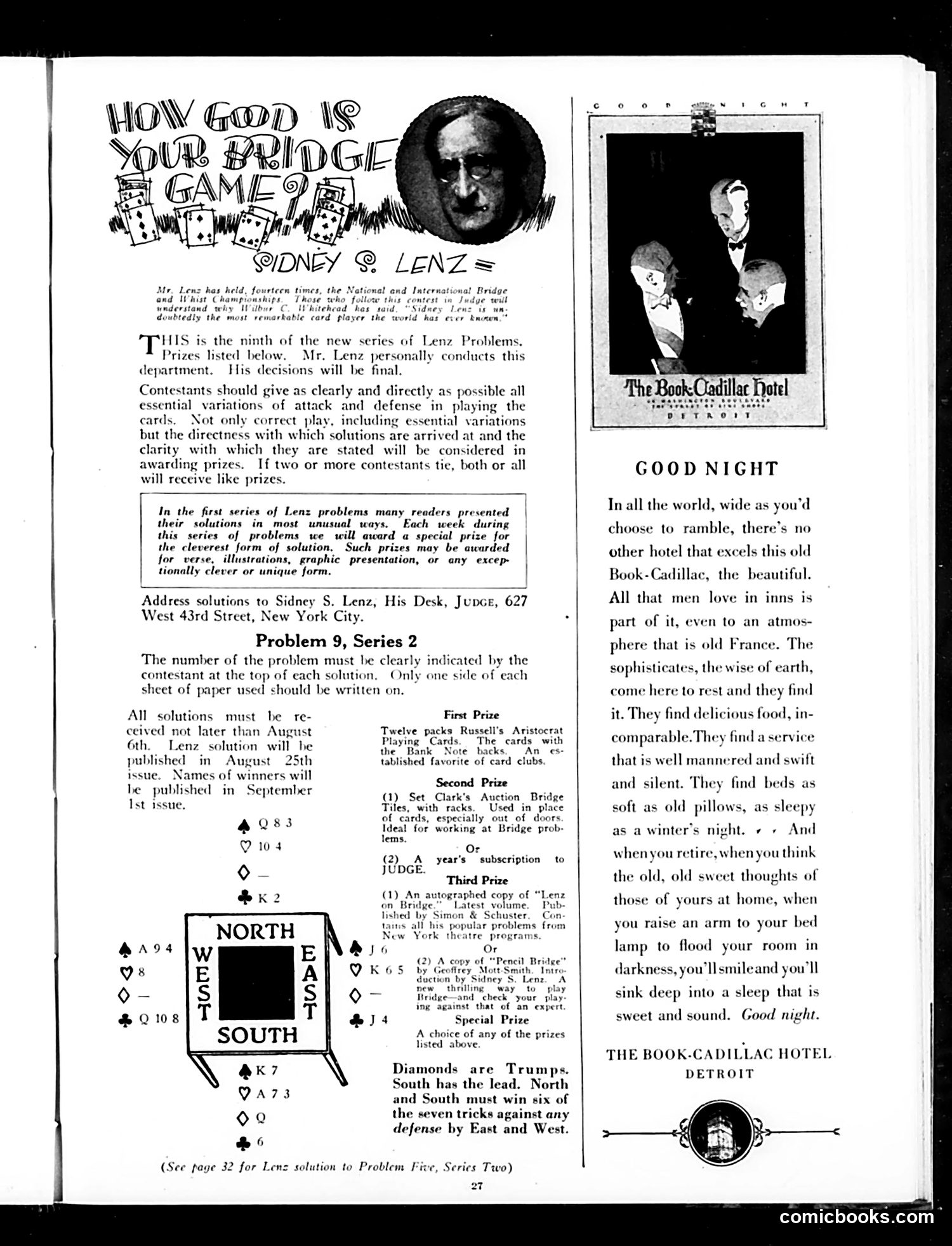
This page features **Sidney Lenz**, a renowned bridge champion (the text notes he won "fourteen times, the National and International Bridge...Championships"). Judge is running an ongoing series of bridge problems contributed by Lenz, inviting readers to submit solutions for prizes. The cartoon at top left ("How Good Is Your Bridge Game?") presents Lenz as an authority figure evaluating players' card skills, using dice imagery to suggest chance versus skill in the game. The content is primarily **instructional/competitive**, not satirical. Readers compete by submitting bridge solutions analyzed for both correctness and clarity of presentation. Prizes range from Russell's Aristocrat Playing Cards to Lenz's own book, "Lenz on Bridge." The right page contains a **Book-Cadillac Hotel advertisement** using nostalgic, sophisticated language to market Detroit's luxury hotel as an old-world refuge for discerning travelers. This represents Judge's dual function: satirical commentary mixed with entertainment, puzzles, and paid advertising.
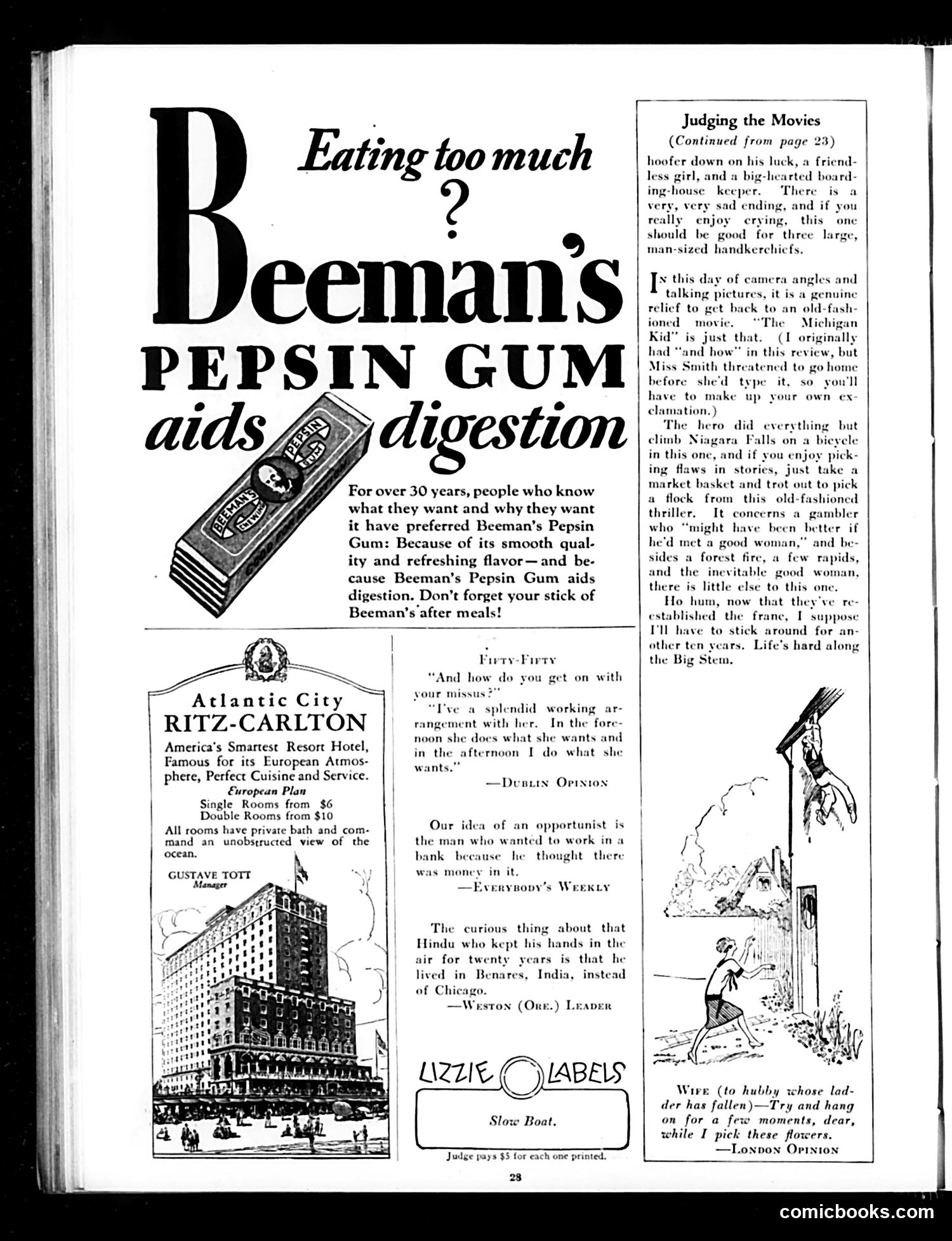
This page is primarily **advertising** interspersed with brief humor items typical of Judge magazine's format. The main advertisement promotes **Beeman's Pepsin Gum**, marketed as a digestive aid—reflecting early 20th-century patent medicine culture when such products made health claims (pepsin was believed to aid digestion). The copy targets people concerned with overeating. Secondary ads include the **Ritz-Carlton** Atlantic City resort and a **Lizzie Labels** product. The humor section contains short jokes and quips about marriage dynamics, opportunism, and Hindu asceticism. The "Fifty-Fifty" joke mocks marital compromise where the wife dominates both morning and afternoon. A cartoon at bottom depicts a wife asking her husband to "hang on" while she picks flowers after he's fallen from a ladder—satire on wives' indifference to husbands' mishaps. A movie review discusses sentimental dramas with predictable plots, suggesting audiences' appetite for melodrama and manufactured emotion.
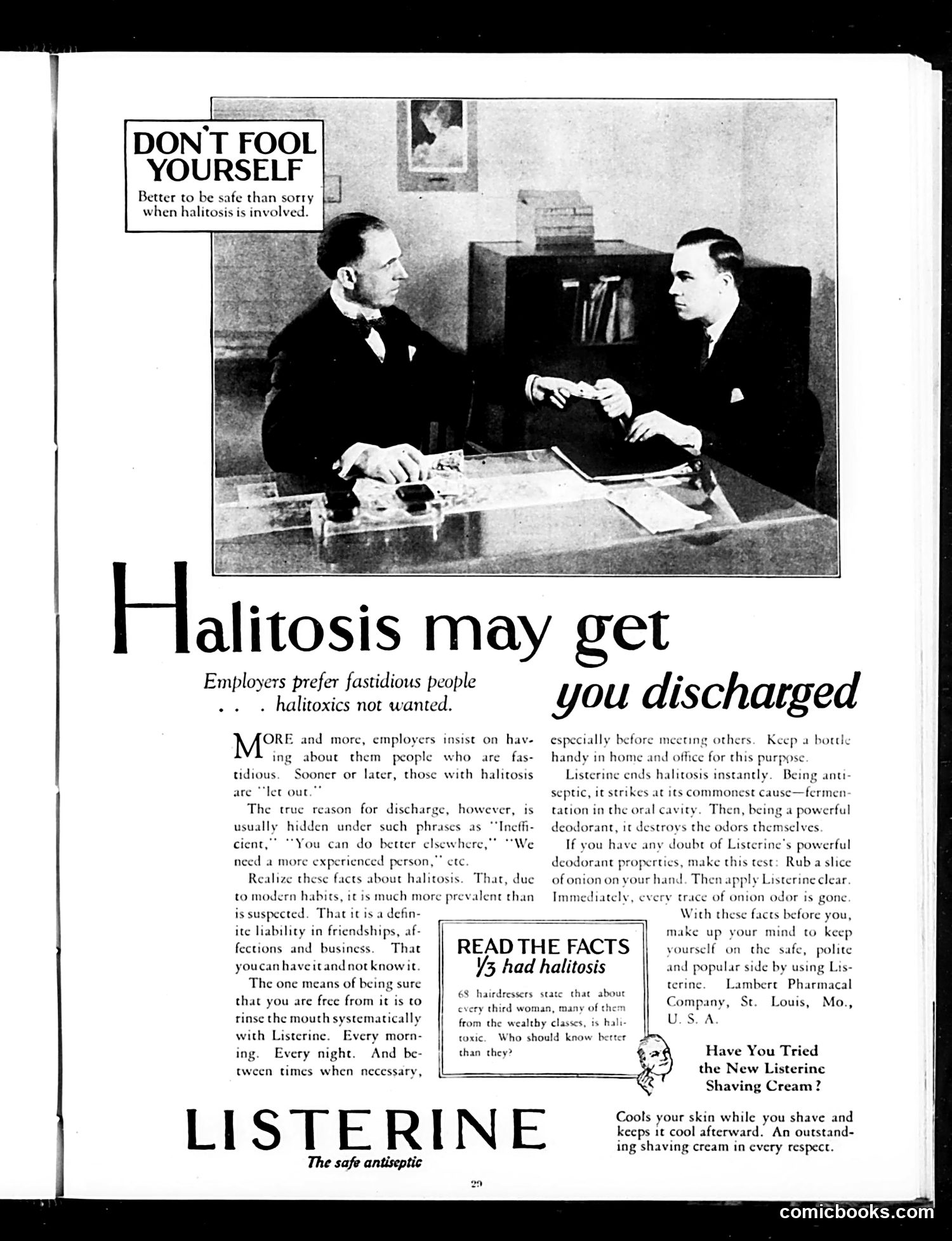
This is primarily a **Listerine advertisement disguised as editorial content**, not political satire. The page uses fear-based marketing targeting early 20th-century workplace anxieties. **The "cartoon"** shows two businessmen in an office; the image suggests a job interview or employment discussion, visually supporting the text's claim that halitosis causes job loss. **The social reference** exploits genuine employment insecurity of the era—workers could be fired for vague reasons. The ad invents "halitosis" (bad breath) as a supposedly widespread, hidden liability affecting friendships and careers, particularly targeting women (noting "68 hairdressers state that about every third woman" suffers it). **The satirical/manipulative angle**: Judge magazine presents this as factual health advice while Listerine actually *created* halitosis as a medical condition to sell mouthwash. The phrase "Don't Fool Yourself" ironically urges readers to accept the product's claims uncritically. The page also advertises Listerine shaving cream, expanding the product line. This represents early 20th-century **advertising disguised as journalism**—a common Judge tactic.
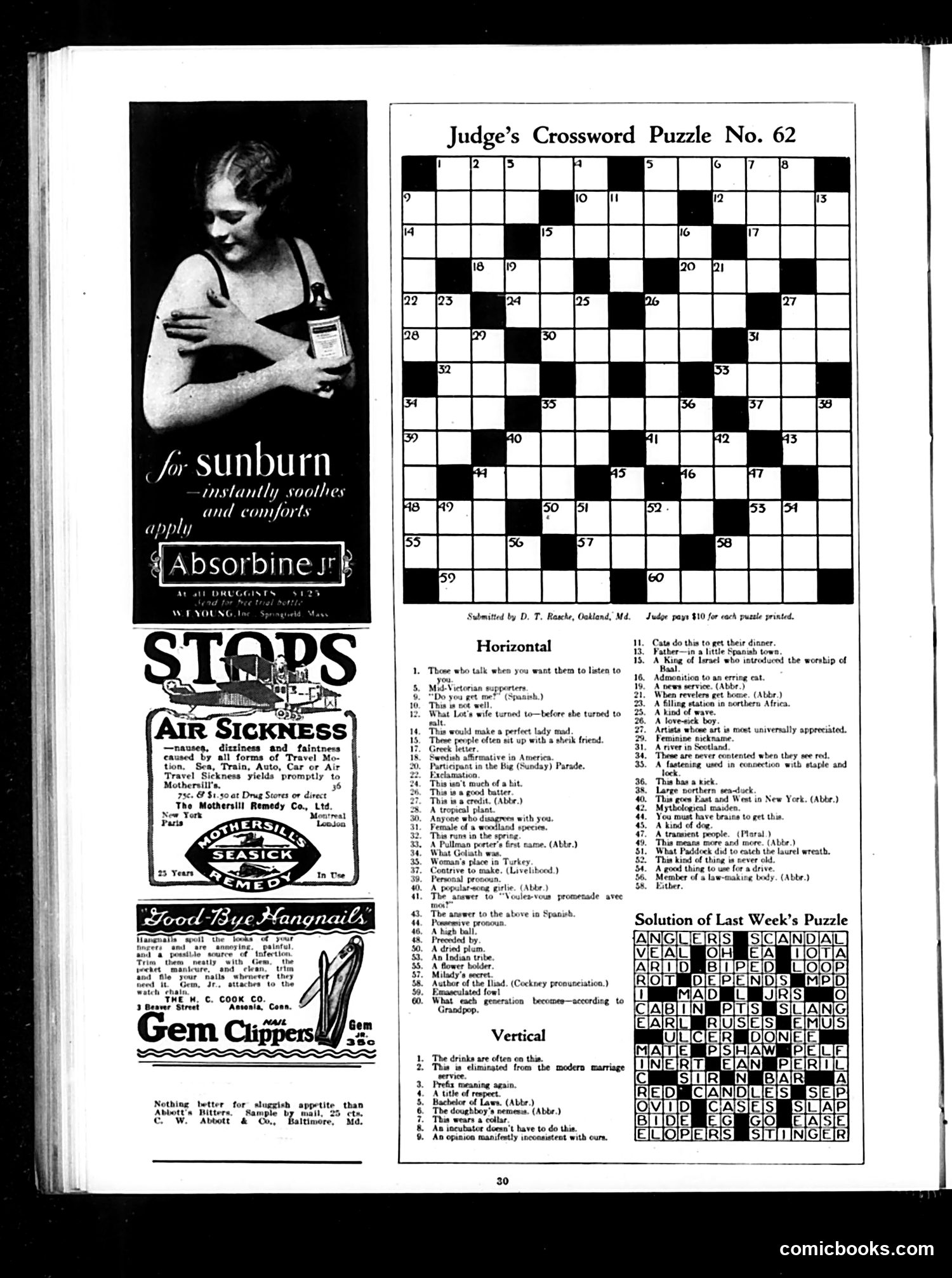
This page is primarily **advertisements and a crossword puzzle**, not editorial satire. The advertisements include: - **Absorbine Jr.** (a liniment for sunburn relief) - **Mothersill's** (a seasickness remedy marketed to travelers) - **Seasick Remedy** (another nausea treatment) - **Gem Clippers** (grooming tools) - **Abbott's Bitters** (a digestive tonic) The only illustrated content is a photograph of a woman applying sunburn treatment—a straightforward product advertisement rather than political commentary. The "Judge's Crossword Puzzle No. 62" dominates the right side, with clues referencing period topics (Turkish customs, Spanish phrases, biblical references to Baal worship). The solution to last week's puzzle is printed below. **Context for modern readers:** This represents how Judge filled space with practical consumer goods and entertainment rather than always delivering satire. Early 20th-century magazines frequently mixed editorial content with substantial advertising.
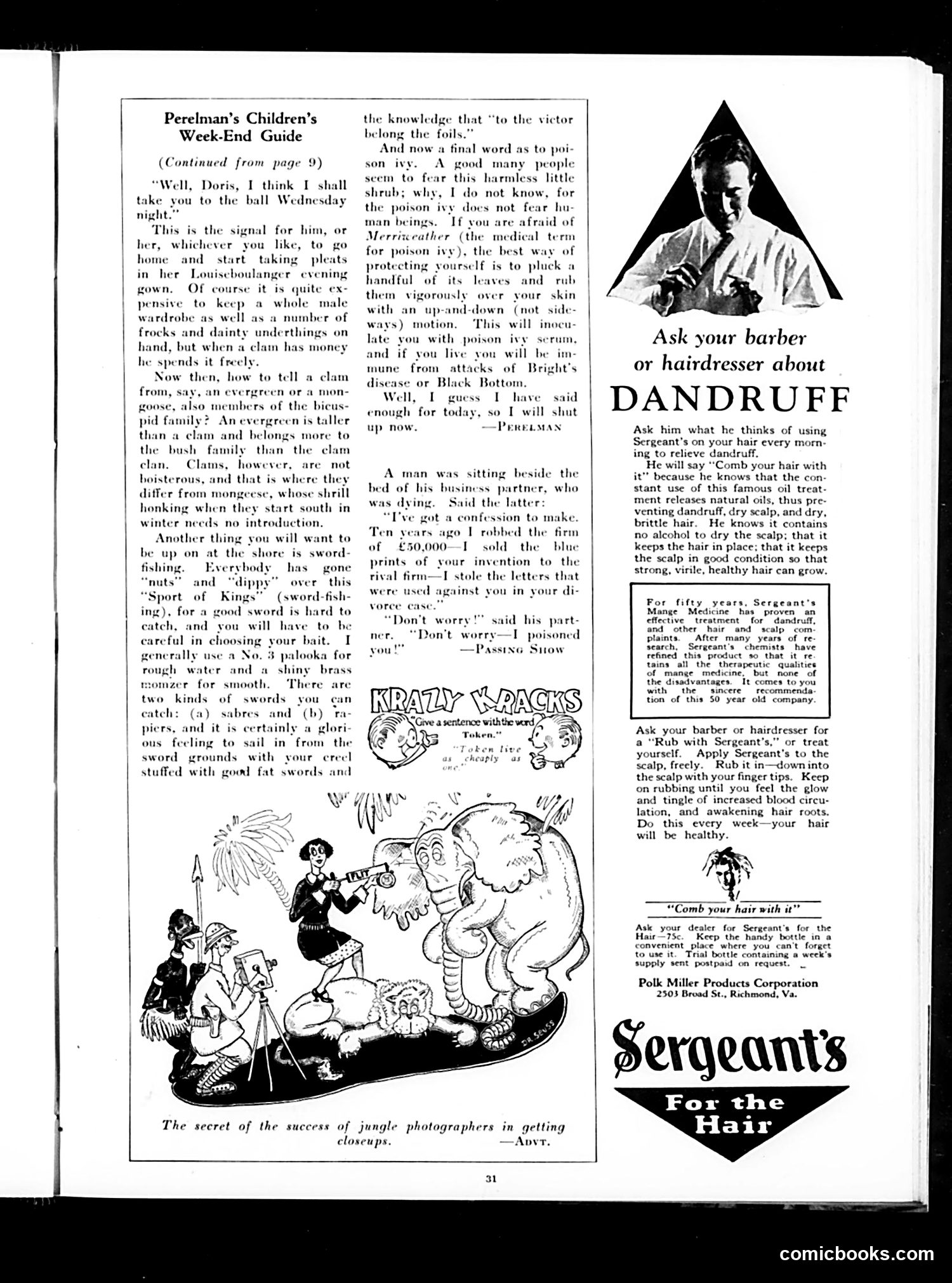
This page contains **Perelman's Children's Week-End Guide**—a humorous advice column by S.J. Perelman (a famous humorist) offering absurd tips for weekend activities. The main joke relies on intentional non-sequiturs: he conflates unrelated things (clams vs. evergreens vs. mongooses) and offers ridiculous advice about sword-fishing and poison ivy that pretends to be practical while being deliberately nonsensical. The **cartoon below** depicts the "secret of jungle photographers getting closeups"—showing armed explorers fleeing from a charging elephant. It's a visual pun on the double meaning of "closeup": getting close to dangerous animals requires weapons and escape tactics, not camera technique. The right side features **advertising for Sergeant's hair products** (dandruff treatment), with endorsements framed as barber advice—common 1920s-30s marketing strategy. The overall page mixes sophisticated satire with commercial messaging, typical of Judge magazine's format.
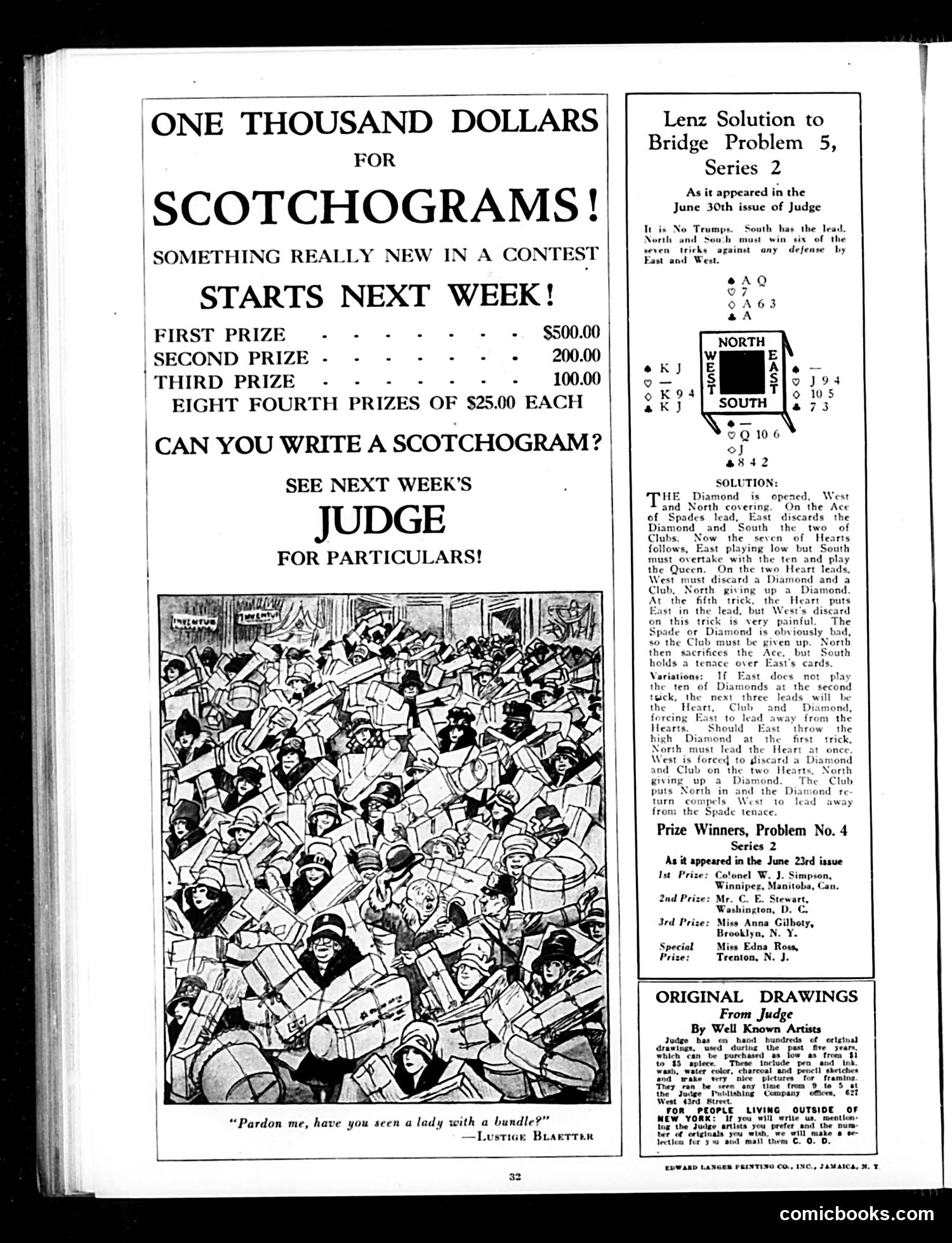
This page mixes advertising with bridge puzzles and humor typical of Judge magazine. **Main Content:** The left side advertises a "Scotchograms" contest—apparently a word puzzle or writing competition offering $1,000 in prizes, starting the following week. The cartoon caption "Pardon me, have you seen a lady with a bundle?" by Lustick Blaetter appears to be a humorous domestic scene, likely playing on Prohibition-era innuendo (the "bundle" possibly suggesting hidden liquor). **Right Side:** This contains a bridge card game solution from the magazine's June 30th issue, including a diagram, explanation of play strategy, and prize winners from an earlier problem. Bridge was enormously popular as parlor entertainment during this era. **Context:** The page reflects 1920s-30s leisure culture: card games, word puzzles, and contests were common Judge features targeting educated, middle-class readers seeking intellectual recreation and cash prizes during economically uncertain times.
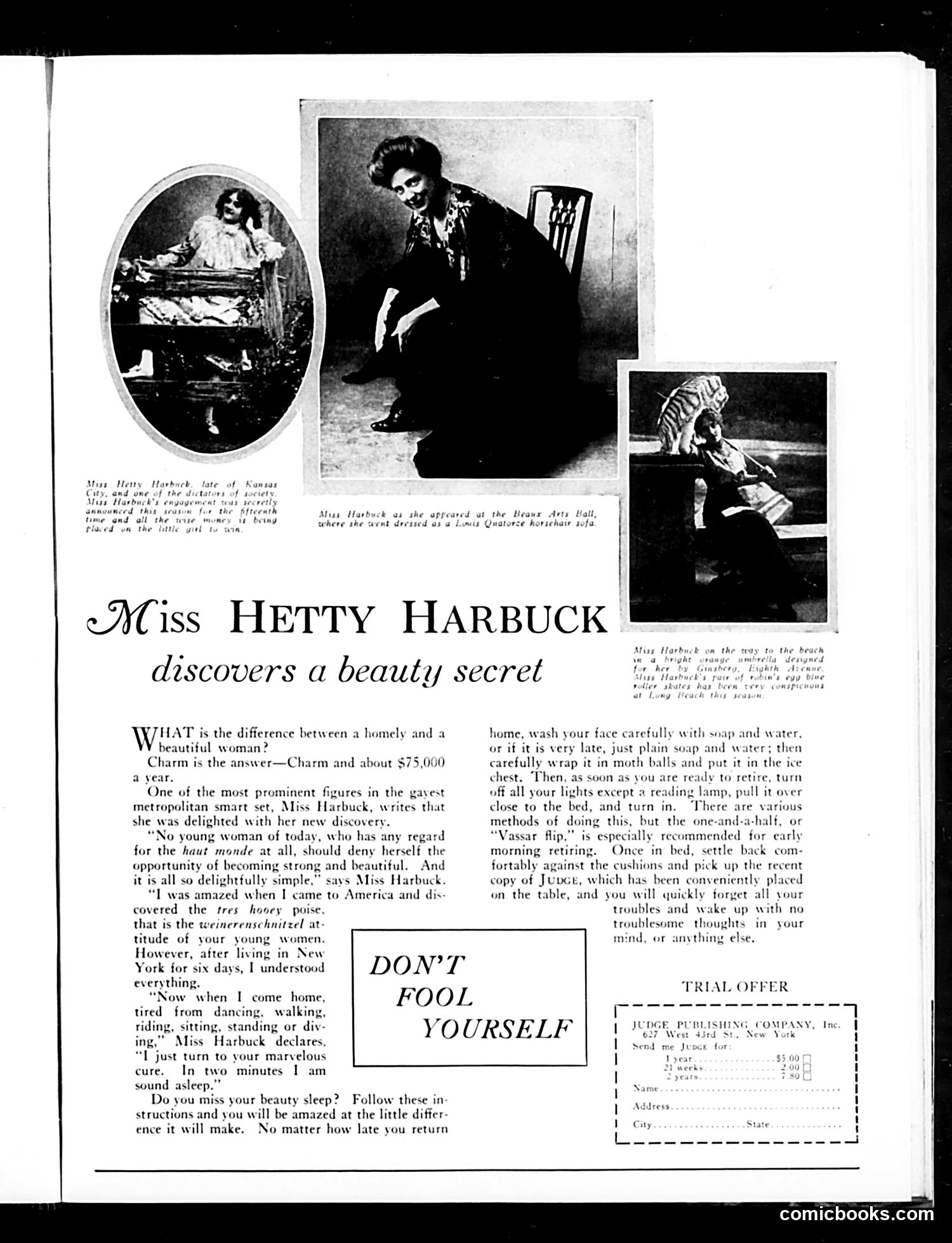
This is a satirical advertisement disguised as a beauty advice feature. Judge magazine mocks wealthy socialites like "Miss Hetty Harbuck" (likely a fictional composite of real society figures) who attribute their beauty to expensive treatments and lifestyles. The satire works on multiple levels: the article claims beauty requires "$75,000 a year" and sophisticated European manners (references to "haut monde," French phrases), while the actual "marvelous cure" advice is deliberately absurd—wrapping your face in mothballs, sleeping under a reading lamp, and reading Judge magazine to fall asleep. The joke targets the vanity and pretension of the wealthy elite during this era (appears to be 1910s-1920s), suggesting that beauty and charm among the upper class are more about money and affectation than genuine self-care. The photographs showing Harbuck in costume reinforce the satirical point: she's literally all performance and artifice.
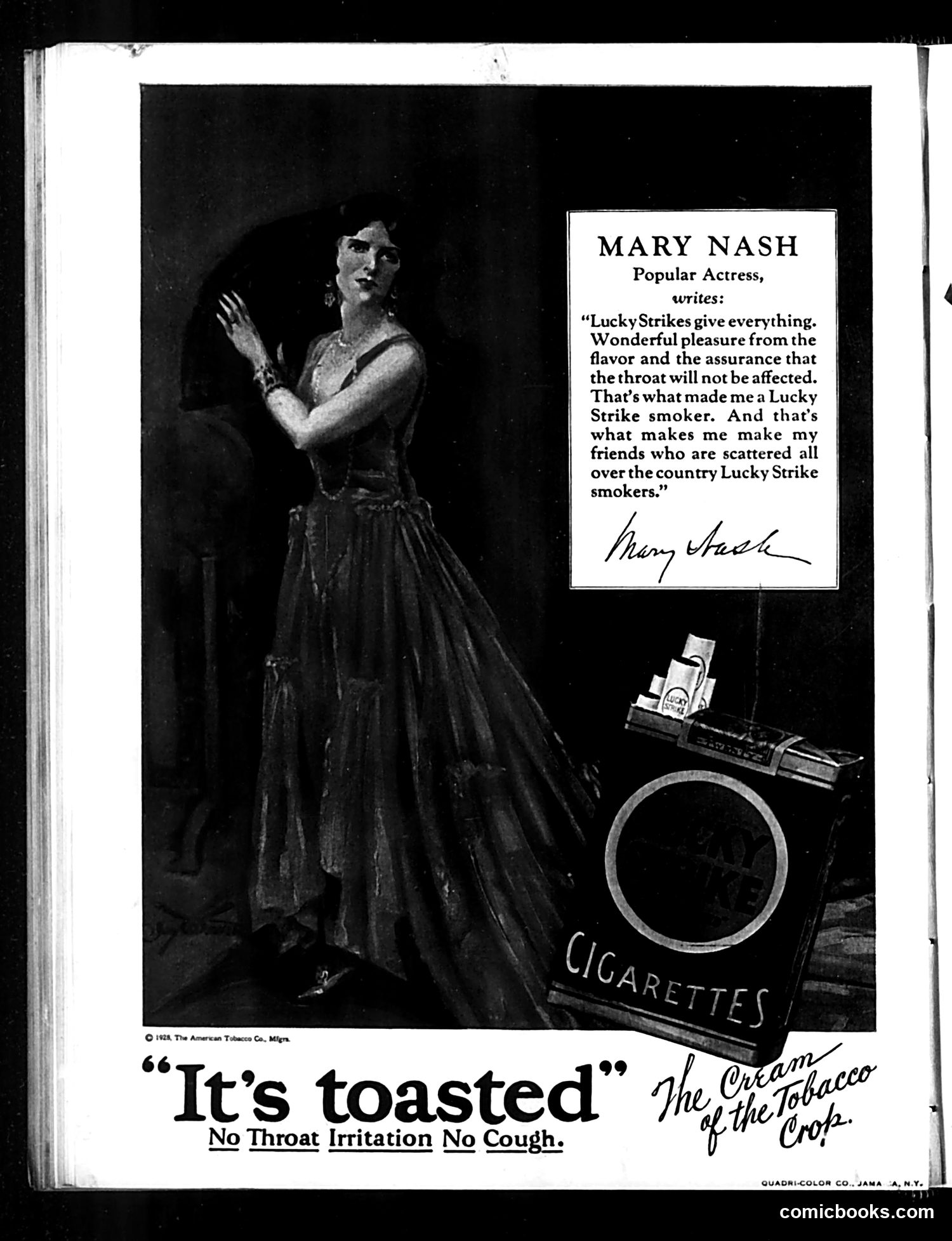
This is a **cigarette advertisement**, not satire or political commentary. It features actress Mary Nash endorsing Lucky Strike cigarettes circa 1920s-1930s. The ad leverages her celebrity status to promote smoking as glamorous and safe. Nash's testimonial claims Lucky Strikes cause "no throat irritation" and "no cough"—health assurances that would later be recognized as false advertising. For modern readers: This exemplifies pre-regulation tobacco marketing that exploited celebrity endorsements and made unsubstantiated health claims. The emphasis on "toasted" tobacco and "cream of the crop" represents typical marketing language used to differentiate brands while avoiding any actual health data. Such advertisements are now illegal, reflecting how consumer protection evolved.