
A complete issue · 36 pages · 1928
Judge — June 23, 1928
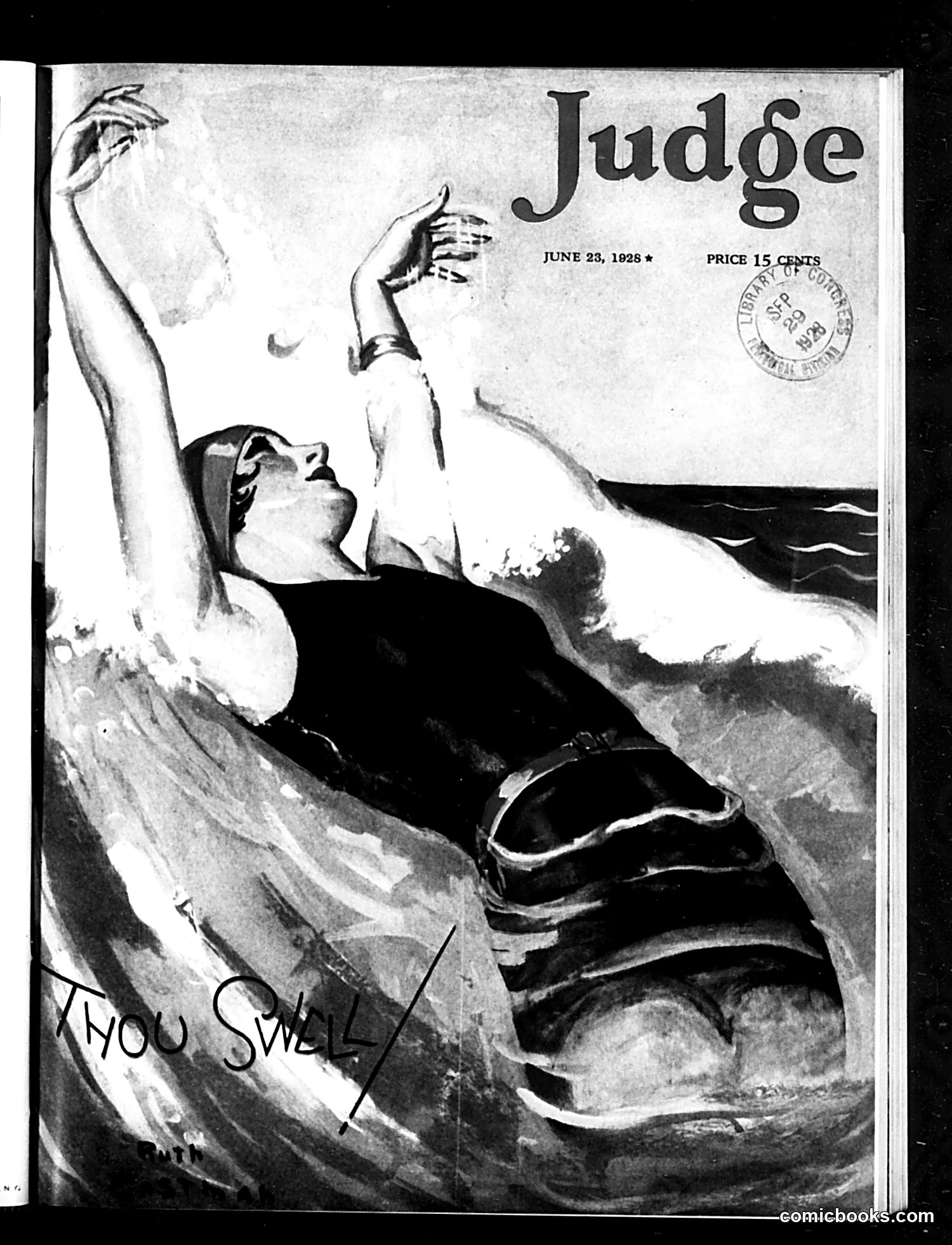
This cover depicts a man in formal attire being swept away by a dramatic wave or gust of wind. The figure's posture—arms raised desperately—suggests he's losing control or being overwhelmed by forces beyond his command. The partial text "THOU SHALT" visible on the lower left appears to reference biblical commandments, suggesting moral or ethical judgment as the cartoon's theme. Without clearer identification of the specific figure or accompanying article text, the precise political target remains unclear. However, the imagery of helplessness against powerful forces was common in 1928 satire addressing financial markets, prohibition enforcement, or political scandals of that era. The overall tone suggests critique of someone or something facing inevitable downfall or judgment.
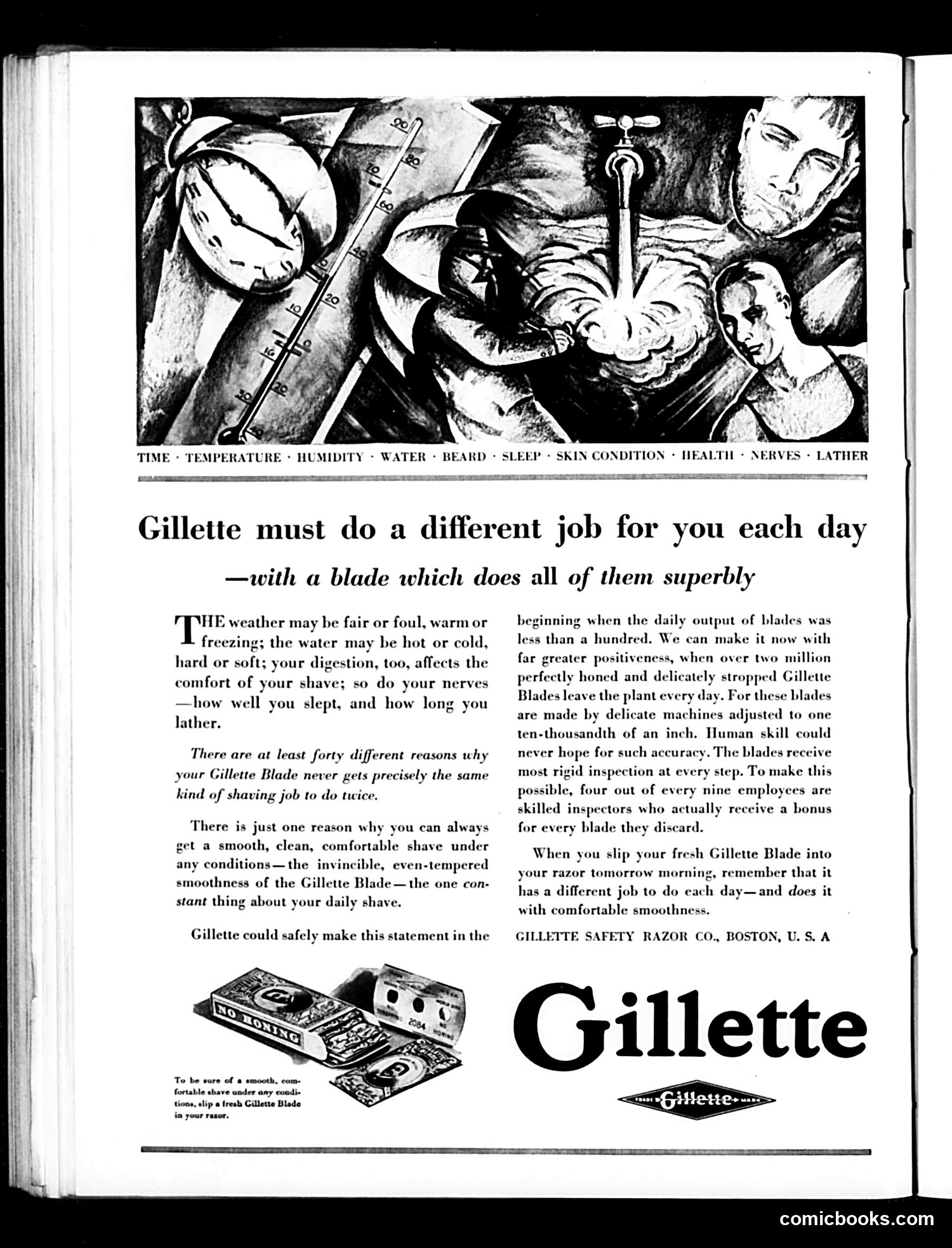
This page is **primarily a Gillette razor advertisement**, not satirical content. The top illustration depicts various factors affecting shaving comfort—temperature, humidity, water quality, beard condition, sleep, skin health, nerves, and lather—represented through sketched figures and objects. The ad's claim is that Gillette blades maintain consistent performance ("the one constant thing") regardless of these variable conditions. The text emphasizes manufacturing precision and quality control (inspectors bonus for rejecting imperfect blades). There is **no political satire or social commentary** present. This is a straightforward commercial that appeared in *Judge* magazine, likely alongside editorial cartoons on other pages. The ad targets men's grooming routines by positioning Gillette as the reliable solution to daily shaving challenges.
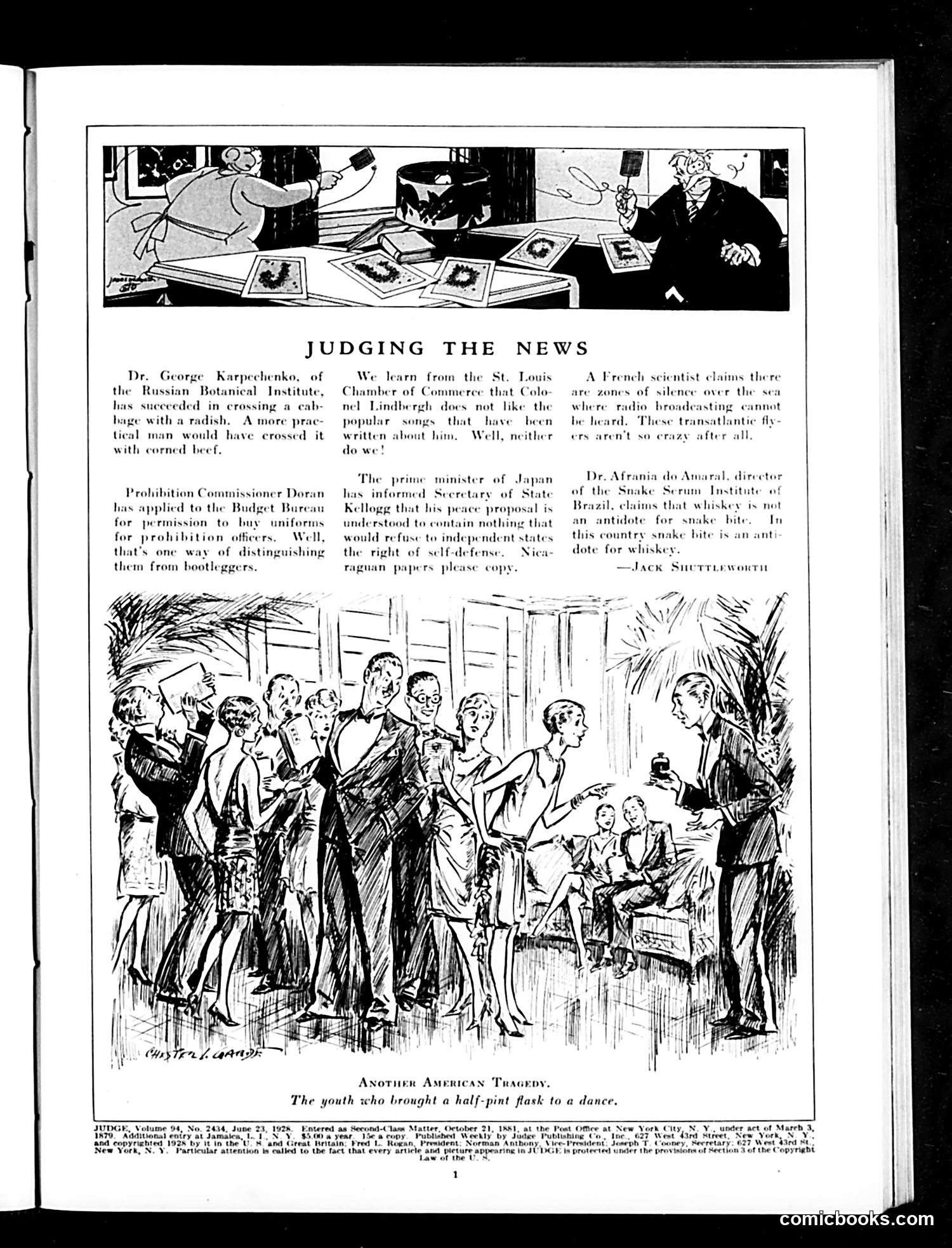
This page satirizes contemporary news stories through short commentaries and cartoons. The **top cartoon** depicts editors reviewing photographs, mocking sensationalism in journalism. The **text items** include: - A joke about Dr. Karpchenko crossing a cabbage with radish (absurdist science mockery) - Criticism of Prohibition Commissioner Doran's uniform distinction proposal - Commentary on Japan's Prime Minister Kellogg's peace proposal being misunderstood as rejecting states' self-defense rights - A claim about French scientists discovering "zones of silence" over the sea where radio broadcasts cannot be heard - A Brazilian scientist's claim that whiskey is "not an antidote for snake bite" The **bottom cartoon** illustrates "Another American Tragedy": a youth bringing a flask to a dance—satirizing Prohibition-era youth culture and illegal alcohol consumption as a social problem.
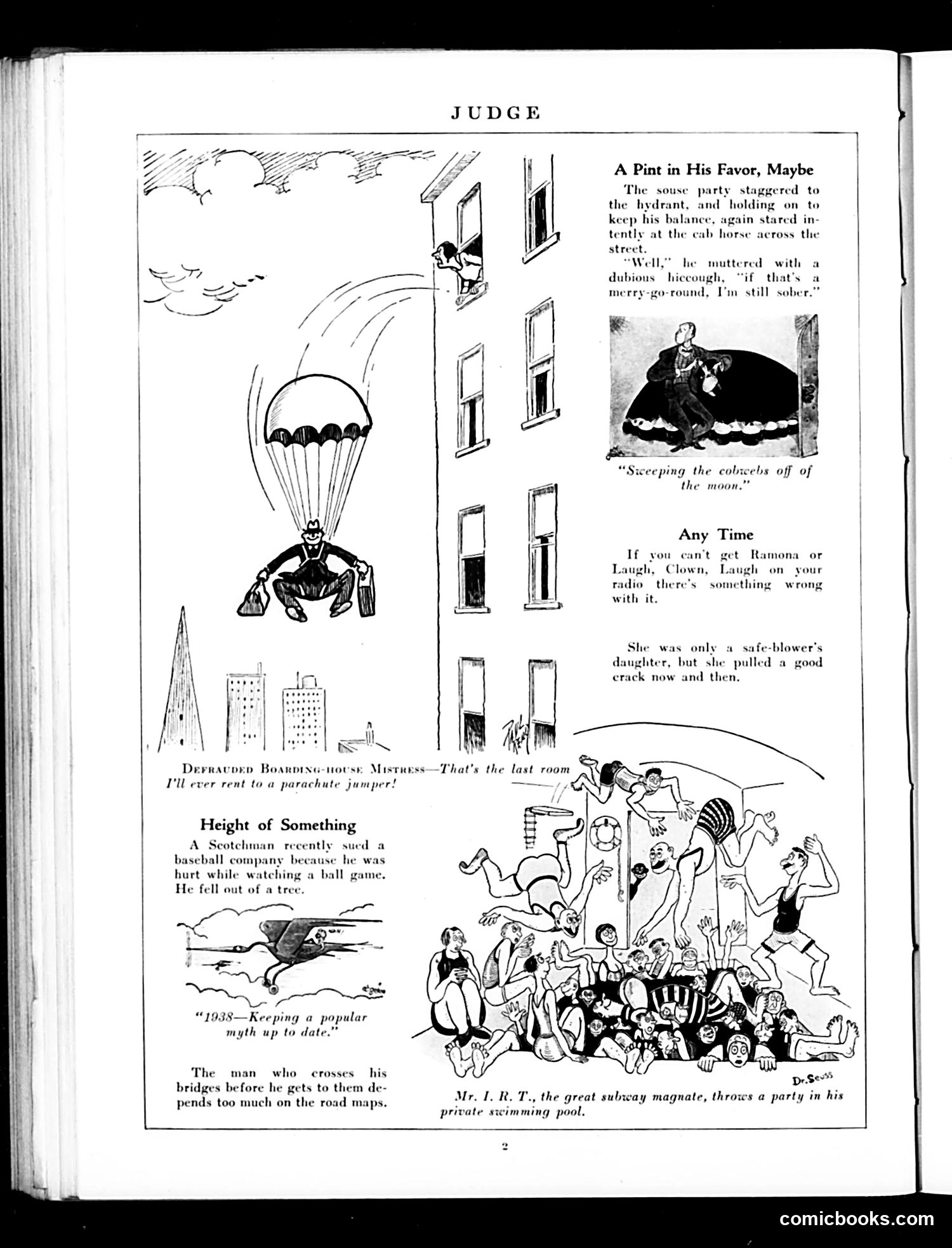
This page contains several unrelated satirical comics and jokes typical of Judge's format: 1. **"A Pint in His Favor, Maybe"** depicts a drunk man clinging to a hydrant, joking that he's "still sober" — satirizing alcohol consumption and public intoxication. 2. **"Defrauded Boarding-house Mistress"** shows a parachutist descending from a building, captioned as someone avoiding rent payment — a visual gag about evasion. 3. **"Height of Something"** references a 1938 lawsuit involving a Scotsman injured at a baseball game, with a pun about "keeping a popular myth up to date." 4. **The swimming pool scene** depicts I.R.T. (Interborough Rapid Transit, NYC's subway system) magnate throwing a crowded party, satirizing the contrast between wealth and working-class conditions during this period.
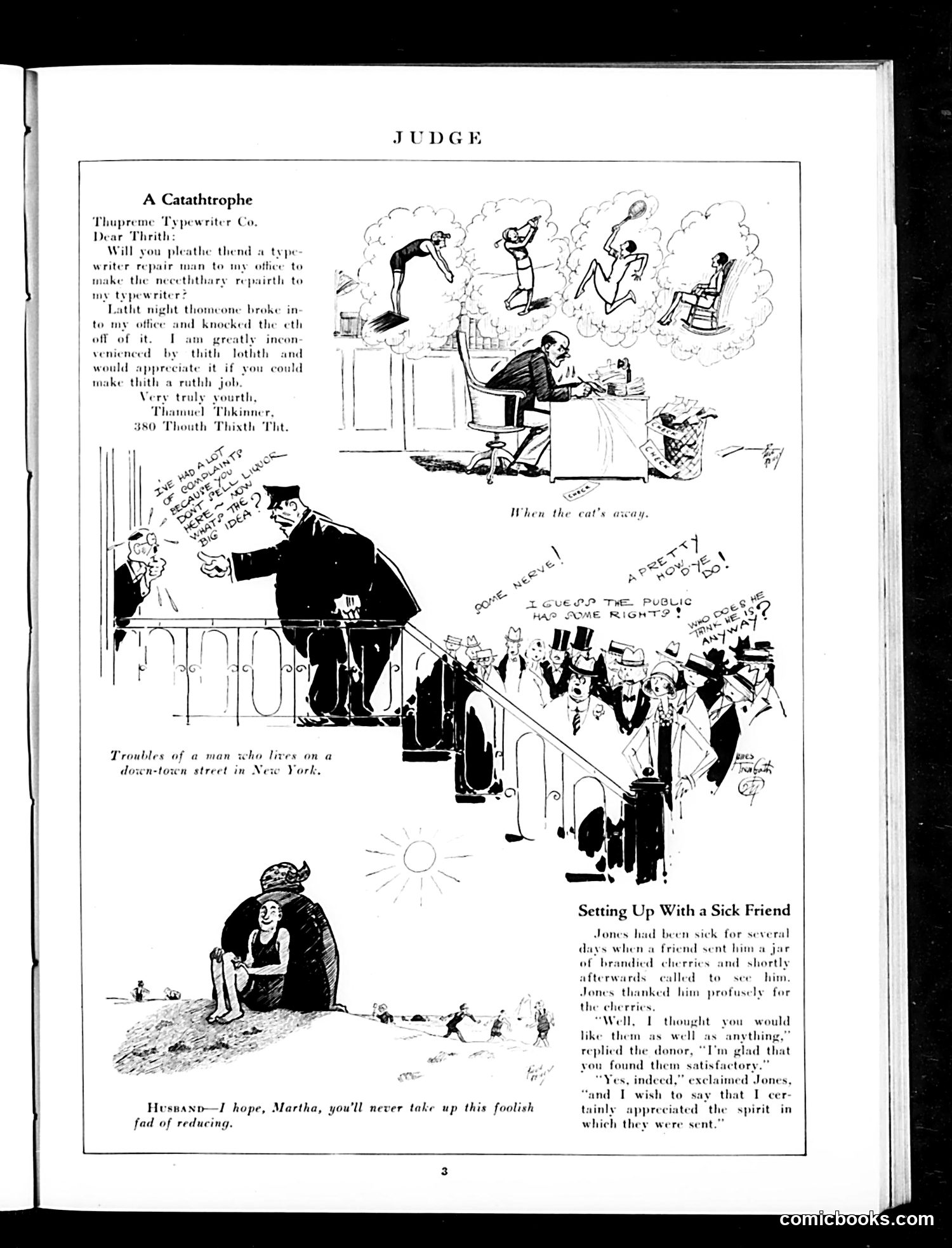
This page contains three distinct satirical pieces: 1. **"A Catastrophe"** (top): A letter from Haplprime Typewriter Co. depicts an office worker's chaotic daydreaming—imagining colleagues flying through the air—after a typewriter malfunction. The satire mocks both workplace frustrations and the writer's dramatic overreaction. 2. **"Troubles of a man who lives on a down-town street in New York"** (middle): Shows a man shouting from a tenement building at crowds below, with speech bubbles about public rights. This likely satirizes urban noise disputes and tenement-living complaints common in early 20th-century New York City. 3. **"Setting Up With a Sick Friend"** (bottom right): Jones receives branded cherry liquor as a "get well" gift. The joke centers on the friend's euphemistic gift—implying alcohol as medicine rather than genuine kindness.
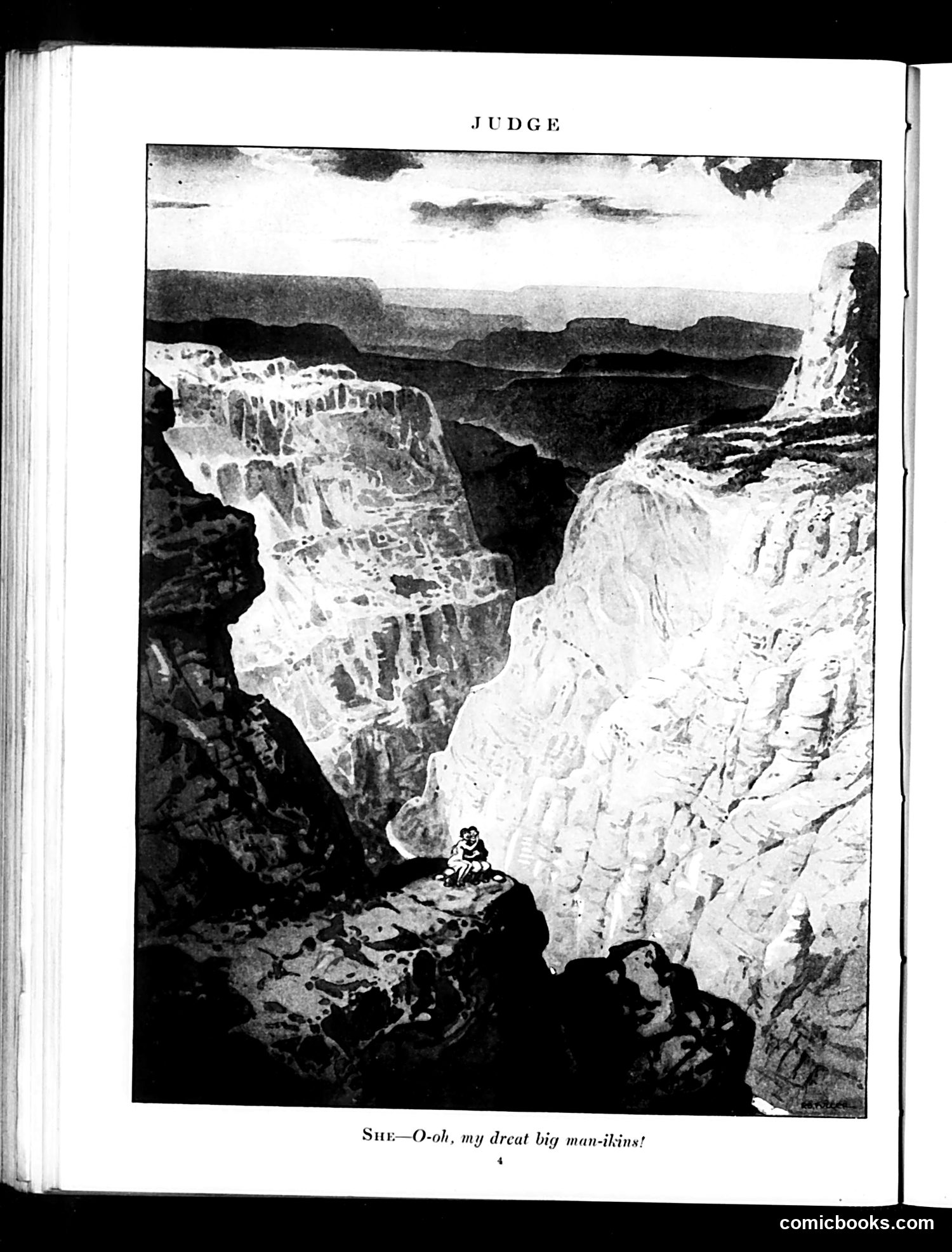
This appears to be a satirical illustration from *Judge* magazine titled "She—Oh, my great big man-skins!" The image shows a figure in a canyon or rocky gorge landscape, positioned dramatically on elevated terrain with steep cliff walls. The caption's phrasing—"man-skins"—suggests gender-based satire, likely mocking either masculine pretense or a woman's admiration of male physique/appearance. Without additional context about the specific historical period or accompanying article text, the exact political or social target remains unclear. The dramatic landscape positioning may emphasize the figure's self-importance or vulnerability depending on the intended irony. The cartoon's meaning requires knowledge of contemporary 1890s-1910s social debates about gender roles to interpret fully.
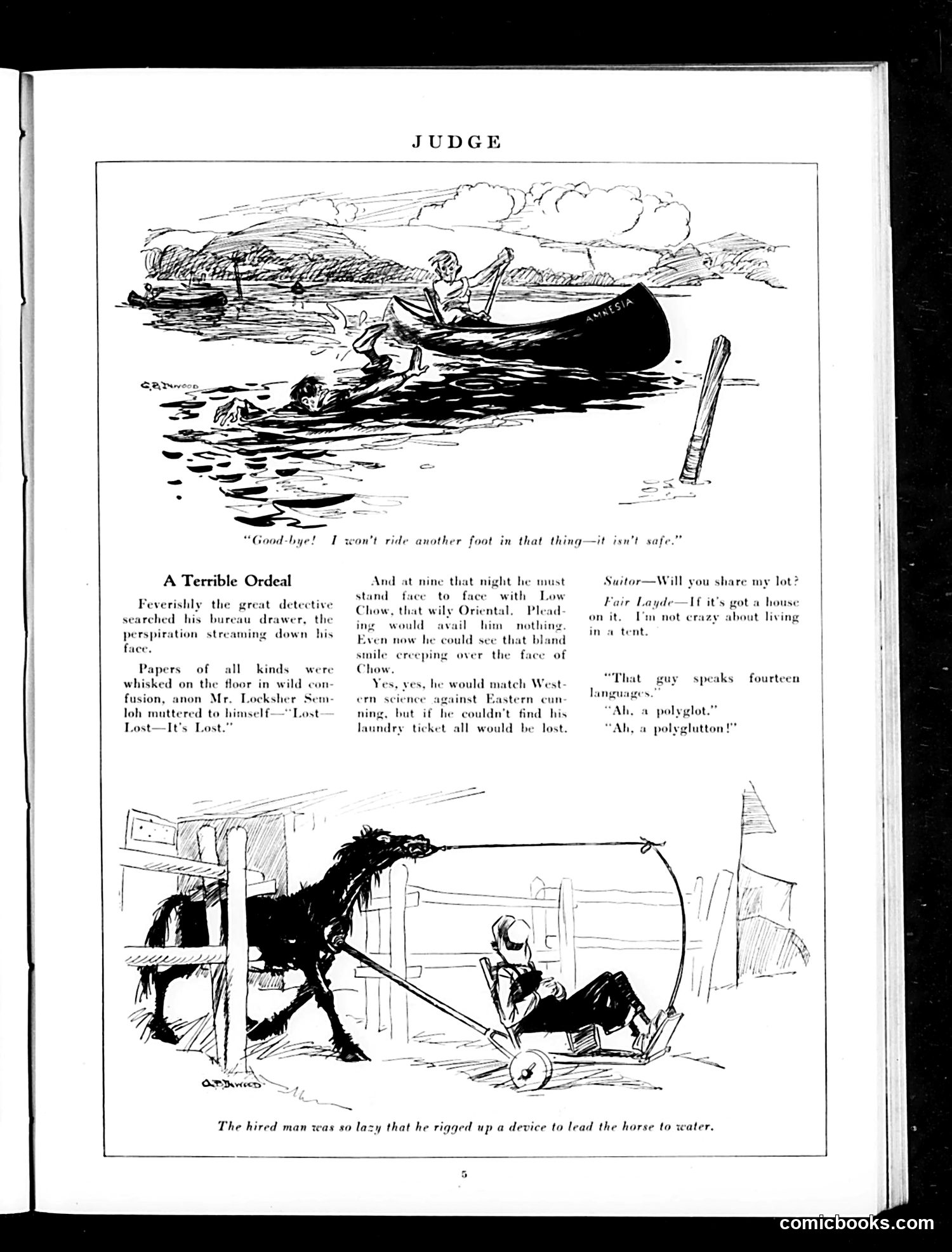
This page contains two unrelated cartoons satirizing different subjects. **Top cartoon ("A Terrible Ordeal"):** Shows someone refusing to ride in a canoe, calling it unsafe. The accompanying text references a detective searching his bureau and papers scattered on the floor, mentioning "Lost—It's Lost" repeatedly. This appears to satirize anxiety about lost documents or misplaced items, possibly mocking someone's disorganization or carelessness, though the specific reference is unclear. **Bottom cartoon:** Depicts a hired man so lazy he rigged a mechanical device to lead a horse to water instead of doing it himself. This straightforward joke ridicules work avoidance and laziness—the irony being that constructing the contraption likely required more effort than simply leading the horse. Both cartoons use visual humor to mock character flaws: carelessness/anxiety and sloth.
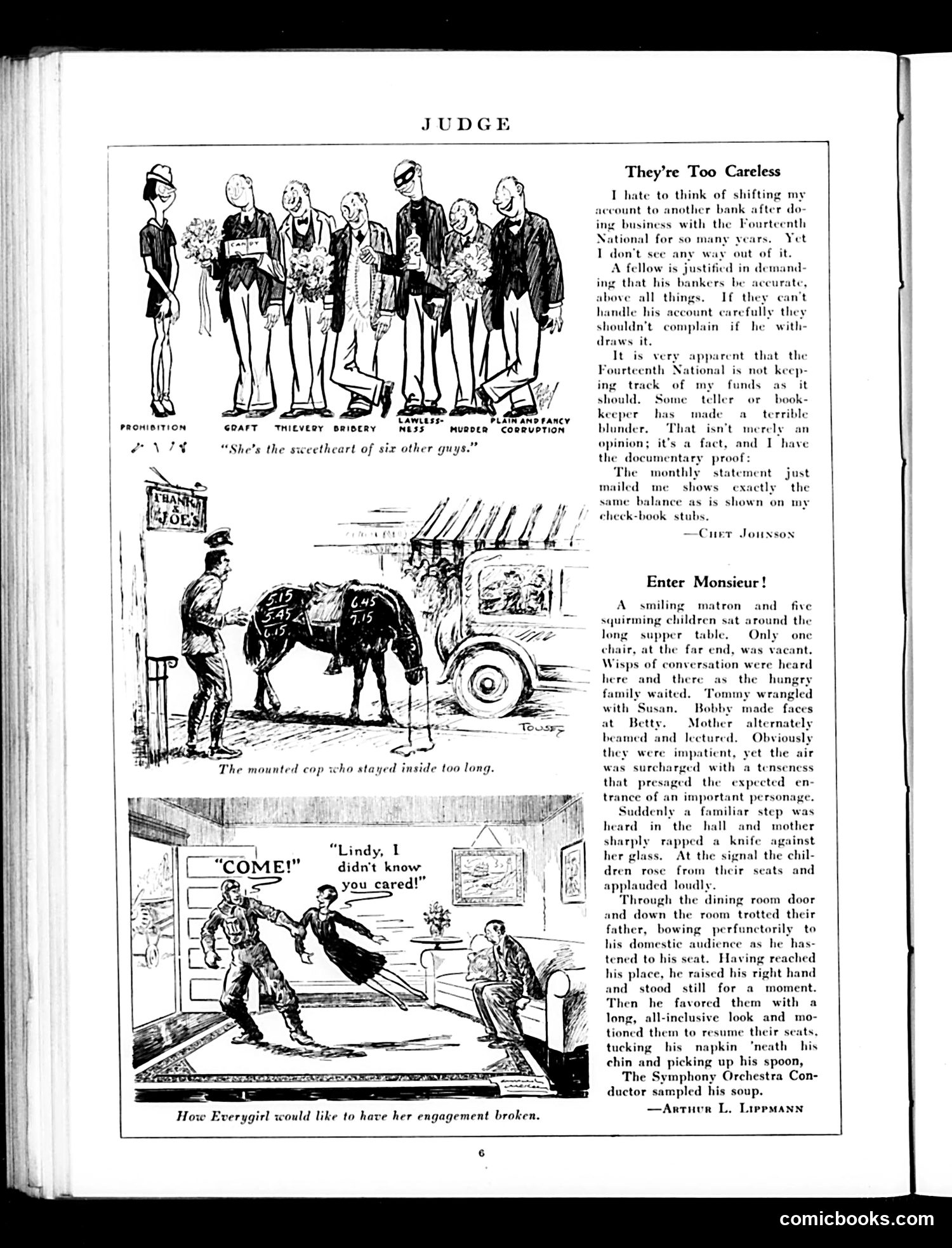
**Top cartoon:** A lineup of seven figures labeled "Prohibition," "Graft," "Thievery," "Bribery," "Scandal," "Murder," and "Corruption"—personified social ills of the Prohibition era (1920s-1930s). The caption "She's the sweetheart of six other guys" sarcastically suggests these vices are interconnected and mutually supporting. **Middle cartoon:** Shows a mounted police officer remaining on his horse inside a storefront, captioned "The mounted cop who stayed inside too long"—likely satirizing police neglect or corruption during Prohibition enforcement. **Bottom cartoon:** Depicts a domestic scene where a father enters the dining room to ceremonial applause from his wife and children, who stand at attention until he signals them to sit. Captioned "How Everygirl would like to have her engagement broken," this mocks the rigid, patriarchal household dynamics of the era by presenting exaggerated formality. **Right column:** A complaint letter about bank incompetence, unrelated to the visual content—typical magazine filler. The page satirizes 1920s social problems and gender/family conventions.
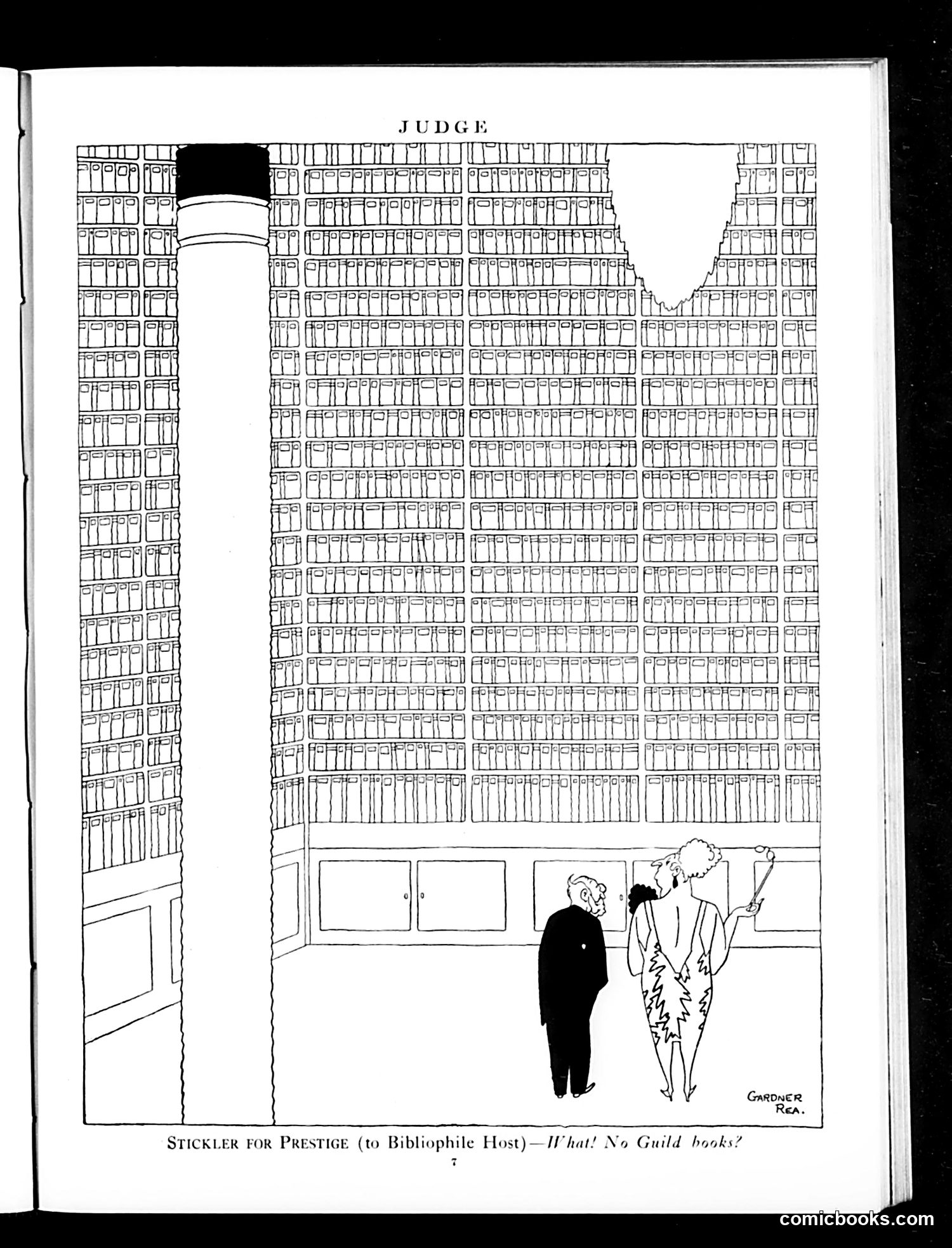
This cartoon satirizes snobbish book collecting among the wealthy. A well-dressed visitor (the "stickler") expresses shock that his host lacks books from a "Guild"—likely referring to prestigious limited-edition book clubs or publishing guilds that catered to bibliophiles and collectors seeking status through rare or exclusive volumes. The joke targets social pretension: the visitor measures his host's worth by possession of fashionable, branded books rather than actual literary merit or genuine love of reading. The towering library wall behind them underscores the absurdity—the host has extensive books, yet lacks the *right* prestigious label. The cartoon mocks how wealthy collectors valued exclusivity and brand prestige over substance, a commentary on materialism and conspicuous consumption among the leisure class.
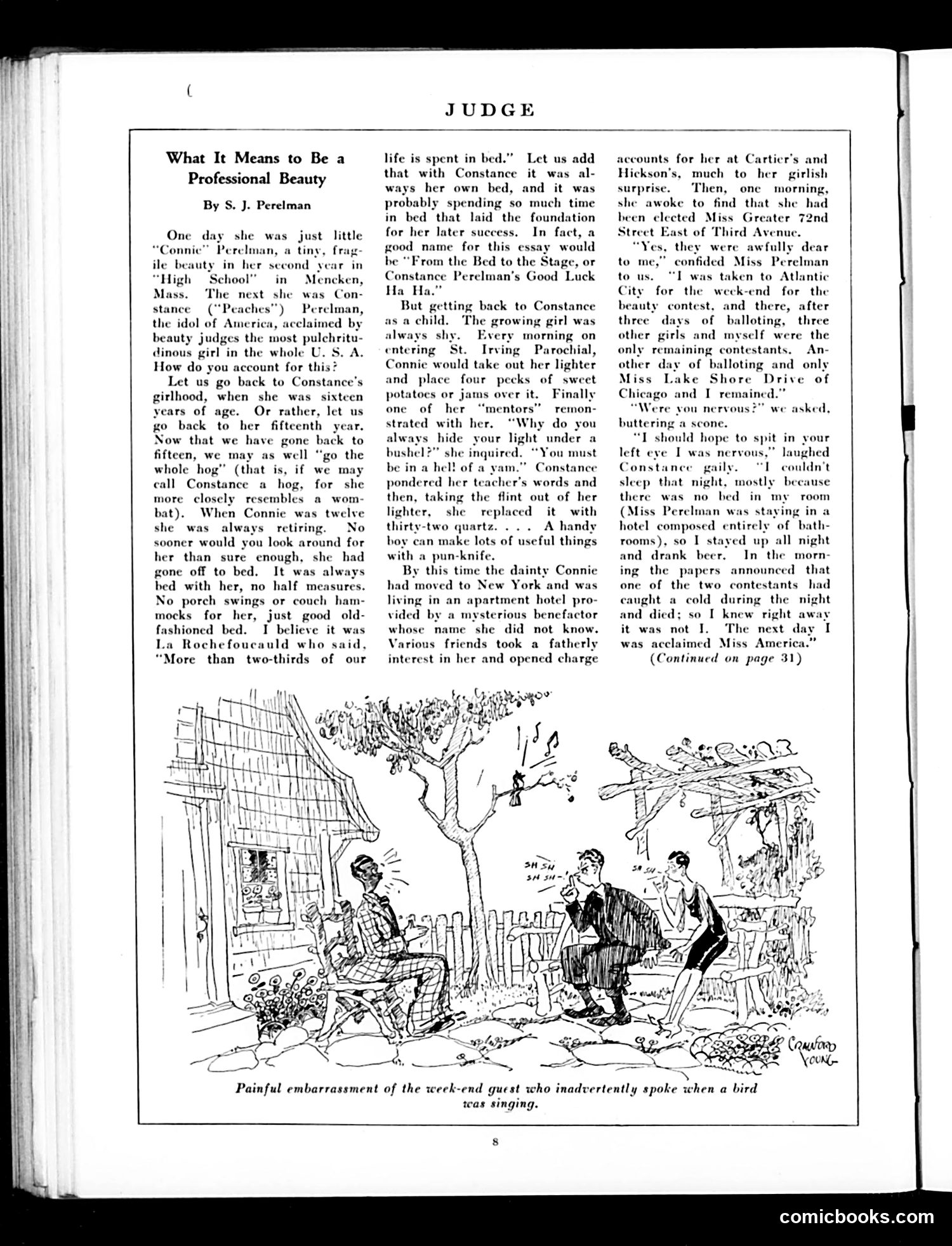
This page contains **two separate pieces**: a humorous essay and a cartoon. **The Essay:** S. J. Perelman's satirical story about "Connie" Perelman's rise to "Miss America" beauty contestant. The humor is absurdist—Perelman mocks beauty pageants by describing Connie's eccentric childhood (hiding under blankets, carrying jam jars, living in hotels with mysterious benefactors) as somehow the foundation for her beauty-queen success. The essay ridicules both the superficiality of beauty pageants and the arbitrary nature of who wins them. Her "victory" partly results from another contestant conveniently dying. **The Cartoon:** Shows guests at a social gathering; one awkwardly speaks while a bird sings nearby. The caption indicates social embarrassment at interrupting nature's sounds—a gentle jab at pretentious behavior and etiquette-consciousness among the well-to-do. Both pieces satirize American upper-class culture: beauty contests, social climbing, and rigid social conventions.
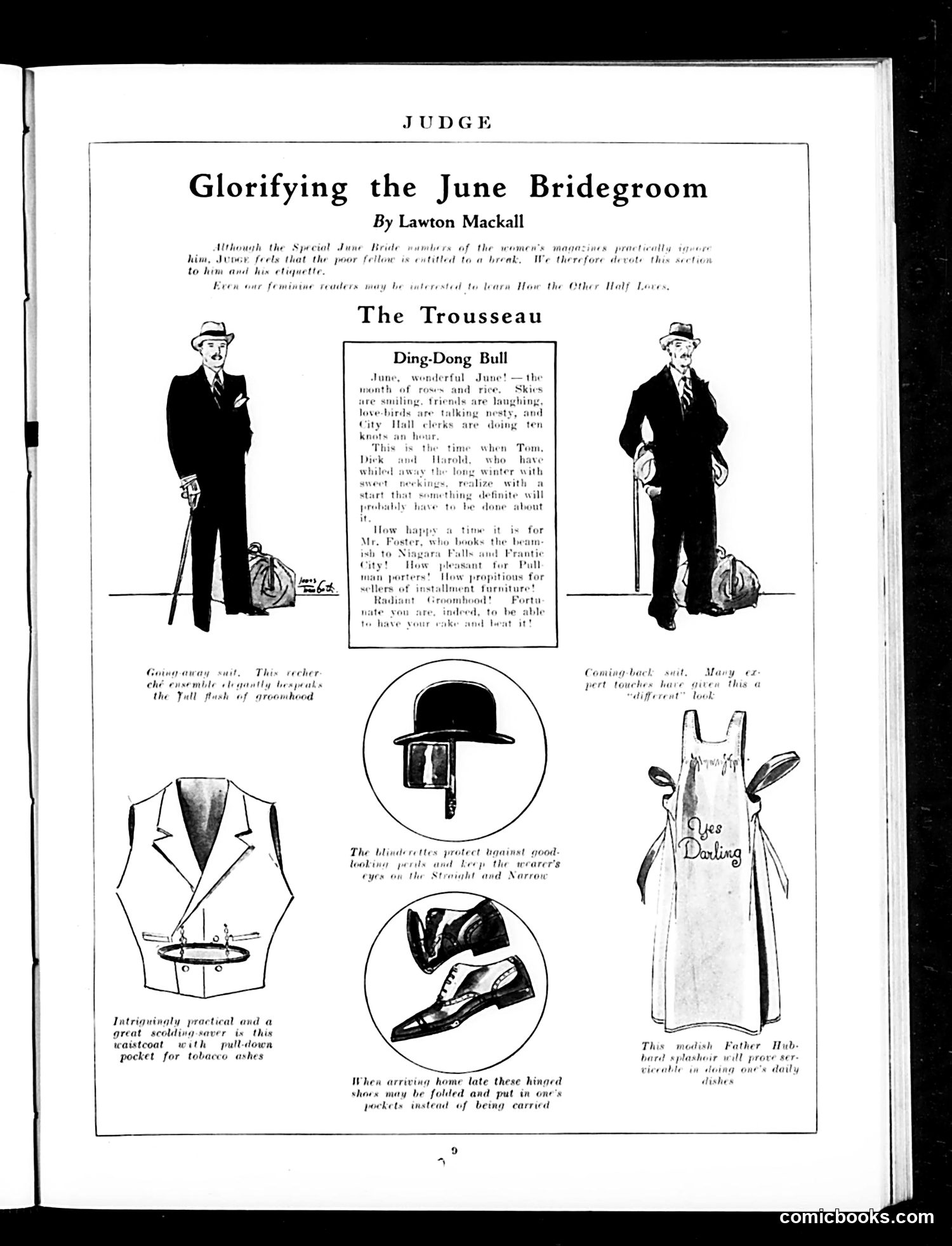
This is a humorous article by Lawton Mackall satirizing the June bridegroom—the groom getting married in June, society's most popular wedding month. The piece mocks the "poor fellow" as deserving sympathy, presenting absurd "practical" wedding gifts and trousseau items. "The Trousseau" section features ridiculous inventions: a waistcoat with a pulldown tobacco-ash pocket, "blinderettes" (blinders) to keep the groom's eyes "on the Straight and Narrow," hinged shoes that fold into pockets, and a "Father Hubbard splashoir" apron for washing dishes. The satire targets gender roles and marital expectations of the 1920s era—specifically the notion that marriage transforms a carefree bachelor into a domesticated, closely-monitored husband. The joke relies on exaggerated "solutions" to the groom's imagined problems: smoking indoors, wandering eyes, and incompetence at housework. It's gentle mockery of both newlyweds and society's expectations for married men.
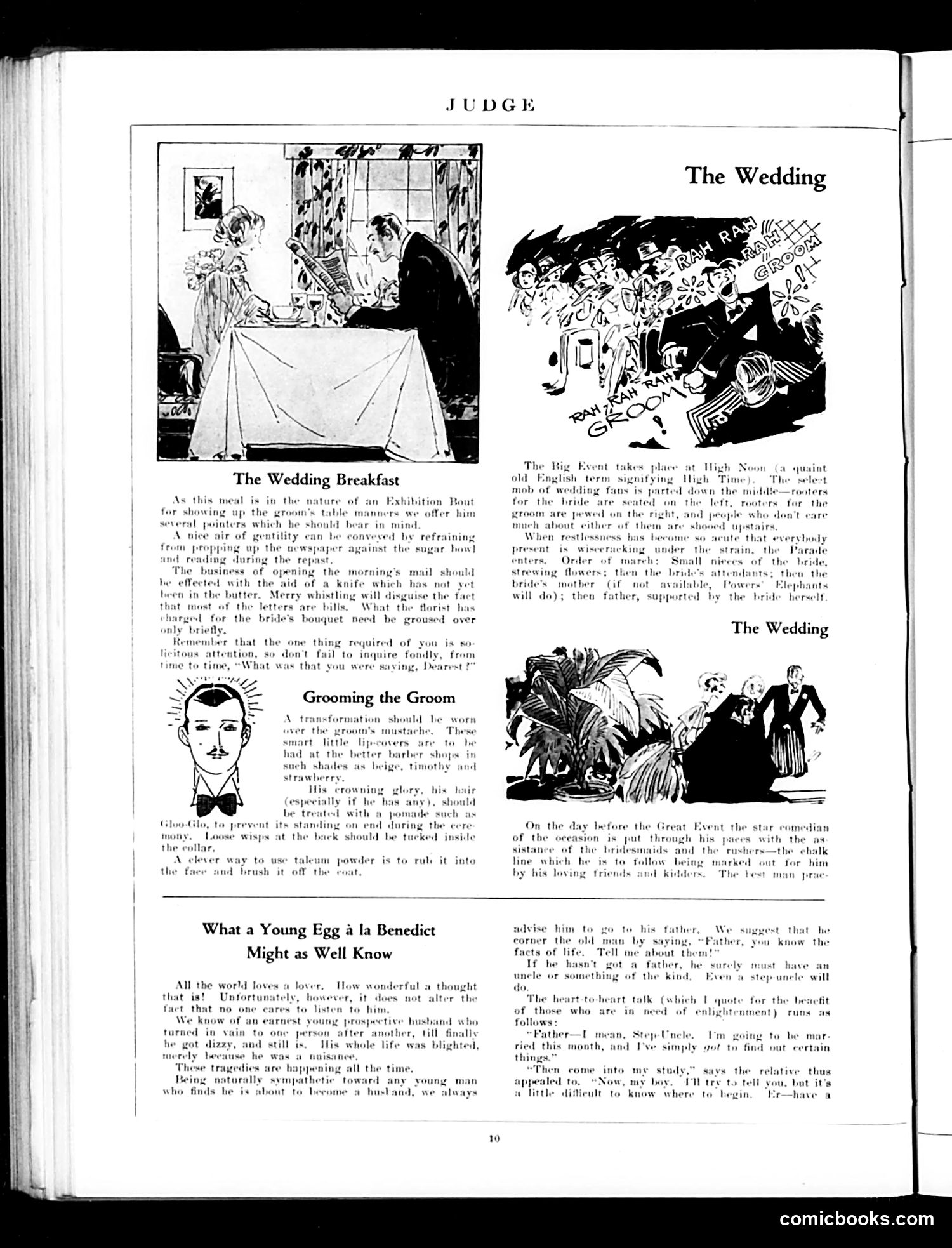
This page from the satirical magazine *Judge* offers humorous advice about weddings and marriage through illustrations and commentary. The content includes practical etiquette tips presented as satire: "The Wedding Breakfast" mocks the formality of wedding meals and suggests disguising poor service; "Grooming the Groom" offers absurd grooming advice (using talcum powder, managing facial hair); and "The Wedding" illustrates the ceremony's organized chaos. The final section, "What a Young Egg à la Benedict Might as Well Know," satirizes the awkwardness of sex education for young men about to marry. It mocks the era's convention of fathers (or uncles) giving vague, uncomfortable "talks" to grooms, suggesting the young man nervously tries to discuss "facts of life" with older relatives. The satire targets Victorian-era social conventions: rigid wedding formality, masculine grooming standards, and the profound discomfort surrounding marriage discussions. The humor relies on readers recognizing these familiar social anxieties.
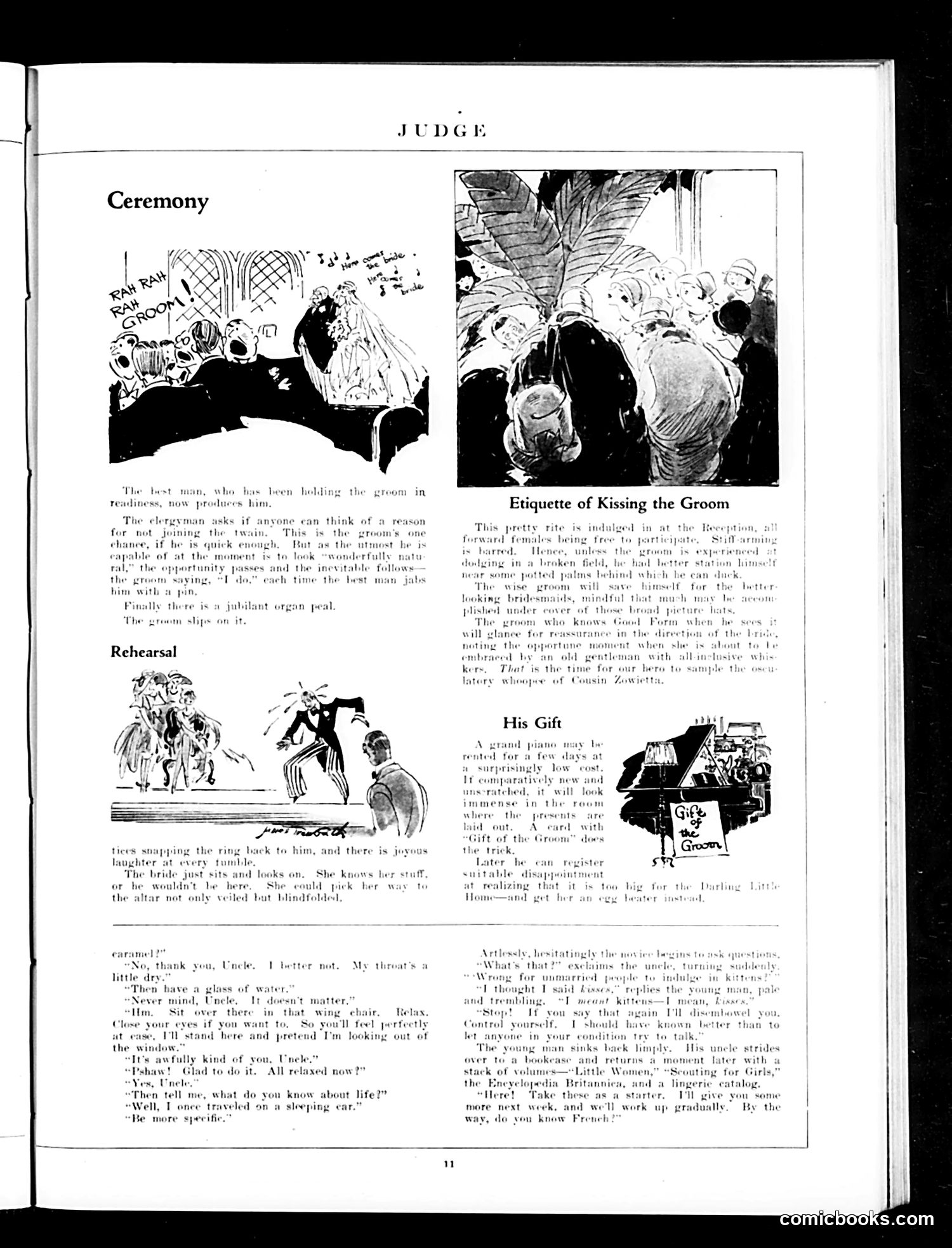
This page satirizes wedding etiquette and customs through three illustrated sections. "Ceremony" mocks the best man's role and the formal rituals surrounding the wedding vows. "Rehearsal" humorously depicts a bride-to-be receiving marital advice from her uncle—comedic dialogue reveals the uncle's obtuse attempts to prepare her for married life through euphemism and evasion ("I once traveled on a sleeping car"). "Etiquette of Kissing the Groom" ridicules strict social rules governing women's behavior at weddings, noting the formal restrictions placed on female guests despite modern conventions loosening. "His Gift" sardonically addresses the groom's gift-giving dilemma: a grand piano appears impressive but proves impractical, leading to later disappointment. Overall, the page gently mocks upper-class wedding conventions, Victorian prudishness about sex education, and the gap between formal etiquette and practical reality—typical Judge magazine fare satirizing American social pretensions.
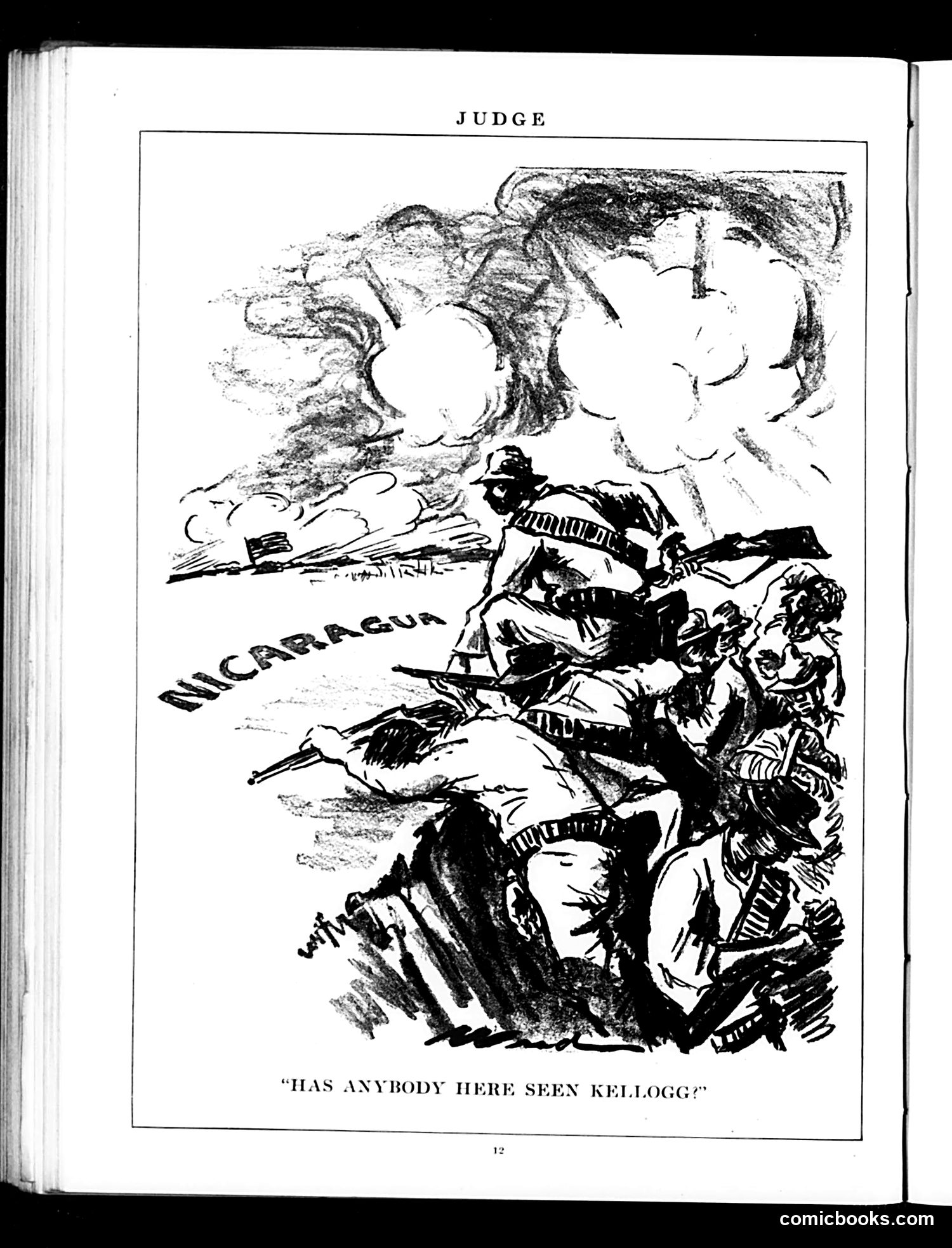
This Judge magazine cartoon depicts U.S. military intervention in Nicaragua. A uniformed American soldier stands atop a pile of dead Nicaraguan bodies, asking "Has anybody here seen Kellogg?" The reference is likely to Frank B. Kellogg, U.S. Secretary of State (1925-1929), who oversaw American military involvement in Nicaragua during that period. The cartoon satirizes American imperialism and military intervention in Central America, critiquing U.S. foreign policy as violent and occupational. The grotesque imagery—bodies stacked beneath the soldier—emphasizes the human cost of American intervention that the government official ("Kellogg") appears indifferent to or absent from acknowledging. The satire suggests hypocrisy: while American leaders make policy decisions, ordinary soldiers and foreign civilians pay the price.
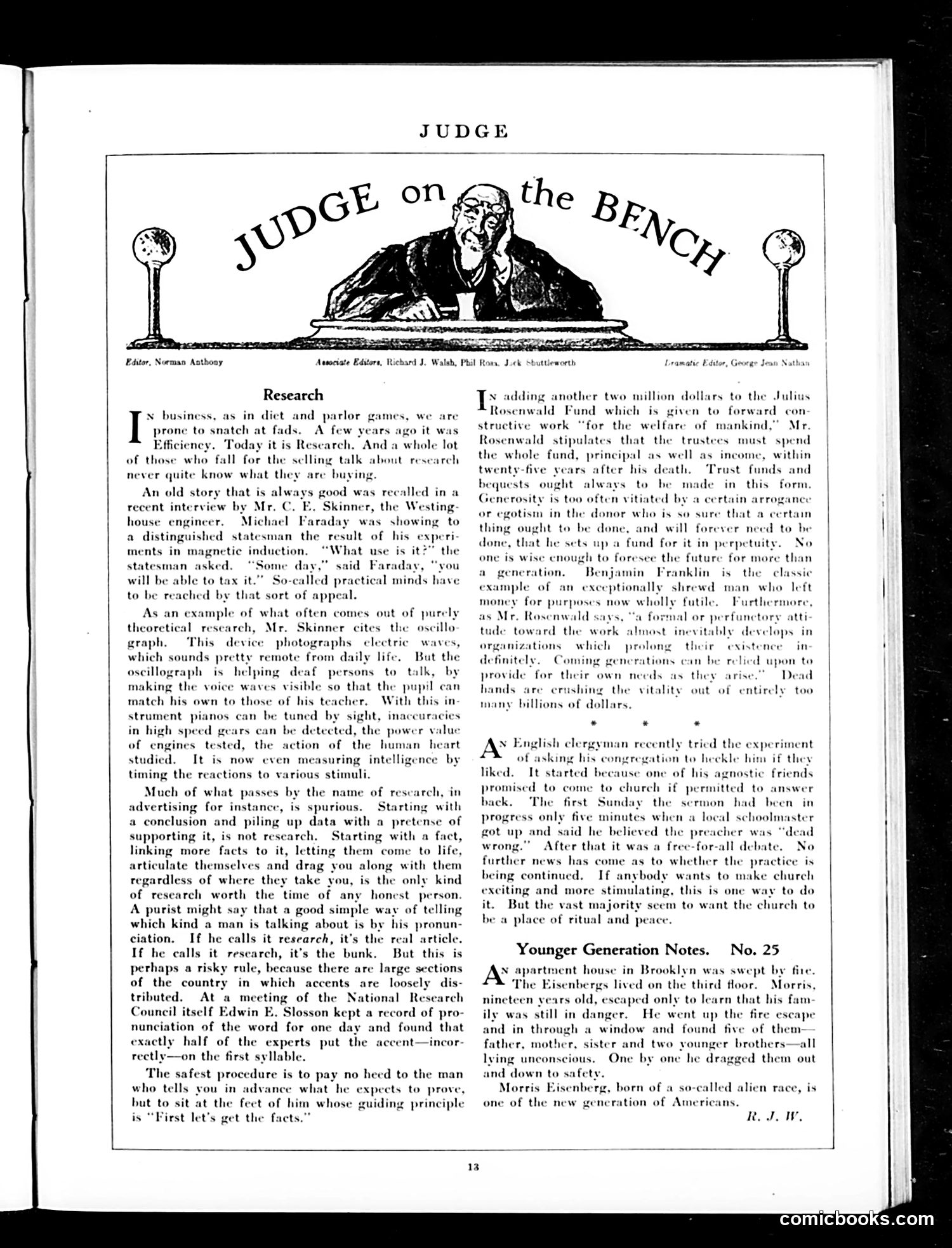
This page satirizes how American businesses mindlessly pursue "Research" as a fashionable fad, similar to earlier crazes for "Efficiency." The editorial mocks companies that claim to conduct research while actually starting with predetermined conclusions and merely assembling data to support them—calling this fraudulent "research" rather than genuine fact-based inquiry. The article uses Michael Faraday's work on oscillographs as a positive example: theoretical research yielding practical applications (helping deaf people communicate). However, the main point critiques how businesses misuse the term "research" for advertising purposes without honest investigation. A secondary piece praises Julius Rosenwald's addition to his charitable fund, stipulating trustees must spend principal and income within twenty-five years after his death—avoiding the perpetual egotism of donors who establish permanent endowments assuming their original intentions remain relevant forever.
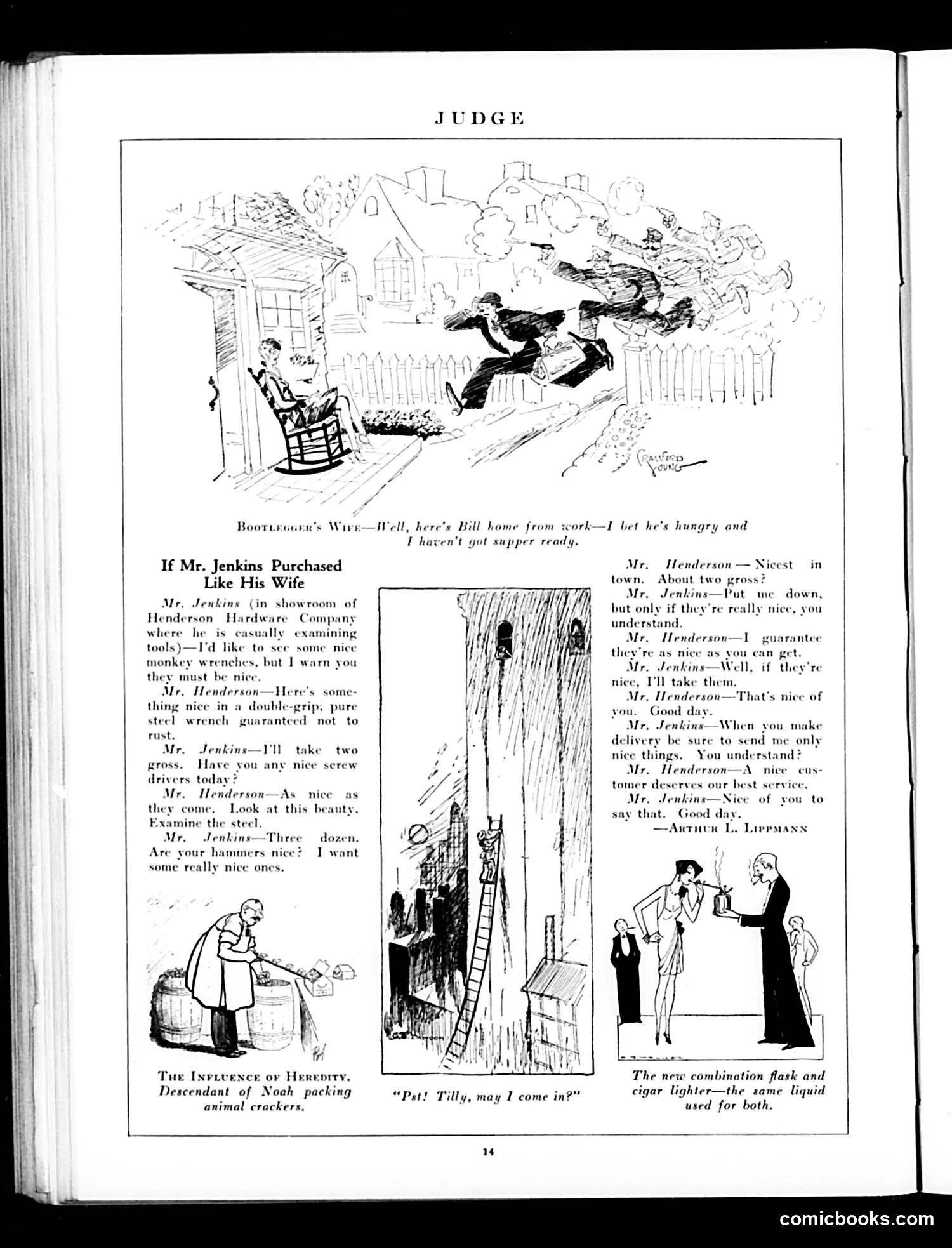
This page contains three separate satirical cartoons mocking domestic and commercial life in early 20th-century America. **"If Mr. Jenkins Purchased Like His Wife"** ridicules a fastidious husband who obsessively demands "nice" quality tools from a hardware store salesman. The joke satirizes excessive pickiness and consumer anxiety—Jenkins' repetitive insistence on niceness becomes absurd, highlighting how some men fussily mimic their wives' domestic perfectionism. **"Bootlegger's Wife"** (top cartoon) shows a bootlegger's wife unprepared for her husband's arrival, joking about Prohibition-era concerns and domestic expectations. **"The Influence of Heredity"** depicts a man packing animal crackers like Noah, a joke about inherited behavioral traits. **"The New Combination Flask and Cigar Lighter"** mocks a useless dual-purpose product—using the same liquid for both smoking and drinking is impractical and absurd, satirizing consumer gadgetry. The page reflects Jazz Age anxieties about consumerism, Prohibition, and modern products.
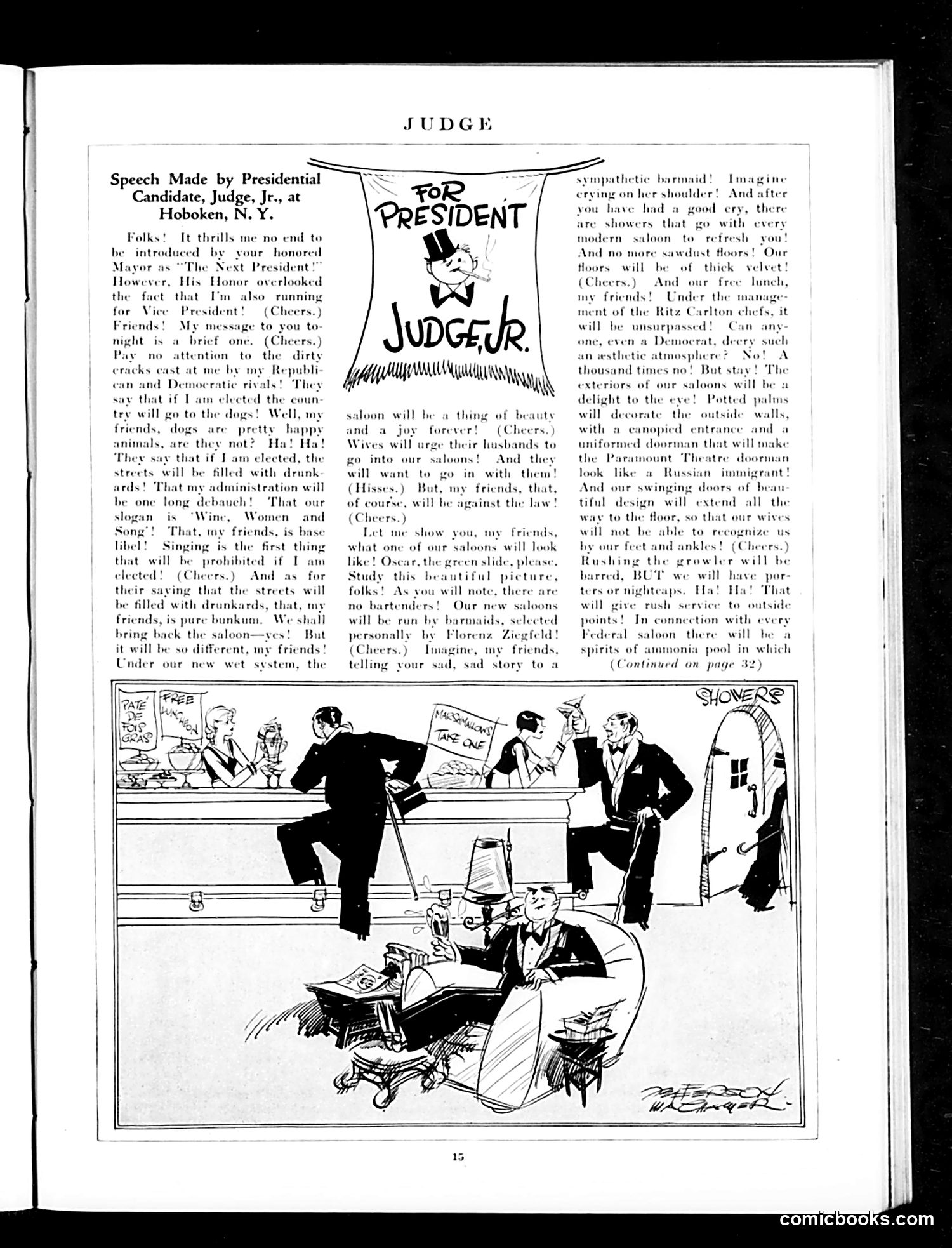
This is a satirical mock-campaign speech by a fictional presidential candidate named "Judge, Jr." The humor targets **Prohibition-era politics** (likely 1920s America, when alcohol was banned). The candidate absurdly proposes reversing Prohibition by opening lavish, upscale saloons. His satirical promises include: bartenders replaced by attractive "barmaids," free showers for crying patrons, no sawdust floors, Ritz Carlton-quality free lunch, potted palms and uniformed doormen at entrances, and swinging doors that reach the floor so wives can't identify their husbands by their ankles. The cartoon below shows the candidate's imaginary "new saloon," illustrated as an elaborate venue. **The satire mocks** both Prohibition advocates (who claimed alcohol caused vice) **and** the wet/anti-Prohibition movement by exaggerating saloon luxury to absurd extremes. It suggests the debate over alcohol had become ridiculous—treating a bar like a high-end restaurant rather than addressing genuine social concerns.
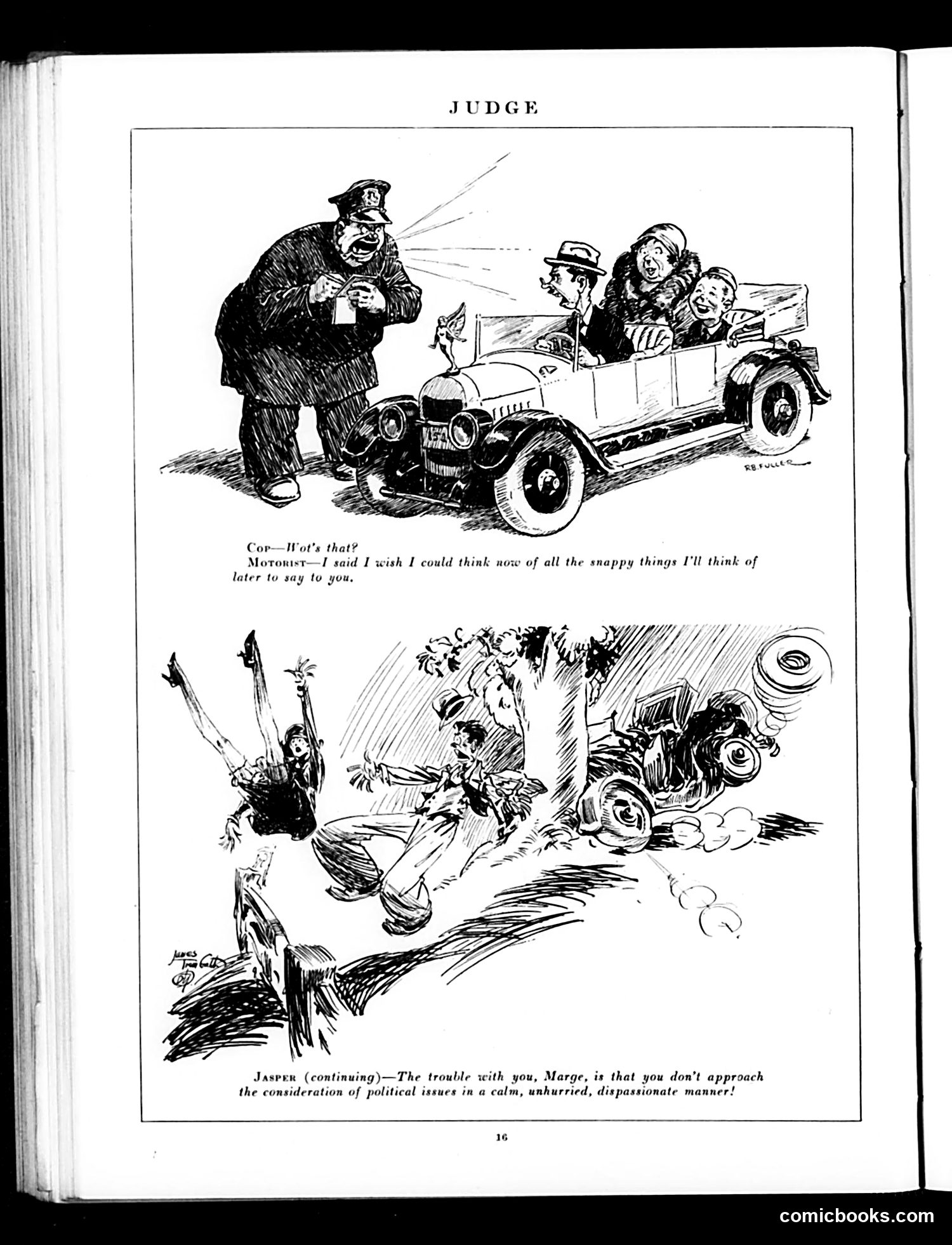
This page contains two separate cartoons satirizing different social behaviors: **Top cartoon:** A traffic stop where a "Moronist" (likely mocking someone of limited intellect) tells a police officer he wishes he could think of clever comebacks now instead of later—a relatable joke about wit that arrives too late. **Bottom cartoon:** A domestic argument where a character named Jasper criticizes his companion Marge for approaching political discussion emotionally rather than rationally. The violent physical altercation depicted (they're colliding with a tree while driving) ironically undercuts his complaint about her lacking "calm, unhurried, dispassionate manner"—the chaos contradicts his lecture about reasoned debate. The satire targets both everyday social awkwardness and marital discord over politics, suggesting that people often fail to practice the virtues they preach.
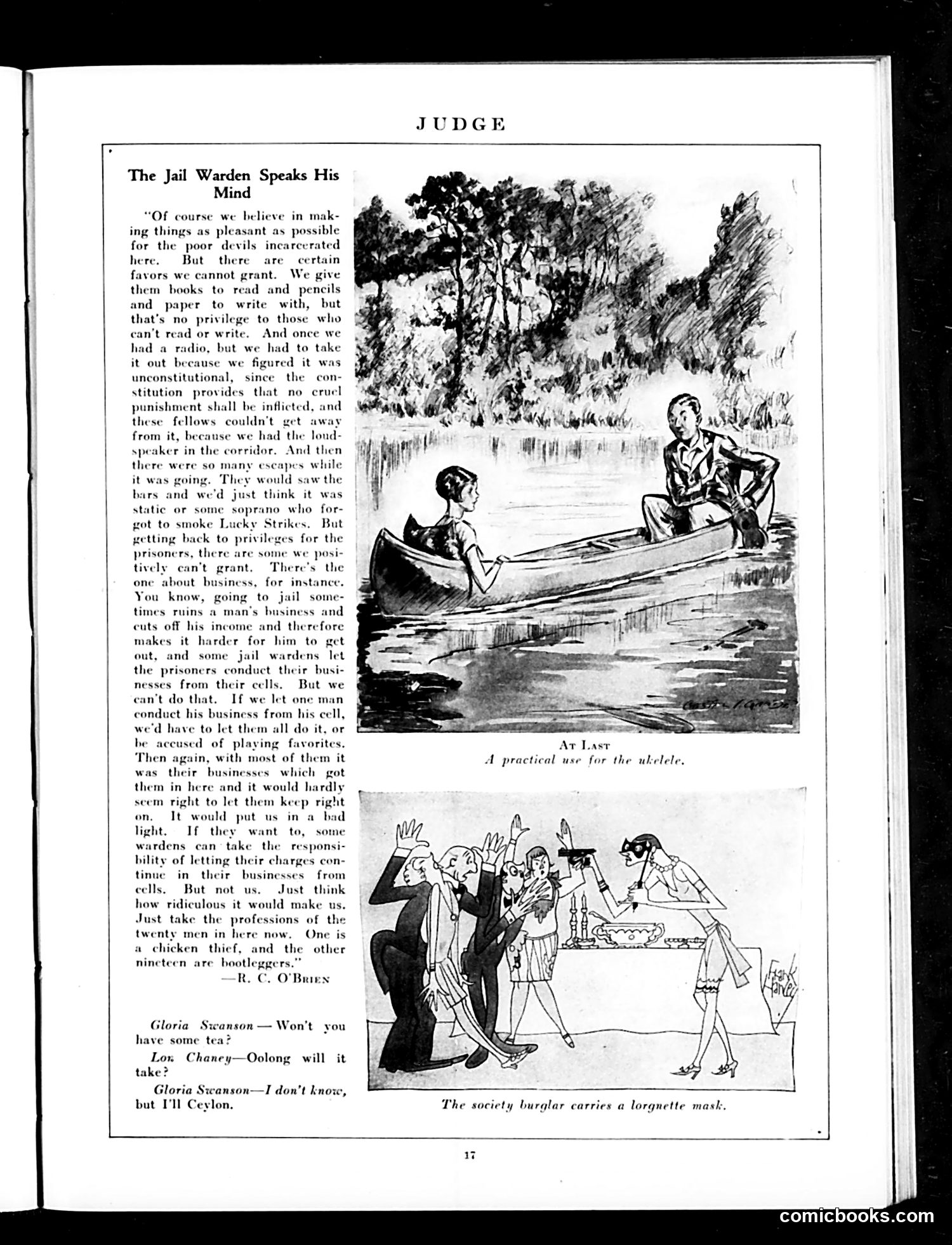
This page satirizes **Prohibition-era jail administration**. The main article features a jail warden explaining why prisoners cannot conduct businesses from their cells. The satire's punch line reveals that of twenty inmates, one is a chicken thief and **nineteen are bootleggers**—a sharp commentary on how Prohibition criminalized ordinary people, filling jails with alcohol smugglers rather than serious criminals. The bottom section contains an unrelated joke playing on tea terminology: Gloria Swanson and Lon Chaney (famous silent film stars) exchange puns using tea names (Ceylon, Oolong, Lox) to mock pretentious social behavior. The cartoon "At Last" depicts wealthy "society burglars" using an athlete as a tool—likely satirizing how the wealthy exploit working-class people. The overall message critiques both Prohibition's absurd criminalization and class disparities in the justice system.
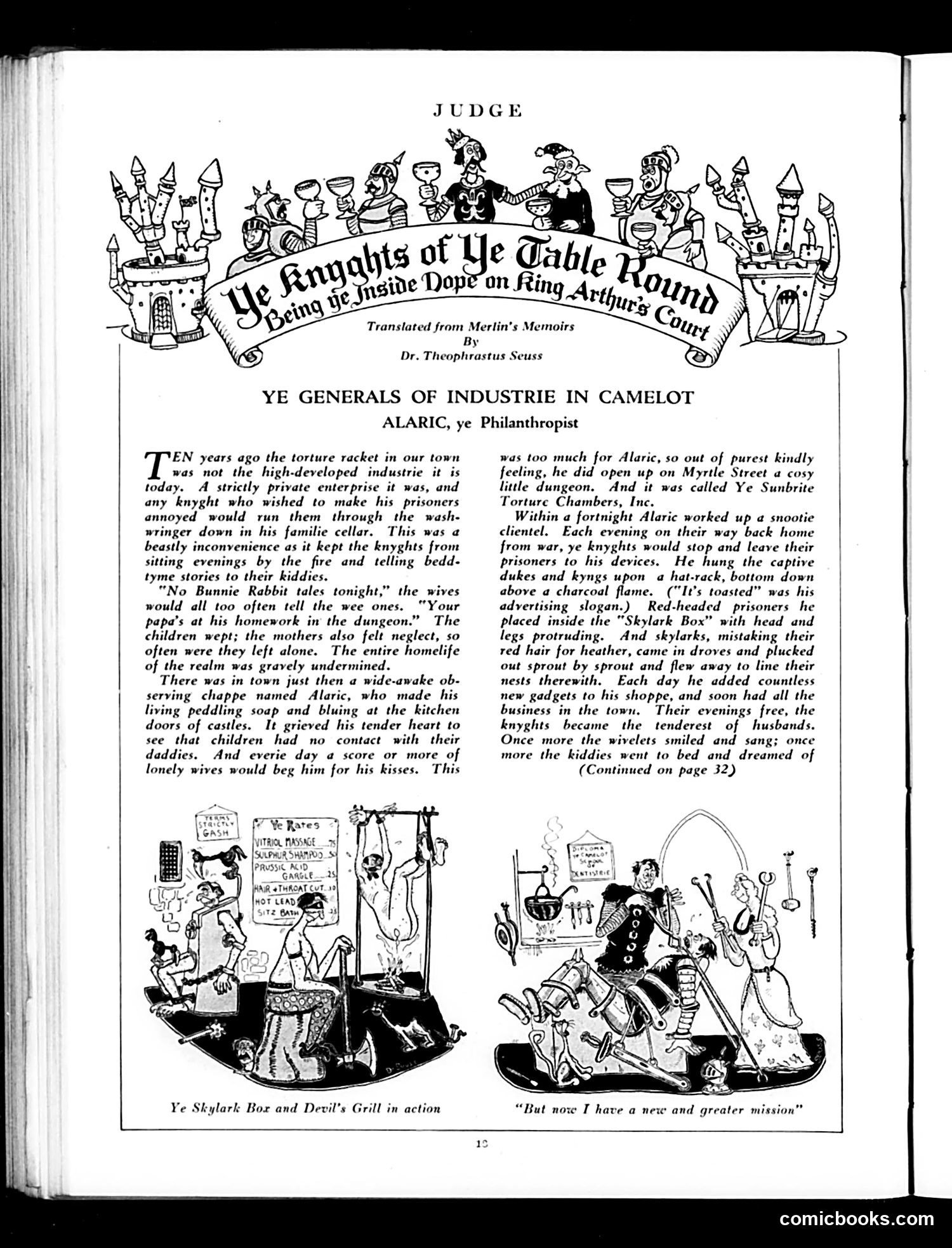
This is a satirical fantasy piece by Dr. Seuss (credited as "Theophrastus Seuss"), presenting a twisted medieval fable. The satire targets **industrialization and the commercialization of brutality**. "Alaric the Philanthropist" is a mock-heroic entrepreneur who opens "Ye Sunbrite Torture Chambers, Inc."—a specialized torture business. The joke is that he frames this commercial enterprise as *moral progress*: by professionalizing torture and centralizing it, knights can outsource cruelty, freeing evenings for family time. This reconciles domestic happiness with systematic brutality. The satire mocks: - **Capitalist rhetoric** that rebrands exploitation as benevolent innovation - **Industrial efficiency applied to violence** - **Consumer culture** that makes evil convenient and profitable The two illustrations show torture devices ("Ye Skylark Box and Devil's Grill") rendered as commercial products—darkly comic visualization of horror as marketable commodity. The piece appears to critique how American capitalism frames morally questionable practices as progress and social benefit.
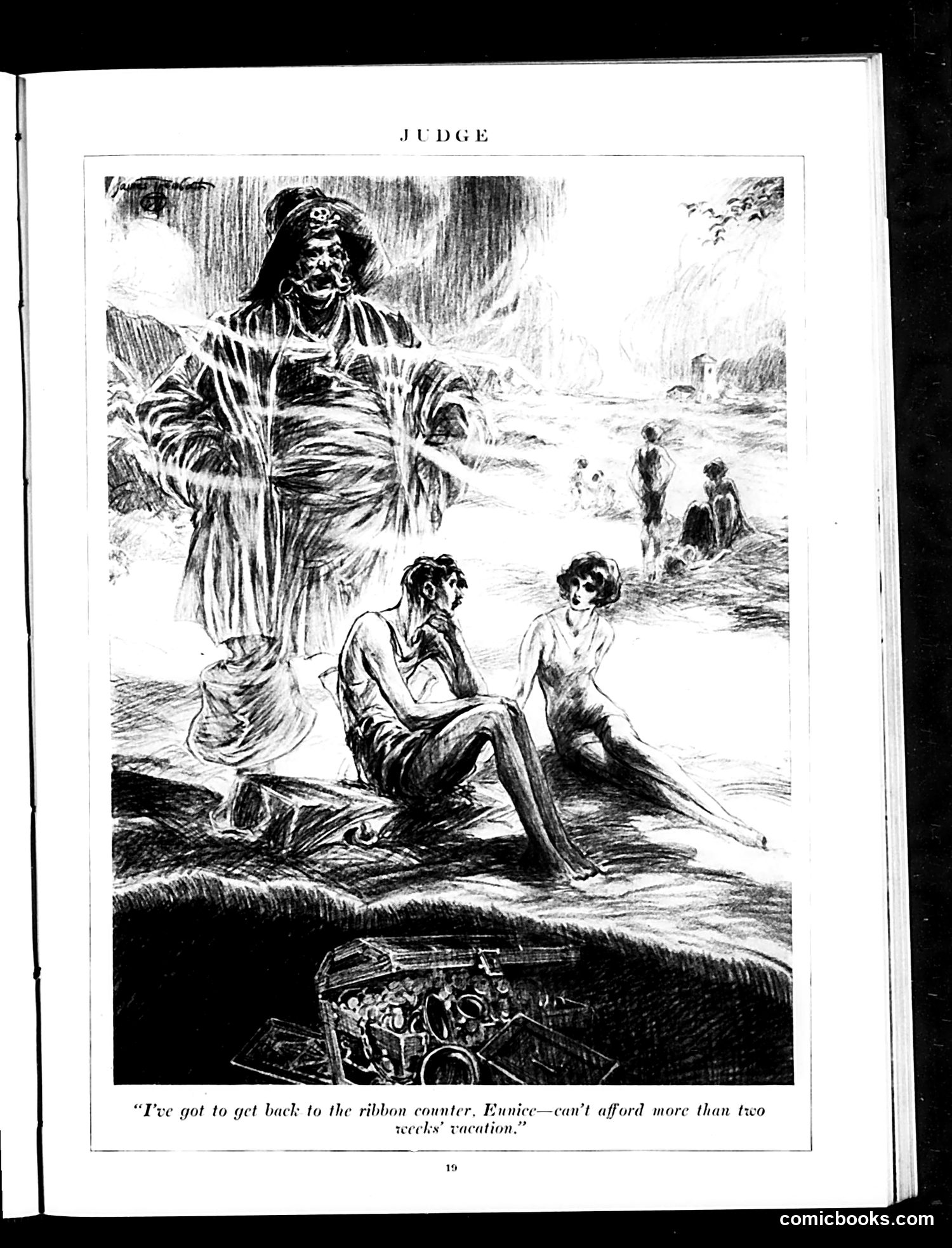
This cartoon satirizes economic hardship and limited vacation time for working-class Americans. The central figure appears to be a man speaking to a woman named Eunice, likely a couple on a beach vacation. The towering judge-like figure looming behind them suggests moral judgment or societal pressure. The satire targets the speaker's inability to afford extended leisure—he can only manage two weeks away before returning to work at "the ribbon counter" (a retail job). This reflects early-to-mid 20th-century American labor conditions where even modest vacations were financial luxuries for ordinary workers. The cartoon critiques both economic inequality and the cultural expectation that workers should feel guilty about taking time away from their jobs. The "Judge" title reinforces the theme of judgment and societal disapproval of workers' limited freedom.
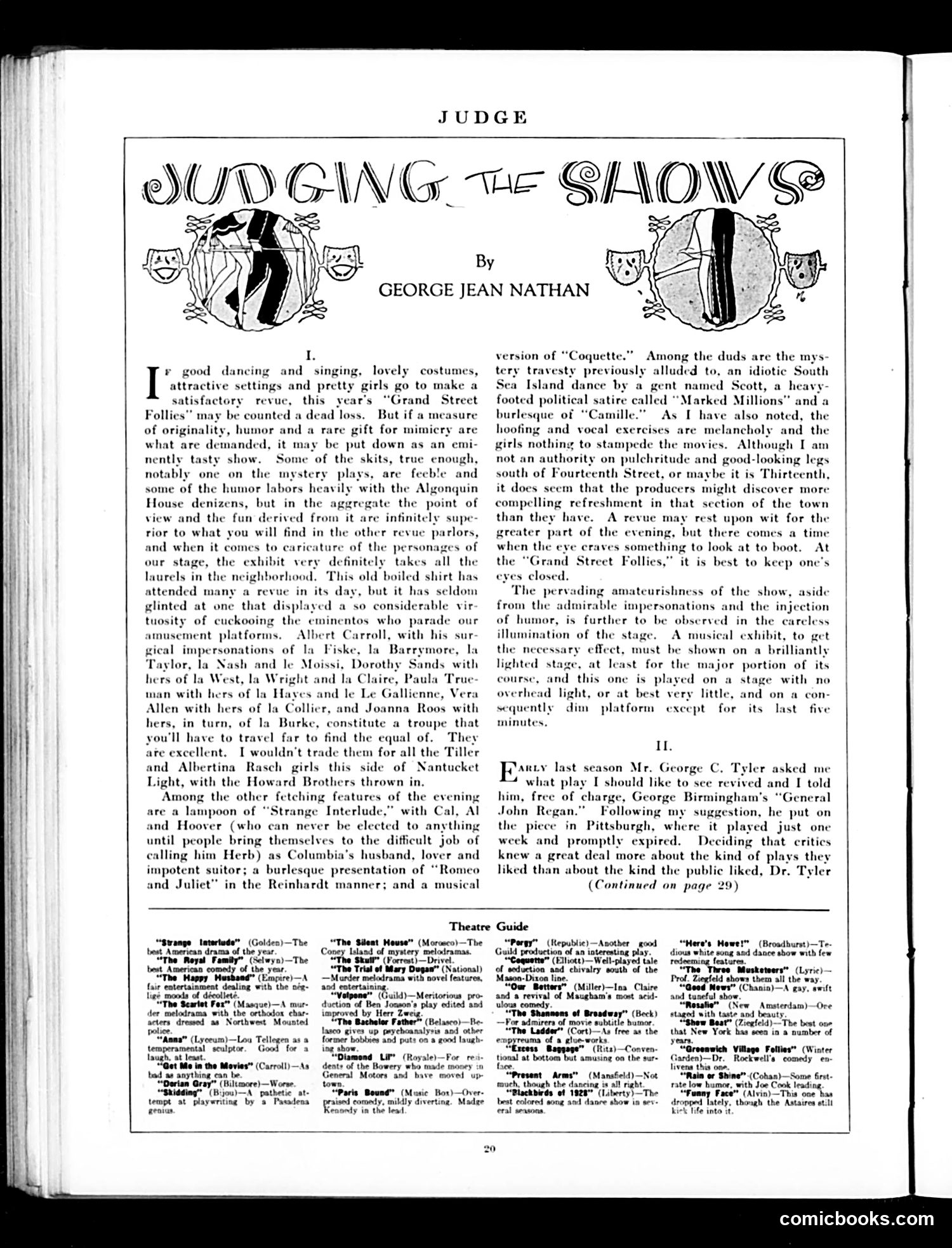
This page from *Judge* magazine features a theatre review by George Jean Nathan titled "Judging the Shows," discussing Broadway revues and musicals. **Main Content:** Nathan reviews the "Grand Street Follies," praising its dancing, costumes, and humor, particularly the skilled mimicry and impersonations by performers including Albert Carroll, Fiske, and others. He criticizes some sketches as weak but praises the overall production quality. **Key References:** - Nathan mentions a "mystery play" and burlesque of "Romeo and Juliet" in Reinhardt style - He references lampoons of contemporary figures, including what appears to be caricatures of Cal and Al Hoover (likely Calvin Coolidge and Herbert Hoover, though unclear from context) - A satirical skit called "Marked Millions" and burlesque of "Camille" **The Satire:** Nathan's critical voice satirizes both theatrical producers and critics themselves—particularly in Section II, where he recounts Dr. George C. Tyler's revival of "General John Regan," suggesting critics' tastes diverge from public preferences. The page emphasizes theatrical quality standards and backstage gossip typical of *Judge's* entertainment coverage.
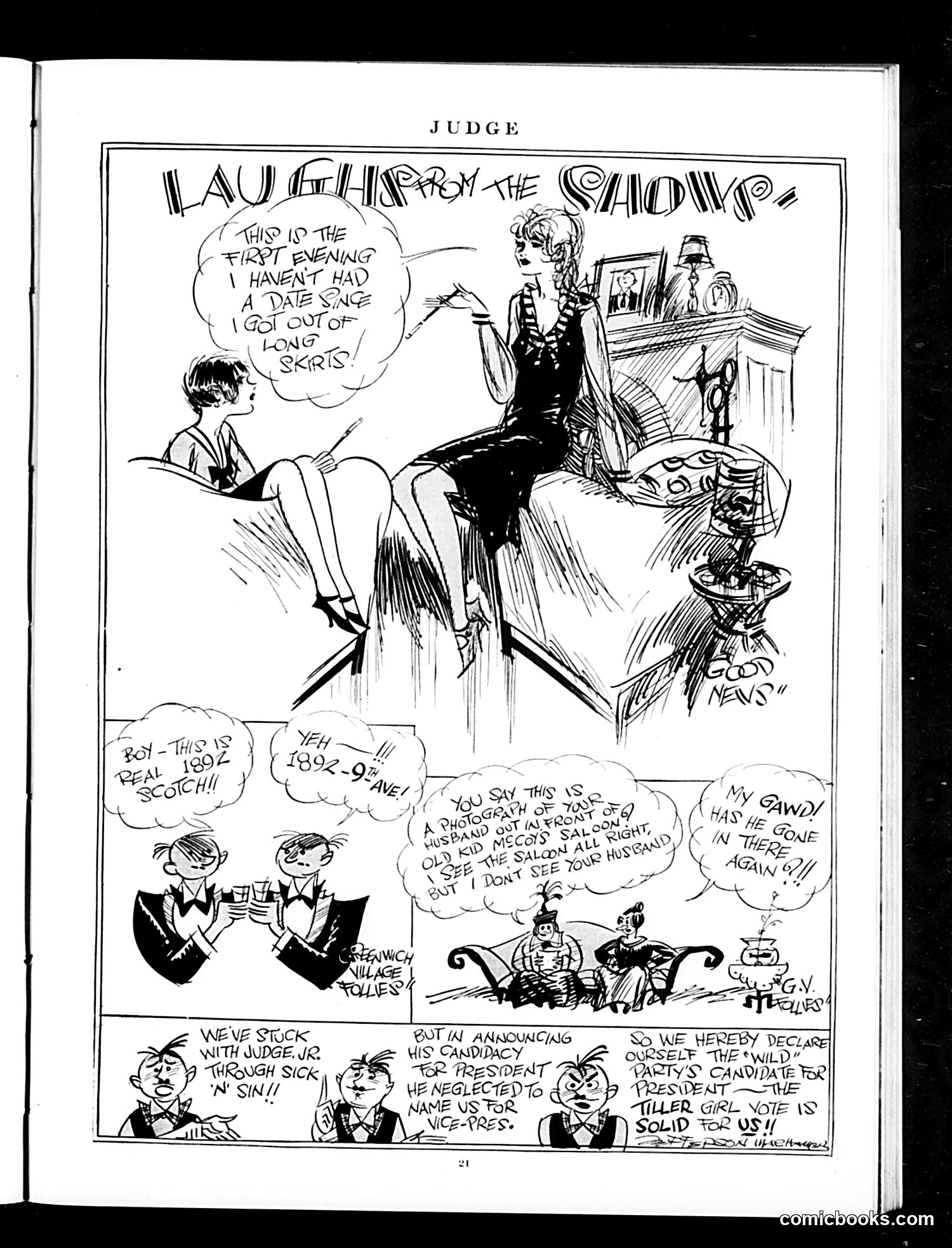
This satirical cartoon mocks the 1892 U.S. presidential election. A flapper-type woman ("Judge's Wild Party Girl") sits prominently, declaring this her first evening out in long skirts. Below, three men appear to be politicians announcing a candidacy for president, while claiming to represent the "Judge" magazine's preferred candidate. The satire targets political figures who neglected to properly nominate or name their vice-presidential candidate, forcing "Judge" to propose their own "wild party girl" as the solution. The cartoon ridicules the era's political establishment as chaotic and incompetent—so disorganized they'd accept a socialite as a serious political option. References to 1892 and "Scotch" suggest whiskey-fueled political machinations. The overall joke: the political process is so absurd that even a frivolous woman's candidacy seems reasonable by comparison.
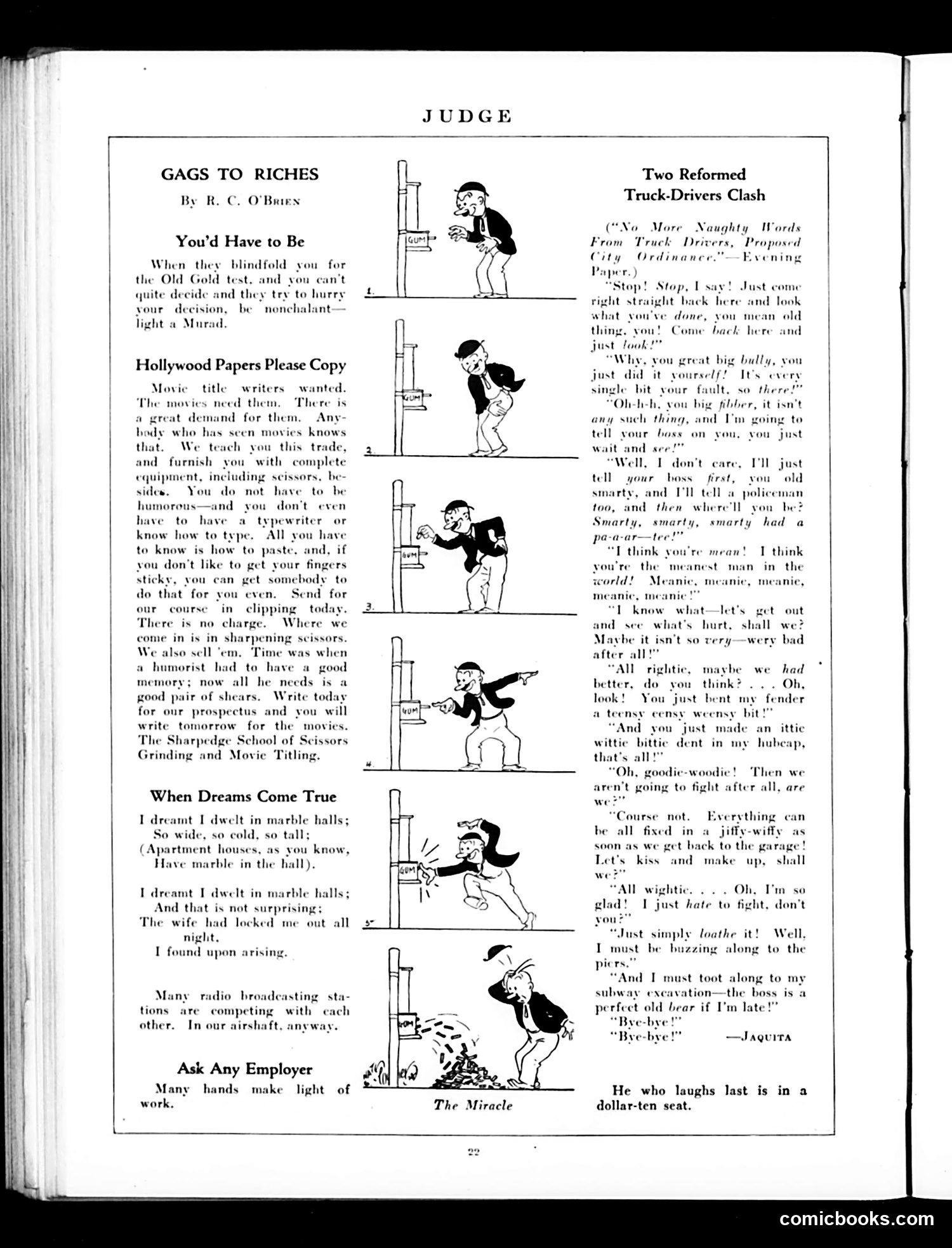
This cartoon satirizes sentimentality in 1920s-30s popular culture by depicting two tough truck drivers who attempt to resolve their conflict with exaggerated, baby-talk politeness. The joke relies on the contrast: tough working-class men are expected to be aggressive and crude, yet they awkwardly adopt affected, childish speech ("goodie-woodie," "pa-a-ar," "teensy censy weensy"). The dialogue mocks both their failed attempt at civility and the magazine's contemporary readers' fondness for treacly, overly sweet resolutions. The headline references a proposed "City Ordinance" banning "naughty words from truck drivers"—suggesting the cartoon is commenting on contemporary moral-reform efforts to clean up working-class speech. The irony: the drivers' forced politeness is somehow more ridiculous than actual profanity would be. The repeated comic beats show escalating silliness as they abandon fighting, kiss and make up, and return to work—mocking both workplace comedy tropes and sentimental reconciliation narratives.
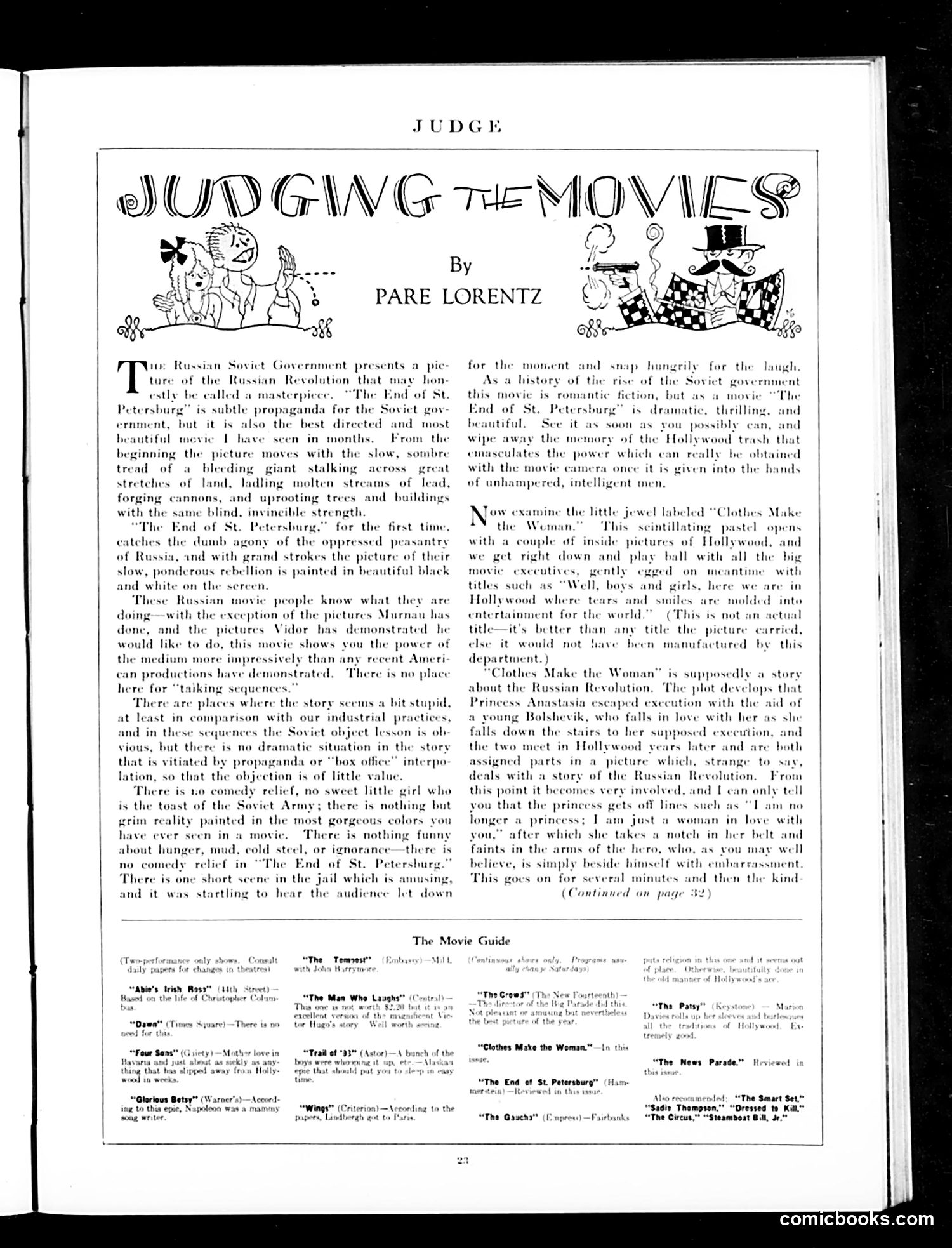
This is a film review column, not a political cartoon. Lorentz discusses Soviet cinema, particularly "The End of St. Petersburg," which he praises as propaganda art—propaganda that happens to be genuinely excellent filmmaking. He admires how it depicts oppressed Russian peasants and their rebellion in "beautiful black and white," comparing it favorably to American directors like Murnau and Vidor. He then critiques "Clothes Make the Woman," a Hollywood picture about Princess Anastasia escaping execution during the Russian Revolution. Lorentz dismisses it as inferior: romantic fiction masquerading as serious drama, with melodramatic dialogue ("I am no longer a princess; I am just a woman in love with you"). The piece reflects 1920s American intellectual attitudes—admiration for Soviet artistic achievement despite political disagreement, and disdain for Hollywood's commercialism and sentimentality. The contrast showcases competing visions of how cinema should handle revolutionary history.
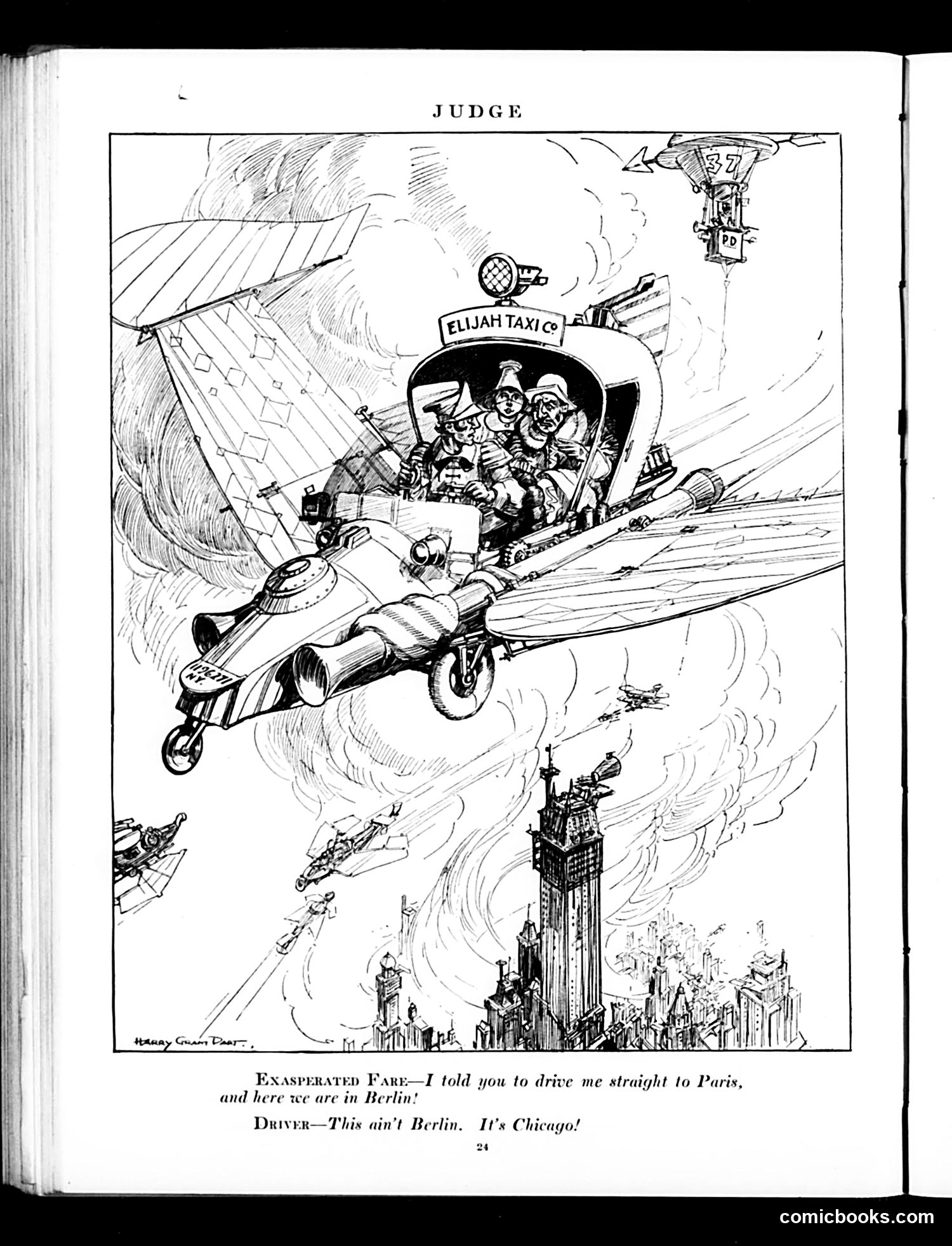
This cartoon satirizes taxi drivers in Chicago, likely from the early 20th century. A chauffeur operating an absurdly fantastical flying taxi ("Elijah Taxi Co.") has wildly overshot the passenger's destination, soaring over Chicago's skyline instead of reaching Paris or Berlin as instructed. The humor operates on multiple levels: the impossibly incompetent taxi driver, the surreal flying vehicle, and the final punchline where the driver dismisses the passenger's complaint by insisting they're already in Chicago—implying Chicago itself is so chaotic or unpleasant that missing a European destination by arriving there instead is somehow unremarkable. The satire mocks both taxi service unreliability and Chicago's reputation during this era.
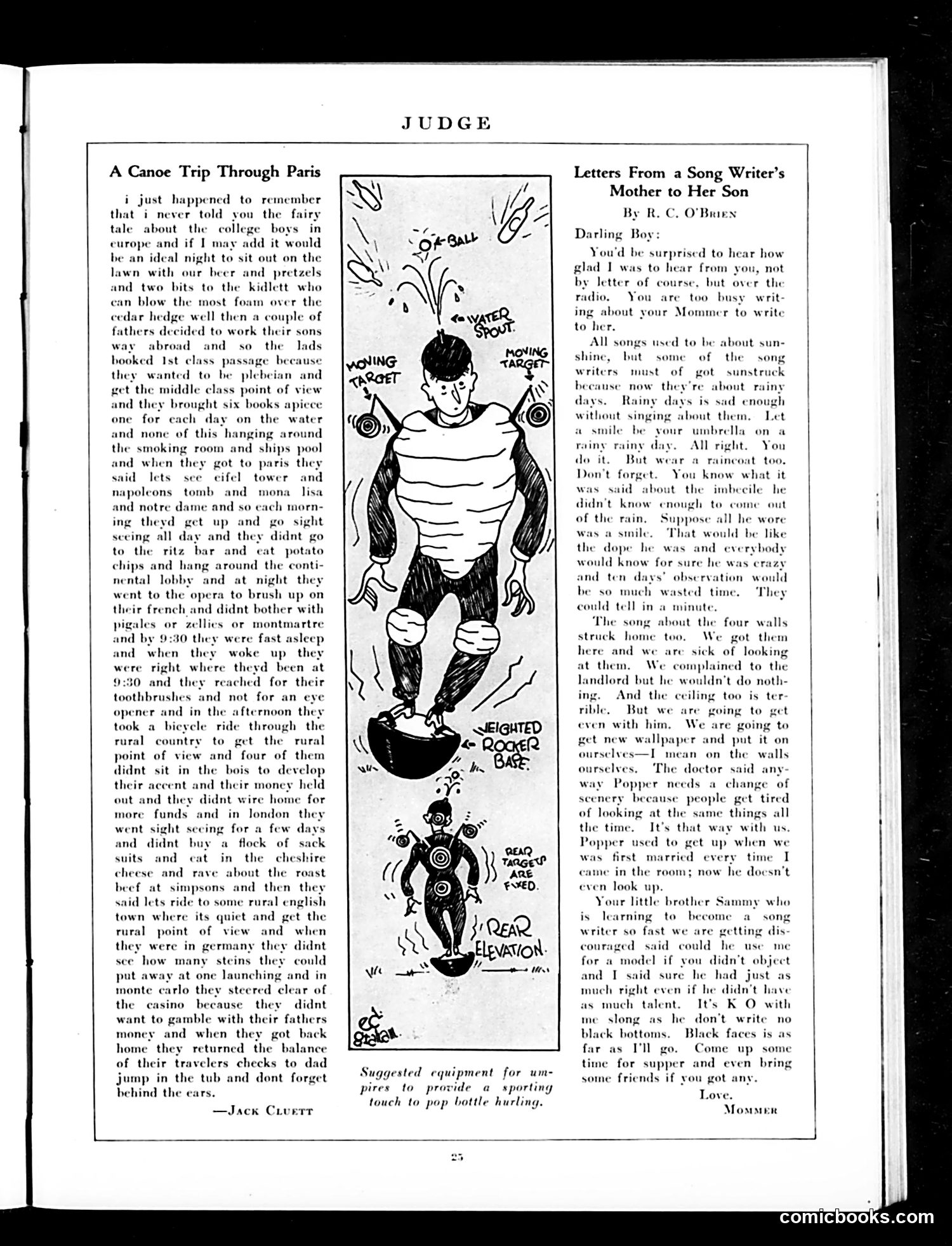
**"A Canoe Trip Through Paris"** by Jack Cluett satirizes American tourists abroad who paradoxically try to be "cultured" while actually experiencing nothing. The cartoon depicts college boys who visit Europe with guidebooks but spend their days industriously sightseeing (Eiffel Tower, Mona Lisa, Notre Dame) rather than enjoying themselves—no nightlife, no excess, no romance. They return home unchanged, having mechanically checked boxes. The joke: authentic travel requires *living*, not tourism. **"Letters From a Song Writer's Mother"** by R.C. O'Brien humorously portrays a working-class mother writing to her successful songwriter son. She complains about rainy-day songs (fashionable then), wears, her shabby apartment, and her lazy husband "Popper." The satire targets both sentimental songwriting trends and domestic malaise—she's so ordinary and unglamorous that her son prefers radio silence to her letters. Both pieces mock 1920s-30s American aspiration: cultured tourism and popular entertainment, respectively.
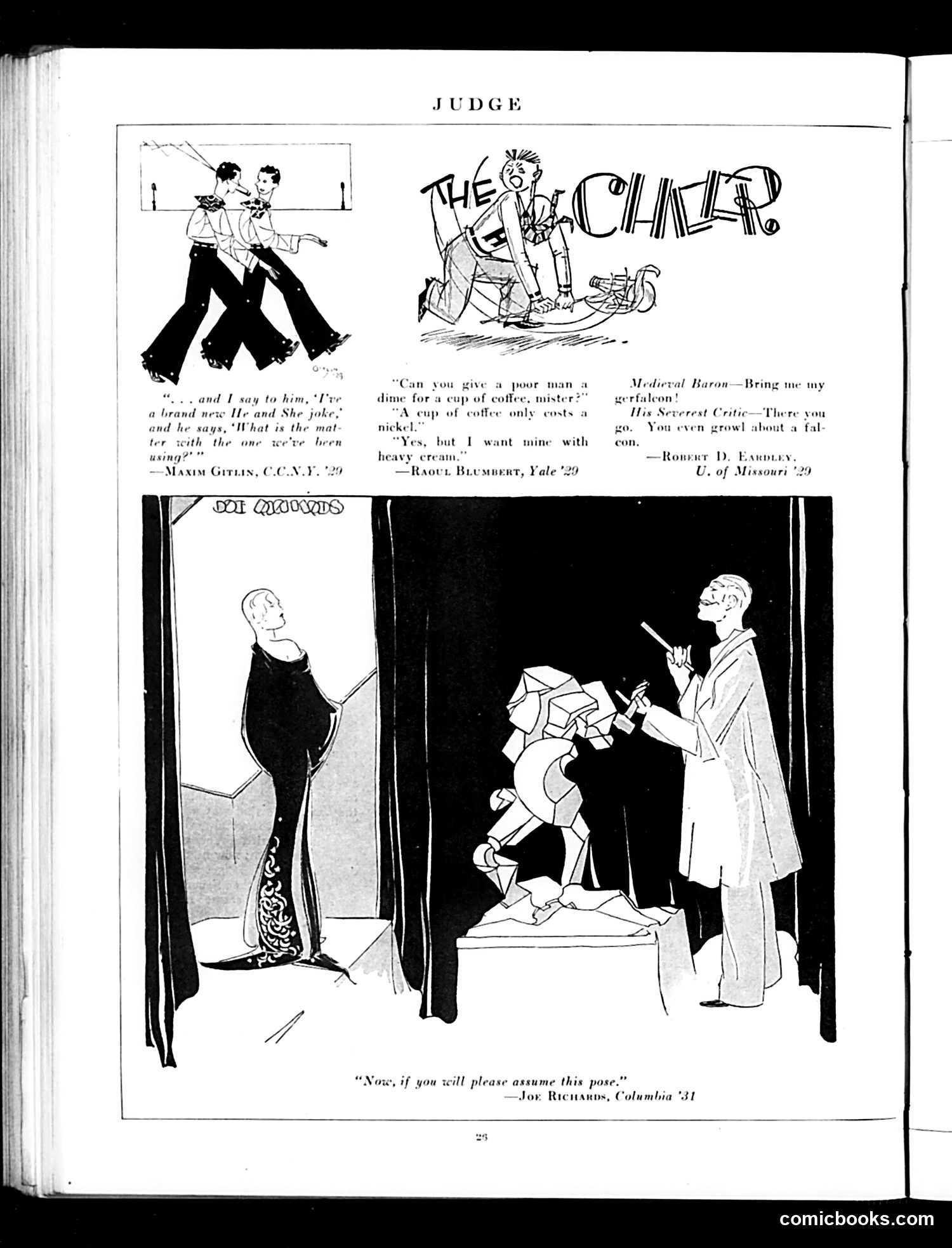
This page from the satirical magazine **Judge** contains three brief humorous submissions from college students (circa 1929-1931). **Top left**: A joke about class disparity—a poor man asks for a dime for coffee, but the speaker insists on giving a nickel and wants it served with heavy cream, mocking wealthy people's pretentious consumption habits even when supposedly helping the poor. **Top right**: "The Chiller" cartoon depicts a medieval baron demanding his "gerfalcon" (a hunting bird), mocking overwrought historical fiction or theatrical drama popular in the era. **Bottom**: A cartoon showing what appears to be an art class or modeling session, where an instructor asks a model to "assume this pose"—the humor likely derives from an awkward or undignified position being requested in a formal artistic context. These are student submissions representing typical 1920s-30s college humor: social commentary, absurdist scenarios, and gentle mockery of pretension and authority figures.
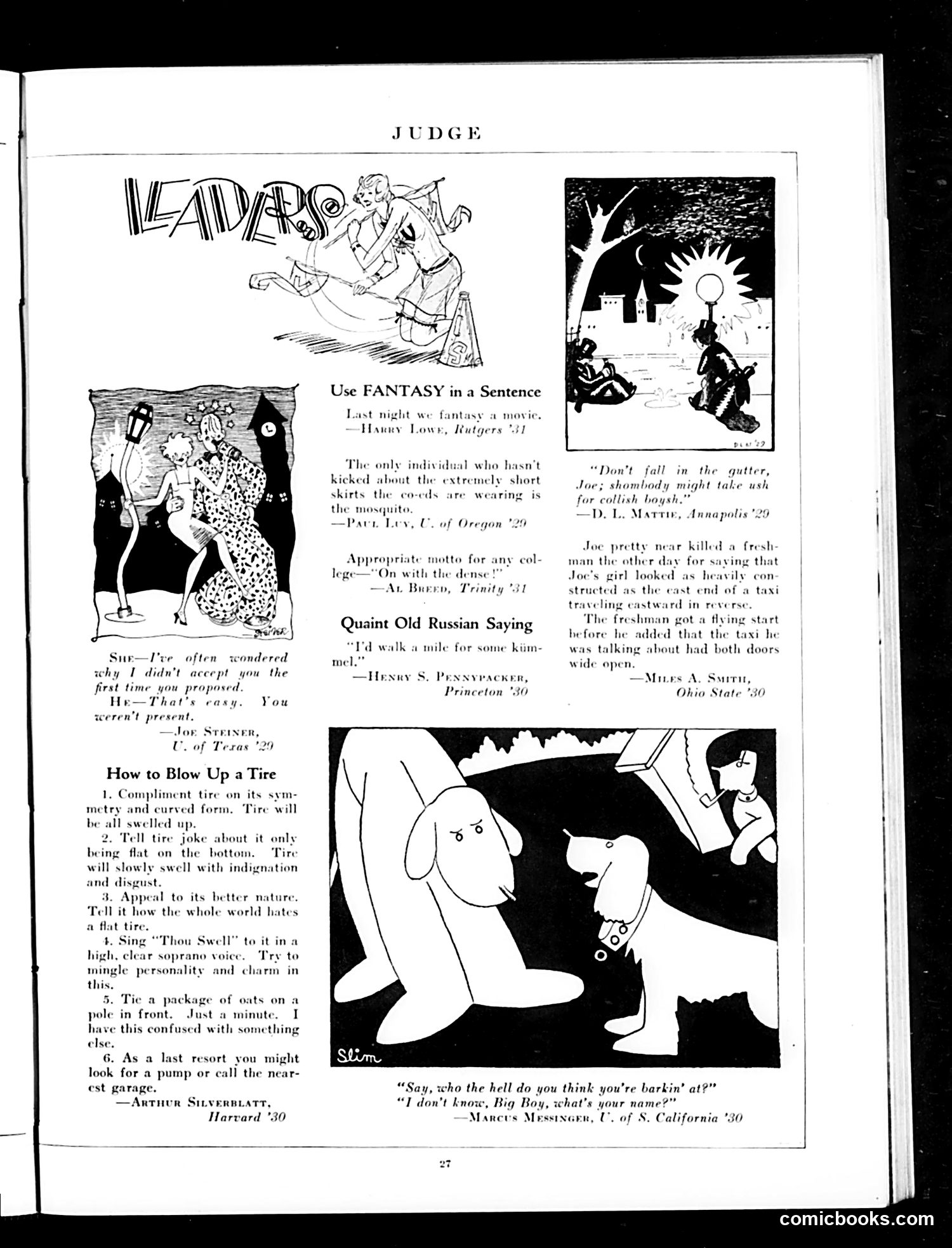
This page from Judge magazine (circa 1930) collects humorous submissions from college students. The content reflects 1920s-30s campus humor and social attitudes: **Main Features:** 1. **"Use Fantasy in a Sentence"** - Mocks improper grammar/usage, a common college humor trope. 2. **"How to Blow Up a Tire"** - A faux-instructional joke playing absurdist humor (steps 1-4 involve psychological appeals to an inanimate tire; step 5 admits confusion). 3. **Short quips** - Target contemporary concerns: women's fashion (short skirts), mosquitoes, college mottos. 4. **The cartoon** - A flirtatious exchange between a man and woman in a car, seemingly about mistaken identity or pickup banter ("what's your name?"), reflecting period dating customs. **Context**: This represents college-generated satire typical of Judge's "Judge's Library" feature, where student humor ranged from wordplay to social observation about campus life, gender relations, and 1920s-30s modernity.
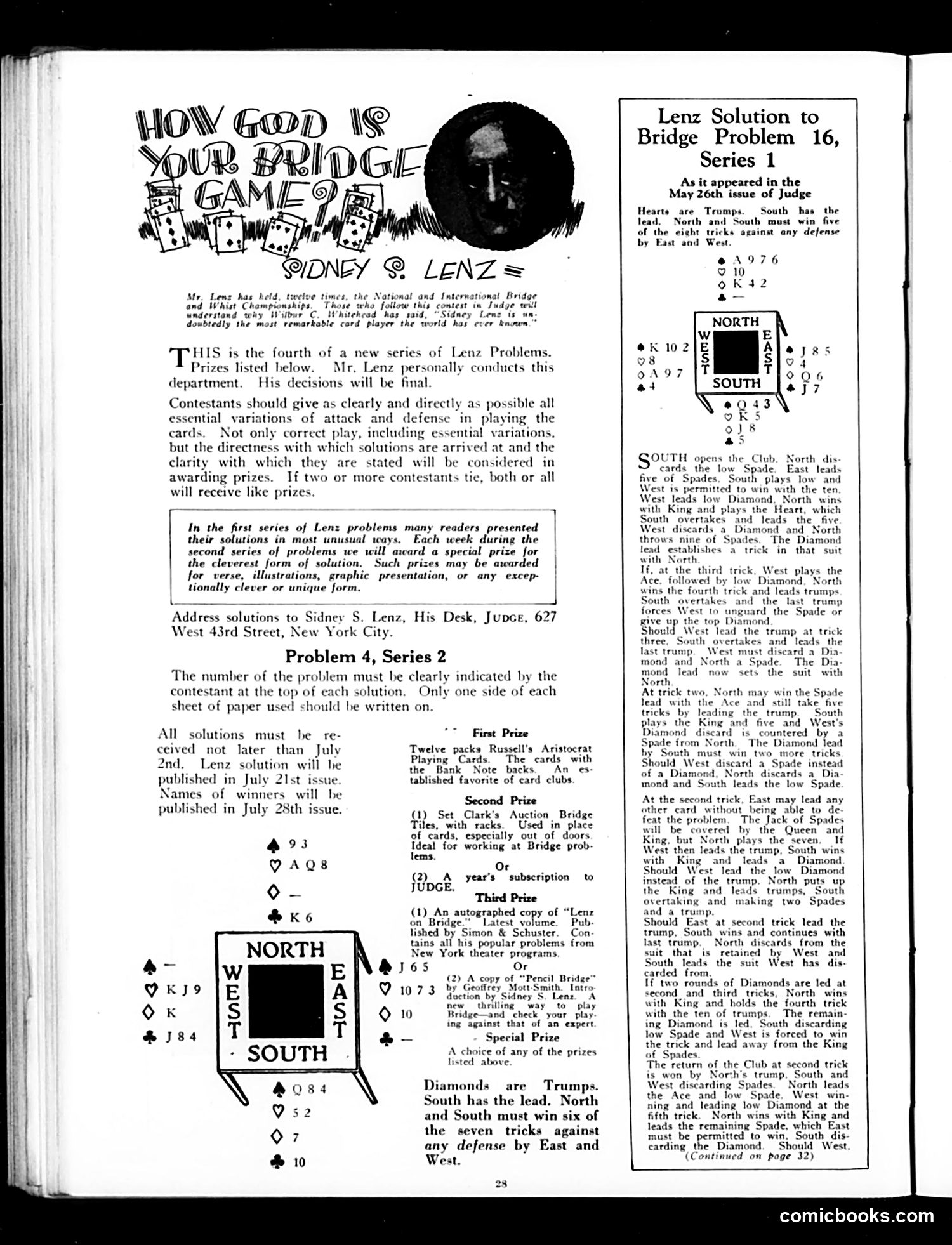
This page features a **bridge card game competition** rather than political satire. Sidney S. Lenz, described as "the most remarkable card player the world has ever known," presents Problem 4 in a series of bridge puzzles for Judge readers to solve. The content is instructional: contestants must demonstrate how North and South can win six of seven tricks at diamonds (trump suit) against any defense from East and West. Solutions compete for prizes including playing card sets, bridge instruction books, and Judge subscriptions. The cartoon header ("How Good Is Your Bridge Game?") is lighthearted wordplay, not satire. This represents Judge's attempt to engage readers with intellectual games and entertainment beyond humor—reflecting the magazine's broader appeal to educated audiences interested in card games, which were immensely popular leisure activities in this era.
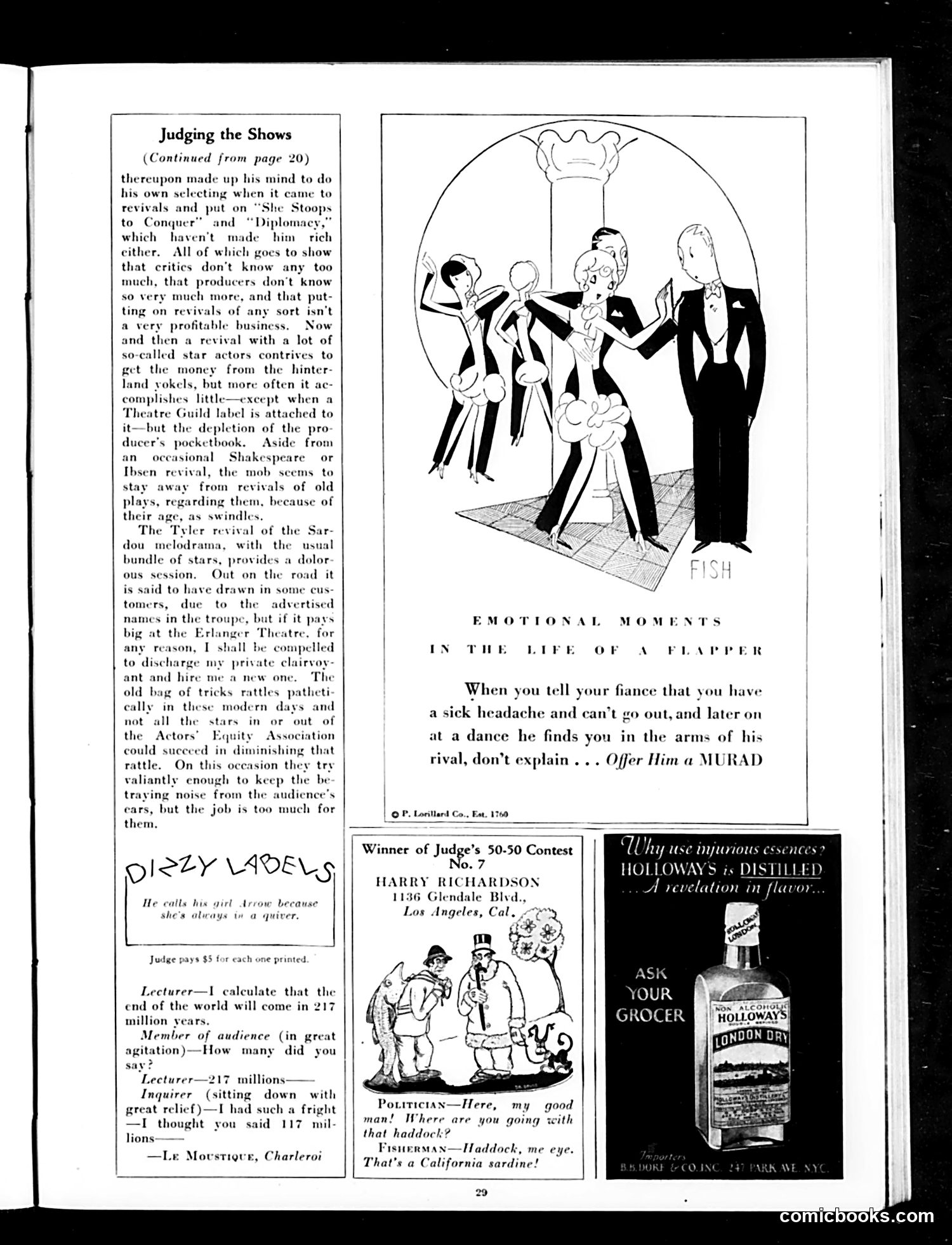
This page contains theater criticism and period humor pieces rather than political cartoons. The main article critiques Broadway producers' poor judgment selecting revival plays—"She Stoops to Conquer" and "Diplomacy" failed financially. The writer argues that theatrical revivals rarely succeed unless branded by the Theatre Guild or featuring major stars, yet producers persist despite losses. The piece mocks both critics' and producers' limited understanding of audience taste. The humor sections include: **"Dizzy Labels"**: A one-liner joke about a nervous girlfriend. **Lecture joke**: A man panics hearing the world ends in "217 million years," fearing he heard "117 million"—dark humor about mortality anxiety. **Politician/Fisherman exchange**: A vendor insists his wares are "California sardines" not haddock—likely mocking California's agricultural promotion or quality deception. The page also includes advertisements for Murad cigarettes and Holloway's London Dry gin.
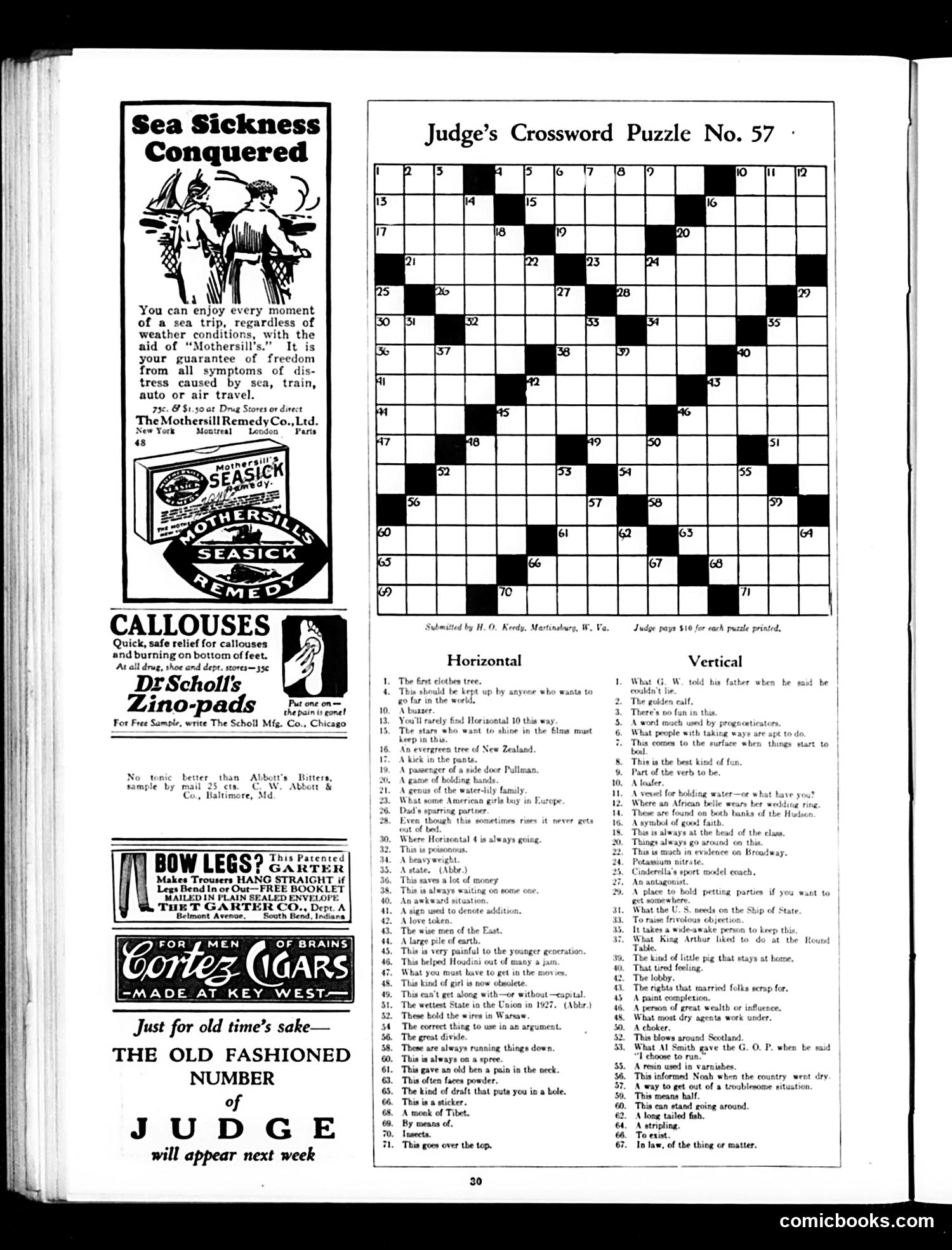
This page is primarily **advertising and puzzle content**, not political satire. The left side features three product advertisements (Mothersill's seasickness remedy, Dr. Scholl's corn pads, and a bow-legs garter) typical of early 20th-century magazine marketing. The dominant content is **Judge's Crossword Puzzle No. 57**, a large crossword grid with accompanying clues. The clues themselves contain mild contemporary humor and social observations—references to "Cinderella's sport model coach," "the wettest State in the Union in 1927" (likely Wisconsin, regarding Prohibition), and "what Al Smith gave the G.O.P." (Al Smith was a Democratic presidential candidate). These hint at 1920s-era topics but are presented as wordplay rather than sharp satire. At bottom, an advertisement announces "The Old Fashioned NUMBER of JUDGE will appear next week," suggesting this is a regular puzzle feature, not satirical commentary.
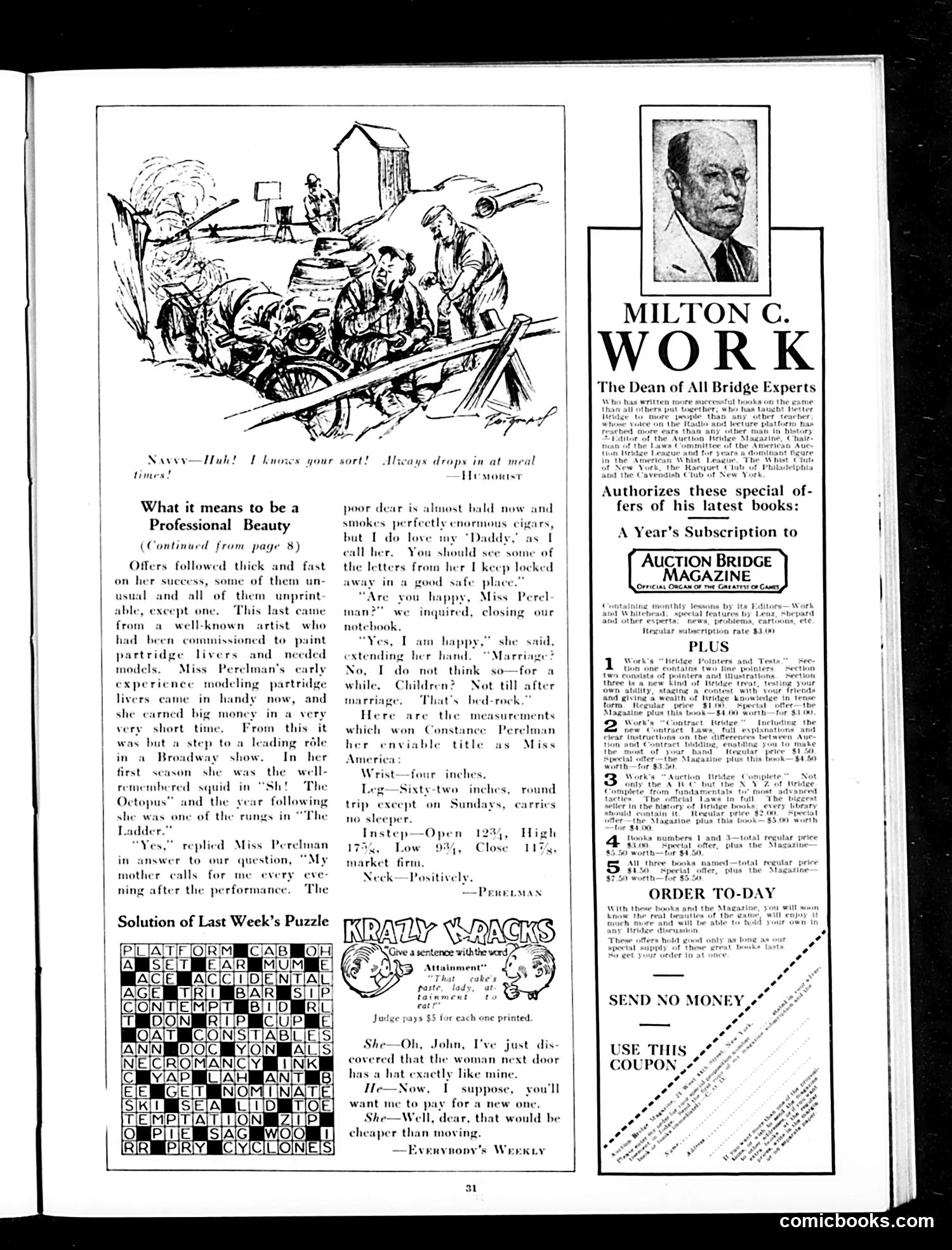
This page contains **satirical humor** rather than political cartooning. The main content is a continuation of "What it means to be a Professional Beauty," mocking the superficiality of theatrical career advancement. The narrative describes a woman (Miss Perelman) who begins modeling for artists painting "partridge livers"—an absurdist reference suggesting even ridiculous work launches entertainment careers—before becoming a Broadway performer. The humor targets the entertainment industry's illogic: her success stems from random connections rather than talent. References to roles in "Sh! The Octopus" and "The Ladder" suggest specific (now-obscure) theatrical productions. The page also includes: - A crossword puzzle solution - "Krazy Kracks" joke section (mild domestic humor) - Advertisement for Milton C. Work's bridge books The satire reflects **early 20th-century magazine humor** mocking theatrical ambition and the arbitrary nature of show business success—themes still recognizable today, though specific references require historical theater knowledge.
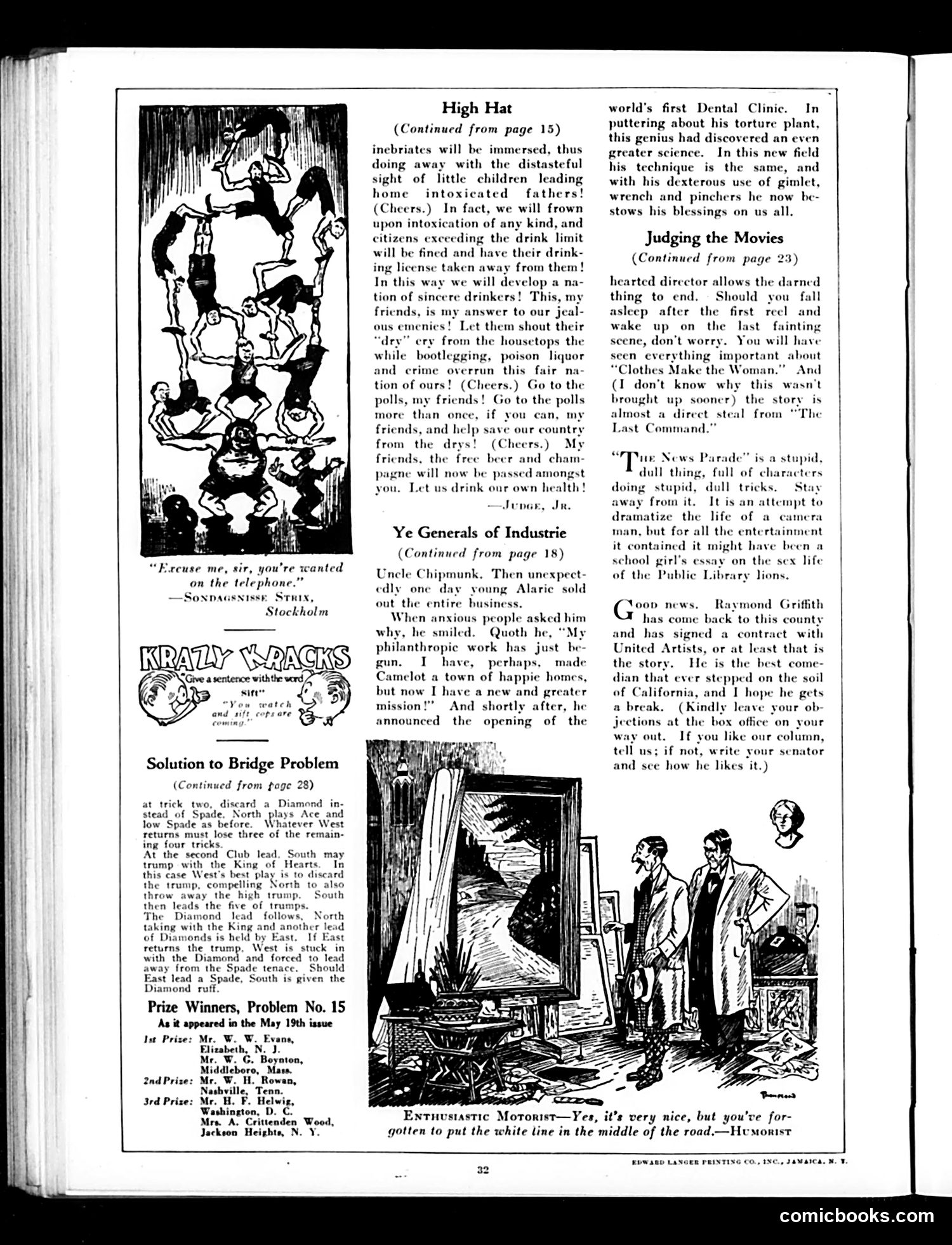
This page from Judge magazine contains several satirical pieces targeting Prohibition-era politics and contemporary culture. **"High Hat"** mocks a pro-Prohibition speech. The speaker ironically proposes drowning intoxicated citizens and implementing "drinking licenses"—absurd solutions presented as serious policy while acknowledging that "bootlegging, poison liquor and crime" will flourish regardless. The satire critiques Prohibition's ineffectiveness and the hypocrisy of "dry" advocates. The phrase "My friends, the free beer and champagne will now be passed amongst you" undercuts the entire argument. **"Ye Generals of Industrie"** describes a businessman (Uncle Chipmunk) who abandons his profitable "Camelot" town to open the "world's first Dental Clinic," using torture-implements (gimlets, wrenches, pinchers). This satirizes the grotesque nature of dental work and perhaps industrialists' claims of philanthropic missions. **"Judging the Movies"** offers caustic film reviews dismissing contemporary cinema as derivative and tedious. The **"Enthusiastic Motorist"** cartoon (bottom) depicts someone forgetting to paint road safety lines—a mild joke about careless infrastructure.
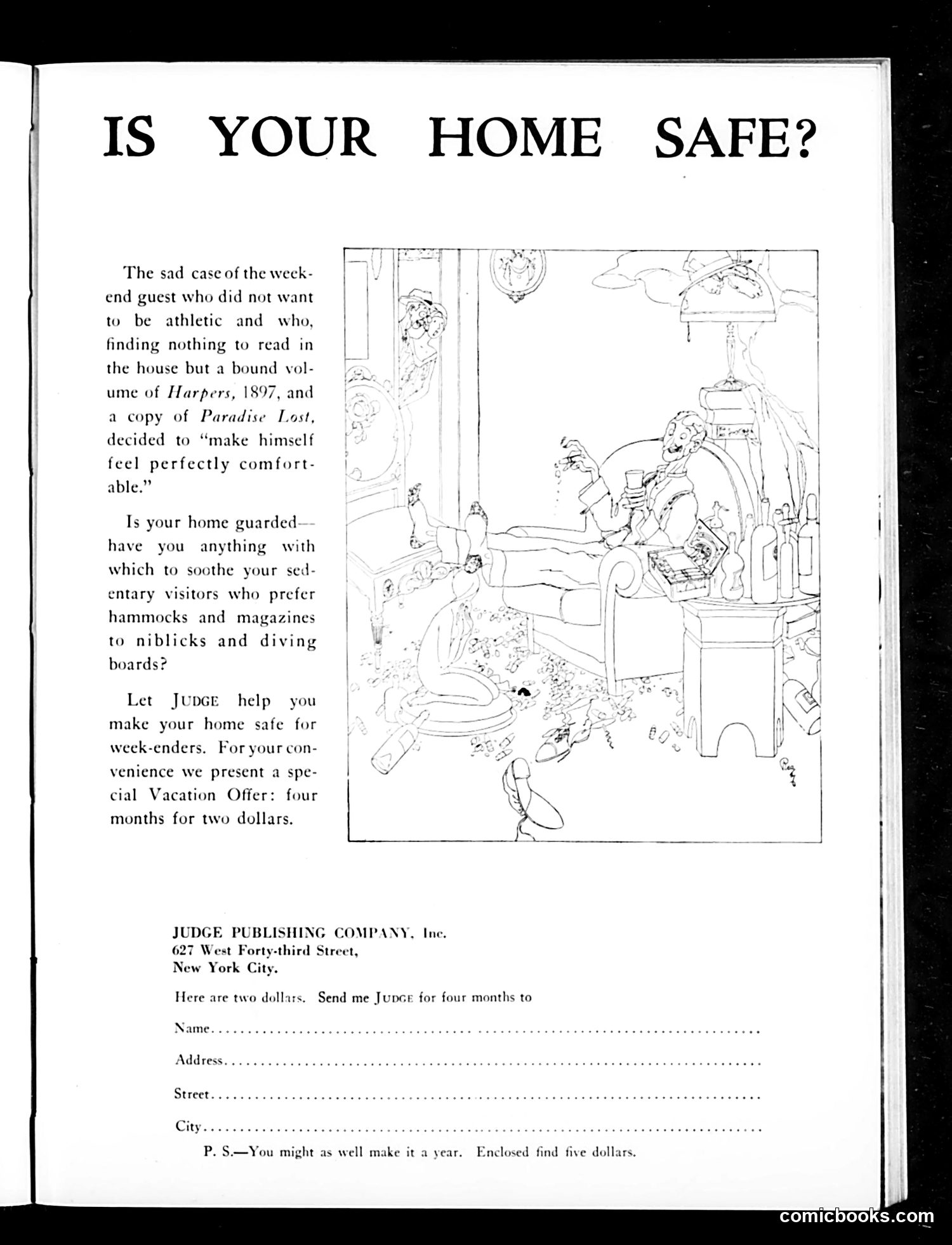
This is primarily a **subscription advertisement** for Judge magazine, using humor to pitch the publication as a solution to a social problem. **The Setup:** The cartoon depicts a lazy weekend houseguest who refuses to participate in athletic activities (golf, diving) and instead sprawls indolently, seeking entertainment. The only reading materials available are outdated (an 1897 *Harper's*) and demanding (*Paradise Lost*). **The Satire:** The ad jokes that such sedentary guests are a "home safety" hazard—implying they represent a social nuisance. By subscribing to Judge, homeowners would have engaging magazines to occupy these reluctant athletes, making visits bearable. **Historical Context:** This reflects early 20th-century anxiety about leisure culture and gender roles. Visiting expectations included sports participation; guests who preferred reading were viewed as odd or burdensome. Judge positions itself as the solution—modern, amusing content for the uncomfortable introvert. The postscript ("You might as well make it a year") uses self-deprecating humor to encourage longer subscriptions through comedic assumption that readers will enjoy the magazine so much they'll upgrade anyway.
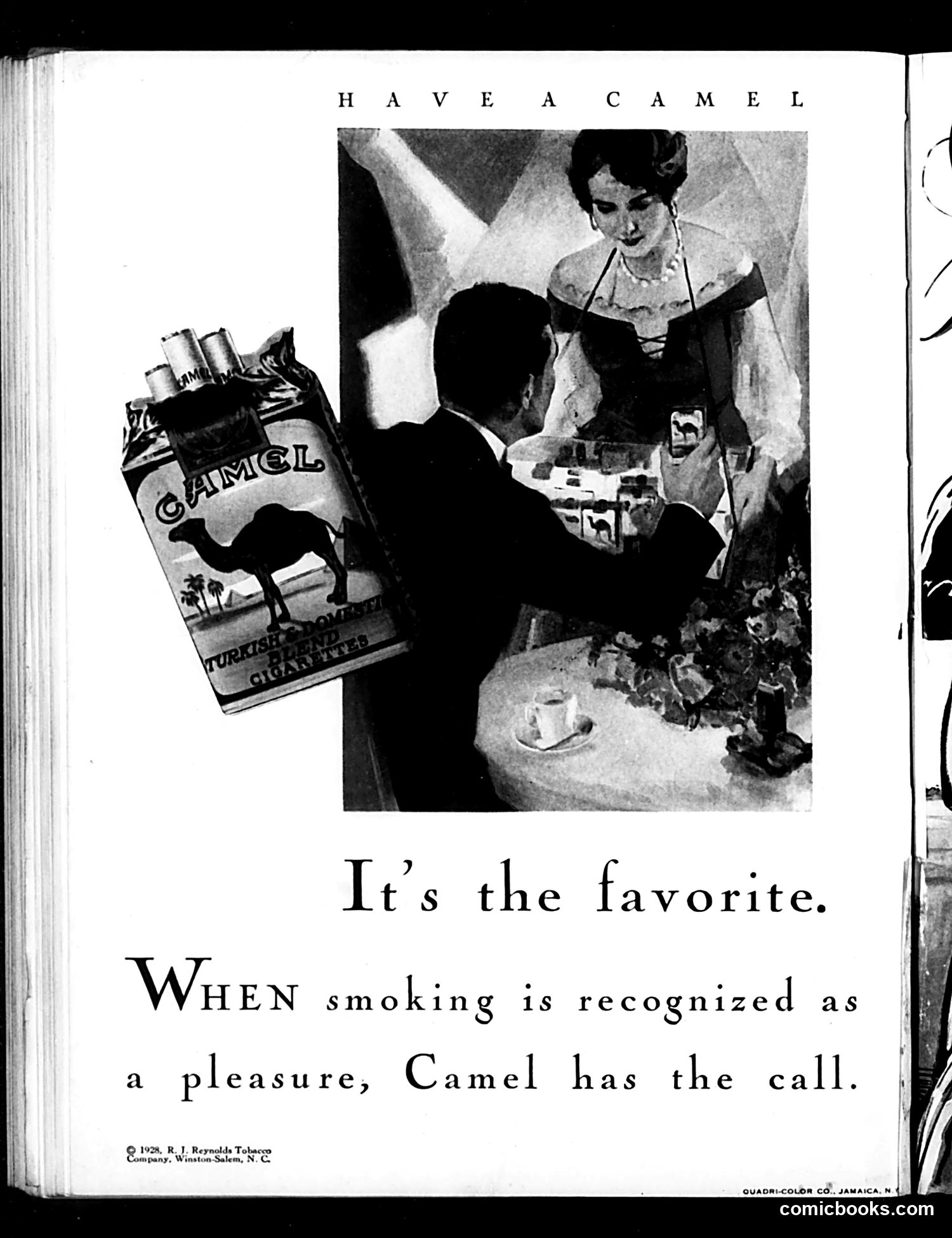
This is a **Camel cigarette advertisement** from 1928, not political satire. The page shows a well-dressed couple at what appears to be a social gathering, with the man offering cigarettes to the woman. The ad's message claims that when smoking is viewed as pleasurable rather than merely habitual, people choose Camel brand cigarettes. The advertisement reflects 1920s marketing that normalized smoking—particularly among women—as a sophisticated social practice. The elegant setting and fashionable couple suggest cigarettes as markers of refinement and modernity. There is no satirical intent; this is straightforward commercial messaging from Reynolds Tobacco Company, typical of the era before widespread understanding of smoking's health dangers.