
A complete issue · 36 pages · 1928
Judge — May 19, 1928
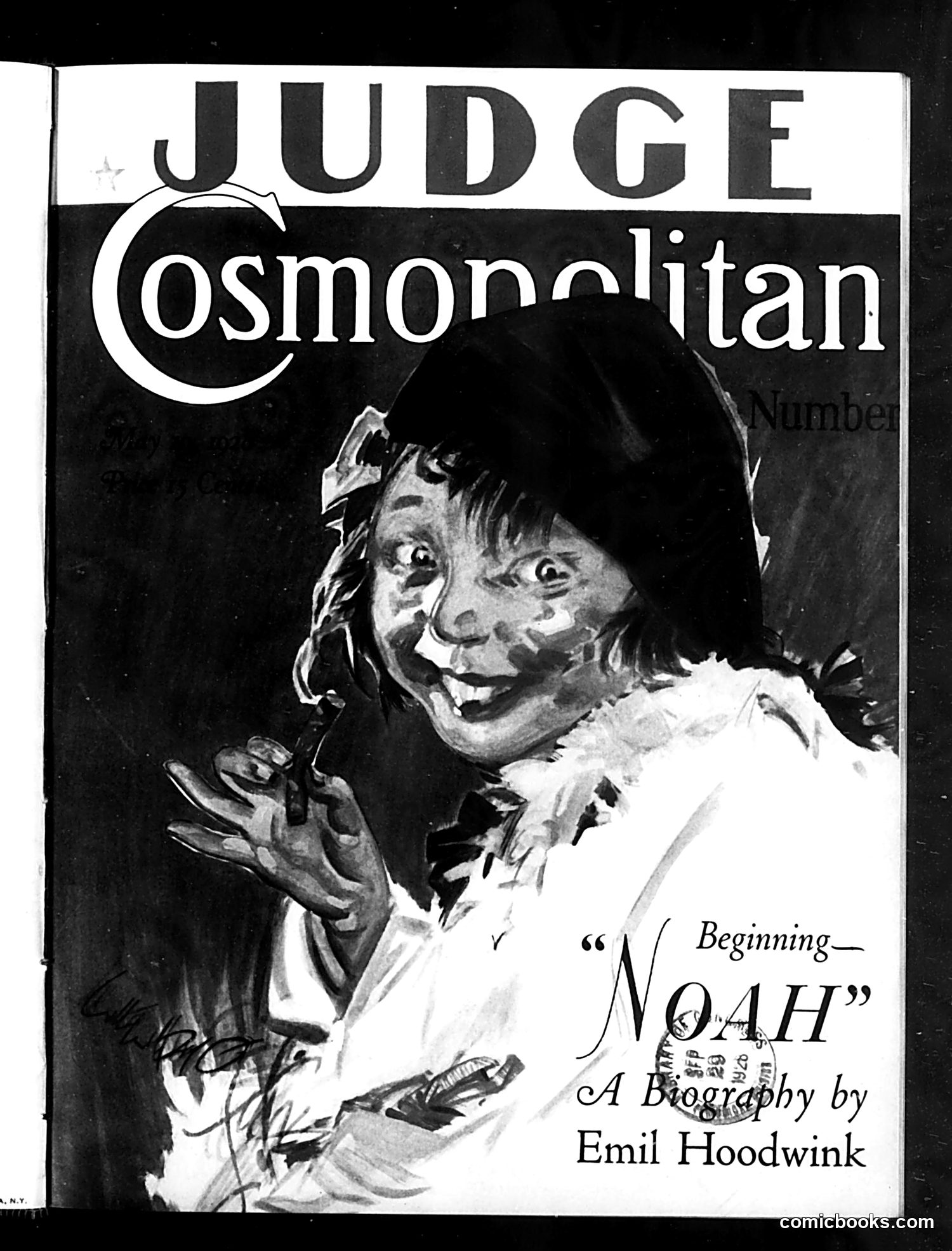
This is a cover for *Judge* magazine advertising a serialized biography of Noah by Emil Hoodwink. The image shows a character with an exaggerated, grotesque face painted white—appearing to be in theatrical or clown makeup—wearing period costume with white fur trim. The satire likely mocks either the biography itself or popular religious/historical treatments of Biblical subjects. The grotesque caricature suggests the work presents Noah as ridiculous or absurd rather than dignified. This reflects *Judge*'s satirical tradition of lampooning contemporary cultural trends, particularly sentimental or overwrought biographical works that were popular during this era. The theatrical makeup implies the biography may have dramatized or sensationalized its subject matter for entertainment value rather than historical accuracy.
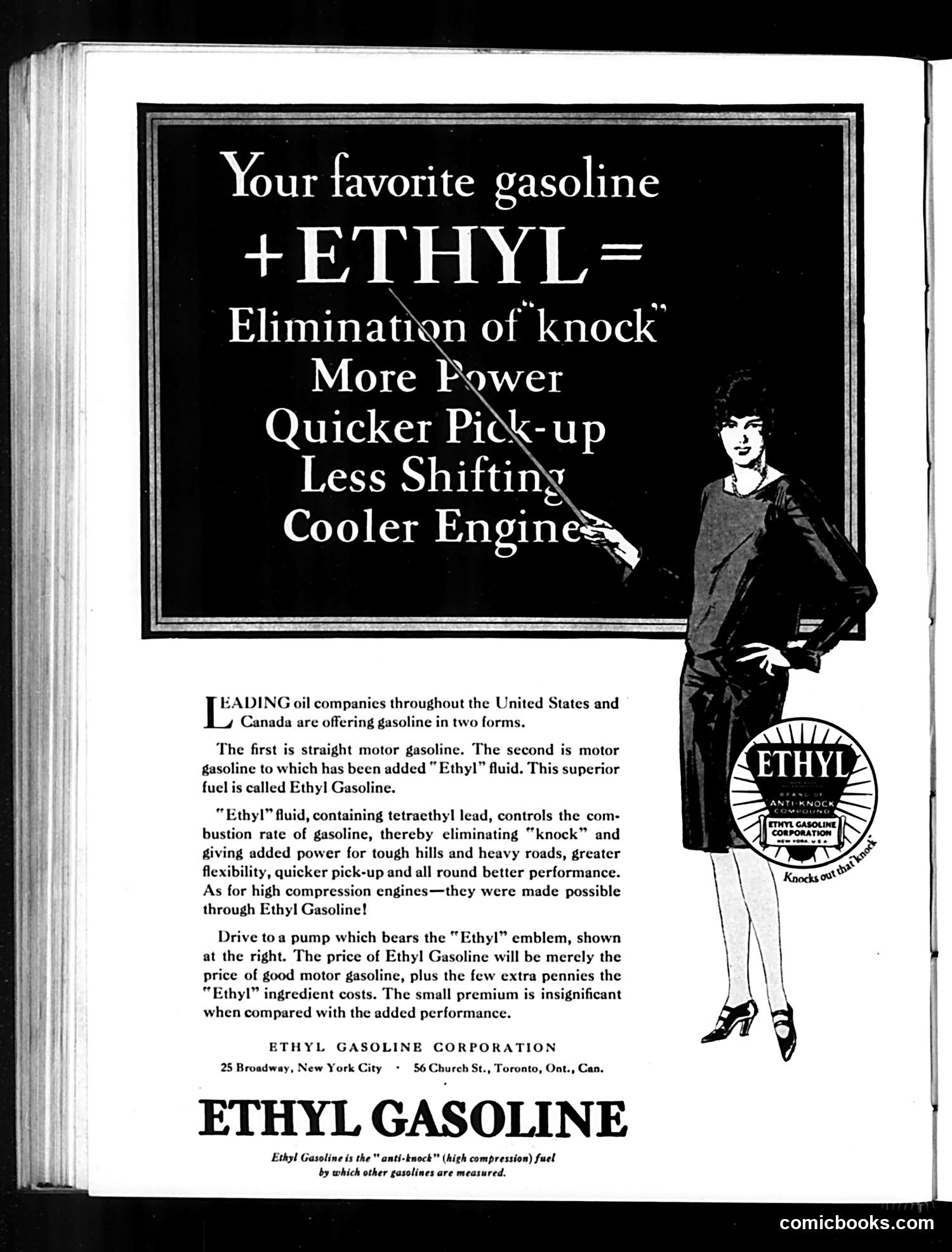
This page is primarily a **commercial advertisement**, not political satire. It promotes Ethyl Gasoline, a fuel additive containing tetraethyl lead, marketed to enhance engine performance. The ad features a stylized woman in 1920s attire pointing to benefits: elimination of engine "knock," more power, quicker acceleration, smoother shifting, and cooler engines. The copy emphasizes that Ethyl Gasoline cost only pennies more than regular fuel while delivering superior performance. The Ethyl Gasoline Corporation (headquartered in New York and Toronto) positions this as a premium product for serious drivers. The woman serves as a professional endorser, common in period advertising. **Historical context**: Tetraethyl lead was later recognized as toxic but remained in gasoline for decades.
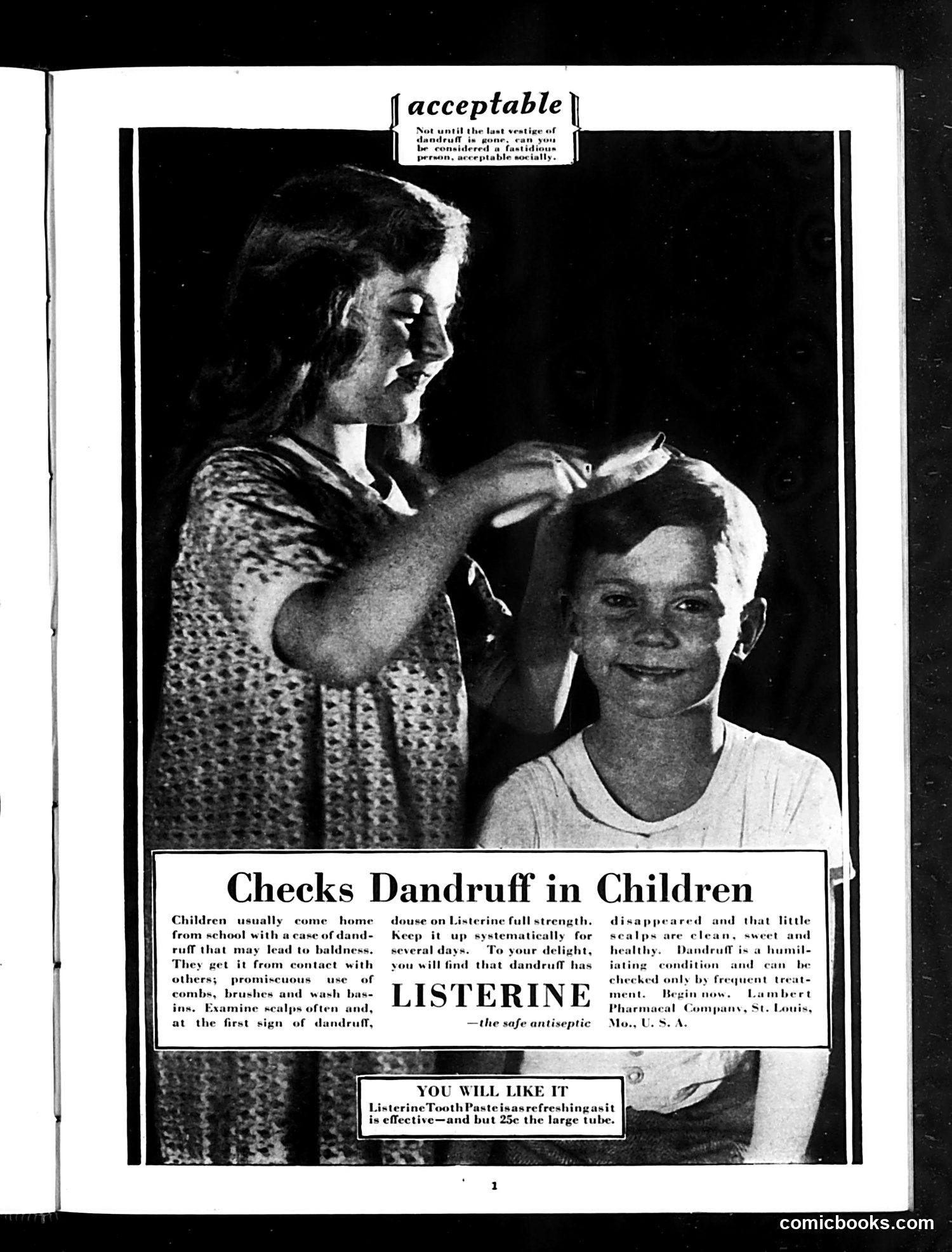
This page is primarily **advertising, not satire or political cartooning**. It contains a Listerine advertisement from Lambert Pharmacal Company promoting their antiseptic mouthwash and toothpaste for treating dandruff in children. The image shows a woman examining a smiling boy's scalp, illustrating the advertiser's claim that Listerine can treat dandruff. The advertisement emphasizes systematic treatment over "several days" and promises clean, healthy scalps. The word "acceptable" at the top appears to be Judge magazine's editorial stamp of approval for the advertisement itself, not commentary on the product. This reflects how early 20th-century magazines routinely vetted ads before publication.
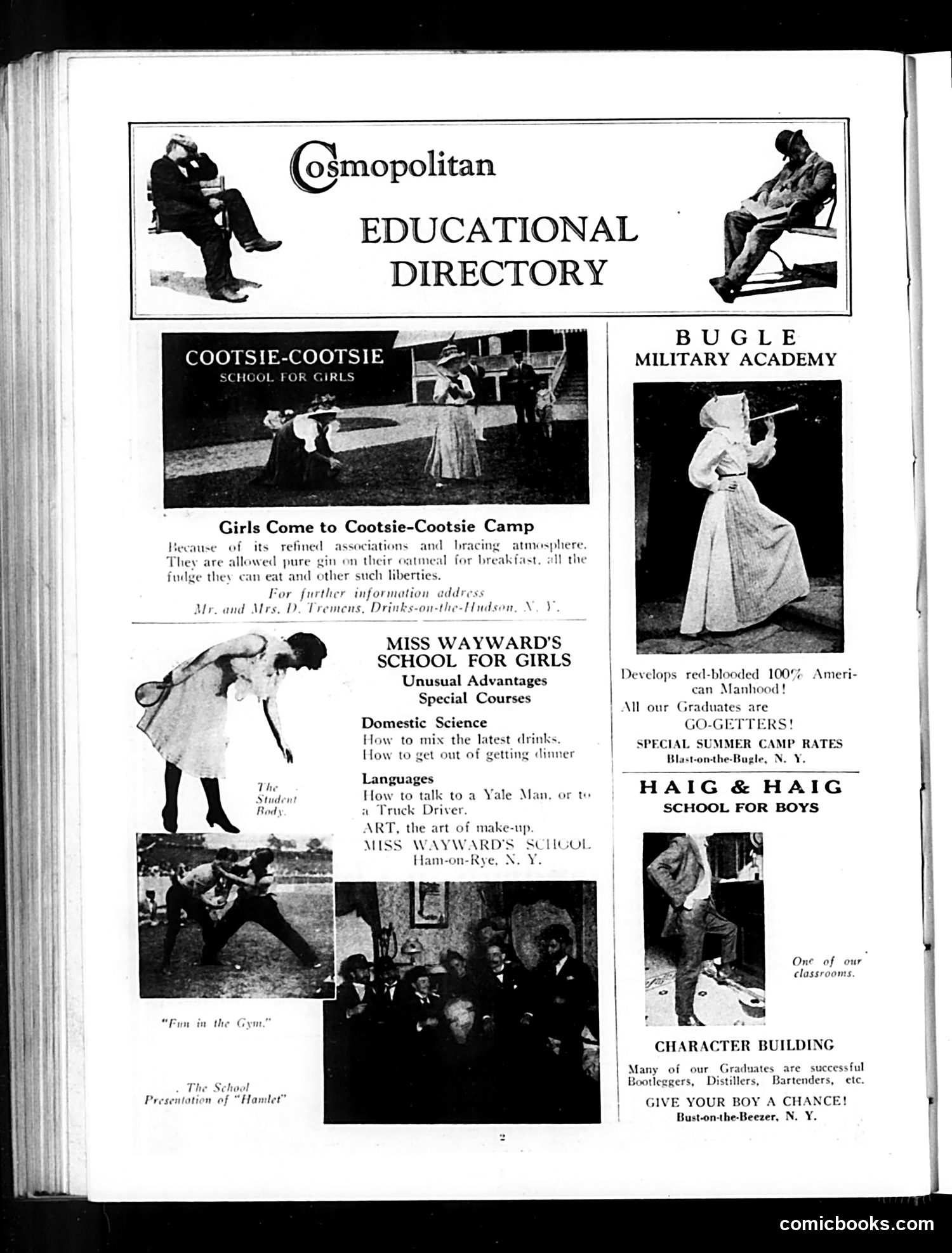
This page is primarily **advertising**, not political satire. It's a "Cosmopolitan Educational Directory" featuring schools and academies from the 1920s-30s era. The advertisements mock educational institutions through exaggerated course descriptions: - **Miss Wayward's School for Girls** satirizes finishing schools by listing absurd "courses": "How to talk to a Yale Man," "the art of make-up," and "How to get out of getting dinner"—mocking both girls' education and gender expectations of the era. - **Bugle Military Academy** and **Haig & Haig School for Boys** advertise character-building and masculine development ("red-blooded 100% American Manhood"). - **Cootsie-Cootsie School for Girls** jokingly references summer camps. The satire targets the pretentiousness of elite educational institutions while reflecting contemporary anxieties about gender roles and class aspiration.
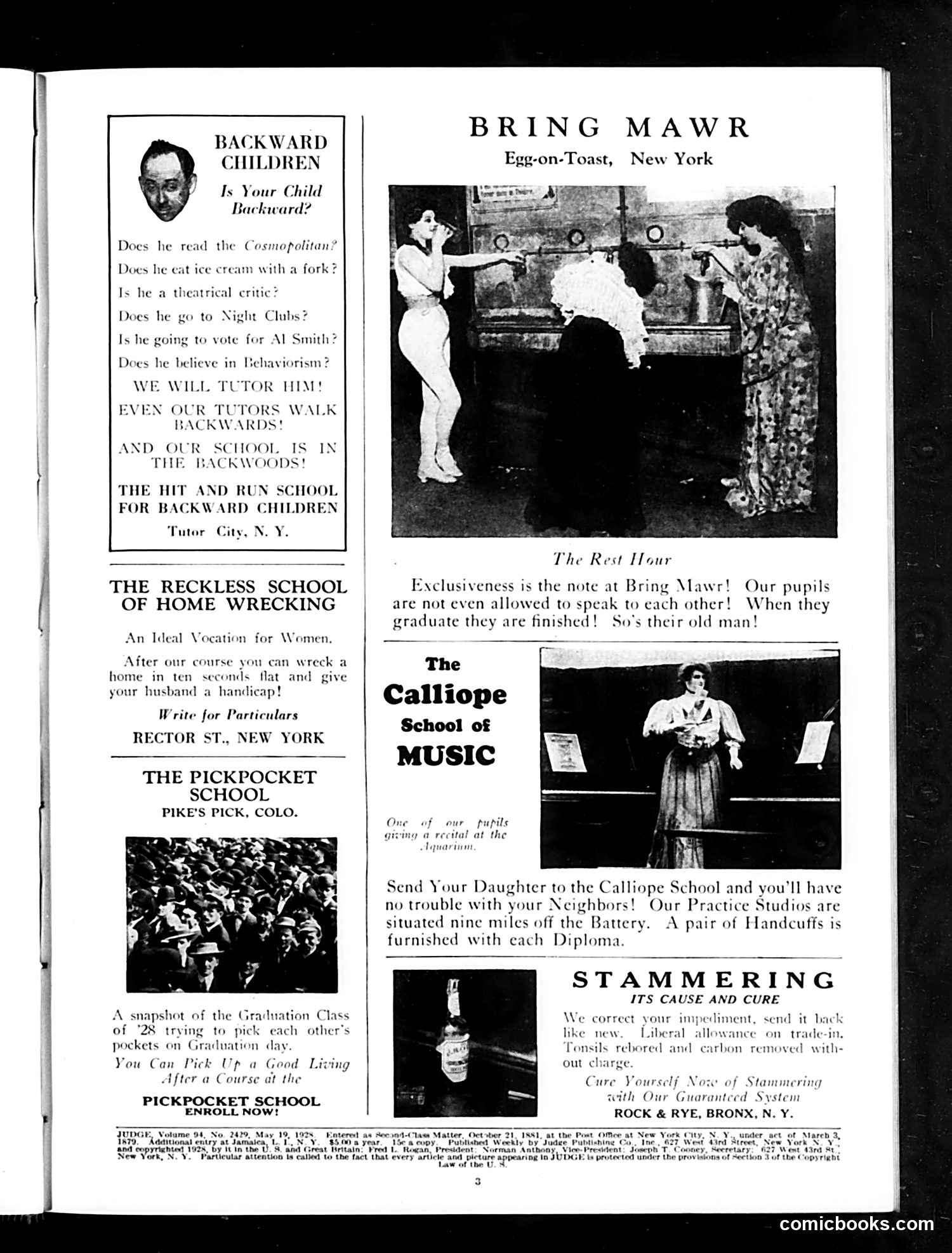
This page is primarily **advertisements** with one satirical section. The left column features "Backward Children" - a mock school advertisement mocking progressive education trends. The satire suggests modern schools are producing intellectually backwards students who read highbrow magazines, eat with forks, and might vote for "Al Smith" (likely the 1928 presidential candidate). The joke targets anxiety about unconventional educational methods. Below are genuine ads for correspondence schools: "The Reckless School of Home Wrecking," "The Pickpocket School," and "The Calliope School of Music" - all fake schools using absurdist humor to mock dubious correspondence-school industry practices. The right side features genuine advertisements for "Bring Mawr" establishment and a stammering cure. The humor relies on readers' familiarity with 1920s educational reform debates and mail-order school scams.
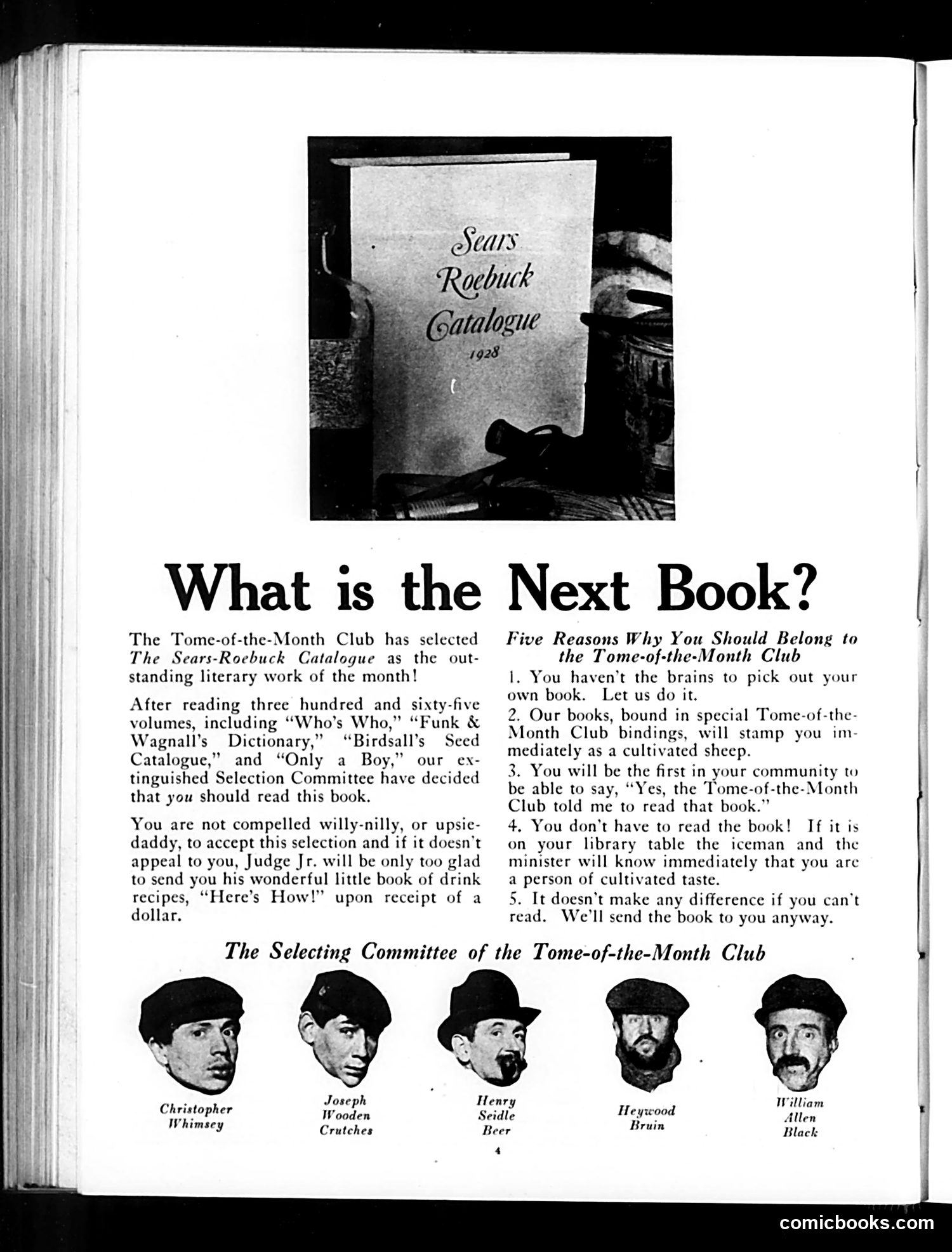
This page is primarily **advertising disguised as satire** for the Tome-of-the-Month Club, promoting their selection of the 1928 *Sears-Roebuck Catalogue*. The humor mocks both the book club concept and intellectual pretension. The five caricatured men at bottom—Christopher Whimsey, Joseph Wooden Crutches, Henry Seidle Beer, Heywood Bruin, and William Allen Black—appear to be **fictional "judges"** whose ridiculous names underscore the absurdity of the selection process. The "Five Reasons" section sarcastically claims members needn't actually read selections or possess taste; the visible book on the table serves purely as a status symbol. This satirizes the real Tome-of-the-Month Club's marketing, which promised cultural sophistication to middle-class subscribers. By substituting a catalogue for serious literature, Judge critiques both the club's pretensions and its members' willingness to purchase respectability rather than genuine intellectual engagement.
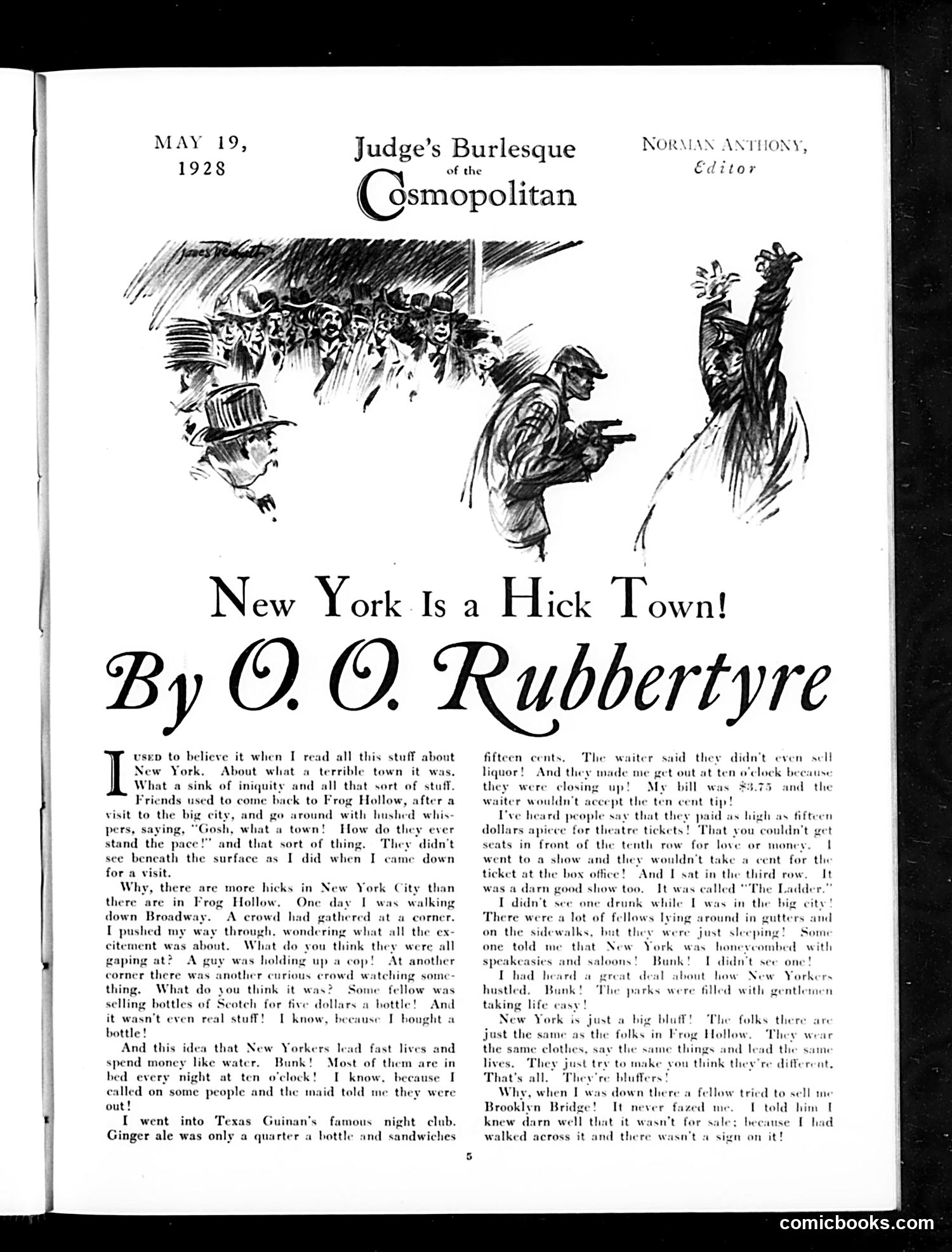
This page from Judge (May 19, 1928) contains a humorous essay titled "New York Is a Hick Town!" by O. O. Rubbertyre, presented as a "Judge's Burlesque of the Cosmopolitan." The accompanying ink sketches show various New York street scenes: a crowded theater or venue, a man with a camera (suggesting a tourist), and figures appearing to celebrate or interact. The satire inverts expectations: the author claims New York—supposedly cosmopolitan and sophisticated—actually resembles small-town America ("Frog Hollow"). He contrasts the city's pretensions (fast living, expensive nightclubs like Texas Guinan's) with observations that New Yorkers behave like small-town folks: same clothes, same attitudes, same bluffing. The piece ridicules both urban pretentiousness and the universal human tendency to perform sophistication while remaining fundamentally ordinary.
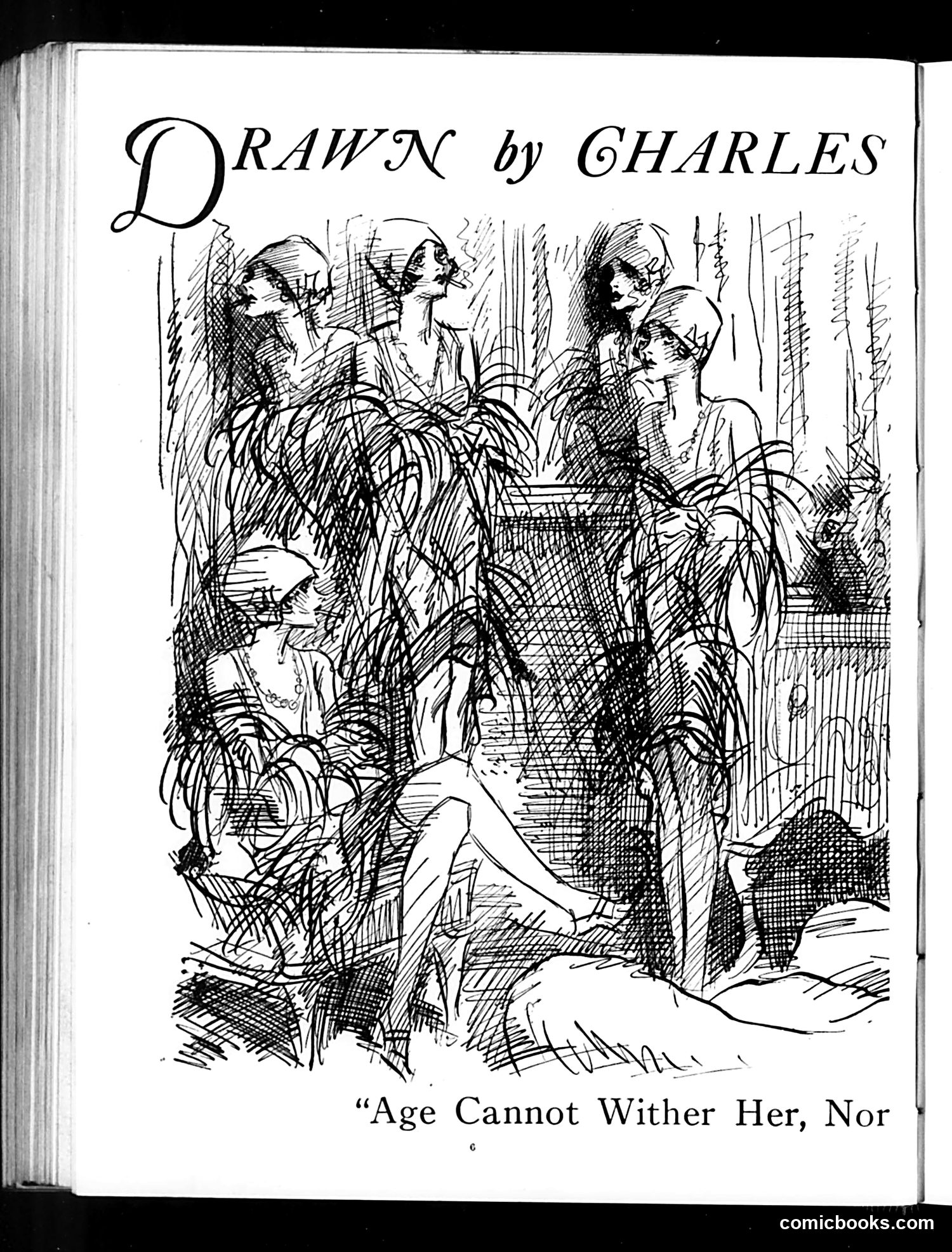
This is a pen-and-ink drawing credited to Charles (artist surname unclear from image). The illustration shows a woman seated centrally, surrounded by several standing figures in what appears to be an interior setting with draped fabric or foliage. The caption reads: "Age Cannot Wither Her, Nor" — a partial quote from Shakespeare's *Antony and Cleopatra*, describing a woman of timeless beauty. The satire likely comments on either: 1. A specific woman public figure maintaining her appearance/relevance despite aging, or 2. A commentary on feminine vanity and beauty standards of the era Without additional context (date, publication details, or the complete caption), the specific target of this satire remains unclear. The drawing style and composition suggest early-to-mid 20th century Judge magazine content, but the precise social or political reference cannot be definitively identified from the image alone.
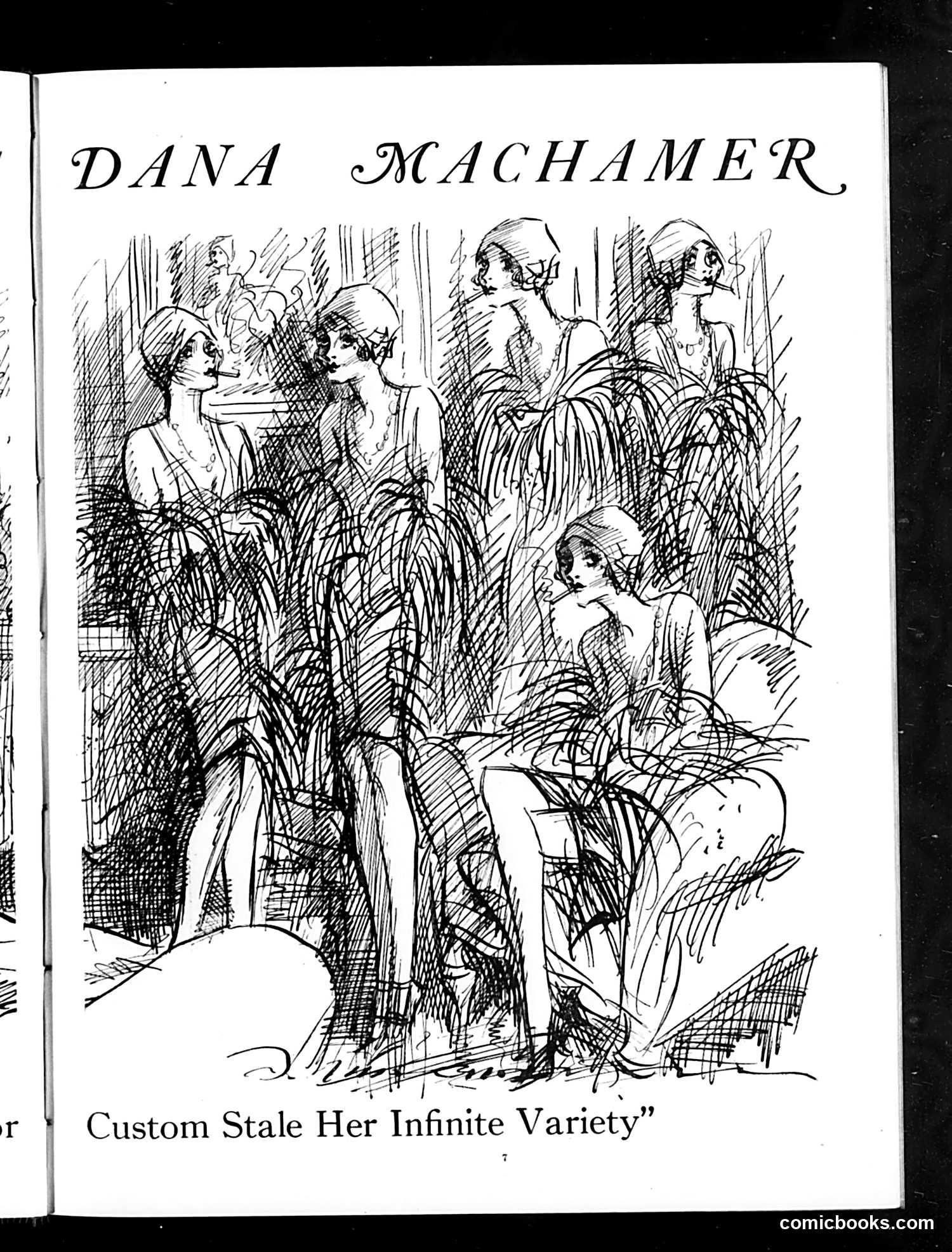
This appears to be a title page or section header for Dana Machamer, likely a cartoonist or illustrator for *Judge* magazine. The sketch shows several elegantly dressed women in what appears to be an interior social setting, rendered in Machamer's characteristic loose ink style. The caption "Custom Stale Her Infinite Variety" is a satirical play on Shakespeare's famous line about Cleopatra ("age cannot wither her, nor custom stale her infinite variety"). The joke appears to target fashionable women or high society, suggesting that despite claims of infinite variety in fashion and style, their customs and appearances have become predictable or "stale"—a commentary on repetitive fashion trends or the homogeneity of wealthy women's social circles. The OCR text is heavily corrupted, making fuller context unclear.
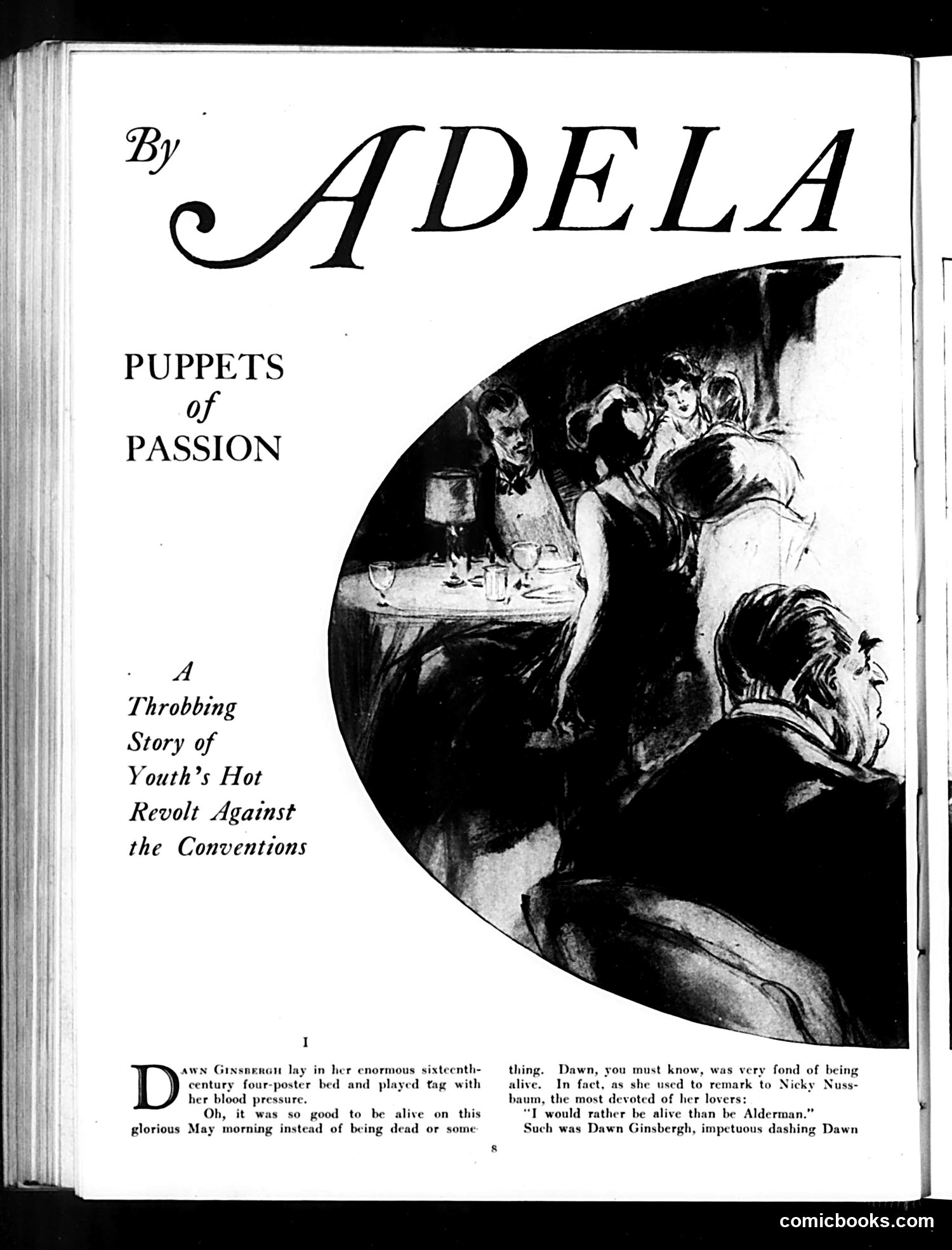
This is a title page for a serialized satirical story mocking 1920s youth culture and "bohemian" rebellion against social conventions. The story follows "Dawn Ginsbergh," a caricatured young woman who embodies the period's moral anxieties about liberated youth. The satire targets: - **The "flapper" era** and young women rejecting Victorian propriety - **Melodramatic excess** — Dawn's dramatic declaration about preferring life to being an "Alderman" (a conventional, respectable position) - **Sexual liberation** — her multiple lovers and open disregard for monogamy - **Self-indulgent youth** — playing "tag" with health concerns while reveling in hedonism The circular illustration shows a social scene (possibly a nightclub or speakeasy), reinforcing themes of youth's "hot revolt" and loose morality. Judge's satirical tone suggests disapproval of these modern transgressions against traditional values, presenting them as ridiculous rather than admirable.
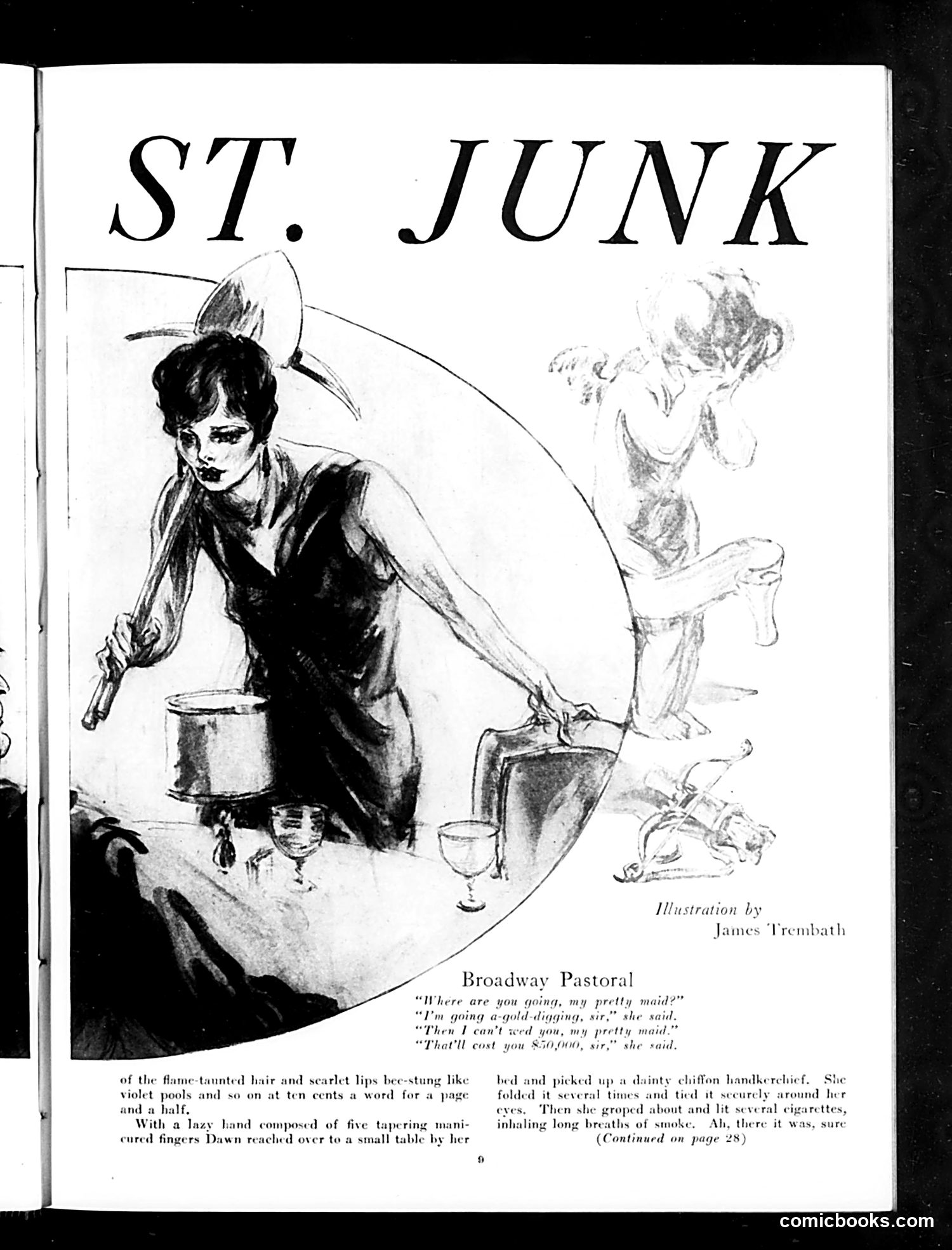
This illustration satirizes the commercialization of sex and romance on Broadway. The cartoon depicts a woman ("Dawn") engaging in a transactional encounter, where a suitor asks "Where are you going, my pretty maid?" and she responds that intimacy will cost $50,000—a substantial sum for the era. The satire targets the romanticized language of pulp fiction and cheap literature ("flame-taunted hair and scarlet lips"), mocking how such overwrought prose sells these stories at "ten cents a word." The woman's worldly behavior—casually smoking multiple cigarettes with a handkerchief—underscores the cynical reality beneath literary pretense. The title "St. Junk" appears to be a critical commentary on this mass-produced, sensationalized entertainment masquerading as art. The piece critiques both the commercialization of female sexuality and the degradation of literature into cheap, formulaic smut for mass consumption.
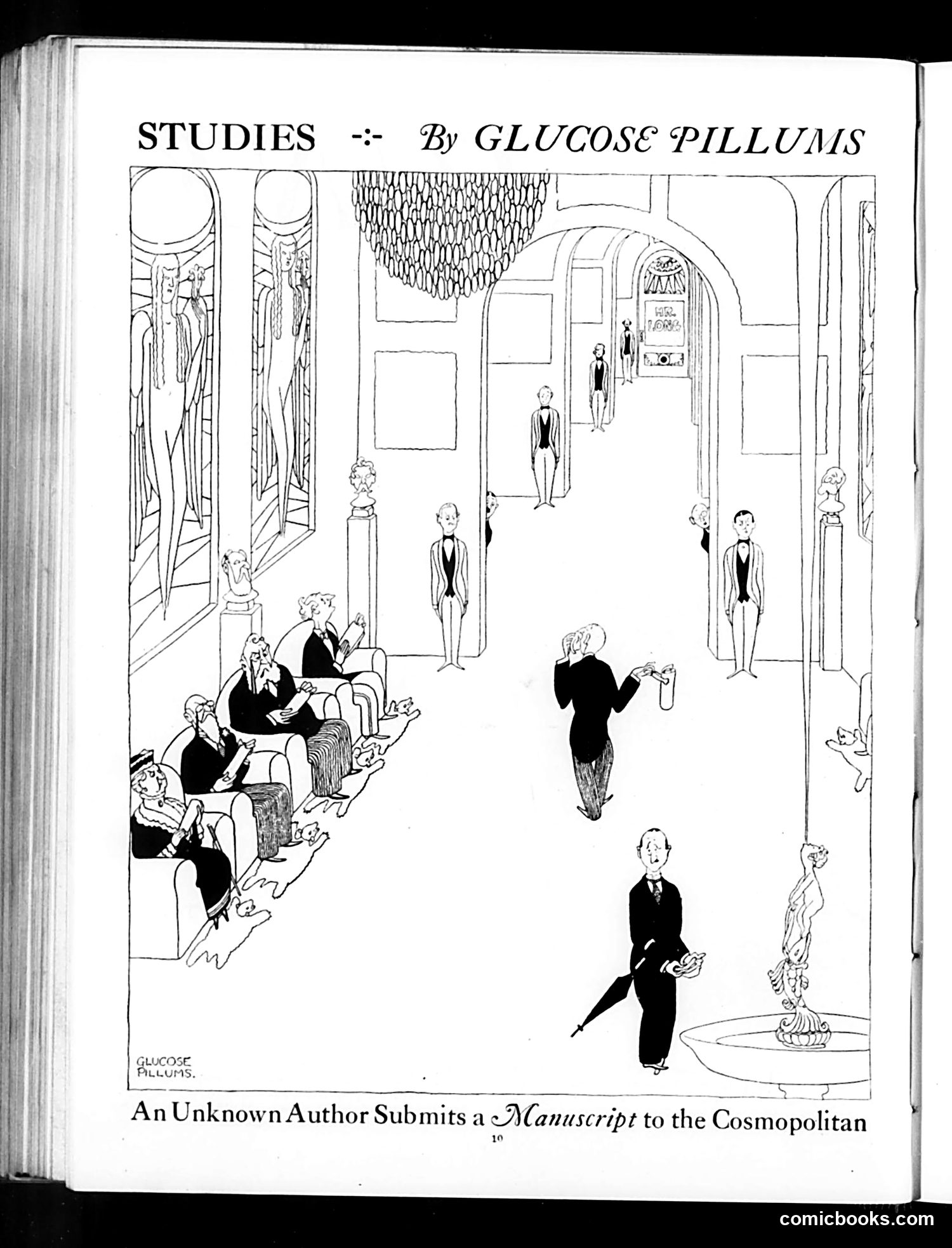
This page features an illustration by "Glucose Pillums" (the artist's name visible in the lower left) depicting a satirical scene titled "An Unknown Author Submits a Manuscript to the Cosmopolitan." The cartoon shows a grand, modern interior space—likely an editorial office—with well-dressed figures in various poses. On the left, seated figures appear to be editors or staff members; in the center and right, figures stand or move about, seemingly waiting or presenting work. The architectural style and fashion suggest early 20th-century setting. The satire likely mocks the manuscript submission process to major magazines like *Cosmopolitan*, poking fun at either the pretensions of unknown writers, the indifference of editors, or the formal absurdity of the publishing world. The precise social commentary remains somewhat opaque without additional historical context about *Judge* magazine's editorial stance during this period.
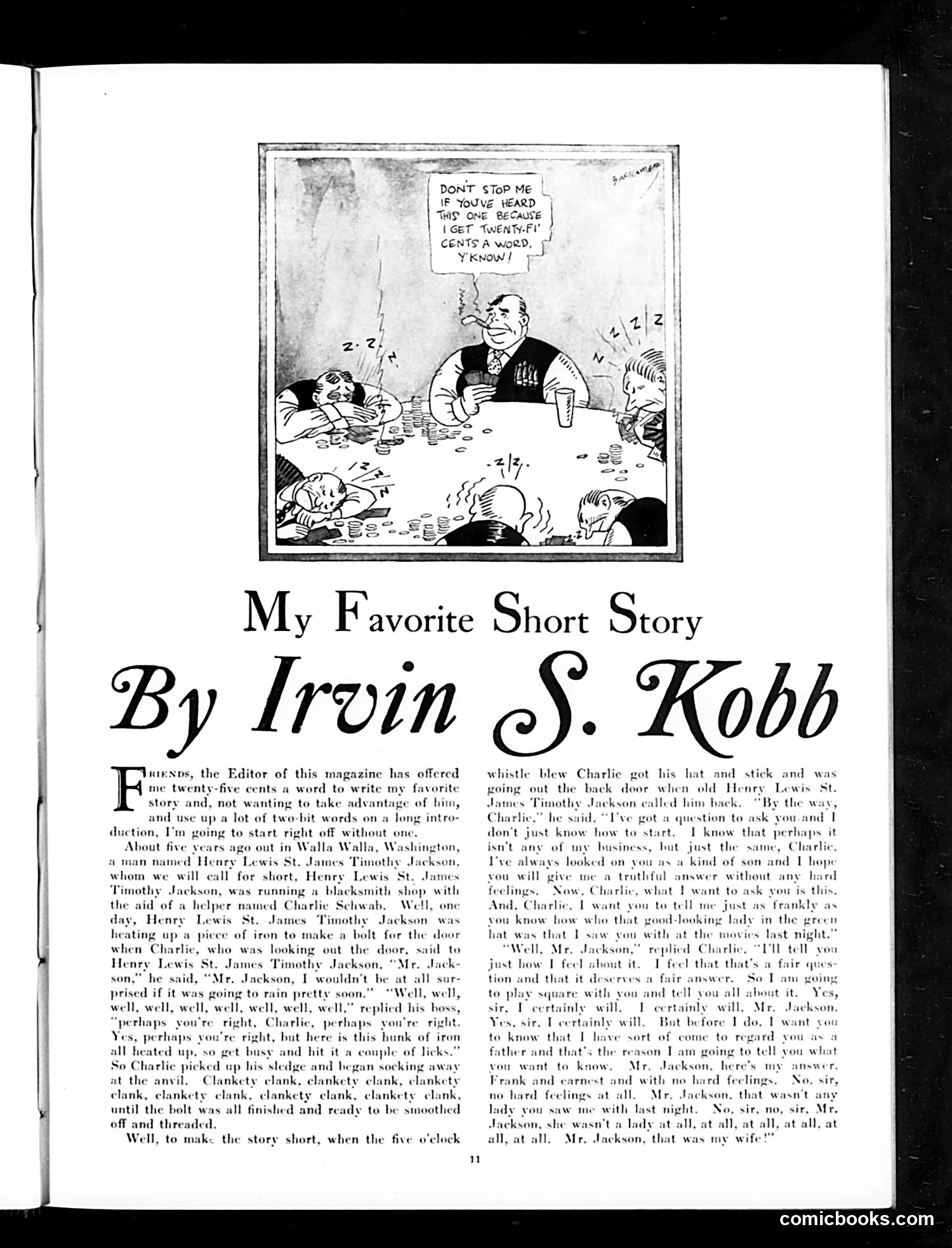
This page features humorist Irvin S. Cobb's short story published in *Judge* magazine. The cartoon at top is a visual joke: a man at a dinner table announces he gets paid 25 cents per word, causing everyone around him to fall asleep (indicated by "Z Z Z" symbols)—the satire being that verbose storytellers are boring. Below, Cobb's actual story satirizes long-winded narratives through irony. He claims to tell a "short story" but opens with an unnecessarily elaborate introduction identifying a blacksmith named "Henry Lewis St. James Timothy Jackson" (the repetitive naming mocks verbose writing). The plot itself—a helper named Charlie deflecting his boss's question about a woman he was seen with by claiming "that wasn't any lady...that was my wife"—is a mild domestic joke. The satire works on multiple levels: Cobb is paid by the word while ironically promising brevity, and the story's padding demonstrates exactly what he's mocking about contemporary magazine writing.
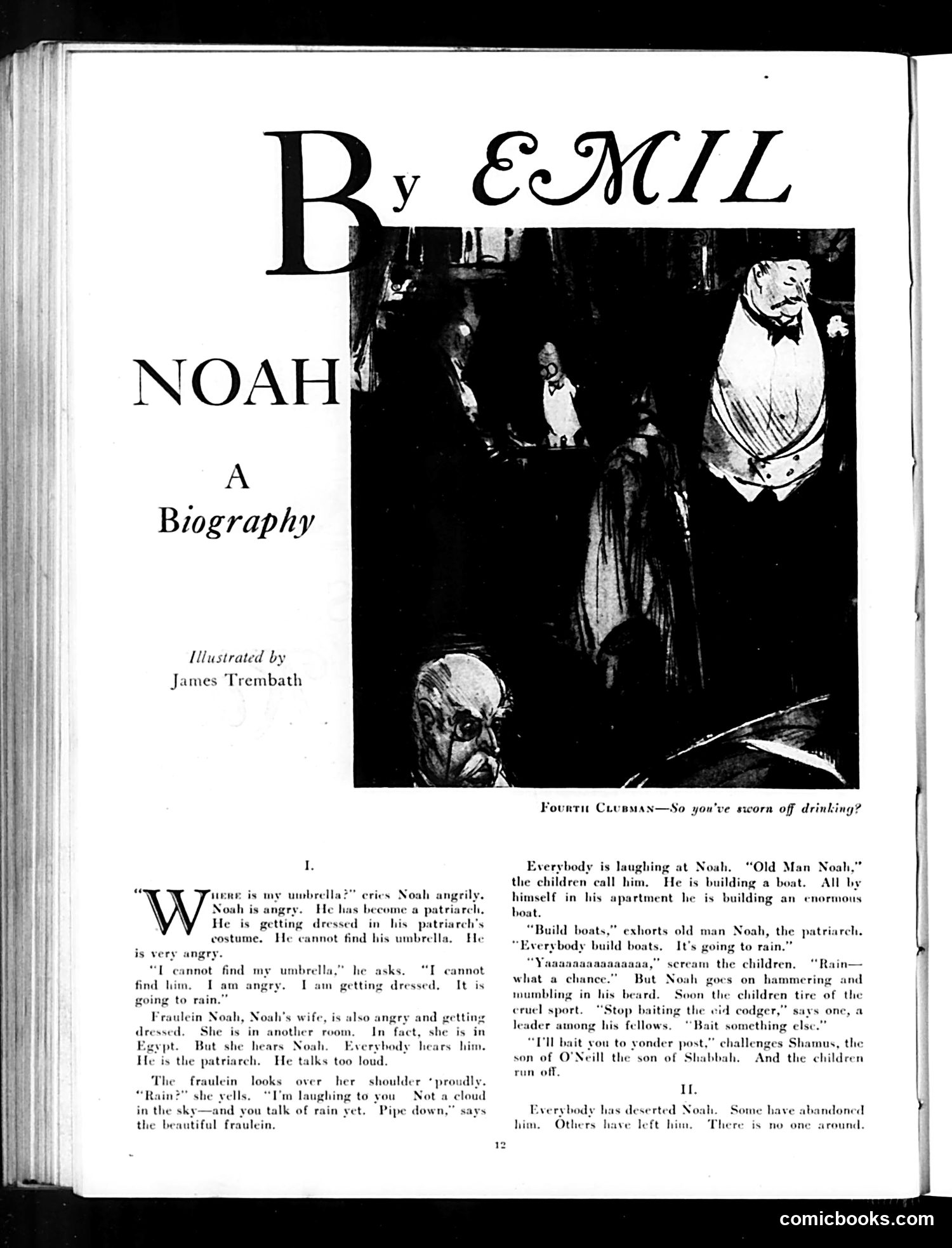
This is the opening installment of a serialized satirical biography illustrated by James Trembath. The piece ridicules Noah (the biblical patriarch) as an obstinate old man obsessed with an irrational premonition of rain. His wife mocks him for predicting rain when the sky is clear ("Not a cloud in the sky"). Neighborhood children taunt him mercilessly as he builds a boat in his apartment, calling him "Old Man Noah." Adults join in the mockery, with a boy named Shamus challenging him aggressively. The satire appears to target blind faith, stubbornness, and social isolation. Noah's warnings go unheeded because nobody believes him—a setup that anticipates the biblical flood narrative, though the humor here comes from portraying him as a cranky, delusional figure rather than a prophet. The piece mocks both Noah's persistence and society's cruel dismissal of him as mad.
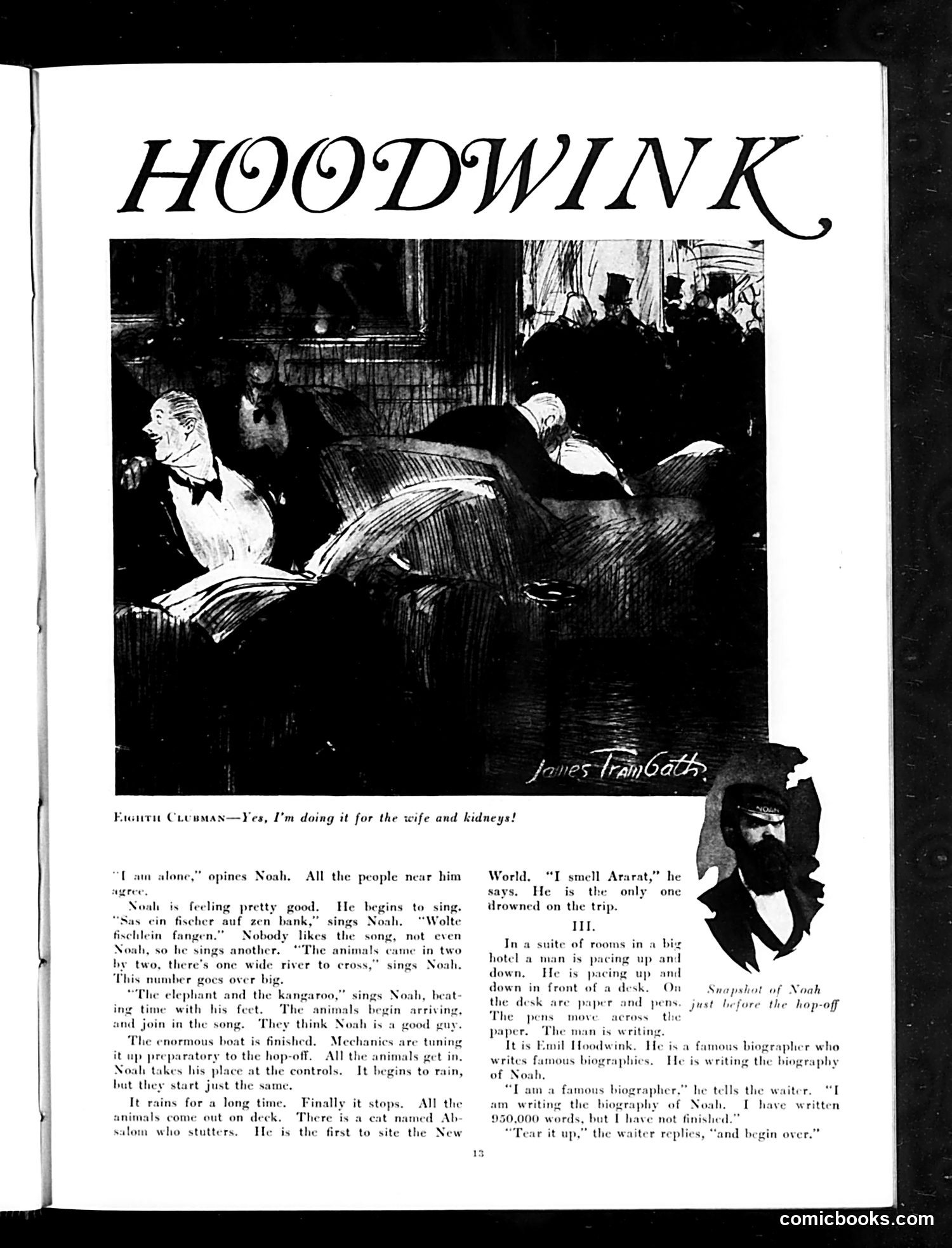
This page satirizes Noah's Ark through absurdist humor. The main illustration shows a formal dinner scene labeled "Eighth Clubman—Yes, I'm doing it for the wife and kidneys!" — a non-sequitur joke about a clubman's motivations. The text below parodies the Biblical flood narrative with comedic details: Noah sings German folk songs nobody likes; animals board two-by-two; it rains endlessly. The satire culminates with Emil Hoodwink, described as a "famous biographer," frantically writing Noah's biography while aboard the ark. He's written 950,000 words but "have not finished," and the waiter tells him to "tear it up" and "begin over." The joke targets verbose biography-writing and perfectionist scholars—Hoodwink cannot finish his work even during apocalypse. The cat Absalom who stutters provides additional absurdist detail. Overall, Judge ridicules both religious literalism and the pretentiousness of contemporary biographers through cartoon comedy.
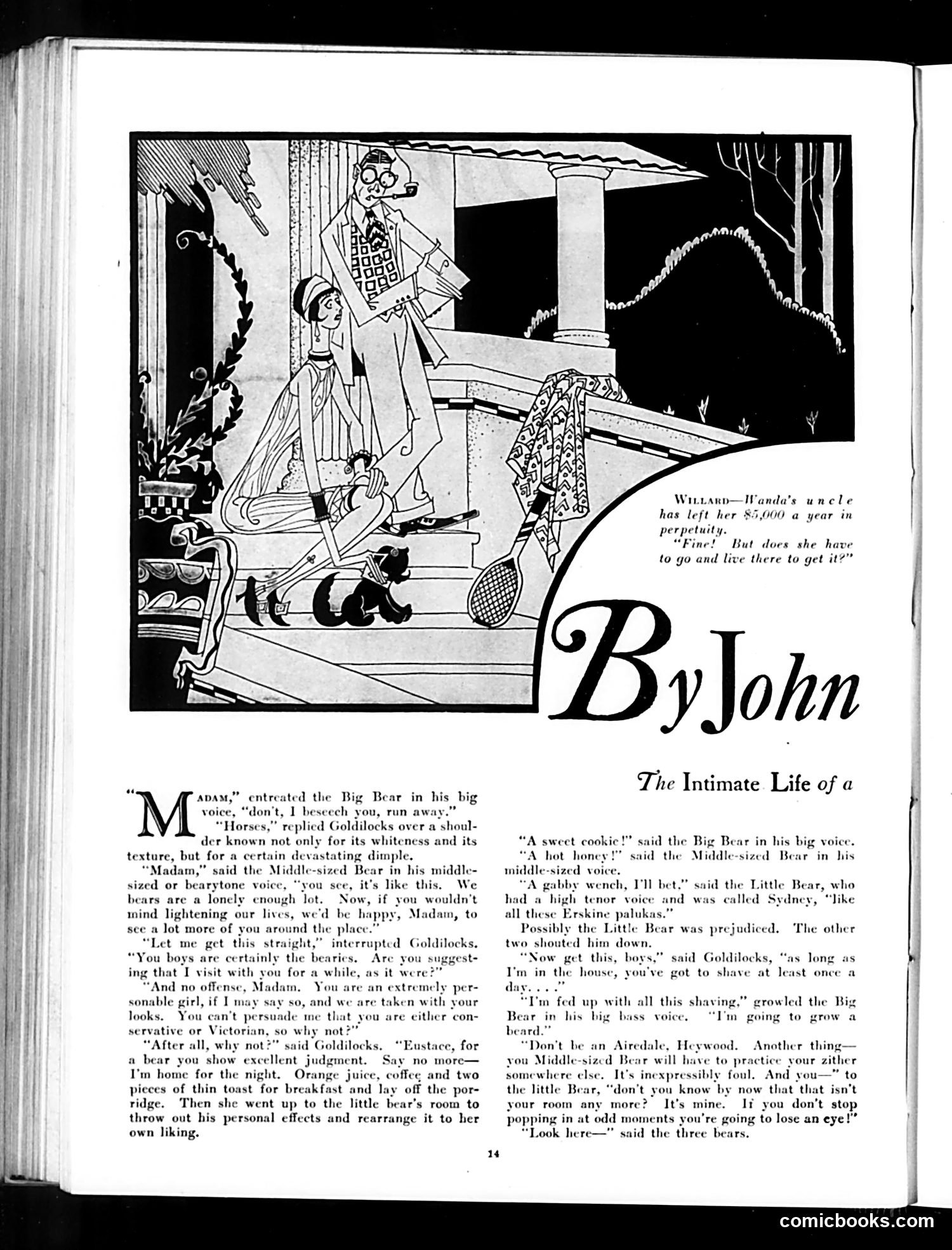
This is a satirical retelling of "Goldilocks and the Three Bears" that comments on evolving gender roles and modern courtship in the 1920s (Judge's era). **The Setup:** Goldilocks, rather than being an innocent intruder, is a sophisticated young woman who manipulates three eligible bachelor bears into domesticity. One bear is named "Heywood" (unclear reference); another is Sydney, dismissively called a "paluka" (slang for an unsophisticated person). **The Satire:** The joke centers on how Goldilocks—representing the modern woman—colonizes the bears' space and dictates their behavior. She demands they shave, bathe regularly, and surrender personal autonomy ("it's mine"). **Social Commentary:** This mocks anxieties about women's increasing independence and authority in relationships. The bears' bewildered resignation to her takeover suggests male anxiety about female empowerment. The sidebar joke about Wanda's inheritance ("does she have to go and live there to get it?") reinforces themes of women pursuing financial security through strategic relationships. The cartoon satirizes both the "new woman" and male vulnerability to her demands.
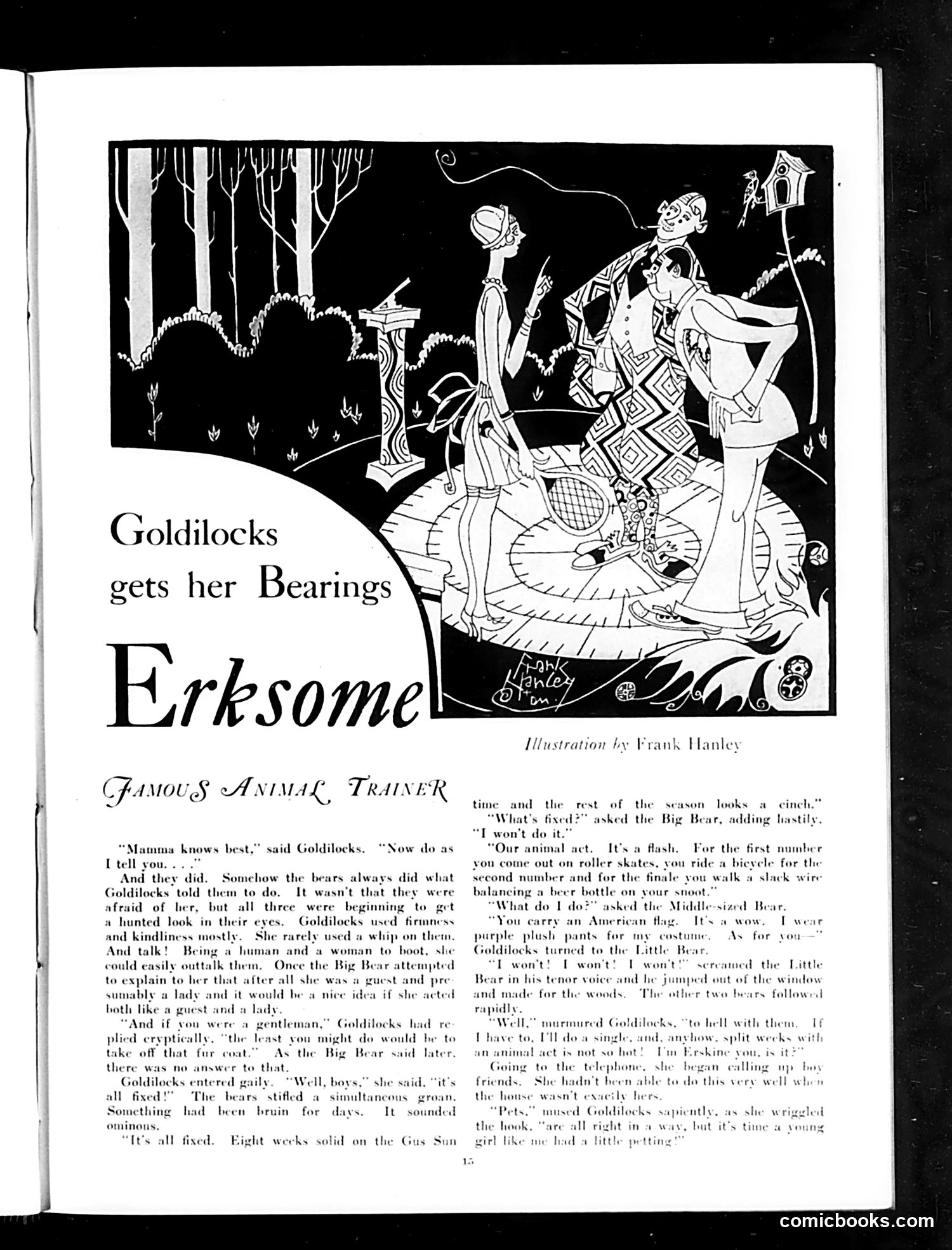
This is a humorous illustrated story (not political satire) about Goldilocks as a circus animal trainer. The narrative plays on the fairy tale: instead of visiting bears' homes, Goldilocks has become a domineering trainer who bosses three performing bears into a circus act for "the Gus Sun" (likely a vaudeville circuit). The joke centers on Goldilocks' imperious personality—she lectures the bears about manners, orders them around despite being their guest, and browbeats them into an eight-week performance schedule. The bears reluctantly agree to perform tricks (wire-walking with a beer bottle, carrying flags, etc.), though the Little Bear rebels by jumping out a window. The satire is gentle social comedy: a woman outsmarting and dominating larger creatures through sheer force of personality and talk. The illustration by Frank Hanley depicts the circus preparations in Art Deco style, typical of Judge magazine's 1920s-era humor—celebrating female assertiveness while poking fun at both stubborn animals and determined women.
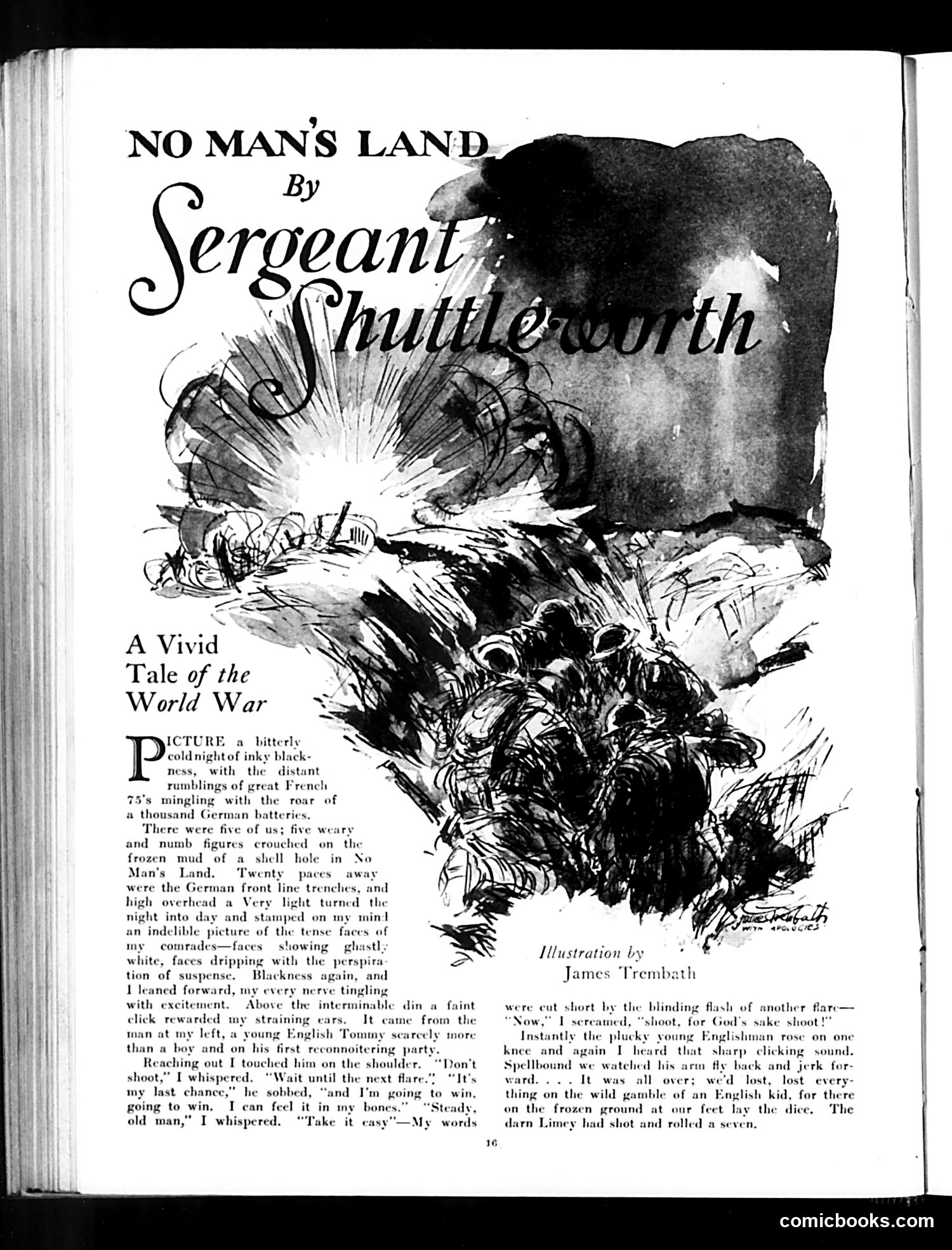
This is the opening of a fictional WWI narrative by Sergeant Chuttleworth, illustrated by James Trembath. It depicts five soldiers huddled in a shell crater in No Man's Land during a nighttime battle, with French and German artillery roaring nearby. The narrator describes the psychological tension of combat: soldiers' faces "ghastly white" with fear during illuminating flare bursts. The dramatic climax involves a young English soldier ("Tommy") gambling their survival on a single rifle shot at an unseen German target—a desperate moment of courage (or recklessness) under fire. The "dice" metaphor suggests warfare as chance; the soldier "rolled a seven," implying success. This appears to be a patriotic, dramatic war story emphasizing British soldier bravery, likely published during or shortly after WWI to appeal to American readers through Judge magazine's entertainment offerings.
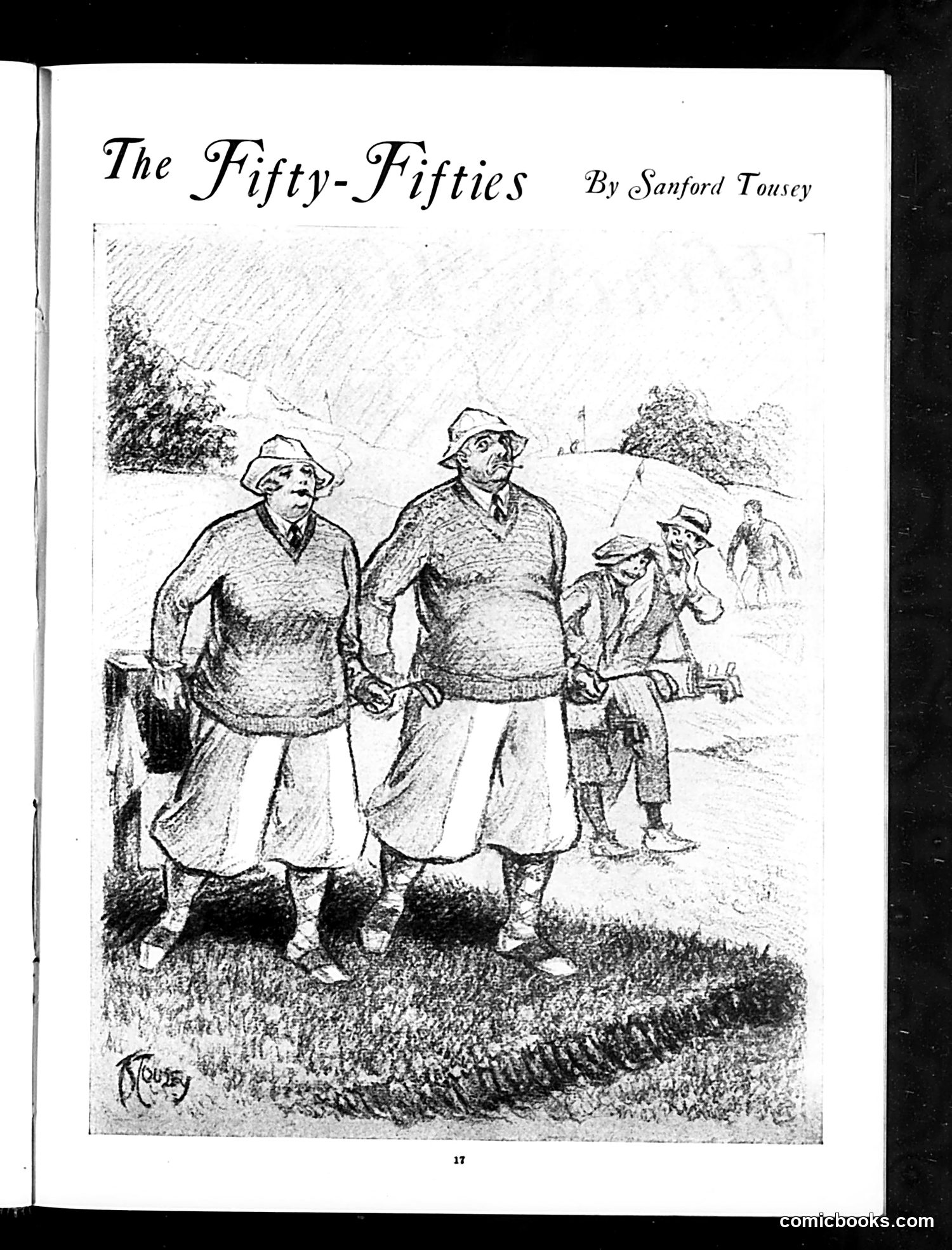
This cartoon depicts what appears to be a family outing, with two large adults and two smaller children in period clothing (knickers, hats) walking outdoors. The title "The Fifty-Fifties" likely refers to a social commentary about equal partnership or shared responsibility—possibly satirizing contemporary discussions about gender roles or marital equality that were relevant in the early-to-mid 20th century. The visual composition emphasizes the size difference between adults and children, suggesting the cartoon may be commenting on how authority or decision-making is distributed within families or society. Without additional context from Judge magazine's publication date, the specific social reference remains unclear, though it appears to critique modern attitudes toward equality or partnership in some form.
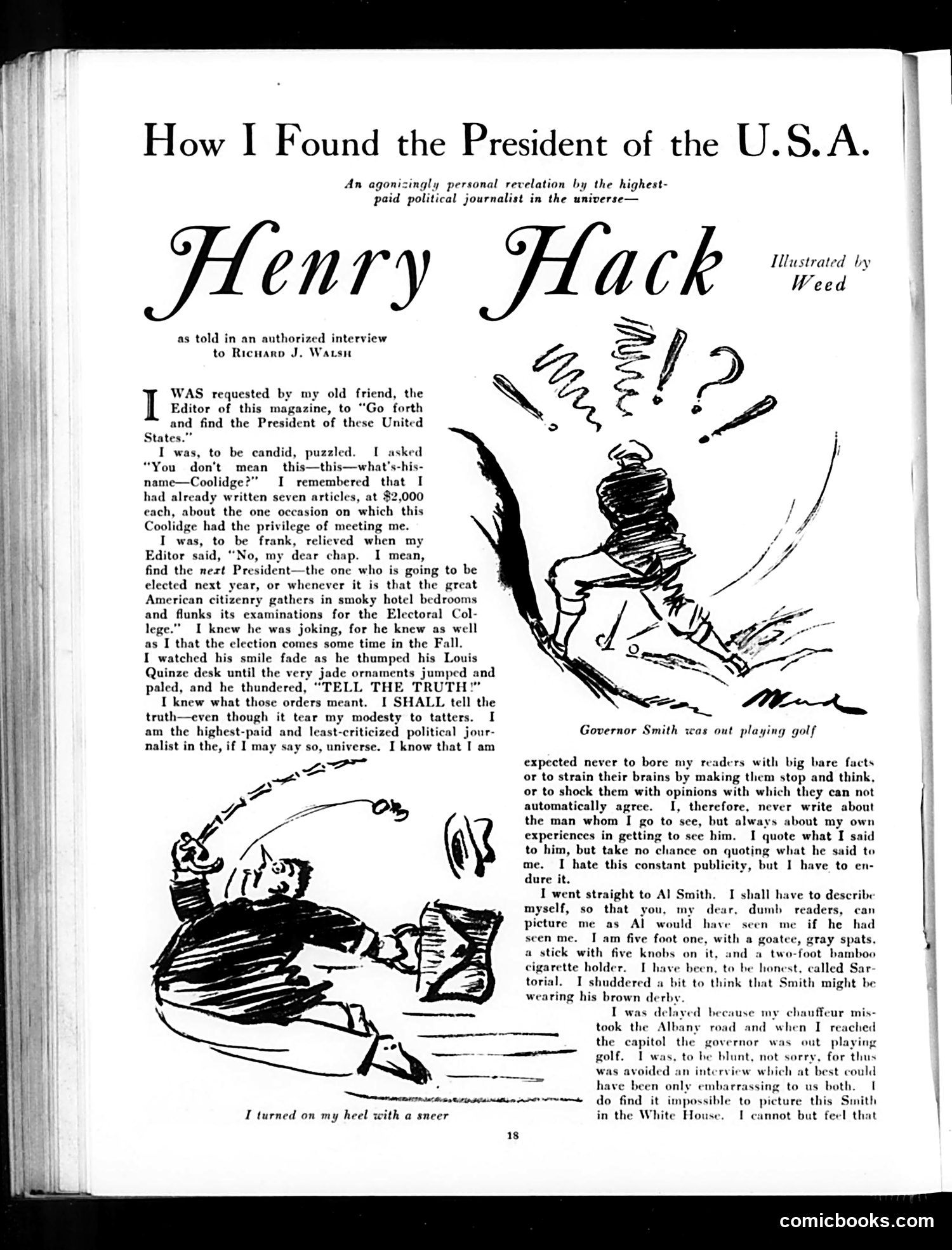
This is a satirical article by Henry Hack mocking pretentious political journalism. The satire targets: **The Figure:** Hack is a self-aggrandizing journalist who brags about being "highest-paid" while admitting he writes about himself rather than his subjects—he quotes what *he* said, never what they said back. **The Target:** Al Smith, then Governor of New York and apparent presidential prospect. The cartoons show Smith golfing while Hack tries to interview him. **The Joke:** Hack's assignment is to "find" the next president, but he's too self-absorbed and incompetent to actually do journalism. He arrives when Smith is golfing, then leaves without interviewing him—yet will presumably write an article anyway, focused entirely on his own experience. **The Context:** This mocks the celebrity-journalist culture where famous reporters become the story themselves rather than reporting facts. Judge magazine used satire to critique both vapid media and politicians like Smith.
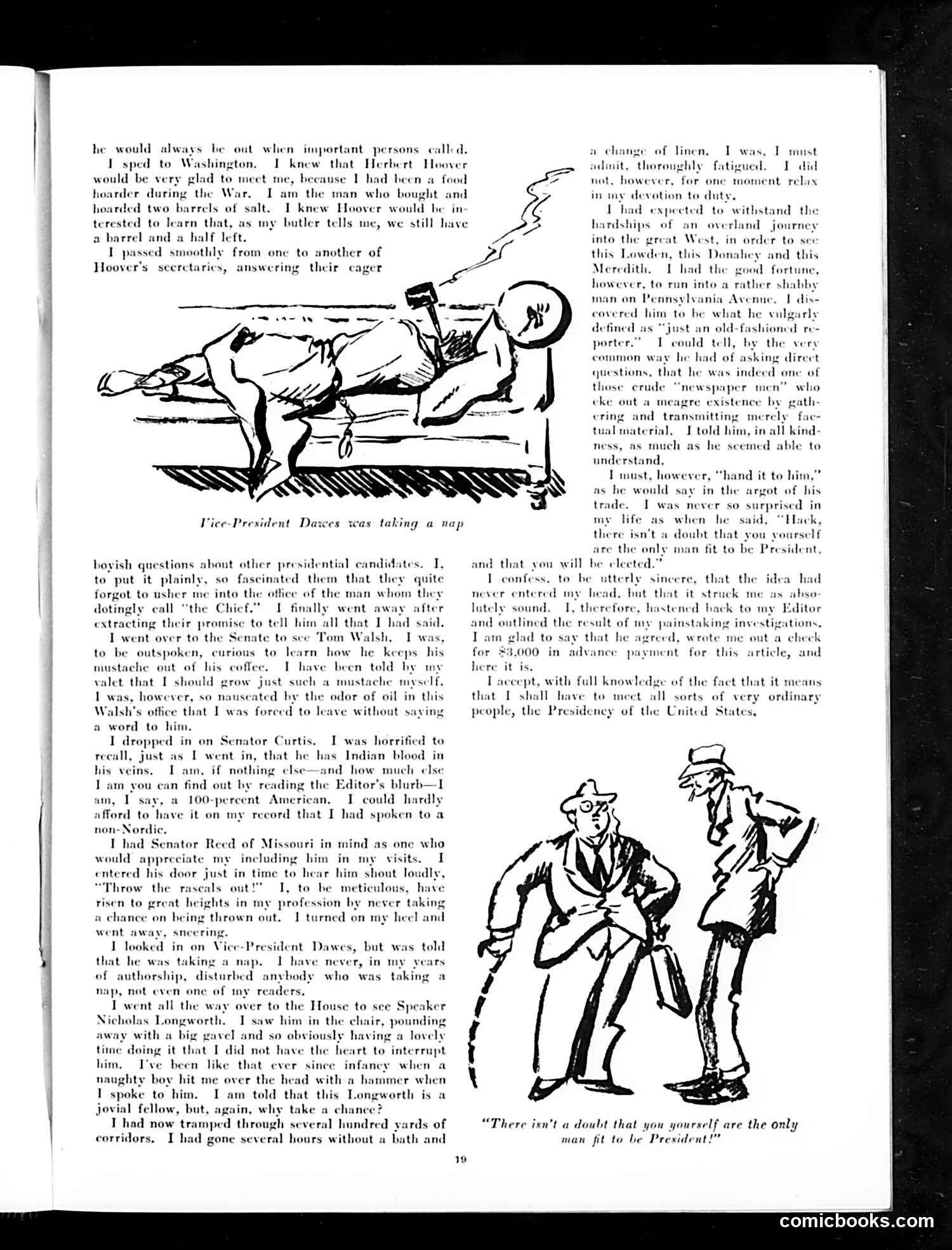
This page satirizes a pompous narrator's self-deluded campaign to become President. The cartoons depict Vice President **Charles Dawes napping** (mocking his inattentiveness) and what appears to be political figures being approached by this absurd character. The text parodies the narrator's arrogant, prejudiced observations during visits to Washington power brokers: he's dismissive of a "newspaper man," expresses horror at Senator Curtis's Indigenous heritage (reflecting the era's racism), and boasts about his wartime salt-hoarding credentials. The satire's target is this character's delusional self-importance—he believes a reporter's flattery, imagines himself presidential material, and sells his "investigation" to a magazine editor for $3,000. The broader joke critiques both political vanity and contemporary journalism's susceptibility to such nonsense. The cartoon caption—"There isn't a doubt that you yourself are the only man fit to be President"—highlights the absurdity of his belief.
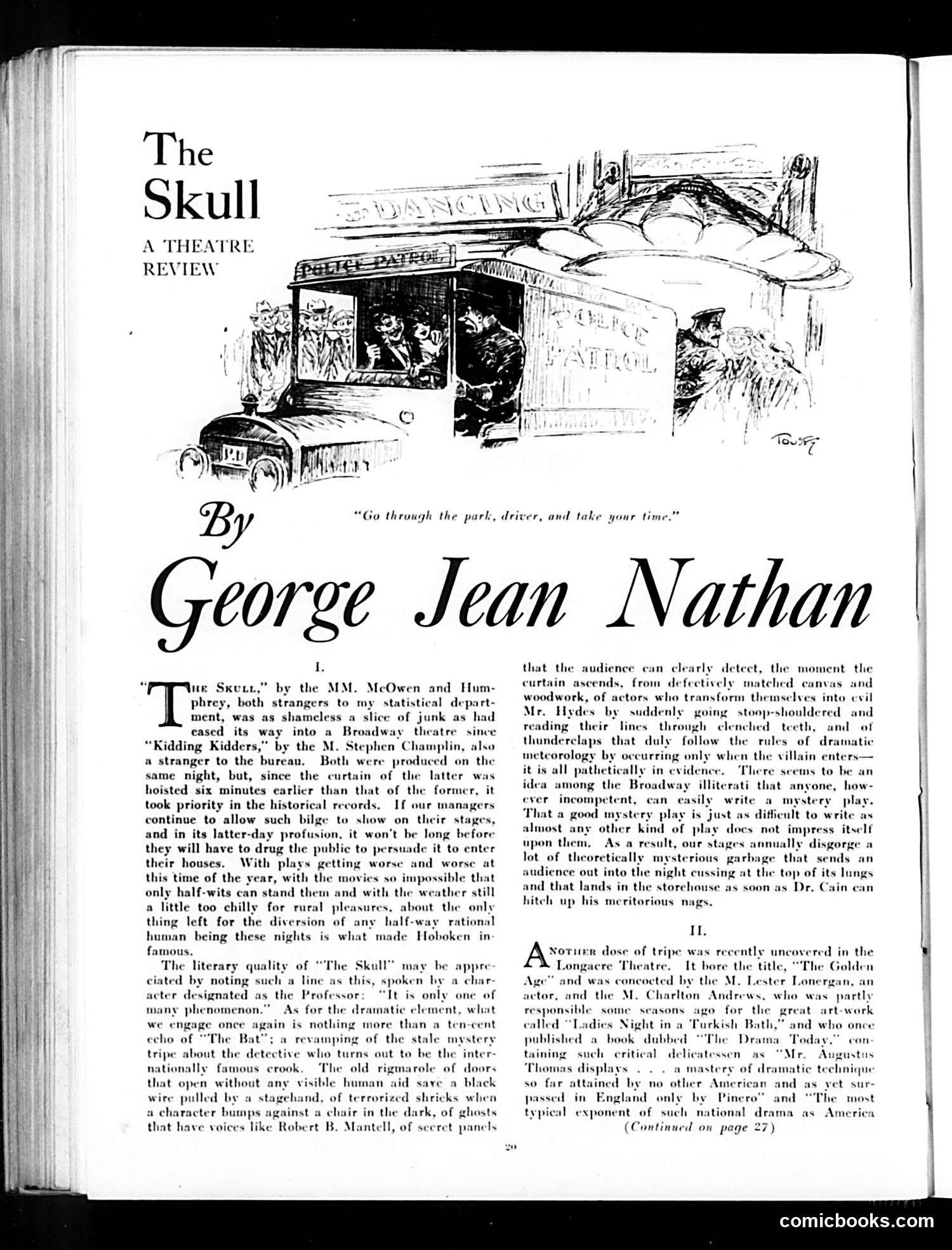
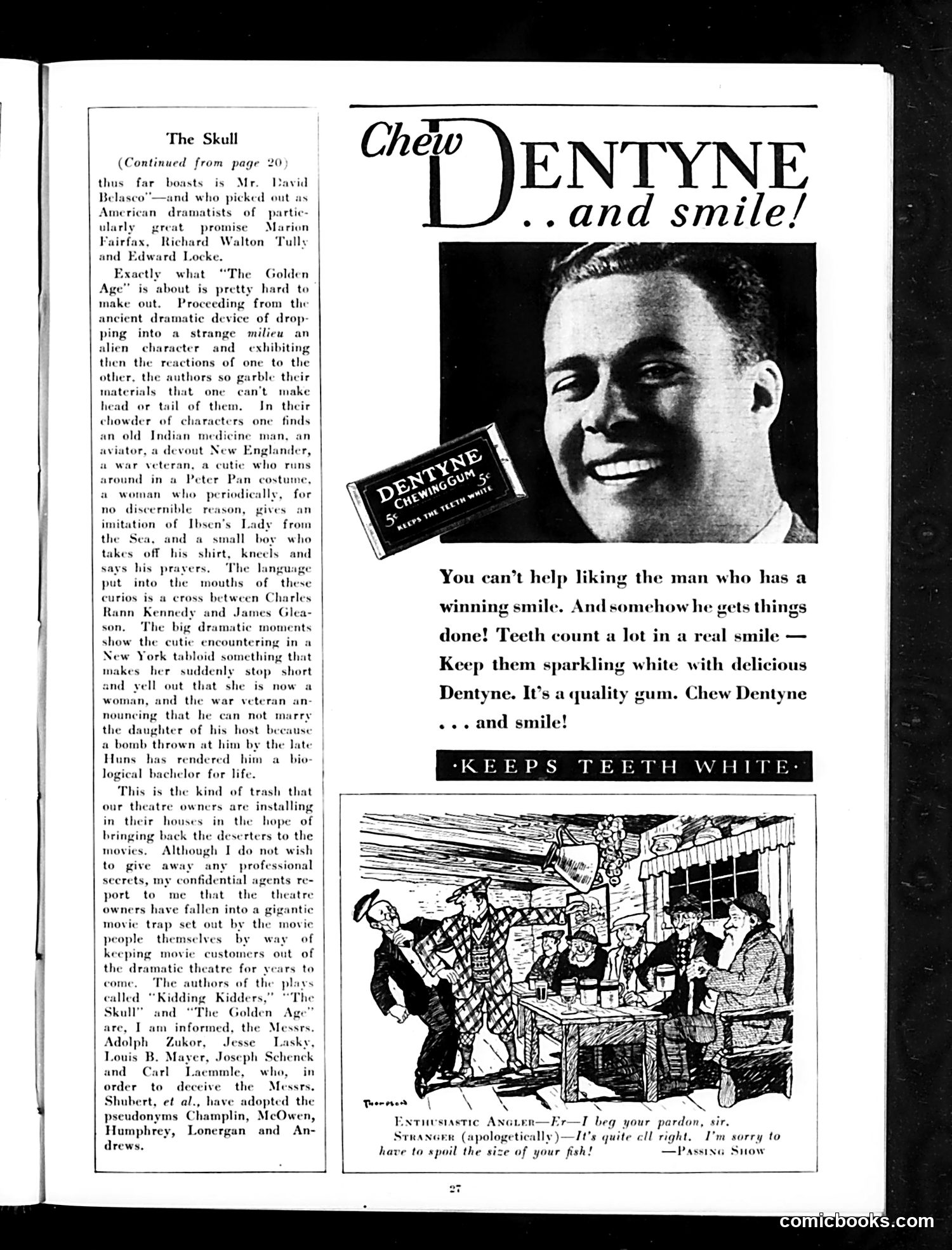
This is a scathing review of a Broadway play called "The Skull" by producers McOwen and Humphrey. The reviewer condemns it as lazy, derivative hack work—a tired mystery-thriller recycling stale plot devices (secret panels, invisible doors operated by wires, dramatic thunderclaps, villains with exaggerated mannerisms). The cartoon depicts a police patrol car driving through a park, illustrating the play's clichéd scenario. The reviewer's central complaint: mystery plays are actually *difficult* to write well, but incompetent producers churn out theatrical "garbage" anyway, assuming audiences won't notice the shoddy craftsmanship and matched canvas backdrops. The second section mentions another recent flop, "The Golden Age," produced by M. Lester Lonergan and M. Charlton Andrews—the latter criticized for his previous theatrical ventures and a book on drama. The tone is contemptuous toward both lowbrow entertainment and producers who exploit public desperation for diversion during economically depressed times.
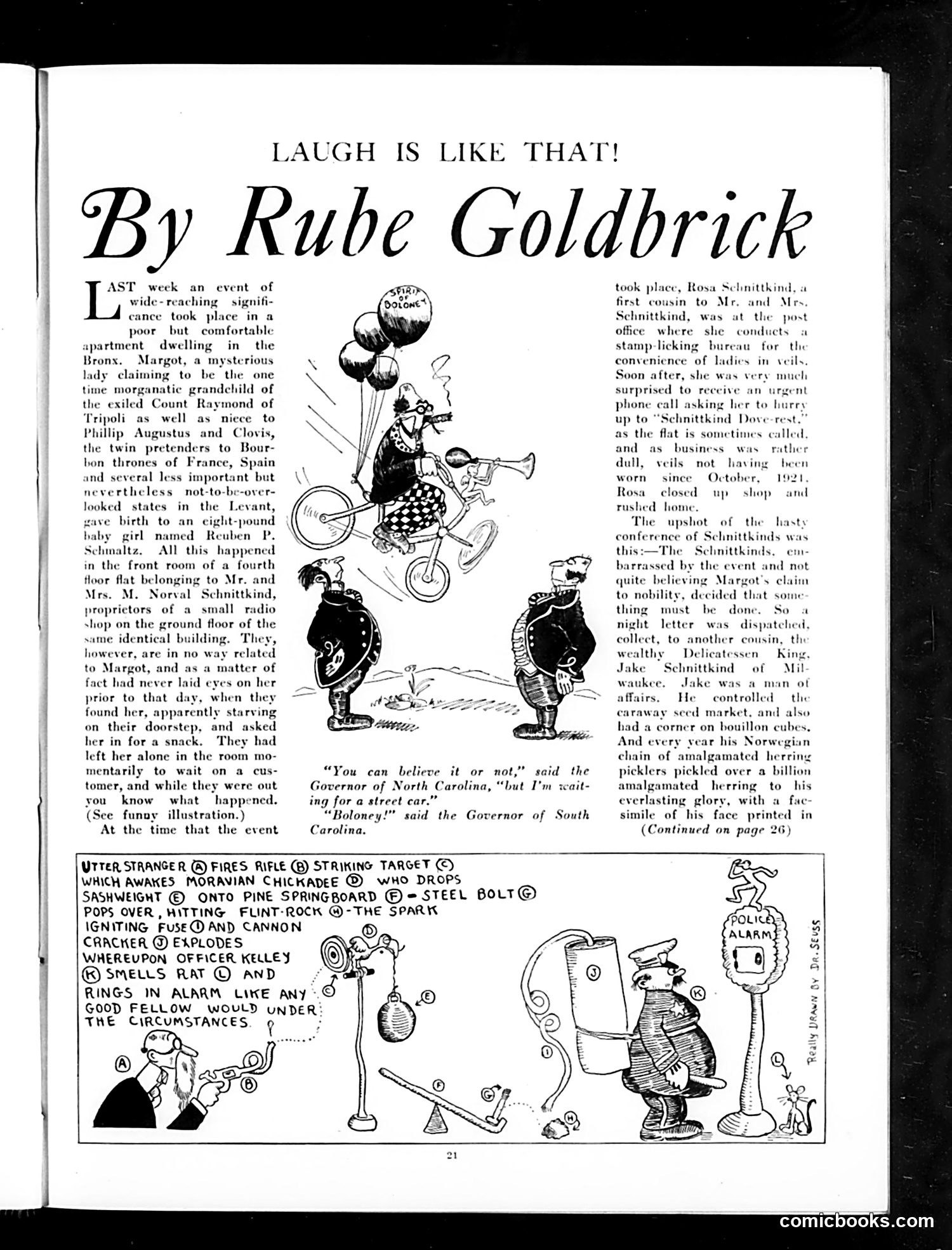
This is a humorous short story illustrated with Rube Goldberg-style contraptions. The narrative satirizes immigrant social pretension: a poor Bronx woman appears at the Schnittkinds' radio shop claiming aristocratic European lineage (exiled Count Raymond of Tripoli, connections to French nobility). She abandons a newborn there, triggering panic among the working-class shop owners. The family's response—consulting wealthy cousin Jake Schnittkind, a delicatessen magnate controlling the caraway seed and bouillon cube markets—mocks both immigrant aspirations to respectability and the absurdity of fabricated genealogies. The bottom panel features a Rube Goldberg machine credited to "Dr. Seuss" (Dr. Seuss's early cartooning work), showing interconnected contraptions triggered by a stranger firing a rifle, ultimately leading Officer Kelley to investigate. The caption jokes that any "good fellow" would ring an alarm under such ridiculous circumstances—a deadpan non-sequitur typical of 1920s Judge magazine humor.
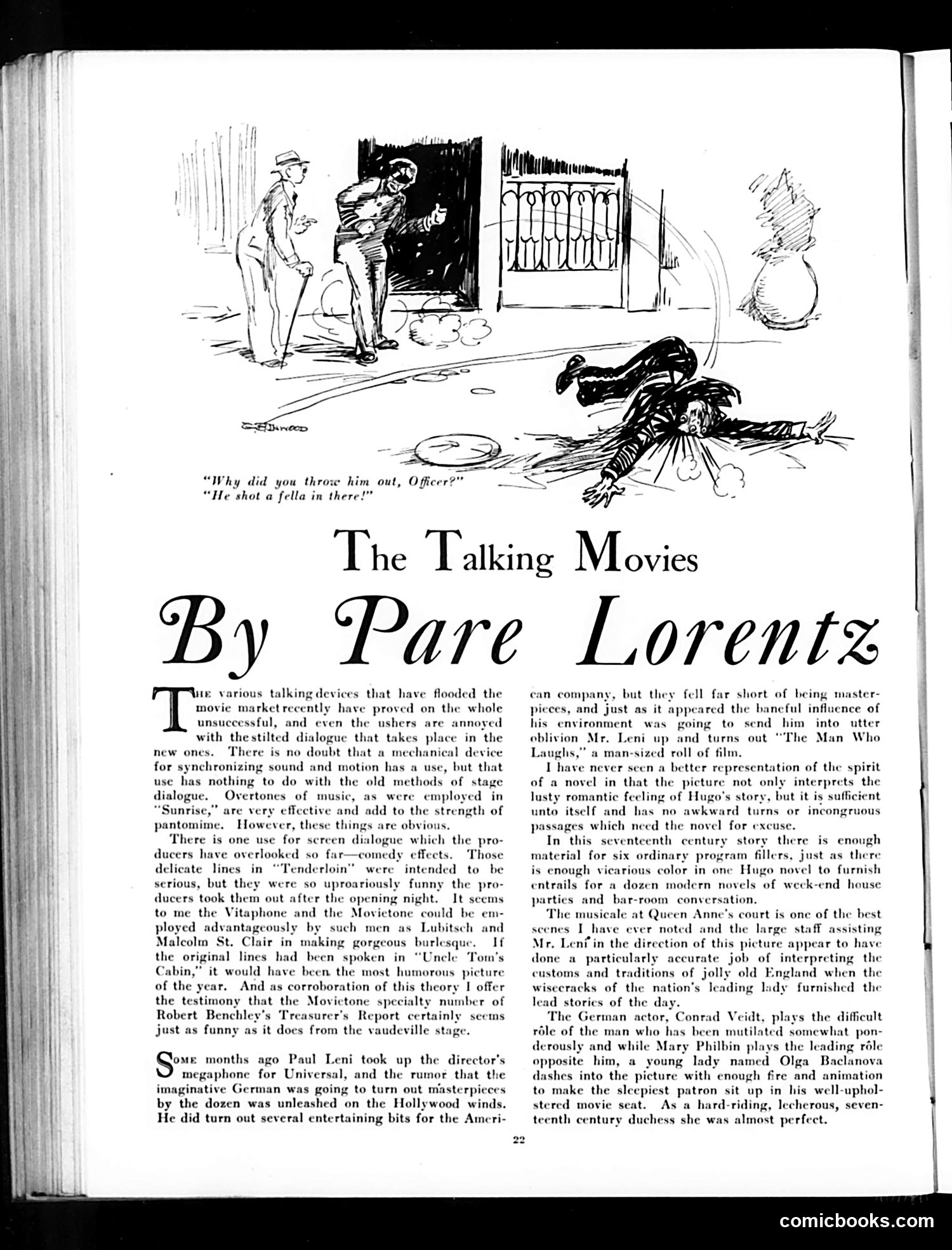
This is a film criticism article by Pare Lorentz reviewing early "talking pictures" (sound films), which were novel and controversial in the late 1920s. **The cartoon** at top depicts a cop ejecting a man from a movie theater, saying "He shot a fella in there!"—a joke about audience confusion between on-screen action and reality, mocking viewers' reactions to new sound technology. **The article's argument**: Lorentz criticizes how studios use synchronized dialogue, arguing it's stilted and awkward. He suggests sound would work better for *comedy* rather than serious drama, noting unintentionally funny moments in "Tenderloin" were removed after opening night. **Key figures reviewed**: Director Paul Leni's "The Man Who Laughs" (adapted from Victor Hugo), praised for capturing the novel's spirit. German actor Conrad Veidt plays the title role; Mary Philbin and Olga Baclanova also star. **The satire**: Lorentz mocks Hollywood's hype around sound technology while defending artistic integrity—early talkies were often technically awkward and theatrically overwrought compared to the refined pantomime of silent films.
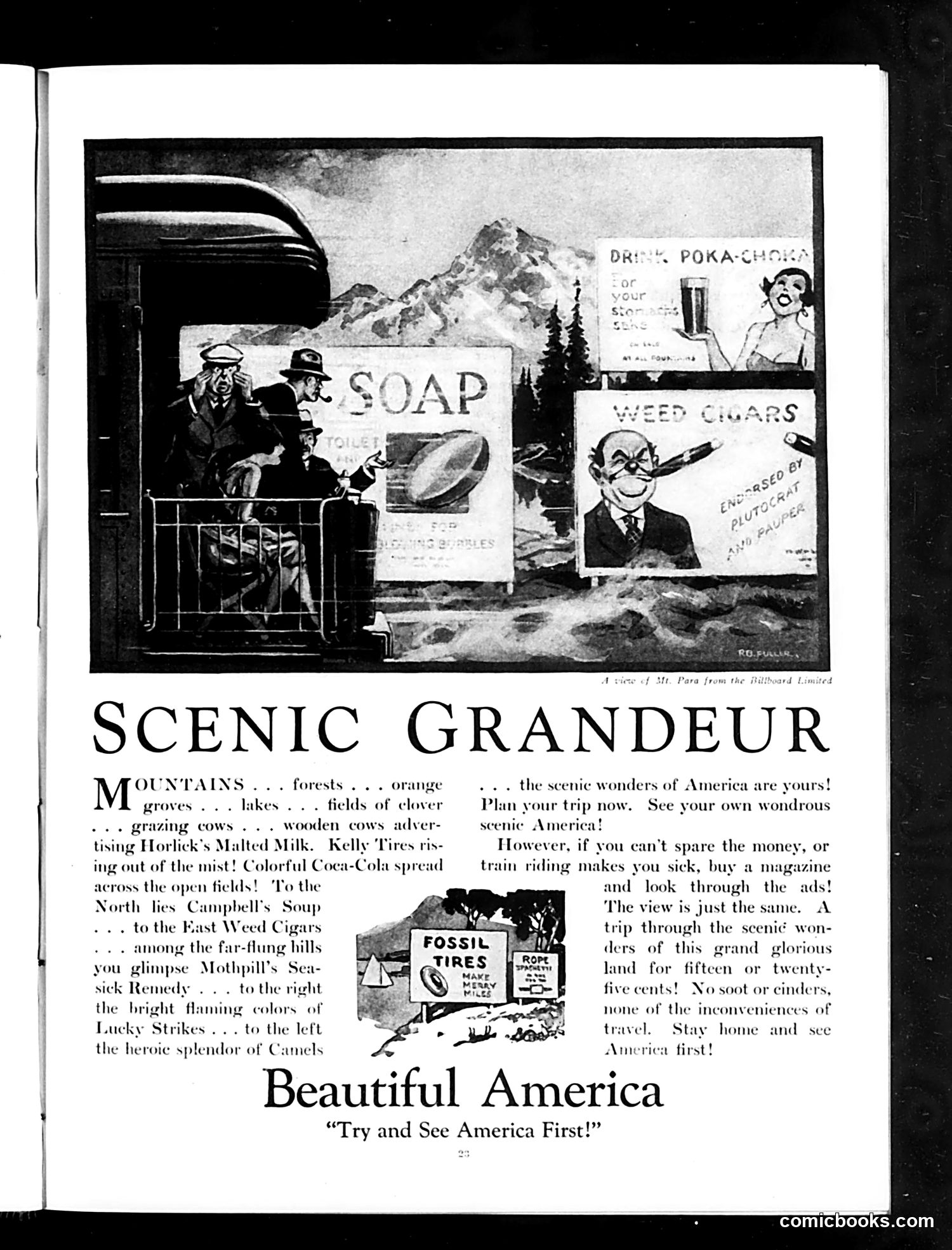
This Judge magazine cartoon mocks how American natural scenery has been overwhelmed by advertising and commercialism. The illustration shows a train journey through mountains and forests, but the "scenic wonders" are actually billboards for consumer products: Horlick's Malted Milk, Kelly Tires, Coca-Cola, Campbell's Soup, Weed Cigars, Mothpill's Sea-sickness Remedy, Lucky Strikes, and Camels cigarettes. The satire's point: America's "beautiful" landscape is now indistinguishable from a magazine full of advertisements. The text even suggests that instead of traveling to see nature, readers might as well stay home and flip through magazine ads—the view is identical. This reflects early 20th-century anxieties about mass commercialization overtaking authentic natural experience and national identity. The ironic tagline "Try and See America First!" suggests such tourism is now impossible.
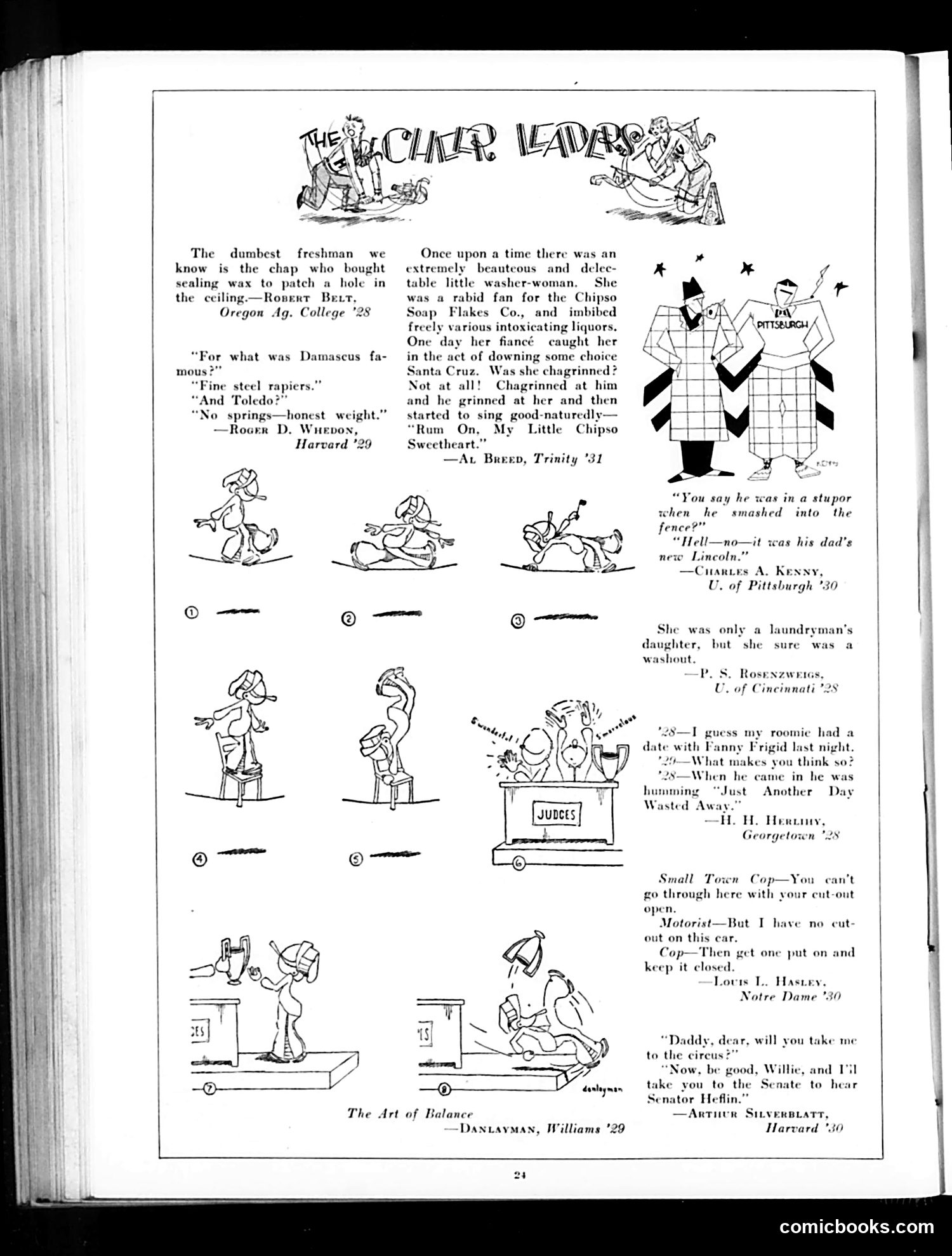
This page from *Judge* magazine collects humor submissions from college students (dated 1928-1931), organized around two themes: witty one-liners and visual gags about "balance." **The one-liners** are brief jokes about collegiate life and current events. One references Damascus and Toledo (likely playing on geography), another mocks a freshman's foolish logic. Several jokes involve Prohibition-era drinking (references to "Chipso Sweetheart" and intoxicating liquors), reflecting the magazine's satirical take on the illegal alcohol culture of the 1920s-30s. **The visual sequence** labeled "The Art of Balance" shows a figure progressively losing equilibrium on a platform—a slapstick commentary on instability, possibly metaphorically commenting on social or economic precariousness during the late 1920s. **The dating/romance jokes** mock young women stereotypically ("Fanny Frigid," the laundry woman), reflecting period attitudes. One final joke references Senator Heflin, though the specific political reference is unclear without additional context. Overall, this is student humor reflecting collegiate life, Prohibition culture, and social attitudes of the era.
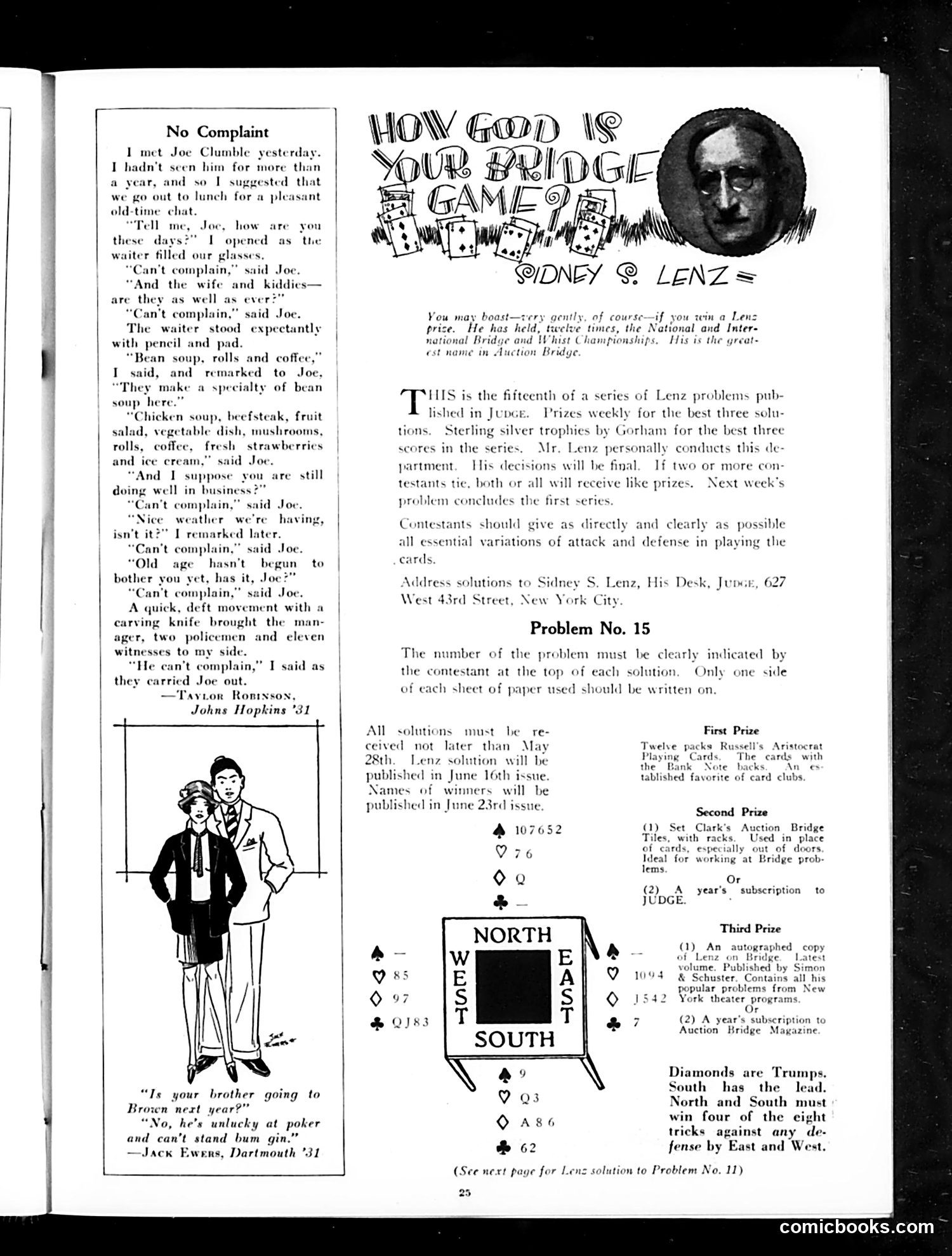
This page presents a **bridge card game problem** by Sidney S. Lenz, a famous bridge expert of the era, rather than political satire. The main content is "Problem No. 15"—a contract bridge puzzle where readers solve a dealt hand and submit solutions for prizes (sterling silver trophies and subscriptions). The page includes two unrelated humorous filler pieces: a joke titled "No Complaint" about a man who responds "Can't complain" to every conversational topic until he's violently removed, and a brief quip about a brother's poor poker skills. These appear designed to fill space in the magazine. The bridge problem itself reflects bridge's enormous popularity among American elites in the 1930s—Judge regularly featured such puzzles as reader engagement contests. The page demonstrates how satirical magazines of this era mixed humor with recreational content to appeal to educated, affluent audiences.
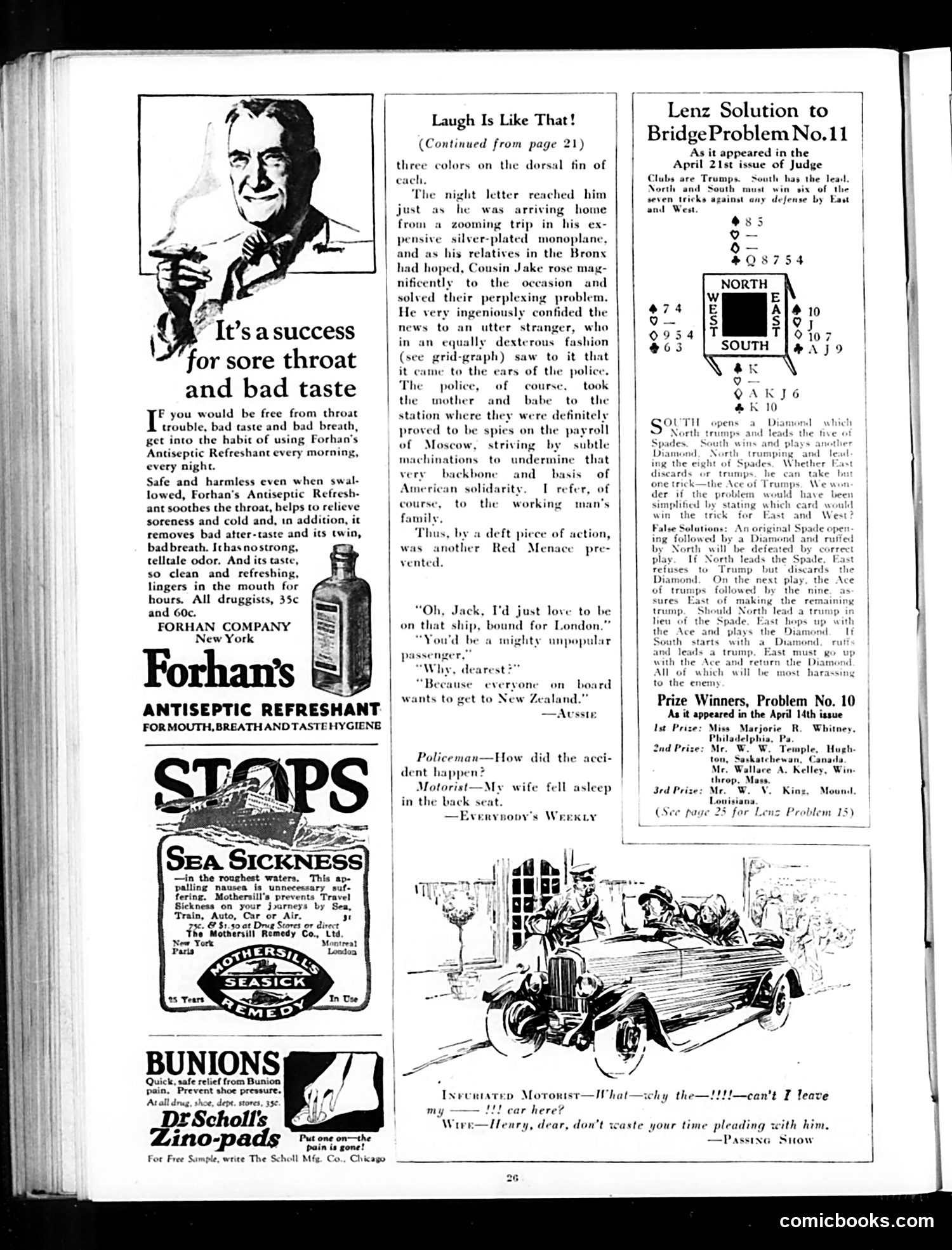
This page is primarily **advertising and puzzle content** rather than political satire. The advertisements promote consumer products: Forhan's antiseptic mouthwash, Mothersill's seasickness remedy, and Dr. Scholl's bunion pads—typical early-20th-century patent medicines and remedies. The main editorial content is "Laugh Is Like That!" (continued story) featuring **Cousin Jake**, apparently a wealthy character who solved a mystery involving spies and Moscow during the Red Scare era—suggesting anti-communist themes common to the period. The story appears to conflate criminal activity with communist conspiracy. The page also includes a **bridge card game puzzle** ("Lenz Solution to Bridge Problem No. 11") with winners listed and a humorous single-panel cartoon about an irate motorist whose car won't start, deflating his anger when his wife notes he's "pleading with him"—a mild gender-dynamics joke. Overall, this is a typical Judge magazine mixed-content page: light humor, advertisements, and a serialized story reflecting period anxieties.
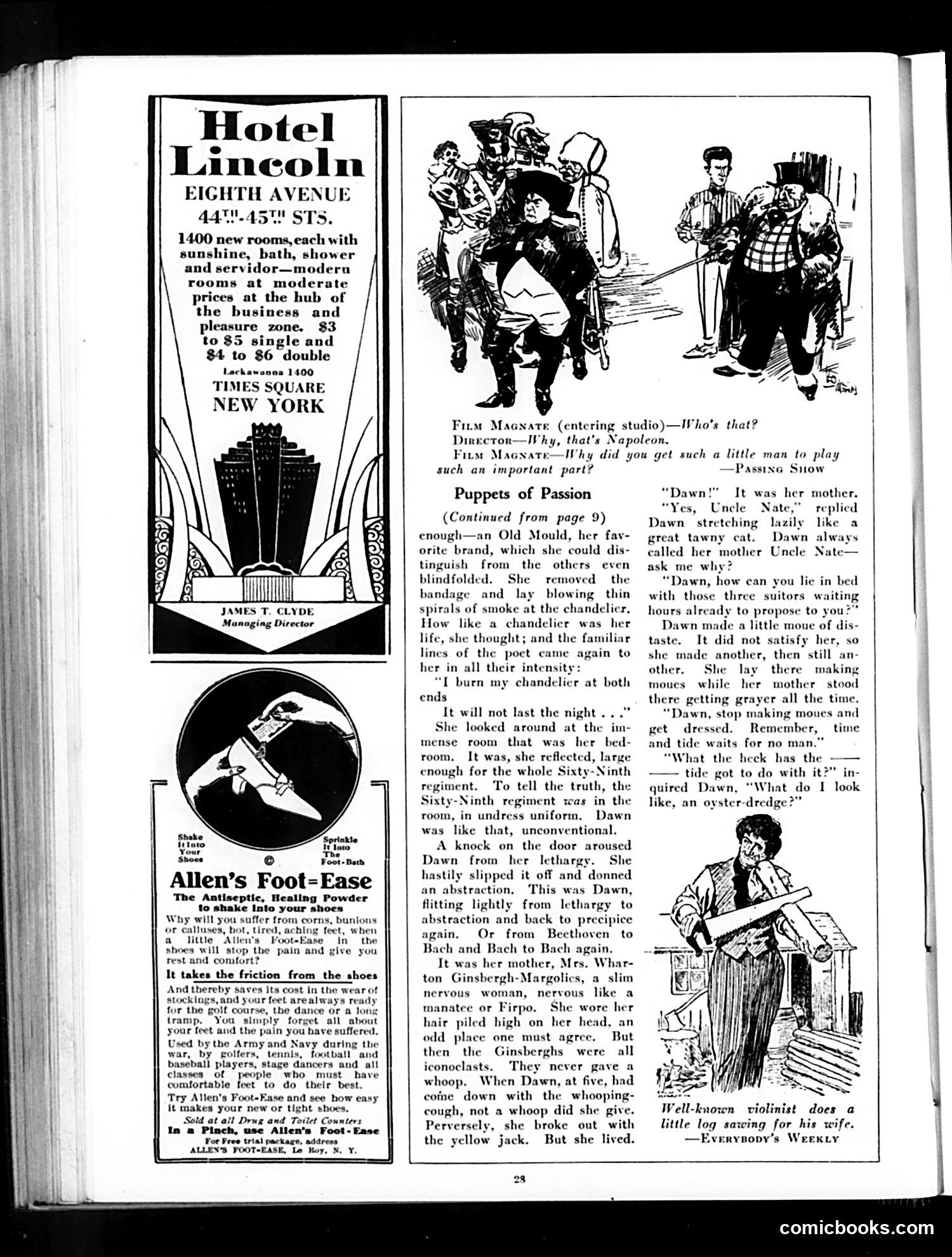
This page features a serialized satirical story mocking the pretentious bohemian lifestyle of wealthy young women in 1920s Manhattan. The protagonist, "Dawn," is portrayed as an affectedly unconventional character who lounges in her enormous bedroom quoting poetry ("I burn my chandelier at both ends") while ostensibly uninterested in three suitors waiting to propose. The satire targets her affected behavior—she constantly shifts between "lethargy" and "abstraction," makes exaggerated facial expressions ("moues"), and speaks with mannered indifference to her anxious mother. Her family name (Ginsbergh-Margolics) and her mother's piled-high hairdo suggest nouveau-riche pretension. The humor lies in depicting this idle young woman as dramatically posed and impractical, embodying the stereotype of Jazz Age frivolity that conservative publications like *Judge* mocked. The story critiques both the character's shallow bohemianism and her mother's social anxiety about marriage prospects.
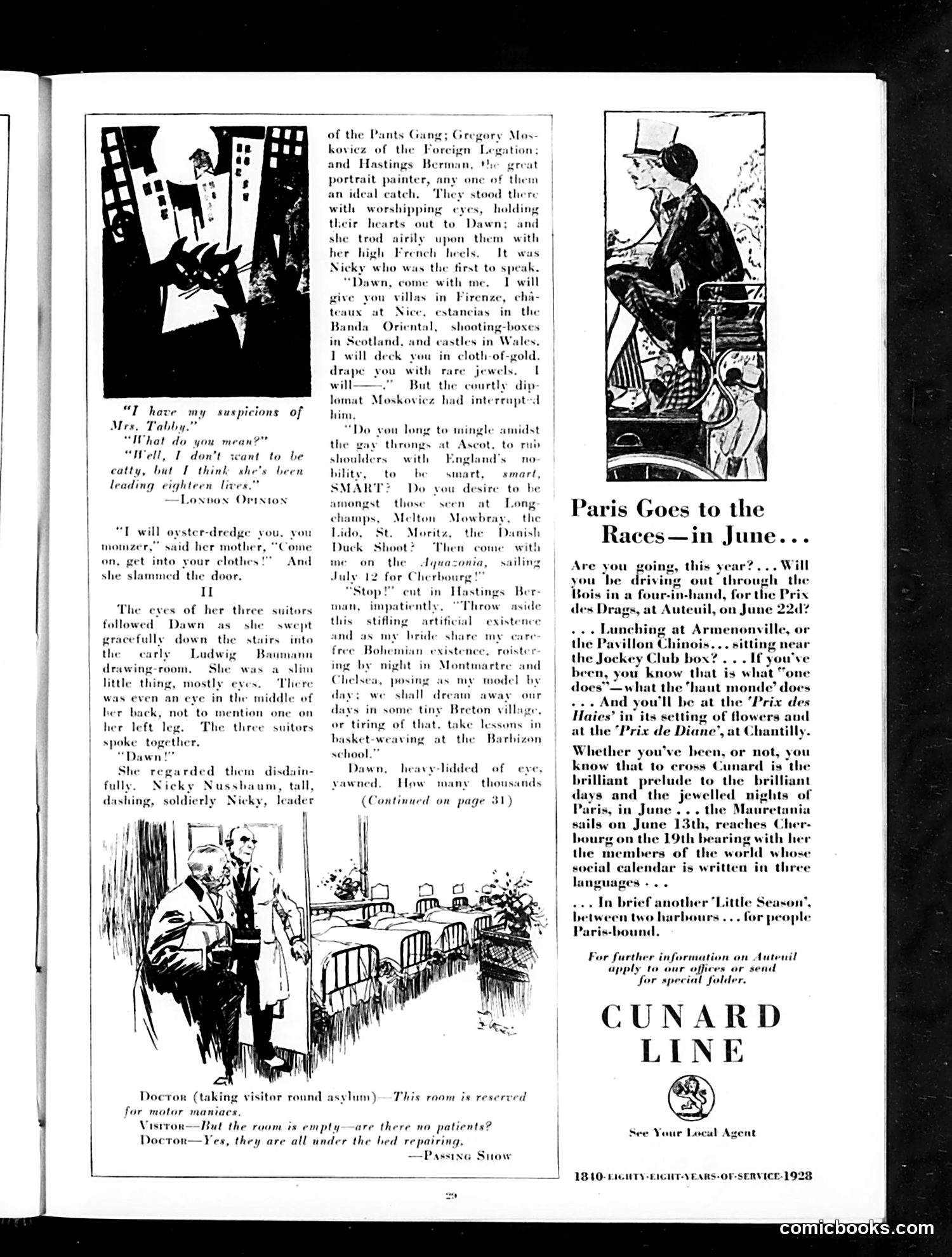
This page contains two distinct sections: **Left side ("II"):** A serialized romantic comedy about a woman named Dawn courted by three suitors—Nicky Nussbaum (a soldier), Gregory Moskovicz (a Foreign Legionnaire diplomat), and Hastings Berman (a portrait painter). Each offers extravagant inducements (villas, yacht voyages, Bohemian artist life) to win her. The satire targets wealthy suitors' predictable, exaggerated romantic appeals and the materialism of the pursued woman. The humor relies on the contrast between their grandiose promises and her indifferent superiority. **Top left corner:** A brief joke playing on "leading nine lives" (the cat phrase), suggesting a woman has lived eighteen lives—implying infidelity or moral looseness. **Right side:** A Cunard Line cruise advertisement disguised as editorial content, promoting a June voyage to Paris via the Mauritania, emphasizing fashionable society events (horse races, social season). It exploits aspirational readers' desires for continental sophistication. The page blends fiction entertainment with advertising—typical Judge practice from this era.
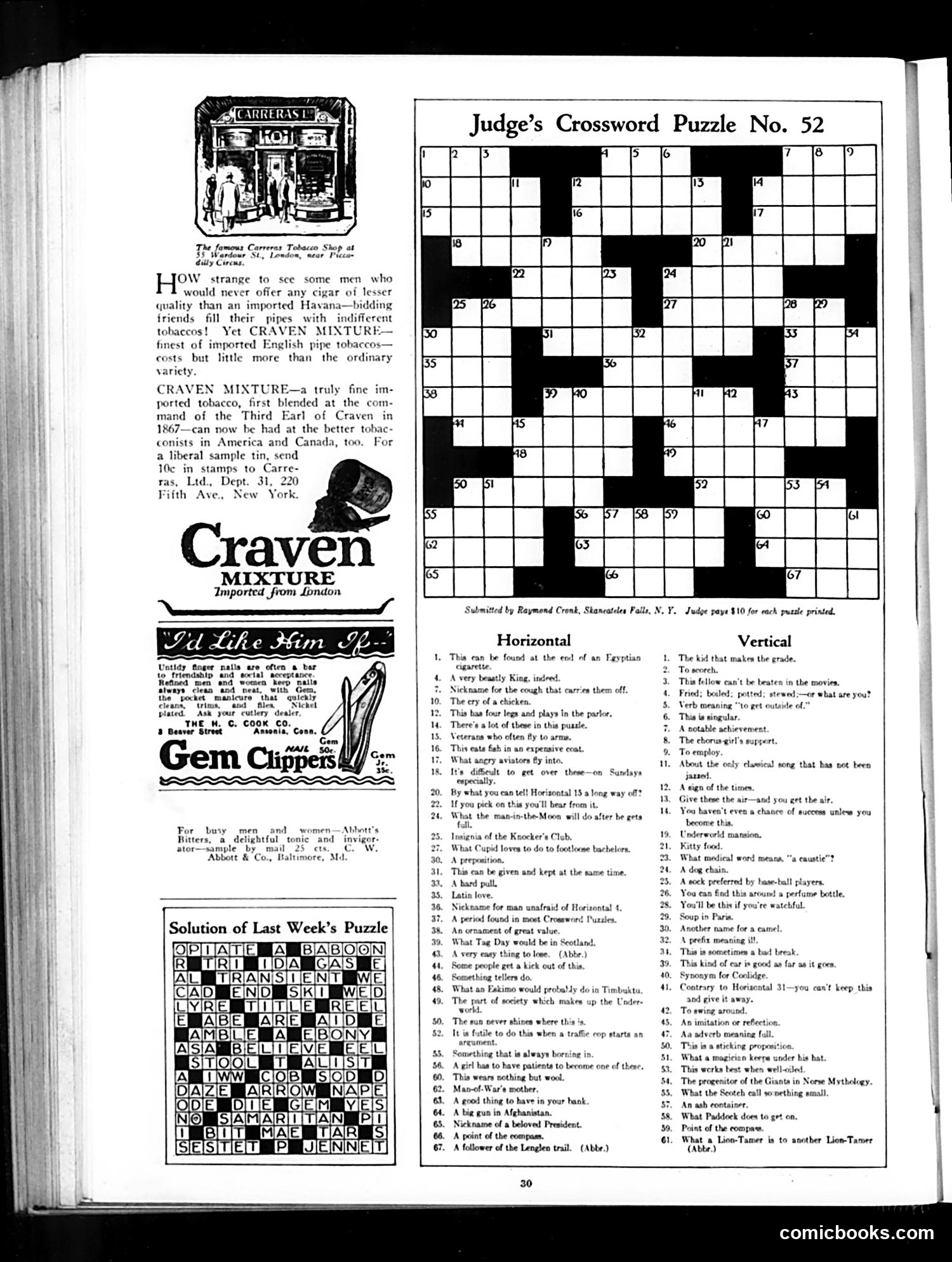
This page is primarily **advertising and a crossword puzzle**, not political satire. The advertisements showcase consumer products typical of the 1920s era: Craven Mixture pipe tobacco (imported from London), Gem Clippers (manicure tools), and Abbott's Bitters (a tonic). These ads reflect the period's commercial culture and consumer goods marketing. The main content is **"Judge's Crossword Puzzle No. 52"**—a substantial crossword with accompanying clues, plus the solution to the previous week's puzzle below. Crossword puzzles were enormously popular in American magazines during this period, representing a new entertainment trend. The Craven tobacco ad includes a brief historical note about the product's origin (1867, blended for the Third Earl of Craven), positioning it as a quality imported good—a common marketing appeal to aspirational consumers. There is no identifiable political cartoon or satire on this page; it represents typical magazine filler content designed to entertain and monetize reader engagement.
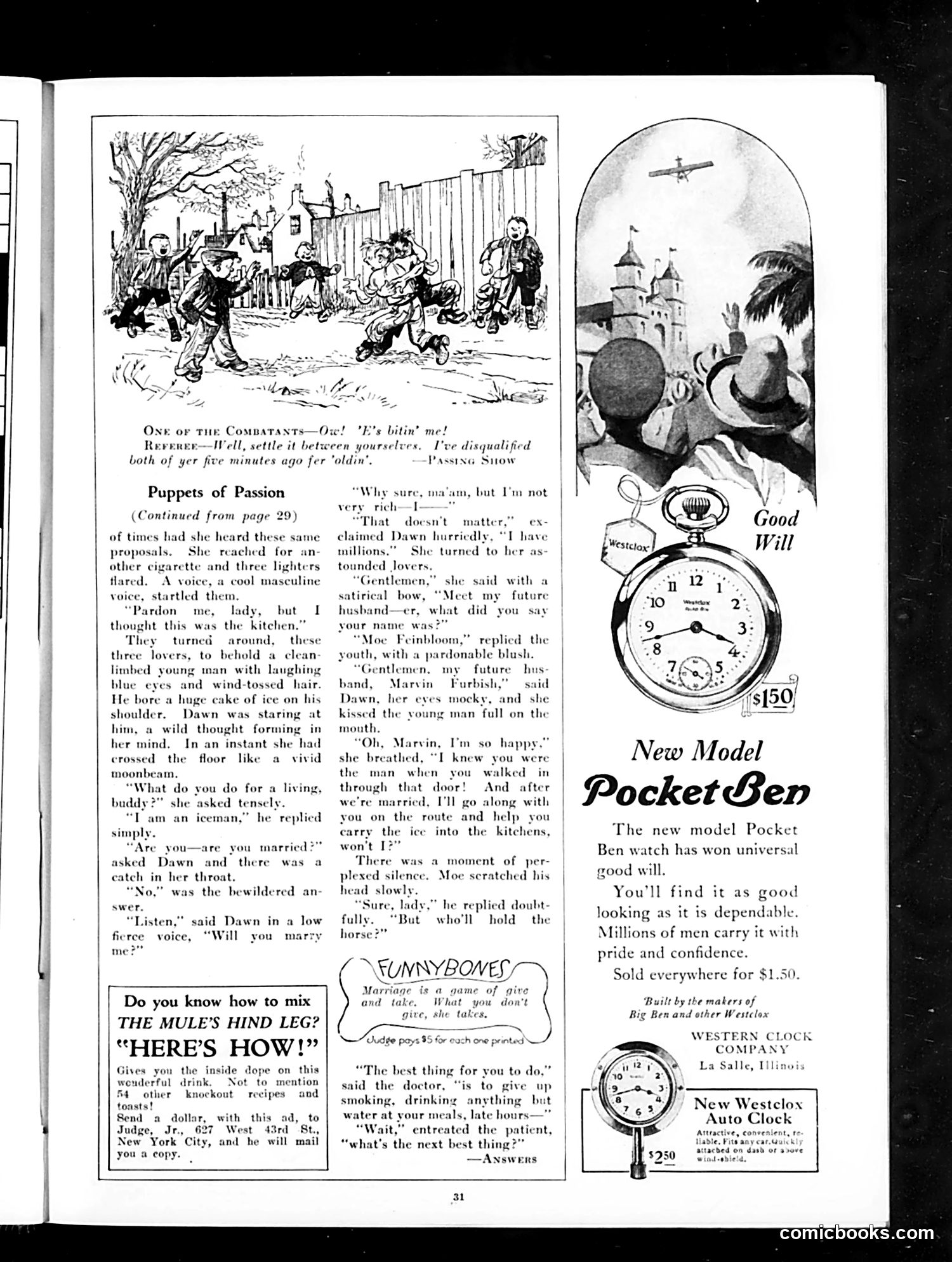
This is a serialized comedy story mocking melodramatic romance fiction popular in the 1920s. The plot deliberately subverts romantic convention: a woman (Dawn) surrounded by wealthy suitors inexplicably falls for an ice delivery man (initially "Moe Feinbloom," whom she immediately renames "Marvin Furbish" to suit her fantasy). The humor lies in the absurdity—she abandons rich gentlemen for a working-class deliveryman, then fantasizes about accompanying him on ice routes. The story satirizes both women who judge men purely by wealth and the overwrought language of pulp romance magazines. The cartoon above depicts this melodramatic clash of classes, while the "Funny Bones" section provides marriage wisdom in similar mock-serious tone. The page is primarily this serialized fiction with watch advertisements, typical of Judge's mix of satire and commercial content.
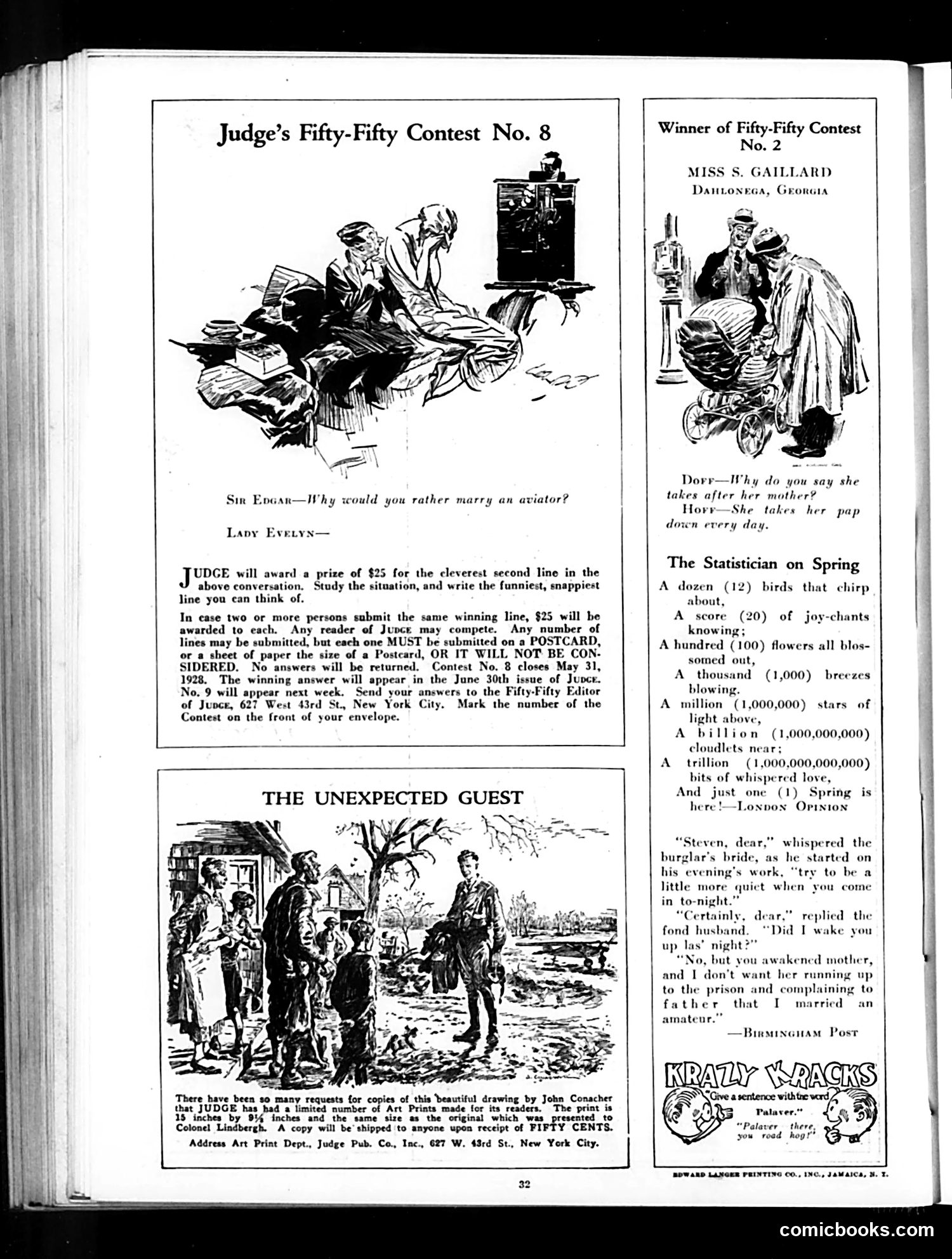
This page features **reader-participation humor contests** typical of Judge magazine's format. **Judge's Fifty-Fifty Contest No. 8** invites readers to complete a witty dialogue: Sir Edgar asks Lady Evelyn why she'd rather marry an aviator. The joke format reflects 1920s fascination with aviation as modern, glamorous, and risky—implying an aviator husband would be either dangerously absent or provide exciting (if precarious) marriage prospects. **The Unexpected Guest** is a John Conacher drawing gifted to **Colonel Charles Lindbergh**, the famous aviator who had just completed his transatlantic flight in 1927. Judge capitalized on Lindbergh's celebrity by offering prints to readers. The page also shows **Contest No. 2's winner** (Miss S. Gaillard) and includes light verse and brief jokes about husbands, mothers-in-law, and domestic life—standard middle-class humor of the era. The overall tone reflects 1920s American optimism about technology, celebrity culture, and consumer entertainment.
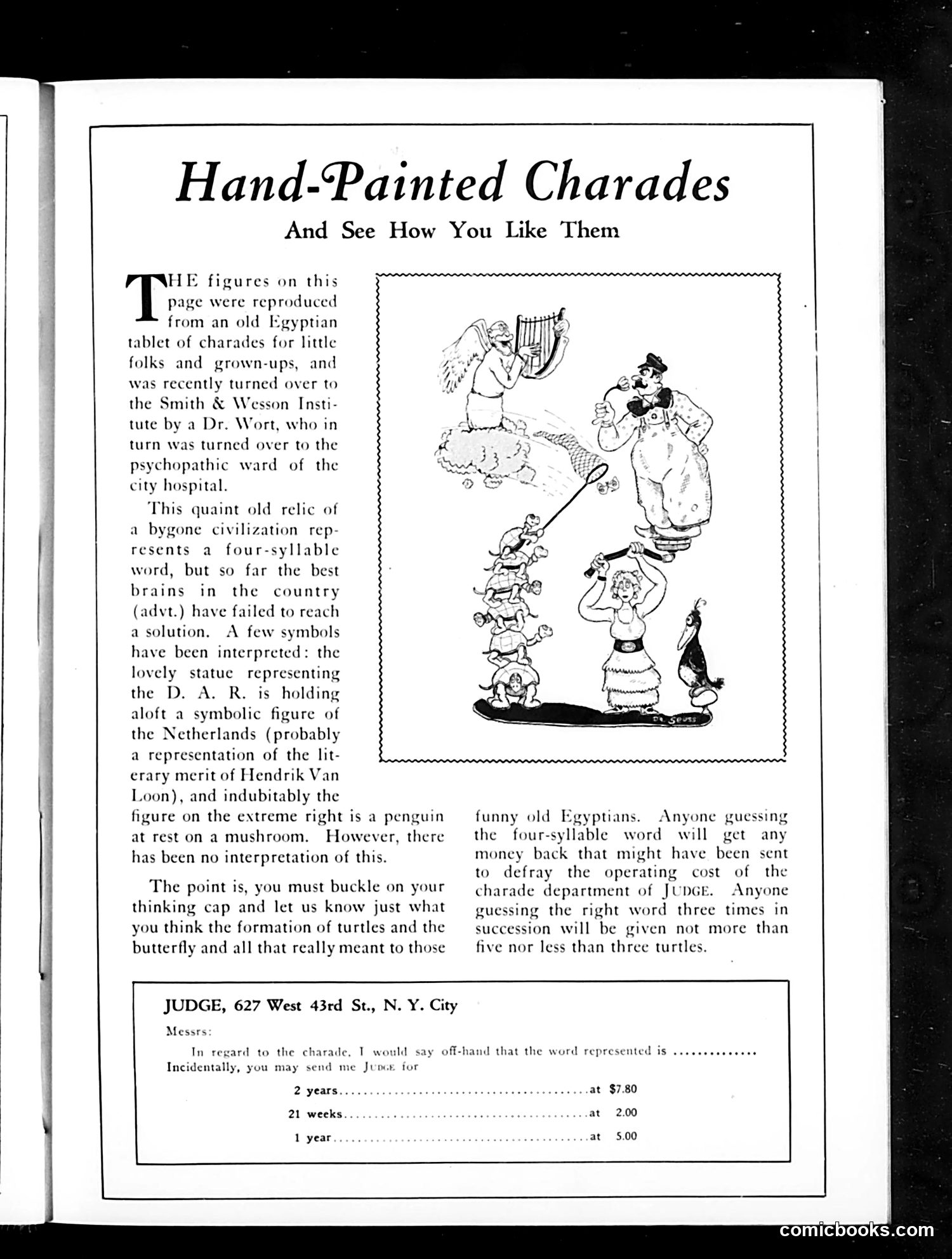
This is a *Judge* magazine puzzle/satire presenting a fictional "Egyptian charade" as a guessing game. The joke operates on multiple levels: **The Premise**: Readers are shown an illustration of whimsical figures and told to guess a four-syllable word they supposedly represent—a playful charades challenge. **The Satire**: The text mocks various cultural targets. It references the D.A.R. (Daughters of the American Revolution) as a "lovely statue," and mentions Hendrik Van Loon's "literary merit" sarcastically (suggesting his work was of dubious quality). A penguin on a mushroom appears as one decoded element, absurdly. **The Fake Authority**: Dr. Wort (a pun name suggesting he's "not worth" taking seriously) supposedly discovered this tablet but was committed to a psychiatric ward—undermining the entire premise's credibility. **The Prize**: Readers sending correct guesses receive "not more than five nor less than three turtles"—an intentionally nonsensical reward, emphasizing the whole thing is humorous fiction rather than a genuine contest.
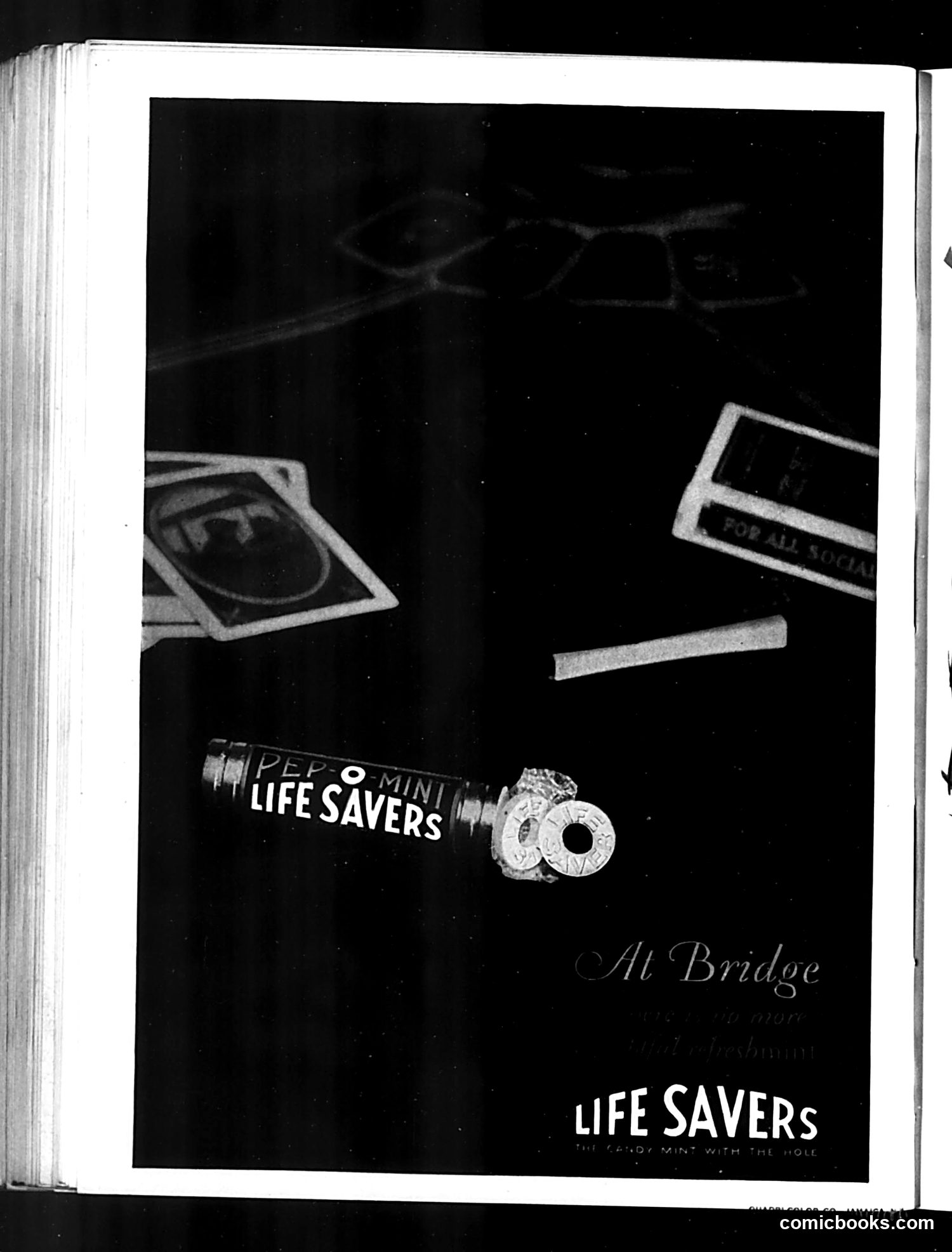
This page is primarily **advertising**, not political satire. It shows two Life Savers candy advertisements featuring the product's distinctive ring shape with a hole in the center. The top ad displays "PEP-O-MINT LIFE SAVERS" with product packaging visible. The lower ad reads "At Bridge" and "LIFE SAVERS" with text referencing "the candy mint with the hole." The humor is commercial rather than political—it plays on the candy's famous marketing angle: the hole in the middle. The "At Bridge" reference suggests these mints were marketed as breath fresheners for social settings like card games. This represents Judge magazine's revenue model, mixing satirical content with period advertisements rather than pure editorial cartooning.