
Judge, 1928-05-19 · page 24 of 36
Judge — May 19, 1928 — page 24: what you’re looking at
What you’re looking at
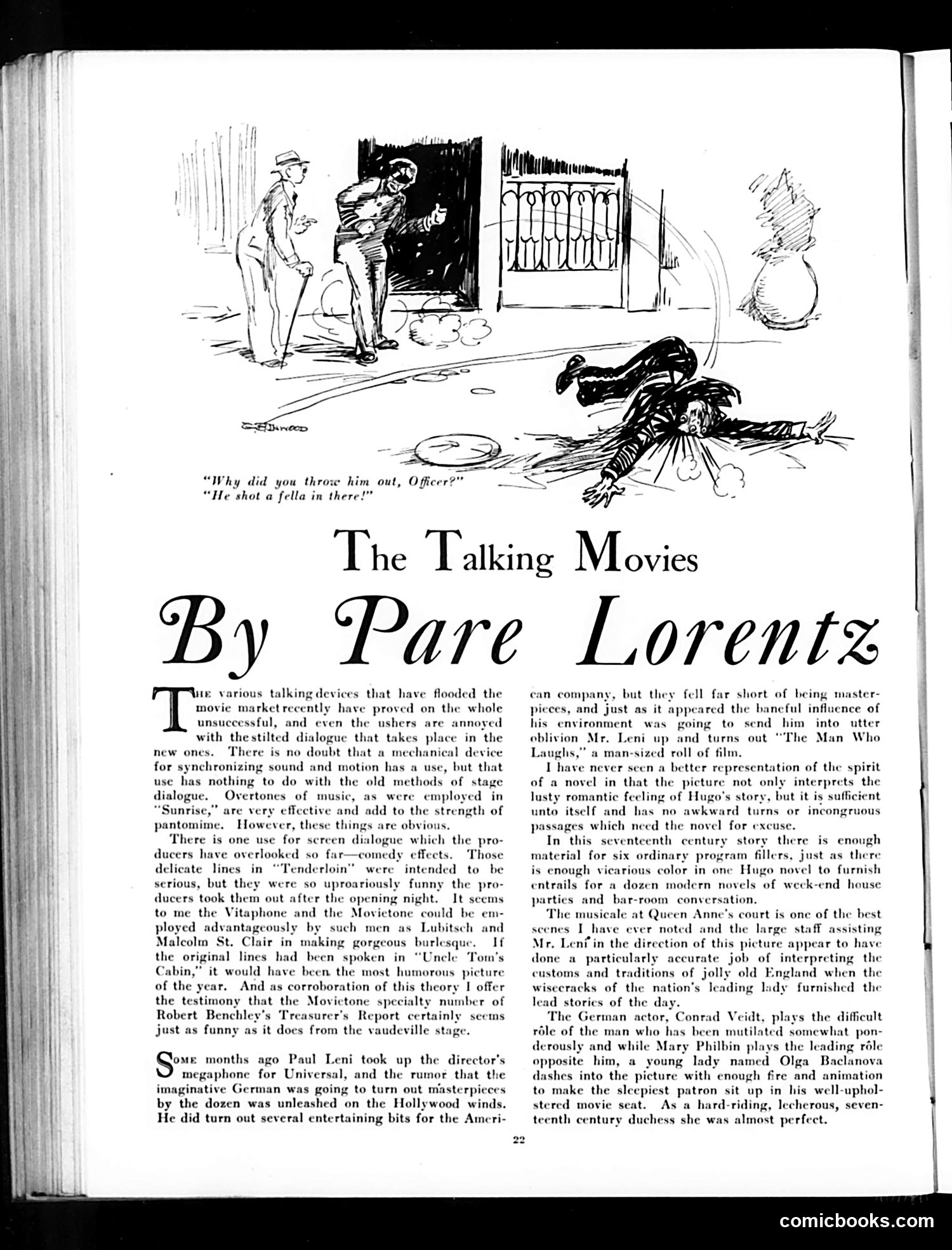
This is a film criticism article by Pare Lorentz reviewing early "talking pictures" (sound films), which were novel and controversial in the late 1920s. **The cartoon** at top depicts a cop ejecting a man from a movie theater, saying "He shot a fella in there!"—a joke about audience confusion between on-screen action and reality, mocking viewers' reactions to new sound technology. **The article's argument**: Lorentz criticizes how studios use synchronized dialogue, arguing it's stilted and awkward. He suggests sound would work better for *comedy* rather than serious drama, noting unintentionally funny moments in "Tenderloin" were removed after opening night. **Key figures reviewed**: Director Paul Leni's "The Man Who Laughs" (adapted from Victor Hugo), praised for capturing the novel's spirit. German actor Conrad Veidt plays the title role; Mary Philbin and Olga Baclanova also star. **The satire**: Lorentz mocks Hollywood's hype around sound technology while defending artistic integrity—early talkies were often technically awkward and theatrically overwrought compared to the refined pantomime of silent films.
📄 Transcribed text from this page (OCR, searchable)
Machine-transcribed from the original scan — historical spelling and the odd misread are preserved.
“Why did you throw him out, Officer? “He shot a fella in there!” The Talking Movies y Pare Lorentz ie various talking devices that have flooded the movie market recently have proved on the whole unsuccessful, and even the ushers are annoyed with thestilted dialogue that takes pl in the new ones. There is no doubt that a mechanical device for synchronizing sound and motion has a use, but that use has nothing to do with the old methods of stage dialogue. Overtones of music, were employed in “Sunrise,” are very effective and add to the strength of pantomime. However, these things are obvious. There is one use for screen dialogue which the pro- ducers have overlooked so far—comedy effects. Those delicate lines in “Tenderloin” were intended to be serious, but they were so uproariously funny the pro- ducers took them out after the opening night. It seems to me the Vitaphone and the Movietone could be em- ployed advantageously by such men as Lubitseh and Malcolm St. Clair in making gorgeous burlesque. If the original lines 1 been spoken in “Uncle Tom's Cabin,” it would have been the most humorous picture of the year. And as corroboration of this theory I offer the testimony that the Movietone specialty number of Robert Benchley’s Treasurer's Report certainly secms just as funny as it does from the vaudeville st: Su months ago Paul Leni took up the director's megaphone for ersal, and the rumor that imaginative German was going to turn out masterpieces by the dozen was unleashed on the Hollywood winds. He did turn out several entertaining bits for the Ameri- re 8 can company, but they fell far short of being master- picces, and just as it appeared the bancful influence of his environment was going to send him into utter oblivion Mr. Leni up and turns out “The Man Who Laughs,” a man-sized roll of film. I have never seen a better representation of the spirit of a novel in that the picture not only interprets the lusty romantic feeling of Hugo's story, but it is sufficient unto itself and has no awkward turns or incong passages which need the novel for excuse. In this seventeenth century story there is enough material for six ordinary pre n fillers, just as there is enough vicarious color in one Hugo novel to furnish entrails for a dozen modern novels of week-end house parties and bar-room conversation. The musicale at Queen Anne's court is one of the best scenes I have ever noted and the large staff assisting Mr. Leni in the direction of this picture appear to have done a particularly accurate job of interpreting the customs and traditions of jolly old England when the wisecracks of the n: ling lady furnished the le uous ion’s lea d stories of the day. he German actor, Conrad Veidt, plays the difficult role of the man who has been mutilated somewhat pon- derously and while Mary Philbin plays the leading réle opposite him, a young lady named Olga Baclanova dashes into the picture with enough fire and animation to make the sleepiest patron sit up in his well-uphol- stered movie seat. As a hard-riding, lecherous, seven- teenth century duchess she was almost perfect. comicbooks.com