
A complete issue · 36 pages · 1928
Judge — March 31, 1928
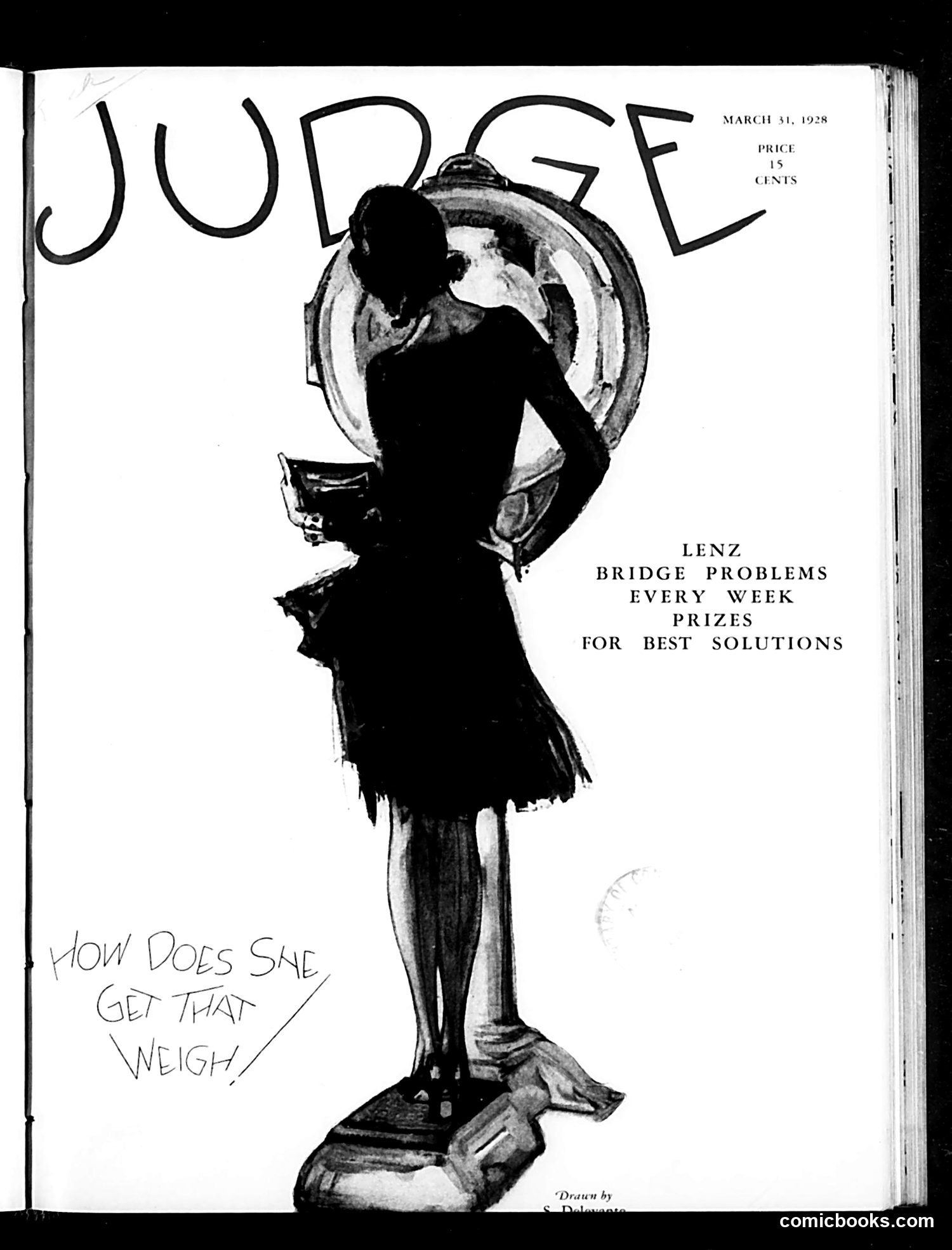
This cover features a stylized female figure standing on a bathroom scale, viewed from behind as she looks at her reflection in a mirror. The accompanying handwritten question—"How Does She Get That Weight?"—suggests satirical commentary on women's body image and weight concerns. The cover advertises "Lenz Bridge Problems Every Week / Prizes for Best Solutions," indicating the magazine's inclusion of puzzle content alongside humor and satire. The silhouette style and the focus on a woman's preoccupation with her appearance reflect 1920s social attitudes toward femininity and weight consciousness—likely mocking either fad diets, vanity, or the emerging culture of body-focused anxiety in modern consumer society.
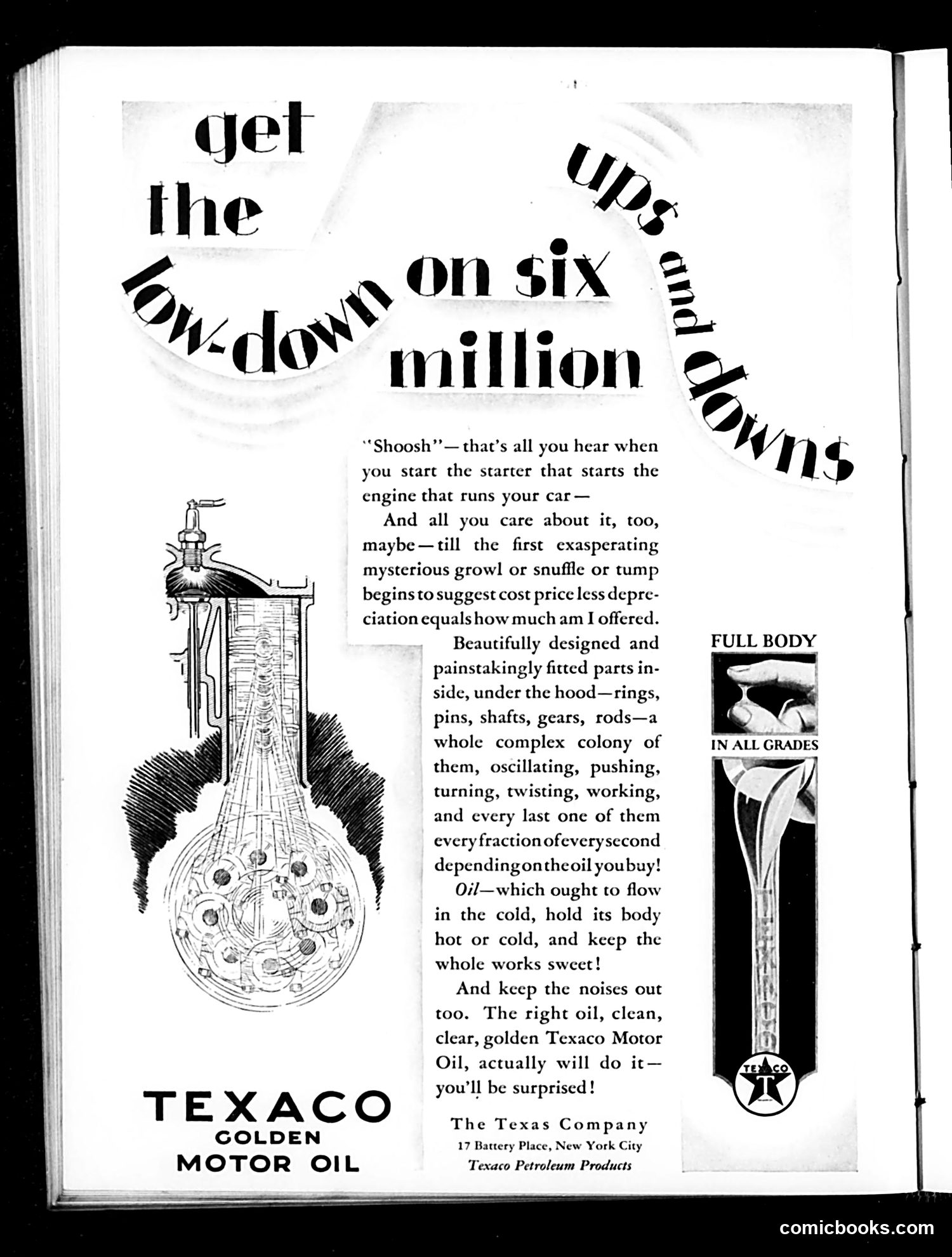
This page is **primarily an advertisement**, not satirical content. It promotes Texaco Golden Motor Oil, appearing in *Judge* magazine. The advertisement uses humor to explain motor oil's function. The large illustration shows an engine's internal mechanism with anthropomorphized "wings," personifying the engine as a creature. The text humorously describes engine sounds ("Shoosh," "growl," "snuffle," "tamp") that worry car owners about potential costly damage. The sales pitch claims Texaco oil prevents these problems by properly lubricating all moving parts ("rings, pins, shafts, gears, rods"). The advertisement emphasizes that quality oil keeps engines running smoothly and quietly. The "Full Body in All Grades" indicator shows oil viscosity options. This is commercial content using lighthearted language and visual humor to market a practical automotive product to early-20th-century consumers.
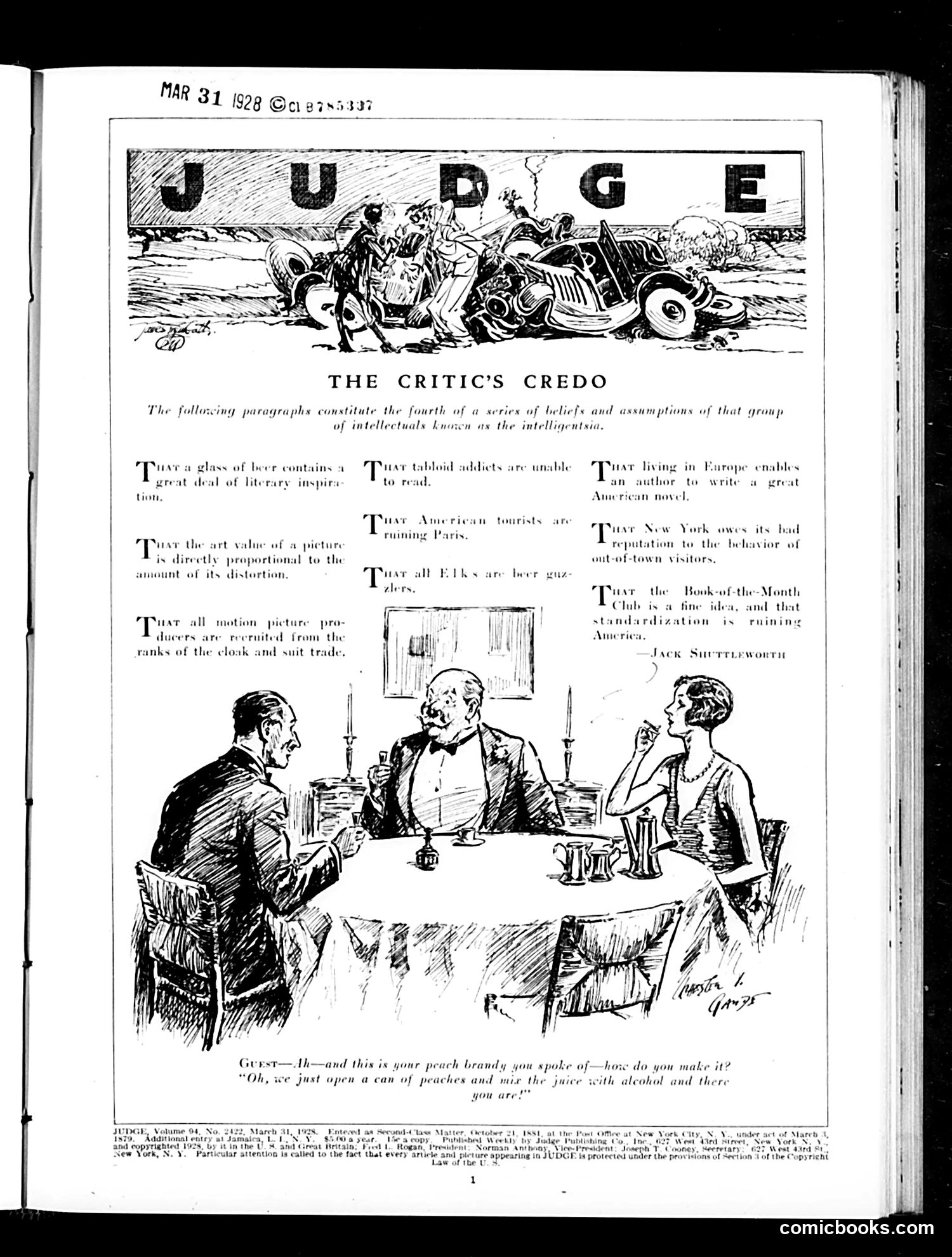
This satirical piece mocks intellectual and cultural critics of the era through a series of absurd "beliefs" attributed to them. The cartoon targets pretentious critics who make sweeping pronouncements about art, literature, and culture without genuine knowledge. The specific jabs include: critics who claim beer inspires literature, those who dismiss tabloid readers as illiterate, dismissal of American tourists and their impact on Paris, complaints about Elk lodges, and attacks on New York's reputation. The final quote—about opening peaches and juice with alcohol—suggests critics speak nonsensically while affecting sophistication. The illustration shows three dinner companions in formal dress, likely representing the type of affected intellectual "Judge" is mocking. The satire critiques elitist cultural gatekeepers of the Jazz Age.
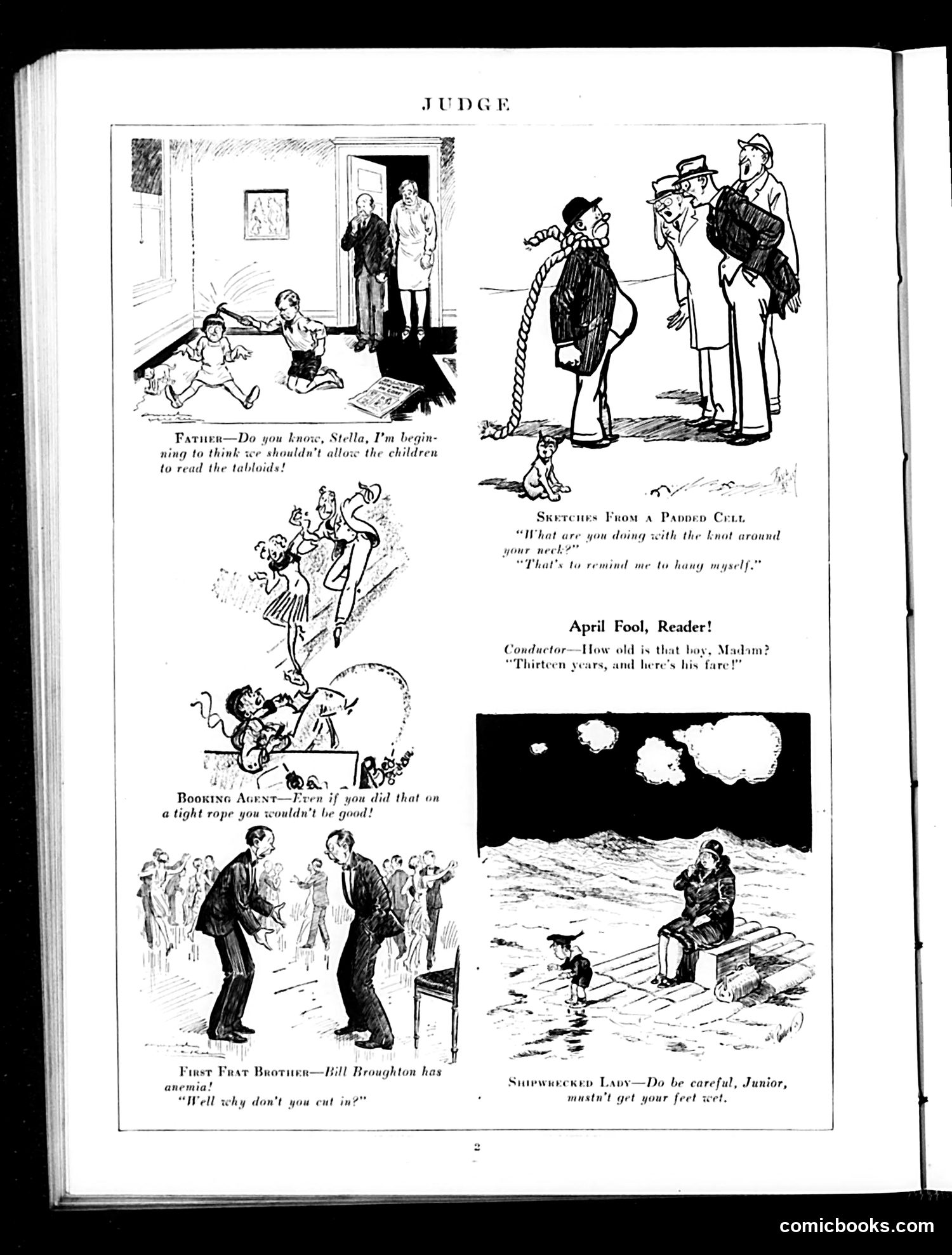
This page collects six satirical sketches on various social topics: 1. **Tabloids & Children**: A father worries about children reading tabloid newspapers, suggesting early-1900s anxieties about sensationalist media's influence on youth. 2. **Prison Discipline**: A prisoner's dark humor about using a noose for self-harm reflects period prison reform debates. 3. **April Fool's Joke**: A conductor's fare joke about a thirteen-year-old, playing on common April 1st pranks. 4. **Booking Agent**: A theatrical agent's threat about a "tight rope gun," likely mocking vaudeville's dangerous stunts. 5. **Frat Hazing**: Two brothers, one asking why the other won't "cut in," appears to satirize college fraternity violence or bullying rituals. 6. **Shipwreck**: A woman warns a boy not to get wet—darkly humorous given their apparent shipwreck situation. These reflect turn-of-century American social anxieties and class commentary.
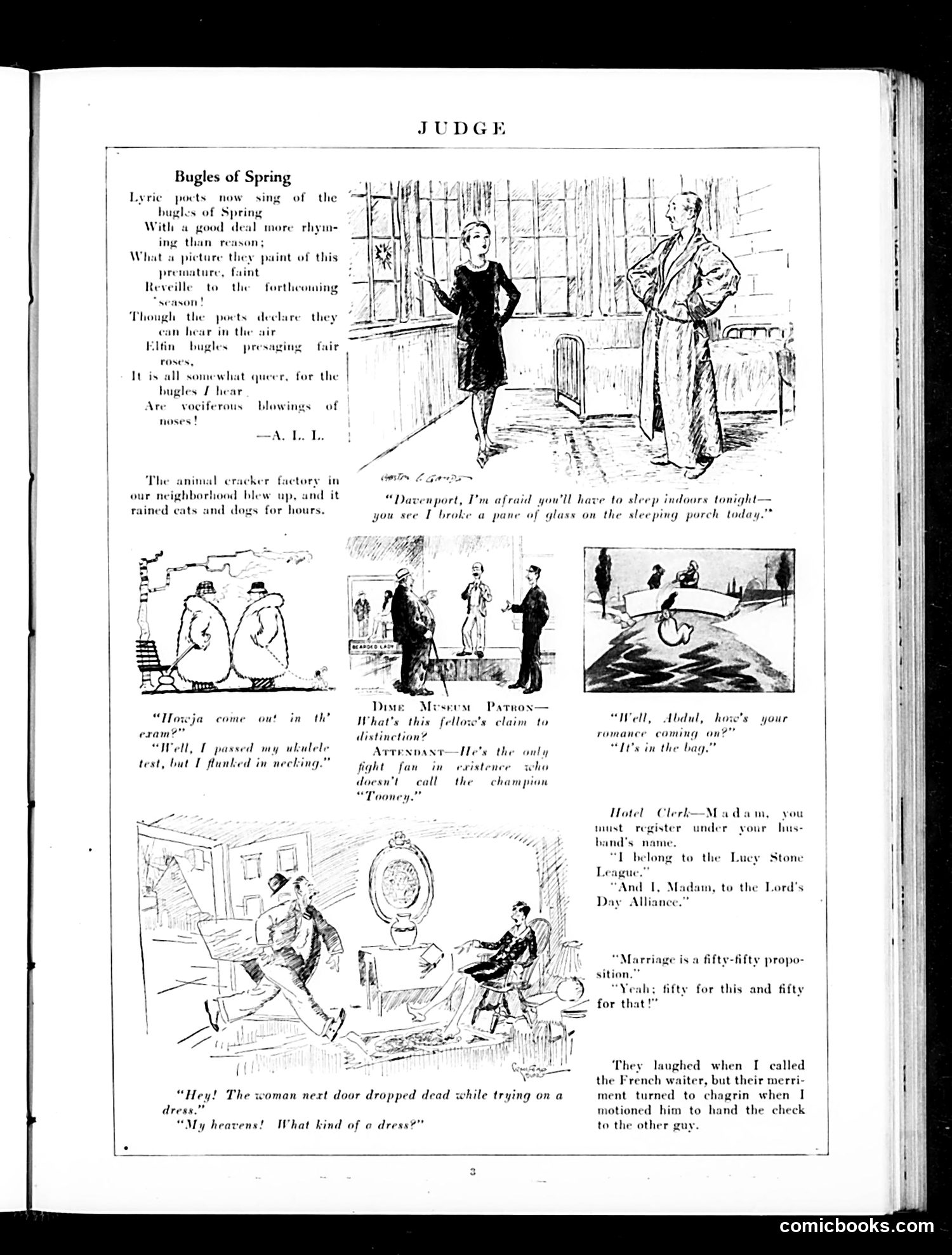
This page from *Judge* magazine contains several unrelated satirical sketches and jokes typical of early 20th-century humor: **"Bugles of Spring"** is a poem mocking romantic poetry about spring, suggesting poets exaggerate nature's beauty. The other cartoons depict everyday social situations: a woman concerned about sleeping porch etiquette; a museum patron claiming distinction as the "only fight fan" who doesn't call champions by nicknames; a hotel clerk requiring league affiliation for registration; a joke about marriage as a "fifty-fifty proposition"; and a mishap involving a woman fainting while trying on a dress. These sketches satirize contemporary social conventions, pretension, and domestic life rather than addressing specific political figures or events. The humor relies on relatable middle-class scenarios and wordplay rather than topical commentary.
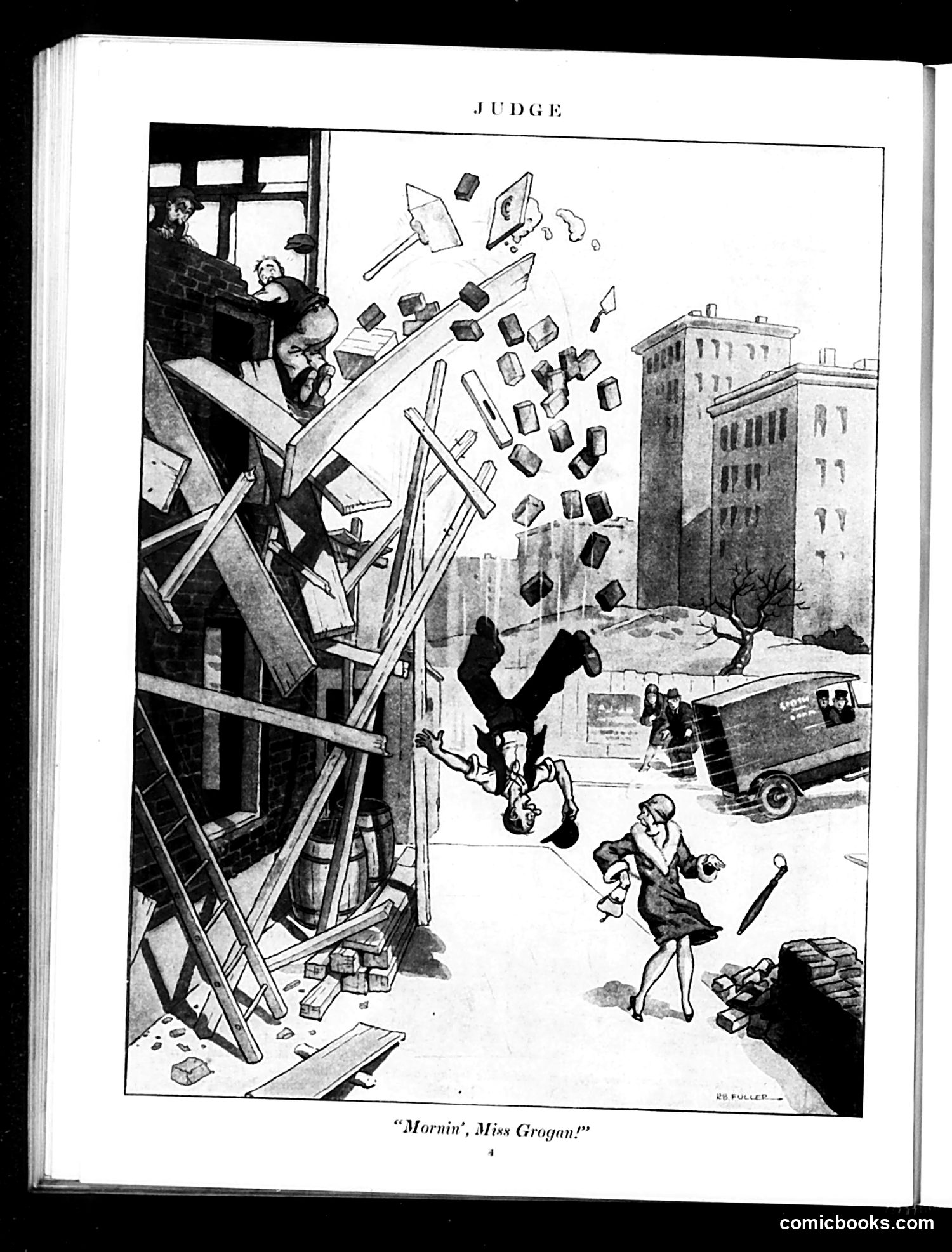
This Judge magazine cartoon satirizes urban construction hazards and workplace safety in early 20th-century America. A construction worker on a high scaffold is greeting a woman below while bricks and tools rain down chaotically around her. The cartoon's humor derives from the surreal contrast: the worker casually says "good morning" while creating a dangerous situation of falling debris. The satire likely critiques both the callous attitude of construction workers toward public safety and the vulnerability of pedestrians to workplace accidents in densely built urban areas. The woman's alarmed pose and the cartoon's exaggerated chaos emphasize how commonplace these hazards were—treated as routine rather than serious dangers. This reflects genuine safety concerns of the industrial era before modern regulations.
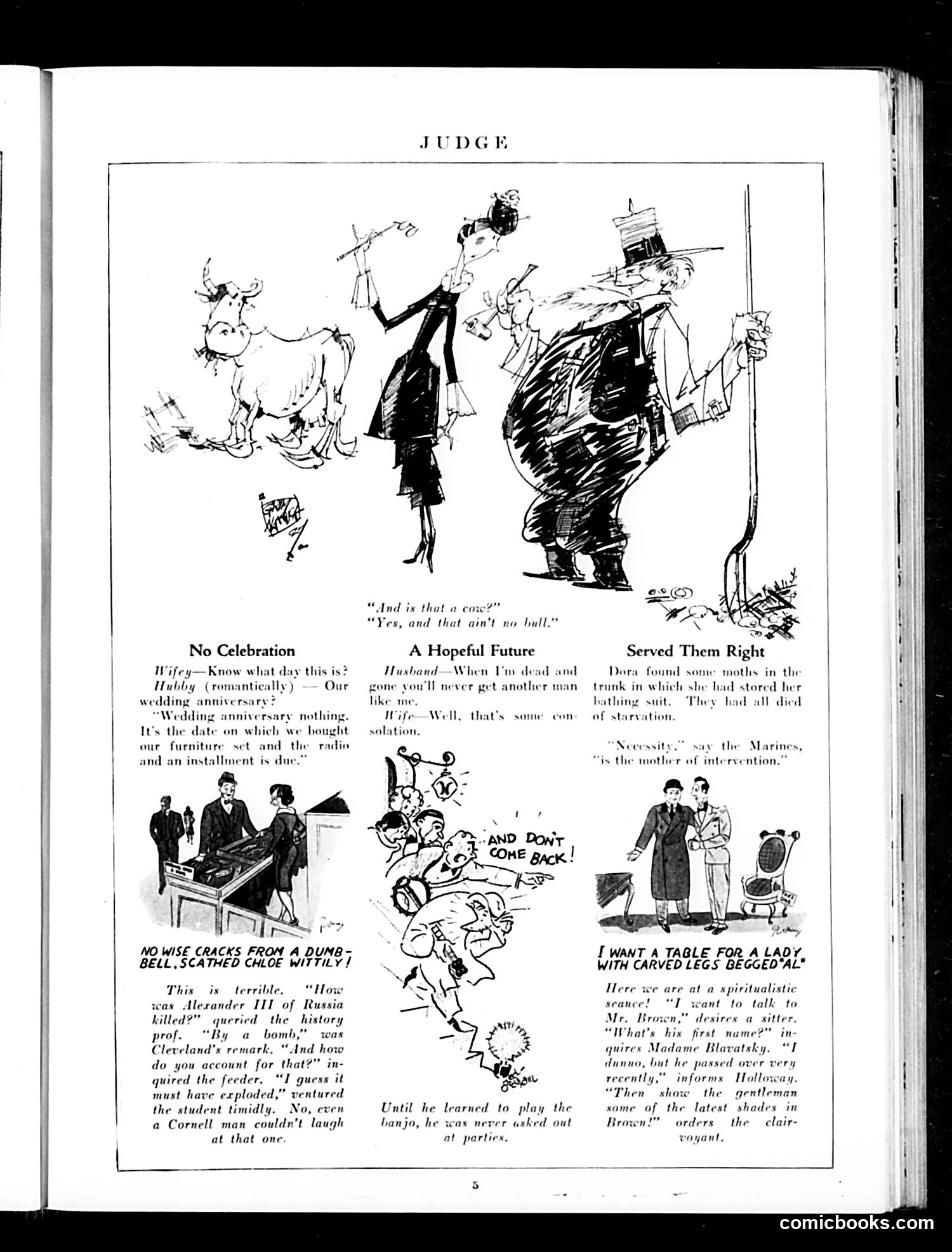
This page presents three unrelated humorous sketches satirizing American domestic life and social customs: **"No Celebration"**: Mocks a couple forgetting their wedding anniversary due to financial preoccupation with furniture payments and radio installments—critiquing 1920s consumer debt culture. **"A Hopeful Future"**: Depicts a husband consoling his wife about dying without remarriage by suggesting she'll find comfort in the afterlife. The Marines' motto ("Necessity is the mother of intervention") appears to be a caption joke, though its exact satirical target is unclear. **"Served Them Right"**: Shows a woman discovering moths in stored clothing, with Marines making a crude joke about military intervention. The spiritualist séance reference and furniture humor suggest commentary on gullible consumers and household management. The overall tone mocks middle-class anxieties about marriage, spending, and domestic life in early 20th-century America.
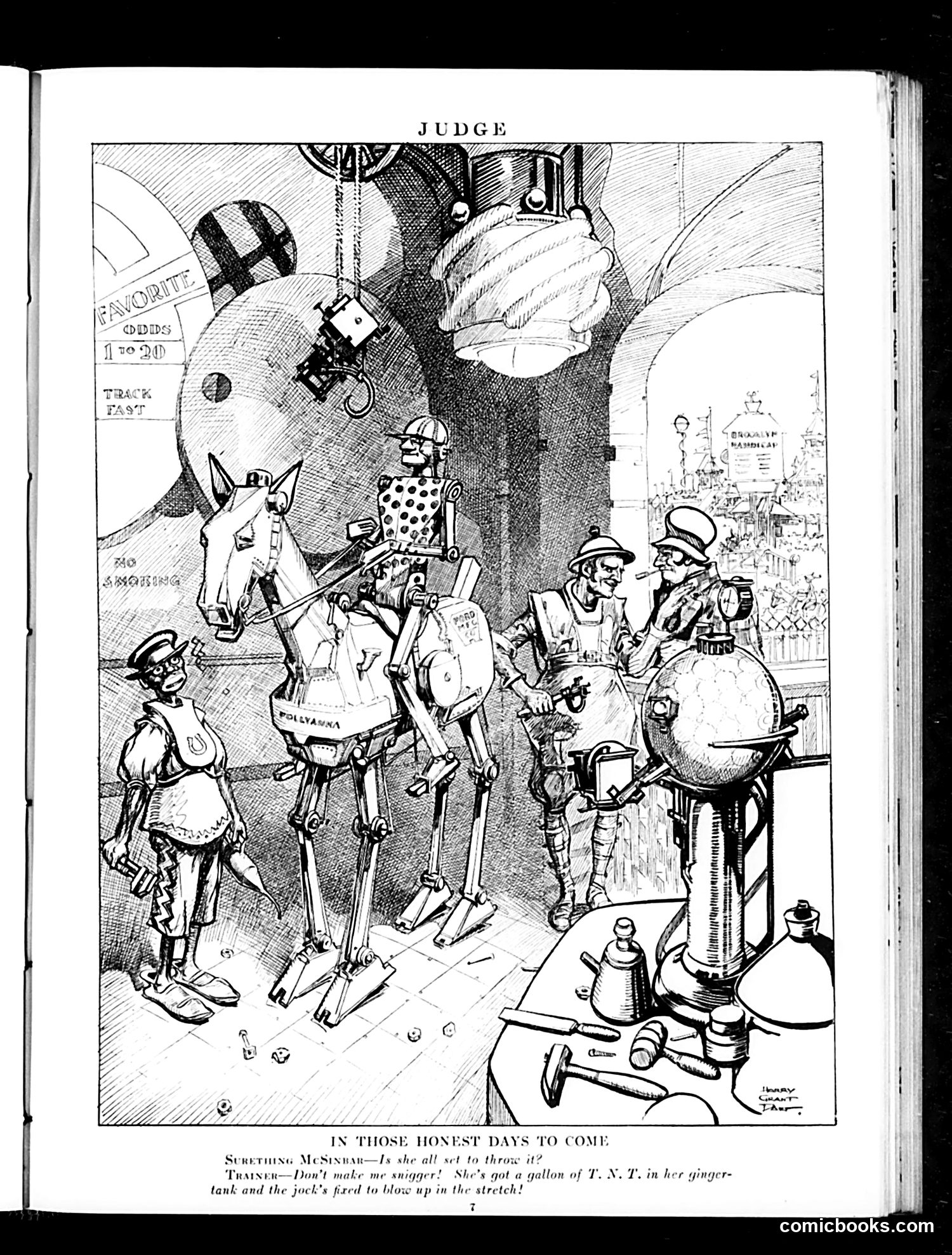
This Judge cartoon satirizes future technology and mechanization through absurdist humor. The image depicts robot-like mechanical figures in what appears to be a futuristic racing or sporting scenario. The dialogue references "Surething McSinubar" and "Trainer," discussing a female competitor ("she") equipped with TNT (explosives) in her "ginger-tank" and a mechanism set to detonate during competition—likely a dark joke about unstable mechanical augmentation. The cartoon seems to mock both: (1) the era's fascination with mechanized progress and human-machine hybrids, and (2) anxieties about dangerous technological experimentation. The absurd premise—combining racing sport with literal explosives—exaggerates contemporary concerns about unchecked mechanical innovation. Without a visible date on this page, the exact historical moment remains unclear, though the art style suggests early-to-mid twentieth century.
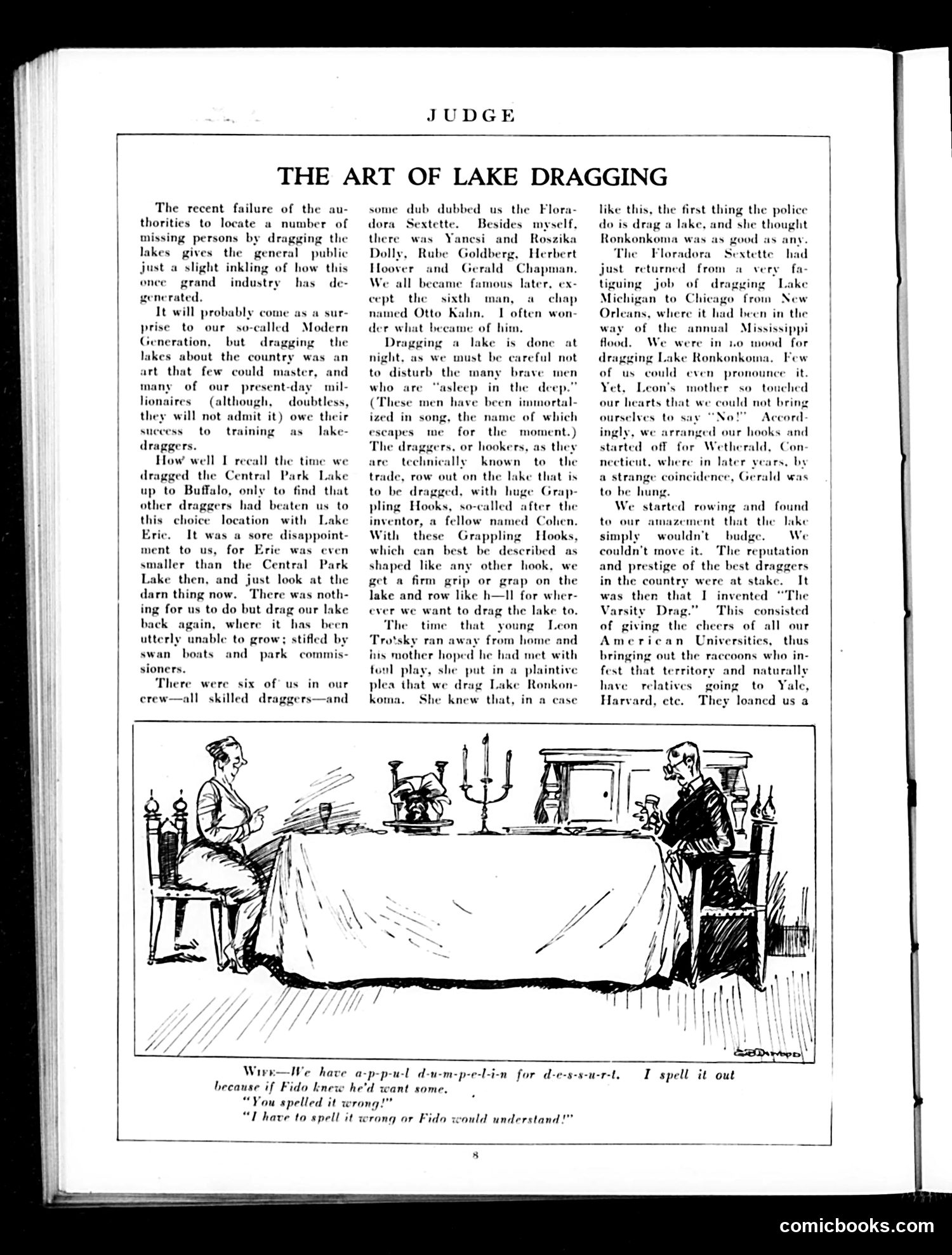
This is a humorous satirical article mocking the era's obsession with "lake dragging"—the practice of dredging lakes to search for missing bodies. The author presents it as a lost "art" practiced by famous figures, naming Rube Goldberg and Herbert Hoover among fictional "draggers" from his youth. The satire works on multiple levels: it ridicules both the ineffectiveness of police dragging operations (referenced in the opening) and the grandiose self-importance of those who participated. The absurd premise—that dragging lakes was a prestigious skill that built fortunes—mocks wealthy industrialists' dubious origin stories. The cartoon below shows a domestic dispute over spelling "dessert," unrelated to the main article—typical of Judge's miscellaneous page design. The piece exemplifies Judge's deadpan, surreal humor style popular in early 20th-century American satire.
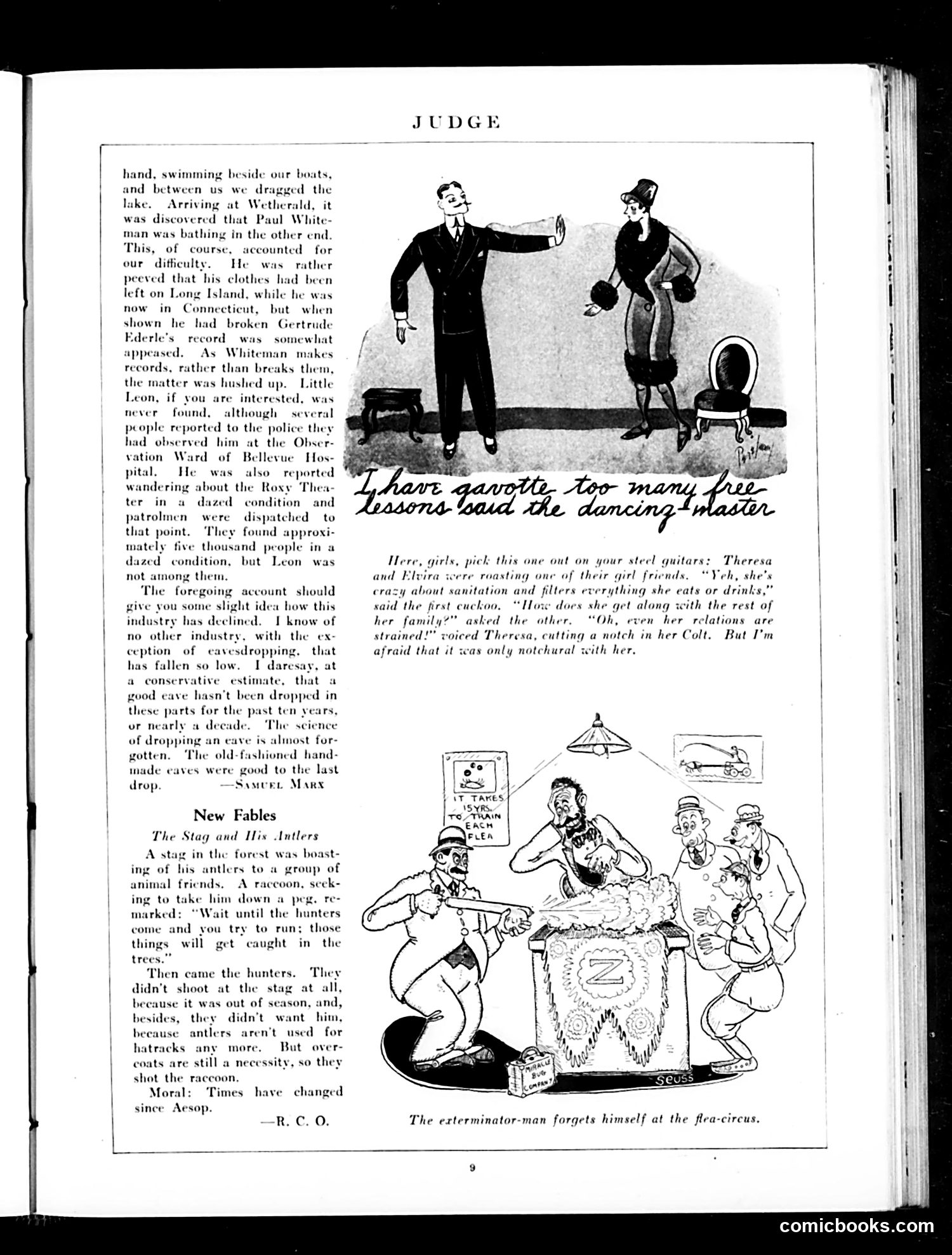
This page contains satirical content from Judge magazine, likely from the 1920s based on references to Paul Whiteman (famous bandleader) and Gertrude Ederle (who swam the English Channel in 1926). **Top Cartoon**: A joke about a dancing master complaining of "too many free lessons." The humor relies on the era's concern with proper etiquette and paid instruction. **"New Fables" Section**: A mock-Aesop's fable about a boastful stag. The moral satirizes changing times: hunters don't want the stag's antlers for hat racks anymore—they shoot the raccoon instead for its fur to make overcoats. It's social commentary on shifting consumer demands and economic priorities. **Bottom Section**: Appears to be a humor column with jokes about young women and their behaviors, using period slang ("steel guitars," "Colt" revolver references). The overall tone reflects 1920s satirical humor targeting contemporary social trends, consumer culture, and modern manners—typical Judge magazine content that combined political/social commentary with light comedic observations.
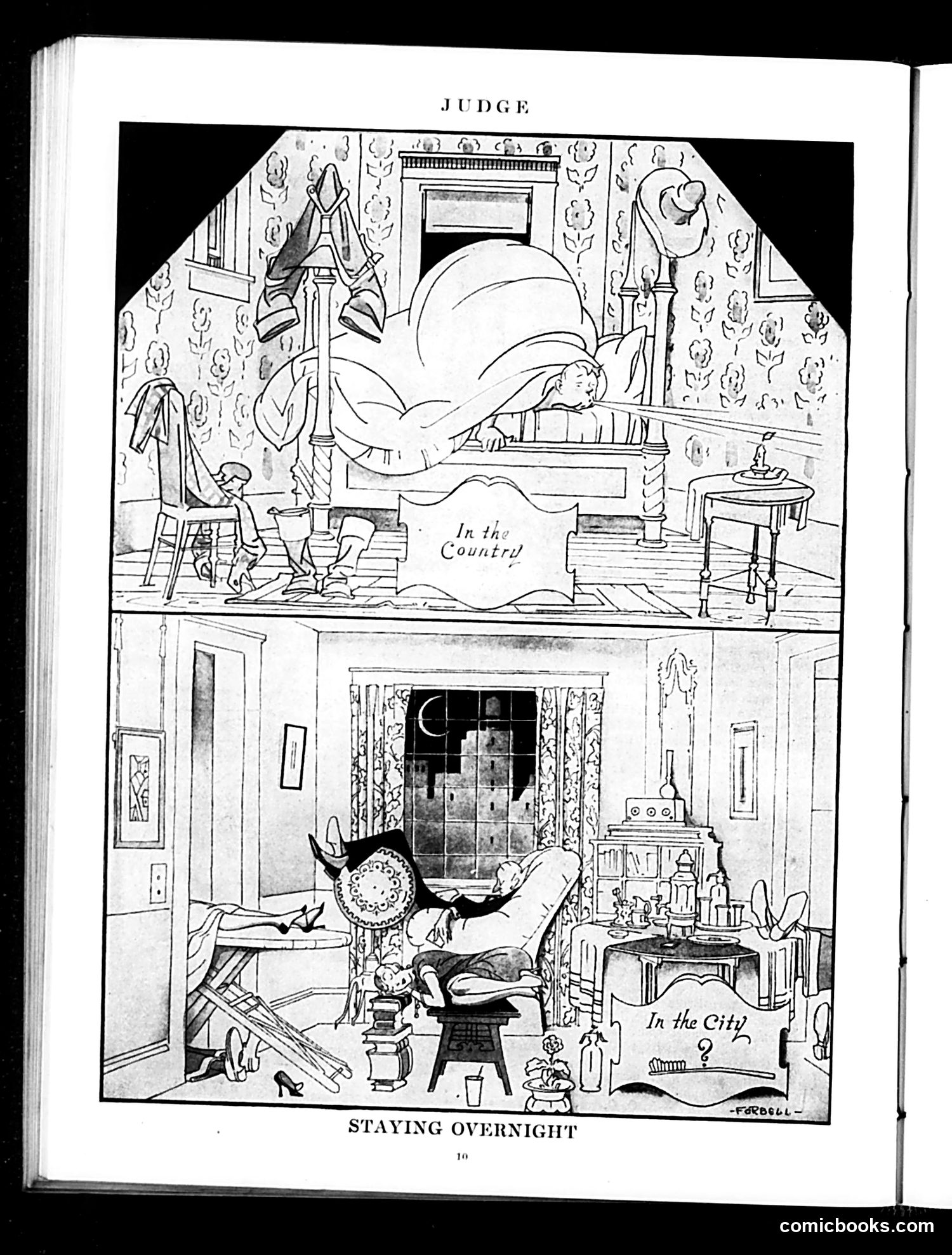
This two-panel cartoon contrasts rural and urban overnight accommodations. The top panel shows a modest country bedroom with simple furnishings, a figure in bed, and basic decor—representing wholesome, plain living. The bottom panel depicts an ornate city bedroom cluttered with elaborate furniture, decorative objects, and luxury items—suggesting excess and artificiality. The satire critiques the contrasting values between country and city life. The country stay appears honest and restful; the city version appears overwrought and uncomfortable despite (or because of) its pretentious trappings. This reflects early 20th-century American anxiety about urbanization and the perceived moral superiority of rural simplicity versus city decadence—a common Judge magazine theme targeting middle-class anxieties about modern urban society.
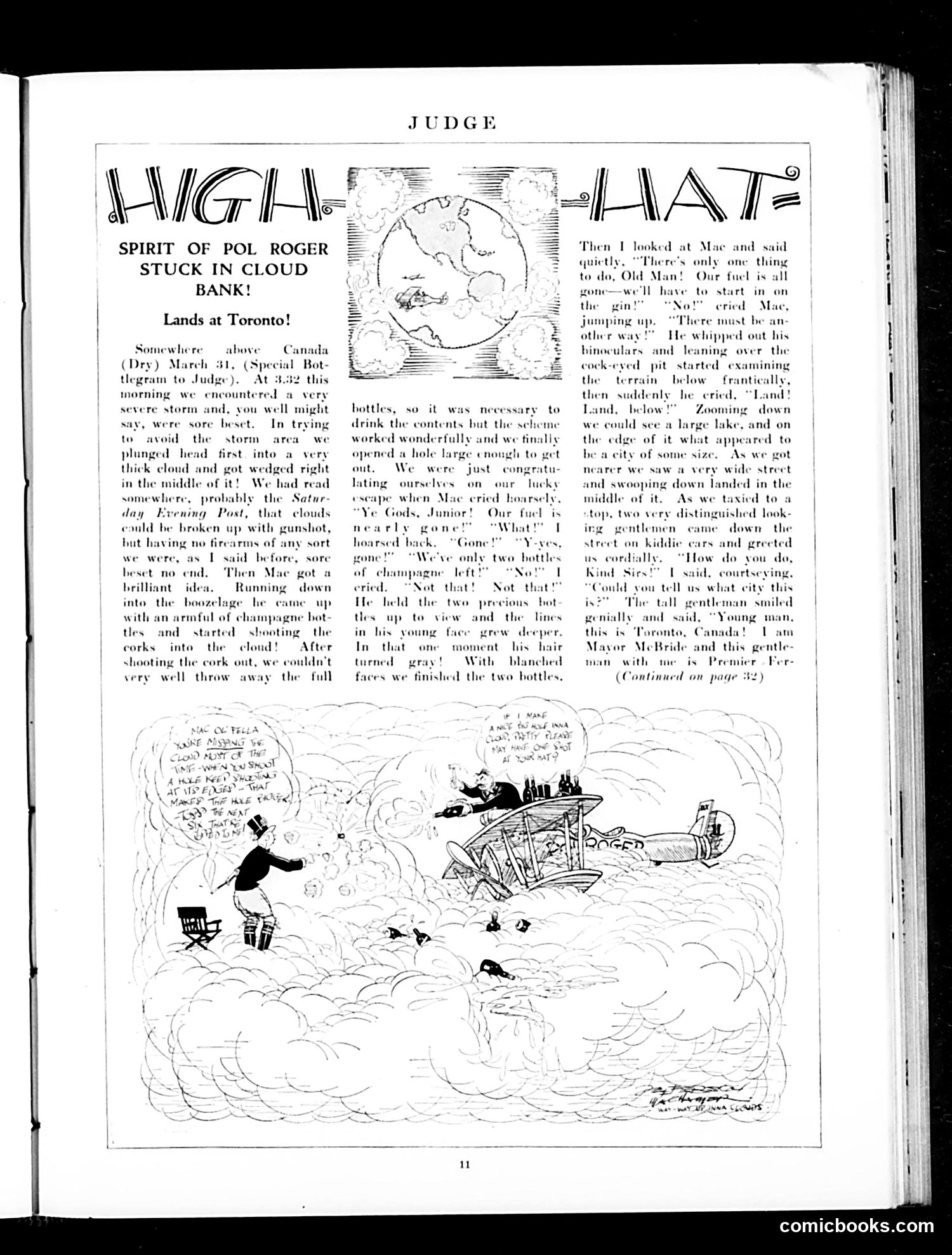
This 1912 Judge magazine story satirizes Canadian geography and pride. Two aviators get lost in a cloud over Canada on March 31 and crash-land in what they assume is wilderness. They consume champagne to stay warm, then spot a lake and land on a city street. Two distinguished gentlemen greet them—identified as Mayor McBride and Premier [Pearson, likely]. The joke centers on the aviators' shock: they've landed in Toronto, a major Canadian city they apparently didn't recognize or expect to find. The satire mocks either Canadian obscurity on the world stage, or perhaps the aviators' ignorance of North American geography. The cartoon below depicts their chaotic landing among clouds, with the aircraft labeled "forced" and figures scattered about. The humor derives from the contrast between expecting remote wilderness and finding urban civilization, combined with the characters' delayed recognition of their location.
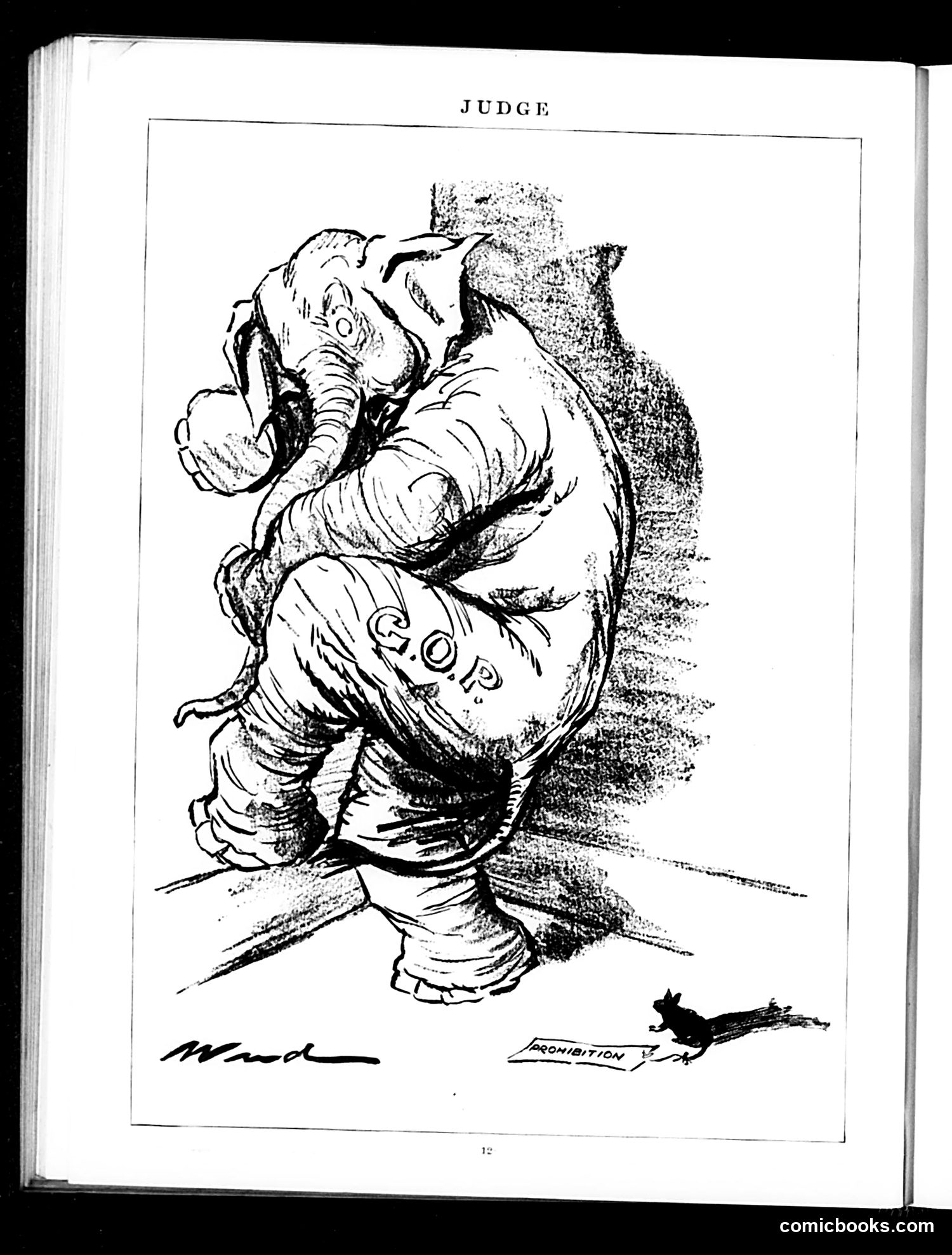
This cartoon depicts an elephant (the Republican Party symbol) labeled "G.O.P." being crushed or weighed down by a large sack marked "PROHIBITION." The elephant appears distressed, with the sack pressing heavily upon it. The satire criticizes how Prohibition policy has become a burden to the Republican Party. The cartoon suggests that the GOP's association with or support of Prohibition is damaging the party politically. This likely dates from the Prohibition era (1920-1933), when the policy was increasingly unpopular and divisive. The artist is arguing that Republicans are being harmed by their stance on this contentious issue, using the visual metaphor of the elephant being crushed under an enormous weight.
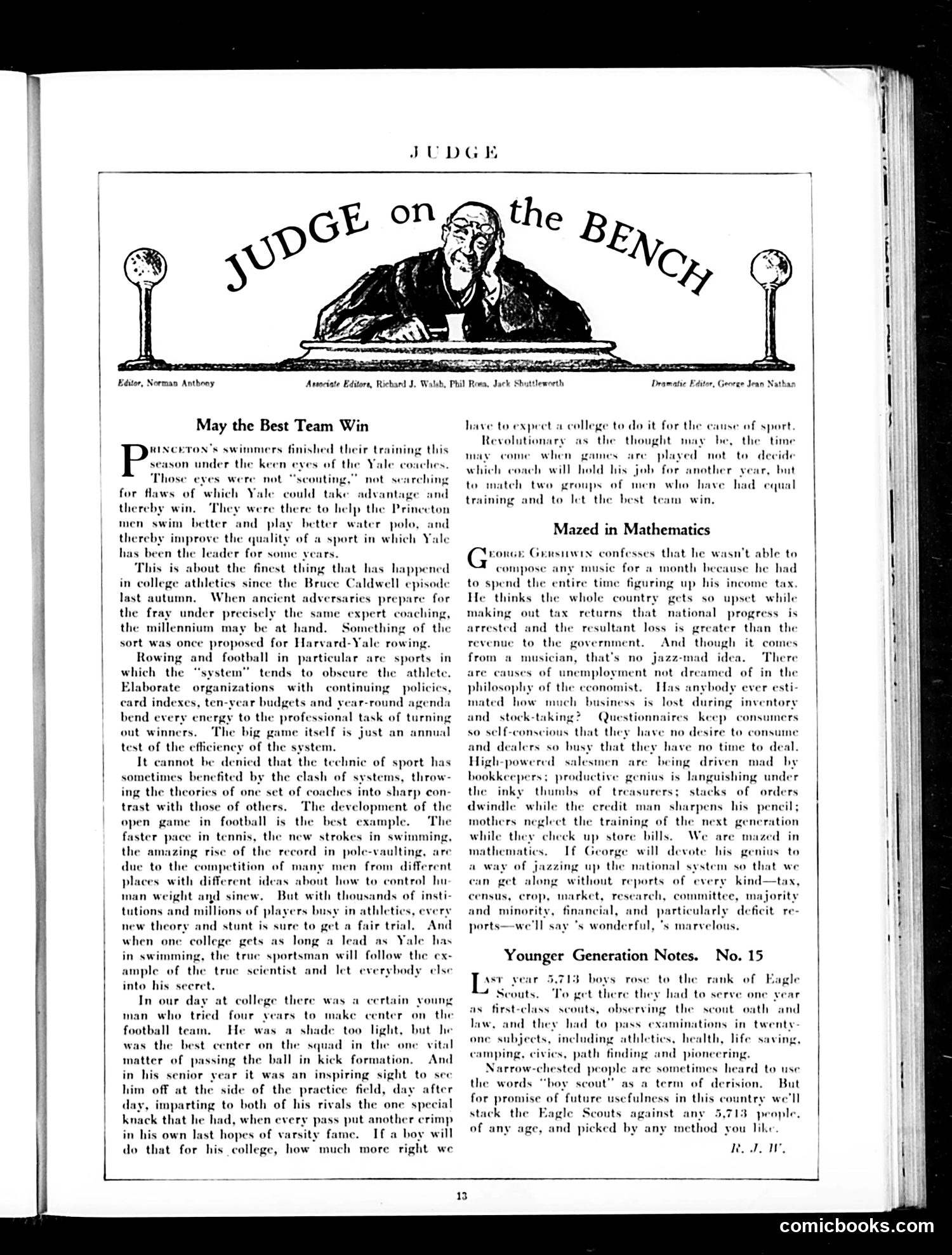
This page from *Judge* magazine contains two satirical articles about American institutional practices. **"May the Best Team Win"** praises Princeton's decision to have Yale coaches train their swimmers—a rare instance of athletic cooperation rather than competitive secrecy. The author argues this represents genuine sportsmanship and suggests colleges should prioritize fair competition between equally-trained teams over winning through superior coaching systems. The piece critiques how elaborate organizational hierarchies ("card indexes, ten-year budgets") have made college athletics about systemic advantage rather than athletic merit. **"Mazed in Mathematics"** satirizes George Gershwin's complaint that income tax calculations consumed a month of his time, preventing musical composition. The author extends this critique absurdly, arguing that income taxes, inventory accounting, and consumer questionnaires collectively damage the national economy more than the tax revenue benefits it—because they distract businesspeople and consumers from productive activity. It's social satire mocking bureaucratic inefficiency during the (likely) 1920s-30s era.
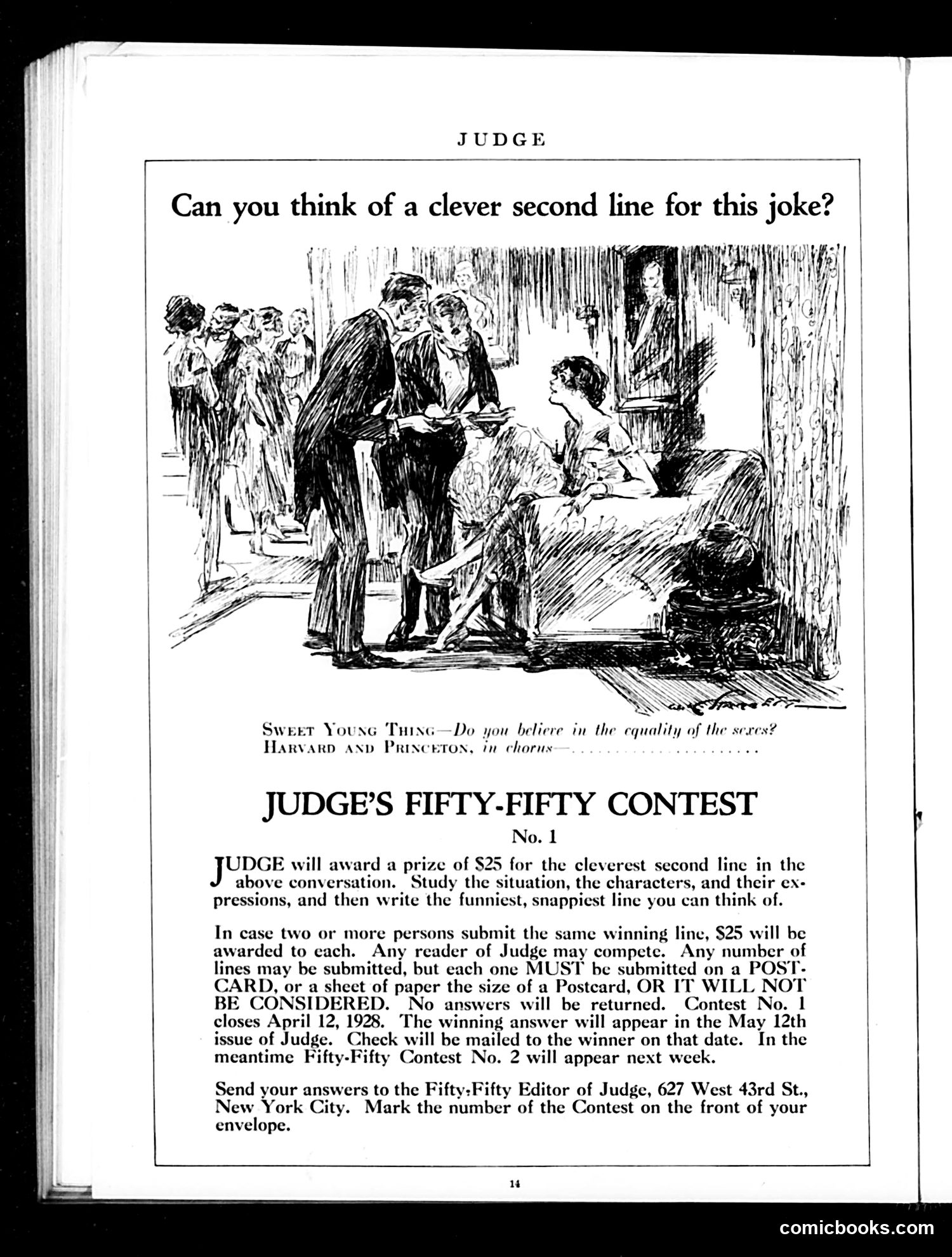
This is a reader-participation contest page from *Judge* magazine (1928). The cartoon depicts a young woman asking two male students from Harvard and Princeton whether they believe in "the equality of the sexes." The joke's setup invites readers to supply a witty punchline. The satire targets upper-class male college students, whose presumed snobbery and gender attitudes are the implied butt of the joke. The woman's question about gender equality was a timely social issue in the 1920s, following women's suffrage (1920). The contrast between her earnest question and the elite male students' presumed dismissive or clever response forms the comedic premise. *Judge* offered $25 for the cleverest second line—a substantial prize then—encouraging reader engagement and showcasing audience humor. This was a common magazine feature blending entertainment with interactivity.
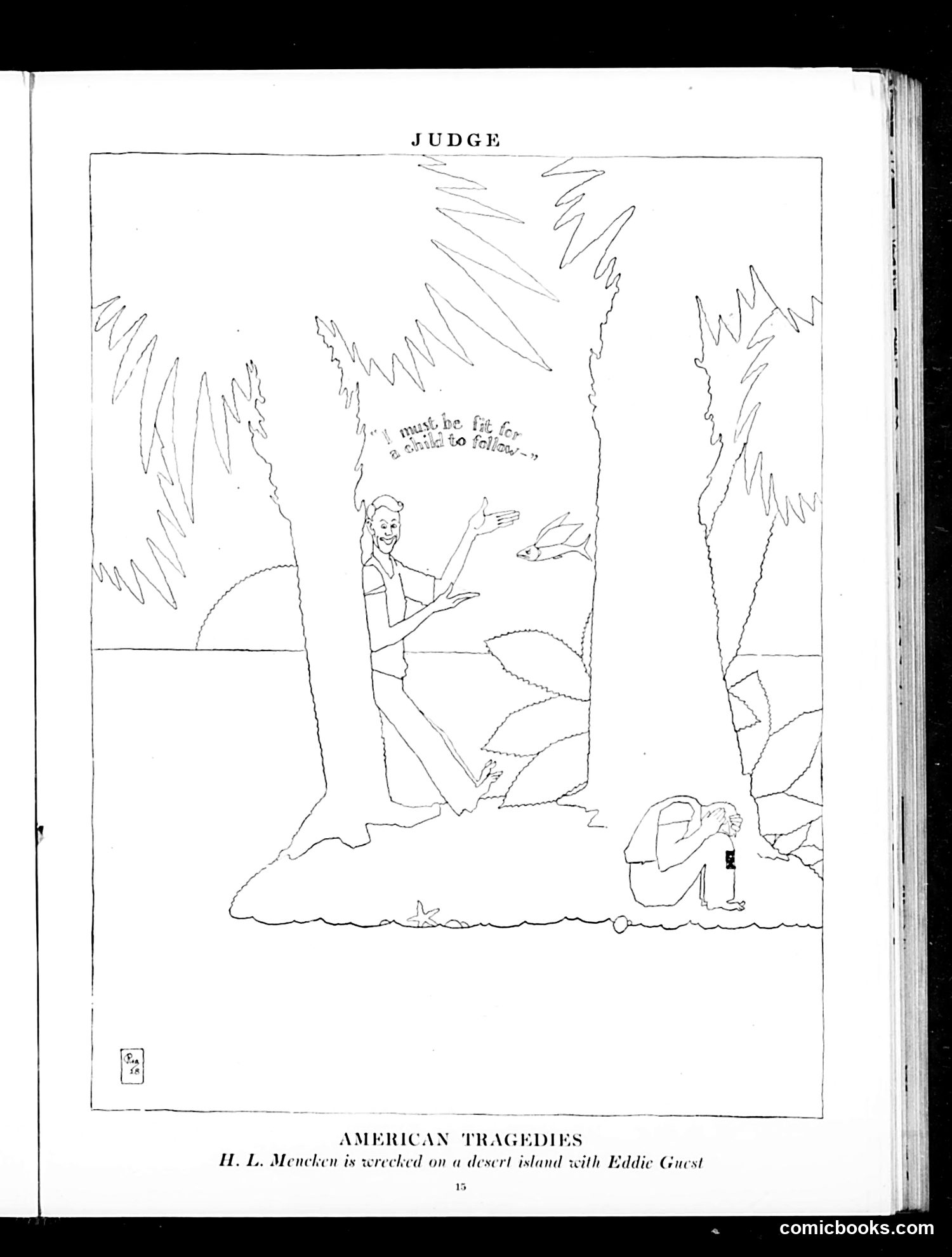
This cartoon satirizes H. L. Mencken, a prominent American social critic and writer known for his caustic wit and intellectual rigor. The joke appears to reference his being "wrecked on a desert island with Eddie Guest"—likely Eddie Guest (also known as Edgar Guest), a popular poet of the era known for sentimental, accessible verse. The satire hinges on contrasting personalities: Mencken was famously contemptuous of middlebrow American culture, while Guest represented exactly that—wholesome, mainstream poetry. Being stranded together would constitute a "tragedy" for the intellectually acerbic Mencken, forced into isolation with someone representing everything he publicly despised. The cartoon's humor relies on readers' familiarity with Mencken's reputation for sardonic criticism and his cultural elitism.
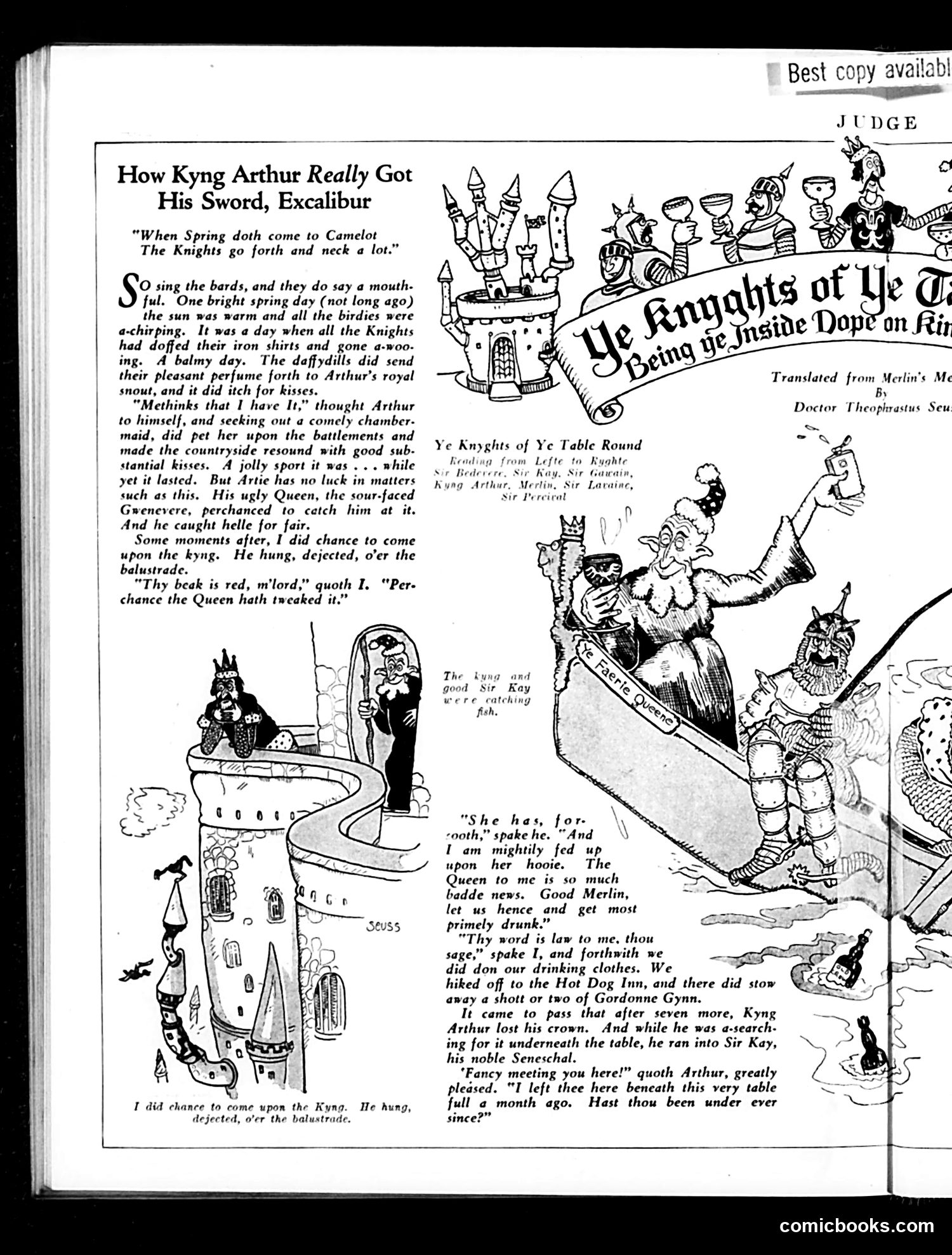
This is a humorous parody of Arthurian legend presented as a salacious modern story. The satire works by contrasting the dignified medieval romance tradition with crude 1920s-30s behavior: King Arthur pursues a chambermaid on the battlements, gets caught by Queen Guinevere (who "tweaks" his nose), and responds by getting drunk at the "Hot Dog Inn" with Merlin rather than undertaking noble quests. The joke relies on treating legendary figures as ordinary people with petty domestic problems and casual attitudes toward infidelity. References like "Hot Dog Inn" and "Gordonne Gynn" anchor the fantasy setting in contemporary casual American culture, intensifying the irreverent deflation of Arthurian dignity. The cartoons feature Dr. Seuss-style illustrations (signed "Seuss") depicting the knights and scenes. This is primarily comedic rather than politically satirical—humor through anachronistic irreverence rather than social commentary.
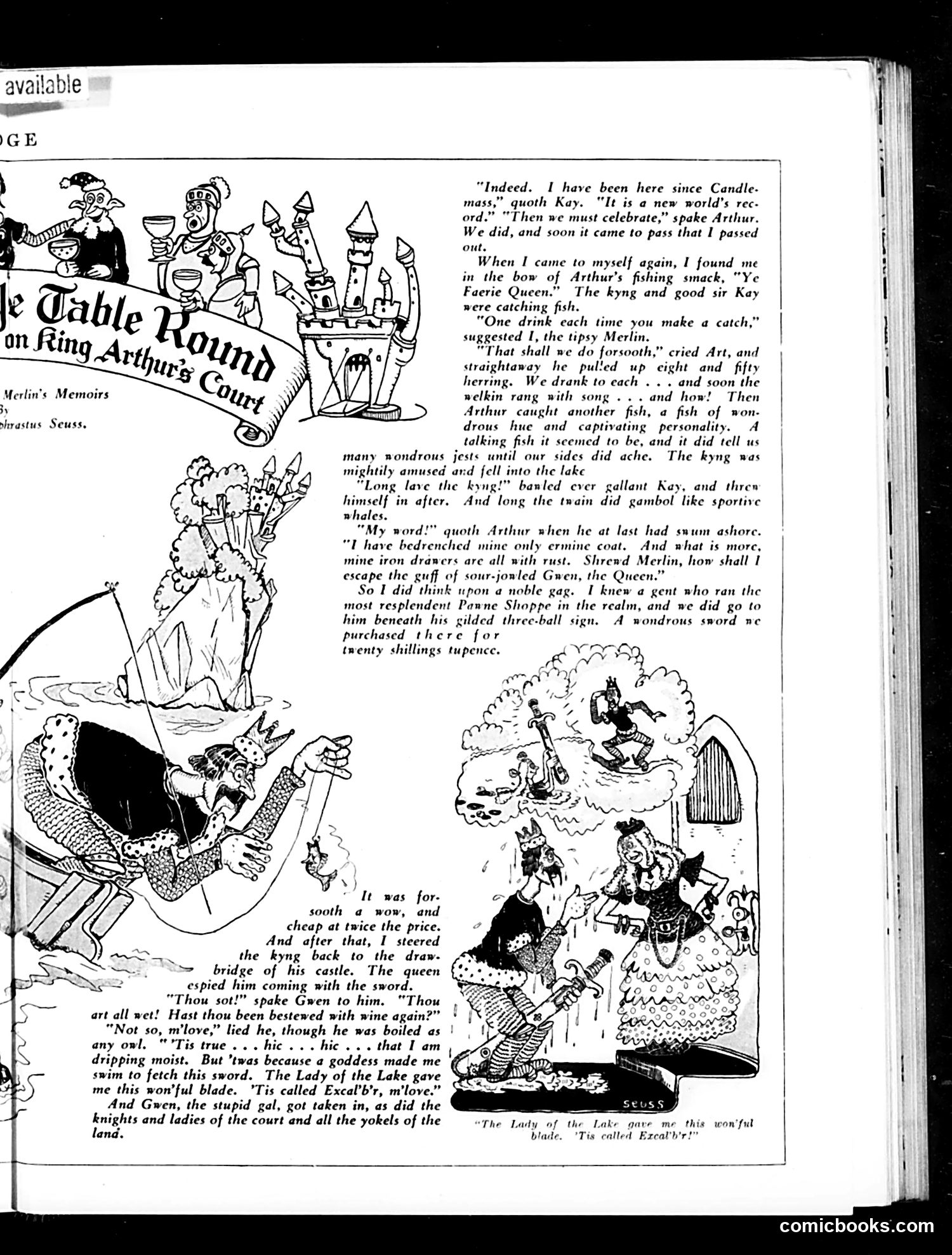
This is a humorous Arthurian legend parody by Dr. Seuss, presented as "Merlin's Memoirs." The satire mocks the romanticized medieval tales by showing their absurdity: Merlin gets drunk, Arthur foolishly destroys his armor, and recovers by fabricating an obviously false excuse—claiming a goddess gave him a sword from a *pawnshop*. The joke is that Queen Gwen and the court "yokels" are gullible enough to believe this obvious lie about Excalibur's divine origin. The cartoon ridicules both the credulity of common people and the thin pretenses of nobility, suggesting that medieval authority figures succeed through deception rather than genuine magic or merit. The cartoonish illustrations emphasize the satirical tone, transforming Arthurian legend into comedic farce—a typical Judge magazine approach to deflating romantic myths and mocking human foolishness.
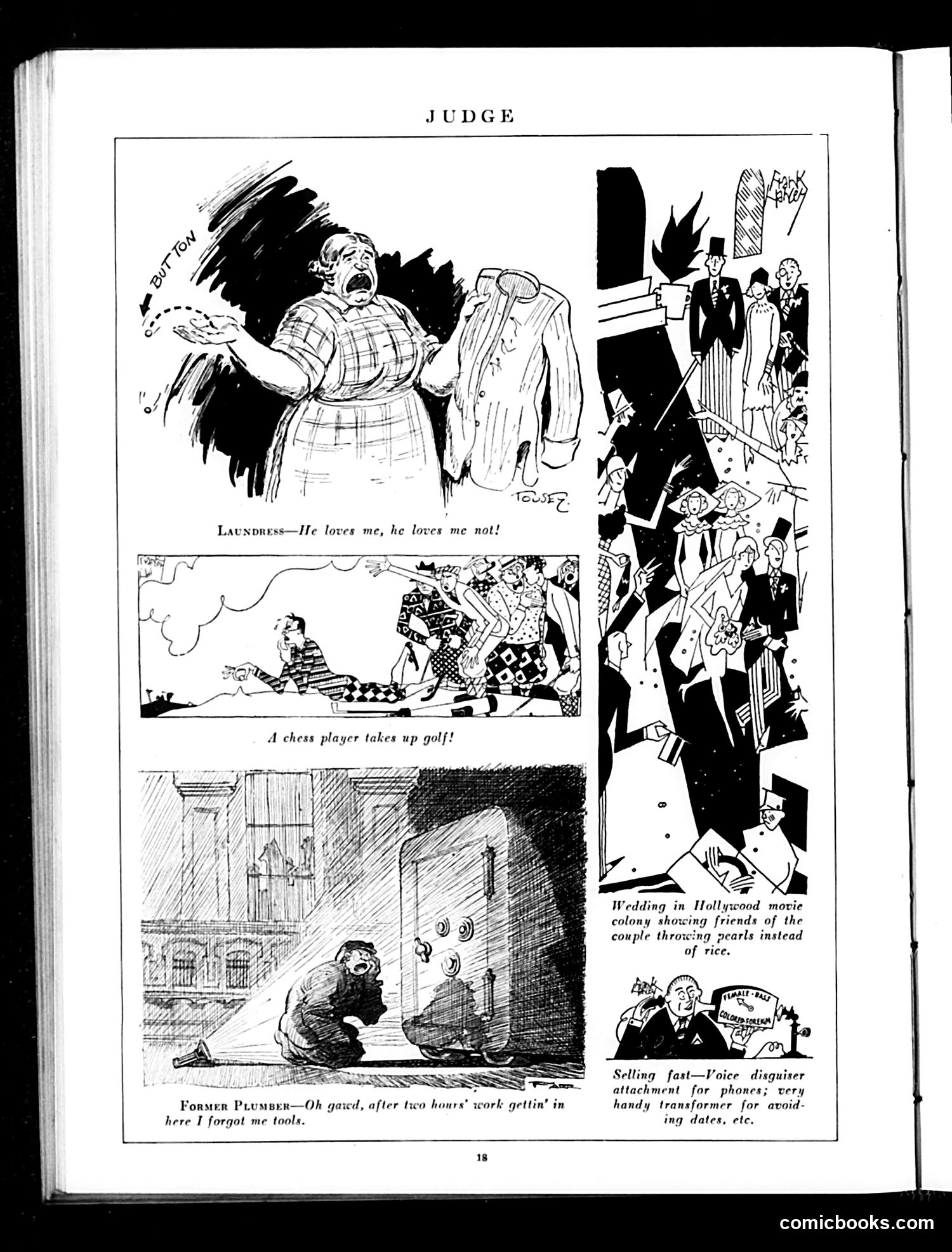
This page contains four separate satirical cartoons mocking everyday situations: 1. **"Laundress"**: A woman in distress over a man's clothing, playing on the phrase "he loves me, he loves me not." 2. **"Chess player takes up golf"**: Mocks someone applying intellectual strategy to a leisure sport. 3. **"Former Plumber"**: A plumber has forgotten his tools after two hours of work—satirizing absent-mindedness or incompetence among tradespeople. 4. **"Wedding in Hollywood"**: Jokes that movie colony couples throw pearls instead of rice at weddings (mocking Hollywood excess and pretension). 5. **"Selling fast—Voice disguiser"**: A humorous advertisement for a phone attachment allowing people to disguise their voices to avoid unwanted dates. The cartoons target middle-class foibles, modern technology quirks, and Hollywood stereotypes typical of early-to-mid 20th century American satire.
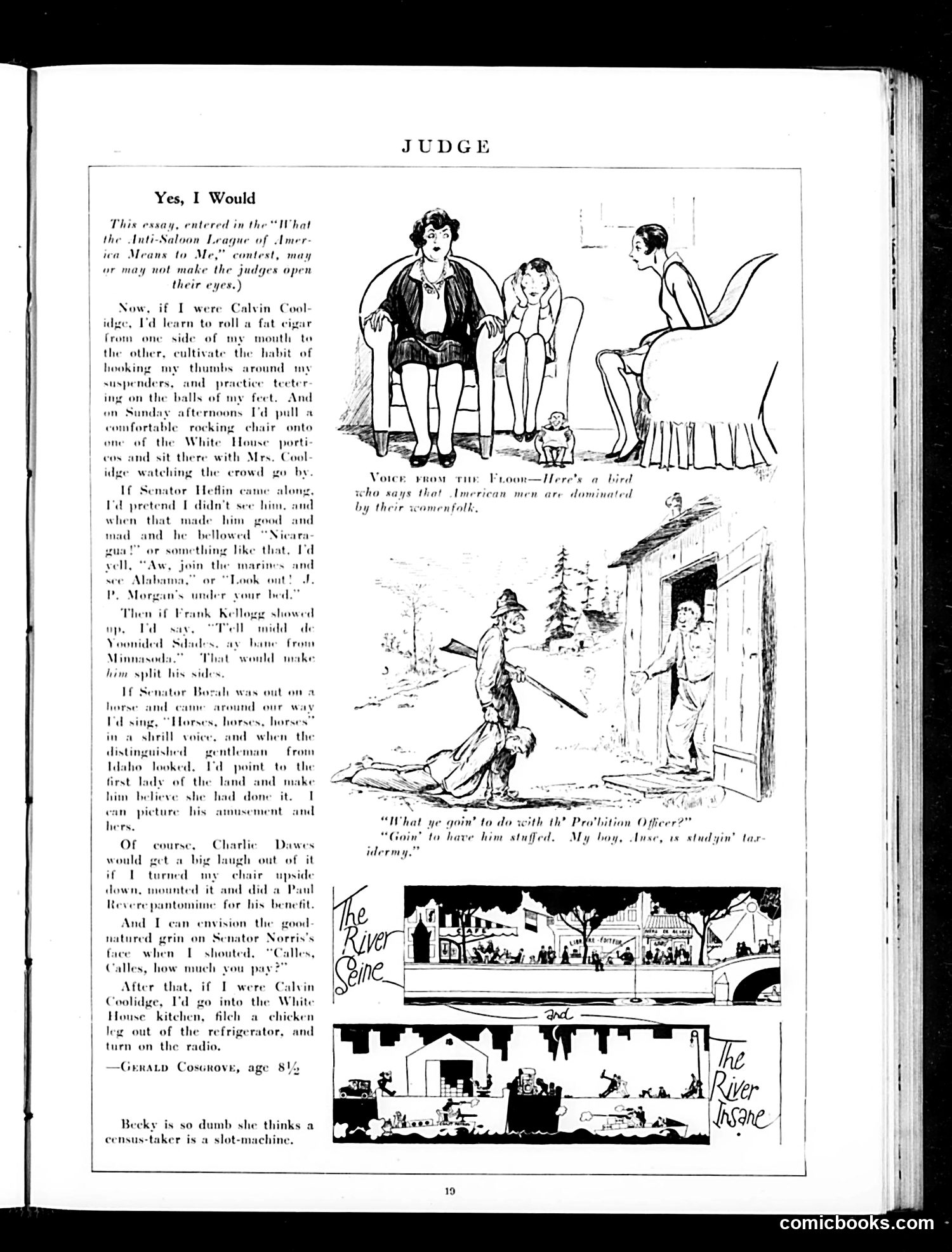
This page satirizes President Calvin Coolidge's notoriously bland public persona. The essay "Yes, I Would" imagines what Coolidge would do if he adopted the distinctive mannerisms of other prominent 1920s figures—rolling cigars like a politician, mimicking Senator Heflin's loudness, Senator Borah's horseback riding, and Treasury Secretary Charles Dawes's eccentric behavior. The joke is that even imitating these colorful personalities, Coolidge would remain fundamentally dull. The bottom cartoons mock gender dynamics: one suggests women dominate American men; another shows a prohibition officer being "stuffed" (taxidermied), mocking enforcement of Prohibition. The page reflects Jazz Age irreverence toward authority and the era's gender-role anxieties, while poking fun at Coolidge's famous taciturnity and emotional reserve—qualities that defined his presidency to contemporaries.
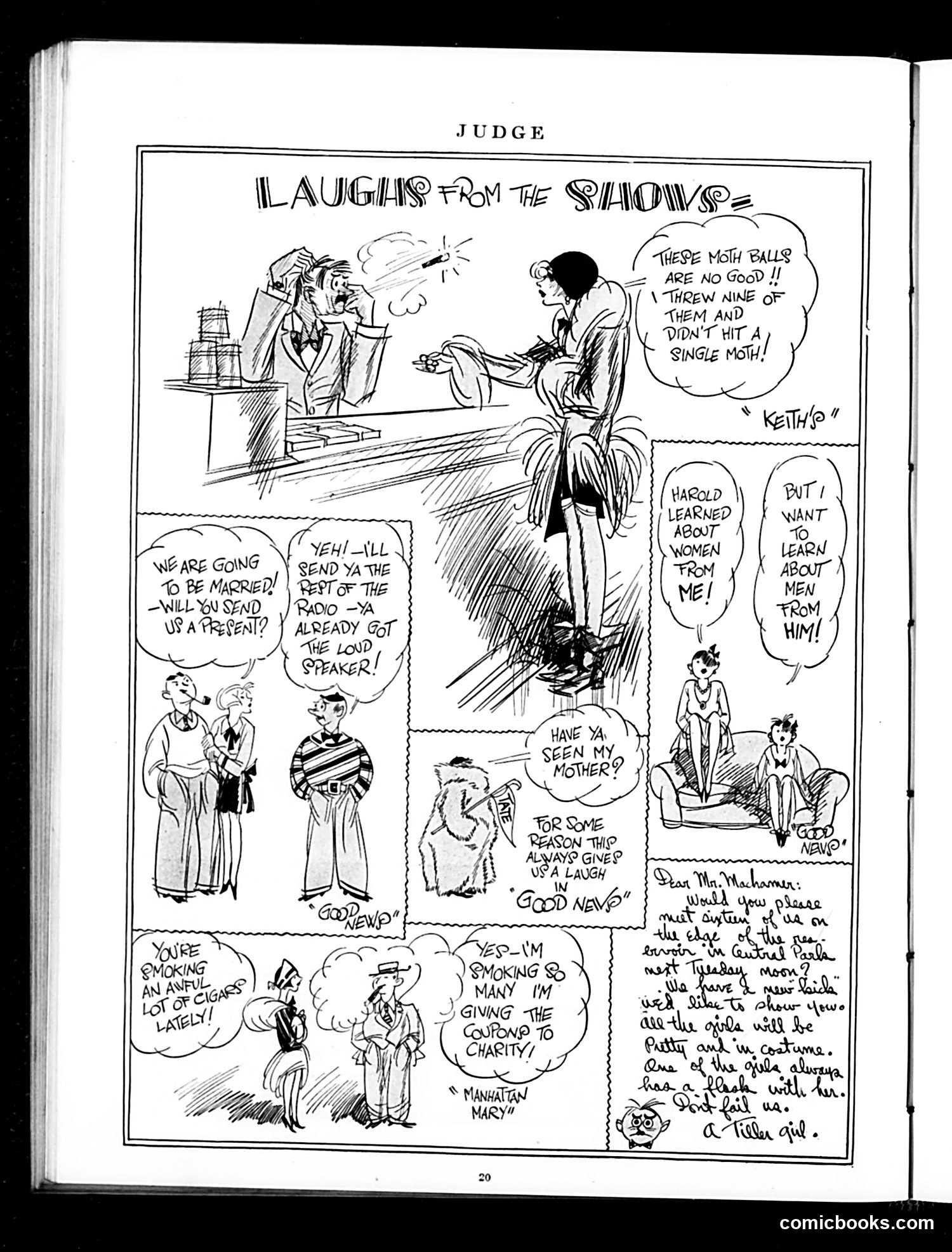
This page contains several disconnected comic vignettes satirizing contemporary domestic situations and radio entertainment, typical of Judge's humor style. The sketches mock: 1. **Moth balls as weapons** - A joke about the ineffectiveness of pest control products 2. **Radio giveaways** - Characters discussing sending radio contest entries, referencing popular 1920s-30s radio programming where stations gave away prizes 3. **Marriage proposals** - Satirizing the idea of using radio broadcasts to propose 4. **Gender dynamics** - A woman wanting to "learn about men" from a male radio personality, poking fun at radio's cultural influence on courtship advice 5. **"Good news" humor** - Multiple scenes where characters deliver announcements framed as good news but reveal domestic complications (cigarette smoking, charity donations) The cartoons target middle-class anxieties about modern technology (radio), consumerism, and evolving social customs. The crude drawing style and punchy dialogue are characteristic of Judge's satirical approach to American culture.
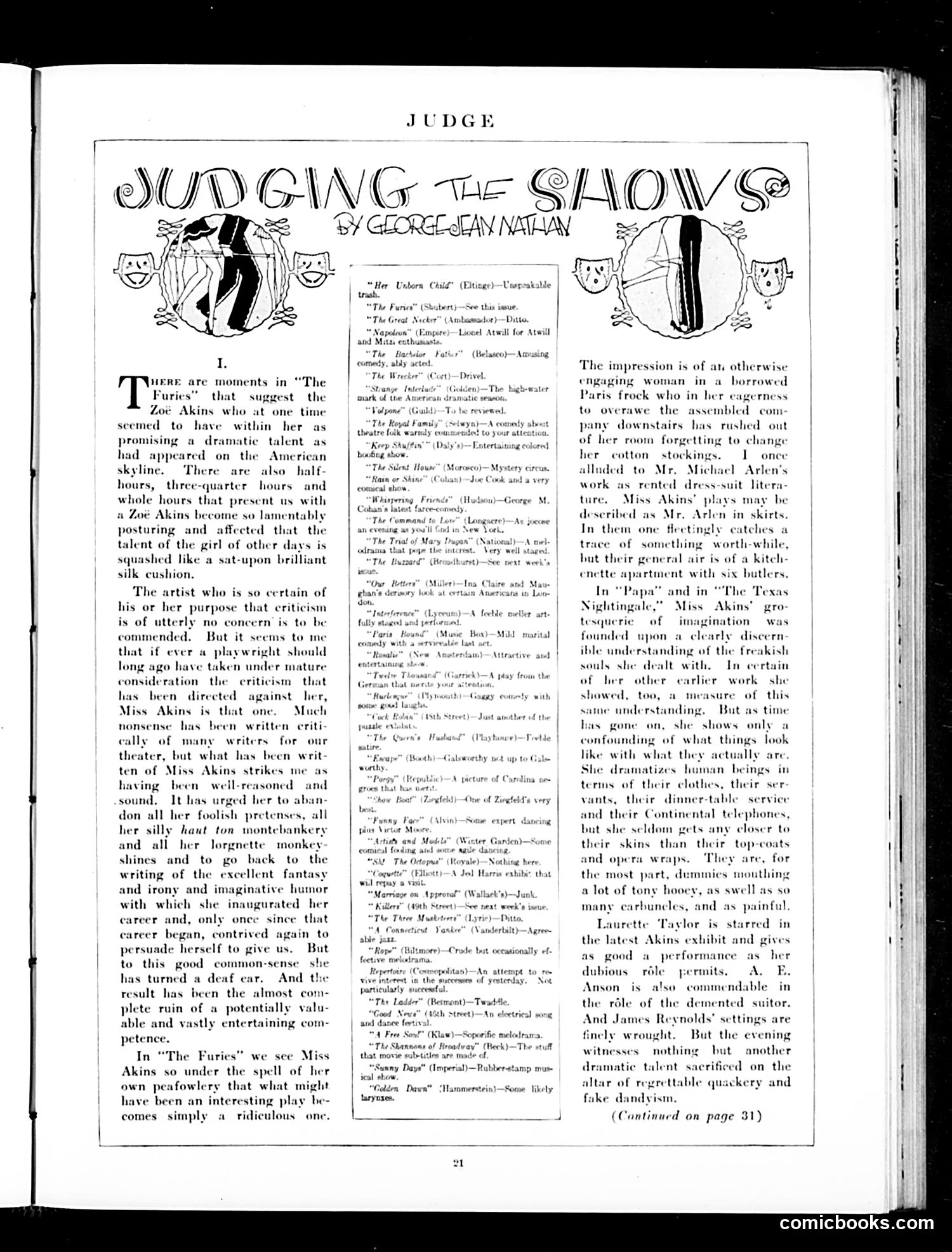
This is a theatrical review column, not a political cartoon. The critic **George Jean Nathan** attacks playwright **Zoë Akins** for her recent play "The Furies," which he views as a disappointing waste of her earlier talent. **The Satire:** Nathan uses elaborate metaphors to mock Akins's pretentiousness—she's like a woman wearing a borrowed Paris dress while forgetting her cotton stockings; her plays are "Mr. Arlen in skirts" (referencing Michael Arlen's shallow society fiction). He argues she's traded genuine imaginative insight for superficial glamour, reducing complex human characters to fashionable dummies spouting "tony hooey." **The Point:** This exemplifies *Judge's* cultural criticism—attacking artistic mediocrity and self-indulgent performance as social failures. Nathan contrasts Akins's promising early work with her current affected posturing, suggesting her career represents squandered potential due to vanity rather than principle. The column also lists contemporary theater productions briefly, typical of the magazine's entertainment coverage.
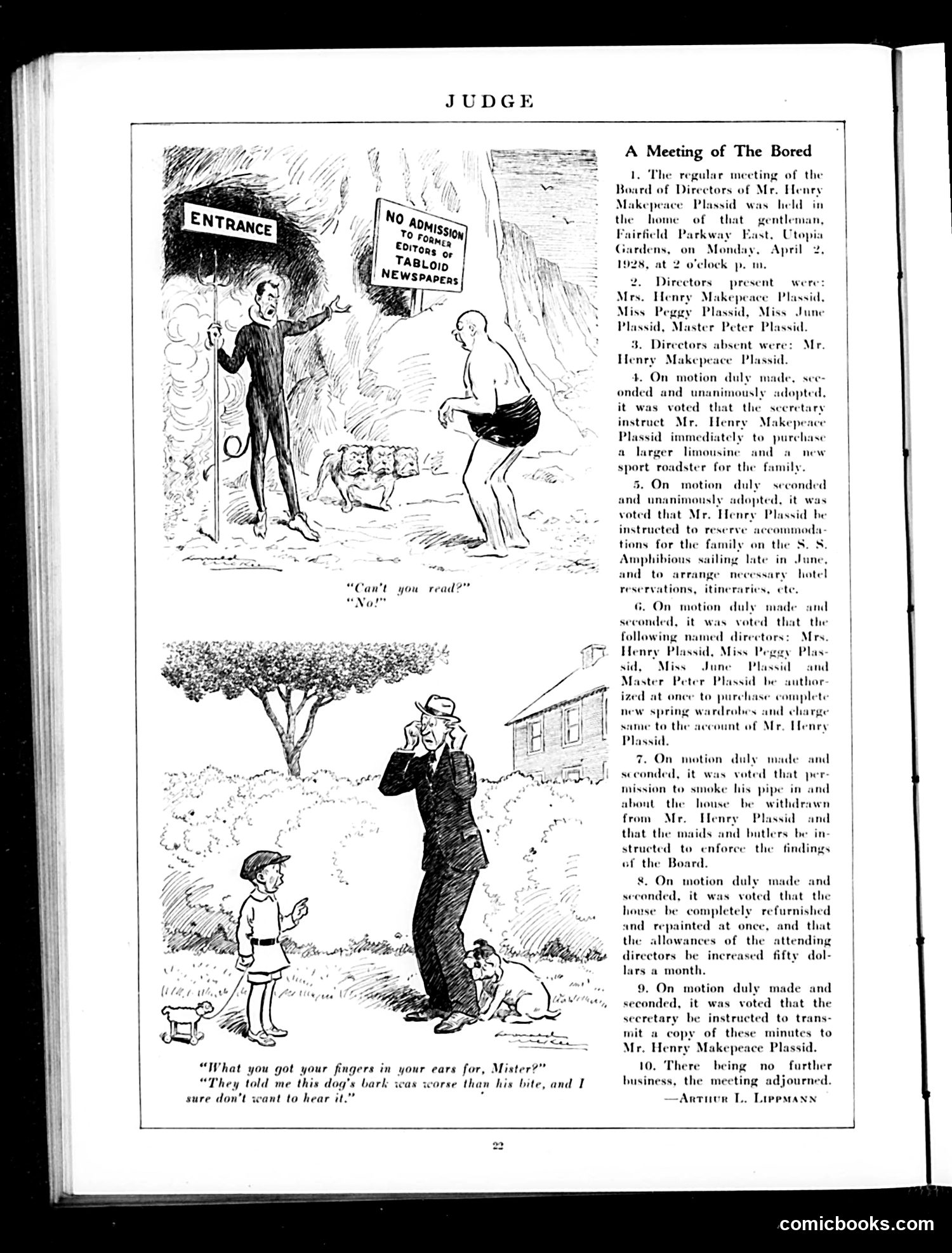
This page satirizes wealthy American families' frivolous spending habits, likely during the 1920s prosperity era. The "Board of Directors" is actually the wife and children of Mr. Henry Makepeace Plassid, meeting to vote on expenditures—parodying corporate governance language applied to household finances. The humor lies in treating trivial family wants as serious boardroom decisions: purchasing luxury cars, booking ocean voyages, buying new wardrobes, redecorating the house, and increasing allowances. The satirical climax is item #7, where they vote to *ban* Mr. Plassid from smoking his pipe—the only restriction placed on the actual breadwinner. The cartoon above, showing a man blocking his ears at an entrance while ignoring a sign, reinforces the theme of willful ignorance about consequences. The satire mocks how the wealthy ignore reality (his wife and children's extravagance) by literally refusing to hear it. This reflects Jazz Age anxieties about uncontrolled consumer spending and women's newfound financial power in households.
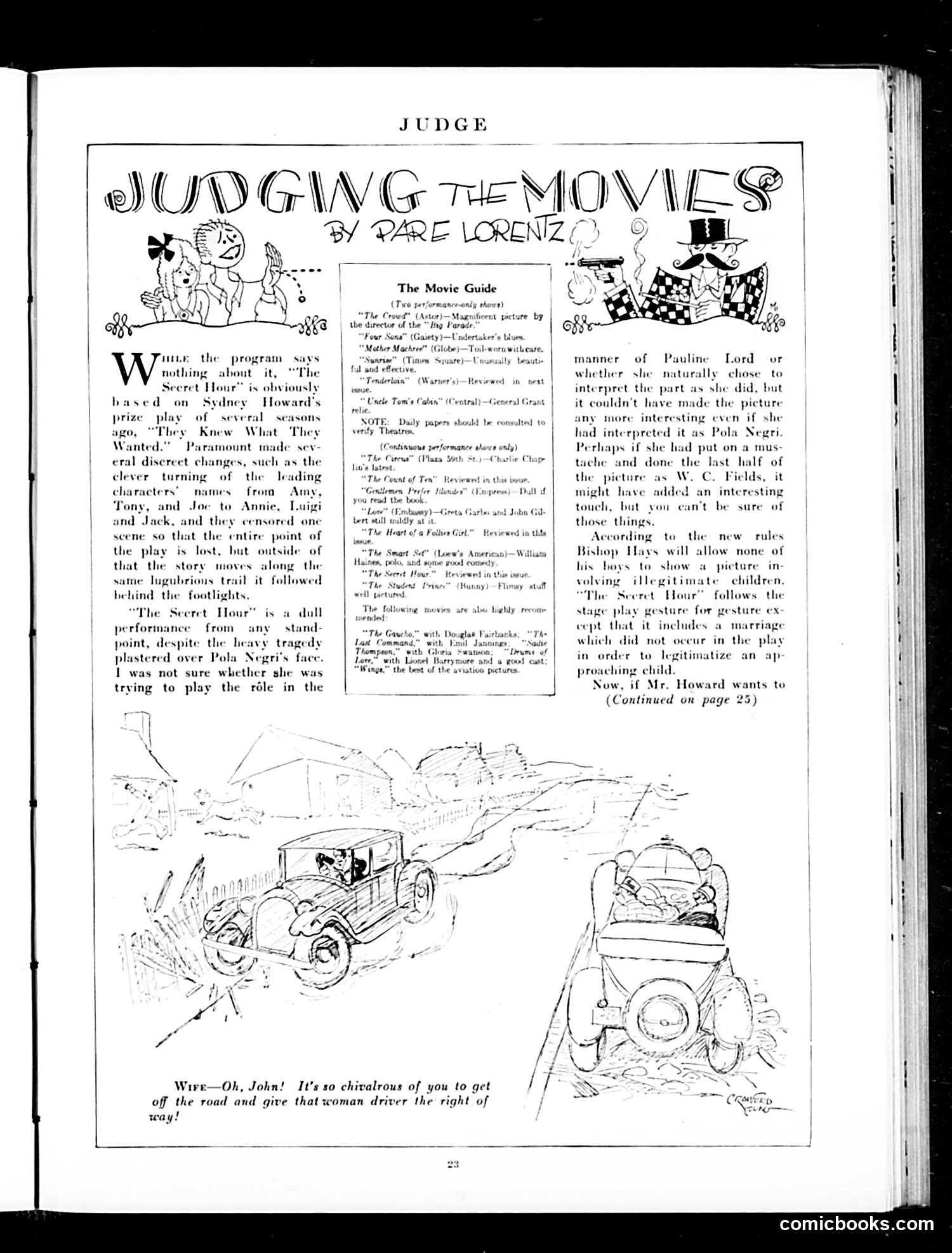
This is a film review column by Pare Lorentz titled "Judging the Movies." The main cartoon depicts a traffic accident between two cars, with the caption sarcastically praising a man for letting a female driver have the right of way—mocking chivalry as patronizing. The review critiques the film "The Secret Hour," based on Sydney Howard's play. Lorentz notes the movie added a marriage scene not in the original play to "legitimatize an approaching child," reflecting 1920s film censorship under the Motion Picture Production Code (enforced by "Bishop Hays"). He sarcastically suggests casting W.C. Fields or Pauline Lord instead of star Pola Negri might have made the picture more interesting, and criticizes the heavy tragic performance as dull. The satire targets both the film's heavy-handed morality and rigid censorship rules that forced narrative changes to satisfy moral guardians, making the story less authentic.
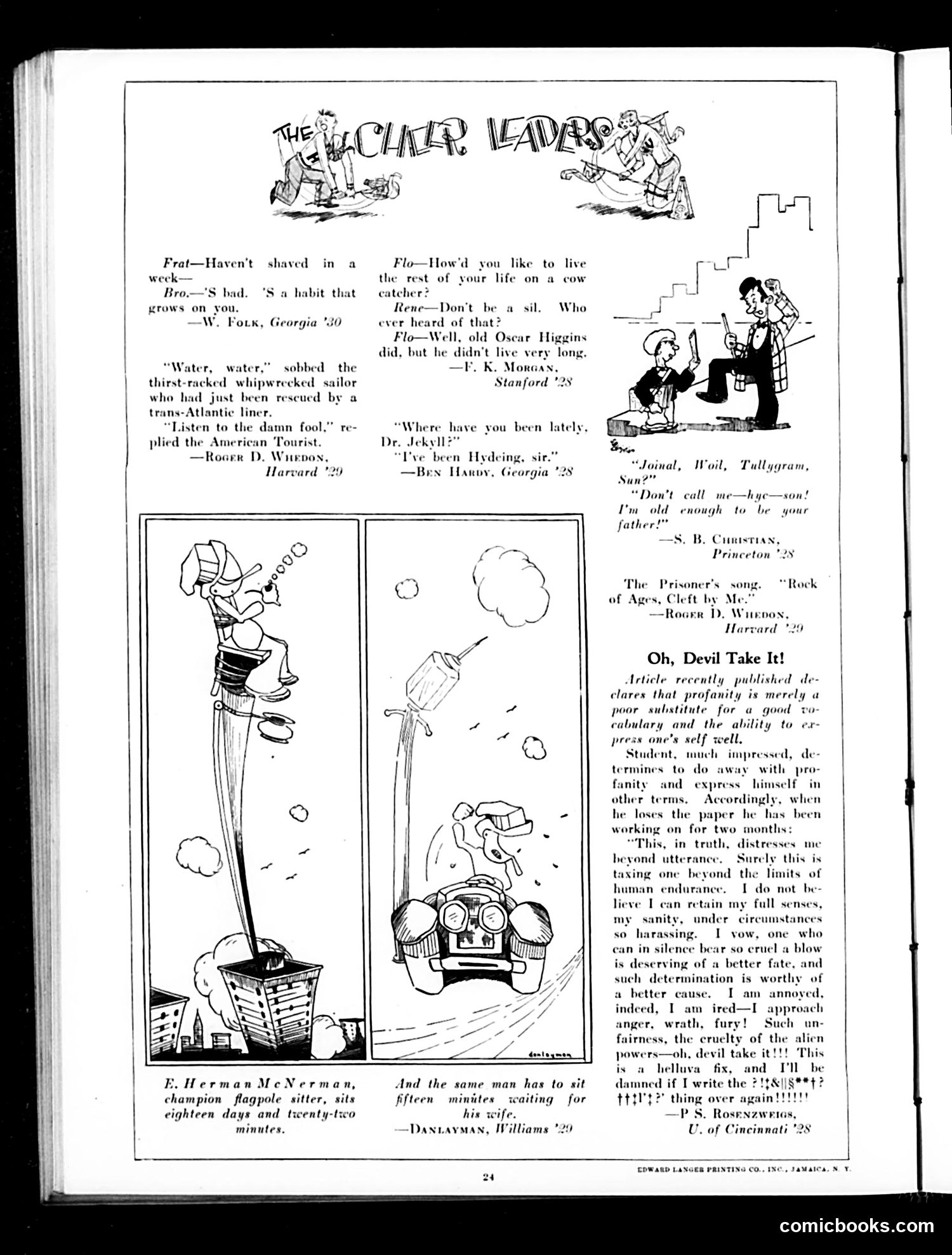
This Judge magazine page contains college humor from circa 1928-1929, featuring student jokes and satirical cartoons mocking undergraduate life. **Key content:** The main cartoons mock: - **Fraternity life**: A joke about not shaving becoming a habit - **Cow-catcher fantasies**: A student's absurd dream of living on a cow catcher - **The flagpole sitter**: A contemporary fad where daredevils sat atop flagpoles for days; the cartoon jokes that even this champion sitter must wait for his wife like ordinary men - **"Oh, Devil Take It!"**: A satire on an article promoting better vocabulary instead of profanity. A student tries replacing curses with elaborate Victorian language after losing his two-month work project, only to abandon the effort in genuine frustration The humor relies on collegiate anxieties (grades, dating, social status) and references faddish behavior of the era (flagpole sitting). The Jekyll/Hyde reference plays on the student's "hidden" frustrated self emerging beneath polished speech.
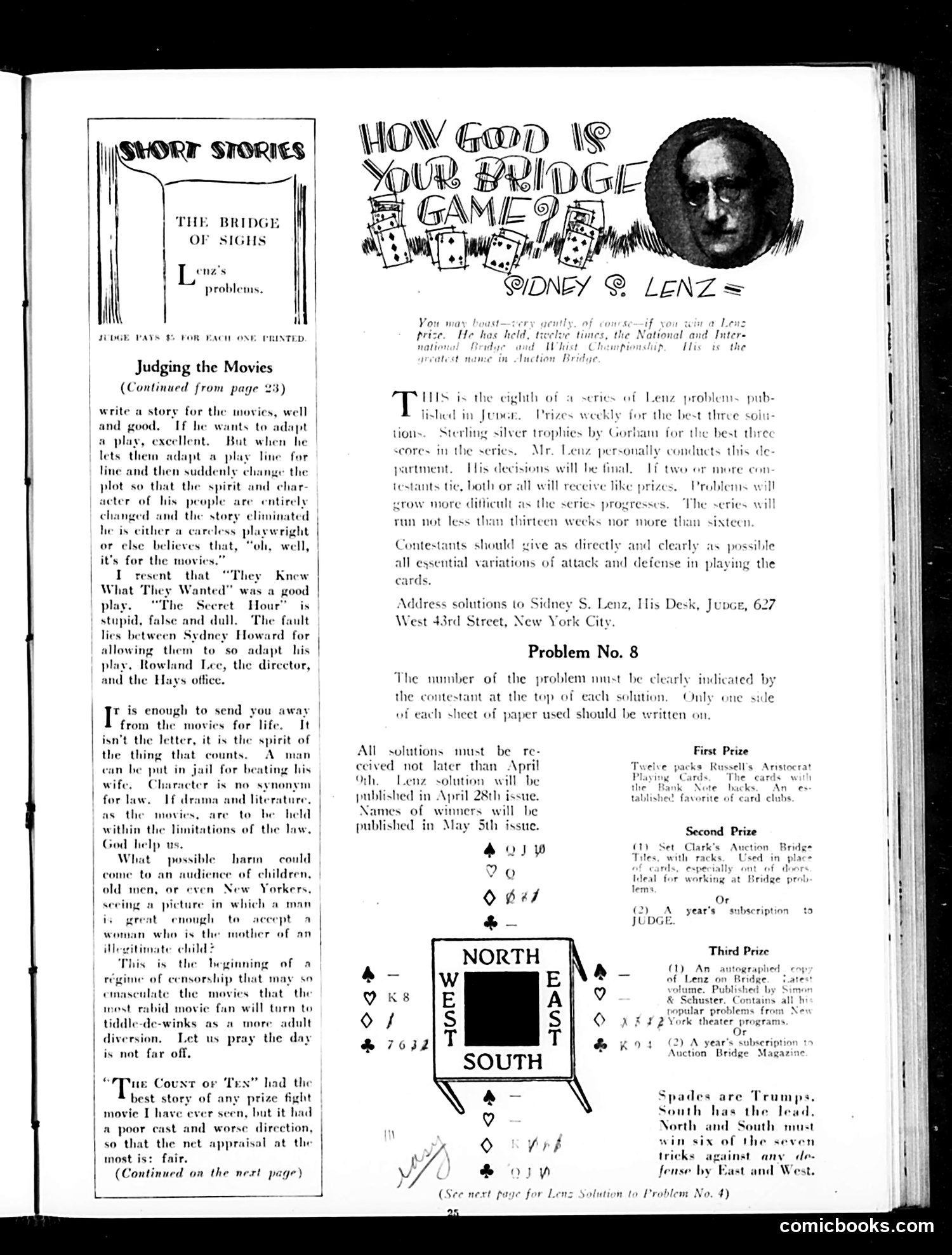
This page features a bridge card game problem by Sidney S. Lenz, a famous bridge expert of the 1920s-30s. The cartoon heading "How Good Is Your Bridge Game?" is a lighthearted challenge to readers, not political satire. The main content is a competitive bridge puzzle contest Judge magazine ran, offering prizes (Russell playing cards, Clark's auction bridge set, subscriptions) for the best solutions. Contestants were required to submit detailed analyses of card play variations. The page also includes a film criticism column criticizing Hollywood's adaptation of stage plays, particularly complaints about censorship and how studios changed works to satisfy the Motion Picture Production Code (the "Hays office"). This reflects 1920s-30s concerns about movie industry control and artistic integrity—not contemporary politics, but *cultural* debate about commercialism versus art.
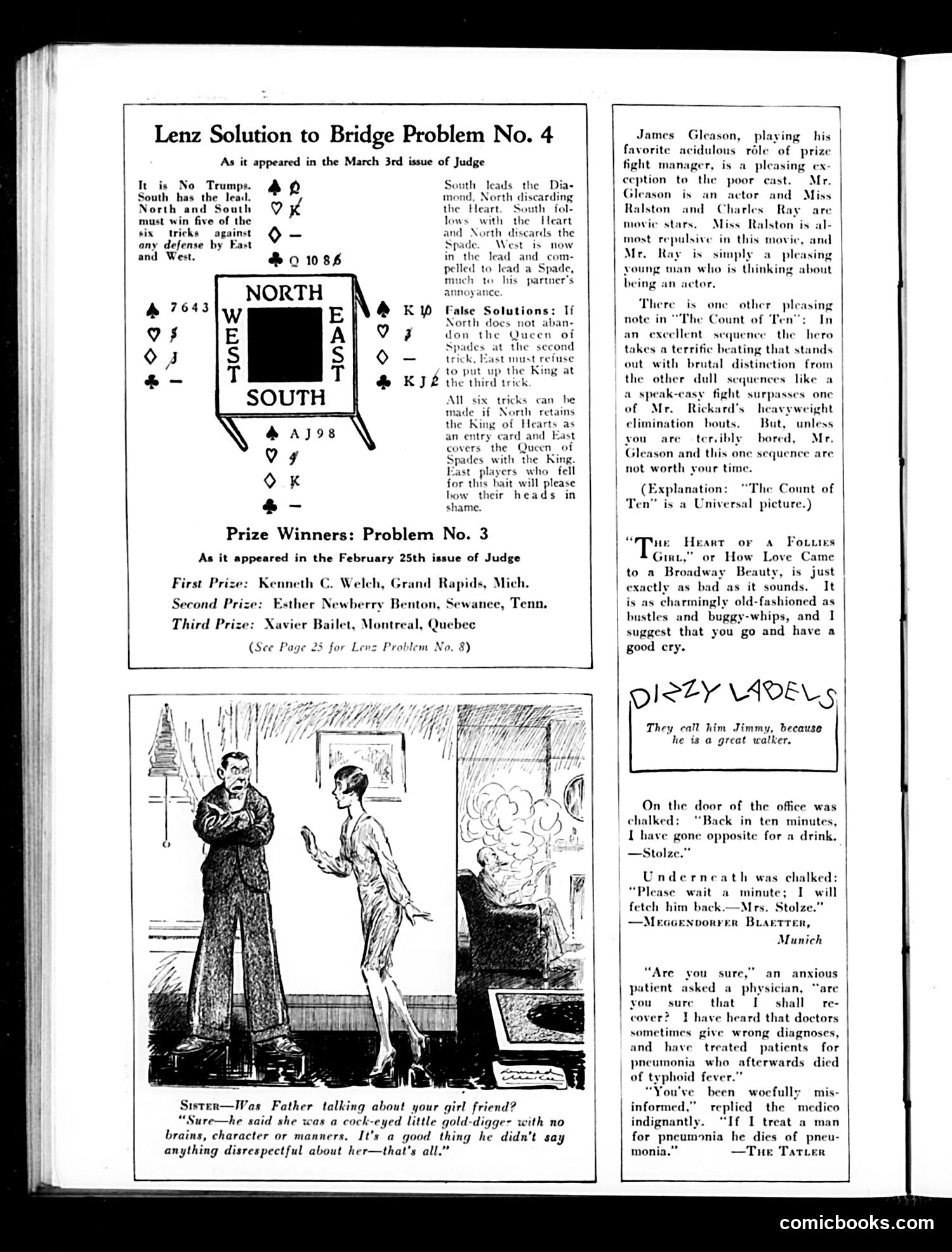
This page from the satirical magazine **Judge** contains three distinct elements: 1. **Bridge Problem Solution**: A technical card game puzzle and solution with prize winners listed—typical instructional content Judge included alongside humor. 2. **Main Cartoon**: A domestic joke about a father's insulting description of his daughter's boyfriend. The humor relies on the daughter's twisted logic: she's pleased he insulted the girl rather than the boyfriend, interpreting this as somehow protective or acceptable. This reflects early 20th-century social attitudes about courtship propriety and fathers' protective roles. 3. **Miscellaneous Jokes and Vignettes**: Short humor pieces about mistaken identity ("Dizzy Labels"), office pranks, and a doctor's sardonic quip about misdiagnosis. These reflect common period humor—workplace mishaps, medical skepticism, and wordplay. The overall tone is lighthearted social satire typical of Judge's format: mixing intellectual puzzles with everyday domestic and professional comedy aimed at middle-class readers.
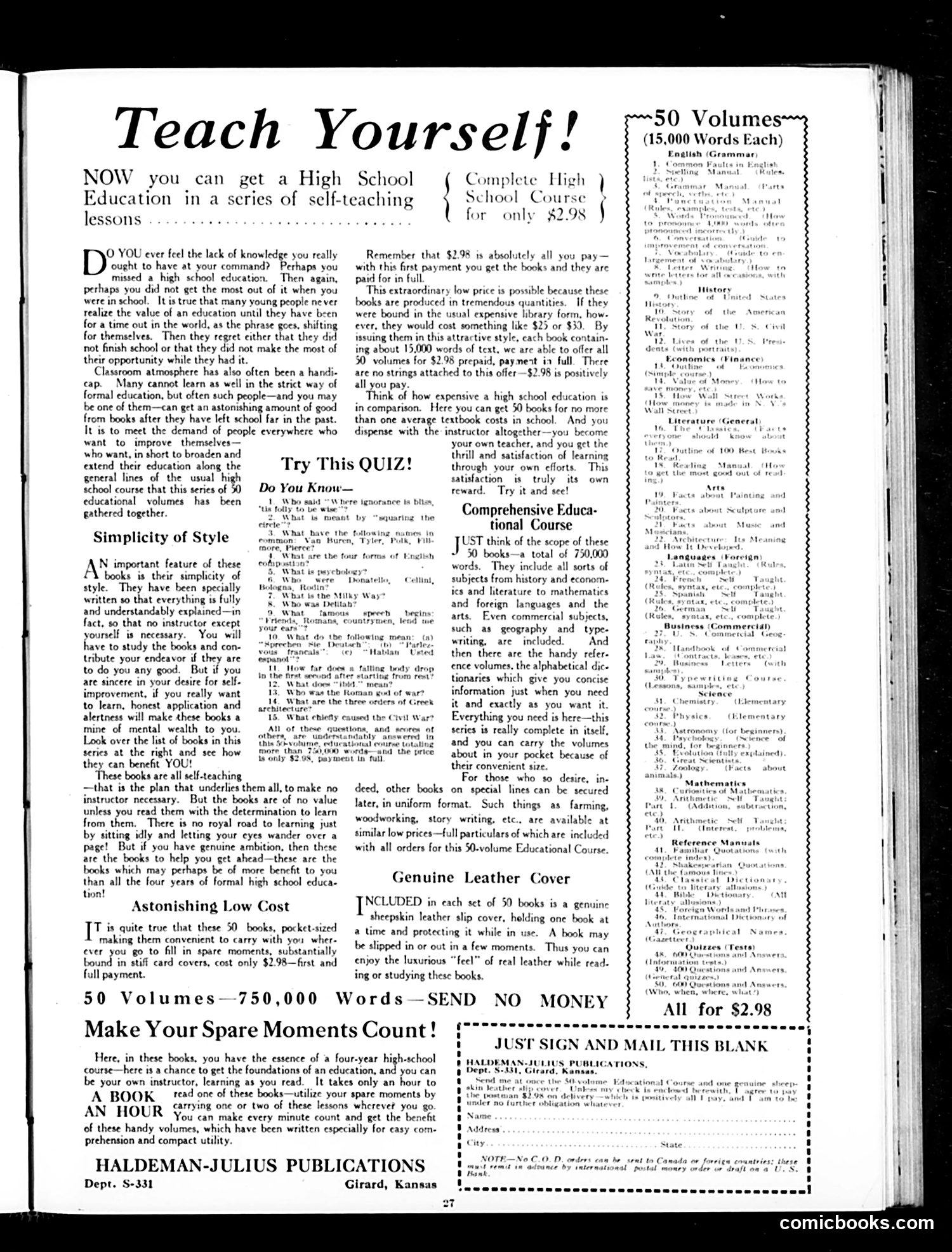
This is primarily a **mail-order advertisement**, not a political cartoon. It promotes a self-teaching educational course of 50 pocket-sized volumes for $2.98—positioned as an affordable alternative to formal high school education. ## The Pitch The ad targets people who missed or regretted their formal schooling, arguing that self-directed learning from books is superior to classroom instruction for many people. It emphasizes: - **Simplicity**: Books written so clearly no instructor is needed - **Affordability**: $2.98 total (versus $25-30 in library binding, or expensive actual schooling) - **Convenience**: Pocket-sized volumes for spare moments - **Comprehensiveness**: 750,000 words covering history, literature, mathematics, languages, arts, and commercial subjects ## Historical Context This reflects early 20th-century American optimism about **self-improvement through reading**—the belief that education could be democratized and made accessible to working people through inexpensive books. The "self-made man" ideal is implicit throughout. The quiz section ("Do You Know...?") serves as both content sample and engagement hook. This is straightforward direct-mail marketing, not satire.
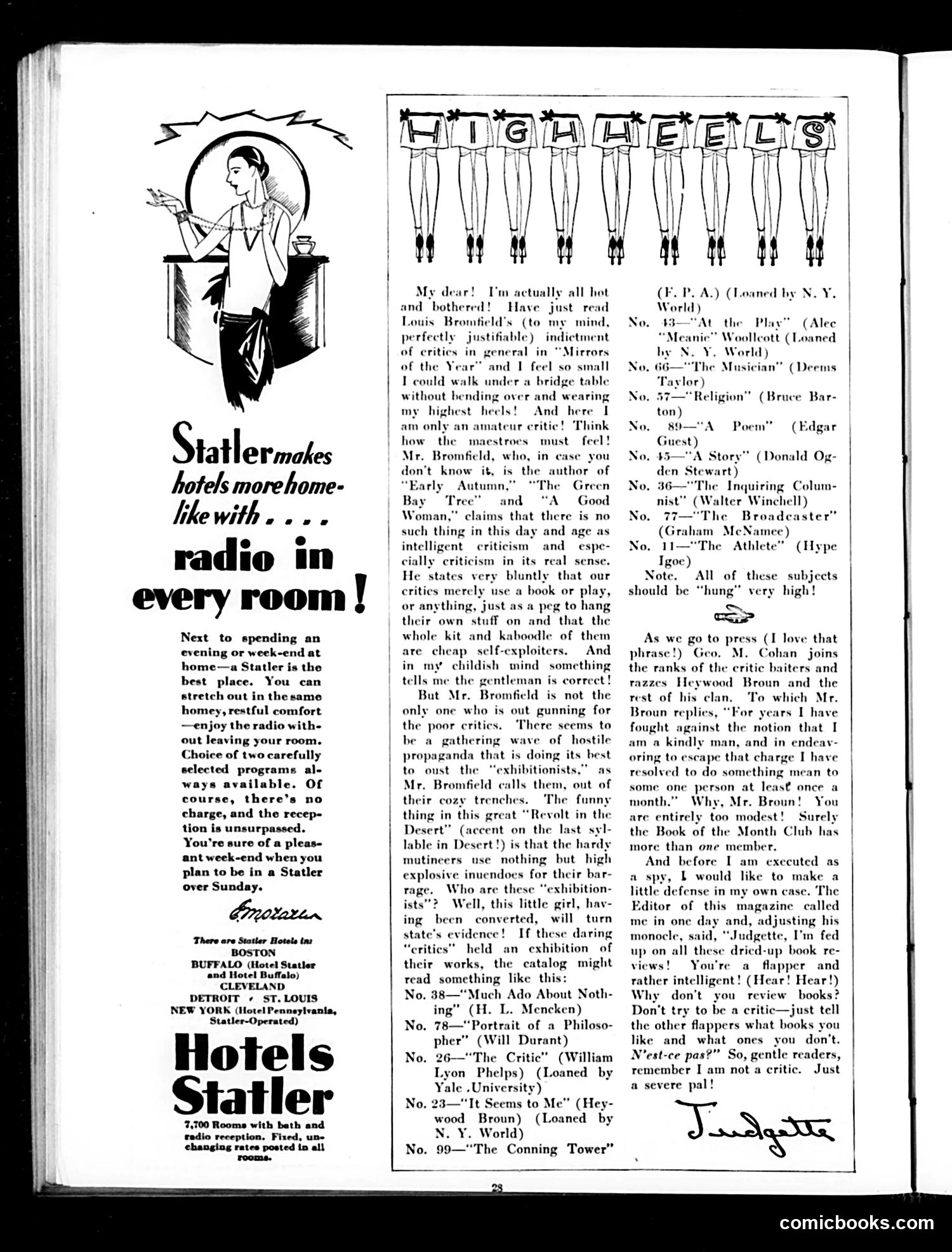
This page consists primarily of a **Statler Hotels advertisement** promoting radios in hotel rooms, paired with a satirical editorial commentary on contemporary literary criticism. The editorial, titled "High Heels," mocks the recent "Revolt in the Desert"—a campaign by author **Louis Bromfield** attacking professional book and theater critics as self-serving "exhibitionists" who misuse literature as props for their own egos rather than offering genuine criticism. The satire lists prominent critics of the era—**H.L. Mencken, Will Durant, Alexander Woollcott, Deems Taylor, Bruce Barton, Edgar Guest, Walter Winchell, Graham McNamee**—as if their works were paintings in an exhibition, ridiculing their pretensions. The author then notes that even entertainer **George M. Cohan** has joined Bromfield in attacking critics, particularly **Heywood Broun**. The piece concludes by defending intelligent criticism while gently mocking the author's own status as a mere "flapper" reviewer rather than serious critic.
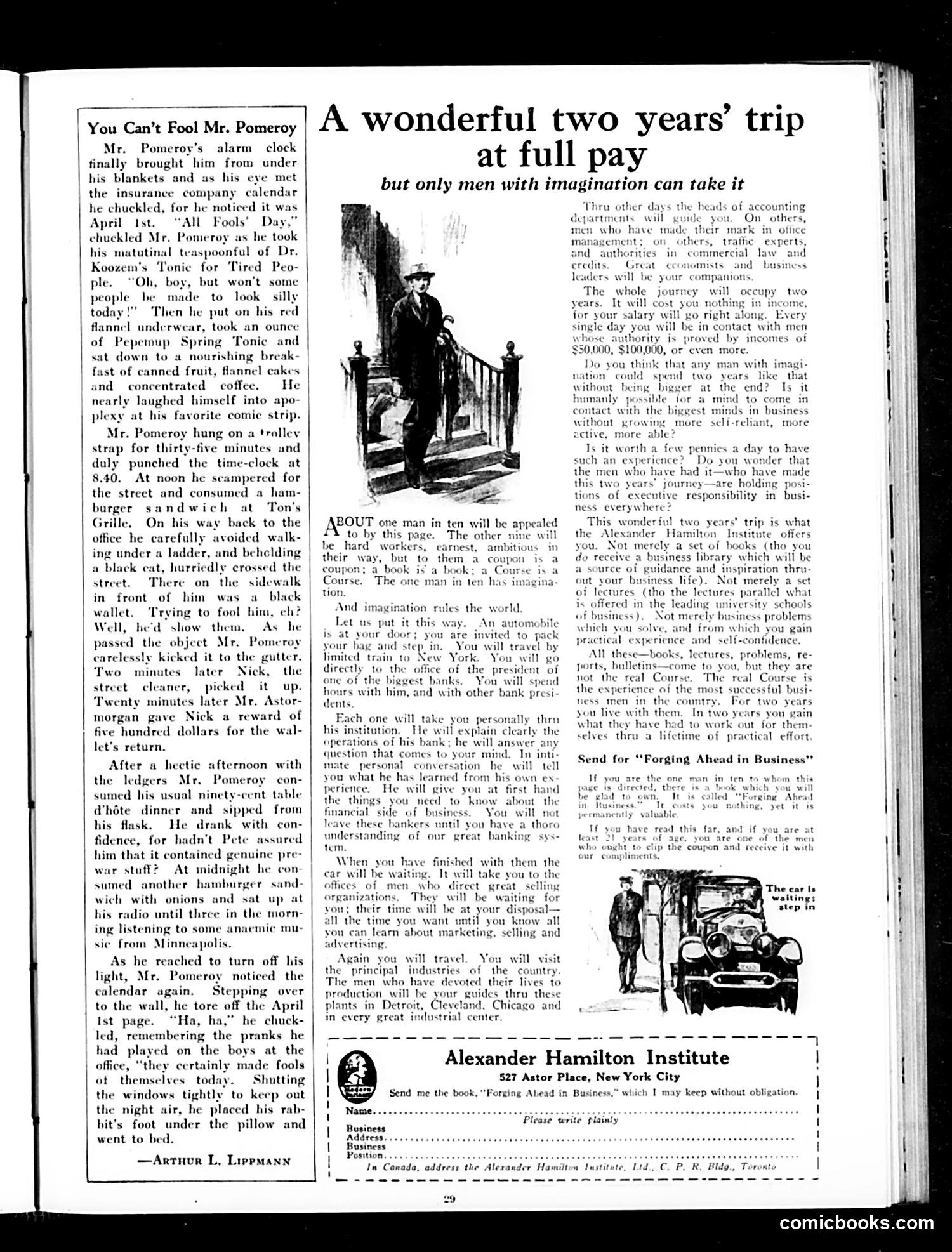
This page combines two distinct pieces: a humorous short story and a business institute advertisement. **"You Can't Fool Mr. Pomeroy"** is an April Fools' Day joke by Arthur L. Lippmann mocking a man who considers himself too clever to be fooled. Despite taking elaborate precautions against pranks (avoiding ladders, black cats, keeping a rabbit's foot), Mr. Pomeroy ironically ends up as the joke's victim when he kicks what he assumes is a harmless object—actually a wealthy man's lost wallet—and misses a $500 reward. The satire targets self-assured mediocrity and false confidence. **The second piece** advertises the Alexander Hamilton Institute's correspondence course promising a two-year, paid "trip" through America's banking and industrial centers—a metaphorical journey of business education. It appeals to ambitious men seeking advancement through specialized knowledge, contrasting the imaginative few who'd pursue such self-improvement against the "earnest, ambitious" majority content with routine work.
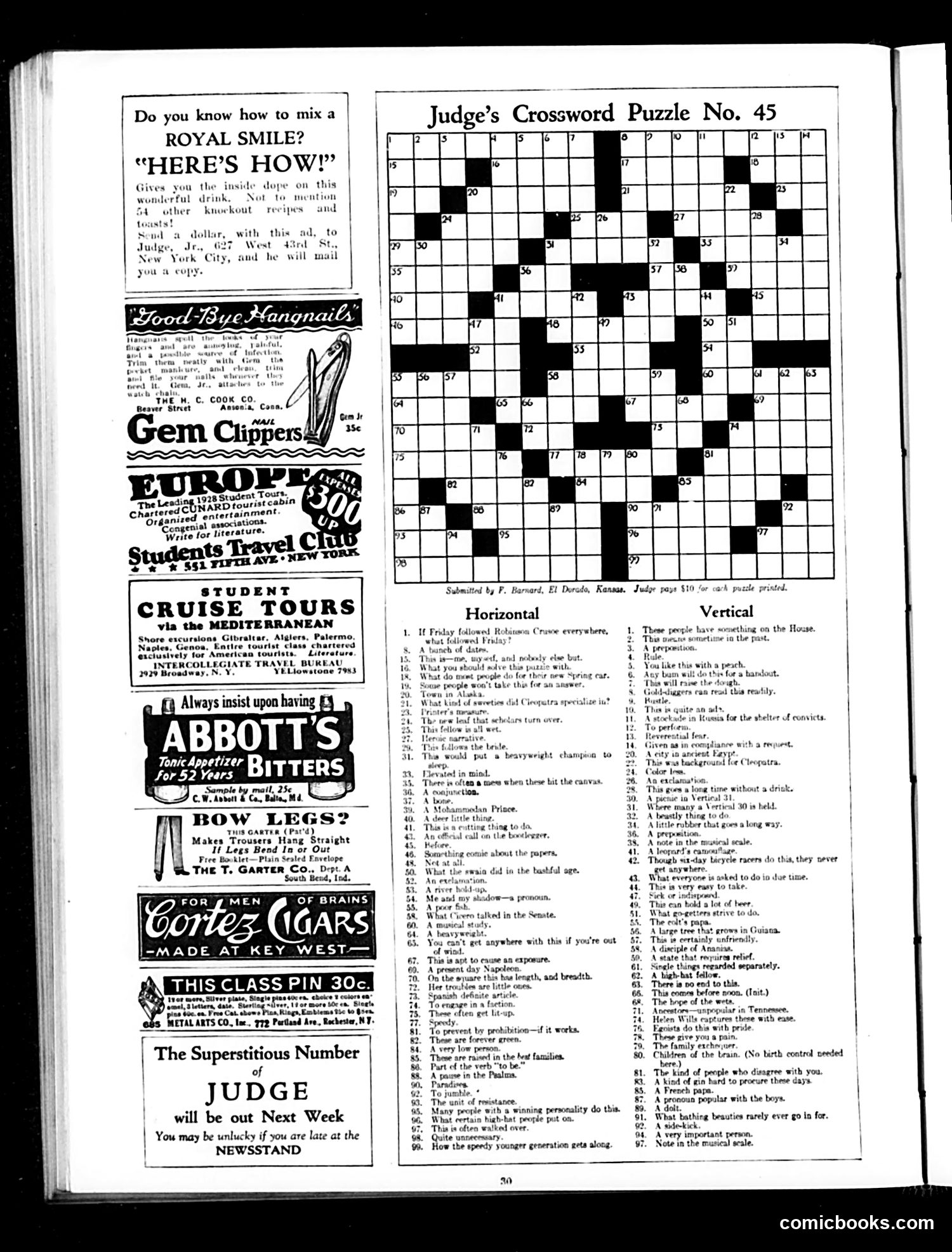
This page is primarily **advertisements and a crossword puzzle**, not a political cartoon. The main content is "Judge's Crossword Puzzle No. 45" with clues listed below. The advertisements reflect 1920s-era consumer culture: a "Royal Smile" drink promotion, student travel cruises to Europe, gem nail clippers, Abbott's Bitters (a tonic appetizer), leg-straightening devices, cigars, and class pins. These ads target young professionals and students. One notable ad mentions **Prohibition-era references**: Abbott's Bitters advertises as a "tonic appetizer" (a common workaround during alcohol prohibition), and a crossword clue hints at "gin hard to procure these days," referencing the difficulty of obtaining alcohol legally during the 1920s-1930s Prohibition era. The puzzle itself contains no obvious political satire—it's a standard word game with literary and general-knowledge clues typical of the era's entertainment magazines.
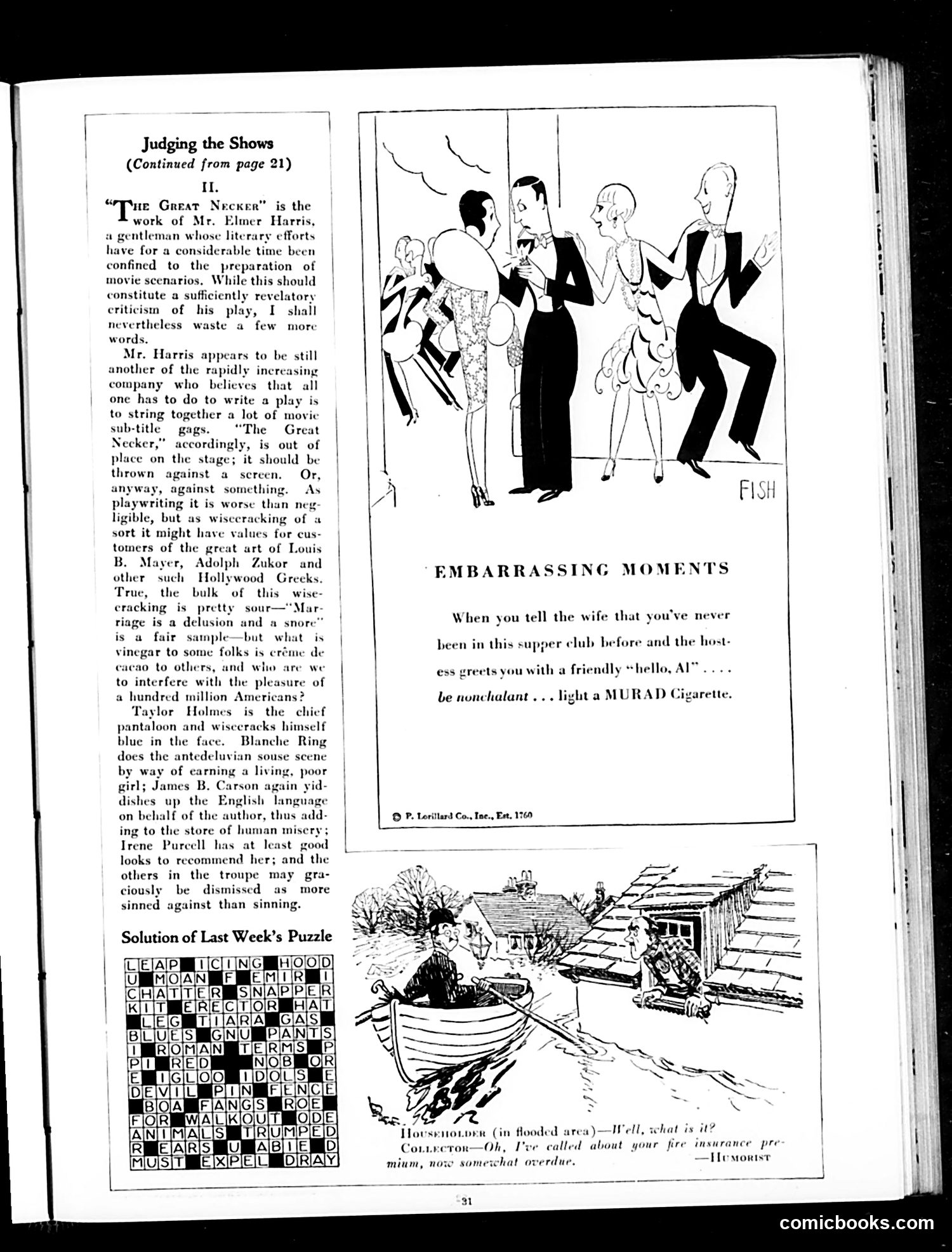
This page contains theater criticism and advertising from Judge magazine. The main article reviews "The Great Necker," a play by Elmer Harris, which the critic dismisses harshly. The reviewer argues the play belongs as a silent film (with "sub-titles") rather than on stage, mocking Harris for his background writing movie scenarios for Hollywood producers Louis B. Mayer and Adolph Zukor. The critic finds the dialogue crude ("Marriage is a delusion and a snore") and criticizes the cast's performances, though acknowledging some actors' merits. The "Embarrassing Moments" cartoon depicts a social comedy: a man pretends to his wife that they've never visited an upscale supper club before, but the hostess recognizes him by greeting him familiarly—undermining his deception. The accompanying Murad cigarette advertisement suggests maintaining composure in awkward situations. A crossword puzzle and insurance humor cartoon complete the page.
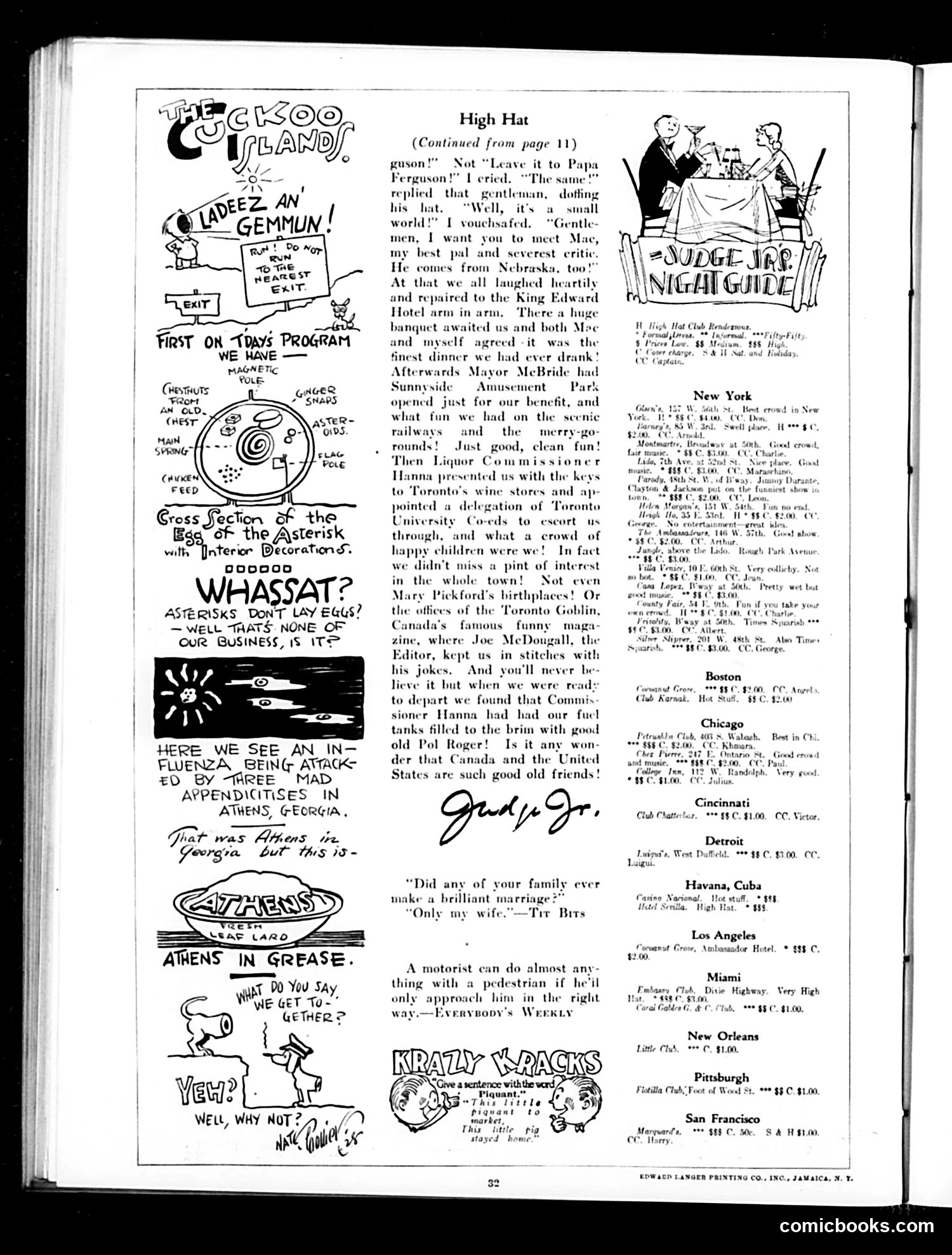
This page mixes humor cartoons with travel/nightlife advertising. The left side contains absurdist gag cartoons typical of Judge's style—visual non-sequiturs about asterisks laying eggs, influenza attacking appendicitis in Athens, Georgia, and wordplay about "Athens in Grease." These appear designed simply for surreal laughs rather than political commentary. The main text, "High Hat (Continued)," is a humorous travel narrative about visiting Toronto. It satirizes American-Canadian relations through exaggerated hospitality: the narrator receives lavish treatment from city officials, including having liquor tanks filled as parting gifts—a joke about Prohibition-era smuggling between the countries and the friendly disregard both nations had for alcohol laws. The right side lists nightclub and restaurant locations across major North American cities, suggesting the magazine's target audience: urban, affluent readers interested in entertainment venues.
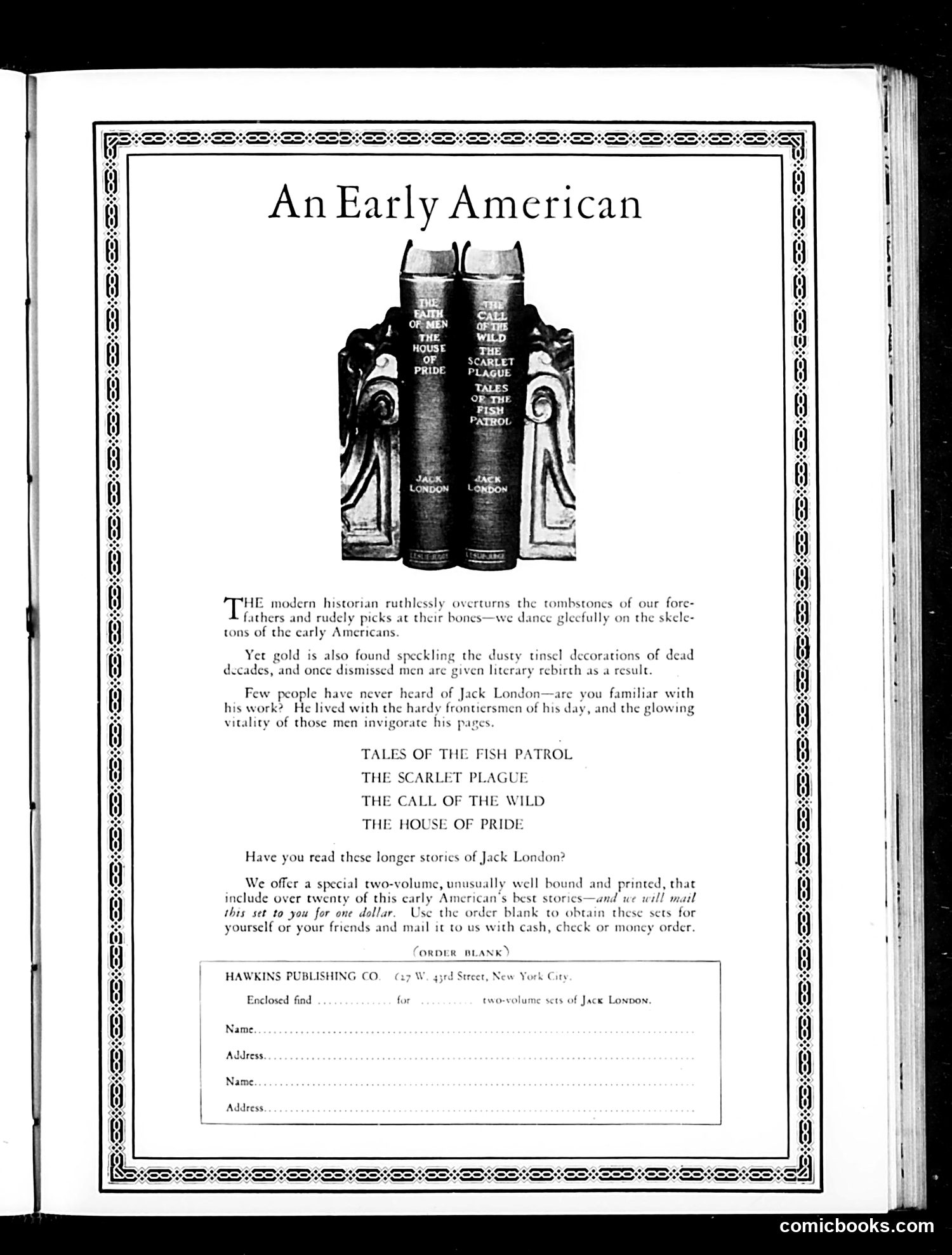
This is primarily an **advertisement**, not a political cartoon. It promotes a two-volume collection of Jack London stories published by Hawkins Publishing Co. The page frames London as a rediscovered "early American" author worth celebrating. The introductory text sardonically notes that modern historians dismiss early Americans, yet some—like London—deserve "literary rebirth." London is positioned as an authentic voice of American frontier life, having lived among "hardy frontiersmen." The four titles listed (*Tales of the Fish Patrol*, *The Scarlet Plague*, *The Call of the Wild*, *The House of Pride*) represent London's adventure and survival narratives. The ornamental bookends pictured suggest quality binding. The satirical opening critiques trendy historical revisionism while using it to sell London's work—a clever marketing strategy. For a modern reader, this reflects early 20th-century publishing practices: reprinting canonical authors in affordable, attractive editions as mass-market products. The one-dollar price was significant for the era.
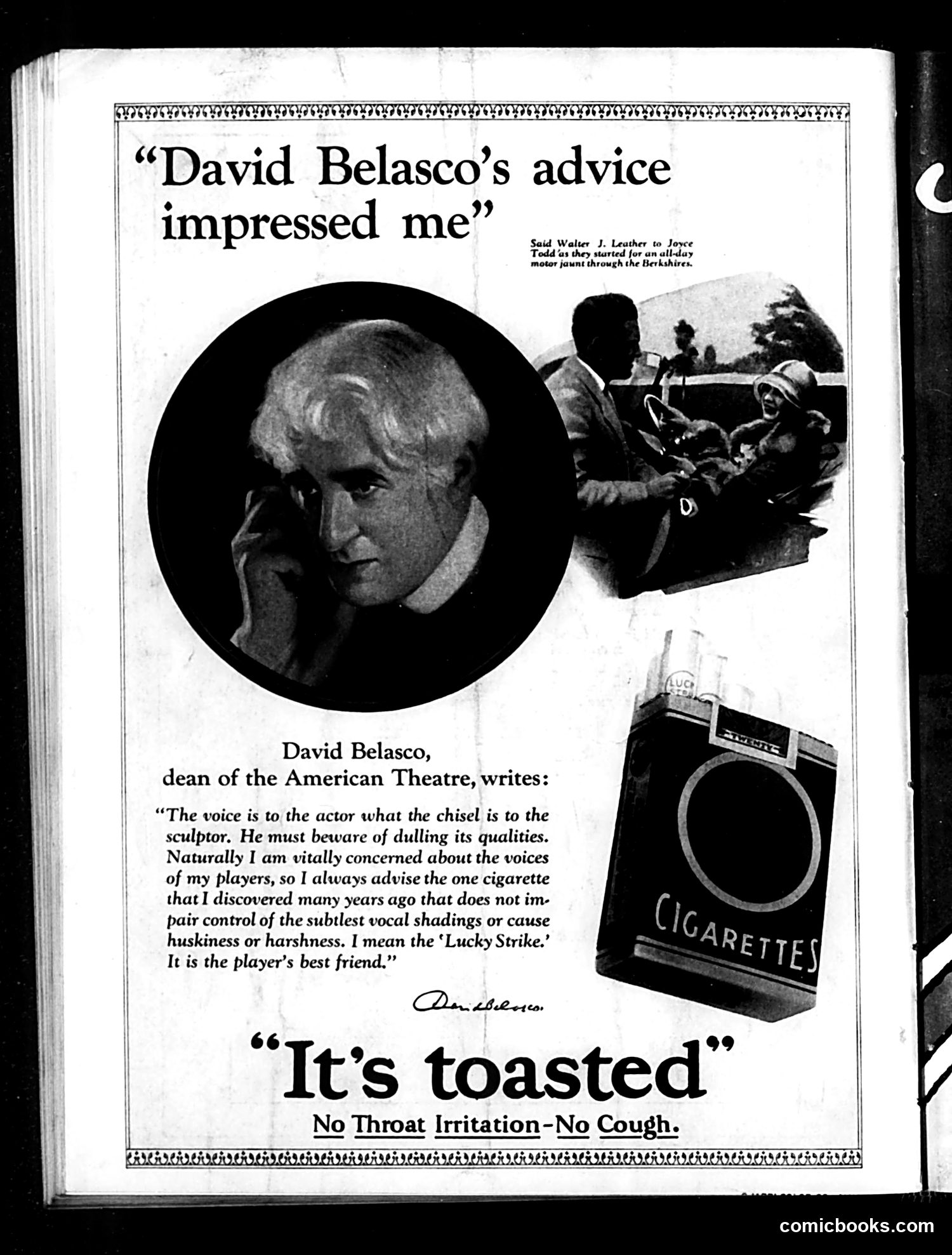
This is a **cigarette advertisement** disguised as celebrity endorsement, not political satire. David Belasco was a real, famous theatrical producer and director of the early 20th century. The ad quotes him endorsing Lucky Strike cigarettes by claiming they don't damage actors' voices—the most important tool of their craft. He compares vocal control to a sculptor's chisel. The accompanying photos show people enjoying leisure activities (a motor car trip through the Berkshires), suggesting Lucky Strikes fit an aspirational lifestyle. The tagline "It's toasted" and "No Throat Irritation—No Cough" are the product's health claims, which modern readers would recognize as false advertising. These were common in early cigarette marketing before tobacco's dangers were widely acknowledged or regulated. This represents pre-FDA era advertising where celebrity testimonials and health claims were unverified and unregulated.