
Judge, 1928-03-31 · page 25 of 36
Judge — March 31, 1928 — page 25: what you’re looking at
What you’re looking at
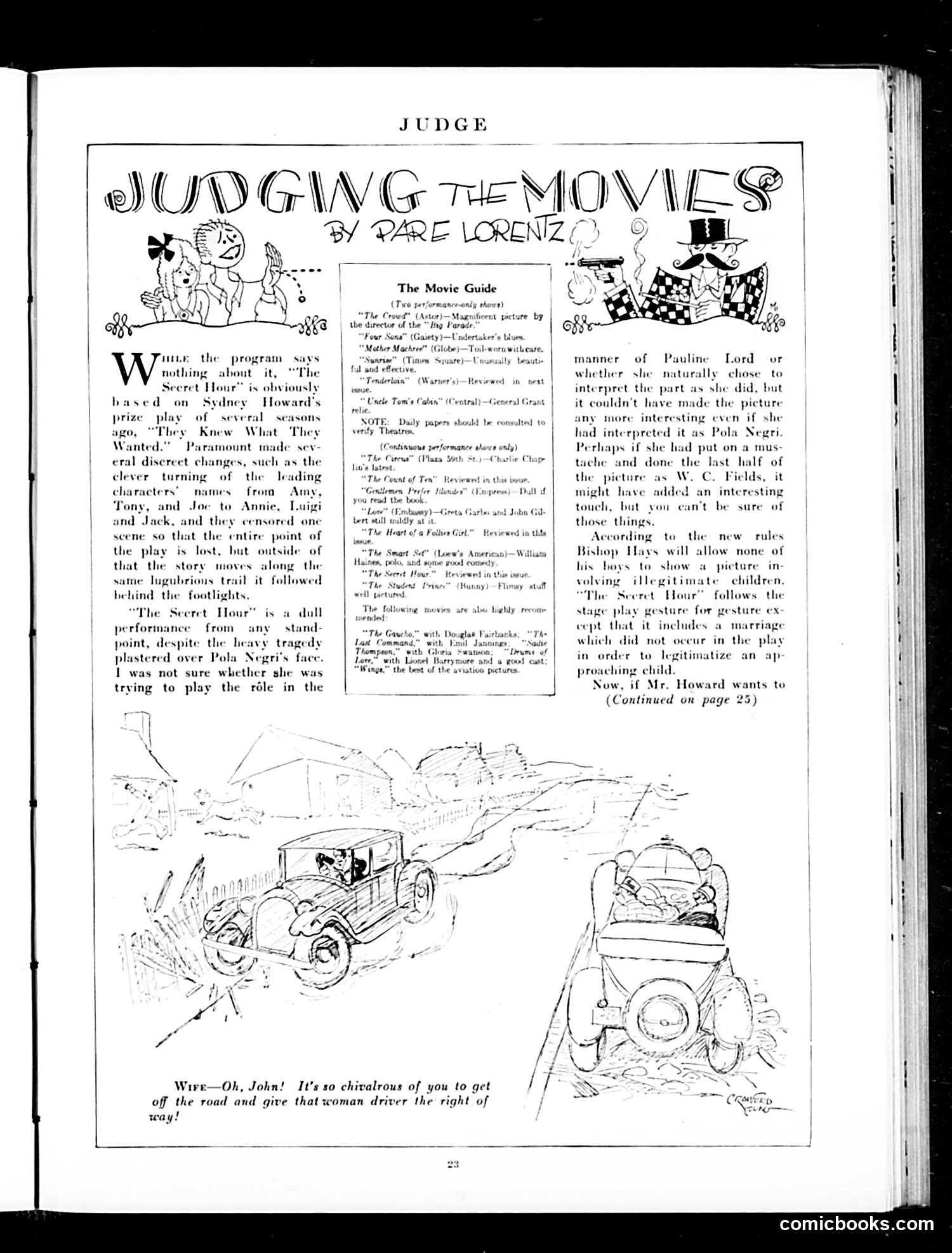
This is a film review column by Pare Lorentz titled "Judging the Movies." The main cartoon depicts a traffic accident between two cars, with the caption sarcastically praising a man for letting a female driver have the right of way—mocking chivalry as patronizing. The review critiques the film "The Secret Hour," based on Sydney Howard's play. Lorentz notes the movie added a marriage scene not in the original play to "legitimatize an approaching child," reflecting 1920s film censorship under the Motion Picture Production Code (enforced by "Bishop Hays"). He sarcastically suggests casting W.C. Fields or Pauline Lord instead of star Pola Negri might have made the picture more interesting, and criticizes the heavy tragic performance as dull. The satire targets both the film's heavy-handed morality and rigid censorship rules that forced narrative changes to satisfy moral guardians, making the story less authentic.
📄 Transcribed text from this page (OCR, searchable)
Machine-transcribed from the original scan — historical spelling and the odd misread are preserved.
based prize ago, Wanted.” discreet cl JUDGE the othing uy oof Knew er turnin of rs) names Jack, the play that the “The performa do Joe to is lost, story program about it, Secret Hour” on Sydney is obviously Howard's several What mount made ges, such as the leading Amy, Luigt the from Annie, and they censored onc scene so that the entire point of but outside of png the sume lugubrious trail it followed behind the moves a footlights. Seeret) Hour” is nee from Wire—Oh, any John! The seve uous performance shows only) a dull tand- point, despite the heavy trag plastered over Pola Negri’s face. 1 was not sure whether she trying to play the réle in the says (Warner Uncle Tom's Calan “Soe Daily papers shox Circus (Plaga Sth Se dy was It’s so chivalrous of you to get off the road and give that woman driver the right of way! manner of whether she Pauline Lord or naturally chose to interpret the part as she did, but it couldn't have made the picture uny more interesting even if she had interpreted it as Pola Negri. Perhaps if she had put on a mus tache and done the last half of the picture as W. C. Fields, it might have added an interesting touch, but you can't be sure of those things. According to the new rules Bishop Hays will allow none of his boys to show a picture in iNegitimate children “The Secret Hour” follows the stage play gesture for valy ing westure ex cept that it includes a marri which did not occur in the play in order to legitimatize an ap proaching child. Now, if Mr. Howard wants to (Continued on page 25) comicbooks.com