
Judge, 1928-03-31 · page 15 of 36
Judge — March 31, 1928 — page 15: what you’re looking at
What you’re looking at
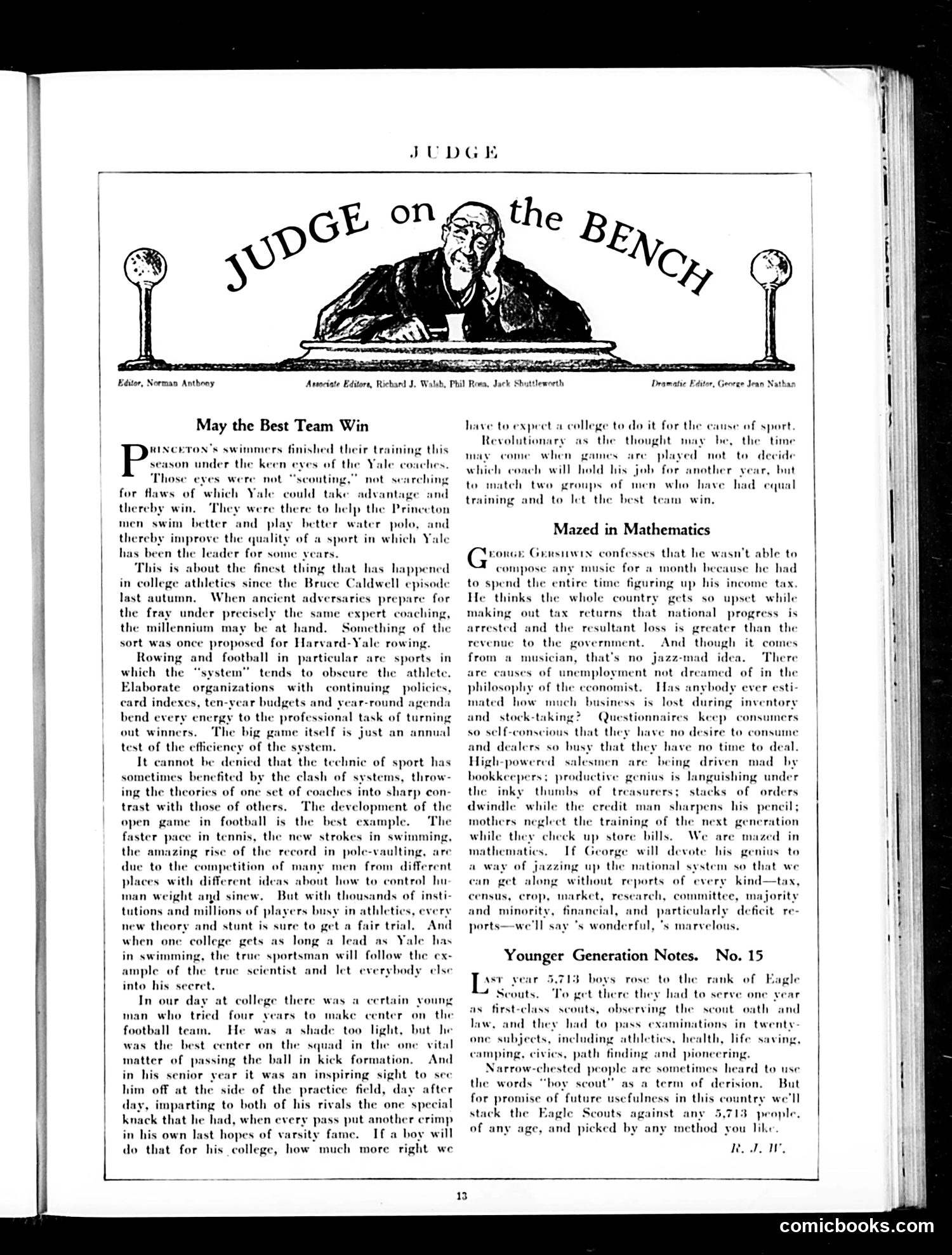
This page from *Judge* magazine contains two satirical articles about American institutional practices. **"May the Best Team Win"** praises Princeton's decision to have Yale coaches train their swimmers—a rare instance of athletic cooperation rather than competitive secrecy. The author argues this represents genuine sportsmanship and suggests colleges should prioritize fair competition between equally-trained teams over winning through superior coaching systems. The piece critiques how elaborate organizational hierarchies ("card indexes, ten-year budgets") have made college athletics about systemic advantage rather than athletic merit. **"Mazed in Mathematics"** satirizes George Gershwin's complaint that income tax calculations consumed a month of his time, preventing musical composition. The author extends this critique absurdly, arguing that income taxes, inventory accounting, and consumer questionnaires collectively damage the national economy more than the tax revenue benefits it—because they distract businesspeople and consumers from productive activity. It's social satire mocking bureaucratic inefficiency during the (likely) 1920s-30s era.
📄 Transcribed text from this page (OCR, searchable)
Machine-transcribed from the original scan — historical spelling and the odd misread are preserved.
Editor, Norman Anthony May the Best Team Win | RINCETON’S swimmers finished their training this P on under the ki es of the Yale coaches. Those eyes were not urching for flaws of which Yale could take advantage thereby win. They were there to help the Princeton men swim better and play better water polo, thereby improve the quality of a sport in which Y has been the leader for some y “scouting,” nots ars. This is about the finest thing that has happened in college athletics since the Bruce Caldwell episode last autumn, When adversaries prepare for the fray under precisely the same expert coaching, the millennium may be at hand. Something of the | sort was once proposed for Harvard-Yale rowing. | Rowing and football in particular are sports in | which the “system” tends to obscure the athlete. borate org card indexes, ten-y tions with continuing poli budgets and year-round agenda bend every en to the professional task of turning out winners. ‘The big game itself is just an annual test of the efficiency of the system. | It cannot be denied that the technic of sport has sometimes benefited by the clash of systems, throw- ing the theories of one set of couches into sharp con- trast with those of others. The development of the open game in football is the best example. The : in tennis, the new strokes in swimming, the amazing rise of the record in pole-vaulting, are due to the competition of many men from different es with different ideas about how to control hu n weight and sinew. But with thousands of insti- ns and millions of play | new theory and stunt is sure to get | when one college gets as long a lead as in swimming, the true sportsman will follow the ex- ample of the true scientist and let everybody else into his secret. In our day at college there was a certain young man who tried four years to make center on the football team. He was a shade too light, but he was the best center on the squad in the one vital matter of passing the ball in kick formation, And in his senior year it was an inspiring sight to sec him off at the side of the 7 ice field, ¢ after | day, imparting to both of his rivals the one special knack that he had, when every pass put another crimp in his own last hopes of varsity fame. If a boy will do that for his college, how much more right we rs busy in athletics, Antociate Editors, Ricbanl J, Walsh, Phil Rows, Jack Shuttleworth Dramatic Editor, George Jean Nathan have to expect a college to do it for the cause of sport. Revolutionary as the thought may be, the time may come when games are played not te decide whi to match two groups of men who have had equal training and to let the best team win, 1 coach will hold his job for another year, but Mazed in Mathematics G' once Gensiwin confesses that he wasn’t able to compose any music for a month because he had to spend the entire time figuring up his income tax He thinks the whole country gets so upset while making out tax returns that national progress is arrested and the resultant loss is greater than the revenue to the government. And though it comes from -mad idea. There are causes of unemployment not dreamed of in the philosophy of the economist. Has anybody ever esti- mated how much business is lost during inventory and stock-taking? — Questionnaires keep consumers so self-conscious that they have no desire to consume 1 musician, that’s no and dealers so busy that they have no time to deal. High-powered salesmen are’ being driven. mad by hookkeepers; productive genius is languishing under the inky thumbs of treasurers; stacks of orders dwindle while the credit man sharpens his pencil; mothers neglect the training of the while they check up store bills. We mathematics. If George will devote his genius to ing up the national system so that we Pe without reports of every kind—tax, census, crop, market, research, committee, 1 3 and minority, financial, and particularly deficit re- ports—we'll say 's wonderful, 's marvelous. No. 15 713 boys rose to the rank of Eagle To get there they had to serve on Younger Generation Notes. asr year 3 4 Scouts. as first-class scouts, observing the scout o: law, and they had to pass examinations in twenty one subjects, including athle camping, civies, path finding life saving, and pioneering. Narrow-chested people are sometimes heard to use the words “boy scout” as a term of derision. But for promise of future usefulness in this country we'll stack the Eagle Scouts against any 13° peoy of any age, and picked by any method you like. Reds Ws comicbooks.com