
Judge, 1928-03-31 · page 23 of 36
Judge — March 31, 1928 — page 23: what you’re looking at
What you’re looking at
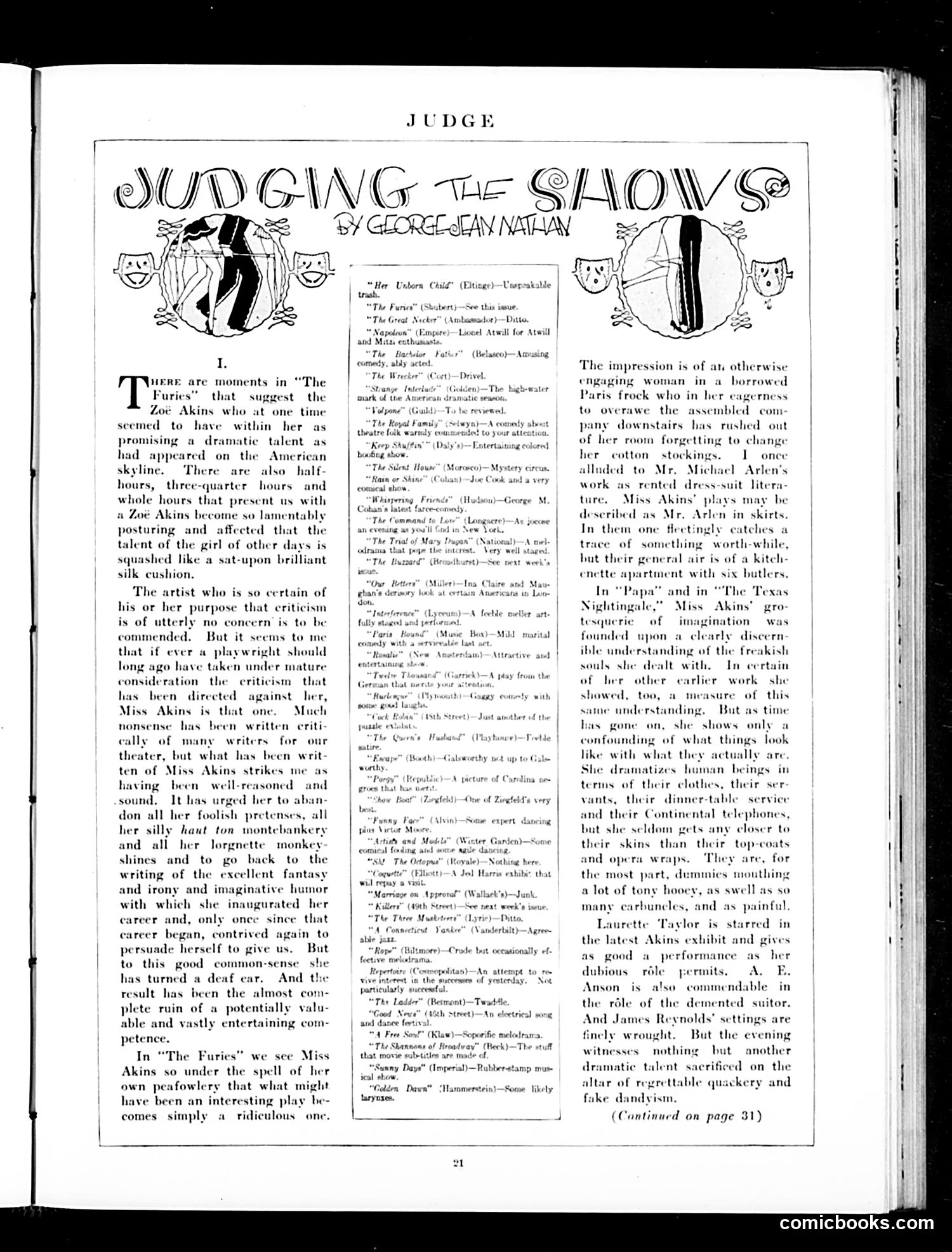
This is a theatrical review column, not a political cartoon. The critic **George Jean Nathan** attacks playwright **Zoë Akins** for her recent play "The Furies," which he views as a disappointing waste of her earlier talent. **The Satire:** Nathan uses elaborate metaphors to mock Akins's pretentiousness—she's like a woman wearing a borrowed Paris dress while forgetting her cotton stockings; her plays are "Mr. Arlen in skirts" (referencing Michael Arlen's shallow society fiction). He argues she's traded genuine imaginative insight for superficial glamour, reducing complex human characters to fashionable dummies spouting "tony hooey." **The Point:** This exemplifies *Judge's* cultural criticism—attacking artistic mediocrity and self-indulgent performance as social failures. Nathan contrasts Akins's promising early work with her current affected posturing, suggesting her career represents squandered potential due to vanity rather than principle. The column also lists contemporary theater productions briefly, typical of the magazine's entertainment coverage.
📄 Transcribed text from this page (OCR, searchable)
Machine-transcribed from the original scan — historical spelling and the odd misread are preserved.
F are moments in “The uries” that suggest the Akins who at one time seemed to have within her as promising a dramatic talent had appeared on the Ame skyline. There are also half- hours, three-quarter hours and whole hours that present us with a Zoé Akins become so lamentably posturing and affected that the talent of the girl of other days is squashed like a sat-upon brilliant silk cushion. The artist who is so certain of his or her purpose that criticism is of utterly no concern is to be commended. But it seems to me that if ever a playwright should long ago have taken under mature onsideration the criticism that has been directed against her, Miss Akins is that one. Much nonsense has been written: criti cally of many theater, but what has been writ ten of Miss Akins strikes me as having been well-reasoned and It has urged her to don all her foolish prete her silly haut ton montebankery and ali her lorgnette monkey shines and to go back to the writing of the excellent fantasy and irony and imaginative humor with which she inaugurated her career and, only once since that career began, contrived again to persuade herself to give us. But to this good common-sense she has turned fear, And the result has been the almost com- plete ruin of a potentially valu- able and vastly entertaining com- petence. writers for our sound. In “The Furies” we see Miss Akins so under the spell of her own peafowlery that what might have been an interesting play I comes simply a ridiculous’ one. JUDGE “Her Unborn Child” (Eltinge) rash. “The Furies” (Shubert rat Necker” (Ambassador) —Ditto, (Finpite)—Lioeel Atwill for Atwill See this issue. (Belasco) —Armasing “The Silent Howse” (Morowco)—My Artiste and comical forking an “SMI The Ortop n Approval” (Wallark’s)—Ji th St “The Three Must wae Yankee” (Vanderbilt)—Agren more)—Crode but occasionally ef- pertoire (Cextopelitan)—An attempt to re successes of yesterday. Not strvet)—An electrics) (Klae)—Soporific melodrama. Beck) —The stuff (imperial) —Rubber-stamp mus “Golden Daven” tarynxes (Hammerstein) —Some likely The impression is of an otherwise engaging woman in a borrowed Paris frock who in her eagerness to overawe the assembled com pany downstairs has rushed out of her room forgetting to chs her cotton” stockings. 1) on alluded to Mr. Michael Arlen's work as rented dress-suit litera- ture, Miss Akins’ plays may be described as Mr. Arlen in skirts. In them one fleetingly catches a trace of something worth-while, but their general air is of a kitch enette apartment with six butlers. Texas Akins’ gro of imagination was founded upon a clearly discern ible understanding of the freakish souls she dealt with, In certain of her other earlier work she showed, too, a measure of this same understanding. But as time In “Papa” and in “The Nightingale,” Miss tesquerie has gone on, she shows only a confounding of what things le like with what they actually are. She dramatizes human beings in terms of their clothes, their ser their dinner-table service and their Continental telephones, but she seldom gets any closer to. their skins than their top-coats and opera wraps. T' vants, the most part, dummies mouthing a lot of tony hooey, as swell as so many carbuncles, and as painful Laurette ‘Taylor is starred in the latest Akins exhibit nd gives performance as her permits, A. I Anson is also) commendable in dubious the réle of the demented suitor. And James Reynolds’ settings are finely wrought, But the evening nothing but another dramatic talent sacrificed on the witnesses altar of regrettable quacke ake dandyism, (Continued on page 31) comicbooks.com