
A complete issue · 36 pages · 1928
Judge — February 18, 1928
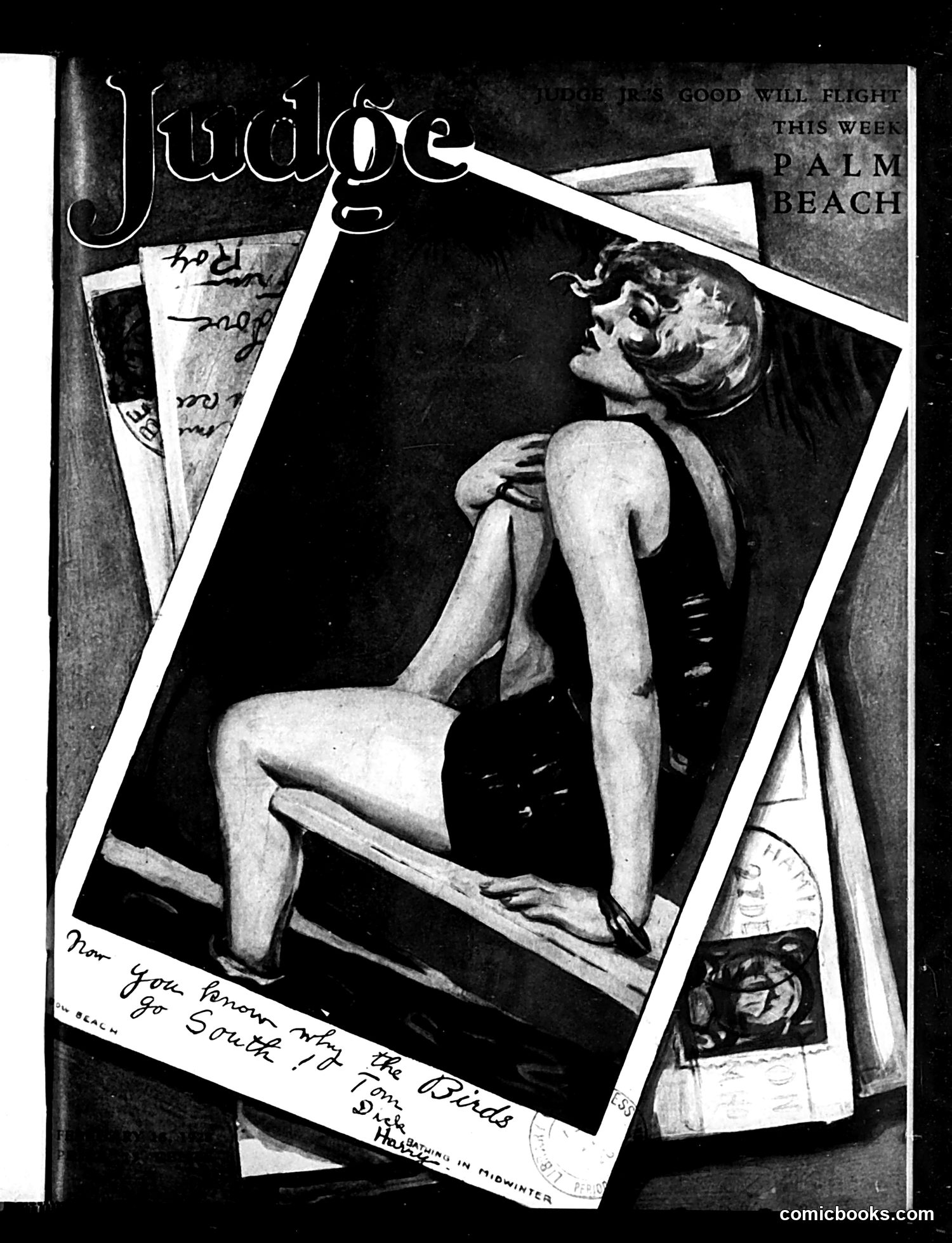
This page is primarily **advertising content** for Judge magazine, not political satire. The large central image shows a glamorous woman in a bathing suit posed on a diving board, captioned "For You Born Way The Woods Come South!" The headline at top reads "JUDGE'S GOOD WILL FLIGHT THIS WEEK PALM BEACH," suggesting this advertises Judge's coverage of social events in that fashionable destination. The smaller images on the left appear to be additional magazine content or advertisements. The composition—overlapping photos with white borders arranged like scattered materials—was a common visual design technique of the era to suggest magazine pages or clippings. Rather than satire, this is straightforward leisure-lifestyle advertising targeting affluent readers interested in fashion, travel, and high society.
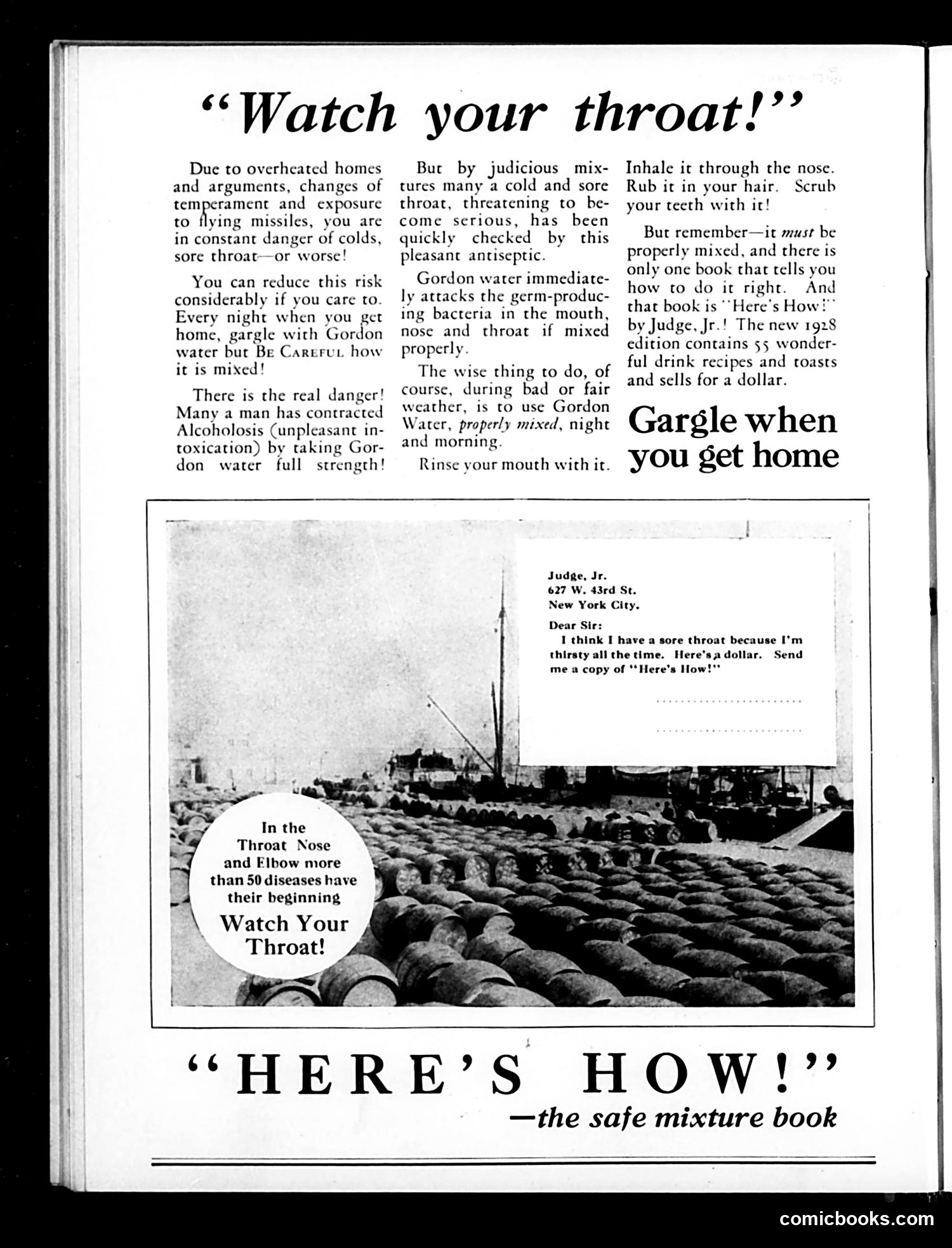
This page is primarily an **advertisement** for "Here's How!" - a cocktail recipe book - rather than political satire. The ad exploits public health anxieties of the era. The text warns about sore throats from "overheated homes and arguments" and "exposure to flying missiles," recommending Gordon Water as a gargle. It then promotes the book by claiming improper mixing of this product caused alcoholism in "many a man." The industrial photograph shows lumber yards, likely referencing post-WWI economic concerns. The included postcard from "Judge, Jr." requesting the book appears designed to encourage reader participation. The satire is **indirect**: the ad mocks health-conscious consumers by suggesting a commercial product book offers medical solutions, while the alcoholism reference darkly hints at Prohibition-era anxieties about drinking mixtures.
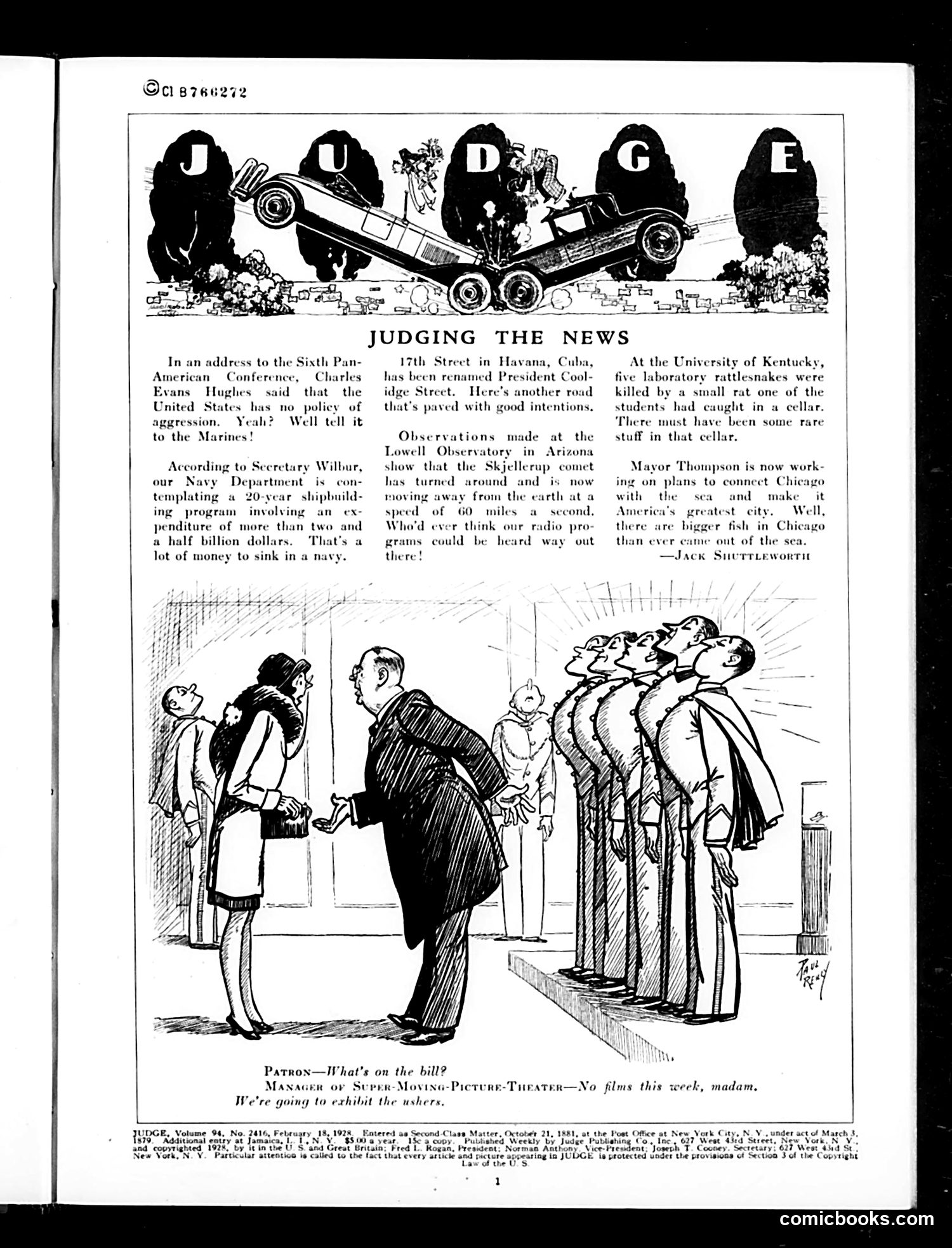
**Top Section ("Judging the News"):** Three brief satirical news items mock recent events: Secretary Wilbur's Navy shipbuilding program (costing 1.5 billion dollars), the Skjellerup comet's trajectory, and Mayor Thompson's plan to connect Chicago with the sea. **Bottom Cartoon:** The illustration depicts a theater manager confronting a patron about an unpaid bill. The caption reads: "What's on the bill? Manager of Super-Moving-Picture-Theater—No films this week, madam. We're going to exhibit the ushers." The joke plays on the double meaning of "bill"—both the financial debt and the entertainment program. The satire mocks movie theaters of the era, suggesting they sometimes relied more on usher employment than actual films, or that ushers were the main attraction worth displaying.
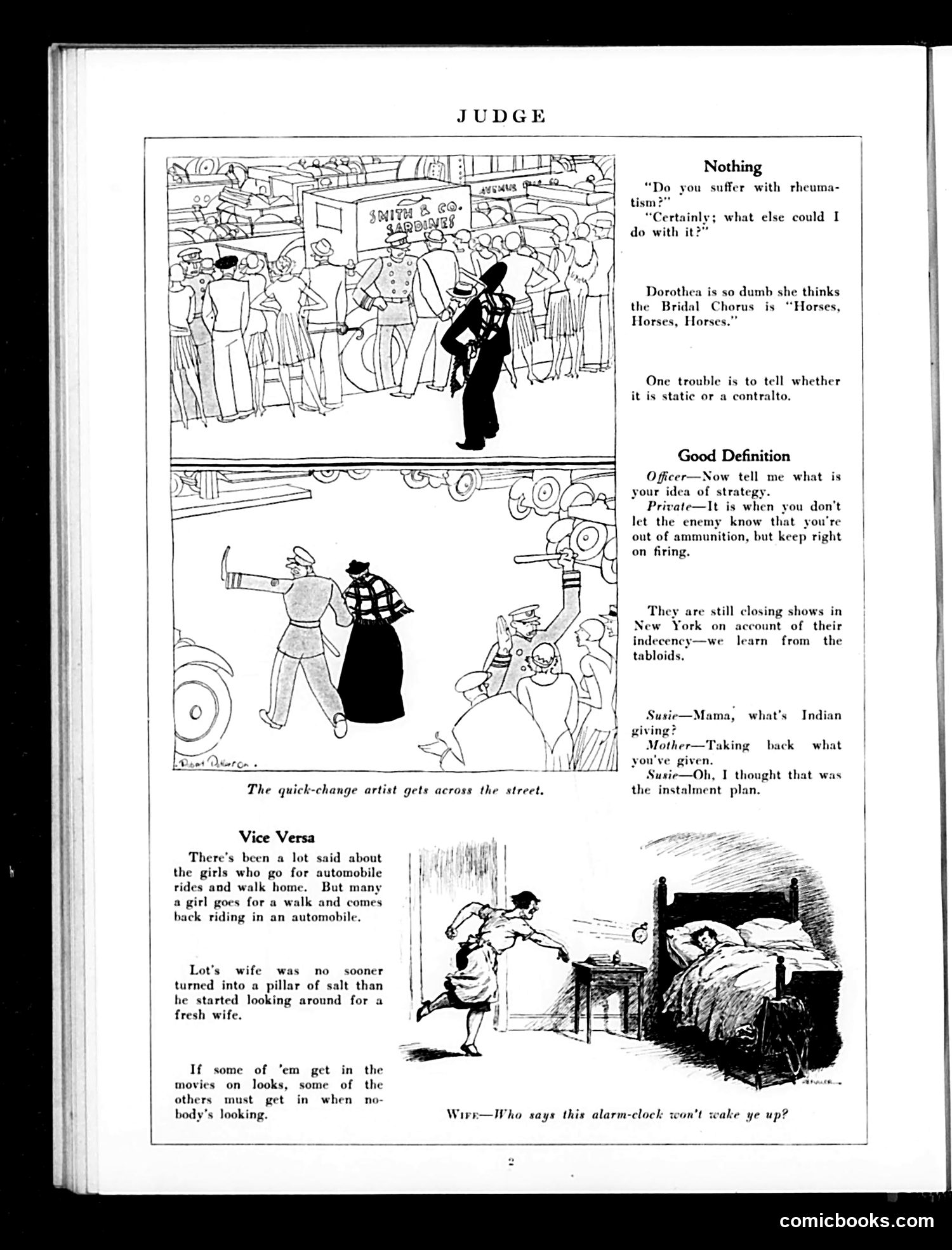
This page from *Judge* contains several satirical humor pieces typical of early 20th-century American comedy: **Top cartoon**: Shows a street scene with "The quick-change artist gets across the street"—likely satirizing either street performers or someone evading traffic/authorities through quick movement. **"Vice Versa" section**: Jokes about automobile culture and relationships. References Lot's wife from the Bible (turned to salt) in a metaphor about wives and cars—humor based on the then-novel phenomenon of automobiles changing social habits. **Bottom cartoon**: A bedroom scene with a wife kicking out of bed and an alarm clock, captioned "Who says this alarm-clock won't wake ye up?"—physical comedy about marital discord and alarm clocks. The overall tone reflects early-1900s middle-class anxieties: traffic, automobiles, marriage dynamics, and domestic life.
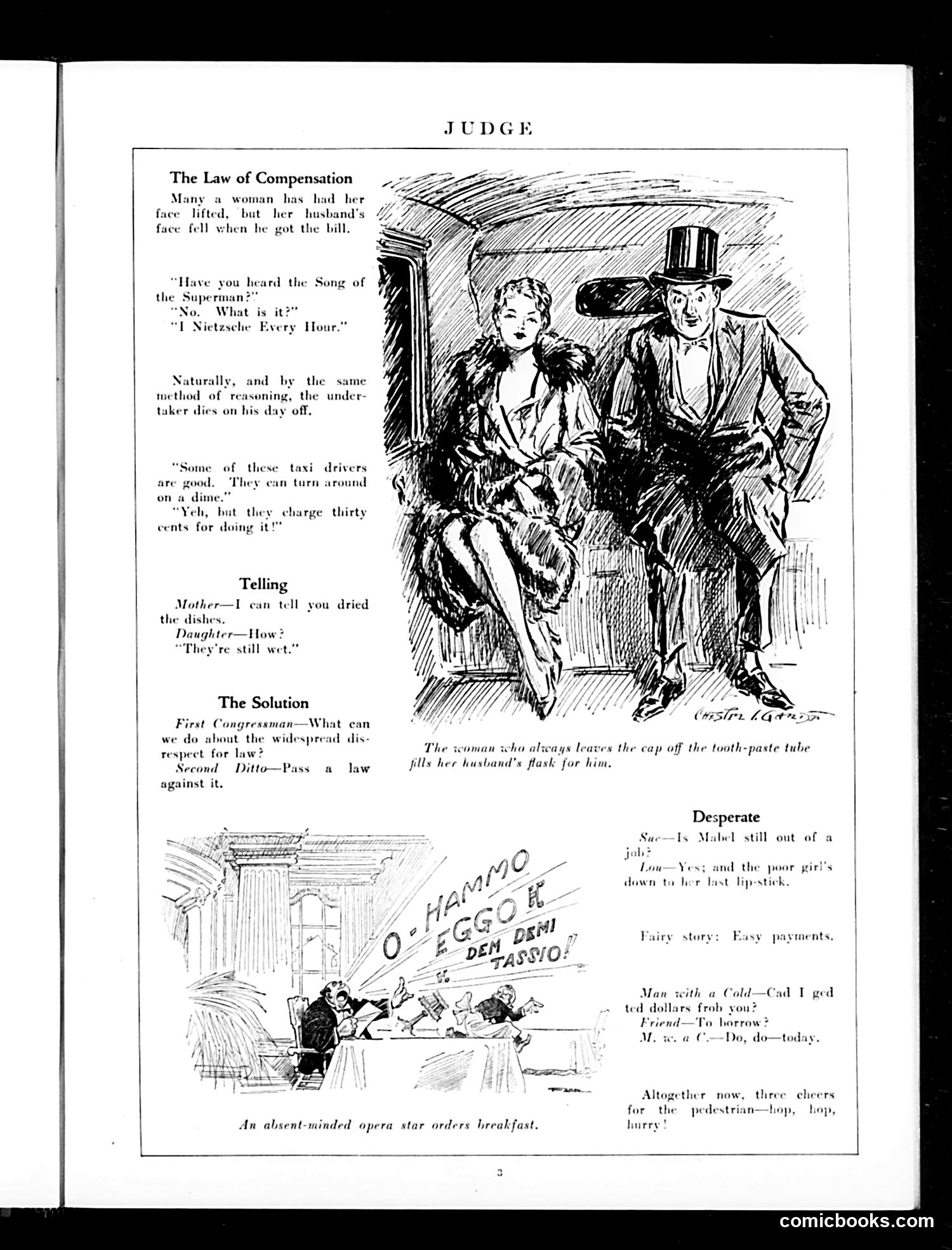
This page contains three separate satirical pieces: **"The Law of Compensation"** jokes about marital dynamics—a woman's face lifts when her husband gets a bill, but falls when he receives one. The reference to "Nietzsche Every Hour" is unclear without more context. **"Telling"** is a brief domestic joke about wet dishes. **"The Solution"** appears incomplete but discusses "disrespect for law." The largest cartoon depicts an "absent-minded opera star" ordering breakfast in Italian ("O Hammo," "Eggo," "Tassio")—satirizing pretentious European cultural affectation common in early 20th-century American satire. The accompanying sketches include domestic humor about toothpaste tubes and cosmetics, reflecting period concerns about consumer goods and household management.
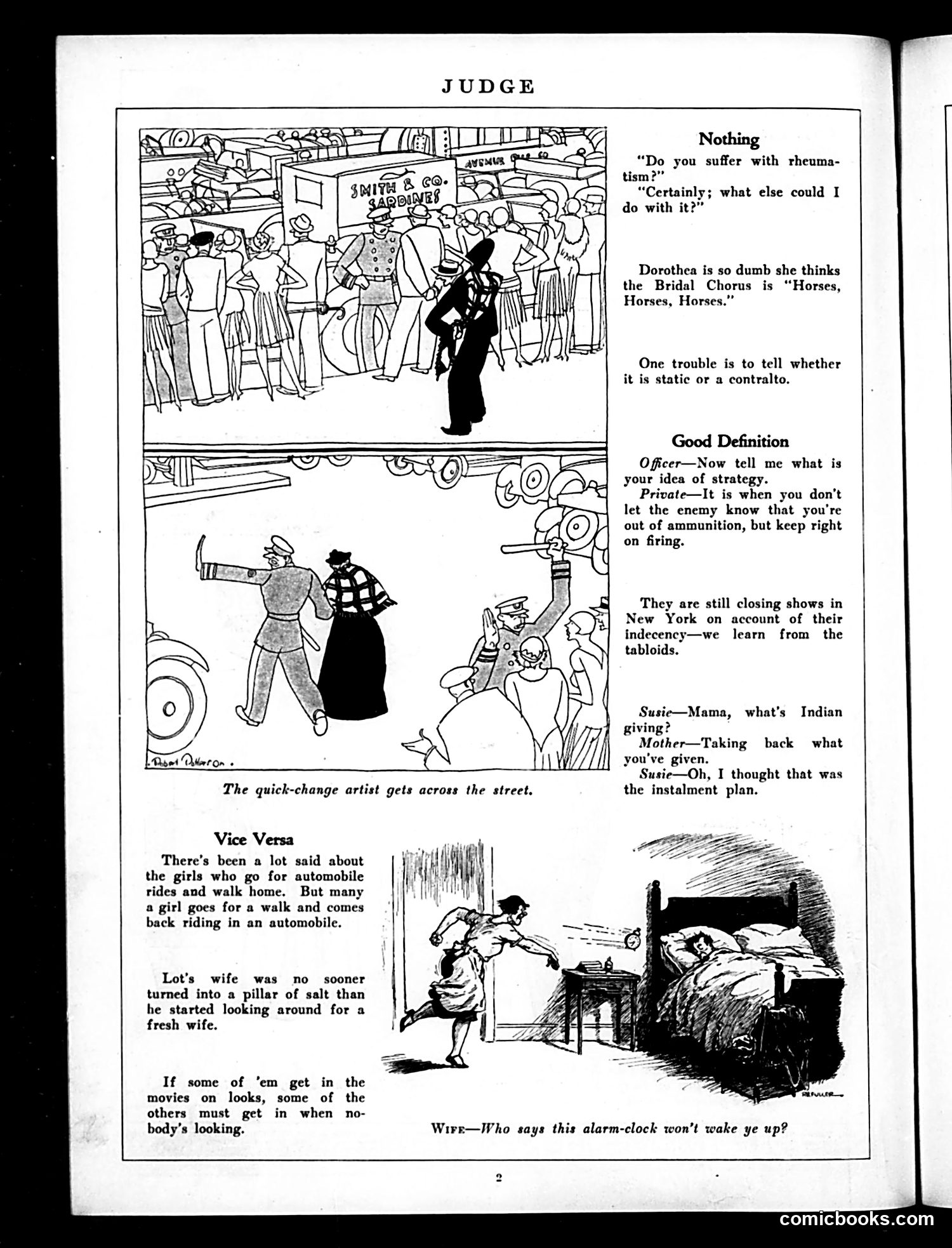
This page contains humor pieces and cartoons satirizing early 20th-century American life. The top cartoon shows a bandleader conducting an orchestra, with accompanying jokes about rheumatism and mishearing lyrics ("Horses, Horses, Horses" instead of the actual Bridal Chorus). "Vice Versa" section jokes about gender roles and courtship—mocking how women pursuing automobile rides are seen differently from women taking walks, and referencing an "instalment plan" for relationships, likely mocking consumer credit culture. The final cartoon shows a wife with an alarm clock and sleeping husband, playing on domestic friction and men avoiding responsibility. The "Good Definition" section offers satirical military wordplay about strategy and ammunition. Overall, the humor targets social pretension, gender dynamics, and domestic life typical of Judge's satire.
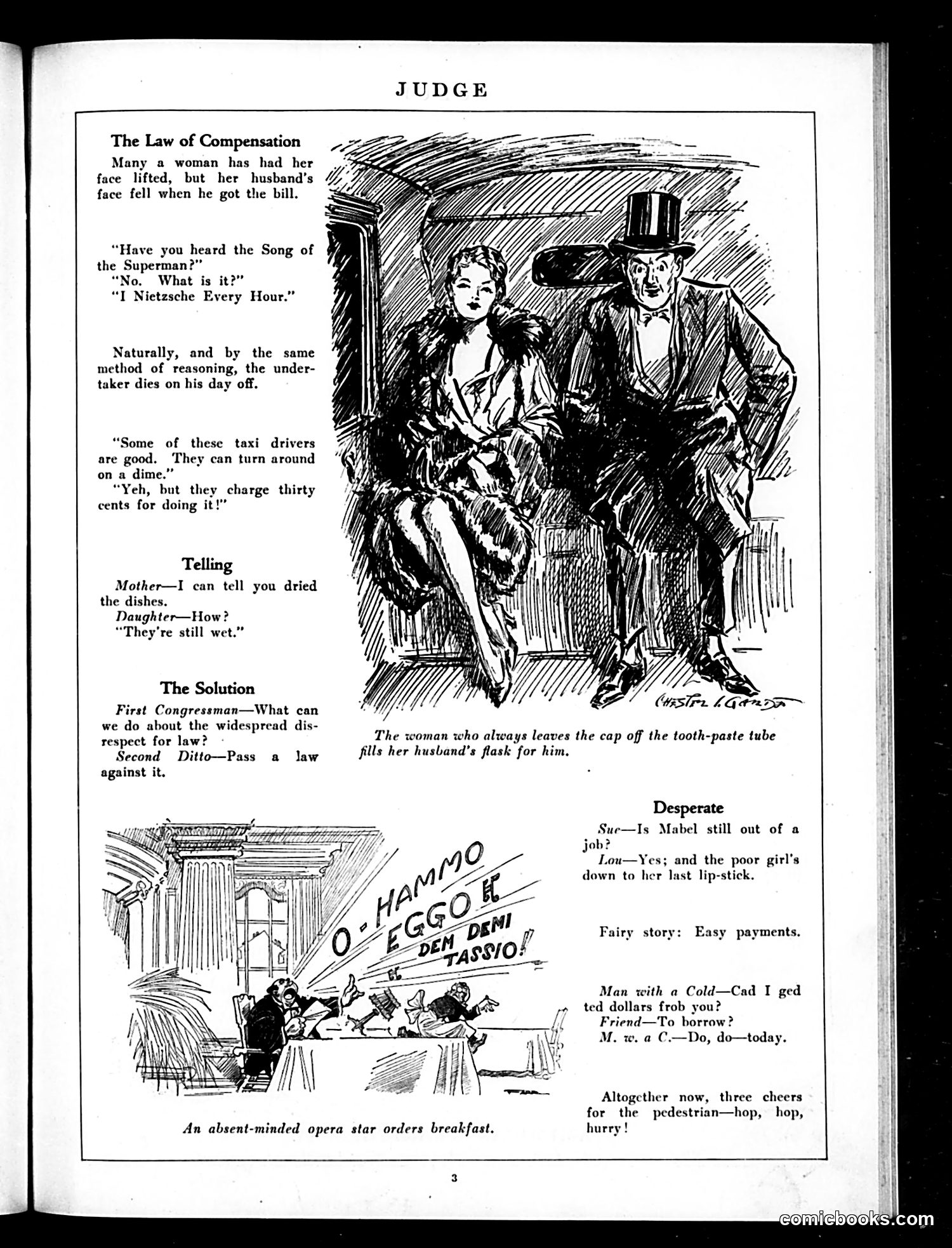
This page contains several satirical vignettes targeting early 20th-century social and economic issues: **"The Law of Compensation"** jokes that wives celebrate receiving bills—suggesting husbands' financial troubles bring domestic satisfaction. **"Telling"** presents a domestic scene where a daughter can't distinguish between wet and dry dishes, mocking household incompetence. **"The Solution"** shows congressmen debating widespread disrespect for law, proposing to simply pass another law against it—satirizing legislative ineffectiveness. **Lower cartoon** depicts an absent-minded opera star ordering breakfast via telegram, mocking celebrity absentmindedness. The remaining brief jokes target job insecurity, easy-payment schemes, borrowing money, and pedestrian safety—all reflecting common urban concerns of the era. The humor relies on class observations and practical domestic/social frustrations recognizable to readers of that period.
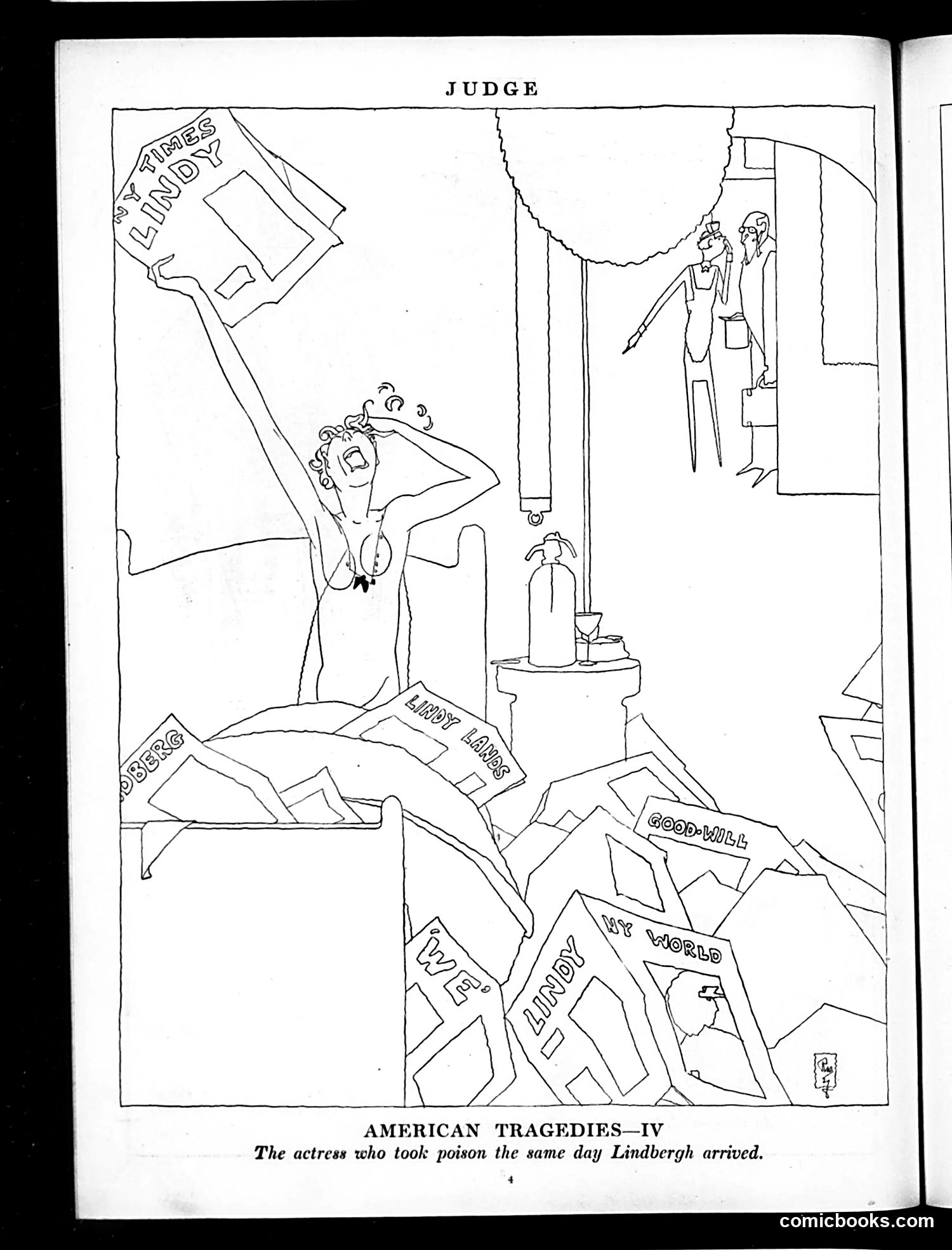
This Judge magazine cartoon satirizes the media's obsession with celebrity news during the Lindbergh era. The caption references "the actress who took poison the same day Lindbergh arrived"—likely alluding to a real suicide that was overshadowed by Charles Lindbergh's arrival (presumably his famous 1927 transatlantic flight). The cartoon depicts a distressed woman among scattered newspapers and media debris labeled "LINDBERGH," "WORLD," and "GOOD WILL." Two well-dressed figures (possibly judges or officials) stand indifferently in a doorway above the chaos. The satire critiques how sensational celebrity news drowns out serious human tragedies. The woman's death becomes invisible amid the media frenzy surrounding Lindbergh's achievement. It's commentary on press priorities and public attention—even suicide cannot compete with aviation spectacle.
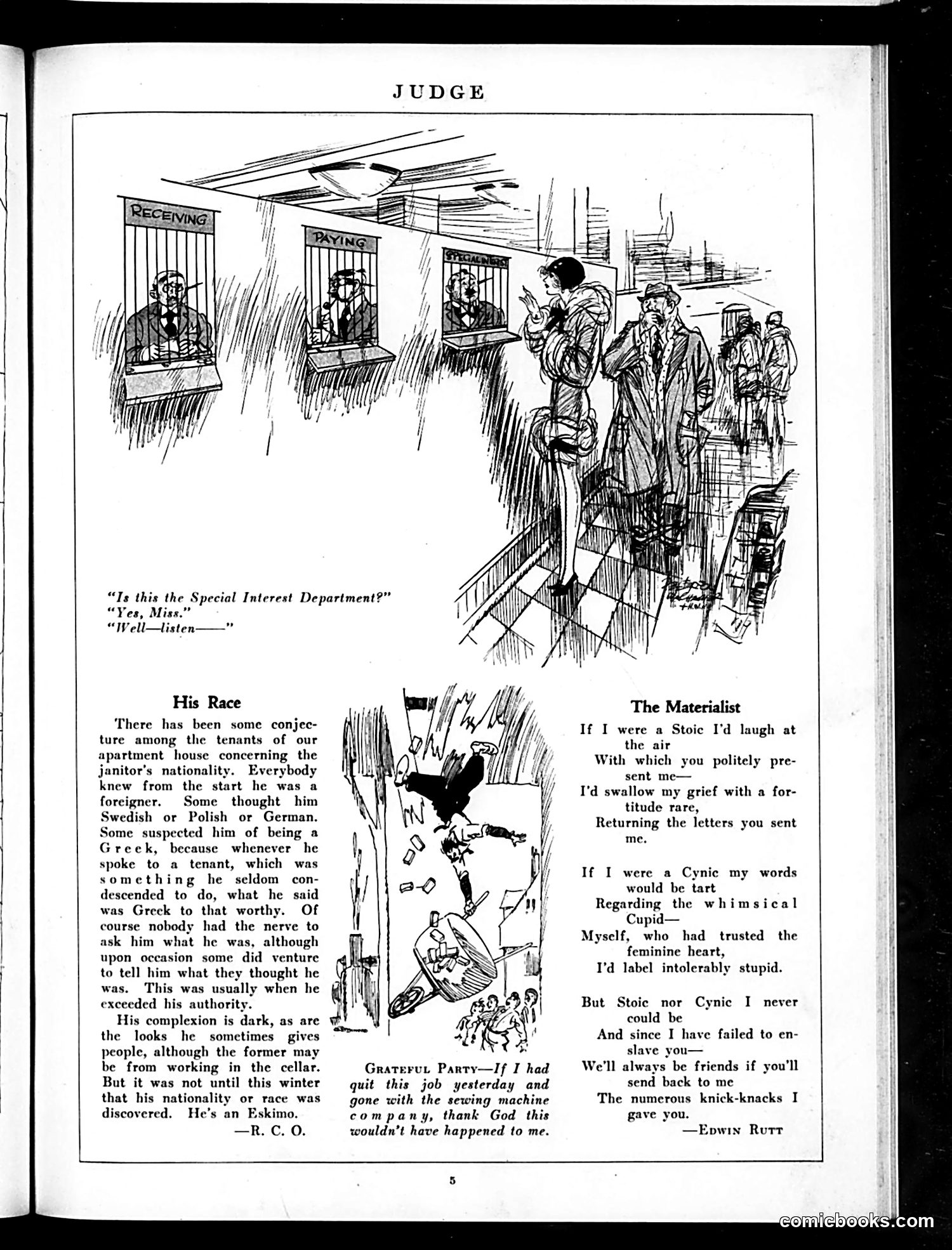
The top cartoon satirizes bureaucratic departments handling "special interests"—likely referencing government agencies or corporate divisions that ostensibly serve particular constituencies but function as mere filing systems. A woman inquires about the "Special Interest Department," and an official directs her to windows labeled "Receiving" and "Paying," suggesting these departments merely process complaints without meaningful action. Below are three unrelated pieces: "His Race" is a humorous short story about apartment tenants speculating on a janitor's ethnicity (Swedish, Polish, German, Greek) before discovering he's Eskimo—the joke playing on the phrase "Greek to me" (meaning incomprehensible) and the reveal's absurdity. "The Materialist" is a romantic poem where the speaker, rejected by his lover, adopts a pragmatic tone—he won't be a philosophical Stoic or Cynic about heartbreak, but simply asks for the return of gifts he gave her.
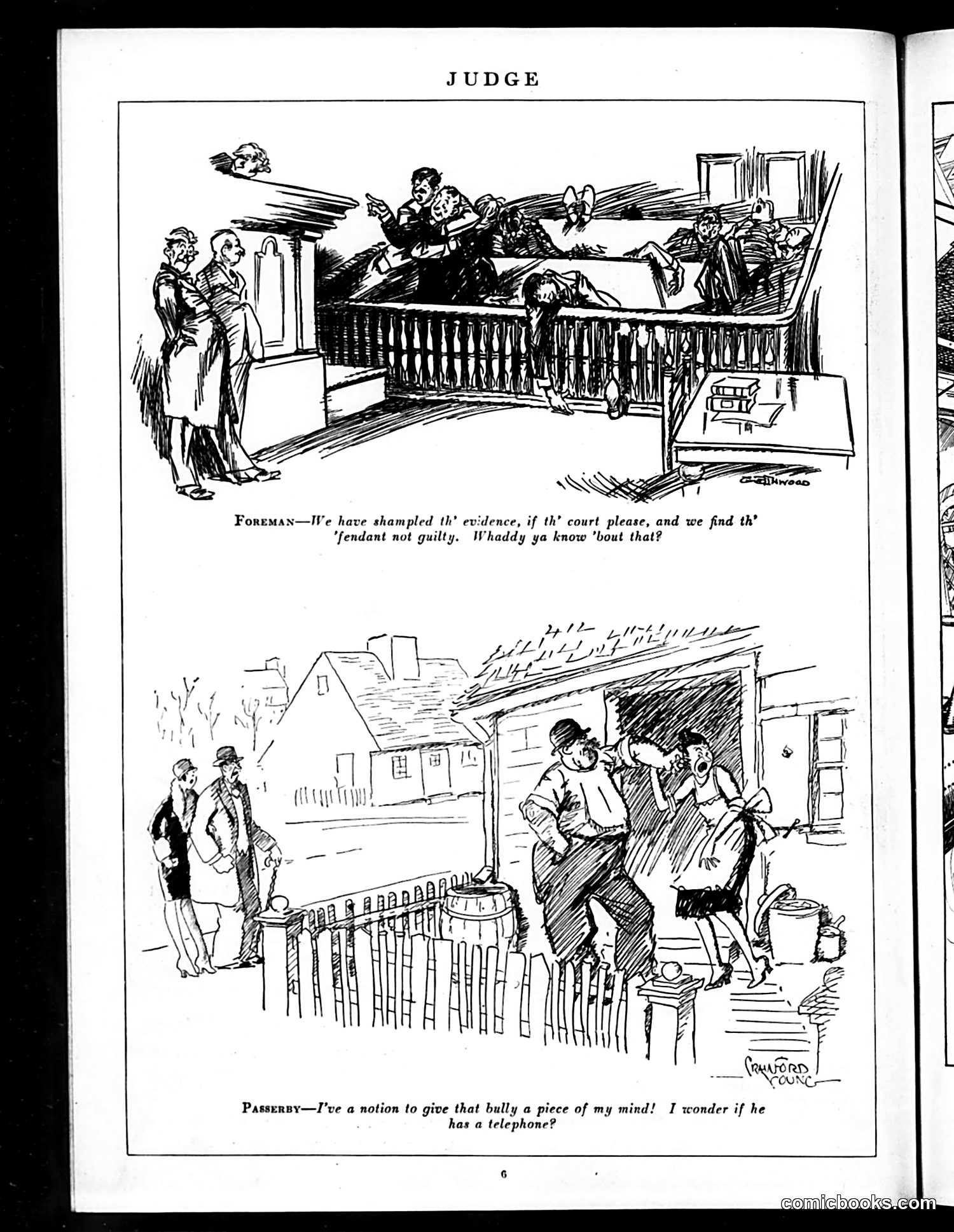
**Top cartoon ("Foreman"):** A jury foreman announces a "not guilty" verdict to the judge, with the phrase "Whaddy ya know 'bout that?"—suggesting casual, almost flippant dismissal of serious proceedings. The satire mocks juries who reach verdicts without properly considering evidence, treating justice as a matter of opinion rather than careful deliberation. **Bottom cartoon ("Passerby"):** A man witnesses a bully and expresses outrage ("give that bully a piece of my mind"), but then undermines his own courage by wondering if the bully "has a telephone?"—implying he's too afraid to confront him directly and would need to call instead. This ridicules people who talk tough but lack actual courage to act. Both cartoons satirize American social behavior: judicial incompetence in the first, and hollow bluster masked as principle in the second.
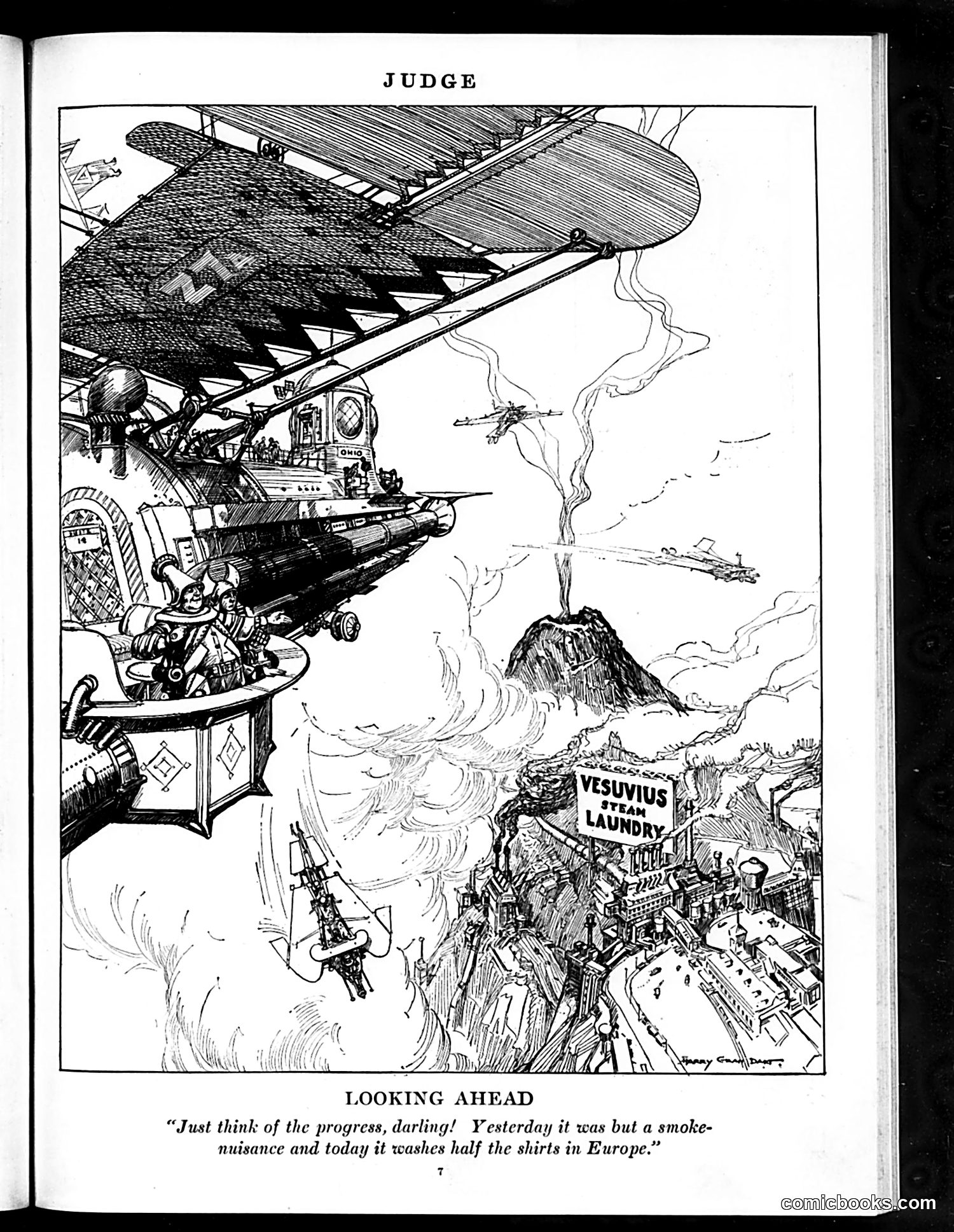
This satirical cartoon depicts modern aviation technology as an environmental and industrial threat. On the left, a wealthy couple observes massive military aircraft and airships overhead with satisfaction. The man boasts about "progress," noting that what was yesterday merely a "smoke-nuisance" now "washes half the shirts in Europe"—meaning the ash and pollution from aircraft now blankets the continent. The caption is ironic: what he celebrates as progress is actually environmental damage. The cartoon critiques how industrial/military advancement is presented as beneficial while causing widespread pollution. The "Vesuvius Laundry" sign below (referencing the volcano that buried Pompeii) reinforces the destructive comparison. The satire targets wealthy elites who embrace technological progress while ignoring its harmful consequences on ordinary people and the environment.
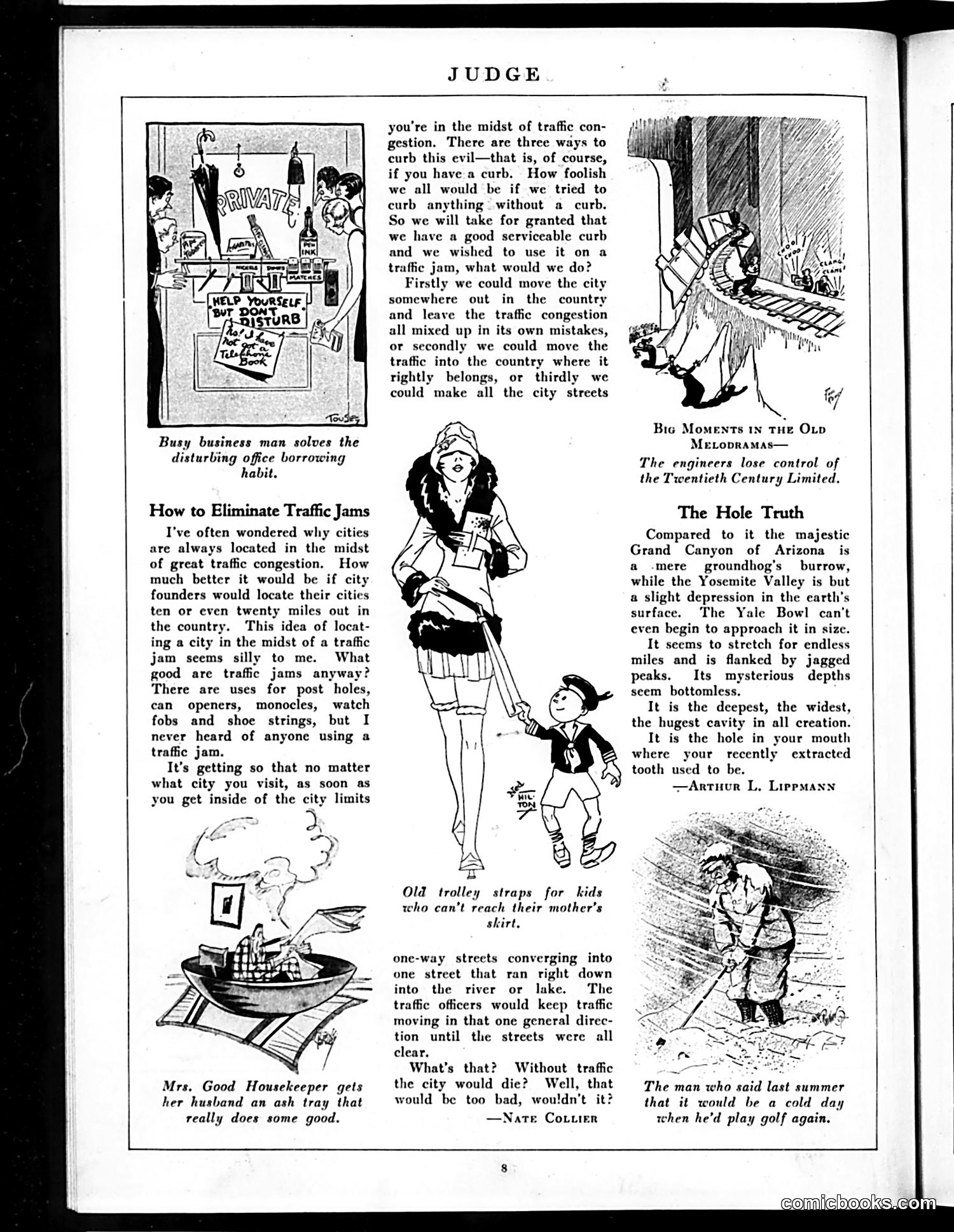
This page from the satirical magazine **Judge** contains absurdist humor about early-20th-century urban problems. **"How to Eliminate Traffic Jams"** by Nate Collier mocks city planners' inability to solve traffic congestion. The author proposes three deliberately ridiculous solutions: relocate cities to the countryside, move traffic to the country instead, or create one-way streets dumping into rivers. The satire targets urban gridlock—a genuine modern problem—by suggesting the real solution is to eliminate cities themselves, since traffic serves no purpose ("never heard of anyone using a traffic jam"). **"The Hole Truth"** by Arthur L. Lippmann uses hyperbolic comparison to make a dental joke: he compares the cavity left by an extracted tooth to grand natural wonders like the Grand Canyon and Yosemite Valley, calling it the "deepest, widest, hugest cavity" ever. It's a pun on "hole." Other cartoons satirize domestic life: a businessman's "ash tray" solves office borrowing problems, and Mrs. Good Housekeeper receives useful household items. The tone is lighthearted, relying on wordplay and absurdist logic typical of Judge's style.
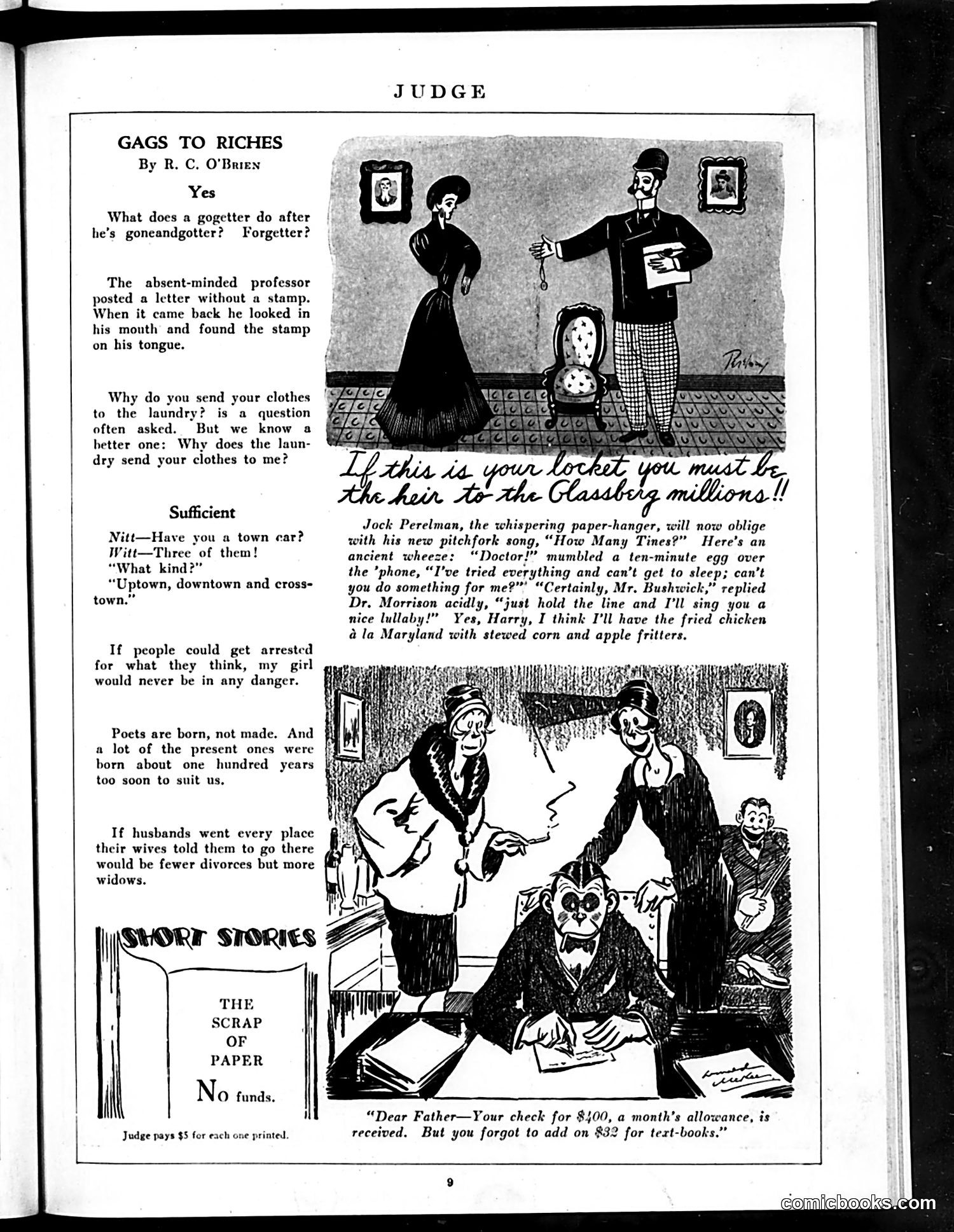
This page from *Judge* magazine collects humor pieces typical of early-20th-century American satirical publishing. The main content includes: **"Gags to Riches"** – A collection of short jokes and quips on everyday topics: absent-minded professors, laundry mishaps, transportation puns, marital relations, and poetry criticism. These are light social observations with no specific political target. **Two cartoons**: The top illustration shows a man displaying clocks to a woman, captioned about "locket" and "Glassware millions." The lower cartoon depicts what appears to be a father figure receiving complaints from three men about a child's allowance—a joke about a son forgetting to request money for textbooks. **"The Scrap of Paper" section** references an old saying about valueless contracts. **Notable**: The page credits Jock Perelman and mentions Dr. Morrison—likely regular *Judge* contributors or recurring comic characters of the era. The humor is domestic, class-conscious (servants, professors, allowances), and assumes a educated, upper-middle-class readership. No specific contemporary political events are referenced.
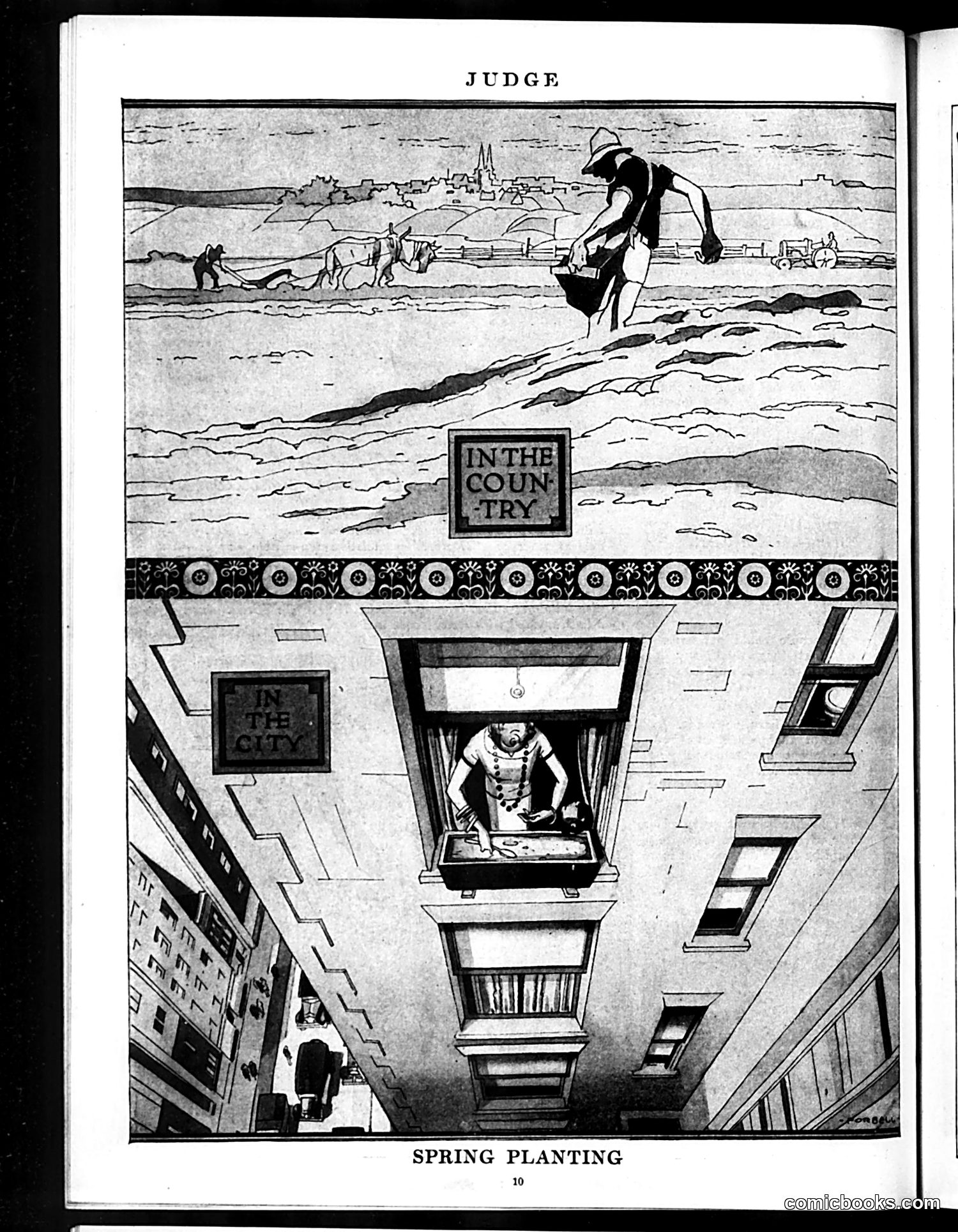
This page from *Judge* magazine presents a two-panel contrast satirizing urban versus rural life. **Top panel ("In the Country"):** Shows a man in a hat actively digging/planting in open countryside, with a village visible in the distance. This represents literal spring planting—agricultural work. **Bottom panel ("In the City"):** Depicts a man at a window of a tall apartment building, appearing to tend a small indoor plant or window box. The perspective looking up the building's facade emphasizes urban confinement. The satire mocks the contrast between genuine rural productivity and the city dweller's diminished, domesticated substitute for farming. The joke suggests urbanites can only simulate "spring planting" in miniature form, unable to engage in real agricultural work. It reflects early 20th-century tensions between rural and urban lifestyles.
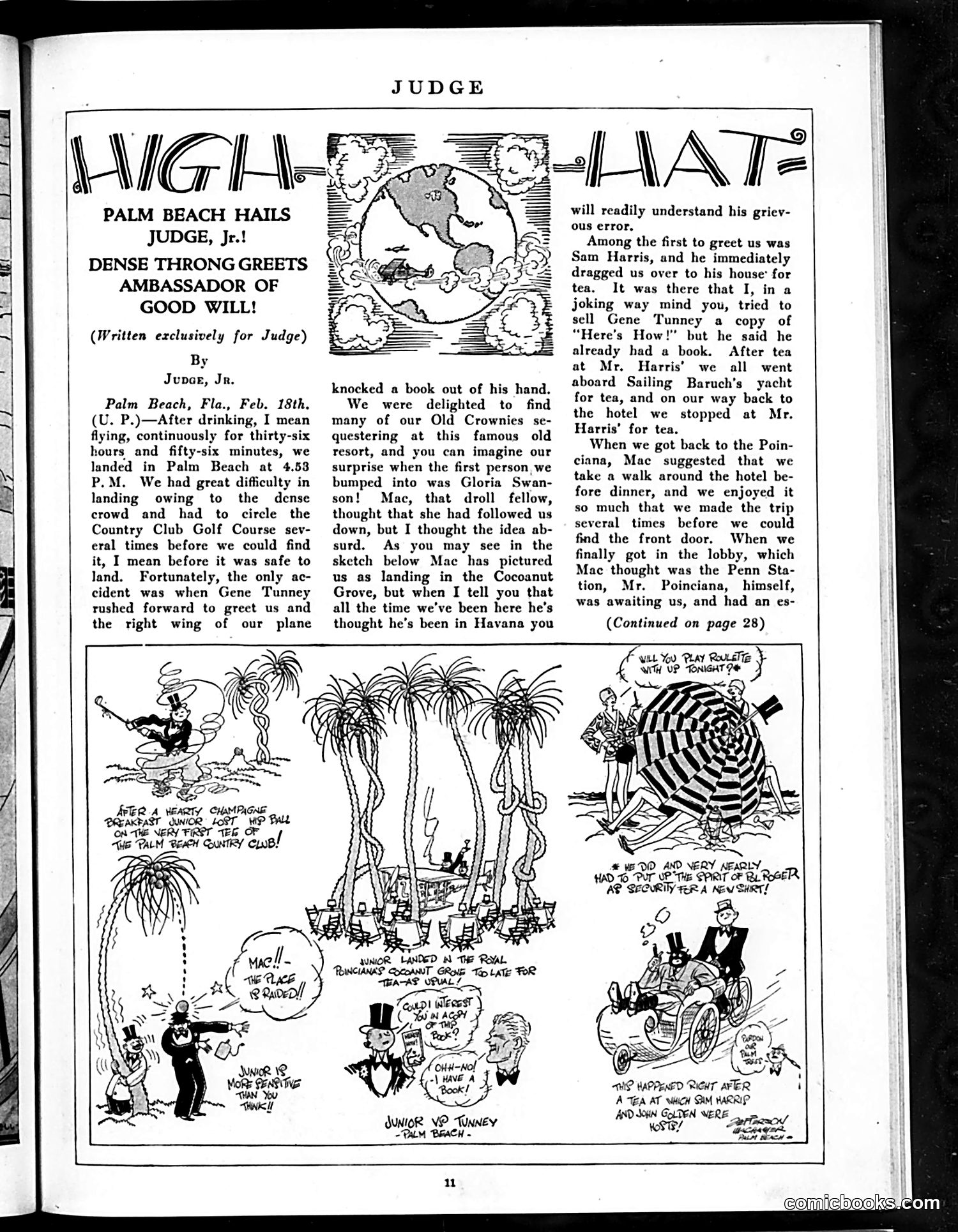
This is a humorous travel column from Judge magazine, written as if by "Judge Jr." It satirizes the wealthy leisure class of 1920s Palm Beach, Florida—a resort destination for the rich and famous. The piece mocks: - **Celebrity sightings**: Gloria Swanson (silent film star) and Gene Tunney (famous boxer) appear casually - **Conspicuous consumption**: Multiple teas at different locations, yacht parties, constant socializing - **Pretentious society figures**: References to Sam Harris (theater producer) and Bernard Baruch (financier) - **Drunken confusion**: The narrator jokes about being "flying" (drunk), and a companion named "Mac" is so disoriented he thinks Palm Beach is Havana or Penn Station The cartoons at bottom show slapstick scenarios: someone attempting roulette, people getting lost in a hotel lobby. The overall tone mocks the frivolous, alcohol-fueled lifestyle of wealthy elites during Prohibition, when drinking was illegal but openly practiced among the affluent.
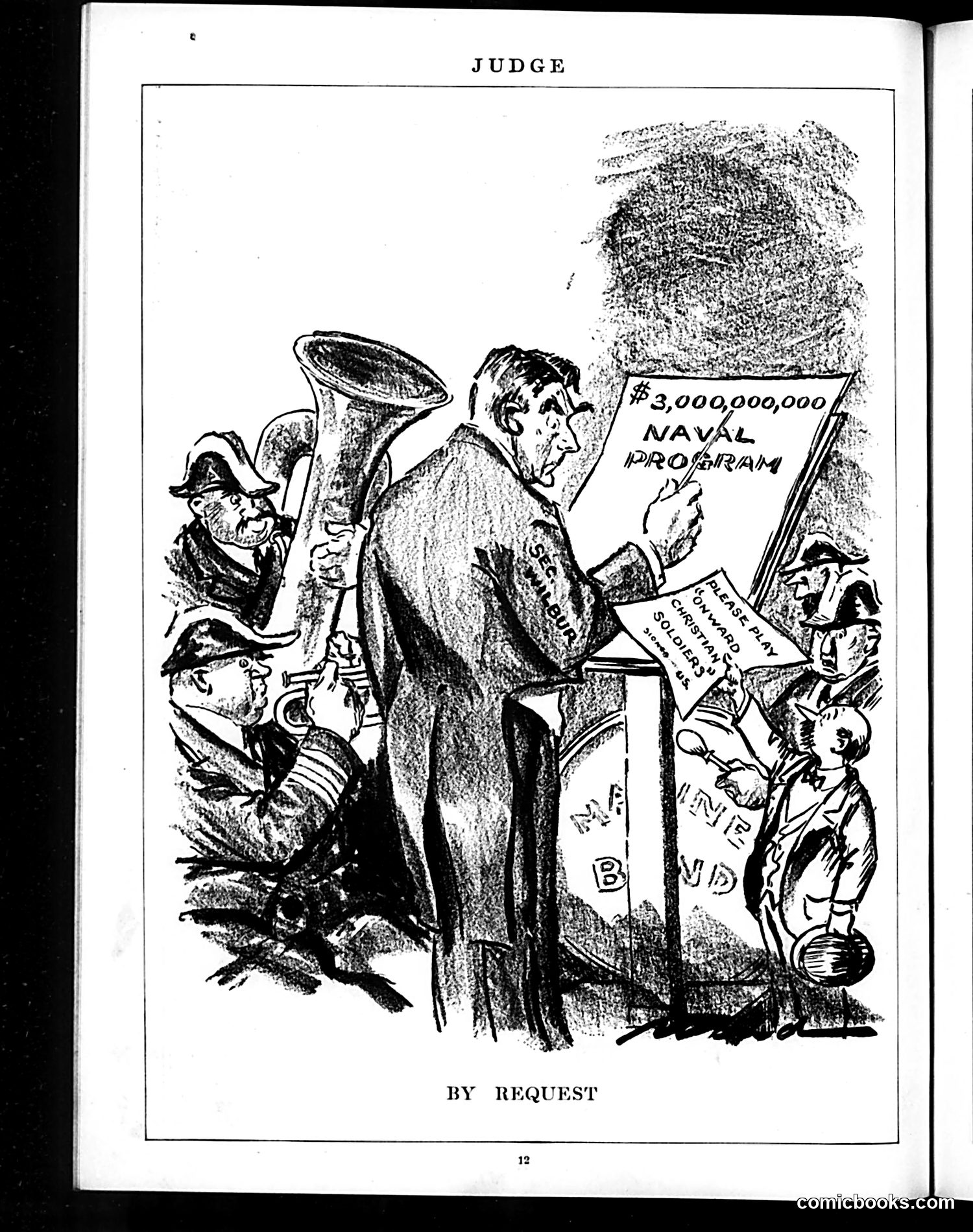
This political cartoon satirizes a **$3,000,000,000 Naval Program** (likely from the early 20th century, when such amounts were massive). A central figure—appearing to be a politician or official—holds the naval program proposal while surrounded by smaller figures representing various interests: **soldiers, workers, and children**. The figures clutch signs reading "Give us," suggesting competing demands for government spending. The satire critiques how a massive military budget request must satisfy multiple constituencies "by request"—various political and social groups lobbying for resources. The towering pile of money in the background emphasizes the scale of expenditure. The cartoon suggests the naval program is being promoted less on strategic merit than on political pressure from multiple directions seeking federal funds.
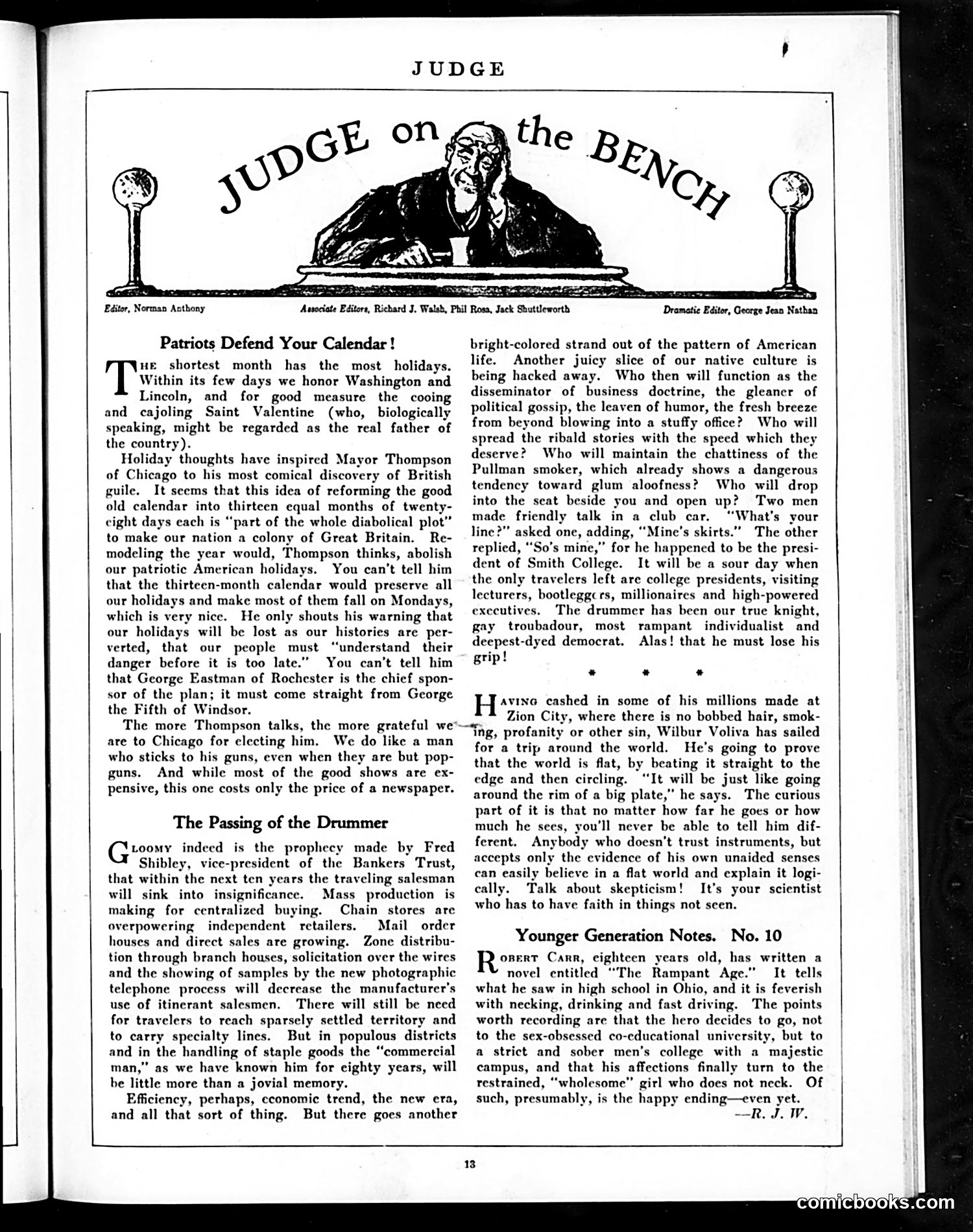
This page from *Judge* magazine contains satirical editorials attacking two targets: **"Patriots Defend Your Calendar"** mocks Chicago Mayor William "Big Bill" Thompson's paranoid opposition to calendar reform (a 13-month proposal). Thompson absurdly claimed the plan was a British plot to abolish American holidays and colonize the U.S. The author ridicules Thompson's irrational fear-mongering while praising his entertainment value—Thompson is portrayed as a comical demagogue wielding "popguns" rather than legitimate arguments. The reference to "George the Fifth of Windsor" suggests the author sees Thompson's anti-British sentiment as overwrought. **"The Passing of the Drummer"** elegizes the traveling salesman, whose decline the author attributes to mass production and chain stores. Rather than celebrate modern efficiency, the piece laments losing the salesman's role as purveyor of gossip, humor, and human connection in office culture. The drummer is romanticized as a democratic, individualistic figure whose absence will make business culture sterile. Both pieces exemplify *Judge*'s satirical tone: defending tradition and personality against modernization and centralization.
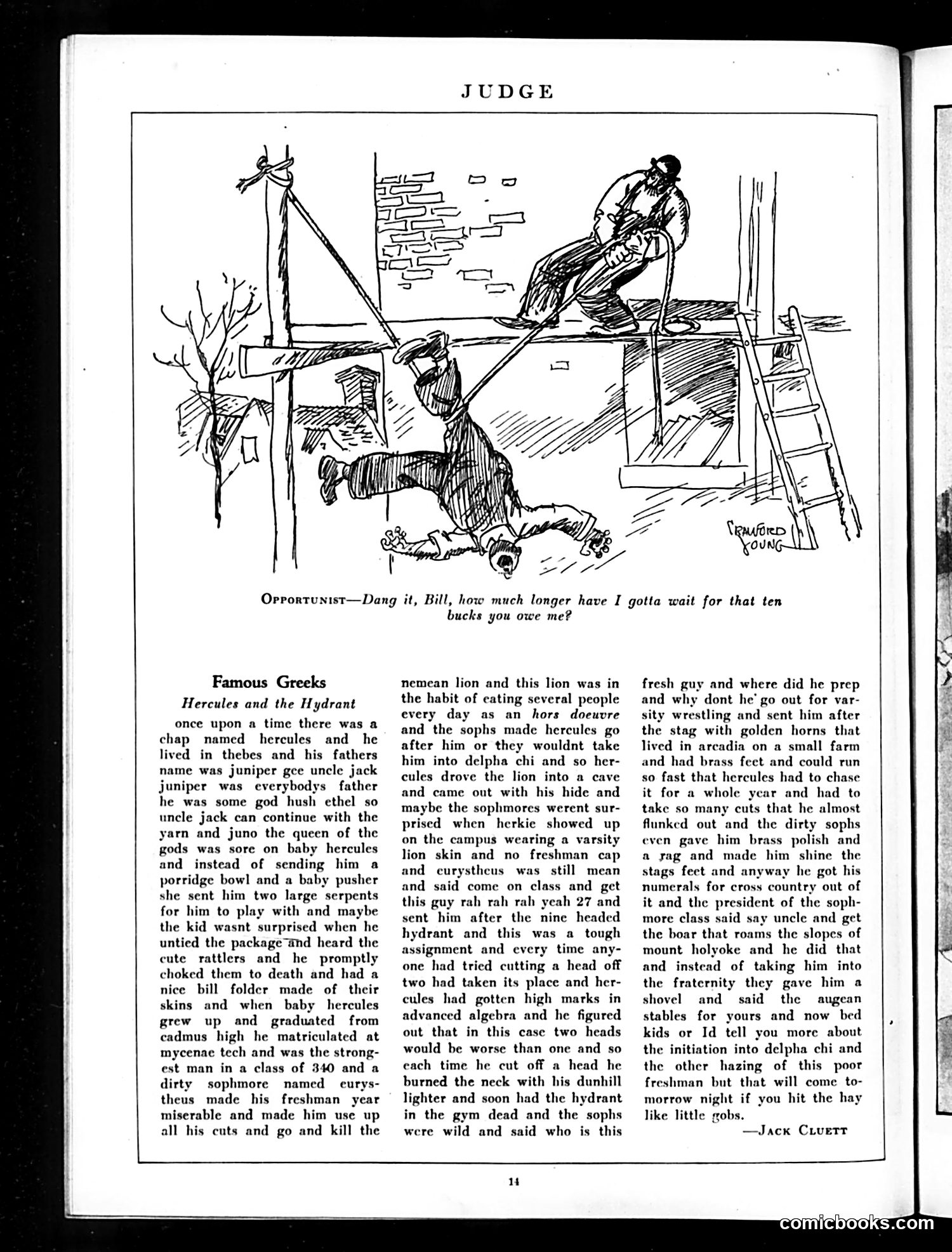
**The Cartoon:** The top image shows a construction worker on scaffolding speaking to another worker below, asking when he'll repay a ten-dollar debt. This is labeled "Opportunist"—a straightforward satirical jab at someone using a moment of vulnerability (the worker is literally trapped high on scaffolding) to demand repayment. The humor relies on the callousness of dunning someone in an awkward position. **The Article:** "Famous Greeks: Hercules and the Hydrant" is mock-heroic satire transplanting classical mythology into college life. The author reimagines Hercules's Twelve Labors as fraternity hazing at "Mycenae Tech" and "Delpha Chi" (Delta Chi fraternity). Sophmores torment freshman "Herkie" with absurd tasks—killing a lion, defeating a multi-headed hydrant (fire hose), chasing a stag—using modern details (Dunhill lighters, varsity letters) to ridicule both classical pretension and college hazing culture. The satire mocks the brutality of fraternity initiation by framing it as mythologically "epic" while revealing its actual pettiness.
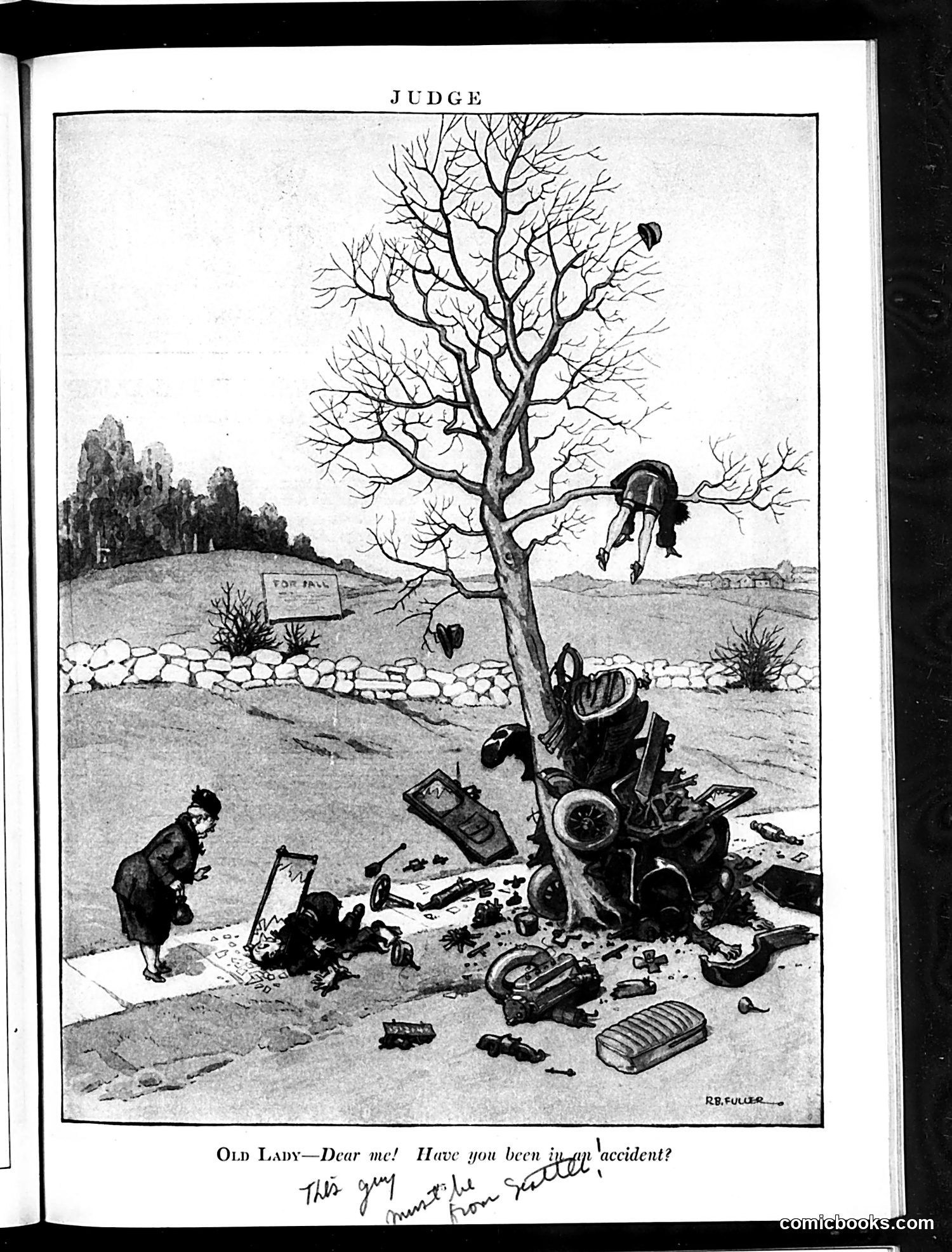
This single-panel cartoon depicts a domestic accident scene. An elderly woman (the "Old Lady" of the caption) surveys the debris of what appears to be a mechanical mishap beneath a bare tree. Scattered around are broken mechanical parts, wheels, and household items suggesting an automobile or motorized device has malfunctioned or crashed. The humor lies in the obvious answer to her concerned question—the wreckage itself speaks volumes. The cartoon satirizes early 20th-century automobile culture, where mechanical failures and accidents were common enough to be cartoon material. The woman's formal concern ("Dear me!") contrasts with the catastrophic mess, creating ironic comedy typical of Judge magazine's satirical style. The artwork is credited to what appears to be "R.B. Fuller" or similar.
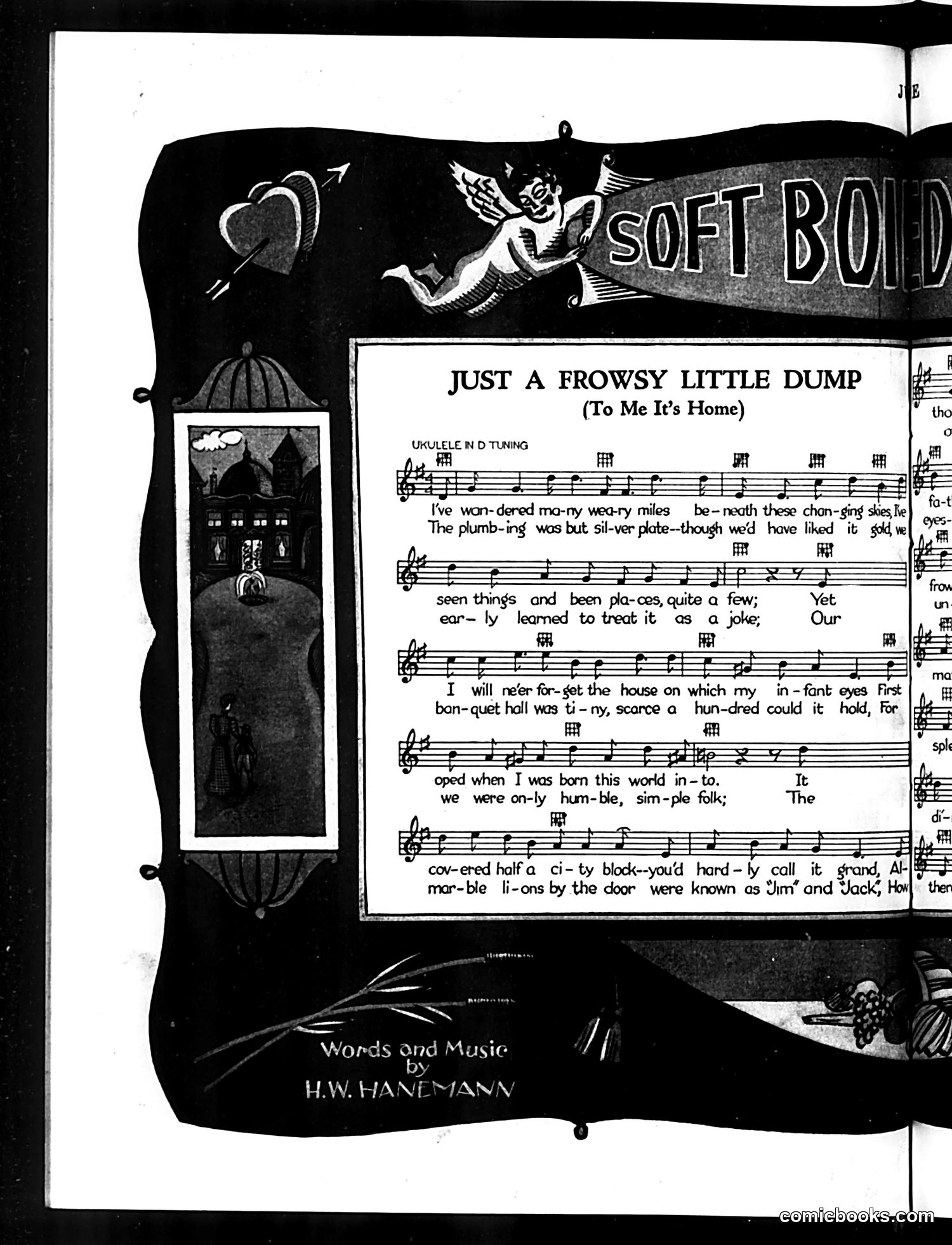
This is a sentimental song sheet from *Judge* magazine, with lyrics and musical notation by H.W. Hanemann. It's not political satire but rather nostalgic humor for a general audience. The song humorously contrasts a modest childhood home—described as a humble, "frowsy little dump"—with the speaker's later travels to grand places. The lyrics suggest the singer has seen marble lions and fancy architecture elsewhere, yet maintains affection for their humble origins: a simple folk dwelling where a banquet hall could barely hold a hundred people. The decorative border features a cupid and romantic imagery typical of 1920s-era sheet music design. The "ukulele in D tuning" notation indicates this was intended for casual home performance—the ukulele being a popular instrument for amateur musicians of that era. The satire is gentle: poking fun at sentimentality and nostalgia rather than addressing political issues.
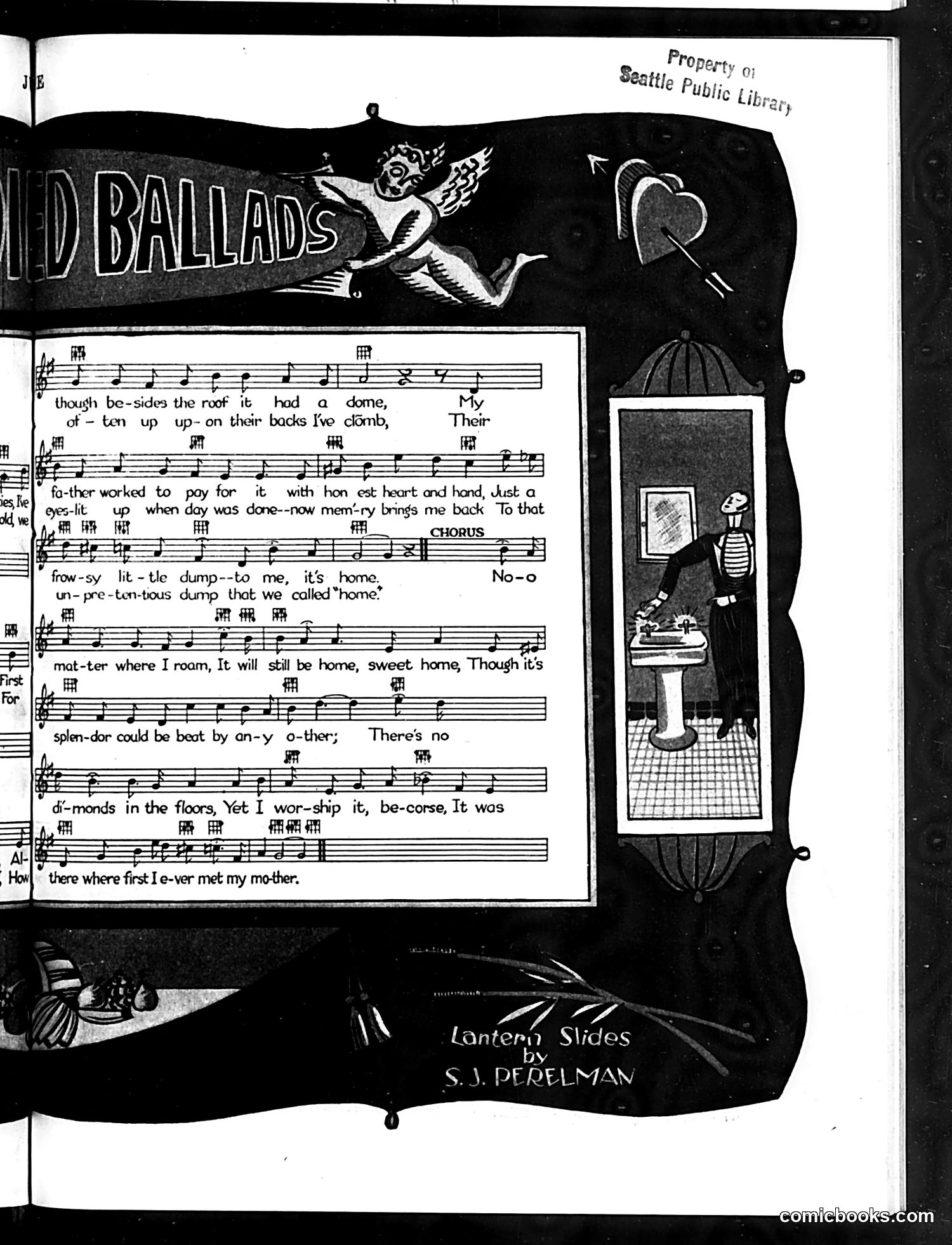
This page presents sheet music for "Old Ballads"—specifically a sentimental song about home, likely a variation on "Home, Sweet Home." The lyrics emphasize modest origins: a humble, unpretentious dwelling where the singer's father worked honestly to provide, remembered fondly despite its humble state. The decorative border features a cherub and heart motif typical of early 20th-century sentimental design. A lantern slide illustration shows a domestic interior scene. **For modern readers:** This represents Judge magazine's occasional inclusion of popular sentimental songs alongside satire. The nostalgic "poor but honest" homestead narrative was culturally resonant in this era—appealing to middle-class anxieties about maintaining respectability despite modest means. S.J. Perelman is credited as the artist, suggesting this may accompany satirical commentary (though the specific satire isn't visible here). The page demonstrates how Judge balanced sharp social criticism with mainstream popular entertainment.
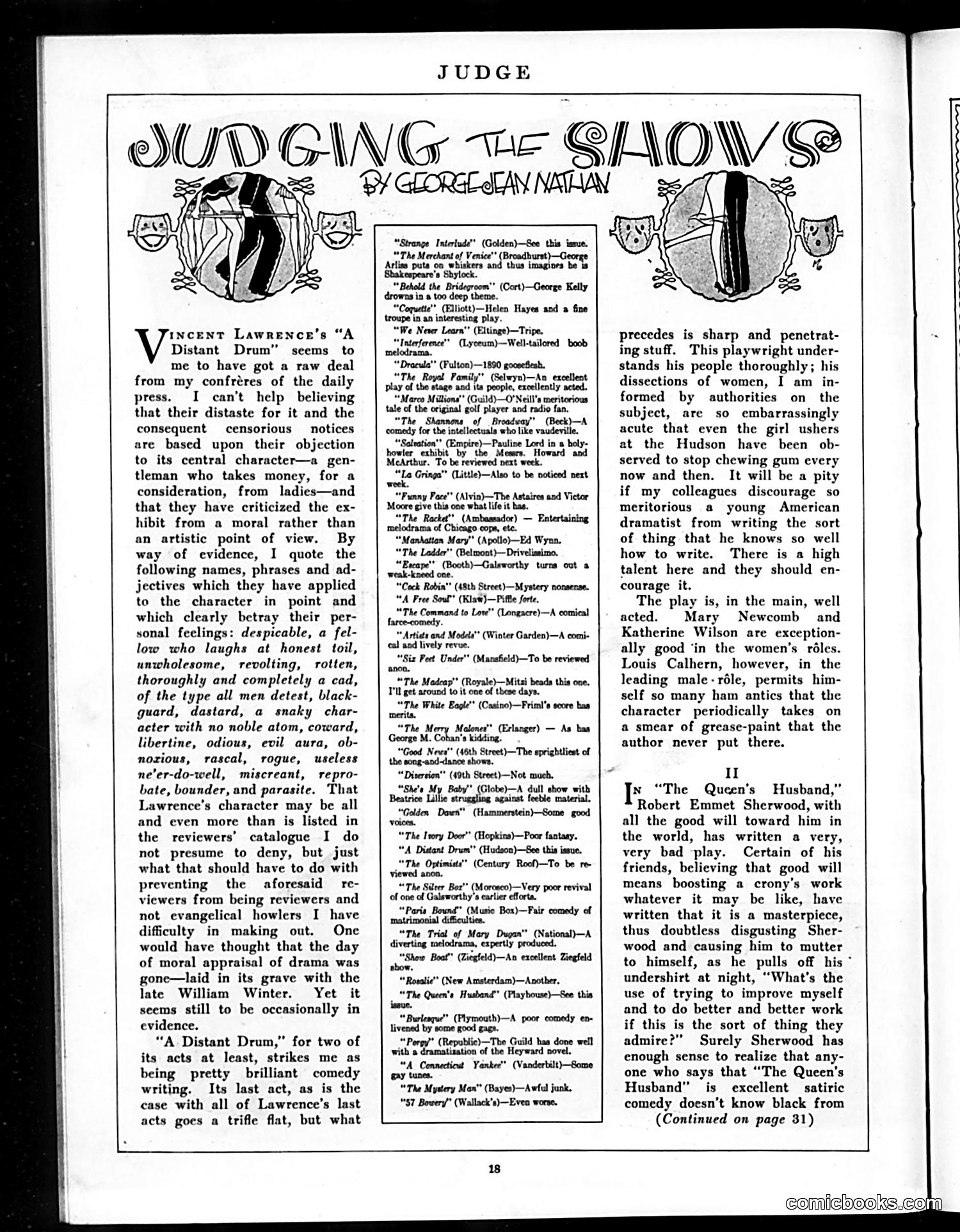
This page features theater criticism by George Jean Nathan, a prominent drama critic of the 1920s. The left column defends Vincent Lawrence's play "A Distant Drum" against moralistic attacks from newspaper reviewers who condemned its protagonist—a man who accepts money from women. Nathan argues critics applied harsh moral judgments ("despicable," "cad," "blackguard") rather than evaluating the *artistic* merit of the work. This reflects a cultural debate of the era: whether theater should be judged by moral standards or aesthetic ones. Nathan advocates for artistic freedom, suggesting puritanical reviewing undermines drama's evolution beyond "William Winter" (a famous 19th-century moralist critic). The right column lists current Broadway productions with brief, often caustic reviews—typical of Judge's satirical theater coverage. The overall argument champions theatrical sophistication over prudish censoriousness, a progressive stance for the late 1920s.
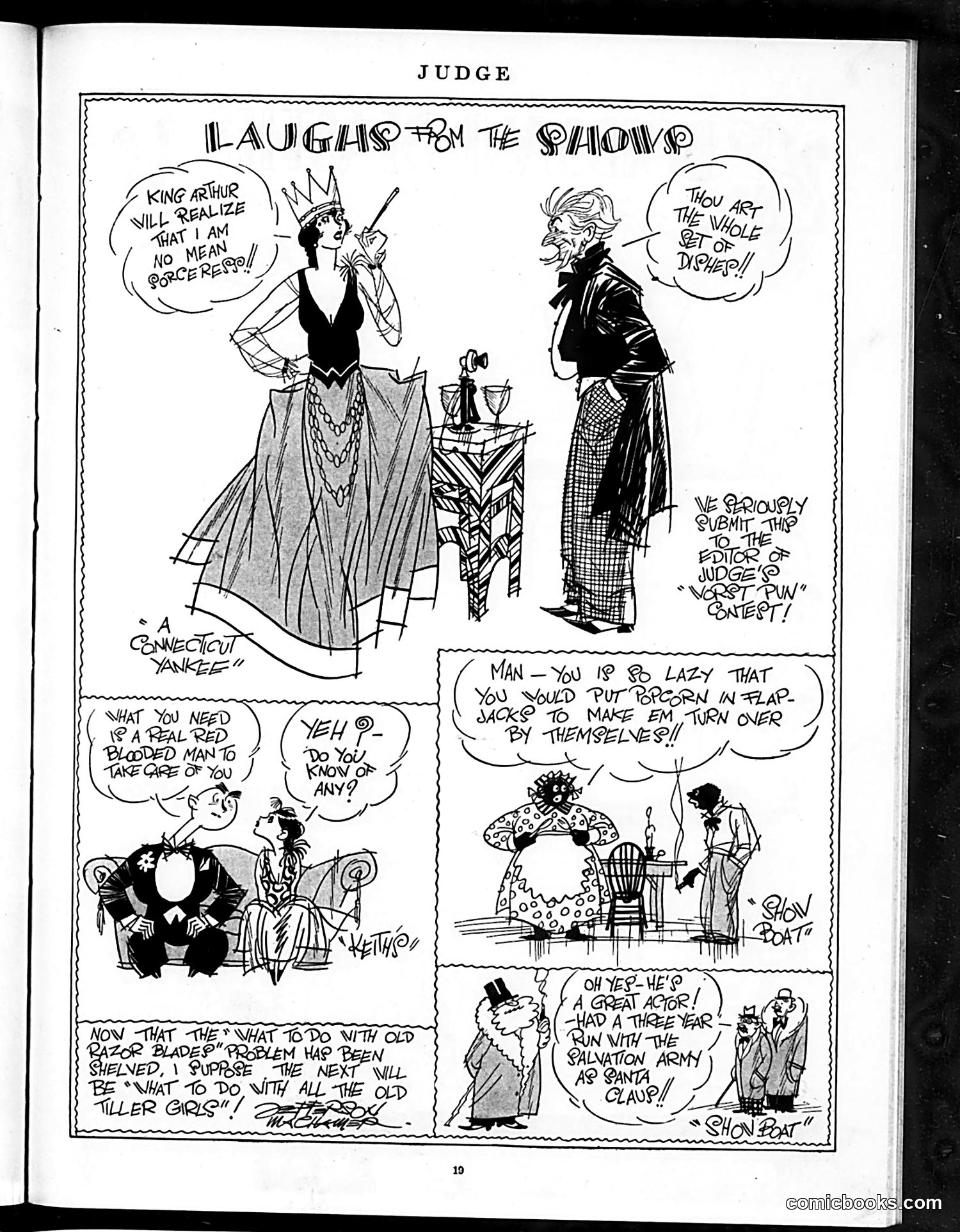
This page contains multiple comic panels satirizing political and social figures of its era (likely 1920s-30s based on style). **Top panel**: A woman dressed as "A Connecticut Yankee" confronts a disheveled man, likely representing a political opponent. The reference is to Mark Twain's *A Connecticut Yankee in King Arthur's Court*, used here to mock someone's outdated thinking or approach. **Middle panels**: Comic exchanges about needing "a real red-blooded man" and references to "old razor-sharp" problems, suggesting political disagreements about how to handle governance and social issues. **Bottom panels**: References to "old killer girls" and Santa Claus suggest satire about recurring political problems or figures that persist despite attempts to resolve them—the joke being that old problems keep returning. The overall theme appears to be mockery of political laziness or circular, unresolved debates, though specific figures remain unclear without additional historical context.
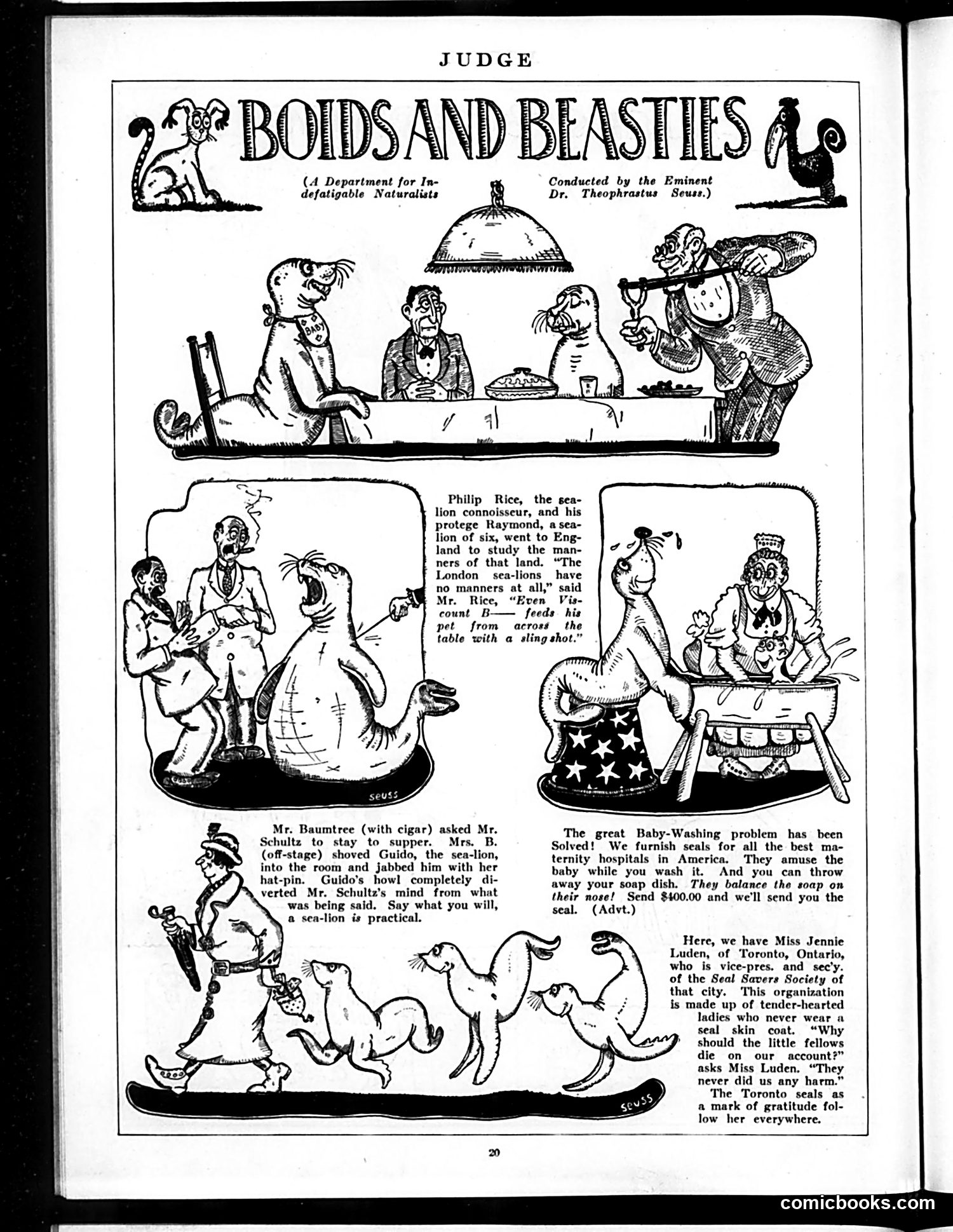
This humorous column by "Dr. Theophrastus Seuss" (likely pseudonymous) uses absurdist animal stories to satirize human behavior and social pretensions. **The satire:** - **Philip Rice story**: Mocks English upper-class rudeness by describing even trained sea-lions adopting crude dining manners (feeding pets with slingshots) - **Baumtree/Schults anecdote**: Ridicules social awkwardness—a woman's violent hat-pin jab distracts guests, yet the narrator calls sea-lions "practical" (ironic understatement) - **"Baby-Washing" ad**: Parodies absurd commercial solutions, advertising seals as babysitters while mothers wash dishes - **Miss Luden story**: Gentle mockery of sentimental animal-rights activists who adopt performative ethics (refusing seal coats) while seals follow them like groupies The humor relies on treating animals as stand-ins for human follies—pretension, rudeness, and sentimentality—with deadpan delivery.
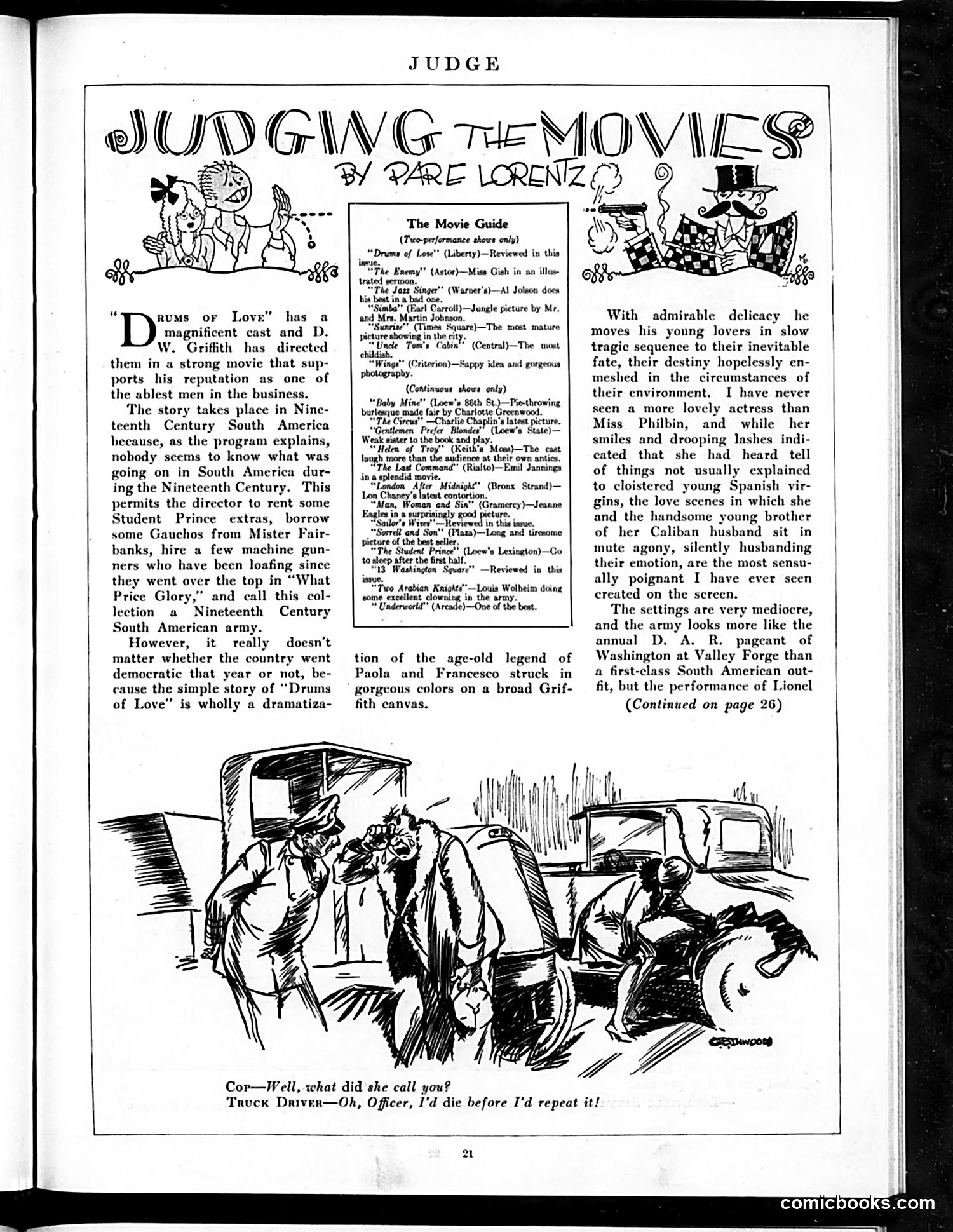
This is a satirical film review column by Pare Lorentz critiquing D.W. Griffith's *Drums of Love*. The humor targets both the film's lazy production and Griffith's reputation as a prestigious director. Lorentz mocks the film for being set in vague "Nineteenth Century South America" solely because filmmakers could cheaply repurpose extras from other productions (*The Student Prince*, Fairbanks films) and rent leftover soldiers from the WWI film *What Price Glory*—essentially admitting the setting is arbitrary costume drama rather than historically grounded storytelling. The accompanying cartoon depicts a traffic accident with a truck driver and cop, with dialogue playing on crude language—the driver saying he'd "die before repeating" what the woman called him. This illustrates common street humor of the era. The "Movie Guide" box lists current theatrical releases with brief, often dismissive reviews, reflecting Judge's satirical approach to 1920s cinema.
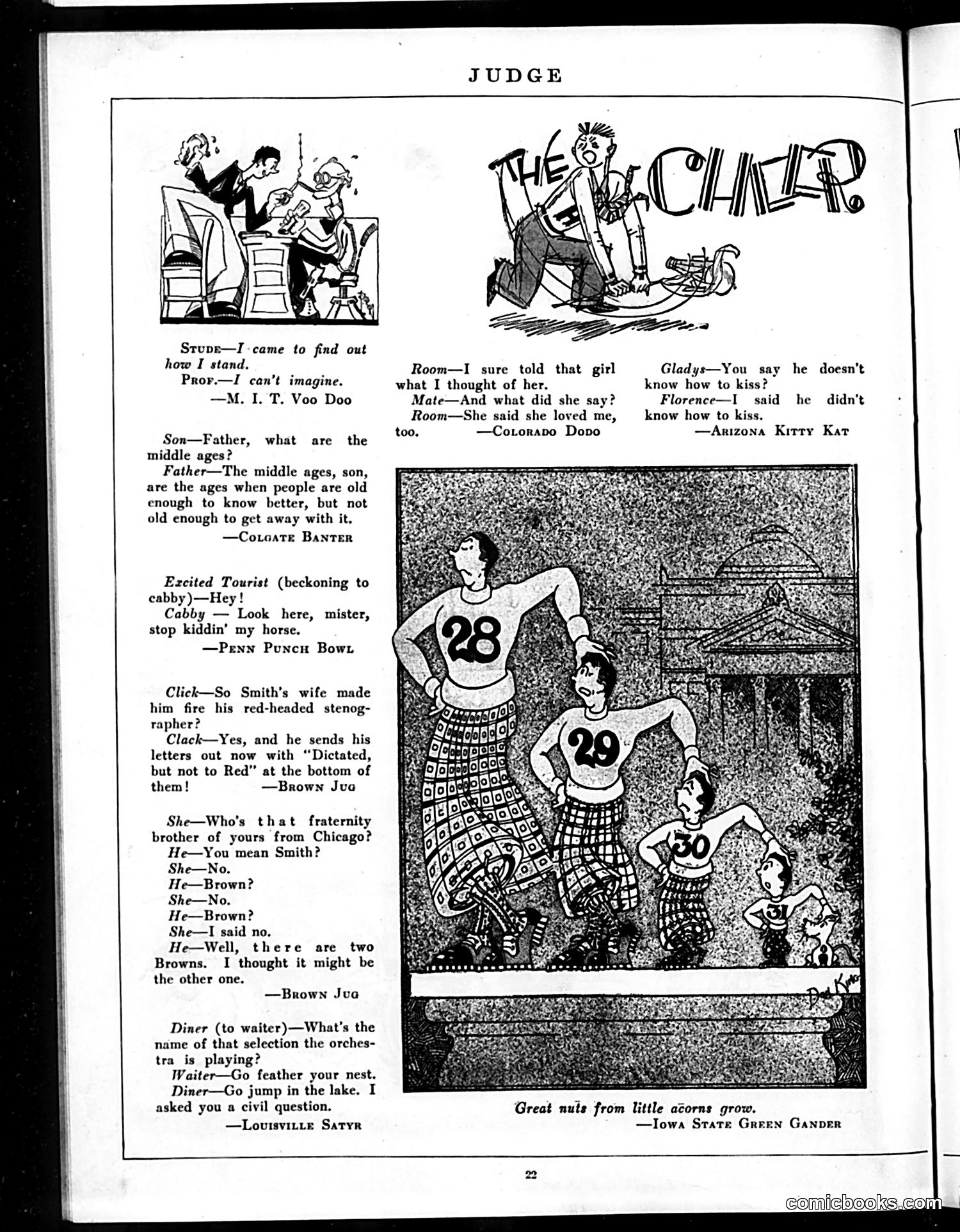
This is a page of short humorous jokes and quips from *Judge* magazine, a satirical publication. The content consists mostly of one-liner jokes submitted by readers from various colleges (M.I.T., Colorado, Arizona, etc.) and other sources. The humor is straightforward campus and domestic comedy: - **The "middle ages" joke** plays on double meaning—literal historical period versus the metaphorical age when one knows better but can't escape consequences - **The "Smith's wife" bit** jokes about office romance and jealousy - **The "Browns" exchange** is a simple back-and-forth about confusion over similar names - **The diner/waiter exchange** features mock-rude retorts The large cartoon at right shows a woman and progressively smaller children numbered 28-31, illustrating the caption about "great nuts from little acorns"—a joke about large families. These are gentle, period-appropriate jokes typical of 1920s-era college humor, with no deep political content or caricature of identifiable figures.
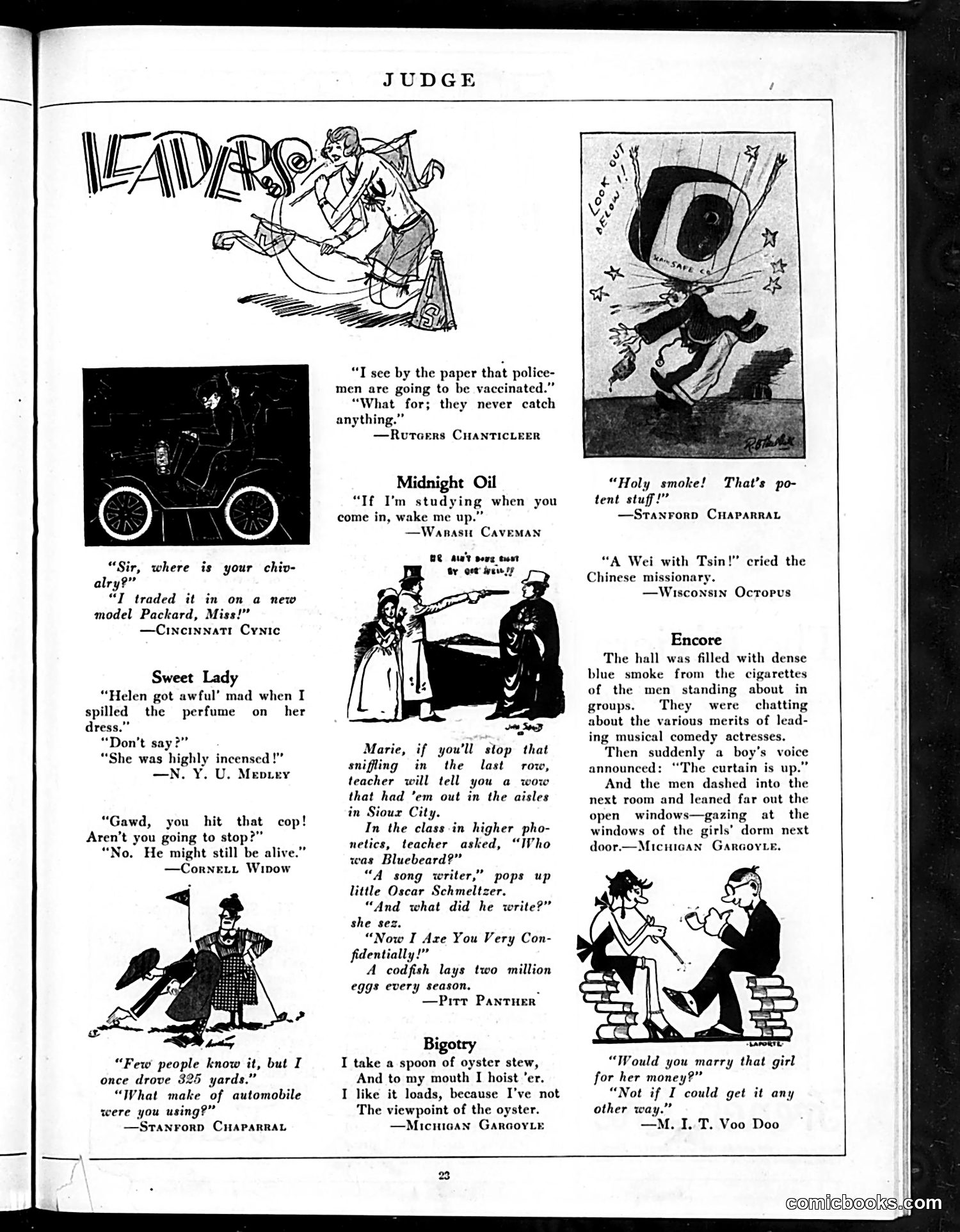
This page from **Judge** (a satirical weekly) collects humorous one-liners and jokes attributed to colleges and universities ("Cincinnati Cynic," "Cornell Widow," "Wisconsin Octopus," etc.). These were actual college humor magazines that contributed material. The jokes mock everyday situations: auto troubles, perfume mishaps, police ineffectiveness, and romantic rejection. The cartoon illustrations show typical early-20th-century scenes—old cars, courtship, classroom humor. One recurring theme: police incompetence (Rutgers's quip about vaccination and catching criminals). The "Bigotry" section features crude ethnic humor about oyster consumption. This represents **collegiate humor journalism**—a popular format where different college publications competed to supply witty one-liners to national magazines. The content reflects period attitudes toward class, ethnicity, and gender.
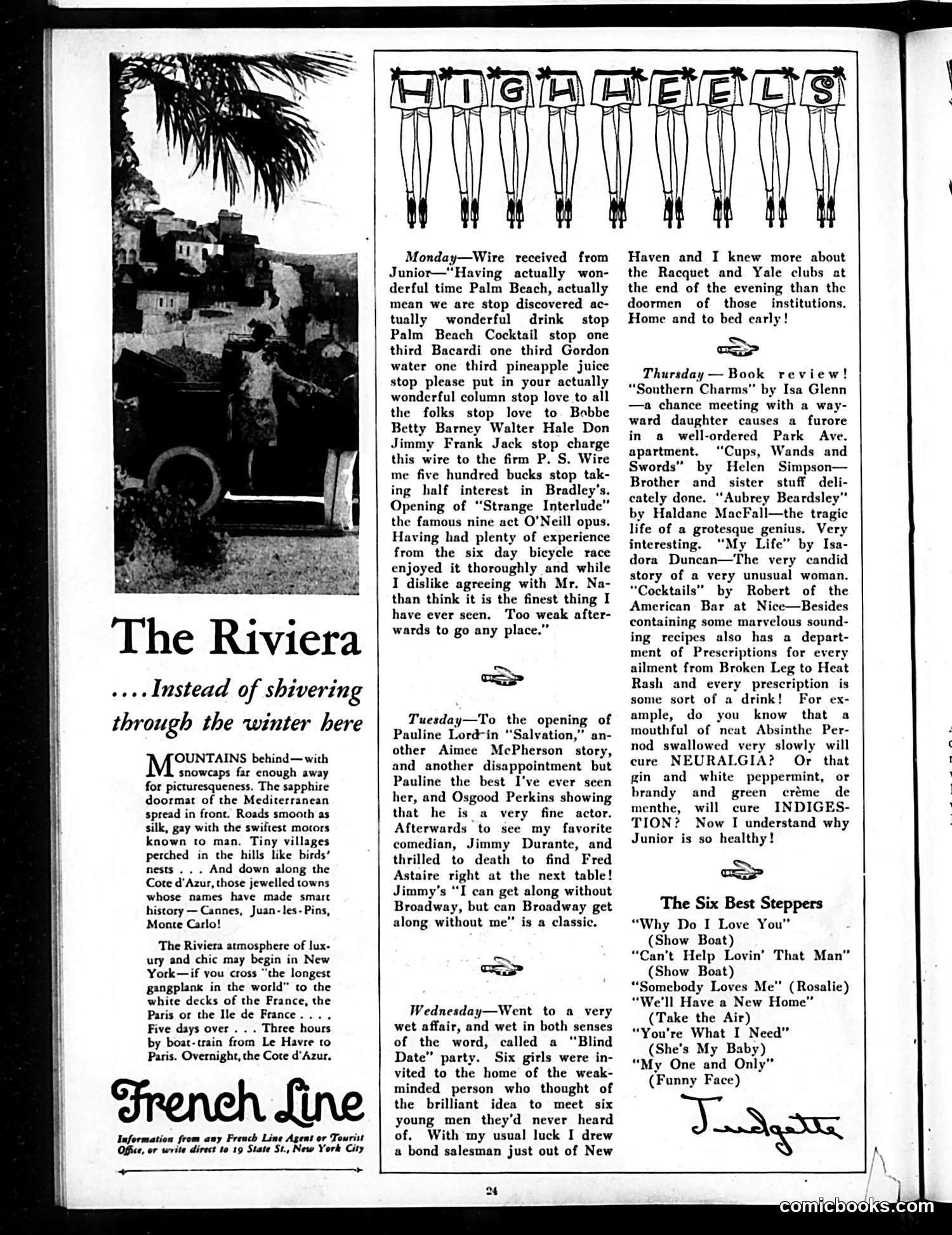
This page is primarily **advertising and lifestyle commentary**, not political satire. The left side promotes French Line steamship travel to the Riviera as an escape from winter—emphasizing luxury, scenic beauty, and sophistication (Monte Carlo, Cannes, Juan-les-Pins). The right side features a society gossip column documenting a week in the life of an affluent New Yorker: attending Broadway openings featuring contemporary stars (Pauline Lord, Jimmy Durante, Fred Astaire), "blind date" parties, and book reviews. References include Eugene O'Neill's "Strange Interlude," Aimee McPherson (a famous evangelist whose scandals inspired theatrical adaptations), and Isadora Duncan's memoir. The humor is gentle—poking fun at upper-class social rituals, a boring bond salesman, and absurdly naming cocktails as medical cures. The page reflects **1920s prosperity-era priorities**: theatrical culture, transatlantic travel, romantic social adventures, and conspicuous leisure among the wealthy.
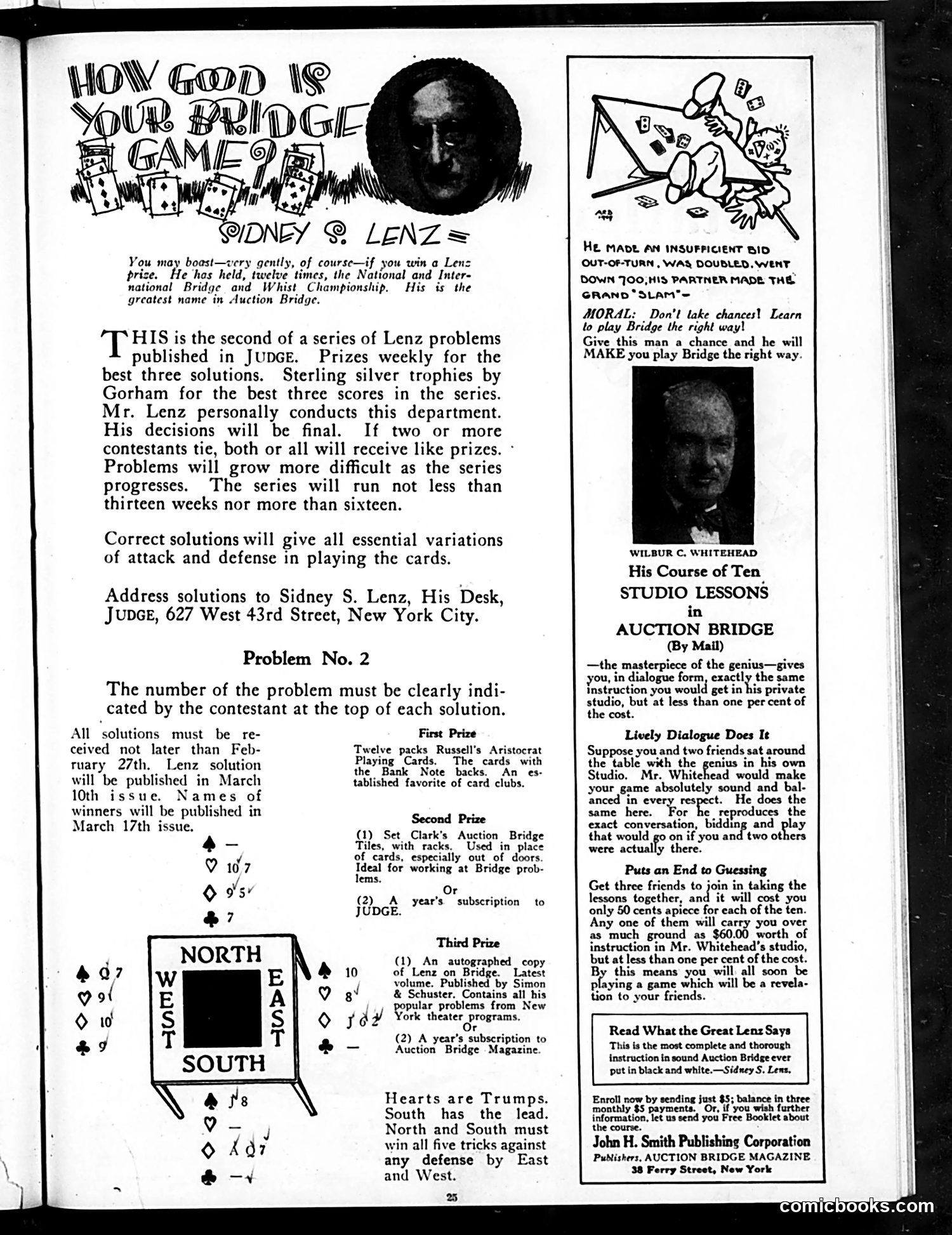
This page promotes a bridge card game competition series sponsored by **Sidney Lenz**, a legendary bridge champion (referenced as holding "twelve times" the National and International Bridge Championship). The magazine is running a 13-16 week series of increasingly difficult bridge problems with prize competitions. The cartoon at top-right satirizes poor bridge playing: a man made an insufficient bid out-of-turn, was doubled, and went down 100 points while his partner achieved a grand slam—illustrating the "moral" that players should learn proper technique rather than take chances. The page also advertises **Wilbur C. Whitehead's** mail-in bridge instruction course, positioning it as affordable ($5 down, three $5 payments) alternative to expensive private lessons, claiming to reproduce his expert guidance through dialogue format. The actual bridge problem shows a hand diagram requiring solvers to demonstrate how North-South can win all five tricks with hearts as trump against any defense.
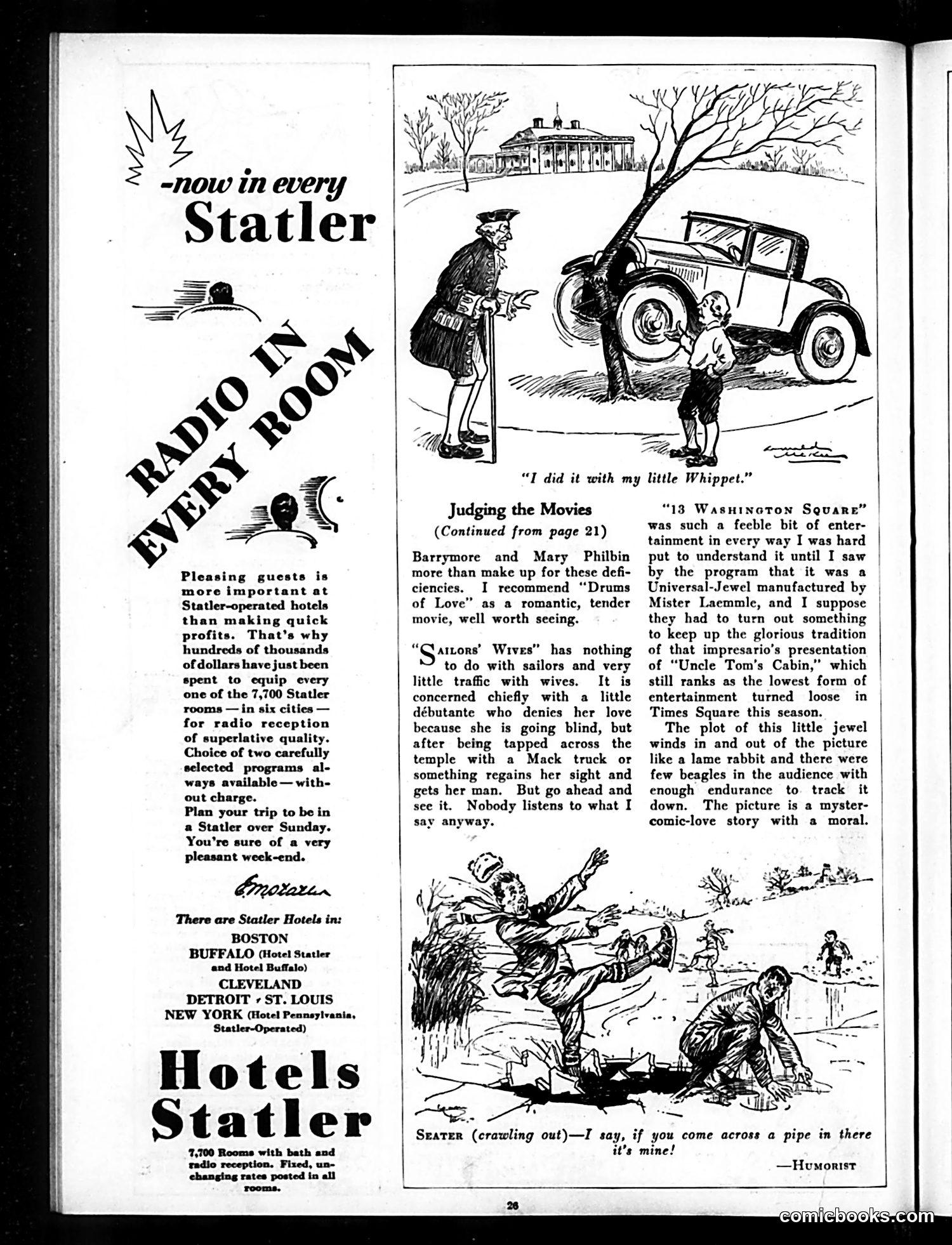
This page is primarily **advertising** for Hotels Statler (a major hotel chain), featuring a promotional article about radio reception in their rooms. The cartoon depicts two working-class men—a "seater" (theater usher) and another worker—arguing over ownership of a pipe, presumably backstage or in a building's infrastructure. The humor relies on the literal interpretation: the seater has literally crawled through pipes and now claims any pipe he finds as "his." This appears to be gentle, non-political humor about blue-collar workers and workplace territoriality. The "Judging the Movies" column reviews three films with dismissive wit, mocking their plots and production values. The reviewer particularly criticizes "18 Washington Square" as a Universal-Jewel picture, suggesting even major studios produced poor entertainment. The overall tone reflects 1920s-era magazine humor: working-class comedy, film criticism, and corporate advertising presented as content—typical of Judge's satirical approach to American life.
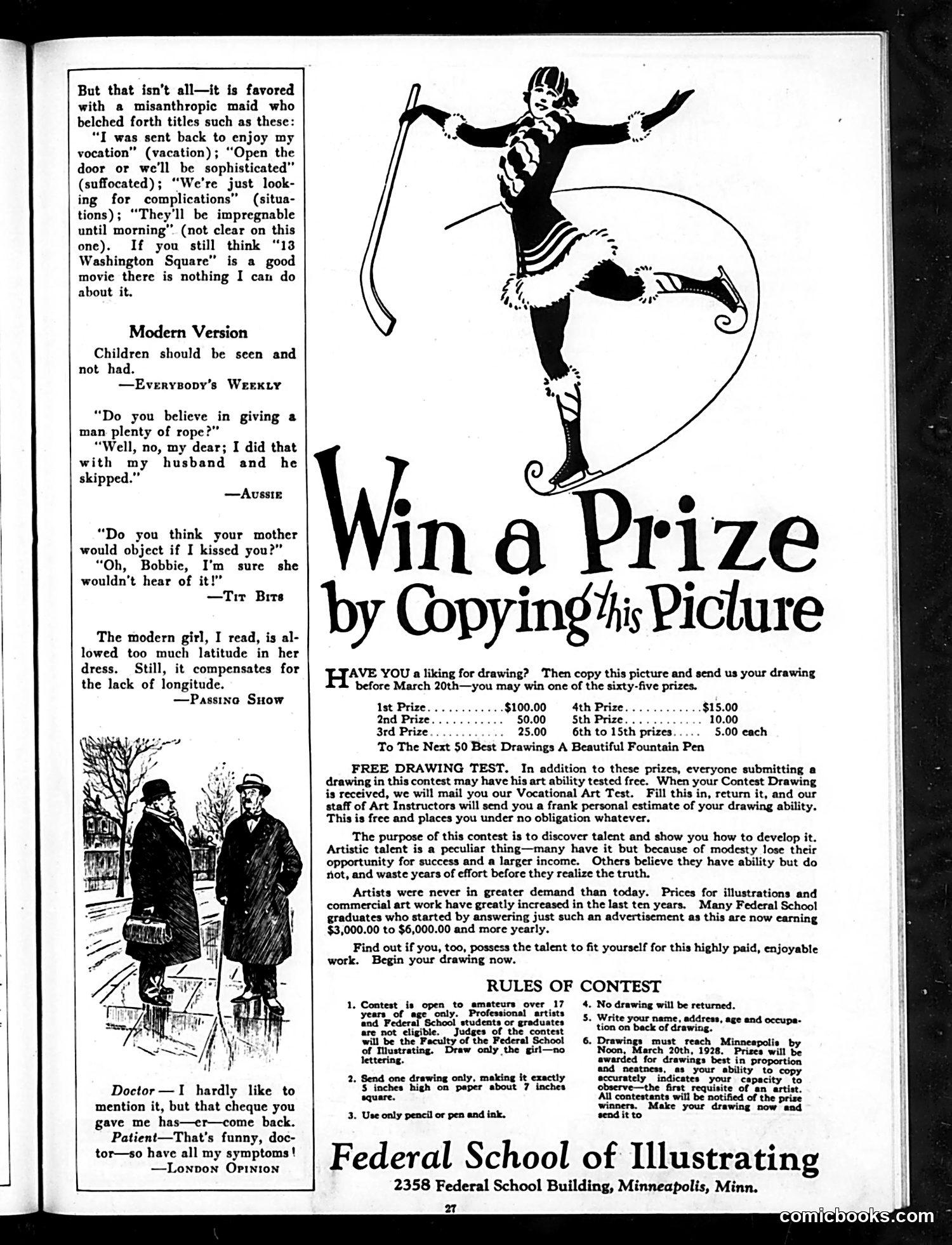
This page is primarily **advertising for the Federal School of Illustrating**, with humorous filler content typical of Judge magazine. ## Main Content: Drawing Contest Advertisement The central feature is a "Win a Prize" contest inviting amateur artists to copy an illustration of a stylized female figure in 1920s fashion (short skirt, fur trim, theatrical pose). The school offers cash prizes ($100 first place down to $5 for 6th-15th) plus free vocational art testing to all entrants. ## The Satire/Humor Elements The page includes several joke items—mostly brief quips about modern manners, gender relations, and fashion. Notable examples: - A maid misusing sophisticated vocabulary - A joke about giving a husband "rope" (implying he left) - Commentary on women's dress lacking "longitude" (length) These are generic period humor—not political satire, but social commentary on 1920s mores and the "modern girl." ## Context for Modern Readers This represents **vocational school marketing** from 1928, targeting young people (especially women) with promises of lucrative commercial art careers. The surrounding jokes reflect 1920s attitudes about gender, language, and social propriety.
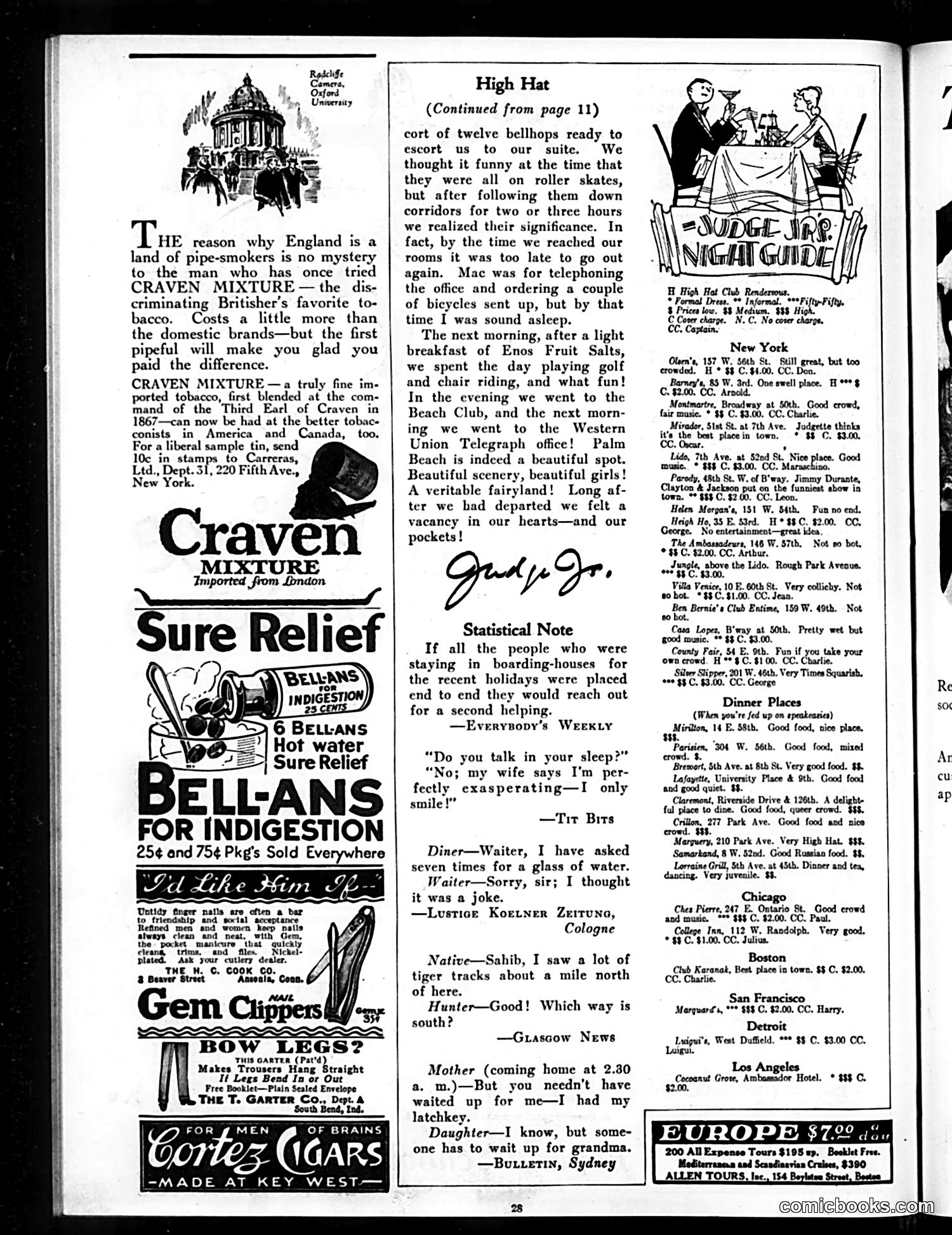
This page is primarily **advertisements and humor** from Judge magazine, a satirical weekly publication. The cartoons and jokes reflect early 20th-century American social anxieties. The **"High Hat" article** (continued story) satirizes wealthy tourists visiting Palm Beach—mocking their leisure activities, extravagance, and the absurdity of bellhops on roller skates. The humor targets upper-class leisure culture. The **advertisements** reveal period concerns: tobacco as sophisticated (Craven Mixture), digestive remedies (Bell-Ans for indigestion), physical "defects" requiring correction (Gem Clippers for nails, devices for "bow legs"), and the listing of nightclubs and dinner establishments reflects Prohibition-era speakeasy culture (note coded references like "H*" and "CC"). The **short jokes** mock domestic life, class differences, and British-American social customs—typical of Judge's satirical humor targeting middle and upper-class readers' pretensions and everyday frustrations.
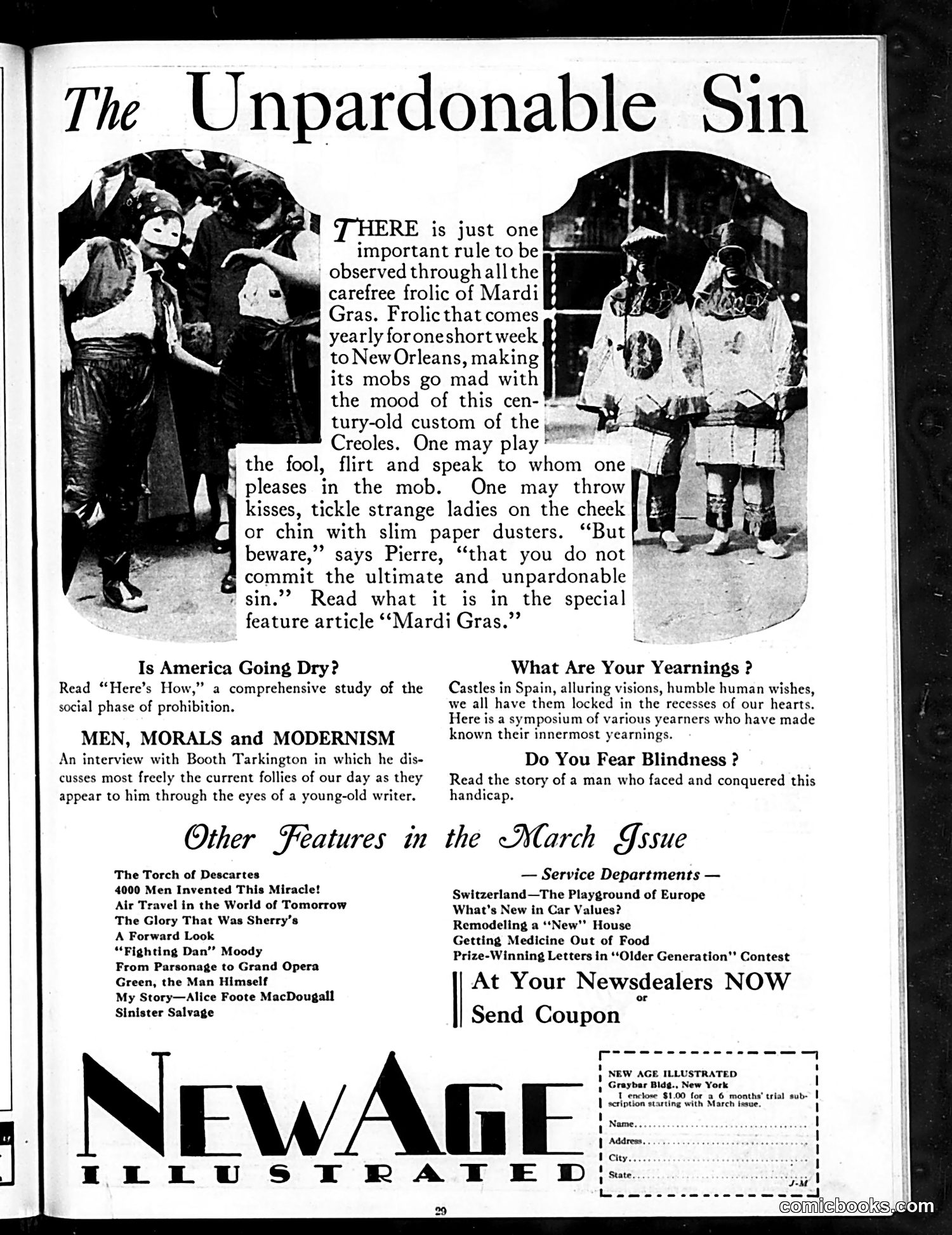
This page advertises Judge magazine's March issue, featuring a satirical piece on Mardi Gras in New Orleans. The main article teases a mysterious "unpardonable sin" one must avoid during Mardi Gras festivities—the text promises readers will discover what this transgression is in the full feature. The accompanying photographs show costumed revelers in traditional Mardi Gras dress. A character named Pierre warns that while the carnival permits foolishness, flirtation, and pranks (like tickling with "slim paper dusters"), there exists one forbidden behavior. The satire likely plays on Mardi Gras's reputation for moral looseness and license, contrasting the celebration's permissiveness with some specific unspoken social boundary. The dramatic framing—calling it "ultimate and unpardonable"—suggests ironic commentary on either carnival excess or the hypocrisy of otherwise respectable society briefly abandoning propriety. The page is primarily promotional, listing other March features including Prohibition-era content and interviews with contemporary figures.
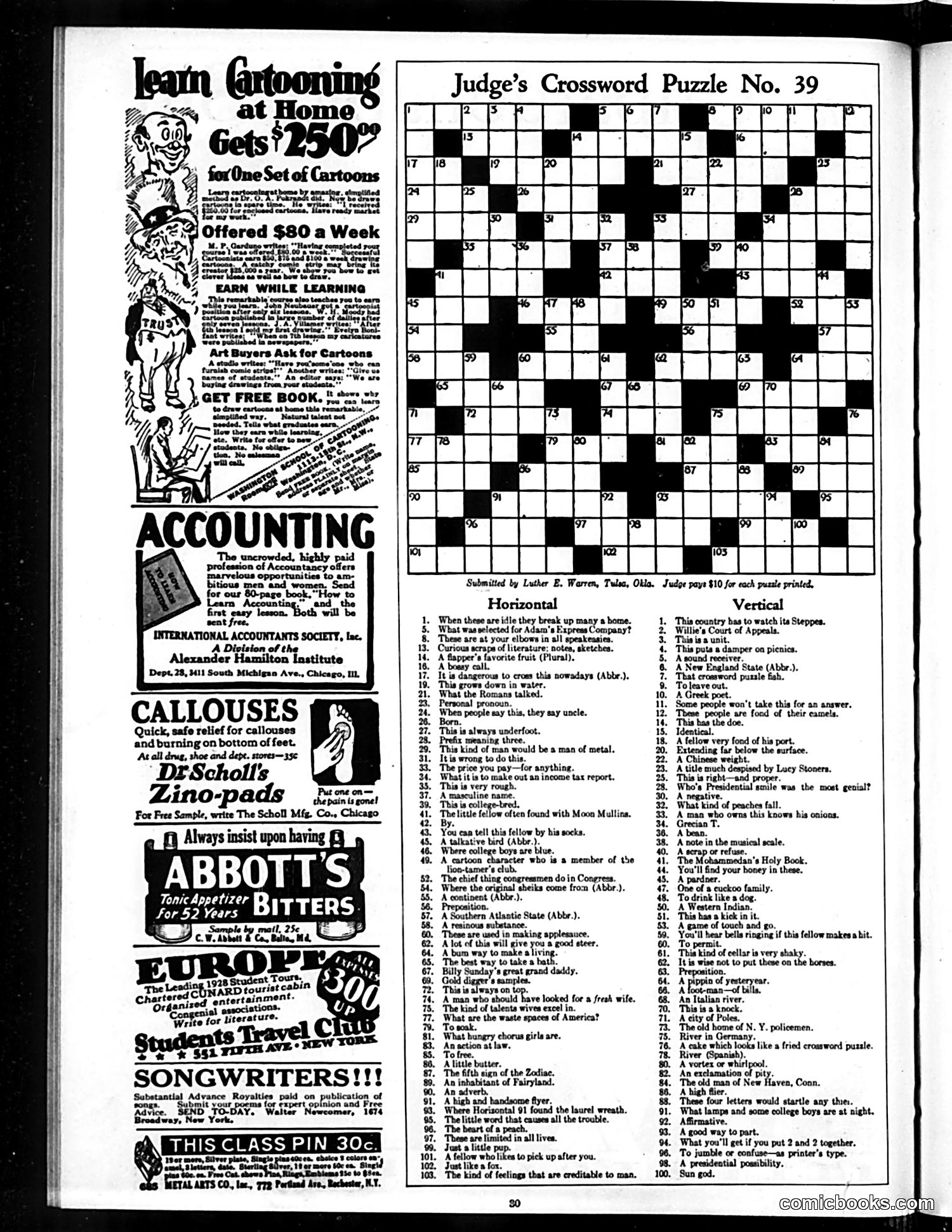
This page is primarily **advertising and a crossword puzzle**, not a political cartoon. The bulk of the content comprises commercial advertisements (accounting courses, callous relief, bitters, travel clubs, songwriting services) typical of 1920s-era magazines seeking revenue. The centerpiece is "Judge's Crossword Puzzle No. 39," a word puzzle submitted by Luther B. Warren of Tulsa, Oklahoma, with $10 payment offered for publication. The clues reference contemporary 1920s culture and slang—references to speakeasies ("are at your elbows in all speakeasies"), Prohibition-era humor, and period figures like "Moon Mullins" (a comic strip character). The puzzle itself contains no satirical content; it's simply recreational entertainment typical of Judge magazine's function as a humor and general-interest publication. The advertising surrounding it reflects the magazine's commercial nature rather than editorial commentary.
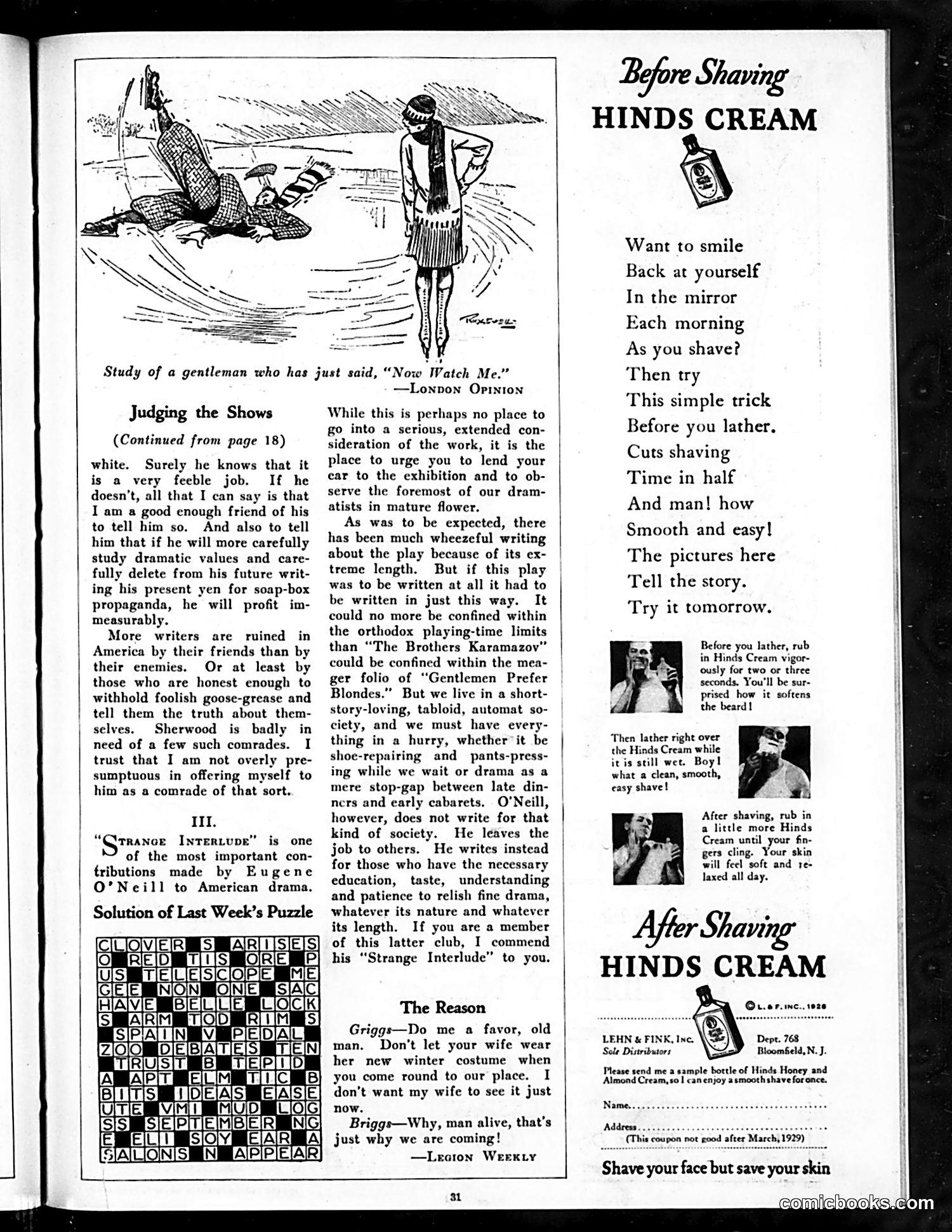
The page combines theater criticism with period advertising, offering little political satire. **The Cartoon:** "Study of a gentleman who has just said, 'Now Watch Me'" depicts a man in an awkward position after his boastful statement—a visual gag about overconfidence and pratfalls common to early 20th-century humor. **Theater Criticism:** The text critiques American playwrights, particularly praising Eugene O'Neill's "Strange Interlude" as serious drama requiring educated audiences. It contrasts O'Neill's ambition with the era's demand for quick, tabloid-style entertainment. The author urges writers like Robert Sherwood to focus on dramatic values rather than "soap-box propaganda." **The Jokes:** Two brief humor pieces mock marital dynamics—one about wives' expensive new clothes, another playing on social competitiveness. **The Advertisement:** Most of the page features a Hinds Cream shaving product ad with instructional photos, typical for this era's magazines. The page reflects 1920s concerns: artistic integrity versus commercial pressure, mass-market entertainment preferences, and consumer product marketing.
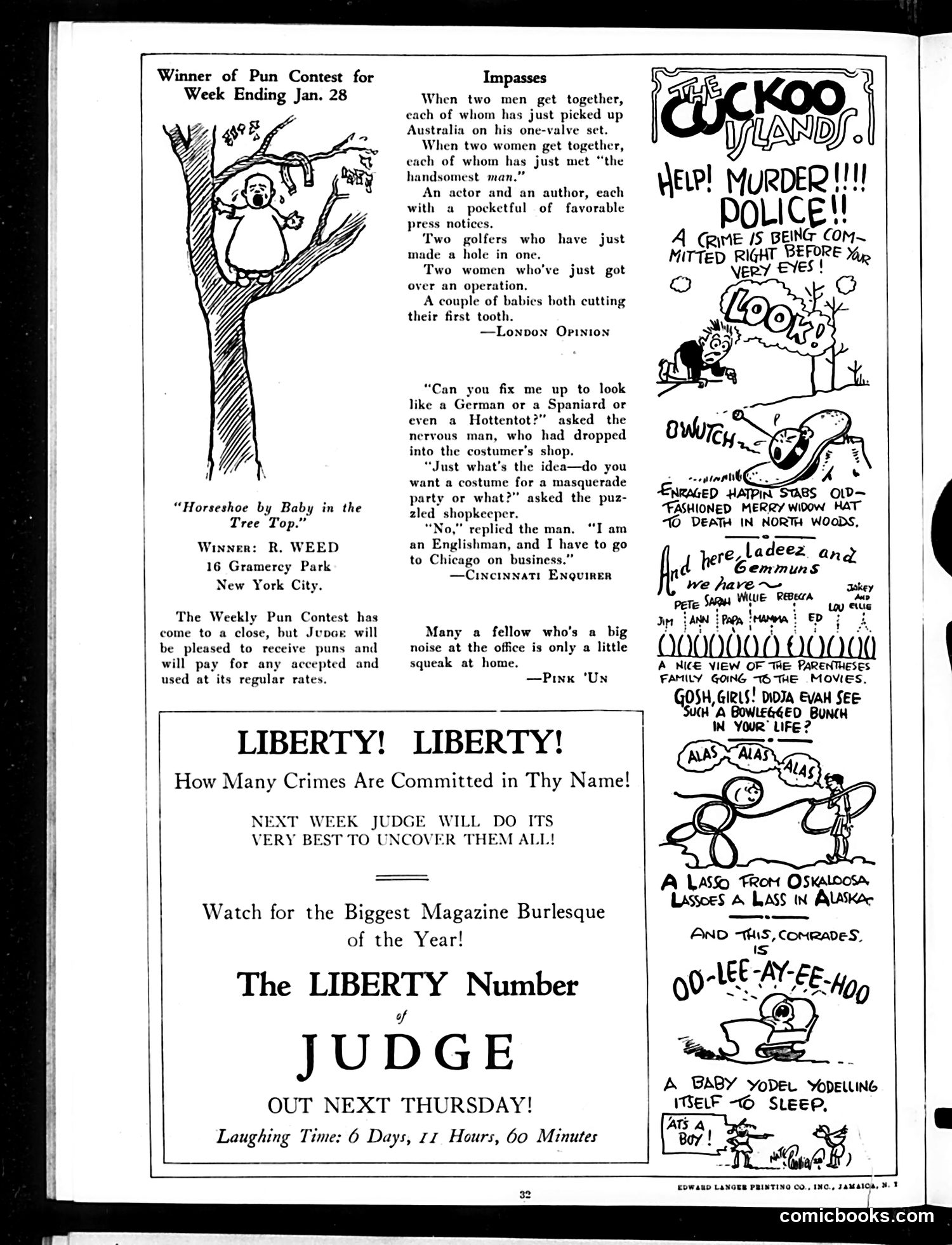
This page combines humor sections typical of early 20th-century satirical magazines. The left side features a "Pun Contest" winner (a visual gag showing a baby in a tree labeled "Horseshoe") and brief humorous observations about social "impasses"—awkward situations like two men discussing radio reception or an Englishman needing a disguise for Chicago (likely satirizing English-American cultural differences). The center advertises Judge's upcoming "Liberty Number," a special issue promising to expose "crimes committed in thy name"—a satirical commentary on abuses perpetrated under the banner of liberty. The right side, "The Cuckoo Land," contains absurdist humor and playful violence typical of the era: exaggerated scenarios like murder by hatpin, family absurdities, and a baby yodeling itself to sleep. The crude drawings and stream-of-consciousness style reflect pre-1930s comic sensibilities emphasizing wordplay and visual slapstick over narrative coherence.