
Judge, 1928-02-18 · page 22 of 36
Judge — February 18, 1928 — page 22: what you’re looking at
What you’re looking at
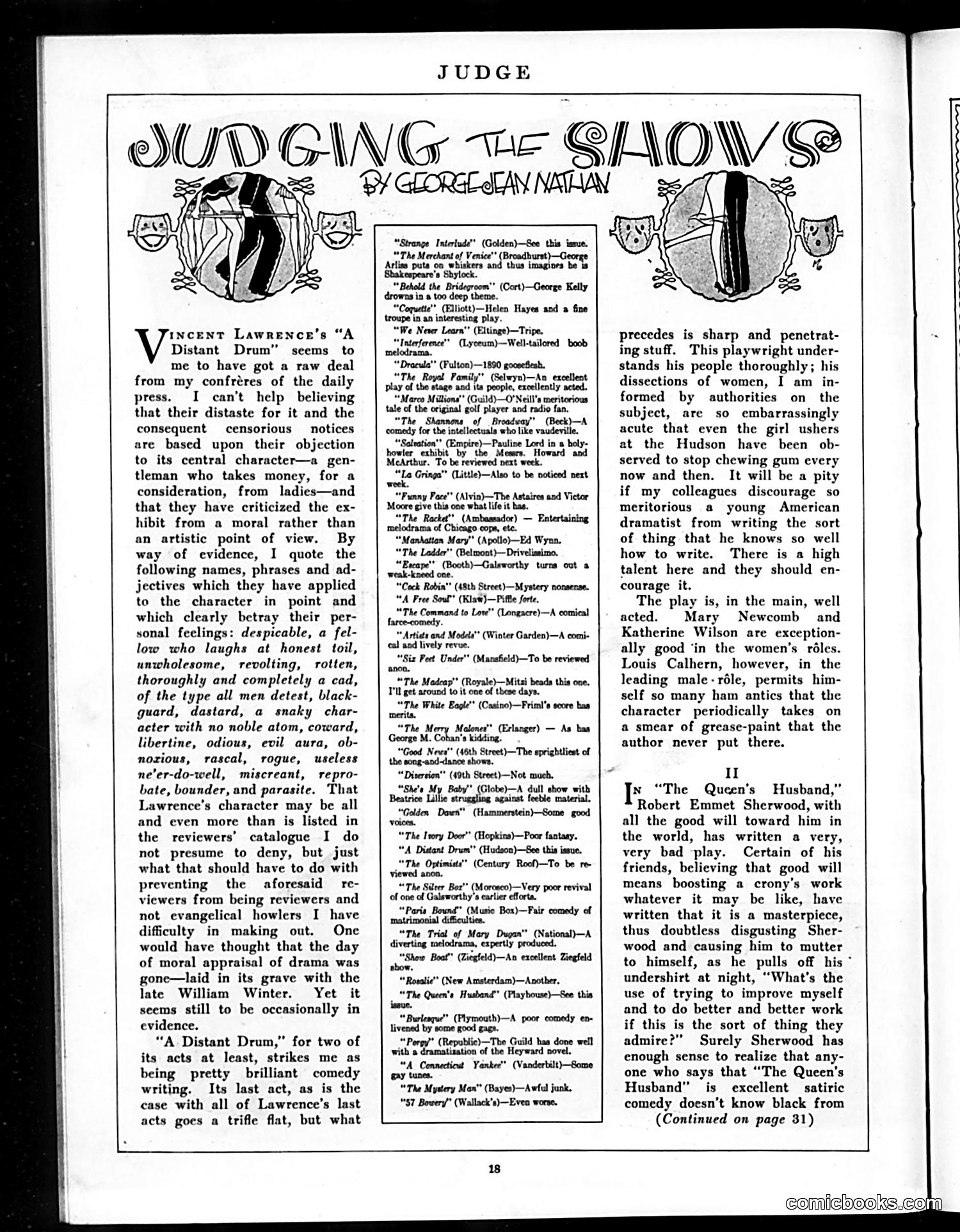
This page features theater criticism by George Jean Nathan, a prominent drama critic of the 1920s. The left column defends Vincent Lawrence's play "A Distant Drum" against moralistic attacks from newspaper reviewers who condemned its protagonist—a man who accepts money from women. Nathan argues critics applied harsh moral judgments ("despicable," "cad," "blackguard") rather than evaluating the *artistic* merit of the work. This reflects a cultural debate of the era: whether theater should be judged by moral standards or aesthetic ones. Nathan advocates for artistic freedom, suggesting puritanical reviewing undermines drama's evolution beyond "William Winter" (a famous 19th-century moralist critic). The right column lists current Broadway productions with brief, often caustic reviews—typical of Judge's satirical theater coverage. The overall argument champions theatrical sophistication over prudish censoriousness, a progressive stance for the late 1920s.
📄 Transcribed text from this page (OCR, searchable)
Machine-transcribed from the original scan — historical spelling and the odd misread are preserved.
1NcENT Lawrence’s “A V Distant Drum” seems to me to have got a raw deal from my confréres of the daily press. I can’t help believing that their distaste for it and the consequent censorious _ notices are based upon their objection to its central character—a gen- tleman who takes money, for a consideration, from ladies—and that they have criticized the ex- hibit from a moral rather than an artistic point of view. By way of evidence, I quote the following names, phrases and ad- jectives which they have applied to the character in point and which clearly betray their per- sonal feelings: despicable, a fel- low who laughs at honest toil, unwholesome, revolting, rotten, thoroughly and completely a cad, of the type all men detest, black- guard, dastard, a snaky char- acter with no noble atom, coward, libertine, odious, evil aura, ob- nozious, rascal, rogue, useless ne’er-do-well, miscreant, repro- bate, bounder, and parasite. That Lawrence’s character may be all and even more than is listed in the reviewers’ catalogue I do not presume to deny, but just what that should have to do with preventing the aforesaid re- viewers from being reviewers and not evangelical howlers I have difficulty in making out. One would have thought that the day of moral appraisal of drama was gone—laid in its grave with the late William Winter. Yet it seems still to be occasionally in evidence, “A Distant Drum,” for two of its acts at least, strikes me as being pretty brilliant comedy writing. Its last act, as is the case with all of Lawrence’s last acts goes a trifle flat, but what JUDGE “Strange Interlude’ (Golden)—See this issue. “The Merchant of Venice’ (Broadburst} Arliss puts on whiskers and thus imagines be is Shakespeare's rylock. “Behold the Bridegri (Cort)—George deowania sto dary eas on “Coquette” (Elliott)—Helen Hayes and a fine troupe in an interesting play. “We Never Learn’ (Eltinge)—Tripe. “Interference” (Lyceum)—Well-tailored boob melodrama. “Dracula” (Fulton)—1800 gooeeSeah, “The Pamily’’ (Selwyn)—An excellent play ete tage anda popleexcletly cto “Marco Millions” (Guild)—O’ Neill’s meritorious tale of the original golf player and radio fan. “The Shannons of Broadway” (Beck)—A comedy for the intellectuals who like vaudeville. “Selsat y—Paulive Lord howler exit Pate gg a] Mekrihur: To be reviewed next week “La Gringa” (Little)—Also to be noticed next week “Funny Pace’ (Alvin)—The Astaires and Victor Moore give this one what life it has. “The Racket’ (Ambassador) — Entertaining melodrama of Chicago cops, etc. “Manhatten Mary’* (Apollo)—Ed Wynn. “The Ladder* (Belmont)—Drivelissimo. “Escape (Sect) aiewwrthy turns out a weak-kneed one. "Cock Robin’ "(48th Street)—Mystery nonsense. 'A Free Soul (Kiaw)—Piffie forte, “The Command to Love’ (Longacre)—A comical farce-comedy. “Artists and Models’ (Winter Garden)—A comi- cal and lively revue. “Siz Peet Under’* (Mansfield)—To be reviewed anon. “The Medcap"* (Royale)—Mitsi beads this one. T'll get around to it one of these days. “The White Eagle’ (Casino)—Friml’s score bas merite. Pistiog Me Melones (Erlanger) — As bas M. Cohan’s Kidding, coal News" (46th Bret) Ths sprightliest of ‘the song-and-dance shows. “Diversion” (49th Street) Not puch, “Shés My Baby" (Glote)—A dull show, with Beatrice Lillie struggling against “Golden Down asec searae good voices. “The Ivory Door’”” (Hopkins)—Poor fantasy. “A Distant Drum (Hudson)—See this issue. “The Optimists” (Century Roof}—To be re viewed anoa. “The Silter Ber’ (Morceco)—Very poor revival of one of Galsworthy’s earlier efforts. “Paris Bound” (Music Box)—Fair comedy of matrimonial diffeulties. “The Trial of ‘Mery Degen”, (Natinall—A diverting melodrama, expertly produced, aiShee Boat (Ziegfeld) —An excellent Ziegfeld Spear (New Amsterdam)—Another, “The Queen's Husband” (Playhouse)—See this issue. “Burlesque” (Plymouth)—A comedy en- livened by pial good gags. ez) 4 “Perey” (Republic) The Guild has done well with a dramatization of the Heyward novel “A Connectiont Youur (Vanderbilt) Some gay tunes. “The Mystery Man” (Bayes)—Awful junk. “$7 Bowery” (Wallack’s)—Even worse. ou GUN Ga BOWS precedes is sharp and penetrat- ing stuff. This playwright under- stands his people thoroughly; his dissections of women, I am in- formed by authorities on the subject, are so embarrassingly acute that even the girl ushers at the Hudson have been ob- served to stop chewing gum every now and then. It will be a pity if my colleagues discourage so meritorious a young American dramatist from writing the sort of thing that he knows so well how to write. There is a high talent here and they should en- courage it. The play is, in the main, well acted. Mary Newcomb and Katherine Wilson are exception- ally good ‘in the women’s réles. Louis Calhern, however, in the leading male-réle, permits him- self so many ham antics that the character periodically takes on a smear of grease-paint that the author never put there. II N “The Queen’s Husband,” Robert Emmet Sherwood, with all the good will toward him in the world, has written a very, very bad play. Certain of his friends, believing that good will means boosting a crony’s work whatever it may be like, have written that it is a masterpiece, thus doubtless disgusting Sher- wood and causing him to mutter to himself, as he pulls off his ~ undershirt at night, “What's the use of trying to improve myself and to do better and better work if this is the sort of thing they admire?” Surely Sherwood has enough sense to realize that any- one who says that “The Queen’s Husband” is excellent satiric comedy doesn’t know black from (Continued on page 31) comichooks.coyp