
Judge, 1928-02-18 · page 12 of 36
Judge — February 18, 1928 — page 12: what you’re looking at
What you’re looking at
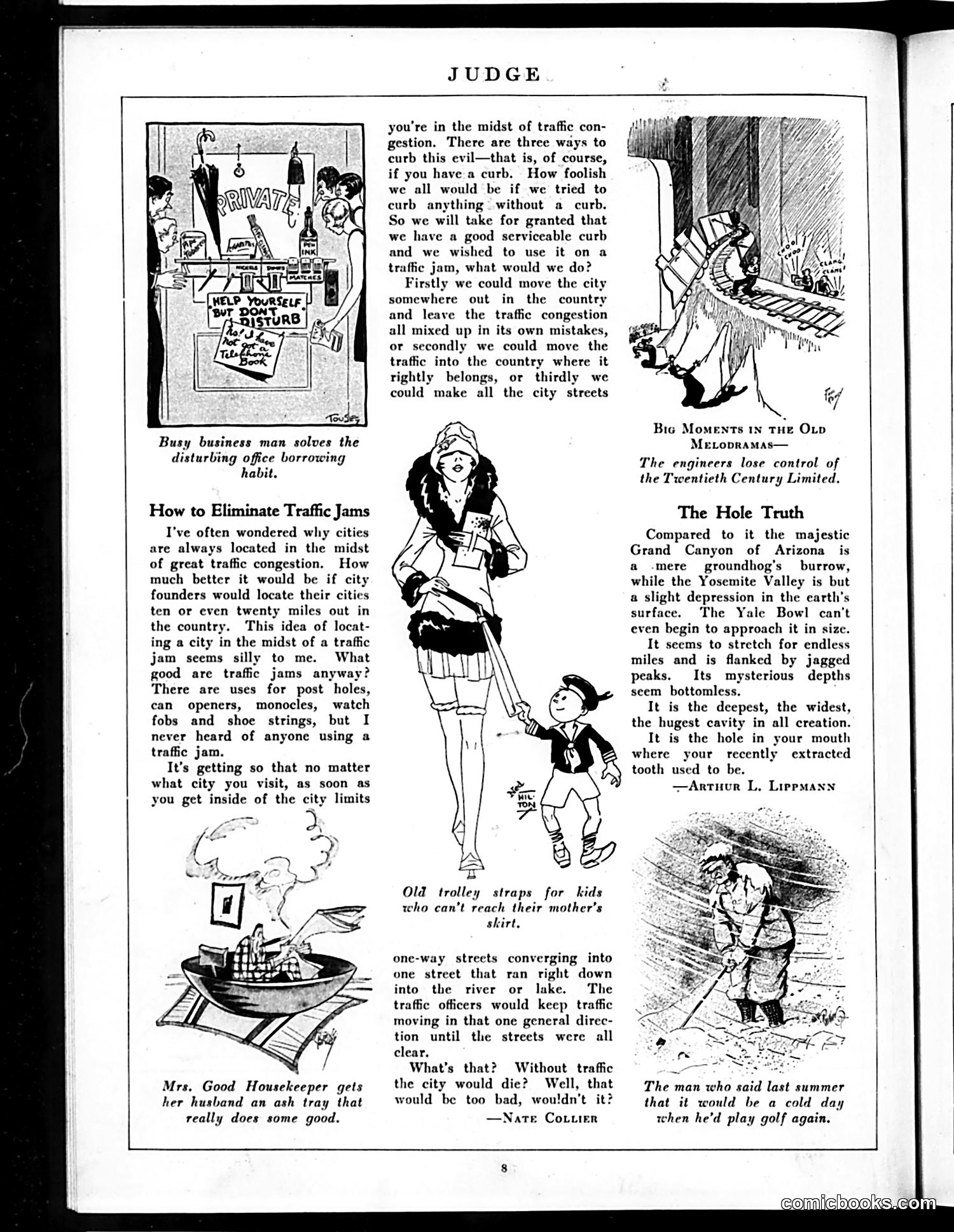
This page from the satirical magazine **Judge** contains absurdist humor about early-20th-century urban problems. **"How to Eliminate Traffic Jams"** by Nate Collier mocks city planners' inability to solve traffic congestion. The author proposes three deliberately ridiculous solutions: relocate cities to the countryside, move traffic to the country instead, or create one-way streets dumping into rivers. The satire targets urban gridlock—a genuine modern problem—by suggesting the real solution is to eliminate cities themselves, since traffic serves no purpose ("never heard of anyone using a traffic jam"). **"The Hole Truth"** by Arthur L. Lippmann uses hyperbolic comparison to make a dental joke: he compares the cavity left by an extracted tooth to grand natural wonders like the Grand Canyon and Yosemite Valley, calling it the "deepest, widest, hugest cavity" ever. It's a pun on "hole." Other cartoons satirize domestic life: a businessman's "ash tray" solves office borrowing problems, and Mrs. Good Housekeeper receives useful household items. The tone is lighthearted, relying on wordplay and absurdist logic typical of Judge's style.
📄 Transcribed text from this page (OCR, searchable)
Machine-transcribed from the original scan — historical spelling and the odd misread are preserved.
JUDGE Busy business man solves the disturbing office borrowing habit. How to Eliminate Traffic Jams I've often wondered why cities are always located in the midst of great traffic congestion. How much better it would be if city founders would locate their cities ten or even twenty miles out in the country. This idea of locat- ing a city in the midst of a traffic jam seems silly to me. What good are traffic jams anyway? There are uses for post holes, can openers, monocles, watch fobs and shoe strings, but I never heard of anyone using a traffic jam. It’s getting so that no matter what city you visit, as soon as you get inside of the city limits B Mrs. Good Housekeeper gets her husband an ash tray that really does some good. you're in the midst of traffic con- gestion. There are three ways to curb this evil—that is, of course, if you have a curb. How foolish we all would be if we tried to curb anything without a curb. So we will take for granted that we have a good serviceable curb and we wished to use it on a traffic jam, what would we do? Firstly we could move the city somewhere out in the country and leave the traffic congestion all mixed up in its own mistakes, or secondly we could move the traffic into the country where it rightly belongs, or thirdly we could make all the city streets Ola trolley straps for kids who can’t reach their mother’s skirt. one-way streets converging into one street that ran right down into the river or lake. The traffic officers would keep traffic moving in that one general direc- tion until the streets were all clear, What's that? Without traffic the city would die? Well, that would be too bad, wou!dn’t it? —Narte Cottier Bic Moments 1x tHe Oxo MELopramas— The engineers lose control of the Twentieth Century Limited. The Hole Truth Compared to it the majestic Grand Canyon of Arizona is a .mere groundhog’s burrow, while the Yosemite Valley is but a slight depression in the earth's surface. The Yale Bowl can't even begin to approach it in size. It seems to stretch for endless miles and is flanked by jagged peaks, Its mysterious depths seem bottomless. It is the deepest, the widest, the hugest cavity in all creation. It is the hole in your mouth where your recently extracted tooth used to be. —Artuer L, Lippmann The man who said last summer that it would be a cold day when he'd play golf again.