
Judge, 1928-02-18 · page 17 of 36
Judge — February 18, 1928 — page 17: what you’re looking at
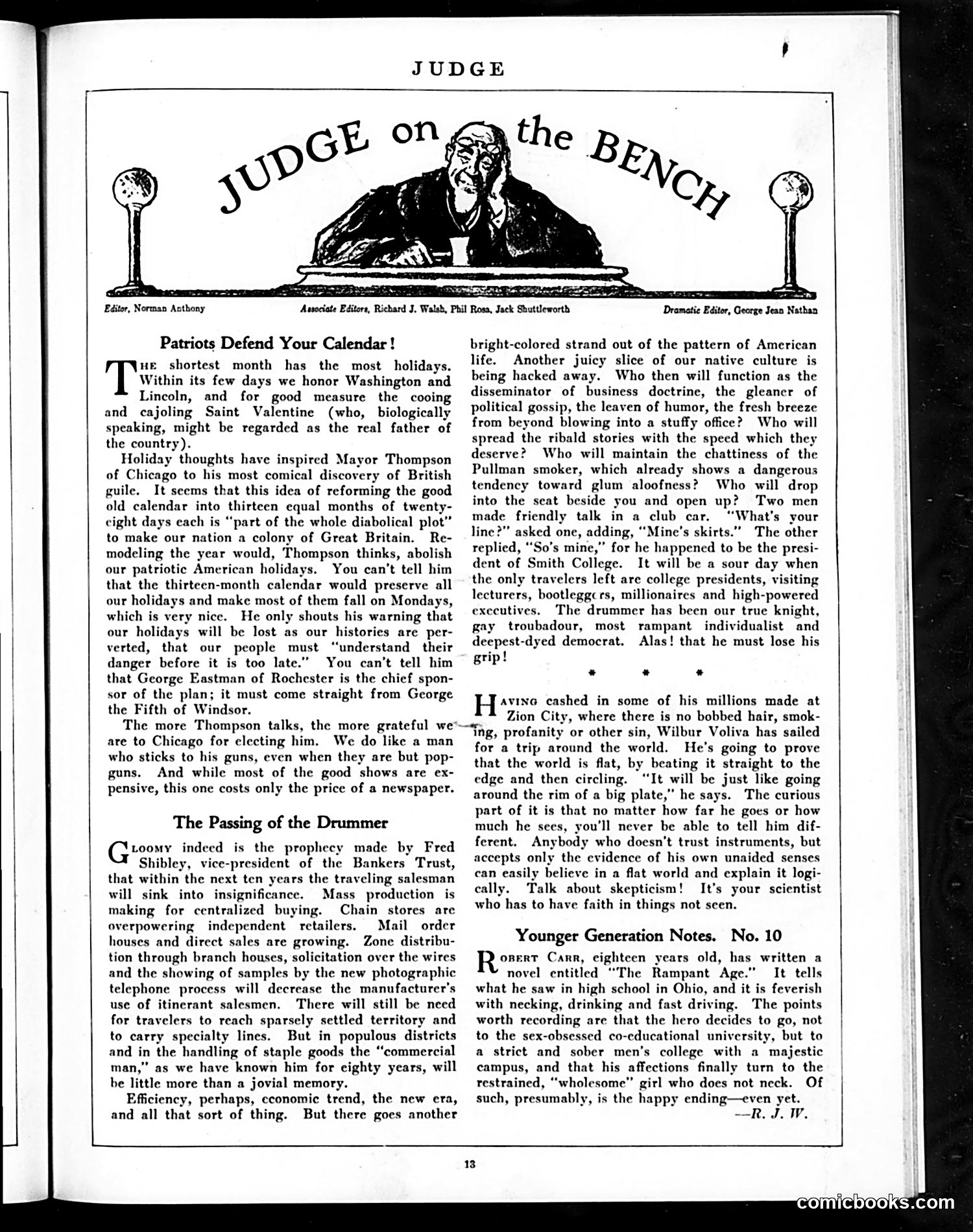
What you’re looking at
This page from *Judge* magazine contains satirical editorials attacking two targets: **"Patriots Defend Your Calendar"** mocks Chicago Mayor William "Big Bill" Thompson's paranoid opposition to calendar reform (a 13-month proposal). Thompson absurdly claimed the plan was a British plot to abolish American holidays and colonize the U.S. The author ridicules Thompson's irrational fear-mongering while praising his entertainment value—Thompson is portrayed as a comical demagogue wielding "popguns" rather than legitimate arguments. The reference to "George the Fifth of Windsor" suggests the author sees Thompson's anti-British sentiment as overwrought. **"The Passing of the Drummer"** elegizes the traveling salesman, whose decline the author attributes to mass production and chain stores. Rather than celebrate modern efficiency, the piece laments losing the salesman's role as purveyor of gossip, humor, and human connection in office culture. The drummer is romanticized as a democratic, individualistic figure whose absence will make business culture sterile. Both pieces exemplify *Judge*'s satirical tone: defending tradition and personality against modernization and centralization.
📄 Transcribed text from this page (OCR, searchable)
Machine-transcribed from the original scan — historical spelling and the odd misread are preserved.
Cav Beir, Neraaa Astbony Patriots Defend Your Calendar ! HE shortest month has the most holidays. Within its few days we honor Washington and Lincoln, and for good measure the cooing and cajoling Saint Valentine (who, biologically speaking, might be regarded as the real father of the country). Holiday thoughts have inspired Mayor Thompson of Chicago to his most comical discovery of British guile. It seems that this idea of reforming the good old calendar into thirteen equal months of twenty- cight days each is “part of the whole diabolical plot” to make our nation a colony of Great Britain. Re- modeling the year would, Thompson thinks, abolish our patriotic American holidays. You can’t tell him that the thirteen-month calendar would preserve all our holidays and make most of them fall on Mondays, which is very nice. He only shouts his warning that our holidays will be lost as our histories are per- verted, that our people must “understand their danger before it is too late.” You can’t tell him that George Eastman of Rochester is the chief spon- sor of the plan; it must come straight from George the Fifth of Windsor. The more Thompson talks, the more grateful we are to Chicago for electing him. We do like a man who sticks to his guns, even when they are but pop- guns. And while most of the good shows are ex- pensive, this one costs only the price of a newspaper. The Passing of the Drummer Greour indeed is the prophecy made by Fred Shibley, vice-president of the Bankers Trust, that within the next ten years the traveling salesman will sink into insignificance. Mass production is making for centralized buying. Chain stores are overpowering independent retailers. Mail order houses and direct sales are growing. Zone distribu- tion through branch houses, solicitation over the wires and the showing of samples by the new photographic telephone process will decrease the manufacturer's use of itinerant salesmen. There will still be need for travelers to reach sparsely settled territory and to carry specialty lines. But in populous districts and in the handling of staple goods the “commercial man,” as we have known him for eighty years, will be little more than a jovial memory. Efficiency, perhaps, economic trend, the new era, and all that sort of thing. But there goes another Ausocicte Editors, Richard J, Walsb, Phil Rosa, Jack Shuttleworth Dramatic Editor, George Jean Nathan bright-colored strand out of the pattern of American life. Another juicy slice of our native culture is being hacked away. Who then will function as the disseminator of business doctrine, the gleaner of political gossip, the leaven of humor, the fresh breeze from beyond blowing into a stuffy office? Who will spread the ribald stories with the speed which they deserve? Who will maintain the chattiness of the Pullman smoker, which already shows a dangerous tendency toward glum aloofness? Who will drop into the seat beside you and open up? Two men made friendly talk in a club car. “What's your line?” asked one, adding, “Mine's skirts.” The other replied, ’s mine,” for he happened to be the presi- dent of Smith College. It will be a sour day when the only travelers left are college presidents, visiting lecturers, bootleggcrs, millionaires and high-powered executives. The drummer has been our true knight, gay troubadour, most rampant individualist and deepest-dyed democrat. Alas! that he must lose his grip! * * * Here cashed in some of his millions made at Zion City, where there is no bobbed hair, smok- “ng, profanity or other sin, Wilbur Voliva has sailed for a trip around the world. He's going to prove that the world is flat, by beating it straight to the edge and then circling. “It will be just like going around the rim of a big plate,” he says. The curious part of it is that no matter how far he goes or how much he sees, you'll never be able to tell him dif- ferent. Anybody who doesn’t trust instruments, but accepts only the evidence of his own unaided senses can easily believe in a flat world and explain it logi- cally. Talk about skepticism! It’s your scientist who has to have faith in things not seen. Younger Generation Notes. No. 10 Rove Carr, eighteen years old, has written a novel entitled “The Rampant Age.” It tells what he saw in high school in Ohio, and it is feverish with necking, drinking and fast driving. The points worth recording are that the hero decides to go, not to the sex-obsessed co-educational university, but to a strict and sober men’s college with a majestic campus, and that his affections finally turn to the restrained, “wholesome” girl who does not neck. Of such, presumably, is the happy ending—even yet. —R. J. W.