
A complete issue · 37 pages · 1927
Judge — December 31, 1927
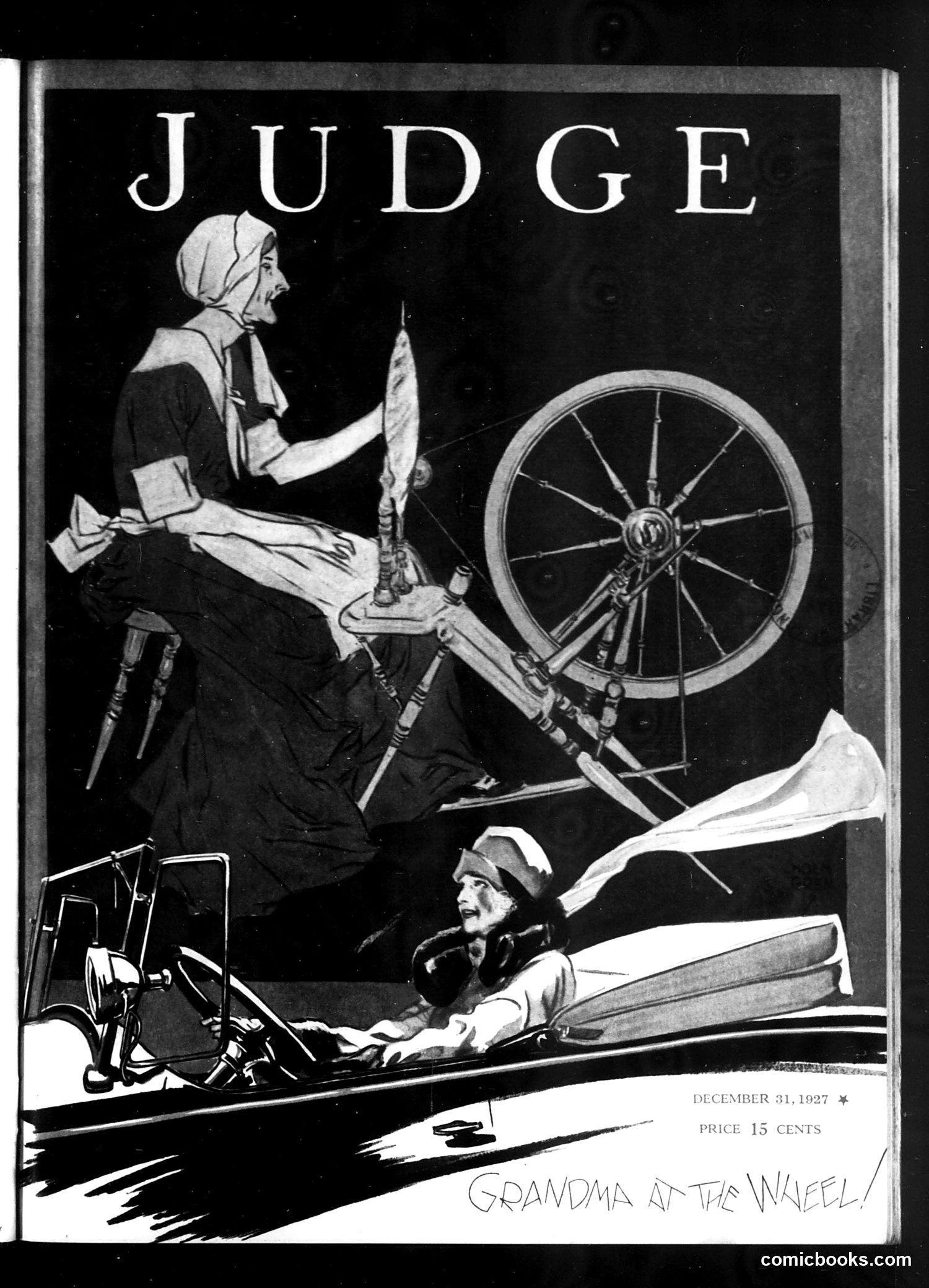
This satirical cover depicts "Grandma at the Wheel," showing two figures in a bicycle-powered contraption. The upper figure (appearing older, wearing a bonnet) sits at the bicycle seat operating the pedals and steering mechanism, while a younger figure below appears trapped or subordinate in the vehicle's framework. The satire likely comments on generational dynamics or domestic power relations of the 1920s—possibly critiquing how older women (or mothers-in-law) controlled or directed younger family members' activities. The mechanical bicycle imagery emphasizes that the younger person is being worked or driven by the elder. The humor derives from inverting typical hierarchies, with "Grandma" in the dominant, active position. This reflects period anxieties about changing gender roles and family authority structures during the post-suffrage era.
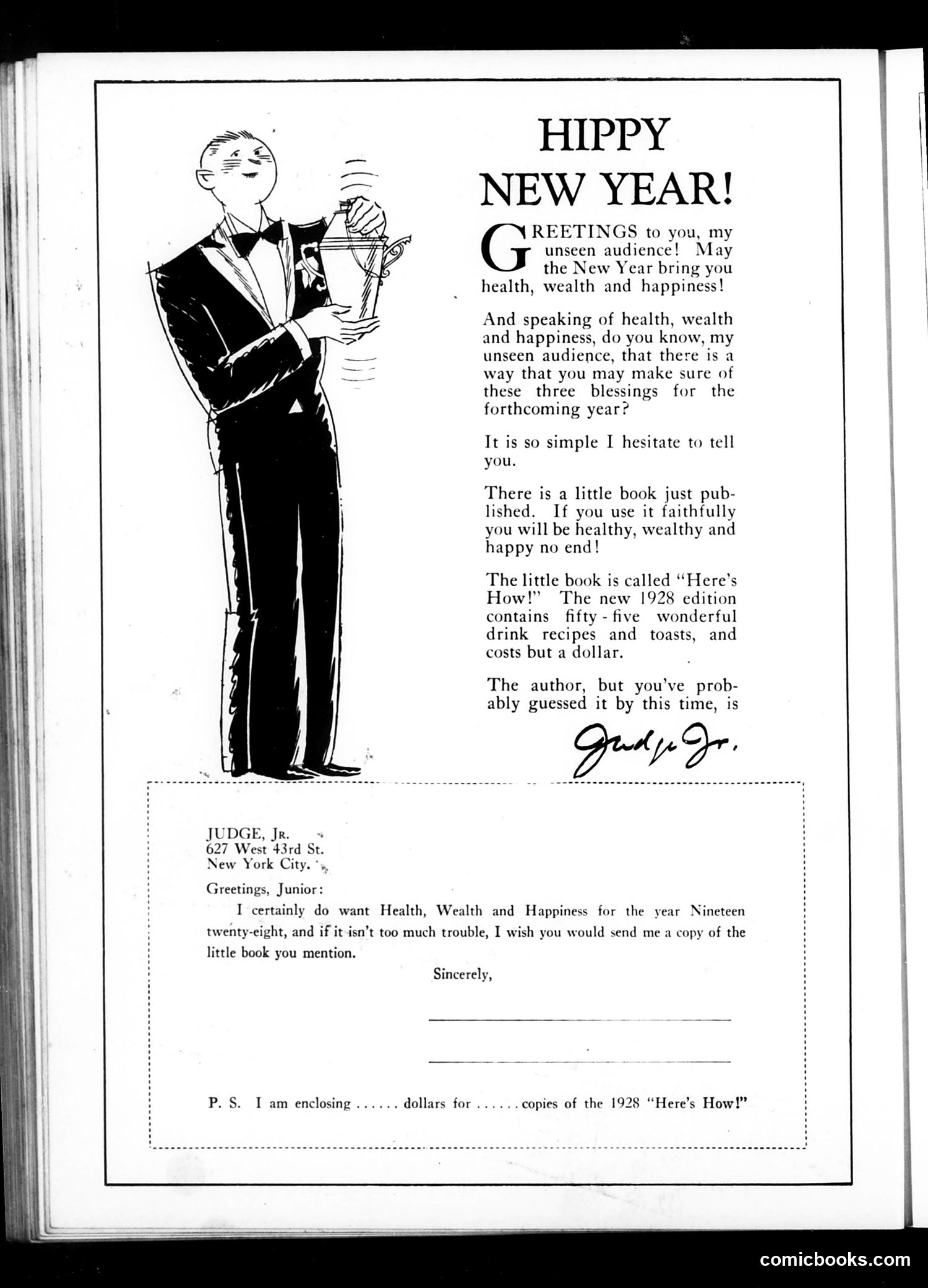
This page is primarily **self-promotional advertising** rather than political satire. It's a New Year's greeting from Judge magazine's editor (signed "Judge Jr.") advertising the 1928 edition of "Here's How!"—a book of cocktail recipes and toasts. The cartoon shows a man in formal attire raising a drink, which is the visual hook for promoting the book. The pitch promises that following the book's 55 drink recipes will ensure "health, wealth and happiness"—clearly tongue-in-cheek, since the book is about alcohol consumption during Prohibition. The included response card from a reader named "Judge, Jr." reinforces this is a direct-mail marketing piece, inviting customers to order copies at one dollar each. This is primarily **commercial content** masquerading as editorial material.
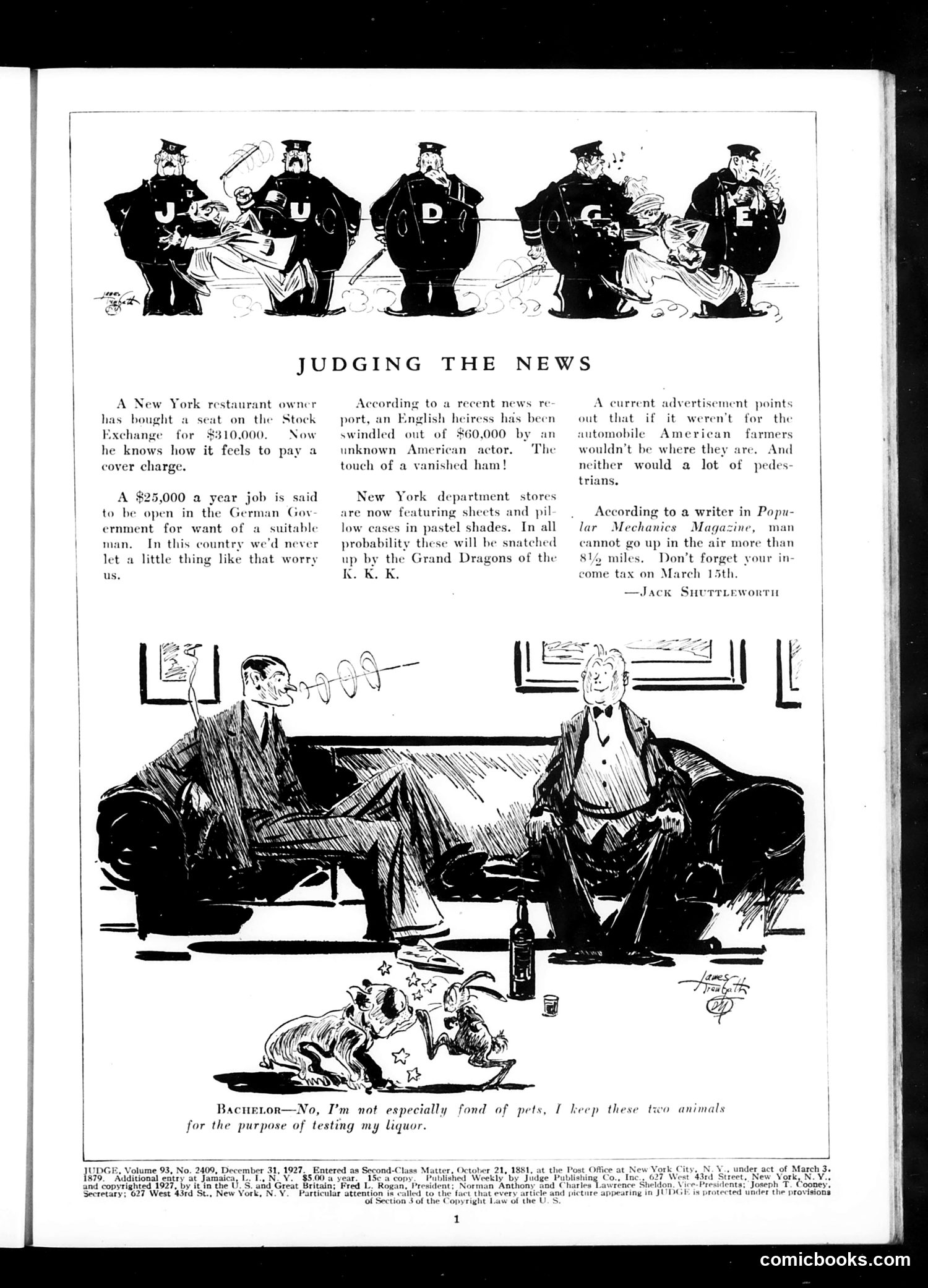
This satirical page mocks contemporary news stories through commentary and cartoons. **Top section ("Judging the News"):** Five judges in academic robes labeled J-U-D-G-E evaluate absurd news items: a restaurant owner paying $810,000 for a stock exchange seat, a $25,000/year German government job, an English heiress swindled by an American actor, automobile advertisements, and a claim about airplane altitude records. **Bottom cartoon:** Depicts two men on a couch with small animals. The bachelor dismisses keeping "these two animals for the purpose of testing my liquor"—a joke about prohibition-era drinking. The cartoon satirizes both illegal alcohol consumption and the absurdity of using pets as a cover story for maintaining a liquor supply during the dry era (1920-1933).
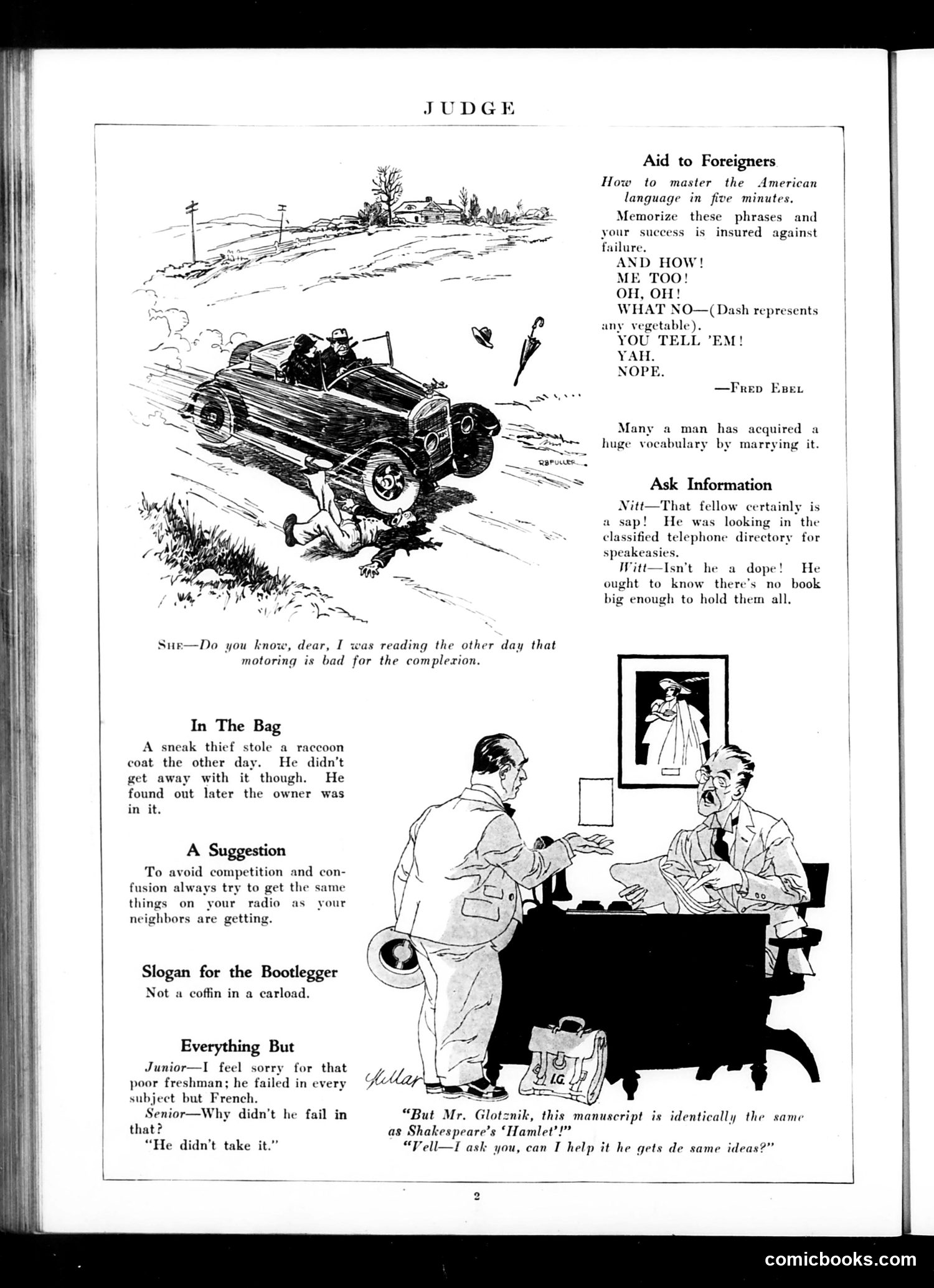
This page contains several brief satirical pieces and jokes typical of Judge magazine's humor: **"Aid to Foreigners"** mocks immigrants struggling with English, presenting phonetic approximations of American slang as a "learning aid." **"In The Bag"** and **"A Suggestion"** are short joke items about theft and radio competition. **"Slogan for the Bootlegger"** references Prohibition-era illegal alcohol smuggling ("not a coffin in a carload"). The main cartoon depicts a man at a desk confronting another about a manuscript, with the caption suggesting plagiarism accusations. The joke plays on intellectual property theft and excuses. **"Everything But"** is a brief exchange about a French class. Overall, the page reflects 1920s-era American concerns: immigration, Prohibition, copyright issues, and educational matters—presented through Judge's characteristic irreverent, punchy humor.
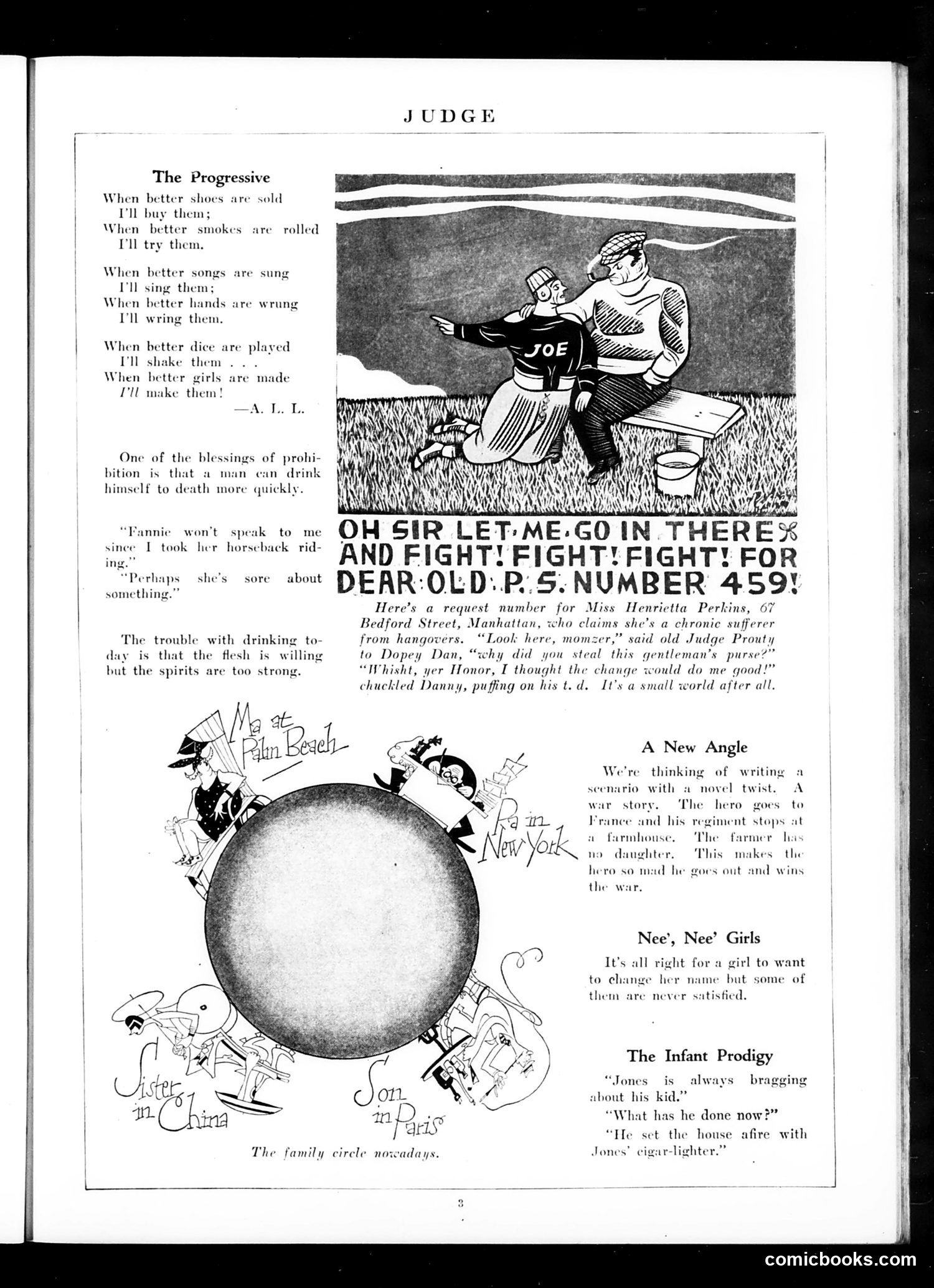
This page contains several satirical pieces typical of early 20th-century Judge magazine humor: **Main Cartoon**: "Oh Sir Let Me Go In There & Fight!" depicts a woman labeled "JOE" pleading with a man to enter a boxing match, referencing Miss Henrietta Perkins of Manhattan who claimed to be a chronic sufferer from hangovers. The caption's request for "P.S. Number 459" appears to be a humorous response to her unusual complaint. **Other Sections**: - "The Progressive" mocks A.L.L.'s poem about pursuing "better" things - "A New Angle" satirizes a proposed war story twist - Smaller jokes mock name-changing ambitions and parental bragging The page primarily uses visual gags and wordplay targeting contemporary social behaviors and fashions rather than specific political events.
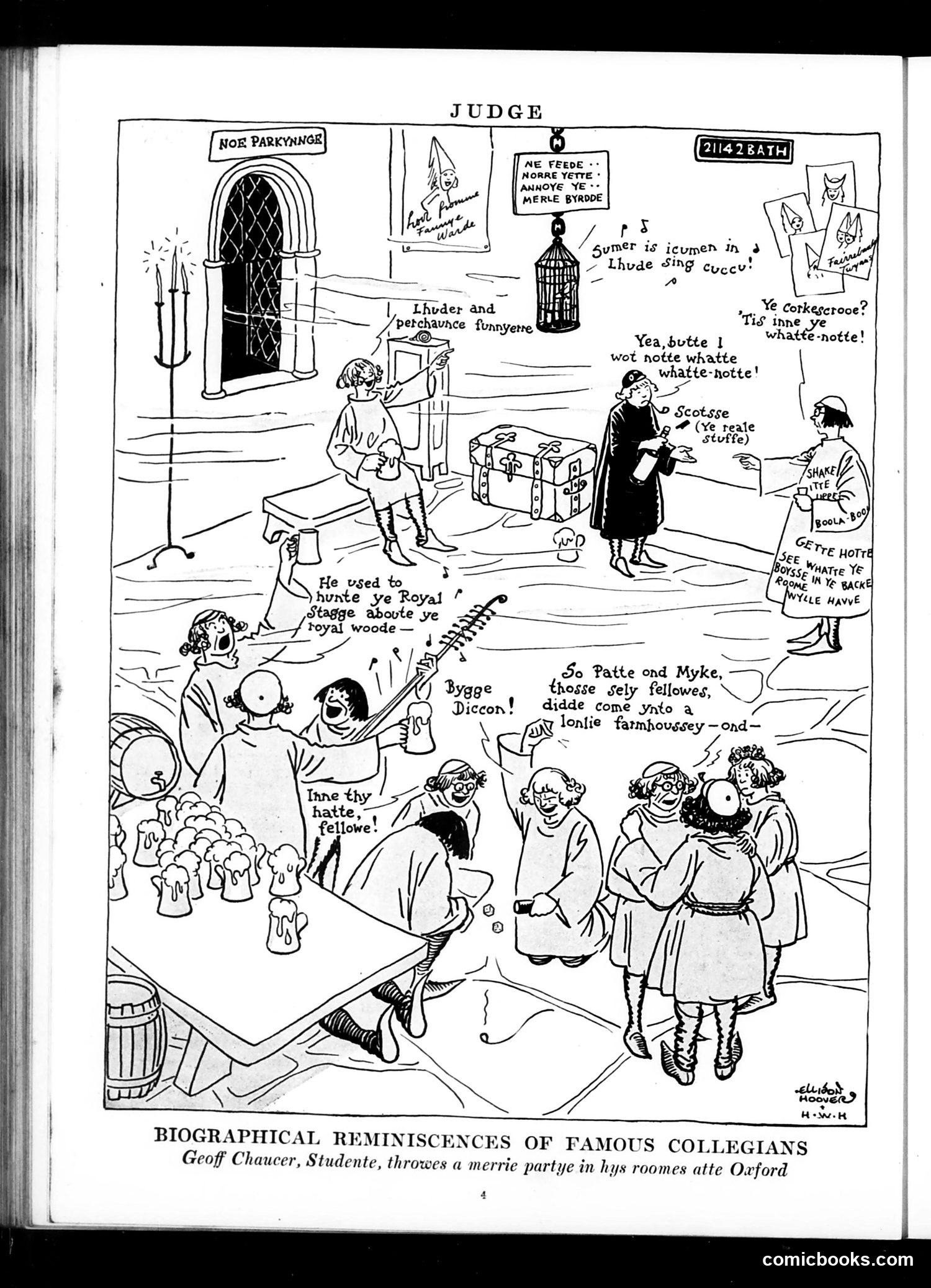
This cartoon illustrates a satirical scene titled "Biographical Reminiscences of Famous Collegians," depicting **Geoffrey Chaucer as a student at Oxford throwing a party in his rooms**. The drawing shows a medieval-themed gathering with period-appropriate dialogue rendered in pseudo-Middle English dialect ("Noe Parkynnor," "Bygge Diccon," etc.). The scene parodies both Chaucer's historical reputation and contemporary college student behavior—young people drinking, carousing, and behaving rowdily. The satire works on two levels: it humorously imagines the famous medieval poet as a raucous undergraduate, while the affected pseudo-archaic language mocks both historical pretension and the type of affected speech college students might adopt. The joke assumes readers recognize Chaucer as a literary figure worth satirizing in this manner.
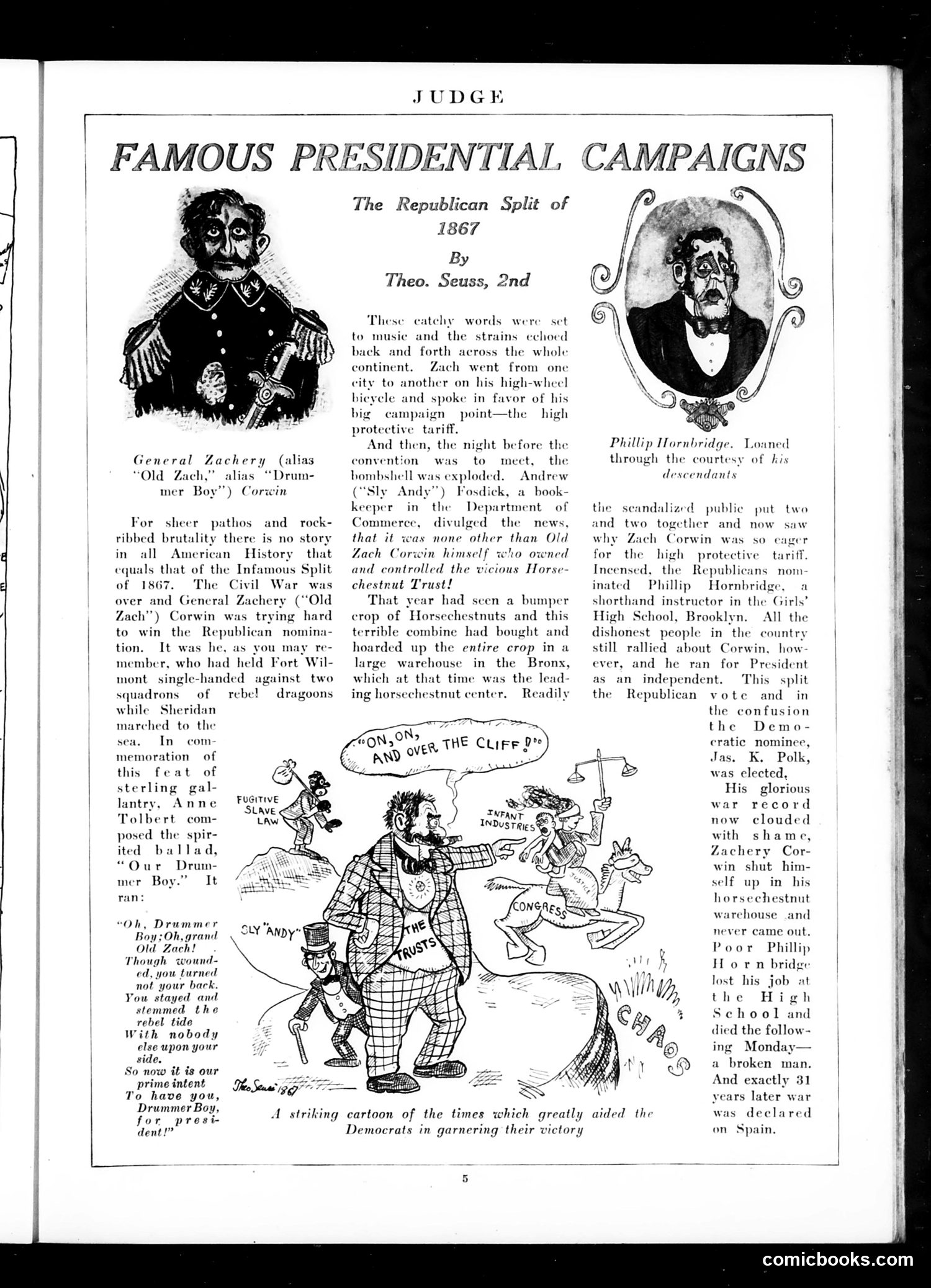
This satirical piece by Theo. Seuss depicts the 1867 Republican Party fracture. **General Zachery Corwin** ("Old Zach"), a Republican campaigner, is mocked for riding a "high-wheel bicycle" promoting protective tariffs. The cartoon illustrates the party's internal conflict: conservatives like Corwin championed tariffs, while a faction (including figures like **Phillip Hornbridge**, a Brooklyn schoolteacher) opposed them as damaging. The central cartoon shows Corwin being pulled apart by competing Republican factions—depicted as "Fugitive Slave Law," "Infant Industries," and "Congress"—over the Horsechestnut Warehouse scandal. The text notes this split ultimately led to Democrat James K. Polk's election, ending Republican dominance and leaving figures like Hornbridge politically displaced.
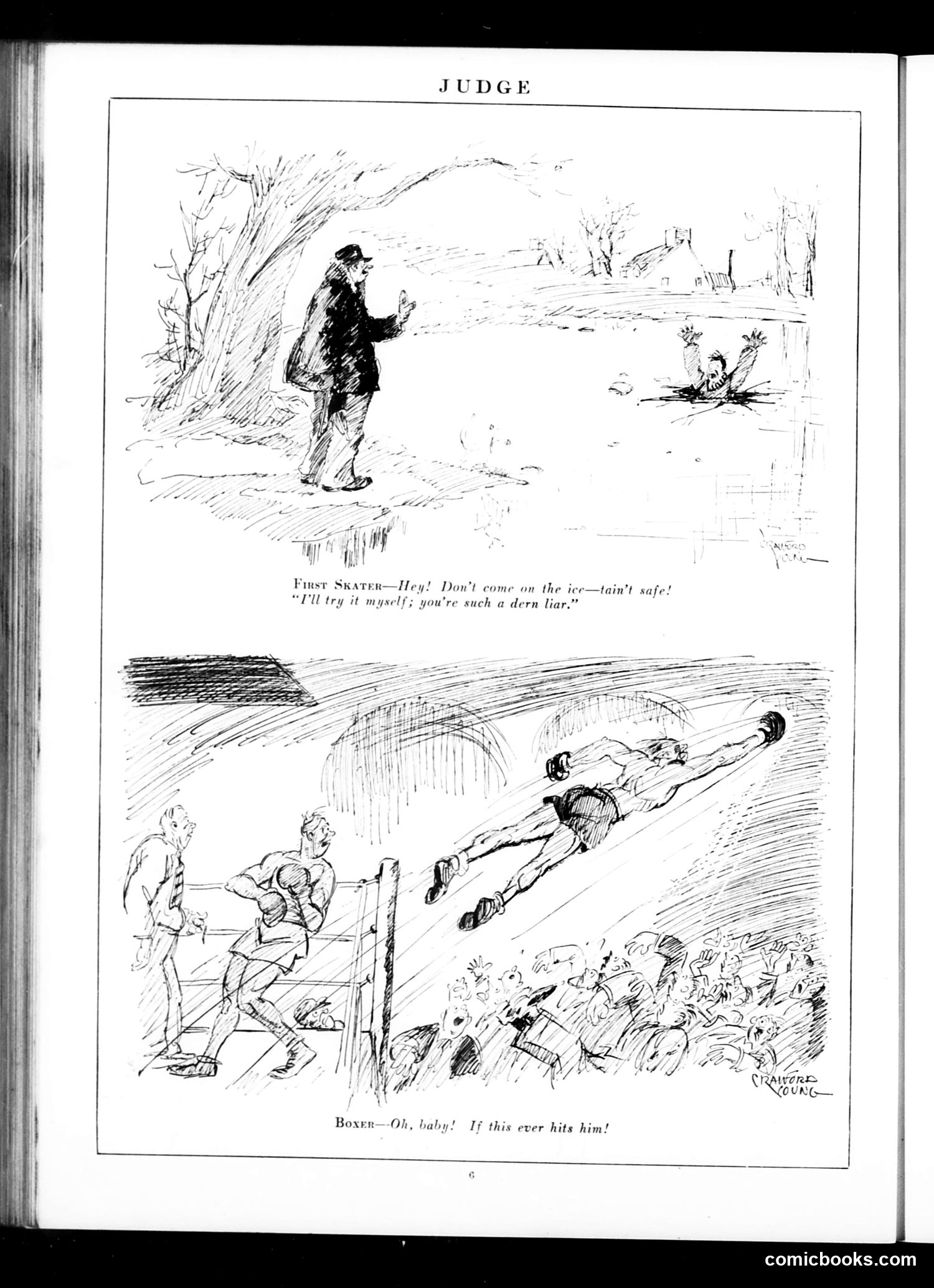
This page contains two satirical cartoons from Judge magazine: **Top cartoon ("First Skater"):** A man stands on frozen ground warning someone not to venture onto thin ice, calling them a "dern liar." The joke appears to be about someone making false claims about the ice's safety—the skater is being warned away from danger by someone who doesn't trust the other person's judgment. **Bottom cartoon ("Boxer"):** Depicts a boxer mid-punch during what appears to be a match, with spectators watching. The caption "Oh, baby! If this ever hits him!" suggests dark humor about the violence of boxing—expressing hope the punch lands solidly on the opponent. Both cartoons use physical danger (thin ice, boxing) as vehicles for humor, typical of Judge's satirical style. Without additional context or visible publication date, the specific political or social references remain unclear, though they appear to be commentary on trust, judgment, and entertainment.
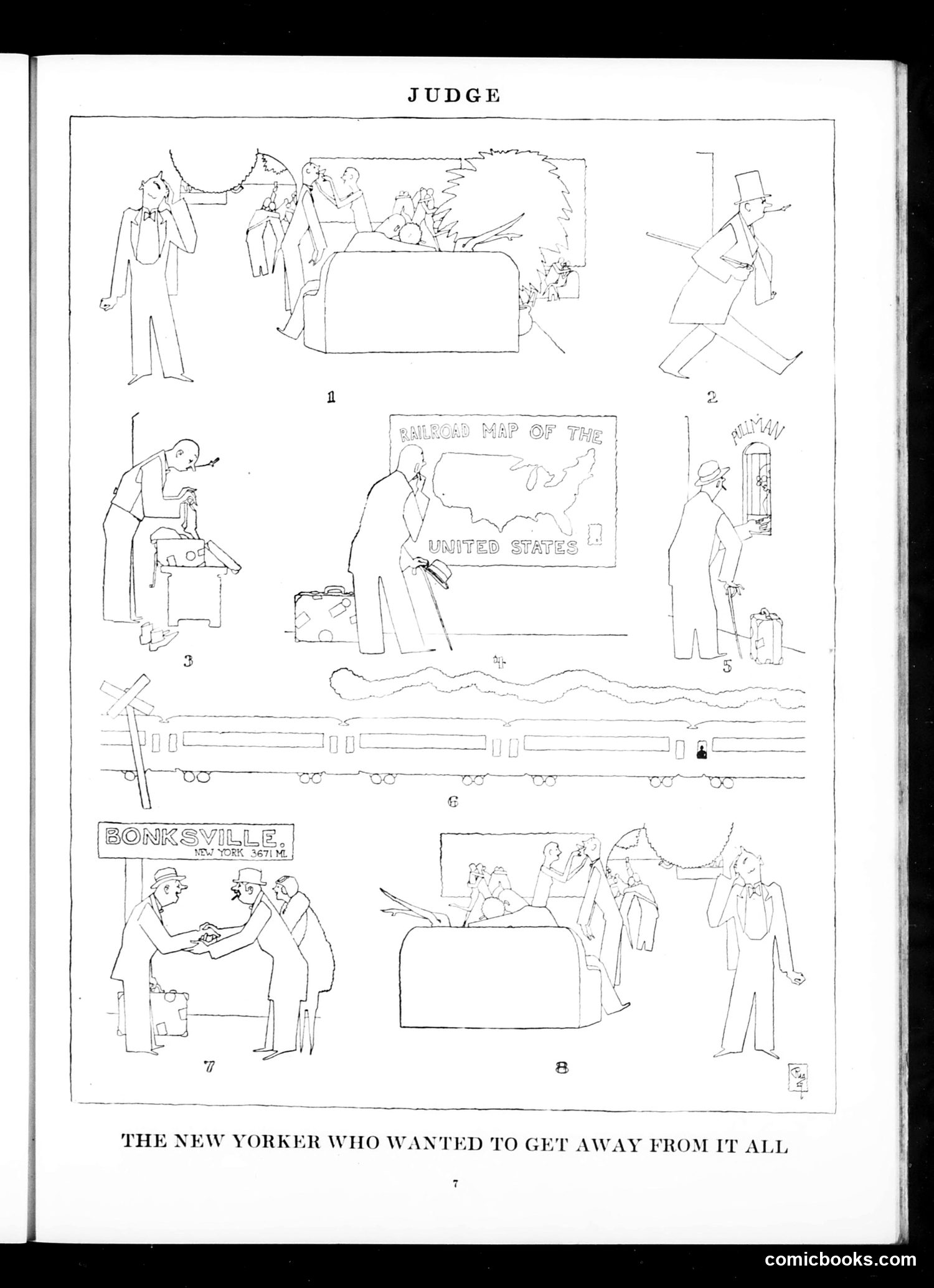
This multi-panel cartoon satirizes a New York City resident's failed attempt at escape. Panel 1 shows courtroom chaos; panel 2 depicts a man fleeing with a map of U.S. railroads; panel 3 shows him working as a porter; panel 4 displays a long train. Panels 5-8 follow his journey, culminating in Bonksville (panel 7), where he encounters the same social pressures and conflicts he sought to escape—shown through arguments and confrontations with locals. The satire suggests that personal problems, social obligations, and urban anxieties follow you regardless of geography. A New Yorker cannot truly "get away from it all" by relocating; the fundamental issues remain. The joke reflects early 20th-century attitudes about New York's fast-paced, complicated social environment versus rural simplicity.
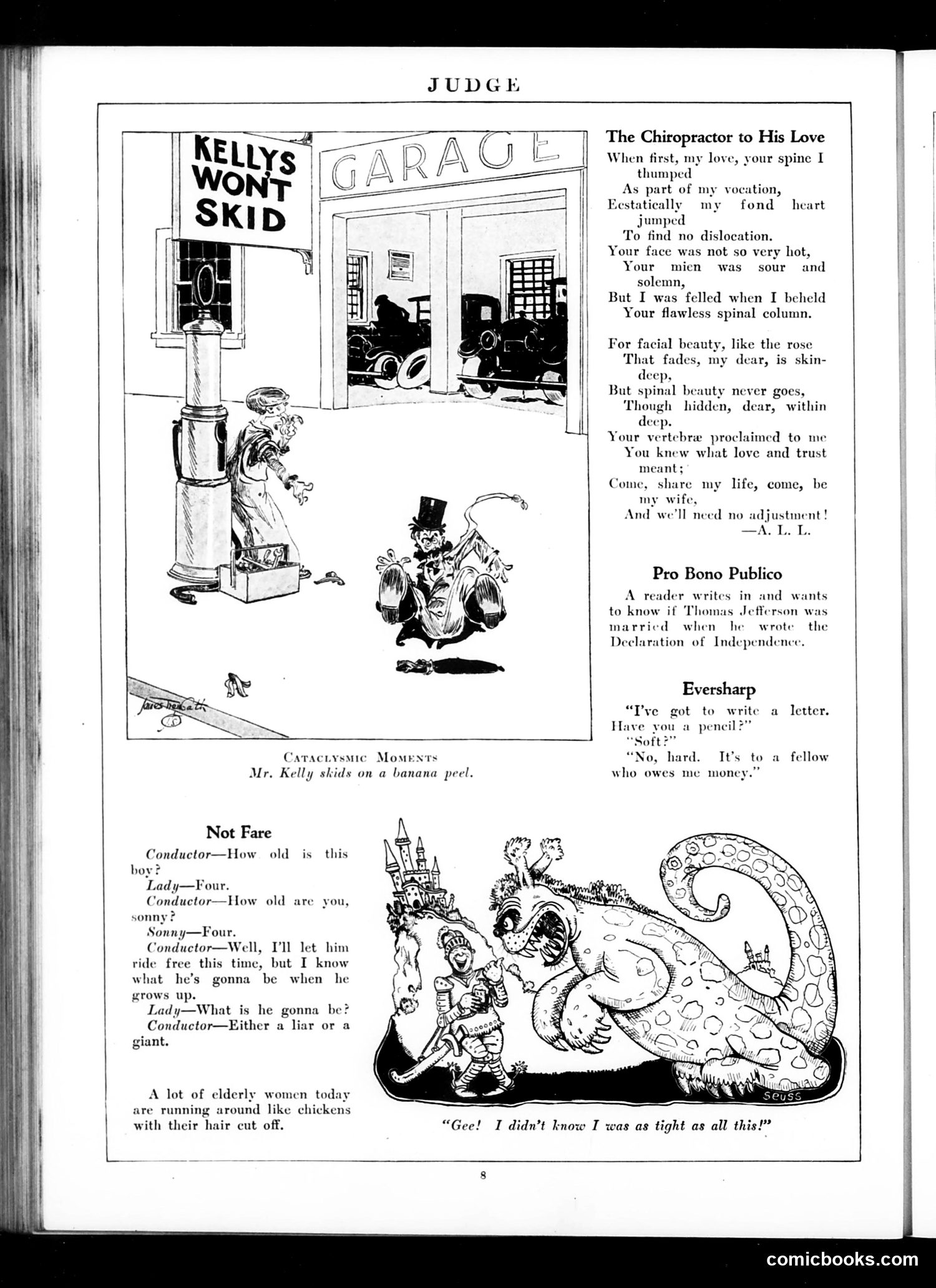
This page contains several satirical pieces typical of early 20th-century Judge magazine: **"The Chiropractor to His Love"** is a humorous poem mocking the then-trendy chiropractic profession by romanticizing a patient's "flawless spinal column" as a marriage proposal. It satirizes both chiropractors' claims and the absurdity of basing love on spinal health. **"Pro Bono Publico"** is a light editorial note joking about whether Thomas Jefferson was married when writing the Declaration of Independence—likely referencing contemporary historical interest. **"Not Fare"** depicts a conductor allowing a four-year-old to ride free, then predicting the child will become either a liar or a giant—satirizing the absurdity of the conductor's logic and perhaps critiquing dishonesty in business dealings. The cartoons use visual humor and wordplay typical of Judge's satirical style, targeting contemporary professions, social behaviors, and everyday absurdities rather than serious political commentary.
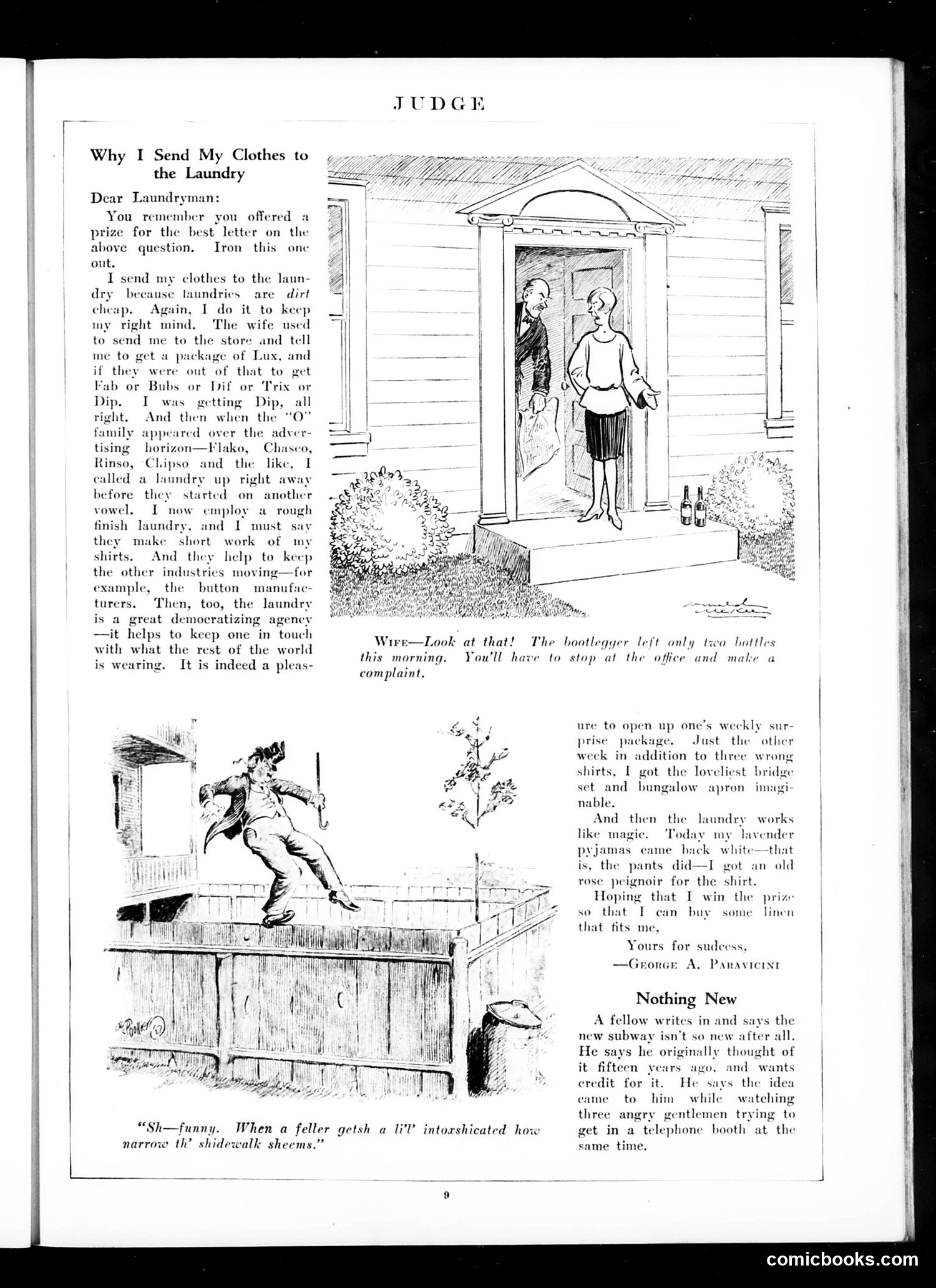
This page contains a humorous letter contest entry about why the writer sends clothes to commercial laundries rather than washing them at home. **The Main Satire:** The letter satirizes the proliferation of competing laundry detergent brands flooding the market. The writer complains his wife constantly sent him to stores requesting specific products—Lux, Fab, Bubs, Dip, Trix—and then newer brands appeared (Flako, Chaseo, Rinso, Chipso). Rather than keep track of these competing products, he simply outsourced laundry entirely to avoid the domestic hassle. **Secondary Humor:** The cartoons mock both poor laundry service (the illustration of chaos at a laundry) and the absurdity of modern life—one cartoon shows a drunk man's difficulty with a telephone booth, another depicts a confused person at a laundry. **Historical Context:** This reflects early-to-mid 20th century consumer culture anxiety about brand proliferation and changing domestic labor patterns. The letter winner receives a "prize," suggesting this was Judge's reader engagement feature.
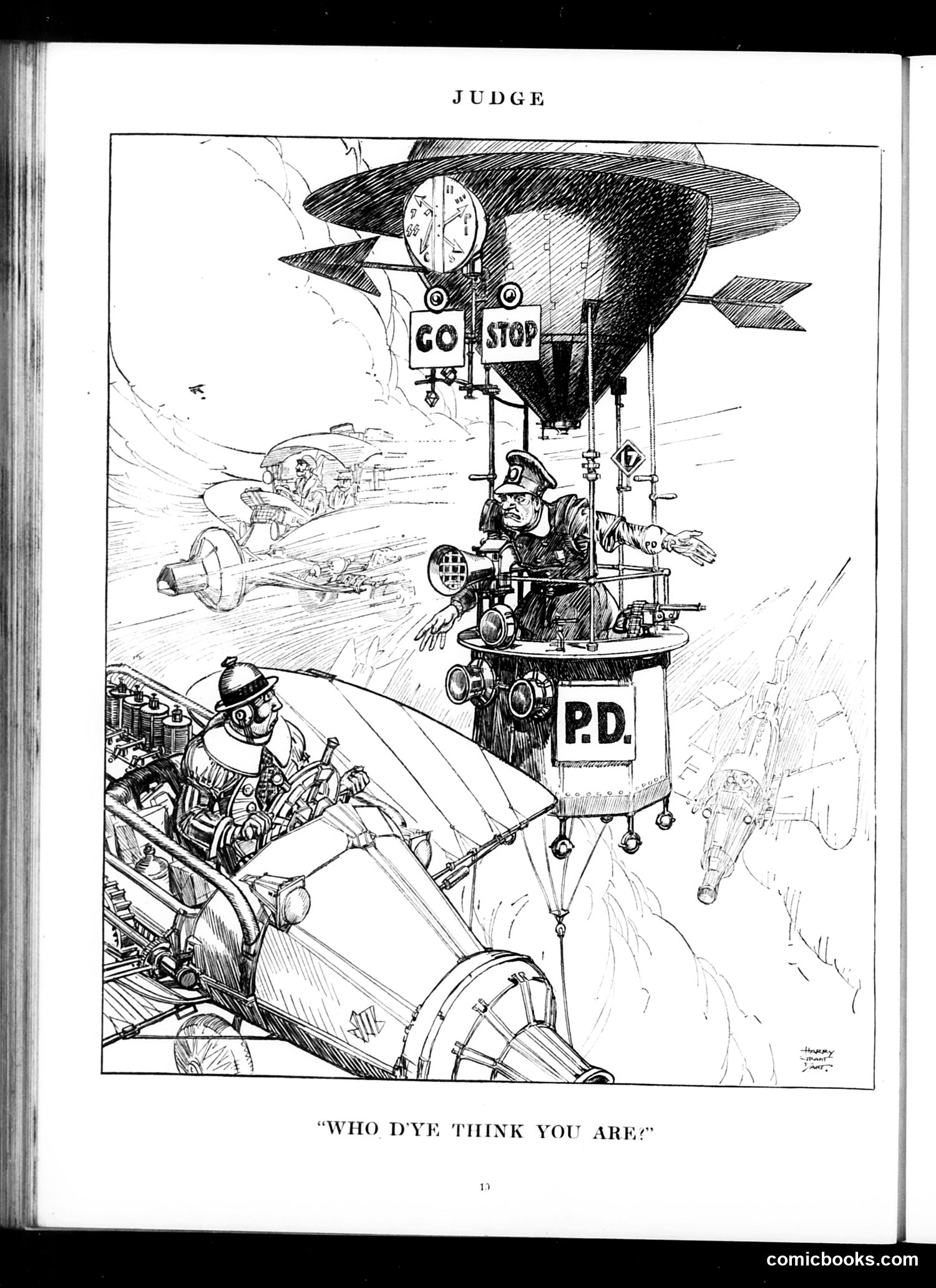
This satirical cartoon depicts a traffic enforcement scene. A police officer in a tall control tower labeled "P.D." (Police Department) operates a "GO STOP" signal—an absurd, contradictory traffic device—while directing speeding motorists below. The cartoon mocks what appears to be overzealous or arbitrary police traffic enforcement, suggesting officers abuse their authority by issuing confusing or contradictory orders to drivers. The title "Who D'ye Think You Are?" conveys drivers' frustration with the police's perceived arrogance and unreasonable control. This likely satirizes early 20th-century complaints about traffic police overreach and the perceived class conflict between authority figures and ordinary motorists, a growing concern as automobile use expanded in American cities.
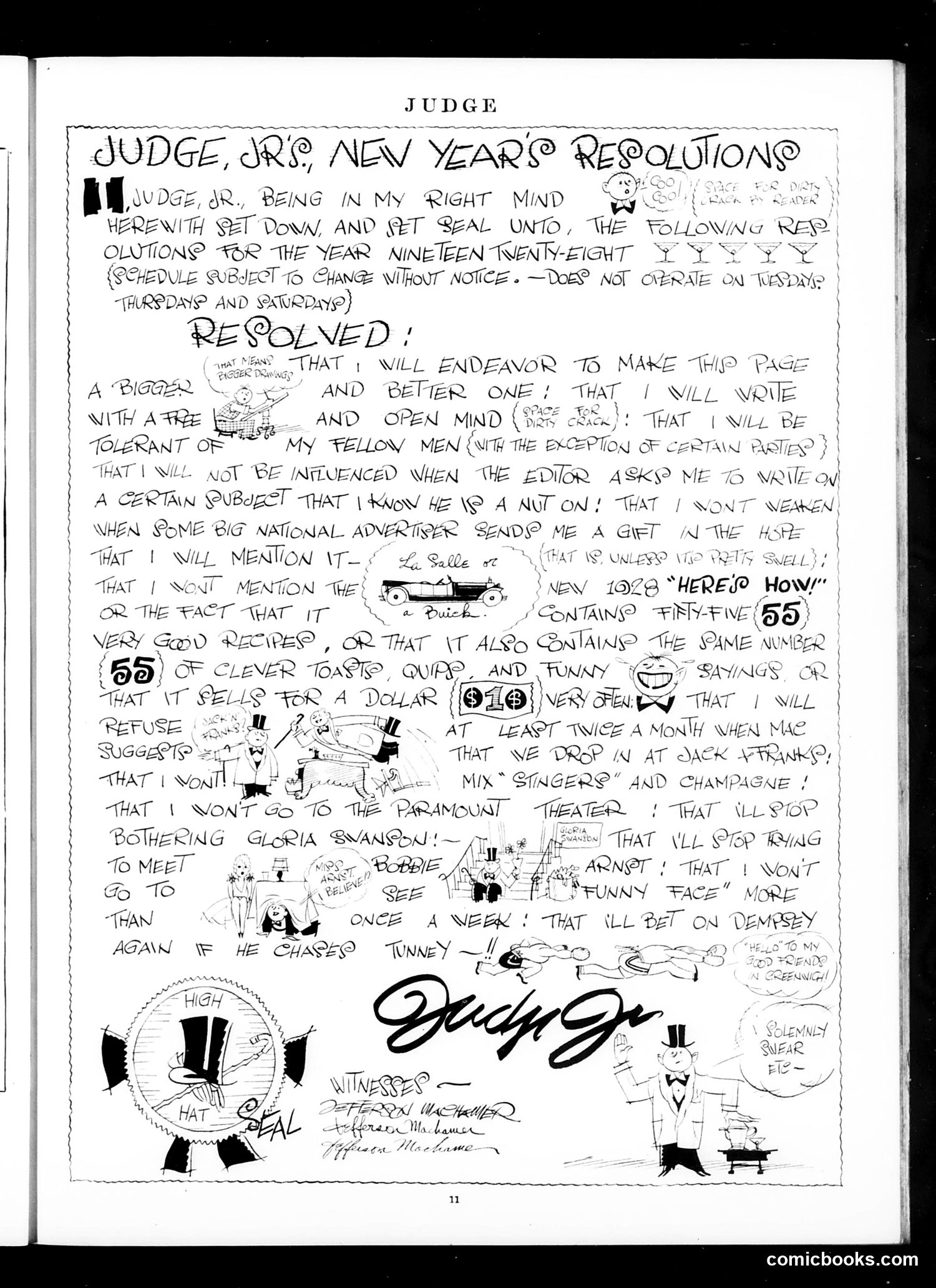
This is a humorous "New Year's Resolutions" piece presented as if Judge magazine's mascot or editor is making formal pledges. The satire targets the magazine's own editorial compromises and hypocrisies. The resolutions mock Judge's actual practices: promising to be "tolerant" and "open-minded" while admitting he *won't* be influenced by editors requesting pieces on certain topics he considers foolish; vowing not to mention big advertisers' gifts—then immediately listing specific products (La Salle automobiles, Buick cars, "Here's How" liquor recipes containing 55 recipes, and items costing $1.10) as if unable to resist. References to Gloria Swanson and Dempsey (boxer Jack Dempsey) are celebrity culture references typical of 1928 entertainment gossip. The overall joke: Judge satirizes itself, admitting that despite noble intentions, the magazine remains commercially influenced and culturally superficial—a frank self-parody about editorial integrity compromised by advertising revenue.
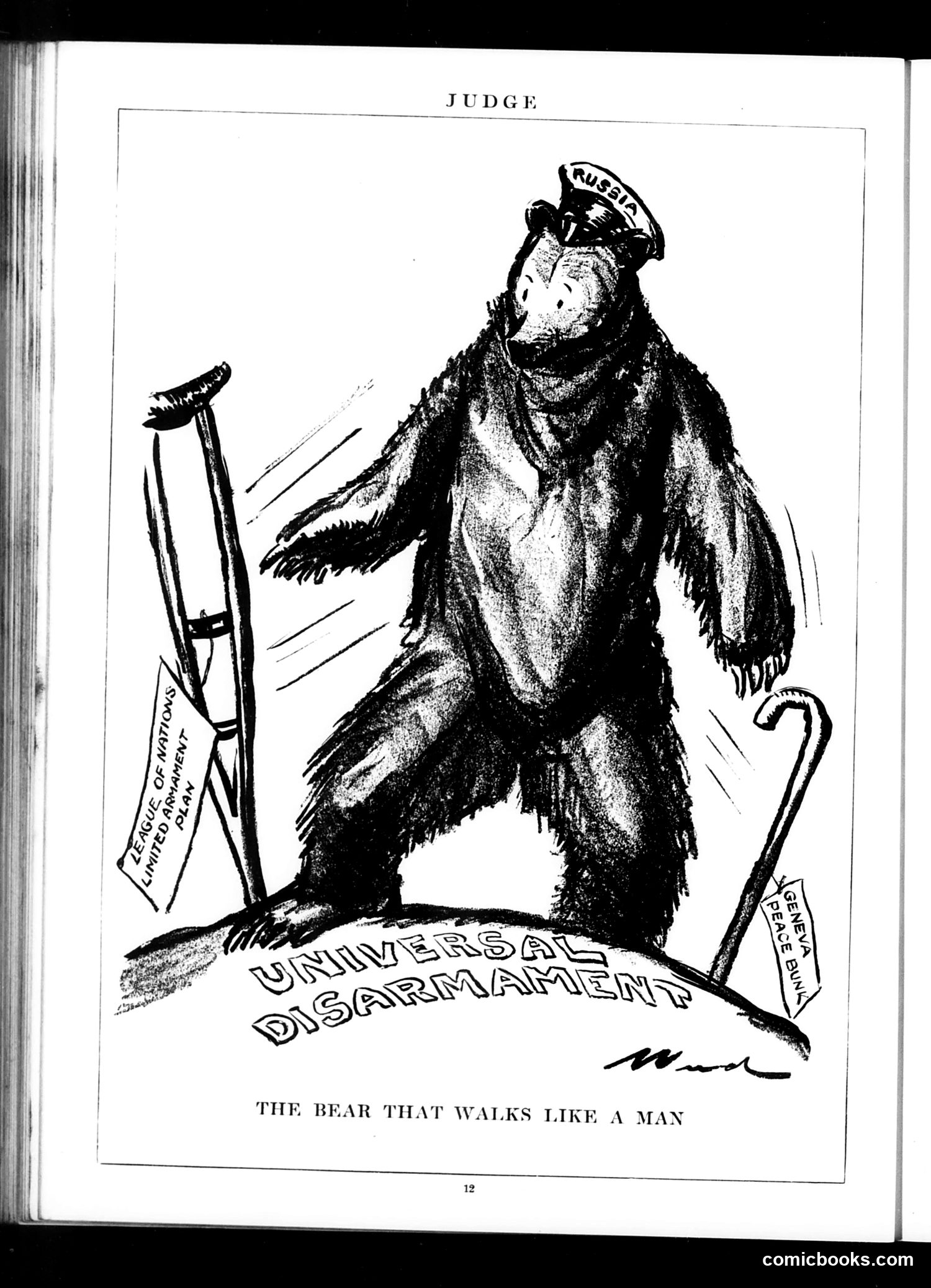
This political cartoon depicts Russia as a bear wearing a crown labeled "RUSSIA," standing upright on hind legs. The bear holds two crutches labeled "UNIVERSAL DISARMAMENT" and what appears to be "PEACE PLAN." The satire suggests that Russia's proposals for universal disarmament and peace are insincere—the bear must use crutches to maintain its human-like posture, implying Russia cannot genuinely support such peaceful positions without artificial support. The cartoon likely critiques Russian diplomatic overtures as unstable or fundamentally dishonest, reflecting Western skepticism toward Russian peace initiatives during a period of international tension. The anthropomorphic bear walking "like a man" emphasizes the unnaturalness of Russia's claimed peaceful intentions.
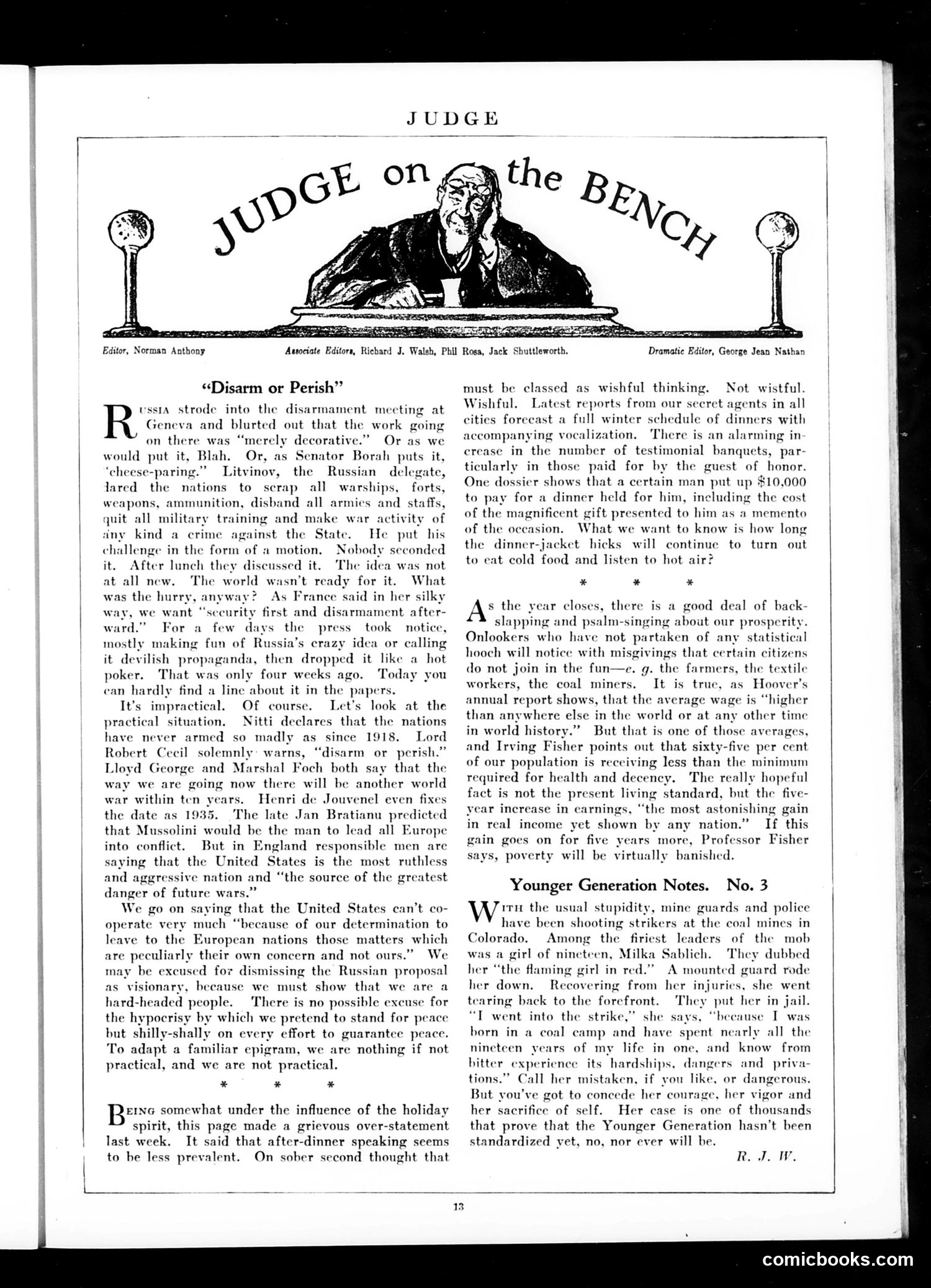
This editorial page satirizes the failure of international disarmament efforts following World War I. The Russian delegate Litvinov challenged nations at a Geneva disarmament conference to eliminate all weapons and armies—a radical proposal that received no seconding and was quickly forgotten. The satire's target: Western hypocrisy. While leaders like Lloyd George and Lord Robert Cecil warn "disarm or perish," the U.S. and Europe continue aggressive rearmament since 1918. Judge mocks America's excuse—claiming Europeans' affairs aren't "our concern"—while pretending to support peace. The piece calls this "shilly-shally" (timid vacillation) and concludes: "we are nothing if not practical, and we are not practical." The secondary items mock testimonial dinners (paid self-celebrations) and false prosperity claims ignoring struggling farmers, textile workers, and coal miners.
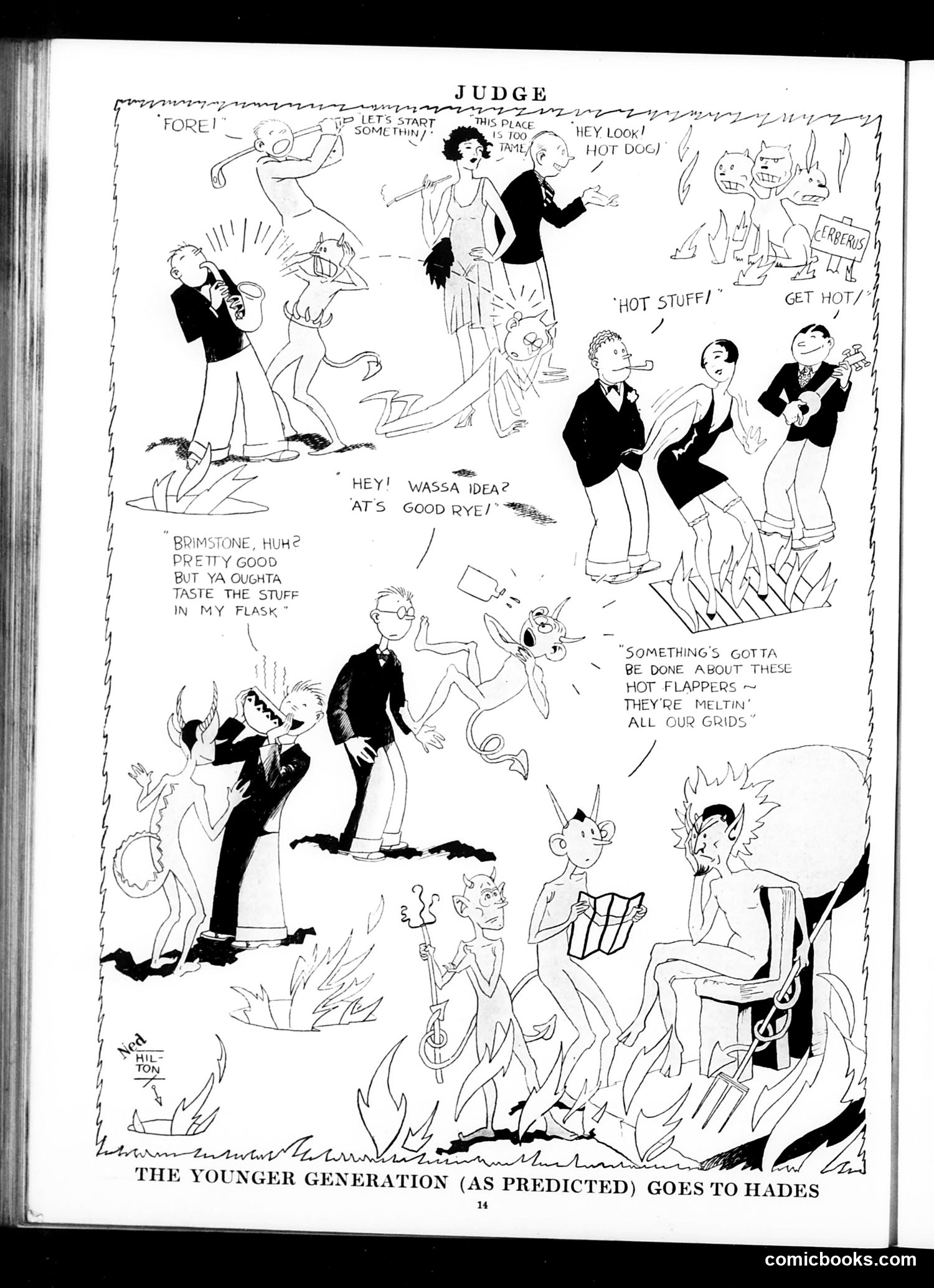
This is a satirical cartoon mocking moral panic about 1920s youth culture. The cartoon depicts young people—particularly "flappers" (modern women with short hair and revealing clothing)—engaging in scandalous behavior: dancing, drinking ("good rye," referencing Prohibition-era bootleg liquor), and generally carousing. The setup is a mock-apocalyptic vision where disapproving elders literally send the younger generation to Hell for their transgressions. References include: - "Hot stuff" and "hot dogs"—slang for attractive/exciting people - "Flapper" culture and jazz-age excess - Prohibition violations (illegal alcohol consumption) - The "Brimstone" flask joke emphasizes the hellfire condemnation The satire targets conservative adults' exaggerated fears about youth morality. Rather than endorsing these fears, Judge magazine appears to be mocking the hysteria itself—presenting the generational conflict as absurdly catastrophic. This reflects 1920s cultural debates over changing social norms.
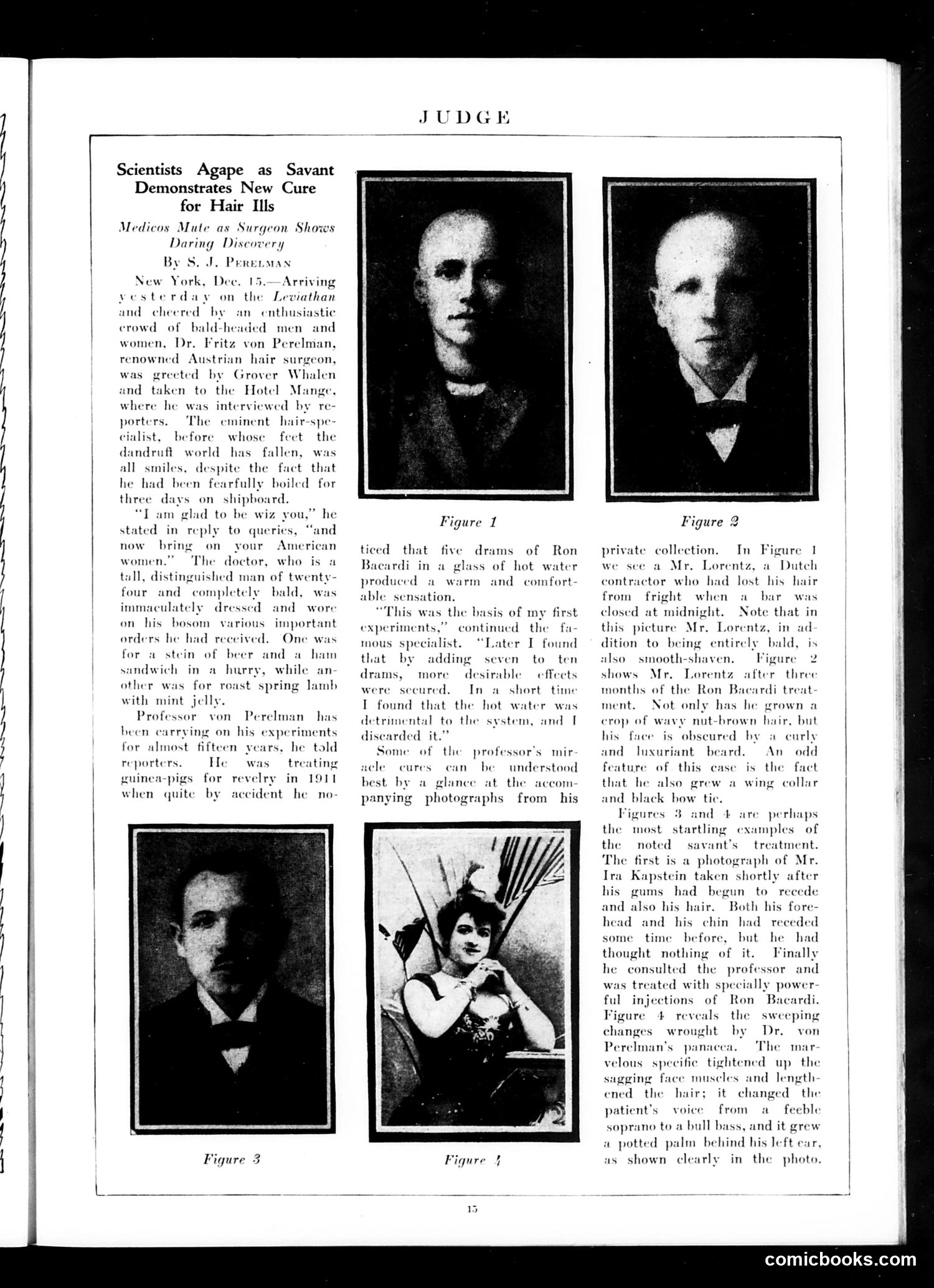
This is a satirical article mocking the era's dubious medical charlatans and "miracle cure" practitioners. Dr. Fritz von Perelman, a fictional Austrian hair surgeon, arrives in New York claiming to cure baldness—a condition causing genuine distress to many men at the time. The satire targets two things: (1) the gullible public's desperation for solutions to hair loss, and (2) quack doctors exploiting this vulnerability. The "cure" is absurdly simple: Ron Bacardi rum in hot water, eventually just the rum. The before-and-after photographs of "patients" showing implausibly miraculous transformations—not only regrowing hair but gaining beards, changing voice pitch, and even sprouting a potted plant—underscore the obvious fakery. The piece mocks the pseudoscientific language and theatrical presentation surrounding dubious treatments marketed to the desperate and vain, while poking fun at the credulous crowds who greeted such charlatans at ports like a celebrity.
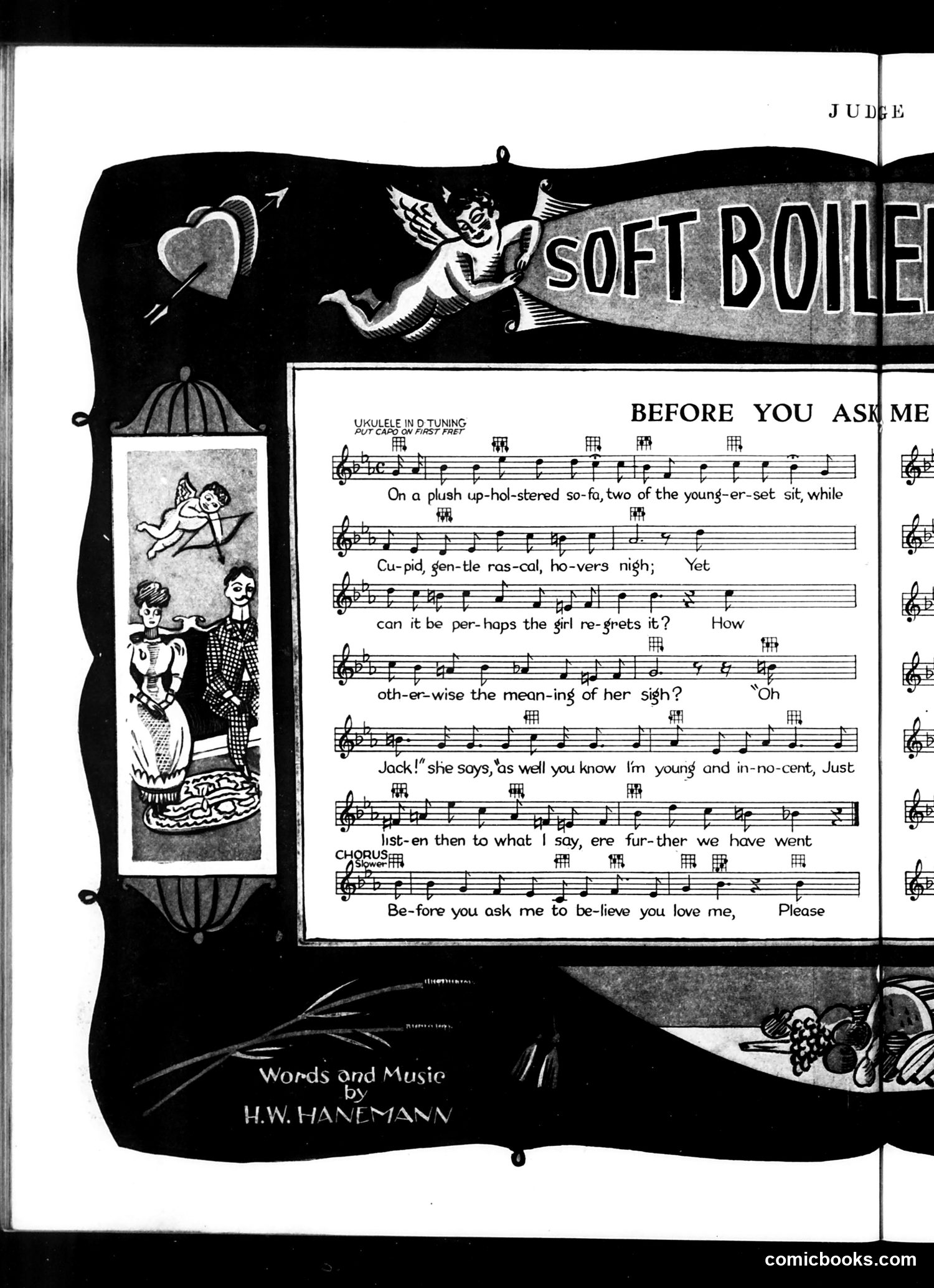
This page features a song titled "Before You Ask Me to Believe You Love Me" by H.W. Hanemann, presented as sheet music with accompanying illustration and lyrics. The content satirizes early 20th-century courtship rituals and male manipulation. The scene depicts a young couple on an upholstered sofa while Cupid hovers above—a common romantic trope. The song's lyrics reveal the girl's wariness: a young man ("Jack") pressures her to listen to his declarations of love, but she skeptically warns him to prove his sincerity first. The satire targets the disconnect between romantic ideology and actual male behavior—the girl's repeated refrain "Before you ask me to believe you love me" suggests men routinely made insincere declarations. The ukulele instruction detail at top reflects the 1920s-30s fad for this instrument as accompaniment to popular songs. The decorative art-deco border featuring cherubs, soft furnishings, and fruit reinforces the magazine's humorous, aspirational advertising tone typical of *Judge*.
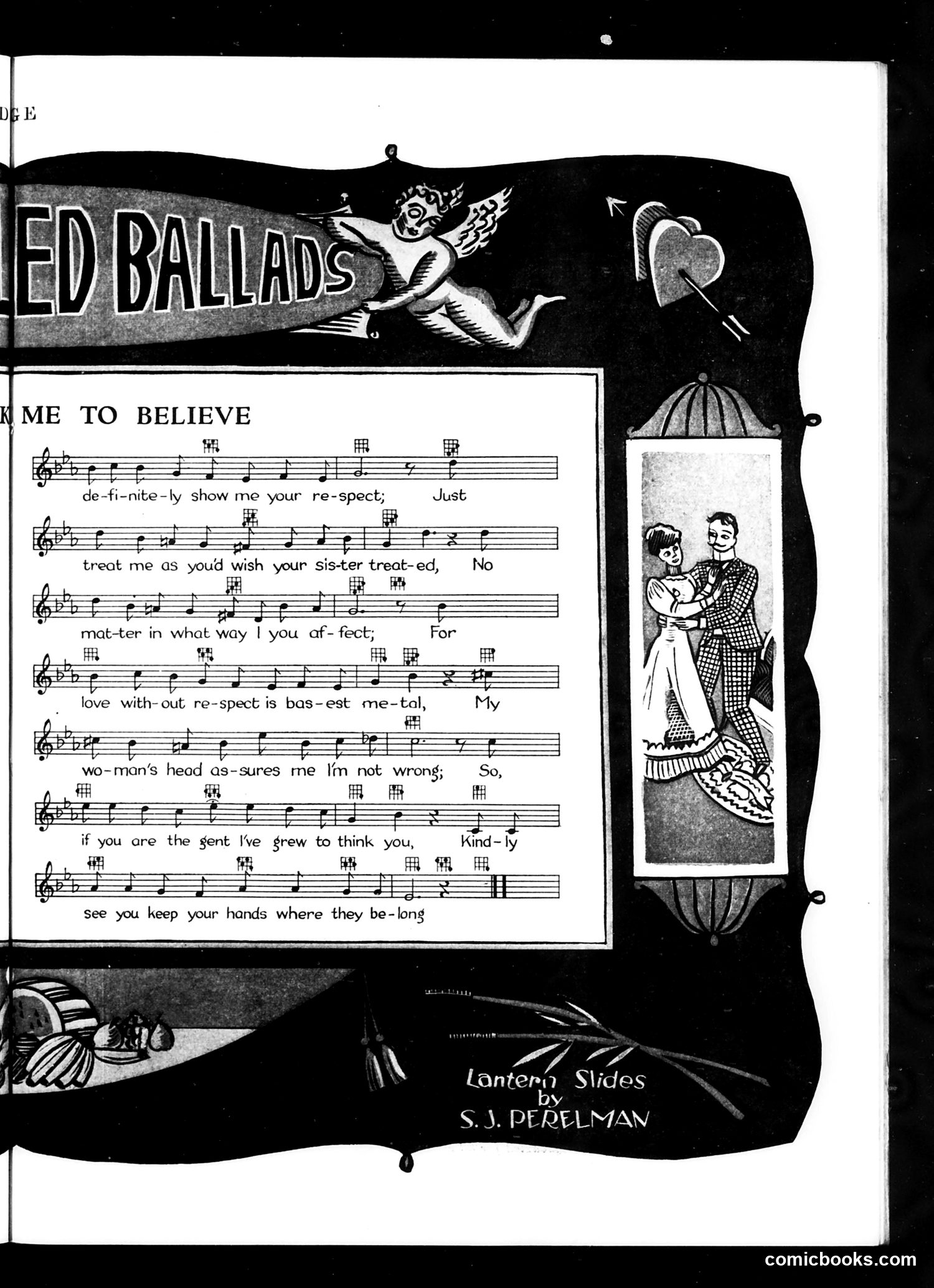
This page presents a sentimental ballad (lyrics with musical notation) paired with a lantern slide illustration—a common early 20th-century entertainment format. The song is a woman's plea for respectful treatment in courtship, asking her suitor to show her the consideration he'd show his sister and to keep "your hands where they belong." The accompanying illustration depicts a couple with a parasol in a romantic scene. The content appears to be earnest rather than satirical—a moralistic song about maintaining propriety and respect in romantic relationships, typical of the era's courtship conventions. The "satire" here likely lies in Judge magazine's presentation: either gently mocking overly sentimental Victorian morality about dating and physical restraint, or ironically presenting such earnest guidance for readers who might already consider such prudishness outdated. The credit to S.J. Perelman (a famous humorist) suggests comedic intent, though the exact satirical target remains somewhat unclear from the page alone.
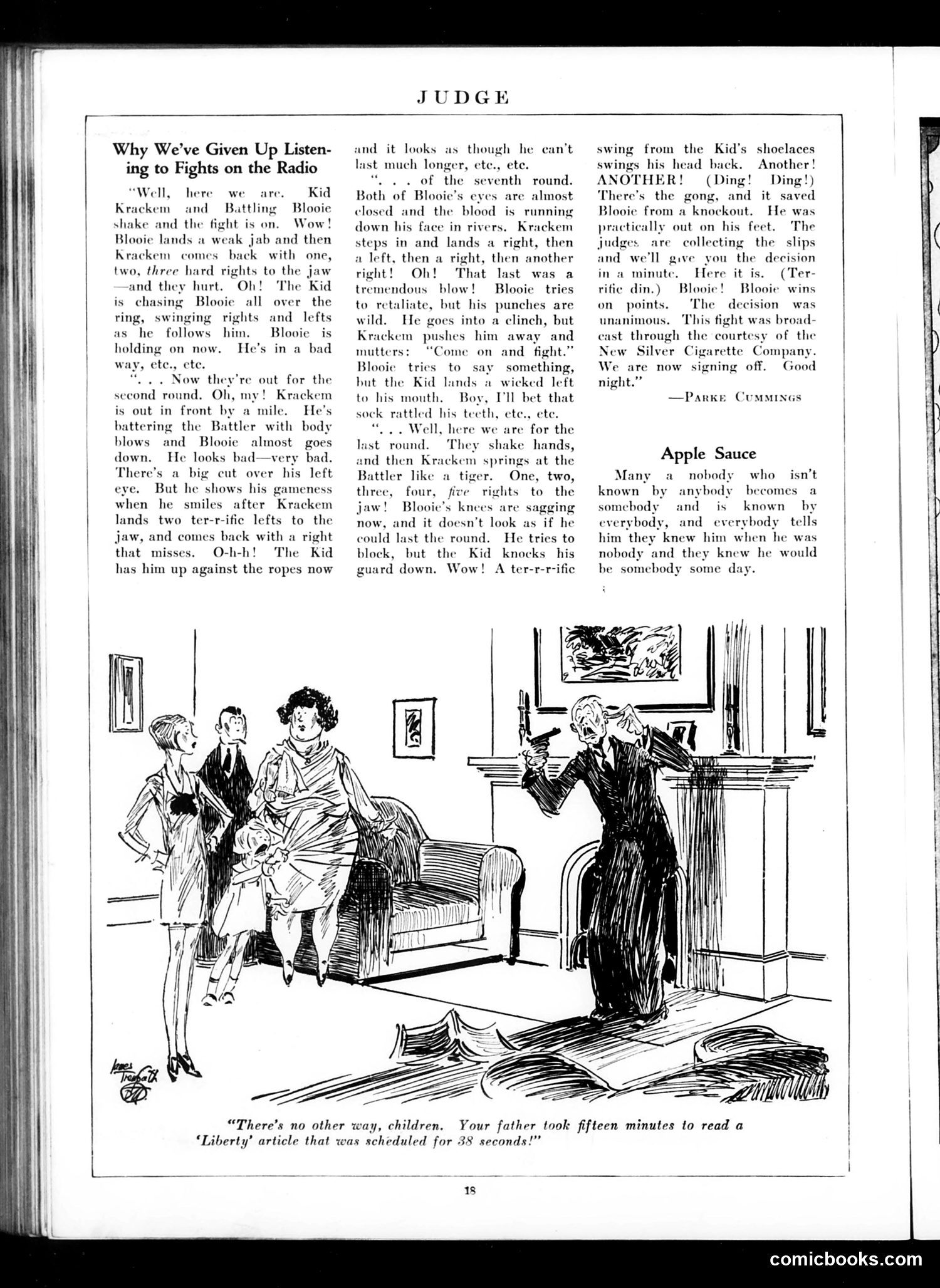
This page satirizes the excessive, breathless commentary style of 1920s-30s radio boxing broadcasts. The left column presents an absurdly overwrought play-by-play of a fight between "Kid Krackem" and "Battling Blooie"—fictional boxers used to mock the genre's theatrical hyperbole and repetitive clichés ("ete., ete."). The cartoon illustrates the joke: a father abandons his family to read a magazine article because a boxing broadcast scheduled for 38 seconds actually consumed 15 minutes of airtime. The satire targets both radio announcers' tendency to pad broadcasts with dramatic filler and listeners' gullible fascination with the format. The brief "Apple Sauce" section offers unrelated social commentary about sudden fame and people claiming prior acquaintance with the newly famous—filler typical of Judge's miscellaneous humor pages.
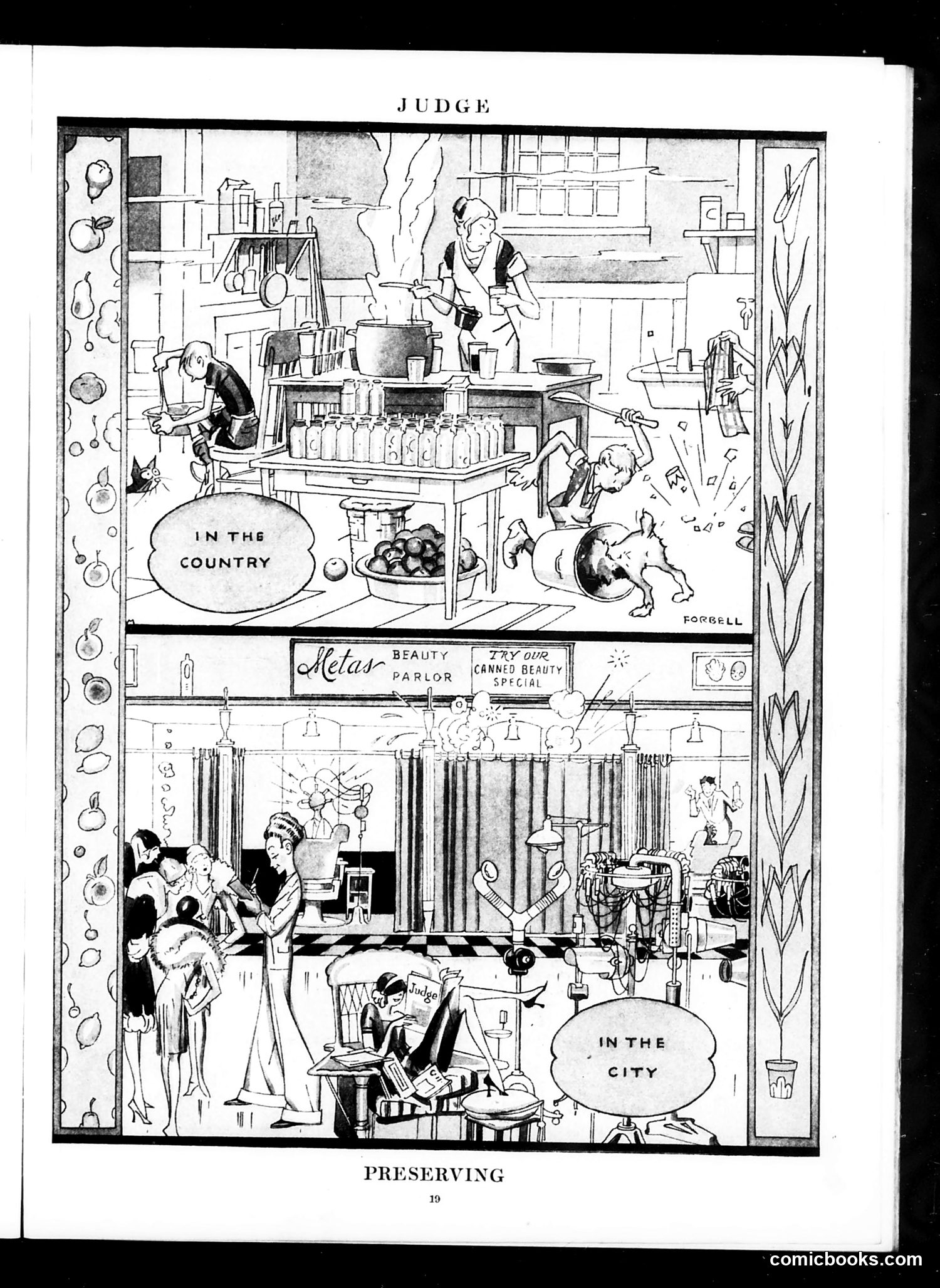
This cartoon contrasts rural and urban life through food preservation. **Top panel ("In the Country"):** A rural kitchen scene shows a woman canning vegetables in a modest home setup, with jars lined up and fresh produce visible. **Bottom panel ("In the City"):** An urban "Melas Beauty Parlor" advertises "Canned Beauty Special"—a beauty salon offering cosmetic treatments. A woman sits at a vanity receiving beauty treatments. **The Satire:** The joke plays on "preserving"—literally canning food in the country versus metaphorically "preserving" beauty through cosmetics in the city. It mocks urban women's reliance on artificial beauty products and beauty parlors as a form of vanity, contrasting this with rural women's practical domestic work. The cartoon reflects early-20th-century attitudes toward urbanization, consumerism, and gender roles, satirizing city dwellers' perceived superficiality compared to rural practicality.
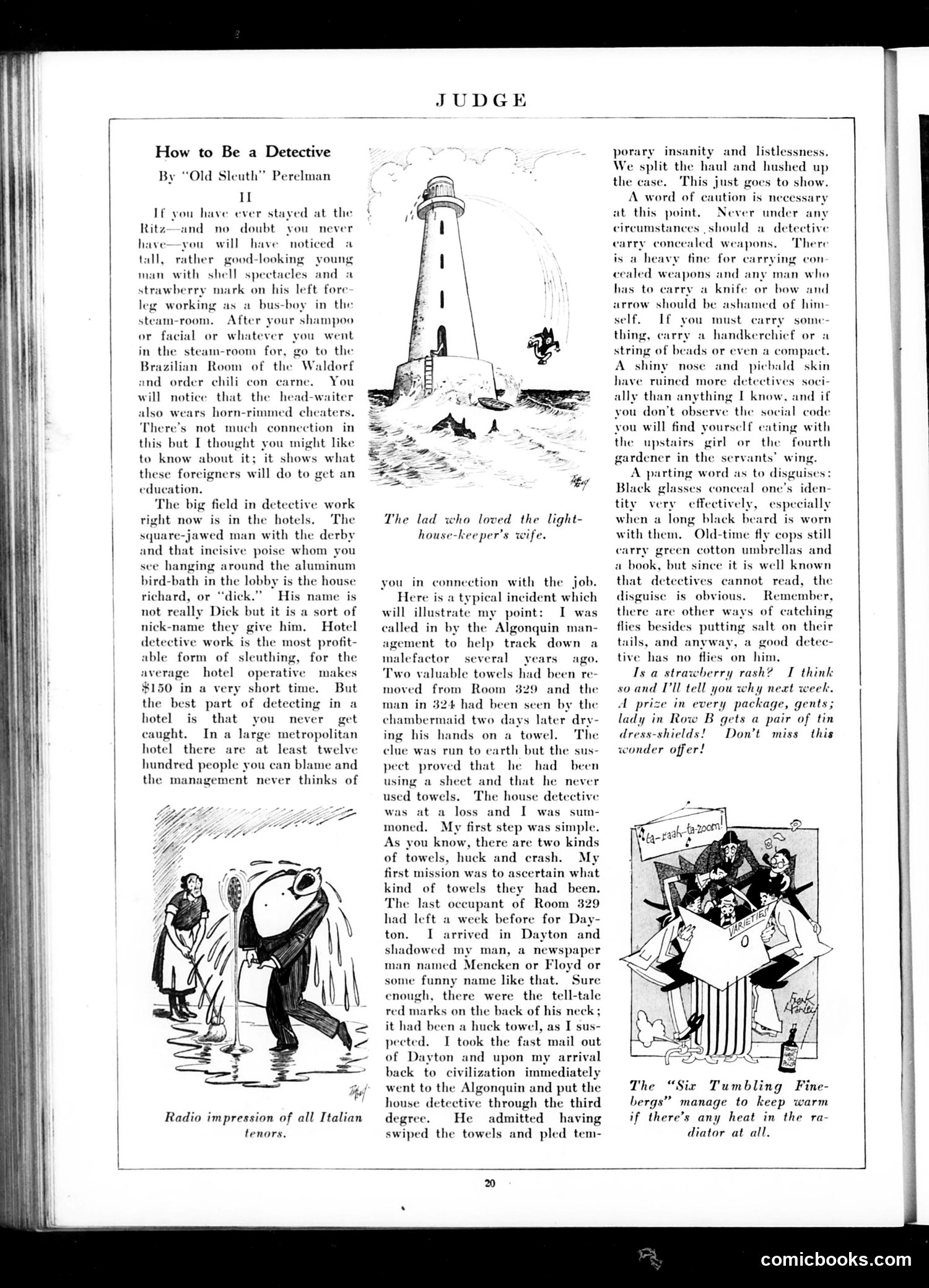
This is a humorous satirical piece mocking detective fiction conventions and incompetent hotel detectives. "Old Sleuth" Perelman (S.J. Perelman, a prominent comedy writer) presents absurd "detective advice" filled with non-sequiturs and circular logic. The cartoons illustrate the article's jokes: one depicts an Italian tenor at a radio microphone (referencing the "radio impression" caption), and another shows the "lighthouse-keeper's wife" scenario mentioned in the text. The satire targets: - **Hotel detective work** as lucrative but unaccountable (with 1,200 potential suspects to blame) - **Ridiculous investigative logic** (the towel theft solved by trailing a suspect to Dayton) - **Detective story clichés** (black glasses, fake beards, green umbrellas as "disguises") The piece mocks both the pulp detective fiction popular in the era and the bumbling real-world operatives supposedly solving petty hotel crimes. The tone is absurdist comedy—Perelman presents obviously flawed reasoning as authoritative advice.
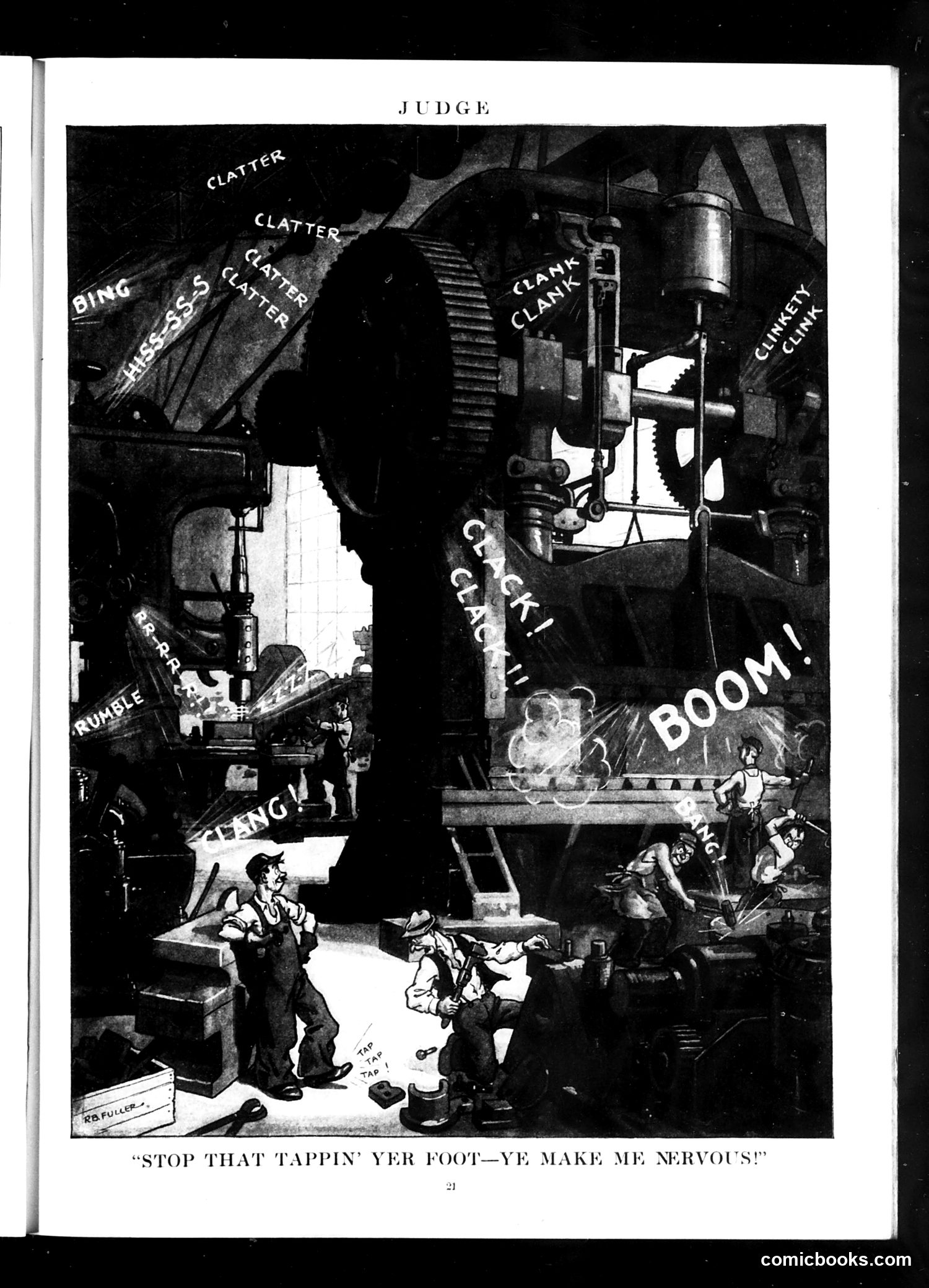
This is a single satirical cartoon depicting an industrial factory setting with massive machinery. Sound effects ("BING," "HISS," "CLATTER," "CLANK," "BOOM," "BANG") fill the image, emphasizing the deafening noise of heavy manufacturing. Two workers stand amid the cacophony. One complains to the other: "Stop that tappin' yer foot—ye make me nervous!" The satire is darkly humorous: in an environment of overwhelming industrial noise and chaos, the worker finds a colleague's foot-tapping—an infinitesimally small sound—to be the irritant. This mocks the absurdity of workplace complaints and human sensitivity in brutal, loud factory conditions. It likely comments on working conditions and the trivial grievances workers voiced amid genuinely hazardous industrial environments.
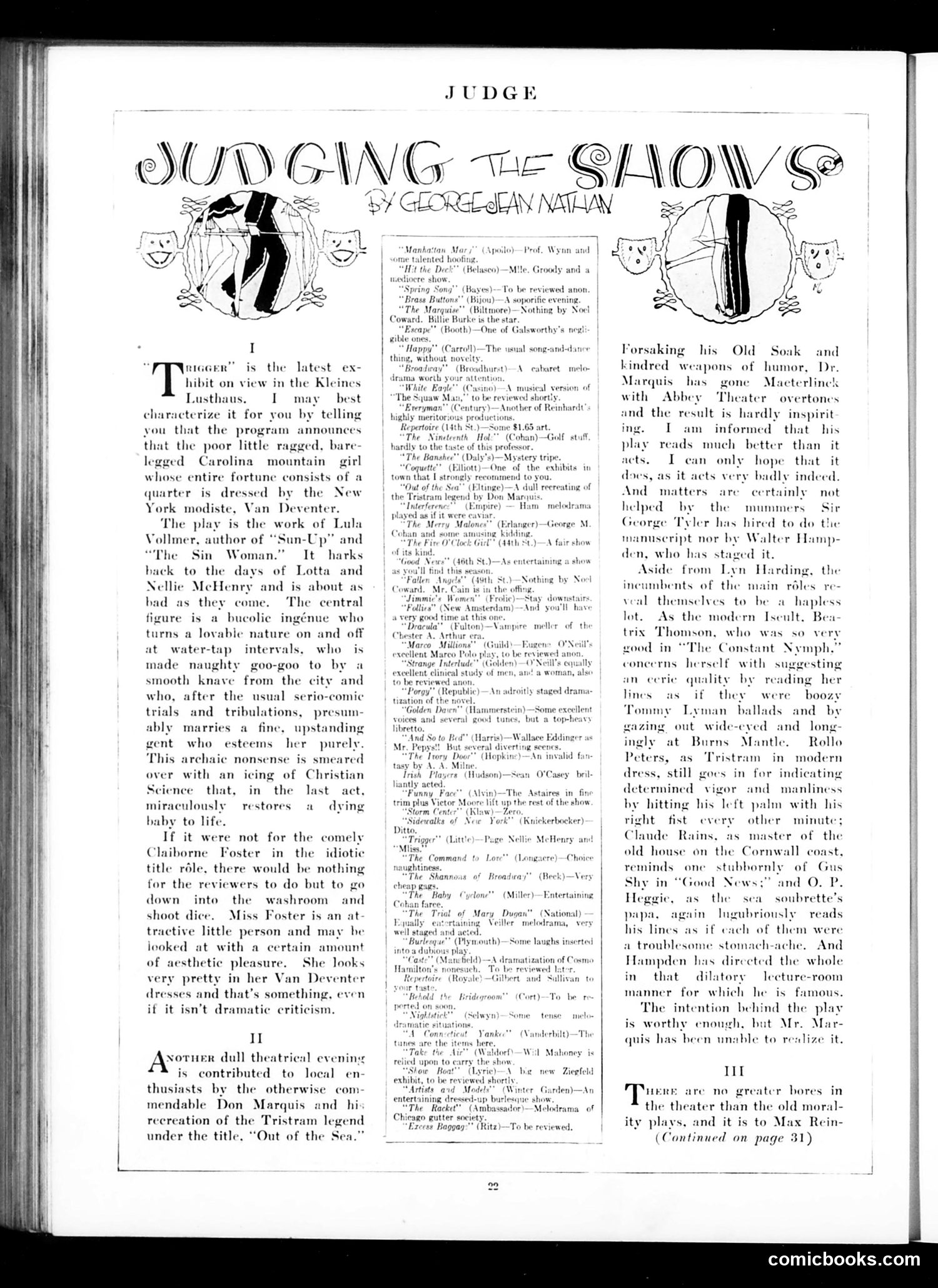
This page presents George Jean Nathan's theater reviews for Judge magazine. The main content is not political satire but rather entertainment criticism covering Broadway productions. The column mocks several shows, particularly "Trigger," a play about a poor Carolina mountain girl dressed by a fancy New York modiste (dressmaker). Nathan dismisses it as nostalgic hokum reminiscent of outdated theatrical fare from the Lotta/Nellie McHenry era. He credits only the actress Claiborne Foster's prettiness and Van Deventer costumes as redeeming qualities. Nathan also criticizes Don Marquis's "Out of the Sea," a Tristram legend adaptation, calling it a "dull theatrical evening" despite commendable contributors. The page is primarily a theater column with detailed show listings rather than political commentary or caricature-based satire typical of Judge. It showcases Nathan's acerbic critical voice regarding contemporary Broadway offerings.
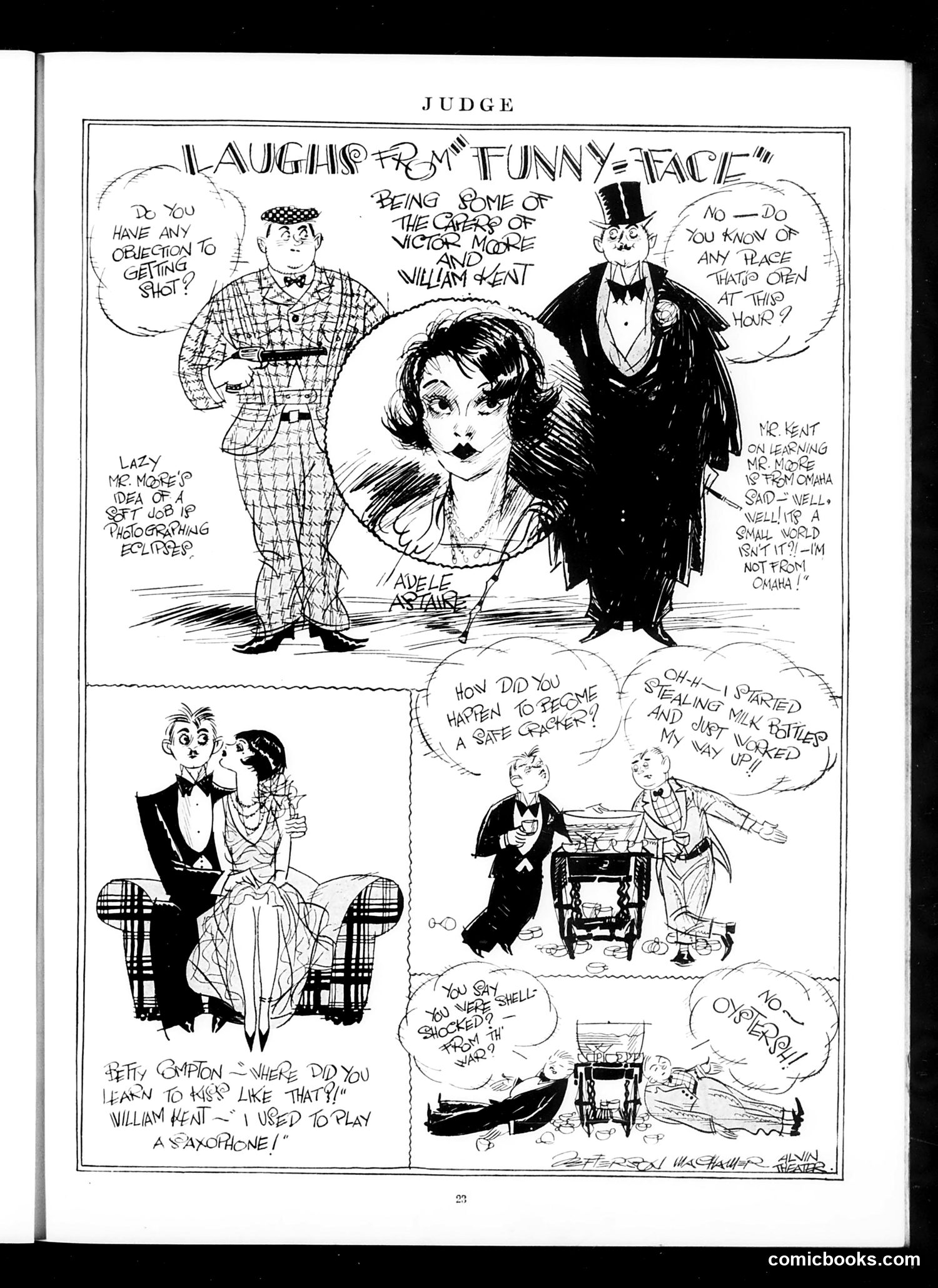
This page satirizes Hollywood and silent film celebrities of the 1920s era. The central figure labeled "Adele Astaire" (likely referring to the famous dancing Astaire siblings) is positioned between two men discussing their careers. The satire mocks: 1. **Victor Moore and William Kent** (vaudeville/stage actors mentioned in dialogue) - their transition into film acting and public perception shifts 2. **Lazy casting decisions** - one character complains about Moore's "set job in photographing eclipses," suggesting typecasting or repetitive roles 3. **Geographic pretense** - repeated references to "Omaha" appear to mock actors claiming humble origins while working in glamorous Hollywood 4. The lower panels show slapstick mishaps with a "safe cracker" and carriage accident, typical physical comedy from the silent film era The overall joke critiques how entertainment industry figures reinvent themselves and the absurdity of celebrity personas versus reality.
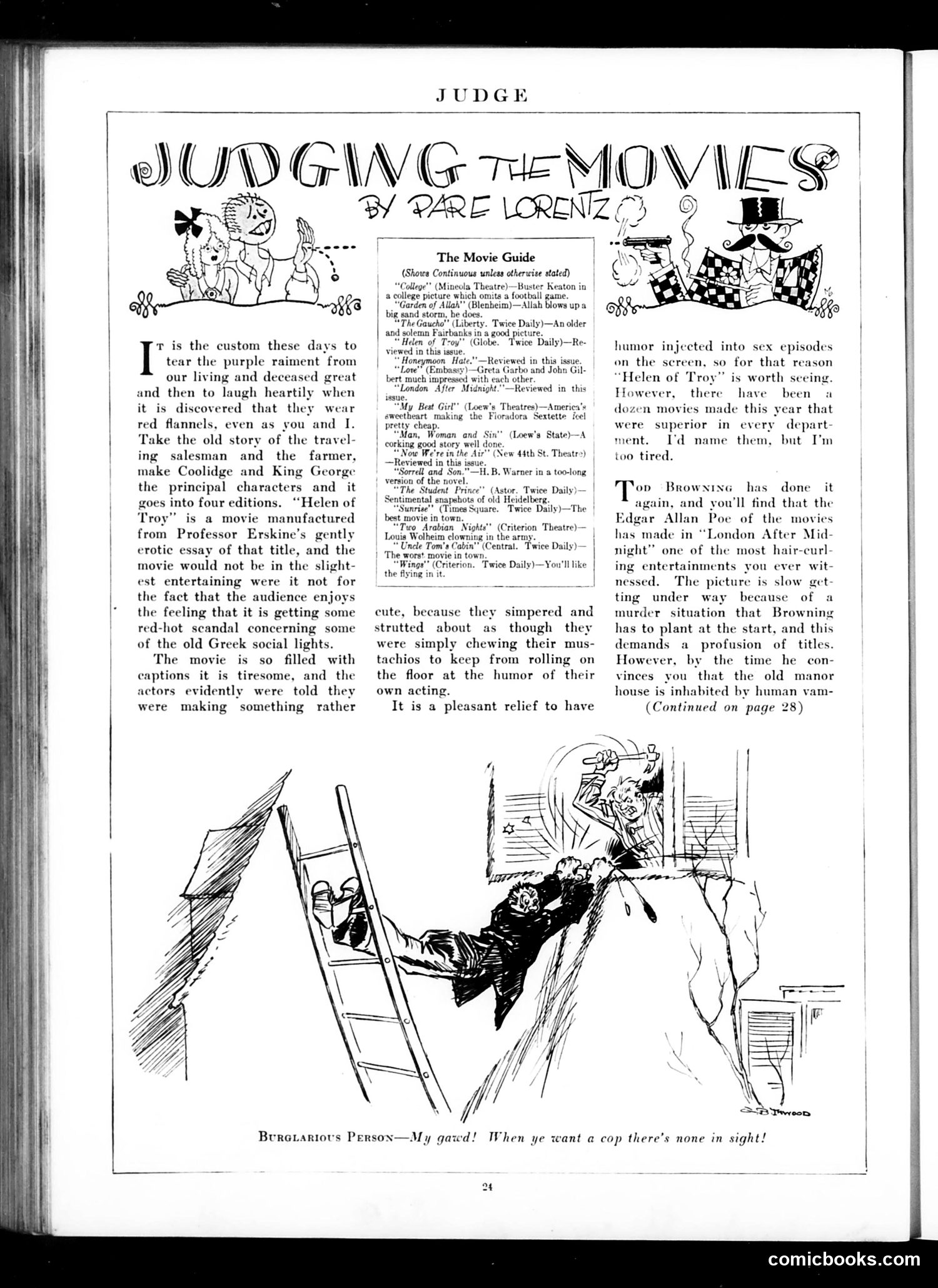
This is a film review column from Judge magazine, likely from the mid-1920s based on movie titles referenced (Buster Keaton's "College," Fairbanks films, "Sunrise"). The main article critiques contemporary cinema's reliance on scandal and titillation. Lorentz argues audiences enjoy movies primarily for glimpses of social impropriety—whether involving celebrities like Coolidge and King George or classical figures like Helen of Troy. He notes films are over-captioned and actors perform poorly, though he praises Tod Browning's "London After Midnight" as genuinely entertaining despite its slow setup. The cartoon below, captioned "Burglarious Person," shows a burglar on a ladder escaping through a window while lamenting the absence of police—a simple visual gag about ironic timing and incompetent law enforcement, reflecting 1920s cynicism about urban crime and policing.
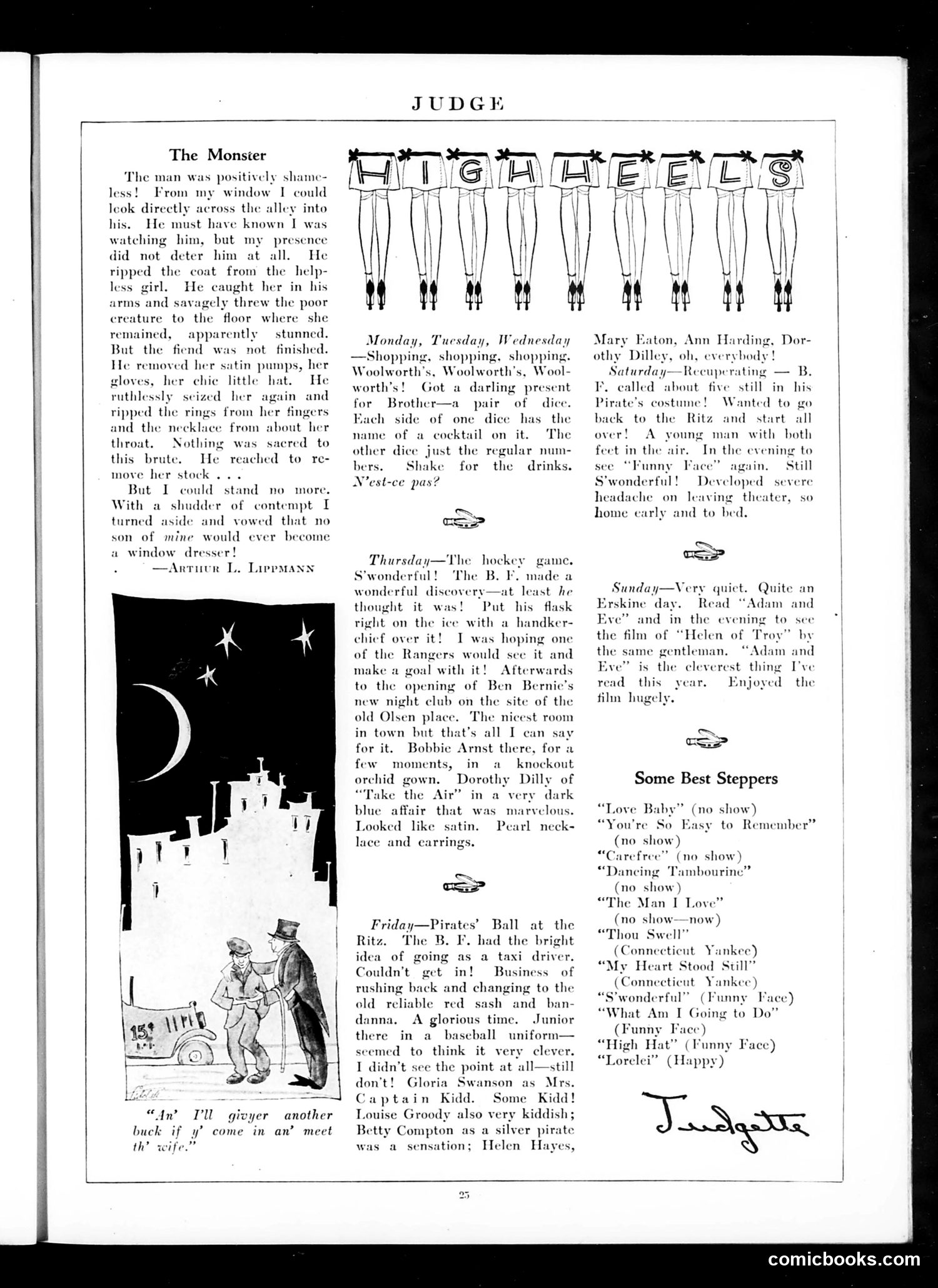
This page contains two distinct pieces of social satire: **"The Monster"** (main cartoon): A father observes a man violently undressing a woman through a window—ripping her coat, jewelry, and shoes. The narrator is horrified until the punchline reveals the man is a **window dresser** removing clothes from a mannequin for display. The satire mocks the narrator's voyeuristic assumptions and tendency to assume the worst. Arthur L. Lippmann's joke plays on the gap between what appears scandalous and innocent reality. **The diary entries** below humorously chronicle a wealthy socialite's week attending fashionable venues (Woolworth's, hockey games, nightclubs, costume balls) and Broadway shows. References include "Pirates' Ball at the Ritz" and contemporary musicals like "Funny Face" and "Connecticut Yankee." The satire targets upper-class leisure culture and the frivolous activities of the Jazz Age elite—endless shopping, parties, and entertainment consuming their time. The tone is gently mocking of this superficial lifestyle.
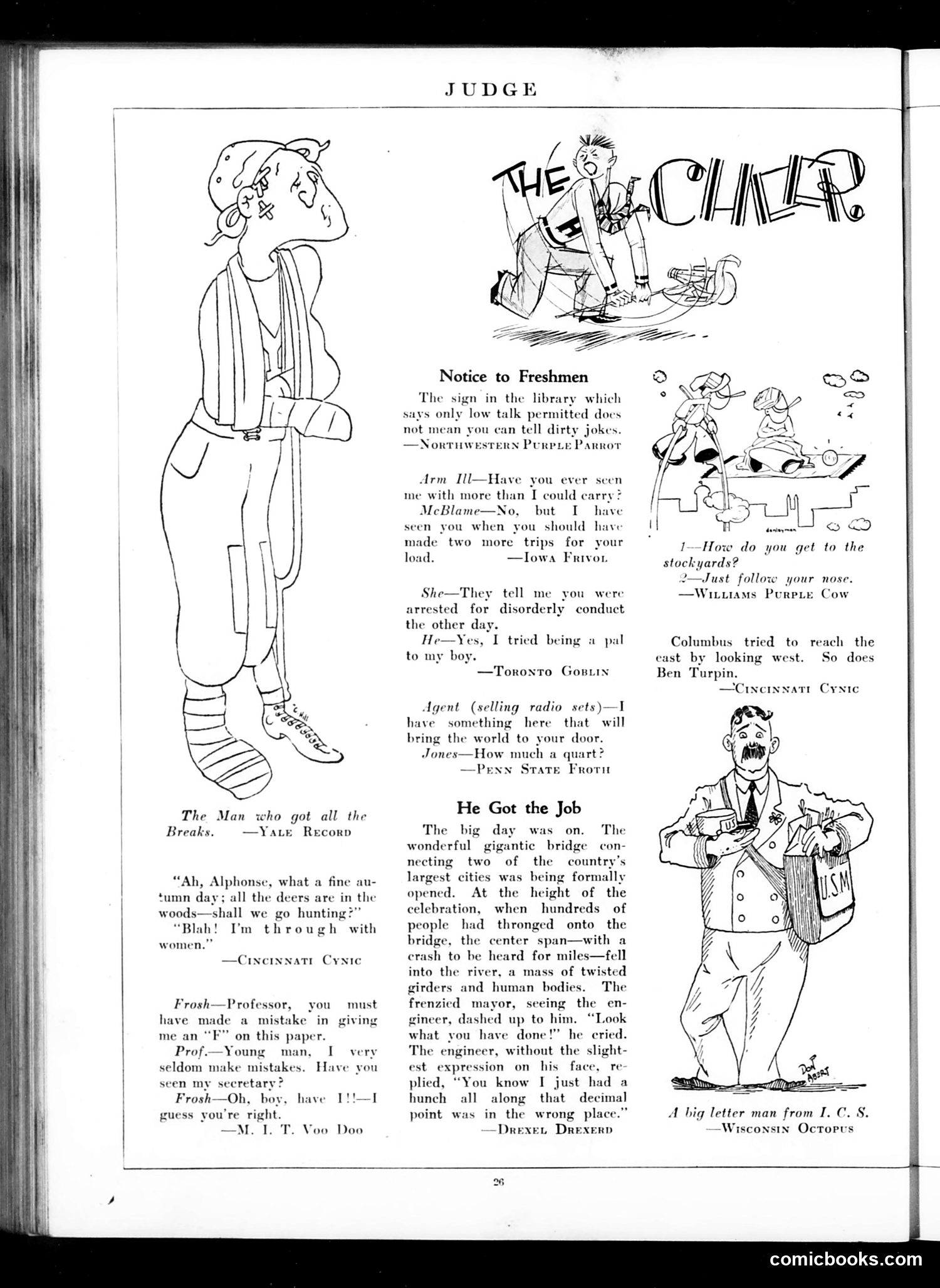
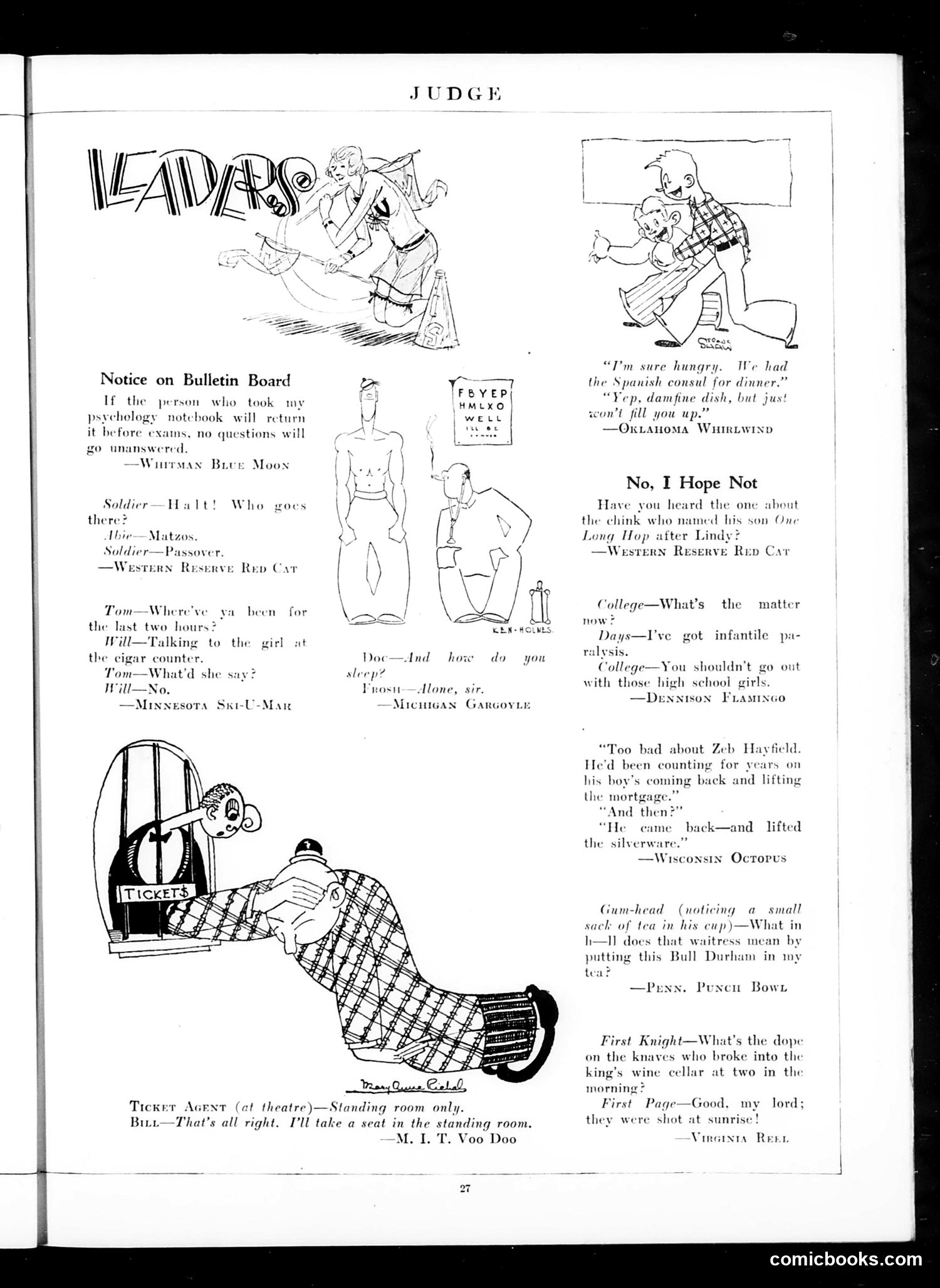
This page collects brief humorous observations and jokes from college humor magazines of the 1920s-era, organized as a miscellaneous humor section. **Key content:** The jokes employ period stereotypes and references: "Matzos/Passover" plays on Jewish identity; a reference to Lindy (Lindbergh's famous flight) suggests topical humor; "Bull Durham" tobacco appears as a recognizable brand for comedic incongruity. **The cartoons** show exaggerated situations—a woman labeled "Leaders" being thrown by men, a theater ticket agent's absurd logic about "standing room seats," a disheveled figure in a ticket booth. **Overall tone:** These are campus/college-oriented jokes emphasizing wordplay, misunderstandings, and gentle social observation rather than sharp political satire. The humor relies on recognizable contemporary references (Lindbergh, specific colleges mentioned) that anchored the jokes in their moment. The page represents Judge's lighter, non-editorial content—filler material showcasing submissions from various college publications.
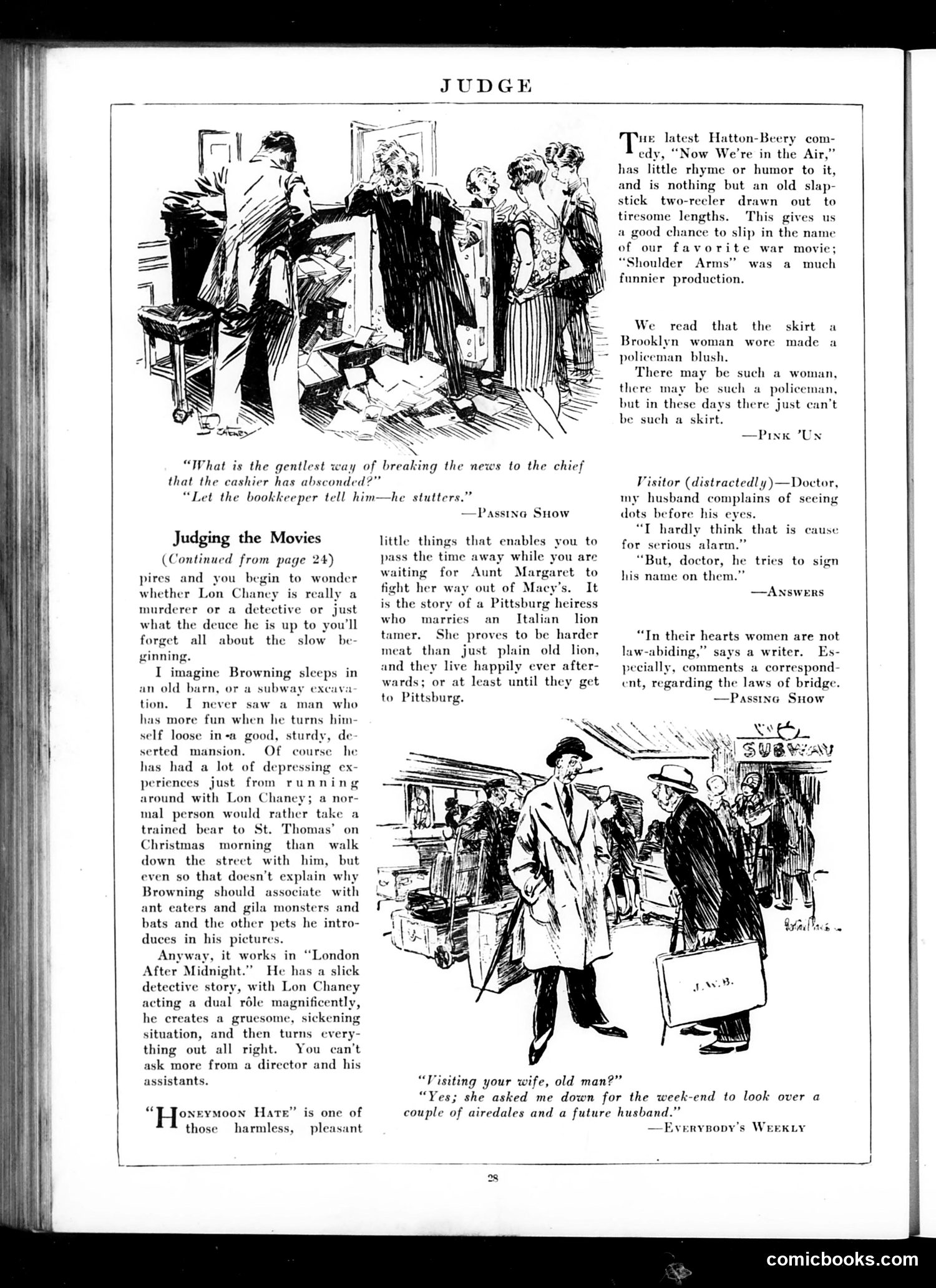
This page from *Judge* contains film reviews and humor pieces typical of 1920s satirical commentary. **Film Reviews Section:** The main article critiques silent films starring actor Lon Chaney. The reviewer praises Chaney's dual-role performance in "London After Midnight" as genuinely suspenseful, contrasting it unfavorably with director Tod Browning's other work, which the reviewer finds relies too heavily on grotesque props (ant eaters, gila monsters) rather than genuine storytelling craft. The piece suggests Browning's films feel artificially padded. **Cartoon & Humor Pieces:** The illustrated cartoon depicts what appears to be a domestic or office scene with figures in period dress. Below are separate joke items from various sources (*Passing Snow*, *Pink 'Un*, *Answers*, *Everybody's Weekly*) covering light social commentary: a bookkeeper joke, observations about women's fashion causing scandals, doctors and patients, and marital visits. These represent typical early-20th-century humor about class, gender relations, and domestic life, now mostly requiring explanation of specific period attitudes.
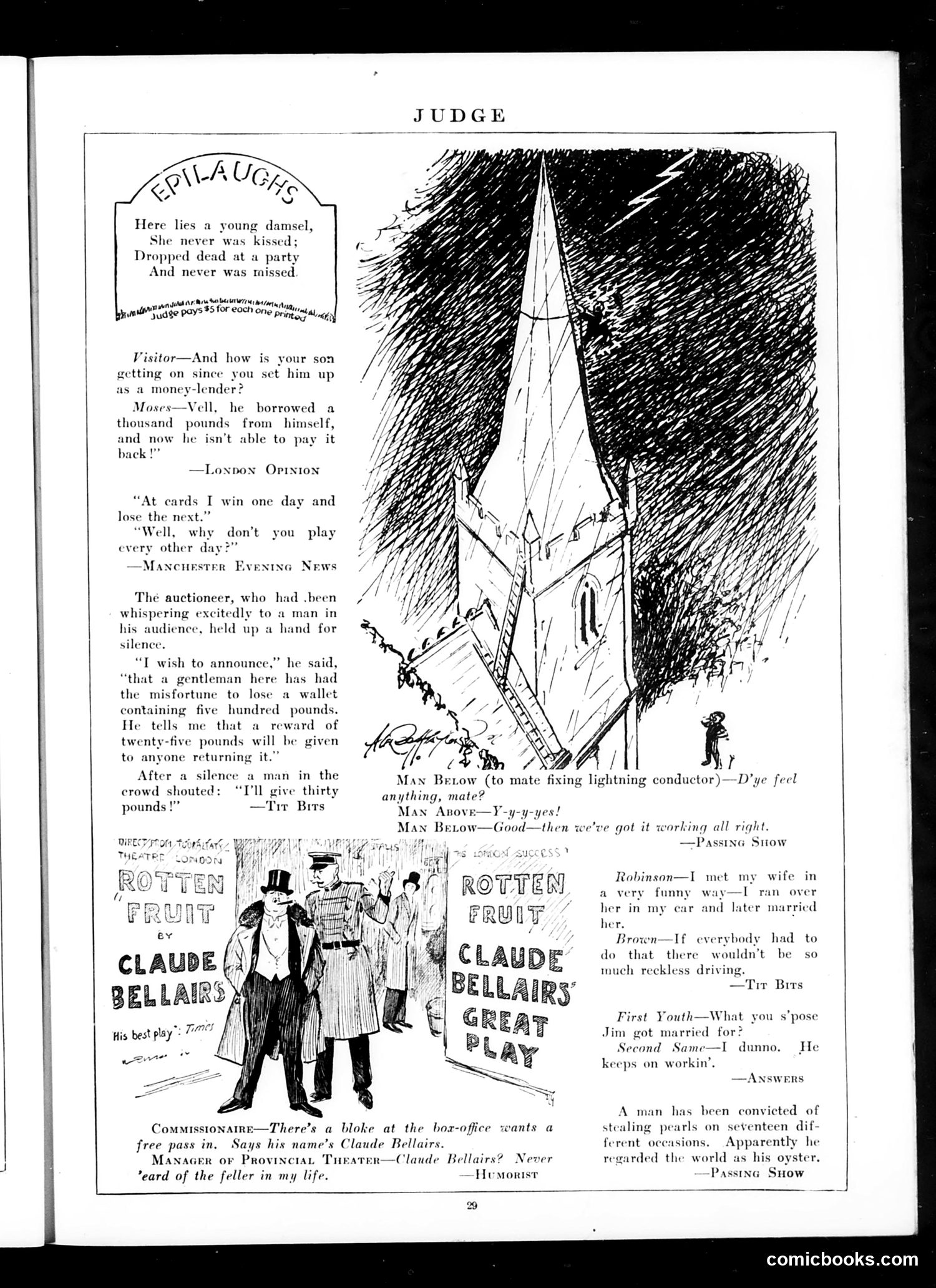
This page collects humor pieces and advertisements typical of early 20th-century satirical magazines. The content includes: **Joke Exchanges**: Several brief comedic dialogues mock contemporary social types—a Jewish money-lender whose son borrows from himself and can't repay, a gambler's illogical card-playing strategy, and an auctioneer's audience offering a reward that exceeds the lost wallet's value (satirizing greed). **Theatrical Advertisement**: Two side-by-side ads promote Claude Bellairs' performances ("Rotten Fruit" and "Great Play"), with a joke about a theater manager claiming never to have heard of this supposedly famous actor—absurdist humor about theatrical pretension. **Nautical Cartoon**: A large illustration shows sailors on a ship during a storm, discussing whether a lightning conductor is functioning. The visual gag relies on the ambiguity of "working" in dangerous conditions. **One-liner Jokes**: Brief quips on marriage (meeting via car accident), workplace dissatisfaction, and a pun about pearl theft ("regarded the world as his oyster"). The page exemplifies Judge's mix of class-conscious satire, wordplay, and visual comedy aimed at educated urban readers.
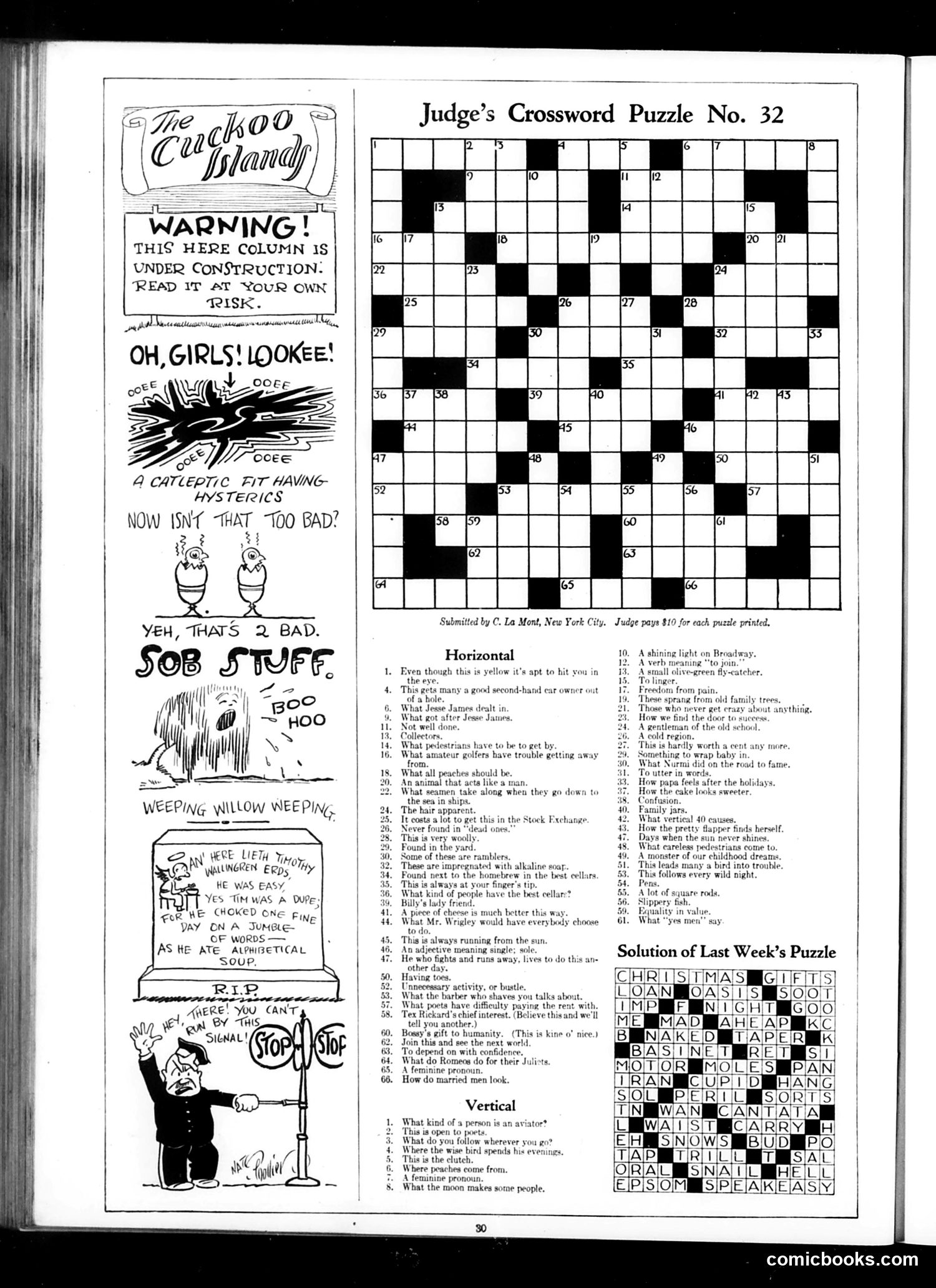
This page primarily features a **crossword puzzle** with accompanying humorous cartoon vignettes on the left side rather than political satire. The cartoons use slapstick humor typical of early 20th-century Judge magazine: **"The Curb's Brawl"** warning column parodies construction notices, suggesting readers proceed "at your own risk." **"Oh Girls! Lookee!"** depicts a woman having a "catalectic fit" (seizure) or hysterics over spilled coffee—mocking Victorian-era female emotional theatricality. **"Sob Stuff"** shows tragic death scenarios presented as melodrama: a man choking on alphabet soup, another dying on a "jungle of words." The cartoons employ **exaggeration and absurdist humor** rather than political commentary. They satirize **sentimental melodrama and overwrought emotional responses** common in popular entertainment of the era. The crude woodcut style and crude lettering match period Judge aesthetics. This appears to be primarily **light entertainment content** rather than serious political criticism.
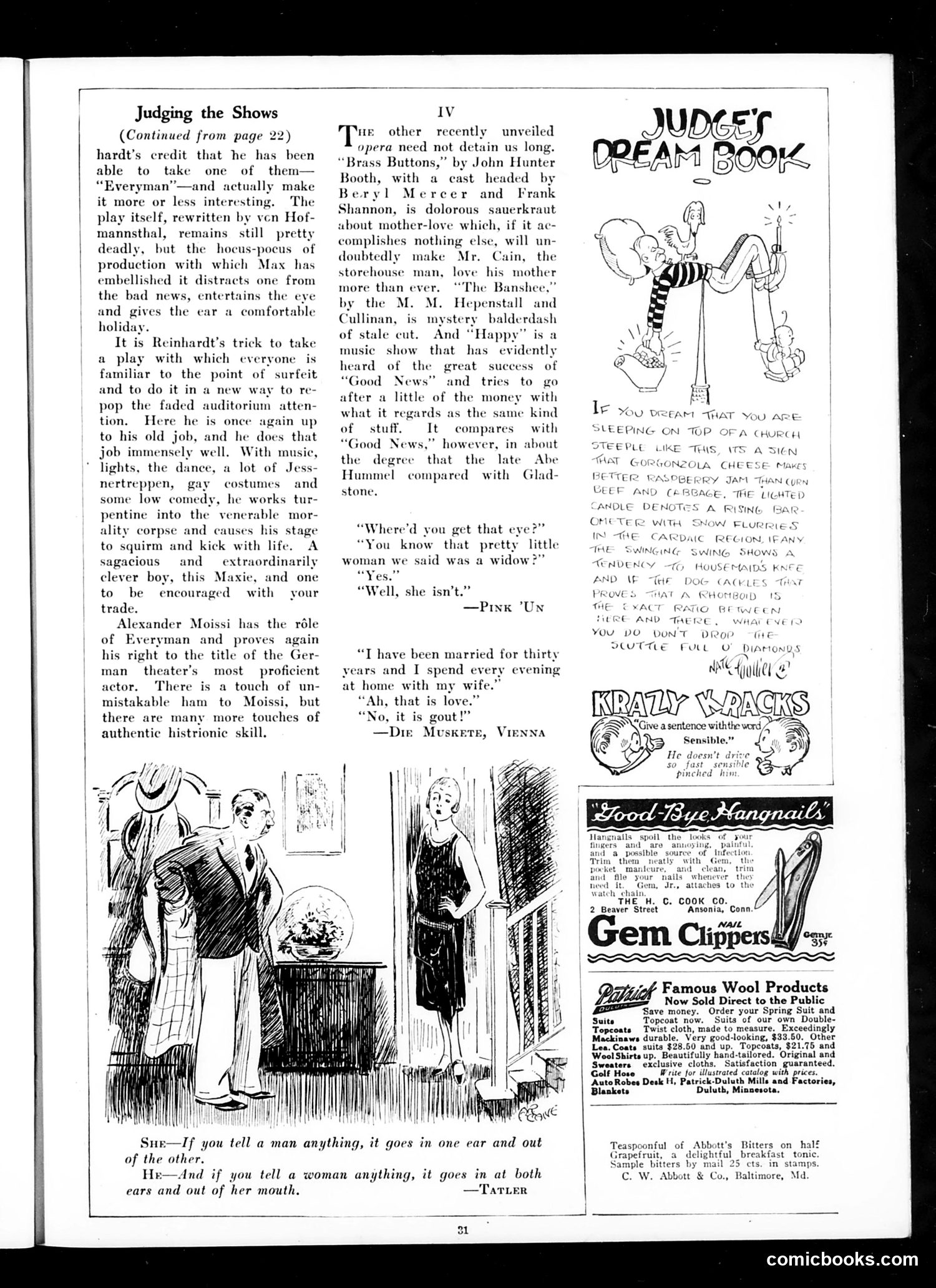
This page contains theater criticism and satirical content typical of Judge magazine's entertainment coverage. **"Judging the Shows" Section:** Reviewer critiques stage productions, particularly praising director Max Reinhardt's revival of "Everyman" for its visual spectacle that enlivens an otherwise "deadly" medieval morality play. Alexander Moissi is noted as a skilled German actor, though with some "ham" in his performance. Three new operas—"Brass Buttons," "The Banshee," and "Happy"—are dismissed as derivative melodrama and poor imitations of the successful musical "Good News." **Cartoon & Jokes:** Below are brief humor pieces playing on gender stereotypes common to the era: secrets told to men stay private, but women gossip; a 30-year marriage sustained by the husband's gout rather than love. A "Judge's Dream Book" section offers mock-superstitious dream interpretations. **Advertisements:** Lower half features typical period ads for beauty products, wool clothing, and patent medicines. The page reflects 1920s theater culture and period attitudes toward women's chattiness.
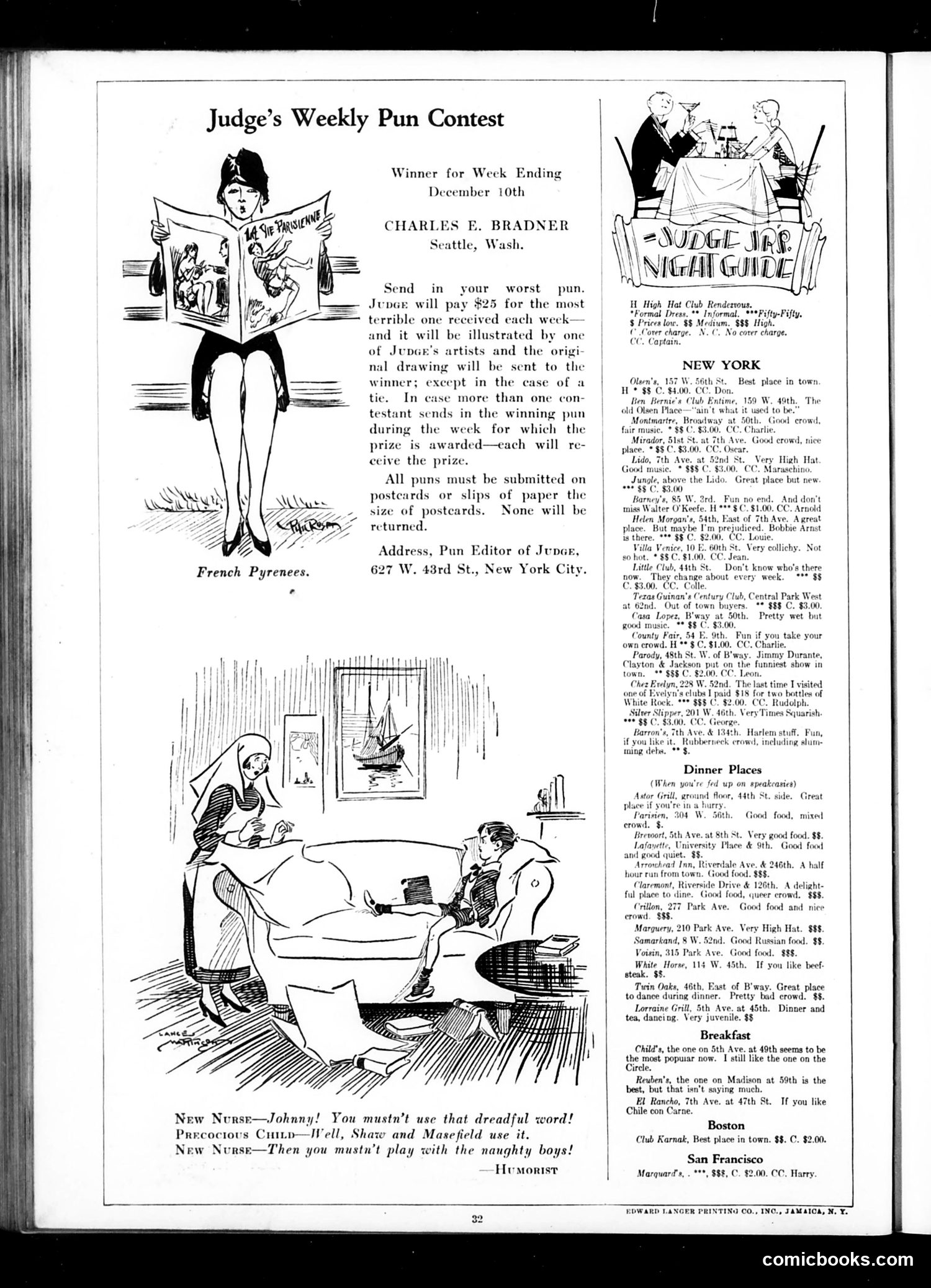
This page features **Judge's Weekly Pun Contest**, a humor competition paying $25 for the worst submitted pun, which would be illustrated by the magazine's artists. The winning pun for December 10th was by Charles E. Bradner of Seattle. The main cartoon shows a **New Nurse scolding a Precocious Child** for using "dreadful" language. The child defends himself by noting that respectable authors Shaw and Masefield use such words. The nurse replies he mustn't play with "naughty boys"—satirizing Victorian prudishness and hypocrisy about propriety. The bulk of the page consists of **restaurant and nightclub guides** for major cities (New York, Boston, San Francisco), reflecting Prohibition-era speakeasies ("when you're fed up on speakeasies"). These venues advertised with coded price ranges ($$, $$$) and brief reviews, serving as practical guides for urban sophisticates seeking entertainment during the 1920s alcohol ban.
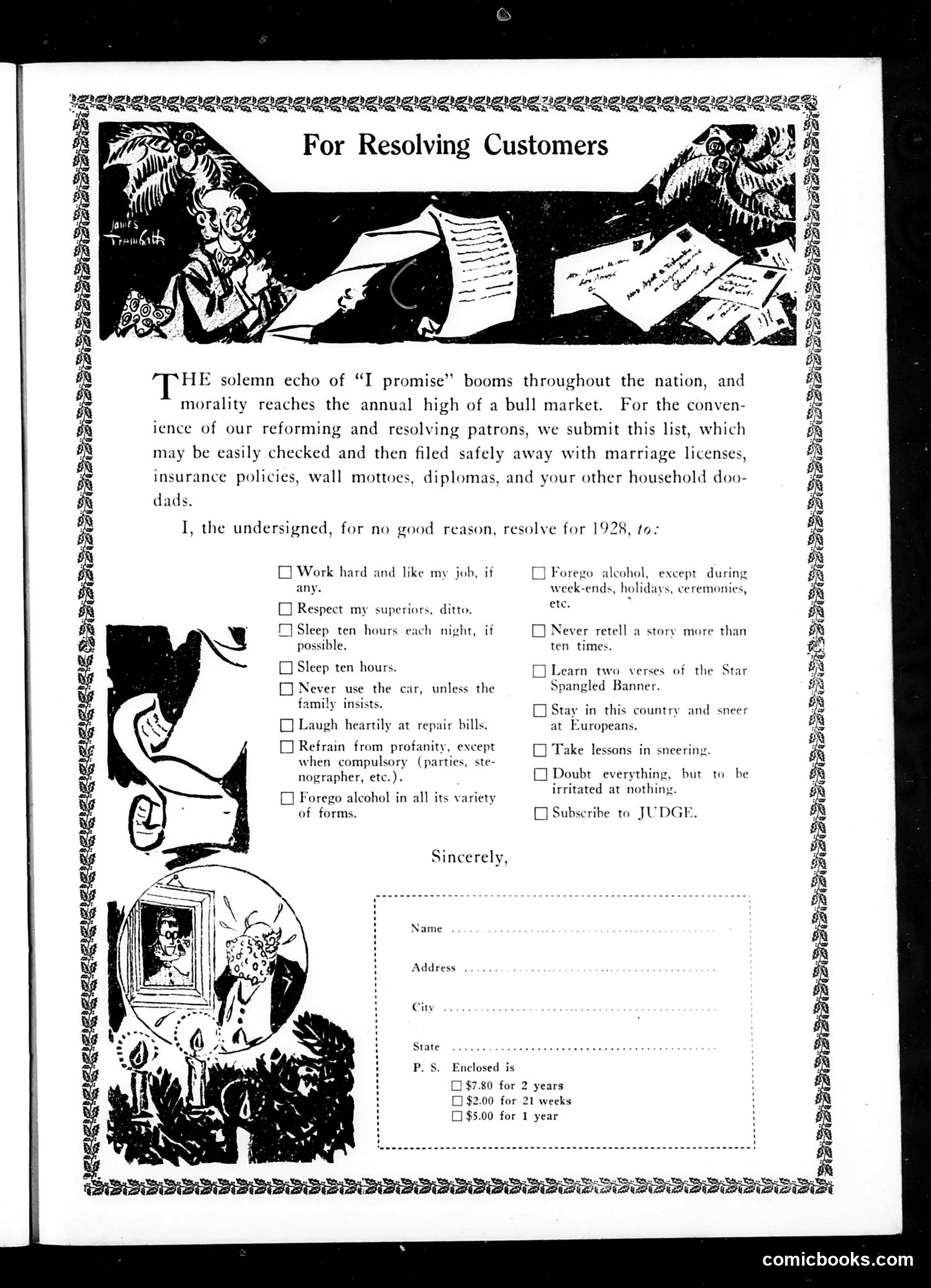
This page mocks the American tradition of making New Year's resolutions—promises people make annually but rarely keep. Judge satirizes the hypocrisy by presenting a checklist of self-improvement vows that are either contradictory or obviously insincere. The humor lies in resolutions like "Work hard and like my job" alongside "Never use the car, unless the family insists" and "Forage alcohol in all its variety"—which immediately gets undercut by the exception "except during week-ends, holidays, ceremonies, etc." The final item, "Subscribe to JUDGE," is the punchline: the entire list is framed as something to "file safely away with marriage licenses, insurance policies, wall mottoes, diplomas"—documents people keep but ignore. The satire suggests Americans make grand moral promises annually that have no real staying power, especially concerning alcohol (Prohibition was still in effect in 1928). The subscription pitch at the bottom cynically transforms moral self-improvement into a sales pitch for the magazine itself.
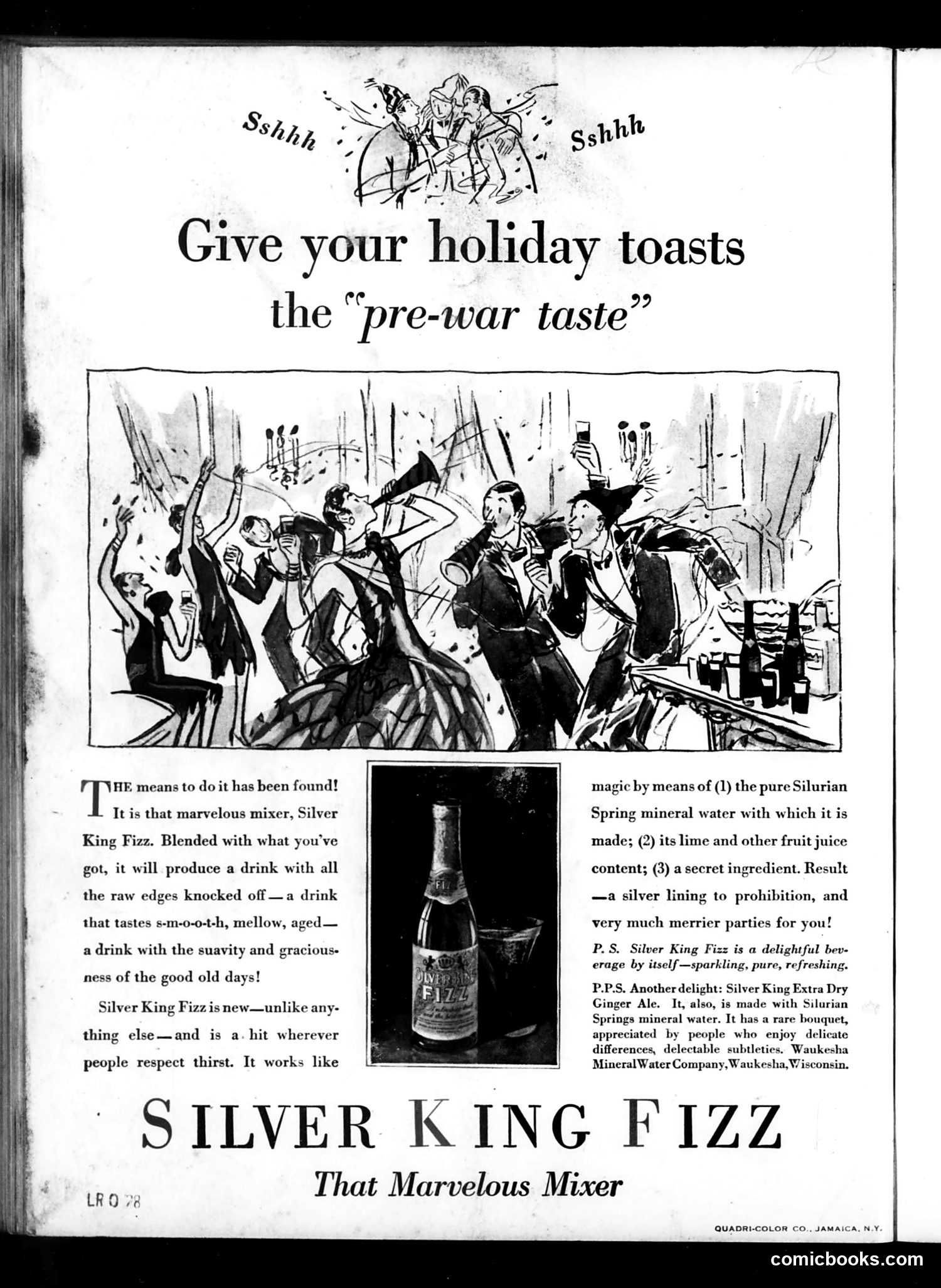
This is a **prohibition-era advertisement** (likely 1920s-early 1930s), not political satire. The cartoon depicts a raucous New Year's Eve party with revelers celebrating with drinks and noisemakers—meant to evoke pre-Prohibition sophistication. The ad's pitch is darkly humorous: it markets Silver King Fizz as a mixer that can transform homemade or illicit alcohol into something resembling "pre-war taste"—quality drinks from before Prohibition (1920-1933). The phrase "silver lining to prohibition" is a cynical double meaning: the product supposedly restores elegance to bootleg liquor. The "secret ingredient" is left vague, likely implying the product helps mask the harsh taste of illegal alcohol. This advertisement essentially encourages consumers to break Prohibition laws while maintaining social respectability—a common marketing strategy during this era.

I can see this is a page from *Judge* magazine with the comicbooks.com watermark, but the image quality is too poor for me to reliably read any text or identify specific cartoon content. The page appears mostly blank or extremely faded, with only faint marks visible that I cannot confidently decipher. To provide accurate historical context about the satire, political figures, and social commentary—as requested—I would need a clearer image where the cartoons and text are legible. Without being able to read the specific content, I cannot responsibly identify who is being caricatured or what events are being referenced. If you have a higher-resolution version of this page, I'd be happy to analyze it properly.