
A complete issue · 36 pages · 1927
Judge — November 26, 1927
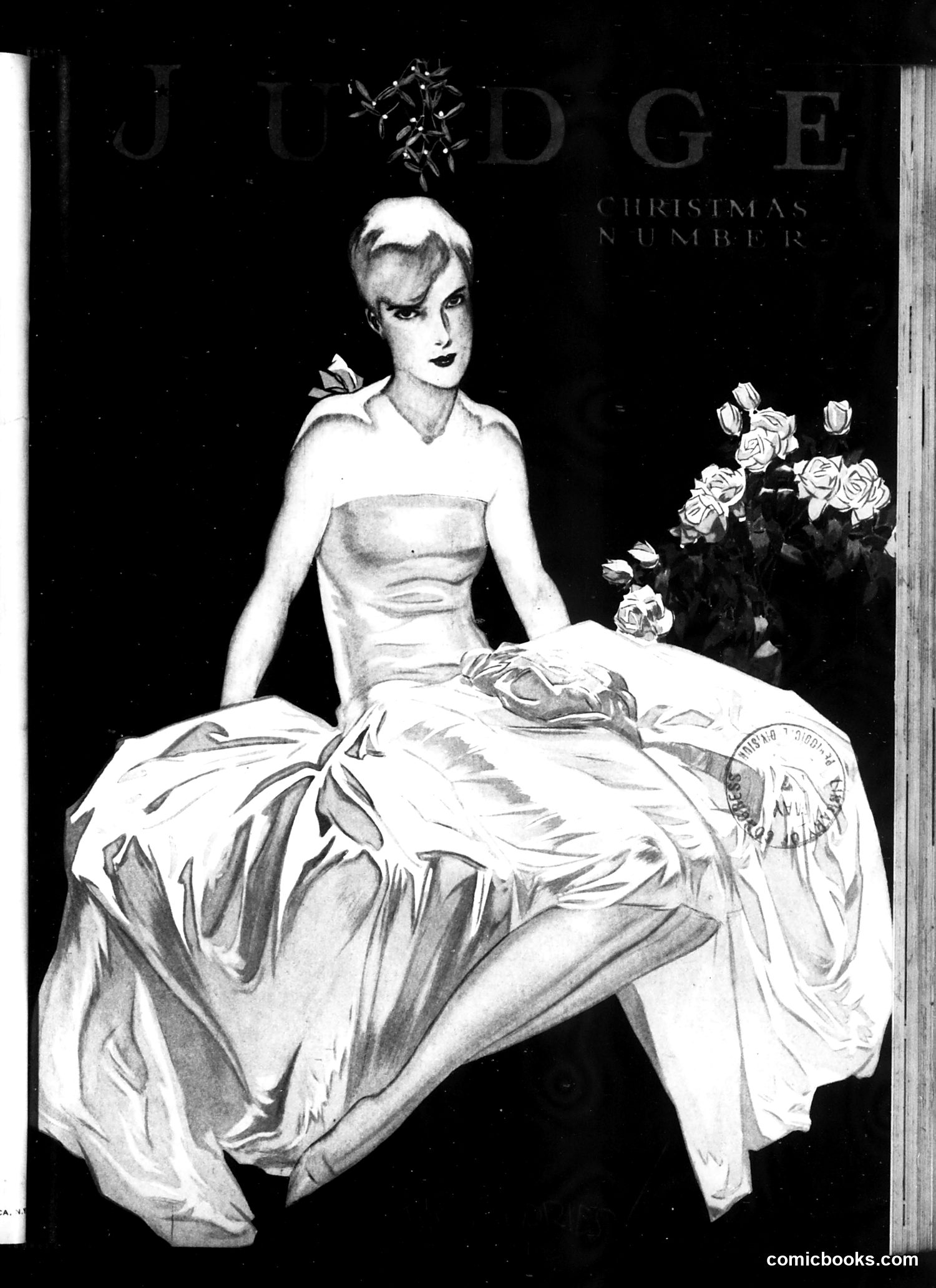
This appears to be a **Judge magazine Christmas cover** from the early 20th century. The illustration shows a fashionably dressed woman in an elegant strapless gown with dramatic fabric draping, posed beside flowers and mistletoe above her head. The satire likely comments on **Christmas shopping and gift-giving culture**, or possibly the commercialization of the holiday season. The woman's glamorous presentation—styled as a desirable "gift"—may mock either consumerism or changing social attitudes about women and fashion during the Jazz Age era. Without clearer OCR text or additional context, the specific satirical target remains unclear, but the juxtaposition of fashion, holiday symbols, and a woman-as-commodity suggests critique of seasonal materialism or evolving gender roles in early 20th-century American society.
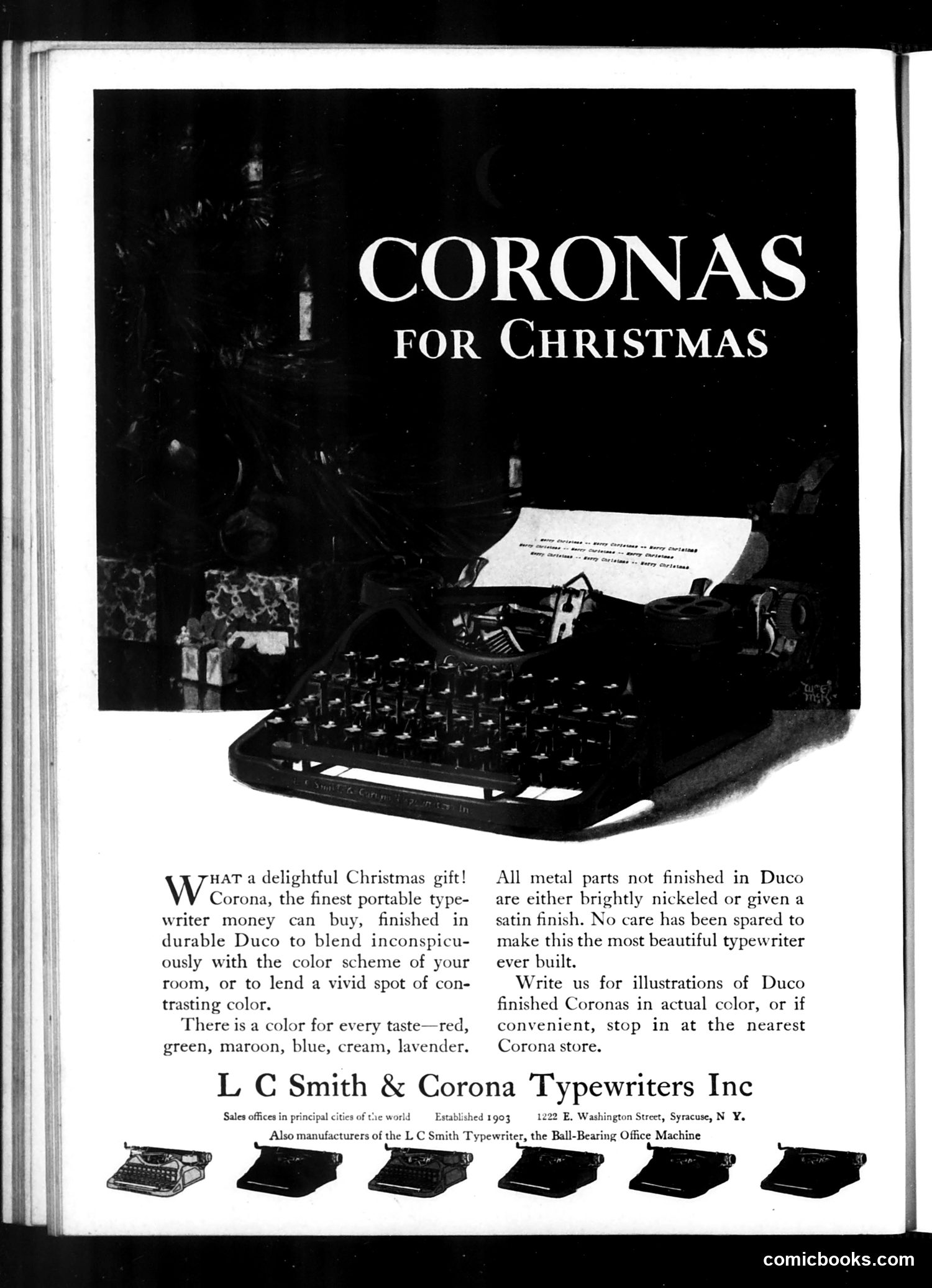
This is **not a political cartoon or satire**—it's a straightforward **advertisement** for the Duco Corona portable typewriter, published in Judge magazine. The ad promotes Corona typewriters as Christmas gifts, emphasizing their durability and aesthetic appeal. It highlights that Duco finishes come in multiple colors (red, green, maroon, blue, cream, lavender) to match home décor. The copy appeals to gift-givers by describing Corona as "the finest portable typewriter money can buy." The page includes product photography of the typewriter and smaller images of other typewriter models at the bottom. This represents standard early 20th-century advertising strategy: placing commercial messages in magazines to reach affluent consumers during the holiday shopping season.
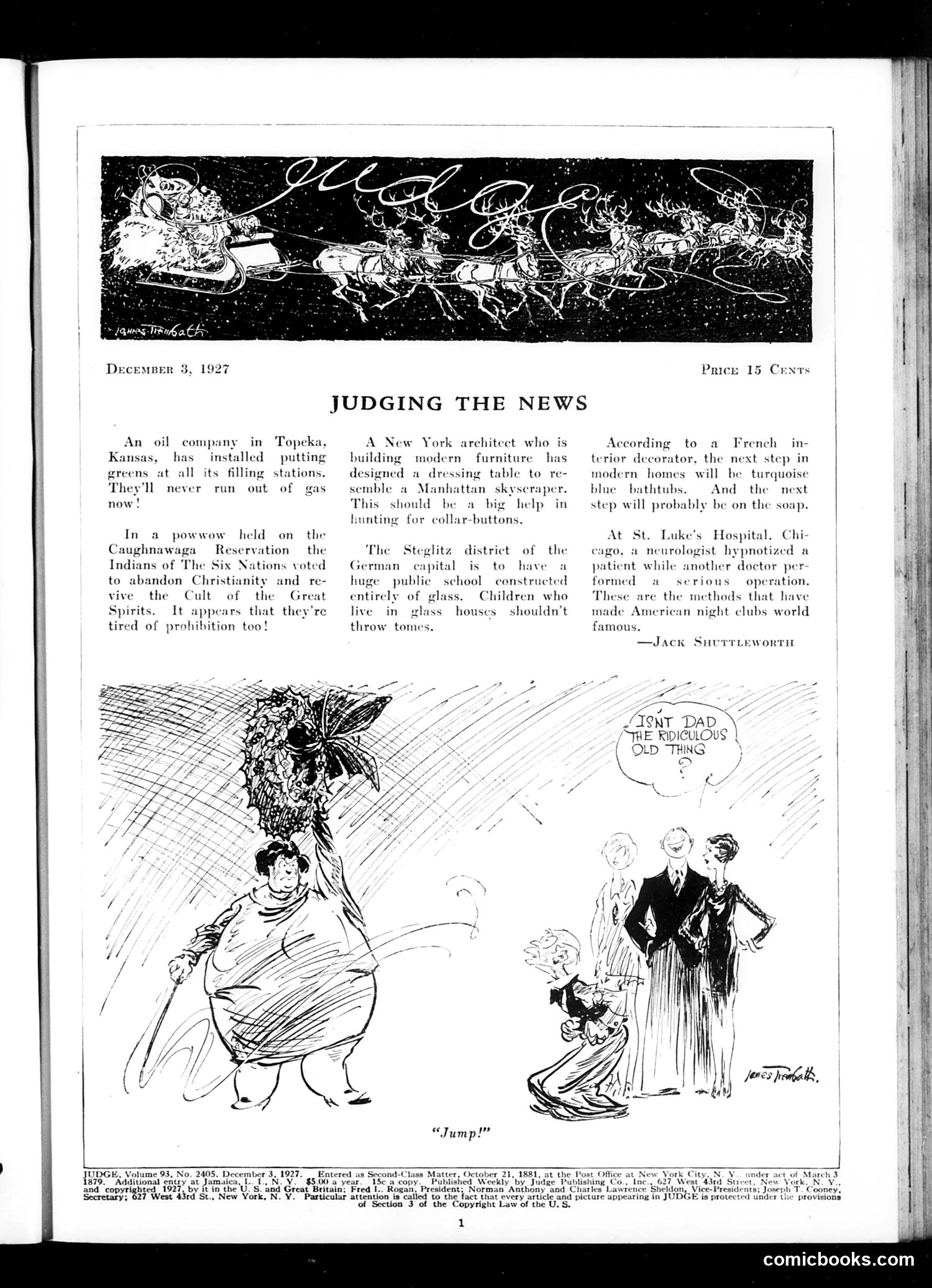
**Main Cartoon: "Jump!"** The cartoon depicts a rotund woman struggling to hold an umbrella in heavy rain, while a fashionable couple and child stand nearby. The man says, "ISN'T DAD THE RIDICULOUS OLD THING?" This appears to be satirizing generational attitudes and changing fashion/social norms of the 1920s. The "ridiculous old thing" likely refers to the umbrella itself—a dated accessory—or possibly the older generation's values. The contrast between the struggling older woman and the stylish young family suggests mockery of outdated practices or appearances. **"Judging the News" section** contains brief satirical commentary on contemporary topics: Kansas oil company practices, German glass architecture, and medical hypnosis at Chicago hospitals.
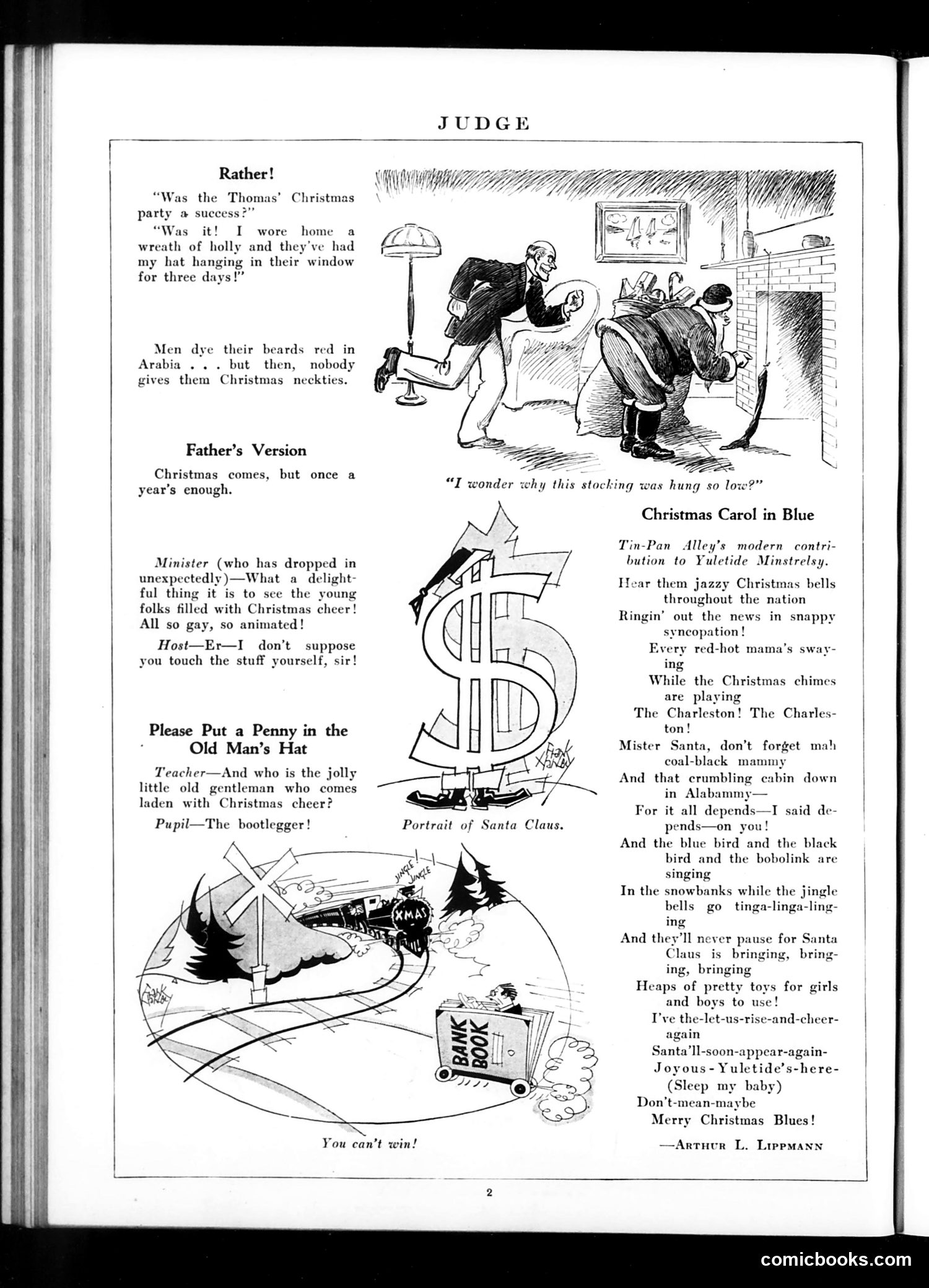
This page contains humorous Christmas vignettes rather than political cartoons. **"Rather!"** depicts a successful Christmas party where guests wore holly wreaths as neckties—a commentary on how men in Arabia dyed their beards red, but Western men lack equivalent Christmas traditions. **"Father's Version"** jokes that fathers view Christmas merely as an annual obligation, contrasting with children's enthusiasm. **"Please Put a Penny in the Old Man's Hat"** presents a teacher/Santa character as a "bootlegger"—likely referencing Prohibition-era slang, joking that teachers were undercompensated. **"Christmas Carol in Blue"** is a jazzy, modern poem by Arthur L. Lippmann celebrating Christmas with contemporary slang ("snappy," "coal-black mammy," "bobolink"). The page primarily offers seasonal entertainment rather than political satire.
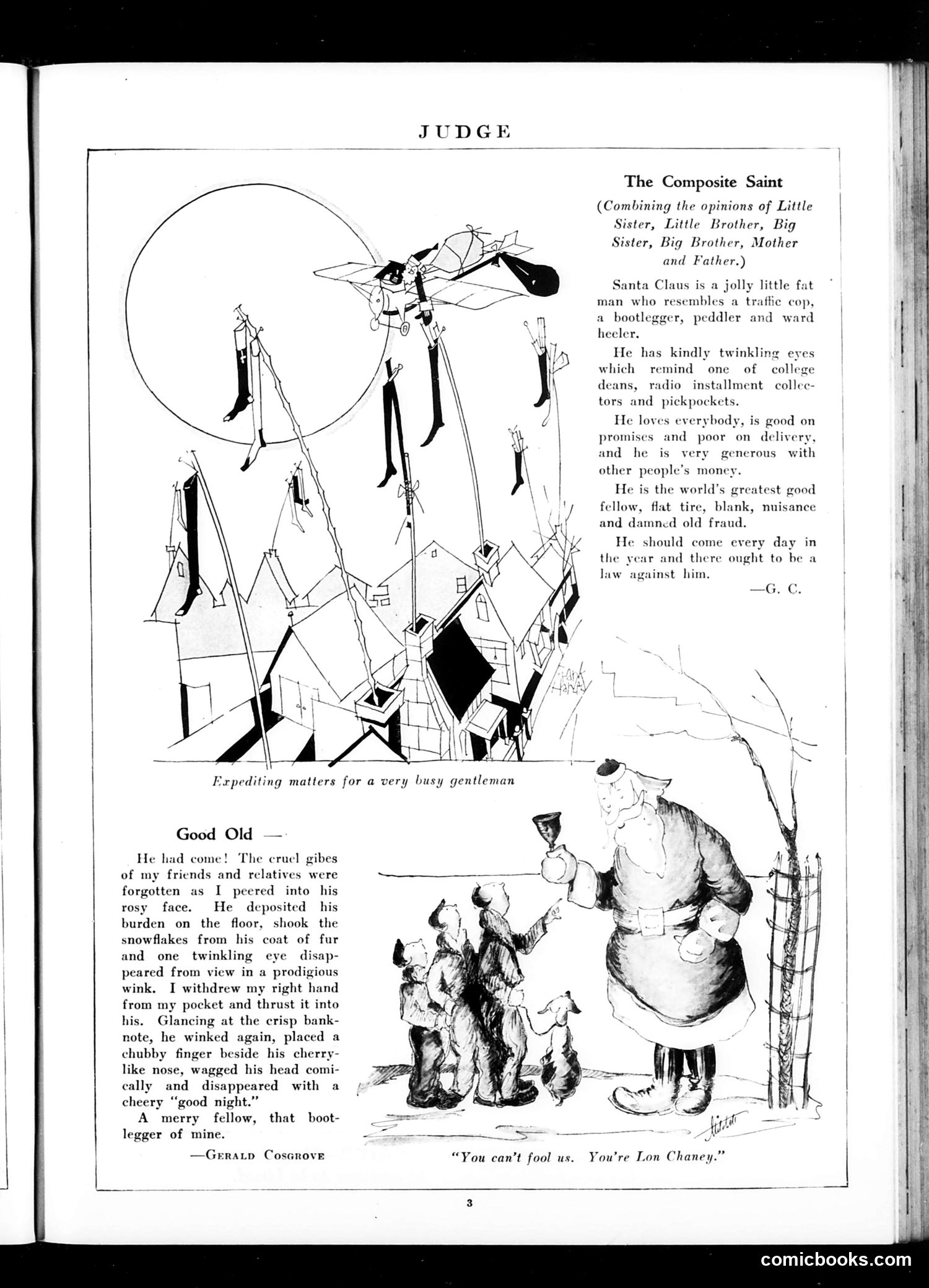
This page satirizes Santa Claus through two pieces: **"The Composite Saint"** (top) depicts Santa as a morally compromised figure—combining opinions of family members who describe him as resembling a "traffic cop, bootlegger, peddler and ward heeler" (a political operative). The illustration shows him distributing gifts from rooftops to crowds below. The satire critiques Santa as embodying corruption, fraud, and commercialism rather than genuine generosity. **"Good Old"** (bottom) portrays Santa as a sentimental con artist who manipulates families with charm ("twinkling eyes," "cherry-like nose") while extracting money. The caption "You can't fool us. You're Lon Chaney" suggests Santa as a theatrical imposter (referencing silent-film actor Lon Chaney's transformative roles). Both pieces mock the commercialization of Christmas and Santa's questionable moral character.
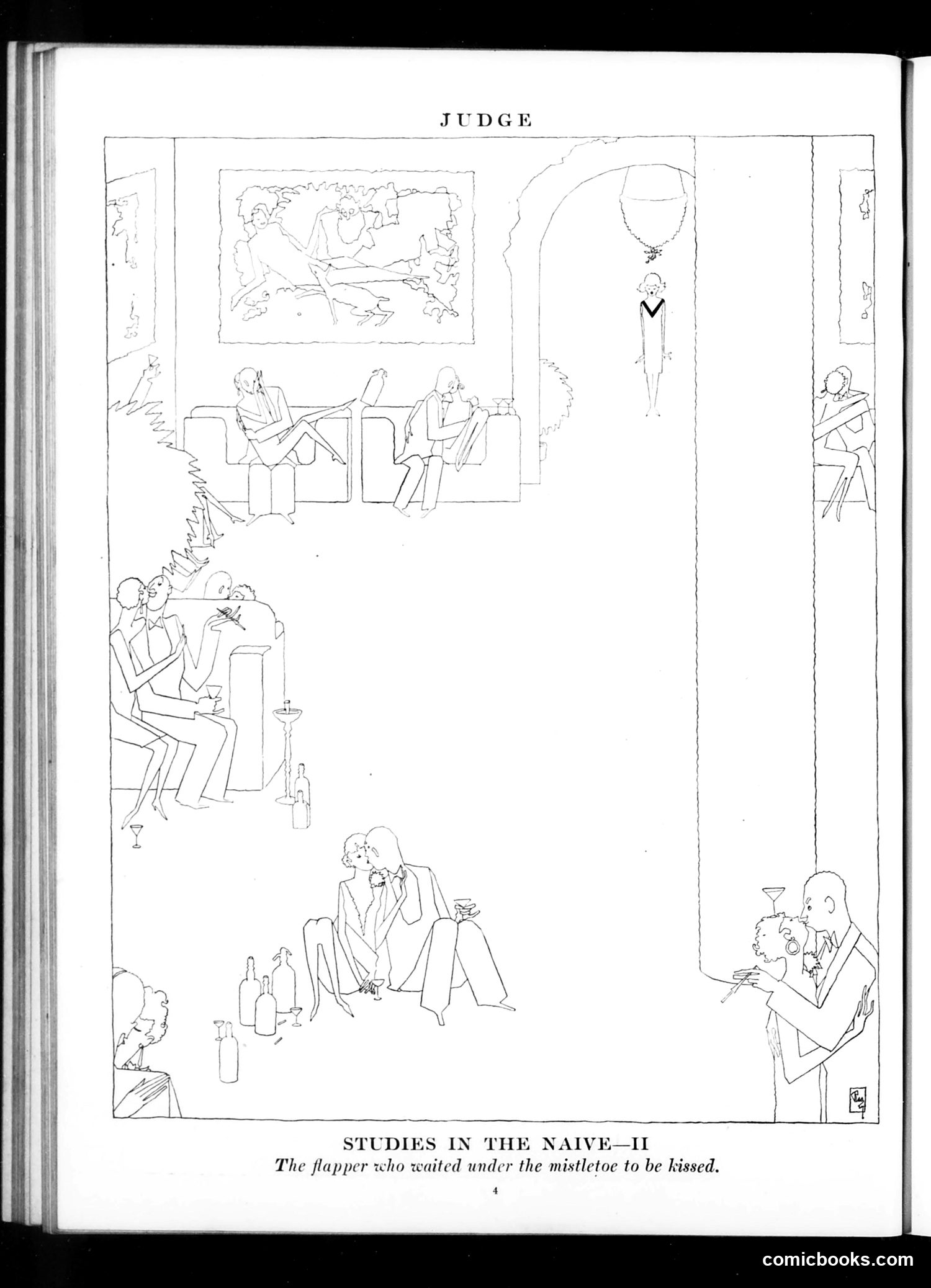
This page from *Judge* magazine presents "Studies in the Naive—II," depicting "The flapper who waited under the mistletoe to be kissed." The cartoon satirizes the "flapper" archetype—young women of the 1920s known for their modern, liberated behavior and fashion. The multiple scenes show various social situations in what appears to be an upscale interior setting, with figures in formal attire and casual poses. The satire targets the contradiction between flappers' reputation for boldness and independence versus their supposedly naive expectation of romantic gestures (waiting under mistletoe). The scenes appear to mock both the flapper's behavior and the men's responses, suggesting the gap between the flapper's self-image as sophisticated and worldly versus the reality of their social interactions.
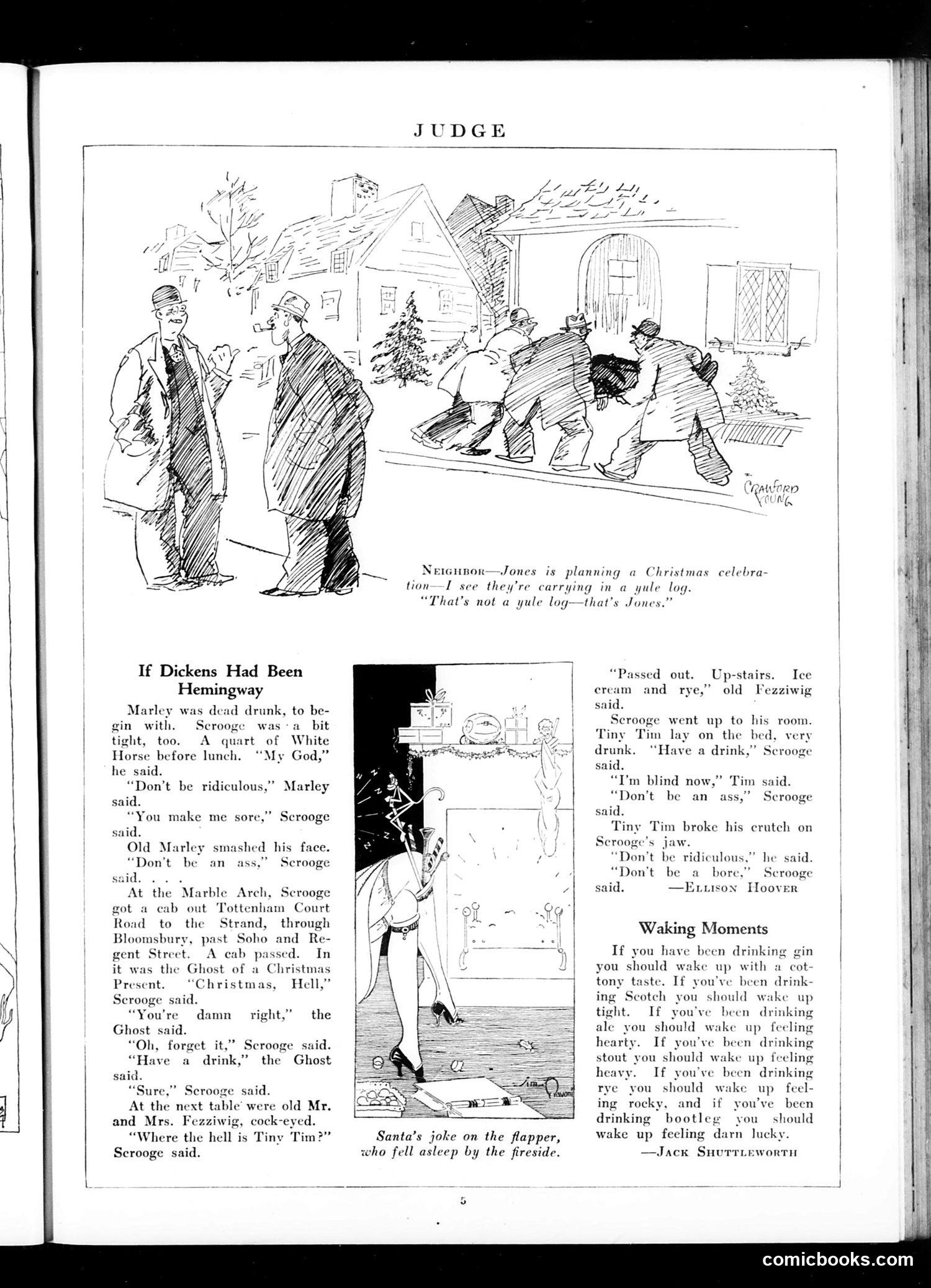
This page from *Judge* magazine contains three distinct pieces: 1. **Top cartoon**: A humorous Christmas scene showing neighbors debating whether Jones is hauling a "yule log" or simply "James" (a person). The joke plays on the double meaning. 2. **"If Dickens Had Been Hemingway"**: A literary parody contrasting Charles Dickens's verbose *A Christmas Carol* with Ernest Hemingway's sparse, hard-boiled writing style. Characters like Marley and Scrooge interact in terse, tough-guy dialogue instead of Dickens's elaborate prose—satirizing Hemingway's distinctive minimalist approach. 3. **"Waking Moments"**: Humorous advice about which drinks cause specific hangovers, attributing personality traits to morning-after symptoms (gin causes "colicky taste," ale causes "hearty" feelings, etc.). The page targets literary style and holiday excess.
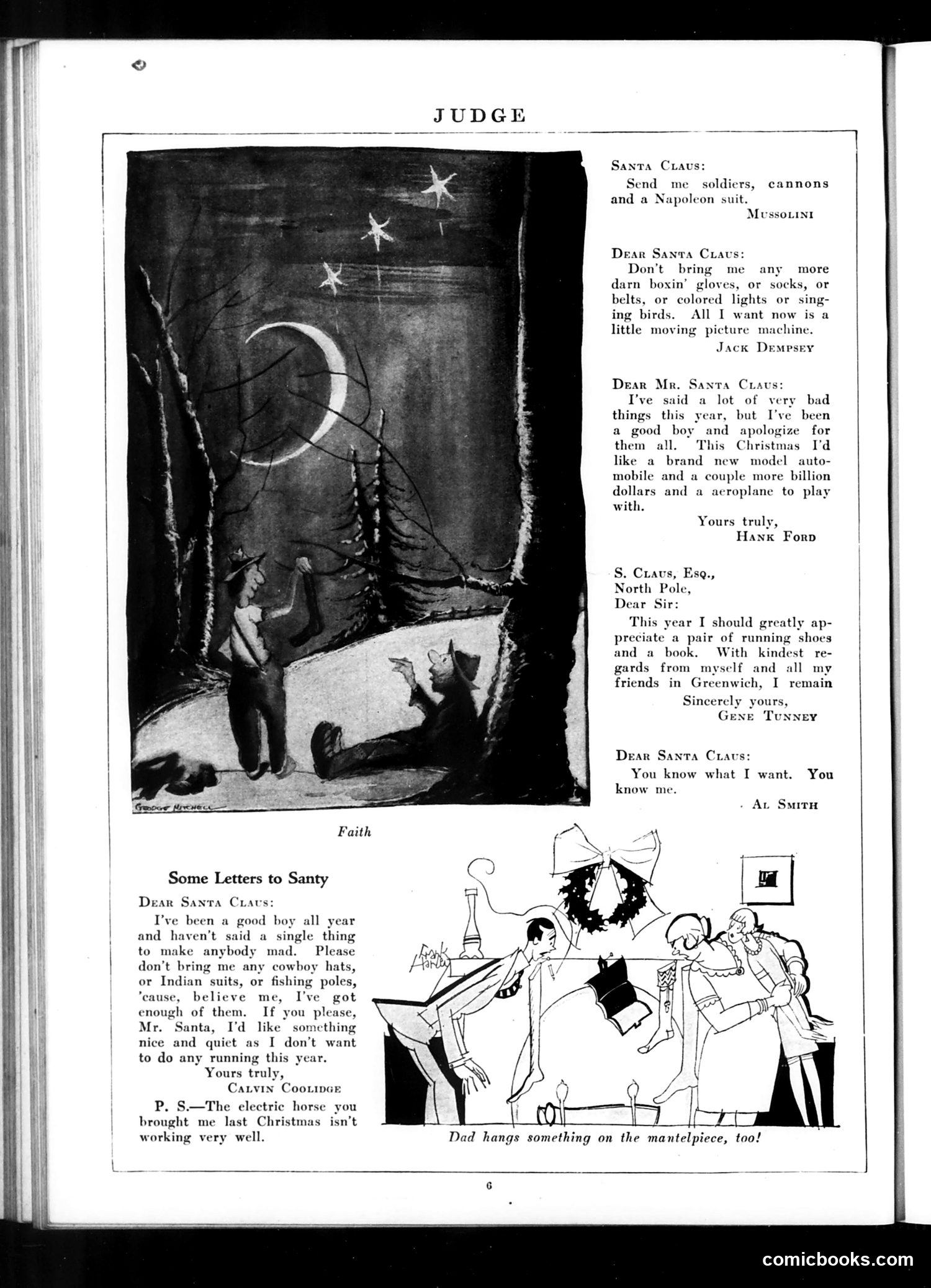
This page satirizes famous public figures' Christmas wishes through mock letters to Santa Claus. The humor lies in contrasting each person's public image with their supposed desires: **Mussolini** requests military equipment and a Napoleon suit—mocking fascist ambitions for conquest and grandiose self-image. **Jack Dempsey** (heavyweight boxing champion) wants a movie camera instead of sports gear—suggesting celebrity obsession with film. **Henry Ford** humorously asks for "a couple more billion dollars and an aeroplane"—satirizing his already vast wealth and industrial empire. **Gene Tunney** (boxer/Dempsey rival) requests modest shoes and a book—presenting himself as cultured and humble. **Calvin Coolidge** wants "something nice and quiet" and no running around—poking fun at his famously taciturn, inactive presidency. **Al Smith's** cryptic letter ("You know what I want. You know me") remains unclear without additional context. The cartoon below shows a family Christmas scene, reinforcing the domestic holiday theme.
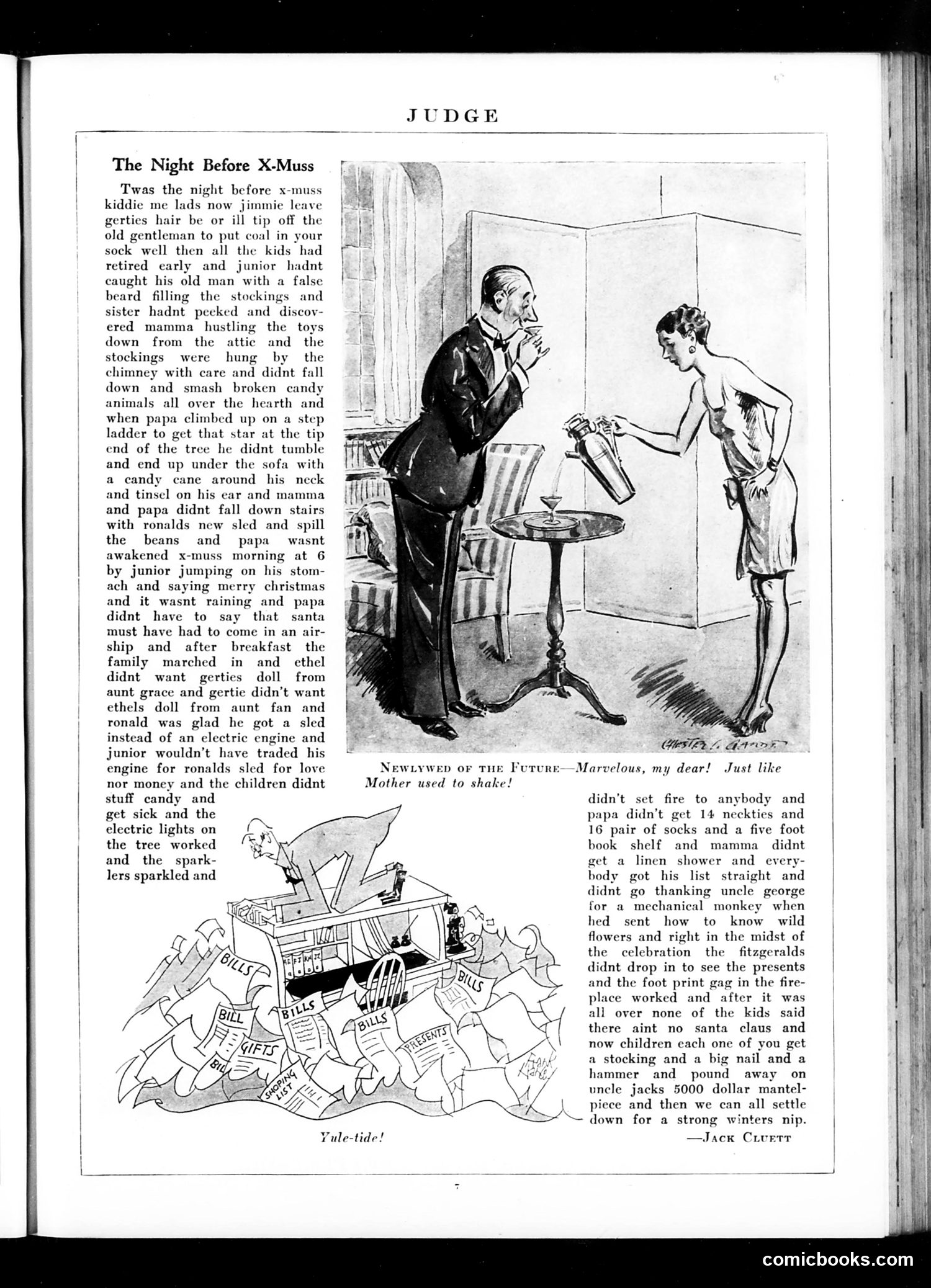
This is a humorous parody of Clement Clarke Moore's "A Visit from Saint Nicholas" ("'Twas the Night Before Christmas"). The satire inverts the famous poem by describing everything that *does* go wrong during Christmas—the opposite of the idealized holiday. The joke targets the reality of turn-of-the-century American family life versus sentimental Christmas mythology. Rather than Santa arriving magically, parents struggle to secretly fill stockings; rather than magical decorations, children discover fake beards and toys being dragged from attics. The poem catalogs domestic chaos: fathers falling off ladders, children getting sick, broken ornaments, arguments over gift choices, unwanted gifts (neckties and socks), and unexpected visitors. The accompanying cartoon shows a newlywed couple, captioned "Just like Mother used to shake!"—likely mocking nostalgic comparisons of modern domestic life to idealized memories. The lower cartoon of bills piling up (labeled "Yule-tide!") emphasizes the financial strain of holiday spending, a common concern. Overall, the piece satirizes the gap between Christmas fantasy and messy reality.
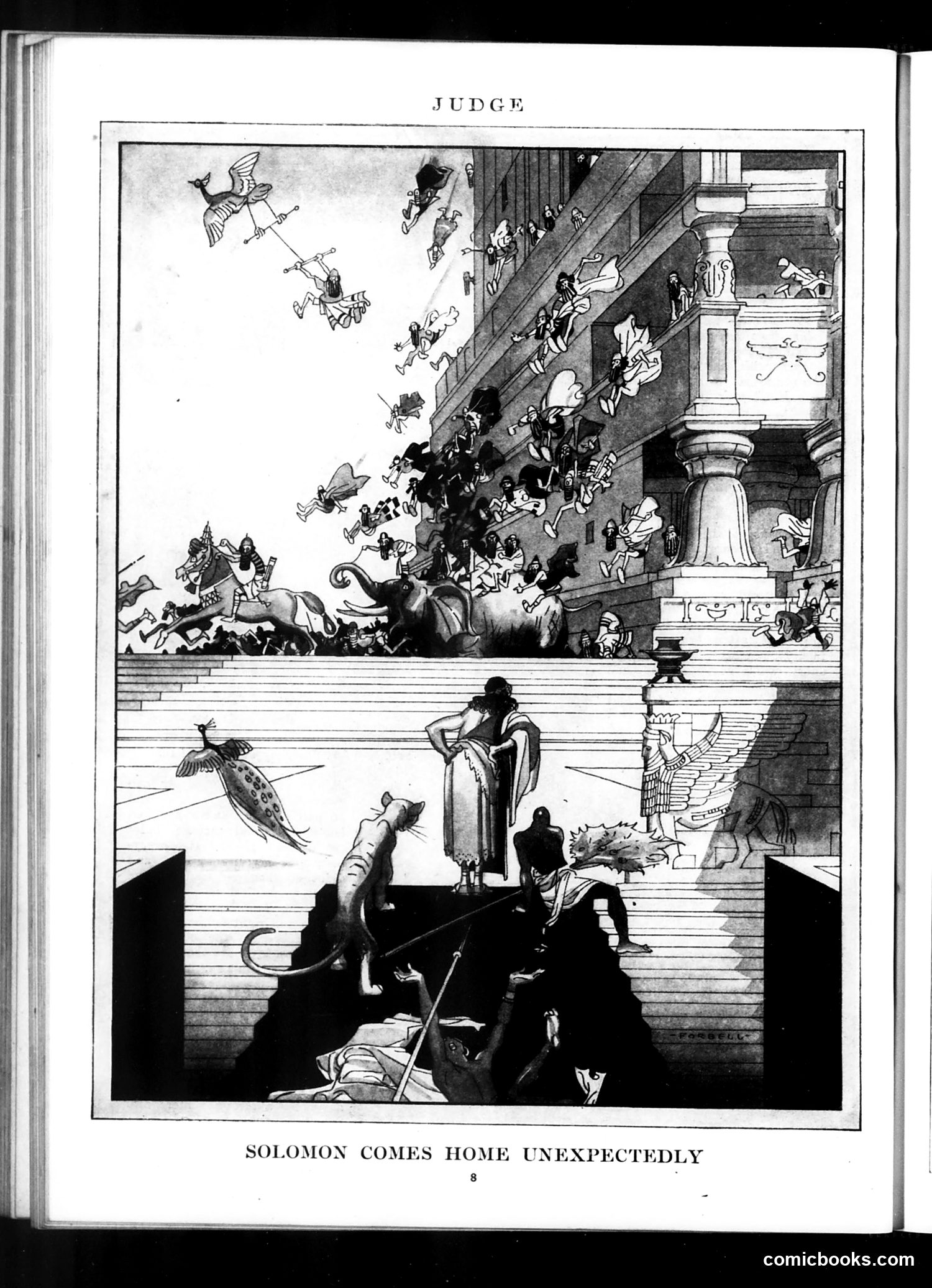
This satirical illustration depicts a chaotic domestic scene titled "Solomon Comes Home Unexpectedly." The cartoon shows a grand classical building (likely representing a government or institutional seat of power) with figures fleeing in disorder—some descending stairs, others appearing distressed or airborne. In the foreground, figures in a boat react with alarm. The satire appears to reference the biblical King Solomon, known for wisdom and judgment, returning to find disorder or misconduct among those responsible for governance in his absence. The "unexpected" return suggests surprise discovery of wrongdoing or mismanagement. The specific political or social scandal referenced is unclear without additional historical context, but the elaborate architecture and dramatic composition indicate this critiques high-level institutional corruption or negligence during someone's absence from authority.
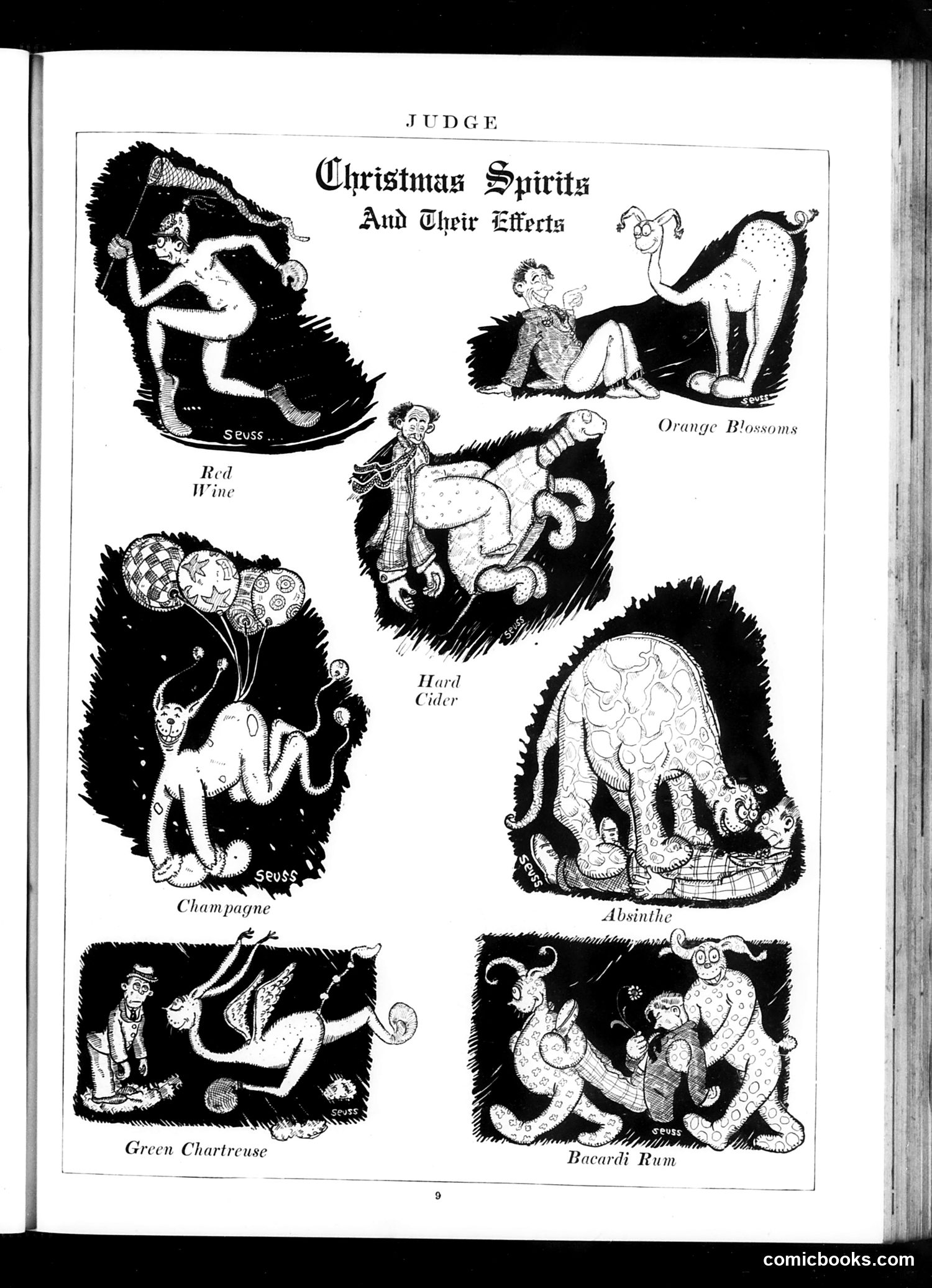
This page from *Judge* magazine presents seven illustrated vignettes, each labeled with an alcoholic beverage and depicting its supposed effect on the drinker. The cartoons use exaggerated, grotesque imagery—characteristic of early 20th-century satirical art—to show how different drinks allegedly transform people's behavior and appearance. Each spirit (red wine, champagne, hard cider, absinthe, green chartreuse, orange blossoms, and bacardi rum) is paired with a caricatured figure displaying increasingly wild, intoxicated, or demonic characteristics. The satire suggests moral anxiety about alcohol consumption and likely mocks both the drinks themselves and the stereotypical behaviors associated with drunkenness. The attribution to "Seuss" suggests early work by Dr. Seuss (Theodor Geisel).
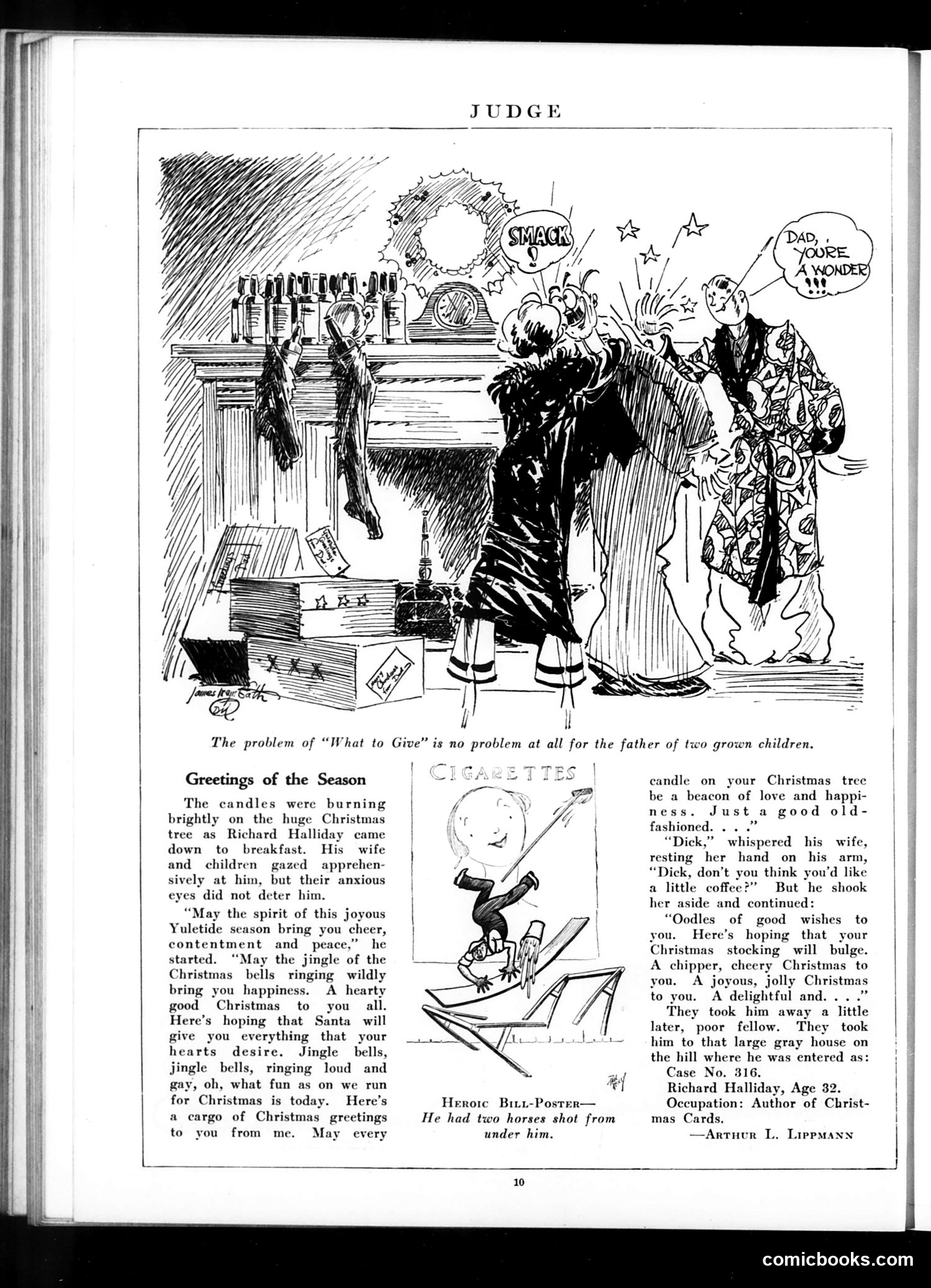
This Judge magazine cartoon satirizes the overwrought sentimentality of Christmas card writing. Richard Halliday, identified as a "Christmas Card Author," delivers an endless barrage of clichéd holiday greetings to his family at breakfast—"jingle bells," "beacon of love," "oodles of good wishes"—until they're so disturbed they commit him to an asylum (the "large gray house on the hill"). The joke mocks both the excessive saccharine language of commercial Christmas cards and the occupational hazard of someone who writes them professionally: he's become so saturated with greeting-card platitudes that he can no longer function normally in real life. His family's concern and his eventual institutionalization are played for dark humor. The satire targets the artificial cheerfulness and formulaic sentiment that mass-produced holiday cards represent.
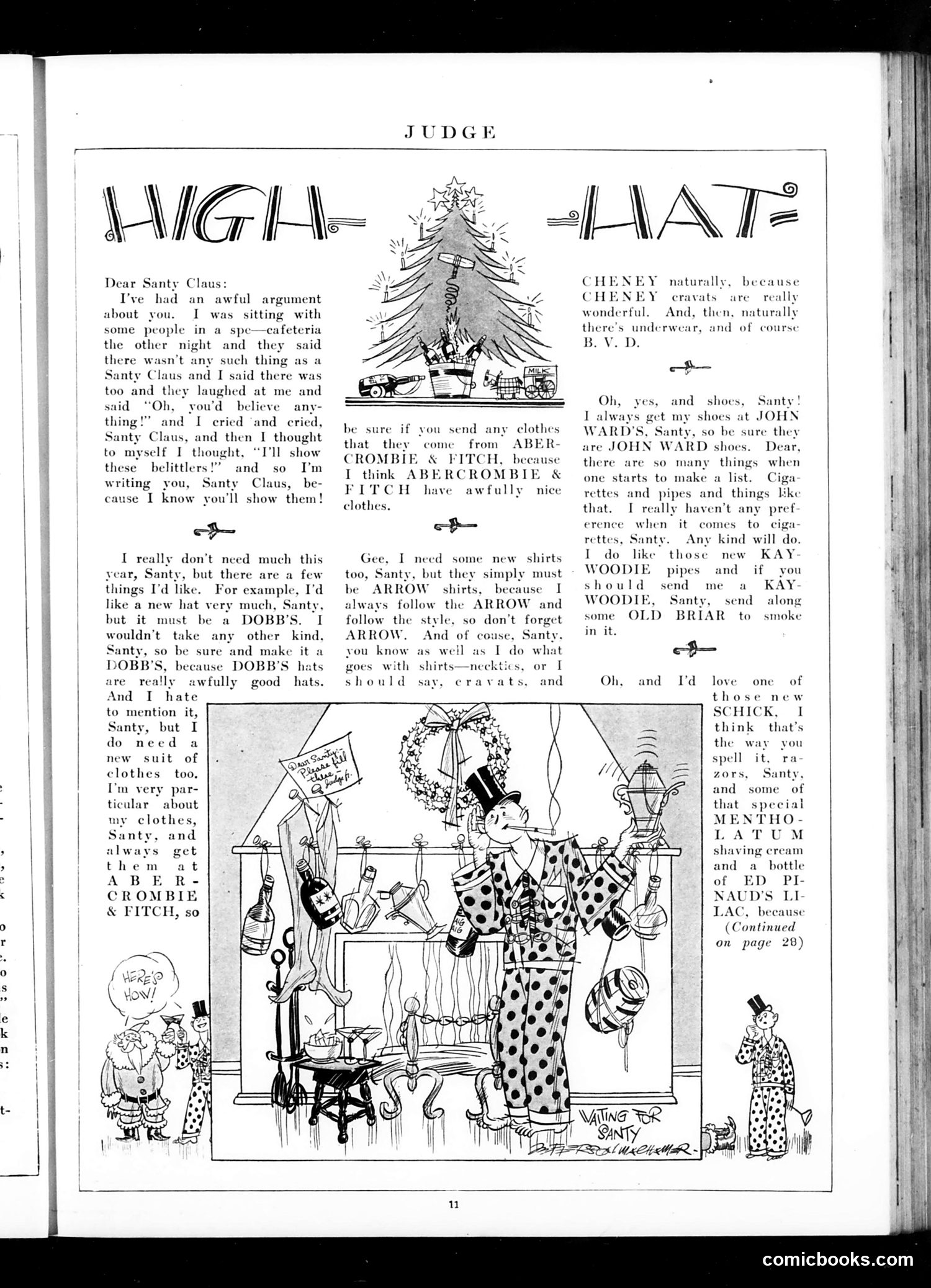
This page is a humorous letter to Santa Claus that satirizes consumer culture and brand obsession in early 20th-century America. A child writes to Santa listing desired gifts, but rather than toys or simple items, the letter is filled with brand-name product placements: DOBB'S hats, ABERCROMBIE & FITCH clothing, ARROW shirts, CHENEY cravats, JOHN WARD shoes, KAY-WOODIE pipes, SCHICK razors, and ED PINAUD'S LILAC shaving cream. The satire mocks how commercialism has infiltrated childhood innocence—even Santa letters now function as advertising vehicles. The extensive brand-dropping by this supposedly young writer suggests how thoroughly marketing has colonized American consumer identity. The accompanying illustration of Santa in a commercial shopping environment reinforces this critique of materialism replacing traditional holiday sentiment.
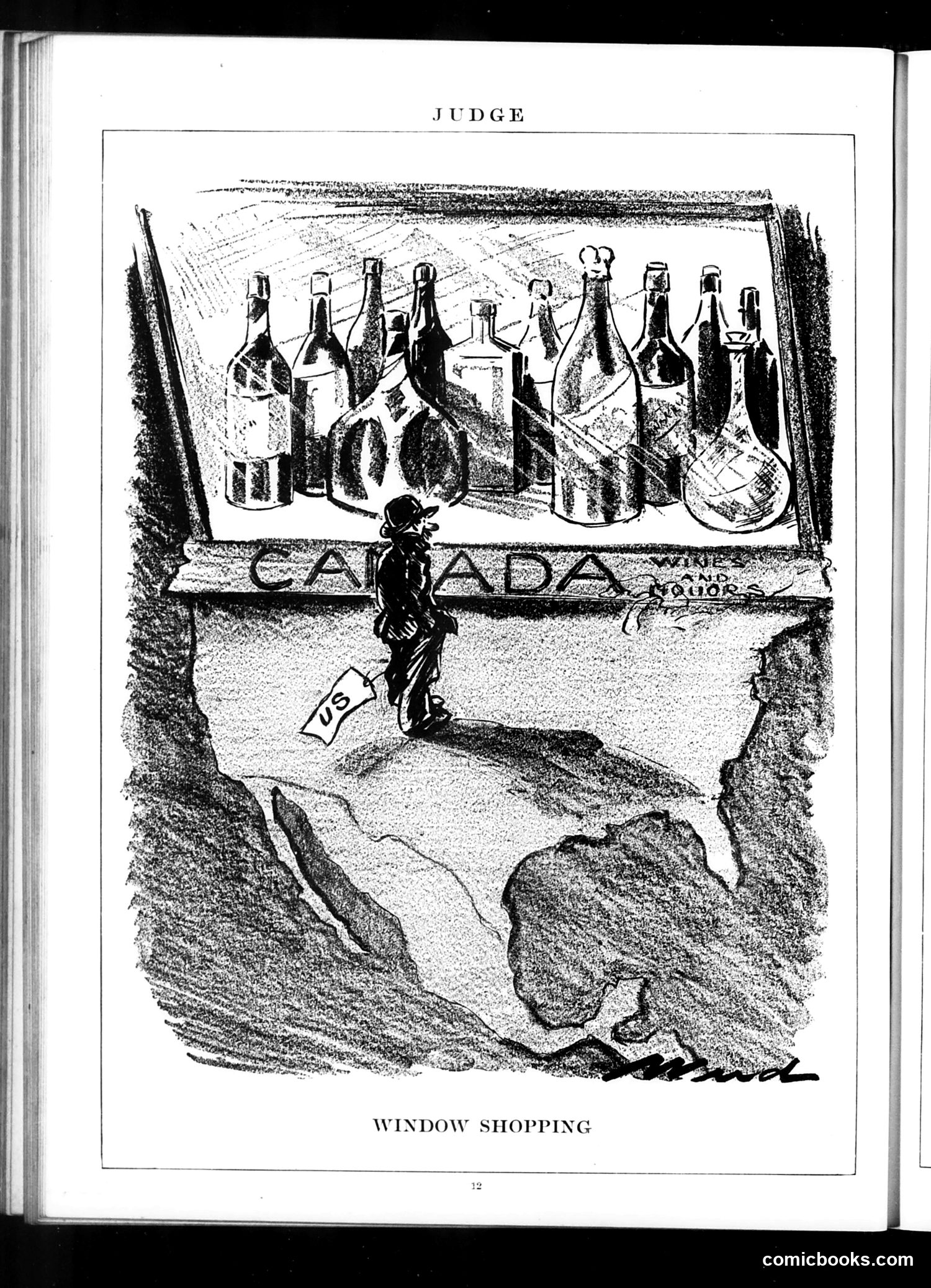
This political cartoon depicts a figure labeled "US" gazing at a window display labeled "CANADA" filled with alcohol bottles. The figure appears to be looking longingly at Canadian liquor during Prohibition. The satire addresses the contrast between American Prohibition laws (which banned alcohol sales) and Canada's legal alcohol trade. Americans during Prohibition would cross into Canada to purchase liquor, making this "window shopping" a pointed commentary on the futility and hypocrisy of Prohibition—citizens could see and access what was forbidden at home by simply traveling north. The cartoon mocks both American alcohol restrictions and the inevitable smuggling/legal cross-border trade that resulted from them.
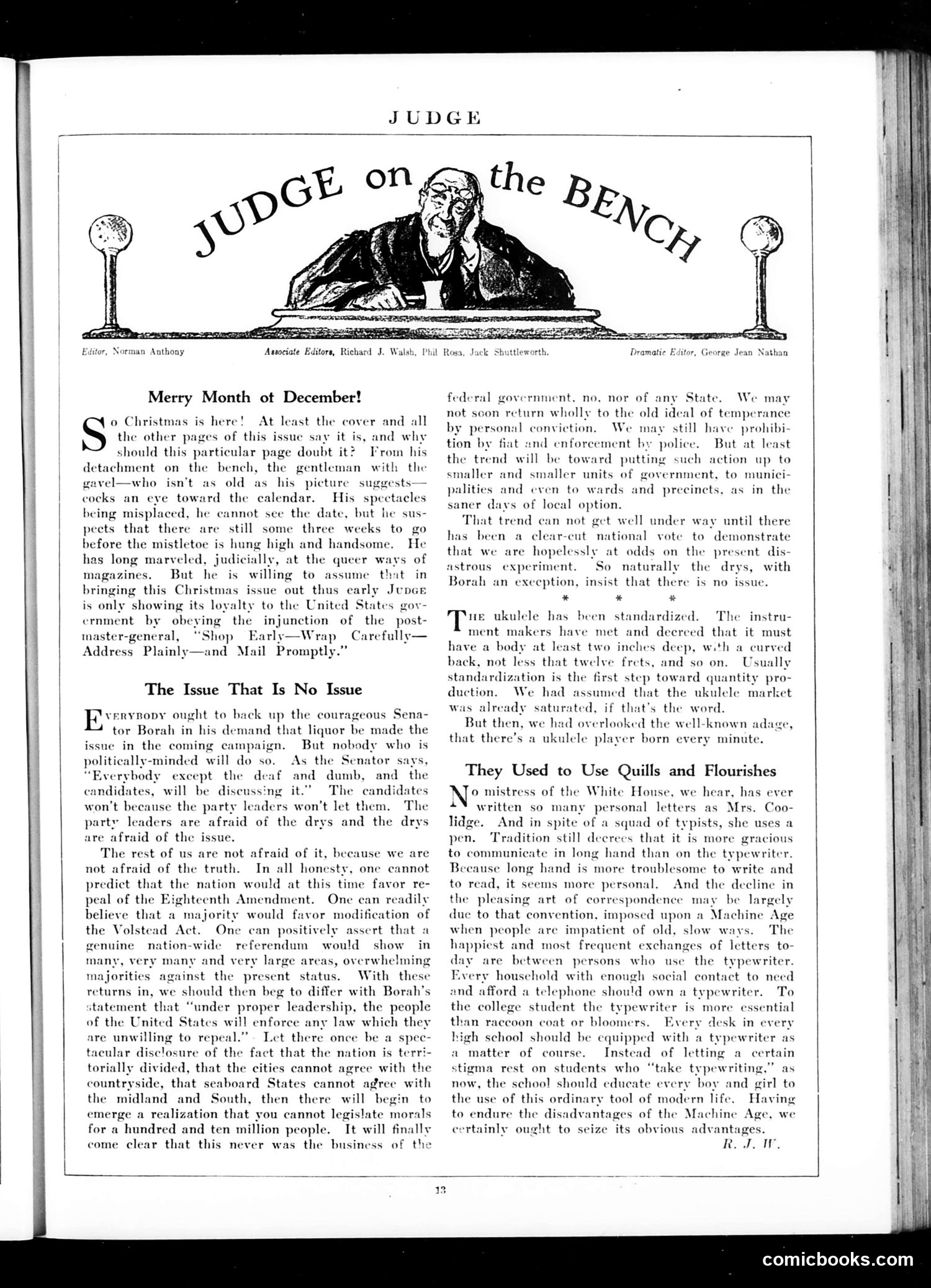
This is the masthead and opening editorial section of *Judge* magazine's December issue. The cartoon shows a befuddled judge at his bench, confused about the calendar—the magazine has published its Christmas issue three weeks early. The joke: he suspects this early publication obeys the Postmaster General's wartime directive to "Shop Early...Mail Promptly," satirizing both the magazine's commercial eagerness and government overreach into everyday life. The editorials discuss Prohibition politics. Senator Borah wanted liquor to be the 1928 campaign issue, but party leaders avoided it because urban areas supported repeal while rural areas supported the Eighteenth Amendment. *Judge* argues a national referendum would reveal this geographic divide, undermining claims that Americans support Prohibition. The page also includes brief notes on ukulele standardization (a 1920s fad) and typewriter use replacing handwriting—minor cultural observations typical of the era's satirical journalism.
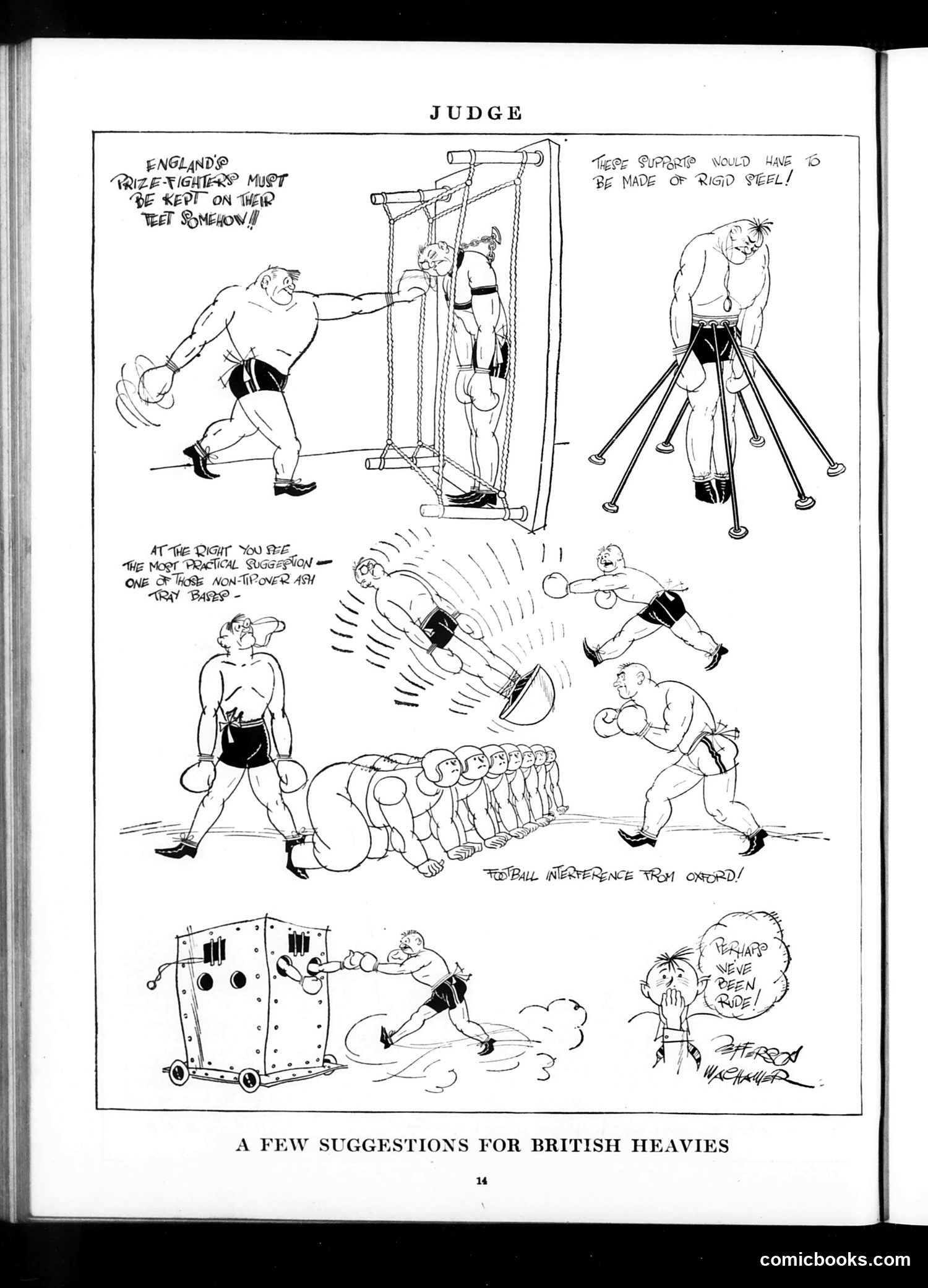
This page satirizes British heavyweight boxers through absurdist training equipment proposals. The title "British Heavies" refers to heavyweight boxing champions. The cartoons mock boxing training methods with increasingly ridiculous contraptions: a rigid steel frame to keep feet planted, multi-legged mechanical supports to prevent tipping, a padded rolling box for punching practice, and a "football interference try" featuring human obstacles. The humor targets the perceived technical deficiencies of British boxers—suggesting they need extreme measures to master basic stability and footwork. This appears to be competitive sports satire, likely from the early-to-mid 20th century when boxing was hugely popular and international competition fierce. The drawings emphasize the boxers' bulk and clumsiness, implying British heavyweights were awkwardly built or poorly trained compared to competitors. The increasingly absurd solutions escalate the joke's ridiculousness.
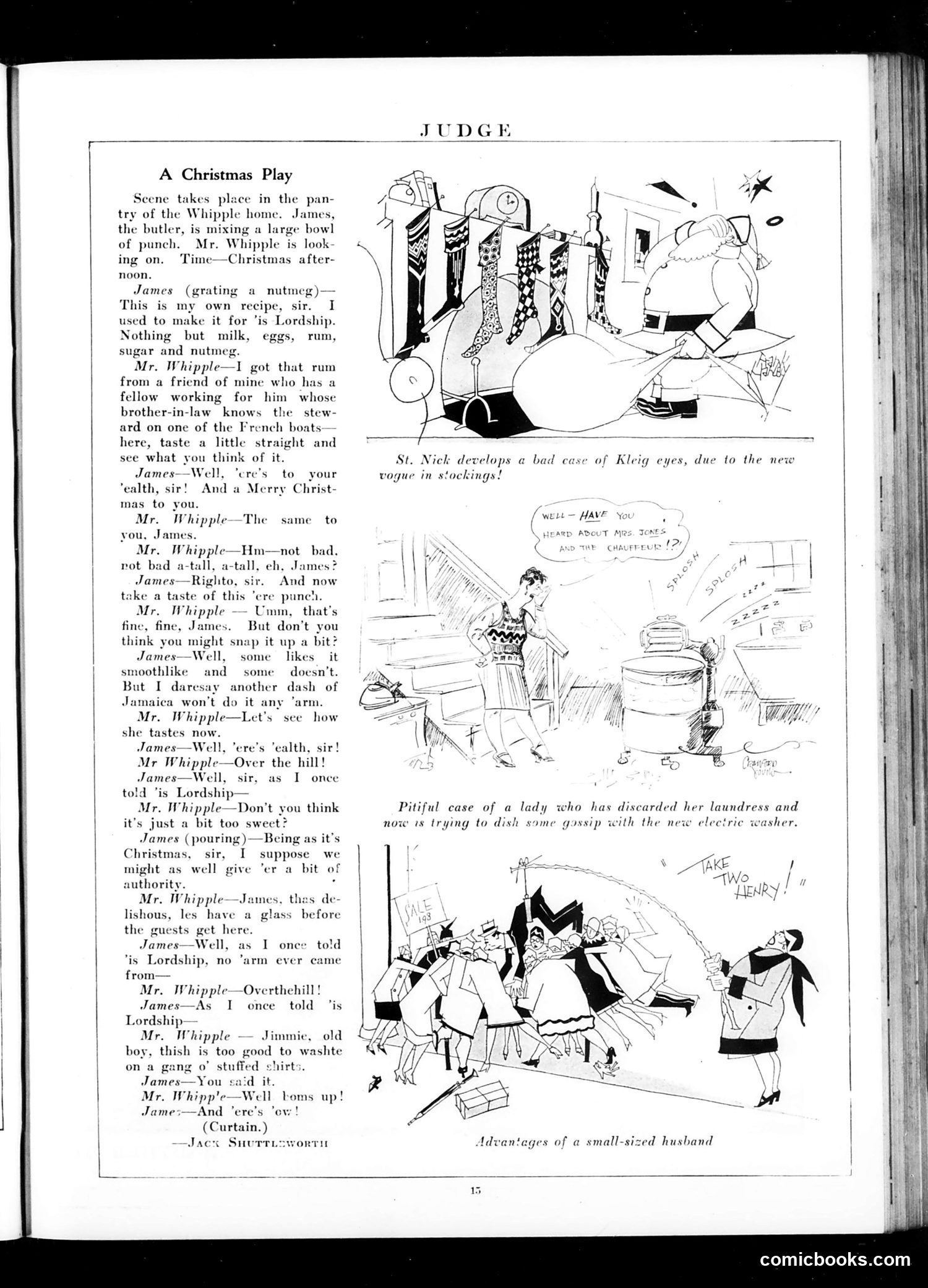
This page contains a satirical one-act play about class dynamics and alcohol consumption during Prohibition era America. The dialogue between Mr. Whipple (employer) and James (butler) centers on punch-making, with James repeatedly referencing his former service to British nobility ("'is Lordship"). The humor derives from James's pretentious name-dropping and Mr. Whipple's increasingly enthusiastic drinking despite claiming the punch is "too sweet." The final joke—Mr. Whipple calling the guests "stuffed shirts" while hoarding the punch—satirizes upper-class hypocrisy and social pretense. The accompanying illustrations depict absurdist holiday scenes: St. Nick suffering from "Kleig eyes" (film studio lights), a woman gossiping while using a washing machine, and a small husband being physically overwhelmed by his wife. These cartoons mock modern technologies and gender dynamics of the period.
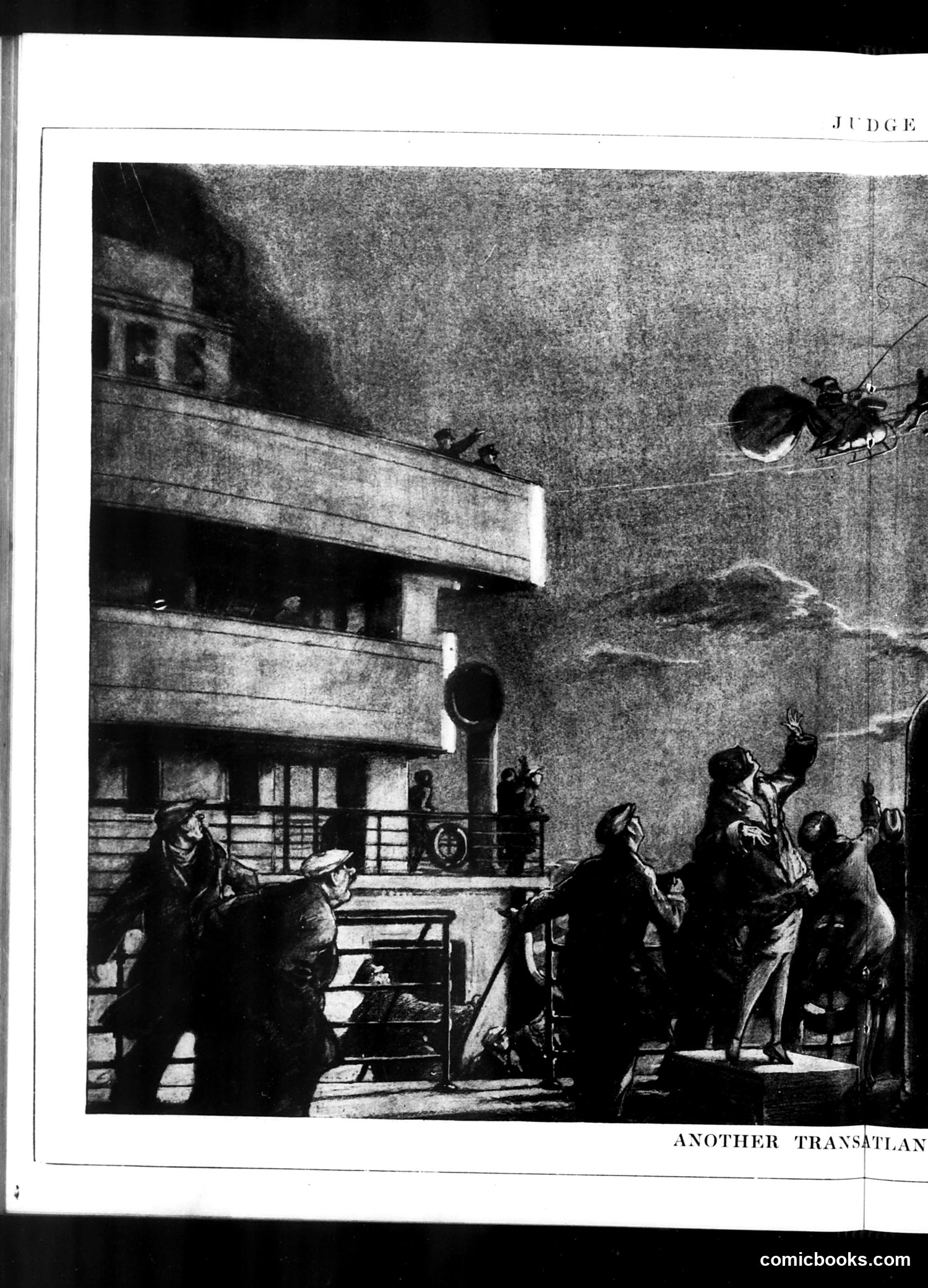
This appears to be a dramatic illustration titled "Another Transatlan[tic]" (likely "Another Transatlantic [crossing]"), showing what seems to be a rescue or emergency scene at a multi-story building. A group of people on the ground gesture urgently upward, while figures are visible on the building's upper levels and what appears to be a rope or cable extends across the scene with figures suspended on it. The "transatlantic" reference likely alludes to ocean travel or a transatlantic voyage, possibly satirizing a maritime disaster or emergency situation. However, without clearer OCR text or additional context, the specific political or social commentary remains unclear. The dramatic staging suggests satire of either a real maritime incident or contemporary anxieties about transatlantic travel during Judge magazine's era.
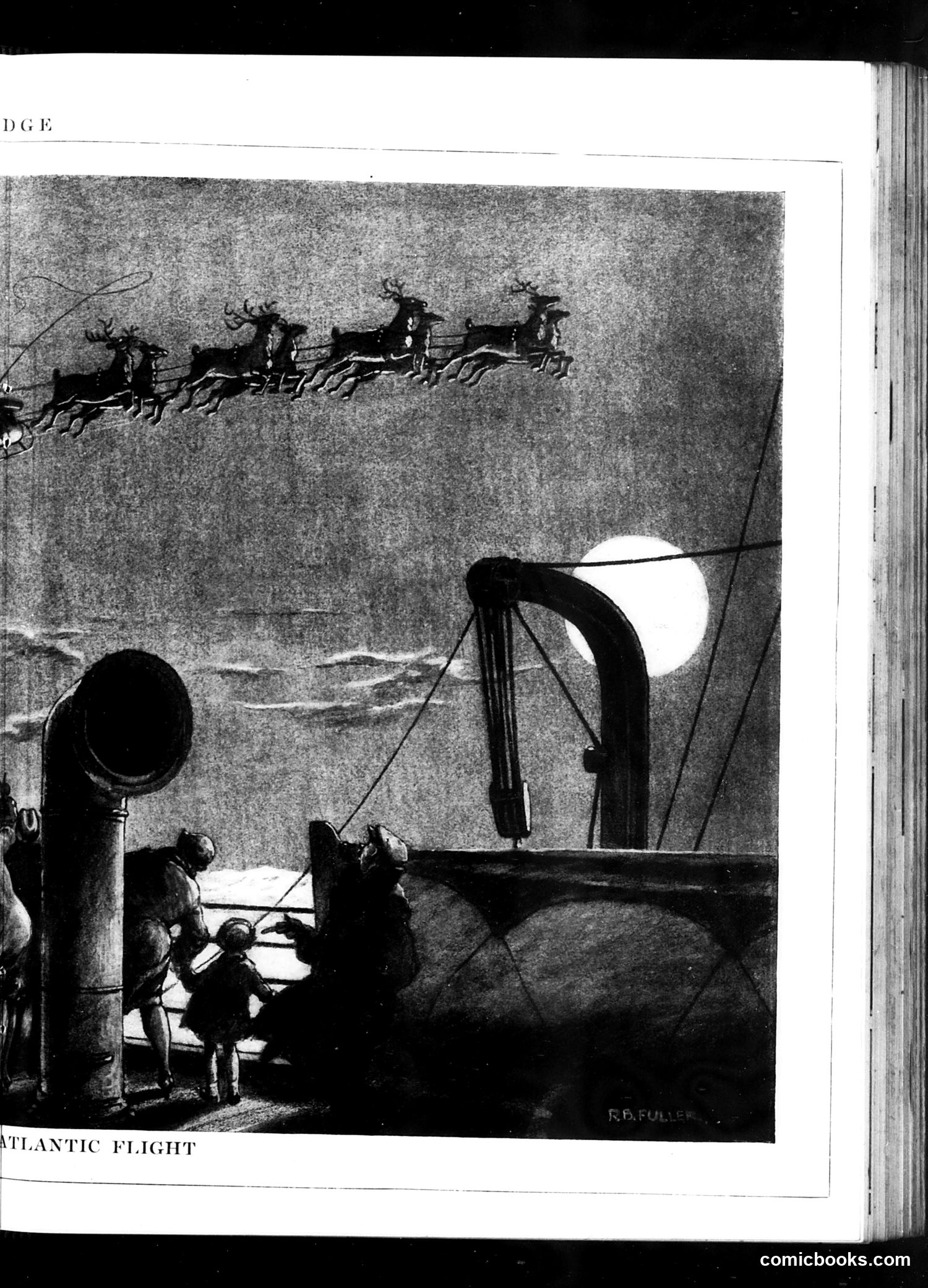
This appears to be a satirical illustration from *Judge* magazine depicting a nighttime scene with silhouettes. The image shows what looks like a telescope or surveying equipment in the foreground, with figures observing something. Above, there's a silhouette of Santa's sleigh with reindeer flying across a full moon—a classic Christmas imagery. The satire likely plays on themes of observation, surveillance, or perhaps the contrast between fantastical expectation (Santa) and mundane reality. Without additional text visible on this page, the specific political or social commentary remains unclear. The "ATLANTIC FLIGHT" reference (visible at bottom) might indicate connection to aviation-related satire, possibly referencing early transatlantic flight attempts that captured public imagination in the early 20th century.
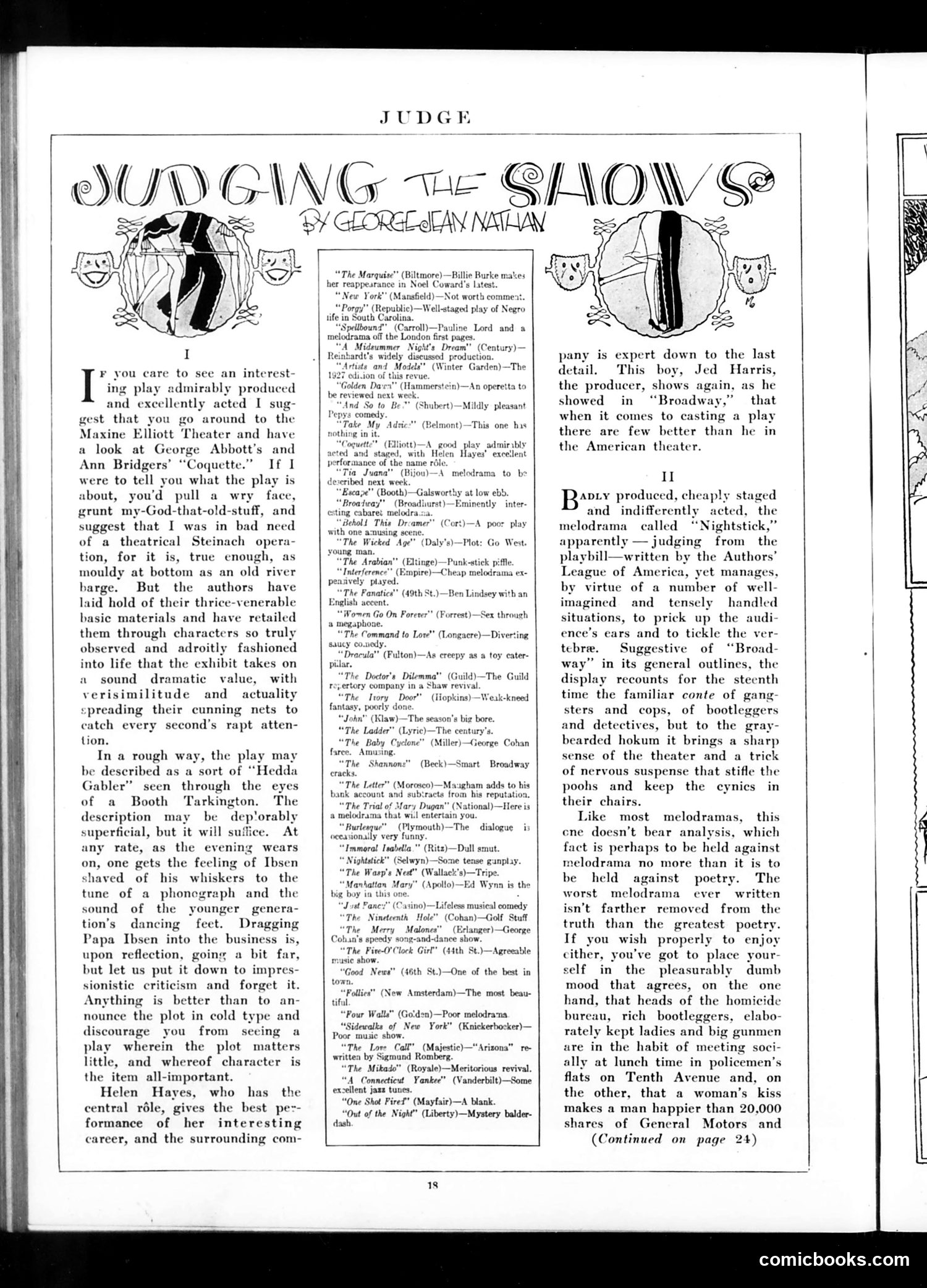
This page contains theater criticism by George Jean Nathan, a prominent drama critic of the 1920s. The two illustrated figures represent theatrical masks (comedy/tragedy), a standard symbol for theater. The main review praises "Coquette" at the Maxine Elliott Theater, starring Helen Hayes, as an admirably acted production despite its conventional plot about generational conflict (invoking comparisons to Ibsen). Nathan critiques the play's old-fashioned premise but credits its skilled execution and Hayes's performance. The remainder of the page is a rapid-fire listing of current Broadway productions with terse, often dismissive judgments—"Mildly pleasant," "Dull smut," "The season's big bore" (about "John"). This format was typical of Judge's theatrical coverage: witty one-liners evaluating shows for a sophisticated urban audience. The reviews reflect 1920s theatrical tastes and Nathan's caustic critical style.
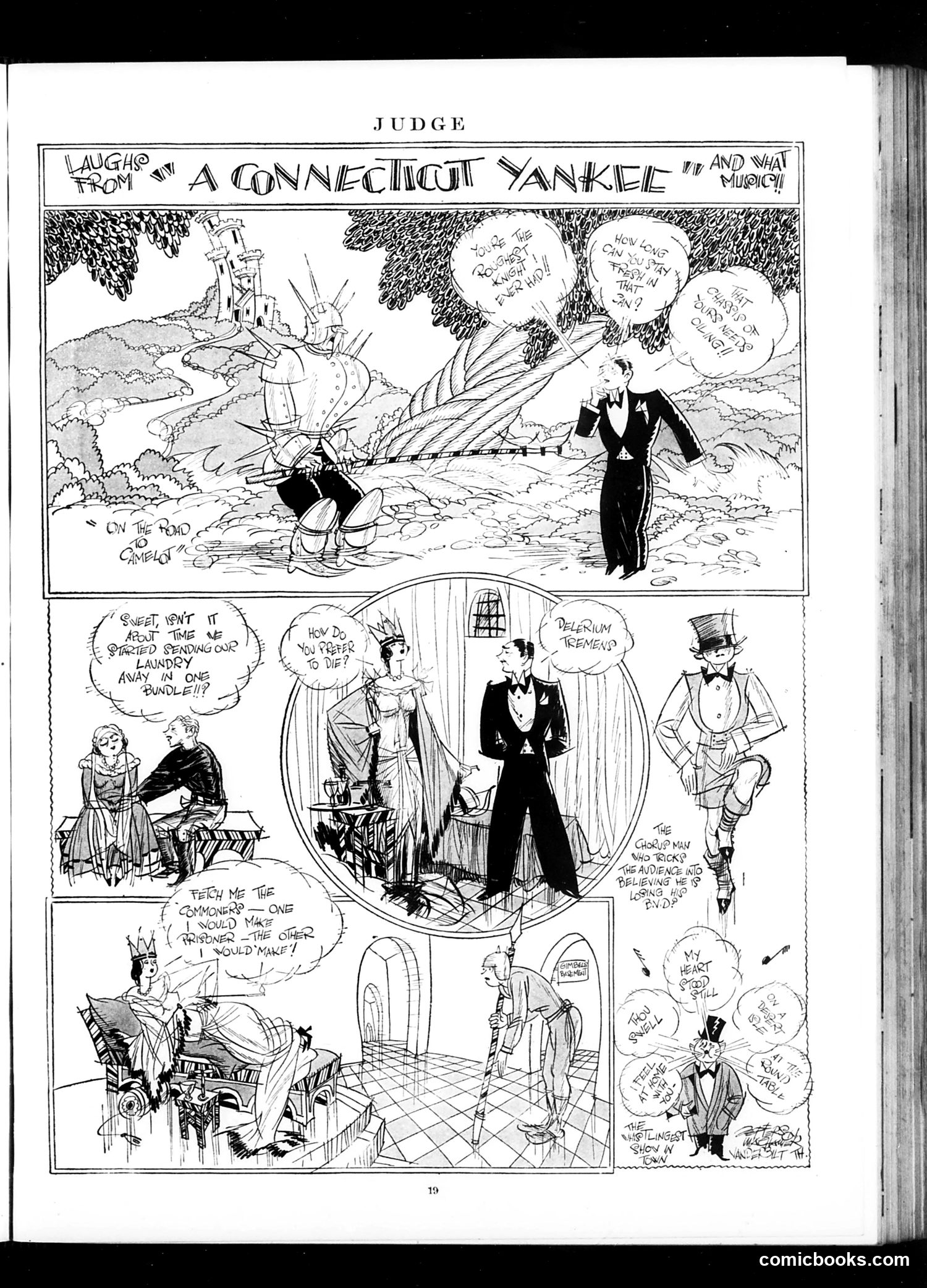
This comic adapts Mark Twain's 1889 novel *A Connecticut Yankee in King Arthur's Court*, wherein a modern American is transported to medieval times. The satire contrasts American practicality and democratic values with aristocratic pretension. The top panel shows the Yankee protagonist arriving in Arthurian Britain with industrial machinery, bewildering the locals. Subsequent panels depict him proposing practical solutions (efficient laundry methods, sensible dress) to the court's absurdities, while nobles resist change, preferring tradition and hierarchy. The joke targets both medieval rigidity and American overconfidence in "progress." The Yankee's democratic common-sense repeatedly clashes with rigid class systems and superstition. Judge uses this beloved literary reference to satirize resistance to modern improvements—a recurring theme in Gilded Age American humor about civilization's advancement versus backward-looking obstruction.
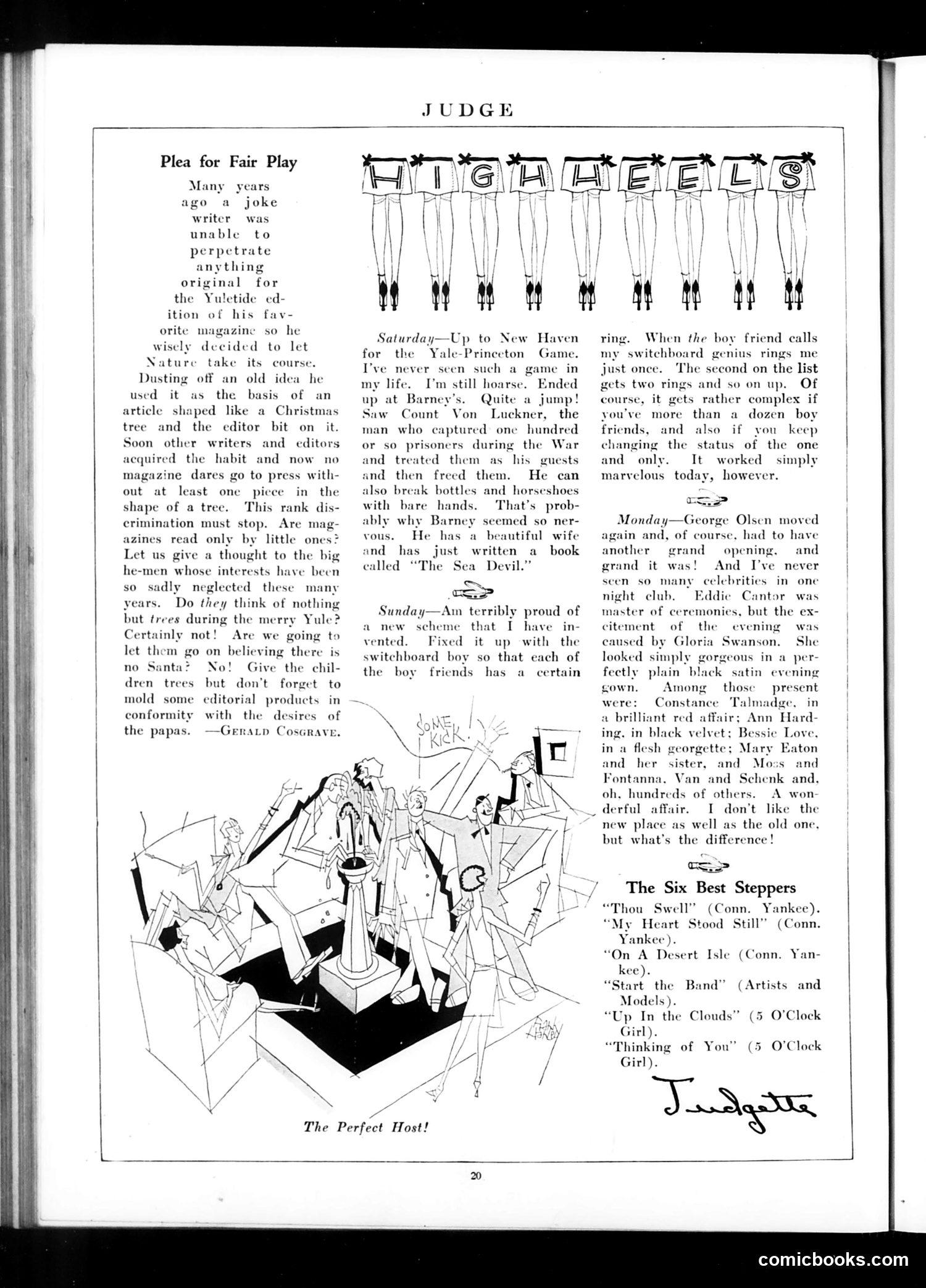
This page contains two distinct pieces: **"Plea for Fair Play"** (left): A humorous editorial complaint by Gerald Cosgrove arguing that magazines rely too heavily on Christmas-themed content shaped like trees. He satirizes this tired trope, pleading for editorial variety that appeals to adult male readers ("he-men") rather than only children. The illustration shows a chaotic Christmas tree scene with figures. **Diary entries** (right): Three brief society column entries documenting the author's weekend attending fashionable events—the Yale-Princeton game, a nightclub visit where Count Von Luckner (a real WWI German naval officer known for humane treatment of prisoners) appears, and George Olsen's nightclub opening. The entries name-drop celebrities like Gloria Swanson and Constance Talmadge, reflecting 1920s entertainment culture. **"The Six Best Steppers"** (bottom right): Lists current popular dance songs from Broadway shows, likely indicating which recordings were popular for social dancing. The page captures 1920s upper-class leisure and entertainment without deeper political content.
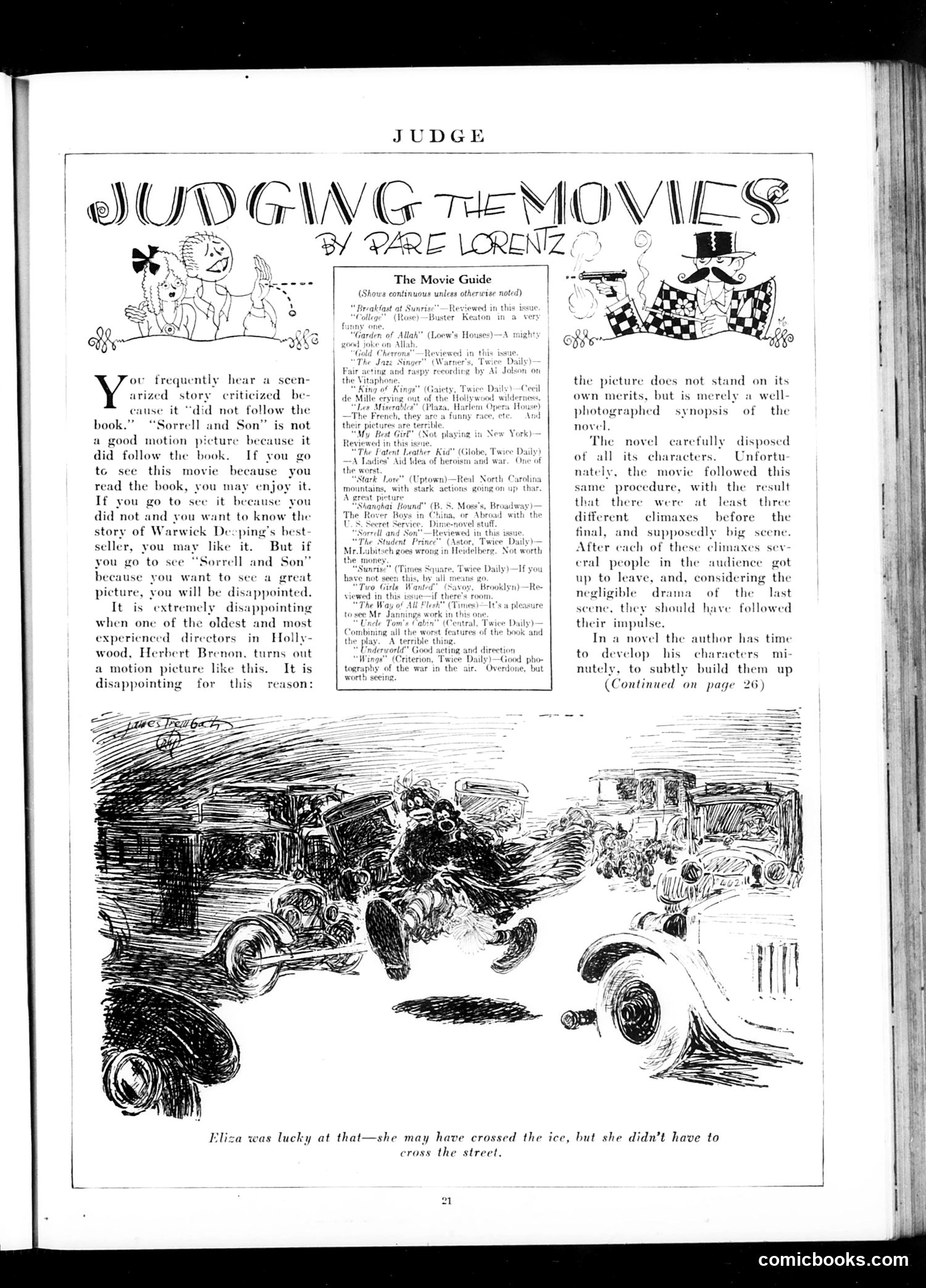
This page contains a film review column by Pare Lorentz titled "Judging the Movies," accompanied by an illustration and a caption-joke unrelated to the main text. **The Review:** Lorentz critiques "Sorrell and Son," a film adaptation of Warwick Deeping's novel directed by Herbert Brenon (a prominent silent-era director). His core complaint: the movie faithfully followed the book's structure but failed as cinema. He argues that novels and films require different storytelling approaches—novels develop characters gradually, while films need tighter pacing. The adaptation's multiple climaxes caused audience members to leave early, suggesting poor dramatic construction. **The Illustration & Caption:** The sketch shows a chaotic street scene with cars and pedestrians. The caption references "Eliza" crossing ice—likely evoking the famous scene from "Uncle Tom's Cabin" where the enslaved character Eliza famously crosses a frozen river. The joke appears to be that navigating a modern street is MORE dangerous than Eliza's theatrical peril. This is primarily a film criticism piece rather than political satire, reflecting Judge's coverage of contemporary entertainment and culture.
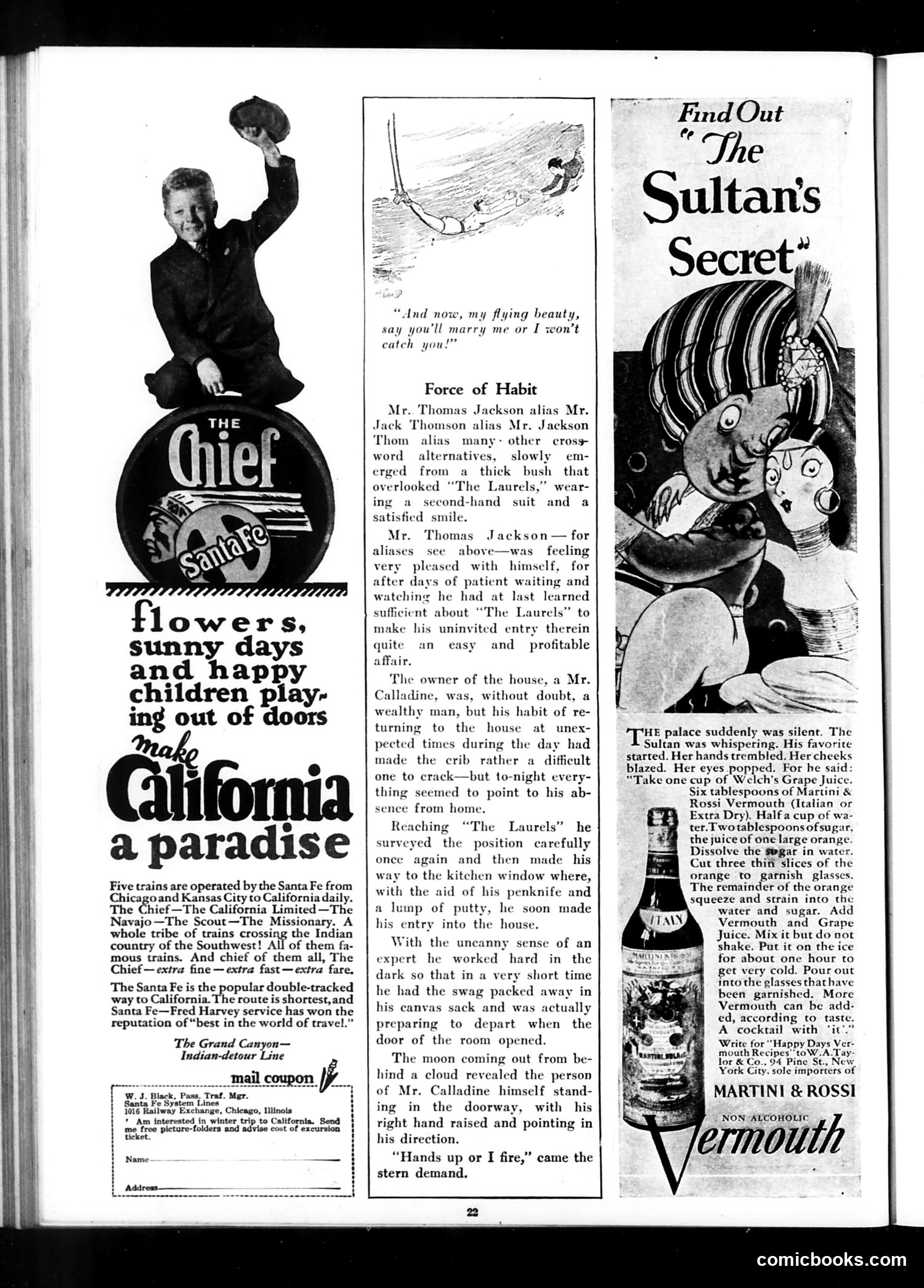
This page contains two distinct sections: **Left side:** A California tourism advertisement for the Santa Fe railway, promoting travel to California as "a paradise" with "flowers, sunny days and happy children." The ad emphasizes the railway's famous trains and reliable service. **Right side:** Two unrelated items— 1. **"Force of Habit"**: A short crime story about a burglar named Thomas Jackson who breaks into a wealthy man's house called "The Laurels." After carefully planning and entering through a kitchen window, he's discovered mid-heist by the homeowner, Mr. Calladine, who confronts him at gunpoint. 2. **"The Sultan's Secret"**: An advertisement for Martini & Rossi Vermouth disguised as exotic fiction. It presents an elaborate cocktail recipe as if it's a scandalous secret whispered in a palace, using orientalist imagery to market the alcoholic beverage. The page juxtaposes earnest tourism promotion and crime fiction with alcohol advertising using theatrical framing—typical of 1920s-era magazine advertising strategy.
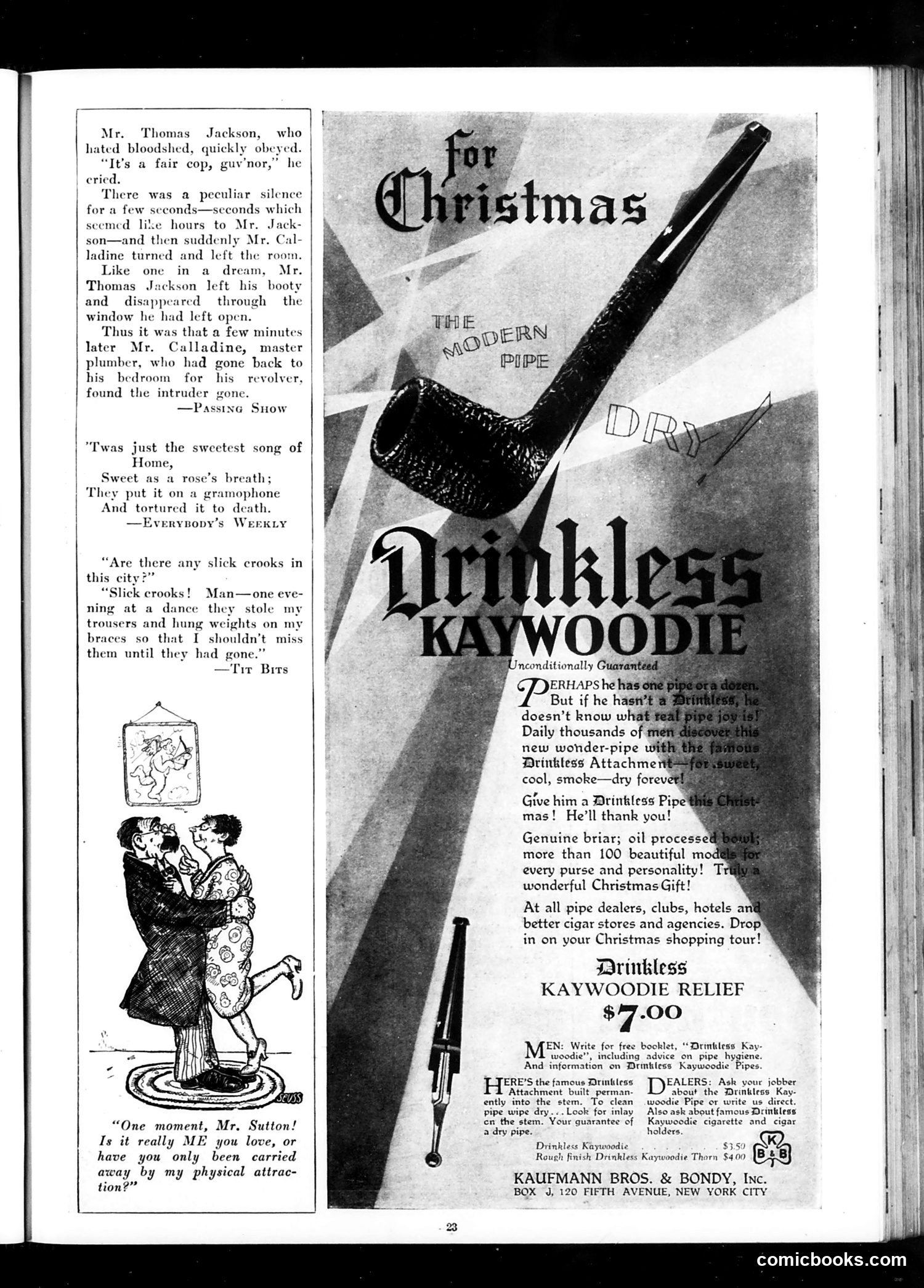
This page contains primarily **advertising** rather than political satire. The dominant content is a full-page Christmas advertisement for the "Drinkless Kaywoodie" pipe—a smoking pipe with an attachment designed to keep the stem dry during use. The left side includes three brief humorous stories unrelated to the main advertisement: one about a burglar named Thomas Jackson, one mocking a gramophone's treatment of a sentimental song, and one about a dancer whose trousers were stolen at a dance. These are typical light comedic filler content common in Judge magazine. The pipe advertisement itself emphasizes the product's practical benefit (keeping tobacco moisture from the smoker's mouth) and positions it as an ideal Christmas gift for men. The copy uses period-appropriate marketing language about the pipe's quality materials and aesthetic appeal, listing multiple price points ($3.50–$7.00) and distribution channels. The cartoon at bottom-left appears unrelated—a couple's romantic moment, captioned with a joke about physical attraction.
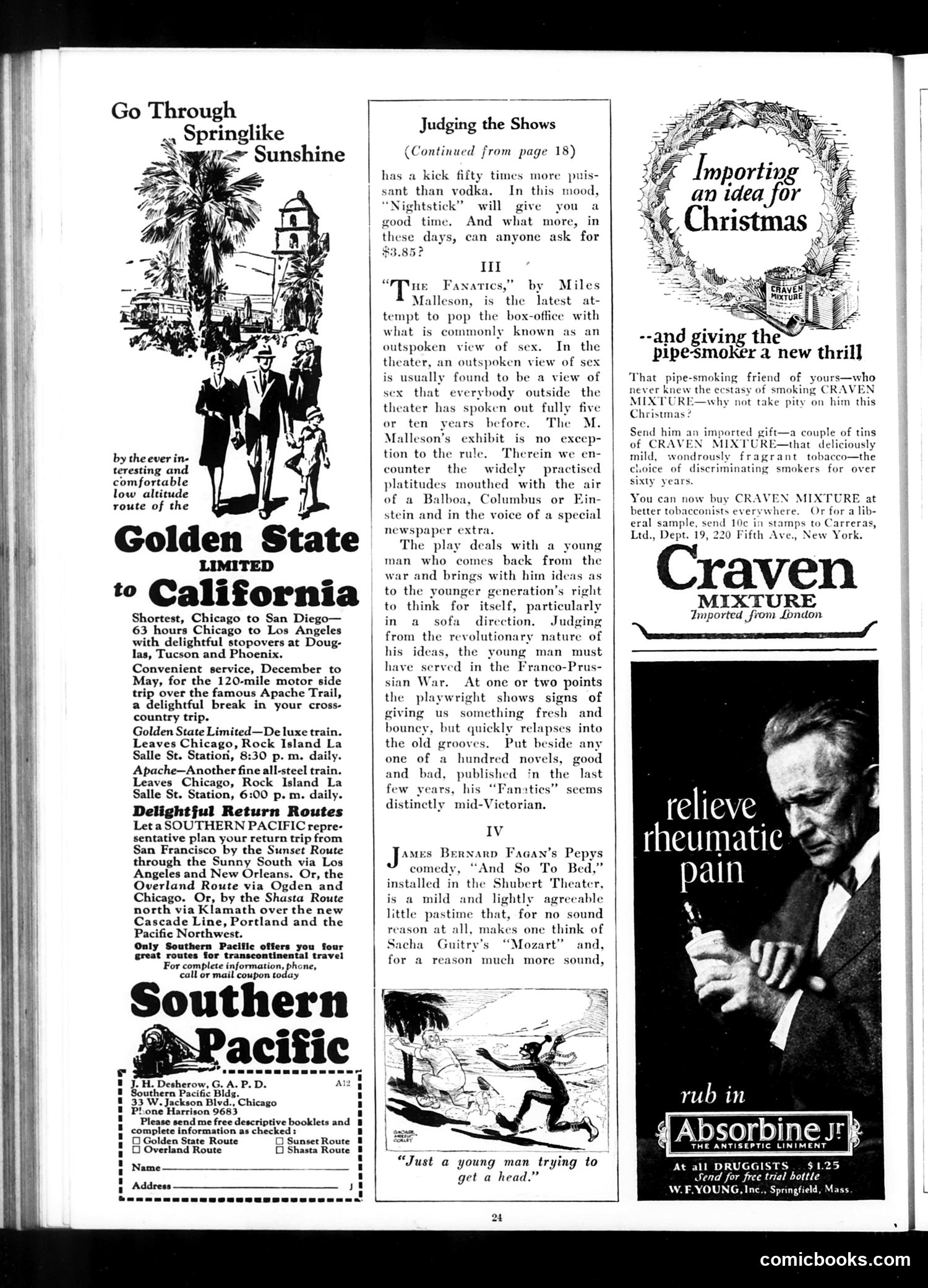
This page is primarily **advertisements and entertainment reviews**, not political satire. The main content includes: **Advertisements:** - Southern Pacific Railroad promoting train travel to California via the "Golden State Limited" - Craven Mixture tobacco (imported from London) marketed as a Christmas gift for pipe smokers - Absorbine Jr. liniment for rheumatic pain relief **Theater Reviews Section:** The "Judging the Shows" column critiques contemporary plays, including Miles Malleson's "The Fanatics" (about post-WWI youth questioning conventional morality) and James Bernard Fagan's "And So To Bed" (a Sacha Guitry-influenced comedy). The reviewer finds both disappointingly conventional—Malleson's "revolutionary" ideas about youth independence seem dated, having already been debated years earlier. The single cartoon depicts "a young man trying to get ahead," illustrating themes from the reviewed plays. This reflects 1920s concerns about generational conflict and modernity, but contains no political satire or caricature worthy of historical analysis.
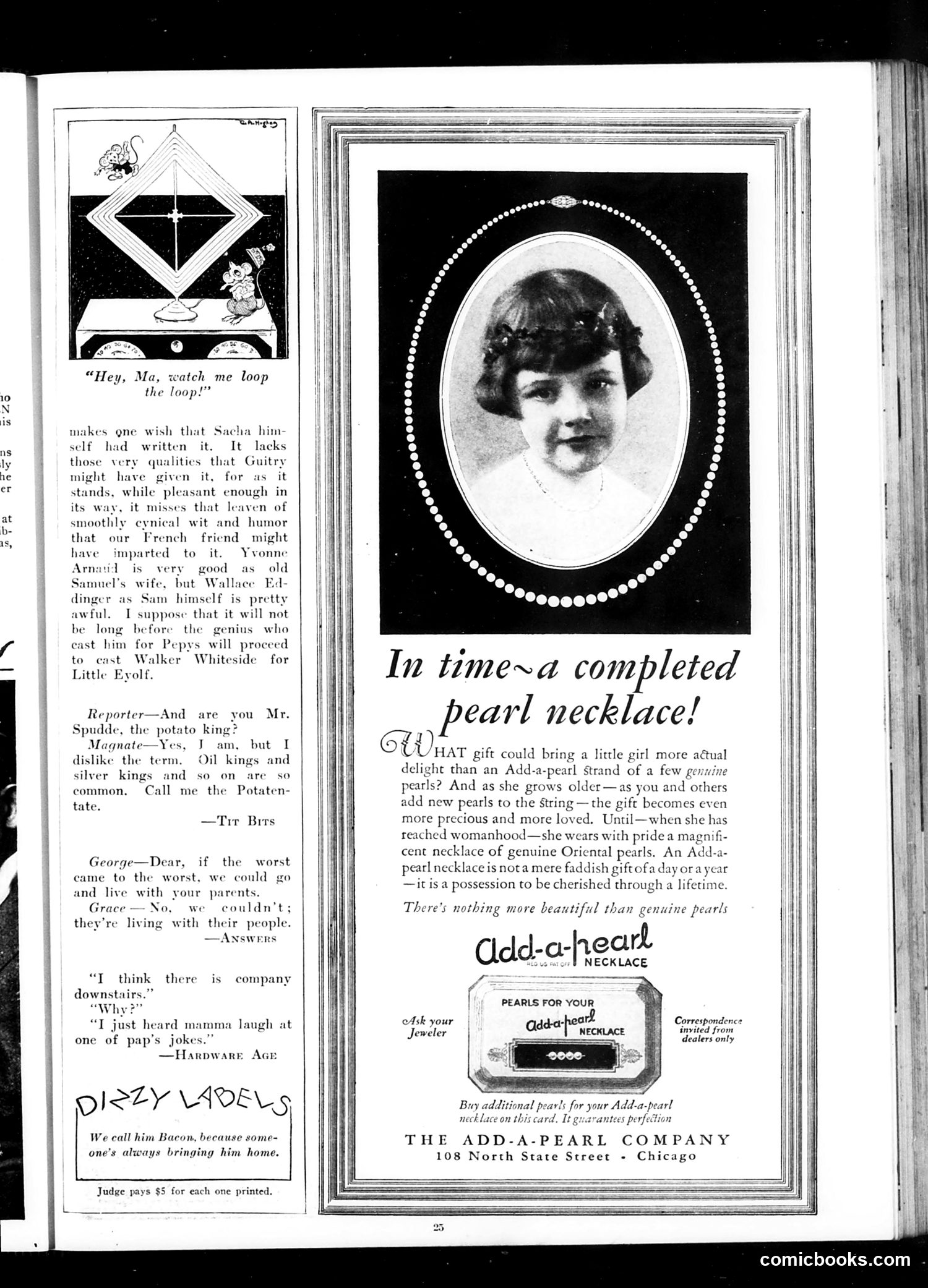
This page contains **multiple unrelated elements typical of Judge's format**: **Left side** features brief humorous anecdotes and jokes, including wordplay about a "potato king" (mocking nouveau-riche businessmen who styled themselves as "kings" of their industries—oil kings, silver kings, etc.). The potato magnate humorously demands to be called the "Potatentate" instead. Other jokes concern domestic life and social situations common to early 20th-century middle-class readers. **"Dizzy Labels"** is a simple joke: calling someone "Bacon" because people are always "bringing him home" (a pun on the phrase). **Right side** is a full-page **advertisement** for the Add-a-Pearl Necklace Company of Chicago—not satire. It marketed pearls as a gift for girls that could be added to over time as she grew, eventually becoming a complete necklace by adulthood. The page itself is **not primarily satirical**—it's a mix of short humor pieces and advertising, typical of Judge's commercial model blending editorial content with paid advertisements.
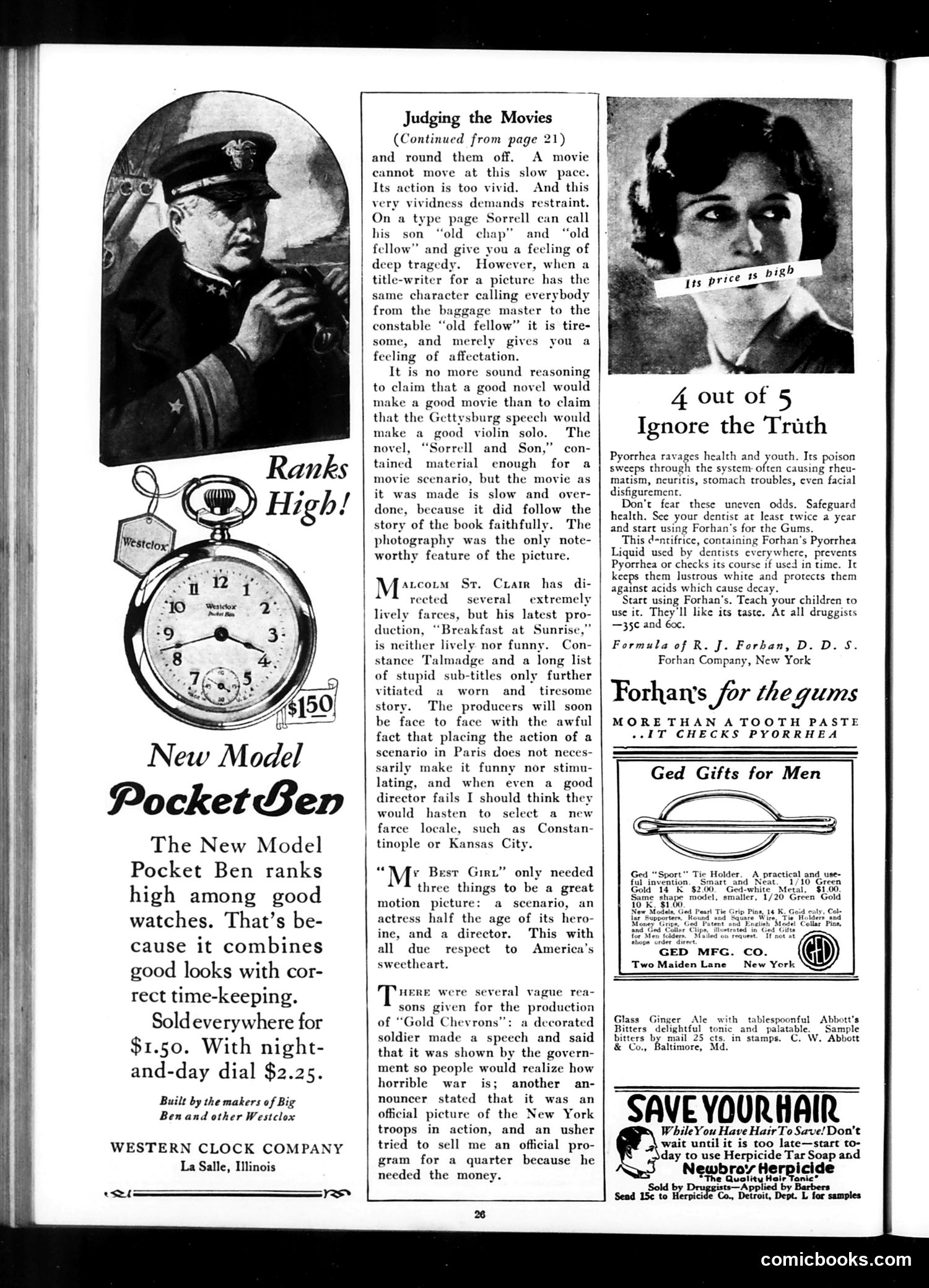
This page is primarily **advertising with a movie criticism column** rather than political satire. The main content is "Judging the Movies," a film review section critiquing contemporary motion pictures. The reviewer argues that novels don't automatically make good films—citing "Sorrell and Son" as competently made but slow, and dismissing "Breakfast at Sunrise" and "My Best Girl" as poorly conceived. The criticism centers on pacing, acting, and scenario quality, particularly criticizing overuse of "old fellow" dialogue and Paris settings in comedies as inherently unfunny. The advertisements are era-typical: a Pocket Ben watch ($1.50), Forhan's toothpaste (claiming to prevent pyorrhea/gum disease), and Herpicide hair tonic. These ads reflect 1920s consumer anxieties about health and grooming. No clear political figures or cartoons appear on this page. It's a standard Judge magazine issue mixing entertainment criticism with commercial advertising.
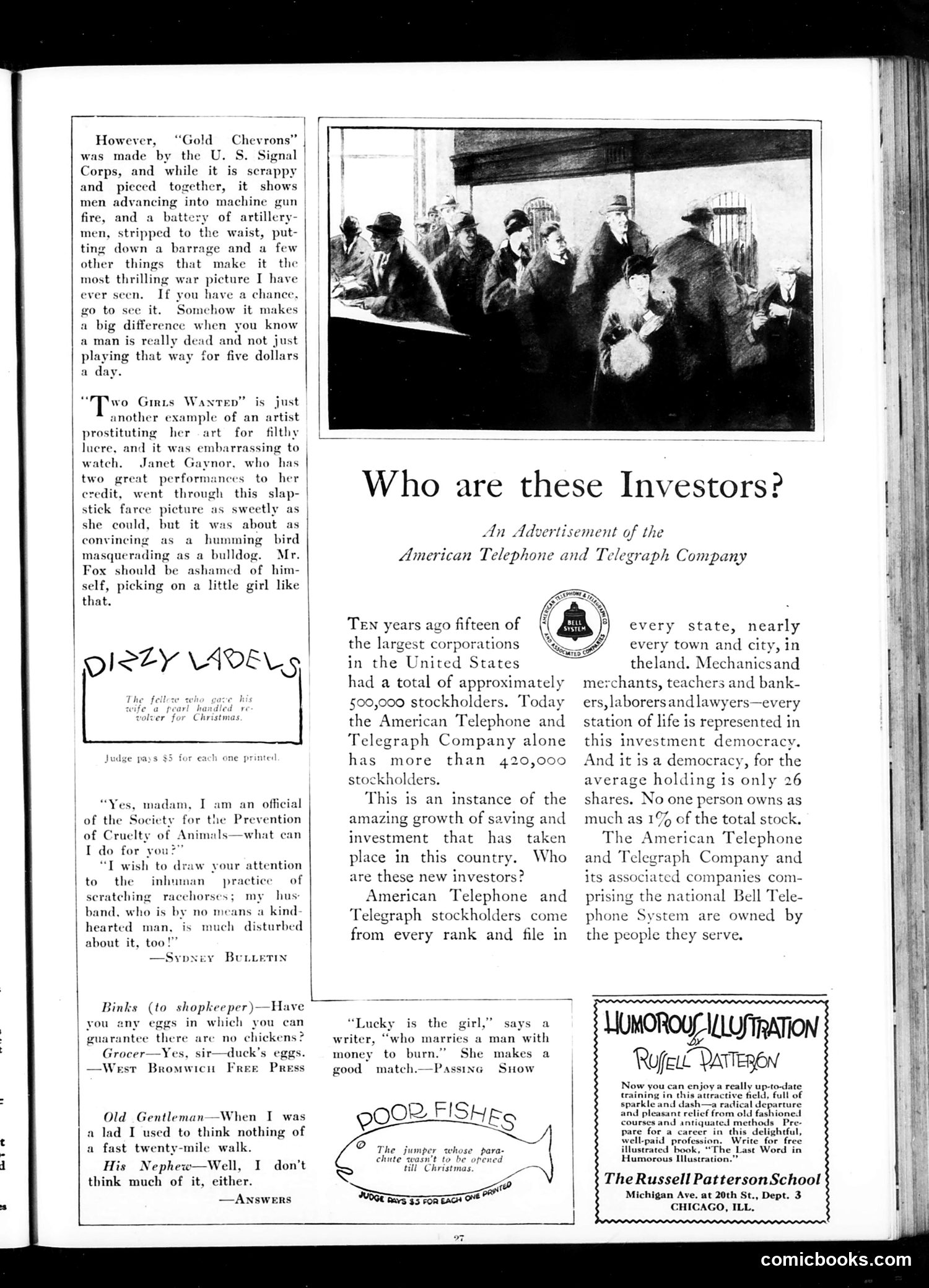
This page mixes film criticism with corporate advertising, reflecting 1920s popular culture and business interests. ## Film Reviews (Left Column) The critic dismisses two movies: "Gold Chevrons" (a WWI combat film by the U.S. Signal Corps) receives qualified praise for its realism—the writer notes it's affecting to watch "real" death rather than actors faking it for pay. By contrast, "Two Girls Wanted" is savagely criticized as actress Janet Gaynor debasing herself in cheap slapstick farce, with Fox Studios ridiculed for exploiting her talent. ## AT&T Advertisement (Right Column) This is a corporate propaganda piece celebrating democratized stock ownership. AT&T claims that while fifteen major corporations had 500,000 total stockholders a decade prior, AT&T alone now has 420,000—suggesting widespread investment across all social classes (mechanics, teachers, laborers, lawyers). The pitch: this represents "investment democracy" where no single person owns more than 1% of stock, and "the people they serve" own the company. The timing (likely 1920s) reflects post-WWI optimism about capitalism and mass participation in markets.
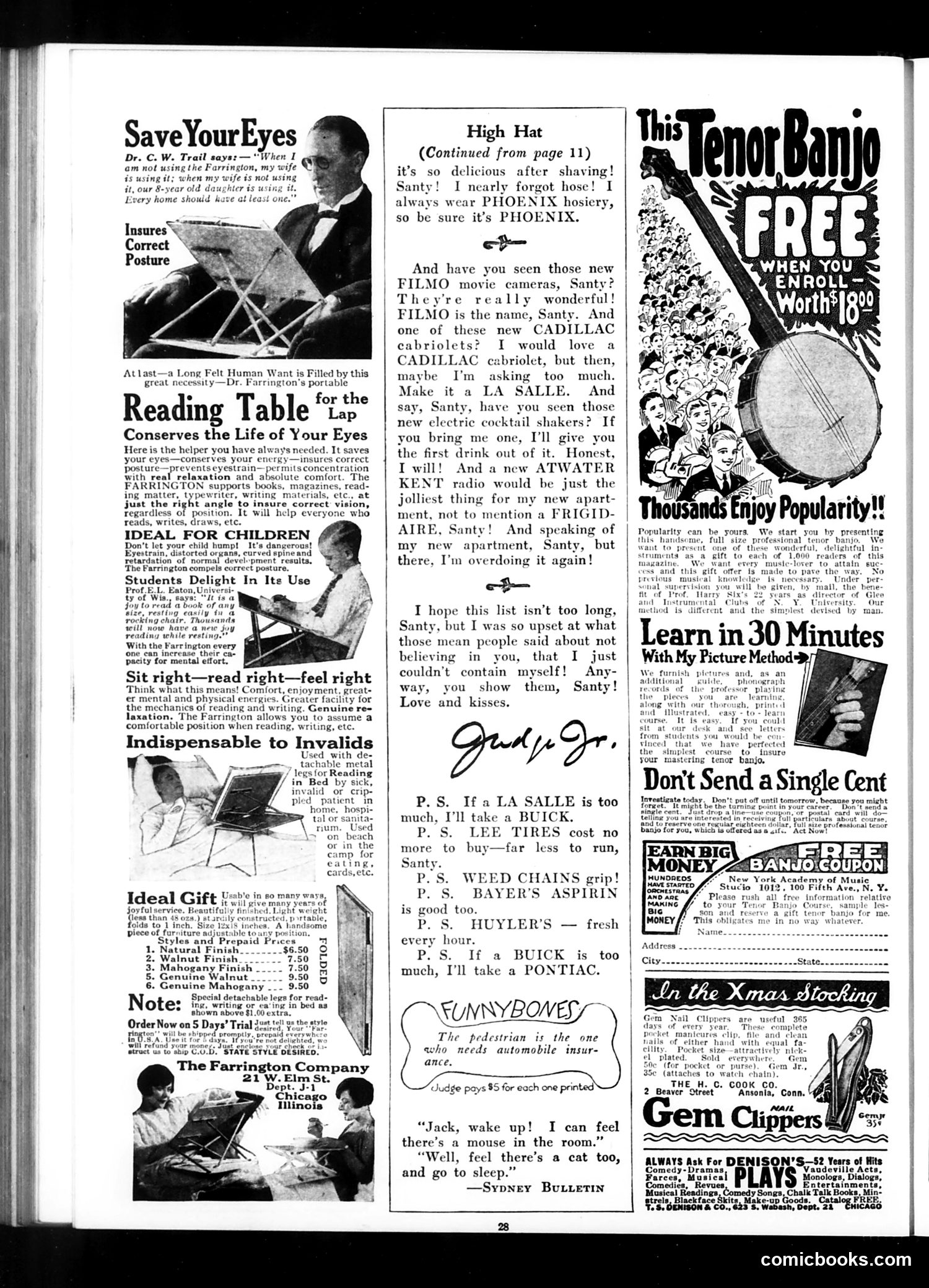
This page is **primarily advertising** with minimal satirical content. The main feature is a lengthy advertorial for "The Farrington Company's" reading table—a posture-correcting stand for books and writing materials. The ads emphasize health benefits: correcting children's posture, aiding invalids, and protecting eyesight. The "High Hat" column (center) is a gossipy society piece where an unnamed socialite lists luxury goods she wants for Christmas: Phoenix hosiery, Filmo cameras, Cadillac automobiles, electric cocktail shakers, and Atwater Kent radios. The satire here is gentle—mocking consumer materialism and name-dropping during the prosperous 1920s. The "Funny Bones" section offers a mild joke about a man feeling both a mouse and cat in his room. The page reflects **1920s consumer culture**: automobile brands, new consumer electronics, and advice columns targeting affluent readers. The satire is light, focusing on conspicuous consumption rather than sharp political critique.
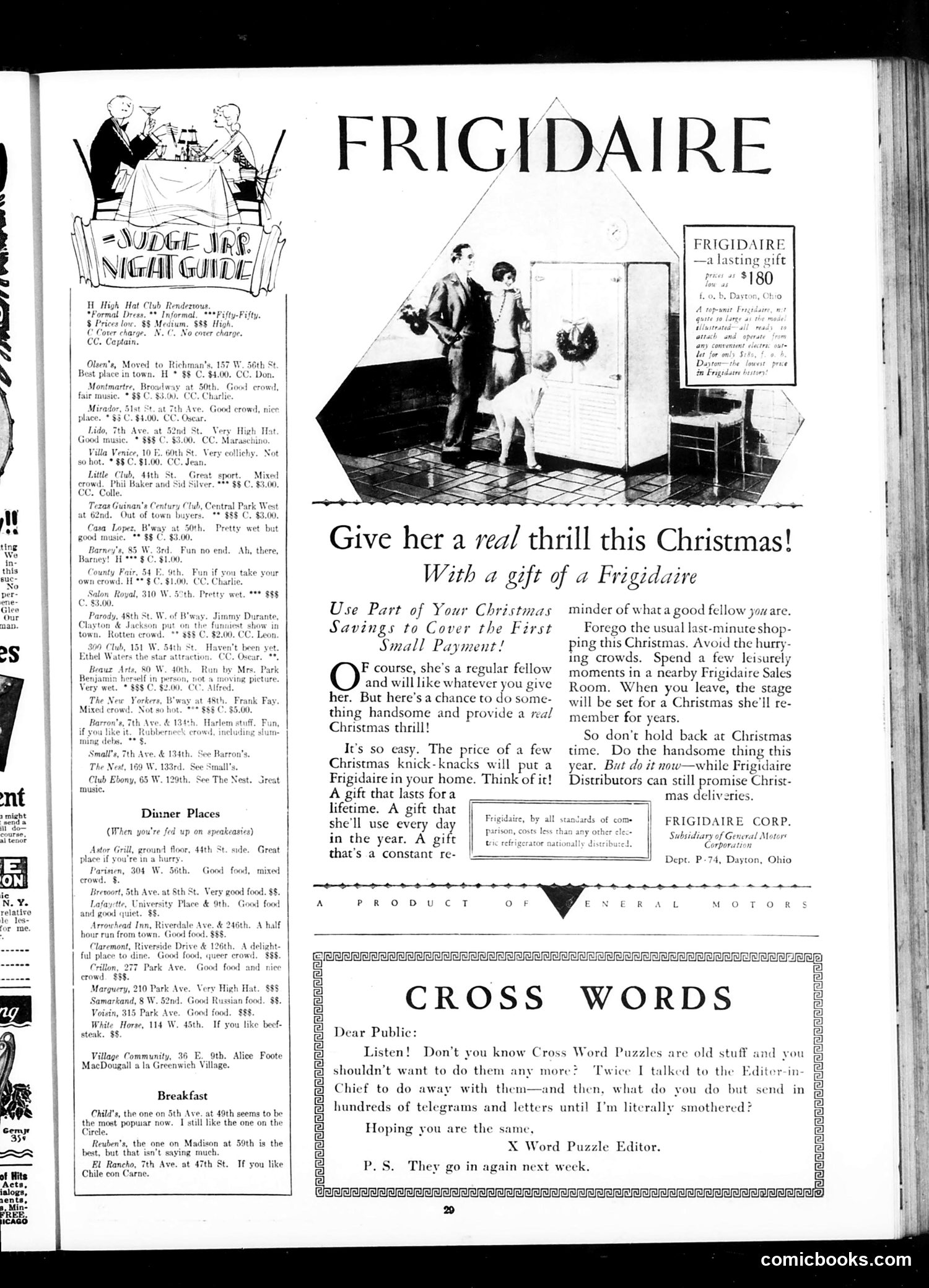
This page is primarily **advertising** rather than political satire. The dominant feature is a large Frigidaire refrigerator advertisement positioned as a Christmas gift recommendation for women. **The Advertisement's Message:** The ad targets male readers, suggesting they impress female partners ("Give her a real thrill this Christmas!") by purchasing an expensive Frigidaire refrigerator ($180—a substantial sum in this era). The copy emphasizes the gift's permanence and daily utility, positioning the appliance as proof of the giver's thoughtfulness and generosity. **Social Context:** This reflects 1920s-30s consumer culture and gender norms: the assumption that a woman's primary sphere is domestic management, and that a modern electric refrigerator represents both luxury and labor-saving convenience. The ad simultaneously celebrates technological progress while reinforcing traditional gender roles. **The Remainder:** The page includes restaurant listings (many labeled "speakeasies," suggesting Prohibition-era venues), breakfast recommendations, and a minor "Cross Words" puzzle section with a humorous note from the puzzle editor resisting calls to discontinue crosswords. The page illustrates Judge's dual function: satirical commentary alongside commercial advertising targeting affluent readers.
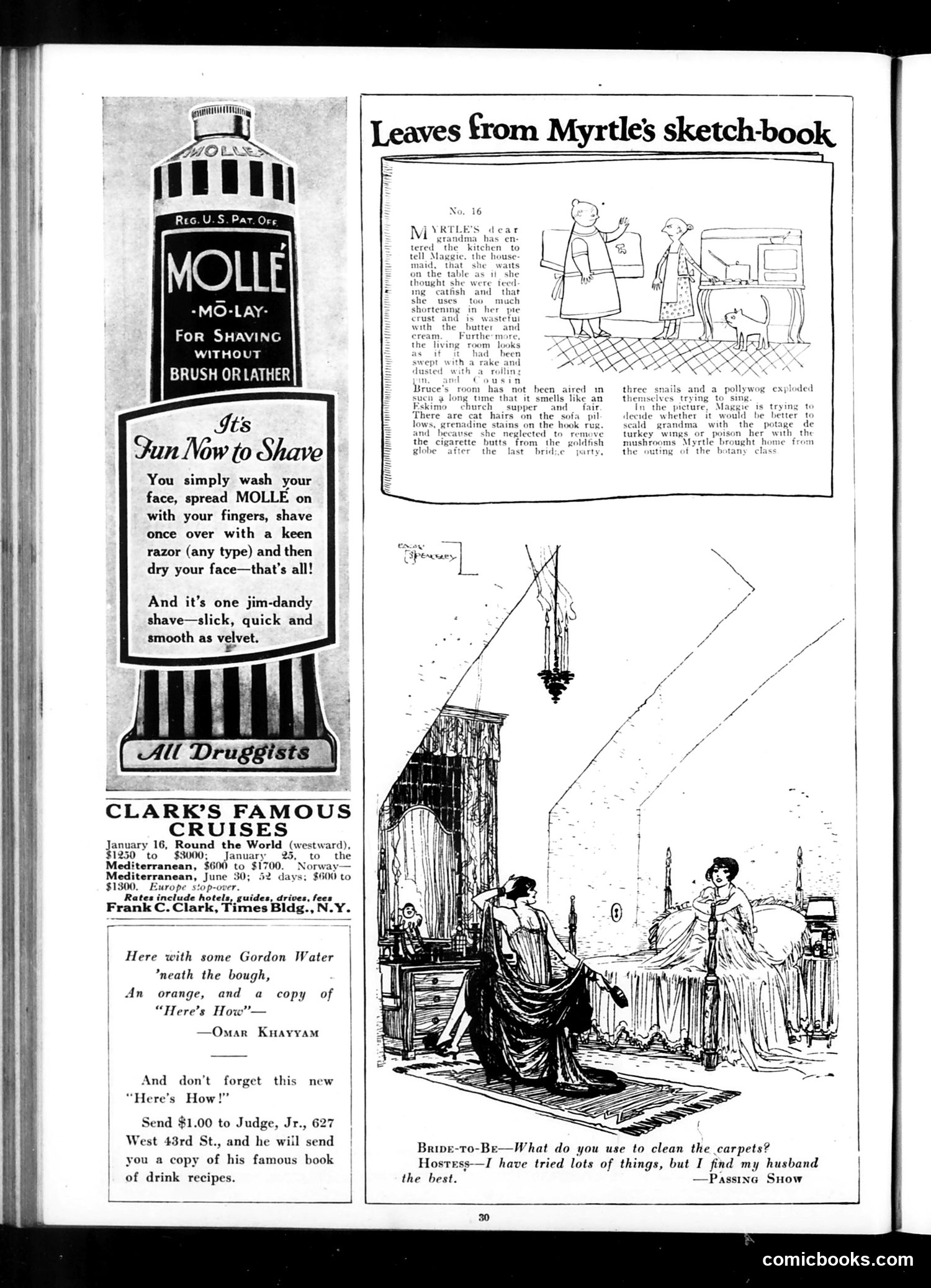
This page mixes advertising with two distinct cartoon features. The left side contains a Molle shaving cream advertisement emphasizing convenience—no brush or lather needed, just finger application. Below are Clark's cruise line ads and a promotional item for a drink recipe book. The right side features "Leaves from Myrtle's Sketch-book," a serialized cartoon series (No. 16). The top cartoon depicts domestic life: a woman trying to sing while her grandmother and maid listen, with Maggie attempting to write a letter—satirizing amateur musicianship. The bottom cartoon shows a bride-to-be asking a hostess about carpet cleaning; the hostess jokingly replies her *husband* is best for cleaning—a joke playing on marital utility and domestic drudgery as a wife's role. These are light domestic humor pieces typical of Judge's satirical take on middle-class American life, with gentle jabs at incompetence and gender roles.
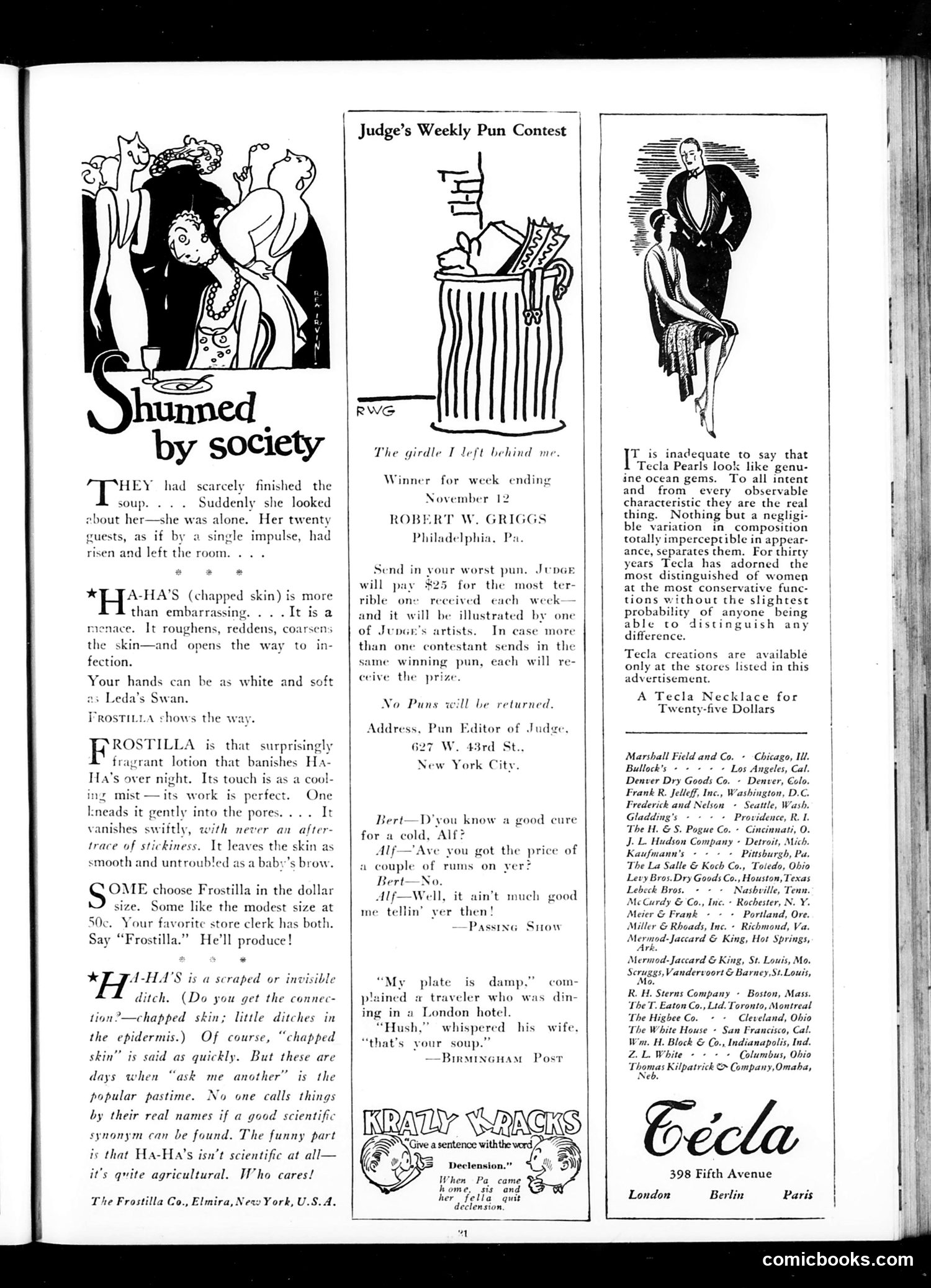
This page contains two main elements: **Left side** is a satirical story titled "Shunned by Society" about a hostess abandoned by twenty guests. It's paired with advertisements for Frostilla lotion, which promises to cure "Ha-Ha's"—a comedic term for chapped skin (the wordplay being that chapped skin causes people to avoid you). The satire mocks both superficial social embarrassment and exaggerated advertising claims about beauty products solving social problems. **Center and right** feature Judge's weekly pun contest (offering $25 for terrible puns) and advertisements for Tecla costume pearls, presented as indistinguishable from real ocean gems. The imitation pearls ads emphasize their "thirty years" of fooling high society. **Overall meaning**: The page satirizes early 20th-century anxieties about appearance, social status, and consumer culture—suggesting that Americans were willing to buy into elaborate deceptions (fake pearls, miracle skin creams) to maintain social standing.
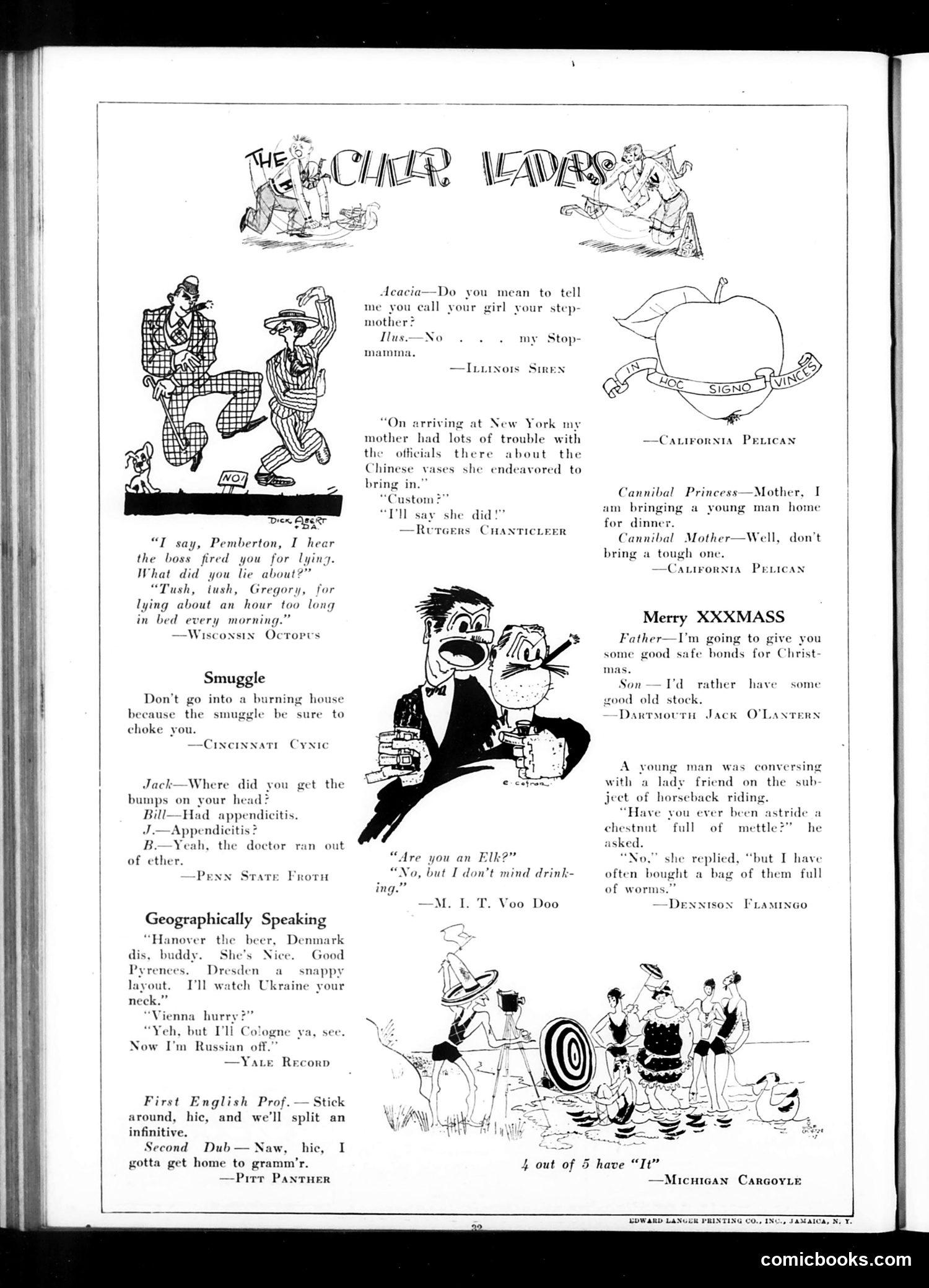
This page from Judge magazine collects short jokes and quips from various college humor publications (Wisconsin Octopus, Penn State Froth, Yale Record, etc.). The content reflects early 20th-century collegiate humor. The jokes employ wordplay and puns: "Geographically Speaking" uses city names as verbs ("Cologne ya," "I'm Russian off"). Several rely on risqué double meanings acceptable for the era—the "stepmother" joke plays on intimate relationships; cannibal jokes were common period humor. The "Merry XXXMASS" section pokes fun at financial conservatism versus risk-taking (safe bonds vs. stock). The horseback riding exchange uses suggestive language about "mettle" (metal) to create innuendo. The illustrations feature period stereotypes and casual depictions now considered offensive (blackface-adjacent caricatures). The overall tone is lighthearted, college-boy irreverence—typical of Judge's satirical approach to social conventions through humor.
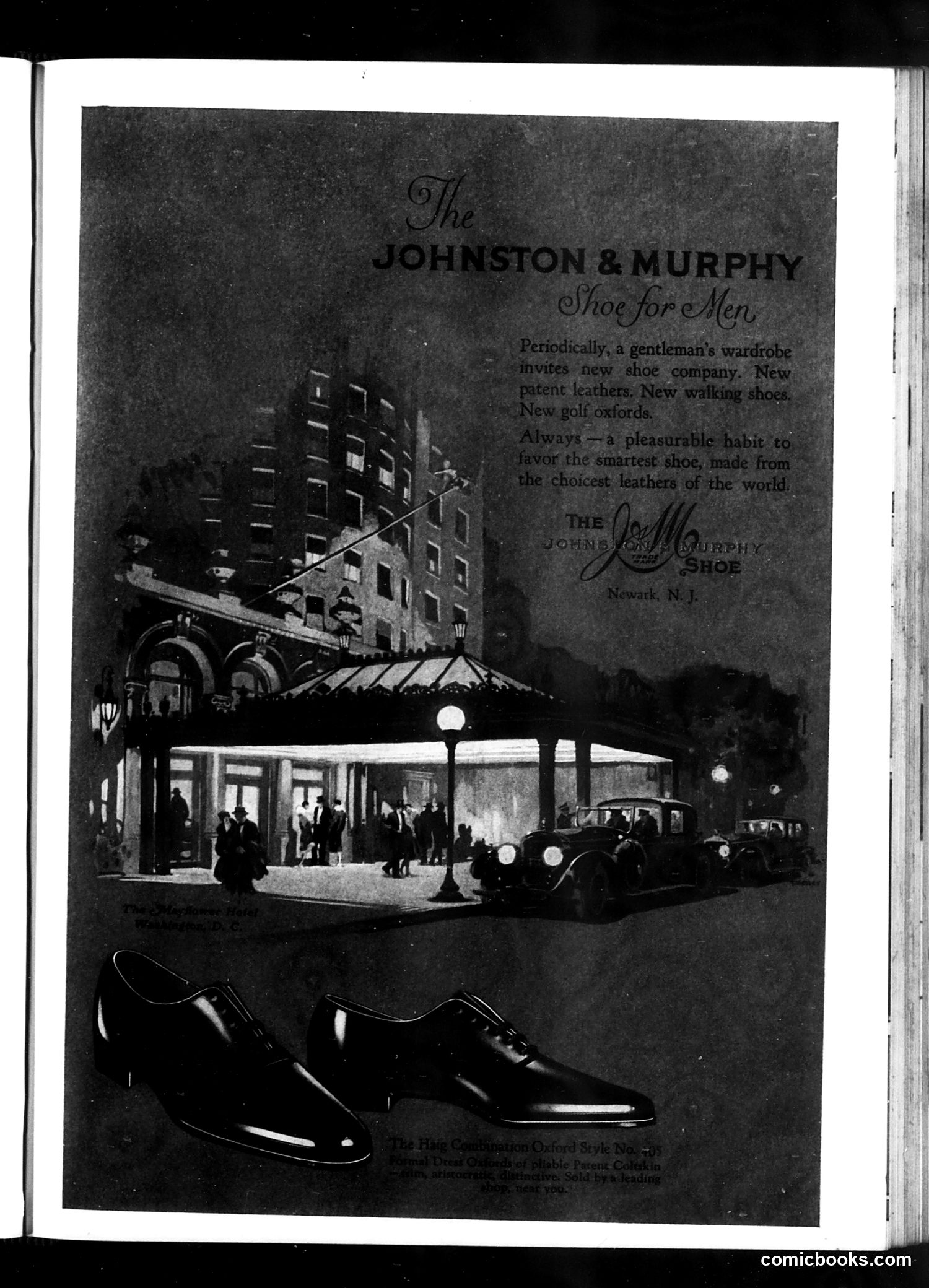
This is a **full-page advertisement**, not a political cartoon or satirical content. It promotes the Johnston & Murphy Shoe Company of Newark, New Jersey, marketing men's dress shoes. The ad uses an illustration of an upscale storefront at night, with well-dressed pedestrians and automobiles outside, to convey sophistication and urban elegance. Below is a product photograph showing two polished oxford-style shoes. The text emphasizes that gentlemen periodically update their wardrobes with new shoe styles—patent leathers, walking shoes, golf oxfords—and positions Johnston & Murphy as the choice for "the smartest shoe, made from the choicest leathers of the world." This reflects early 20th-century consumer culture targeting affluent men through aspirational imagery rather than satire.
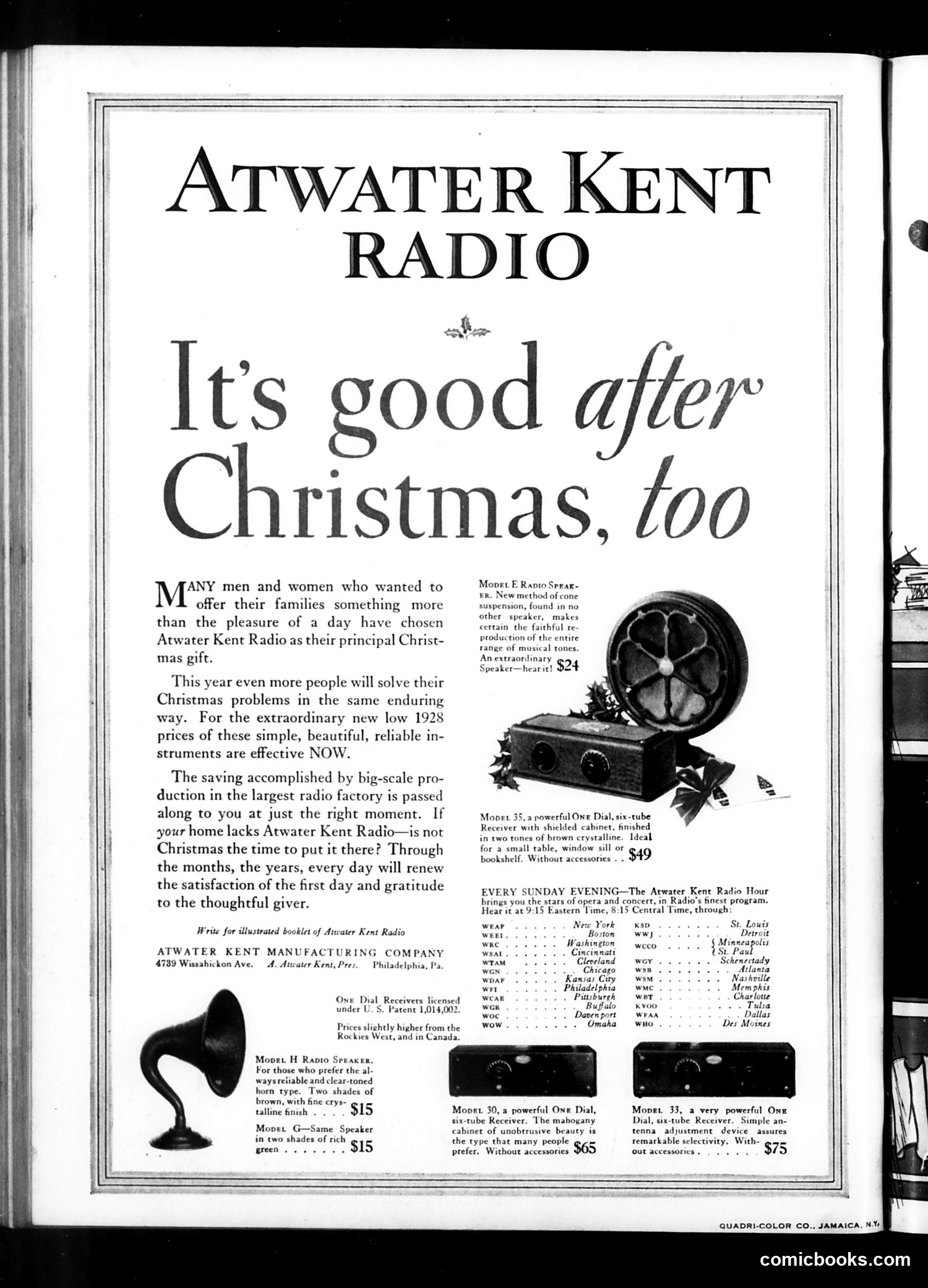
This is **not a cartoon or satire**, but rather a **full-page advertisement** for Atwater Kent radios, appearing in Judge magazine around 1928. The ad promotes radio receivers as ideal Christmas gifts, capitalizing on the post-Christmas shopping period. It emphasizes "extraordinarily new low 1928 prices" made possible by mass production at "the largest radio factory," positioning radio ownership as newly affordable for middle-class families. The page features multiple radio models (priced $15–$75) with technical specifications, along with a **radio programming schedule** listing call letters of affiliated stations across America—evidence that radio networks were becoming a major national entertainment medium. The headline "It's good after Christmas, too" suggests radios provide year-round value, addressing the practical concern that Christmas gifts should offer lasting benefit beyond the holiday season itself.