
Judge, 1927-11-26 · page 15 of 36
Judge — November 26, 1927 — page 15: what you’re looking at
What you’re looking at
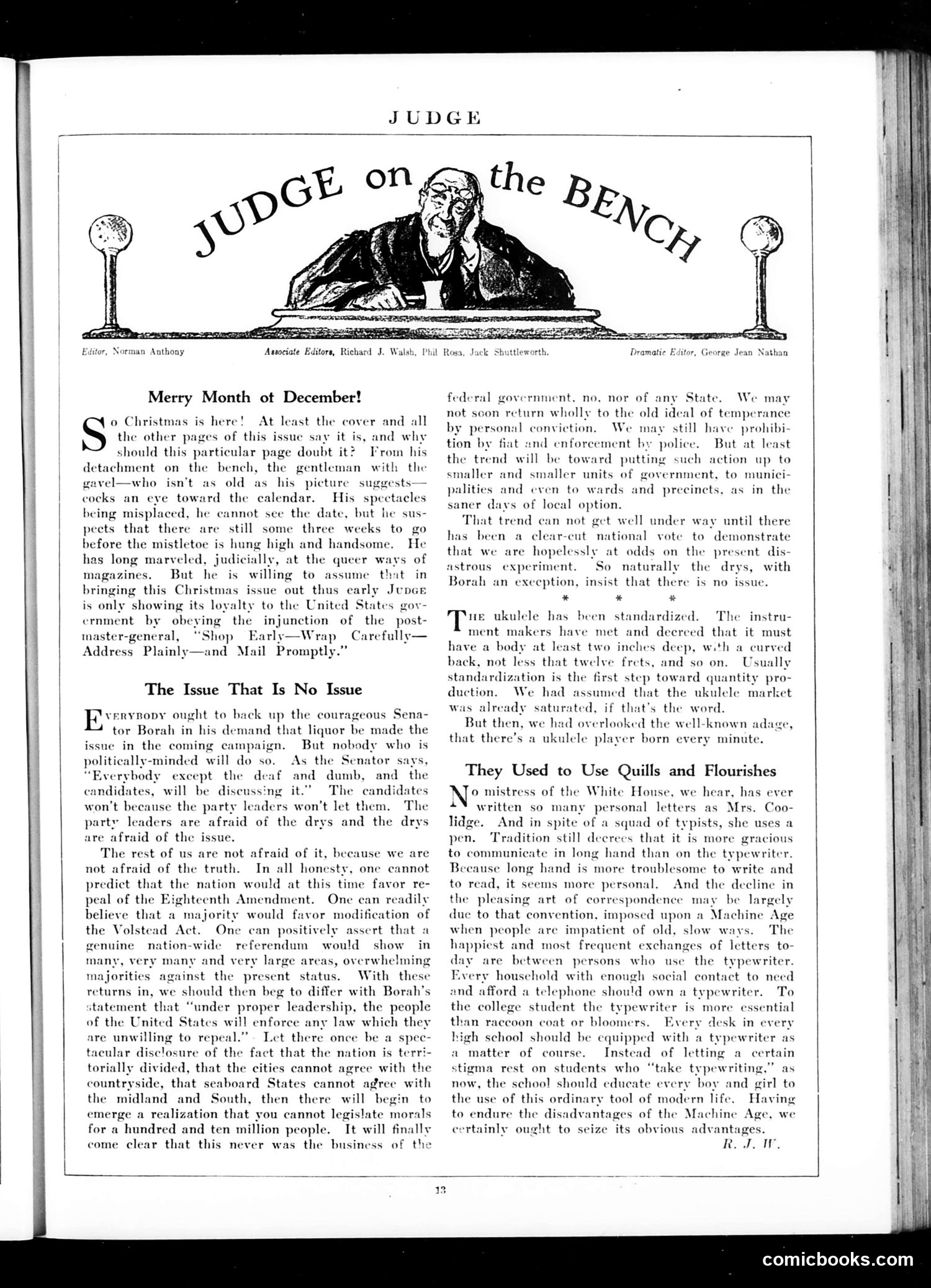
This is the masthead and opening editorial section of *Judge* magazine's December issue. The cartoon shows a befuddled judge at his bench, confused about the calendar—the magazine has published its Christmas issue three weeks early. The joke: he suspects this early publication obeys the Postmaster General's wartime directive to "Shop Early...Mail Promptly," satirizing both the magazine's commercial eagerness and government overreach into everyday life. The editorials discuss Prohibition politics. Senator Borah wanted liquor to be the 1928 campaign issue, but party leaders avoided it because urban areas supported repeal while rural areas supported the Eighteenth Amendment. *Judge* argues a national referendum would reveal this geographic divide, undermining claims that Americans support Prohibition. The page also includes brief notes on ukulele standardization (a 1920s fad) and typewriter use replacing handwriting—minor cultural observations typical of the era's satirical journalism.
📄 Transcribed text from this page (OCR, searchable)
Machine-transcribed from the original scan — historical spelling and the odd misread are preserved.
JUDGE Editor, Norman Anthon; Associate Editors, Richard J. Walst Merry Month ot December! o Christmas is here! At least the cover and all S the other pages of this issue say it is, and why should this particular page doubt it? From his chment on the bench, the gentleman with the gavel—who isn’t as old as his picture suggests— cocks an eye toward the calendar. His spectacles being misplaced, he cannot see the date, but he sus- pects that there are still some three weeks to go before the mistletoe is hung high and handsome. He has long marveled, judicially, at the queer ways of magazines. But he is willing to assume that in bring de ng this Christmas issue out thus early Jupge is only showing its loyalty to the United States gov- ernment by obeying the injunction of the post- master-general, “Shop Early—Wrap Carefully— Address Plainly—and Mail Promptly.” The Issue That Is No Issue Eyvervnopy ought to back up the courageous Sena- tor Borah in his demand that liquor be made the issue in the coming campaign. But nobody who is politically-minded will do so. As the Se iverybody except the deaf and dumb, candidates, will be discussing it.” The candidates won't because the party leaders won’t let them, The party leaders are afraid of the drys and the drys are afraid of the issue. The rest of us are not afraid of it, because we are not afraid of the truth. In all honesty, one cannot predict that the nation would at this time favor re- peal of the Eighteenth Amendment. One can readily believe that a majority would favor modification of the Volstead Act. One can positively assert that a genuine nation-wide referendum would show in many, very many and very large areas, overwhelming jorities against the present status. With these returns in, we should then beg to differ with Borah’s itatement that “under proper leadership, the people of the United States will enforce any law which they are unwilling to repeal.” Let there once be a spec- tacular disclosure of the fact that the nation is terri- torially divided, that the cities cannot agree with the countryside, that seaboard States cannot agree with the midland and South, then there will begin to emerge a rea zation that you cannot legislate morals for a hundred and ten million people. It will finally come clear that this never was the business of the Phil Rosa, Jack Dramatic Euitor, George Jean Nathan federal government. no. nor of any State. We m not soon return wholly to the old ideal of temperan by personal conviction. We may still have prohibi- tion by fiat and enforcement by police. But at least the trend will be toward putting such action up to smaller and smaller units of government, to munici- palities and even to wards and precincts, as in the saner days of local option. That trend c: n not get well under way until there has been a clear-cut national vote to demonstrate that we are hopelessly at odds on the present dis- astrous experiment. So naturally the drys, with Borah an exception, insist that there is no issue. * * * Te tkulele has been standardized. ‘The instrn- ment makers have met and decreed that it must have a body at least two inches deep, with a curved back, not less that twelve frets, and so on. Usually standardization is the first step toward quantity pro- duction. We had assumed that the ukulele market was already saturated, if that’s the word. But then, we had overlooked the well-known adage, that there’s a ukulele player born every minute. They Used to Use Quills and Flourishes N° mistress of the White House, we hear, has ever + written so many personal letters as Mrs. Coo- lidge. And in spite of a squad of typists, she uses a pen. Tradition still decrees that it is more gracious to communicate in long hand than on the typewriter. Because long hand is more troublesome to write and to read, it seems more personal. And the decline in the pleasing art of correspondence may be largely due to that convention imposed upon a Machine when people are impatient of old, slow ways. The happiest and most frequent exchanges of letters to- day are between persons who use the typewriter. Every household with enough social contact to need and afford a telephone should own a typewriter. To the college student the typewriter is more essential than raccoon coat or bloomers. Every esk in every high school should be equipped with a typewriter as 1 matter of course. Instead of letting a certain stigma rest on students who “take typewriting,” as now, the school should educate every boy and girl to the use of this ordinary tool of modern life. Having to endure the disadvantages of the Machine Age, we certainly ought to seize its obvious advantages. dC a comicbooks.com