
Judge, 1927-11-26 · page 20 of 36
Judge — November 26, 1927 — page 20: what you’re looking at
What you’re looking at
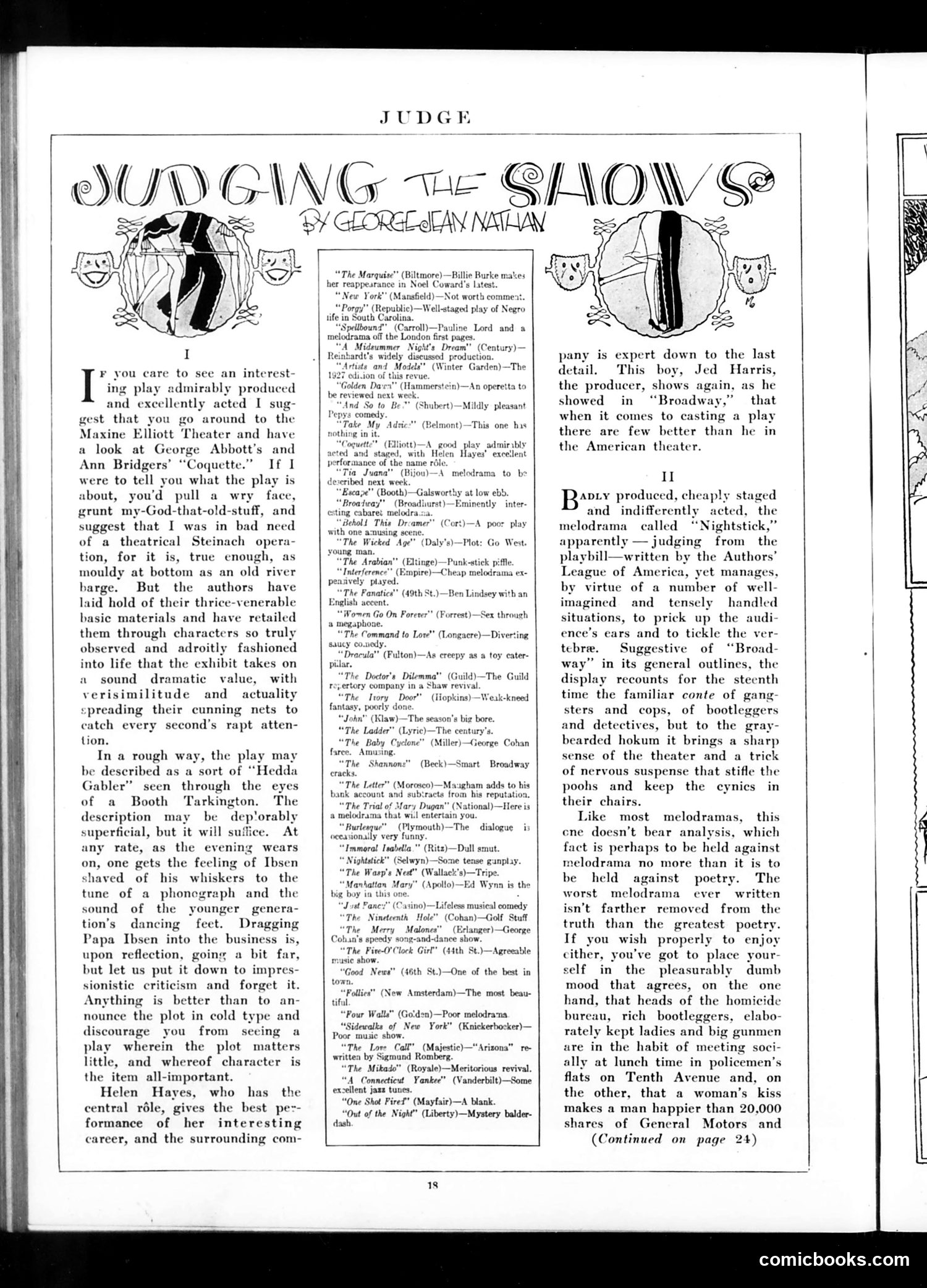
This page contains theater criticism by George Jean Nathan, a prominent drama critic of the 1920s. The two illustrated figures represent theatrical masks (comedy/tragedy), a standard symbol for theater. The main review praises "Coquette" at the Maxine Elliott Theater, starring Helen Hayes, as an admirably acted production despite its conventional plot about generational conflict (invoking comparisons to Ibsen). Nathan critiques the play's old-fashioned premise but credits its skilled execution and Hayes's performance. The remainder of the page is a rapid-fire listing of current Broadway productions with terse, often dismissive judgments—"Mildly pleasant," "Dull smut," "The season's big bore" (about "John"). This format was typical of Judge's theatrical coverage: witty one-liners evaluating shows for a sophisticated urban audience. The reviews reflect 1920s theatrical tastes and Nathan's caustic critical style.
📄 Transcribed text from this page (OCR, searchable)
Machine-transcribed from the original scan — historical spelling and the odd misread are preserved.
JUDGE F you care to see an interest- I ing play admirably produced and excellently acted I sug- gest that you go around to the Maxine Elliott Theater and have a look at George Abbott's and Ann Bridgers’ “Coquette.” If I were to tell you what the play is about, you'd pull a wry face, grunt my-God-that-old-stuff, and suggest that I was in bad need of a theatrical Steinach oper: mn, for it is, true enough, as mouldy at bottom barge. But the laid hold of their thrice-venerable basic materials and have retailed them through characters so truly observed and adroitly fashioned into life that the exhibit takes on a sound dramatic value, with verisimilitude and actuality spreading their cunning nets to catch every second’s rapt atten- tion. In a rough way, the play may be described as a sort of ‘Hedda pler” seen through the eyes a Booth Tarkington. The description may be ede" orably superficial, but it will suf At any rate, as the evening wears on, one gets the feeling of Ibsen shaved of his whis to the tune of phoneg! and the sound of the younger genera- tion’s dancing feet. Dragging Papa Ibsen into the business is, upon reflection, going a bit far, but let us put it down to impres- sionistic criticism and forget it. Anything is better than to an- nounce the plot in cold type and discourage you from seeing a play wherein the plot matters little, and whereof cha the item all-important. Helen Hayes, who has the central réle, gives the best pe formance of her interesting career, and the surrounding com- an old river authors have acter is (Biltmore) —Billie Burke ma nce in Noel Coward's Lat {ansfield)—Not worth co orgy'’ (Republic) —Well-staged pl South Carolina. arroll)—Pauline Lord and a odrama off the London first page Mideummer Night's. Dream" (Century) — hardt’s widely discussed productio “Artiste and Mo: (Winter G: of this revue. Golden Daren" (Hamme be reviewed next we “And So to Be Pepys comedy “Take My Advic:” (Belmont)—This one has nothing in it. “Coquette” (Elliott)—A good play admir acted and staged, with Helen Hayes’ ex performance of the name rdle. Tia Juana’ (Bijou)—A melodrama to be cribed next week. ““Escaze" (Booth)—Galswort! (Broadhurst )—E esting cabaret melodra.::a. Behold This Dreamer” (Cort)—A poor play with one amusing se "The Wicked Age young man. “The Arabian" (Eltinge)—Punk-stick “* (Empire)—Cheap melodrai mi y of Negro n)—The in)—An operetta to (Shubert)—Mildly_ pleasan y at low ebb ninently inter- Daly’s)—Plot: io West, (49th St.) —Ben Lindsey with an Women Go On Foreve 8 megaphone. “The Command to Lore’ (Longacre)—Diverting saucy co, (Forrest)—Sex through (Pulton)—As creepy as a toy eater- “The Doctor's Dilemma’ (Guild)—The Guild ropertory company in a Shaw revival. “The Trory Door” (iopkins)—Weak-kneed fantasy, poorly done “John’’ (Klaw)—The season's big bore “The Ladder” (Lytic)—The o “The Baby Cyclone farce. Amusing, “The Shannon cracks. “The Letter” (Morosco)—Ma:igham adds to his k account and sub:racts from his reputation, The Trial of Mary Dugan" (National)—Here is a melodrama that wil entertain you. “Burlesque” (Plymouth)—The dialogue is oceasionally very funny. “Immoral Ieabella."’ (Ritz)—Dull smut. " Nightatick” (Selwyn)—Some t The Wasp's Ned” (Wallac Manhattan Mary’ (Apollo) —Ed W big boy in this o1 ‘Joust Panes” (Casino)—Lifeless musieal comedy “The Nineteenth Hole” (Cohan)—Golf Stuff Merry Malone: Langer) —George speedy song-and-dance show. The Fire-O'Clock Girl” (44th St.)—Agreeable music show. “Good Ne tow “Follies” (New Amsterdam)—The most beau- tiful Four Walle” (Go!den)—Poor melodrana. ‘Sidewalks of New York" (Knickerbocker)— Poor music show. “The Lore Call" (Majestic)—“Arizona” re written by Sigmund Romberg. “The Mikado” (Royale)—Meritorious revival. A Connecticut Yankee” (Vanderbilt)—Some excellent jazz tunes “One Shot Firef" (Mayfair)—A blank. “Out of the Night” (Liberty)—Mystery balder- dash. tury (Miller)—George Cohan (Beck)—Smart Broadway b. is the (46th St.)\—One of the best in \ eae ee pany is expert down to the last detail. This boy, Jed Harris, the producer, shows again, as he showed in “Broadway that when it comes to casting a pl there are few better than he in the American theater. Il Be produced, cheaply staged and indifferently acted, the melodrama called“ Nightstick,” apparently — judging from the playbill—written by the Authors’ League of America, yet manages, by virtue of a number of well- imagined and tensely handled situations, to prick up the audi- ence’s ears and to tickle the ver- tebre. Suggestive of ‘“Broad- way” in its general outlines, the display recounts for the steenth time the familiar conte of gang- sters and cops, of bootleggers and detectives, but to the gray- bearded hokum it brings a sharp sense of the theater and a trick of nervous suspense that stifle the poohs and keep the cynics in their chairs Like most melodramas, this ene doesn’t bear analysis, which fact is perhaps to be held against melodrama no more than it is to be held against poetry. The worst melodrama ever written isn’t farther removed from the truth than the greatest poetry. If you wish properly to enjoy cither, you've got to place your- self in the pleasurably dumb mood that agrees, on the one hand, that heads of the homicide bureau, rich bootleggers, elabo- rately kept ladies and big gunmen are in the habit of meeting soci- ally at lunch time in policemen’s flats on Tenth Avenue and, on the other, that a woman’s kiss makes a man happier than 20,000 shares of General Motors and (Continued on page 24) 18 comicbooks.com