
A complete issue · 36 pages · 1927
Judge — November 12, 1927
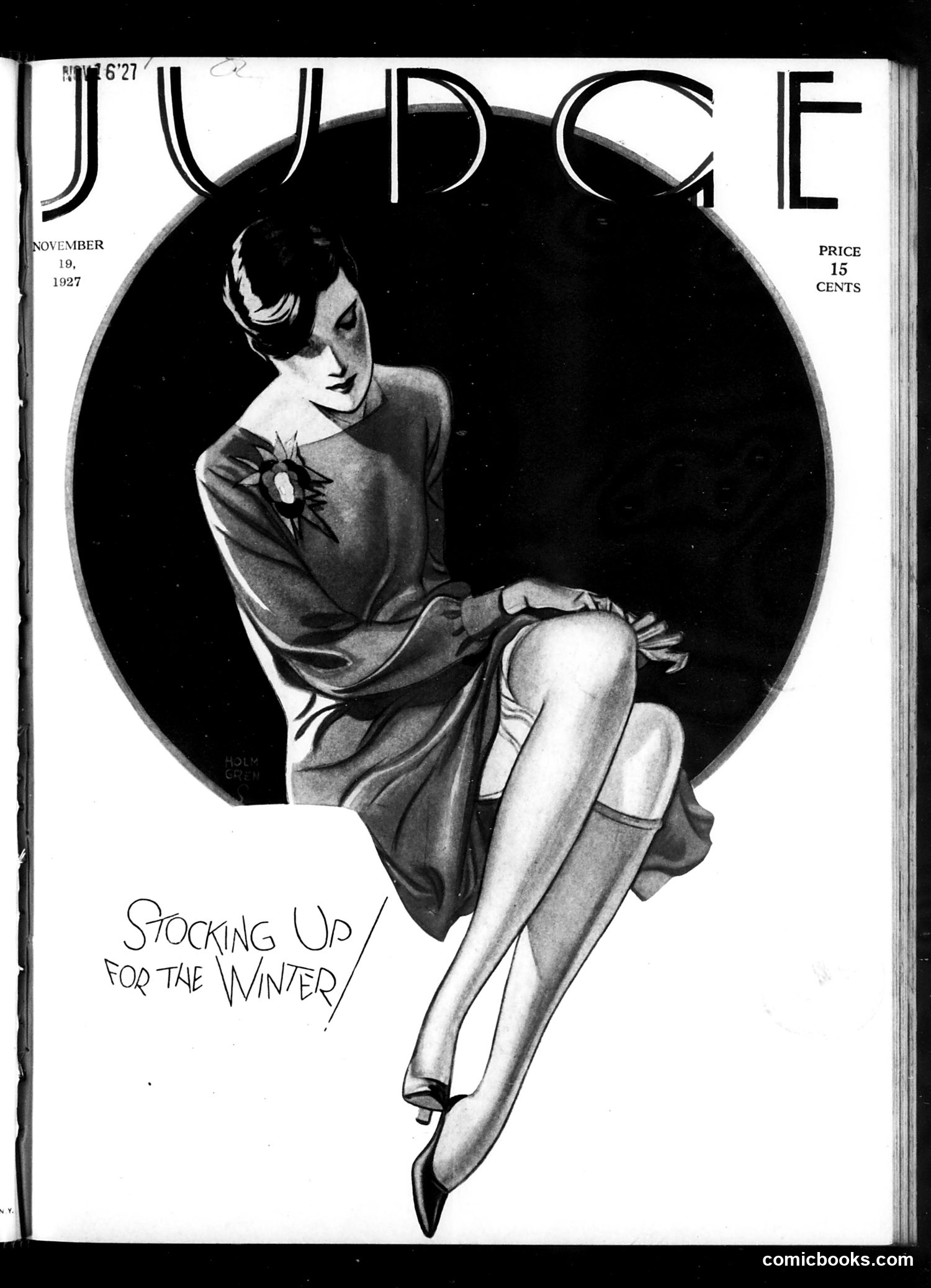
This is a Judge magazine cover from November 19, 1927, priced at 15 cents. The illustration depicts a woman in a seated pose with the caption "Stocking Up for the Winter." The satire plays on the double meaning of "stocking up"—both preparing supplies for winter AND the woman adjusting her stockings (hosiery). This was typical 1920s humor, using suggestive poses and wordplay to create mild innuendo acceptable for the era. The stylized circular background and the woman's fashionable bobbed hair and makeup reflect 1920s Jazz Age aesthetics. The ornamental brooch on her dress adds elegance to what appears to be seasonal consumer humor targeting the approaching winter shopping season.
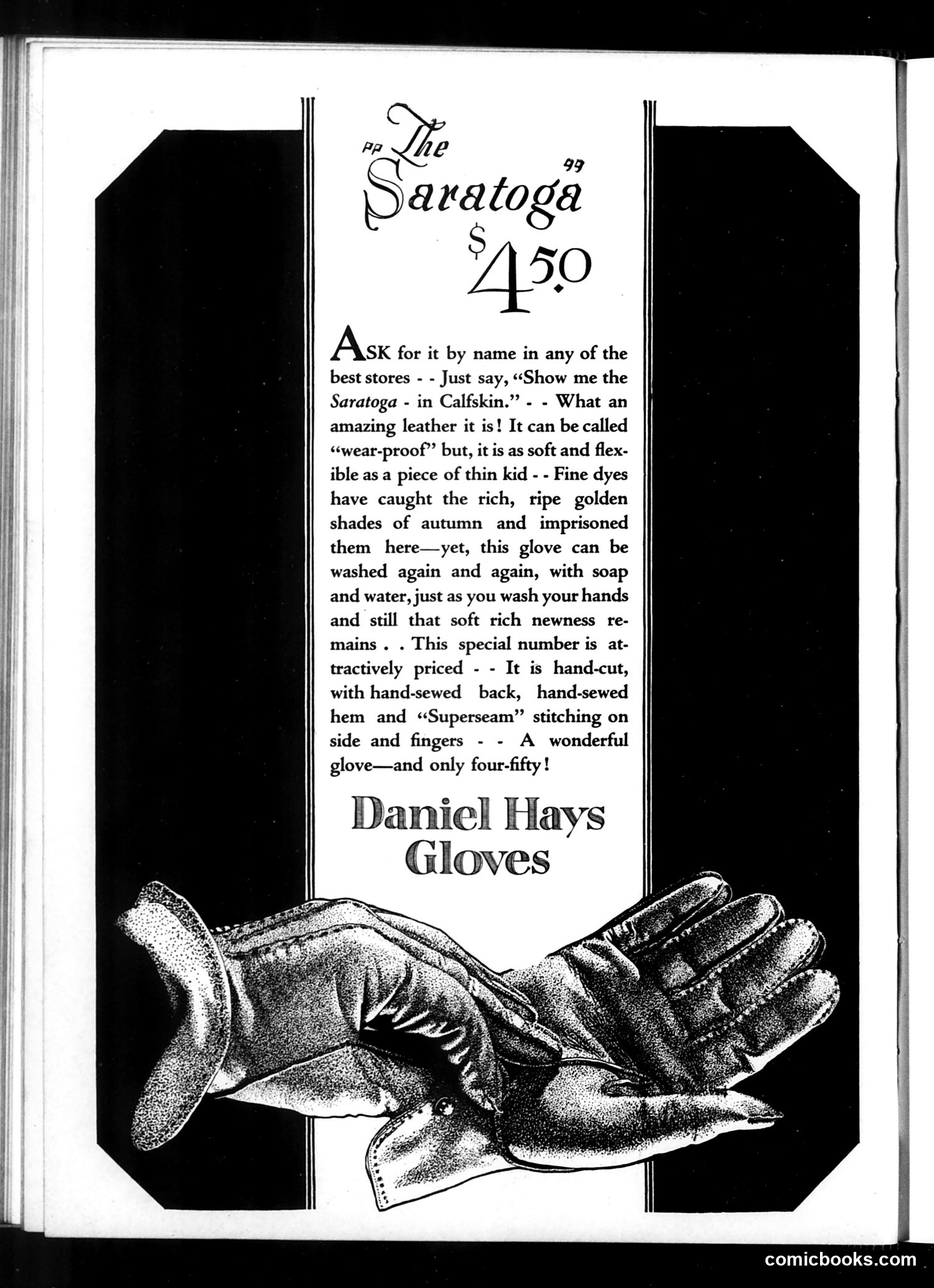
This page is **not a cartoon or satire**—it's a **product advertisement** for Daniel Hays Gloves, specifically their "Saratoga" model priced at $4.50. The ad highlights the gloves' features: durable "wear-proof" leather that remains soft and flexible, washable without losing quality, hand-cut construction with hand-sewn details and "Superseam" stitching, and fashionable autumn colors. The text emphasizes asking for the product "by name" in stores, suggesting brand-name marketing was important to this era. The illustration shows a woman's gloved hands in an elegant gesture, typical of period advertising imagery meant to convey refinement and luxury to consumers. **Context for modern readers:** This reflects early 20th-century advertising practices and consumer culture in Judge magazine's pages.
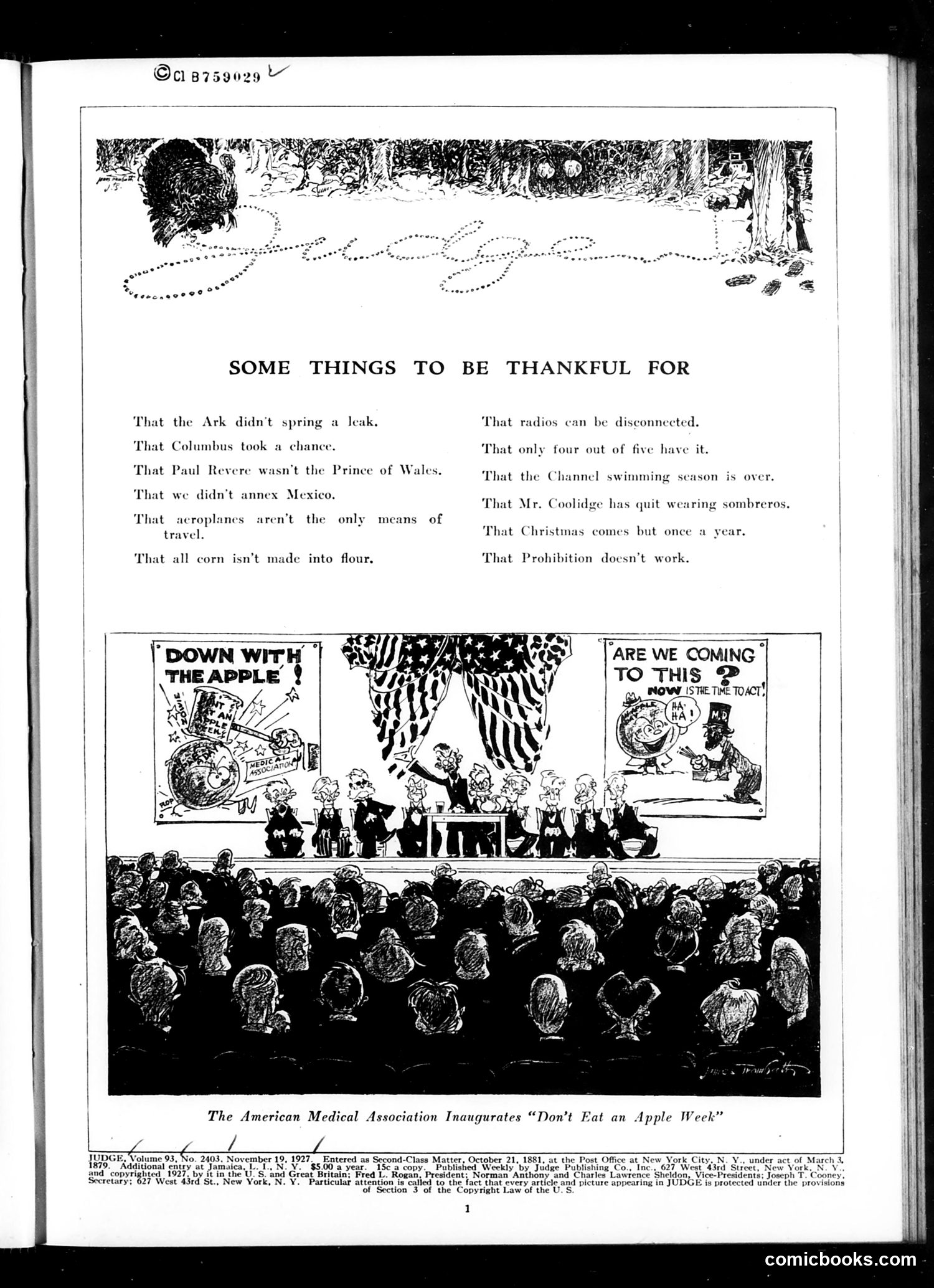
The main cartoon satirizes the American Medical Association's "Don't Eat an Apple Week" campaign. Three large banners behind a stage audience mock this initiative: "DOWN WITH THE APPLE," "ARE WE COMING TO THIS?" and a globe labeled "HOW IS THE TIME TO ACT?" The satire critiques the AMA's counter-campaign against the apple industry's "An Apple a Day Keeps the Doctor Away" slogan. Judge presents the medical association's effort as absurdly authoritarian and propagandistic—comparing it to jingoistic nationalism through the flags and staged appearance. The "Things to be Thankful For" list above contains period-specific references (Paul Revere, Coolidge, Prohibition) treating various 1920s concerns with ironic humor.
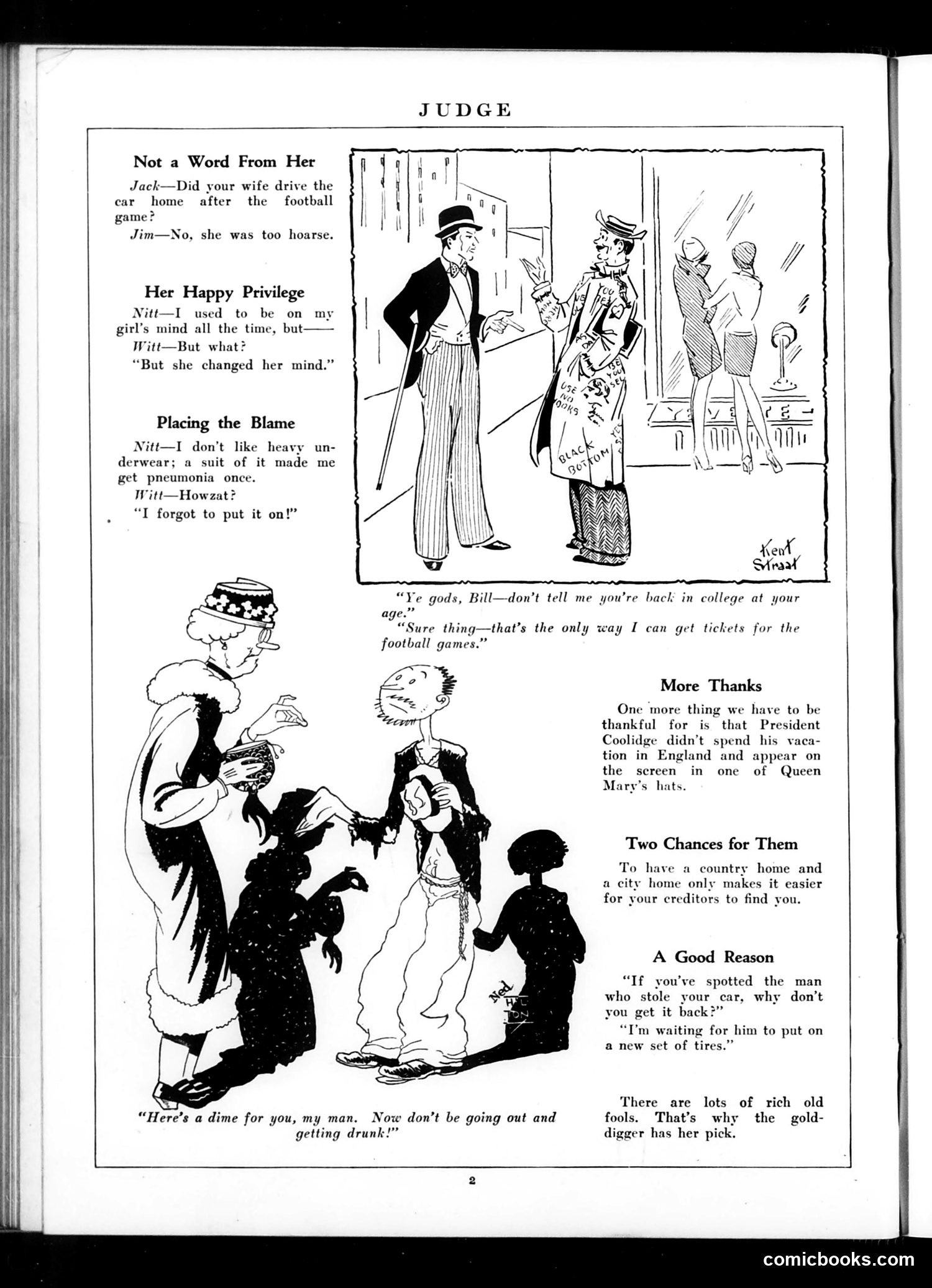
This page from *Judge* magazine contains several short humorous anecdotes and two cartoons satirizing early 20th-century American social life. The main cartoon (top) depicts a college-aged man being confronted by his father, who appears angry about the son's extracurricular activities—likely partying or dating, suggested by the apron labeled "COLLEGE BOUND" and the casual figures in the background. The joke hinges on the father's concern about maintaining respectability while the son pursues college life. The lower cartoon shows someone giving money to impoverished figures, captioned "Here's a dime for you, my man." The accompanying text jokes about economic inequality and the wealthy's casual charity toward the poor—a common *Judge* target. The brief text pieces mock marital dynamics, parental relationships, and class distinctions typical of *Judge's* satirical focus on American social pretensions and hypocrisy.
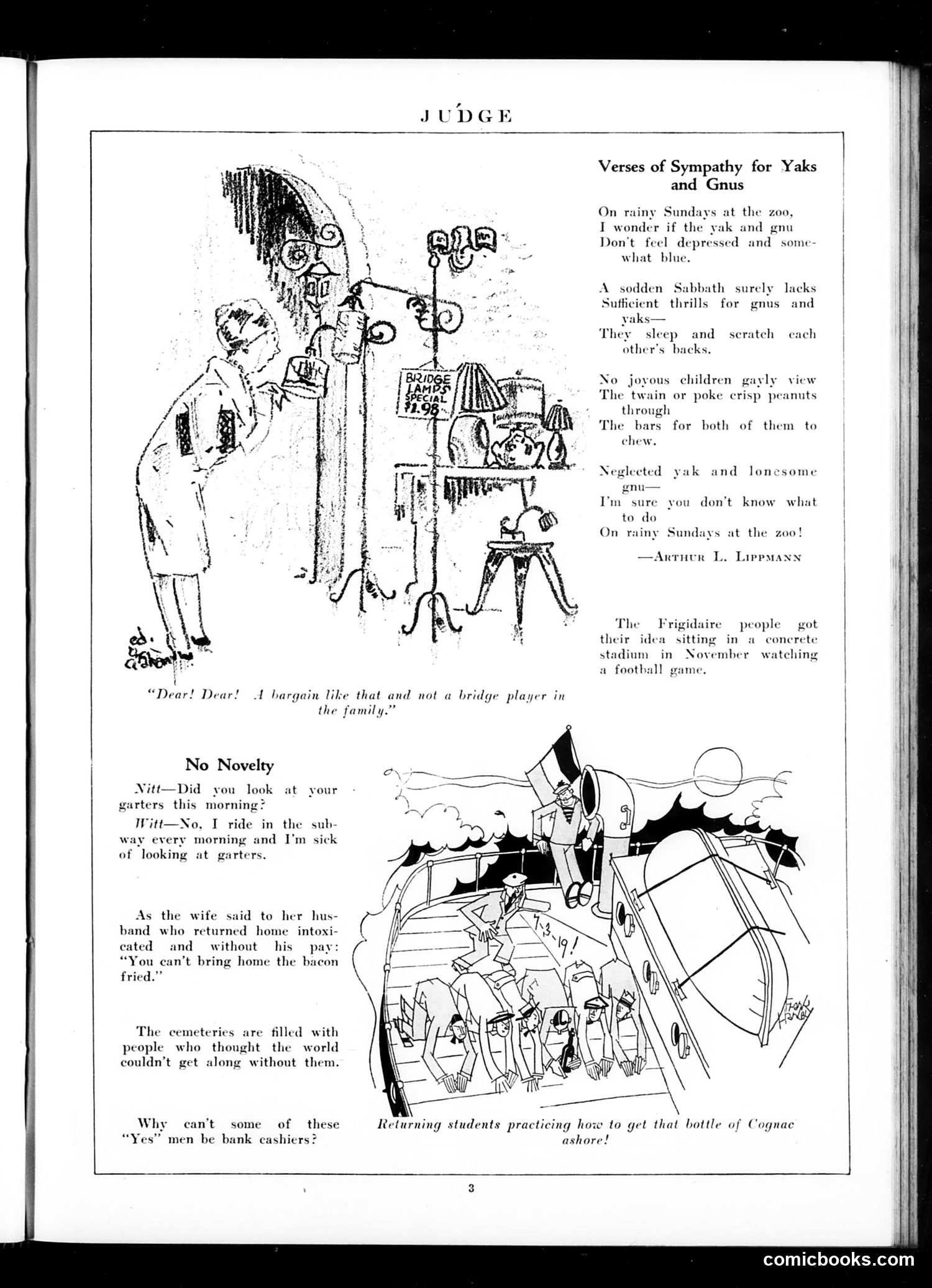
This page contains two distinct pieces: **Top Section - "Verses of Sympathy for Yaks and Gnus":** A humorous poem by Arthur L. Lippmann expressing sympathy for zoo animals, particularly yaks and gnus, who endure boring Sunday visits from children. The accompanying illustration shows a woman viewing caged animals. The satire mocks sentimental anthropomorphization—treating animals as having human emotional needs—while also gently critiquing the tedium of zoo visits. **Bottom Section - "No Novelty":** A brief comedy segment about routine commuting and domestic life. The second illustration depicts what appears to be college students practicing with a racing shell (boat), humorously captioned about obtaining cognac. This satirizes youthful excess and dangerous behavior disguised as athletic activity. Both pieces are light social satire typical of Judge's humor.
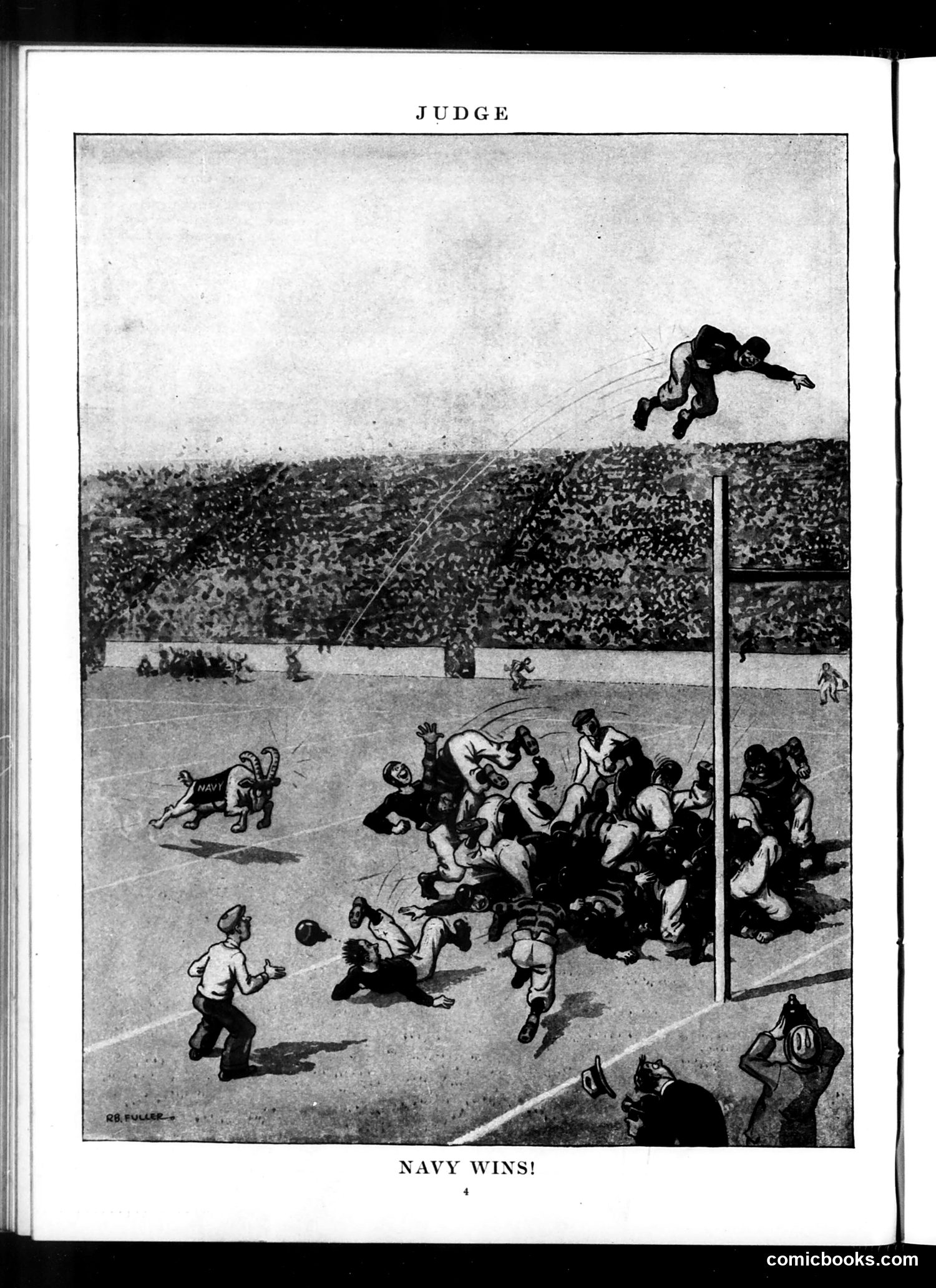
This is a satirical sports illustration depicting what appears to be a chaotic American football game between Navy and Army (indicated by "NAVY" visible on one player's uniform). The cartoon mocks the brutality and disorder of early football, showing a massive pile-up of players in the center while one Navy player flies dramatically through the air above the field—an exaggerated, comedic depiction of athletic violence. The massive stadium crowd in the background emphasizes football's popularity. The satire likely critiques either the sport's increasingly dangerous nature or military rivalry between service academies. The "Navy Wins!" caption presents the absurd victory as inevitable given the chaos, poking fun at competitive fervor and the physical toll of the game.
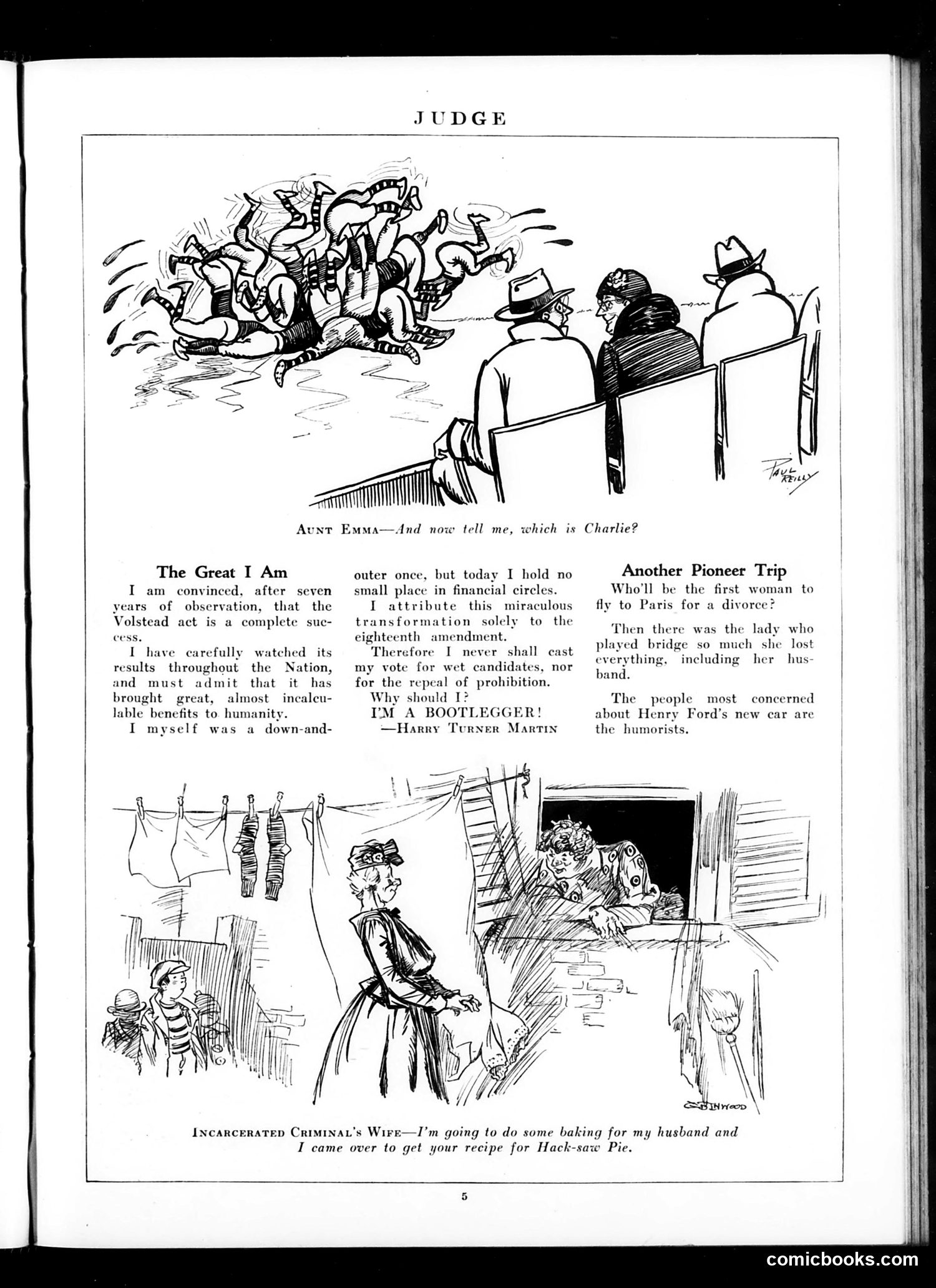
**Top Cartoon:** Shows three men observing a chaotic pile of figures. The caption "Aunt Emma—And now tell me, which is Charlie?" suggests confusion identifying someone in a crowded scene, likely satirizing a contemporary event or social situation, though the specific reference is unclear without additional context. **Text Articles:** Include "The Great I Am" (praising Volstead Act/Prohibition), "Another Pioneer Trip" (about a woman flying to Paris), and commentary on Henry Ford's new car and Hooverites. **Bottom Cartoon:** Depicts an incarcerated criminal's wife seeking a recipe, satirizing the oddness of domestic normalcy persisting despite her husband's imprisonment. The page reflects 1920s American concerns: Prohibition's perceived success, emerging aviation, automobile culture, and criminal justice.
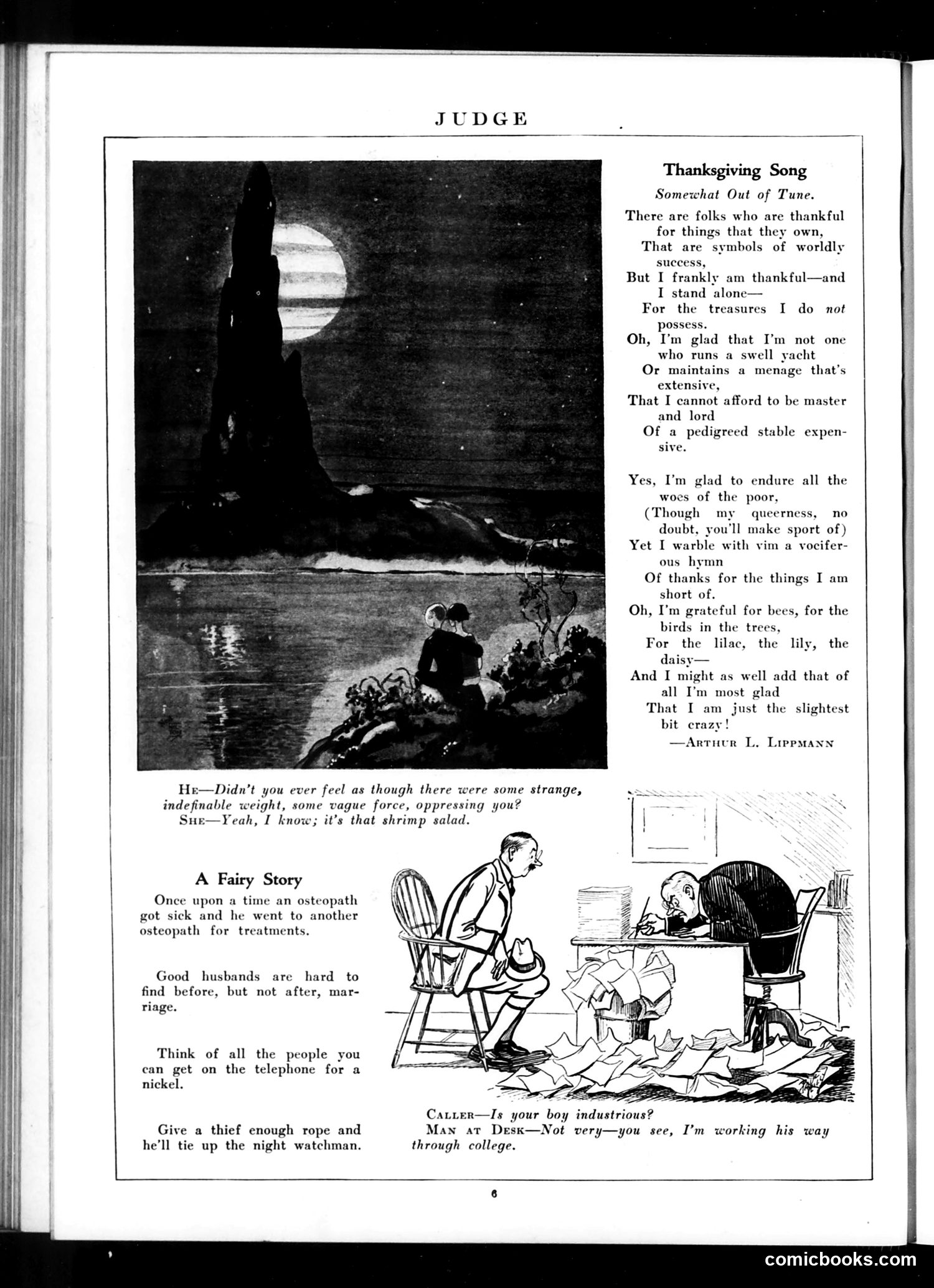
This Judge magazine page contains three separate satirical pieces: **"Thanksgiving Song"** (top right): A poem mocking false humility. The speaker claims gratitude for poverty and lack of possessions (no yacht, no expensive stable) while actually complaining about deprivation. The satire targets people who affect noble poverty while resenting their actual circumstances. **"A Fairy Story"** (bottom): A one-liner joke: an osteopath (a medical practitioner of bone manipulation, popular in early 1900s) seeks treatment from another osteopath—satirizing circular medical practices or quacks treating each other. **Other quips** include observations about marriage, telephone costs (a nickel for service), and a cartoon showing a man claiming his son works through college—while the messy office suggests the father is actually doing the work himself. This mocks parents who claim their children are self-sufficient while secretly supporting them. The humor relies on hypocrisy and pretense common to the era—people claiming virtue while acting otherwise.
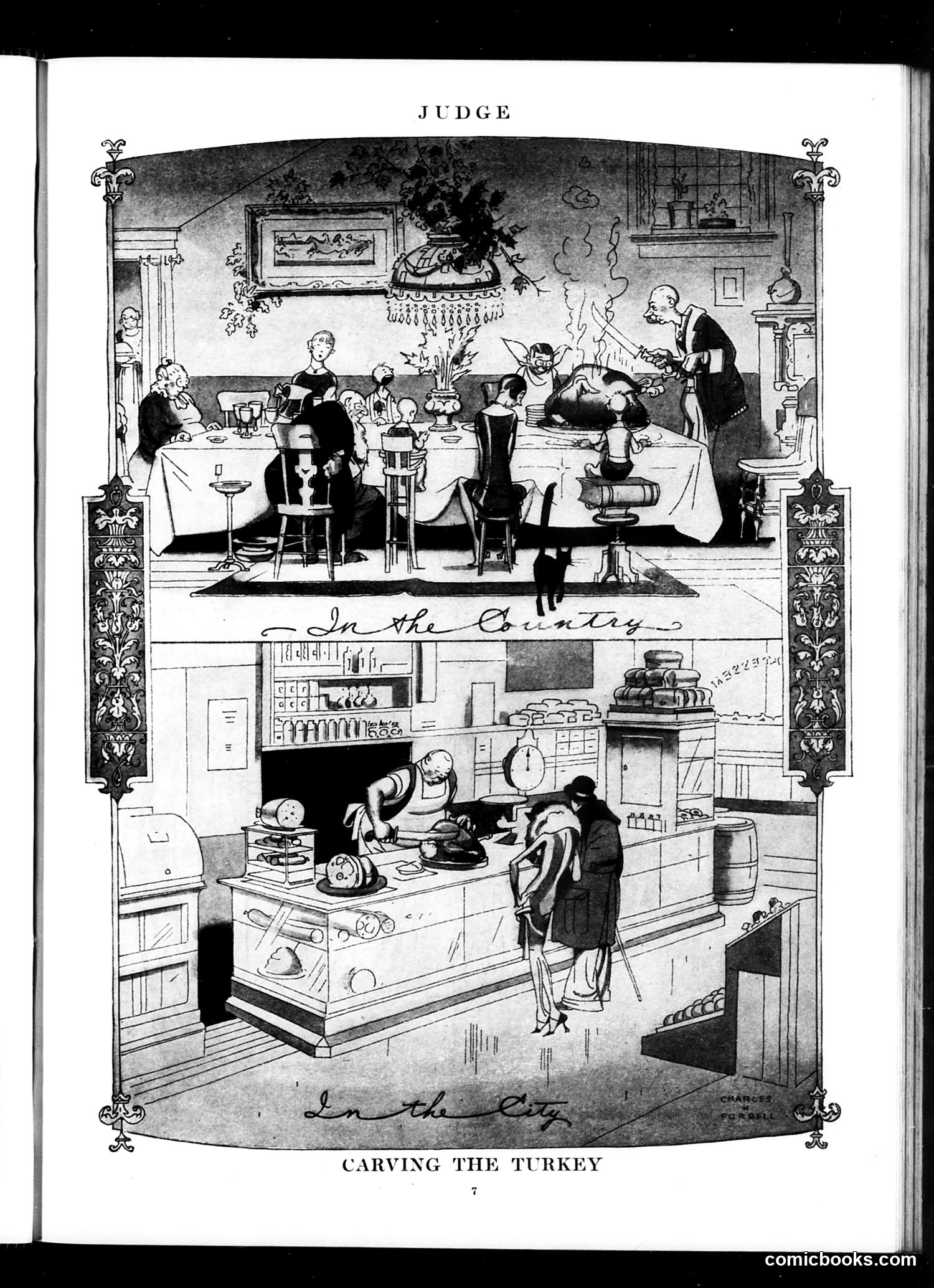
This is a two-panel satirical illustration contrasting wealth and poverty. The top panel shows "In the Country"—an elegant dinner party where wealthy figures carve a turkey at a formal table, surrounded by fine furnishings and art. The bottom panel shows "In the City"—a cramped tenement kitchen where poor families laboriously prepare food in cramped, sparse conditions. The satire critiques economic inequality: the same holiday meal (turkey carving) symbolizes vastly different experiences based on class. The wealthy enjoy abundance and leisure while working-class urbanites toil in poverty. This reflects Judge magazine's typical social commentary on Gilded Age disparities between rich and poor, likely from the late 19th or early 20th century.
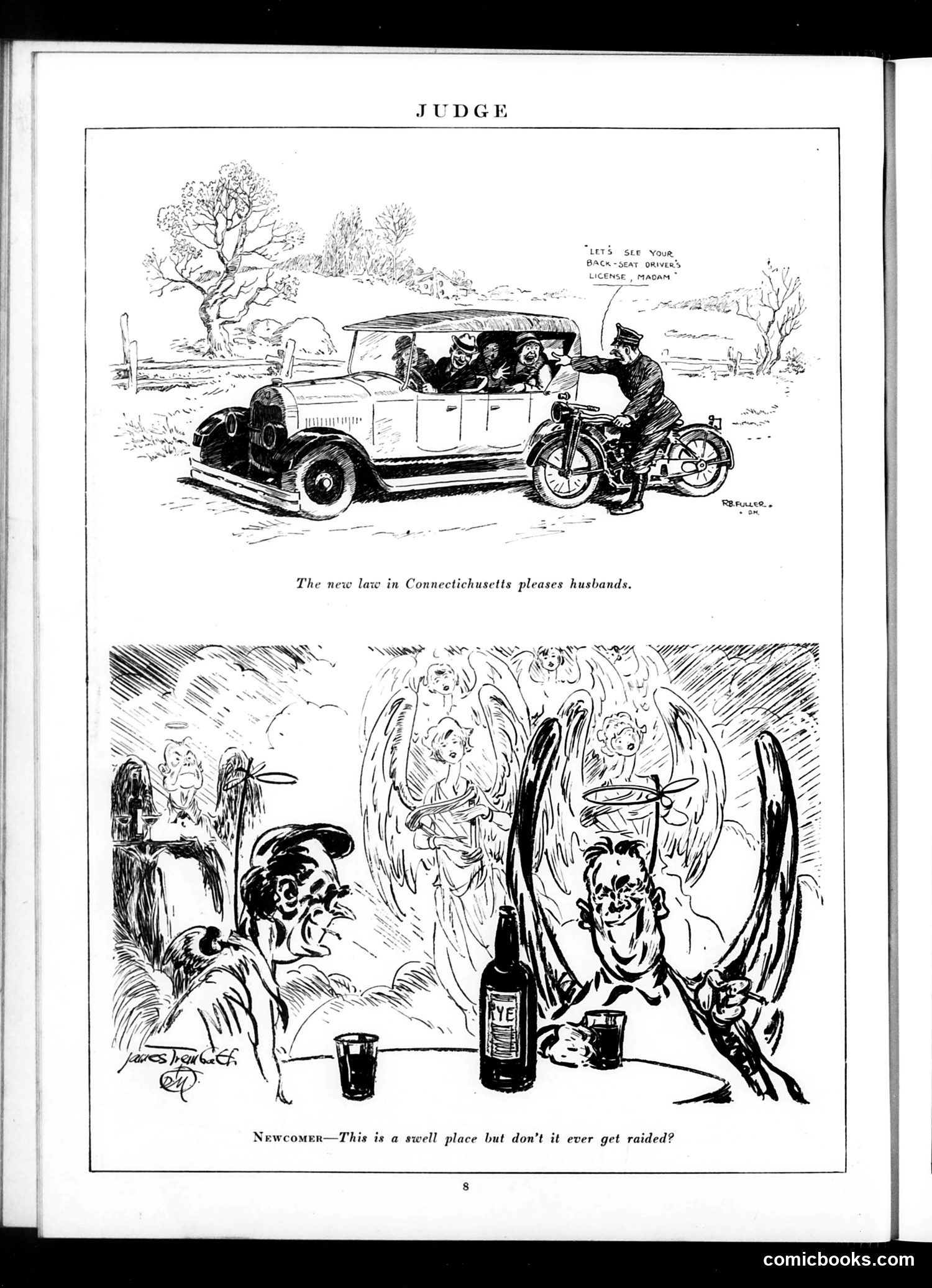
This page contains two cartoons satirizing different topics: **Top cartoon:** References "the new law in Connecticut pleases husbands." It depicts a motorcycle officer stopping a car full of women, suggesting Connecticut passed legislation regulating women drivers or their behavior. The humor targets wives/female drivers, implying husbands approve of legal restrictions on women. **Bottom cartoon:** Shows demons or devil figures in what appears to be a speakeasy or illegal bar, with bottles labeled "RYE" visible. A newcomer asks if the place "ever get raided?" This satirizes Prohibition-era illegal alcohol consumption. The joke plays on the irony that even demonic establishments worry about police raids on illegal drinking establishments. Both cartoons reflect 1920s social anxieties about changing gender roles, transportation, and Prohibition enforcement.
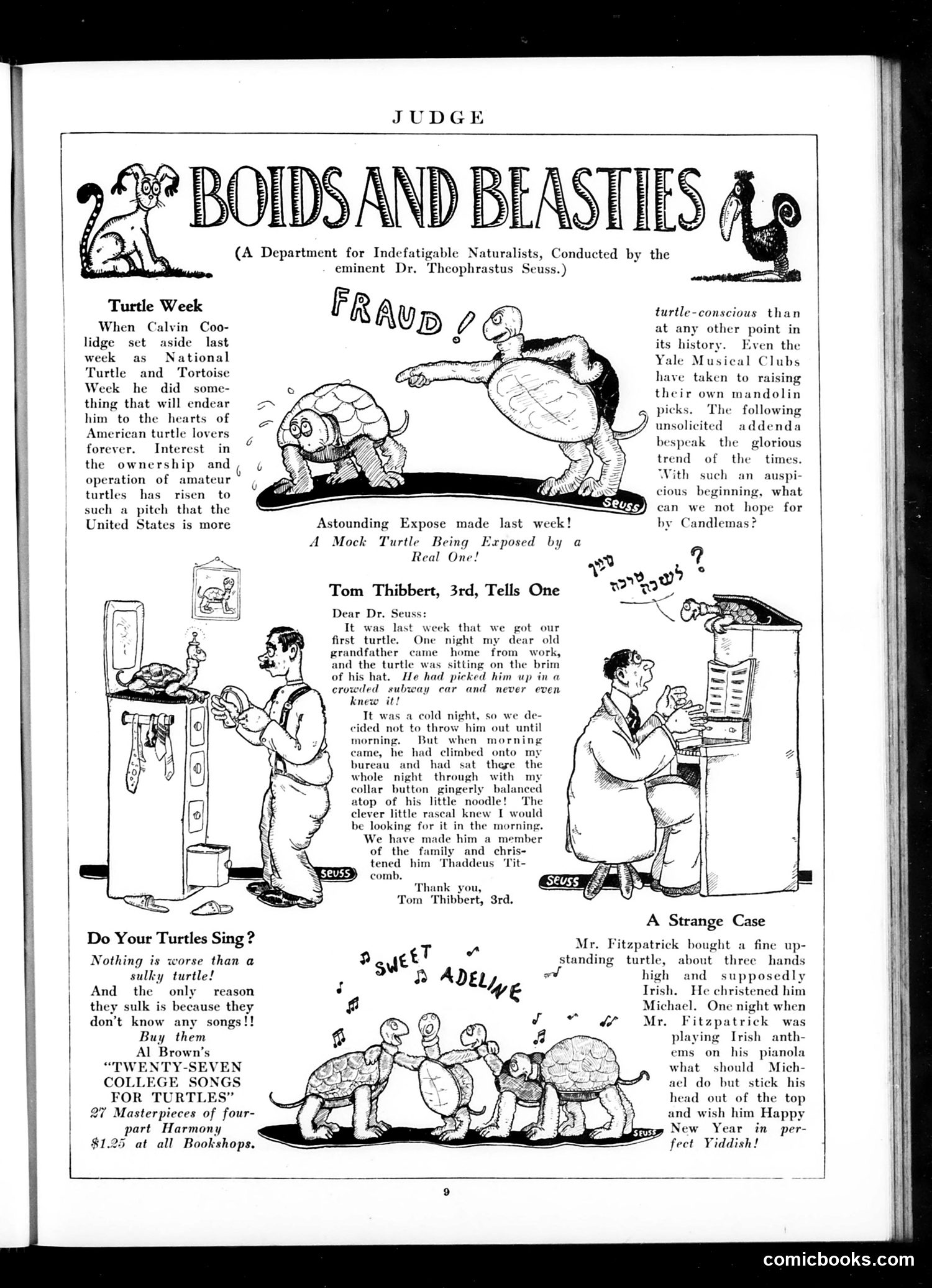
This is a humorous column by "Dr. Theophrastus Seuss" (likely an early Dr. Seuss reference) during "Turtle Week," when President Calvin Coolidge declared a national observance. The page satirizes Americans' sudden obsession with turtle ownership. The cartoons mock absurd turtle stories readers submitted: a man finding a turtle in his subway hat, another's turtle balancing his collar button, and a turtle responding to Irish music by wishing "Happy New Year in perfect Yiddish." The satire targets the faddish nature of American interests—how an arbitrary presidential declaration sparked a craze. The column also includes an ad for "Twenty-Seven College Songs for Turtles," further mocking the turtle mania. The humor relies on the ridiculous incongruity of turtles displaying human behaviors and cultural awareness, exposing how quickly Americans embrace trendy enthusiasms regardless of logic.
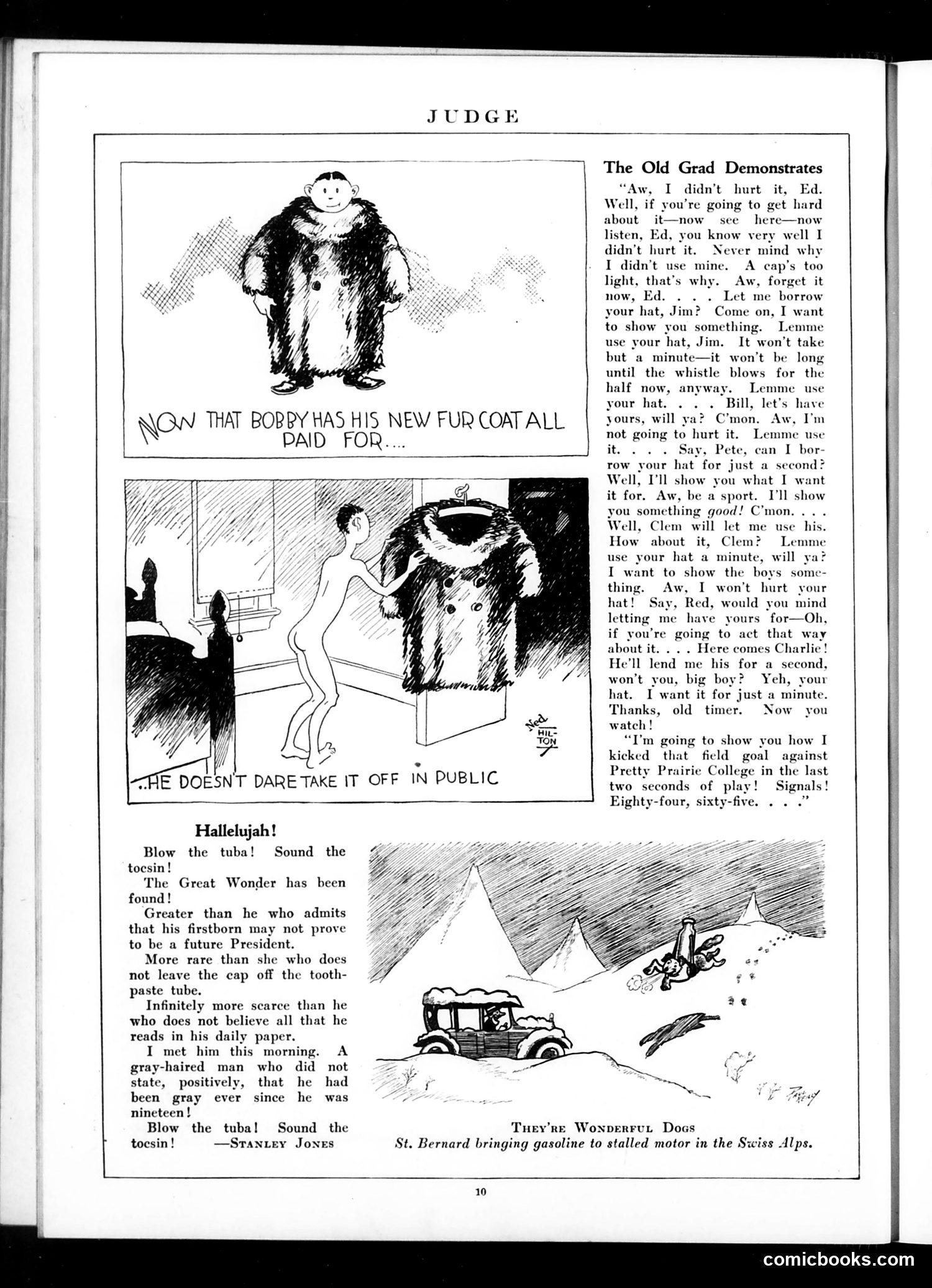
**Top Comic ("The Old Grad Demonstrates"):** Satirizes the stereotype of the nostalgic alumnus who constantly borrows others' possessions while reminiscing about his college glory days. The "old grad" systematically cadges hats from multiple people to demonstrate an old football play, despite their reluctance. The humor lies in his shameless persistence and self-absorption—he commandeers belongings under the pretense of showing something "good," ignoring others' obvious discomfort. **"Hallelujah!" Poem:** Uses mock-heroic language to celebrate finding "the Great Wonder"—a man who doesn't make grandiose claims about his firstborn becoming President, doesn't leave toothpaste caps off, and most remarkably, didn't insist he'd been gray-haired since age nineteen. It's gentle satire of common human pretensions and exaggerations. **Bottom Illustration ("They're Wonderful Dogs"):** A whimsical, non-satirical image showing St. Bernard dogs heroically delivering gasoline to a stalled motorcar in the Swiss Alps—depicting dogs as modern rescue heroes adapting to contemporary technology.
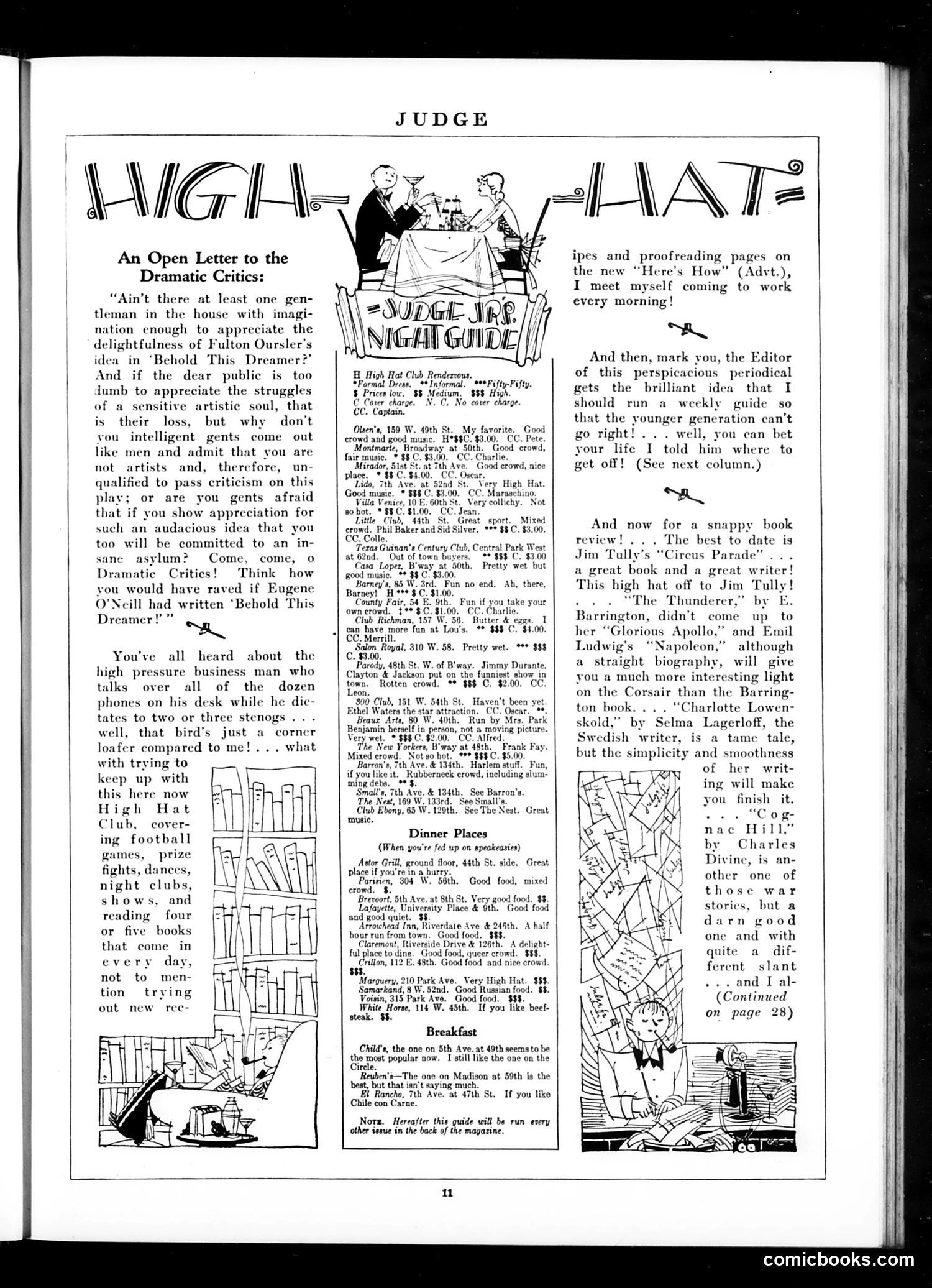
This page from *Judge* magazine combines satirical commentary with entertainment guides. The main cartoon critiques dramatic critics as insufficiently appreciative of innovative theater—specifically Fulton Oursler's play "Behold This Dreamer." The author sarcastically suggests that critics lack imagination and implicitly questions whether they should even be allowed to pass judgment on bold artistic work. The left sidebar features a humorous illustration of bookshelves, likely representing an intellectual's library, satirizing highbrow culture. The page also includes practical guides: restaurant recommendations (labeled "Dinner Places" and "Breakfast") with price ranges and notes about crowd types—reflecting 1920s-30s New York leisure culture. These are presented tongue-in-cheek with coded symbols (asterisks indicating quality/atmosphere). A book review section praises Jim Tully's *Circus Parade* and discusses other contemporary literature. The overall tone mixes elitism-mocking satire with insider entertainment information for *Judge*'s sophisticated urban readership.
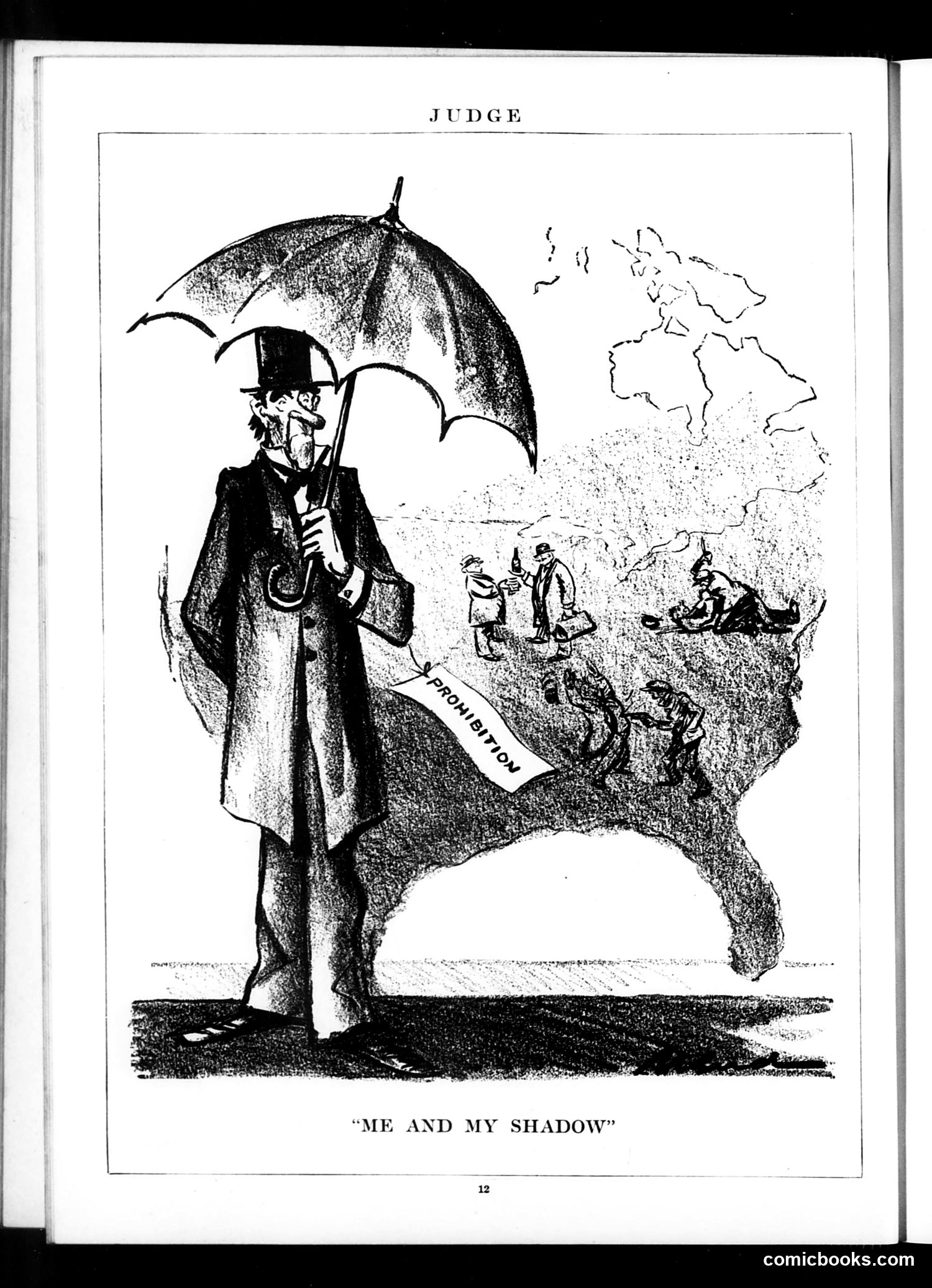
This political cartoon from *Judge* magazine depicts a tall figure in formal dress (top hat and coat) holding an umbrella, standing before a map of the United States. The figure's shadow appears as the darker landmass below. A label reading "PROHIBITION" is visible on the shadow. The cartoon illustrates the relationship between a judge (the title figure) and Prohibition policy—suggesting the judge's authority or influence is inseparable from, or darkly connected to, Prohibition enforcement. The smaller figures scattered across the map appear to represent citizens affected by Prohibition. The satire likely critiques how judicial power was wielded in implementing or enforcing Prohibition laws, or how closely judicial authority shadowed ordinary Americans under Prohibition policies. The umbrella may suggest attempted protection or shelter from the policy's effects.
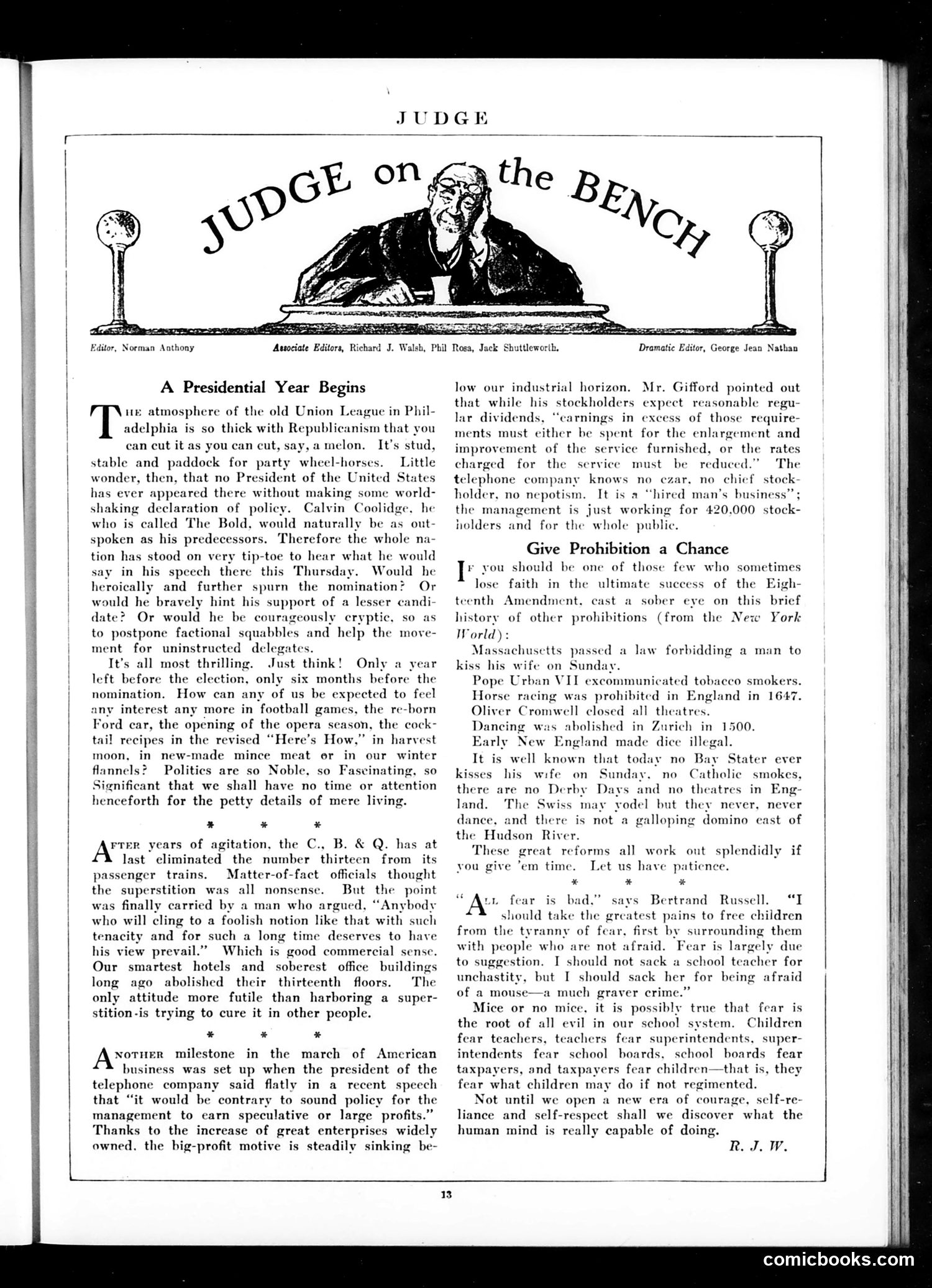
This page satirizes the 1924 U.S. presidential election atmosphere. The opening essay mocks Republican establishment anxiety in Philadelphia's Union League about Calvin Coolidge's upcoming policy speech—will he boldly declare something momentous, or remain cryptically silent? The satire is that this manufactured drama consumes national attention while trivial matters (football, cocktails, opera) suddenly seem irrelevant. A secondary piece ridicules the railroad's removal of "thirteen" from passenger train numbering to appease superstition—then notes hotels did the same thing, suggesting absurd conformity spreads easily. The "Give Prohibition a Chance" section sardonically lists historical prohibition failures (kissing bans, dancing abolitions, theater closures) to argue the Eighteenth Amendment needs patience. The joke: these old prohibitions universally failed, yet readers should trust this new one will succeed. The overall tone is skeptical of both political theater and government overreach.
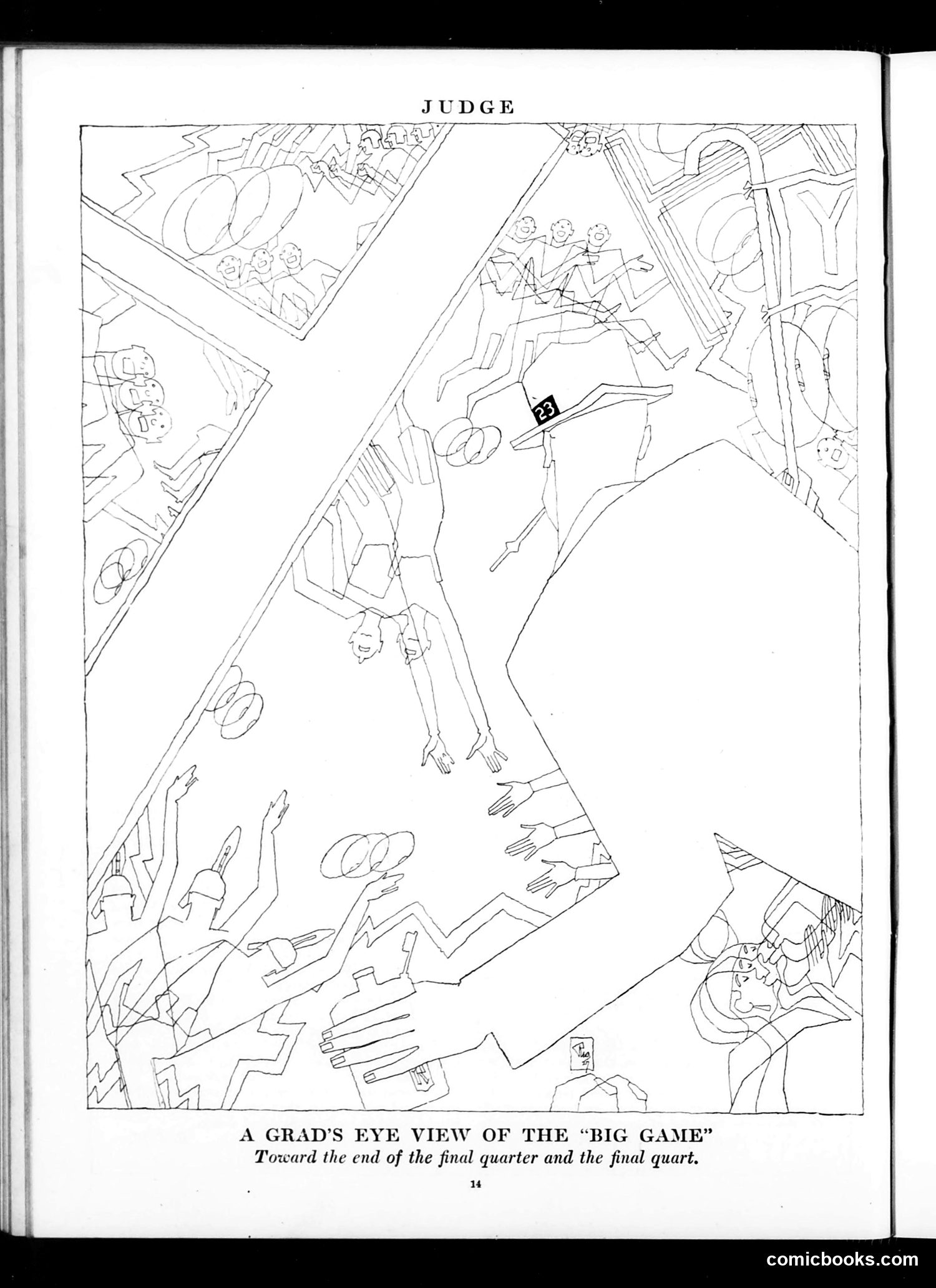
This is a bird's-eye view cartoon of a football game ("the Big Game"), drawn from above as if viewing the field from the stands or press box. The illustration shows players on the field, spectators in the bleachers on either side, and various game action during the final quarter. The satire appears to be social commentary on American college football culture—likely mocking the spectacle, crowds, and intensity surrounding major collegiate games. The overhead perspective emphasizes the organized chaos of the sport and the masses of spectators invested in the outcome. Without a visible date or specific school identification, the exact "Big Game" referenced is unclear, though this likely refers to a famous rivalry (possibly Yale-Harvard or similar prestigious college matchup that would be relevant to Judge's readership). The cartoon satirizes the game's social significance to American culture and academic institutions.
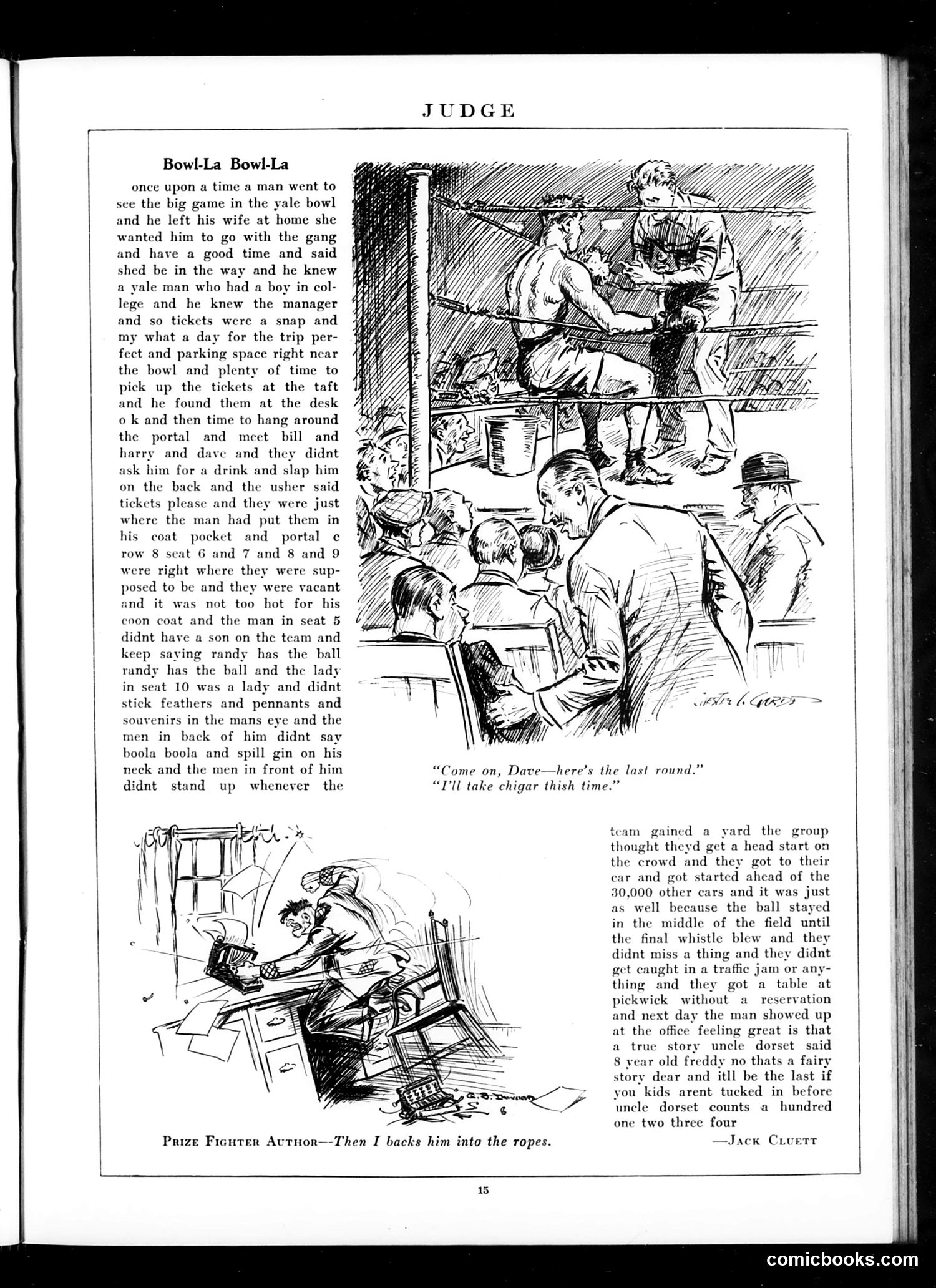
This page contains two satirical pieces about American leisure and excess in the early 20th century. **"Bowl-La Bowl-La"** (top story with illustration) is a humorous tall tale mocking the Yale football game experience. It ironically catalogs a man's *perfect* day: ideal parking, smooth ticket acquisition, ideal seating, no annoying spectators (no loud fans, no drunks spilling gin, no obstructed views, no obnoxious parents). The satire works by listing all the realistic annoyances that *actually* plague stadium crowds—the piece is funny precisely because none of these problems occur, making it clearly fictional. The concluding dialogue and illustration suggest heavy drinking among the group. **"Prize Fighter Author"** (bottom illustration) depicts a writer physically beating someone, captioned "Then I backs him into the ropes"—satirizing the tough-guy persona some male authors adopted. Both pieces mock masculine leisure culture and self-aggrandizing storytelling. The "fairy story" ending suggests the entire tale is fantasy, critiquing how men embellish sporting experiences.
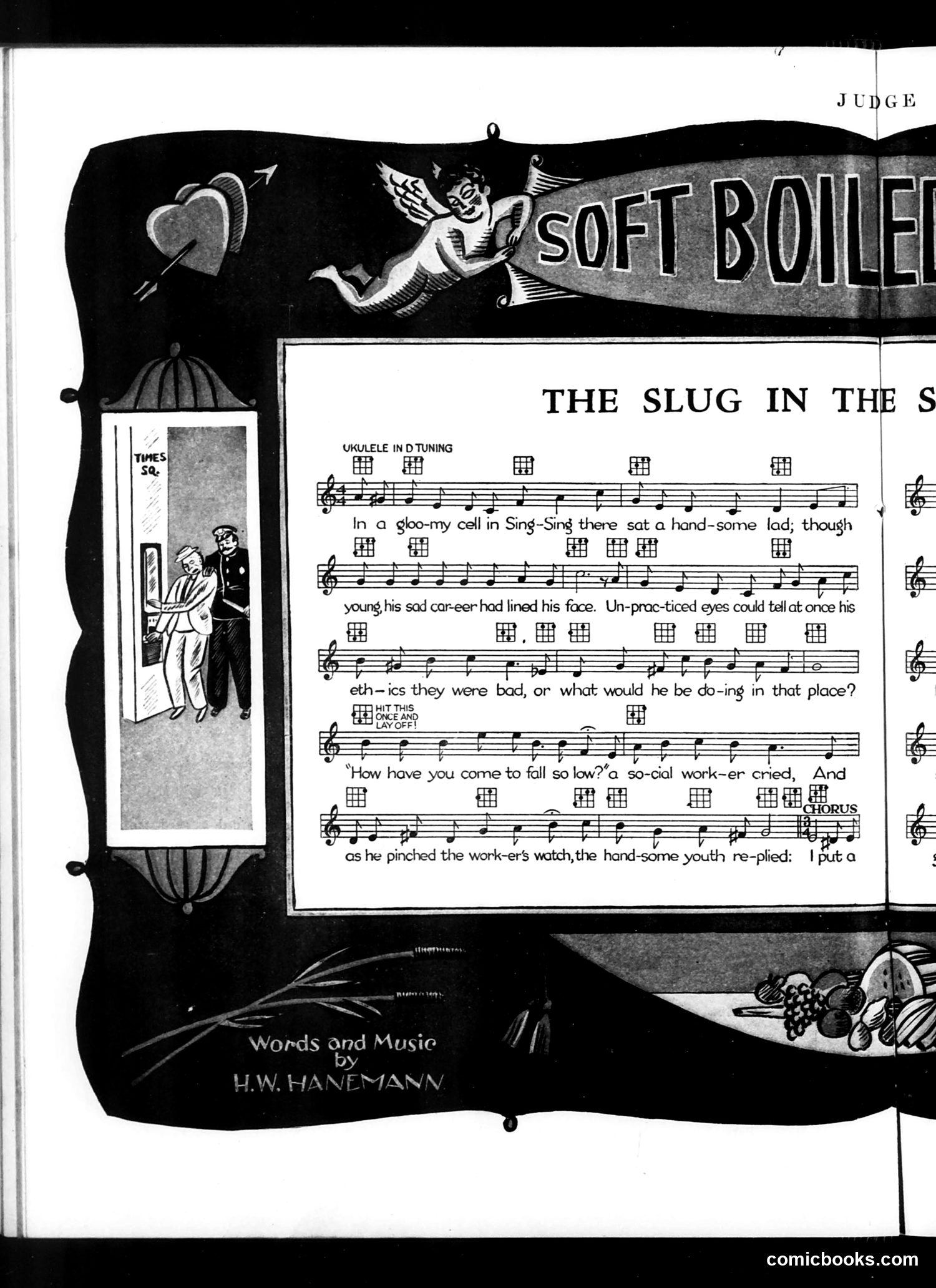
This page presents a song with ukulele accompaniment about a young man in prison ("Sing-Sing," the famous New York penitentiary). The narrative describes a handsome but worn youth who has fallen into crime and ended up incarcerated. A social worker visits him to inquire how he descended into such circumstances. The dark humor culminates in the punchline: when the worker asks this sympathetic question, the youth steals the worker's watch—demonstrating that despite his apparently tragic backstory, he remains a criminal and opportunist. The joke satirizes both the naïveté of well-meaning social workers and the incorrigibility of career criminals. The illustration (left panel) shows the prison visit scene. The song's sentimental framing contrasts sharply with the cynical punchline, underscoring the satire.
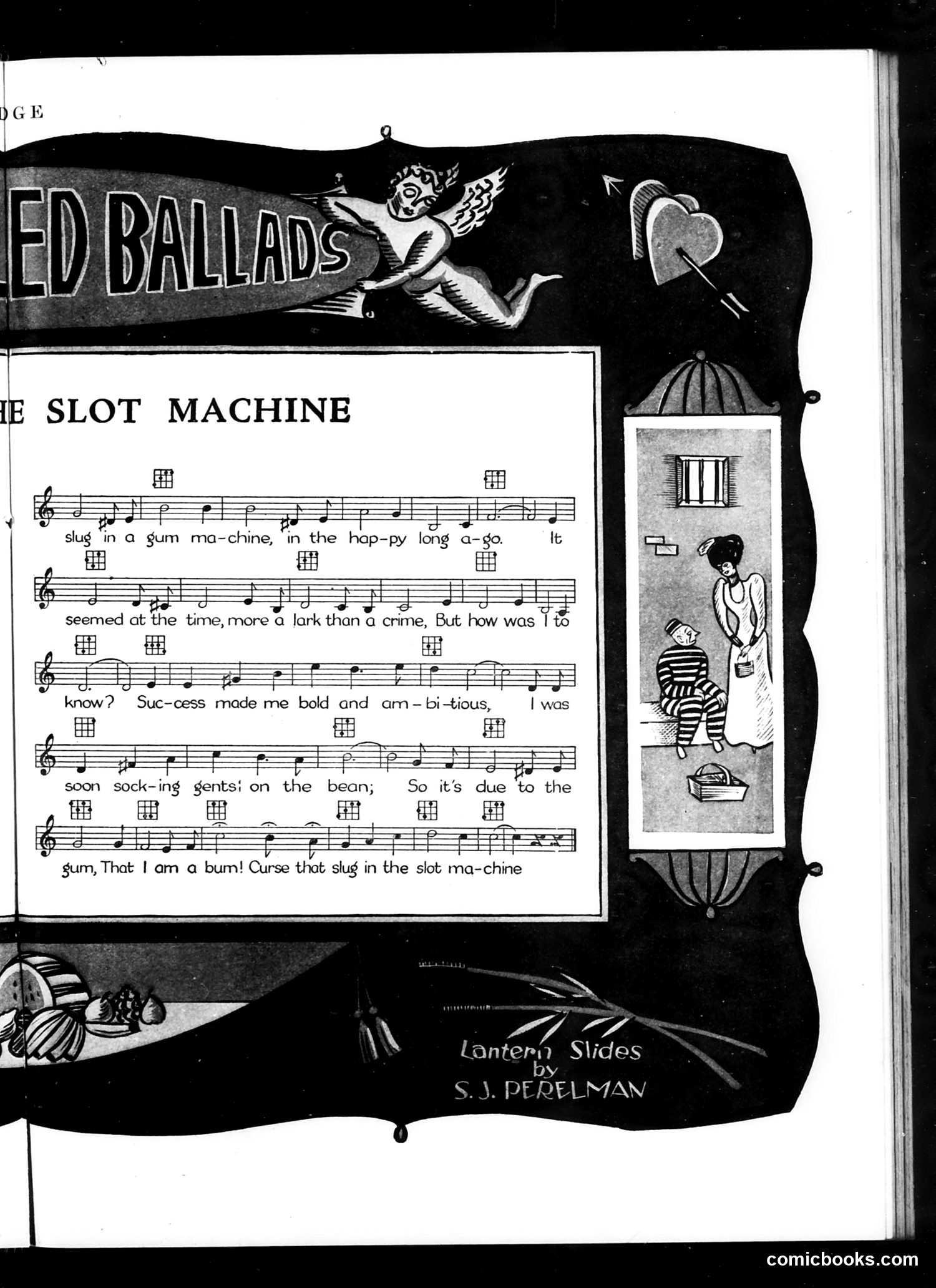
This is a song/ballad page from *Judge* magazine featuring "Lantern Slides" illustrations by S.J. Perelman. The lyrics tell a morality tale about a man who started as a petty criminal—slugging (using fake coins in) gum machines as a "lark"—but whose success emboldened him into larger crimes, eventually leading to his downfall as a "bum." The accompanying illustration depicts a woman visiting a man imprisoned behind bars, suggesting the song's cautionary endpoint. This reflects early-20th-century American anxieties about petty crime and moral corruption. The "slot machine slug" represents small-time delinquency that allegedly escalates into serious criminality—a common theme in period morality tales meant to warn against seemingly harmless rule-breaking. The satire likely mocks both the criminals and the era's reformist messaging about crime's slippery slope.
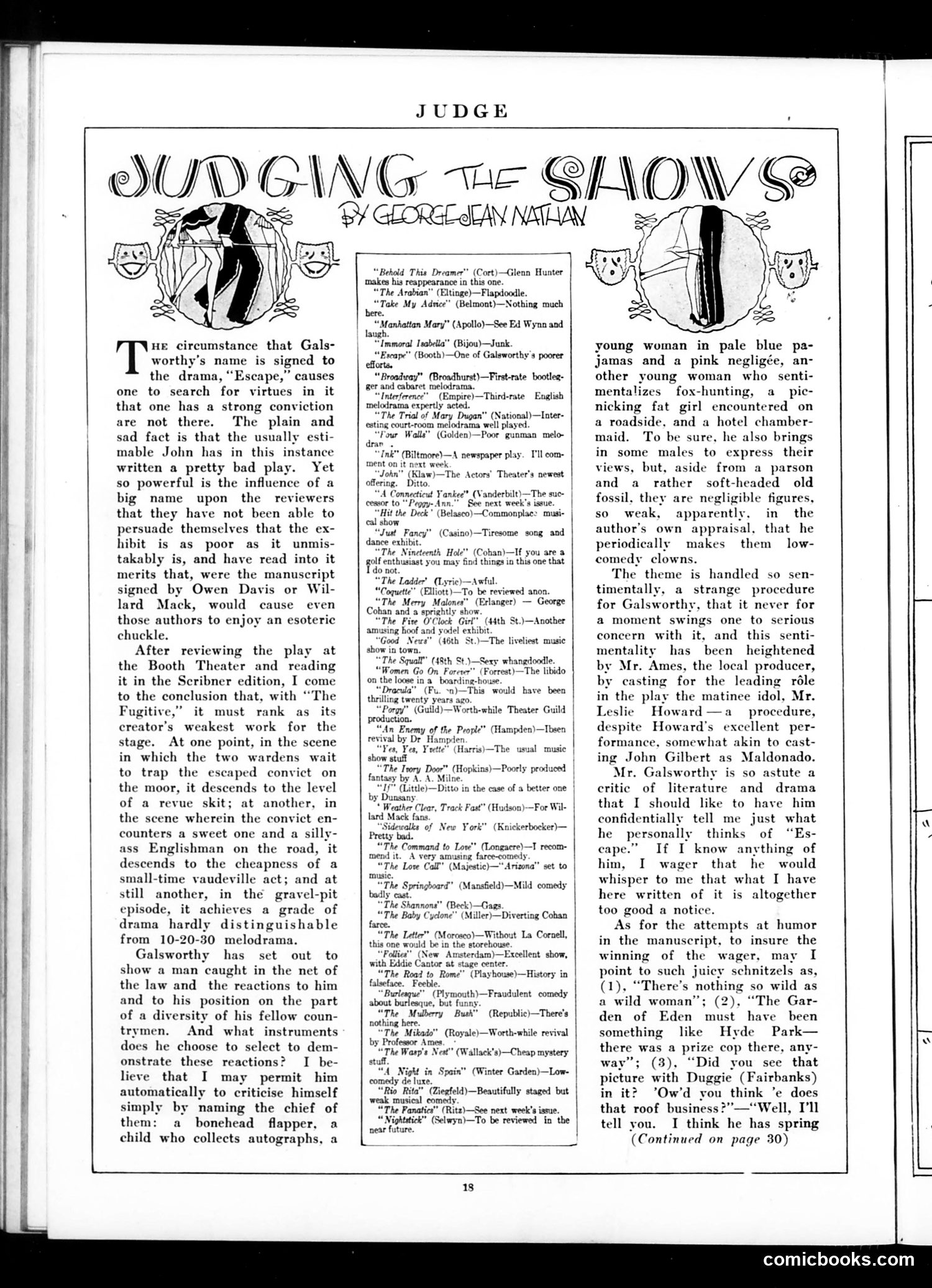
This is a theater review column by George Jean Nathan critiquing John Galsworthy's play "Escape" at the Booth Theater. Nathan argues that Galsworthy's prestigious name has clouded critical judgment—reviewers have given the play undeserved praise because of the author's reputation, when it would be dismissed as mediocre if written by lesser-known playwrights like Owen Davis or Willard Mack. Nathan systematically demolishes the play, claiming it descends into cheap vaudeville and 10-20-30 melodrama. He mocks Galsworthy's choice of characters to explore his theme about a man caught by law: a "bonehead flapper," an autograph-collecting child, and other trivial types. The page also lists brief reviews of current Broadway shows, rating them from forgettable to excellent—standard theater criticism of the 1920s period.
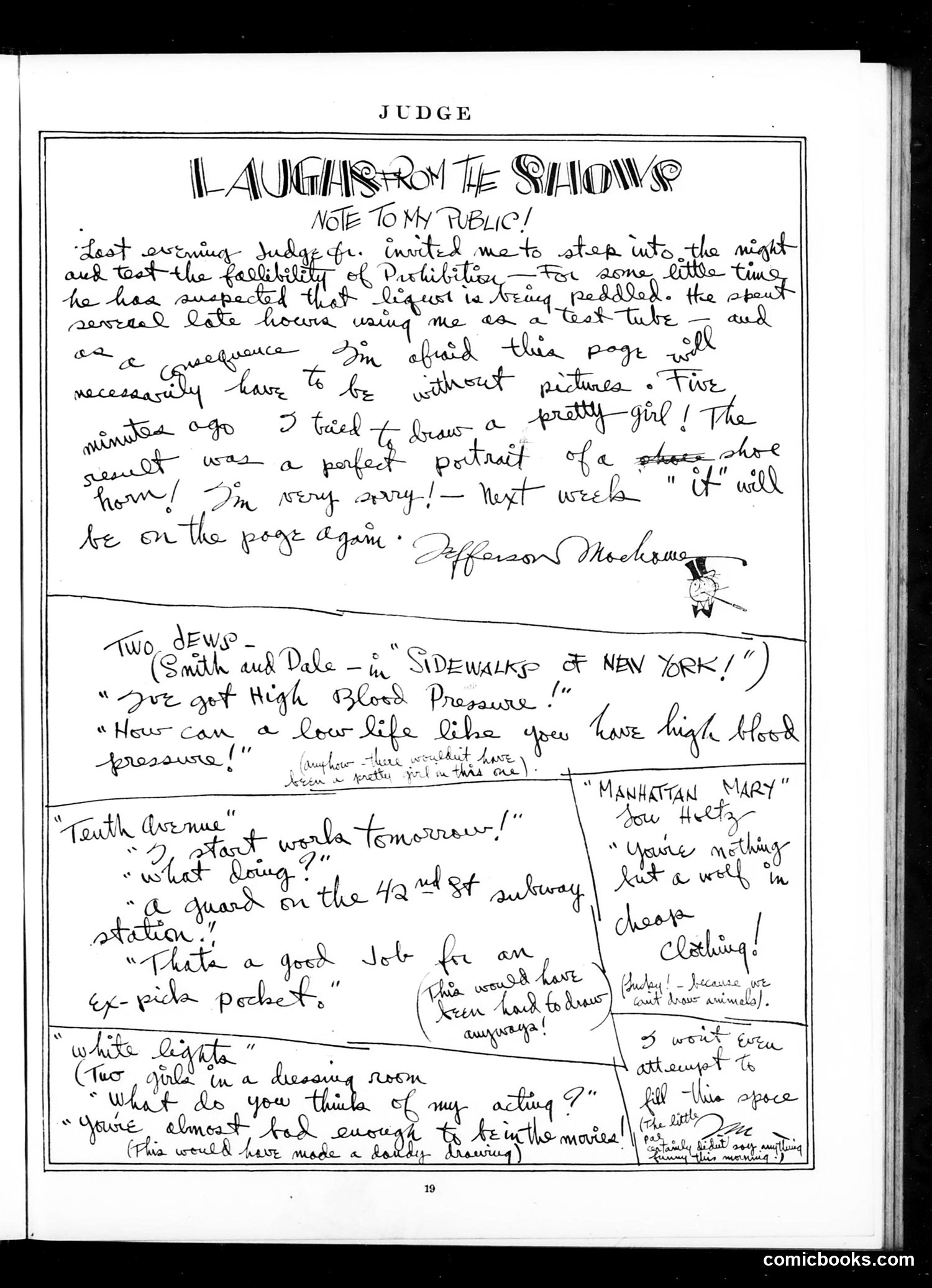
This page contains editorial notes and joke sketches lampooning New York stereotypes and social types, likely from the early 20th century. **The top section** is editor Jefferson Machado's note crediting a young female artist ("pretty girl") for contributing a portrait sketch to the magazine—a tongue-in-cheek acknowledgment of her work appearing in print. **The lower section** presents brief comedic dialogue snippets: - "Sidewalks of New York" jokes about blood pressure and class - "Tenth Avenue" and "Manhattan Mary" sketches satirizing working-class New Yorkers and their speech patterns - "White Lights" depicts stereotypical young women concerned with dating and appearance The humor targets lower-class New Yorkers through dialect, preoccupations with money/romance, and provincial attitudes—typical of Judge's satirical approach to urban American types of that era. The sketches reflect period attitudes toward immigrants and working-class populations.
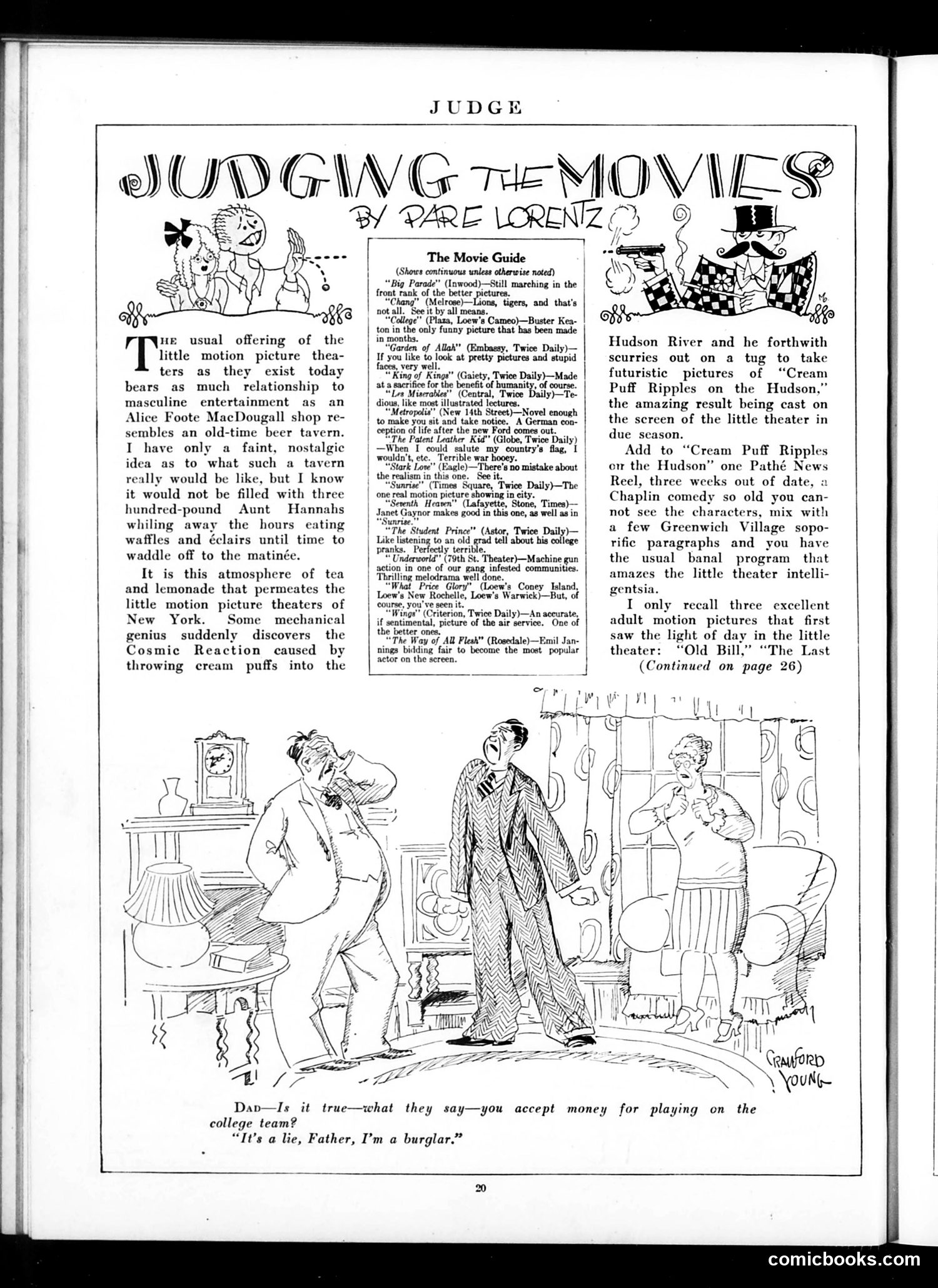
This page satirizes the decline of small movie theaters, which the author claims have become feminized and intellectually vapid. The accompanying cartoon depicts a father confronting his son about accepting money to play college sports—only to learn the son is actually a burglar, suggesting that athletic pay-for-play is comparatively respectable crime. The main article criticizes how these theaters cater to "three hundred-pound Aunt Hannahs" consuming waffles rather than serving "masculine entertainment." The author laments the theaters' shift toward "tea and lemonade" atmospheres, using "Cosmic Reaction" (throwing cream puffs) as satirical shorthand for their trivial, mechanized entertainment. The movie guide reviews actual 1920s films ("Metropolis," "Wings," "Sunrise") with snark, dismissing most as forgettable—except three unnamed "excellent adult motion pictures" including "Old Bill." The satire targets both feminized leisure culture and what the author sees as cinema's artistic bankruptcy in catering to mass audiences rather than serious viewers.
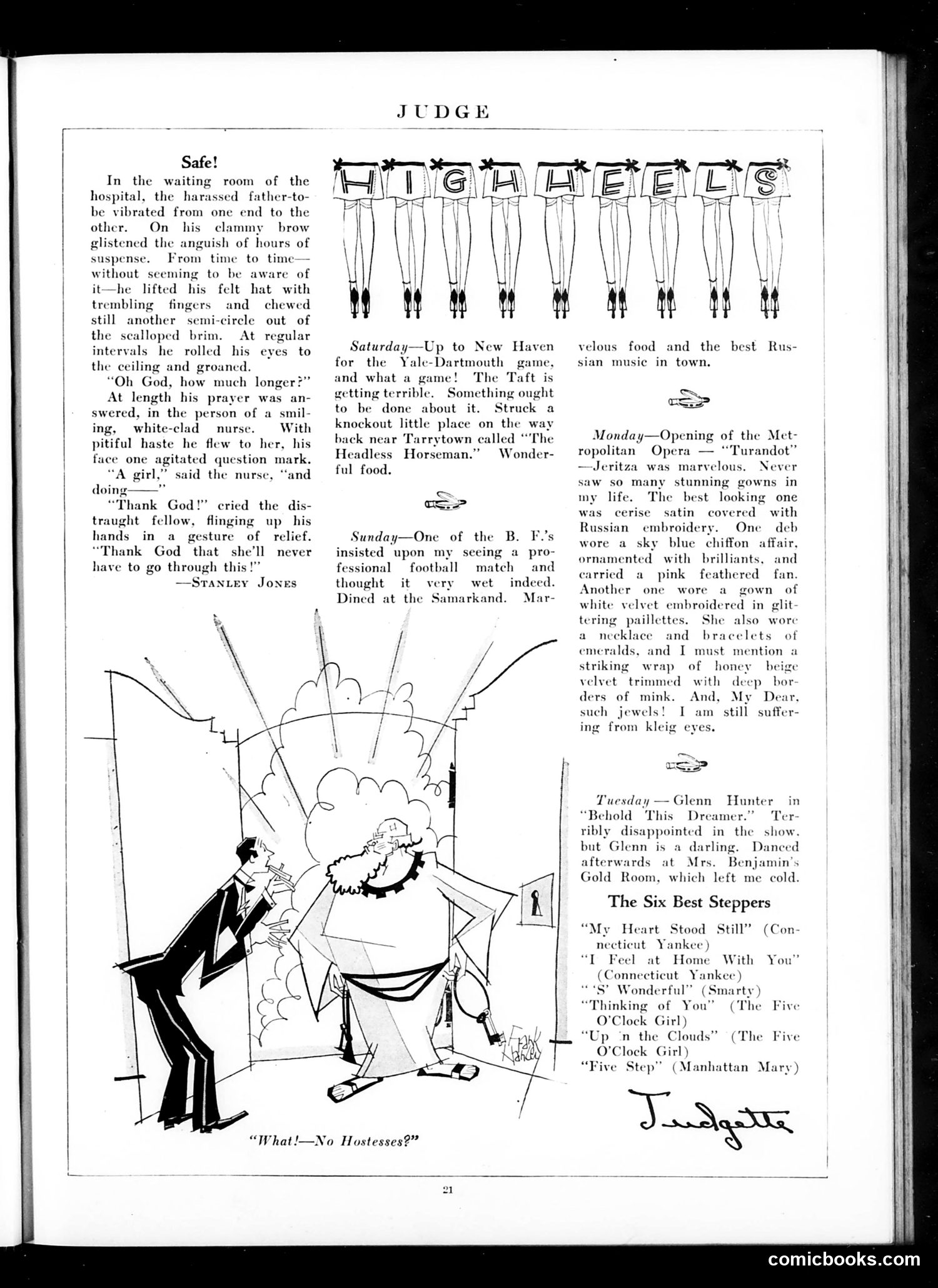
This Judge magazine page contains two distinct pieces of social satire: **"Safe!" cartoon**: A husband in a hospital waiting room nervously awaits his wife's delivery. When told they have a daughter, he exclaims "Thank God that she'll never have to go through this!"—meaning childbirth. The satire mocks male squeamishness about pregnancy and labor while ironically highlighting that his daughter will inevitably face the same ordeal, making his relief absurd and self-centered. **"What!—No Hostesses?" cartoon**: The illustration (labeled by the caption) appears to show social/entertainment commentary, though details remain unclear from the OCR text. **Entertainment section**: The remaining content lists Broadway shows, opera, and popular dance numbers from what appears to be the 1920s (references to Yale-Dartmouth football, the Metropolitan Opera's "Turandot," and performers like Glenn Hunter), along with fashion commentary on elaborate gowns worn by society women. The overall page reflects upper-class entertainment and social preoccupations of the era.
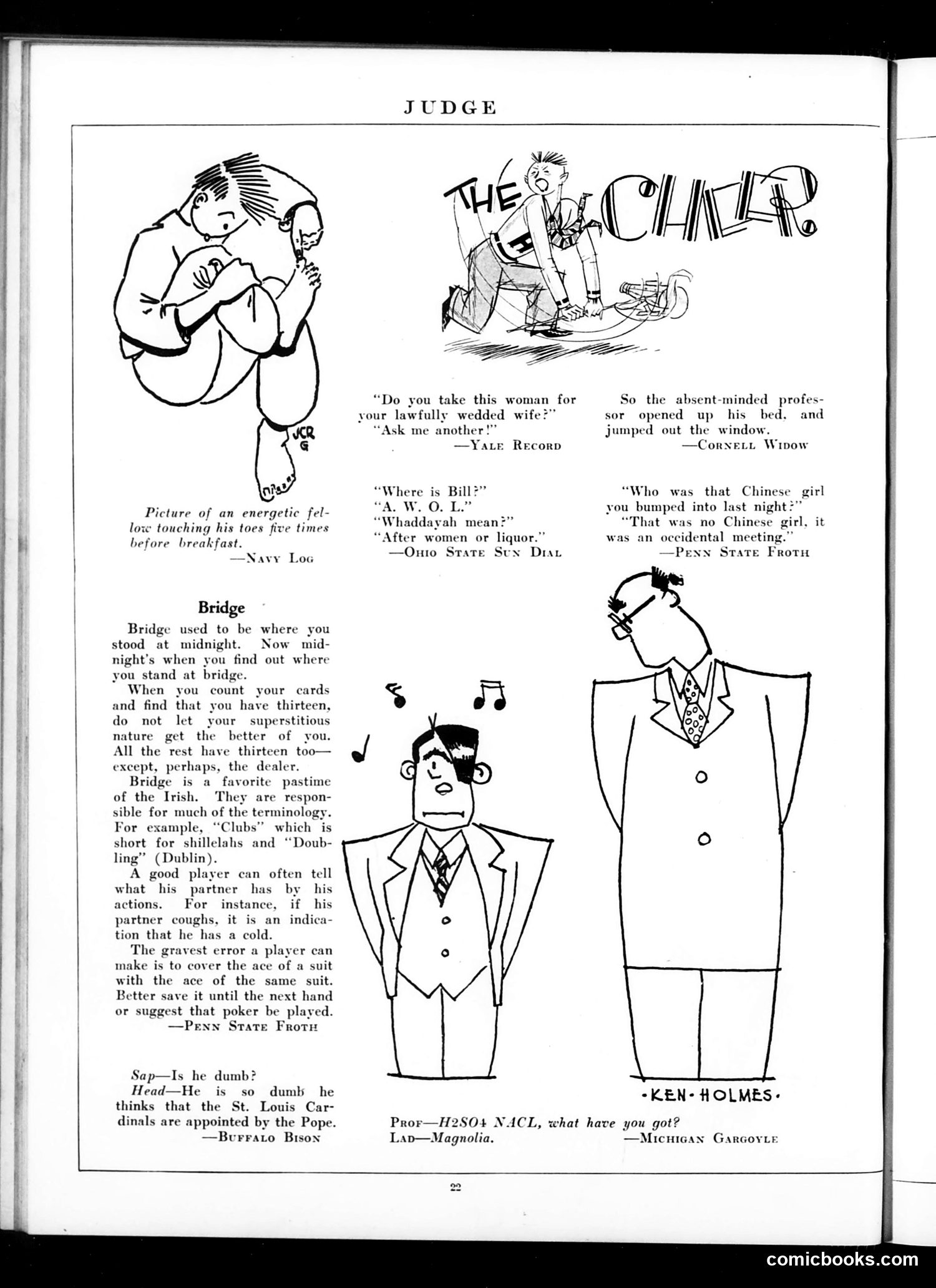
This page from *Judge* magazine contains multiple humor pieces targeting early 20th-century social conventions and contemporary references: **"The Chiller"** mocks absent-minded professors—a stock character type—through slapstick humor about a professor jumping from a window. **"Bridge"** satirizes the card game's popularity among Irish Americans, making ethnic jokes about Irish terminology ("Clubs" from shillelahs, "Doubling" from Dublin). The humor also targets bridge players' superstitions and miscommunication. **The campus jokes** reference college life: "A.W.O.L." (absent without leave, military terminology applied to dating), and a racist "Chinese girl" joke playing on 1920s xenophobia and interracial dating anxieties. **"Ken Holmes"** appears to be a character illustration, though the context is unclear. **The "dumb" joke** uses an ethnic stereotype about Irish Catholics and the St. Louis Cardinals baseball team. The overall tone reflects period humor relying on ethnic stereotypes, anti-intellectualism, and social anxieties about modernity—particularly around women, dating, and leisure activities.
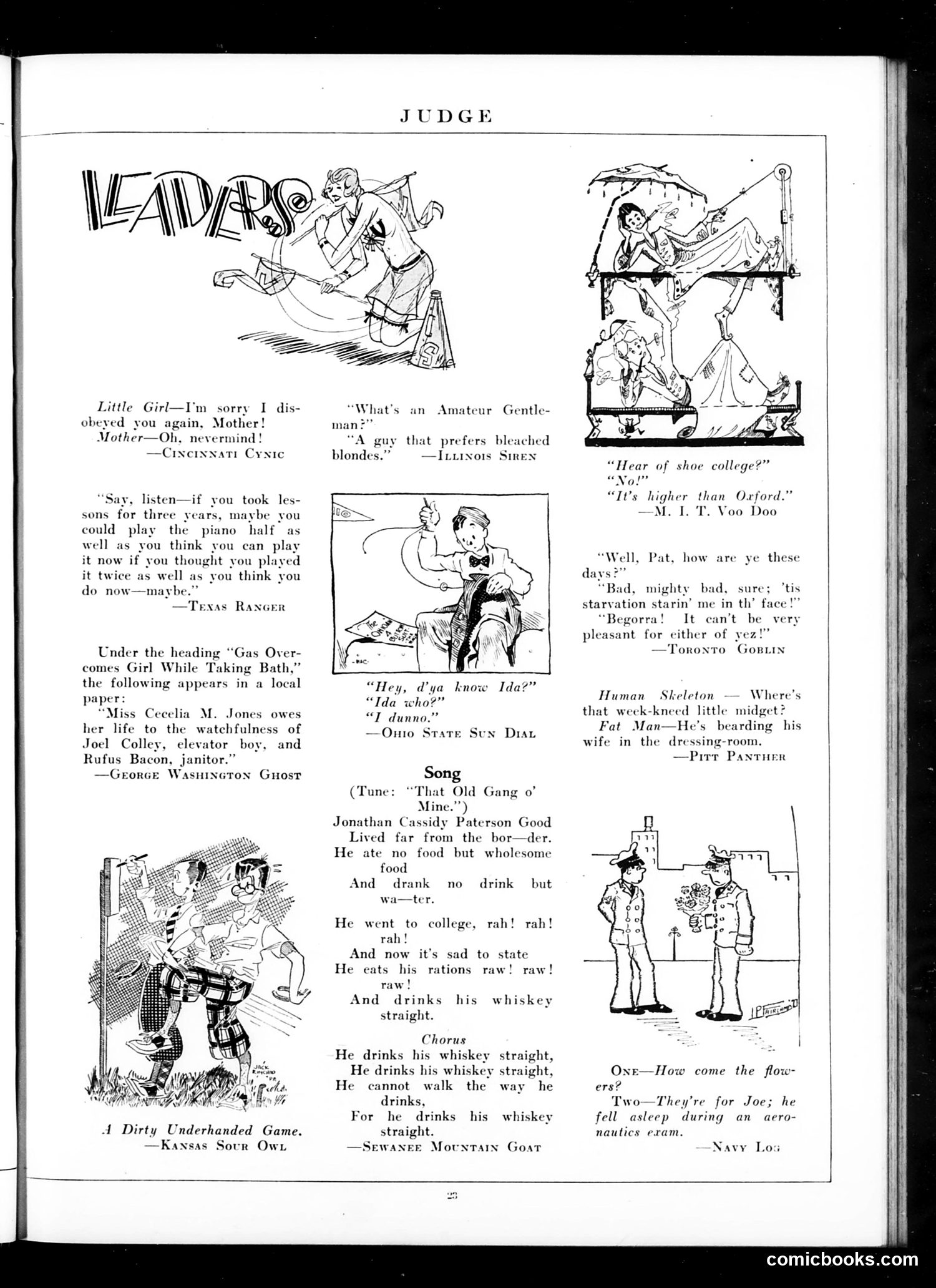
This page from the satirical magazine **Judge** contains humorous short jokes and a cautionary song mocking college culture and social pretensions. The main content is a song about "Jonathan Cassidy Paterson Good," a student who attended college and abandoned his wholesome, abstemious lifestyle for drinking whiskey "straight." The satire targets college corruption—the implicit message being that higher education ruins young men's moral character, turning disciplined youths into drunks who "cannot walk the way he drinks." Supporting jokes mock: - **Piano lessons** (pretentious middle-class aspiration) - **"Amateur Gentlemen"** (shallow social climbing based on preferences for "bleached blondes") - **College prestige** (a "shoe college" being "higher than Oxford"—absurdist deflation of academic hierarchy) - **Student excess** (a student sleeping through aeronautics class) The cartoons illustrate these themes visually. Overall, the page satirizes Gilded Age anxiety about education's failure to maintain Victorian morality and the gap between middle-class pretensions and actual behavior.
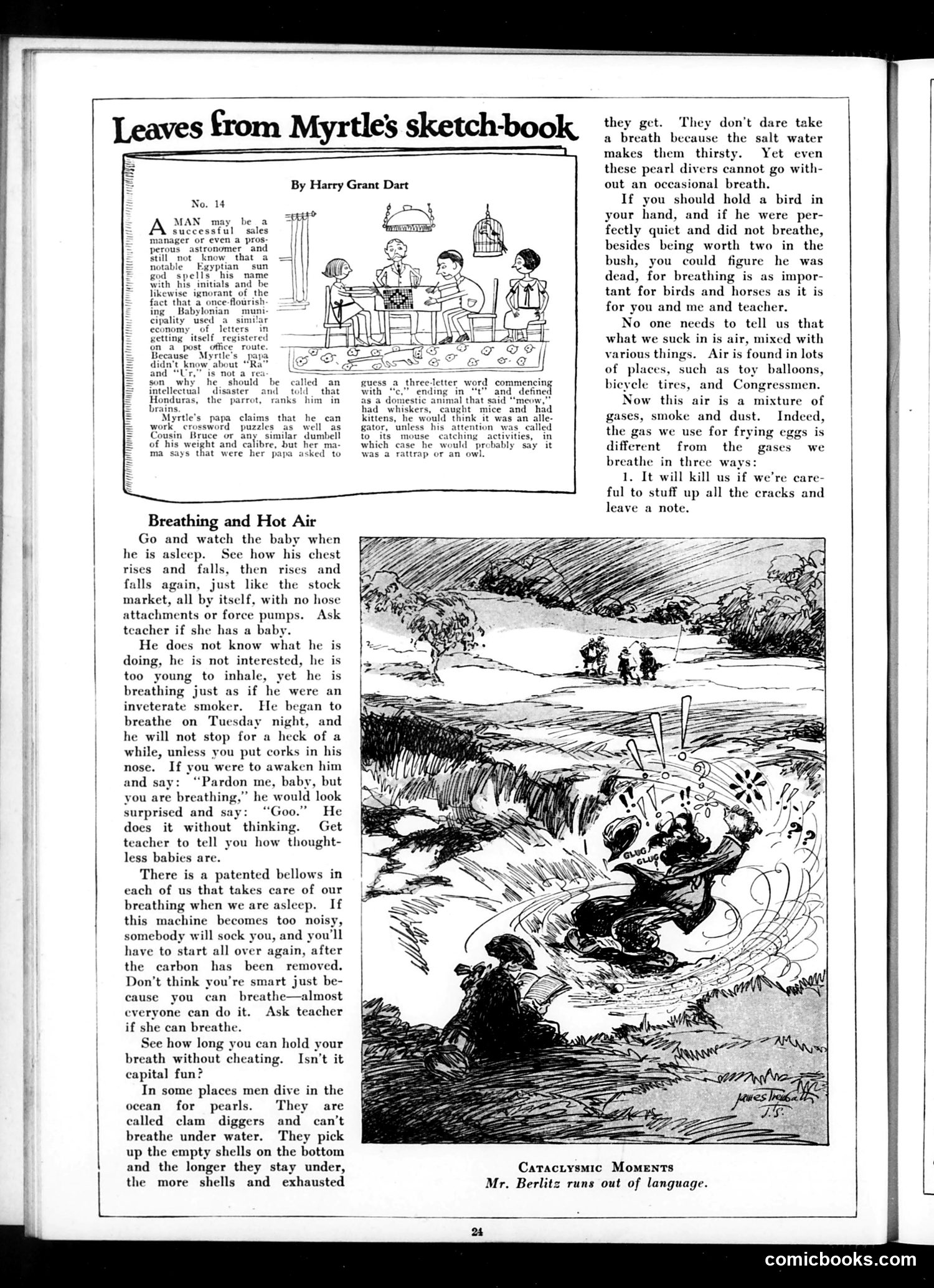
This page contains two distinct pieces of educational humor by Harry Grant Dart: **Top section** ("Leaves from Myrtle's Sketch-book"): A comic sketch mocking ignorance about crossword puzzles and obscure knowledge. Myrtle's father claims competence at crosswords, while her mother disputes this, suggesting he lacks basic erudition. The joke targets pretentious adults who overestimate their intellectual abilities. **Bottom section** ("Breathing and Hot Air"): Educational satire explaining respiration to children. It humorously describes how babies breathe unconsciously, pearl divers who hold their breath underwater, and compares breathing to automatic bodily functions requiring no thought. The final joke about cooking gas being lethal appears to be dark humor about gas-related dangers—possibly referencing early 20th-century domestic hazards. The accompanying illustration ("Cataclysmic Moments") shows someone apparently drowning or in water distress, captioned with a pun about Mr. Berlitz (a famous language instructor) "running out of language"—implying speechless panic. The overall tone is whimsical educational content mixed with gentle satire.
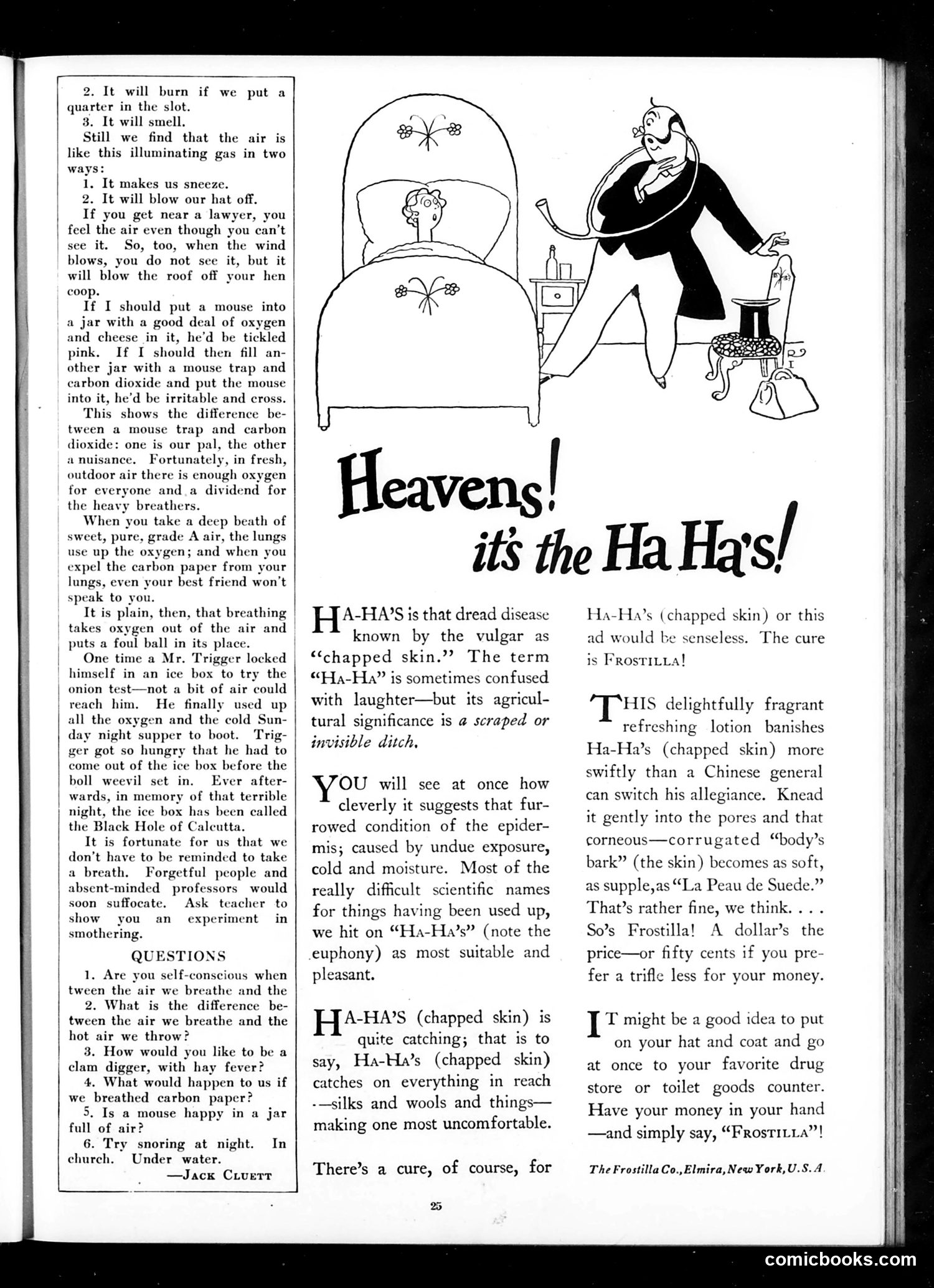
This page combines educational humor with advertising. The left side presents Jack Cluett's humorous essay on air and breathing, using absurd analogies (a lawyer's air, a mouse in an ice box, the "Black Hole of Calcutta" ice box) to explain oxygen and carbon dioxide to children—a science lesson disguised as comedy. The right side advertises **Frostilla**, a skin lotion for "Ha-Ha's" (chapped skin). The ad is written as satirical marketing: it playfully explains that "Ha-Ha" is a geological term for "scraped or invisible ditch," then cleverly compares chapped skin's furrowed appearance to this ditch. The accompanying cartoon shows a well-dressed man and woman, with the woman applying lotion. The joke is that Judge magazine—a satirical publication—presents both educational content and period advertising in exaggerated, tongue-in-cheek style. The ad's pseudointellectual explanation of the product name typifies early 20th-century marketing humor.
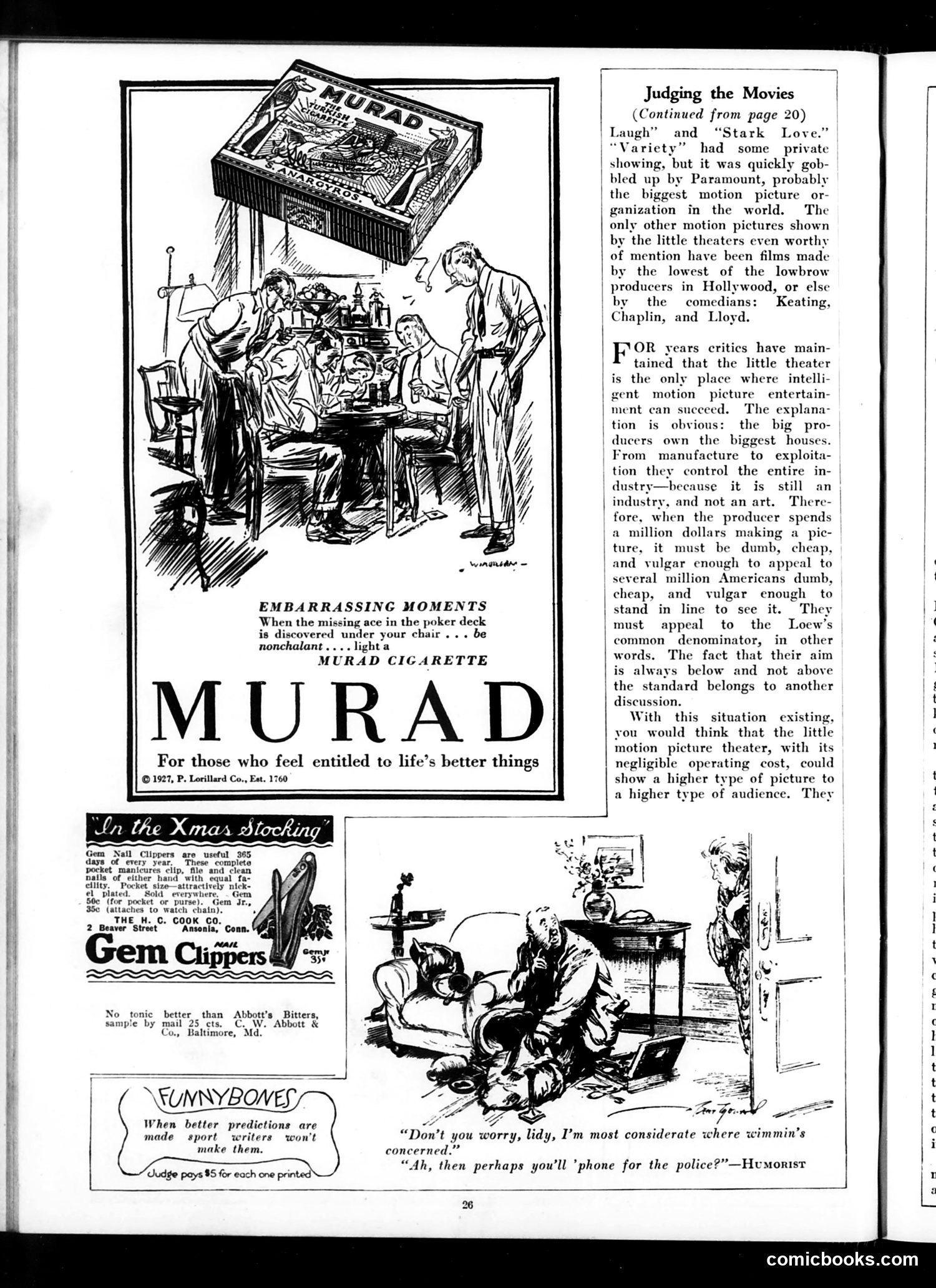
This page combines advertising, social commentary, and humor typical of 1920s Judge magazine. **The Main Content:** The page critiques Hollywood's profit-driven studio system. The essay argues that major producers like Paramount control the entire industry and therefore create only "dumb, cheap, and vulgar" films designed for mass appeal rather than intelligent audiences. The author suggests that small independent theaters, despite having lower operating costs, could theoretically show higher-quality pictures but don't. **The Advertisements:** - A Murad cigarette ad featuring an "embarrassing moment" (being caught cheating at poker) - Gem Nail Clippers and Abbott's Bitters ads **The Cartoon:** A domestic humor sketch showing a woman discovering her husband's infidelity, with the caption about "wimmin's" concerns and calling police—typical early-20th-century marital comedy. The page reflects 1920s anxieties about mass culture, commercialism, and class distinctions between "highbrow" and "lowbrow" entertainment.
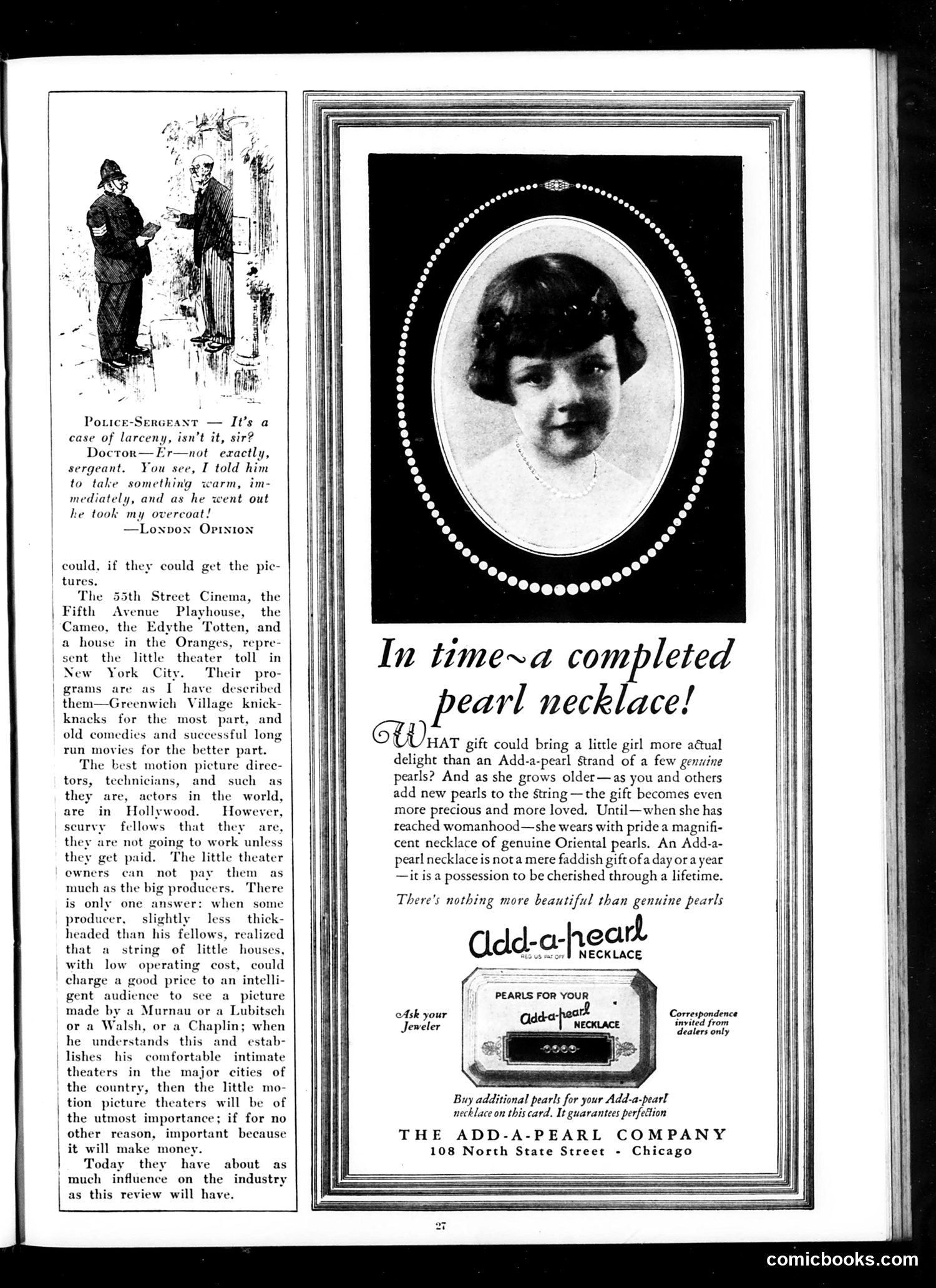
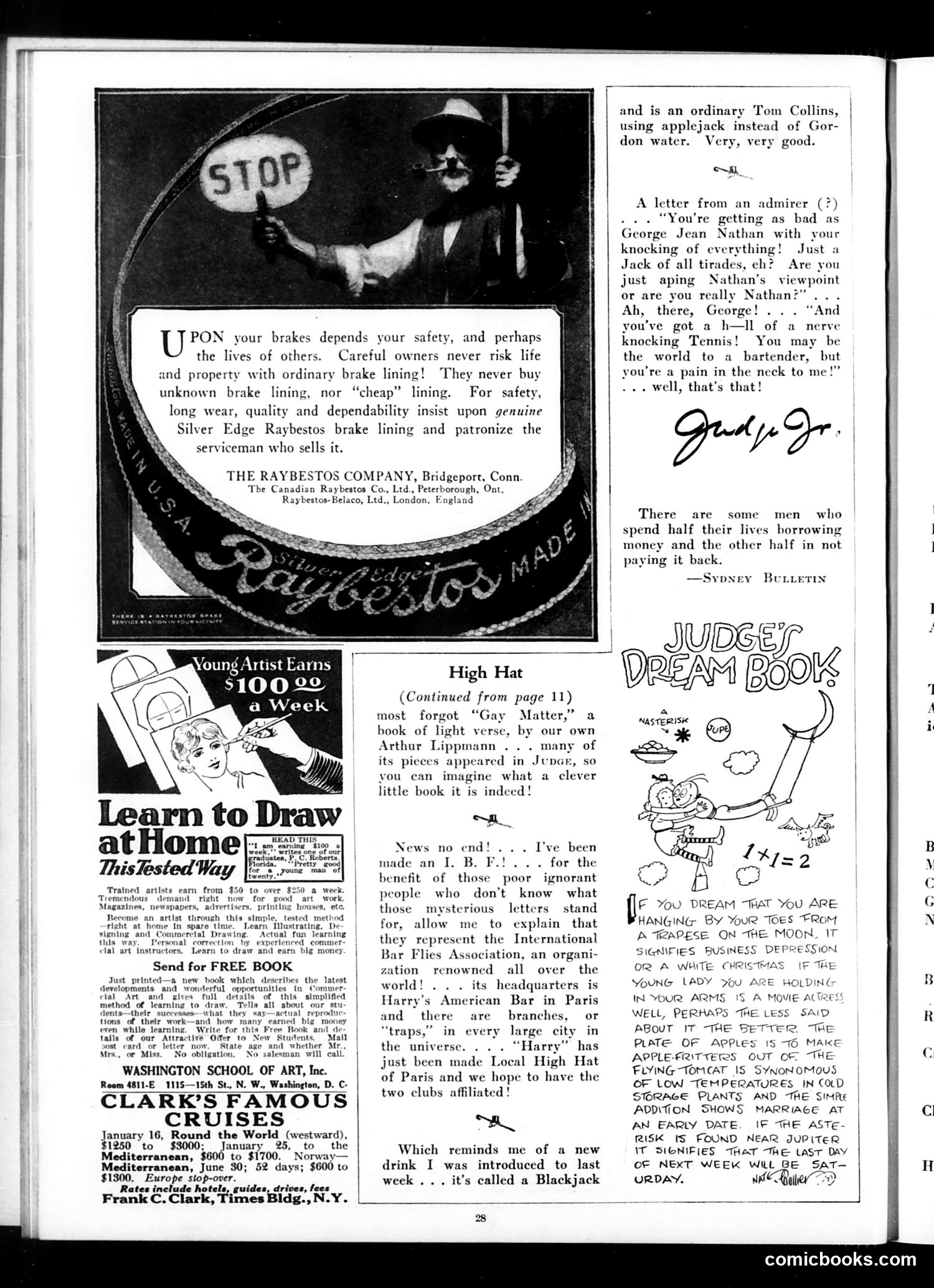
This Judge magazine page contains two distinct elements: **Left side:** A brief joke about a doctor and police sergeant. The humor is straightforward wordplay: a doctor tells a patient to "take something warm immediately," and the patient steals the doctor's overcoat—interpreting the instruction literally and mischievously. It's attributed to "London Opinion," suggesting it's reprinted from a British source. **Right side:** An advertisement for Add-a-Pearl necklaces by the Add-a-Pearl Company (Chicago). The ad promotes a growing pearl necklace as a gift for girls—parents and relatives gradually add pearls as the child grows into womanhood, creating a heirloom. The accompanying portrait shows a young woman in 1920s style. The page also contains substantial text discussing the economics of "little theater" motion picture houses in New York versus Hollywood studios—a serious industry commentary wedged between humor and advertising. This appears to be a typical Judge page mixing satire, advertisement, and social commentary circa the 1920s.
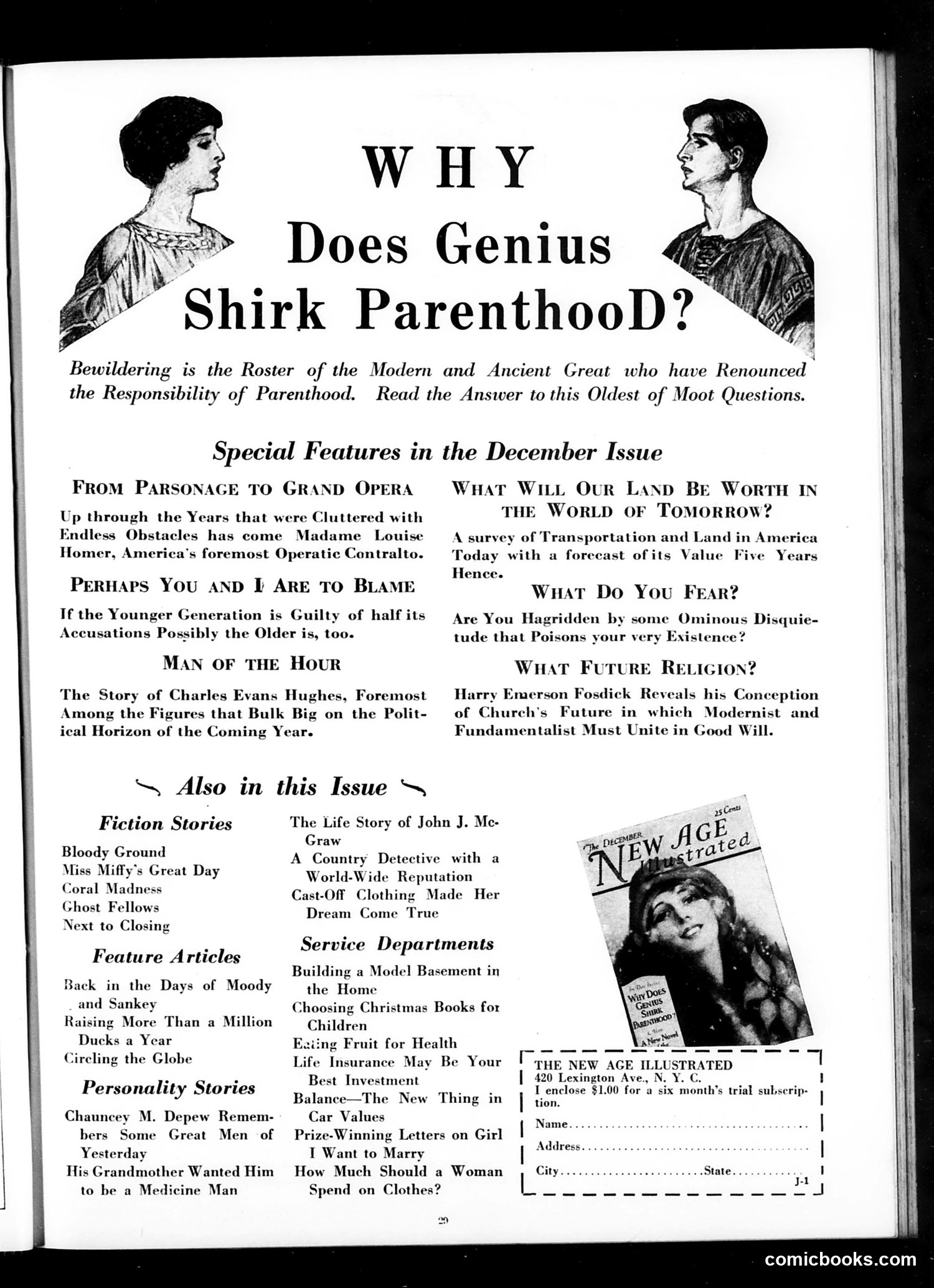
This is primarily a **table of contents and advertising page** from Judge magazine's December issue (date unclear from image). The two illustrated profile heads at top appear to be generic representations of "modern" figures rather than specific political caricatures. The page's satirical thrust centers on **"Why Does Genius Shrink Parenthood?"**—a social commentary on prominent public figures (both historical and contemporary) who chose not to have children. This reflects early 20th-century anxieties about birth rates among the educated classes. Key featured articles reveal period preoccupations: Charles Evans Hughes (likely the 1916 presidential candidate) as "Man of the Hour," religious modernism versus fundamentalism (Harry Emerson Fosdick), and economic forecasting about land values. The personality profiles (Chauncey Depew, John McGraw) highlight prominent Americans of that era. The **service departments** addressing domestic concerns—model basements, Christmas books, car values—target middle-class readers. The page functions primarily as editorial preview rather than satire.
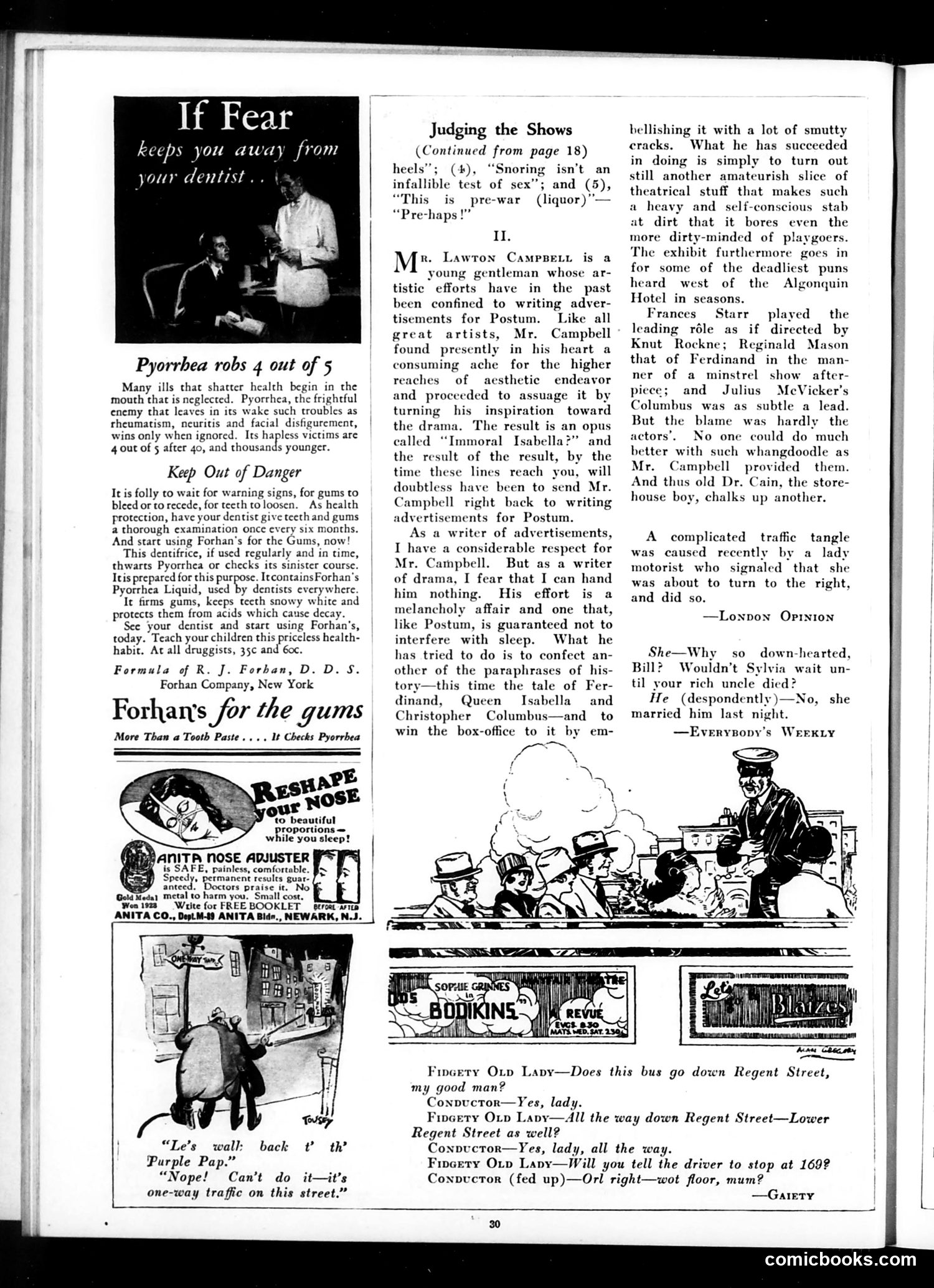
This page mixes **advertising with theater criticism**, offering little political satire. The main advertisements promote **Forhan's toothpaste** (targeting pyorrhea, a gum disease) and **Anita Nose Adjuster** (a device for reshaping noses while sleeping)—typical early 20th-century medical-product marketing with exaggerated health claims. The theater review criticizes Lawton Campbell's play **"Immoral Isabella?"** about Ferdinand, Queen Isabella, and Columbus. The critic dismisses it as amateur theatrical work relying on crude jokes and tired historical paraphrasing, with poor performances despite competent actors like Frances Starr. The review is caustic but not political—it's standard showbiz criticism. The bottom cartoon depicts a London bus conductor's exchange with a passenger, using cockney dialect humor. Its point is unclear from the visible text but appears to be a simple gag about traffic or directions rather than satire. Overall, this is an **entertainment and commerce page**, not political commentary.
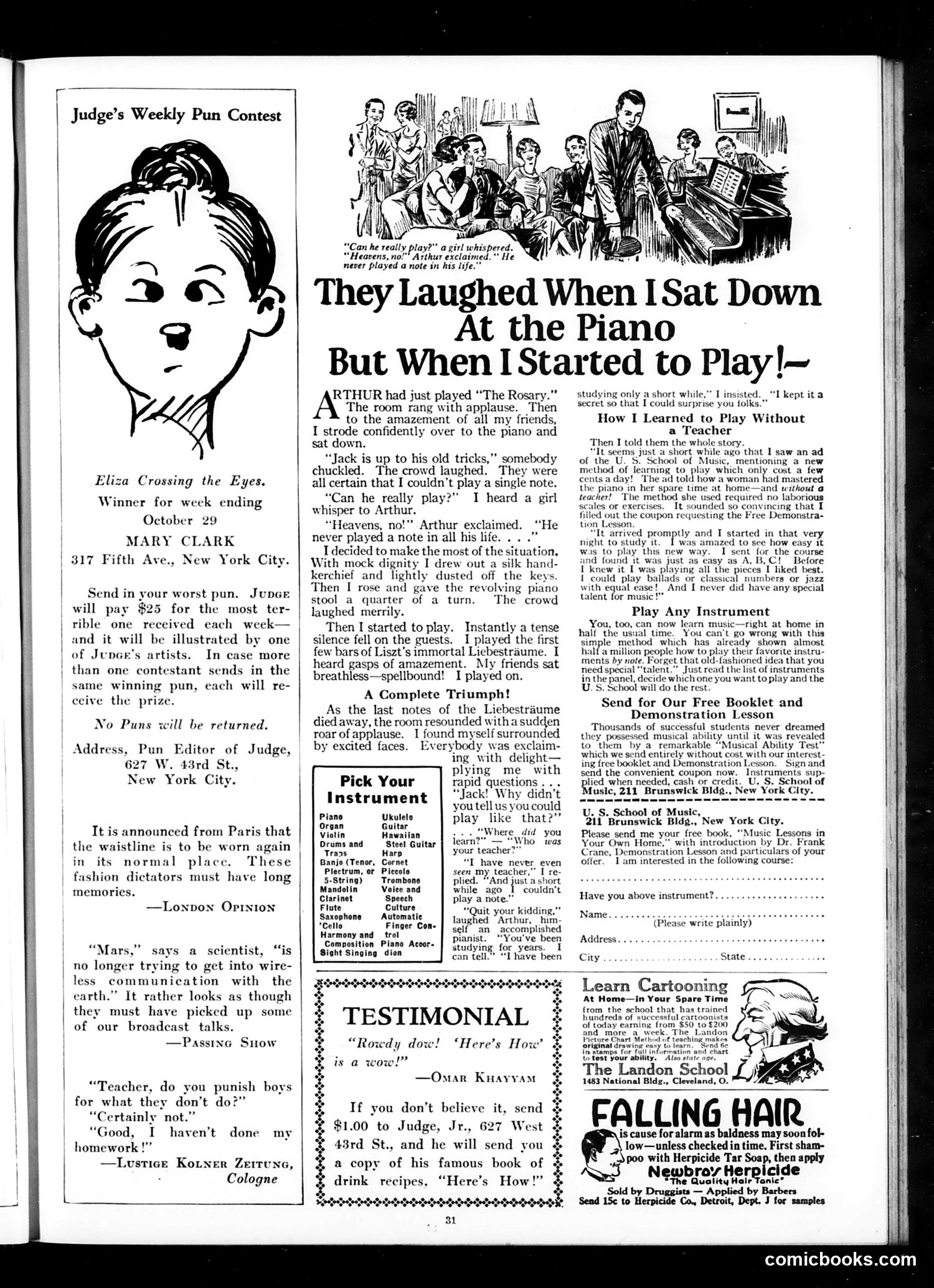
This page consists primarily of **advertising content disguised as narrative entertainment**, a common early 20th-century marketing technique. The main feature, "They Laughed When I Sat Down At the Piano," is a **testimonial advertisement** for the U.S. School of Music's mail-order piano lessons. The story follows a familiar formula: a man surprises skeptical friends by playing beautifully despite claiming no formal training, revealing he learned through the advertised correspondence course. The sidebar "Judge's Weekly Pun Contest" is the magazine's actual editorial content—a genuine humor feature where readers submit puns for prizes. The scattered short jokes and quotes at left are filler material typical of Judge magazine's satirical style, poking fun at contemporary topics like fashion trends and wireless communication. **The key point for modern readers:** This represents an era when magazines blurred advertising and content far more openly than today's standards allow. The piano story isn't presented as a "sponsored post"—it simply appears as regular magazine content, making it subtle but effective product promotion.
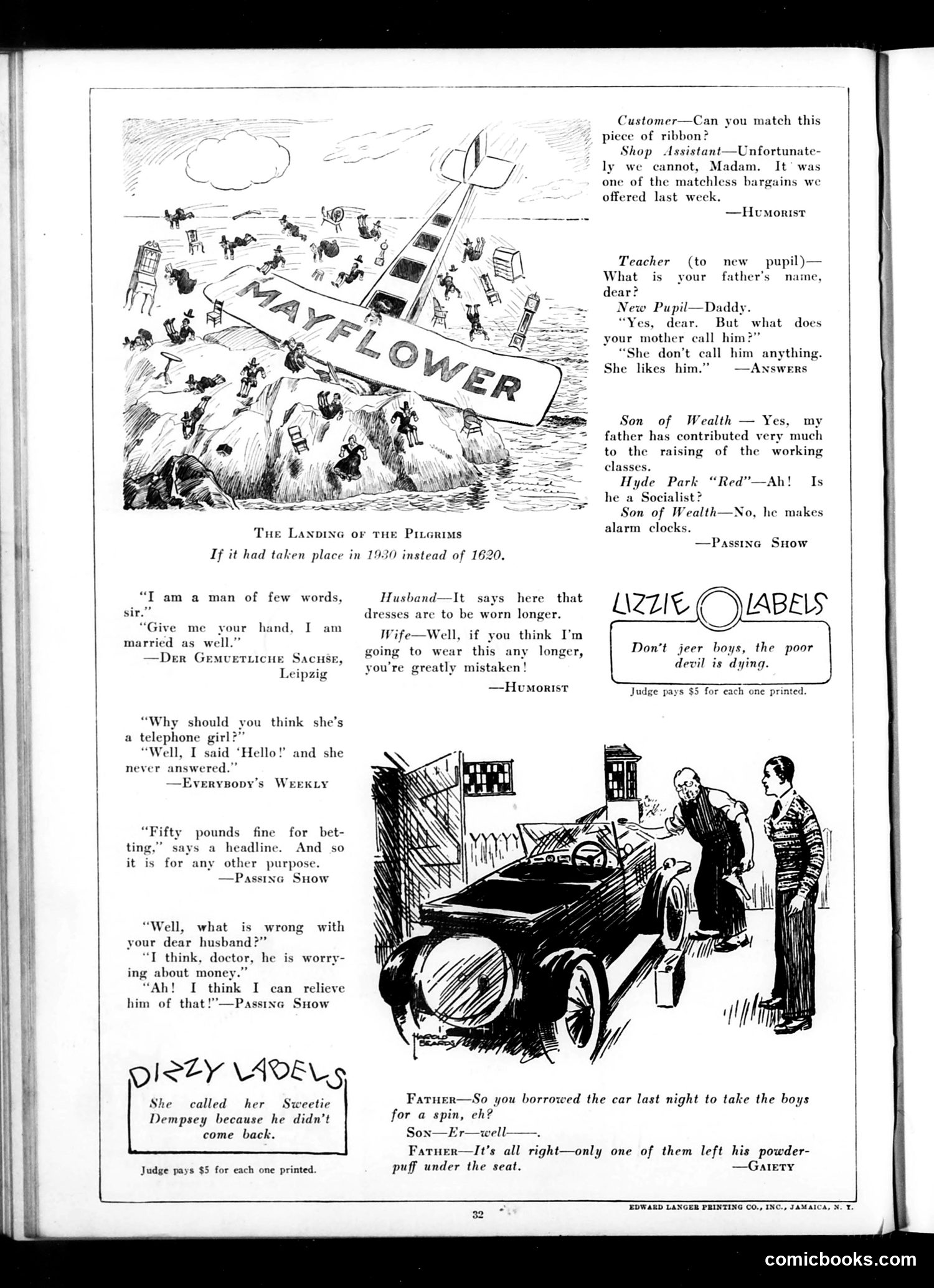
This page contains multiple brief satirical jokes typical of early-20th-century humor magazines. Key items: **"The Landing of the Pilgrims"** (main cartoon): A humorous alternate-history premise imagining the 1620 Mayflower landing occurring in 1930 instead, showing the ship amid modern urban chaos and crowds. **Short jokes** satirize contemporary social issues: - Retail deception ("matchless bargains") - Marriage dynamics (wives' authority over husbands' clothing) - Class commentary (wealthy man claims his alarm-clock manufacturing helps "working classes") - Dating/romance ("Dempsey" reference, likely Jack Dempsey the boxer) - Gender stereotypes (telephone operators, women's powder compacts) **"Dizzy Labels"** and **"Lizzie Labels"** are recurring humor sections paying $5 for reader-submitted jokes. The page reflects 1920s-30s preoccupations: class anxiety, changing gender roles, consumer culture, and romantic humor. Most jokes rely on wordplay or mild social observation rather than political commentary.
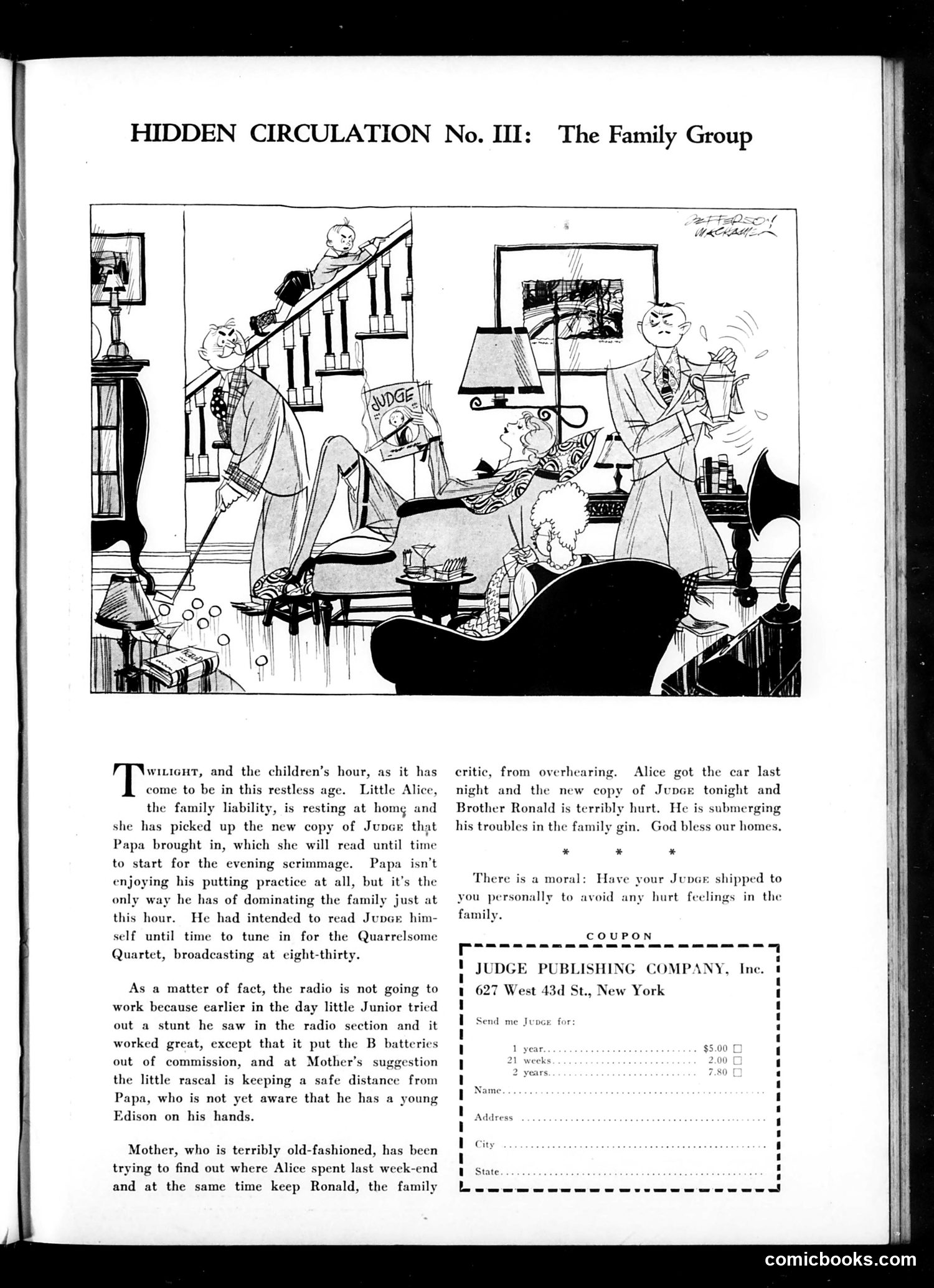
This is satirical commentary on 1920s-30s family life disguised as advertising for *Judge* magazine. The cartoon depicts a chaotic household where every family member is absorbed in competing activities: Father practicing golf indoors, Mother interrogating daughter Alice about her whereabouts, son Ronald sulking over gin (implied to be drinking alcohol during Prohibition), and Junior having sabotaged the radio. The satire targets the "restless age"—modern family breakdown where parents lose control and children pursue independent interests. The moral is tongue-in-cheek: subscribe to *Judge* personally so family members won't fight over who reads it. The social references include radio broadcasting ("Quarrelsome Quartet"), automobiles as symbols of youth independence, and alcohol consumption despite Prohibition. It's essentially satirizing how modern consumer culture and technology are fragmenting traditional family cohesion.
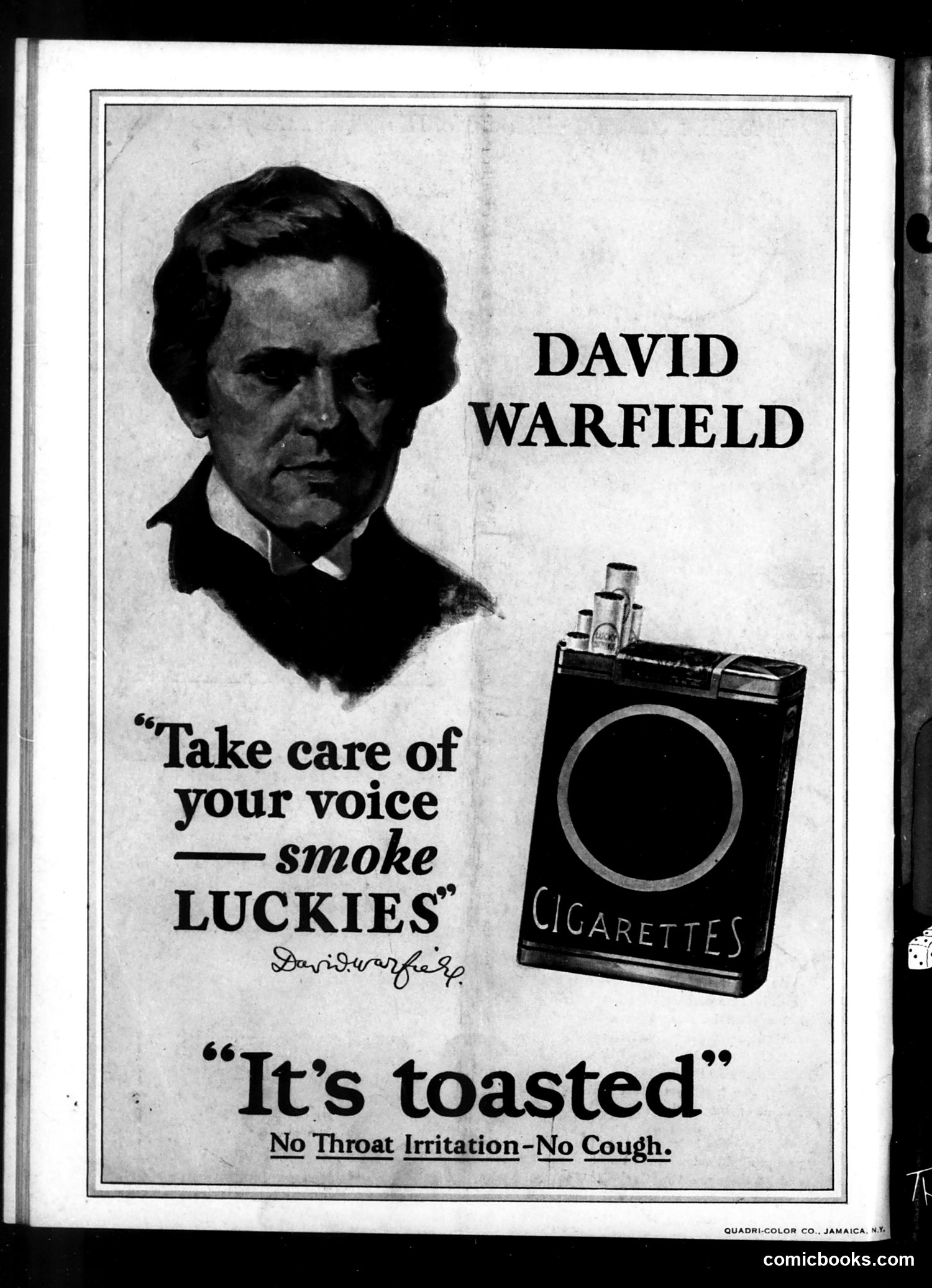
This is a **cigarette advertisement**, not satire or political commentary. It features David Warfield (a prominent stage actor of the early 20th century) endorsing Luckies cigarettes. The ad claims smoking Luckies will protect one's voice—important for a professional actor—with the slogan "It's toasted" and "No Throat Irritation—No Cough." Warfield's signature appears to endorse the product. This reflects the **pre-health-warning era** of cigarette marketing (likely 1920s-1930s), when tobacco companies made unsubstantiated medical claims and recruited celebrities to promote smoking as beneficial or at least harmless. The "toasting" process was Luckies' marketing gimmick claiming reduced throat damage. By modern standards, this advertisement is shocking for promoting cigarettes as voice-protective—the opposite of medical reality.