
Judge, 1927-11-12 · page 20 of 36
Judge — November 12, 1927 — page 20: what you’re looking at
What you’re looking at
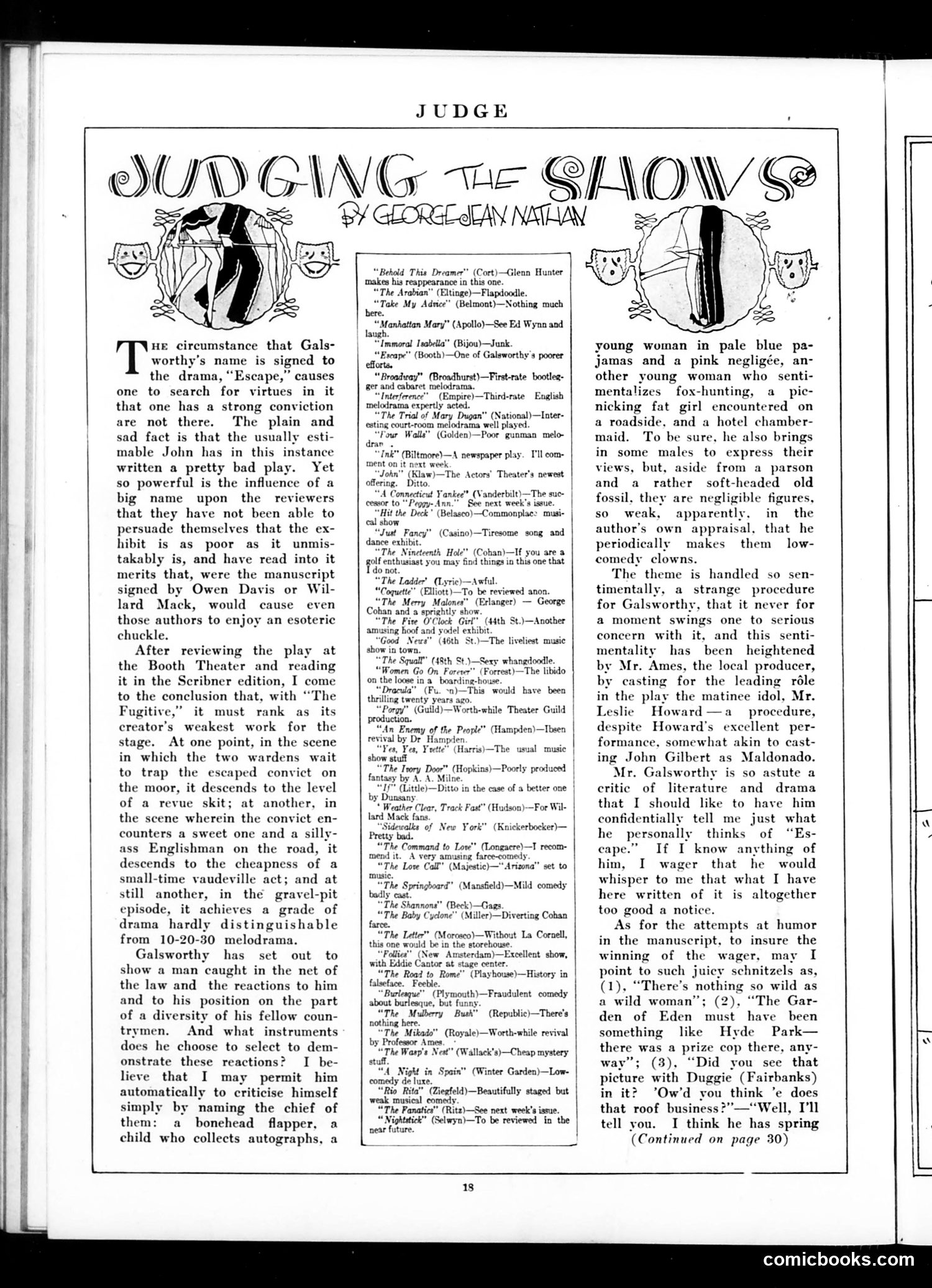
This is a theater review column by George Jean Nathan critiquing John Galsworthy's play "Escape" at the Booth Theater. Nathan argues that Galsworthy's prestigious name has clouded critical judgment—reviewers have given the play undeserved praise because of the author's reputation, when it would be dismissed as mediocre if written by lesser-known playwrights like Owen Davis or Willard Mack. Nathan systematically demolishes the play, claiming it descends into cheap vaudeville and 10-20-30 melodrama. He mocks Galsworthy's choice of characters to explore his theme about a man caught by law: a "bonehead flapper," an autograph-collecting child, and other trivial types. The page also lists brief reviews of current Broadway shows, rating them from forgettable to excellent—standard theater criticism of the 1920s period.
📄 Transcribed text from this page (OCR, searchable)
Machine-transcribed from the original scan — historical spelling and the odd misread are preserved.
ee JUDGE | MUDCING te GLOWS BY GLORGLATAN NAT. HE circumstance that Gals- | worthy’s name is signed to the drama, “Escape,” causes one to search for virtues in it that one has a strong conviction are not there. The plain and sad fact is that the usually esti- mable John has in this instance written a pretty bad play. Yet so powerful is the influence of a big name upon the reviewers that they have not been able to persuade themselves that the ex- hibit is as poor as it unmis- takably is, and have read into it merits that, were the manuscript signed by Owen Davis or Wil- lard Mack, would cause even those authors to enjoy an esoteric chuckle. After reviewing the play at the Booth Theater and reading it in the Scribner edition, I come to the conclusion that, with “The Fugitive,” it must rank as its creator’s weakest work for the stage. At one point, in the scene in which the two wardens wait to trap the escaped convict on the moor, it descends to the level of a revue skit; at another, in the scene wherein the convict en- counters a sweet one and a silly s Englishman on the road, it descends to the cheapness of a small-time vaudeville act; and at still another, in the gravel-pit episode, it achieves a grade of drama hardly distinguishable from 10-20-30 melodrama. Galsworthy has set out to show a man caught in the net of the law and the reactions to him and to his position on the part of a diversity of his fellow coun- trymen. And what instruments does he choose to select to dem- onstrate these reactions? I be- lieve that I may permit him automatically to criticise himself simply by naming the chief of them: a bonehead flapper, a child who collects autographs, a “Behold This Dreamer” (Cort)—Glenn Hunter makes his reappearance in this one. “The Arabian" (Eltinge)—Flapdoodle. ere My Advice” (Belmont)—Nothing much P “Manhattan Mary’ (Apollo)—See Ed Wynn and laugh. “Immoral Isabella” (Bijou)—Junk. Escape" (Booth)—One of Galsworthy's poorer efforts. “Broadway” (Broadhurst)—First-rate bootleg- ma. pire) —Third-rate English melodrama expertly acted. “The Trial of Mary Dugan” (National)—Later- esting court-room melodrama weil played. gp, Wall” (Golden) Poor gunman. melo iran. “Ink” (Biltmore)—A newspaper play. I'll eom- ment on it next week “John” (Klaw)—The Actors’ Theater's newest offering. Ditto. A Connecticut Yankee" (Vanderbilt)—The suc- cemsor to“ Peggy-Ann.” See next week's issue. “Hit the Deck (Belasco)—Commonplac> musi- cal show “Just Fancy” (Casino)—Tiresome song and dance exhibit. “The Nineteenth Hole” (Cohan)—If you are a golf enthusiast you may find things in this one that not. The Ladder’ (Lyric)—Awful “Coquette” (Elliott) —To be reviewed anon. “The Merry Malones” inger) — George Cohan and a sprightly show. “The Five O'Clock Girl” (44th St.)—Another amusing hoof and yodel exhibit “Good News" (46th St.)—The liveliest music show in town. “The Squall” (48th St.)—Sexy whangdoodle. “Women Go On Foreser"* (Forrest)—The libido ‘on the loose ina boar “Dracula” (Fu. ~n)- thrilling twenty years ago. “Porgj” (Guild)—Worth-while Theater Guild production. “An Enemy of the Prople” (Hampden)—Ibsen revival by Dr_ Hampden “Yea, Yea, Yeette” (Harris)—The usual music | show stuf “The Ivory Door” (Hopkins)—Poorly produced fantasy by A. A. Milne | “1#" (Little)—Ditto in the case of a better one by Dunsany * Weather Clear, Track Fast” (Hudson)—For Wil- | lard Mack fans. “Sidewalks of New York” (Knickerbocker)— Pretty bad. “The Command to Low" (Longacre)—T recom- mend it. A very amusing farce-comedy “The Love Call" (Majestic)—"“Arizona” set to music. “The Springboard” (Mansfield)—Mild comedy badly’ cast. “The Shannons” (Beck)—Gags. “The Baby Cyclone” (Miller)—Diverting Cohan farce. “The Letter” (Morosco)—Without La Cornell, this one would be in the storehous “Pollica” (New Amsterdam)—Exeellent show, with Eddie Cantor at stage center. “The Road to Rome” (Playhouse)—History in falseface. Feeble. “Burlesque” (Plymouth)—Fraudulent comedy about burlesque, but funny “The Mulberry Bush” (Republic)—There's nothing here. The Mikado” (Royale)—Worth-while revival by Professor Ames “The Warp's Neat” (Wallack’s)—Cheap mystery his would have been “A Night in Spain’ (Winter Garden)—Low- comedy de luxe. “Rio Rita” (Ziegfeld)—Beautifully staged but musical comedy “The Fanatics” (Ritz)—See next week's issue. “ Nightatick” (Selwyn)—To be reviewed in the near future. young woman in pale blue pa- jamas and a pink negligée, an- other young woman who senti- mentalizes fox-hunting, a pic- nicking fat girl encountered on a roadside, and a hotel chamber- maid. To be sure, he also brings in some males to express their views, but, aside from a parson and rather soft-headed old fossil. they are negligible figures, so weak, apparently, in the author’s own appraisal, that he periodically ma them low- comedy clowns. The theme is handled so sen- timentally, a strange procedure for Galsworthy, that it never for a moment swings one to serious concern with it, and this senti- mentality has been heightened by Mr. Ames, the local producer, by casting for the leading réle in the play the matinee idol, Mr. Leslie Howard —a__ procedure, despite Howard’s excellent per- formance, somewhat akin to cast- ing John Gilbert as Maldonado. Mr. Galsworthy is so astute a critic of literature and drama that I should like to have him confidentially tell me just what he personally thinks of “Es- cape.” If I know anything of him, I wager that he would whisper to me that what I have here written of it is altogether too good a notice. As for the attempts at humor in the manuscript, to insure the winning of the wager, may I point to such juicy schnitzels as, (1), “There’s nothing so wild as a wild woman”; (2), “The Gar- den of Eden must have been something like Hyde Park— there was a prize cop there, any- way”; (3), “Did you see that picture with Duggie (Fairbanks) in it? ’Ow’d you think ’e does that roof business ?”—‘“Well, I'll tell you. I think he has spring (Continued on page 30) 18 comicbooks.com