
A complete issue · 36 pages · 1927
Judge — October 29, 1927
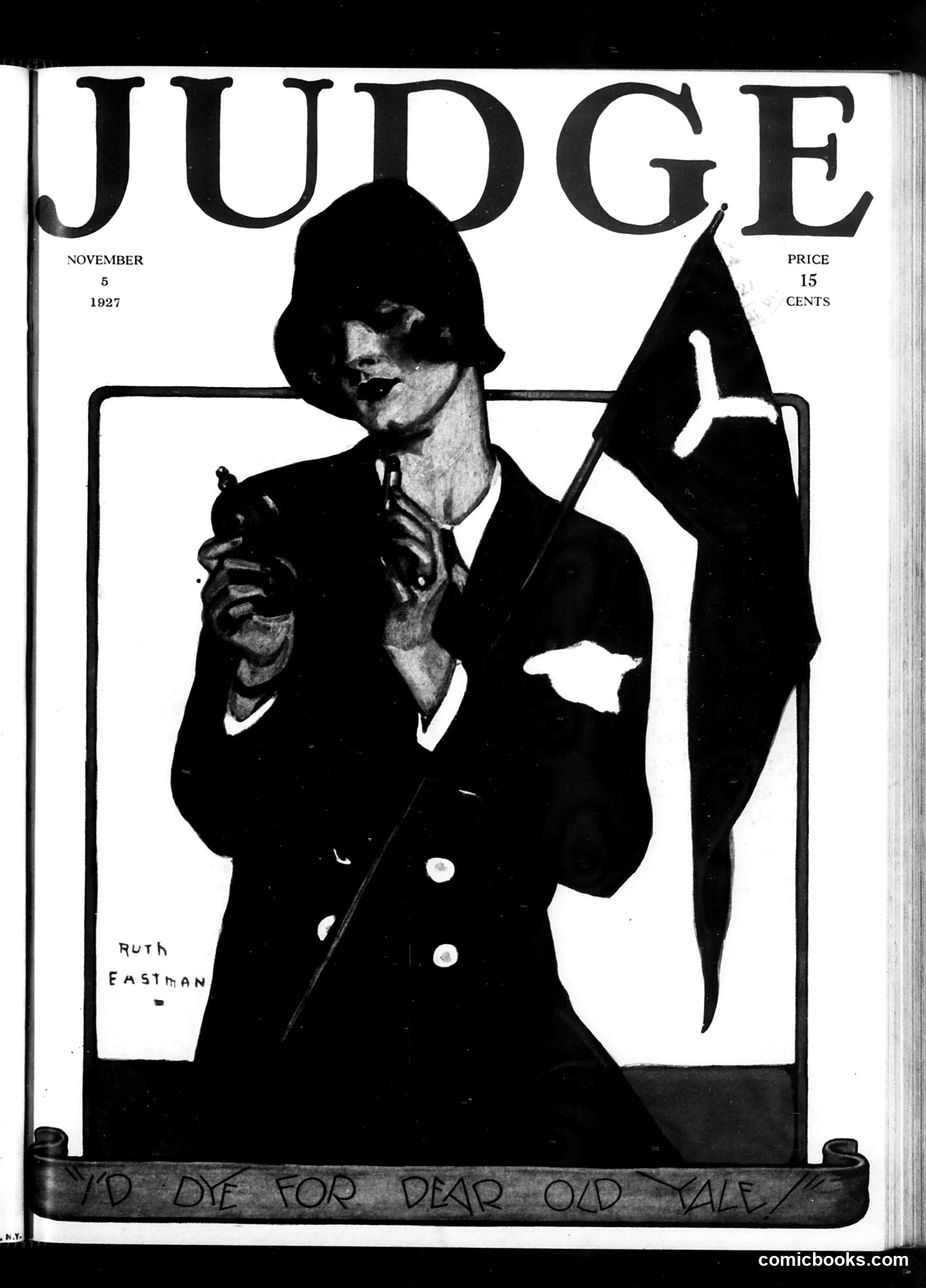
This cover by Ruth Eastman depicts a fashionable woman in 1920s attire—cloche hat, double-breasted coat, and elegant gloves—holding what appears to be a small dog or similar object. She carries a flag, suggesting patriotic or political themes. The caption reads "Old Die For Dear Old Yale," likely referencing Yale University and possibly relating to collegiate traditions or alumni loyalty. The figure's stylish presentation and the magazine's satirical nature suggest the cartoon comments on contemporary upper-class American society, possibly mocking either excessive patriotism, college elitism, or the fashionable affectations of wealthy women during the Jazz Age. The specific political or social reference remains unclear without additional context.
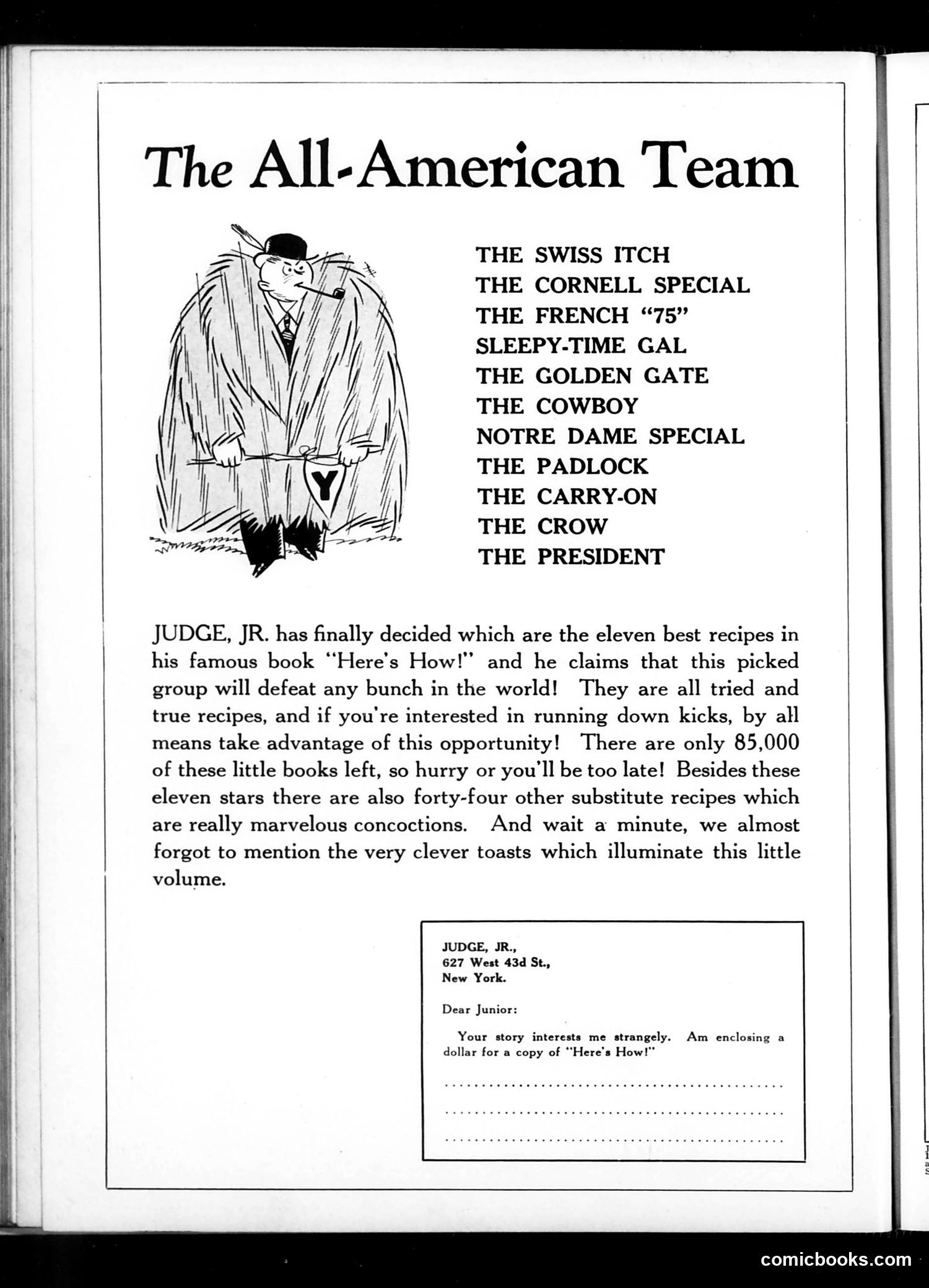
This page advertises Judge Jr.'s cocktail recipe book "Here's How!" The cartoon features a portly gentleman in a coat labeled "Y" (likely representing "Judge" itself or a wealthy establishment figure), presented as the authority on mixing drinks. The eleven recipes are humorously named after American institutions and concepts—"The Cowboy," "Notre Dame Special," "The President"—suggesting that cocktail recipes are as fundamental to American identity as these cultural touchstones. This is satirical commentary on Prohibition-era drinking culture, where cocktails became illicit status symbols. The mock-serious tone claiming these recipes will "defeat any bunch in the world" parodies competitive American boosterism. The advertisement itself is the joke: treating cocktail recipes with inflated importance reflects both Jazz Age excess and Judge magazine's satirical sensibility about American consumer culture.
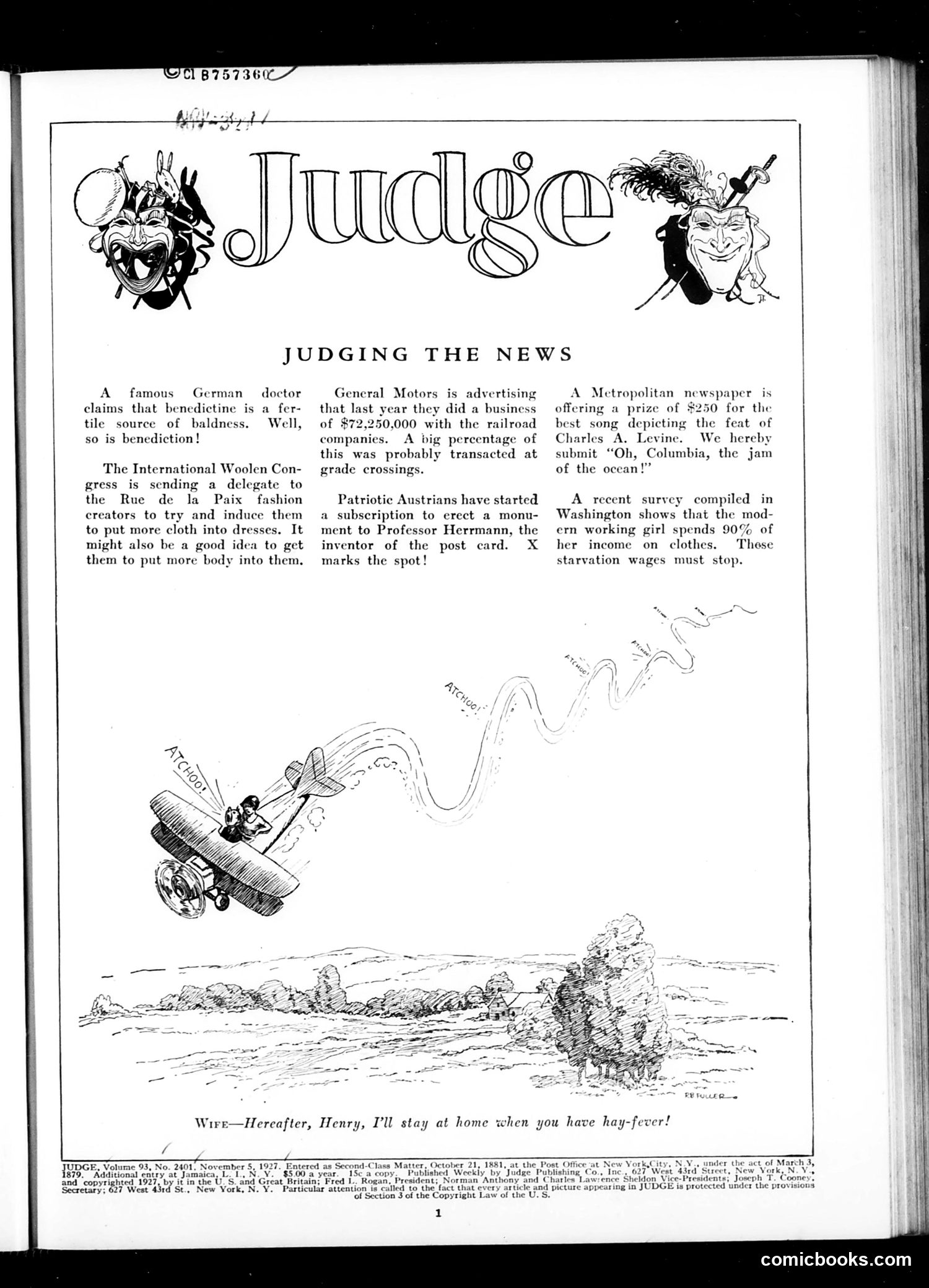
The main cartoon depicts an early airplane with "RECORD" marked on it, piloted by someone writing a wavy line across the sky labeled "RECORD." Below, a wife tells her husband Henry she'll "stay at home when you have hay-fever!"—a pun on "hay-fever" versus "Hereafter." This satirizes contemporary aviation record-breaking attempts, which were frequent headlines in the 1920s. The joke plays on Henry's apparent aerial exploits and hay-fever complaints. The "Judging the News" section above contains brief satirical items about contemporary topics: a German doctor's baldness cure, General Motors' railroad business, Austrian monument-building, and a survey about working women's clothing expenses. The overall tone mocks modern consumer culture and contemporary news stories through light ridicule.
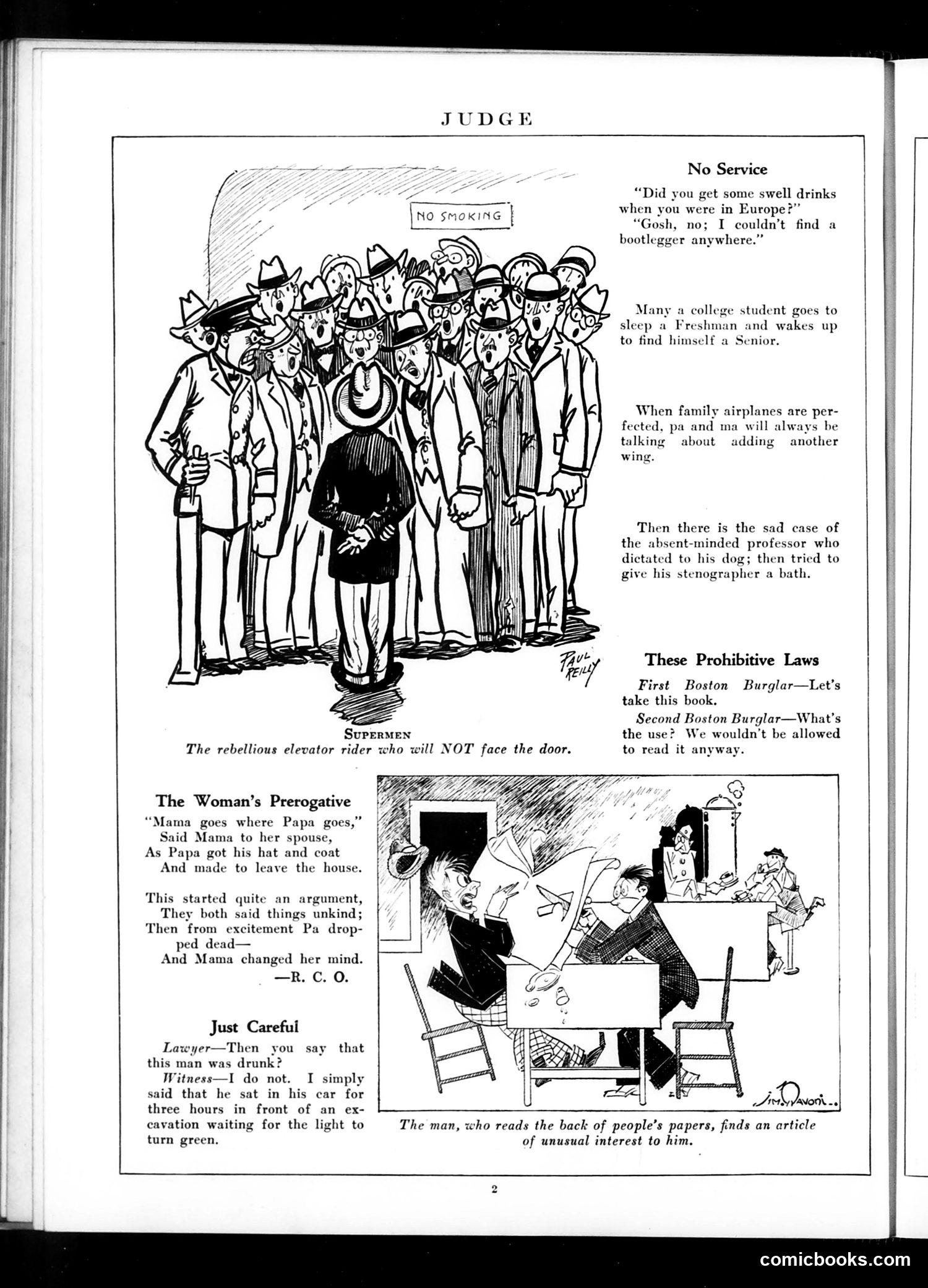
This page contains several unrelated humorous vignettes typical of 1920s-era satirical magazines: **"Supermen"** depicts Prohibition-era bootleggers in a group, with a "No Smoking" sign—likely satirizing their lawlessness and hypocrisy during Alcohol Prohibition (1920-1933). **"No Service"** jokes about post-WWI travel; the speaker couldn't find bootleg alcohol in Europe. **"The Woman's Prerogative"** satirizes changing gender dynamics—a wife asserts independence by refusing to follow her husband's lead, causing marital conflict. **"Just Careful"** presents a lawyer's dubious testimony about a drunk driver, mocking legal evasiveness. **"These Prohibitive Laws"** criticizes censorship of controversial books in Boston. The cartoons reflect 1920s concerns: Prohibition enforcement, gender role shifts, legal corruption, and literary censorship.
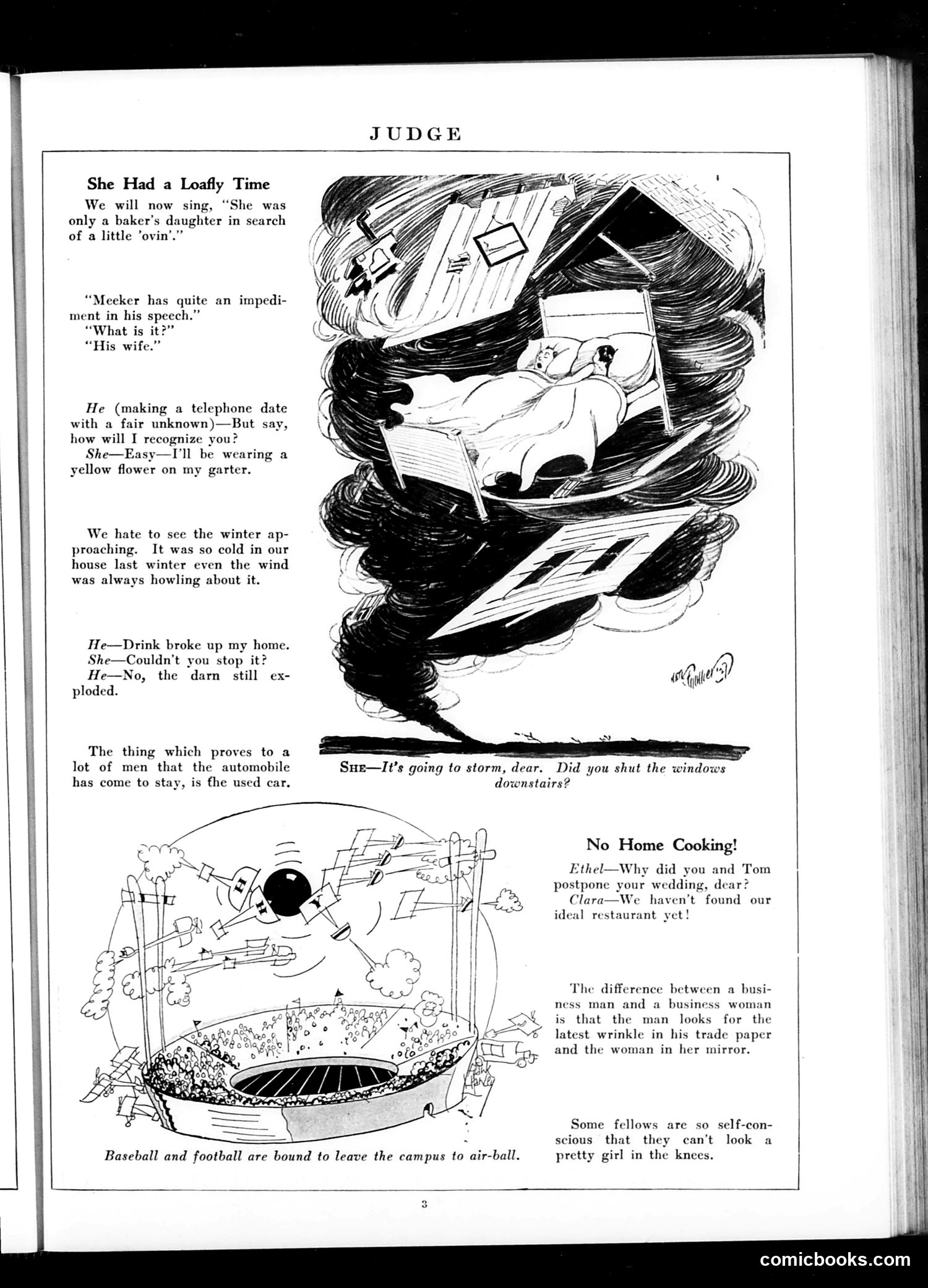
This page contains several unrelated satirical humor pieces typical of Judge magazine's format: **"She Had a Loafly Time"** presents a dialogue joke about a baker's daughter seeking romance, with the punchline involving a telephone date and a yellow flower on a garter—playing on the phrase "loaf" (bread/romance). **"No Home Cooking!"** jokes about a couple postponing their wedding because they haven't found their "ideal restaurant," satirizing the modern trend of dining out rather than cooking at home. The illustrations and scattered jokes mock early 20th-century domestic life, gender roles, and changing social habits. The baseball stadium cartoon suggests sports are replacing domestic activities. These are generic humor pieces with no apparent political figures or specific historical references—just social commentary on contemporary American customs.
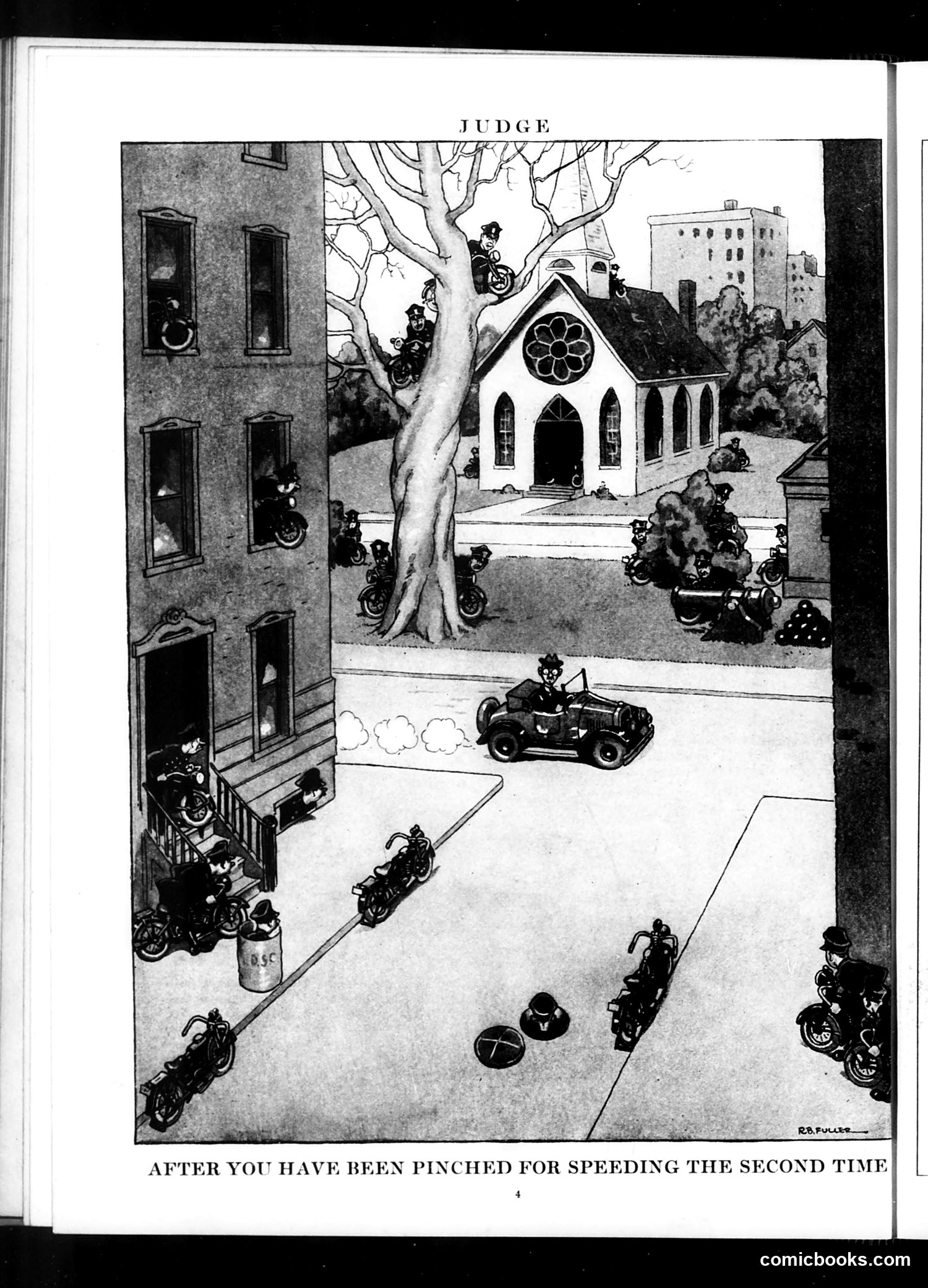
This satirical cartoon, titled "After You Have Been Pinched for Speeding the Second Time," depicts a chaotic urban street scene where motorcyclists have taken over a city block—climbing trees, perching on buildings, and dominating the street—as apparent punishment for traffic violations. The satire critiques the consequences of repeated speeding arrests: rather than deterring dangerous driving, the second offense seems to result in the offender joining an outlaw motorcycle gang or lawless biker culture. The imagery suggests that traffic enforcement fails to rehabilitate repeat offenders, instead driving them toward criminality and anti-social behavior. This reflects early 20th-century anxieties about motorcycles as symbols of recklessness and lawlessness, and satirizes ineffective judicial punishment.
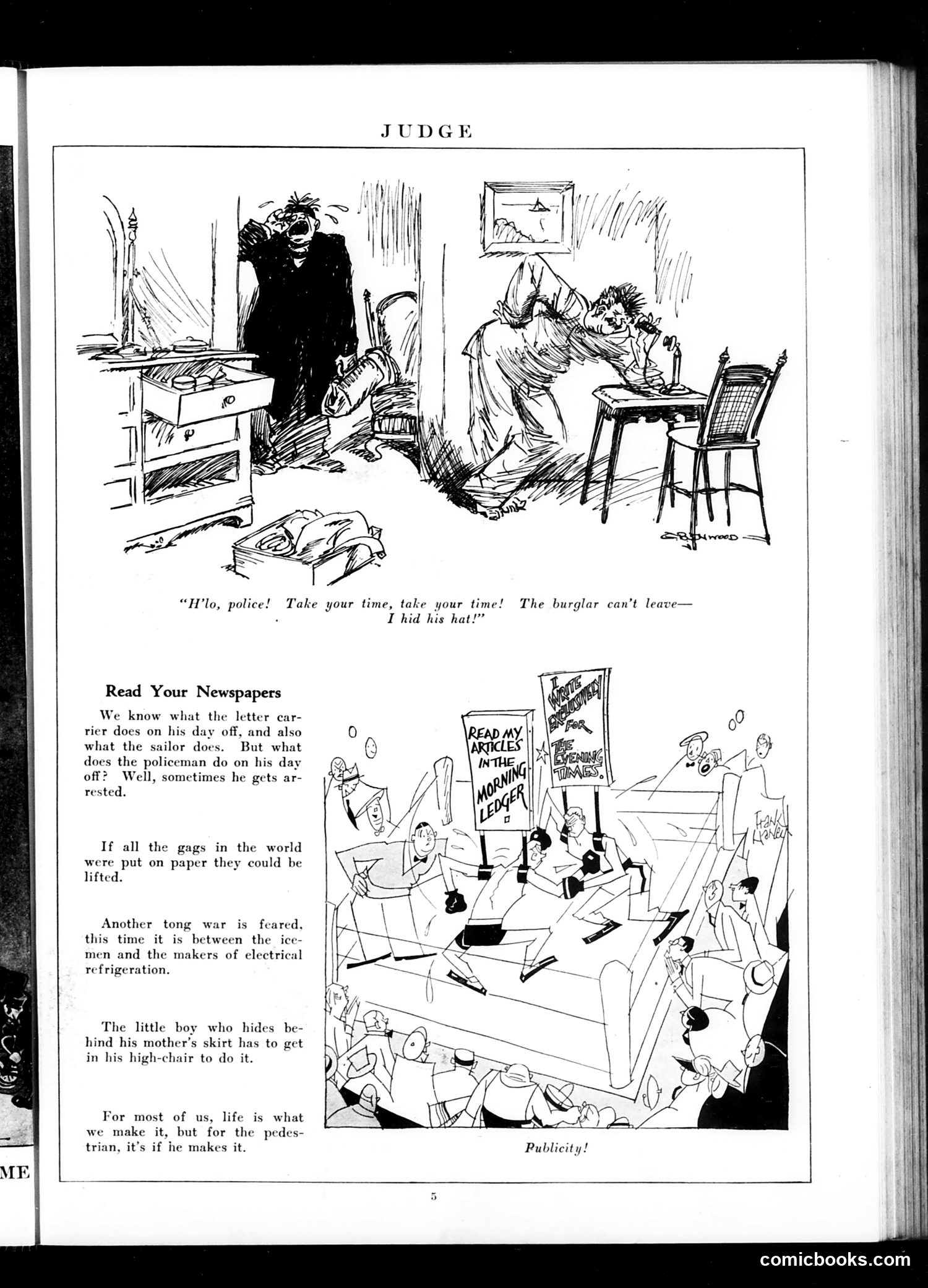
**Top Cartoon ("Judge"):** A woman calls police about a burglar, telling them "take your time"—because she hid his hat. The joke satirizes domestic life, suggesting wives use burglaries as excuses to delay husbands' departures or control household situations through absurd logic. **Lower Section ("Read Your Newspapers"):** This cartoon mocks newspaper reading culture and public attention spans. The crowded scene shows people reading newspapers with headlines like "Read My Articles in the Morning" displayed prominently. The satirical text beneath questions what various professions do on their days off, implying newspapers dominate leisure time. The overall theme critiques how newspapers have become an inescapable part of American daily life, even during supposed relaxation.
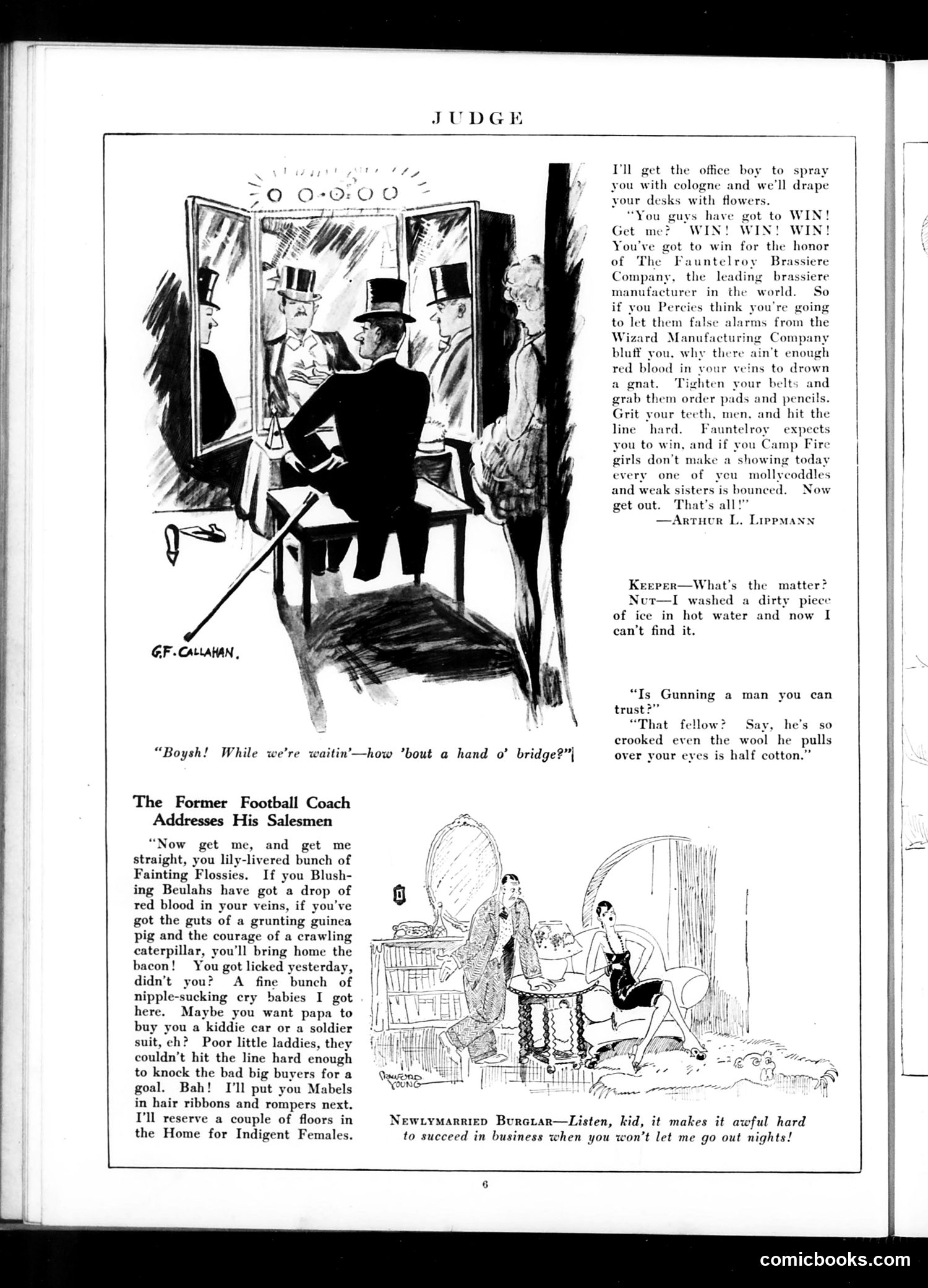
This page contains three satirical pieces mocking early 20th-century American business culture. **Top cartoon** (by G.F. Callahan): Shows men in top hats playing bridge. The caption "Boosh! While we're waitin'—how 'bout a hand o' bridge?" satirizes wealthy businessmen's leisure priorities—they gamble during work hours. **Middle section**: A former football coach, now sales manager for "Fauntelroy Brassiere Company," delivers an aggressive pep talk to his salesmen. The satire mocks masculine business culture: the coach uses military/sports language ("bring home the bacon," "hit the line hard") and insults his workers' manhood ("lily-livered," "cry babies," "Mabels in hair ribbons"), all to sell brassieres. The humor lies in applying hypermasculine rhetoric to an inherently feminine product—the absurdity exposes how toxic this management style was. **Bottom section**: Two brief jokes about dishonesty in business and marriage—supporting the page's theme of deception and dysfunction in commercial life. The overall message critiques aggressive sales culture and its dehumanizing effects on workers.
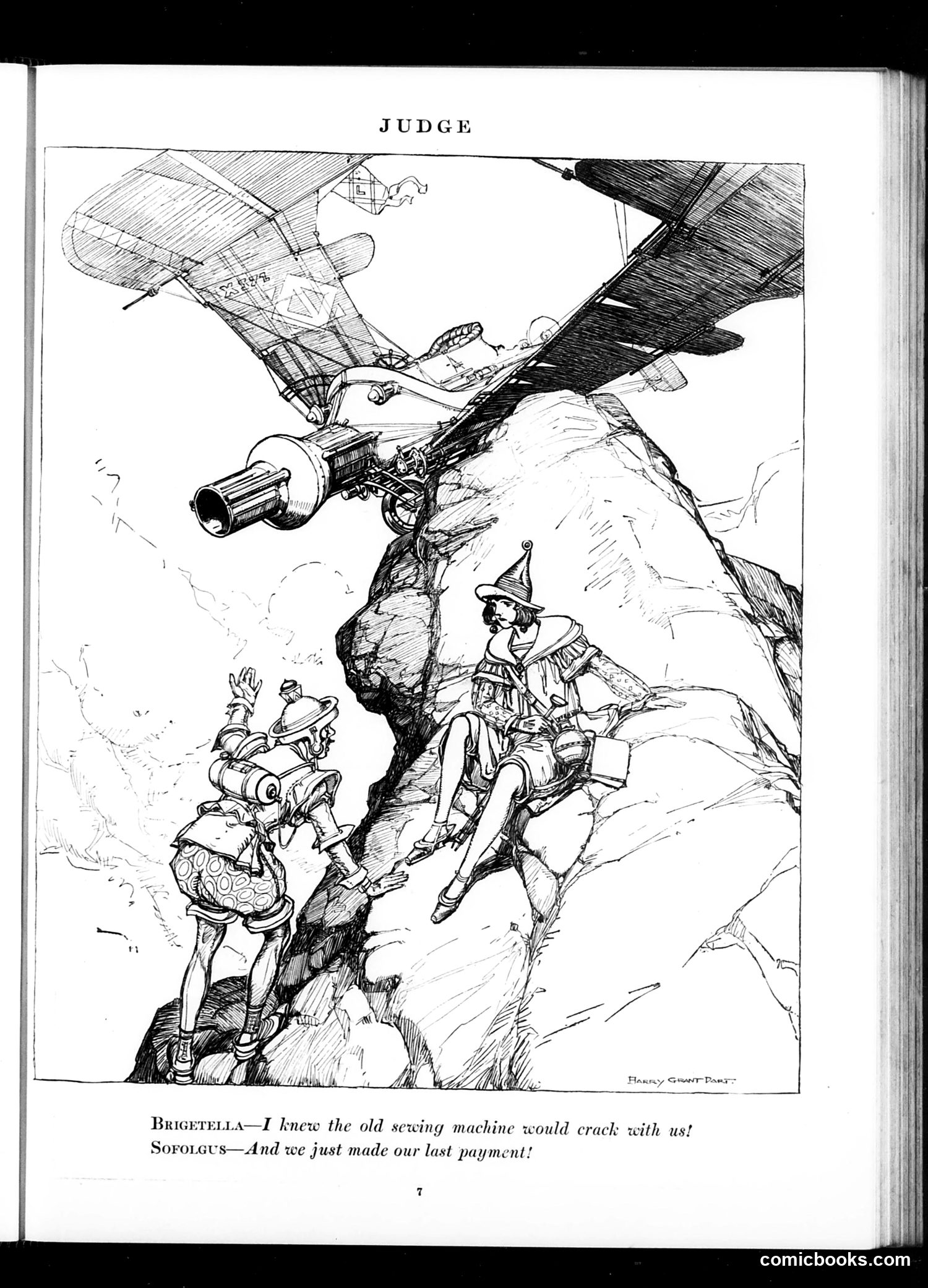
This political cartoon satirizes financial hardship during wartime. Two characters—identified as Brigetella and Sofocius (likely allegorical names representing common people or specific nationalities)—stand amid ruined machinery and military debris. They're surrounded by crashed aircraft and military equipment, suggesting a war-torn landscape. The humor is darkly ironic: they've just finished paying off an old sewing machine when it breaks, right as their world literally crumbles around them with warfare and destruction. The joke critiques the cruel timing of financial obligations—they've sacrificed to complete a payment, only to face far greater losses from war. Without a visible date, the specific conflict is unclear, though the aviation technology and style suggest early-to-mid 20th century. The cartoon illustrates how ordinary civilians suffered both materially and financially during wartime conflicts.
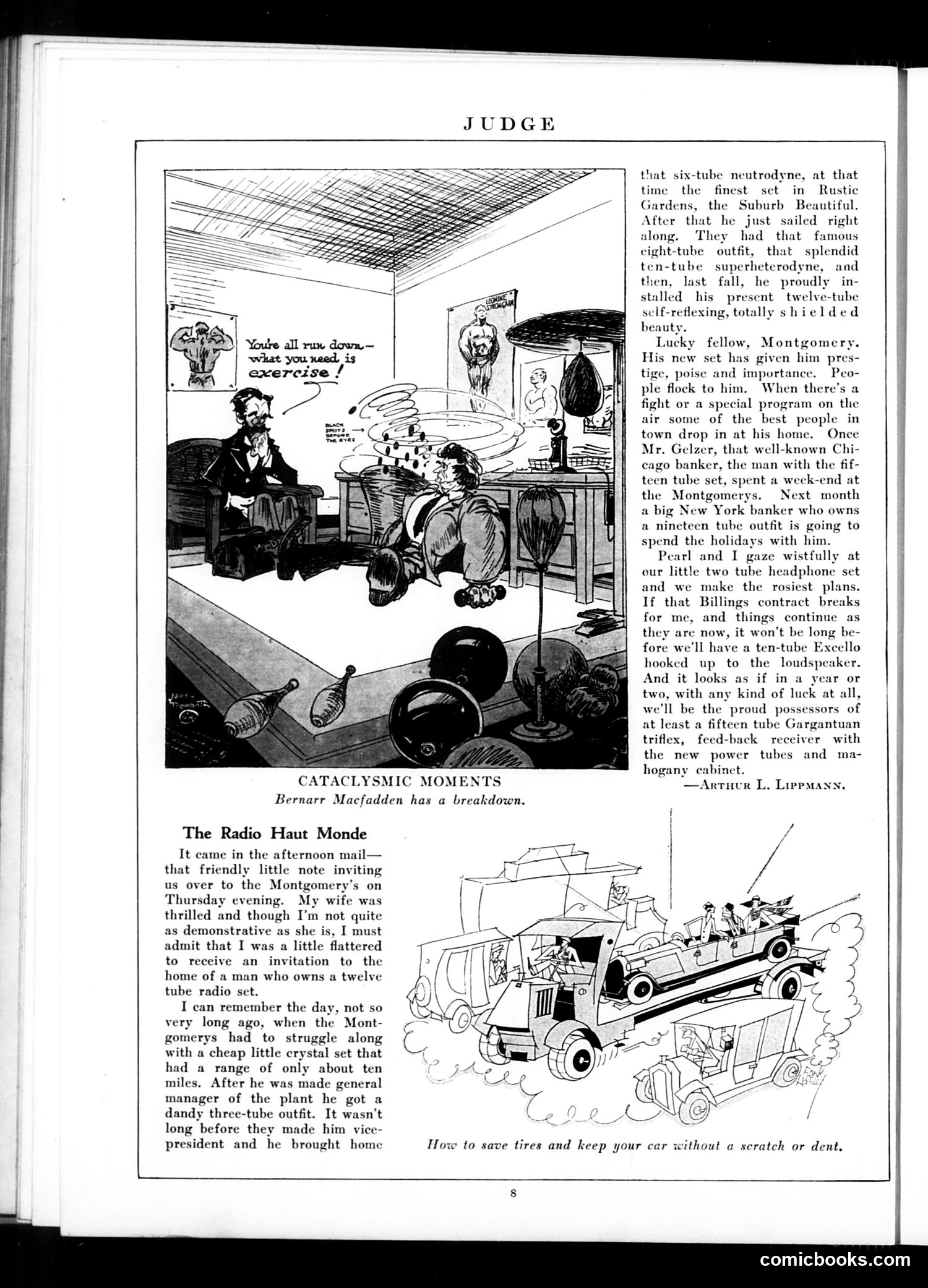
This page satirizes 1920s American consumerism and social climbing through radio ownership. The main cartoon "Cataclysmic Moments" shows Bernarr Macfadden (famous fitness promoter) having a breakdown, likely mocking his extreme health philosophies. The larger piece "The Radio Haut Monde" (French for "high society") ridicules how radio sets became status symbols. A narrator describes how his neighbor Montgomery gained social prestige and attracted wealthy visitors by progressively upgrading from cheap crystal sets to increasingly expensive tube radios (6-tube, then 10-tube, now 12-tube models). The satire suggests that owning the latest radio technology—not character or actual accomplishment—now determines social standing. The narrator envies Montgomery's newfound importance and dreams of eventually affording a comparable set himself, exposing the absurdity of valuing people based on their possessions rather than their merit.
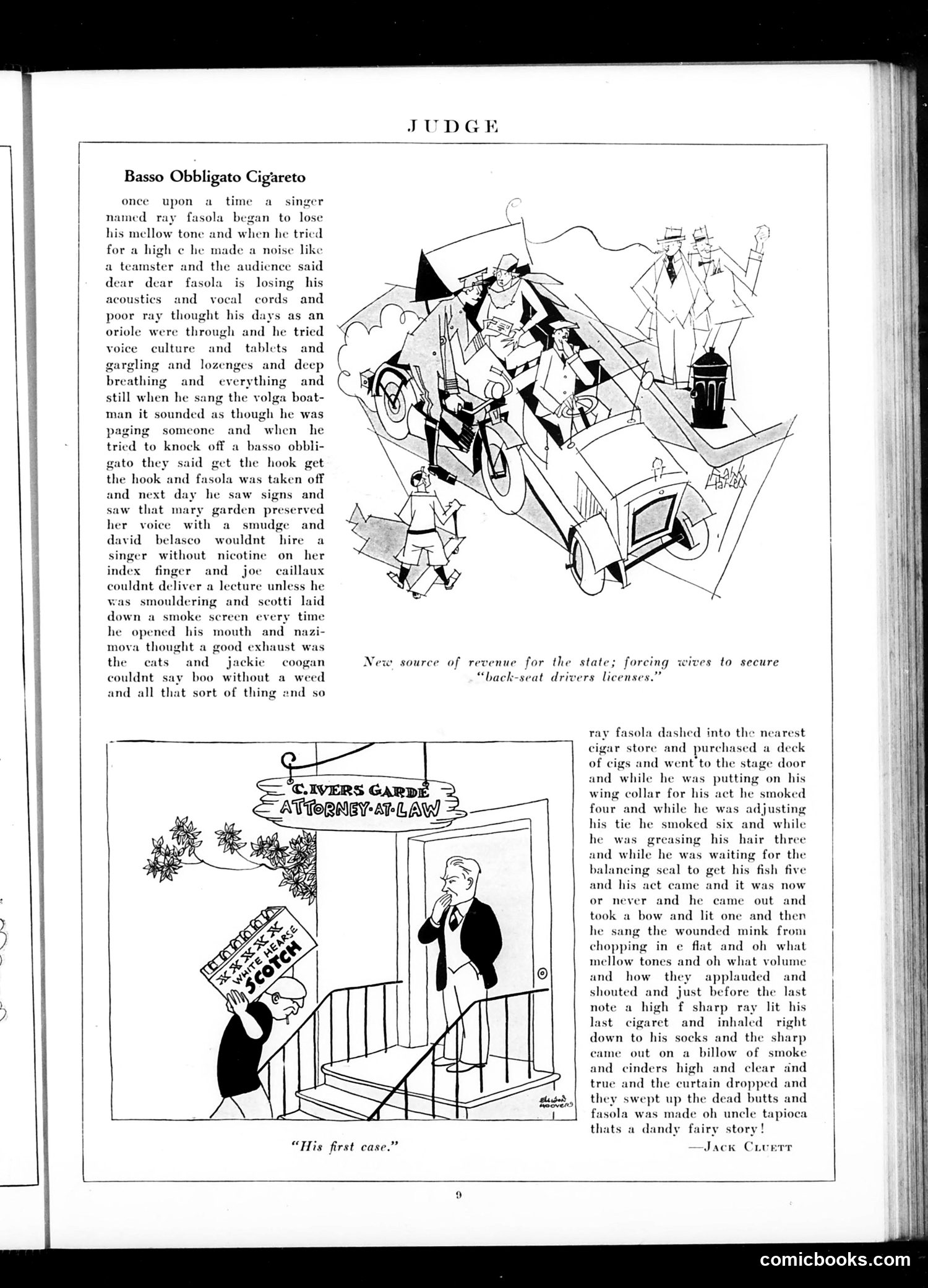
This page satirizes the 1920s cultural obsession with cigarette smoking as a symbol of sophistication and success. The top story mocks opera singer "Ray Fasola," whose voice deteriorates until he discovers that famous performers—Mary Garden, David Belasco, Scotti, and others named—preserve their talent *through* smoking. After adopting cigarettes, Fasola's voice miraculously returns, and he becomes a star. The satire targets the absurd cigarette advertising claims of the era, which associated smoking with elegance, vocal power, and professional achievement. The story is intentionally ridiculous to expose how ridiculous these marketing claims were. The lower cartoon shows "Civers Garde, Attorney-at-Law"—a play on legal practice—with a caption about wives securing "back-seat drivers licenses," satirizing attempts to regulate women drivers, another 1920s social anxiety. Both pieces mock contemporary cultural anxieties and commercial hype.
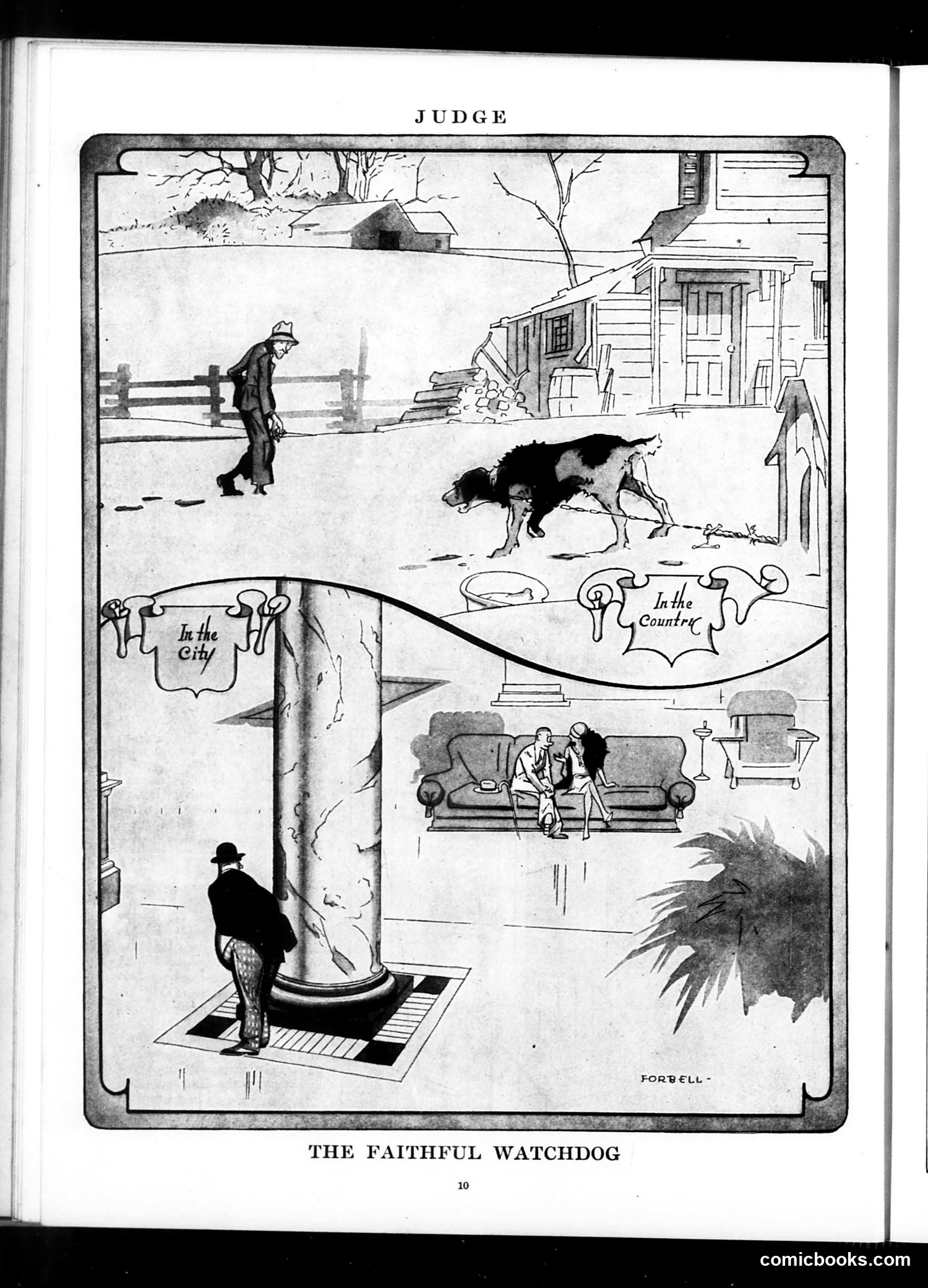
This is a single-panel cartoon depicting contrasting scenes of a dog's behavior. The top half shows a rural setting where a dog actively guards a farmhouse and property against an intruder, appearing vigilant and protective. The bottom half shows an urban interior where the same dog sits passively near a man in formal dress, seemingly indifferent to his presence. The cartoon's title and split composition suggest social commentary on how urban domestication changes animal (or perhaps human) nature. The contrast between "In the City" and "In the Country" implies that city life makes watchdogs—and possibly people—complacent and less vigilant, while rural environments demand active protection and alertness. The cartoonist is Forwell (signature visible).
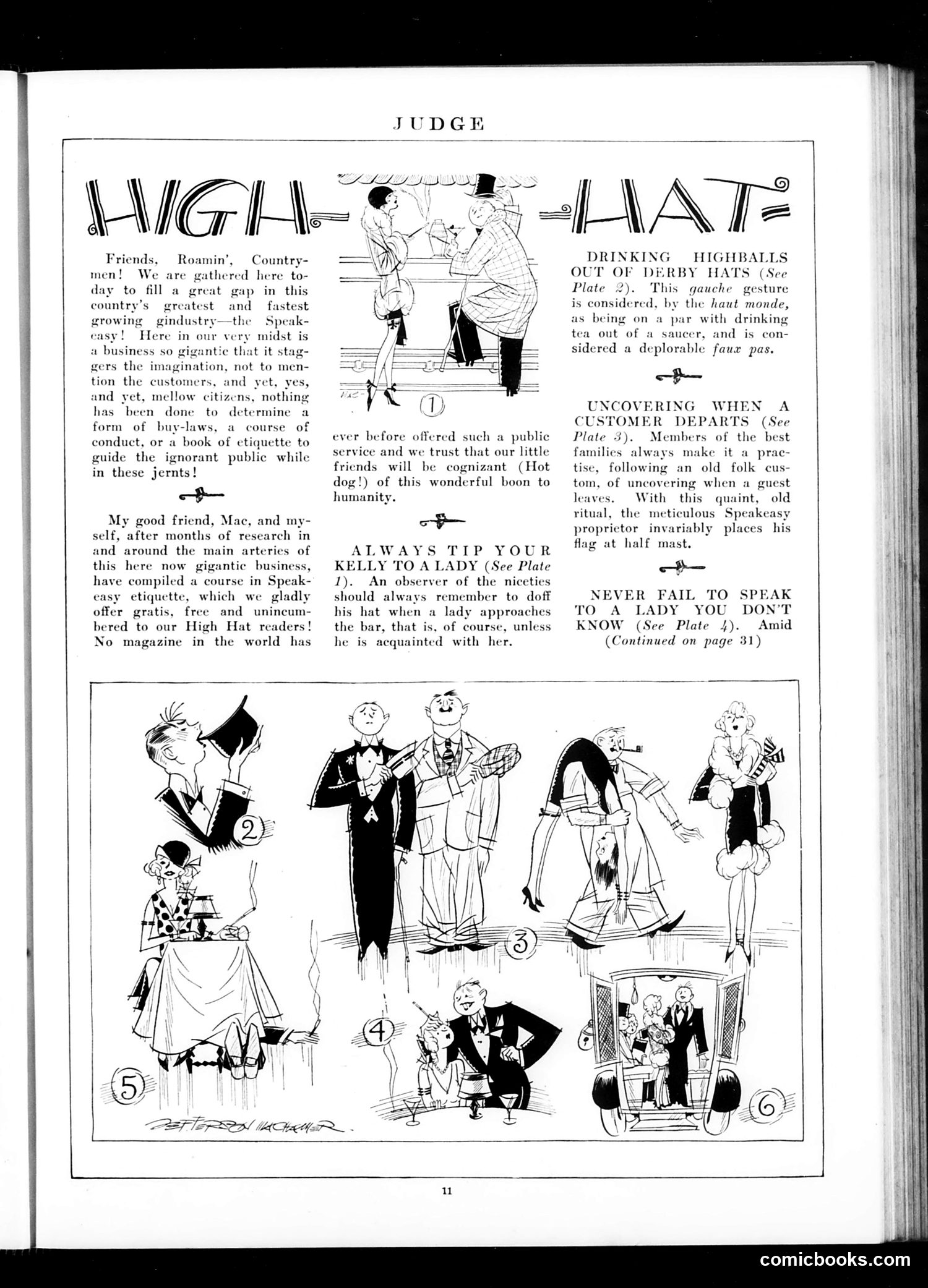
This satirical piece mocks the absurd "etiquette rules" supposedly governing behavior in speakeasies—illegal bars operating during Prohibition. Judge magazine presents a faux-instructional guide on proper conduct in these establishments, with accompanying cartoons illustrating six scenarios. The humor targets both the pretentiousness of high society attempting to maintain "civilized" behavior in fundamentally lawless venues, and the speakeasy culture itself. References include: tipping your hat to women at the bar, the gauche behavior of drinking from derby hats, "uncovering" (removing hats) when guests leave, and speaking to unknown women. The cartoons illustrate these absurd "rules," mocking the contradiction between formal etiquette and the illegal, chaotic nature of Prohibition-era drinking establishments. The satire suggests that speakeasy patrons—attempting to appear refined despite breaking the law—have created an ironically rigid social code for an inherently transgressive activity.
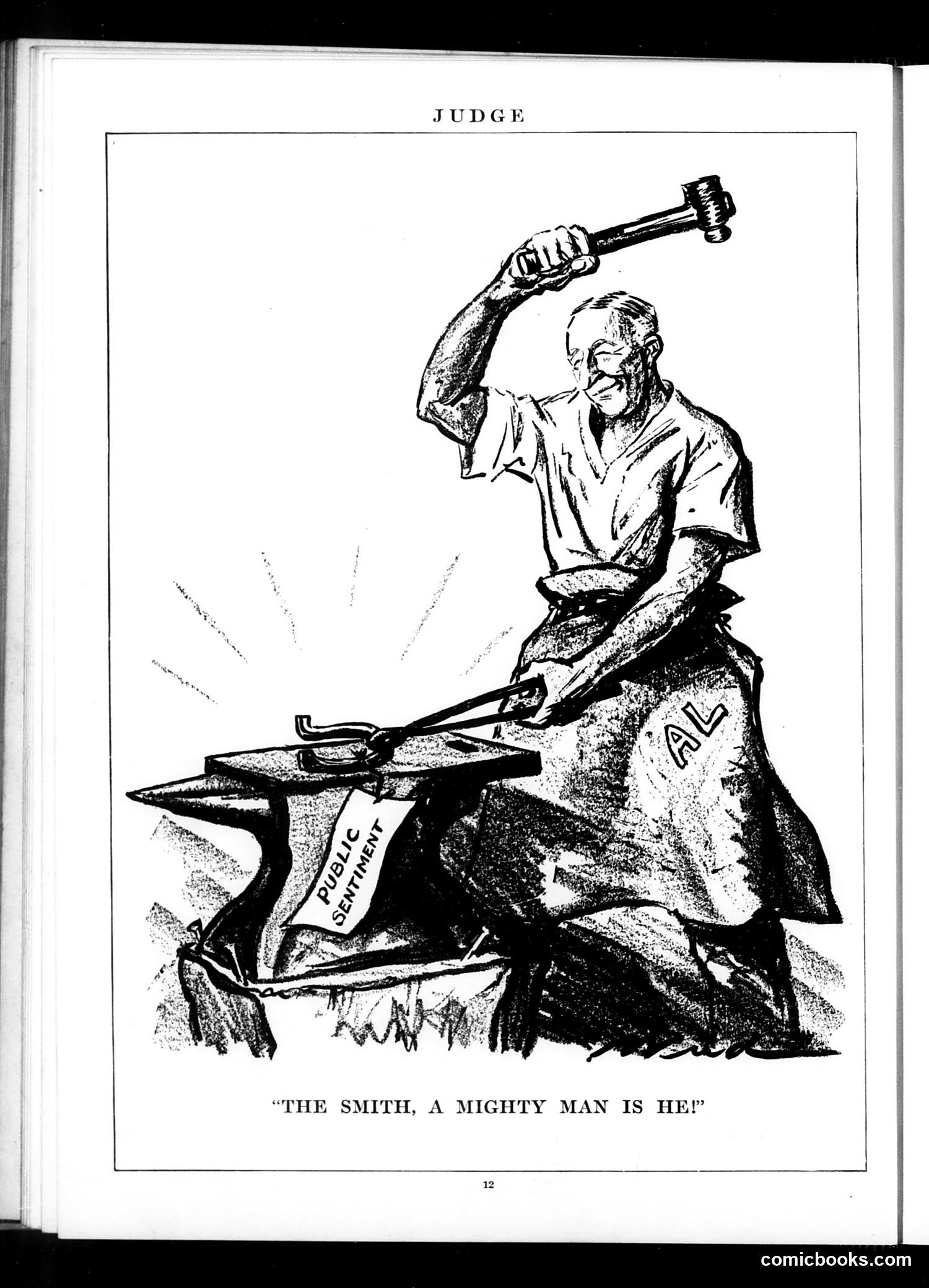
This Judge magazine cartoon depicts a blacksmith wielding a hammer above an anvil, striking what appears to be implements labeled "PUBLIC SENTIMENT" and "ALL." The image uses the traditional figure of the blacksmith as a metaphor for judicial or legal power—shaping public opinion and law through forceful action. The phrase "The Smith, a Mighty Man Is He!" suggests admiration for this authority figure's strength to forge policy or judgment. The radiating lines emphasize the power of the strike. Without additional context about the specific date and political circumstances, the exact target of satire remains unclear, but the cartoon appears to celebrate or critique judicial/executive power to shape public sentiment and broad societal outcomes through authoritative action.
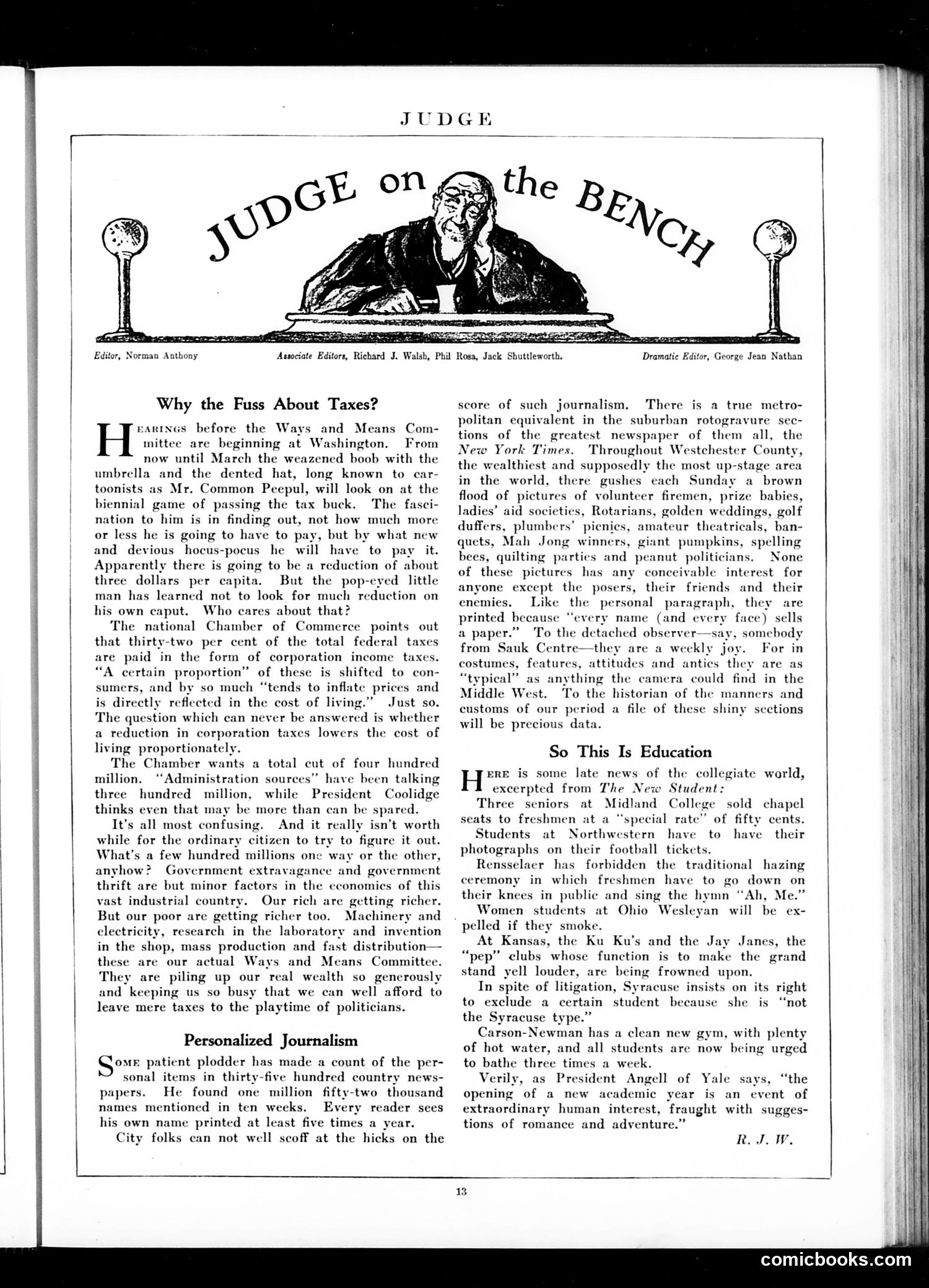
This satirical page from Judge magazine (circa mid-1920s) features three separate columns critiquing American institutions. **"Why the Fuss About Taxes?"** ridicules ordinary citizens ("Mr. Common Peepul"—depicted as a wide-eyed everyman figure) for failing to grasp tax policy debates. The editorial mocks both the Chamber of Commerce demands and political confusion, arguing that actual prosperity derives from technological progress and industrial efficiency rather than tax tinkering. **"Personalized Journalism"** satirizes small-town newspapers' obsession with printing residents' names to boost circulation. The piece ironically legitimizes this by noting even the prestigious New York Times publishes similar vanity content in Westchester County's society pages—wealthy suburbs aren't above the same practice. **"So This Is Education"** begins reporting collegiate absurdities: chapel seat auctions, football photo requirements, and overzealous "pep clubs." All three sections employ Judge's characteristic approach: urban-elite mockery of American mass culture and democratic institutions, blending cynicism with condescension toward both common people and commercial media practices.
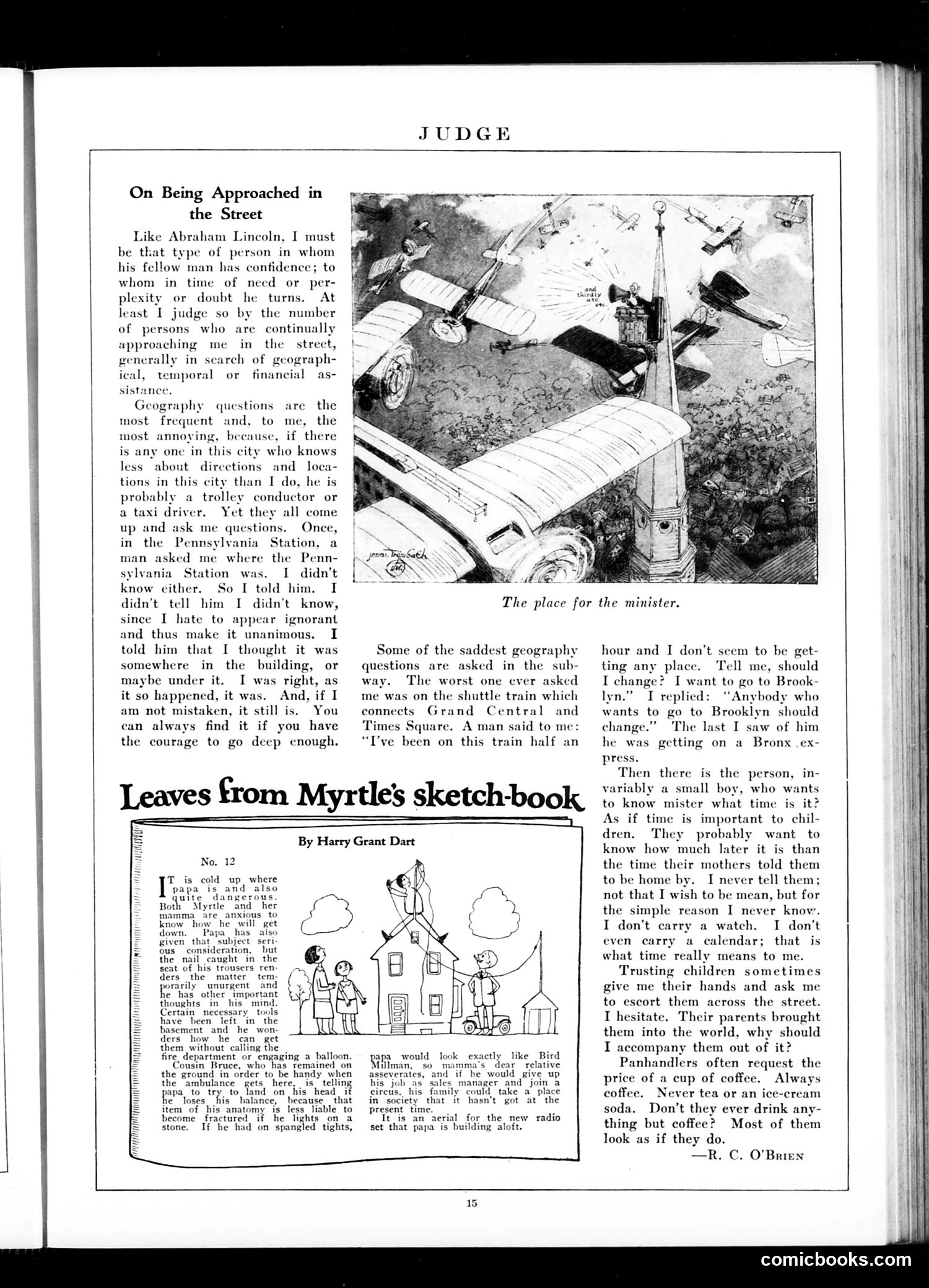
This page contains two distinct pieces of humor content: **"On Being Approached in the Street"** is a comedic essay by an unnamed author (signed R.C. O'Brien) about strangers constantly asking him for directions, the time, or money on city streets. The humor lies in his admission that he's remarkably unhelpful—he doesn't know directions, doesn't carry a watch, and pretends knowledge he lacks to avoid appearing ignorant. The Pennsylvania Station anecdote exemplifies this: asked where the Station is *while in it*, he makes a lucky guess. The piece satirizes both urban anonymity and the social anxiety of appearing foolish in public. **"Leaves from Myrtle's Sketch-book"** (No. 12) by Harry Grant Dart is a cartoon showing a child and mother stuck on a roof with papa attempting an aerial installation. The humor derives from the dangerous, chaotic situation—papa might land on his head; they're considering using a balloon or fire department. It's domestic slapstick comedy about DIY home projects gone absurdly wrong, typical of early 20th-century magazine humor.
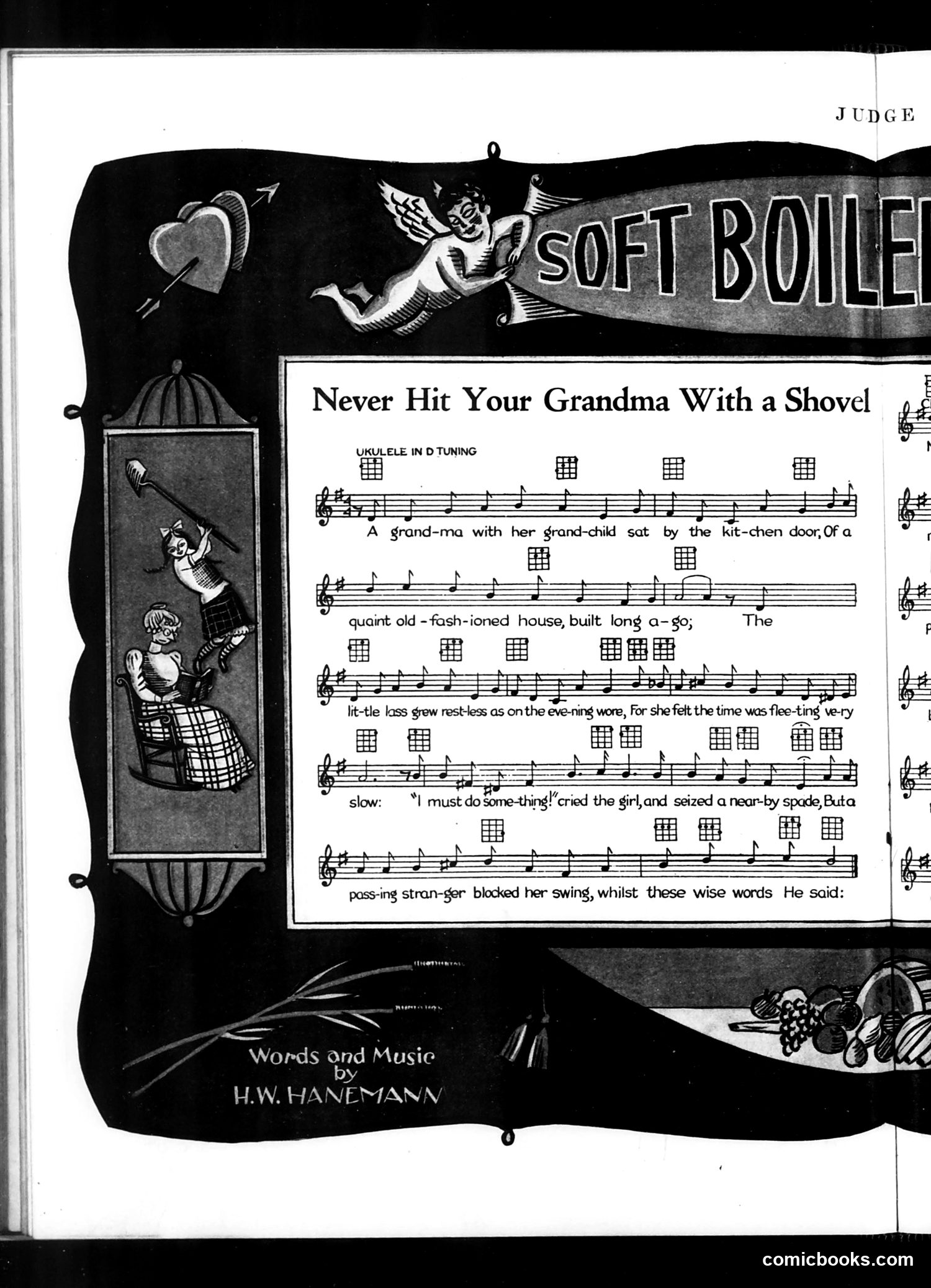
This is a humorous song sheet (words and music by H.W. Hanemann) rather than political satire. The page presents sheet music for a cautionary novelty song in ukulele tuning. The narrative describes a restless granddaughter visiting her grandmother's old-fashioned house. Frustrated with the slow pace of life, the girl grabs a nearby shovel to strike her grandmother, but a passing stranger intervenes, blocking the swing and delivering the titular moral lesson: "Never Hit Your Grandma With a Shovel." The joke relies on absurdist humor — presenting an obviously terrible action as though it requires stating. The decorative border features cherubic figures and domestic imagery (fruit, kitchen scenes), reinforcing the sentimental "grandma" theme. This type of novelty song was common entertainment in Judge during this era, mixing whimsy with mild social commentary about generational impatience and respect for elders.
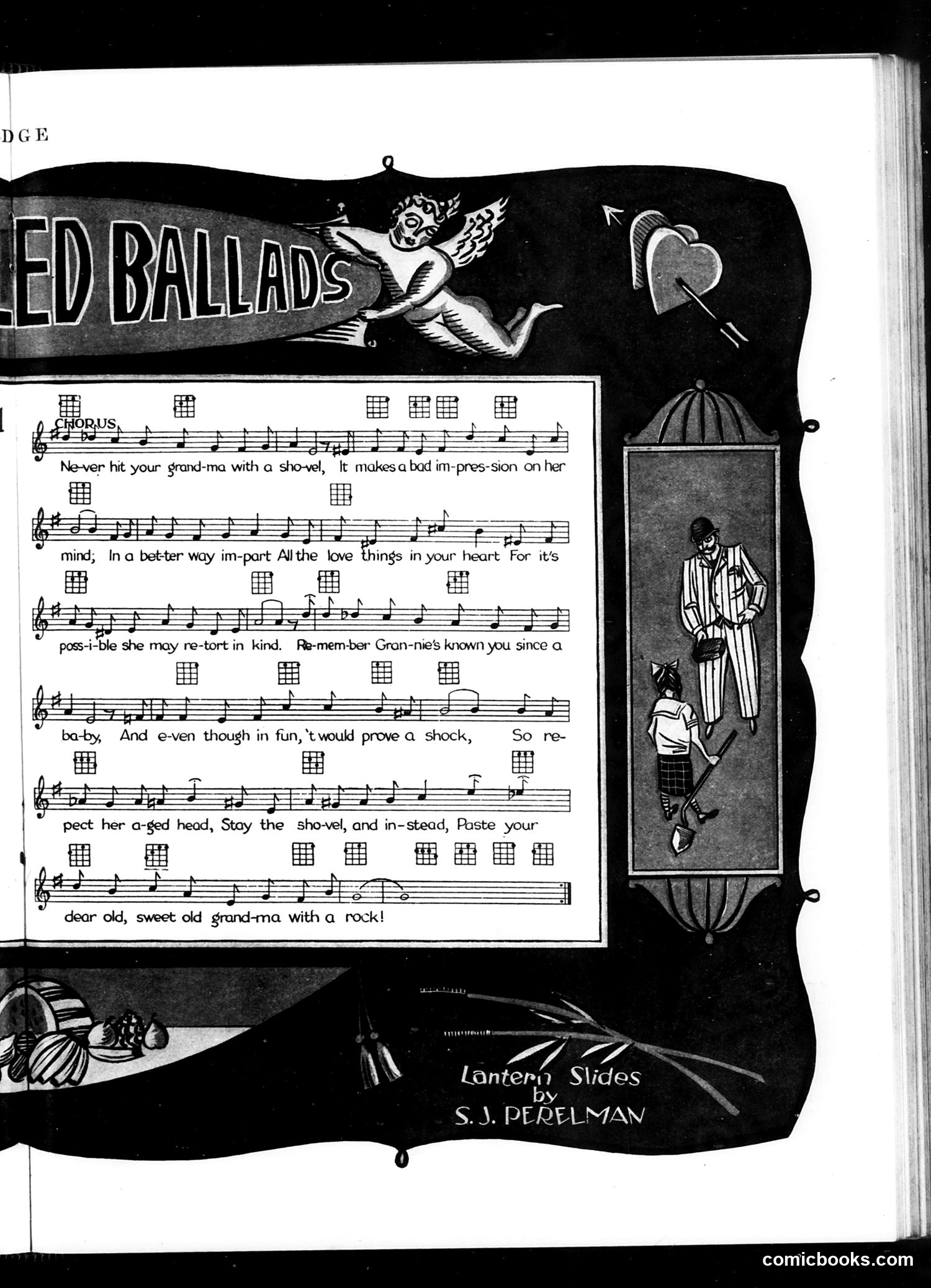
This page presents "Winged Ballads," a humorous song by S.J. Perelman with musical notation and accompanying illustration. The song is a comedic parody of sentimentality about respecting elderly relatives. The joke's premise is absurd: it "advises" against hitting one's grandmother with a shovel because it makes a bad impression, then suggests the "better way" is to hit her with a rock instead. This is deliberately nonsensical humor—the entire moral framework is inverted. The song pretends to offer respectful guidance toward grandmothers while actually describing violent acts, treating them as equivalent choices. The accompanying illustration shows a domestic scene with an adult and child, reinforcing the mock-didactic tone. The satire lampoons sentimental Victorian-era songs about family virtue by subverting their earnest moralizing with absurdist violence. This reflects Perelman's characteristic style of witty, surreal humor that deflates pretentiousness through illogical extremism.
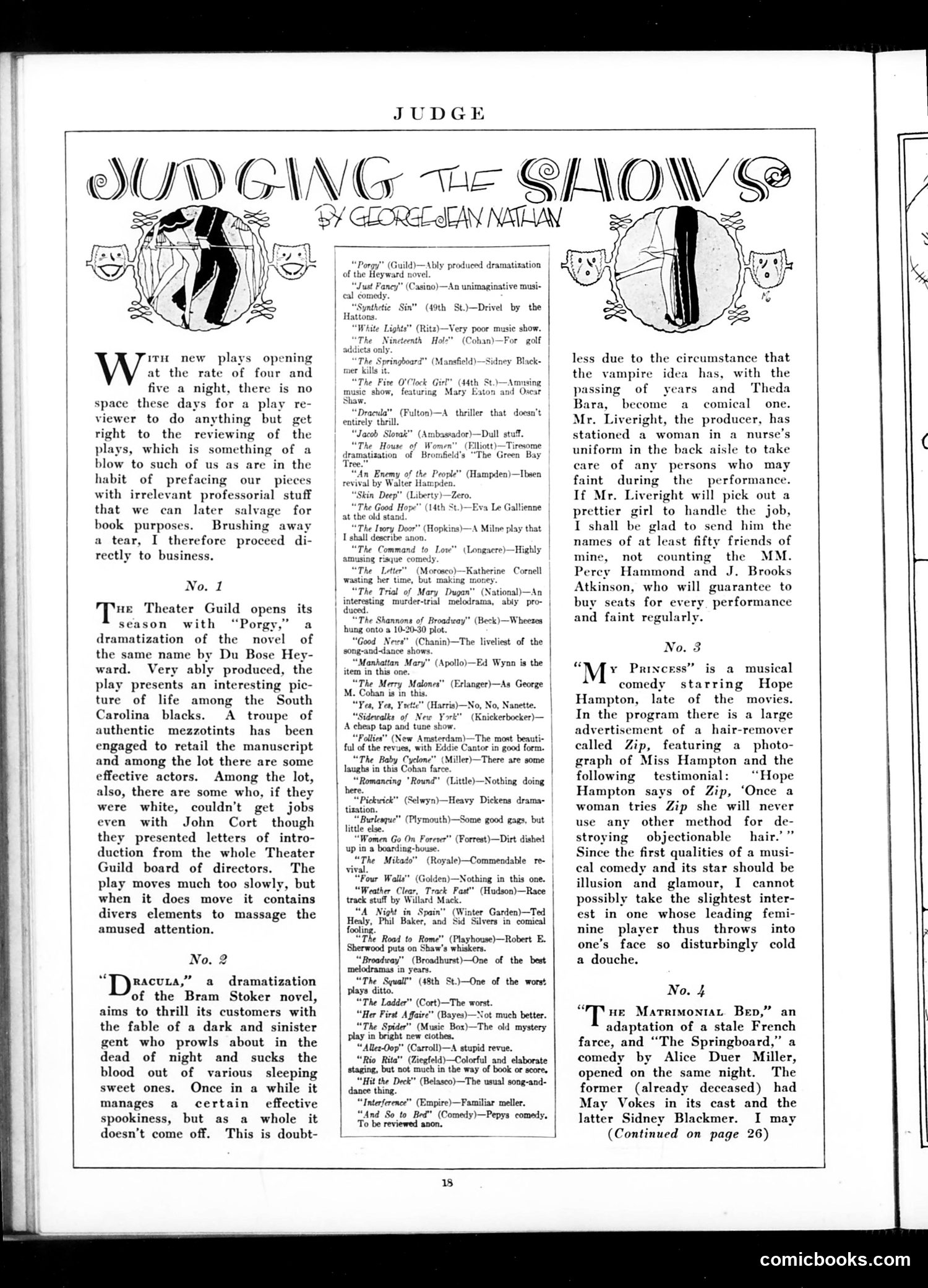
This page is a theater critic's rapid-fire reviews of Broadway plays opening during a busy season. The critic (Nathan, a prominent drama reviewer) apologizes for skipping his usual lengthy preamble due to the sheer volume of productions. Key reviews include "Porgy" (praised as well-produced despite slow pacing), "Dracula" (dismissed as ineffective despite occasional spookiness), and various other comedies, musicals, and dramas receiving brief verdicts—mostly negative. Nathan's tone is caustic: he calls one show "drivel," another "dull stuff," and "The Ladder" simply "the worst." The cartoons flanking the text appear decorative rather than satirical—ornamental theatrical masks and figures. This is straightforward theater criticism presented with Nathan's characteristic wit and brevity, not political satire. The "judge" of the title refers to Nathan's critical judgment of Broadway productions.
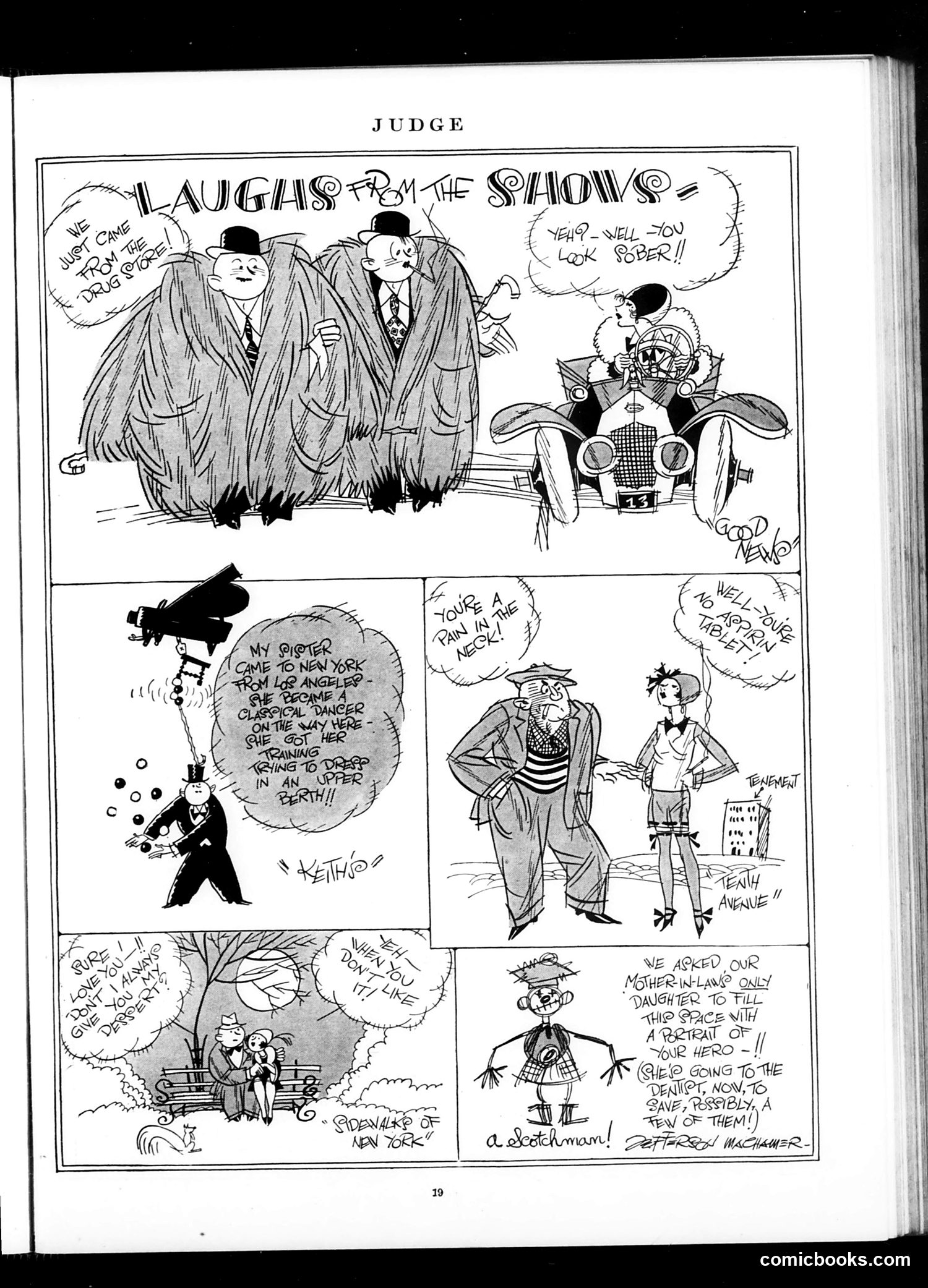
This page satirizes theatrical performances and their dubious quality. The top panel mocks actors with exaggerated features, laughing at "drug store" entertainment. Below, a character with a telescope watches performers, commenting on his sister's career as "a classical dancer" in Los Angeles—though he's uncertain if she'll "drop in an bath," suggesting questionable talent or morality. The subsequent panels feature encounters with theatrical types on city streets, discussing a portrait commission. The final panel shows a Scottish character, suggesting ethnic caricature typical of early 20th-century comedy. Overall, the cartoon ridicules theatrical pretension, amateur performers, and the entertainment industry's dubious standards, using physical caricature and dialogue to mock both performers and those associated with show business during this era.
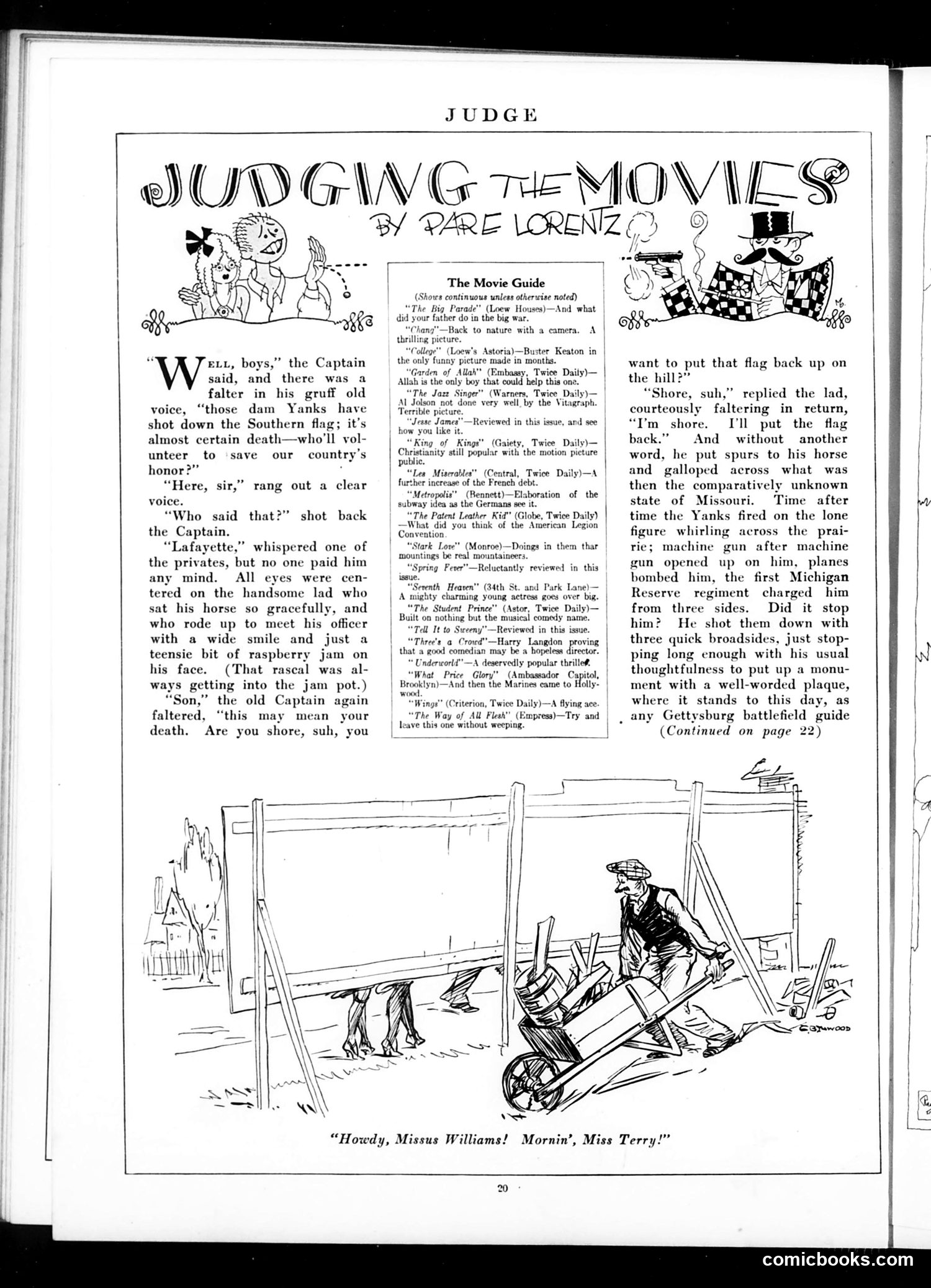
This page from Judge magazine combines two elements: a movie review column and an illustrated story about the Civil War. **The Movie Guide** (center box) is straightforward—brief, sarcastic reviews of 1920s films, including silent classics like Buster Keaton's work and the first "talking picture," *The Jazz Singer*. **The illustrated narrative** depicts a romanticized Civil War anecdote: a Southern captain asks for a volunteer to retrieve a fallen Confederate flag. A young soldier (Lafayette) volunteers and gallops across enemy lines while Union forces shoot at him. Despite being attacked from three sides, he survives, plants the flag, and erects a memorial plaque—the sort of dramatic "Lost Cause" mythology popular in early 20th-century American culture. The bottom illustration shows this soldier greeting women, captioned "Howdy, Missus Williams! Mornin', Miss Terry!"—suggesting he's now a local hero in the South. This reflects Judge's era: celebrating Confederate heroism was mainstream American sentiment, even in Northern publications. The page mixes contemporary entertainment criticism with nostalgia for romanticized antebellum mythology.
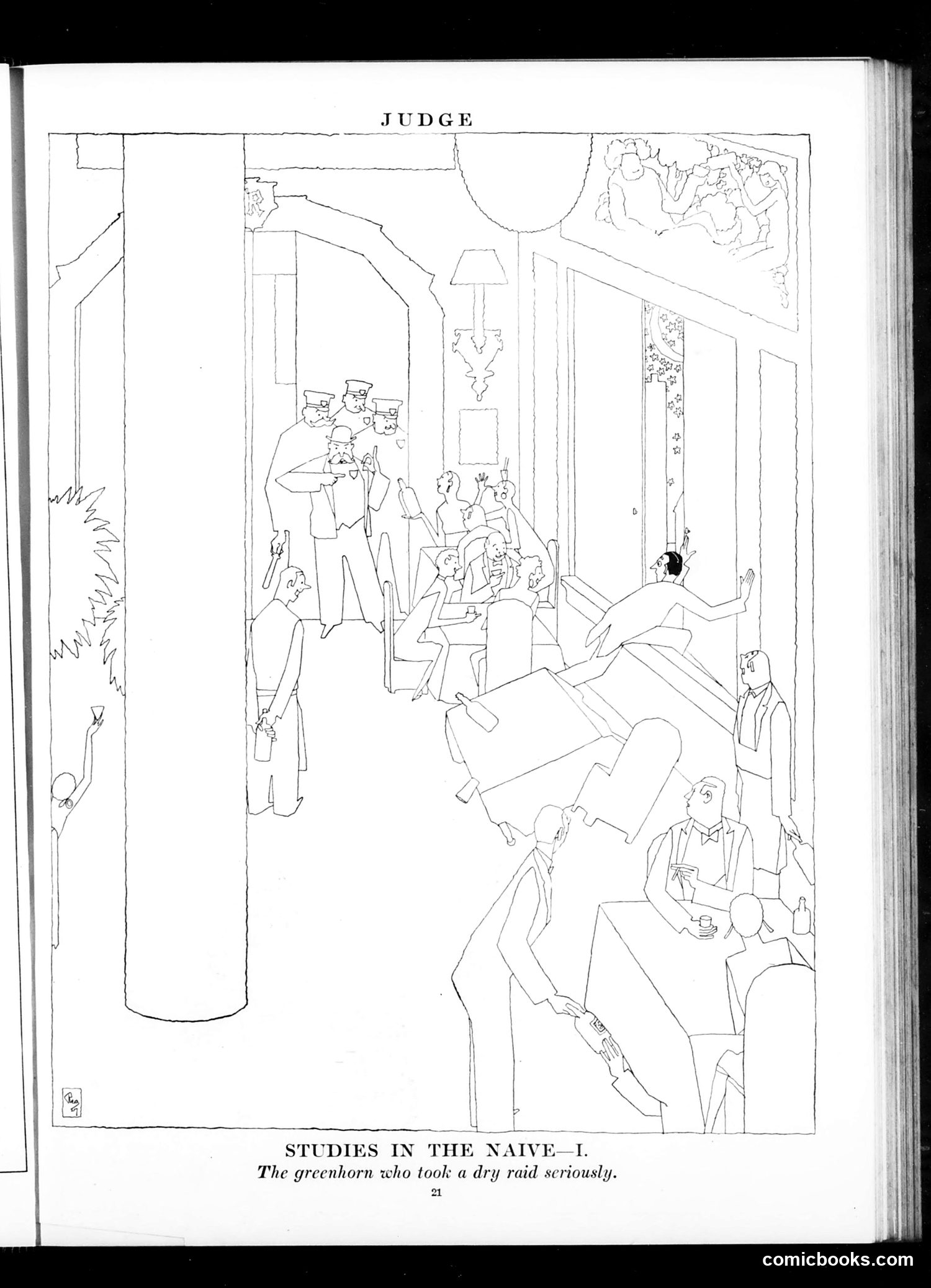
This is a satirical cartoon titled "Studies in the Naive—I: The Greenhorn Who Took a Dry Raid Seriously." The cartoon depicts what appears to be a Prohibition-era scene. A naive or inexperienced person (the "greenhorn") has apparently taken seriously some kind of "dry raid"—likely a police or federal prohibition enforcement action against illegal alcohol. The humor seems to derive from the contrast between this greenhorn's earnest response and the blasé attitudes of others in what appears to be a speakeasy or similar establishment. The cartoon suggests that experienced operators and patrons treated such raids as routine, almost comedic interruptions, while an unsophisticated newcomer panicked or overreacted to the event. The satire mocks both the greenhorn's naiveté and implicitly critiques the widespread casual disregard for Prohibition enforcement among urban populations during the 1920s-early 1930s.
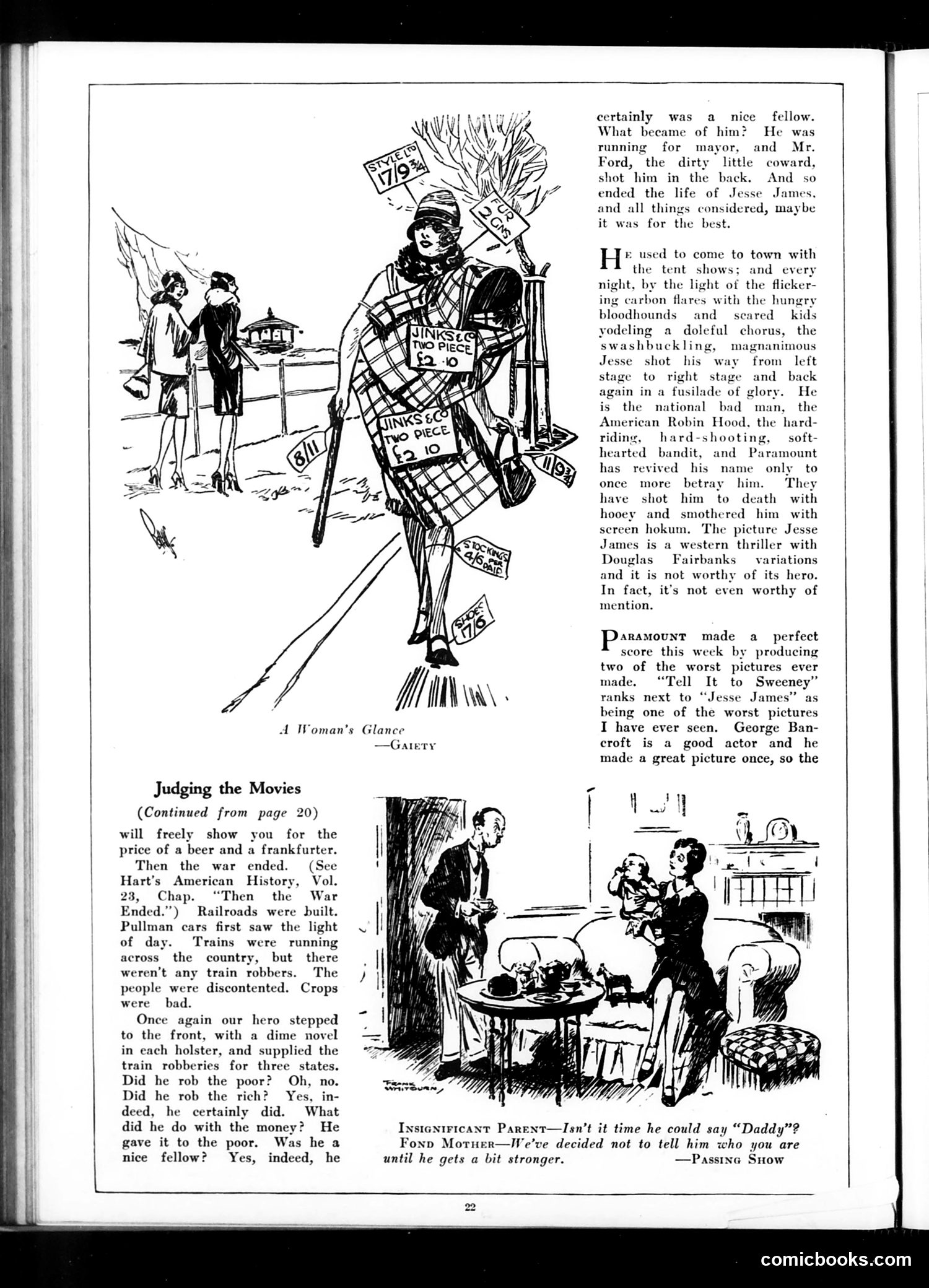
This page critiques early cinema Westerns, particularly Paramount's film adaptations. The main text attacks a "Jesse James" movie (likely the 1927 Fairbanks production), arguing it distorts the outlaw legend into "screen hokum." The author treats Jesse James as folklore—a Robin Hood figure who robbed the rich to aid the poor—then laments Hollywood has betrayed this romanticized image. The cartoon "A Woman's Glance" satirizes materialism: a fashionably dressed woman observes a ragged street performer weighted down with various show bills and price tags, suggesting entertainment has become purely commercial spectacle. The lower cartoon jokes about illegitimacy—a father hesitates to claim paternity until the child grows stronger, implying economic burden. It mocks class anxieties of the era. Together, the page reflects 1920s concerns about commercialization, authenticity in storytelling, and social respectability.
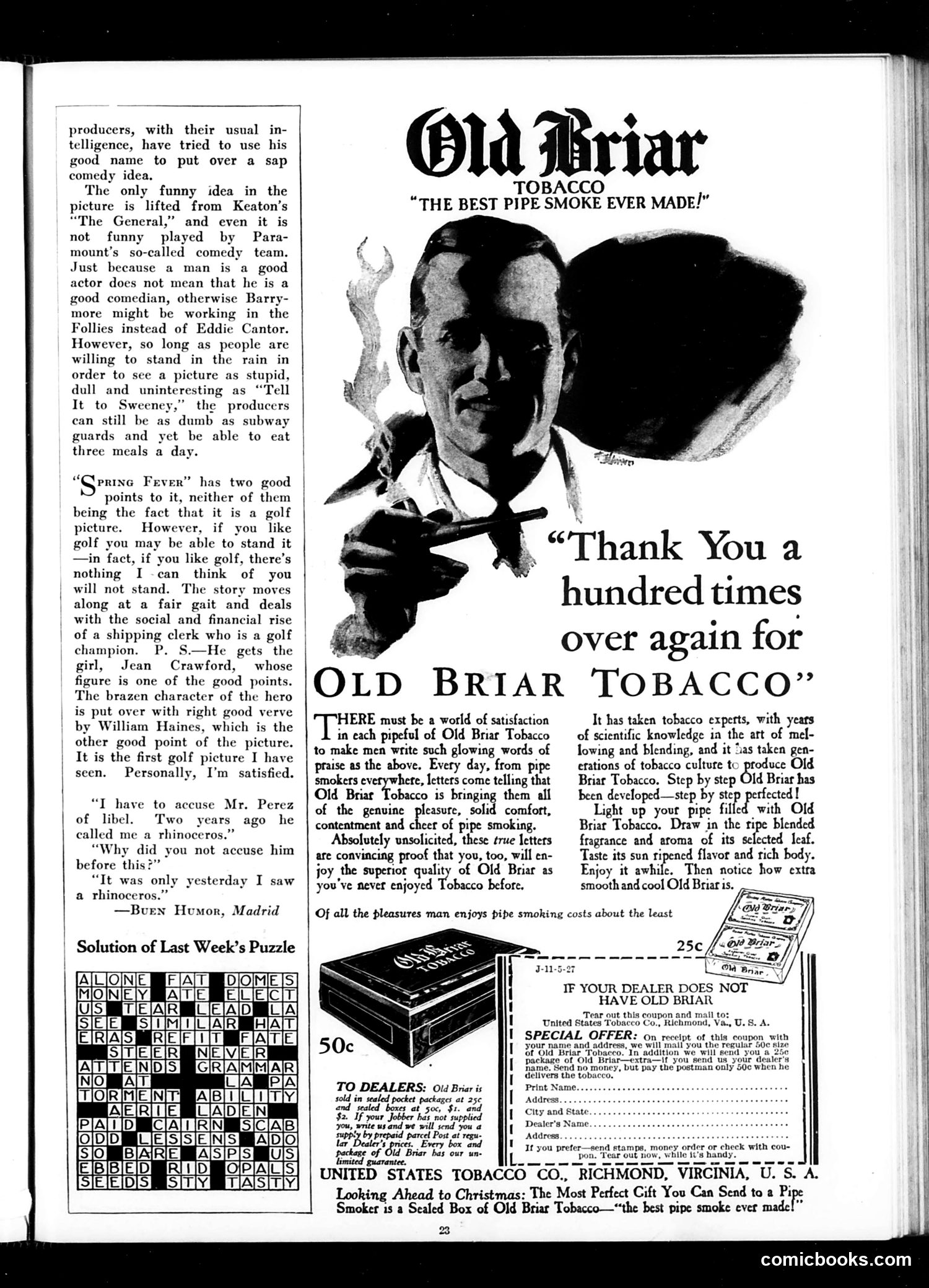
This page is primarily **advertising**, not political satire. The dominant content is a full-page advertisement for Old Briar Tobacco ("the best pipe smoke ever made!"), featuring testimonial letters praising the product and a coupon offer. The left column contains **film reviews** by what appears to be a Judge critic, discussing mediocre movies: a Paramount comedy and a golf-themed picture with Jean Crawford and William Haines. The critic mocks both films and the audience willing to watch them. Below the reviews is a brief **humor item** (credited "Even Humor, Madrid") about a libel accusation regarding someone being called a rhinoceros—a simple, timing-based joke. The page also includes a **crossword puzzle solution**. **No political cartoons or satire appear here.** This is a typical Judge magazine page mixing light entertainment content with period advertising.
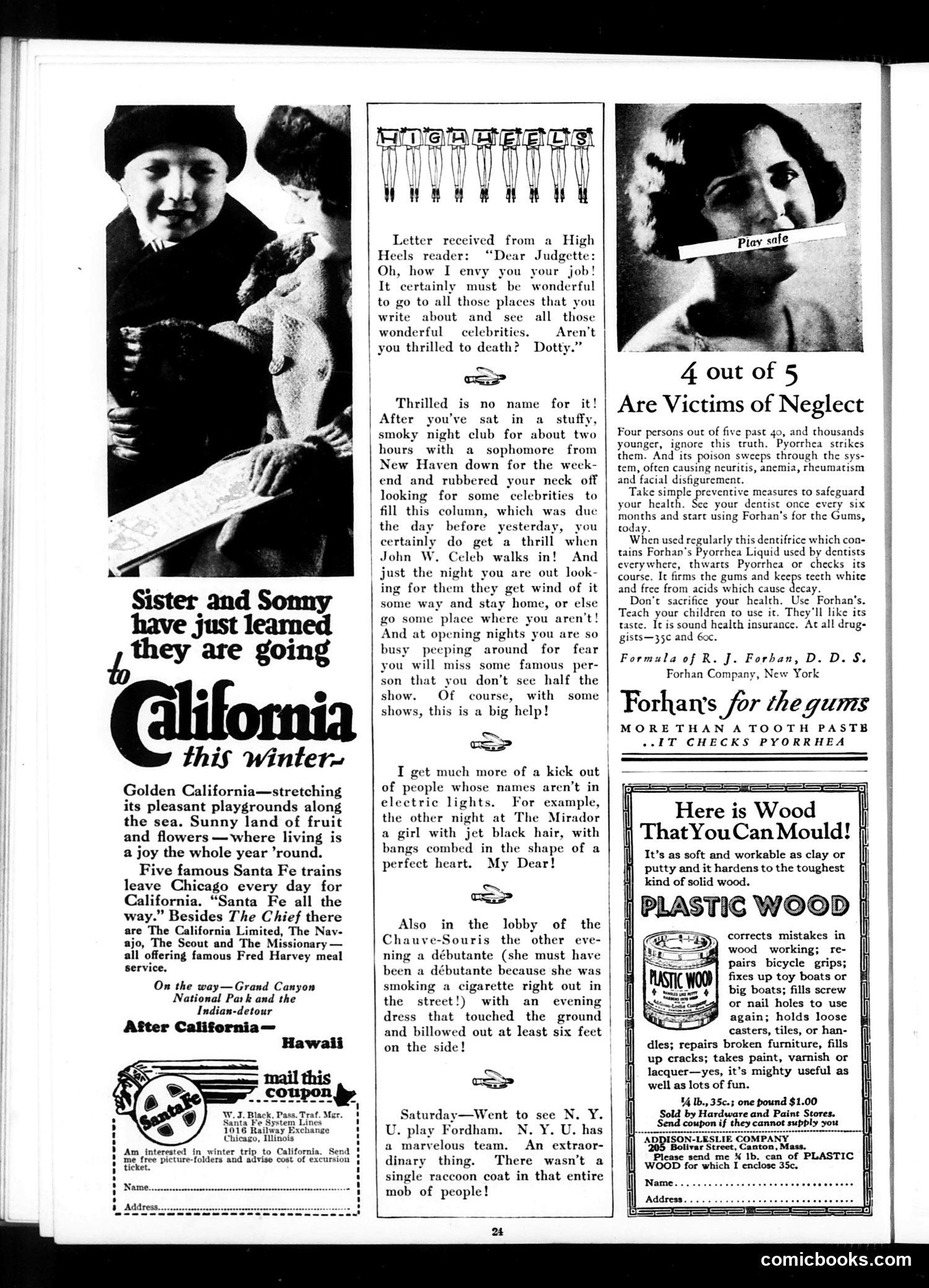
This page mixes lifestyle commentary with period advertising. The main content is a satirical "Judgette" column mocking the glamorous life of a society columnist. The writer claims to envy the job's excitement—attending nightclubs, spotting celebrities—but the column reveals the tedious reality: sitting in smoky venues with bores, straining to identify famous people who deliberately avoid such places, and missing actual performances while searching for subjects. The satire targets both the columnist's aspirational fantasy and 1920s high-society pretension. The letter-writer's excitement about mingling with celebrities is undercut by observations like the absence of fashionable raccoon coats at a football game—suggesting even exclusive events lack expected status markers. The advertisements (Forhan's toothpaste, Plastic Wood, California tourism) represent typical period marketing, unrelated to the editorial content.
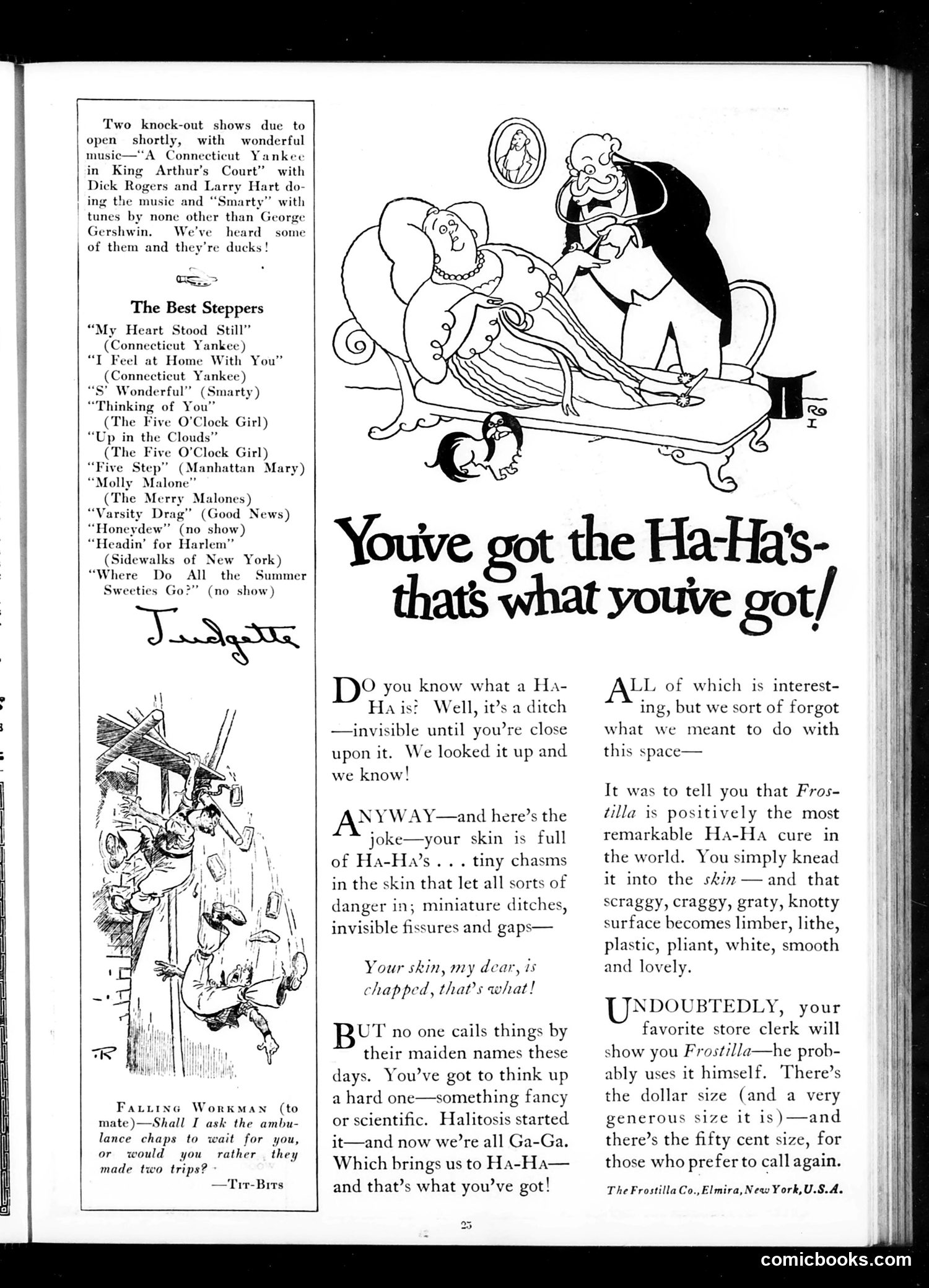
This page combines theatrical listings with a Frostilla skin cream advertisement disguised as humorous editorial content. **The Main Content:** The left column lists hit Broadway songs from upcoming 1926-27 productions ("Connecticut Yankee" and "Smarty"), establishing these as popular entertainment references for Judge's audience. **The Central Joke/Advertisement:** The main illustration and text humorously explain "Ha-Ha"—a landscaping term for a hidden ditch—as a metaphor for skin imperfections (tiny chasms and fissures in chapped skin). The satire mocks how modern marketing invents pseudo-scientific or fancy names for common problems. "Halitosis" is cited as the original culprit (a term coined in ads to describe bad breath). **The Pitch:** Frostilla cream supposedly remedies these "Ha-Ha's," transforming rough skin into smooth, white, and lovely appearance. The advertisement exploits contemporary advertising trends by using clever wordplay and faux-scientific humor to sell a beauty product. **The Bottom Cartoon:** An unrelated joke about ambulance drivers suggests the injured party would require two trips—implying serious injury.
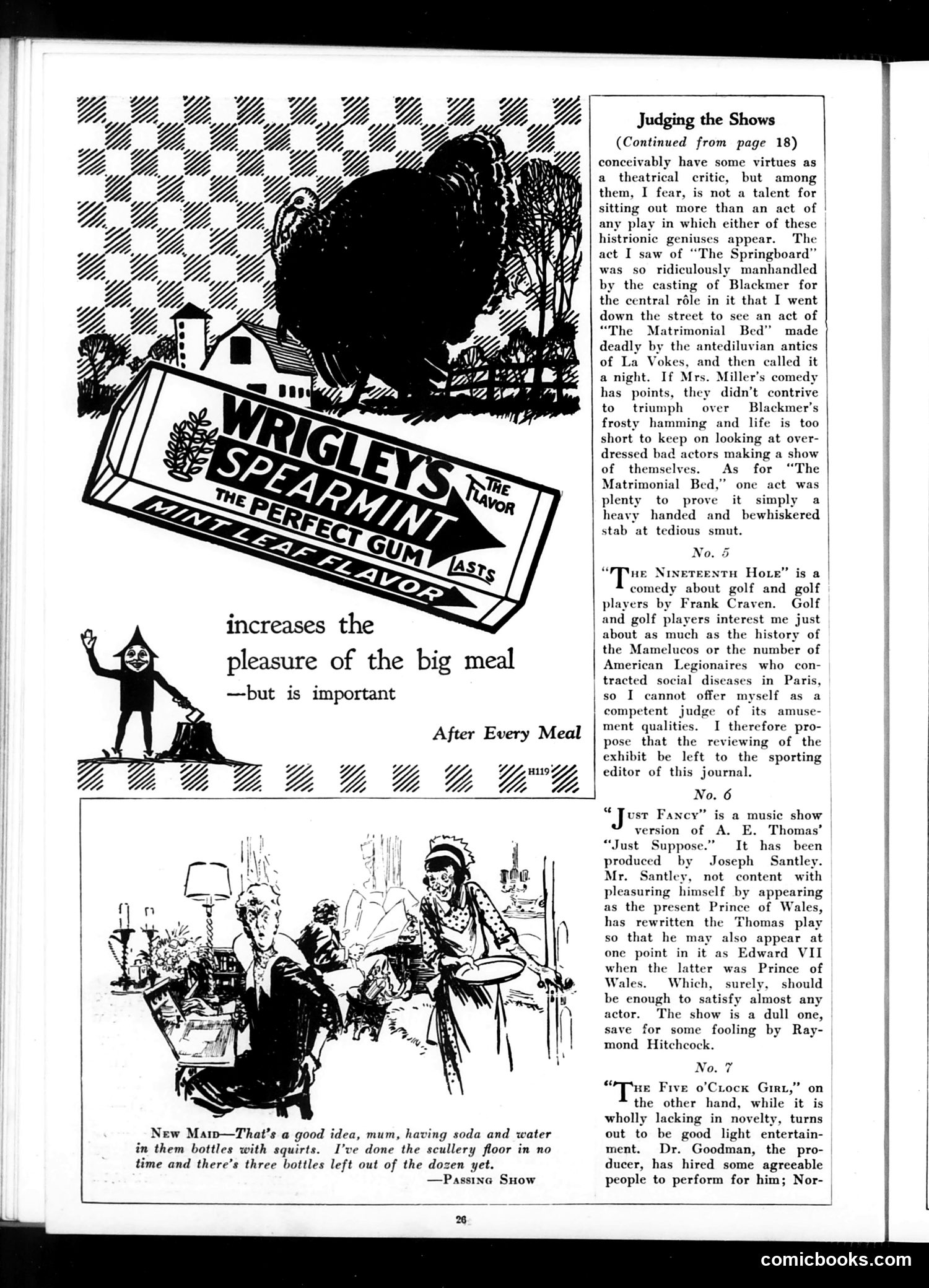
This page combines advertising with theatrical criticism from the 1920s era. **The Wrigley's Spearmint Gum Advertisement** (top-left) is a straightforward commercial claiming the gum "increases the pleasure of the big meal" and should be consumed "After Every Meal." **The "New Maid" cartoon** (bottom-left) satirizes working-class domestic service. A new maid misunderstands instructions about using soda-water bottles for cleaning, apparently using them as spray bottles to clean floors—then boasts she's already used most of a dozen bottles. The joke mocks servants' literal-mindedness and inefficiency. **"Judging the Shows"** (right column) contains theater reviews dismissing several Broadway productions: the critic found *The Springboard* poorly cast with actor Blackmer, *The Matrimonial Bed* tedious, *Just Fancy* dull despite Raymond Hitchcock's performance, but praised *The Five O'Clock Girl* as decent light entertainment. The reviews assume readers' familiarity with contemporary actors and Broadway culture.
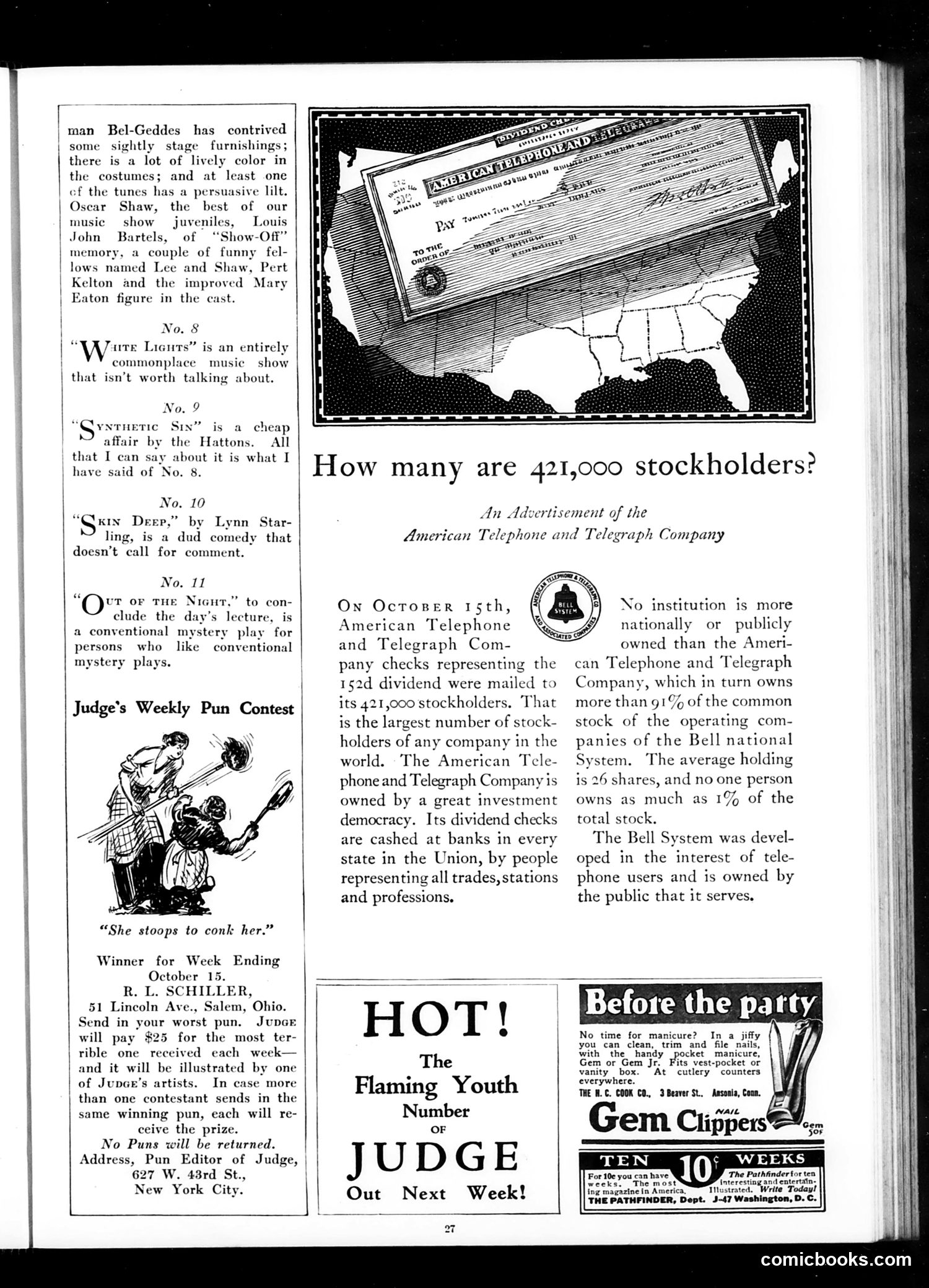
This page mixes theater reviews with corporate advertising. The left column contains brief, dismissive critiques of Broadway productions (shows numbered 8-11), culminating in a "pun contest" where Judge invites readers to submit bad puns for $25 prizes—a recurring feature. The dominant content is a full-page **advertisement for AT&T**, positioned as public-interest messaging. It emphasizes that 421,000 stockholders own the American Telephone and Telegraph Company, framing this as democratic capitalism: ordinary workers across all trades supposedly own shares. The ad claims no single person owns more than 1% of stock, portraying AT&T as "publicly owned" rather than a monopoly. **Historical context**: This is pro-business propaganda. In the 1920s, AT&T faced monopoly scrutiny, so it deployed advertising to reshape its image as a widely-held "people's company" rather than concentrated corporate power. The claims were somewhat misleading—while many held small stakes, institutional and wealthy investors held substantial portions. The page also advertises pocket nail clippers and The Pathfinder magazine, typical period advertisements.
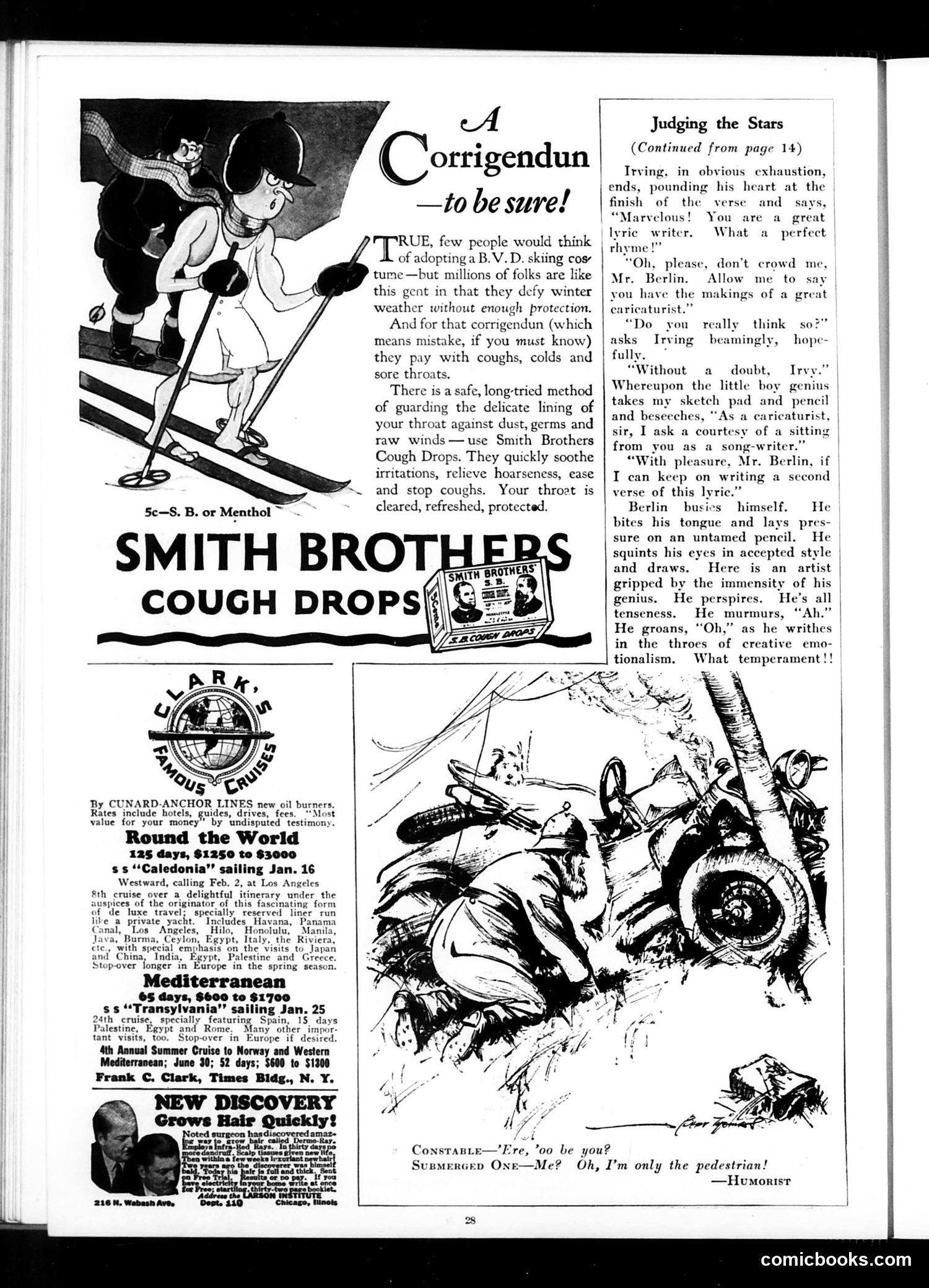
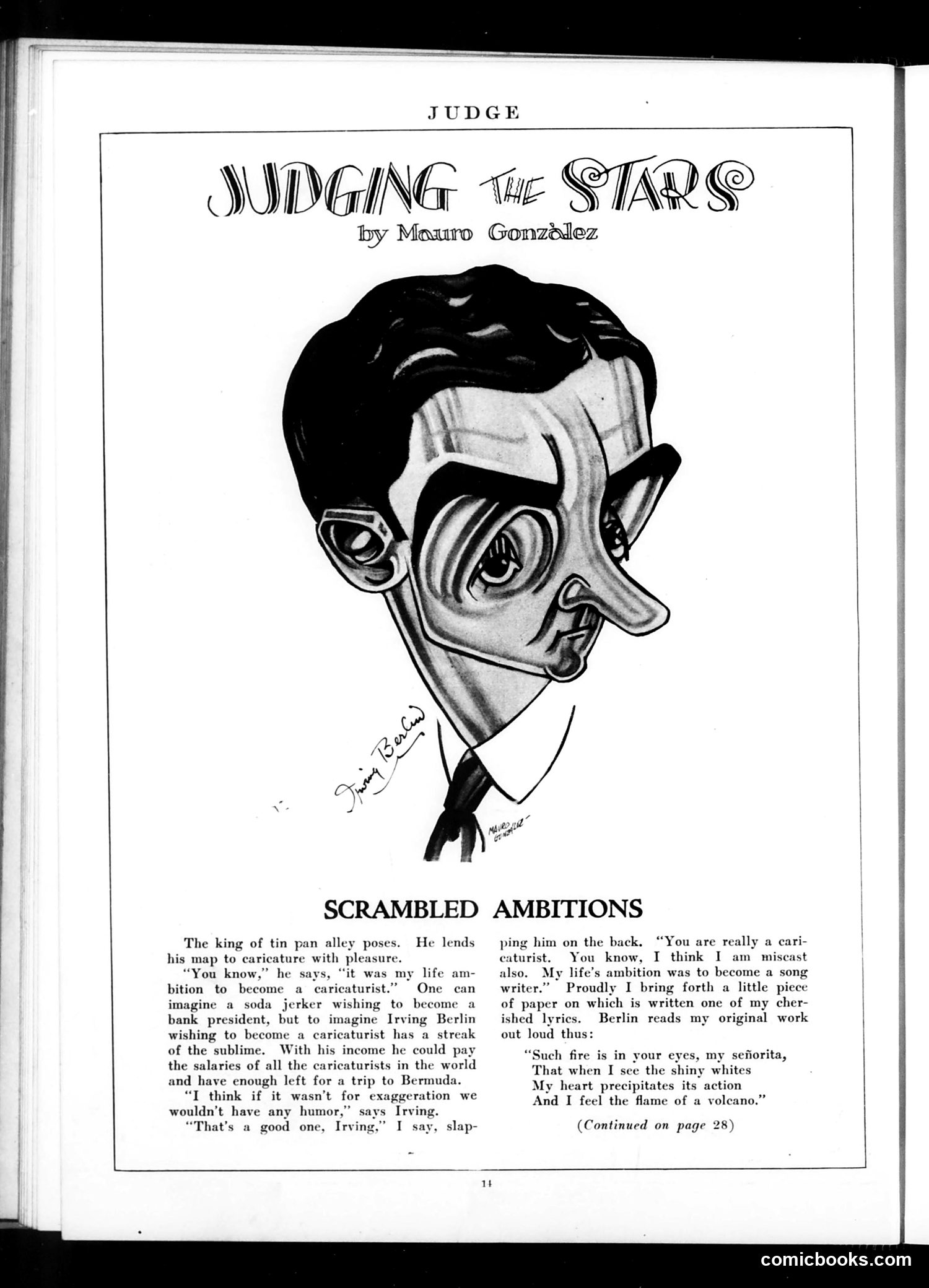
This page features a lighthearted satirical piece about **Irving Berlin**, the famous American songwriter, being critiqued by an unnamed narrator who claims to be a caricaturist and lyricist. The humor centers on mutual flattery and role-confusion: Berlin compliments the narrator as a "great lyric writer," and the narrator responds by praising Berlin's (nonexistent) skills as a "caricaturist." Berlin eagerly agrees to sit for a portrait while attempting to write song lyrics, depicted as intensely emotional creative work—biting his tongue, squinting, perspiring, groaning dramatically. The joke satirizes artistic pretension and the self-important theatricality of creative genius. Berlin's over-the-top "throes of creative emotionalism" mock how artists perform their suffering for effect. The bottom cartoon shows a submerged person claiming to be "only the pedestrian," a simple visual pun unrelated to the Berlin piece above. The page is primarily advertising (cruise lines, cough drops, hair growth product), with this satirical content as filler material.
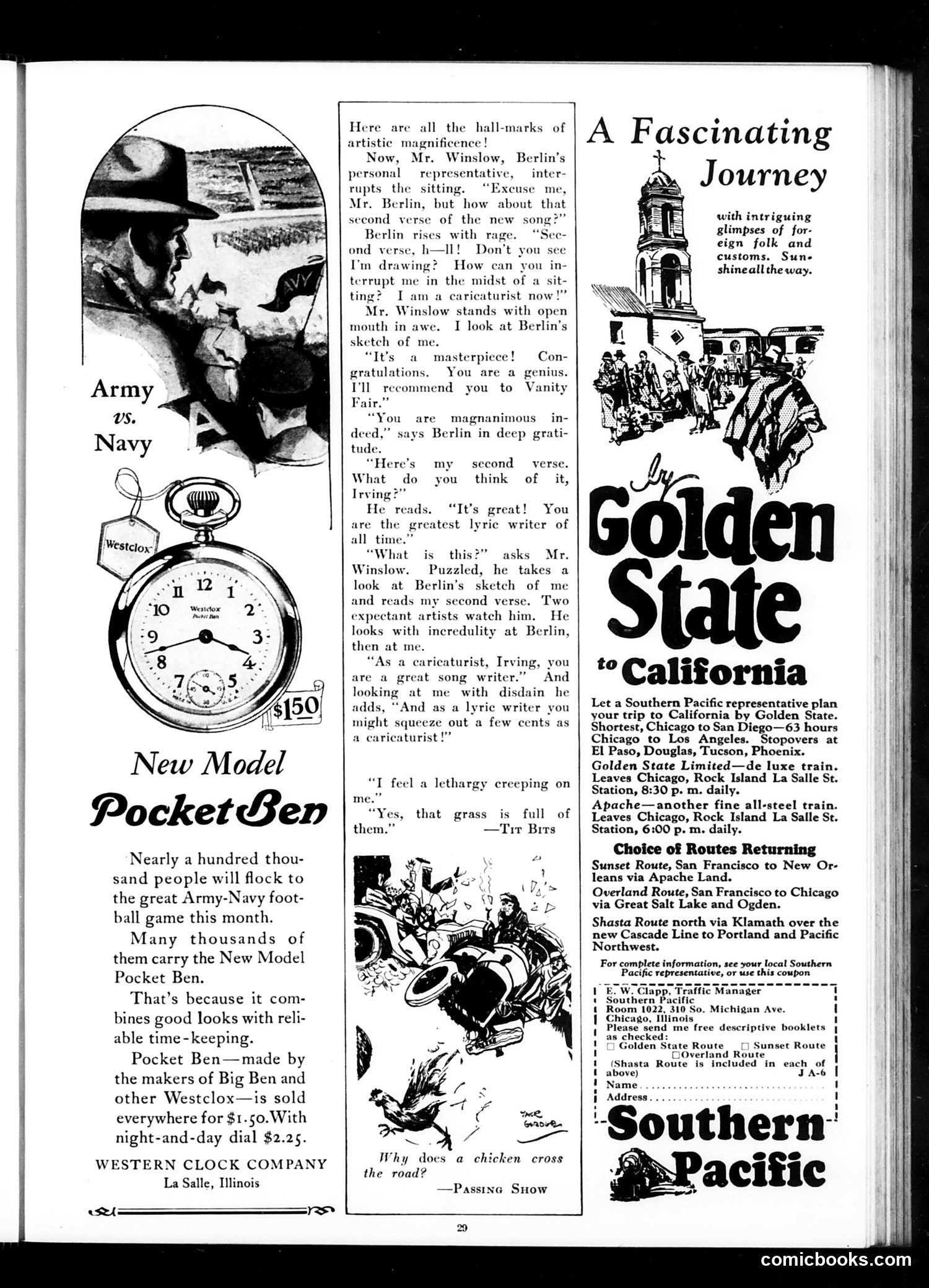
This page contains two distinct advertisements with embedded humor rather than political satire. The left panel shows a **Westclox "Pocket Ben" watch advertisement** using an "Army vs. Navy" framing—a reference to the annual Army-Navy football game, a major American sporting event that would have drawn massive crowds. The ad simply markets the watch as affordable ($1.50) and reliable for attendees. The center panel is a **humorous anecdote about Irving Berlin**, the famous composer-lyricist. Berlin is shown as a caricaturist, interrupting an artistic sitting to compose. When a representative praises his lyric-writing, then dismisses his caricature work, the joke is that Berlin excels at one craft but fails at another—deflating artistic pretension through professional humility. The right side advertises **Southern Pacific Railway's "Golden State" train service to California**, listing routes and schedules. The page is primarily **commercial advertising** with light humor rather than political commentary. The "Army vs. Navy" reference is purely promotional, tying the watch to a popular sporting event.
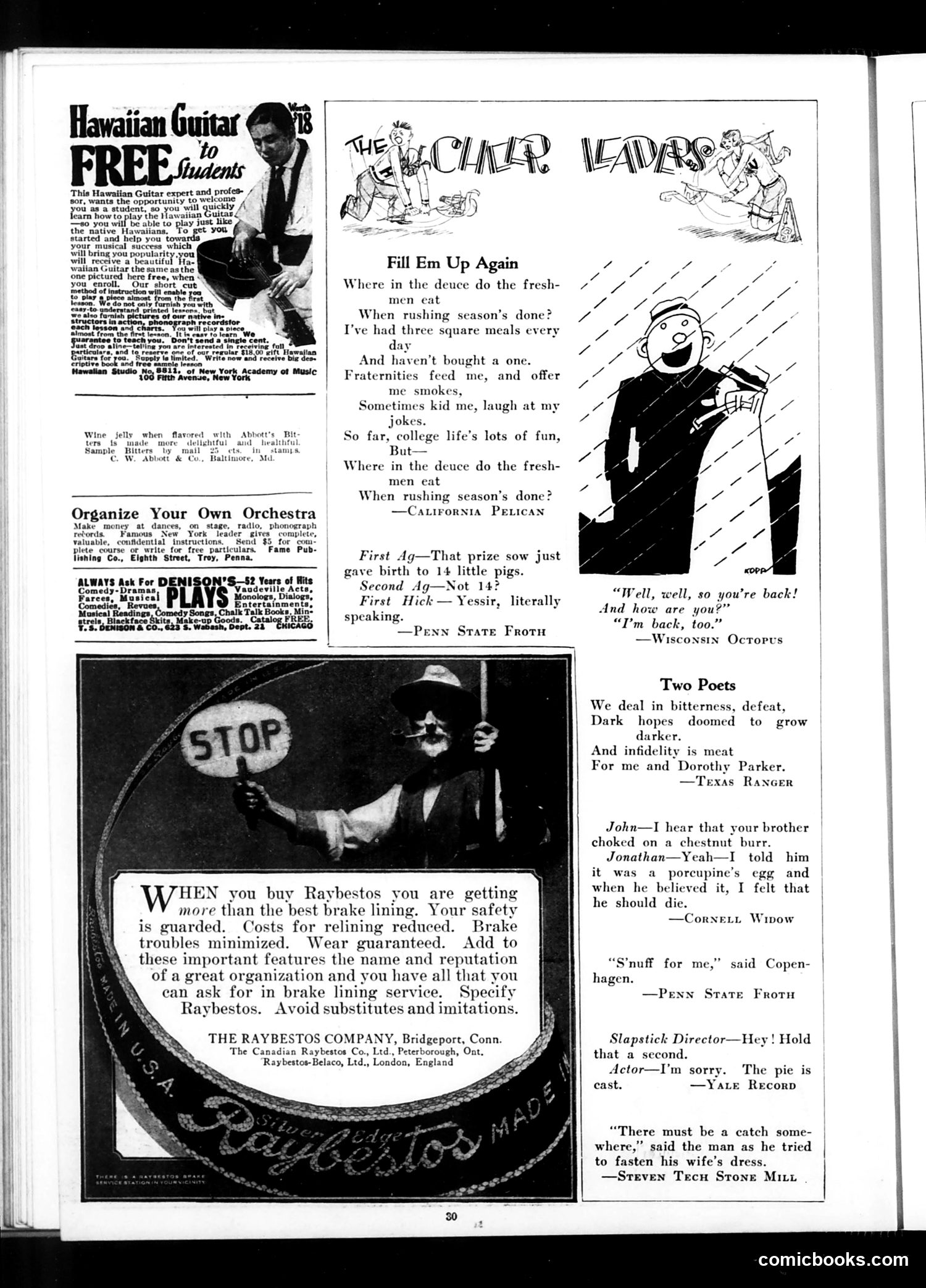
This page from the satirical magazine *Judge* contains mostly humorous college-themed content and advertisements rather than political cartoons. The main literary humor includes: **"Fill Em Up Again"** — A poem lampooning college fraternity life, where a student complains about eating free meals at fraternity recruitment events ("rushing season") while mocking the artificial friendliness and jokes from fraternity members trying to recruit him. **Agricultural humor** — A joke about a Penn State student claiming a prize sow gave birth to "14 little pigs" when it was actually 13, with a freshman taking it literally. **Dorothy Parker reference** — "Two Poets" mentions the famous writer Dorothy Parker, associating her work with themes of bitterness and infidelity—a contemporary cultural reference for 1920s readers. The remaining content consists of advertisements (Hawaiian Guitar lessons, Raybestos brake linings, orchestral instruction) and brief joke submissions from various college publications, reflecting the magazine's mix of satire and commercial content typical of the era.
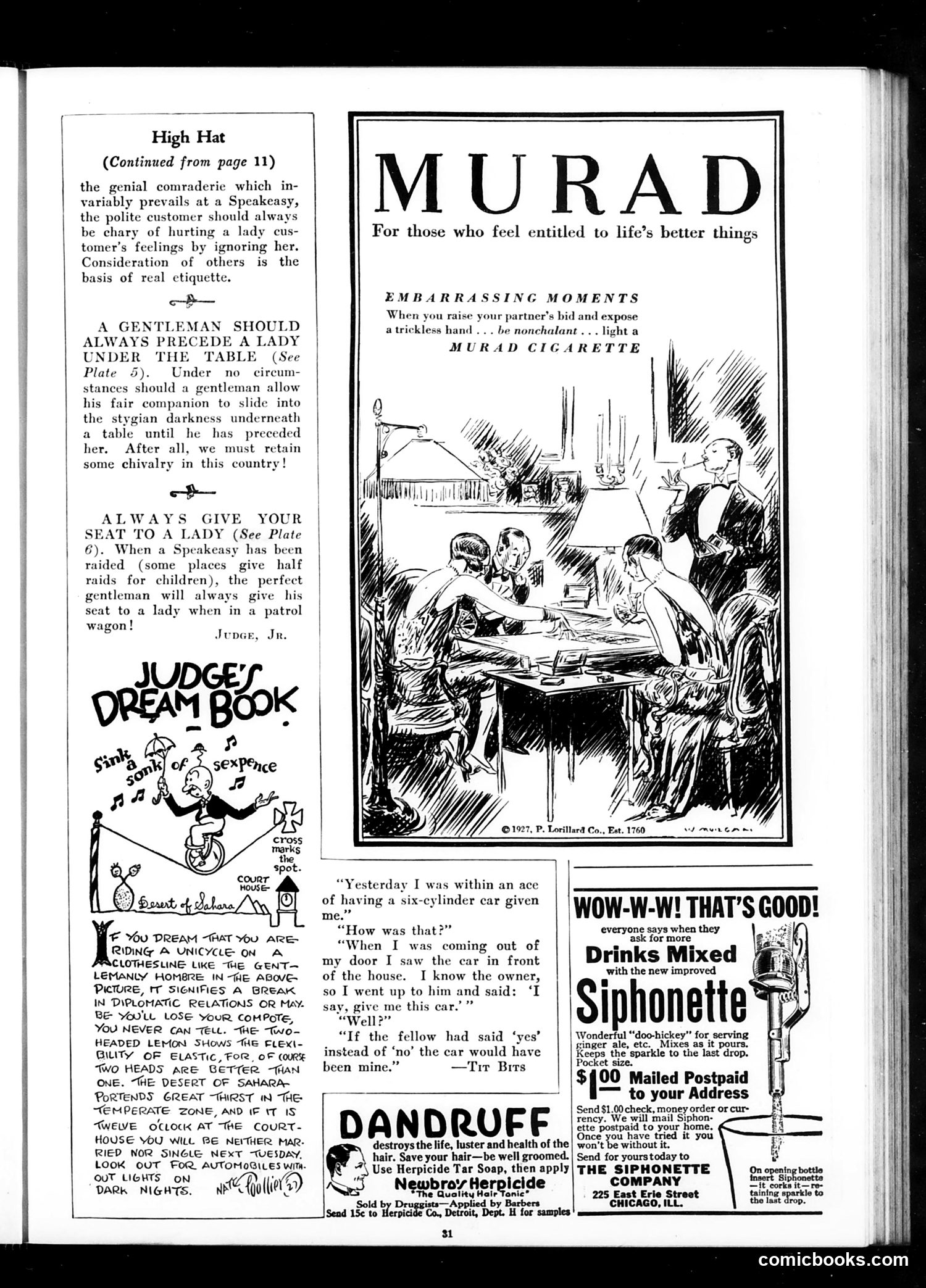
This page satirizes Prohibition-era speakeasy etiquette. The main cartoon depicts men in formal dress playing cards at an underground bar—an illegal establishment operating during the 1920s alcohol ban. The accompanying text humorously proposes absurd "rules" for gentlemen in speakeasies, including preceding ladies "under the table" and offering seats to women "when in a patrol wagon" during police raids. The satire targets both the hypocrisy of operating illegal bars openly and the pretense of maintaining formal etiquette in criminal settings. References to "Speakeasy has been raided" acknowledge the constant danger of law enforcement. The page also contains period advertisements (Murad cigarettes, Siphonette mixer, Herpicide hair treatment) typical of 1920s magazines, along with Judge's "Dream Book" feature interpreting symbolic meanings in dreams—common entertainment content of the era.
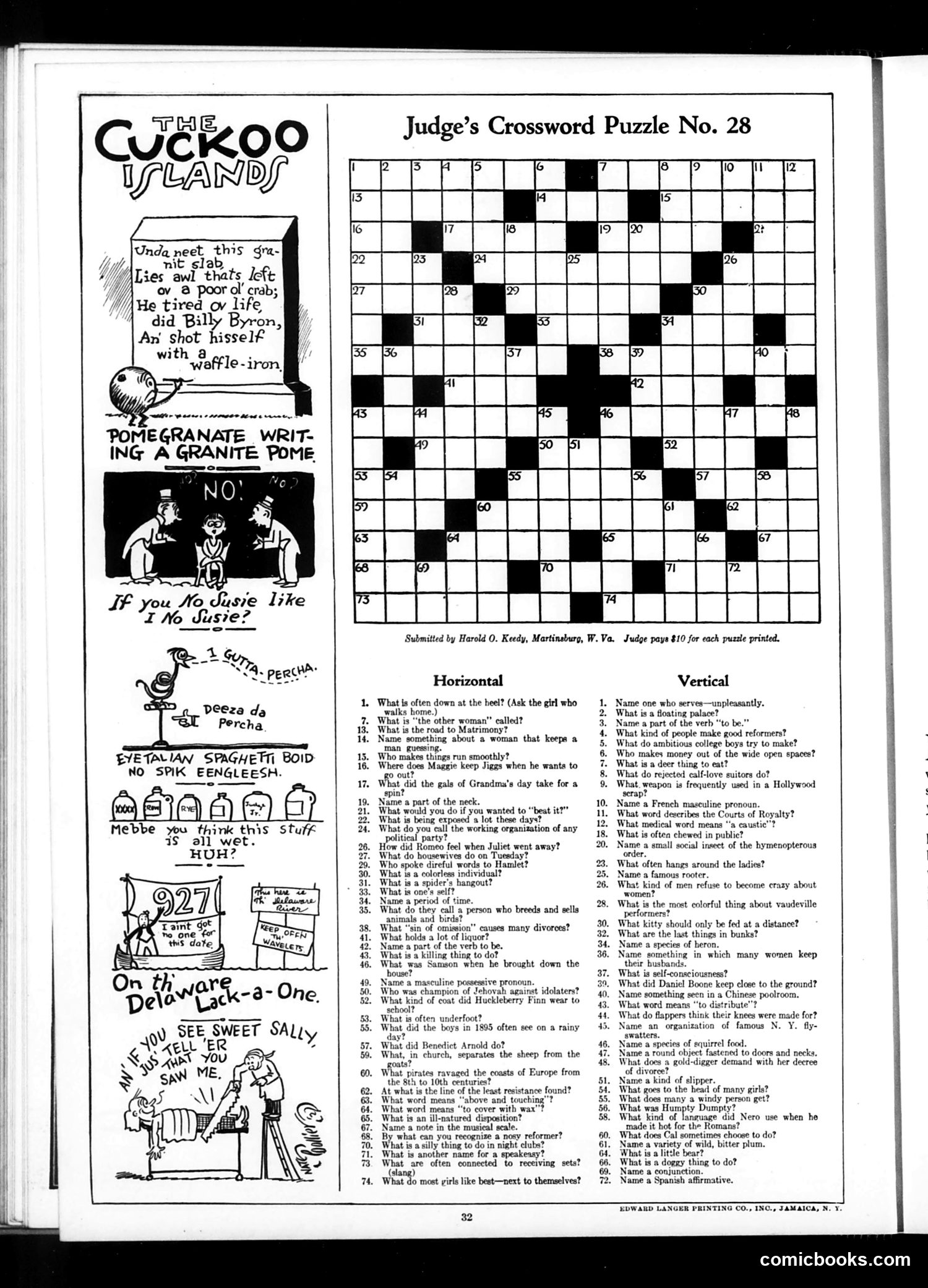
This page is primarily a **crossword puzzle** with accompanying humorous cartoons and advertisements typical of Judge magazine's satirical style. The left side features **ethnic stereotype humor** common to the 1920s-30s era: cartoons mocking Italian immigrants ("Eyetalian Spaghetti Boid No Spik Eengleesh") and Irish characters. One cartoon references "Billy Byron" shooting himself with a waffle-iron—likely a dark joke about a contemporary figure, though the specific reference is unclear today. The "Pomegranate Writing a Granite Poem" section appears to mock pretentious artistic affectation. Other advertisements and jokes reference period concerns: Prohibition-era "speakeasies," flappers, and dating customs. The crossword itself contains era-specific clues referencing contemporary culture: Maggie and Jiggs (popular comic strip), Huckleberry Finn, and various 1920s social attitudes about women, courtship, and morality—presented through the lens of period stereotypes and casual sexism. This is primarily **entertainment content**, not political commentary.
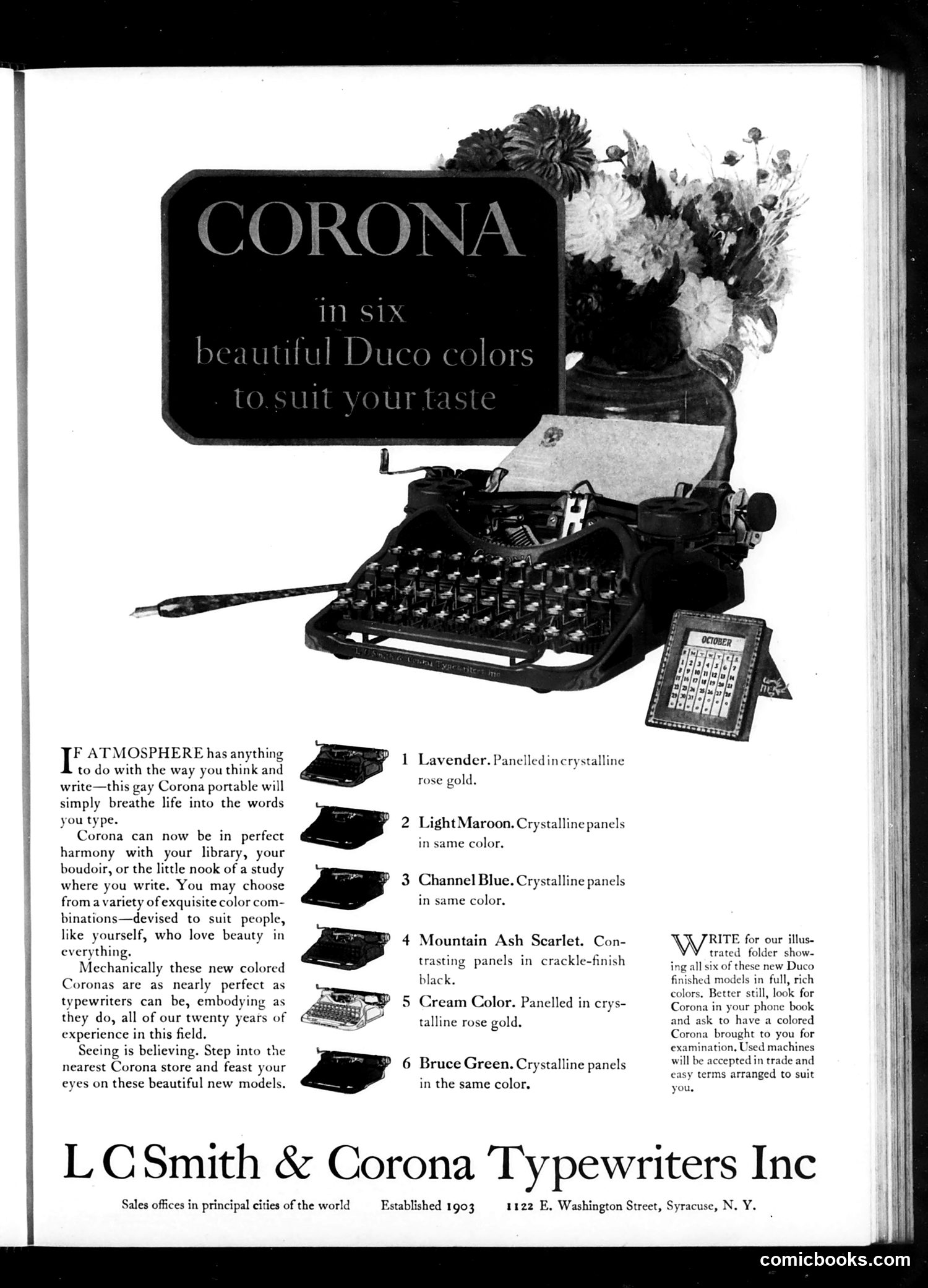
This page is **not a cartoon or satire**—it's a straightforward advertisement for Corona portable typewriters, placed in *Judge* magazine. The ad promotes six new color options for Corona typewriters (Lavender, Light Maroon, Channel Blue, Mountain Ash Scarlet, Cream, and Bruce Green), marketed to aesthetically-minded consumers who value beauty alongside functionality. The copy emphasizes that Corona machines are mechanically superior ("twenty years of experience") while now offering fashionable color choices to match home décor—library, boudoir, or study. The typewriter shown is displayed with flowers and a calendar pad, reinforcing the lifestyle appeal. The advertisement reflects 1920s-era consumer culture's emphasis on personalizing industrial products and matching them to interior design preferences. No political commentary or satire is present—this is commercial advertising that happens to appear in a magazine known for humor and social commentary.
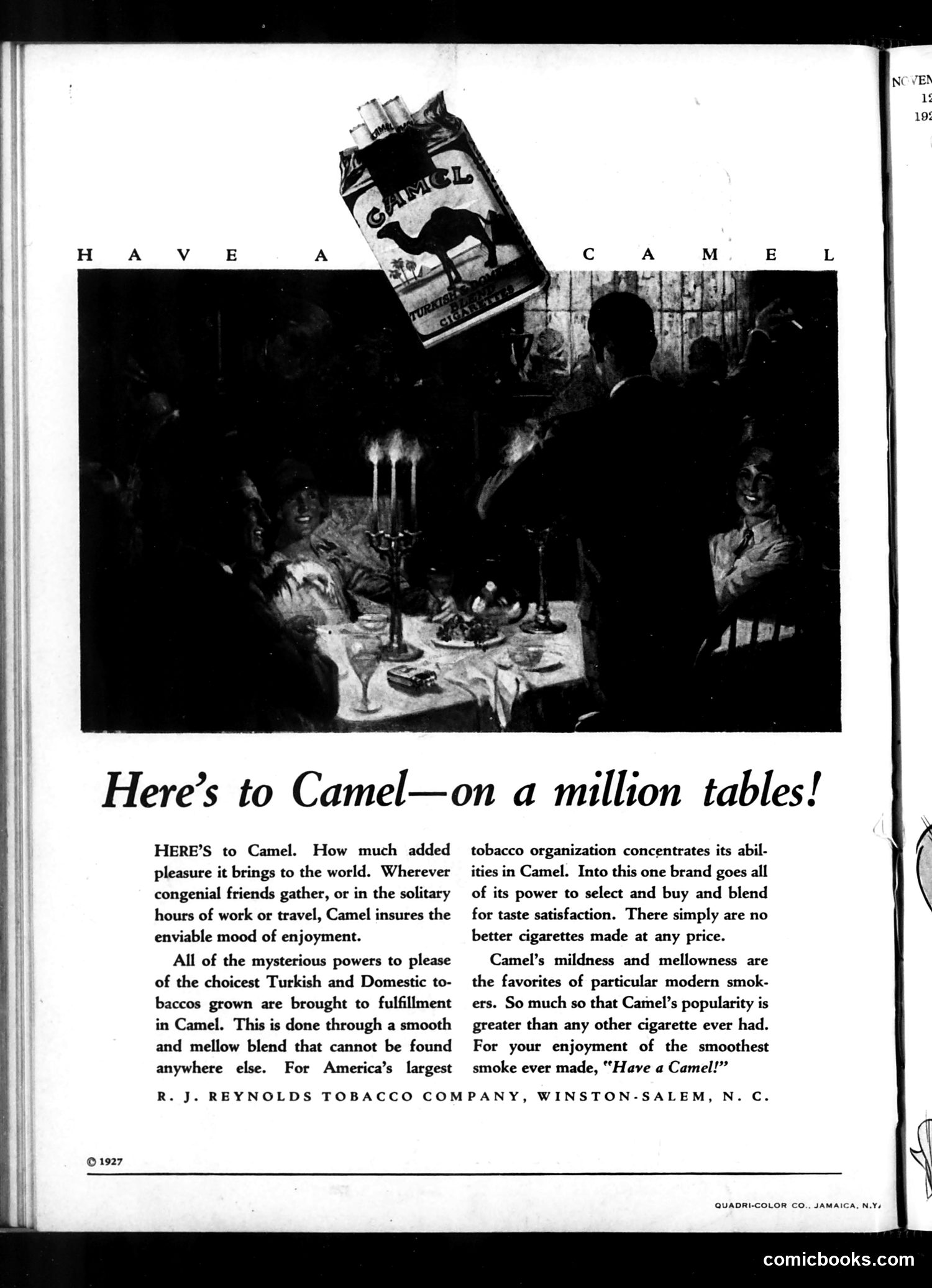
This is a **full-page cigarette advertisement**, not satirical content. It's a Camel cigarettes ad from 1927 by R.J. Reynolds Tobacco Company. The image shows an elegant dinner party scene with well-dressed guests gathered around a table with candelabras. A large Camel cigarette package hovers above, suggesting the product's ubiquitous presence at social gatherings. The ad's message conflates smoking with sophistication and social pleasure: Camel cigarettes supposedly enhance "congenial" moments among friends and provide "the enviable mood of enjoyment." It emphasizes the brand's Turkish-Domestic tobacco blend as superior and claims unmatched popularity. **For modern readers**: This represents pre-regulation cigarette marketing that openly celebrated smoking as integral to refined social life, without health warnings. The aspirational imagery and claims would be illegal in contemporary advertising.